

Therapeutic Tools for Vulvovaginal Candidiasis: Current and Emerging Antifungal Agents

 ,
,  , , , ,
Abstract
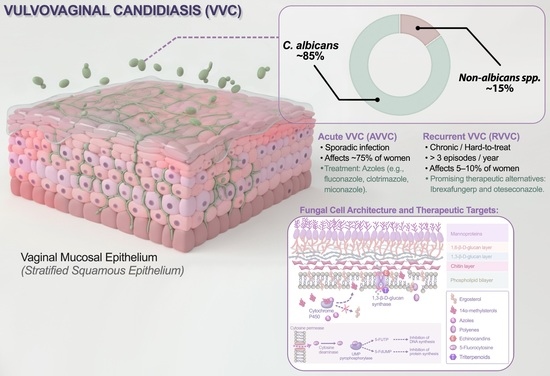
1. Introduction
2. Aetiology of Vulvovaginal Candidiasis
3. Diagnosis of Vulvovaginal Candidiasis
4. Therapeutic Strategies and Clinical Management of Vulvovaginal Candidiasis
4.1. Classical Antifungal Agents: Polyenes and Azoles
4.2. Management of Complicated and Recurrent VVC (RVVC)
4.3. New Antifungal Agents as Alternatives to Those in Common Use
4.4. Non-Antifungal Alternative Therapeutic Strategies

| Antifungal Agents | Vulvovaginal Candidiasis | OTC | Pregnancy ** | SR and QE | ||||
|---|---|---|---|---|---|---|---|---|
| Acute | Recurrent | |||||||
| Uncomplicated | Complicated | Induction Therapy | Maintenance Therapy | |||||
| Underlying Risk Factors | Fluconazole-Resistant Candida * | |||||||
| Presentation (Dose) | ||||||||
| Topical imidazole | Vaginal, for 14 days | Yes | Yes | 1–2 | ||||
| Clotrimazole | Vaginal tablet, 500 mg in a single dose Vaginal tablet 200 mg/day or cream 2%, 5 g/day for 3 consecutive nights | Vaginal cream 1%, 5 g/day for 7–14 consecutive nights | Vaginal tablet, 100 mg/day for 14 days | Vaginal tablet, 500 mg weekly for 6 months | Yes | Yes | 1–2 | |
| Miconazole | Vaginal ovule, 1200 mg in a single dose Vaginal ovule, 200 mg/day for 3 consecutive nights | Vaginal cream 2%, 5 g/day for 7 consecutive nights | Yes | Yes | 1–2 | |||
| Fluconazole | Oral capsule, 150–200 mg in a single dose | Oral capsule, 150 mg, every 72 h, 2–3 doses | Oral, 150 mg/day every 72 h (days 1, 4, and 7) | Oral, 150 mg or 200 mg weekly for 6 months | No | No | 1 | |
| Tioconazole | Vaginal ointment 6.5%, 5 g in a single dose | Yes | Yes | 1 | ||||
| Itraconazole | Oral capsules, 200 mg, twice in a single day Oral capsules, 200 mg/day, for 3 consecutive days | Oral tablet, 200 mg twice a week for 6 months | No | No | 2–3 | |||
| Butoconazole | Vaginal cream 2%, 5 g in a single dose | Vaginal cream 2%, once weekly for 2–3 weeks | No | Yes | 2 | |||
| Ibrexafungerp | Oral capsule, 300 mg, twice in a single day | Oral capsule, 300 mg, twice in a day each 4 weeks for 6 months | No | No | 1–2 | |||
| Terconazole | Vaginal cream 0.8%, 5 g/day for 3 consecutive nights Vaginal ovule, 80 mg/day for 3 consecutive nights | Vaginal cream 0.4%, 5 g/day for 7 consecutive nights | Vaginal cream 0.4%, 5 g/day for 14 consecutive nights | No | Yes | 1 | ||
| Oteseconazole *** | Oral, 600 mg on day 1, 450 mg on day 2 | Oral, 150 mg weekly for 10 weeks, starting on day 14 | No | No | 1–2 | |||
| Econazole | Vaginal pessary, 150 mg, twice in a single day Vaginal pessary, 150 mg/day for 3 consecutive nights | No | Yes (2nd/3rd trim) * Avoid in 1st trimester | 1 | ||||
| Fenticonazole | Vaginal capsule, 600 mg in a single dose Vaginal capsule, 200 mg/day for 3 consecutive nights | No | Yes | 1 | ||||
| Isoconazole | Vaginal pessary, 600 mg in a single dose Vaginal pessary, 150 mg/day for 3 consecutive nights | No | Yes | 1 | ||||
| Sertaconazole | Vaginal ovule, 300 mg in a single dose or vaginal cream 2%, 5 g/day for 7 consecutive nights | Vaginal cream 2%, 5 g/day for 7 consecutive nights | Vaginal cream 2%, 5 g/day for 14 days | Vaginal ovule, 300 mg weekly for 6 months | No | No | 1 | |
| Nystatin | Vaginal tablet, 200,000 IU/day for 7 consecutive nights Vaginal tablet, 100,000 IU/day for 14 consecutive nights | Vaginal tablet, 100,000 IU two or three times a week for six months | Yes | Yes | 1 | |||
| Amphotericin B | Vaginal suppositories, 50–100 mg/day for 14–21 consecutive nights Vaginal cream 3%, 5 g/day for 14 consecutive nights | Yes | Yes | 3 | ||||
| Amphotericin B + 5-fluorcytosine | Vaginal cream, daily for 14–21 consecutive nights | No | No | 3 | ||||
| Boric acid | Vaginal capsule, 600 mg/day, for 14–21 consecutive nights | Vaginal capsule, 600 mg/day for 14 days | Yes | No | 2 | |||
5. Future Directions and Therapeutic Priorities
Author Contributions
Funding
Data Availability Statement
Conflicts of Interest
Abbreviations
| AUC | Area Under the Curve |
| AVVC | Acute Vulvovaginal candidiasis |
| CLSI | Clinical and Laboratory Standards Institute |
| Cmax | Maximum Concentration |
| EUCAST | European Committee on Antimicrobial Susceptibility Testing |
| FDA | US Drugs and Foods Administration |
| MALDI-TOF | Matrix-Assisted Laser Desorption/Ionisation-Time-Of-Flight |
| MIC | Minimum Inhibitory Concentration |
| OTC | Over-The-Counter treatment |
| PCR | Polymerase Chain Reaction |
| PK-PD | Pharmacokinetics and Pharmacodynamics |
| PoC | Point of Care |
| QE | Quality of Evidence |
| RVVC | Recurrent Vulvovaginal Candidiasis |
| SR | Strength of Recommendation |
| VVC | Vulvovaginal Candidiasis |
References
- Farr, A.; Effendy, I.; Frey Tirri, B.; Hof, H.; Mayser, P.; Petricevic, L.; Ruhnke, M.; Schaller, M.; Schaefer, A.P.A.; Sustr, V.; et al. Guideline: Vulvovaginal candidosis (AWMF 015/072, level S2k). Mycoses 2021, 64, 583–602. [Google Scholar] [CrossRef]
- Farr, A.; Effendy, I.; Tirri, B.F.; Hof, H.; Mayser, P.; Petricevic, L.; Ruhnke, M.; Schaller, M.; Schafer, A.P.A.; Willinger, B.; et al. Vulvovaginal Candidosis (Excluding Mucocutaneous Candidosis): Guideline of the German (DGGG), Austrian (OEGGG) and Swiss (SGGG) Society of Gynecology and Obstetrics (S2k-Level, AWMF Registry Number 015/072, September 2020). Geburtshilfe Frauenheilkd 2021, 81, 398–421. [Google Scholar] [CrossRef] [PubMed]
- Miro, M.S.; Rodriguez, E.; Vigezzi, C.; Icely, P.A.; Gonzaga de Freitas Araujo, M.; Riera, F.O.; Vargas, L.; Abiega, C.; Caeiro, J.P.; Sotomayor, C.E. Vulvovaginal candidiasis: An old disease with new challenges. Rev. Iberoam. Micol. 2017, 34, 65–71. [Google Scholar] [CrossRef] [PubMed]
- Mitchell, C.M. Assessment and Treatment of Vaginitis. Obstet. Gynecol. 2024, 144, 765–781. [Google Scholar] [CrossRef]
- Bowen, C.; Marcos-Arias, C.; Checa, C.; Castellanos, M.E.; Miranda-Cadena, K.; Eraso, E.; Quindos, G. Aetiology of vulvovaginal candidiasis in Ecuador and in vitro antifungal activity against Candida vaginal isolates. J. Fungi 2025, 11, 742. [Google Scholar] [CrossRef]
- Goncalves, B.; Ferreira, C.; Alves, C.T.; Henriques, M.; Azeredo, J.; Silva, S. Vulvovaginal candidiasis: Epidemiology, microbiology and risk factors. Crit. Rev. Microbiol. 2016, 42, 905–927. [Google Scholar] [CrossRef]
- Aballea, S.; Guelfucci, F.; Wagner, J.; Khemiri, A.; Dietz, J.; Sobel, J.; Toumi, M. Subjective health status and health-related quality of life among women with Recurrent Vulvovaginal Candidosis (RVVC) in Europe and the USA. Health Qual. Life Outcomes 2013, 11, 169. [Google Scholar] [CrossRef]
- Alonso-Vargas, R.; Elorduy, L.; Eraso, E.; Cano, F.J.; Guarro, J.; Ponton, J.; Quindos, G. Isolation of Candida africana, probable atypical strains of Candida albicans, from a patient with vaginitis. Med. Mycol. 2008, 46, 167–170. [Google Scholar] [CrossRef]
- Lipperheide, V.; Bikandi, J.; Garcia-Fernandez, J.F.; Quindos, G.; Ponton, J. Colony variation in Candida glabrata isolates from patients with vaginitis. Rev. Iberoam. Micol. 2002, 19, 161–164. [Google Scholar]
- Saxon, C.; Edwards, A.; Rautemaa-Richardson, R.; Owen, C.; Nathan, B.; Palmer, B.; Wood, C.; Ahmed, H.; Ahmad, S.; FitzGerald, M. British Association for Sexual Health and HIV national guideline for the management of vulvovaginal candidiasis (2019). Int. J. STD AIDS 2020, 31, 1124–1144. [Google Scholar] [CrossRef] [PubMed]
- Sobel, J.D. Treatment of vaginitis caused by non-albicans Candida species. Expert Rev. Anti Infect. Ther. 2024, 22, 289–296. [Google Scholar] [CrossRef]
- Vempati, Y.S.; Sobel, J.D. Vulvovaginal Candidiasis Caused by Candida krusei (Pichia kudriavzevii), Still a Formidable Challenge. J. Low. Genit. Tract Dis. 2025, 29, 373–375. [Google Scholar] [CrossRef]
- Benyas, D.; Sobel, J.D. Mixed Vaginitis Due to Bacterial Vaginosis and Candidiasis. J. Low. Genit. Tract Dis. 2022, 26, 68–70. [Google Scholar] [CrossRef] [PubMed]
- Sobel, J.D.; Vempati, Y.S. Bacterial Vaginosis and Vulvovaginal Candidiasis Pathophysiologic Interrelationship. Microorganisms 2024, 12, 108. [Google Scholar] [CrossRef]
- Brown, L.; Chamula, M.; Weinberg, S.; Jbueen, F.; Rautemaa-Richardson, R. Compliance with the Updated BASHH Recurrent Vulvovaginal Candidiasis Guidelines Improves Patient Outcomes. J. Fungi 2022, 8, 924. [Google Scholar] [CrossRef] [PubMed]
- Denning, D.W.; Kneale, M.; Sobel, J.D.; Rautemaa-Richardson, R. Global burden of recurrent vulvovaginal candidiasis: A systematic review. Lancet Infect. Dis. 2018, 18, e339–e347. [Google Scholar] [CrossRef]
- Cooke, G.; Watson, C.; Deckx, L.; Pirotta, M.; Smith, J.; van Driel, M.L. Treatment for recurrent vulvovaginal candidiasis (thrush). Cochrane Database Syst. Rev. 2022, 1, CD009151. [Google Scholar] [CrossRef] [PubMed]
- Collins, L.M.; Moore, R.; Sobel, J.D. Prognosis and Long-Term Outcome of Women with Idiopathic Recurrent Vulvovaginal Candidiasis Caused by Candida albicans. J. Low. Genit. Tract Dis. 2020, 24, 48–52. [Google Scholar] [CrossRef]
- Donders, G.; Sziller, I.O.; Paavonen, J.; Hay, P.; de Seta, F.; Bohbot, J.M.; Kotarski, J.; Vives, J.A.; Szabo, B.; Cepuliene, R.; et al. Management of recurrent vulvovaginal candidosis: Narrative review of the literature and European expert panel opinion. Front. Cell. Infect. Microbiol. 2022, 12, 934353. [Google Scholar] [CrossRef]
- Lietz, A.; Eckel, F.; Kiss, H.; Noe-Letschnig, M.; Farr, A. Quality of life in women with chronic recurrent vulvovaginal candidosis: A sub-analysis of the prospective multicentre phase IIb/III Prof-001 study. Mycoses 2023, 66, 767–773. [Google Scholar] [CrossRef]
- Cornely, O.A.; Sprute, R.; Bassetti, M.; Chen, S.C.; Groll, A.H.; Kurzai, O.; Lass-Florl, C.; Ostrosky-Zeichner, L.; Rautemaa-Richardson, R.; Revathi, G.; et al. Global guideline for the diagnosis and management of candidiasis: An initiative of the ECMM in cooperation with ISHAM and ASM. Lancet Infect. Dis. 2025, 25, e280–e293. [Google Scholar] [CrossRef]
- Sobel, J.D.; Akins, R. Determining Susceptibility in Candida Vaginal Isolates. Antimicrob. Agents Chemother. 2022, 66, e02366-21. [Google Scholar] [CrossRef]
- Sobel, J.D.; Sebastian, S.; Boikov, D.A. A longitudinal study on fluconazole resistance in Candida albicans vaginal isolates. Mycoses 2023, 66, 563–565. [Google Scholar] [CrossRef]
- Yan, L.; Wang, X.-D.; Seyedmousavi, S.; Yuan, J.; Abulize, P.; Pan, W.; Yu, N.; Yang, Y.; Hu, H.; Liao, W.; et al. Antifungal Susceptibility Profile of Candida albicans Isolated from Vulvovaginal Candidiasis in Xinjiang Province of China. Mycopathologia 2019, 184, 413–422. [Google Scholar] [CrossRef]
- Arroyo-Fajardo, A.; Juan-Delgado, M.F.S.; García-Rodríguez, J. Candida glabrata vaginitis: The great ignored? Rev. Iberoam. Micol. 2017, 34, 246. [Google Scholar] [CrossRef]
- Francisco, E.C.; Caceres, D.H.; Brunelli, J.G.P.; Garcia-Effron, G.; Arastehfar, A.; Ribeiro, F.d.C.; de Almeida, M.N.; Goncalves, S.S.; Nobrega de Almeida, J.J.; Lass-Florl, C.; et al. An update on clinically relevant, rare, and emerging Candida and Saccharomycotina yeasts that have been recently reclassified from Candida. Clin. Microbiol. Rev. 2025, 38, e0006423-23. [Google Scholar] [CrossRef] [PubMed]
- Aldejohann, A.M.; Menner, C.; Thielemann, N.; Martin, R.; Walther, G.; Kurzai, O. In vitro activity of ibrexafungerp against clinically relevant echinocandin-resistant Candida strains. Antimicrob. Agents Chemother. 2024, 68, e01324-23. [Google Scholar] [CrossRef] [PubMed]
- Arilla, M.; Carbonero, J.; Schneider, J.; Regulez, P.; Quindos, G.; Ponton, J.; Cisterna, R. Vulvovaginal candidiasis refractory to treatment with fluconazole. Eur. J. Obstet. Gynecol. Reprod. Biol. 1992, 44, 77–80. [Google Scholar] [CrossRef]
- Aznar-Marin, P.; Galan-Sanchez, F.; Marin-Casanova, P.; García-Martos, P.; Rodríguez-Iglesias, M. Candida nivariensis as a New Emergent Agent of Vulvovaginal Candidiasis: Description of Cases and Review of Published Studies. Mycopathologia 2016, 181, 445–449. [Google Scholar] [CrossRef] [PubMed]
- Espinel-Ingroff, A.; Wiederhold, N.P. A Mini-Review of In Vitro Data for Candida Species, Including C. auris, Isolated during Clinical Trials of Three New Antifungals: Fosmanogepix, Ibrexafungerp, and Rezafungin. J. Fungi 2024, 10, 362. [Google Scholar] [CrossRef]
- Kan, S.; Song, N.; Pang, Q.; Mei, H.; Zheng, H.; Li, D.; Cui, F.; Lv, G.; An, R.; Li, P.; et al. In Vitro Antifungal Activity of Azoles and Other Antifungal Agents Against Pathogenic Yeasts from Vulvovaginal Candidiasis in China. Mycopathologia 2023, 188, 99–109. [Google Scholar] [CrossRef]
- Echeverría-Irigoyen, M.J.; Eraso, E.; Cano, J.; Gomáriz, M.; Guarro, J.; Quindós, G. Saccharomyces cerevisiae vaginitis: Microbiology and in vitro antifungal susceptibility. Mycopathologia 2011, 172, 201–205. [Google Scholar] [CrossRef]
- Nahuelcura, F.; Duarte, E.A. Species Distribution, Characterization, and Antifungal Susceptibility Patterns of Candida Isolates Causing Oral and Vulvovaginal Candidiasis in Chile. Antibiotics 2025, 14, 712. [Google Scholar] [CrossRef]
- Sobel, J.D.; Borroto-Esoda, K.; Azie, N.; Angulo, D. In Vitro pH Activity of Ibrexafungerp against Fluconazole-Susceptible and -Resistant Candida Isolates from Women with Vulvovaginal Candidiasis. Antimicrob. Agents Chemother. 2021, 65, e00562-21. [Google Scholar] [CrossRef] [PubMed]
- Quindós, G.; Miranda-Cadena, K.; San-Millán, R.; Borroto-Esoda, K.; Canton, E.; Linares-Sicilia, M.J.; Hamprecht, A.; Montesinos, I.; Tortorano, A.M.; Prigitano, A.; et al. In Vitro Antifungal Activity of Ibrexafungerp (SCY-078) Against Contemporary Blood Isolates From Medically Relevant Species of Candida: A European Study. Front. Cell. Infect. Microbiol. 2022, 12, 906563. [Google Scholar] [CrossRef] [PubMed]
- Quindós, G.; Ruesga, M.T.; Martín-Mazuelos, E.; Salesa, R.; Alonso-Vargas, R.; Carrillo-Munoz, A.J.; Brena, S.; San Millan, R.; Ponton, J. In-vitro activity of 5-fluorocytosine against 1021 Spanish clinical isolates of Candida and other medically important yeasts. Rev. Iberoam. Micol. 2004, 21, 63–69. [Google Scholar]
- Yan, Z.; Fu, Y.; Tan, X.; Xu, L.; Ling, J.; Liu, X.; Miao, C.; Liu, L.; Cui, Y.; Li, H.; et al. Isolate distribution and antifungal susceptibility of Saccharomyces cerevisiae in the national regional medical center of Southwest China for women and children during 2018–2023. BMC Microbiol. 2024, 24, 345. [Google Scholar] [CrossRef]
- Jafarzadeh, L.; Ranjbar, M.; Nazari, T.; Naeimi Eshkaleti, M.; Aghaei Gharehbolagh, S.; Sobel, J.D.; Mahmoudi, S. Vulvovaginal candidiasis: An overview of mycological, clinical, and immunological aspects. J. Obstet. Gynaecol. Res. 2022, 48, 1546–1560. [Google Scholar] [CrossRef]
- Quindós, G.; Marcos-Arias, C.; Miranda-Cadena, K.; Sevillano, E.; Jauregizar, N.; Schneider, J.; Eraso, E. The future of non-invasive azole antifungal treatment options for the management of vulvovaginal candidiasis. Expert Rev. Anti Infect. Ther. 2025, 23, 571–584. [Google Scholar] [CrossRef]
- Akinosoglou, K.; Schinas, G.; Papageorgiou, D.; Polyzou, E.; Massie, Z.; Ozcelik, S.; Donders, F.; Donders, G. Rapid Molecular Diagnostics in Vulvovaginal Candidosis. Diagnostics 2024, 14, 2313. [Google Scholar] [CrossRef] [PubMed]
- Amerson-Brown, M.H. From microscopy to molecular diagnostics: Identifying the complexities of clinical diagnostics for vaginal infections. Microbiol. Spectr. 2025, 13, e00251-25. [Google Scholar] [CrossRef]
- Arechavala, A.I.; Bianchi, M.H.; Robles, A.M.; Santiso, G.; Negroni, R. Identification and susceptibility against fluconazole and albaconazole of 100 yeasts’ strains isolated from vaginal discharge. Rev. Iberoam. Micol. 2007, 24, 305–308. [Google Scholar] [CrossRef]
- Arrieta-Aguirre, I.; Menéndez-Manjón, P.; Carrano, G.; Diez, A.; Fernandez-De-Larrinoa, Í.; Moragues, M.-D. Molecular Identification of Fungal Species through Multiplex-qPCR to Determine Candidal Vulvovaginitis and Antifungal Susceptibility. J. Fungi 2023, 9, 1145. [Google Scholar] [CrossRef]
- Baires-Varguez, L.; Cruz-García, A.; Villa-Tanaka, L.; Sanchez-Garcia, S.; Gaitan-Cepeda, L.A.; Sanchez-Vargas, L.O.; Quindos, G.; Hernandez-Rodriguez, C. Comparison of a randomly amplified polymorphic DNA (RAPD) analysis and ATB ID 32C system for identification of clinical isolates of different Candida species. Rev. Iberoam. Micol. 2007, 24, 148–151. [Google Scholar] [CrossRef]
- Vieira-Baptista, P.; Grincevičienė, Š.; Oliveira, C.; Fonseca-Moutinho, J.; Cherey, F.; Stockdale, C.K. The International Society for the Study of Vulvovaginal Disease Vaginal Wet Mount Microscopy Guidelines: How to Perform, Applications, and Interpretation. J. Low. Genit. Tract Dis. 2021, 25, 172–180. [Google Scholar] [CrossRef]
- Amor, I.; Alberola, A.; De Salazar, A.; Vinuela, L.; Ubeda-Portugues, S.; Galan, M.I.; Mendoza, P.; Garcia, F. Evaluation of the Vaginal Panel Realtime PCR kit (Vircell, SL) for diagnosing vaginitis: A comparative study with routinely used diagnostics. PLoS ONE 2024, 19, e0313414. [Google Scholar] [CrossRef] [PubMed]
- Aguirre-Quinonero, A.; de Castillo-Sedano, I.S.; Calvo-Muro, F.; Canut-Blasco, A. Accuracy of the BD MAX vaginal panel in the diagnosis of infectious vaginitis. Eur. J. Clin. Microbiol. Infect. Dis. 2019, 38, 877–882. [Google Scholar] [CrossRef] [PubMed]
- Eraso, E.; Moragues, M.D.; Villar-Vidal, M.; Sahand, I.H.; Gonzalez-Gomez, N.; Ponton, J.; Quindos, G. Evaluation of the new chromogenic medium Candida ID 2 for isolation and identification of Candida albicans and other medically important Candida species. J. Clin. Microbiol. 2006, 44, 3340–3345. [Google Scholar] [CrossRef]
- San-Millán, R.; Ribacoba, L.; Pontón, J.; Quindós, G. Evaluation of a commercial medium for identification of Candida species. Eur. J. Clin. Microbiol. Infect. Dis. 1996, 15, 153–158. [Google Scholar] [CrossRef] [PubMed]
- Carrillo-Muñoz, A.J.; Giusiano, G.; A Ezkurra, P.; Quindós, G. Antifungal agents: Mode of action in yeast cells. Rev. Esp. Quimioter. 2006, 19, 130–139. [Google Scholar]
- Carmo, A.; Rocha, M.; Pereirinha, P.; Tomé, R.; Costa, E. Antifungals: From Pharmacokinetics to Clinical Practice. Antibiotics 2023, 12, 884. [Google Scholar] [CrossRef]
- Akinosoglou, K.; Livieratos, A.; Asimos, K.; Donders, F.; Donders, G.G.G. Fluconazole-Resistant Vulvovaginal Candidosis: An Update on Current Management. Pharmaceutics 2024, 16, 1555. [Google Scholar] [CrossRef]
- Quindos, G.; Gil-Alonso, S.; Marcos-Arias, C.; Sevillano, E.; Mateo, E.; Jauregizar, N.; Eraso, E. Therapeutic tools for oral candidiasis: Current and new antifungal drugs. Med. Oral Patol. Oral Cir. Bucal 2019, 24, e172–e180. [Google Scholar] [CrossRef]
- Carrillo-Muñoz, A.-J.; Brió, S.; Alonso, R.; del Valle, O.; Santos, P.; Quindós, G. Ciclopiroxolamine: In vitro antifungal activity against clinical yeast isolates. Int. J. Antimicrob. Agents 2002, 20, 375–379. [Google Scholar] [CrossRef]
- Arévalo, M.P.; Carrillo-Muñoz, A.-J.; Salgado, J.; Cardenes, D.; Brio, S.; Quindos, G.; Espinel-Ingroff, A. Antifungal activity of the echinocandin anidulafungin (VER002, LY-303366) against yeast pathogens: A comparative study with M27-A microdilution method. J. Antimicrob. Chemother. 2003, 51, 163–166. [Google Scholar] [CrossRef]
- Wolfgruber, S.; Salmanton-García, J.; Kuate, M.P.N.; Hoenigl, M.; Brunelli, J.G.P. Antifungal pipeline: New tools for the treatment of mycoses. Rev. Iberoam. Micol. 2024, 41, 68–78. [Google Scholar] [CrossRef] [PubMed]
- Carrillo-Muñoz, A.J.; Giusiano, G.; Ezkurra, P.A.; Quindós, G. Sertaconazole: Updated review of a topical antifungal agent. Expert Rev. Anti Infect. Ther. 2005, 3, 333–342. [Google Scholar] [CrossRef] [PubMed]
- Regidor, P.A.; Thamkhantho, M.; Chayachinda, C.; Palacios, S. Miconazole for the treatment of vulvovaginal candidiasis. In vitro, in vivo and clinical results. Review of the literature. J. Obstet. Gynaecol. 2023, 43, 2195001. [Google Scholar] [CrossRef] [PubMed]
- Mendling, W.; Atef El Shazly, M.; Zhang, L. Clotrimazole for Vulvovaginal Candidosis: More Than 45 Years of Clinical Experience. Pharmaceuticals 2020, 13, 274. [Google Scholar] [CrossRef]
- Carrillo-Muñoz, A.J.; Brió, S.; Quindós, G.; Palacín, C.; Guglietta, A.; Espinel-Ingroff, A. Sertaconazole: In-vitro antifungal activity against vaginal and other superficial yeast isolates. J. Chemother. 2001, 13, 555–562. [Google Scholar] [CrossRef]
- Carrillo-Muñoz, A.J.; Tur-Tur, C.; Giusiano, G.; Marcos-Arias, C.; Eraso, E.; Jauregizar, N.; Quindos, G. Sertaconazole: An antifungal agent for the topical treatment of superficial candidiasis. Expert Rev. Anti Infect. Ther. 2013, 11, 347–358. [Google Scholar] [CrossRef]
- Denison, H.J.; Worswick, J.; Bond, C.M.; Grimshaw, J.M.; Mayhew, A.; Gnani Ramadoss, S.; Robertson, C.; Schaafsma, M.E.; Watson, M.C. Oral versus intra-vaginal imidazole and triazole anti-fungal treatment of uncomplicated vulvovaginal candidiasis (thrush). Cochrane Database Syst. Rev. 2020, 8, CD002845. [Google Scholar] [CrossRef] [PubMed]
- Abdellatif, M.M.; Khalil, I.A.; Elakkad, Y.E.; Eliwa, H.A.; Samir, T.M.; Al-Mokaddem, A.K. Formulation and Characterization of Sertaconazole Nitrate Mucoadhesive Liposomes for Vaginal Candidiasis. Int. J. Nanomed. 2020, 15, 4079–4090. [Google Scholar] [CrossRef]
- Gupta, A.K.; Talukder, M.; Shemer, A.; Galili, E. Safety and efficacy of new generation azole antifungals in the management of recalcitrant superficial fungal infections and onychomycosis. Expert Rev. Anti Infect. Ther. 2024, 22, 399–412. [Google Scholar] [CrossRef]
- Grant, L.M.; Orenstein, R. Treatment of Recurrent Vulvovaginal Candidiasis with Ibrexafungerp. J. Investig. Med. High Impact Case Rep. 2022, 10, 23247096221123144. [Google Scholar] [CrossRef]
- Mesquida, A.; Vicente, T.; Reigadas, E.; Palomo, M.; Sanchez-Carrillo, C.; Munoz, P.; Guinea, J.; Escribano, P. In vitro activity of ibrexafungerp and comparators against Candida albicans genotypes from vaginal samples and blood cultures. Clin. Microbiol. Infect. 2021, 27, 915.e5–915.e8. [Google Scholar] [CrossRef]
- Ni, T.; Hao, Y.; Ding, Z.; Chi, X.; Xie, F.; Wang, R.; Bao, J.; Yan, L.; Li, L.; Wang, T.; et al. Discovery of a Novel Potent Tetrazole Antifungal Candidate with High Selectivity and Broad Spectrum. J. Med. Chem. 2024, 67, 6238–6252. [Google Scholar] [CrossRef] [PubMed]
- Nunnally, N.S.; Etienne, K.A.; Angulo, D.; Lockhart, S.R.; Berkow, E.L. In Vitro Activity of Ibrexafungerp, a Novel Glucan Synthase Inhibitor against Candida glabrata Isolates with FKS Mutations. Antimicrob. Agents Chemother. 2019, 63, e01692-19. [Google Scholar] [CrossRef] [PubMed]
- Dixon, G.M.; Lewis, J.S., II; Thompson, G.R. III Pharmacokinetic evaluation of ibrexafungerp for the treatment of vulvovaginal candidiasis and beyond. Expert Opin. Drug Metab. Toxicol. 2024, 20, 713–718. [Google Scholar] [CrossRef]
- El Ayoubi, L.W.; Allaw, F.; Moussa, E.; Kanj, S.S. Ibrexafungerp: A narrative overview. Curr. Res. Microb. Sci. 2024, 6, 100245. [Google Scholar] [CrossRef]
- Kow, C.S.; Ramachandram, D.S.; Hasan, S.S.; Thiruchelvam, K. Ibrexafungerp for the treatment of vulvovaginal candidiasis: A systematic review and meta-analysis of randomized placebo-controlled trials. J. Mycol. Med. 2025, 35, 101534. [Google Scholar] [CrossRef]
- Shah, V.; Cyril, A.; Koleoso, P.; Ragutharan, A.; Faiz, M.; Pushpakanthan, P. A cost-effectiveness analysis of the use of oral ibrexafungerp versus fluconazole for acute vulvovaginal candidiasis in the UK NHS primary care service. Br. J. Gen. Pract. 2024, 74, bjgp24X738189. [Google Scholar] [CrossRef] [PubMed]
- Walley, A.H.; Dupuis, L.N.; Woodahl, E.L.; Killam, S.R. Ibrexafungerp: Mechanism of Action, Clinical, and Translational Science. Clin. Transl. Sci. 2025, 18, e70362. [Google Scholar] [CrossRef] [PubMed]
- Goje, O.; Sobel, R.; Nyirjesy, P.; Goldstein, S.R.; Spitzer, M.; Faught, B.; Larson, S.; King, T.; Azie, N.E.; Angulo, D.; et al. Oral Ibrexafungerp for Vulvovaginal Candidiasis Treatment: An Analysis of VANISH 303 and VANISH 306. J. Womens Health 2023, 32, 178–186. [Google Scholar] [CrossRef]
- Schwebke, J.R.; Sobel, R.; Gersten, J.K.; Sussman, S.A.; Lederman, S.N.; Jacobs, M.A.; Chappell, B.T.; Weinstein, D.L.; Moffett, A.H.; Azie, N.E.; et al. Ibrexafungerp Versus Placebo for Vulvovaginal Candidiasis Treatment: A Phase 3, Randomized, Controlled Superiority Trial (VANISH 303). Clin. Infect. Dis. 2022, 74, 1979–1985. [Google Scholar] [CrossRef] [PubMed]
- Sobel, R.; Nyirjesy, P.; Ghannoum, M.A.; Delchev, D.A.; Azie, N.E.; Angulo, D.; Harriott, I.A.; Borroto-Esoda, K.; Sobel, J.D. Efficacy and safety of oral ibrexafungerp for the treatment of acute vulvovaginal candidiasis: A global phase 3, randomised, placebo-controlled superiority study (VANISH 306). BJOG Int. J. Obstet. Gynaecol. 2022, 129, 412–420. [Google Scholar] [CrossRef]
- Phillips, N.A.; Rocktashel, M.; Merjanian, L. Ibrexafungerp for the Treatment of Vulvovaginal Candidiasis: Design, Development and Place in Therapy. Drug Des. Dev. Ther. 2023, 17, 363–367. [Google Scholar] [CrossRef]
- Goje, O.; Azie, N.E.; Angulo, D.A.; Sobel, R.; Nyirjesy, P.; Sobel, J.D. A phase 3, multicenter, randomized, placebo-controlled trial of monthly oral ibrexafungerp to reduce the incidence of recurrent vulvovaginal candidiasis. Am. J. Obstet. Gynecol. 2025, 233, 617.e1–617.e18. [Google Scholar] [CrossRef]
- Sobel, J.D.; Donders, G.; Degenhardt, T.; Person, K.; Curelop, S.; Ghannoum, M.; Brand, S.R. Efficacy and Safety of Oteseconazole in Recurrent Vulvovaginal Candidiasis. NEJM Evid. 2022, 1, EVIDoa2100055. [Google Scholar] [CrossRef]
- Vanreppelen, G.; Nysten, J.; Baldewijns, S.; Sillen, M.; Donders, G.; Van Dijck, P. Oteseconazole (VIVOJA) for prevention of recurrent vulvovaginal candidiasis. Trends Pharmacol. Sci. 2023, 44, 64–65. [Google Scholar] [CrossRef]
- Lanier, C.; Melton, T.C. Oteseconazole for the Treatment of Recurrent Vulvovaginal Candidiasis: A Drug Review. Ann. Pharmacother. 2024, 58, 636–644. [Google Scholar] [CrossRef]
- Raposa, J.; Vazquez, J.A. New pharmacotherapeutic strategies for drug-resistant Candida infections: A review. Expert Opin. Pharmacother. 2025, 26, 1713–1723. [Google Scholar] [CrossRef]
- Perez-Rodriguez, A.; Eraso, E.; Quindós, G.; Mateo, E. Antimicrobial peptides with anti-Candida activity. Int. J. Mol. Sci. 2022, 23, 9264. [Google Scholar] [CrossRef] [PubMed]
- De-La-Fuente, I.; Carton, J.D.; Guridi, A.; Jauregizar, N.; Quindos, G.; Eraso, E.; Sevillano, E. Synergistic effect of lactoferrin combined with fluconazole to overcome antifungal resistance in Candida species. Ann. Clin. Microbiol. Antimicrob. 2025, 25, 3. [Google Scholar] [CrossRef] [PubMed]
- Voltan, A.R.; Quindós, G.; Alarcón, K.P.M.; Fusco-Almeida, A.M.; Mendes-Giannini, M.J.S.; Chorilli, M. Fungal diseases: Could nanostructured drug delivery systems be a novel paradigm for therapy? Int. J. Nanomed. 2016, 11, 3715–3730. [Google Scholar] [CrossRef]
- Carmain, M.; Sappenfield, E.C.; Tunitsky-Bitton, E. Probiotics: Utility, benefits, and risks for gynecologic conditions. Curr. Opin. Obstet. Gynecol. 2025, 37, 426–431. [Google Scholar] [CrossRef] [PubMed]
- Wu, L.Y.; Yang, T.H.; Ou, Y.C.; Lin, H. The role of probiotics in women’s health: An update narrative review. Taiwan. J. Obstet. Gynecol. 2024, 63, 29–36. [Google Scholar] [CrossRef]
- Vinueza, A.M.Z. Probiotics for the Prevention of Vaginal Infections: A Systematic Review. Cureus 2024, 16, e64473. [Google Scholar] [CrossRef]
- Han, Y.; Ren, Q.L. Does probiotics work for bacterial vaginosis and vulvovaginal candidiasis. Curr. Opin. Pharmacol. 2021, 61, 83–90. [Google Scholar] [CrossRef]
- Dambly, J.M.; Dutra, K.J.; Sobel, R.; Stephens, R.W.; Dorsey, L.B.; Romano, C.M.; Nyirjesy, P. Patterns of Intravaginal Boric Acid and Probiotics Use Among Patients with Chronic Vulvovaginal Symptoms. J. Low. Genit. Tract Dis. 2026, 30, 71–75. [Google Scholar] [CrossRef]
- Felix, T.C.; de Brito Roder, D.V.D.; Dos Santos Pedroso, R. Alternative and complementary therapies for vulvovaginal candidiasis. Folia Microbiol. 2019, 64, 133–141. [Google Scholar] [CrossRef]
- Brena, S.; Cabezas-Olcoz, J.; Moragues, M.D.; Fernandez de Larrinoa, I.; Dominguez, A.; Quindos, G.; Ponton, J. Fungicidal monoclonal antibody C7 interferes with iron acquisition in Candida albicans. Antimicrob. Agents Chemother. 2011, 55, 3156–3163. [Google Scholar] [CrossRef]
- Regulez, P.; Garcia-Fernandez, J.F.; Moragues, M.D.; Schneider, J.; Quindos, G.; Ponton, J. Detection of anti-Candida albicans IgE antibodies in vaginal washes from patients with acute vulvovaginal candidiasis. Gynecol. Obstet. Investig. 1994, 37, 110–114. [Google Scholar] [CrossRef]
- Schneider, J.; Mateo, E.; Marcos-Arias, C.; Eiro, N.; Vizoso, F.; Perez-Fernandez, R.; Eraso, E.; Quindos, G. Antifungal Activity of the Human Uterine Cervical Stem Cells Conditioned Medium (hUCESC-CM) Against Candida albicans and Other Medically Relevant Species of Candida. Front. Microbiol. 2018, 9, 2818. [Google Scholar] [CrossRef]
- Singh, S.; Youssef, E.G.; Barbarino, A.; Hautau, H.; Nabeela, S.; Gebremariam, T.; Alkhazraji, S.; Ostroff, G.; Christensen, D.; Cochrane, T.; et al. Next-generation Candida albicans vaccine VXV-01 containing recombinant Als3p and Hyr1p antigens for invasive Candida infections. Sci. Rep. 2025, 16, 2582. [Google Scholar] [CrossRef]
- Wang, Z.; Shao, J. Fungal vaccines and adjuvants: A tool to reveal the interaction between host and fungi. Arch. Microbiol. 2024, 206, 293. [Google Scholar] [CrossRef] [PubMed]
- Wychrij, D.A.; Chapman, T.I.; Rayens, E.; Rabacal, W.; Willems, H.M.E.; Oworae, K.O.; Peters, B.M.; Norris, K.A. Protective efficacy of the pan-fungal vaccine NXT-2 against vulvovaginal candidiasis in a murine model. NPJ Vaccines 2025, 10, 112. [Google Scholar] [CrossRef] [PubMed]
- San-Millan, R.; Ezkurra, P.A.; Quindos, G.; Robert, R.; Senet, J.M.; Ponton, J. Effect of monoclonal antibodies directed against Candida albicans cell wall antigens on the adhesion of the fungus to polystyrene. Microbiology 1996, 142, 2271–2277. [Google Scholar] [CrossRef] [PubMed]
- De Bernardis, F.; Amacker, M.; Arancia, S.; Sandini, S.; Gremion, C.; Zurbriggen, R.; Moser, C.; Cassone, A. A virosomal vaccine against candidal vaginitis: Immunogenicity, efficacy and safety profile in animal models. Vaccine 2012, 30, 4490–4498. [Google Scholar] [CrossRef]
- Uppuluri, P.; Singh, S.; Alqarihi, A.; Schmidt, C.S.; Hennessey, J.P.J.; Yeaman, M.R.; Filler, S.G.; Edwards, J.E.; Ibrahim, A.S. Human Anti-Als3p Antibodies Are Surrogate Markers of NDV-3A Vaccine Efficacy Against Recurrent Vulvovaginal Candidiasis. Front. Immunol. 2018, 9, 1349. [Google Scholar] [CrossRef]
- Moragues, M.D.; Rementeria, A.; Sevilla, M.J.; Eraso, E.; Quindos, G. Candida antigens and immune responses: Implications for a vaccine. Expert Rev. Vaccines 2014, 13, 1001–1012. [Google Scholar] [CrossRef] [PubMed]
- Nyirjesy, P.; Brookhart, C.; Lazenby, G.; Schwebke, J.; Sobel, J.D. Vulvovaginal Candidiasis: A Review of the Evidence for the 2021 Centers for Disease Control and Prevention of Sexually Transmitted Infections Treatment Guidelines. Clin. Infect. Dis. 2022, 74, S162–S168. [Google Scholar] [CrossRef] [PubMed]
- Himschoot, L.; Vanraepenbusch, A.; Selis, N.; Meakin, P.; Blumin, Y.; Schmid, D.A.; Bruisten, S.M.; Cools, P. Evaluation of the diagnostic performance of four self-tests for vulvovaginal candidiasis. Sex. Transm. Infect. 2025. [Google Scholar] [CrossRef] [PubMed]
- He, R.; Lin, F.; Yu, B.; Huang, L. Efficacy and safety of ibrexafungerp in the treatment of vulvovaginal candidiasis: A meta-analysis of randomized controlled trials. Heliyon 2024, 10, e28776. [Google Scholar] [CrossRef]
- Siddiqui, T.; Kumar, K.A.; Iqbal, A.; Doultani, P.R.; Ashraf, T.; Eqbal, F.; Siddiqui, S.I. Efficacy and safety of oteseconazole in recurrent vulvovaginal candidiasis (RVVC)—A systematic review and meta-analysis. Heliyon 2023, 9, e20495. [Google Scholar] [CrossRef]
- Sawant, K.; Elkanayati, R.M.; Almotairy, A.; Repka, M.A.; Almutairi, M. Clotrimazole mucoadhesive films with extended-release properties for vaginal candidiasis—A hot-melt extrusion application. J. Pharm. Sci. 2025, 114, 1296–1306. [Google Scholar] [CrossRef]
- De Seta, F.; Warris, A.; Roselletti, E. New insights toward personalized therapies for vulvovaginal candidiasis and vaginal co-infections. Front. Microbiol. 2025, 16, 1625952. [Google Scholar] [CrossRef]


| Host’s Predisposing Factors | Host’s Behaviours | ||
|---|---|---|---|
| Risk | Mechanisms | Risk | Mechanisms |
| Genetic factors | Immune-related polymorphisms reduce antifungal defences | Tight clothing | Increases perineal moisture and temperature; may trigger hypersensitivity |
| Diabetes mellitus/corticosteroid therapy/Obesity | Hyperglycaemia and immunosuppression impair mucosal immunity Increased inflammation and altered glucose metabolism favour Candida proliferation | Poor hygiene | Accumulation of moisture, sweat and secretions creates a favourable environment for Candida growth |
| Pregnancy | Elevated oestrogen enhances adhesion, germination and hyphal formation; reduced local immunity | Intimate hygiene practices | Showering, perfumed soaps and wipes disrupt microbiota and irritate mucosa |
| Antibiotic treatment | Loss of lactobacilli leads to dysbiosis and increased vaginal pH | Sexual behaviour | Mechanical friction and transient pH shifts cause microdamage and facilitate Candida adherence Oral–genital contact and glycerin-based lubricants alter pH and introduce non-vaginal microbiota Use of spermicides and condoms alter vaginal microbiota; Candida can metabolise spermicidal compounds |
| Immunodeficiency | Impaired mucosal immune responses | Lifestyle habits | High-sugar diet, stress, sleep deprivation and prolonged moisture favour Candida proliferation |
Disclaimer/Publisher’s Note: The statements, opinions and data contained in all publications are solely those of the individual author(s) and contributor(s) and not of MDPI and/or the editor(s). MDPI and/or the editor(s) disclaim responsibility for any injury to people or property resulting from any ideas, methods, instructions or products referred to in the content. |
© 2026 by the authors. Licensee MDPI, Basel, Switzerland. This article is an open access article distributed under the terms and conditions of the Creative Commons Attribution (CC BY) license.
Share and Cite
Quindós, G.; De-la-Pinta, I.; Marcos-Arias, C.; Jauregizar, N.; Sevillano, E.; Madariaga, L.; Eraso, E. Therapeutic Tools for Vulvovaginal Candidiasis: Current and Emerging Antifungal Agents. J. Fungi 2026, 12, 152. https://doi.org/10.3390/jof12020152
Quindós G, De-la-Pinta I, Marcos-Arias C, Jauregizar N, Sevillano E, Madariaga L, Eraso E. Therapeutic Tools for Vulvovaginal Candidiasis: Current and Emerging Antifungal Agents. Journal of Fungi. 2026; 12(2):152. https://doi.org/10.3390/jof12020152
Chicago/Turabian StyleQuindós, Guillermo, Iker De-la-Pinta, Cristina Marcos-Arias, Nerea Jauregizar, Elena Sevillano, Lucila Madariaga, and Elena Eraso. 2026. "Therapeutic Tools for Vulvovaginal Candidiasis: Current and Emerging Antifungal Agents" Journal of Fungi 12, no. 2: 152. https://doi.org/10.3390/jof12020152
APA StyleQuindós, G., De-la-Pinta, I., Marcos-Arias, C., Jauregizar, N., Sevillano, E., Madariaga, L., & Eraso, E. (2026). Therapeutic Tools for Vulvovaginal Candidiasis: Current and Emerging Antifungal Agents. Journal of Fungi, 12(2), 152. https://doi.org/10.3390/jof12020152