

You are currently viewing a new version of our website. To view the old version click .

Journal of Fungi, Volume 10, Issue 3

March 2024 - 71 articles

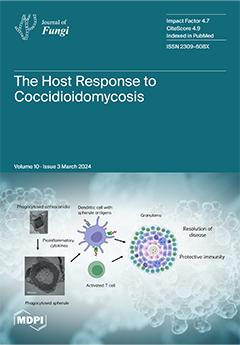
Cover Story: Coccidioides spp. are highly pathogenic fungi found in the soil of desert regions in the western hemisphere. Coccidioidomycosis is particularly prevalent in the southwestern region of the United States, where up to 40% of people in some regions have been infected. Despite the virulence of this fungus, about half of the infections are asymptomatic, and a very large majority of infections are self-limited. This article reviews the mechanisms of the host's response to infection. Innate immunity is discussed, from the initial interaction with the organism to the cytokine responses made by macrophages and dendritic cells and the acquired immune response. The genetics of resistance to infection and the search for an effective vaccine are also reviewed. Hopefully, this review will be useful to those interested in studying this primary pathogenic fungus. View this paper
  • Issues are regarded as officially published after their release is announced to the table of contents alert mailing list .
  • You may sign up for email alerts to receive table of contents of newly released issues.
  • PDF is the official format for papers published in both, html and pdf forms. To view the papers in pdf format, click on the "PDF Full-text" link, and use the free Adobe Reader to open them.

Articles (71)

  • Article
  • Open Access
3 Citations
3,039 Views
8 Pages

19 March 2024

The opportunistic fungus Candida albicans is the leading cause of invasive candidiasis in immune-compromised individuals. Drugs from the echinocandin (ECN) class, including caspofungin, are used as a first line of therapy against invasive candidiasis...

  • Article
  • Open Access
7 Citations
3,367 Views
22 Pages

Hsp90-Mediated Multi-Drug Resistance in DNA Polymerase-Defective Strains of Candida albicans

  • Bhabasha Gyanadeep Utkalaja,
  • Satya Ranjan Sahu,
  • Sushree Subhashree Parida and
  • Narottam Acharya

19 March 2024

The incidence of infections caused by Candida species, specifically by drug-resistant isolates, is a major health concern as they can disseminate to and colonize most vital organs, enhancing morbidity and mortality. Several molecular mechanisms have...

  • Article
  • Open Access
10 Citations
3,265 Views
18 Pages

The Oxidative Stress Response Highly Depends on Glucose and Iron Availability in Aspergillus fumigatus

  • Tamás Emri,
  • Károly Antal,
  • Kinga Varga,
  • Barnabás Csaba Gila and
  • István Pócsi

18 March 2024

Pathogens have to cope with oxidative, iron- and carbon(glucose)-limitation stresses in the human body. To understand how combined iron–carbon limitation alters oxidative stress responses, Aspergillus fumigatus was cultured in glucose–pep...

  • Article
  • Open Access
1 Citations
3,194 Views
22 Pages

Five New Species of Gymnopilus from Xizang Autonomous Region of China and Surrounding Areas

  • Wen-Qiang Yang,
  • Jia-Xin Li,
  • Mao-Qiang He,
  • Shi-Hui Wang,
  • Xin-Yu Zhu,
  • Dorji Phurbu,
  • Jian-Min Yun and
  • Rui-Lin Zhao

18 March 2024

The species of Gymnopilus (Hymenogastraceae, Agricales) are commonly recognized as wood-decaying fungi. Certain members of this genus have been identified as psilocybin-producing mushrooms. Gymnopilus exhibits a diverse range and has a global distrib...

  • Review
  • Open Access
9 Citations
3,660 Views
12 Pages

New Vision of Cell Walls in Aspergillus fumigatus from Solid-State NMR Spectroscopy

  • Isha Gautam,
  • Kalpana Singh,
  • Malitha C. Dickwella Widanage,
  • Jayasubba Reddy Yarava and
  • Tuo Wang

16 March 2024

The fungal cell wall plays a critical role in regulating cellular integrity and communication, and serves as a frontline defense against stress. It is also a prime target for the development of antifungal agents. The cell wall is comprised of diverse...

  • Article
  • Open Access
5 Citations
5,058 Views
18 Pages

16 March 2024

Yeast infections are challenging human and animal medicine due to low rates of detection and the emergence of unknown ecology isolates. The aim of this study was to verify the biochemical identification of yeasts and yeast-like microorganisms obtaine...

  • Article
  • Open Access
9 Citations
2,837 Views
31 Pages

Microfungi Associated with Peach Branch Diseases in China

  • Ying Zhou,
  • Ishara S. Manawasinghe,
  • Zhizheng He,
  • Wei Zhang,
  • Mei Liu,
  • Jinyan Song,
  • Shifang Li,
  • Zaifeng Fan and
  • Jiye Yan

15 March 2024

Peach (Prunus persica L.) is one of the most important and oldest stone fruits grown in China. Even though P. persica is one of the most commonly grown stone fruits in China, little is known about the biodiversity of microfungi associated with peach...

  • Article
  • Open Access
4 Citations
3,260 Views
21 Pages

Genome Comparisons between Botrytis fabae and the Closely Related Gray Mold Fungus Botrytis cinerea Reveal Possible Explanations for Their Contrasting Host Ranges

  • Klaus Klug,
  • Pinkuan Zhu,
  • Patrick Pattar,
  • Tobias Mueller,
  • Nassim Safari,
  • Frederik Sommer,
  • Claudio A. Valero-Jiménez,
  • Jan A. L. van Kan,
  • Bruno Huettel and
  • Kurt Stueber
  • + 3 authors

14 March 2024

While Botrytis cinerea causes gray mold on many plants, its close relative, Botrytis fabae, is host-specifically infecting predominantly faba bean plants. To explore the basis for its narrow host range, a gapless genome sequence of B. fabae strain G1...

  • Review
  • Open Access
13 Citations
11,753 Views
34 Pages

14 March 2024

Aging is a complex biological process that is influenced by both intrinsic and extrinsic factors. Recently, it has been discovered that reactive oxygen species can accelerate the aging process, leading to an increased incidence of age-related disease...

  • Review
  • Open Access
6 Citations
3,954 Views
25 Pages

14 March 2024

Commercial tests are often employed in clinical microbiology laboratories for antifungal susceptibility testing of filamentous fungi. Method-dependent epidemiological cutoff values (ECVs) have been defined in order to detect non-wild-type (NWT) isola...

of 8

Get Alerted

Add your email address to receive forthcoming issues of this journal.

XFacebookLinkedIn
J. Fungi - ISSN 2309-608X