


Abstract
Fusarium wilt is a soil borne fungal disease that has devastated banana production in plantations around the world. Most Cavendish-type bananas are susceptible to strains of Fusarium oxysporum f. sp. cubense (Foc) belonging to the Subtropical Race 4 (STR4) and Tropical Race 4 (TR4). The wild banana diploid Musa acuminata ssp. malaccensis (AA, 2n = 22) carries resistance to Foc TR4. A previous study using segregating populations derived from M. acuminata ssp. malaccensis identified a quantitative trait locus (QTL) (12.9 cM) on the distal part of the long arm of chromosome 3, conferring resistance to both Foc TR4 and STR4. An SNP marker, based on the gene Macma4_03_g32560 of the reference genome ‘DH-Pahang’ v4, detected the segregation of resistance to Foc STR4 and TR4 at this locus. Using this marker, we assessed putative TR4 resistance sources in 123 accessions from the breeding program in Brazil, which houses one of the largest germplasm collections of Musa spp. in the world. The resistance marker allele was detected in a number of accessions, including improved diploids and commercial cultivars. Sequencing further confirmed the identity of the SNP at this locus. Results from the marker screening will assist in developing strategies for pre-breeding Foc TR4-resistant bananas. This study represents the first-ever report of marker-assisted screening in a comprehensive collection of banana accessions in South America. Accessions carrying the resistance marker allele will be validated in the field to confirm Foc TR4 resistance.
1. Introduction
Bananas are among the leading fruits that provide economic sustainability for both small- and large-scale growers, with a worldwide trade value surpassing USD 30 billion per annum [1]. However, banana production has been severely affected by major pests and diseases caused by viruses, bacteria, and fungi. Amongst the fungal diseases affecting bananas, Fusarium wilt, caused by Fusarium oxysporum f. sp. cubense (Foc), is the most economically important.
Fusarium wilt has been an issue in banana monoculture plantation production systems since the 1900s. However, it is the virulent Foc strain known as Tropical Race 4 (TR4) that threatens commercial banana production dominated by Cavendish-type clones, as well as a broad range of other banana varieties [2,3,4]. TR4 was first reported in the regions of southeast Asia and Australia in the 1990s [5]. In recent years, it has made its way into other parts of the world, such as Latin America, reaching the northern region of La Guarija, Colombia, in 2019 [3], the Querecotillo district of Sullana province in the Piura department of Peru in 2021 [2], and more recently, Venezuela [6]. These countries could provide proxies in the potential spread of Foc TR4 across the border to neighboring countries. Thus, pre-emptive breeding to contain and stop the spread of the disease is of utmost importance. Latin America and the Caribbean, which is the world’s largest banana exporting region, is thus endangered [7]. Understanding the epidemiology of Fusarium wilt in bananas is critical for developing control measures, breeding resistant varieties, and formulating effective quarantine strategies to prevent further spread of Foc TR4 in banana-producing regions of the world [8,9]. Foc TR4 remains a critical threat to banana plantations worldwide, partly due to the lack of effective control measures and limited sources of Fusarium wilt resistance within Musa spp. [8,10,11].
Disease symptoms are manifested as vascular discoloration in the corm, while the disease is visually identified on plants displaying leaf yellowing and vascular-induced wilt. Foc, a soilborne pathogen, enters the host plant through the roots and moves through the plant’s vascular system to colonize the whole plant. Its colonization and proliferation in the xylem vessels block water and nutrient supplies to the aerial parts of the plant, leading to wilting of leaves and eventual plant death [8,10]. Internally, Foc-infected corms and pseudo-stems show a reddish-brown discoloration. So far, there are no effective means to control the spread of this disease. Foc can survive in the soil for decades as chlamydospores and cannot be completely eradicated [12]. Therefore, the use of resistant cultivars not only offers the most sustainable and environmentally friendly means of controlling Foc but is perhaps one of the few viable options [13]. This highlights the importance of identifying resistance in wild relatives of cultivated bananas and introducing resistance alleles into commercial cultivars to enhance their resilience against diseases [4,9].
Embrapa Mandioca e Fruticultura (Embrapa Cassava and Fruits, https://www.embrapa.br/mandioca-e-fruticultura, accessed on 21 October 2024) conducts research to improve crop productivity and has an active program for the genetic improvement in bananas since 1976 [14]. It maintains one of the largest banana germplasm collections in South America. This collection includes accessions gathered from various regions worldwide, established through comprehensive collecting expeditions. These expeditions were conducted in the banana center of origin in Southeast Asia and further extended to include accessions from Africa, Central America, and South America. This germplasm collection now has over 400 accessions, aimed at preserving genetic diversity and developing new cultivars suited to both local and global agricultural needs.
Molecular markers based on Single Nucleotide Polymorphisms (SNPs) are used successfully in many crops in the identification of a plant’s resistance to diseases [15,16,17,18]. Previous studies show that lines belonging to the wild diploid banana Musa acuminata subsp. malaccensis (Ma) (AA, 2n = 22) carry resistance to Foc TR4 and STR4 strains [8,10,17,18].
Recently, a detailed study of two Musa acuminata ssp. malaccensis populations segregating for Foc TR4 and STR4 resistance was carried out [18]. Marker loci and trait association using 11 SNP-based PCR markers allowed the candidate region conferring Foc STR4/TR4 resistance to be delimited to a 12.9 cM genetic interval corresponding to a 959 kb region on chromosome 3 of the ‘DH-Pahang’ reference assembly v4 [18].
Within this region, multiple pattern recognition receptors, such as leucine-rich repeats containing receptor-like protein kinases, cysteine-rich cell wall-associated protein kinases, and other genes related to resistance, were identified. To confirm the segregation of single-gene resistance, an inter-cross between the resistant parent ‘Ma850’ and a susceptible line ‘Ma848’ was generated [18]. An informative SNP marker, 29730, based on a single nucleotide change (T544C) in the first intron of a Nuclear transcription factor Y subunit (Macma4_03_g32560, ‘DH-Pahang’ assembly v4.3) was reported as associated with Foc TR4 resistance [18] and allowed the resistance locus to be assessed in a collection of diploid and polyploid banana accessions at Embrapa. The results provide crucial insights into Foc TR4 resistance sources within Embrapa’s banana breeding program, supporting the design of a breeding pipeline geared toward the development of Foc TR4-resistant bananas and as such, mitigate TR4-caused yield losses once TR4 arrives in Brazil. These findings will undoubtedly contribute to the global initiatives aimed at developing Foc TR4-resistant banana varieties.
2. Materials and Methods
M. acuminata-specific primers for the 29730 marker were developed previously, 29730-A-SNP1-F2 5′-GCAATGAGTACCTCTAAGCA-3′ and 29730-A-SNP1-R2 5′-TAAGTTCTAGTATCAAGTACAA-3′, and used to amplify an A-genome specific product of 795 bp. This product was then digested with BcoDI to produce the bi-allelic forms, an undigested dominant band that is putatively associated with resistance, and digested products of 429 bp and 366 bp, linked to susceptibility [18]. Then, 123 accessions from the Embrapa banana germplasm collection (Table 1) were genotyped with this SNP marker, 29730-A-SNP1-F2 and 29730-A-SNP1-R2.
Table 1.
Sample number, accession name and number (Embrapa/ITC), type, genealogy, BcoDI digest, and allele nucleotide of 123 Embrapa accessions genotyped with SNP markers 29730-A-SNP1-F2 and 29730-A-SNP1-R2.
3. Results and Discussion
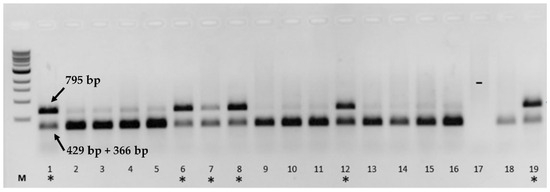
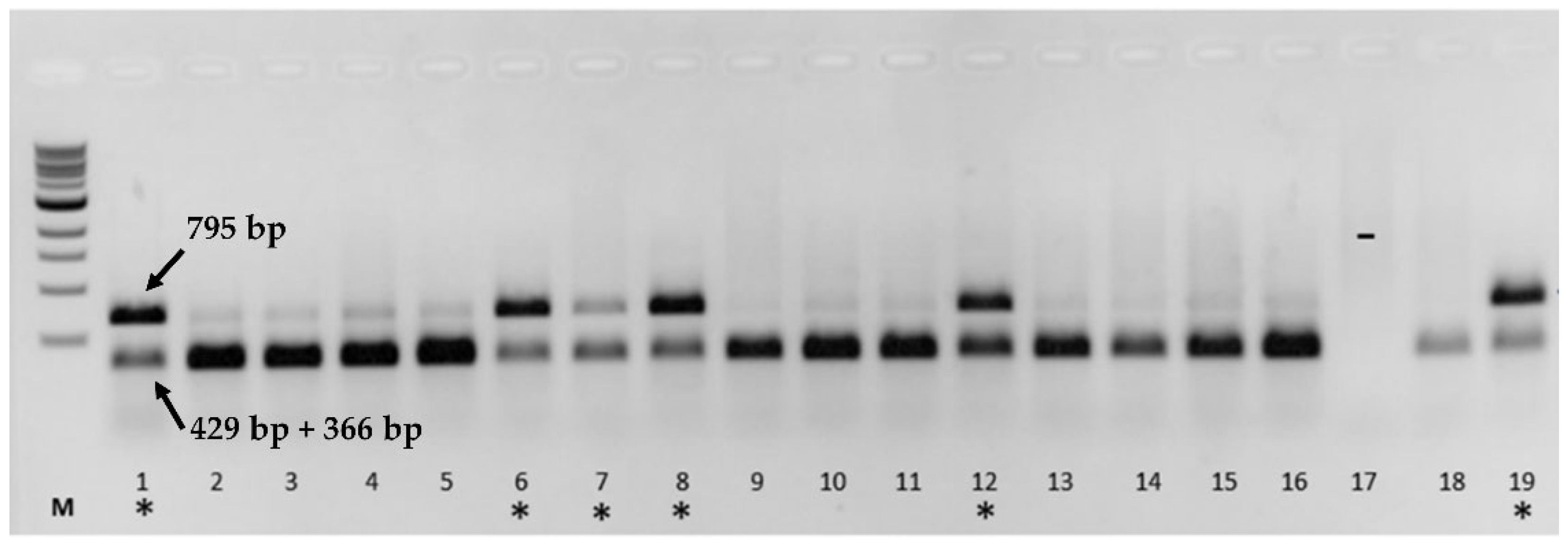
The overall results of the marker-assisted screening for all 123 accessions are summarized in Table 1. A restriction digest was performed using BcoDI on PCR amplicons of all 123 Embrapa accessions. A BcoDI cut site within the PCR amplicon allowed bi-allelic forms to be discriminated on an agarose gel (Figure 1). Accessions displaying a dominant resistant band were subsequently analyzed through Sanger sequencing. The sequencing results confirmed the presence of the informative SNP, as identified in the alignment of chromatograms at the expected position (Figure S1).
Figure 1.
BcoDI digest profile of 19 Embrapa accessions PCR-amplified using the SNP marker 29730-A-SNP1-F2 and 29730-A-SNP1-R2. The 795 bp fragment is putatively associated with resistance. Samples are (1) ‘PA Mysore 2’, (2) ‘Pisang Jari Buaya’, (3) ‘Tuu Gia’, (4) ‘Pisang Nangka’, (5) ‘Tjau Lagada’, (6) ‘Tong Dok Mak’, (7) ‘M-61’, (8) ‘Pisang Mas’, (9) ‘Pisang Cici’, (10) ‘Saney’, (11) ‘Yangambi no.2’, (12) ‘Yangambi Km5’, (13) ‘Highgate’, (14) ‘Pacoua PV03-76’, (15) ‘PA 42-38’, (16) ‘Pa 42-28’, (17) ‘PA 42-19’, (18) ‘M48’, and (19) ‘Ouro’. M = molecular ladder 1 kb (N3232S, New England Biolabs, VIC, Australia), (-): Non-amplified sample. The alternatively cut allele (429 bp and 366 bp) may indicate the presence of the Foc TR4-susceptible allele. Accessions heterozygous for the marker locus are predicted for resistance to Foc STR4 and Foc TR4 given the complete dominance of resistance over susceptibility at this resistance locus. Asterisk = putative Foc TR4/STR4-resistant genotypes.
The SNP marker was screened in all putative genotypes for resistance. PCR products of selected accessions were Sanger-sequenced in both directions by ACTGene Company, using the AB3500 sequencing platform (ACTGene, Porto Alegre, RS, Brazil). Of the retrieved sequences, these were analyzed using the multiple-sequence alignment software MAFFT v 7.490 [20] in Geneious Prime v 2024.0.7 (Biomatter Pty. Ltd., Auckland, New Zealand). Overall, 14 genotypes, out of 15, showed the presence of the resistance allele (Supplementary Figure S1). Of these, three improved diploids have Malaccensis in their genetic background, namely ‘013019’, ‘CNPMF 0542’, and ‘CNPMF 0731’. Given that the breeding program at Embrapa focuses on a preventive breeding strategy to combat the disease, these improved diploids will play a key role in the development of Foc TR4-resistant cultivars aimed at enhancing resistance to Fusarium wilt in the field.
Among the 15 accessions previously identified as highly resistant or resistant to Foc STR4 [19], 10 were associated with the resistance marker band. These included the improved diploids CNPMF- ‘0496’, ‘0534’, ‘0536’, ‘0542’, ‘0557’, ‘0731’, ‘013019-01’, ‘050012-02’, ‘SH3263’, and ‘SH3362’ (Table 1). However, five accessions, including CNPMF- ‘1323’, ‘0513’, ‘0993’, ‘0998’, ‘001016-01’, and ‘M53’, did not exhibit the resistance marker allele despite being resistant to Foc STR4 [19] (Table 1). These findings indicate a 62.5% detection rate of resistant genotypes using the marker, suggesting that while the marker is a useful tool for identifying resistance, it may not capture all resistant genotypes due to linkage disequilibrium and resistance sources controlled by other unlinked loci.
Improved diploids are developed by crossing wild diploids with the objective of obtaining hybrids with important agronomical characteristics such as disease resistance. There are three types of improved diploids: (1) first generation − wild diploid × wild diploid, (2) second generation − Improved diploid × wild diploid, and (3) third generation − improved diploid × improved diploid. The third generation may have many wild diploids in its genealogy, whereas the hybrid combines important agronomical characteristics that were distributed among the wild diploids [14].
The screening results suggest that the marker did not detect the resistant allele in diploids including ‘Calcutta 4’, ‘Pisang Lilin’, ‘Tuu Gia’, and ‘Borneo’ despite having good or intermediate levels of resistance/tolerance to Foc race 1 and Foc TR4 [11,21]. The negative results in marker screening highlight the limitations of this marker in detecting resistance traits at loci other than the target or in genotypes lacking Musa acuminata ssp. malaccensis origin. This suggests that additional markers may be needed to identify resistance in a broader range of banana genotypes and as well in Musa acuminata ssp. malaccensis-derived bananas such as ‘Pisang Lilin’. These genotypes are scheduled for field evaluation to assess their resistance to Foc TR4, adhering to quarantine protocols in Australia and Colombia. Additionally, we plan to use the putative Foc TR4-resistant improved diploids in breeding efforts aimed at introducing sources of Foc TR4-resistance into dessert bananas including ‘Prata’, ‘Silk’, and ‘Cavendish’.
This work highlights the importance of improved diploid genotypes, particularly ‘CNPMF 512’ and ‘CNPMF 1323’, which carry resistance to other pests and diseases. These genotypes also possess desirable agronomic traits, including short plant height, early flowering time, and good tillering ability [22]. The genotypes will be field-tested for resistance to Foc TR4 in Australia and Colombia, in collaboration with the Department of Agriculture, Fisheries, and Forestry and Agrosavia, to further validate the marker.
This study represents the first report of screening an SNP marker across such an extensive number of banana accessions in Latin America. Given that Foc TR4 is already present in Latin America, the urgent need for validation of this SNP marker in genotypes is underscored by its potential impact. Our findings provide valuable insights to expedite resistance breeding in other banana programs worldwide, such as those conducted by IITA for cooking and plantain bananas, and by CIRAD [7,23,24,25].
Supplementary Materials
The following supporting information can be downloaded at https://www.mdpi.com/article/10.3390/jof10120839/s1: Supplementary Figure S1: Sequencing chromatograms for the Macma4_03_g32560 gene were generated using both forward and reverse primers.
Author Contributions
Conceptualization, C.F.F., A.C., E.A.B.A. and E.P.A.; methodology, C.F.F., A.C., E.A.B.A., A.d.J.R. and J.M.d.S.S.; software, C.F.F. and A.C.; validation, C.F.F., A.C. and A.P.d.S.R.; formal analysis, C.F.F., A.C., E.A.B.A., R.S. and B.U.; investigation, C.F.F., A.C., E.P.A., R.S. and B.U.; resources, C.F.F., A.C. and E.A.B.A.; data curation, C.F.F. and A.C.; writing—original draft preparation, C.F.F., A.C., E.A.B.A. and E.P.A.; writing—review and editing, C.F.F., A.C., E.A.B.A., E.P.A., R.S. and B.U.; visualization, C.F.F., A.C., E.A.B.A., E.P.A., R.S. and B.U.; supervision, C.F.F., A.C., E.A.B.A. and E.P.A.; project administration, A.C., E.A.B.A. and E.P.A.; funding acquisition, A.C., E.A.B.A. and E.P.A. All authors have read and agreed to the published version of the manuscript.
Funding
This research was funded by The Bill and Melinda Gates Foundation (Project Grant ID: OPP1093845) through its grant to the International Institute of Tropical Agriculture (IITA) under the project Accelerated Breeding of Better Bananas, grant number IITA 20600.15/0008-8—Phase II. Andrew Chen and Elizabeth Aitken were also funded by Hort Innovation Australia through grant ‘BA17006’.
Institutional Review Board Statement
Not applicable.
Informed Consent Statement
Not applicable.
Data Availability Statement
The authors will provide data upon request.
Acknowledgments
The authors would like to thank the National Council of Scientific and Technological Development–CNPq for research productivity grants of CFF and EPA and Embrapa Mandioca e Fruticultura for the technical support.
Conflicts of Interest
The authors declare no conflicts of interest.
References
- Food and Agriculture Organization. Available online: https://www.fao.org/faostat/> (accessed on 21 October 2024).
- Acuña, R.; Rouard, M.; Leiva, A.M.; Marques, C.; Olortegui, J.A.; Ureta, C.; Cabrera-Pintado, R.M.; Rojas, J.C.; Lopez-Alvarez, D.; Cenci, A.; et al. First report of Fusarium oxysporum f. sp. cubense tropical race 4 causing Fusarium wilt in Cavendish bananas in Peru. Plant Dis. 2022, 106, 2268. [Google Scholar] [CrossRef] [Scilit] [PubMed]
- García-Bastidas, F.A.; Quintero-Vargas, J.C.; Ayala-Vasquez, M.; Schermer, T.; Seidl, M.F.; Santos-Paiva, M.; Noguera, A.M.; Aguilera-Galvez, C.; Wittenberg, A.; Hofstede, R.; et al. First report of Fusarium wilt tropical race 4 in Cavendish Bananas caused by Fusarium odoratissimum in Colombia. Plant Dis. 2020, 104, 994. [Google Scholar] [CrossRef] [Scilit]
- Zhan, N.; Kuang, M.; He, W.; Deng, G.; Liu, S.; Li, C.; Roux, N.; Dita, M.; Yi, G.; Sheng, O. Evaluation of resistance of banana genotypes with AAB genome to Fusarium wilt Tropical Race 4 in China. J. Fungi 2022, 8, 1274. [Google Scholar] [CrossRef] [Scilit] [PubMed]
- Stover, R.H. Disease management strategies and the survival of the banana industry. Annu. Rev. Phytopathol. 1986, 24, 83–91. [Google Scholar] [CrossRef]
- Olivares, B.O.; Rey, J.C.; Lobo, D.; Navas-Cortés, J.A.; Gómez, J.A.; Landa, B.B. Fusarium wilt of bananas: A review of agroenvironmental factors in the Venezuelan production system affecting its development. Agronomy 2021, 11, 986. [Google Scholar] [CrossRef] [Scilit]
- Martínez, G.; Olivares, B.O.; Rey, J.C.; Rojas, J.; Cardenas, J.; Muentes, C.; Dawson, C. The advance of Fusarium Wilt Tropical Race 4 in Musaceae of Latin America and the Caribbean: Current Situation. Pathogens 2023, 12, 277. [Google Scholar] [CrossRef] [Scilit]
- Dita, M.; Barquero, M.; Heck, D.; Mizubuti, E.S.; Staver, C.P. Fusarium wilt of banana: Current knowledge on epidemiology and research needs toward sustainable disease management. Front. Plant Sci. 2018, 9, 1468. [Google Scholar] [CrossRef] [Scilit]
- Pegg, G.K.; Coates, L.M.; O’Nell, W.T.; Turner, D.W. The epidemiology of Fusarium wilt of banana. Front. Plant Sci. 2019, 10, 1396. [Google Scholar] [CrossRef] [Scilit]
- Chen, A.; Sun, J.; Matthews, A.; Armars-Egas, L.; Chen, N.; Hamil, S.; Mintoff, S.; Tran-Nguyen, L.T.T.; Batley, J.; Aitken, E.A.B. Assessing variations in host resistance to Fusarium oxysporum f. sp. cubense Race 4 in Musa species with focus on the Subtropical Race 4. Front. Microbiol. 2019, 10, 1062. [Google Scholar] [CrossRef] [Scilit]
- Rocha, A.J.; Soares, J.A.M.; Nascimento, F.S.; Santos, A.S.; Amorim, V.B.O.; Ferreira, C.F.; Haddad, F.; Santos-Serejo, J.A.; Amorim, E.P. Improvements in the resistance of the banana species to Fusarium wilt: A systematic review of methods and perspectives. J. Fungi 2021, 7, 249. [Google Scholar] [CrossRef] [Scilit]
- Guo, L.; Wang, J.; Liang, C.; Yang, L.; Zhou, Y.; Liu, L.; Huang, J. Fosp9, a novel secreted protein, is essential for the full virulence of Fusarium oxysporum f. sp. cubense on Banana (Musa spp.). Appl. Environ. Microb. 2022, 88, e00604-21. [Google Scholar] [CrossRef] [Scilit] [PubMed]
- Ploetz, R.C. Fusarium wilt of Banana. Phytopathology 2015, 105, 1512–1521. [Google Scholar] [CrossRef] [Scilit] [PubMed]
- Amorim, E.P.; Santos-Serejo, J.A.; Amorim, V.B.O.; Silva, S.O.S. Melhoramento genético. In O Agronegócio da Bananeira; Ferreira, C.F., Silva, S.O., Amorim, E.P., Santos-Serejo, J.A., Eds.; Embrapa: Brasilia, Brazil, 2016; 832p. [Google Scholar]
- Chagne, D.; Vanderzande, S.; Kirk, C.; Profit, N.M.; Weskett, R.; Gardiner, S.E.; Peace, C.P.; Volz, R.K.; Bassil, N.V. Validation of SNP markers for fruit quality and disease resistance loci in apple (Malus × domestica Borkh.) using the OpenArray® Platform. Hortic. Res. 2019, 6, 30. [Google Scholar] [CrossRef] [Scilit] [PubMed]
- Méline, V.; Caldwell, D.L.; Kim, B.S.; Khangura, R.S.; Baireddy, S.; Yang, C.; Sparks, E.E.; Brian, D.; Delp, E.J.; Iyer-Pascuzzi, A.S. Image-based assessment of plant disease progression identifies new genetic loci for resistance to Ralstonia solanacearum in tomato. Plant J. 2023, 113, 887–903. [Google Scholar] [CrossRef] [Scilit]
- Chen, A.; Sun, J.; Martin, G.; Gray, L.-A.; Hřibová, E.; Christelová, P.; Yahiaoui, N.; Rounsley, S.; Lyons, R.; Batley, J.; et al. Identification of a Major QTL-Controlling Resistance to the Subtropical Race 4 of Fusarium oxysporum f. sp. cubense in Musa acuminata ssp. malaccensis. Pathogens 2023, 12, 289. [Google Scholar] [CrossRef] [Scilit]
- Chen, A.; Sun, J.; Viljoen, A.; Mostert, D.; Xie, Y.; Mangila, L.; Bothma, S.; Lyons, R.; Hřibová, E.; Christelová, P.; et al. Genetic Mapping, Candidate Gene Identification and Marker Validation for Host Plant Resistance to the Race 4 of Fusarium oxysporum f. sp. cubense Using Musa acuminata ssp. malaccensis. Pathogens 2023, 12, 820. [Google Scholar] [CrossRef] [Scilit]
- Santana, W.S.; Rocha, A.d.J.; da Silva, W.B.; Amorim, V.B.O.d.; Ramos, A.P.d.S.; Haddad, F.; Amorim, E.P. Selection of Improved Banana Diploid Resistant to Fusarium oxysporum f. sp. cubense Races 1 and Subtropical 4. Agronomy 2024, 14, 1277. [Google Scholar] [CrossRef] [Scilit]
- Katoh, K.; Standley, D.M. MAFFT Multiple sequence alignment software version 7: Improvements in performance and usability. Molecular Biol. Evol. 2013, 30, 772–780. [Google Scholar] [CrossRef] [Scilit]
- Arinaitwe, I.K.; Teo, C.H.; Kayat, F.; Tumuhimbise, R.; Uwimana, B.; Kubiriba, J.; Swennen, R.; Harikrishna, J.A.; Othman, R.Y. Evaluation of banana germplasm and genetic analysis of an F1 population for resistance to Fusarium oxysporum f. sp. cubense race 1. Euphytica 2019, 215, 175. [Google Scholar] [CrossRef] [Scilit]
- Gonçalves, Z.S.; Rocha, A.J.; Haddad, F.; Amorim, V.B.O.; Amorim, E.P. Selection of diploid and tetraploid banana hybrids resistant to Pseudocercospora fijiensis. Agronomy 2021, 11, 2483. [Google Scholar] [CrossRef] [Scilit]
- Batte, M.; Nyine, M.; Uwimana, B.; Swennen, R.; Akech, V.; Brown, A.; Hovmalm, H.P.; Geleta, M.; Ortiz, R. Significant progressive heterobeltiosis in banana crossbreeding. BMC Plant Biol. 2020, 20, 489. [Google Scholar] [CrossRef] [Scilit] [PubMed]
- Batte, M.; Swennen, R.; Uwimana, B.; Akech, V.; Brown, A.; Tumuhimbise, R.; Hovmalm, H.P.; Geleta Dida, M.; Ortiz, R. Crossbreeding East African highland bananas: Lessons learnt relevant to the botany of the crop after 21 years of genetic enhancement. Front. Plant Sci. 2019, 10, 81. [Google Scholar] [CrossRef] [Scilit] [PubMed]
- Tenkouano, A.; Lamien, N.; Agogbua, J.; Amah, D.; Swennen, R.; Traore, S.; Thiemele, D.; Aby, N.; Kobenan, K.; Gnonhouri, G.; et al. Promising high-yielding tetraploid plantain bred-hybrids in West Africa. Int. J. Agron. 2019, 2019, 3873198. [Google Scholar] [CrossRef] [Scilit]

Disclaimer/Publisher’s Note: The statements, opinions and data contained in all publications are solely those of the individual author(s) and contributor(s) and not of MDPI and/or the editor(s). MDPI and/or the editor(s) disclaim responsibility for any injury to people or property resulting from any ideas, methods, instructions or products referred to in the content. |
© 2024 by the authors. Licensee MDPI, Basel, Switzerland. This article is an open access article distributed under the terms and conditions of the Creative Commons Attribution (CC BY) license (https://creativecommons.org/licenses/by/4.0/).