


Simple Summary
Goats are a mainstay of milk production in dry and difficult regions, supporting the livelihoods of millions of smallholder farmers and supplying milk that is nutritious, easy to digest, and less likely to trigger allergies than cow milk. Yet breeding goats for higher and better-quality milk has progressed more slowly than in dairy cattle. Modern DNA-based tools can accelerate this progress by pinpointing the genes that shape how much milk a goat produces and how rich it is in fat and protein. This review brings together findings from many studies to identify which genes most reliably influence these traits and how they act inside the udder. Such knowledge allows breeders to select superior animals earlier and more accurately. Realizing these benefits will require larger, carefully recorded goat populations and the combining of different biological datasets, ultimately helping farmers raise more productive herds and improving the supply of high-quality goat milk.
Abstract
Dairy goats sustain milk production across marginal environments worldwide, yet genetic improvement of milk yield and composition remains slower than in cattle, constrained by smaller reference populations and limited functional validation. This review consolidates current evidence on the genes and polymorphisms governing milk production traits in dairy goats. Whole-genome resequencing and selection-signature scans repeatedly recover a lipogenic–somatotropic core (ACSS2, DGAT2, GHR, VPS13C, PRPF6), whereas genome-wide association studies (GWASs) confirm the casein cluster (CSN1S1, CSN1S2, CSN2, CSN3) as the most reproducible determinant of protein content and DGAT1 as the principal fat-content gene. Transcriptomic, single-cell, and metabolomic analyses, together with functional dissection in goat mammary epithelial cells, resolve the regulatory networks—SREBP1, PPARG, ELF5, and non-coding RNAs—that translate genotype into phenotype. Integrating multi-omic evidence with expanded, well-phenotyped populations is essential to convert this expanding catalog into precise marker-assisted and genomic selection for milk yield and quality.
1. Introduction
Dairy goats occupy a strategically important position in global animal agriculture, particularly across Mediterranean, African, Middle Eastern, and Asian regions, where their adaptability to harsh production conditions and climatic variability makes their contribution to marginal areas difficult to match [1]. For smallholders, dairy goat farming provides a tractable route to improved livelihoods through milk production and income generation, with the potential to strengthen food security and reduce poverty [2,3]. The global goat population exceeded 1.1 billion head in 2022, including more than 200 million dairy goats that together yield an estimated 20.7 million tons of milk annually [4]. Their value in arid and semi-arid zones is amplified by an economic logic centered on risk reduction rather than output maximization, which suits the volatile conditions faced by small-scale rural households [1,4].
Goat milk is further distinguished by its nutritional and functional properties [5,6,7,8]. Its fat globules average approximately 3.5 µm in diameter, against roughly 4.5 µm in bovine milk, and the resulting increase in interfacial surface area exposes more substrate to lipases and improves digestibility [9,10]. A high proportion of short- and medium-chain fatty acids reinforces this advantage, while a β-casein/αS1-casein ratio resembling that of human milk and a comparatively low αS1-casein content render goat milk less allergenic than cow milk [11,12]. Together, these attributes have driven growing consumer demand for specialized goat dairy products such as cheese and yogurt [10].
The economically decisive milk production traits—milk yield, fat percentage, protein percentage, and lactose content—are quantitative in nature and are therefore shaped by numerous genetic and environmental factors and their interactions [13,14,15,16]. Conventional improvement based on phenotype and pedigree is effective but slow, especially for traits that are difficult to record or exhibit low heritability. Accordingly, the application of genomics in livestock has advanced from marker-assisted selection toward whole-genome selection, substantially raising the ceiling on attainable genetic gain, and genome-wide association studies (GWAS) together with selection-signal scanning are now routinely used in dairy goats to localize genomic regions and candidate genes underlying milk yield and composition [13]. These traits are highly polygenic and typically governed by many loci of small effect alongside a few of major effect; the major genes so identified can be deployed in marker-assisted selection or used to sharpen the accuracy of genomic evaluation [13,17,18].
Among candidate loci, the casein genes have attracted the most sustained attention. Milk protein genes are the most intensively analyzed class, and major effects have been documented for αS1-casein in both sheep and goats [19]. In particular, polymorphism at the goat αS1-casein (CSN1S1) locus exerts a major influence on milk protein, casein, and fat content and on cheese yield [20]. More recent work in the Sarda breed, using a panel of 44 SNPs spanning the four casein genes, associated variation across CSN1S1, CSN2, CSN1S2, and CSN3 with protein content, total solids, and milk energy, while CSN1S2 intron variants tracked milk yield [16,21].
Beyond the caseins, genes controlling lipid metabolism and mammary function have emerged as key determinants of yield and fat composition. DGAT1, which encodes a rate-limiting enzyme in triacylglycerol synthesis, is a focal point of milk-production genetics, and several of its polymorphisms associate with production traits in cattle, buffalo, goat, and sheep [22]. Variants in hormonal and lipogenic pathways are similarly implicated: polymorphisms in ACACA, BTN1A1, LPL, and SCD associate with daily milk yield, fat and protein percentages, and somatic cell count in Czech dairy-goat breeds, providing information directly usable for marker-assisted selection [16], whereas PRL, DGAT1, FSHR, and GH regulate lactation and reproductive performance and thereby constitute priority markers for breeding programs [22,23]. Single-nucleotide polymorphisms, insertions/deletions, and copy-number variants at these loci have been repeatedly linked to differences in production performance across breeds and populations.
Despite this progress, reported gene–trait associations frequently diverge among studies and populations, reflecting differences in breed genetic background, allele frequencies, environmental conditions, and analytical strategy [13]. Consolidating this dispersed evidence is therefore essential to identify which genes and polymorphisms are the most reliable determinants of milk production traits and to guide their practical deployment. Accordingly, this review synthesizes current knowledge of the key genes and polymorphisms associated with milk production traits in dairy goats (Figure 1), evaluates the reported effects of these variants on milk yield and composition across whole-genome, association, transcriptomic, and functional studies, and appraises their utility for marker-assisted and genomic selection.
Figure 1.
Key genes controlling milk production traits in dairy goats. Candidate genes group into four functional modules, each mainly affecting one trait. The casein gene cluster—CSN1S1 (αS1-casein), CSN1S2 (αS2-casein), CSN2 (β-casein), and CSN3 (κ-casein)—controls protein content. The lipogenic module—DGAT1 and DGAT2 (diacylglycerol O-acyltransferase 1 and 2), ACSS2 (acyl-CoA synthetase short-chain member 2), SCD (stearoyl-CoA desaturase), and PPARG (peroxisome proliferator-activated receptor gamma)—controls fat content. The somatotropic axis—GHR (growth hormone receptor), GH (growth hormone), PRL (prolactin), PRLR (prolactin receptor), and POU1F1 (POU class 1 homeobox 1)—governs milk yield. The calcium-/mineral-transport genes—TRPV5 and TRPV6 (transient receptor potential cation channel V5 and V6), PTHLH (parathyroid hormone-like hormone), and FGF23 (fibroblast growth factor 23)—affect lactose and mineral content. Figure created with BioRender.com. Note that the schematic is based on speculative information rather than validated data; the relationships shown should therefore be interpreted with caution.
Although multiple GWASs, whole-genome resequencing (WGS) investigations, and transcriptomic analyses have identified numerous such genes and polymorphisms in dairy goats, the findings remain highly scattered across diverse breeds, geographic contexts, analytical platforms, and study designs. These inconsistencies mean that no prior synthesis has systematically evaluated which candidates are truly reproducible across this heterogeneous body of evidence, nor integrated selection-signature, GWAS, transcriptomic, single-cell, and metabolomic layers into a unified, breeding-relevant mechanistic framework. This review fills that gap: it is the first comprehensive multi-omic synthesis focused on 2020–2026 literature that identifies the most reproducible genetic determinants of dairy goat milk yield and composition, resolves the regulatory networks (SREBP1, PPARG, ELF5, and non-coding RNAs) translating genotype into phenotype, and appraises their practical deployment potential—a level of mechanistic integration not provided by any predecessor review on this topic.
This review is directed at three overlapping readerships: (i) animal geneticists, genomic researchers, and molecular biologists seeking a critically appraised synthesis of the current gene-mapping and functional literature in dairy goats; (ii) animal breeders, breeding organization technical officers, and applied geneticists who require guidance on which candidate genes have sufficient reproducibility to merit incorporation into marker-assisted or genomic selection indices; and (iii) graduate students and early-career researchers who need an integrative overview of goat milk genetics. Technical genomic content is presented with full scientific precision, while each major section concludes with a clear summary of practical breeding implications to serve this mixed readership.
2. Literature Search Strategy
This narrative review was conducted to synthesize current evidence on the genetic determinants of milk production traits in dairy goats. Four electronic databases—PubMed, Web of Science, Scopus, and Google Scholar—were searched using key terms combined with Boolean operators (AND/OR): “dairy goat,” “milk production traits,” “candidate gene,” “genome-wide association study,” “quantitative trait loci,” “casein,” “fatty acid synthesis,” “genomic selection,” “whole-genome resequencing,” “selection signature,” “transcriptomics,” and “marker-assisted selection.” Reference lists of retrieved articles were also screened to capture additional relevant studies.
The search primarily targeted publications from January 2020 to July 2026. Older studies were included where they provided foundational evidence or essential context not covered by more recent work.
Articles were included if they were peer-reviewed original research, genome-wide association studies, whole-genome resequencing investigations, transcriptomic or multi-omic studies, or meta-analyses reporting on genetic variants or regulatory mechanisms associated with milk yield, fat, protein, or lactose content in dairy goats, and published in English with the full text available. Conference abstracts, editorials, opinion pieces without original data, and non-English articles without full-text availability were excluded.
Titles and abstracts were first screened for relevance, followed by full-text assessment against the above criteria. As this is a narrative review, no formal risk-of-bias assessment or quantitative meta-analytic synthesis was performed. The included studies were critically appraised and organized thematically, and discrepancies among studies were discussed to ensure balanced coverage.
3. Whole-Genome Resequencing and Selection Signatures for Milk Production Traits
The domestication of goats and the centuries of directional breeding that followed have collectively sculpted the genome into a mosaic of regions reflecting natural adaptation and deliberate human selection. These selective episodes leave behind molecularly recognizable footprints—local reductions in nucleotide diversity, extended blocks of haplotype homozygosity, and elevated genetic differentiation between populations—each of which serves as an archeological record of past selection pressures [24,25,26,27]. The pronounced phenotypic divergence that now exists between dairy and non-dairy breeds makes goats a particularly tractable system for exploiting these signals, since the genomic contrast between populations subjected to opposing selection regimes amplifies the statistical power to detect functionally relevant loci [28]. Whole-genome resequencing (WGS) has emerged as the methodological cornerstone of this approach, simultaneously resolving population structure and identifying polymorphisms with genuine relevance to lactation performance—a prerequisite for rational improvement of dairy lines.
The most analytically productive WGS designs are those that place dairy and non-dairy populations in direct contrast, thereby exposing genomic regions swept specifically during selection for lactation capacity. Across European, African, and Asian goats, such comparisons have converged on a recurring constellation of milk-associated regions despite differences in breed composition, sample size, and statistical frameworks. Surveys of European commercial breeds identified strong differentiation at VPS13C, NCAM2, TMPRSS15, CSN3, and ABCG2 [29], while a parallel dairy-versus-non-dairy comparison additionally highlighted the lipogenic and growth-axis regulators GHR, DGAT2, ELF5, GLYCAM1, ACSBG2, and ACSS2 [30]. That this convergence is substantive rather than coincidental is compellingly supported by the work of Peng et al. [31], who applied five complementary detection statistics—runs of homozygosity (ROH), composite likelihood ratio (CLR), F~ST~, cross-population extended haplotype homozygosity (XP-EHH), and cross-population composite likelihood ratio (XP-CLR)—to a panel of dairy and wild Bezoar goats. ACSS2 was independently recovered by all five methods and validated as a dairy-specific target through extended haplotype and evolutionary conservation analysis, placing it alongside DGAT2, GHR, B4GALT1, VPS13C, NFX1, and PRPF6 as the most robustly supported candidates. The biological pathways enriched across these loci—acyl-CoA metabolism, glycerolipid biosynthesis, galactose metabolism, and growth-hormone signaling—trace a coherent biochemical trajectory from systemic nutrient flux through to the molecular machinery of milk synthesis.
Resequencing studies drawing on Chinese breed diversity have corroborated several of these candidates while simultaneously expanding the catalog. Analysis of dairy goats representing five breeds, augmented by a large body of published genomic data, recovered MPP7, PRPF6, DNAJC5, TPD52L2, HNF4G, LAMA3, FAM13A, and EPHA5 under selection; a companion longitudinal GWAS within the same cohort identified non-synonymous variants in LAMA3 as being quantitatively associated with milk yield [32]. A separate investigation contrasting native and imported animals further nominated STK3, GHR, and PRELID3B, with allele frequency divergence between populations lending further credibility to these candidates [33]. The repeated emergence of GHR, VPS13C, and PRPF6 across studies that differ in breed representation, analytical methodology, and geographic scope constitutes the most compelling available evidence that these loci reflect genuine selective sweeps rather than demographic artifacts. The evolutionary relevance of these signals extends beyond Capra hircus: Akhatayeva et al. [34], demonstrated that CLASP1 carries a convergent selection signature shared between goats and sheep, implying a conserved regulatory function in ruminant lactation; the same study highlighted PRPF6, VPS13C, TPD52L2, NFX1, and B4GALT1 alongside enrichment of U2-spliceosomal and propanoate-metabolism pathways.
Breed-level analyses have refined the architecture of these signals within specific genetic backgrounds. Contrasting high- and low-yield Guanzhong goats through F~ST~ and nucleotide diversity ratios, Ni et al. [35] localized ANPEP, ADRA1A, and PRKG1 to swept chromosomal intervals. In Pakistani breeds selected under conditions of thermal stress, signatures of selection at IGFBP3, LPL, LEPR, TSHR, and ACACA reflect an intersection between thermoregulatory adaptation and lactation physiology (Zhang C et al., [36]), while Ethiopian indigenous goats foregrounded GLYCAM1 and SRC as locally adaptive [37]. The degree to which the detectable signal depends on genetic background is perhaps most sharply illustrated by Demir et al. [38], whose mixed-model analysis of Anatolian breeds identified ID4 and CXCR4 as direct-effect loci for lactation yield exclusively in the Honamlı breed, with no comparable associations detected in Hair or Kabakulak goats. This context-dependence serves as an important reminder that selective sweeps are neither universal nor breed-agnostic. Complementing these genome-wide perspectives, targeted studies have linked prolactin variants to yield in crossbred Anglo-Nubian animals [39] and implicated POU1F1, PRLR, and β-lactoglobulin SNPs in milk trait variation in Kilis goats [40]. Collectively, across all the detection strategies deployed to date, the evidence consistently resolves a lipogenic–somatotropic functional core as the primary genetic substrate of superior dairy performance. The principal findings from these selection-signature investigations are consolidated in Table 1.
Table 1.
Whole-genome resequencing and selection-signature studies identifying candidate genes for milk production traits in goats.
The evidence most convincingly supports ACSS2, VPS13C, GHR, and PRPF6 as genuine dairy-specific selective sweep candidates. Their consistent recovery across multiple independent studies using complementary methods (ROH, XP-EHH, FST, CLR) in geographically diverse populations—European, Asian, and African—distinguishes them from population-specific signals that should not be broadly generalized. The biological coherence of the enriched pathways (acyl-CoA metabolism, glycerolipid biosynthesis, and growth-hormone signaling) lends additional mechanistic credibility. Breed-specific signals such as ID4/CXCR4 in Honamlı goats are scientifically valid but require local validation before incorporation into breed-agnostic selection indices.
4. Genome-Wide Association Studies of Milk Yield and Composition
While selection-signature analyses identify genomic regions shaped by historical selection pressure, GWAS complement this approach by establishing direct statistical relationships between individual genotypes and quantitatively measured phenotypes. The practical feasibility of GWAS in dairy goats was unlocked by two parallel developments: the availability of a high-quality chromosome-level reference assembly and the commercialization of species-specific high-density SNP genotyping platforms, most notably the GoatSNP50 and GoatSNP53K BeadChips [41,42]. These resources together enabled the systematic dissection of milk fat, protein, and lactose as tractable quantitative traits.
The foundational GWAS of French Alpine and Saanen goats genotyped on the 50K array established several principles that have guided subsequent research. The analysis identified association signals distributed across an extensive number of genomic regions for multiple milk traits, and most consequentially validated DGAT1 on chromosome 14 as a fat-content determinant, with exon mutations R251L and R396W shown to measurably reduce milk fat percentage [41]. This result crystallized what later work would repeatedly confirm: milk composition is a deeply polygenic trait architecture in which the casein gene cluster exerts dominant control over protein content while an independent lipogenic module, anchored by DGAT1, governs fat deposition.
Subsequent GWAS investigations have systematically broadened and mechanistically deepened these foundational associations. Integration of the GoatSNP50 chip with transcriptomic data in a large Murciano-Granadina cohort implicated CSN1S1, CSN2, CSN1S2, and CSN3 in protein percentage, and additionally highlighted calcium-transport and calcium–phosphorus regulatory genes—TRPV5, TRPV6, PTHLH, and FGF23—coupling protein synthesis to mineral homeostasis at the genomic level [43]. The temporal robustness of the casein signal was formally established by Luigi-Sierra et al. [44], whose longitudinal analysis confirmed the chromosome-6 protein-percentage association across the first three successive lactations, indicating that this genomic region exerts a persistent rather than stage-specific effect on protein deposition throughout productive life.
More recent methodological advances have shifted attention toward the regulatory architecture underlying these associations. Applying random forest variable importance ranking followed by information-theoretic epistasis analysis to the Murciano-Granadina dataset, Khan et al. [45] identified transcription-factor hubs—DBP, HAND1, HOXA4, PPARA, and THAP1—as shared regulatory nodes across a broad set of milk traits, underscoring that the genetic control of milk composition operates substantially through transcriptional regulatory networks rather than solely through structural coding variation. A complementary multi-model GWAS deploying general linear, mixed, and FarmCPU frameworks on Guanzhong goats further resolved associations for milk traits measured by infrared spectroscopy and flow cytometry, nominating candidates spanning immune function, coagulation, cell-cycle regulation, and extracellular matrix biology [40]. The most granular compositional dissection to date, conducted in Karachai goats on the GoatSNP53K platform, identified functionally distinct sets of candidate loci for protein and β-casein on one hand, and for fat content and fatty-acid profile on the other—with additional loci implicated in broader milk quality attributes—revealing that even within the broad category of milk composition, the genetic architectures governing protein and fat traits are substantially non-overlapping [42].
Caseins account for roughly 80% of goat milk protein, and the four genes encoding them—CSN1S1, CSN1S2, CSN2, and CSN3—sit in a single cluster on chromosome 6 whose polymorphisms track protein content, fat percentage, and total solids across populations [46,47]. CSN1S1 is exceptionally variable, with at least 22 described alleles that constitute a rich resource for marker-assisted selection [47]. These alleles fall into four functional classes defined by αS1-casein output: strong (A, B, C, H, L, M; ~3.5–4.2 g/L), intermediate (E, I; ~1.1–1.6 g/L), weak (F, G; ~0.45–0.6 g/L), and null (O1, O2, N; undetectable) [47]. This quantitative ladder converts genotype directly into predicted protein yield, which is precisely what makes CSN1S1 so attractive for selection.
Allele frequencies, however, are strongly population-specific and carry an adaptive signature. In native goats from arid southern Tunisia, strong alleles dominated at a combined frequency near 0.79 (B, 0.489; A, 0.267; C, 0.033), while null alleles (N + O1) reached 0.133—higher than in Moroccan populations [47]. The authors linked this distribution to survival under water scarcity and temperatures approaching 47 °C: does secreting protein-rich milk provision their kids for rapid growth before the harsh dry season, tying casein variation to reproductive fitness. A contrasting pattern emerges in Chinese breeds. Surveying the CSN1S1 O1 null allele in 2319 goats from 11 breeds by allele-specific PCR, Wang et al. [46] found the functional allele fixed or nearly so (0.946–1.000), with the locus in Hardy–Weinberg equilibrium and low polymorphism information content throughout; the null-carrying A0 allele appeared only in Saanen (0.054), Laoshan (0.025), and Guanzhong (0.016) dairy goats and was absent from cashmere and meat types. This near-monomorphism stands against Norwegian Dairy goats, where the O1 allele reaches ~70–73% and materially alters milk composition and technological properties [48,49]—a divergence that underscores how breed history and drift, not selection alone, sculpt allele frequencies and why population-specific characterization is indispensable. Beyond CSN1S1, an SNP panel spanning all four casein genes in Sarda goats linked the cluster to protein, total solids, and milk energy, with calcium-sensitive genes associated with lipid content and CSN1S2 intron variants correlating with yield, pH, NaCl, and somatic cell score [21].
Considered collectively, the converging outputs of GWAS and selection-signature analyses triangulate a consistent gene set centered on the casein cluster, the lipogenic module, the somatotropic axis, and calcium–mineral transport. Among these, the casein locus stands out as the single most reproducible genetic determinant of milk protein content, a consistency that invites closer functional and regulatory examination, as addressed in the following section.
5. Transcriptomic and Multi-Omic Dissection of Lactation
Genomic and selection-signature analyses identify the chromosomal addresses of variants associated with dairy performance, but they cannot, by themselves, reveal which genes are transcriptionally engaged as the mammary gland cycles through successive phases of growth, secretion, and involution. Transcriptomics addresses this limitation directly, capturing the dynamic regulatory landscape that converts genomic potential into phenotypic output. Over the past decade, studies ranging from bulk tissue profiling to single-cell resolution have progressively assembled a picture of lactation as an orchestrated molecular program governed by layered regulatory logic—encompassing non-coding RNAs, transcription-factor networks, lipid-sensing nuclear receptors, and cross-pathway signaling cascades—all of which bear on the practical goal of improving milk yield and composition.
Functional and multi-omic data now explain how these variants act. By pairing transcriptomics with GWAS, Guan et al. [43] showed that casein-region genes are co-regulated with calcium-ion transport (TRPV5/6) and calcium–phosphorus metabolism (PTHLH, FGF23), integrating protein assembly with the mineral phase of milk. Metabolomic profiling adds a downstream readout: milk from does carrying weak or null alleles is enriched in lactose-metabolism substrates, whereas strong-allele milk favors tricarboxylic-acid-cycle intermediates, indicating that αS1-casein genotype reshapes mammary energy partitioning [46,47,50]. At the regulatory level, the transcription factor ELF5 drives casein synthesis through the JAK2/STAT5 pathway: ELF5 overexpression promotes proliferation, suppresses apoptosis, and raises αS1-, αS2-, β-, and κ-casein expression, an effect abolished when JAK2/STAT5 is inhibited, positioning ELF5 as a manipulable node for elevating protein output [51]. The practical corollary is direct—in Norwegian and other populations, CSN1S1 and CSN2 haplotypes govern total yield and protein content [49], so selecting strong CSN1S1 alleles is a defensible route to protein-rich milk wherever those alleles segregate.
Among the non-coding regulatory elements that have attracted particular attention, long non-coding RNAs (lncRNAs) have emerged as consequential modulators of milk fat synthesis. The lncRNA linc8058 exemplifies this class: highly expressed in the mammary gland during active lactation, it operates as a competitive endogenous RNA by sequestering the microRNA chi-miR-342-5p, thereby relieving post-transcriptional suppression of its target SCARA5 and channeling downstream activation through the PI3K/AKT signaling axis toward enhanced milk fat secretion [52]. That a single non-coding transcript can exert such a topologically central effect illustrates how lncRNA-mediated buffering of miRNA activity constitutes a functionally important layer of mammary gene regulation, one that operates largely invisibly to genomic scans.
MicroRNAs themselves have an independent and stage-specific role in shaping mammary biology across the full lactation cycle. Longitudinal profiling of the mammary gland from late gestation through the dry period in dairy goats reveals that the miRNA landscape is not static but undergoes substantial compositional reorganization, with distinct expression clusters characterizing each physiological transition [31]. The biological significance of this temporal patterning is not merely descriptive: functional investigation of chi-miR-423-3p demonstrated that it suppresses epithelial proliferation and promotes apoptosis by directly targeting IGF1R, thereby attenuating PI3K/AKT pathway activity—a mechanistic logic that positions this miRNA as a critical regulator of the involutional remodeling that follows the cessation of active lactation. The broader implication is that the same signaling pathway—PI3K/AKT—functions as a recurring integration point for both lncRNA and miRNA regulatory inputs, suggesting that the pathway occupies a nodal position in mammary physiology whose sensitivity to upstream non-coding signals merits deeper functional characterization.
At the level of protein-coding gene regulation, transcriptomic dissection has identified several functional hubs that coordinate the cellular transitions defining lactation stages. Profiling Laoshan mammary tissue across the lactation cycle, Ji et al. [53] resolved a regulatory network centered on CCND1, TGFBI, and ESR1 as principal hub genes. CCND1 drives G1/S phase transition to sustain the epithelial proliferative capacity required for lactogenesis, while TGFBI moderates apoptotic signaling and extracellular matrix remodeling during involution, and ESR1 orchestrates estrogen-dependent ductal morphogenesis and alveolar maturation. Auxiliary regulators including WNT4, CSF1, MSX2, and TBX3 contribute to branching morphogenesis and epithelial differentiation, with PI3K-AKT and Hippo pathway enrichment situating these hubs within a broader signaling architecture that coordinates the gland’s developmental trajectory from lactogenesis to involution. A temporally refined analysis spanning peak lactation through involution extended this catalog to include genes with roles in DNA replication fidelity, cytoskeletal dynamics, ubiquitin-mediated proteolysis, and fatty-acid handling—with PLA2, CPT1, and PLD among those specifically nominated for mammary lipid metabolism—alongside enrichment of pathways governing intermediary carbon metabolism [54]. Crisà et al. [55] further demonstrated that stage-wise transcriptional shifts encompass coordinated changes in amino-acid supply, lipid flux, and calcium homeostasis, reinforcing the view that milk composition is not fixed but dynamically adjusted at the transcriptional level throughout lactation.
A particularly important clarification of the lipogenic regulatory hierarchy has come from perturbation experiments. Overexpression of PPARG in goat mammary epithelial cells, with and without the pharmacological agonist rosiglitazone, triggered extensive transcriptional reprogramming and positioned PPARG as a master regulator of milk fatty-acid metabolism, with substantial downstream crosstalk to PPARD and the nuclear receptor NR1H3 [56]. This functional relationship between lipid-sensing nuclear receptors and the transcriptional control of milk fat synthesis provides a mechanistic framework that contextualizes the recurrent identification of lipogenic candidates in GWAS and selection scans. Similarly, at the metabolic level, the ketone body-metabolizing enzyme BDH1 has been identified as a negative regulator of lipid synthesis in mammary epithelial cells, with R-BHBA upregulating BDH1 expression and thereby suppressing triacylglycerol accumulation and lipogenic gene activity—an axis that may be relevant to understanding the metabolic constraints on milk fat production during periods of negative energy balance [57].
The integration of transcriptomic findings with single-cell and metabolomic data has substantially amplified the resolution and translational reach of these observations. The first single-cell RNA-sequencing atlas constructed from goat milk resolved distinct immune and epithelial cell populations whose proportional composition correlated quantitatively with somatic cell count, revealing that high-epithelial-fraction samples display pro-inflammatory signaling through SELL and CXCL networks alongside upregulated casein gene expression, while low-epithelial-fraction samples carry anti-inflammatory signatures [6]. These findings nominate epithelial cell fraction as a candidate biomarker for milk quality and hypoallergenic potential, bridging transcriptomic cell-type resolution with practically actionable phenotypic endpoints.
At the systems level, metabolome-wide association analysis has opened a complementary window by linking specific genomic loci to the biochemical composition of milk with a granularity unattainable by transcriptomics alone. Applying metabolomic GWAS to an extreme-phenotype design in Xinong Saanen goats, Zhang Z et al. [51] resolved associations between distinct metabolite profiles and loci governing fat, solids-not-fat, protein, and lactose fractions—implicating regulators of JAK–STAT signaling, lipoprotein metabolism, TGF-β pathway activity, and cholesterol biosynthesis as determinants of compositional variation across these trait categories. The convergence of these metabolomic loci with candidates previously identified by transcriptomic and genomic studies reinforces the conclusion that milk composition is governed by an interconnected regulatory network rather than by independently acting genes. Finally, transcriptomic characterization of the bioactive protein complement of goat milk—encompassing lactoferrin (LTF), lysozyme (LYZ), β-casein (CSN2), growth-hormone receptor (GHR), butyrophilin (BTN1A1), and β-lactoglobulin (LGB)—provides the molecular basis for understanding the immunomodulatory and bioactive properties that distinguish goat milk as a functional food substrate [7].
Taken together, these multi-omic investigations sketch a regulatory architecture for lactation that is considerably more complex than the genomic studies alone would suggest. Non-coding RNAs modulate transcription-factor networks; nuclear receptors integrate metabolic signals into lipogenic programs; single-cell heterogeneity shapes bulk phenotypic measurements; and metabolomic variation reflects the cumulative output of all these upstream regulatory layers. What the field has not yet fully accomplished—as the existing literature itself acknowledges—is the translation of this rich mechanistic understanding into tangible genetic improvement tools for goat dairy production. That translational gap between transcriptomic insight and practical breeding application represents one of the most pressing challenges for the field going forward.
The chromosome-6 casein cluster represents the single most reproducible genetic determinant of milk protein content in dairy goats, supported by repeated GWAS identification, longitudinal confirmation across three successive lactations [44], and functional validation through ELF5/JAK2-STAT5 studies [51]. DGAT1 holds a comparable position for milk fat, validated across multiple breeds, analytical platforms, and functional approaches. Both loci have sufficient evidence to justify immediate inclusion in marker-assisted selection panels. Transcription-factor hubs (DBP, HAND1, HOXA4, PPARA, THAP1) identified by epistasis analyses represent an important but emerging regulatory layer that warrants functional validation before broad deployment.
6. Candidate Genes Associated with Milk Production Phenotypic Traits
6.1. Molecular Regulation of Lipid Metabolism in Goat Mammary Epithelial Cells
Goat mammary epithelial cells (GMECs) provide the controlled in vitro system in which candidate regulators of milk-fat synthesis can be tested causally rather than correlatively, and the accumulated work now resolves into a small number of interacting control hubs. SREBP1 sits at the center. Its output is amplified by FADS2, whose overexpression raises triacylglycerol (TAG) and lipid-droplet accumulation by transcriptionally activating SREBP1 [58], and by the Akt1–mTOR axis, whose activation upregulates SREBP1 and intracellular TAG while its inhibition suppresses lipogenic genes [59]. Countering this, FoxO1 represses SREBP1 through LXR- and SREBP-response elements in its promoter, lowering FASN, ELOVL6, SCD1, DGAT2, and GPAM; FoxO1 simultaneously sustains ATGL expression, so its depletion raises lipid droplets while its overexpression reduces them [59,60]. SCD1 feeds back onto the same hub by regulating SREBP1 and PPARG1 to set fatty-acid composition and TAG-synthesis rate [61], and pharmacological LXRB activation with T09 drives PUFA synthesis through the LXRB–SREBP1 network [62]. The PPAR family forms a parallel axis: PPARG governs SCD expression and monounsaturated fatty-acid synthesis [63], while PPARD promotes fatty-acid activation, lipid-droplet formation, and secretion to maintain mammary homeostasis [64].
Lipolytic and signaling inputs tune this machinery. ATGL is the principal lipolytic switch—its overexpression accelerates lipolysis and lowers droplet content while raising free fatty acids [65], and its inhibition raises TAG and droplets while depressing HSL, FABP3, PPARα, ADFP, BTN1A1, and XDH and elevating the uptake receptor CD36 [66]. Growth-factor and adipokine signaling feed in through EGF, which stimulates fatty-acid synthesis via PLC-γ1/Akt [67], and through MST1 and ADIPOR1, which modulate GMEC lipid metabolism by distinct routes [68,69]. Two recently characterized brakes complete the signaling layer: TRIB3 suppresses fatty-acid metabolism by inhibiting p-AKT/PPARG and downregulating GPAM, DGAT1, and PLIN1 [70], and BDH1 acts as a negative regulator that counteracts the inhibitory effect of R-β-hydroxybutyrate on lipogenic gene expression [57].
A dense non-coding and epigenetic layer overlays these pathways. Circular RNAs operate as competing endogenous sponges: circ007071, upregulated more than 12-fold at peak lactation, sequesters miR-103-5p to relieve its repression of PPARγ and thereby promotes TAG, cholesterol, and saturated C16:0/C18:0 accumulation [71], while circ003429 sponges miR-199a-3p to stabilize YAP1 and modulate TAG and unsaturated fatty-acid synthesis [72]. Individual microRNAs exert direct control—miR-27a suppresses TAG accumulation [73], miR-26a/b knockout upregulates INSIG1 to shift TAG and cholesterol [74], and miR-375, miR-10, miR-26, miR-29, and miR-126 mark distinct developmental stages of the gland [75]. Epigenetic marks add a further tier: exogenous docosahexaenoic acid remodels fatty-acid composition through H3K9 acetylation [76], and METTL14-mediated m6A modification of CEBPB mRNA—read by YTHDF1 and YTHDF3 to enhance translation—promotes TAG and cholesterol synthesis and droplet accumulation [77]. The regulators governing lipid metabolism in GMECs are consolidated in Table 2, whose organization by mechanistic layer exposes how transcriptional hubs, lipolytic switches, and non-coding regulators are wired into a single, tunable network.
6.2. Candidate-Gene Associations and Prospects for Marker-Assisted Selection
Alongside genome-wide discovery, hypothesis-driven candidate-gene studies have validated individual loci and connected them to defined physiological roles, building the marker panel from which selection programs draw. Energy-metabolism genes feature prominently: polymorphisms in UCP2 associate with milk fat, protein, dry extract, and lactose, and PPARG variants with protein, dry extract, and lactose yield in Saanen and Alpine goats [78], while APOB genotypes—favorable AA at the HaeIII and SmaI sites—predict longer lactation and higher yield through the gene’s role in lipid transport during lactation [79]. Enzymes of fatty-acid metabolism have been resolved at finer allelic resolution in Czech White Shorthaired and Brown Shorthaired goats, where ACACA, BTN1A1, LPL, and SCD polymorphisms correlated with daily milk traits: LPL g.300G>A shaped daily yield and fat percentage, LPL g.185G>T affected protein percentage, and SCD variants influenced fat percentage [16].
The somatotropic–lactotropic axis supplies a second cluster. GH variants support marker-assisted breeding in Algarvia goats [80]; POU1F1 and IGF-1 expression tracks yield in Damascus goats through the lactotropic POU1F1 pathway that also governs GH and prolactin secretion [81,82] and prolactin-system genes recur across breeds, with PRLR g.62130C>T associating with yield in Egyptian Zaraibi goats [83] and PRL, PRLR, LALBA, and IGF-IR affecting yield and protein composition in Liaoning Cashmere and other populations [84,85]. Structural variation contributes independently: DGAT1 copy-number loss raises freezing-point depression and solids-not-fat in Chinese dairy goats [86], and a CNV survey nominated ADAMTS20 and PAPPA2—a metalloprotease active in mammary-cell differentiation and an IGF-binding-protein protease, respectively—as yield-associated genes across five breeds [87,88]. Positional candidates MDM1, SCIMP, and ZNF232 have been tied to milk volume in Saanen goats, though without functional follow-up [89], and the classical structural determinants of composition—αS1-casein, β-casein, DGAT1, and β-lactoglobulin—remain the genes with the most direct control over milk components [19], with BTN1A1 and MFG-E8 additionally linked to fat yield and total solids in Xinong Saanen and Guanzhong goats [90], and DGAT1 confirmed as a promising source of genetic variability in milk-fat characteristics [91]. These validated candidate genes, together with regulators such as STAT5A, MTHFR, SCAP, AGPAT6, and the fatty-acid-composition loci recovered from New Zealand dairy goats (ALOXE3, KIF1C), are compiled in Table 2 at the end of this section, which merges the in vitro functional regulators and the association-derived candidate genes into a single reference.
The remaining challenge is translation. Genomic information already improves prediction: incorporating genome-wide variation raised the accuracy of estimates for 305-day yield, fat and protein content, and somatic cell score in New Zealand dairy goats [92], and rapid, low-cost genotyping frameworks—for instance AS-PCR with mathematical-expectation estimation for the CSN1S1 O1 allele—now make population-scale screening of specific variants feasible [46]. Yet several constraints temper the pace of application. Dairy-goat reference populations remain far smaller than their cattle counterparts, which limits statistical power for the many small-effect variants that build polygenic traits; standardized, high-quality phenotypes are scarce, particularly for trace and functional milk components; and most candidate genes still lack functional validation [13,93]. Even well-characterized loci carry caveats—the near-fixation of CSN1S1 in most Chinese breeds constrains association power for its rare genotypes [46], and small cohorts such as the 45-animal Tunisian sample call for expansion and for parallel analysis of CSN1S2, CSN2, and CSN3 before firm recommendations can be made [47]. The productive path forward is integrative. Combining genomics, transcriptomics, proteomics, and metabolomics reconstructs the regulatory networks that any single layer only fragments, and it is through this systems view—resolving how genes, proteins, metabolites, and phenotypes connect—that the field will convert its expanding catalog of candidate genes into precise genomic and marker-assisted selection strategies for goat milk yield and quality [13,46,47,51,94].
Table 2.
Candidate genes and functional regulators associated with milk production traits in dairy goats.
6.3. Clinical and Translational Significance: Critical Appraisal and Priority Ranking of Candidate Genes
Because this review addresses the genetic architecture of milk production in an animal-breeding context, the endpoint analogous to clinical significance in human medicine is twofold: the value of each variant for genetic-improvement decisions, and its downstream significance for milk-quality and health-related milk attributes relevant to the animal and to the consumer, namely protein and cheese-making yield, hypoallergenic low-αS1 milk, and milk fatty-acid nutritional profile. This section makes that significance explicit and ranks the candidate genes accordingly; Table 3 summarizes, for each priority gene, its clinical and translational significance, the recommended genotyping approach, and its breeding readiness. Not all candidate genes reviewed here are equally ready for practical deployment. We propose a three-tier classification based on evidence strength, cross-population reproducibility, and mechanistic validation:
Table 3.
Clinical, translational, and breeding significance of the priority candidate genes for dairy-goat milk production.
Tier 1—Strongest Evidence; Immediately Implementable: CSN1S1 strong-allele genotyping for protein content and hypoallergenic potential; DGAT1 as a fat-content marker (validated across breeds, methods, and functional studies); and GHR/PRLR for lactation yield. CSN1S1 allele-specific PCR is validated at population scale [46] and recommended for routine herd screening. The αS1-casein (CSN1S1) major gene is already incorporated into the official French dairy-goat genomic evaluation for protein content through weighted single-step GBLUP, providing a concrete operational template for embedding a major gene in a national breeding scheme [103,104,105]. For fat content, the causal DGAT1 missense mutations R251L and R396W have been validated in French Saanen and Alpine goats [41] and are strong candidates for the same kind of incorporation, although they are not yet a routine component of the national evaluation [105].
Tier 2—Good Evidence; Near-Term Integration: CSN2, CSN3, ACACA, LPL, SCD, ACSS2, and VPS13C have credible evidence from ≥2 independent study designs or populations. Effects are sufficiently population-specific to require local allele-frequency characterization and validation before adoption. Their translational relevance spans cheese technology (CSN3 curd firmness and renneting), milk-fat nutritional profile (SCD, LPL), consumer-health positioning (CSN2 A2-type β-casein), and production efficiency (ACSS2, VPS13C). Integration into breed-specific genomic reference panels using available GoatSNP50/53K platforms is the recommended next step.
Tier 3—Emerging; Requires Functional Validation: LAMA3, FADS2, ELF5, METTL14, and linc8058 have compelling in vitro functional or transcriptomic evidence but lack large-scale population association validation. ELF5—which drives casein synthesis through JAK2/STAT5 [51]—and the SREBP1–PPARG axis for fat synthesis [56,62] represent the highest-priority targets for follow-up functional research and longer-term precision gene-editing applications. For each of these loci the appropriate path is functional confirmation followed by association testing before any breeding recommendation.
In terms of consumer-relevant applications: for improved fatty-acid nutritional profile, selection should target PPARG, SCD, and FADS2 variants; for reduced allergenicity, selective breeding toward weak or null CSN1S1 alleles must be embedded in a multi-trait index to compensate for the associated reduction in protein yield; for production efficiency, ACSS2, GHR, and PRLR provide tractable genomic targets. The greatest remaining challenge is not candidate gene discovery but the systematic transition from statistical association to functional proof and from proof to practical breeding implementation, a gap that requires coordinated international investment in larger reference populations, standardized phenotyping pipelines, and genomic evaluation models that accommodate the genetic diversity of local dairy goat breeds worldwide.
7. Conclusions and Future Directions
The genetic architecture of dairy goat milk production is now resolved in sufficient detail to identify a consistent and actionable core of genetic determinants. Selection-signature analyses repeatedly recover a lipogenic–somatotropic module—ACSS2, DGAT2, GHR, VPS13C, and PRPF6 among the most reproducible—as the primary genomic substrate shaped by domestication and directional selection for lactation capacity. GWASs independently confirm two governing systems: the chromosome-6 casein cluster (CSN1S1, CSN1S2, CSN2, CSN3) as the most reproducible determinant of milk protein content, and DGAT1 as the principal controller of milk fat. Functional dissection in goat mammary epithelial cells has resolved these loci into tunable regulatory networks centered on SREBP1, PPARG, and ELF5, modulated by an extensive non-coding and epigenetic layer encompassing lncRNAs (linc8058), circRNAs (circ007071), microRNAs (miR-27a, miR-26a/b), and m6A methylation (METTL14). CSN1S1 remains the paradigmatic selection marker, its graded allelic architecture converting genotype into predicted αS1-casein output, though allele frequencies are strongly population-specific and demand local characterization before broad deployment recommendations can be issued.
At the gene level, dairy goat milk improvement can be pursued through three complementary strategies. First, marker-assisted selection using Tier-1 loci—CSN1S1 strong alleles, DGAT1 R251L/R396W, and GHR/PRLR variants—is feasible today using validated, low-cost genotyping platforms [41,46]. Second, genomic selection incorporating genome-wide SNP information has demonstrated superiority over pedigree-based evaluation for 305-day yield, fat, and protein content [92], and should be extended to additional breeds as reference populations expand. Third, longer-term precision approaches targeting ELF5 (to enhance casein synthesis via JAK2/STAT5) and the SREBP1–PPARG axis (to improve fatty-acid composition) offer transformative potential contingent on regulatory acceptance and in vivo functional validation.
Several priorities require urgent attention. First, reference populations must expand substantially: current dairy-goat genomic reference panels range from 500 to ~3000 animals in the most resourced national programs, yielding GEBV accuracies of 0.30–0.55 for milk traits—substantially below the 0.60–0.80 achievable in Holstein cattle. International data-sharing consortia modeled on EuroGenomics represent the most tractable short-term response. Second, phenotyping must be standardized and deepened; mid-infrared spectroscopy calibration offers cost-effective access to detailed fatty-acid profiles and casein fractions at milk-recording scale and should be adopted as a standard tool. Third, structural variation (DGAT1 copy-number loss, ADAMTS20, PAPPA2) must be integrated alongside SNP panels. Fourth, functional validation must close the gap between statistical discovery and mechanistic proof: few of the hundreds of candidate genes identified to date have been validated in vivo.
The practical challenges of implementing genomic selection in dairy goats must not be underestimated. Compared with dairy cattle, important structural limitations include: fragmented breeding programs organized through nationally isolated breed societies with incompatible phenotypic recording systems; limited availability of high-quality data for functional milk components; reduced genomic prediction accuracy across genetically diverse local breeds, because standard GBLUP models assume long-range LD that breaks down across breed boundaries; and genotyping costs that remain prohibitive for smallholder producers in low- and middle-income countries where most of the world’s dairy goats are managed. Bayesian variable-selection approaches (BayesR, BayesB) calibrated in admixed multi-breed reference panels, and low-density SNP imputation anchored to locally constructed reference panels, offer methodological pathways that deserve prioritization in future research and policy investments.
The most productive path forward is explicitly integrative. Single-cell atlases resolving epithelial fraction as a milk-quality biomarker, metabolome-wide association analyses linking metabolite profiles to composition loci, and transcriptome-wide perturbation experiments ranking master regulators (PPARG, ELF5) each contribute an explanatory layer no single approach can reconstruct alone. Coupling these multi-omic insights with rapid, low-cost genotyping frameworks already validated for casein alleles offers a realistic near-term route to converting mechanistic knowledge into breeding decisions. Realizing the full economic, nutritional, and environmental value of dairy goat production will depend on this systems-level synthesis, sustained by larger well-phenotyped populations, rigorous functional validation to distinguish causal variants from population-specific noise, and the international collaborative structures needed to achieve the scale that individual national programs cannot reach alone.
Author Contributions
A.A.A.: Resources, Funding acquisition. A.A.A., S.W., M.Z.K. and M.T.: Conceptualization, project administration, writing—original draft preparation, supervision, writing—review and editing, visualization. M.T., A.A.A., N.N., A.U. and M.Z.K.: investigation, methodology, data curation, writing—review and editing, visualization, literature search. All authors have read and agreed to the published version of the manuscript.
Funding
The researchers would like to thank the Deanship of Graduate Studies and Scientific Research at Qassim University (www.qu.edu.sa) for financial support (QU-APC-2026).
Institutional Review Board Statement
Not applicable.
Informed Consent Statement
Not applicable.
Data Availability Statement
No new data were created or analyzed in this study. Data sharing is not applicable to this article.
Acknowledgments
During the preparation of this manuscript, the authors used ChatGPT-5 to polish the language, improve scientific soundness, and support the preparation of the work for the purposes of language editing and sentence structure. The authors reviewed and edited the output as needed and take full responsibility for the content of this publication.
Conflicts of Interest
The authors declare no conflicts of interest.
References
- Kahi, A.K.; Wasike, C.B. Dairy goat production in sub-Saharan Africa: Current status, constraints and prospects for research and development. Asian-Australas. J. Anim. Sci. 2019, 32, 1266. [Google Scholar] [CrossRef] [Scilit] [PubMed]
- Navarrete-Molina, C.; Meza-Herrera, C.A.; De Santiago-Miramontes, A.; Valenzuela-Núñez, L.M.; Marin-Tinoco, R.I.; Soto-Cardenas, M.A.; Sariñana-Navarrete, M.A. Dairy goat production: Socioeconomic, environmental, and cultural importance across time (1970–2022) and possible scenarios (2050). Resources 2024, 13, 177. [Google Scholar] [CrossRef] [Scilit]
- Ruvuga, P.R.; Maleko, D.D. Dairy goats’ management and performance under smallholder farming systems in Eastern Africa: The systematic review and meta-analysis. Trop. Anim. Health Prod. 2023, 55, 255. [Google Scholar] [CrossRef] [Scilit] [PubMed]
- Meza-Herrera, C.A.; Navarrete-Molina, C.; Macias-Cruz, U.; Arellano-Rodriguez, G.; De Santiago-Miramontes, A.; Sariñana-Navarrete, M.A.; Marin-Tinoco, R.I.; Perez-Marin, C.C. Dairy goat production systems: A comprehensive analysis to reframe their global diversity. Animals 2024, 14, 3717. [Google Scholar] [CrossRef] [Scilit] [PubMed]
- Verma, A.K.; Singh, T.P.; Rajkumar, V.; Chatli, M.K.; Kushwah, T.; Nanda, P.; Curros, B.; Lorenzo, J.M.; Das, A.K. Goat milk: A versatile dairy alternative with unique health benefits and functional properties. Food Rev. Int. 2026, 42, 215–250. [Google Scholar] [CrossRef] [Scilit]
- Tao, R.; He, C.; Yaolong, L.; Chengli, L.; Pengcheng, R.; Zixuan, W.; Hao-yuan, L.; Ceccobelli, S.; Pengfei, H.; Yan, Z. Single-cell transcriptomic profiling of goat milk somatic cells highlights immune heterogeneity and epithelial cell-related networks. Food Biosci. 2025, 74, 107872. [Google Scholar] [CrossRef] [Scilit]
- Ncube, K.T.; Modiba, M.C.; Mpofu, T.J.; Nephawe, K.A.; Mtileni, B. Genomic tools for medicinal properties of goat milk for cosmetic and health benefits: A narrative review. Int. J. Mol. Sci. 2025, 26, 893. [Google Scholar] [CrossRef] [Scilit] [PubMed]
- Mishra, S.; Kannaujia, S.; Singh, S.; Meena, S.; Duary, R.K.; Meena, K.K. Exploring the Multifaceted Potential of Goat Milk: Nutritional, Processing, and Commercial Applications. Int. Dairy J. 2025, 172, 106447. [Google Scholar] [CrossRef] [Scilit]
- Zhang, M.; Liu, Z.; Kang, F.; Wu, K.; Ni, H.; Han, Y.; Yang, Y.; Fu, T.; Yang, G.; Gao, T. Is milk fat globule size correlated with milk fat content in Ruminants? Food Chem. 2024, 439, 138101. [Google Scholar] [CrossRef] [Scilit] [PubMed]
- Nayik, G.A.; Jagdale, Y.D.; Gaikwad, S.A.; Devkatte, A.N.; Dar, A.H.; Ansari, M.J. Nutritional profile, processing and potential products: A comparative review of goat milk. Dairy 2022, 3, 622–647. [Google Scholar] [CrossRef] [Scilit]
- Liao, G.; Wang, T.; Li, X.; Gu, J.; Jia, Q.; Wang, Z.; Li, H.; Qian, Y.; Qiu, J. Comparison of the lipid composition of milk fat globules in goat (Capra hircus) milk during different lactations and human milk. Foods 2024, 13, 1618. [Google Scholar] [CrossRef] [Scilit] [PubMed]
- Gallier, S.; Tolenaars, L.; Prosser, C. Whole goat milk as a source of fat and milk fat globule membrane in infant formula. Nutrients 2020, 12, 3486. [Google Scholar] [CrossRef] [Scilit] [PubMed]
- Yang, X.; Li, Q.; Wang, Y.; Wang, J.; Hu, J.; Ji, Z.; Chao, T. Research progress on genomic regions and candidate genes related to milk composition traits of dairy goats based on functional genomics: A narrative review. Genes 2024, 15, 1341. [Google Scholar] [CrossRef] [Scilit] [PubMed]
- Atoui, A.; Carabaño, M.J.; Laroussi, A.; Abdennebi, M.; Ben Salem, F.; Najari, S. Assessing environmental effects upon modeling the individual lactation curve of a local goat population in a pastoral system. Animals 2024, 14, 942. [Google Scholar] [CrossRef] [Scilit] [PubMed]
- Teissier, M.; Brito, L.F.; Schenkel, F.S.; Bruni, G.; Fresi, P.; Bapst, B.; Robert-Granie, C.; Larroque, H. Genetic parameters for milk production and type traits in North American and European Alpine and Saanen dairy goat populations. JDS Commun. 2024, 5, 28–32. [Google Scholar] [CrossRef] [Scilit] [PubMed]
- Brzáková, M.; Rychtářová, J.; Čítek, J.; Sztankóová, Z. A candidate gene association study for economically important traits in Czech dairy goat breeds. Animals 2021, 11, 1796. [Google Scholar] [CrossRef] [Scilit] [PubMed]
- Li, B.; Li, Y.; Tian, W.; Abebe, B.K.; Raza, S.H.A.; Yu, H. Milk lipid regulation in dairy goats: A comprehensive review. Mol. Biotechnol. 2025, 67, 3366–3373. [Google Scholar] [CrossRef] [Scilit] [PubMed]
- Massender, E.; Oliveira, H.R.; Brito, L.F.; Maignel, L.; Jafarikia, M.; Baes, C.F.; Sullivan, B.; Schenkel, F.S. Genome-wide association study for milk production and conformation traits in Canadian Alpine and Saanen dairy goats. J. Dairy Sci. 2023, 106, 1168–1189. [Google Scholar] [CrossRef] [Scilit] [PubMed]
- Moioli, B.; D’Andrea, M.; Pilla, F. Candidate genes affecting sheep and goat milk quality. Small Rumin. Res. 2007, 68, 179–192. [Google Scholar] [CrossRef] [Scilit]
- Caravaca, F.; Amills, M.; Jordana, J.; Angiolillo, A.; Agüera, P.; Aranda, C.; Menéndez-Buxadera, A.; Sánchez, A.; Carrizosa, J.; Urrutia, B. Effect of αs1-casein (CSN1S1) genotype on milk CSN1S1 content in Malagueña and Murciano-Granadina goats. J. Dairy Res. 2008, 75, 481–484. [Google Scholar] [CrossRef] [Scilit] [PubMed]
- Dettori, M.L.; Pazzola, M.; Noce, A.; Landi, V.; Vacca, G.M. Variations in casein genes are associated with milk protein and fat contents in Sarda goats (Capra hircus), with an important role of CSN1S2 for milk yield. Animals 2023, 14, 56. [Google Scholar] [CrossRef] [Scilit] [PubMed]
- Khan, M.Z.; Ma, Y.; Ma, J.; Xiao, J.; Liu, Y.; Liu, S.; Khan, A.; Khan, I.M.; Cao, Z. Association of DGAT1 with cattle, buffalo, goat, and sheep milk and meat production traits. Front. Vet. Sci. 2021, 8, 712470. [Google Scholar] [CrossRef] [Scilit] [PubMed]
- Zaghloul, A.R.; Khalil, M.H.; Iraqi, M.M.; Amin, A.M.; El Nagar, A.G. Genetic polymorphisms of PRL, DGAT1, FSHR, and GH genes and their associations with milk and reproduction traits in Egyptian Buffalo (Bubalus bubalis). BMC Genom. 2025, 26, 909. [Google Scholar] [CrossRef] [Scilit] [PubMed]
- Li, F.; He, Y.; Yan, H.; Bu, J.; Wang, Z.; Xu, X.; Li, D.; Cao, B.; An, X. GWAS Reveals Key Candidate Genes Associated with Milk-Production in Saanen Goats. Animals 2025, 15, 3282. [Google Scholar] [CrossRef] [Scilit] [PubMed]
- Feng, D.; Wei, C.; Hu, S.-Y.; Gan, S.-Q. Decoding Complex Traits in Goats Through Genome-Wide Association Studies: Progress, Challenges, and Perspectives. Int. J. Mol. Sci. 2026, 27, 2945. [Google Scholar] [CrossRef] [Scilit] [PubMed]
- Li, R.; Yang, P.; Dai, X.; Asadollahpour Nanaei, H.; Fang, W.; Yang, Z.; Cai, Y.; Zheng, Z.; Wang, X.; Jiang, Y. A near complete genome for goat genetic and genomic research. Genet. Sel. Evol. 2021, 53, 74. [Google Scholar] [CrossRef] [Scilit] [PubMed]
- Liu, X.; Zheng, J.; Ding, J.; Wu, J.; Zuo, F.; Zhang, G. When livestock genomes meet third-generation sequencing technology: From opportunities to applications. Genes 2024, 15, 245. [Google Scholar] [CrossRef] [Scilit] [PubMed]
- Nanaei, H.A.; Cai, Y.; Alshawi, A.; Wen, J.; Hussain, T.; Fu, W.-W.; Xu, N.-Y.; Essa, A.; Lenstra, J.A.; Wang, X. Genomic analysis of indigenous goats in Southwest Asia reveals evidence of ancient adaptive introgression related to desert climate. Zool. Res. 2023, 44, 20. [Google Scholar] [CrossRef] [Scilit] [PubMed]
- Amiri Ghanatsaman, Z.; Ayatolahi Mehrgardi, A.; Asadollahpour Nanaei, H.; Esmailizadeh, A. Comparative genomic analysis uncovers candidate genes related with milk production and adaptive traits in goat breeds. Sci. Rep. 2023, 13, 8722. [Google Scholar] [CrossRef] [Scilit] [PubMed]
- Xiong, J.; Bao, J.; Hu, W.; Shang, M.; Zhang, L. Whole-genome resequencing reveals genetic diversity and selection characteristics of dairy goat. Front. Genet. 2023, 13, 1044017. [Google Scholar] [CrossRef] [Scilit] [PubMed]
- Peng, W.; Zhang, Y.; Gao, L.; Wang, S.; Liu, M.; Sun, E.; Lu, K.; Zhang, Y.; Li, B.; Li, G. Investigation of selection signatures of dairy goats using whole-genome sequencing data. BMC Genom. 2025, 26, 234. [Google Scholar] [CrossRef] [Scilit] [PubMed]
- Zhao, J.; Shi, C.; Kamalibieke, J.; Gong, P.; Mu, Y.; Zhu, L.; Lv, X.; Wang, W.; Luo, J. Whole genome and transcriptome analyses in dairy goats identify genetic markers associated with high milk yield. Int. J. Biol. Macromol. 2025, 292, 139192. [Google Scholar] [CrossRef] [Scilit] [PubMed]
- Zhao, J.; Mu, Y.; Gong, P.; Liu, B.; Zhang, F.; Zhu, L.; Shi, C.; Lv, X.; Luo, J. Whole-genome resequencing of native and imported dairy goat identifies genes associated with productivity and immunity. Front. Vet. Sci. 2024, 11, 1409282. [Google Scholar] [CrossRef] [Scilit] [PubMed]
- Akhatayeva, Z.; Shi, Y.; Dossybayev, K.; Malmakov, N.; Cheng, H.; Baatar, N.; Yang, J.; Li, M.; Lin, K.; Xu, S. Genomic analysis reveals convergent signatures of selection for milk traits in sheep and goats. J. Anim. Sci. Biotechnol. 2026, 17, 22. [Google Scholar] [CrossRef] [Scilit] [PubMed]
- Ni, J.; Xian, M.; Ren, Y.; Yang, L.; Li, Y.; Guo, S.; Ran, B.; Hu, J. Whole-genome resequencing reveals candidate genes associated with milk production trait in Guanzhong dairy goats. Anim. Genet. 2024, 55, 168–172. [Google Scholar] [CrossRef] [Scilit] [PubMed]
- Zhang, C.; Asadollahpour Nanaei, H.; Jafarpour Negari, N.; Amiri Roudbar, M.; Amiri Ghanatsaman, Z.; Niyazbekova, Z.; Yang, X. Genomic analysis uncovers novel candidate genes related to adaptation to tropical climates and milk production traits in native goats. BMC Genom. 2024, 25, 477. [Google Scholar] [CrossRef] [Scilit] [PubMed]
- Gebreselase, H.B.; Nigussie, H.; Wang, C.; Luo, C. Genetic diversity, population structure and selection signature in begait goats revealed by whole-genome sequencing. Animals 2024, 14, 307. [Google Scholar] [CrossRef] [Scilit] [PubMed]
- Demir, E.; Bilginer, U.; Doğru, H.; Karacaören, B.; Meydan, H.; Çiftçi, Z.; Yağci, S.; Kaya, S.; Karsli, T. Candidate genes related to growth and milk production in three Anatolian goats revealed by GWAS. Mamm. Genome 2026, 37, 30. [Google Scholar] [CrossRef] [Scilit] [PubMed]
- Moneva, C.S.O.; Sangel, P.P.; Angeles, A.A.; Mendioro, M.S.; Vega, R.S. Prolactin gene (C576A) polymorphism is associated with milk production performance in crossbred Anglo-Nubian dairy goats. Indian J. Anim. Sci. 2024, 94, 431–434. [Google Scholar] [CrossRef] [Scilit]
- Gündüz, Z.; Biçer, O. Milk-y Way: The impact of single-nucleotide polymorphisms on milk production traits in Kilis dairy goats. Arch. Anim. Breed. 2023, 66, 369–378. [Google Scholar] [CrossRef] [Scilit] [PubMed]
- Martin, P.; Palhière, I.; Maroteau, C.; Bardou, P.; Canale-Tabet, K.; Sarry, J.; Woloszyn, F.; Bertrand-Michel, J.; Racke, I.; Besir, H. A genome scan for milk production traits in dairy goats reveals two new mutations in Dgat1 reducing milk fat content. Sci. Rep. 2017, 7, 1872. [Google Scholar] [CrossRef] [Scilit] [PubMed]
- Selionova, M.; Trukhachev, V.; Aibazov, M.; Sermyagin, A.; Belous, A.; Gladkikh, M.; Zinovieva, N. Genome-wide association study of milk composition in Karachai goats. Animals 2024, 14, 327. [Google Scholar] [CrossRef] [Scilit] [PubMed]
- Guan, D.; Landi, V.; Luigi-Sierra, M.G.; Delgado, J.V.; Such, X.; Castelló, A.; Cabrera, B.; Mármol-Sánchez, E.; Fernández-Alvarez, J.; de la Torre Casañas, J.L.R. Analyzing the genomic and transcriptomic architecture of milk traits in Murciano-Granadina goats. J. Anim. Sci. Biotechnol. 2020, 11, 35. [Google Scholar] [CrossRef] [Scilit] [PubMed]
- Luigi-Sierra, M.G.; Martínez, A.; Macri, M.; Delgado, J.V.; Castelló, A.; Alvarez, J.F.; Such, X.; Jordana, J.; Amills, M. Single and longitudinal genome-wide association studies for dairy traits available in goats with three recorded lactations. Anim. Genet. 2024, 55, 257–264. [Google Scholar] [CrossRef] [Scilit] [PubMed]
- Khan, M.I.; Bertram, H.; Schmitt, A.O.; Ramzan, F.; Gültas, M. Computational identification of milk trait regulation through transcription factor cooperation in murciano-granadina goats. Biology 2024, 13, 929. [Google Scholar] [CrossRef] [Scilit] [PubMed]
- Wang, J.; Yang, Y.; Gao, Y.; Areb, E.; Lan, X.; Zhu, H.; Pan, C. Investigation of a Rare CSN1S101 Allele in Goats Using Allele-Specific PCR and Mathematical Expectation Analysis. Animals 2026, 16, 730. [Google Scholar] [CrossRef] [Scilit] [PubMed]
- Kdidi, S.; Hammadi, M.; Khorchani, T.; Hamouda, M.B.; Yahyaoui, M.H. Tunisian Autochthonous Goats Display a Prevalence of Alpha S1 Casein Genetic Variants Associated with High Protein Content in Milk. Pak. J. Zool. 2026, 58, 1827–1833. [Google Scholar] [CrossRef] [Scilit]
- Devold, T.G.; Nordbø, R.; Langsrud, T.; Svenning, C.; Brovold, M.J.; Sørensen, E.S.; Christensen, B.; Ådnøy, T.; Vegarud, G.E. Extreme frequencies of the αs1-casein “null” variant in milk from Norwegian dairy goats—Implications for milk composition, micellar size and renneting properties. Dairy Sci. Technol. 2011, 91, 39–51. [Google Scholar] [CrossRef] [Scilit]
- Dagnachew, B.S.; Ådnøy, T. Additive and dominance effects of casein haplotypes on milk composition and quality in Norwegian dairy goats. Small Rumin. Res. 2014, 122, 59–69. [Google Scholar] [CrossRef] [Scilit]
- Caboni, P.; Murgia, A.; Porcu, A.; Demuru, M.; Pulina, G.; Nudda, A. Gas chromatography-mass spectrometry metabolomics of goat milk with different polymorphism at the αS1-casein genotype locus. J. Dairy Sci. 2016, 99, 6046–6051. [Google Scholar] [CrossRef] [Scilit] [PubMed]
- Zhang, Z.; Ni, M.; Huang, Q.; Li, Y.; Gong, X.; Luo, X.; Wang, W.; Luo, J.; Li, C. Multi-omics integration deciphers the metabolic–genetic regulatory network underlying milk composition in dairy goats. J. Dairy Sci. 2026, 109, 5402–5416. [Google Scholar] [CrossRef] [Scilit] [PubMed]
- Ni, M.; Wang, W.; Xiong, T.; Chen, C.; Song, M.; Yue, Z.; Luo, J.; Shi, H.; Li, C. The LincRNA8058-mediated chi-miR-342-5p/SCARA5 axis regulates milk fat metabolism in dairy goats. Int. J. Biol. Macromol. 2026, 340, 150254. [Google Scholar] [CrossRef] [Scilit] [PubMed]
- Ji, Z.; Chao, T.; Zhang, C.; Liu, Z.; Hou, L.; Wang, J.; Wang, A.; Wang, Y.; Zhou, J.; Xuan, R. Transcriptome analysis of dairy goat mammary gland tissues from different lactation stages. DNA Cell Biol. 2019, 38, 129–143. [Google Scholar] [CrossRef] [Scilit] [PubMed]
- Li, C.; Zhu, J.; Shi, H.; Luo, J.; Zhao, W.; Shi, H.; Xu, H.; Wang, H.; Loor, J.J. Comprehensive transcriptome profiling of dairy goat mammary gland identifies genes and networks crucial for lactation and fatty acid metabolism. Front. Genet. 2020, 11, 878. [Google Scholar] [CrossRef] [Scilit] [PubMed]
- Crisà, A.; Ferrè, F.; Chillemi, G.; Moioli, B. RNA-Sequencing for profiling goat milk transcriptome in colostrum and mature milk. BMC Vet. Res. 2016, 12, 264. [Google Scholar] [CrossRef] [Scilit] [PubMed]
- Shi, H.; Zhao, W.; Zhang, C.; Shahzad, K.; Luo, J.; Loor, J.J. Transcriptome-Wide Analysis Reveals the Role of PPARγ Controlling the Lipid Metabolism in Goat Mammary Epithelial Cells. PPAR Res. 2016, 2016, 9195680. [Google Scholar] [CrossRef] [Scilit] [PubMed]
- Ni, M.; Zang, S.; Wang, Y.; Qin, X.; Tian, M.; Xiong, T.; Chen, C.; Zhang, Y.; Luo, J.; Li, C. BDH1 identified by transcriptome has a negative effect on lipid metabolism in mammary epithelial cells of dairy goats. BMC Genom. 2025, 26, 66. [Google Scholar] [CrossRef] [Scilit] [PubMed]
- Wu, J.; Luo, J.; Xia, Y.; An, X.; Guo, P.; He, Q.; Tian, H.; Hu, Q.; Li, C.; Wang, H. Goat FADS2 controlling fatty acid metabolism is directly regulated by SREBP1 in mammary epithelial cells. J. Anim. Sci. 2023, 101, skad030. [Google Scholar] [CrossRef] [Scilit] [PubMed]
- Zhang, T.; Huang, J.; Yi, Y.; Zhang, X.; Loor, J.J.; Cao, Y.; Shi, H.; Luo, J. Akt serine/threonine kinase 1 regulates de novo fatty acid synthesis through the mammalian target of rapamycin/sterol regulatory element binding protein 1 axis in dairy goat mammary epithelial cells. J. Agric. Food Chem. 2018, 66, 1197–1205. [Google Scholar] [CrossRef] [Scilit] [PubMed]
- He, Q.; Gao, L.; Zhang, F.; Yao, W.; Wu, J.; Song, N.; Luo, J.; Zhang, Y. The FoxO1-ATGL axis alters milk lipolysis homeostasis through PI3K/AKT signaling pathway in dairy goat mammary epithelial cells. J. Anim. Sci. 2023, 101, skad286. [Google Scholar] [CrossRef] [Scilit] [PubMed]
- Yao, D.; Luo, J.; He, Q.; Shi, H.; Li, J.; Wang, H.; Xu, H.; Chen, Z.; Yi, Y.; Loor, J.J. SCD1 alters long-chain fatty acid (LCFA) composition and its expression is directly regulated by SREBP-1 and PPARγ 1 in dairy goat mammary cells. J. Cell. Physiol. 2017, 232, 635–649. [Google Scholar] [CrossRef] [Scilit] [PubMed]
- Zhang, W.; Zhang, C.; Luo, J.; Xu, H.; Liu, J.; Loor, J.J.; Shi, H. The LXRB-SREBP1 network regulates lipogenic homeostasis by controlling the synthesis of polyunsaturated fatty acids in goat mammary epithelial cells. J. Anim. Sci. Biotechnol. 2022, 13, 120. [Google Scholar] [CrossRef] [Scilit] [PubMed]
- Shi, H.; Luo, J.; Yao, D.; Zhu, J.; Xu, H.; Shi, H.; Loor, J. Peroxisome proliferator-activated receptor-γ stimulates the synthesis of monounsaturated fatty acids in dairy goat mammary epithelial cells via the control of stearoyl-coenzyme A desaturase. J. Dairy Sci. 2013, 96, 7844–7853. [Google Scholar] [CrossRef] [Scilit] [PubMed]
- Shi, H.; Zhang, C.; Zhao, W.; Luo, J.; Loor, J. Peroxisome proliferator-activated receptor delta facilitates lipid secretion and catabolism of fatty acids in dairy goat mammary epithelial cells. J. Dairy Sci. 2017, 100, 797–806. [Google Scholar] [CrossRef] [Scilit] [PubMed]
- Li, J.; Wang, Y.; Yang, P.; Han, H.; Zhang, G.; Xu, H.; Quan, K. Overexpression of ATGL impairs lipid droplet accumulation by accelerating lipolysis in goat mammary epithelial cells. Anim. Biotechnol. 2023, 34, 3126–3134. [Google Scholar] [CrossRef] [Scilit] [PubMed]
- Li, J.; Luo, J.; Wang, H.; Shi, H.; Zhu, J.; Sun, Y.; Yu, K.; Yao, D. Adipose triglyceride lipase regulates lipid metabolism in dairy goat mammary epithelial cells. Gene 2015, 554, 125–130. [Google Scholar] [CrossRef] [Scilit] [PubMed]
- Huang, J.; Dai, B.; Qu, H.; Zhong, Y.; Ma, Y.; Luo, J.; Hadsell, D.; Shi, H. Epidermal growth factor stimulates fatty acid synthesis mainly via PLC-γ1/Akt signaling pathway in dairy goat mammary epithelial cells. Animals 2020, 10, 930. [Google Scholar] [CrossRef] [Scilit] [PubMed]
- Chen, Z.; Shi, H.; Sun, S.; Luo, J.; Zhang, W.; Hou, Y.; Loor, J.J. MiR-183 regulates milk fat metabolism via MST1 in goat mammary epithelial cells. Gene 2018, 646, 12–19. [Google Scholar] [CrossRef] [Scilit] [PubMed]
- Zhao, W.; Adjei, M.; Wang, H.; Yangliu, Y.; Zhu, J.; Wu, H. ADIPOR1 regulates genes involved in milk fat metabolism in goat mammary epithelial cells. Res. Vet. Sci. 2021, 137, 194–200. [Google Scholar] [CrossRef] [Scilit] [PubMed]
- Gong, X.; Pan, T.; Xiong, T.; Zhu, Y.; Loor, J.J.; Han, C.; Li, Y.; Lei, H.; Luo, J.; Li, C. TRIB3 suppresses milk fatty acids metabolism by inhibiting p-AKT/PPARG signaling in goat mammary epithelial cells. Anim. Res. One Health 2025, 3, 268–277. [Google Scholar]
- Chen, Z.; Lu, Q.; Zhang, X.; Zhang, Z.; Cao, X.; Wang, K.; Lu, X.; Yang, Z.; Loor, J.J.; Jiao, P. Circ007071 Inhibits Unsaturated Fatty Acid Synthesis by Interacting with miR-103-5p to Enhance PPAR γ Expression in the Dairy Goat Mammary Gland. J. Agric. Food Chem. 2022, 70, 13719–13729. [Google Scholar] [CrossRef] [Scilit] [PubMed]
- Jiao, P.; Zhang, M.; Wang, Z.; Liang, G.; Xie, X.; Zhang, Y.; Chen, Z.; Jiang, Q.; Loor, J.J. Circ003429 regulates unsaturated fatty acid synthesis in the dairy goat mammary gland by interacting with miR-199a-3p, targeting the YAP1 gene. Int. J. Mol. Sci. 2022, 23, 4068. [Google Scholar] [CrossRef] [Scilit] [PubMed]
- Lin, X.-Z.; Luo, J.; Zhang, L.-P.; Wang, W.; Shi, H.-B.; Zhu, J.-J. MiR-27a suppresses triglyceride accumulation and affects gene mRNA expression associated with fat metabolism in dairy goat mammary gland epithelial cells. Gene 2013, 521, 15–23. [Google Scholar] [CrossRef] [Scilit] [PubMed]
- Zhu, L.; Jiao, H.; Gao, W.; Huang, L.; Shi, C.; Zhang, F.; Wu, J.; Luo, J. Fatty acid desaturation is suppressed in Mir-26a/b knockout goat mammary epithelial cells by upregulating INSIG1. Int. J. Mol. Sci. 2023, 24, 10028. [Google Scholar] [CrossRef] [Scilit] [PubMed]
- Ji, Z.; Liu, Z.; Chao, T.; Hou, L.; Fan, R.; He, R.; Wang, G.; Wang, J. Screening of miRNA profiles and construction of regulation networks in early and late lactation of dairy goat mammary glands. Sci. Rep. 2017, 7, 11933. [Google Scholar] [CrossRef] [Scilit] [PubMed]
- Wu, J.; Luo, J.; He, Q.; Xia, Y.; Tian, H.; Zhu, L.; Li, C.; Loor, J.J. Docosahexaenoic acid alters lipid metabolism processes via H3K9ac epigenetic modification in dairy goat. J. Agric. Food Chem. 2023, 71, 8527–8539. [Google Scholar] [CrossRef] [Scilit] [PubMed]
- Jiao, H.; Zhu, L.; Tang, X.; Gong, P.; Wang, W.; Liu, B.; Luo, J. METTL14 Promotes Lipid Synthesis in Dairy Goat Mammary Epithelial Cells by Targeting CEBPB via m6A-YTHDF1/3-Dependent Manner. Animals 2026, 16, 181. [Google Scholar] [CrossRef] [Scilit] [PubMed]
- Ferreira, L.; Soares, M.A.M.; Rodrigues, M.T.; de Araujo, J.L.S.; de Melo, A.L.P.; Gasparino, E.; Garcia, O.S.R. UCP2 and PPARG gene polymorphisms and their association with milk yield and composition traits in goats. Small Rumin. Res. 2020, 192, 106210. [Google Scholar] [CrossRef] [Scilit]
- Bagatoli, A.; de Melo, A.L.P.; Gasparino, E.; Rodrigues, M.T.; Ferreira, L.; Garcia, O.S.R.; Soares, M.A.M. Association between polymorphisms of APOB, SLC27A6, AGPAT6 and PRLR genes and milk production and quality traits in goats. Small Rumin. Res. 2021, 203, 106484. [Google Scholar] [CrossRef] [Scilit]
- Malveiro, E.; Pereira, M.; Marques, P.; Santos, I.; Belo, C.; Renaville, R.; Cravador, A. Polymorphisms at the five exons of the growth hormone gene in the algarvia goat: Possible association with milk traits. Small Rumin. Res. 2001, 41, 163–170. [Google Scholar] [CrossRef] [Scilit] [PubMed]
- Yakan, A.; Özkan, H.; Şakar, A.E.; Ünal, N.; Özbeyaz, C. Gene expression levels in some candidate genes for mastitis resistance, milk yield, and milk quality of goats reared under different feeding systems. Turk. J. Vet. Anim. Sci. 2018, 42, 18–28. [Google Scholar] [CrossRef] [Scilit]
- Zhao, H.; Wu, X.; Cai, H.; Pan, C.; Lei, C.; Chen, H.; Lan, X. Genetic variants and effects on milk traits of the caprine paired-like homeodomain transcription factor 2 (PITX2) gene in dairy goats. Gene 2013, 532, 203–210. [Google Scholar] [CrossRef] [Scilit] [PubMed]
- Nowier, A.M.; Darwish, H.R.; Ramadan, S.I.; Othman, O.E. Allele mining in prolactin receptor gene and its association with some economic traits in Egyptian goat breeds. Anim. Biotechnol. 2023, 34, 5028–5036. [Google Scholar] [CrossRef] [Scilit] [PubMed]
- Wu, Y.; Zhang, Y.; Qin, Y.; Cai, W.; Zhang, X.; Xu, Y.; Dou, X.; Wang, Z.; Han, D.; Wang, J. Association analysis of single-nucleotide polymorphism in prolactin and its receptor with productive and body conformation traits in Liaoning cashmere goats. Arch. Anim. Breed. 2022, 65, 145–155. [Google Scholar] [CrossRef] [Scilit] [PubMed]
- Getaneh, M.; Alemayehu, K. Candidate genes associated with economically important traits in dairy goats. Cogent Food Agric. 2022, 8, 2149131. [Google Scholar] [CrossRef] [Scilit]
- Liu, M.; Cheng, J.; Chen, Y.; Yang, L.; Raza, S.H.A.; Huang, Y.; Lei, C.; Liu, G.E.; Lan, X.; Chen, H. Distribution of DGAT1 copy number variation in Chinese goats and its associations with milk production traits. Anim. Biotechnol. 2023, 34, 980–985. [Google Scholar] [CrossRef] [Scilit] [PubMed]
- Kang, X.; Li, M.; Liu, M.; Liu, S.; Pan, M.G.; Wiggans, G.R.; Rosen, B.D.; Liu, G.E. Copy number variation analysis reveals variants associated with milk production traits in dairy goats. Genomics 2020, 112, 4934–4937. [Google Scholar] [CrossRef] [Scilit] [PubMed]
- Riley, L.; Gardiner-Garden, M.; Thomson, P.; Wynn, P.; Williamson, P.; Raadsma, H.; Sheehy, P. The influence of extracellular matrix and prolactin on global gene expression profiles of primary bovine mammary epithelial cells in vitro. Anim. Genet. 2010, 41, 55–63. [Google Scholar] [CrossRef] [Scilit] [PubMed]
- Talouarn, E.; Bardou, P.; Palhière, I.; Oget, C.; Clément, V.; Consortium, V.; Tosser-Klopp, G.; Rupp, R.; Robert-Granié, C. Genome wide association analysis on semen volume and milk yield using different strategies of imputation to whole genome sequence in French dairy goats. BMC Genet. 2020, 21, 19. [Google Scholar] [CrossRef] [Scilit] [PubMed]
- Qu, Y.; Liu, Y.; Ma, L.; Sweeney, S.; Lan, X.; Chen, Z.; Li, Z.; Lei, C.; Chen, H. Novel SNPs of butyrophilin (BTN1A1) and milk fat globule epidermal growth factor (EGF) 8 (MFG-E8) are associated with milk traits in dairy goat. Mol. Biol. Rep. 2011, 38, 371–377. [Google Scholar] [CrossRef] [Scilit] [PubMed]
- Kravchenko, O.; Karban, Y. Association of DGAT1 with goat milk and meat production traits. Sci. Messenger LNU Vet. Med. Biotechnol. Ser. Agric. Sci. 2023, 25, 241–245. [Google Scholar] [CrossRef] [Scilit]
- Scholtens, M.; Jiang, A.; Smith, A.; Littlejohn, M.; Lehnert, K.; Snell, R.; Lopez-Villalobos, N.; Garrick, D.; Blair, H. Genome-wide association studies of lactation yields of milk, fat, protein and somatic cell score in New Zealand dairy goats. J. Anim. Sci. Biotechnol. 2020, 11, 55. [Google Scholar] [CrossRef] [Scilit] [PubMed]
- Zhang, L.; Duan, Y.; Zhao, S.; Xu, N.; Zhao, Y. Caprine and ovine genomic selection—Progress and application. Animals 2024, 14, 2659. [Google Scholar] [CrossRef] [Scilit] [PubMed]
- Jia, W.; Liu, Y.; Shi, L. Integrated metabolomics and lipidomics profiling reveals beneficial changes in sensory quality of brown fermented goat milk. Food Chem. 2021, 364, 130378. [Google Scholar] [CrossRef] [Scilit] [PubMed]
- Crepaldi, P.; Nicoloso, L.; Coizet, B.; Milanesi, E.; Pagnacco, G.; Fresi, P.; Dimauro, C.; Macciotta, N.P.P. Associations of acetyl-coenzyme A carboxylase α, stearoyl-coenzyme A desaturase, and lipoprotein lipase genes with dairy traits in Alpine goats. J. Dairy Sci. 2013, 96, 1856–1864. [Google Scholar] [CrossRef] [Scilit] [PubMed]
- Le Provost, F.; Leroux, C.; Martin, P.; Gaye, P.; Djiane, J. Prolactin gene expression in ovine and caprine mammary gland. Neuroendocrinology 1994, 60, 305–313. [Google Scholar] [CrossRef] [Scilit] [PubMed]
- Zheng, X.; Ju, Z.; Wang, J.; Li, Q.; Huang, J.; Zhang, A.; Zhong, J.; Wang, C. Single nucleotide polymorphisms, haplotypes and combined genotypes of LAP3 gene in bovine and their association with milk production traits. Mol. Biol. Rep. 2011, 38, 4053–4061. [Google Scholar] [CrossRef] [Scilit] [PubMed]
- Dettori, M.L.; Pazzola, M.; Paschino, P.; Pira, M.G.; Vacca, G.M. Variability of the caprine whey protein genes and their association with milk yield, composition and renneting properties in the Sarda breed. 1. The LALBA gene. J. Dairy Res. 2015, 82, 434–441. [Google Scholar] [CrossRef] [Scilit] [PubMed]
- An, X.; Song, Y.; Hou, J.; Han, P.; Peng, J.; Zhang, L.; Wang, J.; Cao, B. Mutations in the MTHFR gene and their associations with milk production traits in dairy goats. Small Rumin. Res. 2015, 130, 76–80. [Google Scholar] [CrossRef] [Scilit]
- An, X.; Hou, J.; Zhao, H.; Bai, L.; Peng, J.; Zhu, C.; Yan, Q.; Song, Y.; Wang, J.; Cao, B. Polymorphism identification in goat DGAT1 and STAT5A genes and association with milk production traits. Czech J. Anim. Sci. 2013, 58, 321–327. [Google Scholar] [CrossRef] [Scilit]
- Dixit, S.; Sivalingam, J.; Tyagi, A.; Saroha, V.; Sharma, A.; Nagda, R. Association of novel SNPs in the candidate genes affecting caprine milk fatty acids related to human health. Meta Gene 2015, 4, 45–56. [Google Scholar] [CrossRef] [Scilit] [PubMed]
- Huang, Z.; Tang, Y.; Zhou, J.; Xu, D.; Lin, X.; Cheng, M.; Wang, J.; Zhao, Q.; He, J.; Gao, X. Genome-wide association study on dairy goat milk production traits using three models. Front. Genet. 2025, 16, 1650836. [Google Scholar] [CrossRef] [Scilit] [PubMed]
- Carillier-Jacquin, C.; Larroque, H.; Robert-Granié, C. Including αs1 casein gene information in genomic evaluations of French dairy goats. Genet. Sel. Evol. 2016, 48, 54. [Google Scholar] [CrossRef] [Scilit] [PubMed]
- Teissier, M.; Larroque, H.; Robert-Granié, C. Weighted single-step genomic BLUP improves accuracy of genomic breeding values for protein content in French dairy goats: A quantitative trait influenced by a major gene. Genet. Sel. Evol. 2018, 50, 31. [Google Scholar] [CrossRef] [Scilit] [PubMed]
- Teissier, M.; Larroque, H.; Robert-Granié, C. Accuracy of genomic evaluation with weighted single-step genomic best linear unbiased prediction for milk production traits, udder type traits, and somatic cell scores in French dairy goats. J. Dairy Sci. 2019, 102, 3142–3154. [Google Scholar] [CrossRef] [Scilit] [PubMed]
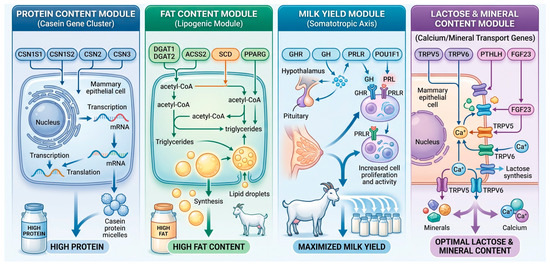
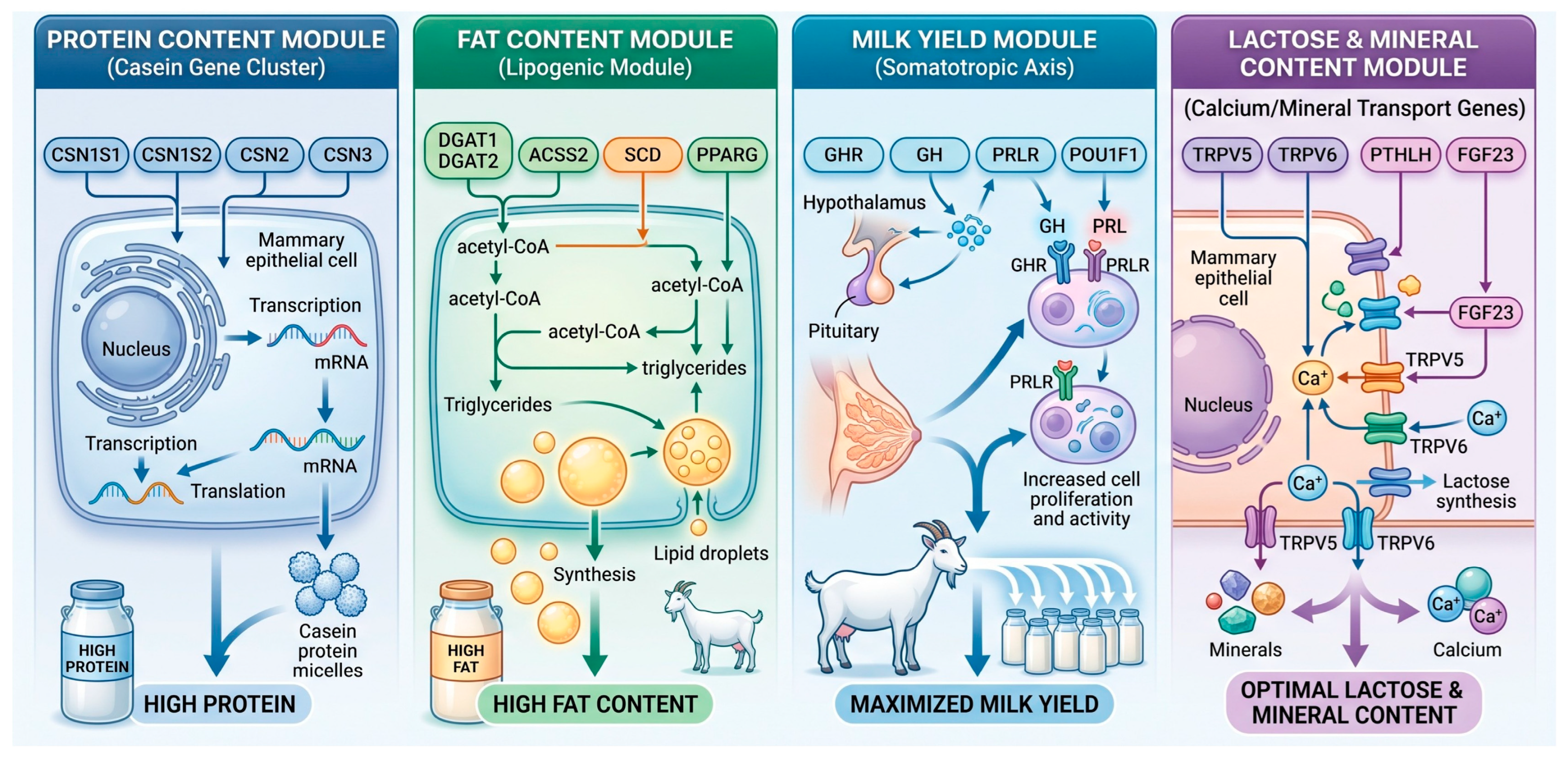

Disclaimer/Publisher’s Note: The statements, opinions and data contained in all publications are solely those of the individual author(s) and contributor(s) and not of MDPI and/or the editor(s). MDPI and/or the editor(s) disclaim responsibility for any injury to people or property resulting from any ideas, methods, instructions or products referred to in the content. |
© 2026 by the authors. Licensee MDPI, Basel, Switzerland. This article is an open access article distributed under the terms and conditions of the Creative Commons Attribution (CC BY) license.