


Simple Summary
Campylobacter jejuni is a common bacterium that causes diarrheal illness in humans. While domestic animals like poultry are known sources, the role of wild birds in spreading this pathogen remains unclear. This review aims to summarize current knowledge on how common Campylobacter jejuni is in wild birds, what factors influence its presence, and how the bacterium spreads among bird populations and potentially to livestock and humans. Our synthesis reveals that wild birds, especially migratory species, frequently carry Campylobacter jejuni and can disperse it across large geographical areas. Key factors affecting prevalence include bird species, age, season, and migration patterns. The genetic diversity of Campylobacter jejuni from wild birds overlaps with strains found in livestock and humans, suggesting cross-species transmission is possible. We conclude that wild birds represent an underappreciated reservoir for Campylobacter jejuni and may contribute to foodborne infection cycles. These findings are valuable to society because they highlight the need for integrated surveillance at the wildlife–livestock–human interface and inform public health strategies aimed at reducing campylobacteriosis risks.
Abstract
Campylobacter jejuni (C. jejuni) is a prevalent zoonotic pathogen that poses a significant threat to global public health, causing gastroenteritis with symptoms ranging from mild diarrhea to severe complications, and is widely distributed among various animal hosts, including poultry, livestock, and wild birds. Among these, wild birds, characterized by their exceptional species diversity, high mobility, and long-distance migratory behavior, are capable of disseminating infectious agents across geographic regions and ecological settings. However, wild birds are increasingly recognized as potential carriers, research on C. jejuni in these hosts remains nascent and fragmented, and a unified understanding has yet to emerge. Therefore, this review synthesizes current knowledge on the prevalence patterns, key determinants, and genetic and transmission characteristics of wild bird origin C. jejuni, aiming to provide a foundation for subsequent in-depth evaluation of the public health significance of C. jejuni derived from wild birds.
1. Introduction
Campylobacter jejuni (C. jejuni) is a prevalent zoonotic pathogen widely distributed in natural environments, with poultry, livestock, wild birds, and other wildlife serving as key reservoirs [1,2]. In humans, C. jejuni infection can result in clinical manifestations such as fever, vomiting, cramping abdominal pain, and watery or bloody diarrhea, representing a significant threat to public health [3,4]. Over recent decades, the global incidence of campylobacteriosis has risen steadily, affecting both developed and developing countries [5].
Wild birds, characterized by their exceptional species diversity, constitute one of the most biodiverse vertebrate groups and play a vital role in maintaining ecological balance [6,7]. However, they can harbor a wide range of pathogens, including viruses, bacteria, and parasites, particularly zoonotic agents, thereby posing potential risks to public health [8,9,10]. Bird migration involves large-scale, seasonal movements between established breeding and wintering sites, typically following consistent flyways [11,12]. The extensive geographic distribution, high mobility, and tendency for dense aggregations during migration enable wild birds to facilitate the spread and dissemination of various infectious agents, contributing to the potential emergence of disease outbreaks [13,14].
As important reservoirs of C. jejuni, wild birds have not yet been fully understood in terms of the bacterium’s prevalence and its potential for transmission to livestock and humans. This review therefore synthesizes the current scientific literature on C. jejuni in wild birds, summarizing the prevalence and associated influencing factors, as well as the genetic evolution and transmission dynamics of avian-origin C. jejuni. The objective is to provide a foundation for subsequent in-depth evaluation of the public health significance of C. jejuni derived from wild birds.
2. Prevalence of C. jejuni in Wild Birds
2.1. The Prevalence of C. jejuni Among Different Wild Birds
C. jejuni has been detected in a wide range of wild bird species, and preliminary statistics indicate its presence in at least 17 avian orders. However, the prevalence varies markedly among different orders, ranging from 2.68% to 64.17%. Among them, Charadriiformes, Passeriformes, and Anseriformes contributed the largest sample sizes and constituted the majority of the monitoring data. According to Table 1, the highest prevalence was found in Gruiformes at 64.17%, followed by Sulidae with a prevalence of 54.55% [15,16,17,18,19]. Several common and widely distributed orders showed moderate prevalence, approximately between 10% and 25% [20,21,22,23,24]. These include Charadriiformes at 24.80%, Pelecaniformes at 23.08%, Strigiformes at 20.00%, Passeriformes at 18.95%, Ciconiiformes at 18.39%, Procellariiformes at 16.28%, Anseriformes at 14.58%, Apodiformes at 13.16%, Columbiformes at 12.46% and Falconiformes at 11.70%. A few orders had prevalence below 10%, namely, Lariformes at 9.73%, Galliformes at 9.38%, Piciformes at 7.14% and Accipitriformes at 6.22%. Sphenisciformes showed the lowest prevalence at 2.68% [21].
Table 1.
Prevalence of C. jejuni in different orders of wild birds.
2.2. The Prevalence of C. jejuni in Wild Bird Populations Across Different Regions
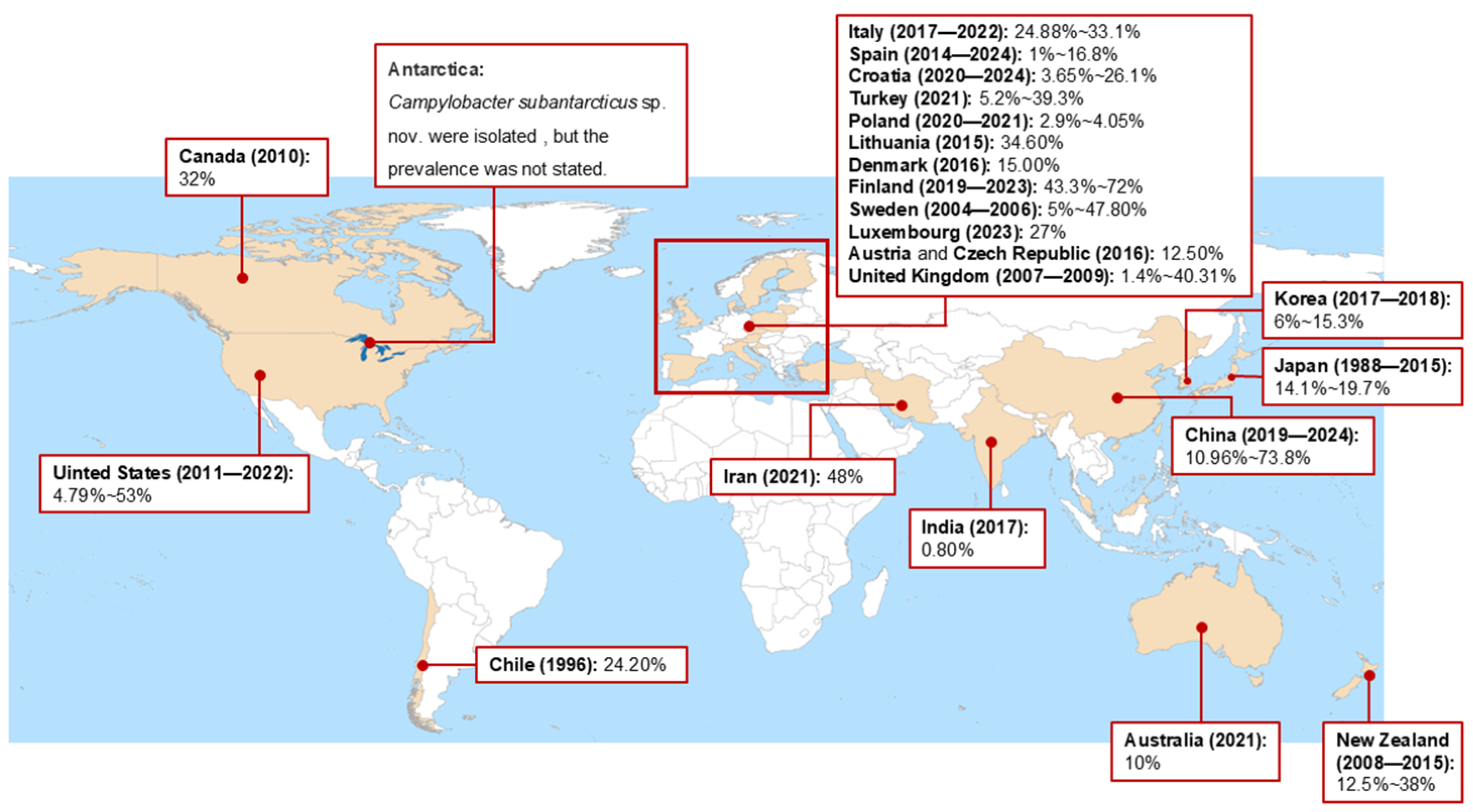
There is marked geographic variation in the reported prevalence of C. jejuni in wild birds across different regions of the world, with economically developed regions generally reporting a greater number of studies and wider prevalence ranges (Figure 1 and Table 2). Notably, C. jejuni is the predominant species reported in most regions worldwide and serves as a major pathogen associated with zoonotic diseases.
Figure 1.
Epidemiology of C. jejuni in wild birds. This heatmap shows the prevalence of C. jejuni in different countries/regions during various time periods. Countries with no reported prevalence data of C. jejuni in wild birds available were in white colour, while those with reported data were in yellow. The heatmap was plotted by https://www.bioinformatics.com.cn (last accessed on 4 May 2026).
In Europe, prevalence ranges from 1% in Spain to 72% in Finland, with intermediate rates reported in Italy (24.9%~33.1%), Croatia (3.7%~26.1%), Poland (2.9%~4.1%), Lithuania (34.6%), Luxembourg (27%), the United Kingdom (1.4%~40.3%), Denmark (15%), and Sweden (5%~47.8%) [15,17,18,20,25,26,27,28,29,30,31,32,33,34,35,36,37,38,39,40,41].
In Oceania, New Zealand reports a prevalence of 33% in urban wild birds, while Australia records approximately 10% in Pacific black ducks and Australian wood ducks [24,42]. In South America, Chile shows an overall positive rate of 24.2% in waterfowl, raptors, and urban-adapted birds [43]. In North America, the United States reports a wide range from 4.8% to 53% [22,23,44].
In Asia, China has a prevalence between 11.0% and 19.7%, South Korea between 6% and 15.3%, Japan between 14.1% and 19.7%, and India a notably low rate of 0.8% [16,45,46,47,48,49,50,51].
Table 2.
Current status and characteristics of Campylobacter spp. isolated from various wild birds.
2.3. Prevalence of Other Campylobacter Species in Wild Birds
Although C. jejuni is the most frequently reported Campylobacter species in wild birds, a diverse range of other species within the genus have also been identified in avian hosts. These include Campylobacter coli (C. coli), Campylobacter lari (C. lari), Campylobacter canadensis (C. canadensis), Campylobacter subantarcticus (C. subantarcticus), and Campylobacter volucris (C. volucris) [25,26]. Among these, C. coli and C. lari are the most frequently detected non-jejuni species and are also recognized as important causes of human gastroenteritis, although they are less prevalent than C. jejuni in clinical settings [5,42]. The prevalence of C. coli in wild birds varies considerably across studies, with reported rates ranging from 0.3% to 8.2% in European gulls [31,34], 2.7% in migratory waterfowl in China [45], and up to 11.5% in raptors from Italy [27]. Similarly, C. lari has been detected at rates of 1.2% to 9.7% in gull populations across Europe [32,34], and has been found in Antarctic penguin species with a prevalence of 4.5% [21]. Notably, some studies have reported that C. lari can be the dominant species in specific bird taxa, such as gulls and waders, suggesting potential host adaptation [39,40]. The co-occurrence of multiple Campylobacter species in the same wild bird populations raises important questions about interspecies competition, niche differentiation, and the potential for genetic exchange through horizontal gene transfer, which may have implications for the emergence of novel pathogenic strains.
3. Determinants of C. jejuni Prevalence in Wild Birds
3.1. Host-Related Factors
The prevalence of C. jejuni in wild birds is not a random occurrence but rather an ecological outcome shaped by the interplay of foraging ecology, migratory behavior, and intrinsic physiological traits. Dietary habits and activity patterns establish the baseline exposure risk, while long-distance migration facilitates pathogen dispersal, and endogenous factors such as body temperature further modulate the likelihood of carriage. Currently, the majority of research findings indicate that the prevalence of C. jejuni in carnivorous or omnivorous birds is significantly higher than that observed in herbivorous birds [15,25,40]. For instance, Mencía-Gutiérrez et al. [25] revealed a significantly higher prevalence of C. jejuni in carnivorous raptors (9.4%) compared to scavenging or insectivorous raptors (3.1%). In contrast, Hock et al. [18] found that omnivorous birds exhibited a significantly higher prevalence (49%) compared to both carnivorous (11%) and herbivorous (9%) birds. Moreover, Mencía-Gutiérrez et al. [25] noted that the prevalence of C. jejuni was significantly greater in nocturnal raptors (15.3%) than in diurnal raptors (6.0%).
Bird migration behavior represents a complex ecological phenomenon and is one of the key factors influencing the prevalence of C. jejuni in these birds. A survey conducted in South Korea on the prevalence of C. jejuni in wild birds revealed that migratory birds (specifically passage, wintering, and summering birds) exhibited a significantly higher prevalence rate of C. jejuni compared to resident birds [48]. In detail, the infection rate among passage birds such as sandpipers and curlews was found to be 19.0% (23/121) [48]. For wintering birds like ducks, the infection rate was 16.7% (286/1712), while summering birds including egrets, herons, and thrushes had an infection rate of 12.3% (18/146) [48]. All these rates were markedly higher than that of resident birds, which stood at only 2.7% [48]. It is important to note that the diverse migratory behaviors exhibited by different populations, including variations in migration routes and distances, can differ significantly among species of migratory birds [63]. These factors, along with food distribution and changes in habitat, may influence the spread and distribution of pathogens, ultimately leading to disparities in the prevalence of C. jejuni across various groups [40,45].
In addition, factors such as avian age and body temperature may influence the prevalence of C. jejuni. Konicek et al. [52] reported that the prevalence of C. jejuni among juvenile birds was 18.1%, which is significantly higher than the 8.47% observed in adult birds. This discrepancy may be attributed to the fact that the immune systems of juvenile birds are not yet fully developed [22,64]. Although wild birds typically sustain a relatively elevated body temperature, the average body temperature of certain larger species, such as barn owls and common vultures, is approximately 39.4 °C. In a study by Casalino et al. [15], no C. jejuni was detected in birds with body temperatures below 40 °C or above 42.2 °C. Consistent with this observation, the average body temperature of certain larger species, such as barn owls and griffon vultures, falls below this range, and no C. jejuni was isolated from these birds [15]. While this observation is intriguing, the in vitro growth range of C. jejuni is relatively broad (approximately 30~47 °C), and since the body temperatures of most bird species fall within this range, temperature alone is unlikely to be the primary determinant of colonization. Furthermore, direct evidence linking host body temperature to carriage rates in wild birds remains limited, and other ecological or physiological factors, such as foraging ecology, migratory behavior, immune competence, and environmental exposure, likely play more prominent roles [2,15,25,40,45]. Thus, while body temperature cannot be excluded as a contributing factor, its significance as a primary determinant requires further investigation.
3.2. Geographic Factors
Both seasonal temperature regimes and habitat characteristics exert a measurable influence on C. jejuni prevalence in wild avian populations, with warmer periods and rural or contaminated environments consistently associated with elevated carriage rates. Mohan et al. [24] indicates that the occurrence of C. jejuni in wild birds is notably higher during warmer months, specifically in September, October, November, and January. Similarly, Hald et al. [17] observed a significantly higher positivity rate in summer (20.0%, 180/901) compared to winter (15.9%, 112/706).
Habitat-mediated effects are equally pronounced. In a study of pathogen occurrence in wild birds at landfill sites in Iran, Malekian et al. [56] suggested that the highly contaminated environment of landfills may contribute to elevated infection rates in gulls, starlings, and crows. Conversely, Tryjanowski et al. [33] observed that rural great tits exhibited C. jejuni colonization odds more than 2.5 times higher than those of their urban conspecifics, with positivity increasing in proximity to livestock operations. Moreover, Mourkas et al. [65] demonstrated that urban-adapted species such as crows and starlings harbor greater C. jejuni genotypic diversity, suggesting that anthropogenic landscapes may alter transmission dynamics and strain circulation patterns.
3.3. Anthropogenic and Methodological Factors
Methodological variation constitutes a significant, non-biological source of disparity in reported C. jejuni detection rates among wild birds, with sample freshness, transport conditions, and the analytical technique employed each exerting measurable influence on recovery outcomes. Regarding sample integrity, French et al. [55] documented a substantially higher detection rate in fresh fecal specimens (15.2%) than in dry specimens (6.7%), underscoring the sensitivity of C. jejuni to desiccation. The detection rate in fresh feces was significantly higher than that observed in dry feces.
Transport conditions also critically influence recovery rates; maintaining low temperatures (e.g., 4 °C) and minimizing transport duration significantly prolong the viability of C. jejuni [66]. In terms of diagnostic methodology, quantitative PCR (qPCR) yields a higher detection frequency (32%) relative to conventional culture (29%) in waterfowl, as reported by Van Dyke et al. [62]. This differential is attributable to the capacity of qPCR to identify viable but non-culturable (VBNC) cells and extracellular DNA, whereas culture-based approaches are constrained by the selectivity and recovery efficiency of enrichment media [67,68,69].
4. Public Health Implications of C. jejuni in Wild Birds
4.1. Genomic Diversity of C. jejuni in Wild Birds
Although wild bird-derived C. jejuni exhibits high overall genomic diversity, its core genomic backbone remains highly conserved throughout evolution. Wild bird-derived C. jejuni consistently retains the typical genomic background features of the species. Its genome is a circular DNA molecule approximately 1.6~1.8 Mbp in size, with a GC content of around 30%. The genome sizes of eight C. jejuni strains obtained from wild birds in Japan ranged from 1.65 to 1.77 Mbp, falling within the typical range observed for the species when compared with isolates from other sources [46,70].
C. jejuni in wild birds exhibits a distinct population structure that is closely associated with host taxonomy, demonstrating a high degree of host specificity. As natural reservoirs with high species diversity, wild birds encompass a wide range of gut environments across taxa such as Anseriformes and Passeriformes, which may promote the emergence of host-adapted subpopulations of C. jejuni [2]. Moreover, the global migratory behavior of birds may facilitate the cross-regional dissemination of bacterial strains, thereby increasing opportunities for genetic exchange [71,72,73]. Consequently, numerous studies have compared the genetic relatedness of C. jejuni isolates from wild birds with those from poultry, humans, and other animals [2,74,75]. Some research indicates that the population structure of C. jejuni in wild birds is closely associated with host taxonomy, suggesting a high degree of host specificity [2]. Griekspoor et al. [2] conducted an analysis of C. jejuni isolates obtained from starlings in Sweden, Australia, and the Azores using MLST. Their findings revealed that starling isolates, specifically ST-1324 and ST-1342, formed distinct independent clusters. This indicates a significant level of host specificity and highlights their marked differences from isolates derived from poultry or humans. Similarly, Kovanen et al. [37] also discovered that the ST of C. jejuni isolates obtained from rooks and wild ducks, such as ST-1282 and ST-6460, were predominantly distinct from those previously identified in humans and other animals.
The sequence type repertoire of wild bird-derived C. jejuni is exceptionally rich, containing a large number of newly identified sequence types and alleles, and its genetic diversity is significantly higher than that of isolates derived from poultry and humans (Table A1). The high degree of genotypic variation among wild bird isolates has been documented in numerous regional surveys [16,18,76]. A study in South Korea isolated 60 C. jejuni strains from 12 wild bird species and identified 32 STs through multilocus sequence typing (MLST) analysis [46]. Similarly, Ječmenica et al. [76] applied MLST to 106 C. jejuni isolates from yellow-legged gulls, revealing 44 STs, including 11 novel types. In a study of wild birds conducted in the Beijing region of China, MLST analysis of 36 C. jejuni isolates assigned them to four clonal complexes together with several sequence types that could not be grouped into any defined complex; among these, 20 STs (accounting for 55.56% of the total) and 6 alleles were documented for the first time [16]. In another study, Mäesaar et al. [77] conducted MLST on 101 C. jejuni isolates derived from wild birds and identified 68 STs, representing the highest genetic diversity compared to isolates from other sources such as humans, poultry, and cattle.
4.2. Transmission Dynamics of C. jejuni in Wild Birds
As summarized in Table A1, wild birds constitute a significant reservoir for C. jejuni; accumulating evidence indicates that avian-derived strains can be transmitted across species boundaries to poultry, livestock, and human populations via multiple environmental pathways. Genomic evidence supports the potential for direct zoonotic transmission. C. jejuni derived from wild birds can infect humans, poultry, and livestock directly or indirectly through fecal contamination [18,46,78]. For example, French et al. [55] revealed that the PFGE profiles of ST-45 isolates obtained from wild bird feces in a city park playground in New Zealand were indistinguishable from those of isolates derived from human cases within the same country. This finding suggests that feces from wild birds may be a potential source of campylobacteriosis among preschool children. Mohan et al. [54] likewise reported ST-45 and ST-177 in mallards and starlings, sequence types that have been associated with human infections. Furthermore, wild bird-derived C. jejuni strains belonging to ST-677, ST-45, and ST-267 have shown genotype overlap with poultry isolates, and ST-806 has been linked to livestock abortion cases [54,79]. Collectively, these molecular overlaps highlight the potential for cross-host transmission facilitated by wild birds. Domestic poultry, particularly free-range flocks, may become infected through direct contact with wild birds or their excreta. Kovanen et al. [37] reported higher C. jejuni positivity rates in domestic ducks that cohabited with wild waterfowl. However, a large-scale UK study involving 2084 wild birds indicated that the predominant direction of transmission may be from poultry to wild birds [20]. In this study, both poultry-associated and wild bird-specific sequence types were isolated from wild birds, whereas no wild bird-specific strains were detected in commercial poultry populations.
Wild birds are recognized as a major source of C. jejuni contamination in surface waters. A Canadian study comparing C. jejuni isolates from river water and waterfowl revealed 100% genetic homology, suggesting that waterfowl contribute significantly to aquatic pollution [62]. Human campylobacteriosis outbreaks in Norway in 1994 and 1995 were suspected to be linked to drinking water contaminated by feces from bean geese [80]. The hydrological cycle plays a critical role in the dissemination of C. jejuni among wild birds, poultry, livestock, and humans. C. jejuni can enter surface water through wastewater discharge, and animals such as cattle, chickens, and wild birds may become infected via contact with contaminated water. Subsequently, their feces can contaminate agricultural land, serving as a persistent source of infection for other animals, food products, and water supplies [81,82].
C. jejuni from wild birds can also be transmitted to humans and livestock through soil and crop contamination. During an outbreak of human campylobacteriosis in Alaska, USA, linked to the consumption of raw peas, C. jejuni isolates from patients, environmental samples, and wild sandhill cranes displayed indistinguishable PFGE patterns. It was hypothesized that sandhill cranes defecated in pea fields, leading to contamination, and that ingestion of raw, contaminated peas constituted the primary transmission route [83].
Additionally, insects such as flies may act as mechanical vectors in the transmission of C. jejuni among wild birds. In a study by Hock et al. [18], C. jejuni isolates ST-1044 and ST-475, which were identical to those found in human clinical cases, were detected in swifts. Given that swifts feed on flying insects, it has been speculated that insects may play a role in the transmission cycle of C. jejuni to wild birds. Collectively, these findings underscore the interconnectedness of wild bird ecology, environmental contamination, and public health risk.
4.3. Virulence Factors and Antimicrobial Resistance of C. jejuni in Wild Birds
Available data indicate that C. jejuni isolates from wild bird hosts routinely possess a defined suite of virulence genes associated with adherence, invasion, and cytotoxicity, although natural infections seldom produce observable clinical disease [84,85]. Among the most frequently detected determinants are the cytolethal distending toxin gene cluster, which comprises cdtA, cdtB, and cdtC, along with flagellin genes (flaA, flaB), the invasion-associated gene ciaB, and the fibronectin-binding adhesin gene cadF [16,49]. The presence of cadF has been documented in wild bird populations across multiple countries, including China, Poland, and Japan [16,26,49].
Beyond the carriage of virulence genes, the antimicrobial resistance profile of C. jejuni derived from wild birds presents additional dimensions of public health concern. Overall, the antimicrobial resistance profile of C. jejuni derived from wild birds is characterized by a comparatively high degree of baseline susceptibility, widespread resistance to certain antimicrobial agents, and the incipient emergence of multidrug resistance. Compared with isolates originating from intensively reared poultry, wild bird strains generally exhibit lower rates of antimicrobial resistance and multidrug resistance [74,86]. However, this does not imply that the associated public health risk can be disregarded. Multiple studies have consistently demonstrated that resistance to quinolones (e.g., ciprofloxacin, nalidixic acid, enrofloxacin) and sulfonamides is the most prevalent among wild bird isolates, with fluoroquinolone resistance having already become a global phenomenon [74,86]. Multidrug-resistant strains have been detected in wild birds sampled at a wildlife rescue centre in Italy, indicating a progressive accumulation of resistance traits in wild hosts [87]. With respect to resistance mechanisms, strains from wild birds share key resistance determinants with isolates from poultry and human clinical cases (Table A1). Nearly all wild bird-derived strains carry OXA-type β-lactamase genes, which confer an intrinsic basis for resistance to β-lactam antibiotics [74,86,88,89]. High-level quinolone resistance is predominantly mediated by the T86I point mutation in gyrA, a mutation that has been detected in isolates from wild birds alike [74,86].
5. Future Perspective
Wild birds serve as important natural reservoirs for C. jejuni [18]. Their migratory behavior facilitates the transmission and spread of this pathogen, effectively acting as a mobile source of infection that connects livestock, humans, and natural environments [45,89]. Therefore, in-depth research on C. jejuni in wild birds, particularly its transmission pathways, is of great significance for early warning of emerging risks.
Current studies primarily focus on the detection of C. jejuni, with some involving antimicrobial resistance analysis and comparisons of population structure across hosts [40,74,90]. However, several limitations remain apparent [22,45,87]. Most existing surveys are situational studies targeting specific regions or bird species, lacking systematic, long-term monitoring networks across ecological zones. This makes it difficult to reveal macro-level epidemiological patterns. Moreover, research methods remain relatively conventional, relying heavily on bacterial culture and typing, while underexploring genetic evolutionary characteristics, virulence factors, and resistance mechanisms of bacterial strains [2,90,91]. As a result, effective traceability and accurate assessment of their true pathogenic risks are hindered.
Finally, although numerous studies have reported carriage rates in wild birds, direct evidence and quantitative models are still lacking regarding their specific role in transmission dynamics (such as how strains are disseminated to farms or water bodies) and how environmental pressures (e.g., climate change, habitat destruction) influence bacterial shedding patterns. Moreover, a critical limitation of current molecular epidemiological studies is that the detection of shared genotypes or antimicrobial resistance determinants between wild bird, livestock, and human isolates has often been taken as suggestive of cross-host transmission. However, such overlaps alone do not constitute definitive evidence of transmission directionality or frequency [20]. The epidemiological significance of these shared genetic markers remains difficult to interpret without integrating source-attribution models and population genetic frameworks that can distinguish between occasional spillover events and sustained transmission cycles [38,65]. Beyond molecular approaches, future investigations should also incorporate field epidemiological tools, such as GPS tracking of individual birds, to directly link host movement patterns with bacterial dispersal and environmental contamination risks. Combining high-resolution genomic data (e.g., whole-genome sequencing and core-genome MLST) with real-time spatial–behavioral data would provide a powerful framework for elucidating the true extent of C. jejuni transmission among wild bird populations, livestock, and humans, and for assessing the impact of anthropogenic and climatic changes on these dynamics.
Looking forward, advanced technologies such as whole-genome sequencing should be utilized to thoroughly analyze the genetic background of C. jejuni isolated from wild birds. Through comparative genomics, evolutionary relationships between wild bird isolates and strains from human clinical cases and livestock can be clarified, aiding in tracing the origin of outbreaks. Simultaneously, research on pathogen–host interactions should be strengthened to explore how the immune physiology of different bird species influences their carrier status. From a prevention and control perspective, it is essential to implement comprehensive surveillance programs and establish interdisciplinary, cross-regional collaborative networks for long-term and continuous sampling and monitoring of wild bird populations, particularly along major migration routes. In addition, integrating ecology, bird banding data, and microbial genomics will help map the spatiotemporal dynamics of C. jejuni in wild bird populations, with special attention to species that have frequent contact with humans and livestock.
Author Contributions
L.Z.: Writing–original draft, Data curation, Conceptualization. Z.L.: Data curation. J.D.: Data curation. X.Z.: Data curation. F.R.: Validation, Supervision, Conceptualization. Y.T.: Supervision, Conceptualization. X.J.: Supervision, Resources, Project administration. J.H.: Validation, Supervision, Resources, Project administration, Funding acquisition, Conceptualization. All authors have read and agreed to the published version of the manuscript.
Funding
This study was financially supported by the National Key Research and Development Program of China (grant number 2024YFC2310300) and the National Natural Science Foundation of China (32473117).
Institutional Review Board Statement
Not applicable.
Informed Consent Statement
Not applicable.
Data Availability Statement
No new data were created or analyzed in this study. Data sharing is not applicable to this article.
Acknowledgments
We declare that this manuscript is original, has not been published before and is not currently being considered for publication elsewhere. During the preparation of this manuscript, the authors used DeepSeek V3.2 for the purposes of polishing the English language and enhancing the overall readability of the translated text. The authors have reviewed and edited the output and take full responsibility for the content of this publication.
Conflicts of Interest
The authors declare no conflicts of interest.
Appendix A
Table A1.
Comparison of C. jejuni Molecular Characteristics across Wild Bird, Livestock, and Human Hosts.
References
- Bonnedahl, J.; Järhult, J.D. Antibiotic resistance in wild birds. Upsala J. Med. Sci. 2014, 119, 113–116. [Google Scholar] [CrossRef] [Scilit] [PubMed]
- Griekspoor, P.; Colles, F.M.; McCarthy, N.D.; Hansbro, P.M.; Ashhurst-Smith, C.; Olsen, B.; Hasselquist, D.; Maiden, M.C.; Waldenström, J. Marked host specificity and lack of phylogeographic population structure of Campylobacter jejuni in wild birds. Mol. Ecol. 2013, 22, 1463–1472. [Google Scholar] [CrossRef] [Scilit] [PubMed]
- Havelaar, A.H.; Kirk, M.D.; Torgerson, P.R.; Gibb, H.J.; Hald, T.; Lake, R.J.; Praet, N.; Bellinger, D.C.; de Silva, N.R.; Gargouri, N.; et al. World Health Organization Global Estimates and Regional Comparisons of the Burden of Foodborne Disease in 2010. PLoS Med. 2015, 12, e1001923. [Google Scholar] [CrossRef] [Scilit] [PubMed]
- Igwaran, A.; Okoh, A.I. Human campylobacteriosis: A public health concern of global importance. Heliyon 2019, 5, e02814. [Google Scholar] [CrossRef] [Scilit] [PubMed]
- Kaakoush, N.O.; Castaño-Rodríguez, N.; Mitchell, H.M.; Man, S.M. Global Epidemiology of Campylobacter Infection. Clin. Microbiol. Rev. 2015, 28, 687–720. [Google Scholar] [CrossRef] [Scilit] [PubMed]
- Root, T.L.; Price, J.T.; Hall, K.R.; Schneider, S.H.; Rosenzweig, C.; Pounds, J.A. Fingerprints of global warming on wild animals and plants. Nature 2003, 421, 57–60. [Google Scholar] [CrossRef] [Scilit] [PubMed]
- Zhang, Q.; Han, J.; Xia, C.; Møller, A.P. A dataset of bird distributions in zoogeographical regions of China. Biodivers. Data J. 2022, 10, e93606. [Google Scholar] [CrossRef] [Scilit] [PubMed]
- Smith, K.F.; Behrens, M.; Schloegel, L.M.; Marano, N.; Burgiel, S.; Daszak, P. Reducing the risks of the wildlife trade. Science 2009, 324, 594–595. [Google Scholar] [CrossRef] [Scilit] [PubMed]
- Brown, V.L.; Drake, J.M.; Stallknecht, D.E.; Brown, J.D.; Pedersen, K.; Rohani, P. Dissecting a wildlife disease hotspot: The impact of multiple host species, environmental transmission and seasonality in migration, breeding and mortality. J. R. Soc. Interface 2013, 10, 20120804. [Google Scholar] [CrossRef] [Scilit] [PubMed]
- Matias, C.A.; Pereira, I.A.; Reis, E.M.; Rodrigues, D.D.; Siciliano, S. Frequency of zoonotic bacteria among illegally traded wild birds in Rio de Janeiro. Braz. J. Microbiol. 2016, 47, 882–888. [Google Scholar] [CrossRef] [Scilit] [PubMed]
- Altizer, S.; Bartel, R.; Han, B.A. Animal migration and infectious disease risk. Science 2011, 331, 296–302. [Google Scholar] [CrossRef] [Scilit] [PubMed]
- Chung, D.M.; Ferree, E.; Simon, D.M.; Yeh, P.J. Patterns of Bird-Bacteria Associations. Ecohealth 2018, 15, 627–641. [Google Scholar] [PubMed]
- García-Carrasco, J.M.; Muñoz, A.R.; Olivero, J.; Segura, M.; Real, R. Mapping the Risk for West Nile Virus Transmission, Africa. Emerg. Infect. Dis. 2022, 28, 777–785. [Google Scholar] [CrossRef] [Scilit] [PubMed]
- Gao, Z.; Song, H.; Dong, H.; Ji, X.; Lei, Z.; Tian, Y.; Wu, Y.; Zou, H. Comparative analysis of intestinal flora between rare wild red-crowned crane and white-naped crane. Front. Microbiol. 2022, 13, 1007884. [Google Scholar] [PubMed]
- Casalino, G.; D’Amico, F.; Dinardo, F.R.; Bozzo, G.; Napoletano, V.; Camarda, A.; Bove, A.; Lombardi, R.; D’Onghia, F.P.; Circella, E. Prevalence and Antimicrobial Resistance of Campylobacter jejuni and Campylobacter coli in Wild Birds from a Wildlife Rescue Centre. Animals 2022, 12, 2889. [Google Scholar] [CrossRef] [Scilit] [PubMed]
- Du, J.; Luo, J.; Huang, J.; Wang, C.; Li, M.; Wang, B.; Wang, B.; Chang, H.; Ji, J.; Sen, K.; et al. Emergence of Genetic Diversity and Multi-Drug Resistant Campylobacter jejuni From Wild Birds in Beijing, China. Front. Microbiol. 2019, 10, 2433. [Google Scholar] [CrossRef] [Scilit] [PubMed]
- Hald, B.; Skov, M.N.; Nielsen, E.M.; Rahbek, C.; Madsen, J.J.; Wainø, M.; Chriél, M.; Nordentoft, S.; Baggesen, D.L.; Madsen, M. Campylobacter jejuni and Campylobacter coli in wild birds on Danish livestock farms. Acta Vet. Scand. 2016, 58, 11. [Google Scholar] [PubMed]
- Hock, L.; Herold, M.; Walczak, C.; Schoos, A.; Penny, C.; Cauchie, H.M.; Ragimbeau, C. Environmental dynamics of Campylobacter jejuni genotypes circulating in Luxembourg: What is the role of wild birds? Microb. Genom. 2023, 9, 001031. [Google Scholar] [CrossRef] [Scilit]
- Kürekci, C.; Sakin, F.; Epping, L.; Knüver, M.T.; Semmler, T.; Stingl, K. Characterization of Campylobacter spp. Strains Isolated from Wild Birds in Turkey. Front. Microbiol. 2021, 12, 712106. [Google Scholar] [CrossRef] [Scilit] [PubMed]
- Hughes, L.A.; Bennett, M.; Coffey, P.; Elliott, J.; Jones, T.R.; Jones, R.C.; Lahuerta-Marin, A.; Leatherbarrow, A.H.; McNiffe, K.; Norman, D.; et al. Molecular epidemiology and characterization of Campylobacter spp. isolated from wild bird populations in northern England. Appl. Environ. Microbiol. 2009, 75, 3007–3015. [Google Scholar] [CrossRef] [Scilit] [PubMed]
- Johansson, H.; Ellström, P.; Artursson, K.; Berg, C.; Bonnedahl, J.; Hansson, I.; Hernandez, J.; Lopez-Martín, J.; Medina-Vogel, G.; Moreno, L.; et al. Characterization of Campylobacter spp. isolated from wild birds in the Antarctic and Sub-Antarctic. PLoS ONE 2018, 13, e0206502. [Google Scholar] [CrossRef] [Scilit] [PubMed]
- Keller, J.I.; Shriver, W.G. Prevalence of three campylobacter species, C. jejuni, C. coli, and C. lari, using multilocus sequence typing in wild birds of the Mid-Atlantic region, USA. J. Wildl. Dis. 2014, 50, 31–41. [Google Scholar] [CrossRef] [Scilit] [PubMed]
- Keller, J.I.; Shriver, W.G.; Waldenström, J.; Griekspoor, P.; Olsen, B. Prevalence of Campylobacter in wild birds of the mid-Atlantic region, USA. J. Wildl. Dis. 2011, 47, 750–754. [Google Scholar] [CrossRef] [Scilit] [PubMed]
- Mohan, V. Faeco-prevalence of Campylobacter jejuni in urban wild birds and pets in New Zealand. BMC Res. Notes 2015, 8, 1. [Google Scholar] [CrossRef] [Scilit] [PubMed]
- Mencía-Gutiérrez, A.; Martín-Maldonado, B.; Pastor-Tiburón, N.; Moraleda, V.; González, F.; García-Peña, F.J.; Pérez-Cobo, I.; Revuelta, L.; Marín, M. Prevalence and antimicrobial resistance of Campylobacter from wild birds of prey in Spain. Comp. Immunol. Microbiol. Infect. Dis. 2021, 79, 101712. [Google Scholar] [CrossRef] [Scilit] [PubMed]
- Krawiec, M.; Woźniak-Biel, A.; Bednarski, M.; Wieliczko, A. Antimicrobial Susceptibility and Genotypic Characteristic of Campylobacter spp. Isolates from Free-Living Birds in Poland. Vector Borne Zoonotic Dis. 2017, 17, 755–763. [Google Scholar] [CrossRef] [Scilit] [PubMed]
- Gargiulo, A.; Fioretti, A.; Russo, T.P.; Varriale, L.; Rampa, L.; Paone, S.; De Luca Bossa, L.M.; Raia, P.; Dipineto, L. Occurrence of enteropathogenic bacteria in birds of prey in Italy. Lett. Appl. Microbiol. 2018, 66, 202–206. [Google Scholar] [PubMed]
- Mencía-Gutiérrez, A.; García-Peña, F.J.; González, F.; Pastor-Tiburón, N.; Pérez-Cobo, I.; Marín, M.; Martín-Maldonado, B. Exploring the Prevalence and Resistance of Campylobacter in Urban Bird Populations. Vet. Sci. 2024, 11, 210. [Google Scholar] [CrossRef] [Scilit] [PubMed]
- Marin, C.; Palomeque, M.D.; Marco-Jiménez, F.; Vega, S. Wild griffon vultures (Gyps fulvus) as a source of Salmonella and Campylobacter in Eastern Spain. PLoS ONE 2014, 9, e94191. [Google Scholar] [CrossRef] [Scilit] [PubMed]
- Latorre, L.; Larrinaga, A.R.; Santamaría, L. Rats and seabirds: Effects of egg size on predation risk and the potential of conditioned taste aversion as a mitigation method. PLoS ONE 2013, 8, e76138. [Google Scholar] [CrossRef] [Scilit] [PubMed]
- Jurinović, L.; Duvnjak, S.; Kompes, G.; Šoprek, S.; Šimpraga, B.; Krstulović, F.; Mikulić, M.; Humski, A. Occurrence of Campylobacter jejuni in Gulls Feeding on Zagreb Rubbish Tip, Croatia; Their Diversity and Antimicrobial Susceptibility in Perspective with Human and Broiler Isolates. Pathogens 2020, 9, 695. [Google Scholar] [CrossRef] [Scilit] [PubMed]
- Jurinović, L.; Duvnjak, S.; Humski, A.; Ječmenica, B.; Taylor, L.T.; Šimpraga, B.; Krstulović, F.; Zelenika, T.A.; Kompes, G. Genetic Diversity and Resistome Analysis of Campylobacter lari Isolated from Gulls in Croatia. Antibiotics 2023, 12, 1310. [Google Scholar] [CrossRef] [Scilit] [PubMed]
- Tryjanowski, P.; Nowakowski, J.J.; Indykiewicz, P.; Andrzejewska, M.; Śpica, D.; Sandecki, R.; Mitrus, C.; Goławski, A.; Dulisz, B.; Dziarska, J.; et al. Campylobacter in wintering great tits Parus major in Poland. Environ. Sci. Pollut. Res. Int. 2020, 27, 7570–7577. [Google Scholar] [PubMed]
- Indykiewicz, P.; Andrzejewska, M.; Minias, P.; Śpica, D.; Kowalski, J. Prevalence and Antibiotic Resistance of Campylobacter spp. in Urban and Rural Black-Headed Gulls Chroicocephalus ridibundus. Ecohealth 2021, 18, 147–156. [Google Scholar] [CrossRef] [Scilit] [PubMed]
- Ramonaitė, S.; Novoslavskij, A.; Zakarienė, G.; Aksomaitienė, J.; Malakauskas, M. High Prevalence and Genetic Diversity of Campylobacter jejuni in Wild Crows and Pigeons. Curr. Microbiol. 2015, 71, 559–565. [Google Scholar] [CrossRef] [Scilit] [PubMed]
- Colles, F.M.; Dingle, K.E.; Cody, A.J.; Maiden, M.C. Comparison of Campylobacter populations in wild geese with those in starlings and free-range poultry on the same farm. Appl. Environ. Microbiol. 2008, 74, 3583–3590. [Google Scholar] [CrossRef] [Scilit] [PubMed]
- Kovanen, S.; Rossi, M.; Pohja-Mykrä, M.; Nieminen, T.; Raunio-Saarnisto, M.; Sauvala, M.; Fredriksson-Ahomaa, M.; Hänninen, M.L.; Kivistö, R. Population Genetics and Characterization of Campylobacter jejuni Isolates from Western Jackdaws and Game Birds in Finland. Appl. Environ. Microbiol. 2019, 85, e02365-18. [Google Scholar] [CrossRef] [Scilit] [PubMed]
- Kivistö, R.; Sauvala, M.; Fredriksson-Ahomaa, M.; Björkroth, J. Prevalence and genotype diversity of Campylobacter jejuni in hunted reared pheasants (Phasianus colchicus) in Finland. Acta Vet. Scand. 2023, 65, 36. [Google Scholar] [CrossRef] [Scilit] [PubMed]
- Waldenström, J.; On, S.L.; Ottvall, R.; Hasselquist, D.; Olsen, B. Species diversity of campylobacteria in a wild bird community in Sweden. J. Appl. Microbiol. 2007, 102, 424–432. [Google Scholar] [PubMed]
- Waldenström, J.; Broman, T.; Carlsson, I.; Hasselquist, D.; Achterberg, R.P.; Wagenaar, J.A.; Olsen, B. Prevalence of Campylobacter jejuni, Campylobacter lari, and Campylobacter coli in different ecological guilds and taxa of migrating birds. Appl. Environ. Microbiol. 2002, 68, 5911–5917. [Google Scholar] [PubMed]
- Broman, T.; Waldenström, J.; Dahlgren, D.; Carlsson, I.; Eliasson, I.; Olsen, B. Diversities and similarities in PFGE profiles of Campylobacter jejuni isolated from migrating birds and humans. J. Appl. Microbiol. 2004, 96, 834–843. [Google Scholar] [CrossRef] [Scilit] [PubMed]
- Chlebicz, A.; Śliżewska, K. Campylobacteriosis, Salmonellosis, Yersiniosis, and Listeriosis as Zoonotic Foodborne Diseases: A Review. Int. J. Environ. Res. Public. Health 2018, 15, 863. [Google Scholar] [CrossRef] [Scilit] [PubMed]
- Fernández, H.; Gesche, W.; Montefusco, A.; Schlatter, R. Wild birds as reservoir of thermophilic enteropathogenic Campylobacter species in southern Chile. Mem. Inst. Oswaldo Cruz 1996, 91, 699–700. [Google Scholar] [CrossRef] [Scilit] [PubMed]
- Miller, W.G.; Lopes, B.S.; Chapman, M.H.; Williams, T.G.; Ramjee, M.; Wood, D.F.; Bono, J.L.; Forbes, K.J. Campylobacter molothri sp. nov. isolated from wild birds. Int. J. Syst. Evol. Microbiol. 2025, 75, 006635. [Google Scholar] [CrossRef] [Scilit] [PubMed]
- Wu, S.; Jia, R.; Wang, Y.; Li, J.; Li, Y.; Wang, L.; Wang, Y.; Liu, C.; Jia, E.M.; Wang, Y.; et al. Prevalence, Diversity, and Virulence of Campylobacter Carried by Migratory Birds at Four Major Habitats in China. Pathogens 2024, 13, 230. [Google Scholar] [CrossRef] [Scilit] [PubMed]
- Wei, B.; Kang, M.; Jang, H.K. Genetic characterization and epidemiological implications of Campylobacter isolates from wild birds in South Korea. Transbound. Emerg. Dis. 2019, 66, 56–65. [Google Scholar] [PubMed]
- Wei, B.; Kang, M. In vitro activity of fosfomycin against Campylobacter isolates from poultry and wild birds. PLoS ONE 2018, 13, e0200853. [Google Scholar] [CrossRef] [Scilit] [PubMed]
- Kwon, Y.K.; Oh, J.Y.; Jeong, O.M.; Moon, O.K.; Kang, M.S.; Jung, B.Y.; An, B.K.; Youn, S.Y.; Kim, H.R.; Jang, I.; et al. Prevalence of Campylobacter species in wild birds of South Korea. Avian Pathol. 2017, 46, 474–480. [Google Scholar] [CrossRef] [Scilit] [PubMed]
- Shyaka, A.; Kusumoto, A.; Chaisowwong, W.; Okouchi, Y.; Fukumoto, S.; Yoshimura, A.; Kawamoto, K. Virulence characterization of Campylobacter jejuni isolated from resident wild birds in Tokachi area, Japan. J. Vet. Med. Sci. 2015, 77, 967–972. [Google Scholar] [CrossRef] [Scilit] [PubMed]
- Ito, K.; Kubokura, Y.; Kaneko, K.; Totake, Y.; Ogawa, M. Occurrence of Campylobacter jejuni in free-living wild birds from Japan. J. Wildl. Dis. 1988, 24, 467–470. [Google Scholar] [CrossRef] [Scilit] [PubMed]
- Ibrahim Mohamed, M.Y.; Abu, J.; Aziz, S.A.; Zakaria, Z.; Khan, A.R.; Habib, I. Occurrence of antibiotic resistant C. jejuni and E. coli in wild birds, chickens, humans, and the environment in Malay villages, Kedah, Malaysia. Vet. Med. 2022, 67, 298–308. [Google Scholar] [CrossRef] [Scilit]
- Konicek, C.; Vodrážka, P.; Barták, P.; Knotek, Z.; Hess, C.; Račka, K.; Hess, M.; Troxler, S. Detection of zoonotic pathogens in wild birds in the cross-border region austria-czech republic. J. Wildl. Dis. 2016, 52, 850–861. [Google Scholar] [PubMed]
- Young, P.; Tarce, P.; Adhikary, S.; Connolly, J.; Crawshaw, T.; Ghorashi, S.A. Evaluation of high-resolution melt curve analysis for rapid differentiation of Campylobacter hepaticus from other species in birds. PLoS ONE 2021, 16, e0251328. [Google Scholar] [CrossRef] [Scilit] [PubMed]
- Mohan, V.; Stevenson, M.; Marshall, J.; Fearnhead, P.; Holland, B.R.; Hotter, G.; French, N.P. Campylobacter jejuni colonization and population structure in urban populations of ducks and starlings in New Zealand. Microbiologyopen 2013, 2, 659–673. [Google Scholar] [PubMed]
- French, N.P.; Midwinter, A.; Holland, B.; Collins-Emerson, J.; Pattison, R.; Colles, F.; Carter, P. Molecular epidemiology of Campylobacter jejuni isolates from wild-bird fecal material in children’s playgrounds. Appl. Environ. Microbiol. 2009, 75, 779–783. [Google Scholar] [PubMed]
- Malekian, M.; Shagholian, J.; Hosseinpour, Z. Pathogen Presence in Wild Birds Inhabiting Landfills in Central Iran. Ecohealth 2021, 18, 76–83. [Google Scholar] [CrossRef] [Scilit] [PubMed]
- Prince Milton, A.A.; Agarwal, R.K.; Priya, G.B.; Saminathan, M.; Aravind, M.; Reddy, A.; Athira, C.K.; Anjay, P.; Ramees, T.P.; Dhama, K.; et al. Prevalence of Campylobacter jejuni and Campylobacter coli in captive wildlife species of India. Iran. J. Vet. Res. 2017, 18, 177–182. [Google Scholar] [PubMed]
- Smith, O.M.; Olimpi, E.M.; Navarro-Gonzalez, N.; Cornell, K.A.; Frishkoff, L.O.; Northfield, T.D.; Bowles, T.M.; Edworthy, M.; Eilers, J.; Fu, Z.; et al. A trait-based framework for predicting foodborne pathogen risk from wild birds. Ecol. Appl. 2022, 32, e2523. [Google Scholar] [PubMed]
- Lawton, S.J.; Weis, A.M.; Byrne, B.A.; Fritz, H.; Taff, C.C.; Townsend, A.K.; Weimer, B.C.; Mete, A.; Wheeler, S.; Boyce, W.M. Comparative analysis of Campylobacter isolates from wild birds and chickens using MALDI-TOF MS, biochemical testing, and DNA sequencing. J. Vet. Diagn. Investig. 2018, 30, 354–361. [Google Scholar] [CrossRef] [Scilit]
- Taff, C.C.; Weis, A.M.; Wheeler, S.; Hinton, M.G.; Weimer, B.C.; Barker, C.M.; Jones, M.; Logsdon, R.; Smith, W.A.; Boyce, W.M.; et al. Influence of Host Ecology and Behavior on Campylobacter jejuni Prevalence and Environmental Contamination Risk in a Synanthropic Wild Bird Species. Appl. Environ. Microbiol. 2016, 82, 4811–4820. [Google Scholar] [CrossRef] [Scilit] [PubMed]
- Sippy, R.; Sandoval-Green, C.M.; Sahin, O.; Plummer, P.; Fairbanks, W.S.; Zhang, Q.; Blanchong, J.A. Occurrence and molecular analysis of Campylobacter in wildlife on livestock farms. Vet. Microbiol. 2012, 157, 369–375. [Google Scholar] [CrossRef] [Scilit] [PubMed]
- Van Dyke, M.I.; Morton, V.K.; McLellan, N.L.; Huck, P.M. The occurrence of Campylobacter in river water and waterfowl within a watershed in southern Ontario, Canada. J. Appl. Microbiol. 2010, 109, 1053–1066. [Google Scholar] [CrossRef] [Scilit] [PubMed]
- Kürten, N.; Schmaljohann, H.; Bichet, C.; Haest, B.; Vedder, O.; González-Solís, J.; Bouwhuis, S. High individual repeatability of the migratory behaviour of a long-distance migratory seabird. Mov. Ecol. 2022, 10, 5. [Google Scholar] [CrossRef] [Scilit] [PubMed]
- Poosakkannu, A.; Xu, Y.; Suominen, K.M.; Meierhofer, M.B.; Sørensen, I.H.; Madsen, J.J.; Plaquin, B.; Guillemain, M.; Joyeux, E.; Keišs, O.; et al. Pathogenic bacterial taxa constitute a substantial portion of fecal microbiota in common migratory bats and birds in Europe. Microbiol. Spectr. 2025, 13, e0194824. [Google Scholar] [CrossRef] [Scilit] [PubMed]
- Mourkas, E.; Valdebenito, J.O.; Marsh, H.; Hitchings, M.D.; Cooper, K.K.; Parker, C.T.; Székely, T.; Johansson, H.; Ellström, P.; Pascoe, B.; et al. Proximity to humans is associated with antimicrobial-resistant enteric pathogens in wild bird microbiomes. Curr. Biol. 2024, 34, 3955–3965. [Google Scholar] [CrossRef] [Scilit] [PubMed]
- Abulreesh, H.H.; Paget, T.A.; Goulder, R. Campylobacter in waterfowl and aquatic environments: Incidence and methods of detection. Environ. Sci. Technol. 2006, 40, 7122–7131. [Google Scholar] [CrossRef] [Scilit] [PubMed]
- Lv, R.; Wang, K.; Feng, J.; Heeney, D.D.; Liu, D.; Lu, X. Detection and Quantification of Viable but Non-culturable Campylobacter jejuni. Front. Microbiol. 2019, 10, 2920. [Google Scholar] [PubMed]
- Reichelt, B.; Szott, V.; Stingl, K.; Roesler, U.; Friese, A. Detection of Viable but Non-Culturable (VBNC)-Campylobacter in the Environment of Broiler Farms: Innovative Insights Delivered by Propidium Monoazide (PMA)-v-qPCR Analysis. Microorganisms 2023, 11, 2492. [Google Scholar] [PubMed]
- Seinige, D.; von Köckritz-Blickwede, M.; Krischek, C.; Klein, G.; Kehrenberg, C. Influencing factors and applicability of the viability EMA-qPCR for a detection and quantification of Campylobacter cells from water samples. PLoS ONE 2014, 9, e113812. [Google Scholar] [PubMed]
- Shyaka, A.; Kusumoto, A.; Asakura, H.; Kawamoto, K. Whole-Genome Sequences of Eight Campylobacter jejuni Isolates from Wild Birds. Genome Announc. 2015, 3, e00315-15. [Google Scholar] [CrossRef] [Scilit] [PubMed]
- Akhil Prakash, E.; Hromádková, T.; Jabir, T.; Vipindas, P.V.; Krishnan, K.P.; Mohamed Hatha, A.A.; Briedis, M. Dissemination of multidrug resistant bacteria to the polar environment—Role of the longest migratory bird Arctic tern (Sterna paradisaea). Sci. Total Environ. 2022, 815, 152727. [Google Scholar] [PubMed]
- Lin, Y.; Dong, X.; Sun, R.; Wu, J.; Tian, L.; Rao, D.; Zhang, L.; Yang, K. Migratory birds-one major source of environmental antibiotic resistance around Qinghai Lake, China. Sci. Total Environ. 2020, 739, 139758. [Google Scholar] [CrossRef] [Scilit] [PubMed]
- Yuan, Y.; Liang, B.; Jiang, B.W.; Zhu, L.W.; Wang, T.C.; Li, Y.G.; Liu, J.; Guo, X.J.; Ji, X.; Sun, Y. Migratory wild birds carrying multidrug-resistant Escherichia coli as potential transmitters of antimicrobial resistance in China. PLoS ONE 2021, 16, e0261444. [Google Scholar] [CrossRef] [Scilit] [PubMed]
- Iglesias-Torrens, Y.; Miró, E.; Guirado, P.; Llovet, T.; Muñoz, C.; Cerdà-Cuéllar, M.; Madrid, C.; Balsalobre, C.; Navarro, F. Population Structure, Antimicrobial Resistance, and Virulence-Associated Genes in Campylobacter jejuni Isolated From Three Ecological Niches: Gastroenteritis Patients, Broilers, and Wild Birds. Front. Microbiol. 2018, 9, 1676. [Google Scholar] [CrossRef] [Scilit] [PubMed]
- Sheppard, S.K.; Colles, F.M.; McCarthy, N.D.; Strachan, N.J.; Ogden, I.D.; Forbes, K.J.; Dallas, J.F.; Maiden, M.C. Niche segregation and genetic structure of Campylobacter jejuni populations from wild and agricultural host species. Mol. Ecol. 2011, 20, 3484–3490. [Google Scholar] [CrossRef] [Scilit] [PubMed]
- Ječmenica, B.; Duvnjak, S.; Humski, A.; Taylor, L.T.; Kralj, J.; Krstulović, F.; Amšel Zelenika, T.; Mašović, V.; Jurinović, L. Age-related presence and genetic diversity of Campylobacter spp. in young and adult yellow-legged gulls (Larus michahellis) in Croatia. Environ. Microbiol. Rep. 2024, 16, e70017. [Google Scholar] [PubMed]
- Mäesaar, M.; Tedersoo, T.; Meremäe, K.; Roasto, M. The source attribution analysis revealed the prevalent role of poultry over cattle and wild birds in human campylobacteriosis cases in the Baltic States. PLoS ONE 2020, 15, e0235841. [Google Scholar] [CrossRef] [Scilit] [PubMed]
- Weis, A.M.; Storey, D.B.; Taff, C.C.; Townsend, A.K.; Huang, B.C.; Kong, N.T.; Clothier, K.A.; Spinner, A.; Byrne, B.A.; Weimer, B.C. Genomic Comparison of Campylobacter spp. and Their Potential for Zoonotic Transmission between Birds, Primates, and Livestock. Appl. Environ. Microbiol. 2016, 82, 7165–7175. [Google Scholar] [CrossRef] [Scilit] [PubMed]
- Griekspoor, P.; Hansbro, P.M.; Waldenström, J.; Olsen, B. Campylobacter jejuni sequence types show remarkable spatial and temporal stability in Blackbirds. Infect. Ecol. Epidemiol. 2015, 5, 28383. [Google Scholar] [CrossRef] [Scilit] [PubMed]
- Varslot, M.; Resell, J.; Fostad, I.G. Water-borne campylobacter infection—probably caused by pink-footed geese. Two outbreaks in Nord-Trøndelag, Stjørtdal in 1994 and Verdal in 1995. Tidsskr. Nor. Laegeforen. 1996, 116, 3366–3369. [Google Scholar] [PubMed]
- Hänninen, M.L.; Niskanen, M.; Korhonen, L. Water as a reservoir for Campylobacter jejuni infection in cows studied by serotyping and pulsed-field gel electrophoresis (PFGE). J. Veter. Med. Ser. B 1998, 45, 37–42. [Google Scholar]
- Inglis, G.D.; Teixeira, J.S.; Boras, V.F. Comparative prevalence and diversity of Campylobacter jejuni strains in water and human beings over a 1-year period in southwestern Alberta, Canada. Can. J. Microbiol. 2021, 67, 851–863. [Google Scholar] [CrossRef] [Scilit] [PubMed]
- Gardner, T.J.; Fitzgerald, C.; Xavier, C.; Klein, R.; Pruckler, J.; Stroika, S.; McLaughlin, J.B. Outbreak of campylobacteriosis associated with consumption of raw peas. Clin. Infect. Dis. 2011, 53, 26–32. [Google Scholar] [CrossRef] [Scilit] [PubMed]
- Asuming-Bediako, N.; Parry-Hanson Kunadu, A.; Abraham, S.; Habib, I. Campylobacter at the Human-Food Interface: The African Perspective. Pathogens 2019, 8, 87. [Google Scholar] [PubMed]
- Kreling, V.; Falcone, F.H.; Kehrenberg, C.; Hensel, A. Campylobacter sp.: Pathogenicity factors and prevention methods-new molecular targets for innovative antivirulence drugs? Appl. Microbiol. Biotechnol. 2020, 104, 10409–10436. [Google Scholar] [PubMed]
- Marotta, F.; Garofolo, G.; di Marcantonio, L.; Di Serafino, G.; Neri, D.; Romantini, R.; Sacchini, L.; Alessiani, A.; Di Donato, G.; Nuvoloni, R.; et al. Antimicrobial resistance genotypes and phenotypes of Campylobacter jejuni isolated in Italy from humans, birds from wild and urban habitats, and poultry. PLoS ONE 2019, 14, e0223804. [Google Scholar] [CrossRef] [Scilit] [PubMed]
- Marotta, F.; Janowicz, A.; Di Marcantonio, L.; Ercole, C.; Di Donato, G.; Garofolo, G.; Di Giannatale, E. Molecular Characterization and Antimicrobial Susceptibility of C. jejuni Isolates from Italian Wild Bird Populations. Pathogens 2020, 9, 304. [Google Scholar] [CrossRef] [Scilit] [PubMed]
- Aksomaitiene, J.; Ramonaite, S.; Tamuleviciene, E.; Novoslavskij, A.; Alter, T.; Malakauskas, M. Overlap of Antibiotic Resistant Campylobacter jejuni MLST Genotypes Isolated From Humans, Broiler Products, Dairy Cattle and Wild Birds in Lithuania. Front. Microbiol. 2019, 10, 1377. [Google Scholar] [CrossRef] [Scilit] [PubMed]
- Tawakol, M.M.; Nabil, N.M.; Samir, A.; M, H.H.; Yonis, A.E.; Shahein, M.A.; Elsayed, M.M. The potential role of migratory birds in the transmission of pathogenic Campylobacter species to broiler chickens in broiler poultry farms and live bird markets. BMC Microbiol. 2023, 23, 66. [Google Scholar] [CrossRef] [Scilit] [PubMed]
- Ahmed, N.A.; Gulhan, T. Campylobacter in Wild Birds: Is It an Animal and Public Health Concern? Front. Microbiol. 2021, 12, 812591. [Google Scholar]
- Herold, M.; Hock, L.; Penny, C.; Walczak, C.; Djabi, F.; Cauchie, H.M.; Ragimbeau, C. Metagenomic Strain-Typing Combined with Isolate Sequencing Provides Increased Resolution of the Genetic Diversity of Campylobacter jejuni Carriage in Wild Birds. Microorganisms 2023, 11, 121. [Google Scholar] [CrossRef] [Scilit] [PubMed]
Disclaimer/Publisher’s Note: The statements, opinions and data contained in all publications are solely those of the individual author(s) and contributor(s) and not of MDPI and/or the editor(s). MDPI and/or the editor(s) disclaim responsibility for any injury to people or property resulting from any ideas, methods, instructions or products referred to in the content. |
© 2026 by the authors. Licensee MDPI, Basel, Switzerland. This article is an open access article distributed under the terms and conditions of the Creative Commons Attribution (CC BY) license.