


Simple Summary
Weaning combines changes in social contact, diet, housing, and handling that can affect growth and physiological measurements in lambs. This study compared a basal diet with daily jackfruit (Artocarpus heterophyllus) leaf extract supplementation at 200 or 400 mg/kg body weight in 30 recently weaned Anatolian Merino lambs. Growth and feed use were evaluated over 28 days, with blood sampling and exploratory adapted behavioral assessments through day 30. Both supplemented groups had higher reported weight gain and lower as-fed feed conversion ratios than the control group. Differences in circulating biomarkers and exploratory adapted behavioral scores provide valuable information regarding post-weaning adaptation. While the findings highlight the potential of the tested extract under these specific study conditions, further molecular studies are warranted to elucidate the precise biological mechanisms and to isolate the individual impacts of maternal separation versus dietary transition.
Abstract
The post-weaning transition exposes lambs to nutritional, social, and environmental stressors that can impair growth and alter physiological balance. This 30-day non-randomized controlled feeding trial evaluated daily dietary supplementation with a single-lot jackfruit (Artocarpus heterophyllus) leaf extract at 200 (JF-200) or 400 (JF-400) mg/kg body weight alongside a basal diet (Control) in 30 recently weaned Anatolian Merino lambs (n = 10/group, balanced by sex and initial weight; 18.46 ± 0.28 kg). Growth and as-fed feed utilization were evaluated over days 0–28, while serum neuroendocrine, metabolic peptide, thyroid, redox, and acute-phase markers alongside exploratory adapted behavioral scores were assessed on days 0, 3, 15, and 30 using repeated-measures general linear models (p < 0.05). Supplemented lambs showed higher 28-day average daily gain (242.1 and 275.0 vs. 185.7 g/day; p < 0.001) and lower as-fed feed conversion ratios (3.82 and 3.55 vs. 4.45; p < 0.05), without establishing superiority of JF-400 over JF-200. On day 3, extract supplementation was associated with lower circulating cortisol, ACTH, TBARS, and haptoglobin alongside higher thyroid hormones, total antioxidant status, antioxidant enzyme activities, and exploratory behavioral scores (p < 0.05). Under these study conditions, supplementation was associated with higher reported growth and lower as-fed feed conversion ratios than the basal diet. Secondary biomarker and exploratory behavioral findings remain bounded by the non-randomized design, lack of individual dry-matter intake and economic data, and assay-validation limitations; neither dose is recommended as economically optimal without confirmatory trials and economic evaluation.
1. Introduction
Weaning combines separation from the ewe with changes in feed and management. These changes can affect intake, growth, behavior, and endocrine responses, with their magnitude depending on age, creep feeding, the weaning procedure, and subsequent husbandry [1]. Nutritional interventions should therefore be assessed using clearly defined productive outcomes and appropriately interpreted physiological measurements.
Phytogenic supplementation has produced variable results in lambs. Studies have reported improved performance under some challenge conditions, whereas other trials found changes in redox or meat oxidative measurements without improved growth [2,3,4]. These differences justify testing individual preparations rather than assuming a general effect of plant extracts.
The post-weaning period may involve hypothalamic–pituitary–adrenal (HPA) activation and altered feeding behavior [1,5]. Handling and blood collection also influence circulating stress measurements. An ovine management-challenge study illustrates the value of measuring endocrine and redox responses together, but does not establish that different challenges have identical effects [6].
Malondialdehyde-equivalent thiobarbituric acid reactive substances (TBARS), total oxidant status (TOS), total antioxidant status (TAS), and antioxidant enzyme activities describe different aspects of circulating redox status. They do not identify the tissue source of oxidants or demonstrate activation of a specific antioxidant pathway. Haptoglobin provides an additional acute-phase measure, but is not specific to weaning. The selected peptide and thyroid measurements provide complementary exploratory information about nutritional and endocrine adaptation. Asprosin was originally described as a fasting-induced glucogenic hormone [7]; apelin and irisin were characterized in distinct receptor-signaling and metabolic contexts [8,9]. Thyroid hormones in small ruminants vary with nutritional, environmental, and physiological conditions [10]. Their inclusion here does not make any one circulating biomarker a specific or validated measure of weaning stress or welfare.
Jackfruit (Artocarpus heterophyllus) leaves contain phenolic and other bioactive constituents with recognized antioxidant and metabolic properties, although their proportions vary with plant tissue and extraction method [11,12]. Previous phytogenic trials in lambs, such as those evaluating graviola extract on fattening performance and circulating endocrine markers [13], as well as rodent studies investigating jackfruit preparations on metabolic peptides [14], provide supportive biological context without establishing an optimal dose for weaned lambs. Therefore, this study aimed to evaluate the effects of daily dietary supplementation with two levels (200 and 400 mg/kg body weight) of the tested single-lot jackfruit leaf extract on growth performance and feed utilization (primary productive outcomes), alongside longitudinal neuroendocrine, appetite-regulatory peptide, thyroid, redox, acute-phase, and exploratory behavioral responses (secondary endpoints) in recently weaned Anatolian Merino lambs.
2. Materials and Methods
2.1. Animals and Ethical Approval
Thirty clinically healthy, recently weaned Anatolian Merino lambs (Ovis aries; 65 ± 3 days of age, mean ± SD) were enrolled on a commercial sheep farm in Çorum, Türkiye (40°33′ N, 34°57′ E). The 30-day experimental trial was conducted in 2026 across days 0–30 post-weaning. Each dietary group consisted of 10 lambs balanced by sex (five males and five females per group), with an overall initial body weight of 18.46 ± 0.28 kg (mean ± SEM). All experimental procedures were approved by the Local Ethics Committee for Animal Experiments of the Veterinary Control Central Research Institute (Approval date: 1 June 2026; Decision No. 2026-0287). Prior to enrollment, all lambs underwent a thorough clinical examination and received routine pre-weaning vaccination and anthelmintic treatments. Each lamb was housed individually in a 1.5 × 1.2 m pen equipped with an individual feeder and an automatic nipple drinker under standardized natural lighting and ventilation conditions, with ad libitum access to fresh water. A sample size of 10 lambs per treatment was selected based on experimental feasibility and prior small-ruminant nutritional trials; because no formal a priori power calculation was performed for the broad panel of secondary endocrine, metabolic, and redox endpoints, secondary biomarker findings are interpreted as supportive physiological indicators. No mortality, clinical complications, or animal exclusions occurred during the study. Study design and reporting were conducted in accordance with the ARRIVE 2.0 guidelines [15].
2.2. Experimental Design
The study was designed as a controlled, three-group feeding trial. Rather than employing a formal computerized random sequence generator, lambs were allocated to one of three dietary treatments (n = 10 per group) using a purposive balancing approach based on sex and initial body weight to ensure homogeneous baselines. This allocation was implemented on-farm by the primary investigator. Because a purposive balanced allocation was used instead of strict randomization, the trial constitutes a quasi-experimental controlled design; therefore, residual confounding by sex and initial body weight remains possible because these variables were not included in the reported primary models. Adjusted sensitivity models are needed to assess robustness. The assigned groups were: Control (basal diet without extract), JF-200 (basal diet supplemented with 200 mg/kg body weight [BW] daily of jackfruit extract), or JF-400 (basal diet supplemented with 400 mg/kg BW daily of jackfruit extract). Because supplementation, feed provision, growth monitoring, and blood sampling were performed individually, the individual lamb served as the experimental unit for all animal-level outcomes, while duplicate laboratory assays represented technical replicates only. A single batch of food-grade jackfruit extract was used throughout the trial. To ensure complete daily ingestion, the assigned extract dose was adjusted according to the most recently recorded body weight and thoroughly mixed into a small portion of the morning concentrate ration prior to offering the remaining basal diet, whereas control lambs received the same concentrate portion without extract.
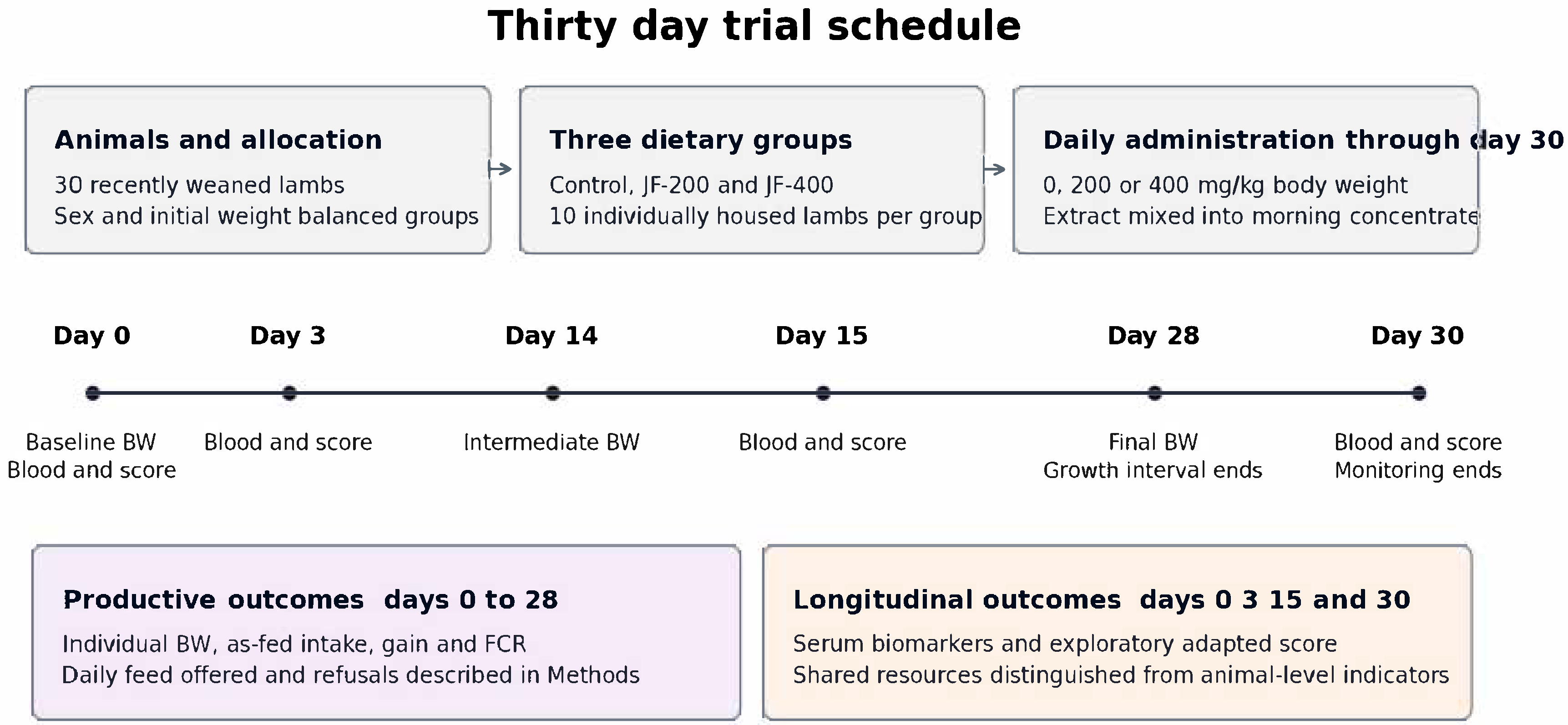
Productive performance (weight gain, feed intake, and feed conversion ratio) was evaluated over a 28-day feeding window (days 0–28), whereas extract administration and physiological/welfare monitoring extended through day 30. Sampling was conducted on the prespecified study days. Body weights were recorded on days 0, 14, and 28, whereas jugular blood samples and exploratory adapted welfare assessments were collected on days 0, 3, 15, and 30 prior to morning feeding (blood sampling between 07:30 and 08:30 h as detailed in Section 2.5, and behavioral scoring between 08:30 and 10:00 h as detailed in Section 2.9). Baseline (day 0) sampling and welfare scoring were performed immediately prior to the administration of the first extract dose. Enrollment on day 0 represented the post-weaning trial baseline upon placement into individual pens. In strict accordance with the availability of verifiable commercial farm records, specific details regarding the exact ewe separation method (abrupt vs. gradual) and prior creep-feeding regimens were not documented and have not been reconstructed from assumed practice. Because these detailed pre-enrollment records were unavailable, maternal separation, dietary transition, and individual housing were evaluated collectively as concurrent, undefined post-weaning stressors. The overall experimental workflow and sampling schedule are illustrated in Figure 1.
Figure 1.
Reported trial schedule and outcome groups. Growth and feed use cover days 0–28; blood and exploratory adapted welfare assessments were scheduled on days 0, 3, 15, and 30 within a 30-day treatment period.
At the initial mean body weight of 18.46 kg, the assigned levels corresponded to approximately 3.69 and 7.38 g extract/lamb/day, providing a twofold experimental spacing selected on the basis of prior small-ruminant phytogenic supplementation trials and supportive metabolic studies with jackfruit preparations [11,12,13,14] to evaluate physiological and productive responses across two inclusion levels.
BW, body weight; JF-200, 200 mg/kg BW jackfruit extract; JF-400, 400 mg/kg BW jackfruit extract; ADG, average daily gain; DFI, daily feed intake; FCR, feed conversion ratio; ACTH, adrenocorticotropic hormone; BDNF, brain-derived neurotrophic factor; tT4, total thyroxine; fT4, free thyroxine; fT3, free triiodothyronine; MDA, malondialdehyde; TAS, total antioxidant status; TOS, total oxidant status; OSI, oxidative stress index; SOD, superoxide dismutase; CAT, catalase; GPx, glutathione peroxidase; ANI, Animal Needs Index.
2.3. Phytochemical Profiling of the Extract
A single lot of commercially sourced, food-grade jackfruit (Artocarpus heterophyllus) extract (Naturalya, Antalya, Türkiye; Lot No. NAT-JH2026/01) was used throughout the feeding trial. The tested preparation was described as a leaf extract with a nominal extraction ratio of 10:1; the lot-specific manufacturer certificate was not available for independent verification in this revision. According to the product information, the extract was derived from the leaves with an extraction ratio of 10:1, utilizing purified water-ethanol as the extraction solvent. Maltodextrin was identified as a carrier, but its mass fraction was not documented in the available study report. The extract was stored in sealed, light-protected containers at room temperature until daily ration preparation. Spectrophotometric quantification of total phenolic content (TPC) and total flavonoid content (TFC) was performed in analytical triplicate using the Folin–Ciocalteu and aluminum chloride colorimetric assays, respectively, with results expressed as mg gallic acid equivalents (GAE)/g dry matter (DM) and mg quercetin equivalents (QE)/g DM (Table 1). These triplicate determinations represent technical analytical replicates of the administered batch.
Table 1.
Reported spectrophotometric total phenolic and flavonoid contents of the tested jackfruit leaf extract.
Phenolic profiling of the administered extract batch (Naturalya, Lot No. NAT-JH2026/01) was conducted using an Agilent 1260 Infinity II HPLC-DAD system (Agilent Technologies, Santa Clara, CA, USA) equipped with a ZORBAX Eclipse XDB-C18 column (250 × 4.6 mm, 5 µm; Agilent Technologies, Santa Clara, CA, USA) maintained at 35 °C. Elution was performed with a binary mobile phase consisting of water containing 0.1% formic acid (solvent A) and acetonitrile (solvent B) under a linear gradient program at a flow rate of 1.0 mL/min with a 10 µL injection volume and diode-array detection at 280 and 320 nm. The original chromatograms, peak integration reports, reference standard runs, and calibration files were not available for independent review; accordingly, compound-level profiling is not interpreted as an analytically confirmed result.
High-performance liquid chromatography with diode-array detection (HPLC-DAD) was described for this extract batch. However, compound-level chromatographic assignments and concentrations cannot be substantiated without the original trace, standard injections, integration reports and calibration data; therefore, these results have been excluded from the present interpretation.
Total phenolic content (TPC) and total flavonoid content (TFC) are reported as spectrophotometric equivalents for the described batch, not as independently confirmed compound identities. DM, dry matter; GAE, gallic acid equivalents; QE, quercetin equivalents. The original laboratory worksheets remain necessary to verify analytical values.
2.4. Diets and Productive Performance
The basal grower ration was formulated to meet the nutrient requirements of growing lambs according to National Research Council (NRC) recommendations [16]. Ingredient composition on a dry-matter (DM) basis and analyzed chemical composition—including an overall ration DM content of 89.60%—are detailed in Table 2. Proximate feed analyses were conducted following AOAC procedures [17], and neutral detergent fiber (NDF) and acid detergent fiber (ADF) fractions were determined according to Van Soest et al. [18]. Individual feed offered and refusals were weighed and recorded daily throughout the 28-day performance period (days 0–28) to determine daily feed intake and feed conversion ratio (FCR), which are expressed on an as-fed basis in Table 3. Lambs were weighed individually prior to morning feeding on days 0, 14, and 28 using a calibrated digital livestock scale (Jadever JKH-150, İstanbul, Türkiye). Total live-weight gain (kg) was calculated as the difference between day 28 and day 0 body weights, average daily gain (ADG, g/day) was calculated as 1000 × (BW_day 28 − BW_day 0)/28, and FCR was calculated as total as-fed feed intake divided by total live-weight gain over the 28-day period. Feed intake denotes feed offered minus refusals, on the same as-fed basis. For an individual-animal analysis, FCR must be derived for each lamb over the same 28-day interval before treatment means are calculated; a ratio of treatment-average intake to treatment-average gain is not necessarily the mean individual FCR. Although the analyzed basal-ration DM proportion was 89.60%, reliable individual dry-matter intake estimates also require the dry-matter content of offered feed and refusals over time. Those records are not demonstrated by the available summary dataset; all intake and FCR comparisons are therefore reported on an as-fed basis and are not directly comparable with dry-matter-based feed efficiency.
Table 2.
Ingredients and chemical composition of the basal diet (dry matter basis).
Table 3.
Effects of dietary jackfruit (Artocarpus heterophyllus) extract supplementation on growth performance and feed efficiency in weaned Anatolian Merino lambs.
2.5. Blood Collection and Serum Preparation
Jugular blood samples were collected prior to morning feeding on days 0, 3, 15, and 30 using gentle, low-stress physical restraint by experienced personnel to minimize handling-induced endocrine artifacts. Blood was drawn into sterile serum-separator tubes containing a clot activator and gel barrier, immediately placed on ice, allowed to clot under refrigerated conditions (4 °C), and centrifuged at 1000× g for 15 min at 4 °C. Harvested serum was dispensed into single-use aliquots to prevent repeated freeze–thaw cycles and stored at −80 °C until laboratory analysis. Visual inspection was performed prior to storage to exclude hemolyzed or lipemic samples; all collected samples met quality criteria and were retained for analysis. Preanalytical handling and serum matrix compatibility for all analytes—including labile peptide hormones such as adrenocorticotropic hormone (ACTH)—were managed in accordance with the respective assay manufacturers’ instructions. Blood collections were strictly standardized between 07:30 and 08:30 a.m. to control diurnal hormonal fluctuations. The total preanalytical interval from blood collection to storage at −80 °C was maintained under 30 min, strictly adhering to the time-temperature matrix parameters specified in the respective assay kit Instructions for Use (IFU) and laboratory standard operating procedures (SOPs).
2.6. Stress and Metabolic Peptide Assays
Serum concentrations of stress and metabolic regulatory peptides were quantified using commercial enzyme-linked immunosorbent assay (ELISA) kits strictly according to the manufacturers’ instructions: cortisol (Cat. No. ELK8817; ELK Biotechnology, Wuhan, China; sensitivity: 0.94 ng/mL; detection range: 3.13–200 ng/mL), adrenocorticotropic hormone (ACTH; Cat. No. CSB-EQ027618SH; CUSABIO, Wuhan, China; detection range: 0.097–400 pg/mL), brain-derived neurotrophic factor (BDNF; Cat. No. YLA0408BO; YL Biont, Shanghai, China; assay range: 0.2–10 ng/mL; sensitivity: 0.09 ng/mL), apelin (Cat. No. SG-60825; SinoGeneClon, Hangzhou, China; detection range: 35–1600 pg/mL; sensitivity: 16 pg/mL), irisin (Cat. No. YLA0410BO; YL Biont, Shanghai, China; assay range: 5–1000 ng/mL; sensitivity: 2.63 ng/mL), asprosin (Cat. No. YLA0412BO; YL Biont, Shanghai, China; assay range: 1–400 pg/mL; sensitivity: 0.49 pg/mL), ghrelin (Cat. No. ELK7969; ELK Biotechnology, Wuhan, China; sensitivity: 49.7 pg/mL; detection range: 156.25–10,000 pg/mL), and leptin (Cat. No. ELK5713; ELK Biotechnology, Wuhan, China; detection range: 0.16–10 ng/mL; sensitivity: 0.06 ng/mL). Because independent sheep-serum matrix validation was not performed for these peptide assays, all peptide biomarker findings are presented and interpreted as exploratory.
All samples and standards were assayed in duplicate wells on a microplate reader (BioTek ELx800, BioTek Instruments, Winooski, VT, USA) at 450 nm with wavelength reference correction, and analyte concentrations were interpolated using four-parameter logistic (4-PL) standard curves. Duplicate wells served strictly as technical analytical replicates, maintaining the biological sample size at n = 10 lambs per treatment group at each time point. Samples exceeding the upper limit of the standard curve (such as high-concentration BDNF specimens) were diluted appropriately with the kit-provided sample diluent, re-assayed, and multiplied by the corresponding dilution factor. Intra-assay coefficients of variation remained below 10% across all runs; however, because independent ovine matrix spike–recovery and dilutional parallelism validations were not separately conducted beyond manufacturer specifications, circulating peptide results are interpreted primarily for comparative longitudinal and between-group trends. Manufacturer-reported species applicability does not replace study-specific assessment of recovery, dilutional parallelism, matrix effects, and precision. An apparently consistent within-study pattern cannot by itself establish the analytical specificity or absolute accuracy of a peptide measurement. Assay performance metrics, including intra-assay precision and dilution integrity, were interpreted based on kit-insert specifications and assay design; formal study-specific spike–recovery, dilutional parallelism, and inter-assay precision were not independently executed beyond standard run-level quality control and technical duplicate consistency.
2.7. Thyroid Hormone Assays
Serum concentrations of total thyroxine (tT4; Cat. No. LS-F10123-1, LSBio, Shirley, MA, USA; detection range: 20–320 ng/mL, sensitivity: 20 ng/mL), free thyroxine (fT4; Cat. No. SG-60297, SinoGeneClon; detection range: 2–64 pmol/L, sensitivity: 4 pmol/L; 5-fold sample dilution as specified in the assay procedure), and free triiodothyronine (fT3; Cat. No. LS-F10393-1, LSBio; detection range: 2–32 pmol/L, sensitivity: 0.38 pmol/L) were quantified in duplicate using commercial ELISA kits strictly according to the manufacturers’ instructions. Optical density was measured at 450 nm, and hormone concentrations were interpolated from four-parameter logistic (4-PL) standard curves, with intra-assay coefficients of variation below 10%. The molar fT3:fT4 ratio (dimensionless, calculated with both hormones expressed in pmol/L) should be calculated from paired fT3 and fT4 concentrations for each lamb at each sampling time point as an exploratory indicator of peripheral circulating thyroid hormone balance rather than a direct measure of tis-sue-level deiodinase enzyme activity. A mean of individual fT3/fT4 ratios is not inter-changeable with a ratio calculated from the treatment means. The ratio does not iden-tify whether differences arose from fT3, fT4, or their within-animal covariance. The re-ported group summaries do not establish that this individual-level ratio was used, and the inferential comparisons for fT3:fT4 should be regarded as unverified pending source-data reconciliation.
2.8. Redox and Acute Phase Assays
Serum total antioxidant status (TAS) and total oxidant status (TOS) were determined using commercial colorimetric assay kits (Rel Assay Diagnostics, Gaziantep, Türkiye) based on the ABTS radical cation decolorization and ferrous-to-ferric ion oxidation methods, respectively [19,20]. Results were expressed as mmol Trolox equivalents/L for TAS and µmol H2O2 equivalents/L for TOS. The oxidative stress index (OSI, arbitrary units) was calculated after unit harmonization according to the equation: OSI = TOS (µmol H2O2 equivalents/L)/[10 × TAS (mmol Trolox equivalents/L)]. This is equivalent to 100 × TOS/[1000 × TAS], with TOS expressed in µmol/L and TAS in mmol/L. OSI must be calculated from paired measurements for each lamb and sampling day before aggregation; the displayed group-mean ratios cannot substitute for such individual-level calculations.
Serum haptoglobin concentration was measured using a sheep-specific commercial ELISA kit (Cat. No. YLA0004SH; Shanghai YL Biotech, Shanghai, China; dynamic range: 2–600 µg/mL) following the manufacturer’s instructions. Specimens exceeding the upper calibration limit (600 µg/mL) were diluted 1:2 with sample diluent, re-assayed, multiplied by the dilution factor, and expressed in g/L (1 g/L = 1000 µg/mL).
Lipid peroxidation was evaluated using a commercial thiobarbituric acid reactive substances (TBARS) assay kit (Cat. No. 10009055; Cayman Chemical, Ann Arbor, MI, USA), with results reported as malondialdehyde (MDA) equivalents (µmol/L). Serum activities of superoxide dismutase (SOD; Cat. No. 706002), catalase (CAT; Cat. No. 707002), and glutathione peroxidase (GPx; Cat. No. 703102) were determined colorimetrically using commercial assay kits (Cayman Chemical, Ann Arbor, MI, USA) according to the manufacturers’ protocols. Enzymatic activities were calculated from standard curves with sample dilution and reaction-volume adjustments according to each kit’s unit definition (SOD expressed as U/mL based on dismutation inhibition; CAT based on formaldehyde formation kinetics; and GPx expressed as nmol/min/mL [mU/mL] based on NADPH oxidation rate), with dimensional equivalences of 1 U/mL = 1 kU/L and 1 nmol/min/mL = 1 mU/mL noted where applicable. Where per-sample dilution factors or raw kinetic exports were not separately itemized in the summary records, enzymatic values are interpreted cautiously as circulating redox indicators.
2.9. Animal Welfare Assessment
An exploratory composite welfare score adapted from the Animal Needs Index (ANI/Tiergerechtheitsindex) framework [21,22] was evaluated on days 0, 3, 15, and 30 prior to morning feeding and blood sampling. The adapted rubric comprised five weighted domains: locomotion and mobility (1.0–6.5 points), social interaction and behavioral synchrony (1.0–7.0 points), flooring and lying comfort (1.0–6.0 points), microclimate and air quality (1.0–6.0 points), and stockperson care, cleanliness, and human–animal relationship (1.0–8.5 points), yielding a theoretical total score ranging from 5.0 to 34.0 points, where higher scores denote more favorable welfare conditions. Resource-based criteria (flooring/lying comfort and microclimate/air quality) were assessed at the housing-unit level, whereas animal-based indicators—including coat cleanliness, posture, nasal/ocular discharge, vocalization, and behavioral reactivity to an approaching handler—were scored individually for each lamb by trained observers blinded to treatment allocation. Because housing-level environmental conditions were shared across all pens and individual pen housing inherently constrains physical social contact, this composite score is presented strictly as an exploratory, supportive indicator of post-weaning behavioral and clinical adaptation rather than a standalone validated ovine welfare index. Housing-level resource scores are shared environmental descriptors and must not be counted as independent treatment-specific observations. Within individual pens, proximity, visual contact, and simultaneous activity are not interchangeable with unrestricted physical social interaction; the social-domain interpretation requires the original operational rubric.
Welfare scoring was performed between 08:30 and 10:00 h during the scheduled morning assessment period by two trained veterinarians blinded to dietary treatment allocation, with daily supplement preparation and feeding conducted independently by separate farm personnel. Inter-observer agreement between the two assessors was high (Cohen’s κ = 0.88; intraclass correlation coefficient, ICC = 0.92, calculated using a two-way random-effects model with absolute agreement for single measures, 95% confidence intervals spanning 0.85–0.96). Direct aggression, displacement, and unrestricted physical social contact could not be assessed as valid pen-level outcomes in individually housed lambs. The twice-weekly behavioral scans are distinct from the four scheduled composite-score assessments. Unless original item-level sheets establish otherwise, social-domain scores should not be interpreted as independently validated outcomes. While assessor blinding was maintained during welfare scoring and laboratory sample analyses, blinding was not applied during daily supplement preparation and feeding.
2.10. Statistical Analysis
All statistical analyses were performed using IBM SPSS Statistics version 26.0 (IBM Corp., Armonk, NY, USA) via the One-Way ANOVA (with Tukey HSD post hoc tests), Repeated Measures General Linear Model (GLM), and Bivariate Pearson correlation procedures. The individual lamb served as the experimental unit (biological replicate; n = 10 per treatment group) for all productive, endocrine, metabolic, redox, acute-phase, and behavioral outcomes, whereas duplicate laboratory wells were averaged as technical replicates prior to statistical evaluation. Data distribution normality and homogeneity of variances were verified using the Shapiro–Wilk and Levene tests, respectively.
Productive performance data (initial and final body weights, total weight gain, ADG, feed intake, and FCR) were analyzed by one-way analysis of variance (ANOVA), followed by Tukey’s honestly significant difference (HSD) post hoc test for pairwise group comparisons. Longitudinal serum biomarkers and composite welfare scores measured across sampling days (days 0, 3, 15, and 30) were analyzed using a repeated-measures general linear model (GLM) framework with individual lamb specified as the repeated subject. Model residuals were verified for normal distribution (Shapiro–Wilk test) and variance homogeneity (Levene’s test), and Greenhouse-Geisser corrections were applied where sphericity assumptions were violated. Post hoc multiple comparisons were adjusted using Tukey’s test, and the reported p-values are interpreted as nominal; original model outputs were not available to verify effect sizes and 95% confidence intervals for productive outcomes.
where Yijk represents the measured observation for lamb k assigned to treatment i at sampling time j; μ is the overall grand mean; Ti is the fixed effect of dietary treatment (i = Control, JF-200, JF-400); Sj is the fixed effect of sampling time (j = Days 0, 3, 15, 30); (T × S)ij is the interaction effect between dietary treatment and sampling time; Lk(i) is the random between-subject effect of individual lamb nested within treatment; and eijk is the residual error term. Sphericity of repeated measures was evaluated using Mauchly’s test, with Greenhouse–Geisser corrections applied where sphericity assumptions were violated.
Exploratory relationships among physiological endpoints (Table 7) were evaluated using Pearson correlation coefficients calculated across all animals (n = 30; one observation per lamb) using acute post-weaning (day 3) biomarker/welfare measurements and cumulative day 0–28 ADG, pooled across treatment groups without adjustment for treatment or sex; this pooling may generate between-treatment correlations and does not establish within-treatment physiological associations. Data are presented as treatment group means with pooled standard errors of the mean (SEM). Statistical significance was declared at p < 0.05; Tukey HSD controls pairwise comparisons within a productive endpoint but does not control error across the full endpoint panel. No panel-wide multiplicity adjustment is documented for the reported secondary biomarker tests or the 45 correlations. Their p-values are therefore nominal and their interpretation exploratory; citing a false-discovery-rate method [23] does not mean that an adjustment was performed. Sex and allocation blocks are not included in the reported models, so balance at allocation does not demonstrate that blocking effects have been accounted for statistically.
3. Results
3.1. Growth Performance and Feed Efficiency
Productive performance outcomes over the 28-day post-weaning feeding period are summarized in Table 3. Initial body weights on day 0 were comparable across all experimental groups (18.45, 18.52, and 18.40 kg for Control, JF-200, and JF-400, respectively; p = 0.955); this baseline test does not verify the allocation procedure. By day 28, final body weights were significantly higher in lambs receiving jackfruit extract supplementation (25.30 kg in JF-200 and 26.10 kg in JF-400) than in Control lambs (23.65 kg; p = 0.001). Correspondingly, total live-weight gain (6.78 and 7.70 kg vs. 5.20 kg) and average daily gain (ADG; 242.1 and 275.0 g/day vs. 185.7 g/day) were significantly greater in both JF-200 and JF-400 groups compared with the Control group (p < 0.001), representing 30.4% and 48.1% improvements in ADG, respectively.
Daily as-fed feed intake was significantly higher in the JF-200 (924.8 g/day) and JF-400 (976.2 g/day) groups relative to the Control group (826.4 g/day; p < 0.001). The reported as-fed FCR was numerically lower in supplemented lambs, decreasing from 4.45 kg as-fed feed/kg gain in Control lambs to 3.82 in JF-200 and 3.55 in JF-400 lambs; the available summaries do not verify individual-animal ratio calculations, limiting inference about group differences in FCR. JF-400 had numerically higher gain and lower FCR than JF-200, but the two supplemented groups share the same post hoc letters for these outcomes in Table 3. The reported pairwise comparisons therefore do not establish superiority of JF-400. A formal dose–response analysis was not reported.
3.2. Stress and Metabolic Peptide Responses
Longitudinal changes in serum hypothalamic–pituitary–adrenal (HPA) axis hormones and neurotrophic stress markers are presented in Table 4. Baseline (day 0) serum cortisol and adrenocorticotropic hormone (ACTH) concentrations did not differ among dietary groups (p > 0.05). Following weaning and individual pen placement, both hormones peaked on day 3 across all treatments before gradually returning toward baseline levels by days 15 and 30, resulting in significant main effects of treatment, sampling day, and treatment-by-day interaction (p < 0.05). On day 3, jackfruit extract supplementation markedly attenuated the acute post-weaning surge in circulating cortisol (4.30 and 3.45 µg/dL in JF-200 and JF-400, respectively, vs. 5.85 µg/dL in Control; p < 0.05) and ACTH (36.50 and 28.30 pg/mL in JF-200 and JF-400, respectively, vs. 48.20 pg/mL in Control; p < 0.05), with JF-400 exhibiting the lowest concentrations. Because blood sampling was restricted to fixed scheduled intervals (days 0, 3, 15, and 30), these profiles capture scheduled post-weaning trajectories in response to concurrent weaning and management stressors rather than continuous inter-visit peak kinetics.
Table 4.
Effects of jackfruit extract on serum stress markers, neuroendocrine factors, and appetite-regulatory peptides during the post-weaning period.
In contrast to the HPA-axis surge, serum brain-derived neurotrophic factor (BDNF) decreased on day 3 in Control lambs (8.20 ng/mL) but remained numerically higher in both JF-200 (11.40 ng/mL) and JF-400 (13.10 ng/mL) groups (p < 0.05; Table 4). Conversely, circulating orexigenic and glucogenic peptides—asprosin and ghrelin—exhibited an inverse pattern on day 3, with higher post-weaning concentrations in Control lambs and significantly attenuated levels in jackfruit-supplemented groups (p < 0.05). Serum apelin, irisin, and leptin concentrations also showed significant treatment and time-dependent variations across the 30-day follow-up (p < 0.05; Table 4). Because these circulating peptides respond dynamically to both neuroendocrine stress and energy balance, longitudinal group differences reflect integrated metabolic and nutritional adaptation rather than a direct pharmacological action isolated from differences in voluntary feed intake.
3.3. Thyroid Hormone Profile
Longitudinal changes in serum thyroid hormones and the peripheral fT3:fT4 ratio are presented in Table 5. Baseline (day 0) concentrations of total thyroxine (tT4), free thyroxine (fT4), and free triiodothyronine (fT3) were comparable across all treatment groups (p > 0.05). Following weaning, circulating tT4, fT4, and fT3 levels declined transiently on day 3 across all groups before progressively recovering on days 15 and 30, with significant main effects of treatment, sampling day, and treatment-by-day interaction (p < 0.05). On day 3, jackfruit extract supplementation markedly attenuated the post-weaning suppression of serum tT4 (53.4 and 60.2 nmol/L in JF-200 and JF-400, respectively, vs. 42.1 nmol/L in Control; p < 0.05), as well as fT4 and fT3 concentrations (p < 0.05), with JF-400 generally showing numerically higher concentrations. The reported fT3:fT4 ratios ranged from 0.254 to 0.274. Because the ratio-specific pairwise annotations require reconciliation with the reported SEM and original model contrasts, no pairwise or mechanistic conclusion is drawn from this exploratory ratio.
Table 5.
Effects of jackfruit extract on the serum thyroid hormone profile (tT4, fT4, and fT3) in weaned lambs.
3.4. Redox Status and Exploratory Welfare Score
Longitudinal changes in serum oxidative stress biomarkers, antioxidant enzyme activities, haptoglobin, and exploratory composite welfare scores are presented in Table 6. Baseline (day 0) redox and acute-phase parameters did not differ significantly among dietary treatments (p > 0.05). Following weaning, Control lambs exhibited a marked acute oxidative and inflammatory shift on day 3 characterized by elevated MDA-equivalent TBARS (6.45 µmol/L), TOS, OSI, and serum haptoglobin alongside reduced TAS (0.92 mmol Trolox equivalents/L) and antioxidant enzyme activities (SOD, CAT, and GPx; Table 6). Dietary supplementation with jackfruit extract (JF-200 and JF-400) significantly attenuated these post-weaning increases in lipid peroxidation, oxidant burden, and haptoglobin while preserving higher TAS and circulating antioxidant enzyme activities across days 3, 15, and 30 compared with Control lambs (p < 0.05). Because these measurements reflect systemic serum redox balance, they are interpreted as circulating indicators of oxidative homeostasis rather than direct evidence of tissue-level cytoprotection or transcriptional pathway activation.
Table 6.
Longitudinal serum redox status biomarkers, antioxidant enzyme activities, haptoglobin concentrations, and exploratory composite welfare scores in weaned lambs supplemented with jackfruit (Artocarpus heterophyllus) extract.
The exploratory adapted composite welfare score declined transiently on day 3 across all groups before progressively recovering through days 15 and 30, with significant effects of treatment, sampling day, and their interaction (p < 0.05; Table 6). Supplemented groups maintained significantly higher composite scores than Control lambs both during the acute post-weaning phase on day 3 (22.5 in JF-200 and 25.0 in JF-400 vs. 18.0 in Control; p < 0.05) and at the end of the trial on day 30 (28.5 and 30.5 vs. 25.0; p < 0.05). Given that housing-level environmental parameters were shared across pens and composite totals aggregate multiple domains, these patterns are presented as exploratory indicators of enhanced behavioral and clinical adaptation rather than validated measures of affective welfare.
3.5. Exploratory Correlations
Pooled Pearson correlation coefficients examining exploratory associations among acute post-weaning (day 3) physiological biomarkers, composite welfare scores, and cumulative 28-day average daily gain (ADG) across all lambs (n = 30) are presented in Table 7. Cumulative ADG correlated negatively with day-3 serum cortisol (r = −0.72) and positively with day-3 total antioxidant status (TAS; r = 0.65), whereas the exploratory composite welfare score correlated inversely with day-3 serum cortisol (r = −0.81). Additional consistent covariations were observed across neuroendocrine, metabolic, redox, and acute-phase parameters (Table 7). Because these coefficients were computed across pooled treatment groups (45 pairwise comparisons evaluated at nominal significance levels without panel-wide multiplicity adjustment), they reflect overall between-animal covariation—partially driven by treatment-induced group separation—rather than within-treatment associations or causal mediation pathways.
Table 7.
Pearson’s correlation matrix showing relationships among growth performance, welfare score, endocrine biomarkers, and redox status.
4. Discussion
4.1. Growth and Feed Utilization
Dietary supplementation with jackfruit extract at 200 and 400 mg/kg BW was associated with higher reported 28-day live-weight gain and average daily gain (ADG), and lower reported as-fed feed conversion ratios (FCR) in newly weaned lambs. The lower FCR observed in supplemented groups coincided with higher voluntary feed intake, but does not establish changes in appetite regulation, maintenance-energy expenditure, or tissue accretion mechanisms. Nevertheless, because nutrient digestibility, dry-matter intake (DMI), and ruminal fermentation parameters were not directly quantified in the present study, improved feed efficiency should be interpreted as an integrated whole-animal productive response rather than direct evidence of altered ruminal fermentation or nutrient digestibility.
Comparison with previous phytogenic supplementation trials in small ruminants highlights the context-dependent nature of growth responses. For example, Passetti et al. [2] reported that essential-oil blends modulated ruminal fermentation and intake patterns in lambs without enhancing overall weight gain, while Muñoz-Cuautle et al. [3] observed improved meat oxidative stability from oregano essential oil without accompanying improvements in growth performance. Those findings indicate that antioxidant modulation does not invariably translate into higher body-weight gain under standard finishing conditions. Conversely, consistent with our observations, Ma et al. [4] demonstrated improved growth performance in heat-stressed lambs receiving an essential-oil blend, and positive productive and endocrine responses have likewise been documented in lambs supplemented with graviola (Annona muricata) leaf extract [13]. Differences across studies likely reflect variations in phytochemical profile, extraction method, basal diet composition, animal age, and the intensity of the physiological stressor—such as the post-weaning transition in the present trial.
Although previous rodent studies using jackfruit pulp preparations demonstrated protective metabolic and antioxidant effects [14], interspecies differences in digestive physiology preclude direct extrapolation of rodent dosing to ruminants. Accordingly, the 200 and 400 mg/kg BW levels evaluated herein are the two body-weight-based doses tested in this experiment, rather than established optimal or commercial feeding recommendations, which warrant further confirmation using DM-adjusted intake measurements and multi-dose titration trials. Accordingly, direct comparisons with studies reporting dry-matter-based feed intake or feed conversion efficiency should be interpreted cautiously given the as-fed basis of the present measurements.
4.2. Stress and Metabolic Adaptation
The attenuated serum cortisol and ACTH concentrations observed on day 3 in jackfruit-supplemented lambs indicate a blunted acute hypothalamic–pituitary–adrenal (HPA) axis response during the post-weaning transition. Previous ovine studies examining weaning, handling, and shearing stressors have similarly highlighted the utility of integrated neuroendocrine and metabolic profiling for evaluating adaptive resilience [1,5,6]. In the present experimental design, maternal separation, dietary transition to solid feed, and individual pen placement occurred concurrently; consequently, the observed endocrine trajectories reflect the integrated physiological response to the overall post-weaning transition rather than the isolated effect of a single stressor. Furthermore, because blood collection was scheduled at fixed intervals (days 0, 3, 15, and 30), the profiles capture key recovery stages rather than continuous inter-visit peak kinetics.
Alongside HPA-axis attenuation, supplemented lambs maintained higher serum brain-derived neurotrophic factor (BDNF) concentrations during the acute post-weaning phase. While elevated circulating BDNF is consistent with preserved peripheral neurotrophic support during environmental challenge, peripheral serum concentrations do not directly quantify central brain BDNF signaling, neuronal survival, or affective state, and are therefore interpreted strictly as supportive systemic indicators rather than direct proof of central neuroprotection.
Circulating metabolic and energy-homeostasis peptides—namely asprosin, ghrelin, leptin, apelin, and irisin [7,8,9]—also exhibited treatment- and time-dependent shifts that paralleled improvements in voluntary feed intake and growth. Specifically, lower day-3 concentrations of glucogenic and orexigenic stress-responsive signals (asprosin [7] and ghrelin) in JF-200 and JF-400 lambs suggest reduced post-weaning negative energy balance compared with Control lambs. However, because tissue-level receptor signaling, phytochemical bioavailability, and formal causal mediation analyses were not conducted, these circulating peptide patterns—including apelin [8] and irisin [9]—are interpreted as exploratory indicators of coordinated metabolic adaptation rather than standalone welfare markers or proven causal mediators of weight gain.
4.3. Thyroid and Redox Responses
Circulating iodothyronines in small ruminants vary with nutritional, environmental, and physiological conditions [10]. The reported tT4, fT4, and fT3 trajectories are compatible with differences in systemic endocrine adaptation during the combined post-weaning transition. They do not directly establish cellular thyroid hormone action or tissue deiodinase activity. Interpretation of the exploratory fT3/fT4 ratio is withheld pending reconciliation of its pairwise annotations with the original statistical output.
The polyphenolic and flavonoid richness of jackfruit (Artocarpus heterophyllus) provides a plausible biochemical basis for testing redox-modulating interventions in livestock [11,12]. In the present trial, supplementation reduced circulating lipid peroxidation (MDA equivalents), total oxidant burden (TOS and OSI), and acute-phase haptoglobin while maintaining higher total antioxidant status (TAS) and serum antioxidant enzyme activities (SOD, CAT, and GPx) across the post-weaning period. Because a whole phytochemical extract was administered without pharmacokinetic tracking of individual phenolic metabolites, these systemic redox improvements are attributed to the overall dietary intervention rather than isolated individual chromatographic constituents.
Comparison across small-ruminant phytogenic studies indicates that oxidative and productive outcomes represent distinct physiological dimensions rather than interchangeable indices of efficacy [2,3,4]. While some ovine trials have documented improved tissue oxidative stability without concomitant weight gain benefits [3], others have reported coordinated improvements in redox balance and growth under environmental or management stress [4]. Because antioxidant gene expression, tissue histopathology, and ruminal fermentation parameters were not evaluated in the current experiment, the observed serum redox and haptoglobin profiles are interpreted as supportive evidence of attenuated systemic oxidative and acute-phase stress rather than proof of direct transcriptional or tissue-level cytoprotective mechanisms.
4.4. Welfare Interpretation and Study Limitations
The exploratory adapted composite welfare score fluctuated across the scheduled post-weaning assessments, showing an acute decline on day 3 followed by progressive recovery through day 30, with higher composite values maintained in jackfruit-supplemented lambs. In interpreting these longitudinal patterns, it is important to recognize that routine post-weaning handling and management procedures can independently influence behavioral reactivity and productive performance in lambs [24]. Moreover, because environmental and housing resources were shared across experimental pens and individual penning restricted direct social interaction among conspecifics, the adapted composite score reflects integrated behavioral, clinical, and physical adaptation rather than validated affective welfare or social behavior. Originally, the ANI 35 L/2000 system was developed for housing-level evaluation [21], and its ovine adaptation primarily addresses farm-level conditions [22]. Consistent with recent research advocating species-appropriate, operationally defined animal-based indicators in sheep [25,26], pooled covariation between the present composite score and circulating biomarkers does not constitute formal scale validation; accordingly, this composite is interpreted strictly as an exploratory observation.
Several methodological limitations should be considered when interpreting the present results, particularly the investigator-balanced non-random allocation, the absence of sex- and baseline-weight-adjusted sensitivity models, incomplete confirmation of individual-animal ratio calculations, and the large exploratory biomarker panel. First, the sample size (n = 10 lambs per treatment) and the 28-day productive evaluation window (30-day physiological follow-up) reflect acute-to-subacute post-weaning adaptation rather than full finishing-phase performance. Second, voluntary feed intake and FCR were recorded on an as-fed basis without individual dry-matter intake (DMI), nutrient digestibility, or ruminal fermentation measurements. Third, phytochemical characterization relied on batch-level analytical summary parameters that did not itemize sample-preparation weights or the minute-by-minute HPLC gradient schedule, precluding independent chromatographic method replication. Moreover, although the tested preparation was a 10:1 jackfruit leaf extract formulated with maltodextrin as a carrier, the exact carrier mass fraction and lot-specific manufacturer certificate documentation were not itemized in the reported dataset, which constrains formulation standardization across studies.
Fourth, given the broad panel of secondary neuroendocrine, metabolic, and oxidative endpoints alongside multiple pairwise correlations, secondary biomarker findings represent supportive physiological indicators rather than standalone confirmatory evidence, and neither direct molecular mechanisms nor an optimum commercial dose can be established from two inclusion levels alone. Future multi-dose studies incorporating larger cohorts, DM-adjusted nutrient balance, fully documented chromatographic protocols, tissue-level mechanistic assays, and independently validated animal-based welfare indicators are warranted to confirm these findings. Detailed pre-enrollment records were unavailable, so responses cannot be attributed exclusively to maternal separation rather than simultaneous dietary, housing, and handling changes. Manufacturer extraction specifications, source chromatographic records, assay worksheets, domain-level welfare records, and statistical outputs are necessary to assess reproducibility. In particular, missing validation cannot be remedied solely by qualifying the biological interpretation.
From a practical standpoint, commercial adoption of jackfruit extract in sheep production will depend on raw-material availability, batch-to-batch phytochemical standardization, palatability, administration labor, storage stability, and compliance with local feed-additive regulations. Because purchase-price comparisons, tissue residue evaluations, and long-term safety trials were beyond the scope of the present study, net economic return cannot be quantified directly from these data.
5. Conclusions
Under the reported study conditions, lambs receiving 200 or 400 mg/kg BW/day of the tested jackfruit leaf preparation had higher 28-day growth and lower as-fed FCR than controls. The productive comparisons did not establish superiority of 400 over 200 mg/kg BW/day. Circulating biomarker profiles and the adapted composite score provide exploratory information about the combined post-weaning transition, without isolating maternal-separation effects or establishing central, tissue-level, or causal mechanisms. Incomplete product characterization, assay-validation limitations, nominal testing across numerous secondary outcomes, and the absence of individual DMI measurements constrain interpretation. These data do not support an optimal-dose recommendation or routine commercial adoption. Confirmatory studies require traceable extract specifications, verified analytical methods, analysis consistent with the allocation design, and validated animal-based welfare measurements.
Supplementary Materials
The following supporting information can be downloaded at https://www.mdpi.com/article/10.3390/vetsci13121279/s1: No individual-animal dataset, primary assay worksheets, or compound-level chromatographic source files were available for inclusion with this version of the manuscript. A completed ARRIVE 2.0 checklist is also required for submission.
Author Contributions
G.C.K.: Conceptualization, methodology, investigation, resources, writing—original draft, project administration, funding acquisition. Ş.A.: Methodology, investigation, data curation, formal analysis, writing—review and editing. B.B.: Conceptualization, formal analysis, visualization, supervision, writing—review and editing. All authors have read and agreed to the published version of the manuscript.
Funding
This research received no external funding.
Institutional Review Board Statement
The experimental procedures and animal care were approved by the Local Ethics Committee of the Veterinary Control Central Research Institute (Approval date: 1 June 2026, Decision number: 2026-0287).
Informed Consent Statement
Written informed consent was obtained from the owner of the private commercial farm where the animals were housed prior to the initiation of the study.
Data Availability Statement
The original contributions presented in this study are included in the article/Supplementary Materials. Further inquiries can be directed to the corresponding author(s).
Acknowledgments
The authors would like to thank the farm owners and staff for their cooperation and assistance during the animal sampling process.
Conflicts of Interest
The authors declare no conflicts of interest.
Abbreviations
ACTH, adrenocorticotropic hormone; ADG, average daily gain; ANI, Animal Needs Index; BDNF, brain-derived neurotrophic factor; BW, body weight; CAT, catalase; CV, coefficient of variation; DFI, daily feed intake; ELISA, enzyme-linked immunosorbent assay; FCR, feed conversion ratio; fT3, free triiodothyronine; fT4, free thyroxine; GPx, glutathione peroxidase; HPA, hypothalamic–pituitary–adrenal; HPLC-DAD, high-performance liquid chromatography with diode-array detection; MDA, malondialdehyde; OSI, oxidative stress index; SEM, standard error of the mean; SOD, superoxide dismutase; TAS, total antioxidant status; TBARS, thiobarbituric acid reactive substances; TFC, total flavonoid content; TOS, total oxidant status; TPC, total phenolic content; tT4, total thyroxine.
References
- Freitas-de-Melo, A.; Orihuela, A.; Hötzel, M.J.; Ungerfeld, R. What Do We Know and Need to Know About Weaning in Sheep? An Overview of Weaning Practises, Stress and Welfare. Front. Anim. Sci. 2022, 3, 823188. [Google Scholar] [CrossRef] [Scilit]
- Passetti, L.C.G.; Passetti, R.A.C.; McAllister, T.A. Effect of essential oil blends and a nonionic surfactant on rumen fermentation, anti-oxidative status, and growth performance of lambs. Transl. Anim. Sci. 2021, 5, txab118. [Google Scholar] [CrossRef] [Scilit]
- Muñoz-Cuautle, A.; Ortega-Cerrilla, M.E.; Herrera-Haro, J.G.; Nava-Cuellar, C.; Gutiérrez-Olvera, C.; Ramírez-Bribiesca, J.E.; Zetina-Córdoba, P. Effect of Oregano (Lippia graveolens) Essential Oil as a Phytogenic Feed Additive on Productive Performance, Ruminal Fermentation, and Antioxidant Activity in Lamb Meat. Agriculture 2022, 12, 973. [Google Scholar] [CrossRef] [Scilit]
- Ma, Y.; Yang, L.; Wu, F.; Luo, J.; Liu, Z.; Chen, W.; Lei, Z.; He, P.; Liu, T.; Song, S.; et al. Feeding an Essential Oil Blend to Growing Crossbred Lambs Mitigates Heat Stress to Improve Growth Performance via Enhanced Antioxidant Capacity. Animals 2026, 16, 853. [Google Scholar] [CrossRef] [Scilit]
- Mormède, P.; Andanson, S.; Aupérin, B.; Beerda, B.; Guémené, D.; Malmkvist, J.; Manteca, X.; Manteuffel, G.; Prunet, P.; van Reenen, C.G.; et al. Exploration of the hypothalamic–pituitary–adrenal function as a tool to evaluate animal welfare. Physiol. Behav. 2007, 92, 317–339. [Google Scholar] [CrossRef] [Scilit]
- Carcangiu, V.; Luridiana, S.; Cocco, R.; Trimasse, O.; Bennaghmouch, I.; Ouadday, M.; Mura, M.C. Oxidative Stress and Blood Parameters During Shearing in Sheep Treated with Melatonin. Animals 2026, 16, 1699. [Google Scholar] [CrossRef] [Scilit]
- Romere, C.; Duerrschmid, C.; Bournat, J.; Constable, P.; Jain, M.; Xia, F.; Saha, P.; Del Solar, M.; Zhu, B.; York, B.; et al. Asprosin, a Fasting-Induced Glucogenic Protein Hormone. Cell 2016, 165, 566–579. [Google Scholar] [CrossRef] [Scilit]
- Tatemoto, K.; Hosoya, M.; Habata, Y.; Fujii, R.; Kakegawa, T.; Zou, M.X.; Kawamata, Y.; Fukusumi, S.; Hinuma, S.; Kitada, C.; et al. Isolation and Characterization of a Novel Endogenous Peptide Ligand for the Human APJ Receptor. Biochem. Biophys. Res. Commun. 1998, 251, 471–476. [Google Scholar] [CrossRef] [Scilit]
- Boström, P.; Wu, J.; Jedrychowski, M.P.; Korde, A.; Ye, L.; Lo, J.C.; Rasbach, K.A.; Boström, E.A.; Choi, J.H.; Long, J.Z.; et al. A PGC1-α-dependent myokine that drives brown-fat-like development of white fat and thermogenesis. Nature 2012, 481, 463–468. [Google Scholar] [CrossRef] [Scilit]
- Todini, L. Thyroid hormones in small ruminants: Effects of endogenous, environmental and nutritional factors. Animal 2007, 1, 997–1008. [Google Scholar] [CrossRef] [Scilit]
- Jagtap, U.; Bapat, V. Artocarpus: A review of its traditional uses, phytochemistry and pharmacology. J. Ethnopharmacol. 2010, 129, 142–166. [Google Scholar] [CrossRef] [Scilit]
- Ranasinghe, R.A.S.N.; Maduwanthi, S.D.T.; Marapana, R.A.U.J. Nutritional and Health Benefits of Jackfruit (Artocarpus heterophyllus Lam.): A Review. Int. J. Food Sci. 2019, 2019, 4327183. [Google Scholar] [CrossRef] [Scilit]
- Kotan, G.C.; Bayraktar, B. Effects of graviola oil extract on fattening performance and circadian rhythms of adipokine, cardiac and mitochondrial function markers in lambs. BMC Vet. Res. 2026, 22, 236. [Google Scholar] [CrossRef] [Scilit]
- Erkılıç, T.O.; Bayraktar, B. Effect of Jackfruıt Pulp Extract on Serum Nesfatın-1 and Vısfatın Levels in Streptozotocın-induced Rats. IJAR 2025, 59, 293–298. [Google Scholar] [CrossRef] [Scilit]
- Percie du Sert, N.; Hurst, V.; Ahluwalia, A.; Alam, S.; Avey, M.T.; Baker, M.; Browne, W.J.; Clark, A.; Cuthill, I.C.; Dirnagl, U.; et al. The ARRIVE guidelines 2.0: Updated guidelines for reporting animal research. PLoS Biol. 2020, 18, e3000410. [Google Scholar] [CrossRef] [Scilit]
- National Research Council. Nutrient Requirements of Small Ruminants: Sheep, Goats, Cervids, and New World Camelids; The National Academies Press: Washington, DC, USA, 2007. [Google Scholar] [CrossRef] [Scilit]
- Latimer, G.W., Jr. (Ed.) Official Methods of Analysis of AOAC International, 20th ed.; AOAC International: Rockville, MD, USA, 2016. [Google Scholar]
- Van Soest, P.; Robertson, J.; Lewis, B. Methods for Dietary Fiber, Neutral Detergent Fiber, and Nonstarch Polysaccharides in Relation to Animal Nutrition. J. Dairy Sci. 1991, 74, 3583–3597. [Google Scholar] [CrossRef] [Scilit]
- Erel, O. A novel automated direct measurement method for total antioxidant capacity using a new generation, more stable ABTS radical cation. Clin. Biochem. 2004, 37, 277–285. [Google Scholar] [CrossRef] [Scilit]
- Erel, O. A new automated colorimetric method for measuring total oxidant status. Clin. Biochem. 2005, 38, 1103–1111. [Google Scholar] [CrossRef] [Scilit]
- Bartussek, H.; Leeb, C.H.; Held, S. Animal Needs Index for Cattle ANI 35 L/2000; Federal Research Institute for Agriculture in Alpine Regions: Gumpenstein, Austria, 2000; Available online: https://bartussek.at/wp-content/uploads/2020/09/anicattle.pdf (accessed on 22 October 2026).
- Napolitano, F.; De Rosa, G.; Ferrante, V.; Grasso, F.; Braghieri, A. Monitoring the welfare of sheep in organic and conventional farms using an ANI 35 L derived method. Small Rumin. Res. 2009, 83, 49–57. [Google Scholar] [CrossRef] [Scilit]
- Benjamini, Y.; Hochberg, Y. Controlling the False Discovery Rate: A Practical and Powerful Approach to Multiple Testing. J. R. Stat. Soc. Ser. B 1995, 57, 289–300. [Google Scholar] [CrossRef] [Scilit]
- Pascual-Alonso, M.; Miranda-de la Lama, G.C.; Aguayo-Ulloa, L.; Ezquerro, L.; Villarroel, M.; Marín, R.H.; Maria, G.A. Effect of Postweaning Handling Strategies on Welfare and Productive Traits in Lambs. J. Appl. Anim. Welf. Sci. 2015, 18, 42–56. [Google Scholar] [CrossRef] [Scilit]
- Richmond, S.E.; Wemelsfelder, F.; de Heredia, I.B.; Ruiz, R.; Canali, E.; Dwyer, C.M. Evaluation of Animal-Based Indicators to Be Used in a Welfare Assessment Protocol for Sheep. Front. Vet. Sci. 2017, 4, 210. [Google Scholar] [CrossRef] [Scilit]
- Zufferey, R.; Minnig, A.; Thomann, B.; Zwygart, S.; Keil, N.; Schüpbach, G.; Miserez, R.; Zanolari, P.; Stucki, D. Animal-Based Indicators for On-Farm Welfare Assessment in Sheep. Animals 2021, 11, 2973. [Google Scholar] [CrossRef] [Scilit]

Disclaimer/Publisher’s Note: The statements, opinions and data contained in all publications are solely those of the individual author(s) and contributor(s) and not of MDPI and/or the editor(s). MDPI and/or the editor(s) disclaim responsibility for any injury to people or property resulting from any ideas, methods, instructions or products referred to in the content. |
© 2026 by the authors. Licensee MDPI, Basel, Switzerland. This article is an open access article distributed under the terms and conditions of the Creative Commons Attribution (CC BY) license.