


Simple Summary
Viral diseases pose major threats to livestock health, animal welfare, and the sustainability of the livestock industry. Although vaccination and biosecurity measures are important for disease prevention, effective antiviral treatments remain limited for many livestock viral infections. Nucleoside and nucleotide analogues are promising antiviral compounds that can interfere with viral genetic material synthesis and inhibit virus replication. Several compounds have shown encouraging activity against important livestock viruses in laboratory studies and animal models. This review summarizes their antiviral mechanisms and current research progress against major livestock viruses, highlighting their potential as therapeutic options. Additionally, it discusses the challenges of applying these compounds in veterinary medicine, including their effectiveness, safety, and practical use in livestock. Understanding these issues will help guide the development of effective and safe antiviral drugs for livestock and support future strategies for controlling viral diseases in animal populations.
Abstract
Livestock viral diseases continue to threaten animal health, agricultural productivity, and the sustainability of animal production systems. Although vaccination remains a cornerstone of disease prevention, antigenic diversity, viral evolution, and the emergence of novel pathogens highlight the need for complementary antiviral strategies. Nucleoside and nucleotide analogues represent promising candidates because they can interfere with viral genome synthesis through mechanisms that may be conserved across both RNA and DNA viruses. However, their antiviral activity varies substantially among viruses and depends on intracellular drug activation, polymerase recognition, nucleotide metabolism, and viral replication dynamics. Studies have demonstrated the antiviral potential of nucleoside analogues against livestock viruses, including protection against foot-and-mouth disease virus (FMDV) in experimentally infected pigs, and in vitro activity against porcine epidemic diarrhea virus (PEDV), African swine fever virus (ASFV), and poxviruses. This review summarizes the pharmacological mechanisms of nucleoside analogues against both RNA and DNA viruses, evaluates evidence for their activity against major livestock viral pathogens, and discusses the determinants of antiviral spectrum and resistance. Particular attention is given to species-specific pharmacokinetics, in vivo efficacy, animal safety, drug residues, and regulatory considerations. Addressing these challenges will be essential for translating nucleoside analogue research into effective and sustainable antiviral strategies for livestock health.
1. Introduction
Viral diseases are major constraints on livestock production, causing substantial economic losses through mortality, reduced productivity, trade restrictions, and the implementation of costly disease-control measures [1,2,3]. Important viral pathogens include foot-and-mouth disease virus (FMDV), African swine fever virus (ASFV), porcine epidemic diarrhea virus (PEDV), porcine reproductive and respiratory syndrome virus (PRRSV), classical swine fever virus (CSFV), and avian influenza A viruses, together with a wider set of RNA and DNA viruses affecting swine, cattle, poultry, and small ruminants. These viruses differ in their genome organization, tissue tropism, transmission routes, and pathogenic mechanisms, making the development of universally effective antiviral interventions challenging. Vaccination remains central to disease control, but antigenic variation and delayed protection highlight the need for complementary antivirals. Ideally, such agents would act rapidly, inhibit multiple viral strains or species, and be suitable for administration under practical livestock production conditions.
Nucleoside and nucleotide analogues have achieved considerable success in the treatment of human viral infections, with several agents now established in clinical practice [4]. Building on this success, a growing body of evidence has demonstrated the antiviral potential of these compounds against livestock viruses, including foot-and-mouth disease virus (FMDV), porcine epidemic diarrhea virus (PEDV), and African swine fever virus (ASFV), although the strength of evidence varies considerably across compounds and viral systems. Despite these advances, no nucleoside or nucleotide analogue has yet been approved specifically for the treatment of major livestock viral diseases in food-producing animals. A notable recent development is the reported approval of GS-441524 in Laos for the treatment of feline infectious peritonitis (FIP), making it the first officially approved oral nucleoside analogue for this indication [5]. This milestone highlights the translational potential of nucleoside analogues in veterinary medicine, while also underscoring the distinction between therapeutic applications in companion animals and those in food-producing livestock. The efficacy and safety of these compounds depend not only on viral susceptibility and polymerase selectivity but also on intracellular drug activation, species-specific pharmacokinetics, tissue distribution, and tolerability. Consequently, efficacy demonstrated in vitro or in human clinical settings cannot be directly extrapolated to livestock. For food-producing animals, further challenges include establishing effective dosing regimens, characterizing tissue residues, determining appropriate withdrawal periods, and ensuring food safety. These considerations make species-specific pharmacological evaluation and in vivo validation essential for translating the antiviral potential of nucleoside and nucleotide analogues into practical interventions against livestock viral diseases.
The literature retrieval was performed in PubMed using search terms related to nucleoside/nucleotide analogues and viral pathogens. Considering the limited and fragmented body of literature concerning these agents against livestock viruses, we gave priority to direct studies on livestock viruses and selectively incorporated studies from other viral systems where they provided relevant mechanistic or pharmacological insights into antiviral activity in veterinary viruses and animal models. This review provides a critical assessment of nucleoside and nucleotide analogues investigated against livestock viral pathogens, covering both RNA viruses, for which evidence is relatively more extensive, and DNA viruses, for which evidence remains more limited and is supplemented by insights from antiviral research on human herpesviruses and poxviruses. We examine their mechanisms of action, antiviral efficacy, and spectrum of activity, with particular attention to the molecular and pharmacological factors governing susceptibility, resistance development, and therapeutic performance. We also evaluate the translational challenges associated with their use in veterinary medicine, including species-specific pharmacokinetics, in vivo efficacy, safety, and, where relevant, drug residues and withdrawal requirements in food-producing animals. By distinguishing experimentally validated findings from preliminary evidence and mechanistic hypotheses, this review identifies critical knowledge gaps and outlines research priorities for advancing nucleoside- and nucleotide-based antiviral strategies for livestock disease control.
3. Nucleoside and Nucleotide Analogues Against Major Livestock Viruses
Evidence for nucleoside and nucleotide analogues against livestock viruses varies substantially across viral families, compounds, and experimental systems. Although in vivo efficacy data are limited to small animal group sizes from single-laboratory studies, foot-and-mouth disease virus (FMDV) represents one of the most advanced examples in livestock antiviral research, with evidence extending from in vitro antiviral activity across multiple serotypes to protective efficacy in experimentally infected pigs [47]. For porcine epidemic diarrhea virus (PEDV), several compounds originally developed for human viral infections have shown promising in vitro activity, although evidence of efficacy in target livestock remains limited [48,49]. Studies of other livestock RNA viruses provide additional insights into the potential of this drug class, but the strength of evidence ranges from direct antiviral testing to findings that support further investigation only. Research on livestock DNA viruses is even more limited [50]. To distinguish the direct relevance of these findings to livestock, the evidence is categorized into direct antiviral studies against livestock viruses and indirect supporting evidence from companion animal viruses, other animal models, or human virus studies. The latter provides complementary insights into antiviral activity and mechanisms but does not constitute direct evidence of efficacy against livestock viruses. This section evaluates these findings according to their experimental support and translational relevance, distinguishing demonstrated antiviral activity from preliminary evidence and hypotheses that require pathogen-specific validation. The principal compounds and their reported activities are summarized in Table 1.
Table 1.
Principal nucleoside and nucleotide analogues targeting livestock RNA viruses discussed in this review, with their mechanism of action, representative viral targets, and the highest level of available evidence.
3.1. Antiviral Activity Against Picornaviruses
Foot-and-mouth disease virus (FMDV), a member of the family Picornaviridae, causes a highly contagious disease in cloven-hoofed animals, including cattle, pigs, sheep, and goats. Its antigenic diversity and rapid transmission complicate disease control, creating a need for complementary strategies that could be used alongside vaccination and established control measures [64]. Ribavirin and favipiravir have been investigated for their activity against foot-and-mouth disease virus (FMDV), with favipiravir shown to increase viral mutation frequency and reduce the specific infectivity of viral populations, consistent with a contribution from lethal mutagenesis [59]. However, the antiviral potency of ribavirin in cell culture appears relatively limited, and the extent to which mutagenesis accounts for favipiravir’s overall antiviral effect may depend on the compound and experimental conditions. More compelling preclinical evidence is available for T-1105, which inhibited 28 reference strains representing all seven FMDV serotypes at non-cytotoxic concentrations and protected experimentally infected pigs against clinical disease when administered orally shortly before or within several hours after viral challenge [47]. Notably, neither infectious virus nor viral genetic material was detected in sampled sera, oral and nasal discharges, or tissues collected 48 h after inoculation, although these findings are limited to the sampling time points and experimental conditions examined. Thus, though in vivo data are restricted to one small-cohort challenge study in pigs, T-1105 shows broad multi-serotype in vitro activity and livestock host protection, making it a promising candidate for further study [47]. Nevertheless, its efficacy against diverse field isolates, following delayed treatment, and under natural outbreak conditions remains to be established. Accordingly, anti-FMDV treatment should be evaluated as an early, species-specific adjunct to vaccination and biosecurity, with treatment timing, viral shedding and transmission as key endpoints. The protective efficacy of T-1105 in experimentally infected pigs cannot be extrapolated to other livestock species or field outbreaks, and antivirals cannot replace vaccination, surveillance, movement controls or other established control measures. Galidesivir (BCX4430), an adenosine analogue with in vitro activity against RNA viruses from multiple families, including picornaviruses in screening studies, provides an additional lead for antiviral discovery; however, its activity against FMDV or other livestock picornaviruses requires direct validation in relevant virus–host systems, given that polymerase recognition, intracellular activation, and replication biology can influence susceptibility [67].
3.2. Antiviral Activity Against Coronaviruses
Livestock coronaviruses, including porcine epidemic diarrhea virus (PEDV), transmissible gastroenteritis virus (TGEV), and porcine deltacoronavirus (PDCoV) in pigs, infectious bronchitis virus (IBV) in chickens, and bovine coronavirus (BCoV) in cattle, are potential targets for nucleoside and nucleotide analogue development because their replication depends on viral RNA synthesis. However, direct evidence for these compounds remains uneven across livestock coronaviruses, with the clearest comparative data currently available for PEDV. Xie et al. reported that GS-441524, remdesivir, and β-D-N4-hydroxycytidine (NHC) inhibited PEDV replication in Vero E6 cells, with EC50 values of 0.31, 0.74, and 1.17 μM, respectively [51]. GS-441524 showed the greatest potency in this assay, and its antiviral activity was supported by immunofluorescence analysis; the compound also exhibited a favorable safety profile in cells and mice [51]. These findings establish proof of concept for nucleoside-based inhibition of PEDV, but the potency ranking should be interpreted within the specific experimental system rather than as evidence of superior therapeutic efficacy in pigs. Differences between GS-441524 and remdesivir may reflect their distinct cellular uptake and intracellular metabolic requirements, while antiviral activity can also vary with cell type, viral strain, and assay conditions [75]. Evidence from feline infectious peritonitis, for which GS-441524 and NHC have also been investigated, further illustrates the veterinary potential of nucleoside-based antiviral strategies, but does not establish efficacy against livestock coronaviruses [53,57,76]. Translation to food-producing animals will require assessment of pharmacokinetics, tissue exposure, tolerability, and efficacy in the target species, alongside consideration of practical dosing and food-animal residue requirements. In particular, the activity of candidate compounds should be validated in relevant porcine or other species-specific cell systems and subsequently in appropriate animal models.
3.3. Antiviral Activity Against Influenza Viruses
Influenza A viruses infect multiple animal hosts, including poultry and swine, and pose substantial challenges to livestock production because of their genetic diversity, capacity for reassortment, and zoonotic potential [77]. Favipiravir, a nucleoside analogue that is converted intracellularly to an active ribonucleotide form, inhibits viral RNA synthesis and has demonstrated activity against influenza viruses [78,79]; it has also been approved for influenza treatment in Japan under specified conditions [80]. Favipiravir exhibits broad in vitro activity against H5N1 and other avian influenza isolates [61]. However, these findings do not establish equivalent efficacy across influenza subtypes or host species, or demonstrate suitability for routine use in food-producing animals. The emergence of highly pathogenic avian influenza A(H5N1) in dairy cattle in the United States further underscores the need to evaluate antiviral strategies across diverse animal hosts, yet direct evidence for favipiravir efficacy in cattle remains limited [81,82]. Differences in drug disposition, tissue exposure, disease progression, and viral susceptibility may influence treatment outcomes across species. Further studies should therefore establish the efficacy and safety of favipiravir in relevant target animals and determine whether treatment produces meaningful virological and clinical benefits under realistic infection conditions, while also addressing the practical and regulatory requirements for its use in food-producing animals.
3.4. Evidence Across Other Livestock RNA Viruses
Evidence for nucleoside and nucleotide analogues against other livestock RNA viruses remains heterogeneous, spanning cell-based and replicon assays to experimental animal studies [60]. In pestiviruses, including bovine viral diarrhea virus (BVDV) and classical swine fever virus (CSFV), the relationship between their RNA-dependent RNA polymerases and that of hepatitis C virus (HCV) has informed the evaluation of nucleoside analogues initially developed for human infections. Compounds such as 2′-C-methyladenosine have inhibited BVDV replication in cell-based or replicon systems, while sofosbuvir and its active triphosphate metabolite, GS-461203, have also shown activity in BVDV replicon assays. Notably, BVDV variants carrying the F224S mutation in the RdRp finger domain that confers resistance to the non-nucleoside inhibitor BPIP remained fully sensitive to 2′-C-methyladenosine [73], suggesting that distinct inhibitor classes may retain activity against viruses with specific resistance mutations and warranting further investigation of resistance profiles and combination strategies. However, evidence supporting therapeutic efficacy against pestivirus infections in cattle or pigs remains limited. For Rift Valley fever virus (RVFV), the adenosine analogue galidesivir (BCX4430) reduced viremia and protected Syrian golden hamsters against lethal infection, providing in vivo evidence of antiviral activity against a pathogen of livestock importance, although efficacy and dosing remain to be established in natural host species [65]. Evidence for nucleoside analogue activity against porcine reproductive and respiratory syndrome virus (PRRSV) is more limited [83,84]. Remdesivir and GS-441524 have demonstrated in vitro activity against PRRSV-1 and PRRSV-2 in MARC-145 cells [52]; however, efficacy, pharmacokinetics, and safety in pigs remain to be established. Likewise, the activity of these compounds against bluetongue virus and other livestock RNA viruses remains insufficiently characterized. Collectively, these studies identify several candidates and experimental leads, but the evidence currently supports different levels of confidence, from replication inhibition in surrogate systems to protection in non-natural animal models; pathogen-specific validation is needed to determine their relevance for livestock disease control.
3.5. Antiviral Activity Against DNA Viruses
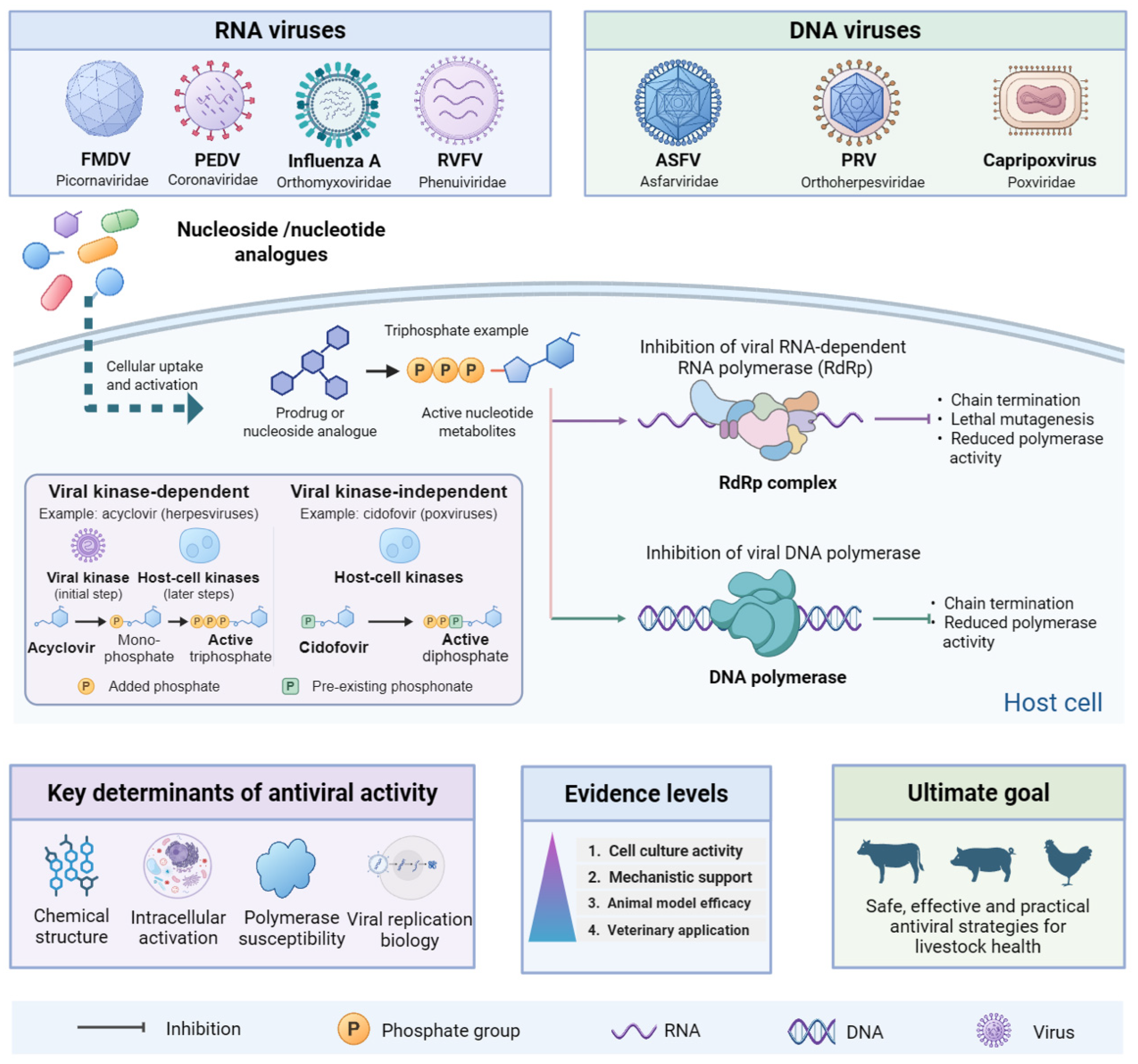
Compared with RNA viruses, livestock DNA viruses remain relatively underexplored targets for nucleoside and nucleotide analogue antivirals. Among them, African swine fever virus (ASFV) is a particularly important target because of its substantial impact on pig production and its reliance on virus-encoded DNA replication machinery. Cyclic cidofovir (cHPMPC), a cyclic prodrug of the acyclic nucleoside phosphonate cidofovir designed to optimize cellular uptake and bypass viral kinase-dependent initial activation, has demonstrated inhibitory activity against ASFV in cell culture [85]. Brincidofovir (CMX001), a lipid conjugate designed to improve oral delivery and modify the pharmacological properties of cidofovir, represents a related candidate for investigation. Brincidofovir has demonstrated potent anti-ASFV activity in vitro and protective efficacy in pigs, reducing viral replication, tissue viral loads, viral shedding, and ASFV-associated mortality and pathological changes, supporting its potential for ASFV control [86]. Although brincidofovir confers partial protection in controlled pig challenge models, available evidence is restricted to peri-exposure prophylactic dosing, with no data supporting delayed therapeutic use. Reduced shedding in this single study does not equate to field transmission blockade, and its veterinary utility remains unproven. Azvudine, a clinically approved nucleoside analogue, acts at the post-entry stage of the viral life cycle without directly inactivating viral particles, representing a promising repurposed candidate for anti-ASFV drug development [50]. The potential utility of these compounds must also be considered in light of cidofovir-associated nephrotoxicity and the need to establish an acceptable therapeutic window in pigs. In livestock herpesviruses, acyclovir and related guanosine analogues have been investigated against pseudorabies virus (PRV) [87,88]. Their activity depends on initial phosphorylation by viral thymidine kinase, followed by intracellular phosphorylation and inhibition of viral DNA polymerase, a mechanism that differs from the activation pathway of cidofovir [89]. Whether this approach can be extended to other livestock herpesviruses, including bovine herpesvirus 1 (BoHV-1), Marek’s disease virus (MDV), and infectious laryngotracheitis virus (ILTV), remains insufficiently characterized [90]. Evidence for capripoxviruses is also emerging, with several nucleoside analogues showing in vitro antiviral activity against lumpy skin disease virus (LSDV) [91]. However, their efficacy against sheep pox and goat pox viruses and in infected livestock remains to be established. Across these virus groups, the presence of a DNA polymerase or a plausible mechanism of action does not by itself establish susceptibility; antiviral activity must be demonstrated in the relevant virus–host system, with particular attention to intracellular drug activation, polymerase sensitivity, and achievable drug exposure. Table 2 summarizes the principal compounds investigated against livestock DNA viruses, including their mechanisms of action, representative antiviral potency, and highest levels of available evidence.
Table 2.
Principal nucleoside and nucleotide analogues targeting livestock DNA viruses discussed in this review, with their mechanism of action, representative viral targets, and the highest level of available evidence.
4. Challenges in Veterinary Translation
Despite promising antiviral activity against several livestock viruses, the translation of nucleoside and nucleotide analogues into practical veterinary interventions remains challenging. In vitro potency and efficacy in experimental models do not necessarily predict therapeutic benefit in target animals, as drug disposition, safety margins, and delivery requirements can differ substantially across species and production settings [103]. Moreover, the use of these compounds in food-producing animals introduces additional considerations, including tissue residues, withdrawal periods, and food safety [104]. Accordingly, successful veterinary translation requires an integrated assessment of species-specific pharmacokinetics and in vivo efficacy, safety and residue-related risks, and the feasibility of drug delivery and administration under field conditions.
4.1. Species-Specific Pharmacokinetics and In Vivo Efficacy
The translation of nucleoside analogues into veterinary medicine requires more than demonstrating antiviral activity in cell culture. Effective treatment depends on achieving sufficient concentrations of the active compound or its intracellular metabolites at the sites of viral replication for an appropriate duration [105]. Pharmacokinetic properties may differ substantially between humans and livestock species. Absorption, distribution, metabolism, and excretion can vary with species, age, physiological condition, disease status, and route of administration. Beyond systemic pharmacokinetic differences, interspecies variation in intracellular nucleoside kinase expression, enzyme activity and nucleotide pool dynamics alters activation and intracellular retention of active triphosphate metabolites, leading to divergent pharmacodynamic outcomes despite comparable plasma drug concentrations. Remdesivir, for example, requires intravenous infusion in humans because its prodrug ester is not orally bioavailable [106]; this makes it impractical for large-scale livestock use. GS-441524, the parent nucleoside of remdesivir, has shown oral bioavailability in non-livestock species [54], but systematic pharmacokinetic (PK) data in pigs, chickens, and cattle remain limited. Its species-specific oral bioavailability, maximum plasma concentration (Cmax), area under the concentration-time curve (AUC), and elimination half-life require further characterization.
These factors are particularly important when comparing drugs evaluated in human-derived cell lines with their potential use in pigs, cattle, or poultry. Even if a compound shows similar antiviral potency in vitro, differences in systemic exposure or tissue penetration may lead to different outcomes in vivo. The selection of appropriate animal models is therefore essential. Studies should assess clinically relevant endpoints, including disease severity, viral load, infectious virus shedding, survival where appropriate, and the potential for onward transmission. Pharmacokinetic and pharmacodynamic measurements should be integrated with these endpoints to establish exposure–response relationships. For enteric viruses such as PEDV, drug concentrations at intestinal infection sites should be evaluated alongside plasma exposure when assessing antiviral efficacy [103]. For respiratory viruses, concentrations in respiratory tissues and secretions may be critical [107,108,109]. For RVFV and other systemic infections, hepatic and endothelial distribution matters [110]. Formulation and delivery strategies should therefore be selected according to the tissue tropism and pathogenesis of the target virus.
4.2. Safety, Drug Residues, and Food Safety
Safety evaluation is a major requirement for antiviral drugs intended for food-producing animals. In addition to acute and chronic toxicity in the target species, assessment must consider potential residues in edible tissues, milk, and eggs, depending on the species and intended use [111]. The use of a drug in human medicine does not automatically establish its safety for food-producing animals. Species-specific metabolism may alter exposure to the parent compound and its metabolites, and the persistence of residues in edible tissues may differ from that in humans. The European Medicines Agency (EMA) guideline on determination of withdrawal periods for edible tissues specifies how residue depletion data are used to derive withdrawal intervals with statistical confidence bounds; corresponding frameworks exist at the U.S. Food and Drug Administration (FDA) and National Medical Products Administration (NMPA).
These concerns are particularly relevant to nucleoside analogues because their biological activity depends on interactions with nucleotide metabolism and nucleic acid synthesis. Although selective inhibition of viral replication is possible, candidate compounds must be evaluated for potential effects on host cells, including mitochondrial function and other processes that may be affected by nucleotide analogues [112]. For certain compounds, adverse effects are well established and experimentally confirmed: Ribavirin, for example, causes hemolytic anemia and is teratogenic, which effectively precludes its use in terrestrial food-producing animals [113]. For other candidates, safety risks remain theoretical or insufficiently investigated: NHC has raised theoretical concerns about host–cell mutagenesis [114] and reproductive toxicity that would require extensive safety testing before any food-animal use could be authorized [115]. The precedent of ribavirin use in farmed Atlantic salmon against infectious salmon anemia (ISA) provides a quantitative case study: at an oral dose of 1.6 mg/kg body weight, residue depletion in muscle was compatible with a calculated withdrawal time of approximately 1966 degree-days, illustrating that residue-based regulation is feasible but demanding [104]. Evidence on nucleoside analogue residues in terrestrial food-producing animals remains limited. Ribavirin residues have been detected in commercially available chicken samples, highlighting the need for further residue-depletion studies in food-producing animals [116]. These findings do not establish withdrawal periods. Further characterization of residues and metabolites in edible tissues is needed for individual candidates and target species, particularly pigs and cattle.
A further consideration is environmental. Excretion of active drug through manure and urine could select for antiviral resistance in environmental viruses or affect non-target organisms, an understudied dimension of veterinary antiviral use [117]. The magnitude of this risk remains uncertain and requires residue-exposure assessment and resistance surveillance. This concern applies with equal force to DNA-virus-directed nucleotide analogues such as cidofovir derivatives: their broad activity against DNA viruses raises the possibility of non-target effects in environmental viral communities and on host commensal viruses. Food safety should therefore be treated as an integral component of drug development rather than a final consideration after antiviral efficacy has been established.
4.3. Drug Delivery, Administration, and Practical Feasibility
The practical requirements of livestock production can influence whether a promising antiviral candidate is suitable for real-world use. Animals may be housed in large groups, treatment may need to be administered rapidly during an outbreak, and individual dosing can be difficult in certain production systems. Cost, formulation stability, administration frequency, and the availability of reliable delivery routes are therefore important considerations. For enteric infections, oral formulations may be attractive, but they must provide adequate exposure at the site of infection without excessive degradation or poor absorption. For systemic or respiratory infections, other routes may be more appropriate depending on the compound’s physicochemical properties and pharmacokinetic behavior. In commercial poultry and swine operations, medication via feed or drinking water is generally the most practical scalable route for mass medication, which inherently favors orally bioavailable compounds such as favipiravir, NHC, and potentially galidesivir, over parenteral agents such as remdesivir. Injection remains viable for individual treatment of high-value animals such as breeding pigs, though its applicability is not universal and depends on the compound, production system and intervention strategy [118].
Drug delivery approaches should be selected according to the specific limitations of each candidate. Improving solubility, stability, tissue distribution, or intracellular delivery may enhance antiviral activity, but additional formulation complexity can also increase cost and complicate large-scale use. Enteric-release formulations that deliver active nucleosides to the gastrointestinal tract, and nucleotide prodrug (ProTide) approaches that bypass species-dependent first phosphorylation, are two design directions worth pursuing [119]. Another important consideration is the timing of treatment. Antiviral compounds that act during viral genome replication may be most effective when administered early in infection. However, livestock infections are not always detected at an early stage, particularly when clinical signs are initially subtle or transmission occurs rapidly within a herd or flock. Studies should therefore evaluate treatment windows that reflect realistic disease-control scenarios.
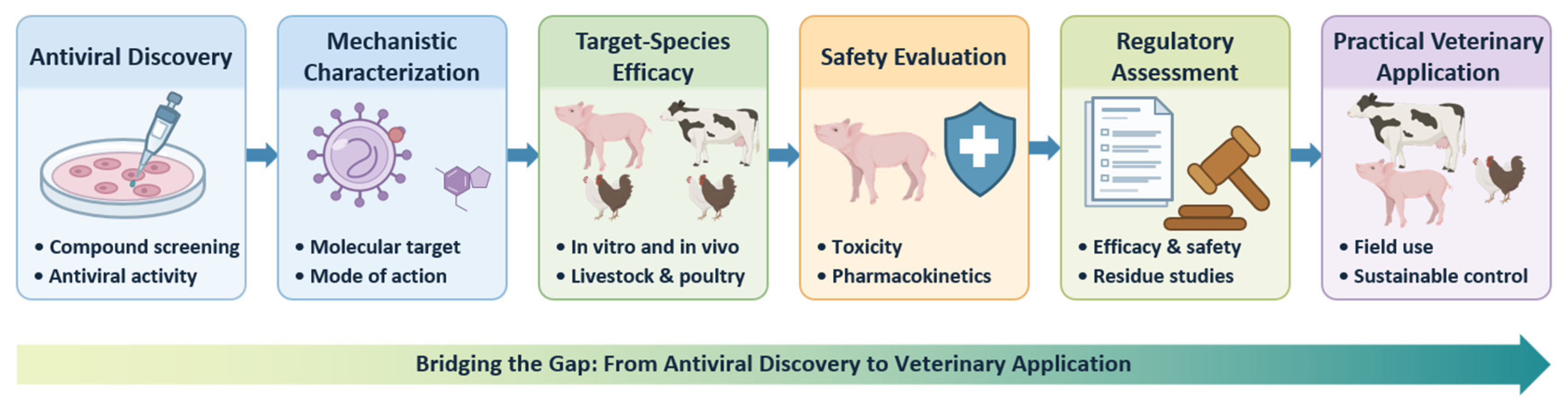
Finally, the regulatory status of antiviral agents must be considered separately from their experimental efficacy. A compound that shows promising results in a laboratory or animal challenge study is not necessarily approved for use in food-producing animals. Veterinary development must integrate efficacy, safety, manufacturing quality, residue assessment, and applicable regulatory requirements. Figure 2 summarizes the major stages and evaluation requirements for translating nucleoside and nucleotide analogues into veterinary antiviral applications.
Figure 2.
Translational framework for the development of nucleoside and nucleotide analogues against livestock viruses. Schematic overview of the major stages involved in translating nucleoside and nucleotide analogues into veterinary antiviral applications. The process encompasses antiviral discovery and initial screening, mechanistic characterization, target-species pharmacokinetic evaluation, in vivo efficacy and safety assessment, regulatory evaluation, and practical veterinary application.
5. Conclusions and Future Perspectives
Nucleoside and nucleotide analogues offer a mechanistically rational complement to vaccination for controlling livestock viral diseases, particularly when antigenic diversity, delayed diagnosis, or emerging outbreaks constrain vaccine-based interventions. Their potential lies not in an assumed universal broad-spectrum effect with equivalent efficacy across different viral families and host species, but in the possibility of developing targeted, scalable antiviral agents that can be deployed rapidly when needed. However, current evidence remains limited and uneven across pathogens: T-1105 and brincidofovir currently have the strongest target-livestock challenge evidence, whereas most other candidates remain supported mainly by in vitro or non-target-animal studies. Priority should therefore be given to target-species pharmacokinetic/pharmacodynamic (PK/PD) evaluation and efficacy, followed by resistance surveillance, safety and residue assessment, and field validation. This gap highlights a central challenge: antiviral activity cannot be inferred solely from chemical class or conserved viral targets, but must be established in the context of intracellular activation, polymerase susceptibility, viral replication biology, and achievable drug exposure. In parallel, antiviral resistance evidence must be stratified into experimentally validated findings and theoretically plausible risks; standardized surveillance is essential for sustainable drug use in high-density farming, where resistant variants spread rapidly under selection pressure. Future research should therefore move beyond screening for broad in vitro activity toward defining the molecular determinants of susceptibility and resistance, validating efficacy in relevant host species, and using these insights to guide compound optimization and rational combination strategies. Host nucleotide metabolism and complementary resistance pathways may offer additional opportunities to improve antiviral activity and limit resistance emergence. For veterinary applications, candidate selection should integrate reproducible efficacy, safety, feasible administration, and species-specific pharmacological properties from the outset, and full clinical translation requires systematic toxicological assessment, edible tissue residue-depletion studies, and legally defined withdrawal periods to safeguard food safety. Ultimately, a mechanism-guided, evidence-based approach that connects antiviral activity with efficacy in the intended host will be essential to translate these compounds into practical tools for sustainable livestock health and One Health preparedness.
Author Contributions
X.Y., B.W. and J.D. wrote the manuscript and made the figures. Z.L., Y.X. and P.S. conceived, designed, and edited the manuscript. All authors have read and agreed to the published version of the manuscript.
Funding
This work was funded by the grants from the National Key Research and Development Plan of China (2023YFD1801900), the National Natural Science Foundation of China (82102375, 32470175, 31972680), Ningbo Natural Science Foundation (2024J466), the Summit Advancement Disciplines of Zhejiang Province (Wenzhou Medical University–Pharmaceutics), and Science Technology Department of Wenzhou (Y2023074).
Institutional Review Board Statement
Not applicable.
Informed Consent Statement
Not applicable.
Data Availability Statement
No new data were created or analyzed in this study. Data sharing is not applicable to this article.
Conflicts of Interest
The authors declare no conflicts of interest.
References
- Grubman, M.J.; Baxt, B. Foot-and-Mouth Disease. Clin. Microbiol. Rev. 2004, 17, 465–493. [Google Scholar] [CrossRef] [Scilit] [PubMed]
- Dixon, L.K.; Sun, H.; Roberts, H. African Swine Fever. Antivir. Res. 2019, 165, 34–41. [Google Scholar] [CrossRef] [Scilit] [PubMed]
- Jung, K.; Saif, L.J. Porcine Epidemic Diarrhea Virus Infection: Etiology, Epidemiology, Pathogenesis and Immunoprophylaxis. Vet. J. 2015, 204, 134–143. [Google Scholar] [CrossRef] [Scilit] [PubMed]
- De Clercq, E.; Li, G. Approved Antiviral Drugs over the Past 50 Years. Clin. Microbiol. Rev. 2016, 29, 695–747. [Google Scholar] [CrossRef] [Scilit] [PubMed]
- Tasker, S.; Spiri, A.M.; Hartmann, K.; Addie, D.D.; Belák, S.; Bergmann, M.; Egberink, H.; Frymus, T.; Hofmann-Lehmann, R.; Marsilio, F.; et al. Update on Treatment of Feline Infectious Peritonitis: European Advisory Board on Cat Diseases (ABCD) Guidelines. Viruses 2026, 18, 452. [Google Scholar] [CrossRef] [Scilit] [PubMed]
- Geraghty, R.J.; Aliota, M.T.; Bonnac, L.F. Broad-Spectrum Antiviral Strategies and Nucleoside Analogues. Viruses 2021, 13, 667. [Google Scholar] [CrossRef] [Scilit] [PubMed]
- Peterson, L.W.; McKenna, C.E. Prodrug Approaches to Improving the Oral Absorption of Antiviral Nucleotide Analogues. Expert Opin. Drug Deliv. 2009, 6, 405–420. [Google Scholar] [CrossRef] [Scilit] [PubMed]
- Schneider, B.; Sarfati, R.; Deville-Bonne, D.; Véron, M. Role of Nucleoside Diphosphate Kinase in the Activation of Anti-HIV Nucleoside Analogs. J. Bioenerg. Biomembr. 2000, 32, 317–324. [Google Scholar] [CrossRef] [Scilit] [PubMed]
- Graci, J.D.; Cameron, C.E. Therapeutically Targeting RNA Viruses via Lethal Mutagenesis. Future Virol. 2008, 3, 553–566. [Google Scholar] [CrossRef] [Scilit] [PubMed]
- Hadj Hassine, I.; Ben M’hadheb, M.; Menéndez-Arias, L. Lethal Mutagenesis of RNA Viruses and Approved Drugs with Antiviral Mutagenic Activity. Viruses 2022, 14, 841. [Google Scholar] [CrossRef] [Scilit] [PubMed]
- Long, C.; Romero, M.E.; La Rocco, D.; Yu, J. Dissecting Nucleotide Selectivity in Viral RNA Polymerases. Comput Struct. Biotechnol. J. 2021, 19, 3339–3348. [Google Scholar] [CrossRef] [Scilit] [PubMed]
- Ferrer-Orta, C.; Sierra, M.; Agudo, R.; de la Higuera, I.; Arias, A.; Pérez-Luque, R.; Escarmís, C.; Domingo, E.; Verdaguer, N. Structure of Foot-and-Mouth Disease Virus Mutant Polymerases with Reduced Sensitivity to Ribavirin. J. Virol. 2010, 84, 6188–6199. [Google Scholar] [CrossRef] [Scilit] [PubMed]
- Yin, W.; Mao, C.; Luan, X.; Shen, D.-D.; Shen, Q.; Su, H.; Wang, X.; Zhou, F.; Zhao, W.; Gao, M.; et al. Structural Basis for Inhibition of the RNA-Dependent RNA Polymerase from SARS-CoV-2 by Remdesivir. Science 2020, 368, 1499–1504. [Google Scholar] [CrossRef] [Scilit] [PubMed]
- Soriano, V.; Vispo, E.; de Mendoza, C.; Labarga, P.; Fernandez-Montero, J.V.; Poveda, E.; Treviño, A.; Barreiro, P. Hepatitis C Therapy with HCV NS5B Polymerase Inhibitors. Expert Opin. Pharmacother. 2013, 14, 1161–1170. [Google Scholar] [CrossRef] [Scilit] [PubMed]
- Deval, J.; Symons, J.A.; Beigelman, L. Inhibition of Viral RNA Polymerases by Nucleoside and Nucleotide Analogs: Therapeutic Applications against Positive-Strand RNA Viruses beyond Hepatitis C Virus. Curr. Opin. Virol. 2014, 9, 1–7. [Google Scholar] [CrossRef] [Scilit] [PubMed]
- Gordon, C.J.; Oliva, M.F.; Lee, H.W.; Goovaerts, Q.; De Wijngaert, B.; Götte, M.; Das, K. Preferential Remdesivir Triphosphate Incorporation by SARS-CoV-2 Polymerase Is Altered to ATP by the S759A Mutation. Commun. Biol. 2026, 9, 591. [Google Scholar] [CrossRef] [Scilit] [PubMed]
- Gordon, C.J.; Tchesnokov, E.P.; Woolner, E.; Perry, J.K.; Feng, J.Y.; Porter, D.P.; Götte, M. Remdesivir Is a Direct-Acting Antiviral That Inhibits RNA-Dependent RNA Polymerase from Severe Acute Respiratory Syndrome Coronavirus 2 with High Potency. J. Biol. Chem. 2020, 295, 6785–6797. [Google Scholar] [CrossRef] [Scilit] [PubMed]
- Kokic, G.; Hillen, H.S.; Tegunov, D.; Dienemann, C.; Seitz, F.; Schmitzova, J.; Farnung, L.; Siewert, A.; Höbartner, C.; Cramer, P. Mechanism of SARS-CoV-2 Polymerase Stalling by Remdesivir. Nat. Commun. 2021, 12, 279. [Google Scholar] [CrossRef] [Scilit] [PubMed]
- Lam, B.; Henry, L.; Younossi, Z. Sofosbuvir (Sovaldi) for the Treatment of Hepatitis C. Expert Rev. Clin. Pharmacol. 2014, 7, 555–566. [Google Scholar] [CrossRef] [Scilit] [PubMed]
- Sofia, M.J.; Bao, D.; Chang, W.; Du, J.; Nagarathnam, D.; Rachakonda, S.; Reddy, P.G.; Ross, B.S.; Wang, P.; Zhang, H.-R.; et al. Discovery of a β-d-2′-Deoxy-2′-α-Fluoro-2′-β-C-Methyluridine Nucleotide Prodrug (PSI-7977) for the Treatment of Hepatitis C Virus. J. Med. Chem. 2010, 53, 7202–7218. [Google Scholar] [CrossRef] [Scilit] [PubMed]
- Ferrer-Orta, C.; Arias, A.; Pérez-Luque, R.; Escarmís, C.; Domingo, E.; Verdaguer, N. Sequential Structures Provide Insights into the Fidelity of RNA Replication. Proc. Natl. Acad. Sci. USA 2007, 104, 9463–9468. [Google Scholar] [CrossRef] [Scilit] [PubMed]
- Anderson, T.K.; Hoferle, P.J.; Chojnacki, K.J.; Lee, K.W.; Coon, J.J.; Kirchdoerfer, R.N. An Alphacoronavirus Polymerase Structure Reveals Conserved Replication Factor Functions. Nucleic Acids Res. 2024, 52, 5975–5986. [Google Scholar] [CrossRef] [Scilit] [PubMed]
- Gao, X.; Zhang, J.; Gao, P.; Ge, X.; Zhang, Y.; Han, J.; Guo, X.; Zhou, L.; Yang, H. Identification of Fidelity-Determined Residues of Porcine Reproductive and Respiratory Syndrome Virus through Structural Alignment. Virulence 2026, 17, 2629134. [Google Scholar] [CrossRef] [Scilit] [PubMed]
- Marques, M.I.; Costa, J.V. Functional and Molecular Characterization of African Swine Fever Virus Mutants Resistant to Phosphonoacetic Acid. Virology 1995, 214, 72–81. [Google Scholar] [CrossRef] [Scilit] [PubMed]
- Kabinger, F.; Stiller, C.; Schmitzová, J.; Dienemann, C.; Kokic, G.; Hillen, H.S.; Höbartner, C.; Cramer, P. Mechanism of Molnupiravir-Induced SARS-CoV-2 Mutagenesis. Nat. Struct. Mol. Biol. 2021, 28, 740–746. [Google Scholar] [CrossRef] [Scilit] [PubMed]
- Gordon, C.J.; Tchesnokov, E.P.; Schinazi, R.F.; Götte, M. Molnupiravir Promotes SARS-CoV-2 Mutagenesis via the RNA Template. J. Biol. Chem. 2021, 297, 100770. [Google Scholar] [CrossRef] [Scilit] [PubMed]
- Sheahan, T.P.; Sims, A.C.; Zhou, S.; Graham, R.L.; Pruijssers, A.J.; Agostini, M.L.; Leist, S.R.; Schäfer, A.; Dinnon, K.H., 3rd; Stevens, L.J.; et al. An Orally Bioavailable Broad-Spectrum Antiviral Inhibits SARS-CoV-2 in Human Airway Epithelial Cell Cultures and Multiple Coronaviruses in Mice. Sci. Transl. Med. 2020, 12, eabb5883. [Google Scholar] [CrossRef] [Scilit] [PubMed]
- Crotty, S.; Cameron, C.E.; Andino, R. RNA Virus Error Catastrophe: Direct Molecular Test by Using Ribavirin. Proc. Natl. Acad. Sci. USA 2001, 98, 6895–6900. [Google Scholar] [CrossRef] [Scilit] [PubMed]
- Jordan, P.C.; Stevens, S.K.; Deval, J. Nucleosides for the Treatment of Respiratory RNA Virus Infections. Antivir. Chem. Chemother. 2018, 26, 2040206618764483. [Google Scholar] [CrossRef] [Scilit] [PubMed]
- Leyssen, P.; Balzarini, J.; De Clercq, E.; Neyts, J. The Predominant Mechanism by Which Ribavirin Exerts Its Antiviral Activity in Vitro against Flaviviruses and Paramyxoviruses Is Mediated by Inhibition of IMP Dehydrogenase. J. Virol. 2005, 79, 1943–1947. [Google Scholar] [CrossRef] [Scilit] [PubMed]
- Crotty, S.; Maag, D.; Arnold, J.J.; Zhong, W.; Lau, J.Y.; Hong, Z.; Andino, R.; Cameron, C.E. The Broad-Spectrum Antiviral Ribonucleoside Ribavirin Is an RNA Virus Mutagen. Nat. Med. 2000, 6, 1375–1379, Erratum in Nat Med. 2001, 7, 255. https://doi.org/10.1038/84722. [Google Scholar] [CrossRef] [Scilit] [PubMed]
- Vanderlinden, E.; Vrancken, B.; Van Houdt, J.; Rajwanshi, V.K.; Gillemot, S.; Andrei, G.; Lemey, P.; Naesens, L. Distinct Effects of T-705 (Favipiravir) and Ribavirin on Influenza Virus Replication and Viral RNA Synthesis. Antimicrob. Agents Chemother. 2016, 60, 6679–6691. [Google Scholar] [CrossRef] [Scilit] [PubMed]
- Graci, J.D.; Cameron, C.E. Mechanisms of Action of Ribavirin against Distinct Viruses. Rev. Med. Virol. 2006, 16, 37–48. [Google Scholar] [CrossRef] [Scilit] [PubMed]
- Meng, Q.; Hagemeier, S.R.; Fingeroth, J.D.; Gershburg, E.; Pagano, J.S.; Kenney, S.C. The Epstein-Barr Virus (EBV)-Encoded Protein Kinase, EBV-PK, but Not the Thymidine Kinase (EBV-TK), Is Required for Ganciclovir and Acyclovir Inhibition of Lytic Viral Production. J. Virol. 2010, 84, 4534–4542. [Google Scholar] [CrossRef] [Scilit] [PubMed]
- Elion, G.B.; Furman, P.A.; Fyfe, J.A.; de Miranda, P.; Beauchamp, L.; Schaeffer, H.J. Selectivity of Action of an Antiherpetic Agent, 9-(2-Hydroxyethoxymethyl) Guanine. Proc. Natl. Acad. Sci. USA 1977, 74, 5716–5720. [Google Scholar] [CrossRef] [Scilit] [PubMed]
- Reardon, J.E.; Spector, T. Herpes Simplex Virus Type 1 DNA Polymerase. Mechanism of Inhibition by Acyclovir Triphosphate. J. Biol. Chem. 1989, 264, 7405–7411. [Google Scholar] [CrossRef] [Scilit]
- Ilsley, D.D.; Lee, S.H.; Miller, W.H.; Kuchta, R.D. Acyclic Guanosine Analogs Inhibit DNA Polymerases Alpha, Delta, and Epsilon with Very Different Potencies and Have Unique Mechanisms of Action. Biochemistry 1995, 34, 2504–2510. [Google Scholar] [CrossRef] [Scilit] [PubMed]
- Xu, Y.; Wu, Y.; Wu, X.; Zhang, Y.; Yang, Y.; Li, D.; Yang, B.; Gao, K.; Zhang, Z.; Dong, C. Structural Basis of Human Mpox Viral DNA Replication Inhibition by Brincidofovir and Cidofovir. Int. J. Biol. Macromol. 2024, 270, 132231. [Google Scholar] [CrossRef] [Scilit] [PubMed]
- Magee, W.C.; Hostetler, K.Y.; Evans, D.H. Mechanism of Inhibition of Vaccinia Virus DNA Polymerase by Cidofovir Diphosphate. Antimicrob. Agents Chemother. 2005, 49, 3153–3162. [Google Scholar] [CrossRef] [Scilit] [PubMed]
- Kendle, J.B.; Fan-Havard, P. Cidofovir in the Treatment of Cytomegaloviral Disease. Ann. Pharmacother. 1998, 32, 1181–1192. [Google Scholar] [CrossRef] [Scilit] [PubMed]
- Gilbert, C.; Bestman-Smith, J.; Boivin, G. Resistance of Herpesviruses to Antiviral Drugs: Clinical Impacts and Molecular Mechanisms. Drug Resist Updat 2002, 5, 88–114. [Google Scholar] [CrossRef] [Scilit] [PubMed]
- De Clercq, E. Cidofovir in the Treatment of Poxvirus Infections. Antivir. Res. 2002, 55, 1–13. [Google Scholar] [CrossRef] [Scilit] [PubMed]
- Sierra, M.; Airaksinen, A.; González-López, C.; Agudo, R.; Arias, A.; Domingo, E. Foot-and-Mouth Disease Virus Mutant with Decreased Sensitivity to Ribavirin: Implications for Error Catastrophe. J. Virol. 2007, 81, 2012–2024. [Google Scholar] [CrossRef] [Scilit] [PubMed]
- Agostini, M.L.; Andres, E.L.; Sims, A.C.; Graham, R.L.; Sheahan, T.P.; Lu, X.; Smith, E.C.; Case, J.B.; Feng, J.Y.; Jordan, R.; et al. Coronavirus Susceptibility to the Antiviral Remdesivir (GS-5734) Is Mediated by the Viral Polymerase and the Proofreading Exoribonuclease. mBio 2018, 9, e00221-18. [Google Scholar] [CrossRef] [Scilit] [PubMed]
- Rasmussen, H.B.; Thomsen, R.; Hansen, P.R. Nucleoside Analog GS-441524: Pharmacokinetics in Different Species, Safety, and Potential Effectiveness against Covid-19. Pharmacol. Res. Perspect. 2022, 10, e00945. [Google Scholar] [CrossRef] [Scilit] [PubMed]
- Toutain, P.-L.; Ferran, A.; Bousquet-Mélou, A. Species Differences in Pharmacokinetics and Pharmacodynamics. In Comparative and Veterinary Pharmacology; Cunningham, F., Elliott, J., Lees, P., Eds.; Handbook of Experimental Pharmacology; Springer: Berlin, Heidelberg, Germany, 2010; Volume 199, pp. 19–48. [Google Scholar]
- Nishi, T.; Fukai, K.; Masujin, K.; Kawaguchi, R.; Ikezawa, M.; Yamada, M.; Nakajima, N.; Komeno, T.; Furuta, Y.; Sugihara, H.; et al. Administration of the Antiviral Agent T-1105 Fully Protects Pigs from Foot-and-Mouth Disease Infection. Antivir. Res. 2022, 208, 105425. [Google Scholar] [CrossRef] [Scilit] [PubMed]
- Zou, H.; Huang, S.; Mu, Z.; Luo, G.; An, W. Comparative Efficacy of Medications and Compound Interventions against Porcine Epidemic Diarrhea Virus Replication in Vitro: A Systematic Review and Meta-Analysis. BMC Vet. Res. 2026, 22, 294. [Google Scholar] [CrossRef] [Scilit] [PubMed]
- Huang, Z.-X.; Zhou, S.-T.; Wang, J.; Yang, Z.-B.; Wang, Z. Remdesivir Inhibits Porcine Epidemic Diarrhea Virus Infection in Vitro. Heliyon 2023, 9, e21468. [Google Scholar] [CrossRef] [Scilit] [PubMed]
- Xi, F.; Sun, B.; Duan, L.; Lu, B.; Zhang, S.; Tian, H.; Yang, F.; Zhu, Z.; Zheng, H.; Zhu, G.; et al. Azvudine Potently Inhibits African Swine Fever Virus Replication in Vitro. Virus Res. 2026, 363, 199675. [Google Scholar] [CrossRef] [Scilit] [PubMed]
- Xie, Y.; Guo, X.; Hu, T.; Wei, D.; Ma, X.; Wu, J.; Huang, B.; Shen, J. Significant Inhibition of Porcine Epidemic Diarrhea Virus In Vitro by Remdesivir, Its Parent Nucleoside and β-D-N4-Hydroxycytidine. Virol. Sin. 2021, 36, 997–1005. [Google Scholar] [CrossRef] [Scilit] [PubMed]
- Zhang, M.; Qian, B.; Kunec, D.; Veit, M. Development of GFP-Expressing Infectious Clones for PRRSV Using TAR Cloning for Antiviral Drug Screening. npj Viruses 2025, 3, 66. [Google Scholar] [CrossRef] [Scilit] [PubMed]
- Pedersen, N.C.; Perron, M.; Bannasch, M.; Montgomery, E.; Murakami, E.; Liepnieks, M.; Liu, H. Efficacy and Safety of the Nucleoside Analog GS-441524 for Treatment of Cats with Naturally Occurring Feline Infectious Peritonitis. J. Feline Med. Surg. 2019, 21, 271–281. [Google Scholar] [CrossRef] [Scilit] [PubMed]
- Cook, S.; Wittenburg, L.; Yan, V.C.; Theil, J.H.; Castillo, D.; Reagan, K.L.; Williams, S.; Pham, C.-D.; Li, C.; Muller, F.L.; et al. An Optimized Bioassay for Screening Combined Anticoronaviral Compounds for Efficacy against Feline Infectious Peritonitis Virus with Pharmacokinetic Analyses of GS-441524, Remdesivir, and Molnupiravir in Cats. Viruses 2022, 14, 2429. [Google Scholar] [CrossRef] [Scilit] [PubMed]
- Huang, Z.-X.; Zhou, S.-T.; Yang, Z.-B.; Wang, Z. Molnupiravir Inhibits Porcine Epidemic Diarrhea Virus Infection In Vitro. Viruses 2023, 15, 1317. [Google Scholar] [CrossRef] [Scilit] [PubMed]
- Yoon, J.-J.; Toots, M.; Lee, S.; Lee, M.-E.; Ludeke, B.; Luczo, J.M.; Ganti, K.; Cox, R.M.; Sticher, Z.M.; Edpuganti, V.; et al. Orally Efficacious Broad-Spectrum Ribonucleoside Analog Inhibitor of Influenza and Respiratory Syncytial Viruses. Antimicrob. Agents Chemother. 2018, 62, e00766-18. [Google Scholar] [CrossRef] [Scilit] [PubMed]
- Sase, O.; Iwami, T.; Sasaki, T.; Sano, T. GS-441524 and Molnupiravir Are Similarly Effective for the Treatment of Cats with Feline Infectious Peritonitis. Front Vet. Sci. 2024, 11, 1422408. [Google Scholar] [CrossRef] [Scilit] [PubMed]
- Chi, C.-K.; Bajpai, V.; Li, C.-H.; Tsai, H.-Y.; Chen, C.-W.; Cheng, C.-A.; Liu, H.-W.; Chang, C.-Y. Molnupiravir: A Prodrug of the Ribonucleoside β-D-N4-Hydroxycytidine Triphosphate Inhibits the Propagation of Nervous Necrosis Virus in Grouper Brain Cells. J. Fish. Dis. 2026, 49, e70121. [Google Scholar] [CrossRef] [Scilit] [PubMed]
- de Avila, A.I.; Moreno, E.; Perales, C.; Domingo, E. Favipiravir Can Evoke Lethal Mutagenesis and Extinction of Foot-and-Mouth Disease Virus. Virus Res. 2017, 233, 105–112. [Google Scholar] [CrossRef] [Scilit] [PubMed]
- Scharton, D.; Bailey, K.W.; Vest, Z.; Westover, J.B.; Kumaki, Y.; Van Wettere, A.; Furuta, Y.; Gowen, B.B. Favipiravir (T-705) Protects against Peracute Rift Valley Fever Virus Infection and Reduces Delayed-Onset Neurologic Disease Observed with Ribavirin Treatment. Antivir. Res. 2014, 104, 84–92. [Google Scholar] [CrossRef] [Scilit] [PubMed]
- Nguyen, H.T.; Nguyen, T.; Mishin, V.P.; Sleeman, K.; Balish, A.; Jones, J.; Creanga, A.; Marjuki, H.; Uyeki, T.M.; Nguyen, D.H.; et al. Antiviral Susceptibility of Highly Pathogenic Avian Influenza A(H5N1) Viruses Isolated from Poultry, Vietnam, 2009-2011. Emerg. Infect. Dis. 2013, 19, 1963–1971. [Google Scholar] [CrossRef] [Scilit] [PubMed]
- Xue, X.; Zhu, Y.; Yan, L.; Wong, G.; Sun, P.; Zheng, X.; Xia, X. Antiviral Efficacy of Favipiravir against Canine Distemper Virus Infection in Vitro. BMC Vet. Res. 2019, 15, 316. [Google Scholar] [CrossRef] [Scilit] [PubMed]
- Cai, L.; Sun, Y.; Song, Y.; Xu, L.; Bei, Z.; Zhang, D.; Dou, Y.; Wang, H. Viral Polymerase Inhibitors T-705 and T-1105 Are Potential Inhibitors of Zika Virus Replication. Arch. Virol. 2017, 162, 2847–2853. [Google Scholar] [CrossRef] [Scilit] [PubMed]
- Choi, J.-H.; Jeong, K.; Kim, S.-M.; Ko, M.-K.; You, S.-H.; Lyoo, Y.S.; Kim, B.; Ku, J.-M.; Park, J.-H. Synergistic Effect of Ribavirin and Vaccine for Protection during Early Infection Stage of Foot-and-Mouth Disease. J. Vet. Sci. 2018, 19, 788–797. [Google Scholar] [CrossRef] [Scilit] [PubMed]
- Westover, J.B.; Mathis, A.; Taylor, R.; Wandersee, L.; Bailey, K.W.; Sefing, E.J.; Hickerson, B.T.; Jung, K.-H.; Sheridan, W.P.; Gowen, B.B. Galidesivir Limits Rift Valley Fever Virus Infection and Disease in Syrian Golden Hamsters. Antivir. Res. 2018, 156, 38–45. [Google Scholar] [CrossRef] [Scilit] [PubMed]
- Xie, Y.; Chi, Y.L.; Liu, S.Q.; Zhu, W.Y. BCX4430 Inhibits the Replication of Rabies Virus by Suppressing mTOR-Dependent Autophagy in Vitro. Virology 2023, 585, 21–31. [Google Scholar] [CrossRef] [Scilit] [PubMed]
- Warren, T.K.; Wells, J.; Panchal, R.G.; Stuthman, K.S.; Garza, N.L.; Van Tongeren, S.A.; Dong, L.; Retterer, C.J.; Eaton, B.P.; Pegoraro, G.; et al. Protection against Filovirus Diseases by a Novel Broad-Spectrum Nucleoside Analogue BCX4430. Nature 2014, 508, 402–405. [Google Scholar] [CrossRef] [Scilit] [PubMed]
- Durantel, D.; Carrouée-Durantel, S.; Branza-Nichita, N.; Dwek, R.A.; Zitzmann, N. Effects of Interferon, Ribavirin, and Iminosugar Derivatives on Cells Persistently Infected with Noncytopathic Bovine Viral Diarrhea Virus. Antimicrob. Agents Chemother. 2004, 48, 497–504. [Google Scholar] [CrossRef] [Scilit] [PubMed]
- Smee, D.F.; Hurst, B.L.; Wong, M.-H.; Bailey, K.W.; Morrey, J.D. Effects of Double Combinations of Amantadine, Oseltamivir, and Ribavirin on Influenza A (H5N1) Virus Infections in Cell Culture and in Mice. Antimicrob. Agents Chemother. 2009, 53, 2120–2128. [Google Scholar] [CrossRef] [Scilit] [PubMed]
- Bhuvaneswar, C.; Rammohan, A.; Bhaskar, B.V.; Babu, P.R.; Naveen, G.; Gunasekar, D.; Madhuri, S.; Reddanna, P.; Rajendra, W. Sophora Interrupta Bedd. Root-Derived Flavonoids as Prominent Antiviral Agents against Newcastle Disease Virus. RSC Adv. 2020, 10, 33534–33543. [Google Scholar] [CrossRef] [Scilit] [PubMed]
- Hall, C.B.; McBride, J.T.; Walsh, E.E.; Bell, D.M.; Gala, C.L.; Hildreth, S.; Ten Eyck, L.G.; Hall, W.J. Aerosolized Ribavirin Treatment of Infants with Respiratory Syncytial Viral Infection. A Randomized Double-Blind Study. N. Engl. J. Med. 1983, 308, 1443–1447. [Google Scholar] [CrossRef] [Scilit] [PubMed]
- Gilbert, B.E.; Wilson, S.Z.; Knight, V.; Couch, R.B.; Quarles, J.M.; Dure, L.; Hayes, N.; Willis, G. Ribavirin Small-Particle Aerosol Treatment of Infections Caused by Influenza Virus Strains A/Victoria/7/83 (H1N1) and B/Texas/1/84. Antimicrob. Agents Chemother. 1985, 27, 309–313. [Google Scholar] [CrossRef] [Scilit] [PubMed]
- Paeshuyse, J.; Leyssen, P.; Mabery, E.; Boddeker, N.; Vrancken, R.; Froeyen, M.; Ansari, I.H.; Dutartre, H.; Rozenski, J.; Gil, L.H.V.G.; et al. A Novel, Highly Selective Inhibitor of Pestivirus Replication That Targets the Viral RNA-Dependent RNA Polymerase. J. Virol. 2006, 80, 149–160. [Google Scholar] [CrossRef] [Scilit] [PubMed]
- Carroll, S.S.; Tomassini, J.E.; Bosserman, M.; Getty, K.; Stahlhut, M.W.; Eldrup, A.B.; Bhat, B.; Hall, D.; Simcoe, A.L.; LaFemina, R.; et al. Inhibition of Hepatitis C Virus RNA Replication by 2′-Modified Nucleoside Analogs. J. Biol. Chem. 2003, 278, 11979–11984. [Google Scholar] [CrossRef] [Scilit] [PubMed]
- Tao, S.; Zandi, K.; Bassit, L.; Ong, Y.T.; Verma, K.; Liu, P.; Downs-Bowen, J.A.; McBrayer, T.; LeCher, J.C.; Kohler, J.J.; et al. Comparison of Anti-SARS-CoV-2 Activity and Intracellular Metabolism of Remdesivir and Its Parent Nucleoside. Curr. Res. Pharmacol. Drug Discov. 2021, 2, 100045. [Google Scholar] [CrossRef] [Scilit] [PubMed]
- Murphy, B.G.; Perron, M.; Murakami, E.; Bauer, K.; Park, Y.; Eckstrand, C.; Liepnieks, M.; Pedersen, N.C. The Nucleoside Analog GS-441524 Strongly Inhibits Feline Infectious Peritonitis (FIP) Virus in Tissue Culture and Experimental Cat Infection Studies. Vet. Microbiol. 2018, 219, 226–233. [Google Scholar] [CrossRef] [Scilit] [PubMed]
- Chowdhury, D.; Das, A.; Mishra, M.; Khutere, T.; Jayashree; Manna, R.; Bodakhe, S.H. Impact and Evolution of Influenza A Virus: A Comprehensive Review on Zoonosis, Animal Health, and Control Strategies. Vacunas 2026, 27, 500650. [Google Scholar] [CrossRef] [Scilit]
- Smee, D.F.; Hurst, B.L.; Egawa, H.; Takahashi, K.; Kadota, T.; Furuta, Y. Intracellular Metabolism of Favipiravir (T-705) in Uninfected and Influenza A (H5N1) Virus-Infected Cells. J. Antimicrob. Chemother. 2009, 64, 741–746. [Google Scholar] [CrossRef] [Scilit] [PubMed]
- Furuta, Y.; Gowen, B.B.; Takahashi, K.; Shiraki, K.; Smee, D.F.; Barnard, D.L. Favipiravir (T-705), a Novel Viral RNA Polymerase Inhibitor. Antivir. Res. 2013, 100, 446–454. [Google Scholar] [CrossRef] [Scilit] [PubMed]
- Shiraki, K.; Daikoku, T. Favipiravir, an Anti-Influenza Drug against Life-Threatening RNA Virus Infections. Pharmacol. Ther. 2020, 209, 107512. [Google Scholar] [CrossRef] [Scilit] [PubMed]
- Gu, C.; Maemura, T.; Guan, L.; Eisfeld, A.J.; Biswas, A.; Kiso, M.; Uraki, R.; Ito, M.; Trifkovic, S.; Wang, T.; et al. A Human Isolate of Bovine H5N1 Is Transmissible and Lethal in Animal Models. Nature 2024, 636, 711–718. [Google Scholar] [CrossRef] [Scilit] [PubMed]
- Caserta, L.C.; Frye, E.A.; Butt, S.L.; Laverack, M.; Nooruzzaman, M.; Covaleda, L.M.; Thompson, A.C.; Koscielny, M.P.; Cronk, B.; Johnson, A.; et al. Spillover of Highly Pathogenic Avian Influenza H5N1 Virus to Dairy Cattle. Nature 2024, 634, 669–676. [Google Scholar] [CrossRef] [Scilit] [PubMed]
- Khatun, A.; Shabir, N.; Yoon, K.-J.; Kim, W.-I. Effects of Ribavirin on the Replication and Genetic Stability of Porcine Reproductive and Respiratory Syndrome Virus. BMC Vet. Res. 2015, 11, 21. [Google Scholar] [CrossRef] [Scilit] [PubMed]
- Zhang, X.; Yang, Z.; Zhang, Z.; Wang, Z.; Zhao, Y.; Yang, T.; Gong, J.; Feng, K.; He, J.; Zheng, Q.; et al. Contribution of Critical Amino Acid Residues in the RNA-Dependent RNA Polymerase to the Replication Fidelity and Viral Ribavirin Sensitivity of Porcine Reproductive and Respiratory Syndrome Virus. Vet. Res. 2025, 56, 83. [Google Scholar] [CrossRef] [Scilit] [PubMed]
- Goulding, L.V.; Kiss, E.; Goatley, L.; Vrancken, R.; Goris, N.E.J.; Dixon, L. In Vitro and in Vivo Antiviral Activity of Nucleoside Analogue cHPMPC against African Swine Fever Virus Replication. Antivir. Res. 2022, 208, 105433. [Google Scholar] [CrossRef] [Scilit] [PubMed]
- Guo, S.; Zhang, Y.; Liu, Z.; Wang, D.; Liu, H.; Li, L.; Chen, Q.; Yang, D.; Liu, Q.; Guo, H.; et al. Brincidofovir Is a Robust Replication Inhibitor against African Swine Fever Virus in Vivo and in Vitro. Emerg. Microbes Infect. 2023, 12, 2220572. [Google Scholar] [CrossRef] [Scilit] [PubMed]
- Rollinson, E.A.; White, G. Relative Activities of Acyclovir and BW759 against Aujeszky’s Disease and Equine Rhinopneumonitis Viruses. Antimicrob. Agents Chemother. 1983, 24, 221–226. [Google Scholar] [CrossRef] [Scilit] [PubMed]
- Field, H.J. Chemotherapy of Aujeszky’s Disease (Pseudorabies) in the Mouse by Means of Nucleoside Analogues: Bromovinyldeoxyuridine, Acyclovir, and Dihydroxypropoxymethylguanine. Antivir. Res. 1985, 5, 157–168. [Google Scholar] [CrossRef] [Scilit] [PubMed]
- De Clercq, E.; Holý, A. Acyclic Nucleoside Phosphonates: A Key Class of Antiviral Drugs. Nat. Rev. Drug Discov. 2005, 4, 928–940. [Google Scholar] [CrossRef] [Scilit] [PubMed]
- Yuan, C.; Fu, X.; Huang, L.; Ma, Y.; Ding, X.; Zhu, L.; Zhu, G. The Synergistic Antiviral Effects of GSH in Combination with Acyclovir against BoHV-1 Infection in Vitro. Acta Virol. 2016, 60, 328–332. [Google Scholar] [CrossRef] [Scilit] [PubMed]
- Gong, Z.; Dai, J.; Qu, H.; Hu, Y.; Sun, F.; Liu, C.; Li, X.; Feng, C.; Wang, Z.; Yang, Z.; et al. Anti-Orthopoxvirus Drugs Inhibit Lumpy Skin Disease Virus Replication by Targeting Viral DNA Polymerase. PLoS Pathog. 2026, 22, e1013903. [Google Scholar] [CrossRef] [Scilit] [PubMed]
- Guo, H.; Liu, Q.; Yang, D.; Zhang, H.; Kuang, Y.; Li, Y.; Chen, H.; Wang, X. Brincidofovir Effectively Inhibits Proliferation of Pseudorabies Virus by Disrupting Viral Replication. Viruses 2024, 16, 464. [Google Scholar] [CrossRef] [Scilit] [PubMed]
- Garré, B.; van der Meulen, K.; Nugent, J.; Neyts, J.; Croubels, S.; De Backer, P.; Nauwynck, H. In Vitro Susceptibility of Six Isolates of Equine Herpesvirus 1 to Acyclovir, Ganciclovir, Cidofovir, Adefovir, PMEDAP and Foscarnet. Vet. Microbiol. 2007, 122, 43–51. [Google Scholar] [CrossRef] [Scilit] [PubMed]
- Alling, C.R.; Liu, C.-C.; Langohr, I.M.; Haque, M.; Carter, R.T.; Baker, R.E.; Lewin, A.C. Assessment of Cidofovir for Treatment of Ocular Bovine Herpesvirus-1 Infection in Cattle Using an Ex-Vivo Model. Viruses 2021, 13, 2102. [Google Scholar] [CrossRef] [Scilit] [PubMed]
- Studies of Ocular Complications of AIDS Research Group in Collaboration with the AIDS Clinical Trials Group. Parenteral Cidofovir for Cytomegalovirus Retinitis in Patients with AIDS: The HPMPC Peripheral Cytomegalovirus Retinitis Trial. A Randomized, Controlled Trial. Ann. Intern Med. 1997, 126, 264–274. [Google Scholar] [CrossRef] [Scilit] [PubMed]
- Lalezari, J.; Schacker, T.; Feinberg, J.; Gathe, J.; Lee, S.; Cheung, T.; Kramer, F.; Kessler, H.; Corey, L.; Drew, W.L.; et al. A Randomized, Double-Blind, Placebo-Controlled Trial of Cidofovir Gel for the Treatment of Acyclovir-Unresponsive Mucocutaneous Herpes Simplex Virus Infection in Patients with AIDS. J. Infect. Dis. 1997, 176, 892–898. [Google Scholar] [CrossRef] [Scilit] [PubMed]
- Fontenelle, J.P.; Powell, C.C.; Veir, J.K.; Radecki, S.V.; Lappin, M.R. Effect of Topical Ophthalmic Application of Cidofovir on Experimentally Induced Primary Ocular Feline Herpesvirus-1 Infection in Cats. Am. J. Vet. Res. 2008, 69, 289–293. [Google Scholar] [CrossRef] [Scilit] [PubMed]
- Baker, R.O.; Bray, M.; Huggins, J.W. Potential Antiviral Therapeutics for Smallpox, Monkeypox and Other Orthopoxvirus Infections. Antivir. Res. 2003, 57, 13–23. [Google Scholar] [CrossRef] [Scilit] [PubMed]
- Tylden, G.D.; Hirsch, H.H.; Rinaldo, C.H. Brincidofovir (CMX001) Inhibits BK Polyomavirus Replication in Primary Human Urothelial Cells. Antimicrob. Agents Chemother. 2015, 59, 3306–3316. [Google Scholar] [CrossRef] [Scilit] [PubMed]
- Marty, F.M.; Winston, D.J.; Chemaly, R.F.; Mullane, K.M.; Shore, T.B.; Papanicolaou, G.A.; Chittick, G.; Brundage, T.M.; Wilson, C.; Morrison, M.E.; et al. A Randomized, Double-Blind, Placebo-Controlled Phase 3 Trial of Oral Brincidofovir for Cytomegalovirus Prophylaxis in Allogeneic Hematopoietic Cell Transplantation. Biol. Blood Marrow Transpl. 2019, 25, 369–381. [Google Scholar] [CrossRef] [Scilit] [PubMed]
- Sun, L.; Peng, Y.; Yu, W.; Zhang, Y.; Liang, L.; Song, C.; Hou, J.; Qiao, Y.; Wang, Q.; Chen, J.; et al. Mechanistic Insight into Antiretroviral Potency of 2′-Deoxy-2′-β-Fluoro-4′-Azidocytidine (FNC) with a Long-Lasting Effect on HIV-1 Prevention. J. Med. Chem. 2020, 63, 8554–8566. [Google Scholar] [CrossRef] [Scilit] [PubMed]
- Smith, D.B.; Kalayanov, G.; Sund, C.; Winqvist, A.; Maltseva, T.; Leveque, V.J.-P.; Rajyaguru, S.; Le Pogam, S.; Najera, I.; Benkestock, K.; et al. The Design, Synthesis, and Antiviral Activity of Monofluoro and Difluoro Analogues of 4′-Azidocytidine against Hepatitis C Virus Replication: The Discovery of 4′-Azido-2′-Deoxy-2′-Fluorocytidine and 4′-Azido-2′-Dideoxy-2′,2′-Difluorocytidine. J. Med. Chem. 2009, 52, 2971–2978. [Google Scholar] [CrossRef] [Scilit] [PubMed]
- Wang, A.Q.; Hagen, N.R.; Padilha, E.C.; Yang, M.; Shah, P.; Chen, C.Z.; Huang, W.; Terse, P.; Sanderson, P.; Zheng, W.; et al. Preclinical Pharmacokinetics and In Vitro Properties of GS-441524, a Potential Oral Drug Candidate for COVID-19 Treatment. Front Pharmacol. 2022, 13, 918083. [Google Scholar] [CrossRef] [Scilit] [PubMed]
- San Martín, B.; Muñoz, R.; Cornejo, J.; Martínez, M.A.; Araya-Jordán, C.; Maddaleno, A.; Anadón, A. Pharmacokinetics, Efficacy Prediction Indexes, and Residue Depletion of Ribavirin in Atlantic Salmon’s (Salmo Salar) Muscle after Oral Administration in Feed. J. Vet. Pharmacol. Ther. 2016, 39, 388–397. [Google Scholar] [CrossRef] [Scilit] [PubMed]
- Humeniuk, R.; Mathias, A.; Cao, H.; Osinusi, A.; Shen, G.; Chng, E.; Ling, J.; Vu, A.; German, P. Safety, Tolerability, and Pharmacokinetics of Remdesivir, An Antiviral for Treatment of COVID-19, in Healthy Subjects. Clin. Transl. Sci. 2020, 13, 896–906. [Google Scholar] [CrossRef] [Scilit] [PubMed]
- Xie, J.; Wang, Z. Can Remdesivir and Its Parent Nucleoside GS-441524 Be Potential Oral Drugs? An in Vitro and in Vivo DMPK Assessment. Acta Pharm. Sin. B 2021, 11, 1607–1616. [Google Scholar] [CrossRef] [Scilit] [PubMed]
- Cox, R.M.; Wolf, J.D.; Lieber, C.M.; Sourimant, J.; Lin, M.J.; Babusis, D.; DuPont, V.; Chan, J.; Barrett, K.T.; Lye, D.; et al. Oral Prodrug of Remdesivir Parent GS-441524 Is Efficacious against SARS-CoV-2 in Ferrets. Nat. Commun. 2021, 12, 6415. [Google Scholar] [CrossRef] [Scilit] [PubMed]
- Sheahan, T.P.; Sims, A.C.; Graham, R.L.; Menachery, V.D.; Gralinski, L.E.; Case, J.B.; Leist, S.R.; Pyrc, K.; Feng, J.Y.; Trantcheva, I.; et al. Broad-Spectrum Antiviral GS-5734 Inhibits Both Epidemic and Zoonotic Coronaviruses. Sci. Transl. Med. 2017, 9, eaal3653. [Google Scholar] [CrossRef] [Scilit] [PubMed]
- FitzGerald, R.; Dickinson, L.; Else, L.; Fletcher, T.; Hale, C.; Amara, A.; Walker, L.; Penchala, S.D.; Lyon, R.; Shaw, V.; et al. Pharmacokinetics of ß-d-N4-Hydroxycytidine, the Parent Nucleoside of Prodrug Molnupiravir, in Nonplasma Compartments of Patients with Severe Acute Respiratory Syndrome Coronavirus 2 Infection. Clin. Infect. Dis. 2022, 75, e525–e528. [Google Scholar] [CrossRef] [Scilit] [PubMed]
- Odendaal, L.; Davis, A.S.; Venter, E.H. Insights into the Pathogenesis of Viral Haemorrhagic Fever Based on Virus Tropism and Tissue Lesions of Natural Rift Valley Fever. Viruses 2021, 13, 709. [Google Scholar] [CrossRef] [Scilit] [PubMed]
- Khalifa, H.O.; Shikoray, L.; Mohamed, M.-Y.I.; Habib, I.; Matsumoto, T. Veterinary Drug Residues in the Food Chain as an Emerging Public Health Threat: Sources, Analytical Methods, Health Impacts, and Preventive Measures. Foods 2024, 13, 1629. [Google Scholar] [CrossRef] [Scilit] [PubMed]
- Lewis, W.; Day, B.J.; Copeland, W.C. Mitochondrial Toxicity of NRTI Antiviral Drugs: An Integrated Cellular Perspective. Nat. Rev. Drug Discov. 2003, 2, 812–822. [Google Scholar] [CrossRef] [Scilit] [PubMed]
- Chutaputti, A. Adverse Effects and Other Safety Aspects of the Hepatitis C Antivirals. J. Gastroenterol. Hepatol. 2000, 15, E156–E163. [Google Scholar] [CrossRef] [Scilit] [PubMed]
- Zhou, S.; Hill, C.S.; Sarkar, S.; Tse, L.V.; Woodburn, B.M.D.; Schinazi, R.F.; Sheahan, T.P.; Baric, R.S.; Heise, M.T.; Swanstrom, R. β-d-N4-Hydroxycytidine Inhibits SARS-CoV-2 Through Lethal Mutagenesis But Is Also Mutagenic To Mammalian Cells. J. Infect. Dis. 2021, 224, 415–419. [Google Scholar] [CrossRef] [Scilit] [PubMed]
- Marikawa, Y.; Alarcon, V.B. An Active Metabolite of the Anti-COVID-19 Drug Molnupiravir Impairs Mouse Preimplantation Embryos at Clinically Relevant Concentrations. Reprod. Toxicol. 2023, 121, 108475. [Google Scholar] [CrossRef] [Scilit] [PubMed]
- Xu, D.; Huang, H.; Hu, W.; Liu, X.; Yang, J. LC–MS/MS Separation and Quantitation of Ribavirin in Chicken and Comparison of Different Mass Spectrometric Platforms. BMC Chem. 2023, 17, 96. [Google Scholar] [CrossRef] [Scilit] [PubMed]
- Kumar, M.; Kuroda, K.; Dhangar, K.; Mazumder, P.; Sonne, C.; Rinklebe, J.; Kitajima, M. Potential Emergence of Antiviral-Resistant Pandemic Viruses via Environmental Drug Exposure of Animal Reservoirs. Environ. Sci. Technol. 2020, 54, 8503–8505. [Google Scholar] [CrossRef] [Scilit] [PubMed]
- Gens, K.D.; Singer, R.S.; Dilworth, T.J.; Heil, E.L.; Beaudoin, A.L. Antimicrobials in Animal Agriculture in the United States: A Multidisciplinary Overview of Regulation and Utilization to Foster Collaboration: On Behalf Of the Society of Infectious Diseases Pharmacists. Open Forum Infect. Dis. 2022, 9, ofac542. [Google Scholar] [CrossRef] [Scilit] [PubMed]
- Mehellou, Y.; Rattan, H.S.; Balzarini, J. The ProTide Prodrug Technology: From the Concept to the Clinic. J. Med. Chem. 2018, 61, 2211–2226. [Google Scholar] [CrossRef] [Scilit] [PubMed]

Disclaimer/Publisher’s Note: The statements, opinions and data contained in all publications are solely those of the individual author(s) and contributor(s) and not of MDPI and/or the editor(s). MDPI and/or the editor(s) disclaim responsibility for any injury to people or property resulting from any ideas, methods, instructions or products referred to in the content. |
© 2026 by the authors. Licensee MDPI, Basel, Switzerland. This article is an open access article distributed under the terms and conditions of the Creative Commons Attribution (CC BY) license.