


Simple Summary
Greece reformed its animal-protection legislation in 2021. This is the first study of its kind in the country, in which 475 companion-animal veterinarians answered a questionnaire on how they handle cases of animal abuse. Almost all of them had encountered suspected cases of abuse, most often poisoning. However, only about one in three felt able to distinguish a deliberate injury from an accidental one, and only one in seven felt able to write a correct report for use in court. Those whose university had offered a course in veterinary forensics rated themselves higher on these tasks. As for reporting, fear of conflict was the most common reason that would stop them, yet just over half supported a legal duty for veterinarians to report serious abuse. One in four had also encountered an abused animal from a home where they suspected violence against people. Training in these areas, together with clear procedures in veterinary clinics, could therefore help veterinarians protect abused animals and, in some cases, the people who live with them.
Abstract
The current study is the first to examine how veterinarians in Greece detect, evaluate, and report animal abuse. In a cross-sectional survey (March–July 2026), 475 small-animal practitioners completed an anonymous, paper-based questionnaire. Most respondents reported cases they suspected to be abuse: 89.9% had dealt with at least one active abuse case in the previous five years, and poisoning was the form most often reported. However, only about a third considered themselves able to distinguish an inflicted injury from an accidental one, less than half were familiar with current legislation, and only 14.3% thought they could produce a competent forensic report, although 38.5% had already written one. Respondents whose university had offered veterinary forensics rated these skills higher, and those who knew the legislation more often felt able to manage a case. Concern about interpersonal conflict was the most often cited deterrent to reporting, yet a majority supported making it mandatory. Most respondents were also aware of the link between animal abuse and domestic violence, and one-quarter had suspected it in a case they handled. More teaching of veterinary forensics and animal-protection law in undergraduate and continuing education, together with workplace protocols, could improve how veterinarians respond to animal abuse.
1. Introduction
Over the past two decades, veterinary forensics has grown in response to increasing interest in investigating and prosecuting animal offenses. Veterinarians have a crucial role in this field as they report suspected abuse, assess the animal during the inquiry, and testify as expert witnesses in court. They are trained to assess animal health and can provide a professional opinion on whether an animal has suffered or been injured [1].
Recognizing abuse is often more difficult than encountering it, as a non-accidental injury may show no clear sign of having been inflicted deliberately and can be mistaken for an accident or a medical condition [2]. Suspicion arises from a combination of findings, such as an unexplained injury in the history, repeated injuries, and injuries to more than one animal in a home, that collectively point to non-accidental injury [3]. The absence of any established criteria for detecting abuse makes the process even more difficult, as many veterinarians are hesitant about whether they can commit to a diagnosis [4]. Detection also has clinical significance, as it is the basis for the animal’s treatment [5].
Recognition alone does not necessarily lead to action, as veterinarians sometimes hesitate to report abuse even when they feel morally obligated to do so [6]. Documented barriers include time and financial constraints, fear of undermining the veterinarian–owner relationship, and doubt about whether a report will ultimately lead to a meaningful response [7].
Even so, training in veterinary forensics has been minimal in many countries [8]. A forensic necropsy is best performed by a veterinarian qualified and, ideally, experienced in veterinary diagnostic pathology, who can explain to the court whether lesions related to natural disease, common injuries, or incidental findings possibly due to age are significant [9]. Many veterinarians have not been formally taught to recognize abuse during their undergraduate studies and have acquired the relevant knowledge through continuing education or textbooks, while even those with some training often hesitate to act for fear that their suspicion may prove wrong [10].
Cruelty extends beyond the particular animal and is often related to violence toward people in the same home [11,12,13]. The association between animal abuse and violence against people [14] is known as “the Link” and is part of the One Welfare concept, under which human well-being is inseparable from animal welfare and the surrounding environment [15,16]. A veterinarian who examines an abused animal may therefore also be in contact with victims of violence and can help protect them by reporting the case to the authorities [13].
In Greece, the killing and torture of animals were reclassified from a misdemeanor to a felony under Law 4745/2020, and the criminal and administrative penalties for animal mistreatment were substantially toughened under Law 4830/2021. However, how companion-animal veterinarians respond to animal maltreatment in practice remains unknown.
Animal abuse and its link with domestic violence have been surveyed among veterinarians in many countries, including the United States [17,18,19,20], Australia [21,22], New Zealand [23], Brazil [24,25,26], Colombia [24], South Korea [27], the United Kingdom [28,29,30], Taiwan [31], Sweden [32], Thailand [33], and Romania [34]. No such survey has been conducted in Greece. This study addresses that gap by surveying Greek veterinarians on their knowledge, experiences, and perceptions of the recognition, forensic assessment, and reporting of animal abuse. It also recorded their position on mandatory reporting and their awareness of the link, and identified the factors associated with this position and with their perceived ability to manage abuse cases. The aim was to identify deficiencies in training, legal knowledge, and workplace procedures, and to provide an evidence base for changes in veterinary education and practice. Although most respondents had encountered animal abuse, only a minority felt able to manage such cases. These findings indicate a need for teaching veterinary forensics and animal-protection law and for clear protocols for suspected cases.
2. Materials and Methods
2.1. Study Design
This cross-sectional survey was based on a self-administered, anonymous, paper-based questionnaire issued to veterinarians in Greece between March and July 2026. The target population was veterinarians in private practice who treat small animals, including postgraduate trainees, PhD students and new graduates. Veterinarians working in public veterinary services, and those working exclusively with production animals, were excluded. Veterinarians who treat both small animals and production animals were eligible. A convenience sample was used, and 475 completed questionnaires were included in the analysis.
2.2. Questionnaire
The questionnaire was developed by the authors based on published surveys of veterinarians concerning animal abuse [19,20,21,22,24,25,31,32]. Some items were modified by translating into Greek and, if appropriate, simplifying the response format (e.g., reducing Likert scales to dichotomous or trichotomous answers) to conform to the Greek context and reduce completion time. Other items were derived from the relevant literature and phrased by the authors. The questionnaire was pilot-tested with 30 veterinarians to confirm clarity, wording, and completion time, which averaged approximately eight minutes.
The questionnaire comprised 34 items in five sections (Supplementary Material S1): (A) demographics and practice characteristics; (B) knowledge, undergraduate education, awareness of Greek animal-protection legislation, and perceived training needs; (C) management of suspected abuse cases, covering types of neglect and active abuse encountered, species involved, the number of active-abuse cases over the preceding five years, and indicators raising suspicion; (D) reporting practice, including the potential recipients of a report, factors encouraging or discouraging reporting, and views on mandatory reporting; and (E) awareness of the link between animal abuse and interpersonal violence, and any experience of cases suggesting co-occurring human violence.
The forms of neglect and active abuse were listed in two checklists adapted from the surveys of Kronhardt Scheffer et al. and Chen and Huang [25,31]. Their division into active abuse and neglect corresponds to the distinction between active maltreatment and passive neglect in the typology of Vermeulen and Odendaal [35], whose categories of mental abuse were not included. Respondents selected the forms they had encountered, without definitions of either category, and classified the cases on the basis of their own clinical experience. No confirmation, such as necropsy, toxicological analysis or a legal outcome, was required.
Response formats included single-choice questions, multiple-response checklists (some with an “other” free-text option), two numerical fields (age and years in practice), and three open-ended questions. Responses to the three open-ended questions are not analyzed in this article and will be reported separately.
The final questionnaire was distributed in two ways. First, members of the research team visited small-animal practices in several regions of Greece and asked the veterinarians working there to complete it. Second, the questionnaire was distributed at two Panhellenic companion-animal veterinary conferences held in Neos Marmaras, Chalkidiki, and in Athens in May 2026. Members of the research team knew which veterinarians had already completed the questionnaire and did not invite them to participate again. Because the questionnaires were anonymous and unnumbered, no follow-up reminders were possible.
2.3. Ethical Considerations
The study was approved by the Animal Use Ethics Committee for Educational and Research Purposes of the Faculty of Veterinary Medicine, School of Health Sciences, University of Thessaly (protocol no. 208, 27 February 2026). The introductory page of the questionnaire informed participants of the purpose of the study, the voluntary and anonymous nature of participation, and their right to stop completing the questionnaire at any time. It stated that no personal data were collected and that responses would be used solely for research purposes, in compliance with the EU General Data Protection Regulation (2016/679). Each respondent provided informed consent by marking the corresponding statement before completing the questionnaire.
2.4. Statistical Analysis
Categorical variables were summarized using frequencies and percentages. Questionnaire items with response options “Yes”, “No”, and “Unsure” were dichotomized as Yes versus No/Unsure. This coding distinguished respondents who affirmatively reported knowledge, ability, or support from those who did not. Years in veterinary practice were categorized as 0–4, 5–9, 10–19, and ≥20 years. Sex was included as male or female in the adjusted analyses; respondents reporting another sex or preferring not to answer were excluded from these models.
Binary logistic regression was used to investigate factors associated with support for mandatory reporting of suspected animal abuse and perceived ability to manage suspected animal abuse cases. The predictors included knowledge of relevant legislation, knowledge of acts legally classified as abuse, awareness of the association between animal and interpersonal violence, years in veterinary practice, sex, and relevant undergraduate coursework. Relevant coursework was coded as Yes when participants reported coursework in animal welfare, veterinary forensics, or both, and as No/Unsure when they selected neither or were unsure. Crude and mutually adjusted odds ratios (ORs) with 95% confidence intervals (CIs) were estimated.
Associations of undergraduate coursework with self-rated forensic skills and legal knowledge were examined using separate logistic regression models for perceived ability to distinguish accidental from non-accidental injuries, to write a forensic report correctly and to identify and collect evidence, and for awareness of the legislation and knowledge of acts legally classified as abuse. Veterinary-forensics coursework and animal-welfare coursework were represented by two binary indicators and entered simultaneously into each model. These models were adjusted for sex and years in veterinary practice.
The association between the presence of a workplace protocol for suspected abuse and evidence handling, clinical priorities, and legal knowledge was also assessed using logistic regression. Workplace protocol was coded as Yes versus No/Unsure. Outcomes included selection of evidence collection as a clinical priority and affirmative responses to the items on identifying and collecting evidence, awareness of the legislation, and knowledge of acts legally classified as abuse. Models were adjusted for sex, years in veterinary practice, and relevant undergraduate coursework.
In supplementary analyses, university coursework was retained in four categories: neither, animal-welfare coursework only, veterinary-forensics coursework only, and both. The “neither” category was used as the reference, and respondents answering “Unsure” about their coursework were excluded. Separate models were fitted for support for mandatory reporting and perceived ability to manage cases, with adjustment for sex and years in veterinary practice.
Because Unsure responses were common for several outcomes, all regression analyses involving Yes/No/Unsure outcomes were repeated as sensitivity analyses after excluding respondents who answered Unsure and comparing Yes directly with No. Predictor coding and covariate adjustment were kept identical to the corresponding primary models. The analysis of evidence collection as a clinical priority was not repeated because this outcome did not include an Unsure response. Complete sensitivity-analysis results are presented in Supplementary Table S2.
The association between awareness of current legislation and knowledge of acts legally classified as abuse was assessed using the phi correlation for their binary coding and Spearman’s rank correlation for the original ordered No, Unsure, and Yes responses. Coefficient-level variance inflation factors were examined to assess multicollinearity. As a sensitivity analysis, the models for perceived ability to manage cases and for support for mandatory reporting were repeated with each of the two knowledge variables entered separately while retaining the other prespecified predictors and covariates.
Because multiple related regression models and predictor contrasts were examined without formal adjustment for multiple comparisons, all association analyses were considered exploratory and hypothesis-generating. Effect estimates and 95% confidence intervals were emphasized, and p-values were interpreted as measures of statistical compatibility rather than as confirmatory tests.
Overall predictor effects were evaluated using likelihood-ratio tests, while category-specific coefficients were assessed using Wald tests. All tests were two-sided, with statistical significance defined as p < 0.05. Analyses were performed using R version 4.5.3 (R Foundation for Statistical Computing, Vienna, Austria). The map of respondents by administrative region was created with Claude Opus 5.5 (Anthropic, San Francisco, CA, USA) from the survey data.
3. Results
3.1. Demographics
The questionnaire was completed by 475 veterinarians. Of these, 254 (53.5%) completed it during practice visits and 221 (46.5%) at the two conferences. Women accounted for 257 respondents (54.1%) and men for 210 (44.2%); one respondent (0.2%) reported another sex and seven (1.5%) preferred not to answer. The median age was 37.0 years (first and third quartiles 30.0 and 47.0; range of 23.0–72.0). Most respondents were 30–39 years of age (152; 32.0%), followed by 40–49 years (115; 24.2%), under 30 years (112; 23.6%), 50–64 years (87; 18.3%), and 65 years or older (9; 1.9%). The median time in veterinary practice was 12.0 years (first and third quartiles 4.0 and 20.0; range 0.0–43.0). Time in practice was most often reported as 10–19 years (150; 31.6%), followed by 0–4 years (128; 26.9%), 20 years or more (122; 25.7%), and 5–9 years (75; 15.8%) (Table 1).
Table 1.
Demographic characteristics of the participating veterinarians (N = 475).
A veterinary degree was the highest qualification for most respondents (277; 58.3%), followed by a master’s degree (90; 18.9%), a continuing-education certificate (77; 16.2%), a doctoral degree (24; 5.1%), and a foreign specialist title (7; 1.5%).
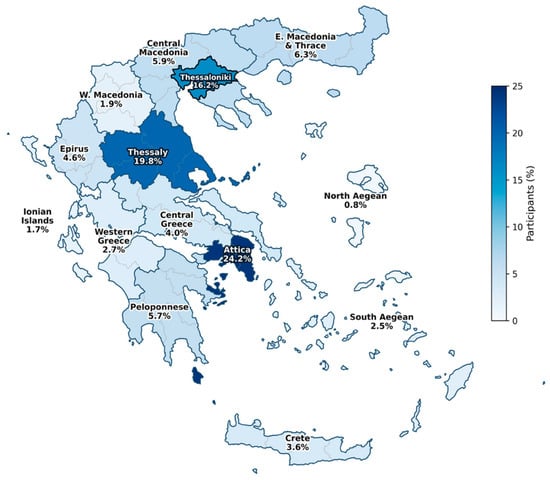
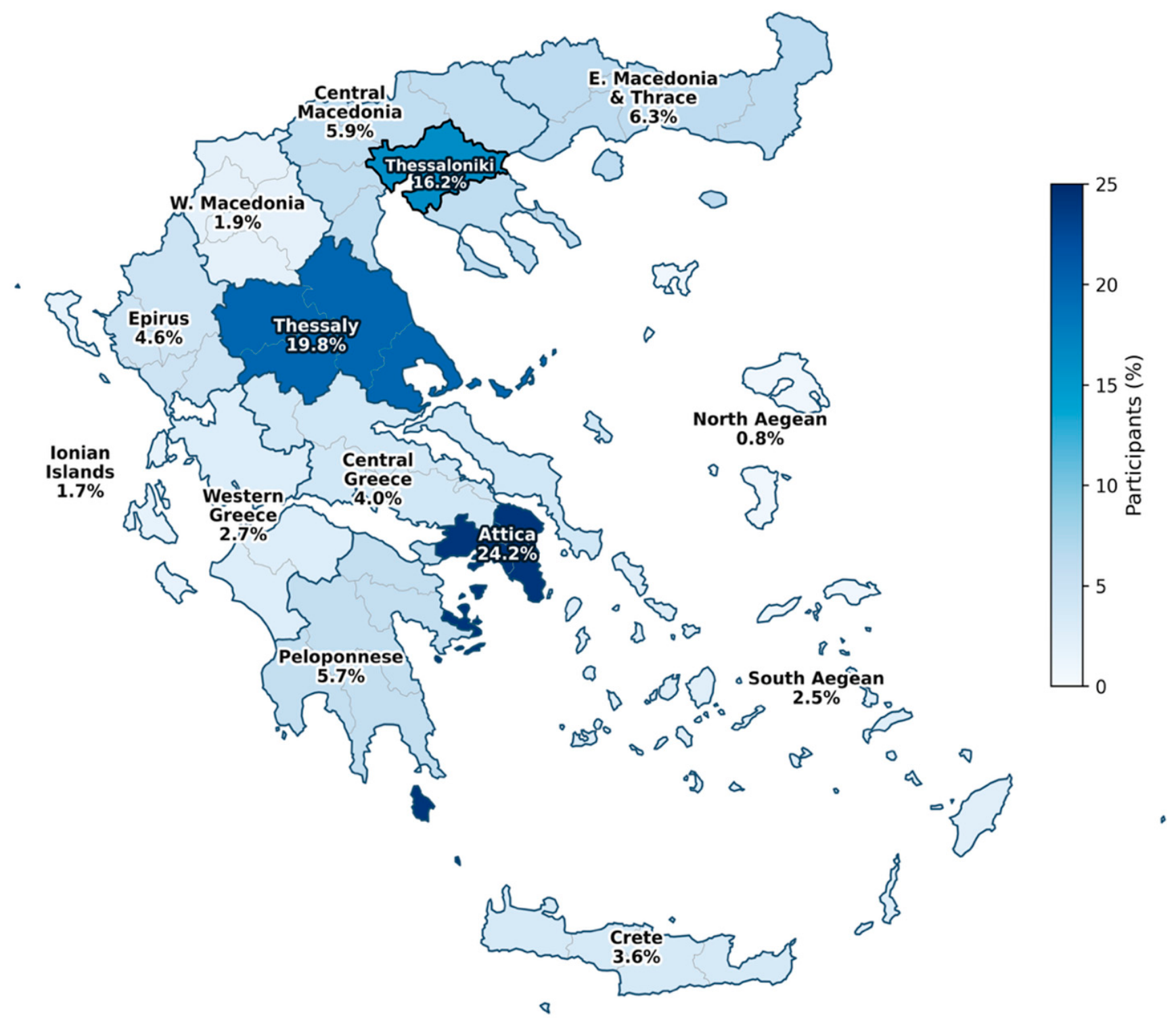
Nearly three in five respondents (283; 59.6%) practiced outside the two largest urban centers, with 115 (24.2%) in Attica and 77 (16.2%) in Thessaloniki (Table 1). Outside these two centers, Thessaly was the most common region (94; 19.8%), followed by Eastern Macedonia and Thrace (30; 6.3%), the rest of Central Macedonia (28; 5.9%), and the Peloponnese (27; 5.7%); the remaining respondents were spread across the other regions (Table 1; Figure 1).
Figure 1.
Geographic distribution of survey participants across the administrative regions of Greece (N = 475), shown as the percentage of the total sample working in each region (color scale). Absolute participant counts (n) per region are reported in Table 1.
3.2. Veterinarians’ Knowledge and Training
When asked whether they felt able to manage a suspected abuse case, 158 respondents (33.3%) answered yes and 132 (27.8%) answered no, while the largest group (185; 38.9%) was unsure (Table 2). Regarding undergraduate coursework, 144 respondents (30.3%) reported that their university had offered courses in both veterinary forensics and animal welfare, 140 (29.5%) in animal welfare only, and 37 (7.8%) in veterinary forensics only, while 132 (27.8%) reported neither and 22 (4.6%) were unsure. A standalone undergraduate forensics course was considered necessary by 417 respondents (87.8%), and postgraduate forensics training by 343 (72.2%).
Table 2.
Perceived knowledge, undergraduate education, perceived training needs, legal knowledge, and practical forensic preparedness (N = 475).
Knowledge of the legal framework was limited (Table 2). Awareness of current Greek animal-protection legislation was reported by 235 respondents (49.5%), and 196 (41.3%) reported knowing which acts or omissions the law classifies as abuse; the remainder answered no or were unsure. A forensic report had previously been written by 183 respondents (38.5%), but only 68 (14.3%) felt able to write one correctly, and 171 (36.0%) felt able to identify and collect evidence. A workplace protocol for suspected abuse was used by 75 respondents (15.8%), while most (329; 69.3%) had none.
Associations with perceived ability to manage animal abuse cases are shown in Table 3. Respondents who reported awareness of current Greek animal protection legislation were more likely to consider themselves able to manage such cases than those who answered no or unsure (46.4% vs. 20.4%; adjusted OR 2.13, 95% CI 1.31–3.46), as were those who reported knowing which acts or omissions are legally classified as animal abuse (48.0% vs. 22.9%; adjusted OR 2.30, 95% CI 1.44–3.67). Women were less likely than men to consider themselves able (25.7% vs. 41.9%; adjusted OR 0.48, 95% CI 0.32–0.74). Respondents with 20 or more years in practice were more likely to consider themselves able in the crude analysis (crude OR 1.75, 95% CI 1.04–2.95; overall p = 0.055) but not after adjustment (adjusted OR 1.26, 95% CI 0.64–2.50). No other factor, including university coursework (adjusted OR 1.15, 95% CI 0.68–1.96), was associated with perceived ability. When coursework was analyzed in four categories (Table 4), respondents who reported a veterinary forensics course only were more likely to consider themselves able to manage a case than those who reported neither course (56.8% vs. 33.3%; adjusted OR 3.56, 95% CI 1.59–7.96). Those who reported an animal welfare course only (adjusted OR 0.94, 95% CI 0.50–1.76) or both courses (adjusted OR 1.93, 95% CI 0.98–3.78) did not differ from those who reported neither.
Table 3.
Factors associated with perceived ability to manage animal abuse cases.
Table 4.
University coursework and perceived ability to manage suspected animal abuse cases.
Associations of undergraduate coursework with self-rated forensic skills and legal knowledge are shown in Table 5. Respondents who reported a veterinary forensics course were more likely to consider themselves able to distinguish inflicted from accidental injuries (44.8% vs. 28.2%; adjusted OR 2.31, 95% CI 1.48–3.61), to write a forensic report correctly (19.9% vs. 10.9%; adjusted OR 3.25, 95% CI 1.76–6.00), and to identify and collect evidence (51.4% vs. 26.5%; adjusted OR 2.66, 95% CI 1.70–4.15). The crude association between reported veterinary-forensics coursework and self-rated ability to write a forensic report correctly was OR 2.06 (95% CI 1.23–3.48). Adjustment for years in veterinary practice increased the estimate to OR 3.11 (95% CI 1.70–5.67), and the fully adjusted OR was 3.25 (95% CI 1.76–6.00). This increase primarily reflected negative confounding by years in practice: reported availability of forensic coursework was substantially more frequent among respondents with fewer years in practice, whereas the proportion reporting an ability to write a forensic report was highest among those with 20 or more years in practice. A forensics course was not associated with awareness of the legislation (adjusted OR 1.18, 95% CI 0.77–1.82), and its association with knowing which acts the law classifies as abuse did not reach significance (adjusted OR 1.52, 95% CI 1.00–2.31; p = 0.051). An animal welfare course was associated only with the ability to identify and collect evidence (41.2% vs. 28.3%; adjusted OR 1.72, 95% CI 1.03–2.87).
Table 5.
Undergraduate coursework, self-rated forensic skills, and legal knowledge.
Associations of workplace protocol use with evidence collection and legal knowledge are shown in Table 6. Compared with respondents who had no protocol or were unsure (n = 400), those who used a workplace protocol for suspected abuse (n = 75) more often included evidence collection among their priorities when presented with a live animal, alone or together with animal care (72.0% vs. 51.8%; adjusted OR 2.36, 95% CI 1.37–4.09), and more often felt able to identify and collect evidence (64.0% vs. 30.8%; adjusted OR 3.77, 95% CI 2.19–6.48). They were also more often aware of current Greek animal protection legislation (70.7% vs. 45.5%; adjusted OR 3.38, 95% CI 1.91–5.97) and more often reported knowing which acts or omissions are legally classified as animal abuse (64.0% vs. 37.0%; adjusted OR 2.90, 95% CI 1.72–4.88).
Table 6.
Association of workplace protocol use with evidence collection and legal knowledge.
3.3. Management of Animal Abuse Cases
When presented with a live animal suspected of having been abused, most respondents would prioritize both animal care and evidence collection (254; 53.5%) or animal care alone (214; 45.1%); only 7 (1.5%) chose evidence collection alone (Table 7). An expert or technical-adviser appointment in a suspected-abuse necropsy had been held by 77 respondents (16.2%). Half performed diagnostic necropsies (239; 50.3%), and 73 (15.4%) had encountered necropsy findings compatible with abuse.
Table 7.
Clinical management, necropsy experience, and recognition of suspected abuse (N = 475).
Among forms of neglect, deprivation of veterinary care was the most frequently encountered (403; 84.8%), followed by emaciation or cachexia (380; 80.0%), poor coat condition (367; 77.3%), poor environmental hygiene (366; 77.1%), restriction or permanent tethering (333; 70.1%), inadequate shelter (330; 69.5%), and food or water deprivation (245; 51.6%). Animal hoarding (167; 35.2%) and excessive breeding (130; 27.4%) were less commonly reported, and 14 respondents (2.9%) had never encountered neglect. Among forms of active abuse, poisoning was the most frequently encountered (407; 85.7%). This was followed by firearm injury (331; 69.7%); blunt-force injury (263; 55.4%); sharp-force injury (185; 38.9%); chemical and friction burns (151 each; 31.8%); thermal burns (113; 23.8%); asphyxia, hanging or drowning (89; 18.7%); and use in rituals, shows or dog fighting (82; 17.3%). Sexual abuse was reported by 30 respondents (6.3%), and 30 (6.3%) had never encountered active abuse (Table 8). Because more than one option could be selected, these percentages do not sum to 100%. Free-text “other” responses to the multiple-response checklists are listed in Supplementary Table S1.
Table 8.
Forms of animal abuse encountered (N = 475).
The animals involved were most often stray dogs (420; 88.4%) and stray cats (368; 77.5%), ahead of owned dogs (344; 72.4%) and owned cats (212; 44.6%); production animals (53; 11.2%), wildlife (35; 7.4%), equids (31; 6.5%), and exotic animals (24; 5.1%) were each managed by a small minority, and 7 respondents (1.5%) had never encountered an abuse case (Table 9). Over the preceding five years, 48 respondents (10.1%) had managed no active-abuse case, 96 (20.2%) one or two, 122 (25.7%) three to five, 107 (22.5%) six to ten, 50 (10.5%) eleven to twenty, and 52 (10.9%) more than twenty.
Table 9.
Species involved and frequency of active-abuse cases (N = 475).
When asked whether they could distinguish abuse-related from accidental injuries, 164 respondents (34.5%) answered yes and 42 (8.8%) no, while the majority (269; 56.6%) were unsure. The indicators most often raising suspicion were signs of neglect (316; 66.5%) and the nature of the injury (310; 65.3%), followed by owner behavior (271; 57.1%), an inconsistent medical history (228; 48.0%), and witness reports (169; 35.6%); recurrent injuries were the least selected (90; 18.9%), and 9 respondents (1.9%) had never suspected or encountered abuse (Table 7). A further 12 respondents (2.5%) wrote in another indicator (Supplementary Table S1).
3.4. Reporting of Abuse Cases
When asked where they would report a case, respondents most often named the police (372; 78.3%), followed by a supervisor, clinic director, or employer (174; 36.6%); the municipality (107; 22.5%); an animal-welfare organization (98; 20.6%); and the prosecutor (55; 11.6%) (Table 10). A further 23 respondents (4.8%) wrote in another recipient: the state veterinary service, a university veterinary forensics department, the municipal police, a veterinary association, the animal’s owner or family, or no one (Supplementary Table S1).
Table 10.
Reporting of suspected animal abuse: potential recipients, factors encouraging and discouraging reporting, and attitudes toward mandatory reporting (N = 475).
Protecting the affected animal was the most frequently cited reason to report (419; 88.2%), ahead of protecting other animals in the household (263; 55.4%), professional codes of ethics (260; 54.7%), and protecting people in the household (247; 52.0%); veterinary practice or clinic policy was cited least (60; 12.6%). A further 8 respondents (1.7%) wrote in their own answer (Supplementary Table S1).
Among factors discouraging reporting, concern about interpersonal conflict was cited most often (200; 42.1%), followed closely by uncertainty about whether the assessment was correct (194; 40.8%) and concern about financial or professional consequences (183; 38.5%) (Table 10). Concern about being called to testify (126; 26.5%), lack of time (116; 24.4%), the belief that reporting would lead to no outcome (115; 24.2%), and concern that the animal might subsequently suffer (115; 24.2%) followed. A further 34 respondents (7.2%) wrote in their own answer. Twenty-one of them wrote that nothing would deter them from reporting. The other 13 answers included ineffective enforcement by the police and the courts, inability to substantiate the case, bureaucracy, unpaid costs, excessive fines, not knowing what to do, and concern about where the animal would end up (Supplementary Table S1).
Mandatory reporting of reasonably suspected felony-level abuse was supported by 263 respondents (55.4%), opposed by 58 (12.2%), and left undecided by 154 (32.4%).
Associations with support for mandatory reporting are shown in Table 11. Women supported mandatory reporting more often than men (adjusted OR 1.62, 95% CI 1.11–2.37). Support decreased with time in veterinary practice in the crude analysis (66.4% among respondents with 0–4 years and 49.2% among those with 20 or more; p = 0.021). The overall association did not remain after adjustment (p = 0.178), although respondents with 10–19 years in practice retained lower odds of support than those with 0–4 years (adjusted OR 0.56, 95% CI 0.33–0.94). Respondents who reported coursework in veterinary forensics or animal welfare supported mandatory reporting more often in the crude analysis (58.9% vs. 48.1%; crude OR 1.55, 95% CI 1.05–2.28), but not after adjustment (adjusted OR 1.19, 95% CI 0.75–1.90). No other factor was associated with support. When coursework was analyzed in four categories (Table 12), no category differed after adjustment from respondents who reported neither course (overall p = 0.469); the crude association for respondents reporting both courses (crude OR 1.67, 95% CI 1.03–2.69) did not remain (adjusted OR 1.03, 95% CI 0.56–1.91).
Table 11.
Factors associated with support for mandatory reporting of reasonably suspected felony-level abuse.
Table 12.
University coursework and support for mandatory reporting of reasonably suspected felony-level animal abuse.
3.5. Link Between Animal Abuse and Violence Against Humans
Most respondents (296; 62.3%) were aware of a relationship between animal abuse and interpersonal or domestic violence, while 130 (27.4%) were unsure (Table 13). An abuse case from an environment with suspected human violence had been encountered by 117 respondents (24.6%).
Table 13.
Awareness of the link between animal abuse and interpersonal violence (N = 475).
3.6. Sensitivity Analyses
Sensitivity analyses excluding Unsure responses are presented in Supplementary Table S2. For perceived ability to manage a suspected abuse case, the adjusted analysis included 285 respondents. Awareness of the legislation (adjusted OR 2.68, 95% CI 1.46–4.93) and knowledge of acts legally classified as abuse (adjusted OR 3.09, 95% CI 1.70–5.62) remained positively associated with perceived ability, whereas women continued to have lower odds than men of reporting such ability (adjusted OR 0.53, 95% CI 0.31–0.91). In the four-category coursework model, both veterinary-forensics coursework only (adjusted OR 5.12, 95% CI 1.81–14.45) and both courses (adjusted OR 3.52, 95% CI 1.53–8.06) were associated with perceived ability compared with neither course.
For ability to distinguish inflicted from accidental injury, exclusion of Unsure responses reduced the adjusted sample to 205. The association with reported veterinary-forensics coursework remained positive but was no longer statistically significant (adjusted OR 2.01, 95% CI 0.88–4.58; p = 0.098). Veterinary-forensics coursework remained associated with perceived ability to write a forensic report correctly (adjusted OR 4.07, 95% CI 2.09–7.92) and to identify and collect evidence (adjusted OR 3.48, 95% CI 1.82–6.66), and it was also associated with identifying acts legally classified as abuse (adjusted OR 2.19, 95% CI 1.27–3.78), an association that did not reach significance in the primary analysis. The association between animal-welfare coursework and evidence-collection ability did not remain statistically significant (adjusted OR 1.74, 95% CI 0.90–3.36; p = 0.097).
Workplace protocol use remained associated with perceived ability to identify and collect evidence (adjusted OR 3.69, 95% CI 1.65–8.25), awareness of the legislation (adjusted OR 3.66, 95% CI 1.61–8.32), and knowledge of acts legally classified as abuse (adjusted OR 2.35, 95% CI 1.21–4.53). In the sensitivity analysis of support for mandatory reporting, no predictor was statistically significant. Female sex retained an association of similar magnitude and direction to that in the primary analysis, although the confidence interval included the null (adjusted OR 1.63, 95% CI 0.89–2.96).
Awareness of current legislation and knowledge of acts legally classified as abuse were moderately correlated (phi = 0.47 using the binary coding; Spearman’s ρ = 0.51 using the original ordered responses). Their variance inflation factors were 1.39 and 1.32, respectively, indicating no problematic multicollinearity. When the two variables were entered into separate adjusted models, awareness of the legislation remained associated with perceived ability to manage a suspected abuse case (adjusted OR 3.16, 95% CI 2.05–4.85), as did knowledge of acts legally classified as abuse (adjusted OR 3.23, 95% CI 2.13–4.90). For support for mandatory reporting, neither knowledge variable was associated with the outcome when entered together or separately.
4. Discussion
4.1. Knowledge, Education, and Perceived Training Needs
Only 33% of responding veterinary professionals believed they had sufficient knowledge to manage an abuse case, and the largest group (39%) was unsure. The prevalence of uncertainty is a finding in itself. Just 38% of respondents answered that veterinary forensics had been taught at their university, which is not surprising as the discipline is a relatively new addition to veterinary training and thus not part of the education of older generations. However, 88% considered that veterinary forensics should be taught as a standalone course rather than as part of another subject, and 72% considered postgraduate training necessary, particularly for handling abuse cases. Veterinarians in Greece therefore seem to recognize the importance of the field but do not consider their current knowledge sufficient to act on it. Demand for training is also apparent in other countries. In Brazil and Colombia, 96.2% and 90.3% of practitioners agreed that veterinary forensics should be mandatory in the curriculum [24] and 94% of US veterinary professionals supported mandatory animal-cruelty training for veterinary students [20]. In the United States, 72.7% of veterinarians were very or moderately interested in learning to recognize and report abuse [19] and 82.4% of Romanian veterinarians said they needed additional training [34].
Self-reported knowledge of the animal-protection law itself was also limited. About half of respondents (49.5%) said they were informed about current Greek legislation on animal abuse, and fewer (41.3%) said they knew exactly which acts or omissions the law classifies as abuse. In Paraíba, Brazil, the result was similar as 48% of veterinarians who had treated abused animals said they did not know the animal-abuse legislation [26]. Greece reclassified the killing and torture of animals from a misdemeanor to a felony under Law 4745/2020, with penalties of up to ten years, and in the following year, Law 4830/2021 expanded the animal-welfare framework. This major reform had been in place for years, but its provisions had not become common knowledge among veterinarians by the time of the survey. Recognizing that an animal has been harmed is a clinical judgment, but knowing whether that harm meets the legal definition of abuse, and is therefore reportable, depends on knowing the law. A change in animal law does not reach practitioners by itself, so it must be taught.
Legal knowledge was associated with feeling able to manage an abuse case. Respondents who reported awareness of the legislation had more than twice the odds of feeling able to manage a case, as did those who reported knowing which acts or omissions the law classifies as abuse (Table 3). A related association was reported in Romania, where veterinarians who were more familiar with national legislation rated their training in identifying and documenting abuse higher [34]. Legal knowledge therefore appears to be part of veterinarians’ preparedness to manage abuse cases, and training in animal-protection law may help them manage these cases with more confidence.
Women were less likely than men to consider themselves able to manage a case, independently of legal knowledge, years in practice and coursework (Table 3). In contrast, confidence in handling abuse did not differ by sex in the United Kingdom [29].
Of the two practical forensic skills examined (writing a report and collecting evidence), writing a report correctly was the weaker. Although 38.5% of respondents had already written a forensic report, 14.3% felt able to do so correctly. This means that at least 24.2% of the respondents had written a report without feeling able to write one correctly. The proportion who had written a report was higher than in Paraíba, Brazil, where 20% of veterinarians who had treated abused animals had produced an expert report or a report attesting to animal abuse [26], and in Romania, where 18.2% had ever completed official documentation of a suspected case [34]. The second skill, identifying and collecting evidence, scored higher, at 36.0%. In the United States, 71.7% of veterinarians felt minimally or not at all prepared to collect forensic evidence [19], and in Sweden, fewer than half (43%) felt they knew which documentation and evidentiary material a suspected case might require for later legal proceedings [32]. Samples from the animal and the surrounding environment have evidential value only when handled under a proper chain of custody [36], and a report carries little weight if it does not meet the court’s requirements [37]. When veterinarians lack these skills, the effective handling of animal abuse cases cannot be assured.
Respondents who reported that their university had offered a veterinary forensics course had more than twice the odds of believing they could tell the difference between inflicted and accidental injuries, write a forensic report correctly, and identify and collect evidence, whereas an animal welfare course was only associated with evidence collection (Table 5). When Unsure answers were excluded, the associations of the forensics course with report writing and evidence collection remained, whereas its association with distinguishing inflicted from accidental injuries and the association of the animal welfare course with evidence collection were no longer statistically significant (Supplementary Table S2). The forensics course was not associated with awareness of the legislation, and its association with knowing which acts the law classifies as abuse was borderline in the primary analysis (p = 0.051) but significant when Unsure answers were excluded (Supplementary Table S2). Reporting a forensics course only was likewise associated with perceived ability to manage a case (Table 4), whereas coursework in either subject, analyzed as a single variable, was not (Table 3). In Brazil and Colombia, practitioners whose university had offered veterinary forensics or animal welfare were also more likely to believe they could distinguish intentional from accidental injuries [24] and in the United Kingdom, veterinarians with more hours of specialized training reported greater self-efficacy in reporting abuse [28]. Because the design was cross-sectional and preparedness was self-rated, these associations do not show that the course itself improved preparedness. In the four-category analysis of perceived ability to manage a case, the forensics-only group was small (n = 37), and respondents who reported both courses did not differ significantly from those who reported neither. When Unsure answers were excluded, both groups were more likely than those reporting neither course to consider themselves able to manage a case (Supplementary Table S2). The associations are nonetheless consistent with a benefit of teaching veterinary forensics, and most respondents (87.8%) considered a standalone undergraduate forensics course necessary.
Only 15.8% of respondents reported that they used a workplace protocol to manage suspected cases of abuse. Surveys in the United States [19,20], Sweden [32], and Romania [34] found similar or higher proportions: 22.1% and 31% (21% in general practice) in the two US surveys, 17% in Sweden, and 21.9% in Romania. A written protocol promotes uniformity and thoroughness throughout the examination [38] and protects the evidence from being challenged in court [9]. In the United States, 93% of veterinarians with a workplace policy reported at least some of the suspected cases they saw, compared with 54% of those without one [20]. In the present survey, respondents who used a workplace protocol more often included evidence collection among their priorities (72.0% vs. 51.8%), felt able to identify and collect evidence (64.0% vs. 30.8%), and reported knowing the legislation (70.7% vs. 45.5%) and which acts it classifies as abuse (64.0% vs. 37.0%) than those who did not (Table 6). These associations remained when Unsure answers were excluded (Supplementary Table S2). Because the design was cross-sectional, they cannot show whether using a protocol improved preparedness or whether better-prepared practices were more likely to adopt one, for example practices with a particular interest in abuse cases or larger and referral practices. The findings are nonetheless consistent with the conclusion of Patterson-Kane et al. [20] that efforts to improve the veterinary response to cruelty should focus on training and workplace protocols, both of which were limited in the present survey.
4.2. Management of Suspected Abuse Cases
Almost half of respondents would prioritize animal care alone with a live animal suspected of abuse, and most of the rest would combine care with evidence collection. Putting the patient first is appropriate, but evidence loses value once handling and treatment begin [36]. Not including evidence in the priorities at all may indicate that some veterinarians who deal with a suspected-abuse case do not routinely preserve forensic material. The question did not specify the clinical status of the animal, and respondents may have assumed that this was an emergency and that treatment could not be delayed.
About one in six respondents (16.2%) had been appointed as an expert or adviser in a suspected-abuse necropsy. Most respondents encounter maltreatment in daily clinical work rather than in a formal role. Such roles may be rare because few cases reach a formal investigation, or because veterinarians hesitate to take on work that can lead to court appearances and personal exposure. Requests from the authorities are also uncommon in Brazil. In the state of Paraíba, 10.7% of veterinarians who had treated mistreated animals had been approached by a court or law-enforcement entity to help investigate an animal cruelty case [26]. Other studies report hesitance to testify. A survey of veterinary professionals found that 47.7% lacked confidence in providing expert testimony in cases of animal sexual abuse [39]. Even among board-certified veterinary pathologists, 17% tried to avoid medicolegal matters because they did not want to go to court, and 48% indicated they required additional training as expert witnesses [40]. In the present survey, 26.5% of respondents identified being summoned to testify as a barrier to reporting (Section 4.3). Half of the respondents (50.3%) perform diagnostic necropsies, and 15.4% had found evidence compatible with abuse during one. Necropsy is therefore a common diagnostic procedure among the respondents, and it can reveal maltreatment in animals that arrived with no prior suspicion.
Poisoning was the form of active abuse encountered by the largest proportion of respondents (85.7%), followed by firearm injury (69.7%) and blunt-force injury (55.4%). Some of the poisonings reported as abuse may have been accidental, with no intent to harm the particular animal. In comparable surveys, 52% of veterinarians in Paraíba, Brazil [26], 42.8% in Porto Alegre, Brazil [25] and about a quarter of veterinarians in Australia [21] had encountered poisoning. In a survey of veterinary pathology laboratories, most of them European, intentional poisoning was also the case type most often ranked among the three most common forensic cases [41].
The finding is consistent with the illegal use of poison baits in Greece, where baits are laid mainly against predators and stray dogs blamed for livestock and game losses, and in retaliation between stakeholders such as hunters and livestock breeders, and where shepherd dogs accounted for 66.4% of domestic animal deaths in rural poisoning incidents [42]. Firearm injury, the second most common form in the present survey, was the most common type of physical injury recorded in the United Kingdom [29] and was reported by 40% of veterinarians in Paraíba [26]. Sexual abuse was reported by 6.3% of respondents. The two Brazilian surveys reported 12% and 18.6% [25,26], and in the United States, 5% of veterinary professionals who had encountered a suspected case in the preceding 12 months reported sexual abuse [20].
For neglect, deprivation of veterinary care (84.8%) and emaciation or cachexia (80.0%) were the forms most often encountered, ahead of poor coat condition and poor hygiene in the living environment. Deprivation of veterinary care was also the most frequently reported form of neglect in Paraíba (68%) [26] and Porto Alegre (62.8%) [25], and untreated acute or painful conditions were the most frequent manifestations of neglect in Romania (38.7%) [34]. Because veterinary care is paid for by the owner, deprivation of veterinary care may also result from the owner’s inability to pay for treatment [43].
The free-text “other” responses were few (4.0% for neglect and 4.2% for active abuse). Under active abuse, several respondents described the act rather than the injury it caused, although the resulting injuries corresponded to types already on the list. This may reflect unfamiliarity with forensic terminology, consistent with the gaps in forensic training and skills described in Section 4.1. The acts described were mutilation (including ear and tail cropping), dragging behind a car, falls or throws from a height, beating, binding with wire or rubber bands, shooting with a bow and arrow, exposure to drugs, harsh equipment and handling, heat stress, and attacks by other owned animals. Under neglect, respondents described abandonment, an embedded collar, injuries from not using a lead, accidental poisoning, refusal of euthanasia, obesity and inappropriate feeding, lack of socialization, treatment given without a veterinarian, inadequate deworming and vaccination, and violent training. Some of these answers belonged elsewhere: inadequate deworming and vaccination fall within deprivation of veterinary care, which was already a listed option, and violent training is active abuse rather than neglect. This may indicate uncertainty about what each category includes. Part of the problem may lie in how the law is written. Active abuse is described by a clear, though not exhaustive, set of acts. Neglect is defined in general terms, such as lack of care, inappropriate housing, or lack of food, water or veterinary treatment, so whether a case counts as neglect is left to the veterinarian’s judgement. What is regarded as abuse also changes over time.
Almost all respondents reported having encountered suspected abuse in clinical practice: 97.1% had seen neglect and 93.7% active abuse. These proportions are a cause for concern, although they rest on the respondents’ own classification of cases, which were not confirmed. They are higher than the 73–88% reported in the United States, South Korea, Brazil and Romania [19,20,25,27,34] and similar to the 92% reported in Australia [21]. In the five years before the survey, 89.9% of respondents had managed at least one active-abuse case and 44.0% had managed more than five. Over a five-year period, 63% of veterinarians in New Zealand [23] and 63.9% in Taiwan [31] had seen at least one case of physical abuse. This widespread exposure occurred under the stricter legislation introduced in 2020 and 2021. Whether the caseload has changed since these reforms cannot be assessed, because no comparable survey was carried out before them; the present survey provides a baseline for future comparison.
Dogs were reported more often than cats, and strays more often than owned animals, with owned cats the least frequently reported of the four groups; production animals, equids and wildlife were each reported by few respondents, consistent with the study’s focus on companion-animal veterinarians. The predominance of dogs matches other surveys, in which dogs are the species most commonly reported as abused [21,23,29,31]. The present findings agree with a survey from Paraíba, Brazil, in which strays slightly predominated (45.3% vs. 41.3%) [26] but contrast with another Brazilian survey, in which owned animals predominated (56.3% vs. 37.7%) [25].
Stray animals were the victims most often reported (88.4% for dogs and 77.5% for cats). An abused stray has no owner and is usually brought in by a volunteer, a rescuer or a municipal worker, often with no one to pay for its treatment (Supplementary Table S1). For training, this means recognizing abuse from physical findings alone, since a stray has no history and no owner whose behavior can raise suspicion, and documenting the findings in such cases so that a report against an unknown perpetrator can be filed.
Although almost all respondents had encountered suspected animal abuse cases, only about one-third (34.5%) felt able to distinguish abuse-related from accidental injuries, while more than half (56.6%) were unsure. Uncertainty was higher in Brazil and Colombia, where more than 70% of practitioners were unsure when asked essentially identical questions [24]. In Sweden, 56% of respondents considered that they could make the distinction in most cases (17%) or sometimes (39%), and about one-third (32%) said they lacked the requisite skills [32]. The distinction is important because an inflicted injury dismissed as an accident leaves the animal vulnerable to further injury, whereas an accident viewed as abuse can result in an unsubstantiated charge. A clear difference is also essential in documenting and prosecuting abuse [5].
Signs of neglect (66.5%) and the nature of the injury (65.3%) were the most often reported indicators, followed by owner behavior and an inconsistent medical history. Recurrent injuries were the least selected indicator (18.9%), although injuries at different stages of healing are a recognized sign of non-accidental injury [4,5]. Surveys conducted in Australia, New Zealand, and Taiwan indicated similar patterns, with the nature of the injury being the most common reason for suspicion and recurrent injuries being among the least common [21,23,31]. Twelve respondents chose “other” (Supplementary Table S1). Six reported diagnostic findings, the majority of which were radiographic. These included projectiles such as shotgun pellets, one of which was discovered by chance on a radiograph taken for an open limb fracture, and a jaw fracture with different stages of healing, which is evidence of recurrent injury. Thus, a single radiographic examination can show recurrent injury without the need for repeat visits [4]. Two respondents cited the animal’s fear, which is among the signs that raise suspicion of abuse [3]. Suspicion therefore starts most often from the signs on the animal, so veterinarians need to be able to tell whether these signs point to abuse when their cause is not obvious. This again points to the need for training in veterinary forensics (Section 4.1).
4.3. Reporting of Animal Abuse Cases
Most of the respondents (78.3%) stated that they would report a case to the police, which is the authority with the legal ability to investigate and act in animal abuse cases. In the United States, by contrast, veterinarians turned mainly to animal control or a supervisor [19] and in the United Kingdom to a colleague or manager or to an animal-welfare organization [29]. In both countries, the police were chosen far less often than in the present survey. These differences probably arise because a different body handles animal abuse complaints in each country.
The animal itself was the main reason to report. Protection of the affected animal was mentioned considerably more frequently than any other reason, followed by protection of other animals in the household, professional codes of ethics, and protection of people in the household. Respondents therefore seem to see reporting mainly as an extension of their responsibility to care for the animal. The same leading motive was found in two US surveys and in Romania [19,20,34]. Protection of people in the household, however, was named by 52.0% of respondents in the present survey, compared with 38.3% of US veterinarians who had reported a case [19] and 8.8% in Romania [34].
The most often mentioned deterrents were interpersonal conflict (42.1%), uncertainty in the veterinarian’s own assessment (40.8%), and financial or professional consequences (38.5%). Being called to testify and lack of time followed. In Brazil and Colombia, similar concerns led, as lack of training to identify abuse and fear of the owner were the reasons most often given for why veterinarians avoid reporting [24]. Doubt about the assessment is consistent with the finding that only one-third of respondents felt able to distinguish inflicted from accidental injuries (Section 4.2), and the same doubt was a common barrier to reporting in the United States, South Korea and the United Kingdom [19,20,27,29]. Doubt about what follows a report appeared less common in Greece. In the present survey, 24.2% of respondents expected no outcome, compared with nearly half in the United Kingdom and 81% in Paraíba, Brazil [26,29]. The same proportion (24.2%) feared the animal would suffer after a report, compared with 68% in South Korea [27]. Greek veterinarians seem to be discouraged less by doubts about what happens after a report than by their own diagnostic uncertainty and by the personal and professional costs of reporting. Measures to encourage reporting are more likely to be successful if they address these deterrents, for example through training in veterinary forensics and legal protection for reporting veterinarians.
Not all respondents saw obstacles. Although the question was hypothetical and offered no corresponding response option, 21 respondents (4.4%) selected none of the listed deterrents and instead wrote that nothing would deter them. The other 13 free-text answers repeated deterrents already described, such as doubt that the police and the courts would act, difficulty in proving the abuse, concern about the client and about where the animal would end up, and colleagues’ negative experiences. Deterrents not covered by the listed options were also reported, namely bureaucracy and delays in toxicology results, unpaid costs, and uncertainty about the procedure to follow (Supplementary Table S1). Other answers described a graded response rather than an immediate report: respondents would give the abuser a second chance with monthly monitoring of the animal, report only if the behavior was repeated after advice (given as a reason that would encourage reporting), or considered the fines too severe for owners who harm their animals out of ignorance (Supplementary Table S1). This is consistent with the 11.8% who would rather inform their clients than report them. In the United States, 33% of veterinary professionals sometimes educated owners instead of reporting them, most often when the case involved neglect or no malicious intent [20].
Reporting of suspected animal abuse was not mandatory for veterinarians in Greece at the time of the survey, and no veterinary code of ethics with legal force imposed such a duty. When asked whether it should become so for reasonably suspected felony-level abuse, just over half of respondents (55.4%) replied yes, fewer than the 66–89% reported in other countries [19,24,29,31]. However, only 12.2% were opposed and a third (32.4%) were unsure. Legal protection for the reporting veterinarian may make a reporting duty more acceptable, although this was not investigated here. In the United States, 81.3% of veterinarians supported reporting if immunity from civil and criminal liability were granted [19].
Women were more supportive of mandatory reporting than men (61.9% vs. 48.1%; Table 11), as in New Zealand [23]. When Unsure answers were excluded, the difference was of similar size but not statistically significant (Supplementary Table S2). Support also tended to be lower among respondents with 10–19 years in practice than among those with up to four years, a difference not found in New Zealand [23]. After adjustment, knowledge of the legislation, awareness of the link with interpersonal violence and university coursework were not associated with support for mandatory reporting (Table 11 and Table 12). Legal knowledge was associated with feeling able to handle a case (Section 4.1) but not with wanting reporting to be a duty, and support appeared to depend more on who the respondents were than on what they knew. Training alone might not be sufficient to build acceptance of mandatory reporting, and how the duty is designed, including protection for the reporting veterinarian and room for education where neglect stems from ignorance or inability to pay, may be as important.
4.4. The Link Between Animal Abuse and Violence Against Humans
In the present survey, the majority of respondents (62.3%) were aware of the association between animal abuse and interpersonal or domestic violence, and 24.6% had already encountered an abused animal from an environment where they suspected violence against people. Thus, the link is part of the clinical activity of a considerable minority of Greek veterinarians. The proportion was similar in Australia [21] and lower in New Zealand, Taiwan and Sweden, where it ranged from roughly 8% to 16% [23,31,32]. Uncertainty was common on both questions, with 27.4% unsure whether the Link exists and 30.1% unsure whether they had handled such a case. This uncertainty signals a need for training in the indicators of co-occurring violence. In a small pilot program in Australia, veterinary professionals rated their capacity to recognize, respond to and refer victims of domestic violence higher after such training [22].
Awareness of the link was lower than in Sweden, where a similar question was asked and 90% of veterinarians were aware of the link [32], and in the United States, where 81% were certain of a link with domestic violence [19]. The link may therefore be less prominent in Greek veterinary education and practice than in these countries.
4.5. Limitations
A convenience sample was used, although it included veterinarians from all 13 administrative regions of Greece. Those with an interest in animal abuse may have been more willing to participate. Respondents from Thessaly, where the research team is based, were overrepresented (19.8%). The questionnaire did not record the university of graduation, so the coursework associations could not be adjusted for it and may partly reflect where respondents studied. Coursework was measured as whether the respondent’s university had offered a course, not whether the respondent attended it, and its content and length were not recorded. Respondents who graduated many years ago may also have recalled their curriculum inaccurately. In addition, the veterinary-forensics-only category was small, resulting in imprecise estimates in the four-category analyses. Members of the research team, which is based in a veterinary forensics laboratory, distributed the questionnaires in person, so social desirability may have influenced some answers. The number of questionnaires distributed was not recorded, so a response rate could not be calculated. All responses were self-reported, and knowledge and skills were rated by the respondents rather than tested. Likewise, abuse cases were not verified, and most questions about reporting were hypothetical, so stated intention may differ from actual behavior. In the regression analyses, Unsure answers were grouped with No, so these models do not distinguish uncertainty from a negative answer. Sensitivity analyses that excluded Unsure answers confirmed most associations, but those of veterinary forensics coursework with distinguishing inflicted from accidental injuries, of animal welfare coursework with evidence collection, and of sex and time in practice with support for mandatory reporting were no longer statistically significant (Supplementary Table S2). The study also examined multiple related outcomes and predictor contrasts without formal correction for multiple comparisons. These analyses should therefore be regarded as exploratory and hypothesis-generating, and some statistically significant findings may represent chance associations. Interpretation should focus on the magnitude and precision of the estimated associations, their consistency across related analyses, and their plausibility in relation to the study design rather than on isolated p-values. Finally, comparisons with other countries are approximate, as those surveys varied in period, mode of administration, definitions of abuse, and response formats.
5. Conclusions
The findings of this first survey of companion-animal veterinarians in Greece on animal abuse indicate that such cases are frequently encountered in companion-animal practice. However, the majority of respondents did not consider themselves adequately prepared to address such cases. Self-reported knowledge of the relevant legislation was associated with greater perceived preparedness. The management of suspected cases relied primarily on the discretion of the individual veterinarian, as workplace protocols were rarely used. Companion-animal veterinarians in Greece seem to encounter abused animals from households in which people may also be at risk of violence, so they could help detect such violence, provided they are prepared to act.
Respondents recognized the value of veterinary forensics in handling animal abuse. There is therefore a need for teaching veterinary forensics and animal-protection law in the undergraduate curriculum and in continuing professional education, covering recognition of non-accidental injuries, collection of evidence, and writing of forensic reports. In clinical practice, workplace protocols that specify how and to whom suspected cases are reported would make their handling consistent. Clearer criteria for neglect, which the law defines only in general terms, would make its recognition less dependent on individual judgment. Legal protection for those who report could also reduce the concerns that deter them. As veterinarians are often among the first professionals to encounter abused animals, these measures may contribute to a more effective response to such cases. Their effect should be evaluated in future studies.
Supplementary Materials
The following supporting information can be downloaded at https://www.mdpi.com/article/10.3390/vetsci13121267/s1, Supplementary Material S1: Questionnaire; Table S1: Free-text “other” responses to the multiple-response questions (English translation); Table S2: Sensitivity analyses excluding Unsure responses.
Author Contributions
Conceptualization, D.T.; methodology, A.K., D.D., G.R. and D.T.; software, M.K.; validation, A.K. and D.D.; formal analysis, M.K.; investigation, A.K. and D.D.; resources, D.T.; data curation, A.K., M.K. and G.R.; writing—original draft preparation, A.K.; writing—review and editing, D.D., M.K., G.R., G.Z. and D.T.; visualization, A.K. and M.K.; supervision, D.D.; project administration, D.T. All authors have read and agreed to the published version of the manuscript.
Funding
This research received no external funding.
Institutional Review Board Statement
The study was approved by the Animal Use Ethics Committee for Educational and Research Purposes, Faculty of Veterinary Medicine, School of Health Sciences, University of Thessaly (Ref. No. 208, 27 February 2026). This committee is responsible for the ethical review of research conducted at the faculty, including research involving human participants.
Informed Consent Statement
All participants gave informed consent before taking part in the study. The first page of the questionnaire described the study and its voluntary and anonymous nature, and participants marked an explicit consent statement before proceeding to the questions. No names or other direct identifiers were collected.
Data Availability Statement
The original contributions presented in this study are included in the article/Supplementary Material. Further inquiries can be directed to the corresponding author.
Acknowledgments
The authors thank the Hellenic Companion Animal Veterinary Society and the Hellenic Veterinary Medical Society for permitting the distribution of the questionnaire at their conferences, and all the veterinarians who participated in the study. During the preparation of this manuscript, the authors used Claude Opus 5.5 (Anthropic, San Francisco, CA, USA) to create Figure 1 and for language editing. The authors have reviewed and edited the output and take full responsibility for the content of this publication.
Conflicts of Interest
The authors declare no conflicts of interest.
References
- Benetato, M.A.; Reisman, R.; McCobb, E. The Veterinarian’s Role in Animal Cruelty Cases. J. Am. Vet. Med. Assoc. 2011, 238, 31–34. [Google Scholar] [CrossRef] [Scilit] [PubMed]
- Woolf, J.A. How Can Veterinarians Be Reporters of Animal Abuse When They Are Not Taught to Recognize It? J. Am. Vet. Med. Assoc. 2015, 247, 1363–1364. [Google Scholar] [CrossRef] [Scilit] [PubMed]
- Doukas, D.; Tontis, D. Non-Accidental Injuries in Dogs and Cats: Review of Post-Mortem Forensic Evaluations and the Social Significance of Small Animal Practice. J. Hell. Vet. Med. Soc. 2022, 73, 3543–3552. [Google Scholar] [CrossRef] [Scilit]
- Tong, L.J. Fracture Characteristics to Distinguish between Accidental Injury and Non-Accidental Injury in Dogs. Vet. J. 2014, 199, 392–398. [Google Scholar] [CrossRef] [Scilit] [PubMed]
- Intarapanich, N.P.; McCobb, E.C.; Reisman, R.W.; Rozanski, E.A.; Intarapanich, P.P. Characterization and Comparison of Injuries Caused by Accidental and Non-accidental Blunt Force Trauma in Dogs and Cats. J. Forensic Sci. 2016, 61, 993–999. [Google Scholar] [CrossRef] [Scilit] [PubMed]
- Morgan, C.A. Stepping up to the Plate: Animal Welfare, Veterinarians, and Ethical Conflicts. Ph.D. Thesis, The University of British Columbia, Vancouver, BC, Canada, 2009. [Google Scholar]
- Long, K.; Spencer, C.M.; Orchard, R.; Moreau, C.; Otteman, K. Factors Associated with Veterinary Professionals’ Intent to Intervene in Cases of Animal Maltreatment. Animals 2026, 16, 2675. [Google Scholar] [CrossRef] [Scilit] [PubMed]
- Robertson, I. Legally Protecting and Compelling Veterinarians in Issues of Animal Abuse and Domestic Violence. N. Z. Vet. J. 2010, 58, 114–120. [Google Scholar] [CrossRef] [Scilit] [PubMed]
- Brownlie, H.W.B.; Munro, R. The Veterinary Forensic Necropsy: A Review of Procedures and Protocols. Vet. Pathol. 2016, 53, 919–928. [Google Scholar] [CrossRef] [Scilit] [PubMed]
- Balkin, D.; Janssen, L.; Merck, M. The Legal System: The Veterinarian’s Role and Responsibilities. In Veterinary Forensics: Animal Cruelty Investigations, 2nd ed.; Merck, M.D., Ed.; Wiley-Blackwell: Ames, IA, USA, 2013; pp. 1–16. [Google Scholar]
- Ascione, F.R. Children Who Are Cruel to Animals: A Review of Research and Implications for Developmental Psychopathology. Anthrozoös 1993, 6, 226–247. [Google Scholar] [CrossRef] [Scilit]
- Volant, A.M.; Johnson, J.A.; Gullone, E.; Coleman, G.J. The Relationship Between Domestic Violence and Animal Abuse: An Australian Study. J. Interpers. Violence 2008, 23, 1277–1295. [Google Scholar] [CrossRef] [Scilit] [PubMed]
- Monsalve, S.; Ferreira, F.; Garcia, R. The Connection between Animal Abuse and Interpersonal Violence: A Review from the Veterinary Perspective. Res. Vet. Sci. 2017, 114, 18–26. [Google Scholar] [CrossRef] [Scilit] [PubMed]
- Ladny, R.T.; Meyer, L. Traumatized Witnesses: Review of Childhood Exposure to Animal Cruelty. J. Child Adolesc. Trauma 2020, 13, 527–537. [Google Scholar] [CrossRef] [Scilit] [PubMed]
- García Pinillos, R.; Appleby, M.C.; Manteca, X.; Scott-Park, F.; Smith, C.; Velarde, A. One Welfare—A Platform for Improving Human and Animal Welfare. Vet. Rec. 2016, 179, 412–413. [Google Scholar] [CrossRef] [Scilit] [PubMed]
- Jegatheesan, B.; Enders-Slegers, M.-J.; Ormerod, E.; Boyden, P. Understanding the Link between Animal Cruelty and Family Violence: The Bioecological Systems Model. Int. J. Environ. Res. Public Health 2020, 17, 3116. [Google Scholar] [CrossRef] [Scilit] [PubMed]
- Stolt, L.; Johnson-Ifearulundu, Y.; Kaneene, J. Attitudes of Veterinarians, Animal Control Directors, and County Prosecutors in Michigan Regarding Enforcement of State Animal Cruelty Legislation. J. Am. Vet. Med. Assoc. 1997, 211, 1521–1523. [Google Scholar] [CrossRef] [Scilit]
- Sharpe, M.S.; Wittum, T.E. Veterinarian Involvement in the Prevention and Intervention of Human Violence and Animal Abuse: A Survey of Small Animal Practitioners. Anthrozoös 1999, 12, 97–104. [Google Scholar] [CrossRef] [Scilit]
- Kogan, L.R.; Schoenfeld-Tacher, R.M.; Hellyer, P.W.; Rishniw, M.; Ruch-Gallie, R.A. Survey of Attitudes toward and Experiences with Animal Abuse Encounters in a Convenience Sample of US Veterinarians. J. Am. Vet. Med. Assoc. 2017, 250, 688–696. [Google Scholar] [CrossRef] [Scilit] [PubMed]
- Patterson-Kane, E.G.; Kogan, L.R.; Gupta, M.E.; Touroo, R.; Niestat, L.N.; Kennedy-Benson, A. Veterinary Needs for Animal Cruelty Recognition and Response in the United States Center on Training and Workplace Policies. J. Am. Vet. Med. Assoc. 2022, 260, 1853–1861. [Google Scholar] [CrossRef] [Scilit] [PubMed]
- Green, P.C.; Gullone, E. Knowledge and Attitudes of Australian Veterinarians to Animal Abuse and Human Interpersonal Violence. Aust. Vet. J. 2005, 83, 619–625. [Google Scholar] [CrossRef] [Scilit] [PubMed]
- Paterson, R.; Boller, E.; Kim, Y.; Hammond, K.; Diemer, K. What Can Veterinary Professionals Do? Measuring the Effect of One Domestic Violence Training Pilot Program on Veterinary Professionals’ Capacity to Recognize, Respond, and Refer Human Victims of Domestic Violence. Front. Vet. Sci. 2024, 11, 1254373. [Google Scholar] [CrossRef] [Scilit] [PubMed]
- Williams, V.M.; Dale, A.R.; Clarke, N.; Garrett, N.K.G. Animal Abuse and Family Violence: Survey on the Recognition of Animal Abuse by Veterinarians in New Zealand and Their Understanding of the Correlation between Animal Abuse and Human Violence. N. Z. Vet. J. 2008, 56, 21–28. [Google Scholar] [CrossRef] [Scilit] [PubMed]
- Monsalve, S.; Pereira, É.L.; Leite, L.O.; Polo, G.; Garcia, R. Perception, Knowledge and Attitudes of Small Animal Practitioners Regarding Animal Abuse and Interpersonal Violence in Brazil and Colombia. Res. Vet. Sci. 2019, 124, 61–69. [Google Scholar] [CrossRef] [Scilit] [PubMed]
- Kronhardt Scheffer, G.; Ayres França, L.; Da Silva Guedes, A.F. Animal Abuse: Profile of the Offender, Typology of Violence and Forms of Control. Derecho Anim. 2021, 12, 6–23. [Google Scholar] [CrossRef] [Scilit]
- Brandão, T.D.S.; Dantas Neto, A.M.; Alves, A.D.S.; Ximenes, R.G.; Bezerra, K.P.G.; Brasil, A.W.D.L.; Nóbrega, S.C.A.D.; Silva, R.M.N.D.; Souza, A.P.D. Animal Abuse and Interpersonal Violence from the Perspective of Veterinarians from Paraíba State, Brazil. Semin. Ciênc. Agrár. 2022, 43, 1269–1282. [Google Scholar] [CrossRef] [Scilit]
- Joo, S.; Jung, Y.; Chun, M.-S. An Analysis of Veterinary Practitioners’ Intention to Intervene in Animal Abuse Cases in South Korea. Animals 2020, 10, 802. [Google Scholar] [CrossRef] [Scilit] [PubMed]
- Alleyne, E.; Sienauskaite, O.; Ford, J. To Report, or Not to Report, Animal Abuse: The Role of Perceived Self-efficacy in Veterinarians’ Decision-making. Vet. Rec. 2019, 185, 538. [Google Scholar] [CrossRef] [Scilit] [PubMed]
- Williams, J.M.; Wauthier, L.; Scottish SPCA; Knoll, M. Veterinarians’ Experiences of Treating Cases of Animal Abuse: An Online Questionnaire Study. Vet. Rec. 2022, 191, e1975. [Google Scholar] [CrossRef] [Scilit] [PubMed]
- Munro, H.M.C.; Thrusfield, M.V. ‘Battered Pets’: Features That Raise Suspicion of Non-Accidental Injury. J. Small Anim. Pract. 2001, 42, 218–226. [Google Scholar] [CrossRef] [Scilit] [PubMed]
- Chen, Y.-H.; Huang, W.-H. Pilot Study of Attitudes of Taiwanese Veterinarians and Undergraduate Veterinary Students toward Animal Abuse and Interpersonal Violence. Animals 2022, 12, 1135. [Google Scholar] [CrossRef] [Scilit] [PubMed]
- Oellig, L.; Lindsjö, J.; Röcklinsberg, H. Exploring Swedish Veterinarians’ Awareness of Non-Accidental-Injuries, Animal Abuse and the Link to Domestic Violence, and Their Role in Addressing This Societal Issue. Front. Vet. Sci. 2024, 11, 1439106. [Google Scholar] [CrossRef] [Scilit] [PubMed]
- Lorsirigool, A.; Sudjaroen, Y.; Kulnides, N.; Pumipuntu, N.; Kullaya, A.; Santichat, N.; Tawinwang, K. Veterinarians’ Perspectives on Pet Abuse, Legal Involvement, and Forensic Investigation in Thailand: A Cross-Sectional Study. Open Vet. J. 2025, 15, 2806. [Google Scholar] [CrossRef] [Scilit] [PubMed]
- Mustăţea, A.I.; Rotărescu, V.Ș.; Gorbănescu, A.; Ciobotaru-Pîrvu, E. Animal Abuse and Neglect in Companion-Animal Practice: The Role of Training, Legislation, and Veterinarian–Client Relationships in Romania. Vet. Sci. 2026, 13, 696. [Google Scholar] [CrossRef] [Scilit] [PubMed]
- Vermeulen, H.; Odendaal, J.S.J. Proposed Typology of Companion Animal Abuse. Anthrozoös 1993, 6, 248–257. [Google Scholar] [CrossRef] [Scilit]
- Touroo, R.; Baucom, K.; Kessler, M.; Smith-Blackmore, M. Minimum Standards and Best Practices for the Clinical Veterinary Forensic Examination of the Suspected Abused Animal. Forensic Sci. Int. Rep. 2020, 2, 100150. [Google Scholar] [CrossRef] [Scilit]
- Davis, G.; McDonough, S.P. Writing the Necropsy Report. In Veterinary Forensic Pathology; Brooks, J.W., Ed.; Springer: Cham, Switzerland, 2018; Volume 2, pp. 139–149. [Google Scholar] [CrossRef] [Scilit]
- Munro, R.; Munro, H. Forensic Veterinary Medicine: 2. Postmortem Investigation. In Pract. 2011, 33, 262–270. [Google Scholar] [CrossRef] [Scilit]
- Zidenberg, A.M.; Sparks, B.; Olver, M. A Survey of Veterinary Medical Professionals’ Knowledge, Attitudes, and Experiences with Animal Sexual Abuse. J. Appl. Anim. Welf. Sci. 2024, 27, 502–513. [Google Scholar] [CrossRef] [Scilit] [PubMed]
- McEwen, B.J.; McDonough, S.P. A Survey of Attitudes of Board-Certified Veterinary Pathologists to Forensic Veterinary Pathology. Vet. Pathol. 2016, 53, 1099–1102. [Google Scholar] [CrossRef] [Scilit] [PubMed]
- Ottinger, T.; Rasmusson, B.; Hård af Segerstad, C.; Merck, M.; van der Goot, F.; Olsén, L.; Gavier-Widén, D. Forensic Veterinary Pathology, Today’s Situation and Perspectives. Vet. Rec. 2014, 175, 459. [Google Scholar] [CrossRef] [Scilit] [PubMed]
- Ntemiri, K.; Saravia, V.; Angelidis, C.; Baxevani, K.; Probonas, M.; Kret, E.; Mertzanis, Y.; Iliopoulos, Y.; Georgiadis, L.; Skartsi, D.; et al. Animal Mortality and Illegal Poison Bait Use in Greece. Environ. Monit. Assess. 2018, 190, 488. [Google Scholar] [CrossRef] [Scilit] [PubMed]
- Stull, J.W.; Shelby, J.A.; Bonnett, B.N.; Block, G.; Budsberg, S.C.; Dean, R.S.; Dicks, M.R.; Forsgren, B.W.; Golab, G.C.; Hamil, J.A.; et al. Barriers and Next Steps to Providing a Spectrum of Effective Health Care to Companion Animals. J. Am. Vet. Med. Assoc. 2018, 253, 1386–1389. [Google Scholar] [CrossRef] [Scilit] [PubMed]

Disclaimer/Publisher’s Note: The statements, opinions and data contained in all publications are solely those of the individual author(s) and contributor(s) and not of MDPI and/or the editor(s). MDPI and/or the editor(s) disclaim responsibility for any injury to people or property resulting from any ideas, methods, instructions or products referred to in the content. |
© 2026 by the authors. Licensee MDPI, Basel, Switzerland. This article is an open access article distributed under the terms and conditions of the Creative Commons Attribution (CC BY) license.