


Simple Summary
Kudzu (Pueraria lobata) is a legume whose root is used as food and in traditional medicine in East Asia. Its main isoflavone, puerarin, is now being tested as a feed additive for cattle, sheep and goats, partly because antibiotic growth promoters are being withdrawn. This review asks three questions: what happens to puerarin in the rumen, how the rumen microorganisms respond, and whether those responses reach the animal as better fermentation, growth or meat and milk quality. The answers are uneven. Puerarin disappears quickly from rumen fluid, but only its first breakdown step has been measured; the later steps are inferred. Several studies report more propionate and more microbial protein, yet the number of animals and the range of doses remain small, and no study has tied a specific bacterium to a measured animal response. We end with the experiments needed to close these gaps.
Abstract
Puerarin is the principal C-glycosidic isoflavone of Pueraria lobata, a legume long used as food and medicine, and has recently attracted interest as a plant-derived feed additive for ruminants. Research on puerarin in ruminant nutrition has expanded quickly, yet the findings remain scattered across in vitro cultures, feeding trials and mechanistic studies in non-ruminant models. This review follows the chain of events that begins when puerarin enters the rumen. Puerarin is degraded rapidly in rumen fluid in vitro (approximately 70% within 6 h) and is converted by the microbiota through isomerisation to daidzin, deglycosylation to daidzein and, potentially, reduction to equol, so that the parent compound is not the only bioactive species present. These transformations are accompanied by selective shifts in the abundance of taxa such as Veillonellaceae, Prevotella and Succiniclasticum, and by changes in fermentation output, most consistently an increase in microbial crude protein concentration and a shift in the volatile fatty acid profile towards propionate. Methane decreased in the single in vitro study that measured it, and the ammonia nitrogen response varied between studies. Beyond the rumen, puerarin and its metabolites have well-documented antioxidant, anti-inflammatory and barrier-protective effects in other species, acting through Nrf2, NF-κB and NLRP3 signalling, and these effects are relevant to rumen epithelial integrity and to post-ruminal tissues when protected formulations are used. Reported consequences for growth, meat and milk quality are promising but inconsistent. This review evaluates the strength of evidence for each link separately, identifies where causality has not been established, and outlines the dose, formulation and validation studies needed before puerarin can be recommended as a feed additive.
1. Introduction
Ruminant production converts plant biomass that humans cannot digest into high-quality protein, and it does so through the rumen, a strictly anaerobic fermentation system hosting a dense and functionally diverse microbial community [1,2,3]. The efficiency of this conversion is limited by two well-characterised losses. Between 2% and 12% of ingested gross energy is lost as enteric methane, and a substantial fraction of dietary nitrogen is excreted rather than retained in animal product [4]. Because enteric methane is also a major source of agricultural greenhouse gas, reducing these losses serves both farm profitability and environmental targets [5].
Against this background, and with antimicrobial growth promoters being withdrawn in many countries, plant secondary metabolites have become a focus of rumen modulation research [6,7,8,9]. Tannins, saponins, essential oils and flavonoids have all been shown to shift rumen fermentation, although the magnitude and direction of the response depend strongly on dose, diet and animal [10,11]. Isoflavones are a less-explored group in this context, even though their dietary sources are common in ruminant rations and their microbial metabolism is well documented [12].
Puerarin, the most abundant isoflavone in the root of Pueraria lobata (kudzu), is unusual among isoflavones in carrying a glucose moiety attached through a carbon–carbon bond rather than the usual oxygen linkage [13]. Pueraria species have a long history of use as food and medicine, and puerarin is now commercially available as a purified compound, which makes it a realistic candidate for feed application [14]. Studies using rumen fluid from dairy and beef cattle, and a feeding trial in sheep, have reported that puerarin alters volatile fatty acid (VFA) profiles and increases microbial crude protein (MCP) concentration [15,16,17]; methane yield decreased in the one in vitro study that measured it [16]. Rumen-protected formulations have been developed to deliver the compound beyond the rumen [18]. Feeding trials have also reported improved growth performance and meat quality in heat-stressed cattle [19].
The evidence base has two features that shape how it should be reviewed. First, the direct studies in ruminants are few and heterogeneous: they differ in animal species and physiological stage, basal diet, dose, formulation, experimental system and measured endpoints. For this reason the review grades the evidence link by link instead of pooling effect sizes, and the criteria used are stated below. Second, and more importantly, the biological effects of puerarin are not confined to the rumen. In non-ruminant species, puerarin has been shown to act on antioxidant defence, inflammatory signalling, epithelial barrier function and lipid and glucose metabolism [20,21,22,23]. These actions are relevant to ruminants in two ways: they may protect the rumen epithelium, which is the first tissue exposed to the compound, and they may contribute to the post-ruminal effects of protected formulations.
This review therefore follows puerarin from its entry into the rumen through to the metabolic and productive responses reported in animals (Figure 1). We first summarise what is known about its sources, chemistry and bioavailability, then examine its fate in the rumen and its effects on fermentation and the microbial community. We then consider the antioxidant, anti-inflammatory, barrier and metabolic actions documented largely in non-ruminant models, before turning to production outcomes, dose and formulation. Throughout, we distinguish effects supported by direct evidence in ruminants from those inferred from other species, and we indicate which links still require causal validation. Earlier reviews of Pueraria in livestock have focused on production performance and health outcomes [14]; the present review is organised around the sequence of biological events rather than around the animal production endpoints.
Figure 1.
Overview of puerarin action in ruminants: from rumen microbial modulation to host metabolic and production responses. Dietary puerarin enters the rumen, where it undergoes microbial biotransformation and shifts the composition of the rumen microbial community. These changes remodel the fermentation phenotype, altering VFA profiles, methane output in vitro, ammonia–N concentration and microbial crude protein concentration. The fraction of puerarin and its metabolites that escapes the rumen reaches the lower gut and peripheral tissues, where antioxidant, anti-inflammatory and barrier-protective effects have been described, and where they are proposed to underlie reported changes in feed efficiency, meat and milk quality and animal health. Solid arrows denote relationships supported by direct evidence in ruminants; dashed arrows denote links that are proposed, extrapolated from non-ruminant models, or awaiting causal verification.
This is a narrative review rather than a systematic one. Records were identified from PubMed, Web of Science and the China National Knowledge Infrastructure (CNKI) using combinations of puerarin, Pueraria lobata, rumen, ruminant, fermentation, microbiota and isoflavone, from inception to October 2026, and reference lists of the retrieved articles were screened. Studies were included if they reported original measurements of puerarin or its metabolites in rumen fluid, a production or health endpoint in ruminants, or a mechanism relevant to ruminant tissues; reviews were used for background only. Each link in the argument is graded on three criteria: whether it has been measured directly in ruminants, whether it has been reproduced in more than one independent ruminant experiment, and whether the direction of the effect agrees between those experiments. Statements resting on a single experiment, or on non-ruminant models, are identified as such throughout. The approach has the limitations of a narrative review, and these should be stated plainly: the search was not designed to be exhaustive, no formal risk-of-bias instrument was applied to individual studies, and effect sizes were not pooled, so the grading used here is qualitative and relative rather than a quantitative score. Its purpose is to show the reader which links rest on replicated ruminant measurement and which do not, not to rank one study against another.
2. Puerarin: Sources, Chemistry, Bioavailability and Feed Application
Puerarin (IUPAC name 8-C-β-D-glucopyranosyl-7-hydroxy-3-(4-hydroxyphenyl)-4H-1-benzopyran-4-one; 7,4′-dihydroxy-8-C-glucosylisoflavone) is the major isoflavone of the root of Pueraria lobata (Willd.) Ohwi (Puerariae lobatae radix) and related Pueraria species, which are widely distributed in East Asia and used both as food and as medicinal plants [13]. The Pueraria root contains a family of related isoflavones, including daidzein, daidzin and puerarin derivatives, and the composition varies with species, plant part and processing [13,24].
The distinguishing structural feature of puerarin is its C-glycosidic bond: the glucose unit is attached to C-8 of the isoflavone skeleton through a carbon–carbon linkage, whereas the more common isoflavone glycosides such as daidzin and genistin carry an O-glycosidic bond [12]. This difference has direct metabolic consequences. O-glycosides are readily hydrolysed by acid and by ubiquitous β-glucosidases, whereas the C-glycosidic bond resists both, so puerarin is not simply deglycosylated by conventional enzymes. Microorganisms have evolved specialised routes to cleave it, as discussed in Section 3, and this resistance is one reason why the fate of puerarin differs from that of the isoflavones usually studied in ruminant nutrition.
A second feature that shapes the biological behaviour of puerarin is its low oral bioavailability. Puerarin is poorly water-soluble and is subject to extensive first-pass metabolism, so plasma concentrations after oral dosing are low and the elimination half-life is short; in humans, a single 1 g oral dose of a kudzu extract standardised to 19% puerarin produced a peak plasma concentration of about 37 ng/mL (0.09 μmol/L) at 2 h, and the terminal half-life was about 4.3 h; doubling the dose raised the peak to about 49 ng/mL without lengthening the half-life [25,26,27]. In practice, this has prompted the use of repeated high-dose intravenous administration, which carries its own risks [25]. The same limitation applies to animal use: only a fraction of an oral dose reaches peripheral tissues, and the concentration reaching a given tissue depends on how much survives rumen fermentation and hepatic metabolism [28].
Two strategies have been explored to overcome this. The first is chemical or enzymatic modification of the sugar moiety. Glycosidases can be used to remodel flavonoid glycosides, altering solubility, stability and biological activity, and puerarin monoesters synthesised by whole-cell catalysis show increased lipophilicity and antioxidant activity [29,30]. The second is formulation-based delivery. Puerarin has been loaded into PEGylated mesoporous silica nanoparticles, which prolong release and improve oral exposure in animals [25], and puerarin itself can self-assemble into supramolecular hydrogels with intrinsic antioxidant capacity, a property of interest for sustained local delivery [31].
These observations matter for ruminant nutrition because the rumen introduces an additional barrier that does not exist in monogastric species. Any orally administered puerarin is first exposed to the rumen microbiota before it can be absorbed, so its effective dose is determined by ruminal degradation as much as by intestinal absorption.
Four forms of puerarin have been used in animal studies: the milled or extracted plant material, semi-purified extracts, the purified compound, and rumen-protected preparations. The purified compound predominates in mechanistic work, while rumen-protected puerarin (RPPUE) has been introduced specifically to limit ruminal degradation [18].
Reported doses differ widely between experiments. In vitro rumen studies have used 50 to 1600 mg/kg of substrate dry matter (0.005% to 0.16%, w/w) [15,16], whereas in vivo studies have used 50 to 800 mg/kg diet in sheep [17] and 0.1% RPPUE in goats [18]. In poultry, dietary inclusion rates of 200 to 800 mg/kg have been tested in aged laying hens [32] and 750 mg/kg in broilers [33,34]. This range spans more than an order of magnitude, and the absence of a common dose framework is one reason why cross-study comparison remains difficult.
3. Ruminal Fate of Puerarin: Degradation and Microbial Biotransformation
Puerarin is degraded rapidly in rumen fluid. In an in vitro fermentation study using dairy cow rumen fluid, approximately 70% of added puerarin had disappeared after 6 h and nearly 85% after 12 h, as measured by high-performance liquid chromatography (HPLC) and liquid chromatography–tandem mass spectrometry (LC-MS/MS) [16]; these remain the only direct measurements of puerarin degradation in rumen fluid. This rate is consistent with the broader behaviour of dietary isoflavones in the rumen: incubation of isoflavone standards in rumen fluid from cows fed either a hay-based or a concentrate-rich diet showed substantial degradation of daidzein, genistein, formononetin and biochanin A within hours, with the rate depending on the diet and on the compound [35]. Two practical implications follow. First, the parent compound is present in the rumen for only a limited time, so the assumption that effects are driven by puerarin itself needs to be tested rather than assumed. Second, the products of this degradation are present for longer and in greater quantity than the parent compound, and their own biological activities have to be considered [16].
The pathway proposed for puerarin in the rumen has three steps [16]. Puerarin is first isomerised from a C-glycoside to the corresponding O-glycoside, daidzin. Daidzin is then hydrolysed by β-glucosidase to release daidzein, and daidzein may subsequently be reduced to equol (Figure 2). The first step is the unusual one, because it converts an enzyme-resistant C-glycosidic bond into a hydrolysable O-glycosidic bond. Of the three steps, only the formation of daidzin has been observed in rumen fluid; daidzein and equol were not detected in that study [16], so the second and third steps are inferred from the behaviour of O-glycosides rather than measured.
Figure 2.
Proposed ruminal biotransformation pathway of puerarin. Puerarin, a C-glycosidic isoflavone, may be isomerised by rumen microorganisms to daidzin, an O-glycoside; only this first conversion has been detected in rumen fluid, whereas the subsequent hydrolysis by β-glucosidase to daidzein and reduction to equol are inferred. Each metabolite has independent biological activity. Evidence for the three activities listed in the right-hand panel comes from cattle studies (daidzein, intramuscular fat) and from bovine mammary epithelial cells in culture (equol, claudin-3 and STAT5); none has been shown for puerarin itself in the rumen.
Direct enzymological evidence for this step comes from work outside the rumen. A human intestinal bacterium related to Dorea species was shown to metabolise puerarin to daidzein and glucose, and the reaction proceeds through a 3″-oxo-puerarin intermediate that is cleaved by a two-component enzyme complex, designated DgpB-DgpC [36]. This establishes that bacteria can cleave the C-glycosidic bond of puerarin, and that they do so through an oxidation-dependent mechanism rather than by conventional glucosidase action. Whether the same or a comparable enzyme system operates in the rumen has not been established: no DgpB-DgpC homologue has been reported in rumen metagenomes or metatranscriptomes, and the taxa responsible for puerarin isomerisation in rumen fluid remain unidentified [16].
The later steps of the pathway are better supported. Deglycosylation of isoflavone O-glycosides is a widespread capability of gut and rumen bacteria [37], and reduction in daidzein to equol occurs in the gut of several species, including ruminants [38]. In rats, puerarin is excreted mainly as conjugated metabolites in urine and bile, indicating that phase II metabolism follows any aglycone released [39].
A related body of evidence concerns the O-methylated isoflavone biochanin A, which is abundant in red clover and has been studied more extensively in rumen systems. Biochanin A is metabolised by rumen microorganisms [40] and alters the growth of specific functional groups: it stimulates cellulolytic bacteria and increases fibre fermentation [41], affects amylolytic bacteria during corn fermentation [42], and inhibits ruminal nitrogen-metabolising bacteria, thereby reducing amino acid and urea decomposition [43]. This pattern shows that isoflavones can act selectively on defined rumen functional groups, which is directly relevant to the interpretation of puerarin effects discussed in Section 4.
Because the transformation is microbial, it is expected to depend on the composition and activity of the rumen community. Diet is the strongest known modifier. Isoflavone degradation in rumen fluid differed between hay-fed and concentrate-fed cows, indicating that the basal ration shifts the degradative capacity of the microbiota [35]. Conversely, isoflavone-rich diets themselves alter the rumen community: lactating dairy cows receiving a diet with higher isoflavone content showed changes in rumen microbiota composition and transfer of isoflavones into milk [44]. This reciprocal relationship, in which the diet determines the rate of isoflavone metabolism while the isoflavones in turn modify the community that performs it, complicates the design and interpretation of dose–response studies. Other likely modifiers, including rumen pH, retention time and the protozoal population, have not been examined for puerarin.
If puerarin is largely converted in the rumen, the biological effects observed in vivo may be attributable in part to its transformation products. Daidzein and equol are biologically active in their own right, and equol in particular binds oestrogen receptors with appreciably higher affinity than puerarin itself [38,45].
How much of a puerarin dose is converted to equol has not been measured in any ruminant study, and this is the largest single gap in the safety argument. What can be said is that the conversion is extensive for isoflavones in general. In bovine rumen fluid the half-life of daidzein is 9.3 h, only 7 to 15% of daidzein and of its metabolite equol leave the rumen unmetabolised, and equol is the dominant isoflavone in the digesta of cattle [38]. Equol production also varies between individuals in a way that matters here: roughly 30 to 40% of humans carry equol-producing bacteria, whereas animals in general produce equol [38], so a ruminant cannot be treated as an organism in which equol exposure is low or intermittent. The parent compound, by contrast, is a weak oestrogen. Puerarin does not appear in the ranking of isoflavones by oestrogenic potency given in the same review, which places equol and genistein highest [38], and in ovariectomised mice a puerarin diet neither restored the atrophied uterus nor stimulated the growth of oestrogen receptor-positive MCF-7 cells, even at concentrations ten thousand times higher than oestradiol [45]. Puerarin persists in the rumen for several hours, so the parent compound is present at the epithelium while these conversions proceed, but the oestrogenic load is carried mainly by the metabolites.
Daidzein has been linked to lipid metabolism in cattle. It enhances intramuscular fat deposition and improves meat quality in finishing steers [46], promotes milk synthesis and proliferation of bovine mammary epithelial cells through oestrogen receptor-dependent NFKB1 activation [47], and puerarin itself modulates the Akt pathway during bovine preadipocyte differentiation [48]. Equol upregulates tight junction proteins such as claudin-3 and activates STAT5 signalling, and isoflavone metabolites influence milk production capacity in bovine mammary epithelial cells in a metabolite-specific manner [49]. Equol is also the target of efforts to produce equol-enriched bovine milk, which illustrates both its bioactivity and its commercial interest [38].
Oestrogenic activity is a double-edged property in ruminants. Equol impaired ram spermatozoa function in vitro at 0.1 and 1 μmol/L after 6 h of exposure, concentrations the authors selected as physiologically relevant [50]; for comparison, the peak plasma concentration after an oral dose of puerarin in humans is about 0.09 μmol/L [27], whereas the concentration in rumen fluid, where the conversion occurs, has not been measured and is likely to be far higher. The relevance of these concentrations to a supplemented animal therefore depends on an exposure measurement that has not yet been made [51]. More broadly, oestrogenic pastures are recognised as a source of endocrine disruption in sheep reproduction, with consequences for fertilisation and embryo development [52]. Any evaluation of puerarin as a feed additive therefore needs to consider reproductive endpoints in addition to production endpoints, particularly for breeding animals.
Finally, the physicochemical properties of the products differ from those of the parent compound. Acetylation increases the lipophilicity of puerarin [53], and enzymatically synthesised puerarin esters show altered antioxidant activity [30]. These modifications change tissue distribution, which in turn changes where a given biological effect is likely to be expressed.
4. Effects on Rumen Fermentation and the Microbial Community
The effects of puerarin on rumen fermentation have been examined in vitro with rumen fluid from dairy and beef cattle and in vivo in goats and sheep. The main findings are summarised in Table 1. The consistency of the responses varies by endpoint, and the sections below separate those that agree across studies from those that do not.
Table 1.
Effects of puerarin on rumen fermentation and the microbial community in different ruminants and experimental systems.
Improved degradability is the most frequently reported effect, although the affected fractions differ between studies. In an in vitro beef-cattle system, addition of 0.01% to 0.16% (w/w) puerarin increased dry matter degradability at every level tested. Neutral detergent fibre degradability rose at 0.04% and 0.16%, and crude protein degradability at 0.04% to 0.16% [15]. In goats, 0.1% RPPUE increased the apparent digestibility of neutral and acid detergent fibre and of organic matter and crude protein [18]. In Hu sheep, 100 mg/kg free puerarin increased acid detergent fibre digestibility while dry matter, crude protein and neutral detergent fibre digestibility were unchanged [17]. The direction of the effect is therefore consistent, but the magnitude and the specific fractions are not, and part of this variation is likely to reflect differences between in vitro and in vivo conditions rather than differences between doses.
The VFA response is the most consistent part of the picture. Acetate decreased at all five doses tested (0.01% to 0.16%), the acetate-to-propionate ratio decreased from 0.02% upwards, and propionate itself increased only at 0.04% in beef cattle rumen fluid [15], a pattern confirmed in a second in vitro study, in which propionate increased and the acetate-to-propionate ratio decreased linearly across 50, 100 and 150 mg/kg substrate DM [16]. In Hu sheep, 50 and 100 mg/kg increased propionate and 100 mg/kg lowered the acetate-to-propionate ratio, in agreement with the in vitro results, whereas an 800 mg/kg dose decreased total VFA and acetate, suggesting that high doses can suppress fermentation rather than shift its pattern [17]. Several explanations are possible, including a direct antimicrobial effect at high concentration, substrate-level inhibition, or adaptation of the community over the feeding period, but none has been tested. In vivo results are not entirely concordant: RPPUE in goats increased total VFA and butyrate, an effect not observed in vitro [18].
Methane output responds in the same direction as the VFA shift, which is mechanistically plausible because propionate formation competes with methanogenesis for hydrogen. Methane yield declined linearly with puerarin dose during in vitro fermentation [16]. This is a promising signal, but it should be treated as preliminary: it comes from a single in vitro dataset, has not been confirmed in vivo, and the magnitude is small relative to the interventions reviewed for enteric methane mitigation [5].
Microbial crude protein concentration is the most consistently increased endpoint, and the basis for that statement is worth setting out. Four independent experiments have measured it, two in vitro [15,16] and two in vivo [17,18], and three of the four report higher MCP in treated incubations or animals than in controls; the exception is the goat trial with 0.1% rumen-protected puerarin, in which MCP did not differ from control. The effect sizes are not comparable between them, because the doses, the basal substrates and the sampling times all differ, so the claim is one of directional agreement rather than of a pooled magnitude. In vitro, MCP increased at every puerarin dose tested [15], and dose-dependent increases in both MCP and ammonia nitrogen were reported at 6 h in a second in vitro study [16]. In vivo, RPPUE lowered ruminal ammonia nitrogen in goats [18], and 100 and 400 mg/kg puerarin increased MCP in Hu sheep while ammonia nitrogen declined linearly with dose [17]. The direction of the ammonia response is thus not fully consistent between studies, which is not surprising given that ruminal ammonia concentration reflects the balance between proteolysis, deamination and microbial assimilation, all of which are sensitive to diet. What the data support is a higher MCP concentration and, in some studies, a lower ruminal ammonia concentration. Neither is a direct measure of the rate of microbial protein synthesis or of the efficiency of nitrogen capture, both of which require duodenal flow measurement or isotopic labelling, so the efficiency gain should be treated as a hypothesis rather than a finding. It remains of practical interest because nitrogen losses are a major component of the environmental burden of ruminant production [4].
Puerarin does not appear to restructure the rumen community broadly. In vitro fermentation for 48 h did not change alpha diversity indices, and principal coordinate analysis did not separate treated from control communities [16]. A goat trial with RPPUE reported the same pattern, with no significant change in operational taxonomic unit numbers or diversity indices [18]. Taken together, these observations suggest a selective rather than a broad-spectrum action, which distinguishes puerarin from antimicrobial plant extracts that suppress large parts of the community [8].
Within that overall stability, specific taxa respond. RPPUE increased the relative abundance of Veillonellaceae_UCG-001 and decreased that of Lachnospiraceae_UCG-002, and enriched Verrucomicrobiota, Bacteroidota and the genus Prevotella [18]. In vitro, puerarin lowered the relative abundance of g_UBA1217, g_UBA2810 and Succiniclasticum [16]. The g_ prefix denotes a genus-level assignment, and the UBA designations refer to genome bins assembled from metagenomes that have no cultured representative, so the metabolic role of these two taxa cannot be inferred from a type strain and remains unknown. Members of Veillonellaceae ferment lactate and succinate to propionate, so their enrichment is consistent with the propionate increases reported elsewhere, but in the goat trial in which the enrichment was measured, propionate did not differ from control [18]. Succiniclasticum converts succinate to propionate, and the decrease in its abundance runs opposite to the increase in propionate, a discrepancy the present data do not resolve [16]. Three explanations are compatible with the data. Another succinate-utilising group, possibly within Veillonellaceae, may have expanded and taken over the function; the genus may be present in numbers too low to set the rate of propionate formation in this system; or the change may be too small to detect reliably in relative abundance data that are not quantitative. Distinguishing between these requires absolute abundances or flux measurements rather than relative proportions.
Placing these results alongside other phytogenic additives helps to define what is distinctive about puerarin. Condensed tannins from tropical browse plants reduce methane production and modify rumen microbial populations in sheep, but they also reduce intake and digestibility at higher inclusion rates [55]. Saponins shift the rumen microbiome and metabolome in cattle, with effects that vary with the fibre source of the diet [56]. Essential oils suppress selected microbial groups and can improve nitrogen utilisation, but their antimicrobial action is broader and their effects on feed intake are a recognised drawback [8,57]. Blends of phytogenic additives have improved lactation performance and health status and reduced methane emission in buffaloes [58]. Isoflavones, by contrast, appear to act on a narrower set of functional groups [41,42,43], and the rumen community as a whole remains largely intact in the presence of puerarin [16,18]. The practical significance of this difference is that selective modulation may be easier to combine with existing rations and less likely to impair fibre digestion, but it also means that the effects are likely to be smaller in magnitude than those of antimicrobial additives.
The observations above can be arranged into a three-layer framework (Figure 3). In the first layer, puerarin enters the rumen and is rapidly transformed by the microbiota. In the second layer, both the parent compound and its transformation products interact with the microbial community, producing selective changes in the abundance of specific taxa. In the third layer, these changes are accompanied by a remodelled fermentation phenotype, notably higher propionate and MCP concentration, lower methane in vitro, and a lower ammonia nitrogen concentration in most studies.
Figure 3.
Proposed mechanism of puerarin regulation of rumen fermentation in ruminants. The three-layer “ruminal exposure–microbial response–fermentation phenotype” framework links the transformation of puerarin in the rumen to selective changes in the abundance of specific microbial taxa and to a remodelled fermentation phenotype characterised by higher propionate and microbial crude protein concentration, lower methane in vitro and a lower ammonia nitrogen concentration in most studies. The sequence from daidzin to equol is drawn as a proposed route whose ruminal order requires verification.
The strength of evidence differs between the layers. The corresponding production and health outcomes, which depend on these fermentation changes, are summarised in Table 2. The first layer is supported by direct measurement of degradation and metabolite formation in rumen fluid [16], although the enzymes and taxa responsible remain unidentified in the rumen [36]. The third layer is supported by replicated measurements of fermentation parameters in several independent experiments [15,16,17,18]. The second layer is the weakest: the reported changes in taxon abundance are robust as observations, but the functional consequences attributed to them are usually inferred from the known metabolic capabilities of those taxa rather than demonstrated in the same experiment [18]. In particular, the enrichment of Veillonellaceae and the increase in propionate come from different trials, because propionate did not differ from control in the goat study that reported the enrichment, so the two are linked only by inference from the known metabolism of the family, and in vitro, Succiniclasticum declined while propionate increased, which the known metabolism of this genus does not predict [16].
Table 2.
Reported effects of puerarin on production performance, product quality and health in ruminants.
The central unresolved question is therefore not whether puerarin changes fermentation parameters, but whether the microbial changes cause the fermentation changes. The available evidence establishes covariation and, in the case of the transformation pathway, direct biochemical observation; it does not establish causation. The experimental designs required to close this gap are discussed in Section 7 and summarised in Figure 4.
Figure 4.
From correlation to causality: current limitations and future validation paths. Current puerarin studies rely mainly on fermentation-parameter measurement and 16S rRNA gene sequencing and remain at the level of correlative description; causal links between microbial community changes and fermentation-phenotype changes can be established through functional omics, isolation and pure-culture tests, strain-addition or inhibition assays, and controllable microbial systems.
5. Beyond the Rumen: Antioxidant, Anti-Inflammatory, Barrier and Metabolic Effects
The effects of puerarin are not limited to fermentation, and its role as a modulator of gastrointestinal homeostasis in livestock has been reviewed [60,61]. A large body of work in non-ruminant models and cell systems has characterised its actions on oxidative stress, inflammation, epithelial barrier function and metabolism. This section summarises that evidence (Table 3) and then considers how far it can be transferred to ruminants, which is the question that matters for feed application.
Table 3.
Bioactivity and mechanisms of puerarin reported in non-ruminant and cell models, and their relevance to ruminants.
Puerarin reduces oxidative damage in several cell and animal models, and the nuclear factor erythroid 2-related factor 2 (Nrf2) pathway is the most frequently implicated mechanism. In PC12 neuronal cells, puerarin attenuated 1-methyl-4-phenylpyridinium (MPP+)-induced oxidative stress by increasing the biosynthetic capacity for glutathione through an Nrf2-dependent mechanism, with suppression of Fyn phosphorylation by glycogen synthase kinase-3β (GSK-3β); the same study showed that puerarin ameliorated motor deficits in 1-methyl-4-phenyl-1,2,3,6-tetrahydropyridine (MPTP)-treated mice but not in Nrf2-knockout mice, which places the effect firmly on the Nrf2 pathway [20]. In bovine mammary epithelial cells challenged with H2O2 in vitro, puerarin attenuated oxidative stress and preserved barrier integrity [59]. In the animal part of the same study, dairy cows (n = 20, four groups of five; ten cows with clinical mastitis detected by CMT and ten healthy cows, mean body weight 624 kg) received 300 g of puerarin per day mixed into the diet for 7 d and showed lower concentrations of inflammatory mediators in milk and serum, although no H2O2 challenge was applied in vivo [59]. On a body-weight basis that dose corresponds to about 480 mg/kg of body weight, roughly 50 times the 10 mg/kg supplied by a 400 mg/kg dietary inclusion in a 400 kg animal consuming 10 kg of dry matter per day, so it should be read as a pharmacological exposure rather than a nutritional one: it establishes that the anti-inflammatory effect is possible in cattle, not that it occurs at feed-additive doses [59]. Puerarin derivatives and esters show comparable or enhanced antioxidant activity, indicating that the antioxidant pharmacophore is retained after structural modification [30,53].
The common feature of these reports is that puerarin acts by reinforcing endogenous antioxidant defences rather than by direct radical scavenging alone, which matters for translation because the effect depends on the presence of intact cellular signalling machinery.
In rodents and in poultry, puerarin interferes with inflammation at several points. Inhibition of nuclear factor-kappa B (NF-κB) signalling is the most consistently reported action. In a rat model of glaucoma, puerarin alleviated the inflammatory response through inhibition of the NF-κB pathway [62], and in chickens infected with Mycoplasma gallisepticum it suppressed inflammation and apoptosis via the Toll-like receptor 6 (TLR6)/myeloid differentiation primary response 88 (MyD88)/NF-κB axis [63]. In piglets infected with porcine epidemic diarrhoea virus, a quantitative proteomic analysis showed both antiviral and anti-inflammatory effects of puerarin [70].
A second mechanism is inhibition of the NLRP3 inflammasome. Puerarin inhibited NOD-like receptor family pyrin domain containing 3 (NLRP3)-caspase-1-gasdermin D (GSDMD)-mediated pyroptosis through the purinergic P2X7 receptor in cardiomyocytes and macrophages [64], and it ameliorated metabolic dysfunction-associated fatty liver disease by inhibiting ferroptosis and inflammation [65]. A third mechanism is modulation of macrophage phenotype: puerarin ameliorated experimental colitis by directly suppressing M1 polarisation of macrophages [21], and reduced inflammation and oxidative stress in a dextran sulfate sodium colitis model [66].
Collectively, these studies show that puerarin acts on well-defined inflammatory pathways rather than through a single target. NF-κB, the NLRP3 inflammasome and macrophage polarisation are all relevant to the rumen epithelium and to the intestinal tissues that a protected formulation would encounter.
The barrier effects of puerarin have been studied mainly in the intestine. Puerarin rebuilt the colonic mucus layer and regulated mucin-utilising bacteria in a model of ulcerative colitis, increasing mucus thickness and promoting goblet cell differentiation [67]. In combination with tryptophan, it enhanced intestinal barrier function in rats, strengthening tight junction integrity [68]. Puerarin also ameliorated 5-fluorouracil-induced intestinal mucositis by inhibiting Janus kinases [71]. Restoration of barrier function is a consistent theme across these models.
For ruminants, the relevant barrier is the rumen epithelium. The stratified squamous epithelium of the rumen is the principal site of short-chain fatty acid absorption and must simultaneously prevent the entry of microbes and microbial toxins into the blood [72]. Subacute ruminal acidosis and high-grain feeding compromise this barrier, allowing bacterial endotoxin to enter the circulation and triggering an inflammatory response that extends from the gut to metabolic organs and affects animal health and longevity [73]. Direct evidence in ruminants has appeared only recently. In heat-stressed beef cattle, 400 mg/kg puerarin (dry matter basis) given for 60 d increased papillae length and the thickness of the stratum granulosum, stratum spinosum and stratum basale, reduced the thickness of the stratum corneum, lowered serum TNF-α, IL-1β, IL-6, cortisol, creatine kinase and lactate dehydrogenase, and raised rumen microbial crude protein and isovalerate [54]. The same animals showed higher abundances of Oribacterium, Streptococcus, Enterococcus and Akkermansia and a lower abundance of Fusobacteriota, and Akkermansia correlated negatively with IL-1β, IL-6, creatine kinase and cortisol [54]. These are structural, inflammatory and community-level responses. They establish that the rumen epithelium responds to dietary puerarin in vivo, but they do not identify the mechanism, because morphology alone does not show that paracellular permeability fell. The trial was run under heat stress and at a single dose, so whether the same response occurs in thermoneutral animals and whether it is dose-dependent are both unknown. The question remains worth pursuing for two reasons: puerarin is present in the rumen at its highest concentration immediately after feeding, so the rumen epithelium is the first tissue exposed; and the intestinal barrier effects described above suggest that epithelial protection is a plausible activity of the compound.
Two anatomical differences limit the transfer of intestinal barrier findings to the rumen. The rumen epithelium is a stratified squamous epithelium, whereas the intestinal epithelium is a single layer of columnar cells [72,74]. In the rumen, the keratinised stratum corneum provides mechanical protection against abrasion, but it is not the permeability barrier: the paracellular seal is formed by tight junctions in the upper stratum granulosum, and these junctions restrict the passive passage of solutes and prevent the translocation of microbial toxins into the blood [72]. Tight junctions therefore occupy the same central position in the ruminal barrier as they do in the intestinal barrier, and the difference between the two tissues lies in the layers that surround the junctions rather than in the junctions themselves [74]. Claudins, occludin and ZO-1 have been described in ruminal tissue, and their abundance changes with diet and in subacute ruminal acidosis [72]; whether puerarin modifies them in the rumen has not been examined. The concentration reaching the epithelium is also unknown: it depends on the rate of ruminal degradation, on binding to feed particles and on whether a protected formulation is used. The morphological response described above is consistent with barrier protection, but the junctional mechanism remains an inference from intestinal models.
Puerarin influences both lipid and glucose metabolism. In high-fat diet-induced obese mice, puerarin supplementation reduced liver triglycerides and free fatty acids, modulated hepatic farnesoid X receptor (FXR) signalling and corrected gut microbiota dysbiosis [22]. Puerarin also ameliorated metabolic dysfunction-associated fatty liver disease in a combined high-fat diet and streptozotocin model [65], and extracts of Puerariae lobatae root regulated brown fat activity [75]. In diabetic rats and hepatoma cells, puerarin suppressed hepatic gluconeogenesis through activation of phosphoinositide 3-kinase (PI3K)/protein kinase B (Akt) signalling [23], and a review of its use in diabetes concluded that it affects both glycaemic control and diabetic complications [26]. The hepatoprotective effects of puerarin have been reviewed in detail, with evidence spanning steatotic liver disease, alcohol-related liver disease and hepatic carcinoma [76]. Glucose metabolism in ruminants differs from that in rodents, however: little dietary glucose is absorbed, and gluconeogenesis in the liver supplies most of the glucose requirement, so hepatic gluconeogenic data cannot be transferred directly.
Effects on lipid metabolism are directly relevant to ruminants, where intramuscular fat deposition determines meat quality. Daidzein, a transformation product of puerarin, enhances intramuscular fat deposition in finishing steers [46], and rumen microbiota-host interactions regulate intramuscular fat deposition in cattle through an α-linolenic acid and L-carnitine dependent axis [77]. Taken together, these findings suggest that the lipid effects of puerarin may be mediated partly by its metabolites and partly by changes in the rumen community, rather than by a direct action of the parent compound on adipose tissue.
Cardiovascular and neurological effects have been summarised in six reviews [78,79,80,81,82,83], and the primary studies they cover were carried out mainly in rodents. In high-fat, high-sugar diet-fed mice, puerarin alleviated Alzheimer disease-like pathology and insulin resistance by inhibiting p35/cyclin-dependent kinase 5 (CDK5)-mediated mitochondrial fission [84], and it improved behavioural and biochemical outcomes in rats subjected to two-vessel occlusion [85]. Evidence for the liver, bone [24,86] and reproductive system likewise comes from non-ruminant species: from a review of Pueraria lobata radix in steatotic liver disease [87], a study in Salmonella-infected chicks [88] and, for reproduction, high-fat diet-fed mice [89]. None of these organ-level effects has been reproduced in ruminants; the bovine study described above measured milk and serum mediators rather than tissue-level endpoints.
Several recent studies show that puerarin can act on host physiology indirectly, by changing the gut microbiota and the metabolites it produces. Puerarin prevented high-fat diet-induced obesity in mice by enriching Akkermansia muciniphila [69], and modulated the gut microbiota in obese mice alongside hepatic FXR signalling [22]. The clearest example of a microbiota-dependent mechanism is in atherosclerosis: puerarin reduced the abundance of Prevotella copri, a bacterium that produces trimethylamine, and lowered plasma trimethylamine-N-oxide concentrations in ApoE-/- mice and in patients with carotid artery plaque [28]. This study is notable because it combined animal experiments with a human intervention and used faecal microbiota transplantation and mono-colonisation to establish the microbial link. In poultry, puerarin modulated a gut-liver-ovarian axis to ameliorate reproductive ageing in breeder hens [90], and protected chicks against Salmonella enteritidis infection with accompanying changes in the gut microbiome and metabolome [91].
This body of work is relevant to ruminants because the rumen is itself a microbial ecosystem whose metabolites enter the host. If puerarin alters the rumen community, the metabolites produced by that community, including VFA and any products of isoflavone metabolism, will in turn reach host tissues. The rumen therefore represents an earlier point of intervention than the gut, and studying puerarin in ruminants could contribute to the general understanding of microbial-metabolite–host signalling.
Several caveats apply when this evidence is used to interpret ruminant studies. First, most of it comes from mice, rats, chickens or cultured cells, not from ruminants. Second, puerarin has low oral bioavailability, so the systemic exposure achieved in a non-ruminant study is not necessarily reproduced in a ruminant, particularly when the compound is partly degraded before absorption [25,28]. Third, the rumen adds a metabolic step that has no counterpart in monogastric animals, so the species arriving at the intestine differ between animal groups.
These caveats cut in both directions. They mean that antioxidant, anti-inflammatory and metabolic effects observed elsewhere cannot be assumed in ruminants; they also mean that the effects of puerarin in ruminants may be broader than the rumen data alone suggest, because both the parent compound and its transformation products are present in the digestive tract and, in the case of protected formulations, beyond it. Distinguishing ruminal from post-ruminal effects is therefore a prerequisite for choosing between unprotected and protected formulations.
6. Production Performance, Product Quality and Application Strategy
Direct evidence on production responses in ruminants is limited but encouraging. In heat-stressed beef cattle, dietary puerarin improved growth performance and postmortem meat quality through regulation of lipid metabolism [19]. In that trial 32 bulls received 0, 200, 400 or 800 mg/kg diet for 60 d, of which 54 d met the heat-stress criterion. Only 400 mg/kg raised average daily gain, dry matter intake and intramuscular fat and lowered serum cortisol; 200 and 800 mg/kg did not improve growth. The growth response was therefore dose-specific and modest in size rather than a general effect of supplementation. A second heat-stress trial, in which 36 cattle received a single dose of 400 mg/kg for 60 d, reported higher average daily gain and dry matter intake together with a thicker rumen epithelium and lower circulating inflammatory markers [54]. The two trials therefore agree on the direction of the growth response at 400 mg/kg, but only one of them tested a dose series, so the shape of the dose–response curve in cattle remains undefined. These gains are plausible in light of the fermentation changes reviewed above, since increased propionate supply and a higher microbial crude protein concentration would be expected to increase the energy and protein available to the animal. In Hu sheep, a single trial measured intake, growth, digestibility, rumen fermentation and the bacterial community, and average daily gain was highest at 100 mg/kg, whereas intake and feed conversion ratio did not differ between doses [17]. Measuring these endpoints together does not by itself establish that the fermentation changes produced the growth response, and that step still requires a designed test.
The effects of puerarin on carcass and meat quality are likely to involve both rumen-mediated and direct pathways (Table 2). Daidzein, one of its transformation products, enhances intramuscular fat deposition and improves meat quality in finishing steers [46], and puerarin itself modulates the Akt pathway in bovine preadipocytes [48]. Rumen microbiota–host interactions also regulate intramuscular fat deposition in cattle via an α-linolenic acid-dependent axis [77]. Because puerarin is converted to daidzein in the rumen, some of the observed improvements in meat quality may be attributable to this metabolite rather than to puerarin itself. Testing this would require simultaneous quantification of the parent compound, its metabolites and the fat deposition endpoints in the same animals.
Evidence in lactating animals is indirect. In bovine mammary epithelial cells, puerarin preserved the expression of claudin-4, occludin, ZO-1 and symplekin after an H2O2 challenge, indicating protection of tight-junction integrity at the cell level [59]; barrier permeability itself was not measured in the cows. Isoflavone metabolites influence milk production capacity in bovine mammary epithelial cells [49], and daidzein promotes milk synthesis and mammary epithelial cell proliferation [47]. Isoflavones from the diet are transferred into milk, which provides a route for these metabolites to reach the mammary gland in vivo and also means that the isoflavone content of milk is itself responsive to diet [44]. Equol-enriched milk has been proposed as a production target, illustrating the practical interest in this pathway [38].
Because direct ruminant data are limited, studies in other livestock species provide useful indications of what puerarin can do as a feed additive. In aged laying hens, dietary puerarin at 200 to 800 mg/kg improved laying performance, egg quality, endocrine hormone profiles, antioxidant capacity and intestinal morphology [32], and it improved eggshell quality by mitigating uterine senescence in late-phase breeder hens [92]. In broilers, puerarin improved small intestinal immune function in birds challenged with oxidised oil [33], acting through Nrf2/Kelch-like ECH-associated protein 1 (Keap1) and high-mobility group box 1 (HMGB1)/Toll-like receptor 4 (TLR4)/mitogen-activated protein kinase (MAPK) signalling [34]. In piglets, it showed antiviral and anti-inflammatory effects against porcine epidemic diarrhoea virus [70], and in chickens it suppressed Mycoplasma gallisepticum-induced inflammation [63].
The value of these studies is threefold: they show that puerarin is biologically active when administered in the diet; they demonstrate production-level benefits in species where the rumen is absent, which supports a post-ruminal component of action; and they provide the dosing and safety experience needed to design ruminant trials. They do not, however, indicate what dose would be appropriate in ruminants, where ruminal degradation reduces the fraction of the dose that reaches the intestine.
Dose optimisation is the largest practical obstacle to the use of puerarin as a feed additive. In the only in vitro study that tested a full dose series, 0.04% produced the largest overall response, mainly because propionate increased significantly at this level alone [15]. Dry matter degradability improved at every dose from 0.01% upwards, neutral detergent fibre degradability at 0.04% and 0.16%, and crude protein degradability at 0.04%, 0.08% and 0.16%, so the higher doses did not depress degradability, although the response was not uniform across fractions, and they added no further gain, whereas other endpoints changed linearly with dose over the narrower range tested in a second study [16]. That plateau is consistent with saturation of the response above 0.04%, but saturation is one explanation among several: degradability was maintained in vitro, and maintained degradability neither identifies the mechanism nor excludes adverse effects at higher doses. In Hu sheep, 800 mg/kg lowered total VFA and acetate without a reported decrease in digestibility [17], so the loss of fermentation at the high dose cannot be attributed to a failure of degradation; at 50 and 100 mg/kg, by contrast, propionate increased and ADF digestibility improved [17]. A receptor-mediated or transport-limited step, or the finite capacity of the microbial population to assimilate ammonia, would produce the pattern seen here. Taken together, these results suggest a window of beneficial inclusion rather than a monotonic relationship. On the evidence available, benefit has been reported between 50 and 400 mg/kg diet DM: in Hu sheep, 100 mg/kg gave the greatest average daily gain and the largest increase in propionate, whereas 800 mg/kg depressed total VFA and raised malondialdehyde [17]; in heat-stressed beef cattle, 400 mg/kg improved average daily gain, dry matter intake and intramuscular fat, while 200 and 800 mg/kg did not [19]; and in vitro the optimum for microbial crude protein concentration was 0.04% of substrate, equivalent to 400 mg/kg, with no further gain in degradability above that level [15]. A confirmatory trial could therefore use 0, 100, 200 and 400 mg/kg DM of free puerarin, with 100 to 200 mg/kg as the expected optimum. This range is proposed to guide the design of future dose–response trials, not as a feeding recommendation: the upper bound marks where the evidence for benefit currently ends, not a level that has been shown to be safe or effective under production conditions. Doses should be reported as mg/kg diet DM, with the corresponding intake in mg/kg body weight given alongside, because the same dietary concentration becomes a different exposure as intake and body weight change; in vitro doses should continue to be given as a proportion (w/w) of substrate DM, as in Table 1.
Two factors make the establishment of such a framework necessary. The composition of the basal diet determines the baseline fermentation pattern and therefore the capacity for further change; the response to the same additive under a high-forage and a high-concentrate diet is not expected to be identical [1,93]. And because the active species may include transformation products as well as the parent compound, the effective dose depends on the extent of ruminal conversion, which in turn depends on the community [35]. Dose therefore cannot be optimised independently of diet and formulation.
The rapid degradation of puerarin in the rumen (approximately 70% within 6 h) raises the question of whether protection is desirable [16]. The answer depends on the target effect. If the aim is to modulate rumen fermentation through the parent compound, then protection would be counterproductive, because it would remove the compound from the site of action. If the aim is to exploit the transformation products, then a degree of ruminal conversion is a prerequisite rather than a problem. If the aim is to deliver puerarin to the intestine or to peripheral tissues, then protection is necessary, and the observed benefits of RPPUE on digestibility and fermentation in goats show that protected forms retain biological activity [18]. The same logic applies to the antioxidant, anti-inflammatory, barrier and metabolic effects described above (Table 3), which are likely to require the compound to reach the tissues concerned.
Formulation technology offers additional options. Nanoparticle carriers improve the oral exposure of puerarin [25], and self-assembling hydrogels based on puerarin itself provide sustained release together with intrinsic antioxidant activity [31]. For ruminants, the most useful near-term approach may be to accept ruminal conversion as part of the mechanism and to focus formulation development on matching release to the intended target rather than on maximising rumen bypass.
The response to puerarin is expected to depend on the diet and on the animal. Diet composition shapes the rumen community and its metabolic capacity [93], and the host animal influences community composition and responsiveness through genetic and early-life factors [1]. The ruminant studies available cover dairy and beef cattle, goats and sheep, but not growth stages, lactation stages or physiological states such as heat stress in a systematic way. This limits the generalisability of any recommendation.
Safety deserves attention because the transformation products of puerarin, and equol in particular, are oestrogenically active [38,50]. Equol impairs ram spermatozoa function in vitro [50], and oestrogenic pastures are a recognised cause of reproductive disruption in sheep [52]. Reproductive endpoints have not been examined in the ruminant puerarin studies published so far. Given that puerarin is intended for use in breeding animals as well as in finishing animals, reproductive safety should be assessed before wider application, together with the question of whether isoflavone residues in milk or meat raise any consumer-facing issue [38,44].
7. Conclusions and Future Perspectives
Puerarin is a plant-derived isoflavone with a plausible role in ruminant nutrition, and the evidence supporting that role is uneven rather than uniformly weak or uniformly strong. The following paragraphs take each link in the chain in turn and state whether it rests on measurement in ruminants or only on inference from other species.
The fate of puerarin in the rumen is partly established, and the qualifier carries weight. Degradation is rapid and measured directly, but only the first transformation, to daidzin, has been detected in rumen fluid; the later steps are inferred [16]. The enzymology of C-glycoside cleavage characterised in intestinal bacteria shows that the reaction is chemically feasible, but it does not show that the same sequence occurs in the rumen, where no homologue of the responsible enzyme complex has been found [36]. The consequences for fermentation are also supported by repeated measurement: propionate and microbial crude protein concentration tend to increase and overall microbial diversity is largely unaffected [15,16,17,18], whereas methane decreased in the single in vitro study available [16] and ammonia nitrogen responses were not uniform [16,17]. What is not established is the causal link between the two: the changes in taxon abundance that accompany these effects have not been shown to produce them, and in at least one case the observed change in a taxon runs counter to its known metabolism [16].
Outside the rumen, the mechanistic evidence is extensive but comes predominantly from non-ruminant species. Puerarin reinforces antioxidant defence through Nrf2 signalling [20,34], inhibits NF-κB and NLRP3-dependent inflammation [21,62,64], restores epithelial barriers [67,68], and modulates lipid and glucose metabolism [22,23]. Microbiota-dependent mechanisms have been demonstrated convincingly in at least one case, in which puerarin acted by suppressing a trimethylamine-producing bacterium [28]. How far these actions occur in ruminants, at what tissue concentrations, and whether they contribute to the production responses reported in cattle [19] remain open questions. The low oral bioavailability of puerarin makes this a substantive rather than a formal caveat [25].
Six priorities follow from this assessment, and each implies a specific design rather than a general call for more work. First, dose–response relationships should be established within a single experimental system, using a common basal diet and a common set of endpoints, rather than assembled from studies that differ in every respect [15,16]; the four-level design proposed in Section 6, replicated on at least two basal diets, would show whether the optimum is stable. Second, transformation products should be quantified alongside the parent compound, ideally with a mass balance, so that the contribution of each species can be estimated rather than assumed [16,36]; this requires puerarin, daidzin, daidzein and equol to be measured in the same samples of rumen fluid, digesta and plasma. Third, causal claims about the microbial community should be tested directly, using functional omics to identify candidate pathways, pure-culture work to characterise responses to puerarin and its metabolites, and strain-addition or inhibition experiments to test whether a change in a given taxon produces the predicted change in fermentation [41,42,43]. Fourth, the rumen epithelium should be examined as a target in its own right, because it is the first tissue exposed and because its barrier function is central to ruminant health [72,73]; explant or Ussing-chamber measurements on rumen tissue, rather than extrapolation from intestinal cell lines, are what the question requires. One trial has now taken the first step, showing structural repair of the rumen epithelium in heat-stressed cattle at 400 mg/kg [54]; junctional proteins and permeability were not measured, and repeating that design with those endpoints is the obvious next step. Fifth, formulation should be matched to purpose, distinguishing rumen-targeted from intestine-targeted delivery instead of treating rumen protection as an unconditional goal [18,25]; for each candidate formulation, release of puerarin and its metabolites should be measured through a simulated rumen-abomasum-intestine sequence, so that the site of release is demonstrated rather than assumed. Sixth, reproductive and residue endpoints should be included in safety assessment, given the oestrogenic activity of the transformation products [38,52]; tissue concentrations of puerarin, daidzein and equol, together with sperm quality and ovarian cyclicity, should be measured at the intended inclusion rate and at a margin above it. One requirement links all six: the endpoints must be measured in the same animals over the same period. This has now been done once, in sheep [17], and it settled the design question without settling the causal one. What remains is a formal test of mediation, in which a change in a specified microbial or fermentation variable is shown to account for the production response rather than merely accompanying it.
Puerarin is unlikely to become a broad-spectrum modifier of rumen fermentation, and the evidence reviewed here does not support that expectation. It may, however, have a useful and more specific role: a plant-derived additive that selectively favours propionate production and raises microbial crude protein concentration, and that combines these rumen effects with antioxidant actions documented across species and with barrier-protective effects now reported in the rumen epithelium of heat-stressed cattle [54]. Establishing that role will require studies that follow the compound through the system, and the design of such studies is now the more pressing need than additional descriptive trials.
Author Contributions
Conceptualization, Q.D. and L.D.; investigation, Y.Z., L.J. and B.L.; writing—original draft preparation, Y.Z.; writing—review and editing, Y.Z., Q.D. and L.D.; visualization, Y.Z.; supervision, Q.D. and L.D. All authors have read and agreed to the published version of the manuscript.
Funding
This research was funded by the First-class Scientific Research Special Fund of Inner Mongolia (grant number YLXKZX-NMD-010), the National Natural Science Foundation of China (grant number 32560881), and the Natural Science Foundation of Inner Mongolia (grant number 2025MS03060).
Institutional Review Board Statement
Not applicable. This review is based on previously published literature and did not involve new work with animals or human subjects.
Informed Consent Statement
Not applicable.
Data Availability Statement
No new data were created or analysed in this study. Data sharing is not applicable to this article. All data discussed are reported in the cited publications.
Acknowledgments
ChatGPT(version ChatGPT-6.1, OpenAI) was used to assist with grammatical corrections, sentence structure adjustments, word choice optimisation, and language polishing to improve the clarity and readability of the manuscript. The authors reviewed and approved the final text.
Conflicts of Interest
The authors declare no conflicts of interest.
References
- Newbold, C.J.; Ramos-Morales, E. Review: Ruminal microbiome and microbial metabolome: Effects of diet and ruminant host. Animal 2020, 14, s78–s86. [Google Scholar] [CrossRef] [Scilit] [PubMed]
- Xu, Q.; Qiao, Q.; Gao, Y.; Hou, J.; Hu, M.; Du, Y.; Zhao, K.; Li, X. Gut microbiota and their role in health and metabolic disease of dairy cow. Front. Nutr. 2021, 8, 701511. [Google Scholar] [CrossRef] [Scilit] [PubMed]
- Badhan, A.; Wang, Y.; Terry, S.; Gruninger, R.; Guan, L.L.; McAllister, T.A. Invited review: Interplay of rumen microbiome and the cattle host in modulating feed efficiency and methane emissions. J. Dairy Sci. 2025, 108, 5489–5501. [Google Scholar] [CrossRef] [Scilit] [PubMed]
- Beauchemin, K.A.; Ungerfeld, E.M.; Eckard, R.J.; Wang, M. Review: Fifty years of research on rumen methanogenesis: Lessons learned and future challenges for mitigation. Animal 2020, 14, s2–s16. [Google Scholar] [CrossRef] [Scilit] [PubMed]
- Beauchemin, K.A.; Ungerfeld, E.M.; Abdalla, A.L.; Alvarez, C.; Arndt, C.; Becquet, P.; Benchaar, C.; Berndt, A.; Mauricio, R.M.; McAllister, T.A.; et al. Invited review: Current enteric methane mitigation options. J. Dairy Sci. 2022, 105, 9297–9326. [Google Scholar] [CrossRef] [Scilit] [PubMed]
- Wallace, R.J. Antimicrobial properties of plant secondary metabolites. Proc. Nutr. Soc. 2004, 63, 621–629. [Google Scholar] [CrossRef] [Scilit] [PubMed]
- Oh, J.; Wall, E.H.; Bravo, D.M.; Hristov, A.N. Host-mediated effects of phytonutrients in ruminants: A review. J. Dairy Sci. 2017, 100, 5974–5983. [Google Scholar] [CrossRef] [Scilit] [PubMed]
- Cobellis, G.; Trabalza-Marinucci, M.; Yu, Z. Critical evaluation of essential oils as rumen modifiers in ruminant nutrition: A review. Sci. Total Environ. 2016, 545–546, 556–568. [Google Scholar] [CrossRef] [Scilit] [PubMed]
- Firkins, J.L.; Mitchell, K.E. Invited review: Rumen modifiers in today’s dairy rations. J. Dairy Sci. 2023, 106, 3053–3071. [Google Scholar] [CrossRef] [Scilit] [PubMed]
- Hassan, F.U.; Arshad, M.A.; Ebeid, H.M.; Rehman, M.S.U.; Khan, M.S.; Shahid, S.; Yang, C. Phytogenic additives can modulate rumen microbiome to mediate fermentation kinetics and methanogenesis through exploiting diet-microbe interaction. Front. Vet. Sci. 2020, 7, 575801. [Google Scholar] [CrossRef] [Scilit] [PubMed]
- Tedeschi, L.O.; Muir, J.P.; Naumann, H.D.; Norris, A.B.; Ramírez-Restrepo, C.A.; Mertens-Talcott, S.U. Nutritional aspects of ecologically relevant phytochemicals in ruminant production. Front. Vet. Sci. 2021, 8, 628445. [Google Scholar] [CrossRef] [Scilit] [PubMed]
- Grgić, D.; Varga, E.; Novak, B.; Müller, A.; Marko, D. Isoflavones in animals: Metabolism and effects in livestock and occurrence in feed. Toxins 2021, 13, 836. [Google Scholar] [CrossRef] [Scilit] [PubMed]
- Kou, B.; Meng, L.; Zhao, M.; Wang, H.; Lu, C.; Yan, M.; Li, G. Unveiling the power of Pueraria lobata: A comprehensive exploration of its medicinal and edible potentials. Front. Pharmacol. 2025, 16, 1578472. [Google Scholar] [CrossRef] [Scilit] [PubMed]
- Wang, H.S.; Xiong, X.R.; Liu, X.H.; Cai, J.; Gong, P.; Zhang, K.; Rong, H.; Niu, J.J.; Wang, S.Y. Main active components, biological functions and applications of Pueraria in livestock production. Chin. J. Anim. Sci. Vet. Med. 2026, 53, 4802–4817. (In Chinese) [Google Scholar]
- Nie, C.T.; Shang, X.L.; Yang, Z.M.; Chen, H.; Qu, M.R.; You, J.M.; Song, X.Z. Effects of different levels of puerarin on in vitro rumen fermentation and nutrient degradability of beef cattle. J. Jiangxi Agric. Univ. 2021, 43, 1381–1387. (In Chinese) [Google Scholar]
- Guo, X.; Li, Z.; Lin, X.; Pei, Y.; Wang, Z.; Ma, Y.; Li, Y.; Xu, H.; Ma, F.; Shen, Y.; et al. Ruminal degradation of puerarin and its effects on in vitro ruminal fermentation, methane emission, and microbial community structure. Animals 2026, 16, 57. [Google Scholar] [CrossRef] [Scilit] [PubMed]
- Nie, C.; Ye, J.; Fu, D.; Pan, X.; Zhu, T.; Chen, W.; Bai, M.; Song, X. Dietary puerarin modulates the rumen microbiota and enhances growth performance and rumen fermentation in Hu sheep. Animals 2026, 16, 2425. [Google Scholar] [CrossRef] [Scilit] [PubMed]
- Wang, P.; Wan, Z.B.; Zheng, Z.D.; Li, L.; Song, X.Z.; Chen, R.R. Effects of dietary rumen-protected puerarin and rumen-protected guanidinoacetic acid on apparent nutrient digestibility, rumen fermentation parameters and microbial composition in goats. Chin. J. Anim. Nutr. 2026, 38, 495–505. (In Chinese) [Google Scholar]
- Peng, T.; Shang, H.; Yang, M.; Li, Y.; Luo, J.; Qu, M.; Zhang, X.; Song, X. Puerarin improved growth performance and postmortem meat quality by regulating lipid metabolism of cattle under hot environment. Anim. Sci. J. 2021, 92, e13543. [Google Scholar] [CrossRef] [Scilit] [PubMed]
- Li, X.; Zhang, J.; Zhang, X.; Dong, M. Puerarin suppresses MPP+/MPTP-induced oxidative stress through an Nrf2-dependent mechanism. Food. Chem. Toxicol. 2020, 144, 111644. [Google Scholar] [CrossRef] [Scilit] [PubMed]
- Tao, Q.; Liang, Q.; Fu, Y.; Qian, J.; Xu, J.; Zhu, Y.; Gu, C.; Xu, W.; Song, S.; Wu, Y.; et al. Puerarin ameliorates colitis by direct suppression of macrophage M1 polarization in DSS mice. Phytomedicine 2024, 135, 156048. [Google Scholar] [CrossRef] [Scilit] [PubMed]
- Yang, C.W.; Liu, H.M.; Chang, Z.Y.; Liu, G.H.; Chang, H.H.; Huang, P.Y.; Lee, T.Y. Puerarin modulates hepatic farnesoid X receptor and gut microbiota in high-fat diet-induced obese mice. Int. J. Mol. Sci. 2024, 25, 5274. [Google Scholar] [CrossRef] [Scilit] [PubMed]
- Liu, Y.; Qiu, Y.; Chen, Q.; Han, X.; Cai, M.; Hao, L. Puerarin suppresses the hepatic gluconeogenesis via activation of PI3K/Akt signaling pathway in diabetic rats and HepG2 cells. Biomed. Pharmacother. 2021, 137, 111325. [Google Scholar] [CrossRef] [Scilit] [PubMed]
- Kulczyński, B.; Gramza-Michałowska, A.; Suliburska, J.; Sidor, A. Puerarin-an isoflavone with beneficial effects on bone health. Front. Biosci. (Landmark Ed.) 2021, 26, 1653–1667. [Google Scholar] [CrossRef] [Scilit] [PubMed]
- Liu, X.; Ding, Y.; Zhao, B.; Liu, Y.; Luo, S.; Wu, J.; Li, J.; Xiang, D. In vitro and in vivo evaluation of puerarin-loaded PEGylated mesoporous silica nanoparticles. Drug Dev. Ind. Pharm. 2016, 42, 2031–2037. [Google Scholar] [CrossRef] [Scilit] [PubMed]
- Chen, X.; Yu, J.; Shi, J. Management of diabetes mellitus with puerarin, a natural isoflavone from Pueraria lobata. Am. J. Chin. Med. 2018, 46, 1771–1789. [Google Scholar] [CrossRef] [Scilit] [PubMed]
- Penetar, D.M.; Teter, C.J.; Ma, Z.; Tracy, M.; Lukas, S.E. Pharmacokinetic profile of the isoflavone puerarin after acute and repeated administration of a novel kudzu extract to human volunteers. J. Altern. Complement. Med. 2006, 12, 543–548. [Google Scholar] [CrossRef] [Scilit] [PubMed]
- Li, Z.H.; Weng, J.; Yan, J.; Zeng, Y.H.; Hao, Q.Y.; Sheng, H.F.; Hua, Y.Q.; Deng, Y.; Wen, Z.P.; Wu, Z.Y.; et al. Puerarin alleviates atherosclerosis via the inhibition of Prevotella copri and its trimethylamine production. Gut 2024, 73, 1934–1943. [Google Scholar] [CrossRef] [Scilit] [PubMed]
- Slámová, K.; Kapešová, J.; Valentová, K. “Sweet flavonoids”: Glycosidase-catalyzed modifications. Int. J. Mol. Sci. 2018, 19, 2126. [Google Scholar] [CrossRef] [Scilit] [PubMed]
- Li, X.F.; Yuan, T.; Xu, H.; Xin, X.; Zhao, G.; Wu, H.; Xiao, X. Whole-cell catalytic synthesis of puerarin monoesters and analysis of their antioxidant activities. J. Agric. Food Chem. 2019, 67, 299–307. [Google Scholar] [CrossRef] [Scilit] [PubMed]
- Cai, Y.; Zhang, J.; He, Y.; Li, Z.; Hua, Y.; Wu, Z.; Gao, J.; Ou, C.; Chen, M. A supramolecular hydrogel of puerarin. J. Biomed. Nanotechnol. 2018, 14, 257–266. [Google Scholar] [CrossRef] [Scilit] [PubMed]
- Du, X.; Zhao, D.; Pian, H.; Li, Y.; Wu, X.; Liu, F.; Yu, D. Effects of puerarin as a feed additive on the laying performance, egg quality, endocrine hormones, antioxidant capacity, and intestinal morphology of aged laying hens. Poult. Sci. 2024, 103, 103420. [Google Scholar] [CrossRef] [Scilit] [PubMed]
- Zhou, H.; Yu, Y.; Shi, X.; Zou, T.; Yang, L.; OuYang, J.; Bian, Y.; Liu, Y.; Li, G. Dietary puerarin supplementation improves immune function in the small intestines of oxidized oil-challenged broilers. Anim. Sci. J. 2023, 94, e13895. [Google Scholar] [CrossRef] [Scilit] [PubMed]
- Zhou, H.; Shi, X.; Yu, Y.; Yang, L.; OuYang, J.; Bian, Y.; Liu, Y.; Li, G. Puerarin alleviates oxidized oil-induced oxidative injury and inflammation via inhibition of the Nrf2/Keap1 and HMGB1/TLR4/MAPK signaling pathways: An investigation in a chicken model. Mol. Nutr. Food Res. 2023, 67, e2200663. [Google Scholar] [CrossRef] [Scilit] [PubMed]
- Trnková, A.; Šancová, K.; Zapletalová, M.; Kašparovská, J.; Dadáková, K.; Křížová, L.; Lochman, J.; Hadrová, S.; Ihnatová, I.; Kašparovský, T. Determination of in vitro isoflavone degradation in rumen fluid. J. Dairy Sci. 2018, 101, 5134–5144. [Google Scholar] [CrossRef] [Scilit] [PubMed]
- Nakamura, K.; Zhu, S.; Komatsu, K.; Hattori, M.; Iwashima, M. Deglycosylation of the isoflavone C-glucoside puerarin by a combination of two recombinant bacterial enzymes and 3-oxo-glucose. Appl. Environ. Microbiol. 2020, 86, e00607-20. [Google Scholar] [CrossRef] [Scilit] [PubMed]
- Kim, D.H.; Yu, K.U.; Bae, E.A.; Han, M.J. Metabolism of puerarin and daidzin by human intestinal bacteria and their relation to in vitro cytotoxicity. Biol. Pharm. Bull. 1998, 21, 628–630. [Google Scholar] [CrossRef] [Scilit] [PubMed]
- Křížová, L.; Křešťáková, V.; Dadáková, K.; Kašparovský, T. Production of bovine equol-enriched milk: A review. Animals 2021, 11, 735. [Google Scholar] [CrossRef] [Scilit] [PubMed]
- Yasuda, T.; Kano, Y.; Saito, K.; Ohsawa, K. Urinary and biliary metabolites of puerarin in rats. Biol. Pharm. Bull. 1995, 18, 300–303. [Google Scholar] [CrossRef] [Scilit] [PubMed]
- Dickinson, J.M.; Smith, G.R.; Randel, R.D.; Pemberton, I.J. In vitro metabolism of formononetin and biochanin A in bovine rumen fluid. J. Anim. Sci. 1988, 66, 1969–1973. [Google Scholar] [CrossRef] [Scilit] [PubMed]
- Harlow, B.E.; Flythe, M.D.; Aiken, G.E. Biochanin A improves fibre fermentation by cellulolytic bacteria. J. Appl. Microbiol. 2018, 124, 58–66. [Google Scholar] [CrossRef] [Scilit] [PubMed]
- Harlow, B.E.; Flythe, M.D.; Aiken, G.E. Effect of biochanin A on corn grain (Zea mays) fermentation by bovine rumen amylolytic bacteria. J. Appl. Microbiol. 2017, 122, 870–880. [Google Scholar] [CrossRef] [Scilit] [PubMed]
- Liu, S.; Zhang, Z.; Hailemariam, S.; Zheng, N.; Wang, M.; Zhao, S.; Wang, J. Biochanin A inhibits ruminal nitrogen-metabolizing bacteria and alleviates the decomposition of amino acids and urea in vitro. Animals 2020, 10, 368. [Google Scholar] [CrossRef] [Scilit] [PubMed]
- Kasparovska, J.; Pecinkova, M.; Dadakova, K.; Krizova, L.; Hadrova, S.; Lexa, M.; Lochman, J.; Kasparovsky, T. Effects of isoflavone-enriched feed on the rumen microbiota in dairy cows. PLoS ONE 2016, 11, e0154642. [Google Scholar] [CrossRef] [Scilit] [PubMed]
- Michihara, S.; Tanaka, T.; Uzawa, Y.; Moriyama, T.; Kawamura, Y. Puerarin exerted anti-osteoporotic action independent of estrogen receptor-mediated pathway. J. Nutr. Sci. Vitaminol. 2012, 58, 202–209. [Google Scholar] [CrossRef] [Scilit] [PubMed]
- Zhao, X.H.; Yang, Z.Q.; Bao, L.B.; Wang, C.Y.; Zhou, S.; Gong, J.M.; Fu, C.B.; Xu, L.J.; Liu, C.J.; Qu, M. Daidzein enhances intramuscular fat deposition and improves meat quality in finishing steers. Exp. Biol. Med. 2015, 240, 1152–1157. [Google Scholar] [CrossRef] [Scilit] [PubMed]
- Yu, M.; Qi, H.; Gao, X. Daidzein promotes milk synthesis and proliferation of mammary epithelial cells via the estrogen receptor alpha-dependent NFKB1 activation. Anim. Biotechnol. 2022, 33, 43–52. [Google Scholar] [CrossRef] [Scilit] [PubMed]
- Yun, J.; Yu, Y.; Zhou, G.; Luo, X.; Jin, H.; Zhao, Y.; Cao, Y. Effects of puerarin on the Akt signaling pathway in bovine preadipocyte differentiation. Asian-Australas. J. Anim. Sci. 2020, 33, 4–11. [Google Scholar] [CrossRef] [Scilit] [PubMed]
- Tsugami, Y.; Wakasa, H.; Kawahara, M.; Nishimura, T.; Kobayashi, K. Isoflavones and their metabolites influence the milk production ability of bovine mammary epithelial cells in a type-specific manner. Anim. Sci. J. 2022, 93, e13720. [Google Scholar] [CrossRef] [Scilit] [PubMed]
- Pool, K.R.; Kent, T.C.; Blache, D. Oestrogenic metabolite equol negatively impacts the functionality of ram spermatozoa in vitro. Theriogenology 2021, 172, 216–222. [Google Scholar] [CrossRef] [Scilit] [PubMed]
- Gray, S.; Lackey, B.; Boone, W. Impact of kudzu and puerarin on sperm function. Reprod. Toxicol. 2015, 53, 54–62. [Google Scholar] [CrossRef] [Scilit] [PubMed]
- Pool, K.R.; Chazal, F.; Smith, J.T.; Blache, D. Estrogenic pastures: A source of endocrine disruption in sheep reproduction. Front. Endocrinol. 2022, 13, 880861. [Google Scholar] [CrossRef] [Scilit] [PubMed]
- Xiao, C.; Li, J.; Dong, X.; He, X.; Niu, X.; Liu, C.; Zhong, G.; Bauer, R.; Yang, D.; Lu, A. Anti-oxidative and TNF-α suppressive activities of puerarin derivative (4Ac) in RAW264.7 cells and collagen-induced arthritic rats. Eur. J. Pharmacol. 2011, 666, 242–250. [Google Scholar] [CrossRef] [Scilit] [PubMed]
- Wang, W.W.; Liu, Y.T.; Song, X.Z.; Qu, M.R.; Li, Y.J. The protective effect of puerarin on the rumen epithelial barrier in heat-stressed beef cattle. Anim. Feed Sci. Technol. 2026, 335, 116668. [Google Scholar] [CrossRef] [Scilit]
- Rira, M.; Morgavi, D.P.; Archimède, H.; Marie-Magdeleine, C.; Popova, M.; Bousseboua, H.; Doreau, M. Potential of tannin-rich plants for modulating ruminal microbes and ruminal fermentation in sheep. J. Anim. Sci. 2015, 93, 334–347. [Google Scholar] [CrossRef] [Scilit] [PubMed]
- Wang, B.; Ma, M.P.; Diao, Q.Y.; Tu, Y. Saponin-induced shifts in the rumen microbiome and metabolome of young cattle. Front. Microbiol. 2019, 10, 356. [Google Scholar] [CrossRef] [Scilit] [PubMed]
- McCann, J.C.; Elolimy, A.A.; Loor, J.J. Rumen microbiome, probiotics, and fermentation additives. Vet. Clin. N. Am. Food Anim. Pract. 2017, 33, 539–553. [Google Scholar] [CrossRef] [Scilit] [PubMed]
- Dey, A.; Attri, K.; Dahiya, S.S.; Paul, S.S. Influence of dietary phytogenic feed additives on lactation performance, methane emissions and health status of Murrah buffaloes (Bubalus bubalis). J. Sci. Food Agric. 2021, 101, 4390–4397. [Google Scholar] [CrossRef] [Scilit] [PubMed]
- Lyu, C.; Yuan, B.; Meng, Y.; Cong, S.; Che, H.; Ji, X.; Wang, H.; Chen, C.; Li, X. Jiang H and Zhang J, Puerarin alleviates H2O2-induced oxidative stress and blood-milk barrier impairment in dairy cows. Int. J. Mol. Sci. 2023, 24, 7742. [Google Scholar] [CrossRef] [Scilit] [PubMed]
- Zhou, J.; Lv, J.; Chen, X.; Li, T.; Shen, J.; Wang, Z.; Dai, C.; Hao, Z. Puerarin as a phytochemical modulator of gastrointestinal homeostasis in livestock: Molecular mechanisms and translational applications. Antioxidants 2025, 14, 756. [Google Scholar] [CrossRef] [Scilit] [PubMed]
- Zhou, J.H.; Li, T.; Hao, Z.H.; Tang, S.S.; Dai, C.H. Research progress on nutritional regulation and molecular mechanisms of natural product puerarin on the gastrointestinal tract of livestock. In Proceedings of the 10th National Youth Science and Technology Conference of the Chinese Society of Toxicology, Fuzhou, China, 30 June 2025. abstract T04-0041. (In Chinese) [Google Scholar]
- Liu, X.; Liang, S.; Liu, H.; Geng, Y.; Xu, L.; Wang, Y.; He, L.; Liu, D. Puerarin exerts a protective effect by alleviating the inflammatory response through inhibition of the NF-κB signaling pathway in a rat model of glaucoma. Exp. Eye Res. 2026, 268, 111005. [Google Scholar] [CrossRef] [Scilit] [PubMed]
- Niu, L.; Luo, R.; Zou, M.; Sun, Y.; Fu, Y.; Wang, Y.; Peng, X. Puerarin inhibits Mycoplasma gallisepticum (MG-HS)-induced inflammation and apoptosis via suppressing the TLR6/MyD88/NF-kB signal pathway in chicken. Int. Immunopharmacol. 2020, 88, 106993. [Google Scholar] [CrossRef] [Scilit] [PubMed]
- Sun, S.; Gong, D.; Liu, R.; Wang, R.; Chen, D.; Yuan, T.; Wang, S.; Xing, C.; Lv, Y.; Du, G.; et al. Puerarin inhibits NLRP3-caspase-1-GSDMD-mediated pyroptosis via P2X7 receptor in cardiomyocytes and macrophages. Int. J. Mol. Sci. 2023, 24, 13169. [Google Scholar] [CrossRef] [Scilit] [PubMed]
- Yang, M.; Xia, L.; Song, J.; Hu, H.; Zang, N.; Yang, J.; Zou, Y.; Wang, L.; Zheng, X.; He, Q.; et al. Puerarin ameliorates metabolic dysfunction-associated fatty liver disease by inhibiting ferroptosis and inflammation. Lipids Health Dis. 2023, 22, 202. [Google Scholar] [CrossRef] [Scilit] [PubMed]
- Jeon, Y.D.; Lee, J.H.; Lee, Y.M.; Kim, D.K. Puerarin inhibits inflammation and oxidative stress in dextran sulfate sodium-induced colitis mice model. Biomed. Pharmacother. 2020, 124, 109847. [Google Scholar] [CrossRef] [Scilit] [PubMed]
- Wu, Y.; Li, Y.; Ruan, Z.; Li, J.; Zhang, L.; Lu, H.; Xu, Z. Puerarin rebuilding the mucus layer and regulating mucin-utilizing bacteria to relieve ulcerative colitis. J. Agric. Food Chem. 2020, 68, 11402–11411. [Google Scholar] [CrossRef] [Scilit] [PubMed]
- Wu, Y.; Li, J.; Ding, W.; Ruan, Z.; Zhang, L. Enhanced intestinal barriers by puerarin in combination with tryptophan. J. Agric. Food Chem. 2021, 69, 15575–15584. [Google Scholar] [CrossRef] [Scilit] [PubMed]
- Wang, L.; Wu, Y.; Zhuang, L.; Chen, X.; Min, H.; Song, S.; Liang, Q.; Li, A.D.; Gao, Q. Puerarin prevents high-fat diet-induced obesity by enriching Akkermansia muciniphila in the gut microbiota of mice. PLoS ONE 2019, 14, e0218490. [Google Scholar] [CrossRef] [Scilit] [PubMed]
- Wu, M.; Zhang, Q.; Yi, D.; Wu, T.; Chen, H.; Guo, S.; Li, S.; Ji, C.; Wang, L.; Zhao, D.; et al. Quantitative proteomic analysis reveals antiviral and anti-inflammatory effects of puerarin in piglets infected with porcine epidemic diarrhea virus. Front. Immunol. 2020, 11, 169. [Google Scholar] [CrossRef] [Scilit] [PubMed]
- Wang, L.; Song, B.; Hu, Y.; Chen, J.; Zhang, S.; Chen, D.; Wang, J. Puerarin ameliorates 5-fluorouracil-induced intestinal mucositis in mice by inhibiting JAKs. J. Pharmacol. Exp. Ther. 2021, 379, 147–155. [Google Scholar] [CrossRef] [Scilit] [PubMed]
- Aschenbach, J.R.; Zebeli, Q.; Patra, A.K.; Greco, G.; Amasheh, S.; Penner, G.B. Symposium review: The importance of the ruminal epithelial barrier for a healthy and productive cow. J. Dairy Sci. 2019, 102, 1866–1882. [Google Scholar] [CrossRef] [Scilit] [PubMed]
- Khiaosa-Ard, R.; Zebeli, Q. Diet-induced inflammation: From gut to metabolic organs and the consequences for the health and longevity of ruminants. Res. Vet. Sci. 2018, 120, 17–27. [Google Scholar] [CrossRef] [Scilit] [PubMed]
- Steele, M.A.; Penner, G.B.; Chaucheyras-Durand, F.; Guan, L.L. Development and physiology of the rumen and the lower gut: Targets for improving gut health. J. Dairy Sci. 2016, 99, 4955–4966. [Google Scholar] [CrossRef] [Scilit] [PubMed]
- Buhlmann, E.; Horváth, C.; Houriet, J.; Kiehlmann, E.; Radtke, J.; Marcourt, L.; Wolfender, J.L.; Wolfrum, C.; Schröder, S. Puerariae lobatae root extracts and the regulation of brown fat activity. Phytomedicine 2019, 64, 153075. [Google Scholar] [CrossRef] [Scilit] [PubMed]
- He, Y.X.; Liu, M.N.; Wu, H.; Lan, Q.; Liu, H.; Mazhar, M.; Xue, J.Y.; Zhou, X.; Chen, H.; Li, Z. Puerarin: A hepatoprotective drug from bench to bedside. Chin. Med. 2024, 19, 139. [Google Scholar] [CrossRef] [Scilit] [PubMed]
- Zhang, W.T.; Wang, M.L.; Liu, C.Y.; Li, C.; He, X.P.; Wang, H.B.; Zan, L.S.; Cheng, G. Rumen microbiota-host interactions regulate intramuscular fat deposition in cattle via the alpha-linolenic acid-fatty acid beta-oxidation/L-carnitine-MPO axis. Microbiome 2025, 14, 49. [Google Scholar] [CrossRef] [Scilit] [PubMed]
- Lv, J.; Shi, S.; Zhang, B.; Xu, X.; Zheng, H.; Li, Y.; Cui, X.; Wu, H.; Song, Q. Role of puerarin in pathological cardiac remodeling: A review. Pharmacol. Res. 2022, 178, 106152. [Google Scholar] [CrossRef] [Scilit] [PubMed]
- Jiang, Z.; Cui, X.; Qu, P.; Shang, C.; Xiang, M.; Wang, J. Roles and mechanisms of puerarin on cardiovascular disease: A review. Biomed. Pharmacother. 2022, 147, 112655. [Google Scholar] [CrossRef] [Scilit] [PubMed]
- Qin, W.; Guo, J.; Gou, W.; Wu, S.; Guo, N.; Zhao, Y.; Hou, W. Molecular mechanisms of isoflavone puerarin against cardiovascular diseases: What we know and where we go. Chin. Herb. Med. 2022, 14, 234–243. [Google Scholar] [CrossRef] [Scilit] [PubMed]
- Wang, Q.; Shen, Z.; Zhang, S.; Sun, Y.; Zheng, F.; Li, Y. Protective effects and mechanism of puerarin targeting PI3K/Akt signal pathway on neurological diseases. Front. Pharmacol. 2022, 13, 1022053. [Google Scholar] [CrossRef] [Scilit] [PubMed]
- Liu, X.; Huang, R.; Wan, J. Puerarin: A potential natural neuroprotective agent for neurological disorders. Biomed. Pharmacother. 2023, 162, 114581. [Google Scholar] [CrossRef] [Scilit] [PubMed]
- Zhang, L.; Liu, L.; Wang, M. Effects of puerarin on chronic inflammation: Focus on the heart, brain, and arteries. Aging Med. 2021, 4, 317–324. [Google Scholar] [CrossRef] [Scilit] [PubMed]
- Lv, H.; Mao, N.; Liu, A.; Zhao, X.; Zhu, B. Puerarin alleviates high-fat high-sugar diet-induced Alzheimer disease-like pathology and insulin resistance in mice by inhibiting p35/CDK5-mediated mitochondrial fission. Mol. Neurobiol. 2026, 63, 9. [Google Scholar] [CrossRef] [Scilit] [PubMed]
- Tang, H.; Li, Y.; Pu, Y.; Wang, L.; Yang, Y.; Liu, L.; Bai, X. Investigating the therapeutic mechanism of puerarin in vascular dementia: An integrated approach combining network pharmacology and experimental validation. Front. Pharmacol. 2026, 17, 1796295. [Google Scholar] [CrossRef] [Scilit] [PubMed]
- Pang, G.; Bai, R.; Chen, M.; Chen, W. Mitochondria-associated ferroptosis and diabetic osteoporosis: Exploration of traditional Chinese medicine treatment and mechanisms of action. Am. J. Chin. Med. 2026, 54, 1455–1474. [Google Scholar] [CrossRef] [Scilit] [PubMed]
- Zhou, X.; Xu, H.; Wang, H.; Zhang, H.; Chen, Y.; Chen, J. Roles and mechanisms of Pueraria lobata radix in metabolic dysfunction-associated steatotic liver disease. J. Ethnopharmacol. 2026, 369, 121891. [Google Scholar] [CrossRef] [Scilit] [PubMed]
- Lu, Y.; Guo, X.; Xu, F.; Wang, F.; Wu, H.; Bai, Y.; Li, W.; Zhang, G.; Yuan, J.; Pang, Q. Protective effects of puerarin on liver tissue in Salmonella-infected chicks: A proteomic analysis. Poult. Sci. 2024, 103, 103281. [Google Scholar] [CrossRef] [Scilit] [PubMed]
- Pan, Y.; Li, Y.; Huang, K.; Huang, Q.; Fu, Z.; Wu, H.; Yang, J.; Cai, Y.; Qian, W.; Cao, X.; et al. Puerarin ameliorates obesity-induced spermatogenic dysfunction by targeting GRP78/StAR to increase testosterone synthesis. J. Transl. Med. 2026, 24, 1118. [Google Scholar] [CrossRef] [Scilit] [PubMed]
- Huang, Z.; Ma, D.; Wang, G.; Shi, Y.; Feng, J.; Li, C.; Zhang, M. Puerarin modulates the gut-liver-ovarian axis to ameliorate reproductive aging in breeder hens. Microbiome 2026, 14, 161. [Google Scholar] [CrossRef] [Scilit] [PubMed]
- Lu, Y.; Ge, S.; Zhang, H.; Lu, W.; Bao, X.; Pan, S.; Pang, Q. Metabolomic and microbiome analysis of the protective effects of puerarin against Salmonella enteritidis infection in chicks. BMC Vet. Res. 2023, 19, 242. [Google Scholar] [CrossRef] [Scilit] [PubMed]
- Huang, Z.; Wang, G.; Xu, M.; Shi, Y.; Feng, J.; Zhang, M.; Li, C. Puerarin enhances eggshell quality by mitigating uterine senescence in late-phase laying breeder hens. Antioxidants 2025, 14, 960. [Google Scholar] [CrossRef] [Scilit] [PubMed]
- Palmonari, A.; Federiconi, A.; Formigoni, A. Animal board invited review: The effect of diet on rumen microbial composition in dairy cows. Animal 2024, 18, 101319. [Google Scholar] [CrossRef] [Scilit] [PubMed]
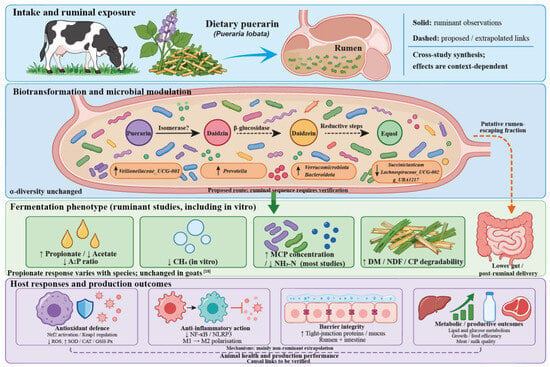
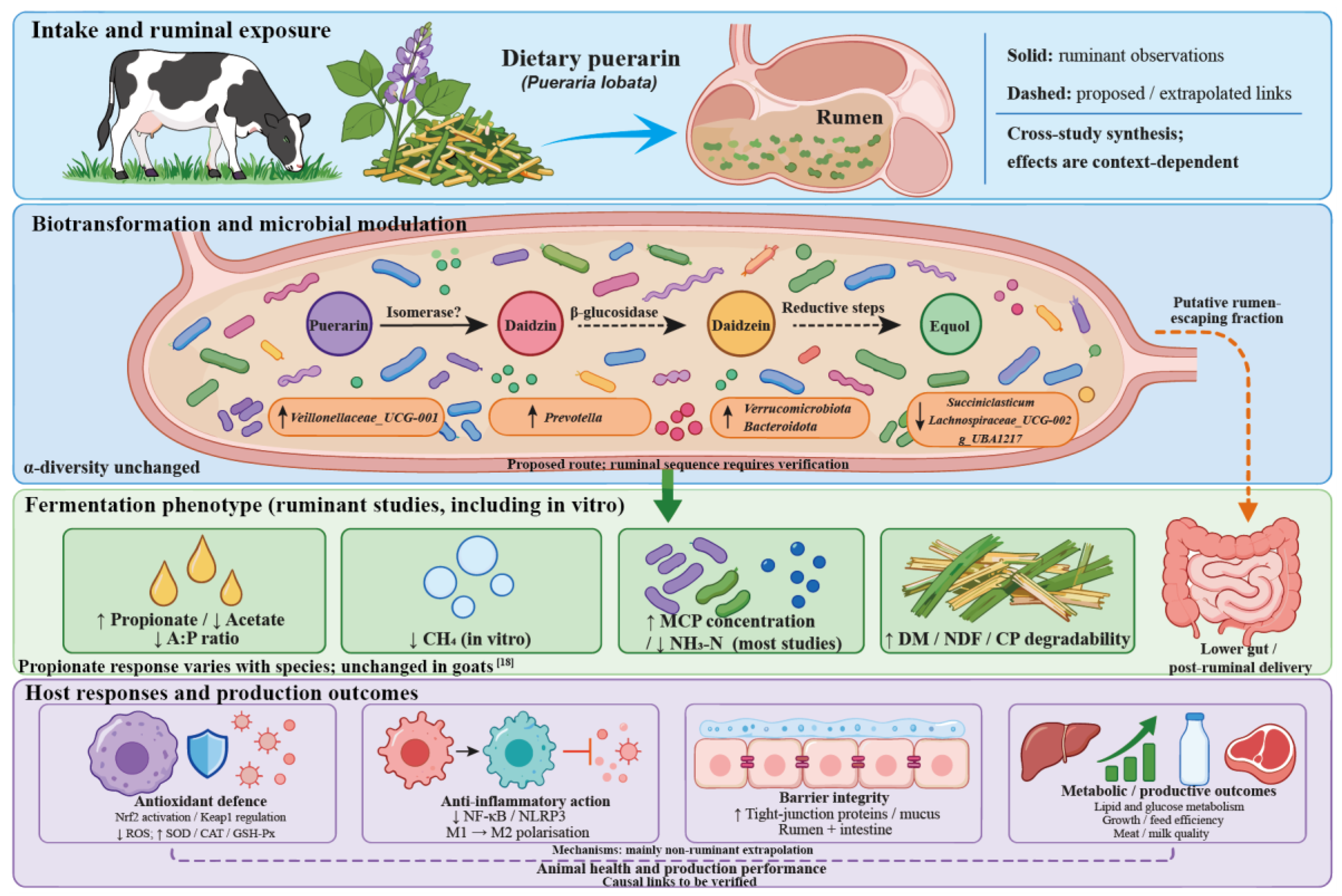
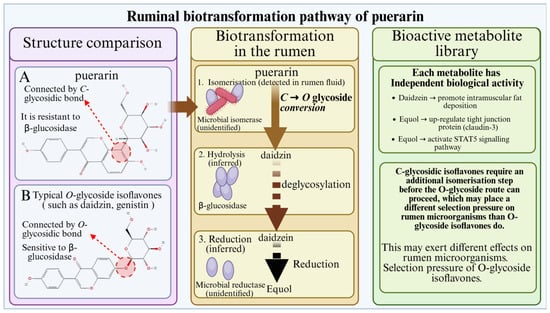
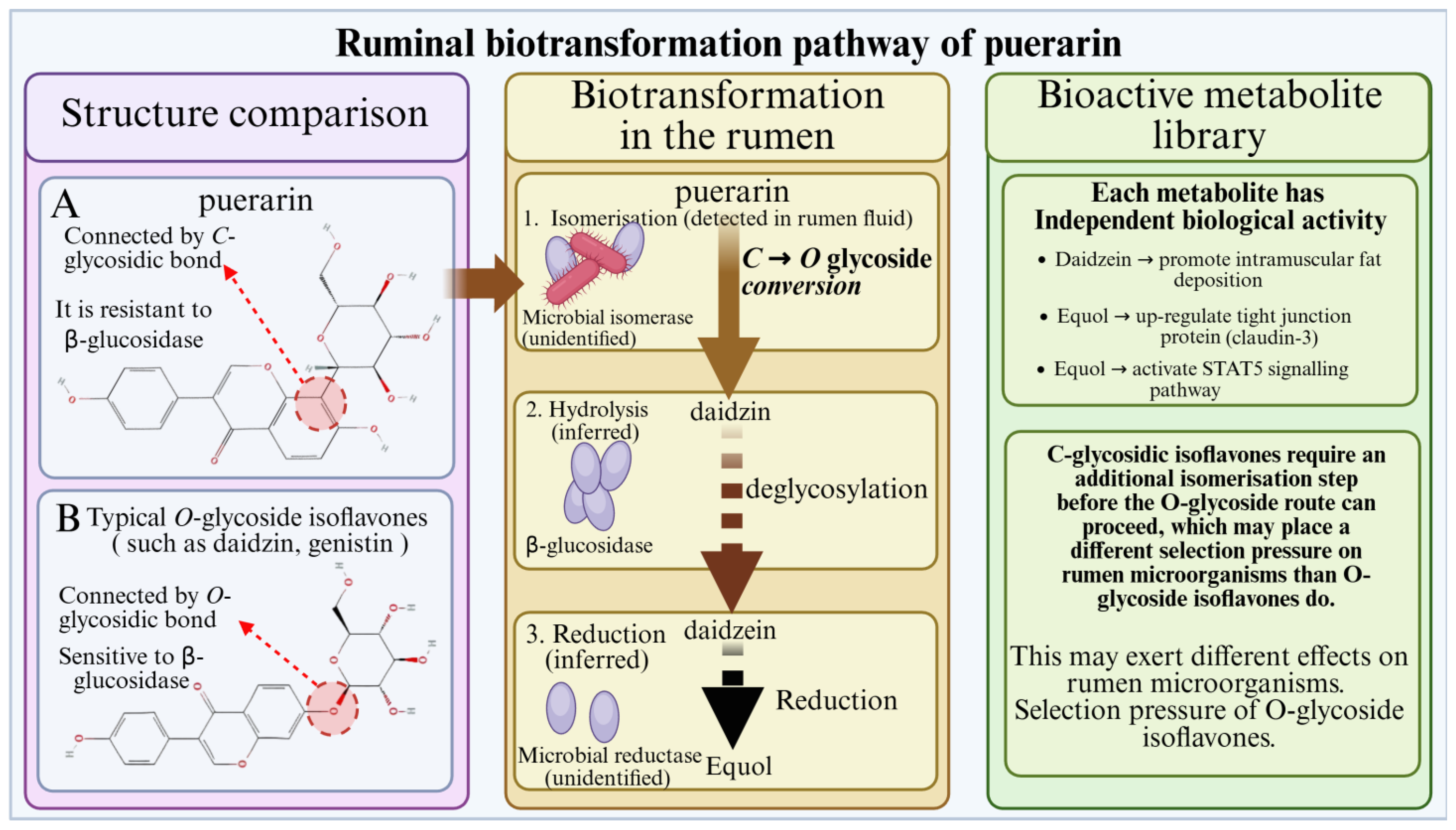
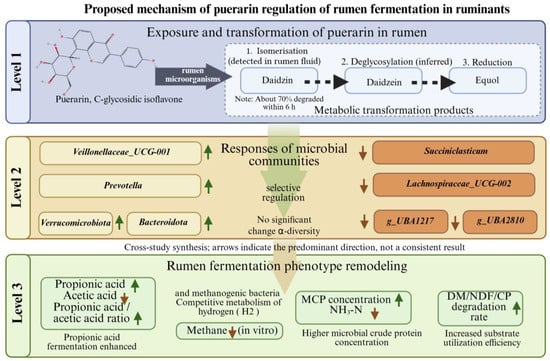
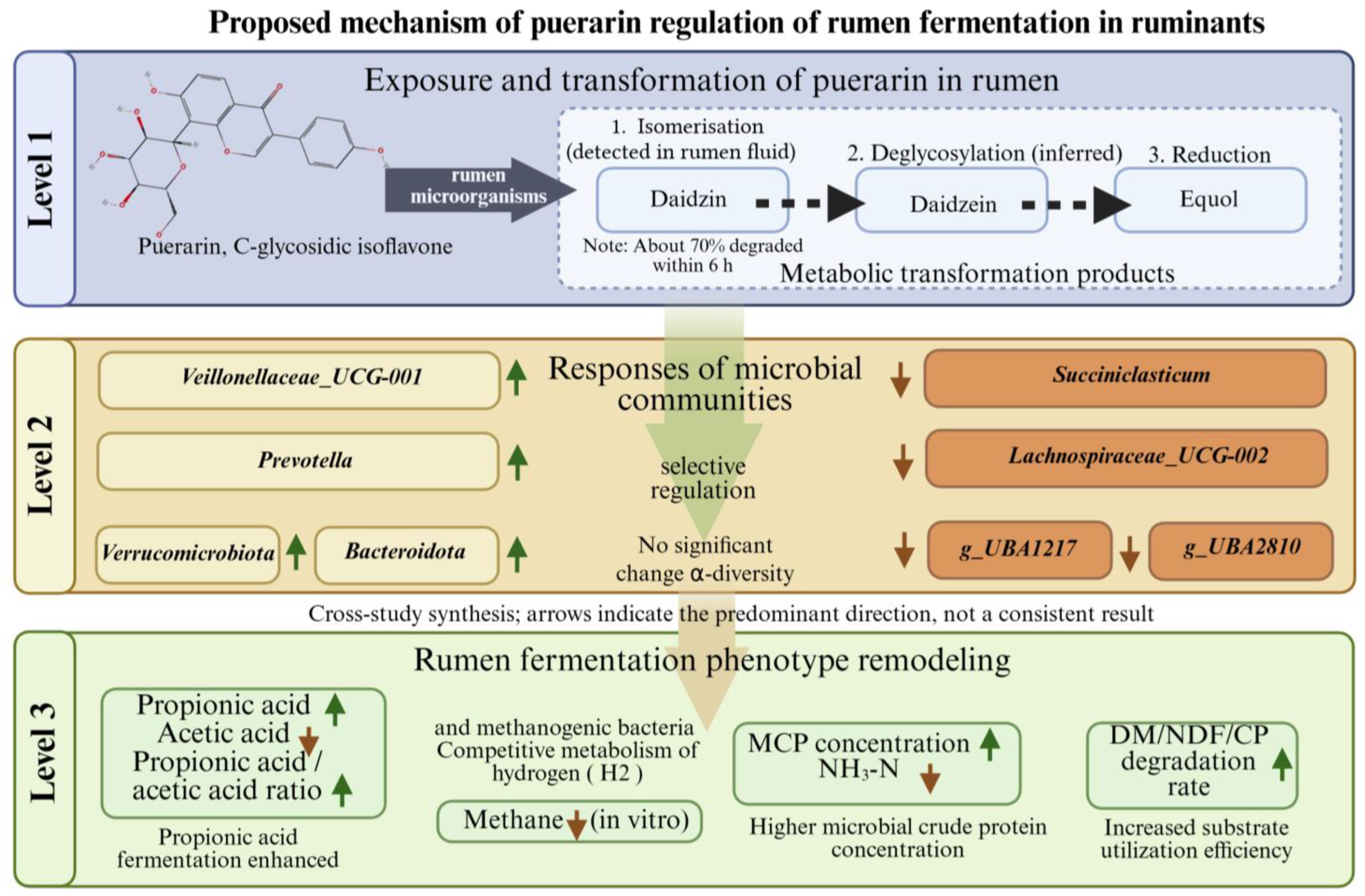
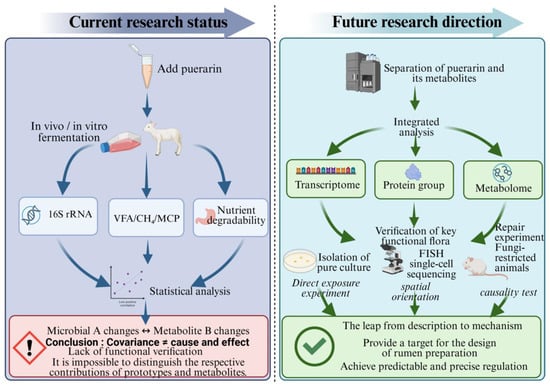
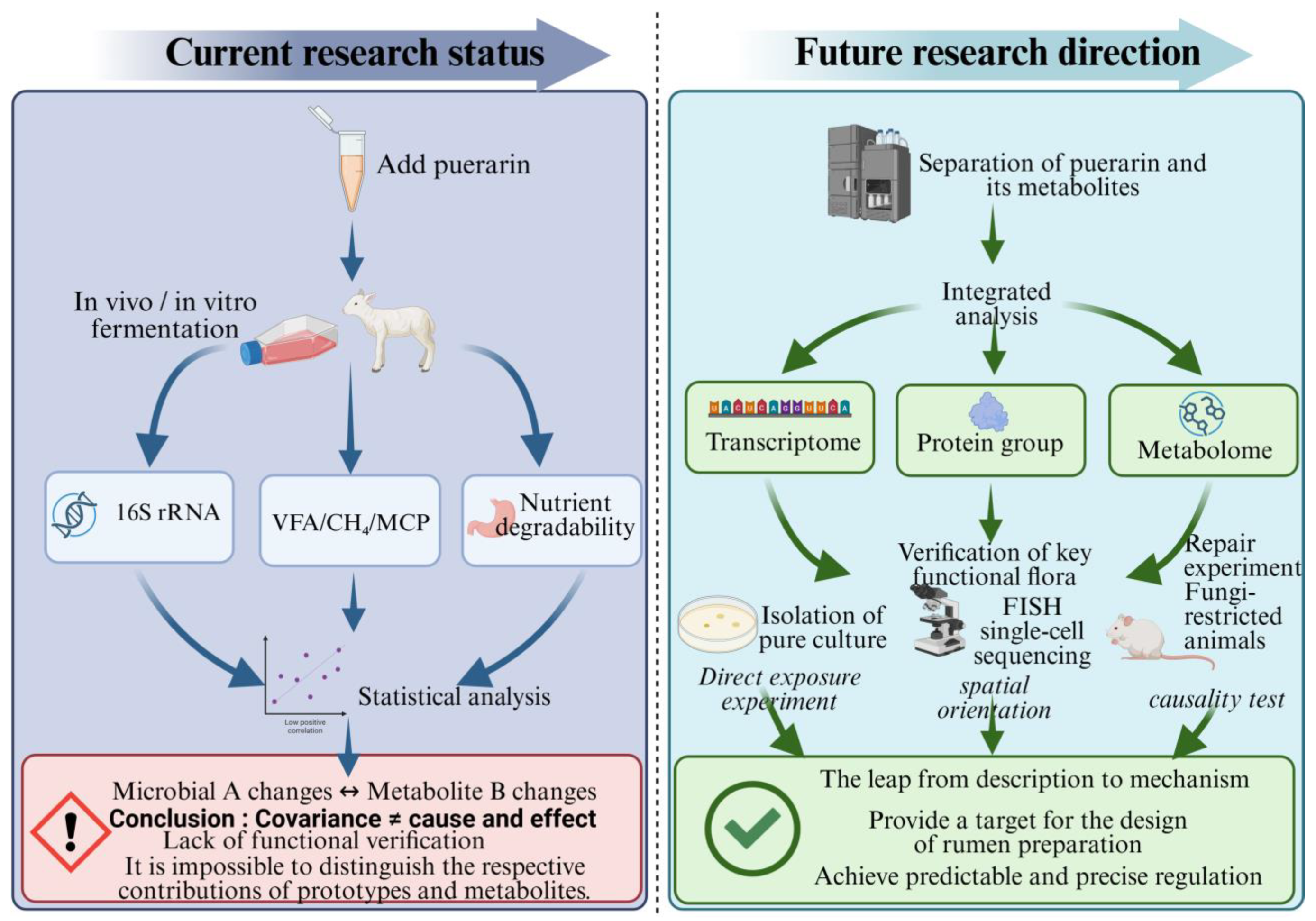

Disclaimer/Publisher’s Note: The statements, opinions and data contained in all publications are solely those of the individual author(s) and contributor(s) and not of MDPI and/or the editor(s). MDPI and/or the editor(s) disclaim responsibility for any injury to people or property resulting from any ideas, methods, instructions or products referred to in the content. |
© 2026 by the authors. Licensee MDPI, Basel, Switzerland. This article is an open access article distributed under the terms and conditions of the Creative Commons Attribution (CC BY) license.