Single-Nucleotide Polymorphisms in Calpastatin (CAST) and Micro-Calpain (CAPN1) Genes Influencing Meat Tenderness in Crossbred Beef Cattle in Thailand
by
 , , , and
Thanathip Thaloengsakdadech
1 ,
,
Supawit Triwutanon
1,
Preeda Lertwatcharasarakul
2,
Nitipong Homwong
3 and
Theera Rukkwamsuk
1,*
1
Department of Large Animal and Wildlife Clinical Sciences, Faculty of Veterinary Medicine, Kasetsart University, Kamphaeng Saen Campus, Kamphaeng Saen, Nakhon Pathom 73140, Thailand
2
Department of Pathology, Faculty of Veterinary Medicine, Kasetsart University, Bangkhen Campus, Chatuchak, Bangkok 10900, Thailand
3
Department of Animal Science, Faculty of Agriculture at Kamphaeng Saen, Kasetsart University, Kamphaeng Saen Campus, Kamphaeng Saen, Nakhon Pathom 73140, Thailand
*
Author to whom correspondence should be addressed.
Vet. Sci. 2026, 13(1), 99; https://doi.org/10.3390/vetsci13010099
Submission received: 10 December 2025
/
Revised: 27 December 2025
/
Accepted: 13 January 2026
/
Published: 19 January 2026
(This article belongs to the Section Veterinary Physiology, Pharmacology, and Toxicology)
Simple Summary
Thailand’s beef cattle industry comprises diverse production systems dominated by Bos indicus native breeds, Brahman crossbreds, and high-grade hybrids selected for improved growth and meat quality. Tenderness is a key consumer priority influenced by postmortem processes, proteolysis, and genetic factors, particularly single-nucleotide polymorphisms (SNPs) in the micro-calpain (CAPN1) and calpastatin (CAST) genes. In this study, qPCR-HRM (high-resolution melting) analysis was used to genotype CAPN1 316, CAPN1 4751, and CAST 2959. The CAPN1 4751 TT genotype was consistently associated with tougher meat, whereas CAST 2959 showed no phenotypic effect and CAPN1 316 had minimal influence. Population genetic analyses indicated Hardy–Weinberg equilibrium at CAPN1 316 and CAST 2959 but significant deviation at CAPN1 4751, suggesting possible selection pressures. The linkage disequilibrium (LD) analysis demonstrated predominantly independent segregation among markers, with a significant chi-squared value of LD detected between CAST 2959 and CAPN1 4751. Although crossbred genetic backgrounds and short aging times may have contributed to variation in tenderness, the findings confirmed CAPN1 4751 as a strong marker for meat quality. The polygenic nature of beef tenderness and the SNP markers detected by qPCR-HRM provide valuable tools for improving genetic selection, meat quality, and production efficiency in Thailand’s evolving beef industry.
Abstract
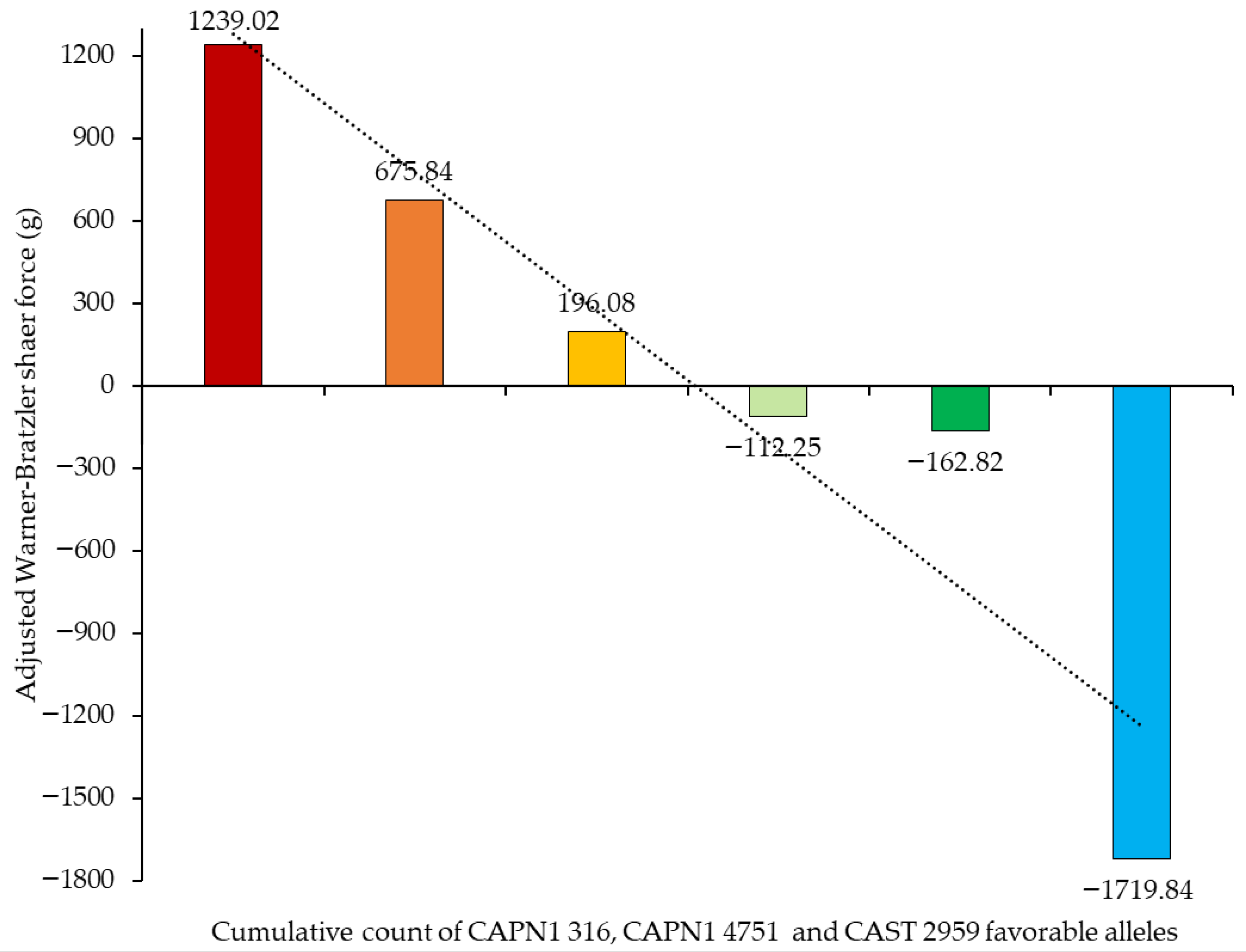
This study investigated single-nucleotide polymorphisms (SNPs) within the CAPN1 316, CAPN1 4751, and CAST 2959 markers using high-resolution melting (HRM) analysis to predict meat tenderness in crossbred beef cattle. Tenderness was assessed using the Warner–Bratzler shear force (WBSF) test, with results expressed in grams (g), representing the force required to shear muscle fibers. Significant differences in phenotypic data were observed among the genotypic groups. The finding showed that polymorphisms at CAPN1 316, CAPN1 4751, and CAST 2959 exert interactive effects on meat quality traits. Notably, the TT genotype at CAPN1 4751 increased the adjusted WBSF (aWBSF) by approximately 792 g, indicating that TT was an unfavorable variant for tenderness. These results support the use of marker-assisted selection strategies in which the TT genotype is managed to minimize its frequency while other relevant markers are concurrently monitored, thereby enhancing genetic progress in meat tenderness across commercial cattle populations. This study demonstrated that CAPN1 4751 could serve as an effective marker for genetic selection in crossbred beef cattle and confirmed the efficiency of HRM analysis as a molecular tool for SNP genotyping. In conclusion, the findings provided an alternative approach for SNP detection in livestock breeding programs and represented an important step toward improving meat quality, meeting consumer expectations, and supporting the long-term sustainability of Thailand’s beef industry. The results highlighted the polygenic nature of meat tenderness and emphasized the importance of integrating multiple SNP markers to accurately assess the genetic potential for meat quality traits in cattle.