1. Summary
Small unmanned aerial vehicles are difficult sensing targets because their signatures overlap with ordinary activity. Birds can resemble small platforms in visible imagery; helicopters, road traffic, wind, and reverberation, and anthropogenic machinery can confound acoustic channels; intermittent connectivity and heterogeneous clocks complicate distributed reports; and the operationally relevant question is often not merely whether a target is present, but whether it is approaching a protected zone with sufficient warning time for action. Small UAVs are also used in broader operational settings, including UAV-assisted wildfire monitoring in sensitive and difficult-to-access ecosystems [
1] and tactical military operations [
2]. These applications further motivate timely, traceable observations, although the present rehearsal does not evaluate either scenario. A sensor-only benchmark cannot fully represent the event context required by such applications. An early-warning data resource must preserve how an observation was produced, how it was linked to an event, what evidence supports its label, which uncertainty applies, and whether correlated objects have been separated across evaluation partitions.
The FAIR principles require persistent identification, accessible metadata, interoperable representations, explicit provenance, and clear reuse conditions [
3]. Existing anti-UAV resources provide valuable but narrower views. MMAUD synchronizes stereo vision, LiDAR, millimeter-wave radar, and audio for detection, classification, tracking, and trajectory estimation [
4]. Anti-UAV provides visible and infrared sequences for tracking [
5], DroneRF represents radio-frequency operating states [
6], the Drone-vs-Bird challenge emphasizes difficult visual negatives [
7], and acoustic collections support sound-based detection and identification [
8]. Recent Data Descriptors in event annotation, multimodal activity sensing, wireless crowd sensing, simultaneous localization and mapping, and nano-quadrotor assessment also illustrate the value of publishing acquisition context and reusable structure as first-class results [
9,
10,
11,
12,
13]. These resources demonstrate the benefit of complementary modalities, but an operational warning chain also needs upstream event anchors, public-warning context, participatory observations, evidence tiers, privacy treatment, and warning-time semantics. Multimodal fusion is most defensible when synchronization, uncertainty, missing channels, and source dependence are documented rather than hidden in preprocessing [
14].
The deposited uavews record [
15] addresses this documentation and engineering gap. It is intentionally a synthetic rehearsal release. All records under corpus/, dataset/, figures/, and report/ were computed by uavews.simulate from a fixed seed of 20250411. No row, media object, timestamp, location, sensor statistic, or validation result in the deposit is a field measurement. This distinction is repeated in the README and in the PROVENANCE_WARNING field of report/validation_report.json. The same report contains a machine-readable map showing where a future empirical run would supply manuscript quantities, but the rehearsal values are reported here only because the rehearsal itself is the subject of this Descriptor.
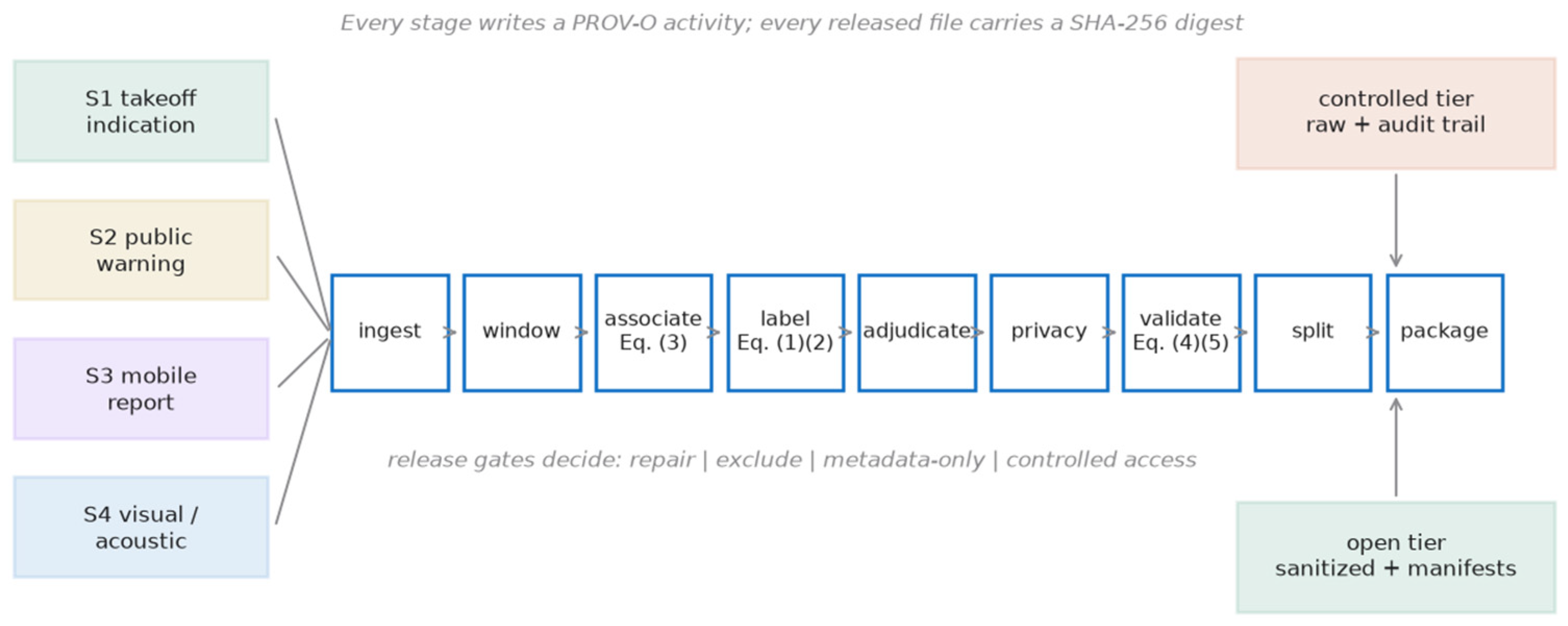
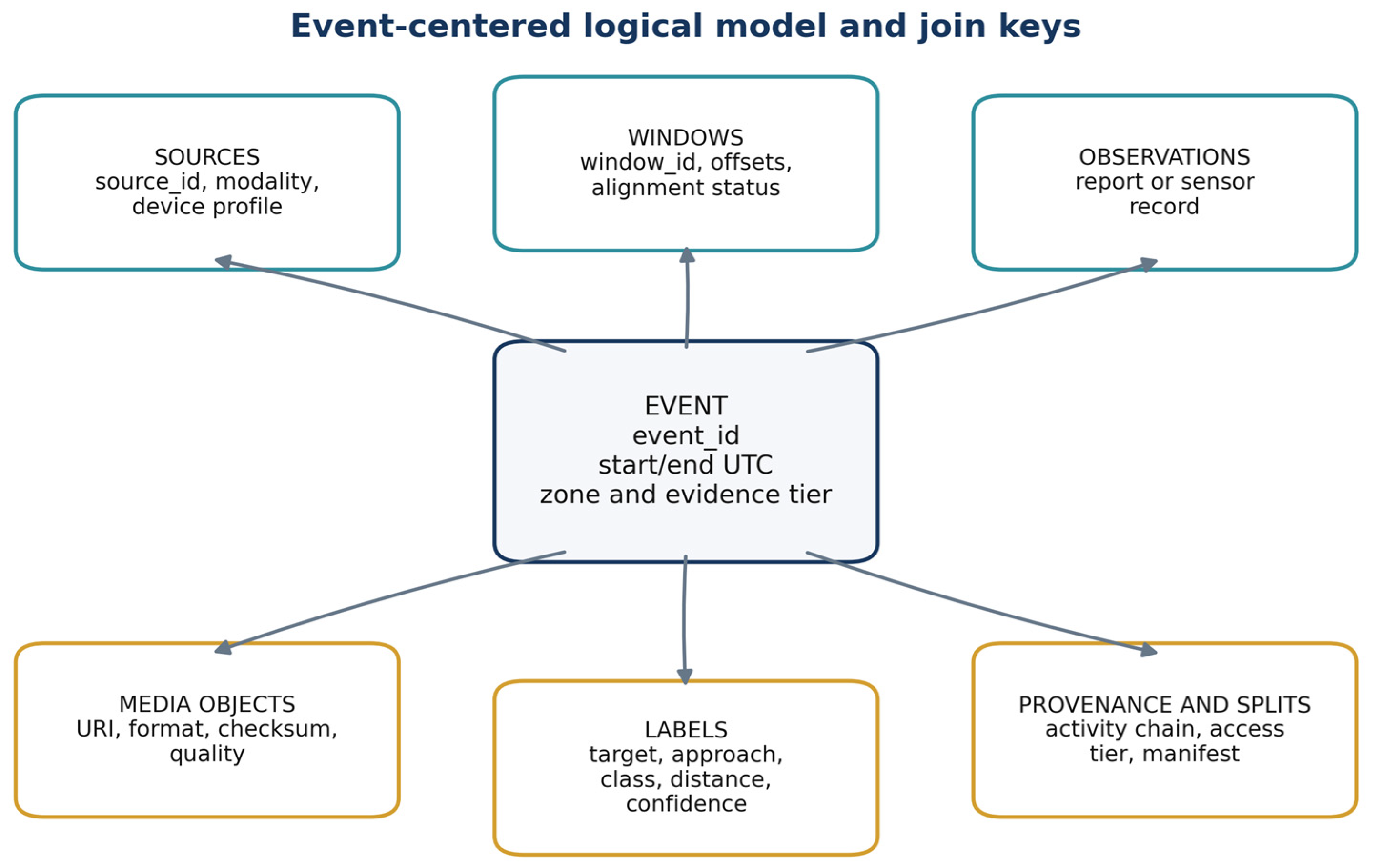
The resource makes five contributions. First, it supplies an event-centered schema connecting four source families: controlled-area takeoff indications, public-warning-like messages, voluntary mobile-report-like observations, and visual/acoustic media. Second, it implements a ten-stage executable pipeline for ingest, windowing, association, labeling, adjudication, privacy treatment, validation, split construction, release gating, and packaging. Third, it provides evidence-aware labels, uncertainty fields, integrity checks, quality metrics, and explicit release gates whose failures remain visible rather than being suppressed. Fourth, it supplies leakage-resistant event-, location-, time-, source-, and hard-negative-aware evaluation manifests together with machine-readable provenance and research-object metadata. Fifth, it includes a field-trial planning module that makes its assumptions explicit and separates synthetic rehearsal outputs from future empirical measurements.
This release makes no claim about real-world detection accuracy, deployment readiness, or superiority over other datasets. It contains no trained baseline model and no baseline prediction table. Its purpose is to show that a future empirical release can be ingested, normalized, validated, packaged, audited, and rejected when a declared gate fails. Failures are therefore informative outputs. A rehearsal in which every deliberately injected defect disappears would be less useful than one that exposes exact duplicates, near duplicates, cross-modal contradictions, and insufficient annotation agreement. Two further defects were not injected but are disclosed rather than corrected silently in this record: the provenance log lacks object-level lineage (
Section 3.1 and
Section 3.11.6), and the reduced field-trial design omits two configured factors (
Section 3.12.4). Both are scheduled for correction in the next version.
3. Methods
3.1. Ten-Stage Pipeline
The executable sequence is summarized in
Table 5. Privacy transformation precedes validation so that release gates assess the representation users would receive. Near-duplicate grouping is computed before split construction because duplicate membership is a partition constraint. In the executable implementation, metrics and gate outcomes are determined before final package assembly; the final packaging step then writes the tables, manifests, metadata, provenance, RO-Crate description, and detached checksum manifest. This ordering corrects the ambiguous shorthand “package, then gate” found in an internal stage comment and avoids describing an unaccepted package as a release.
The archived provenance log contains 16 succeeded activity records with the software version, parameter-file name, agent, start time, activity type, and descriptive subject. In this rehearsal, endedAtTime is null and the used and generated arrays are empty. The deposit therefore demonstrates activity-level provenance generation, but it does not yet provide complete object-level input/output lineage; that limitation must be corrected before an empirical release. A concrete remediation path is given in
Section 3.11.6. Hybrid edge/cloud placement may be useful for future acquisition and privacy-sensitive transformation [
23,
24], but no live distributed deployment is represented in the rehearsal.
3.2. Configuration and Simulation Design
Release-specific values reside in code/config/pipeline.yaml; controlled vocabularies reside in code/config/vocabularies.yaml. Configuration is validated before data are read. Invalid split fractions, a hop longer than a window, a polygon with fewer than three vertices, non-positive association overlap, and an explicitly set direction threshold below its uncertainty-derived floor are rejected. Externalization makes assumptions visible and replaceable, although reproducibility still requires code, inputs, dependencies, and configuration together—not the parameter file alone.
uavews.simulate uses seed 20250411 to generate source deliveries in the formats consumed by the adapters. Injected defects include upstream redelivery, byte-identical and re-encoded media, clock offsets, missing sensor objects, clipped and silent audio, blurred and mis-exposed images, speech-like content, disagreement near a detection boundary, and weak reports that contradict reference motion. These conditions are designed to test whether gates respond. They are not estimates of defect prevalence in an operational system.
3.3. Identifiers and Time Representation
Stable non-semantic identifiers permit repeatable joins without embedding sensitive attributes. Contributor-like identifiers incorporate a rotation epoch so repeated reports can be clustered within an epoch while cross-epoch linkage is reduced. The synthetic release salt is part of the rehearsal machinery; a real implementation would require institutional key management, access separation, and rotation procedures that are outside this synthetic record.
RFC 3339 strings with the Z designator are used for interchange [
17]. Analytical tables use signed 64-bit nanoseconds so that clock arithmetic does not lose precision through floating-point epoch seconds. Native source time is retained; a corrected value is derived alongside offset, uncertainty, and method. Site-like sources carry PTP- or NTP-scale assumptions, while mobile and public sources are treated as asynchronous unless they observe a physical marker.
3.4. Kinematics and Warning Time
Let
denote a target position in a local East-North frame and let
be a warning-zone polygon. The horizontal distance to its boundary is
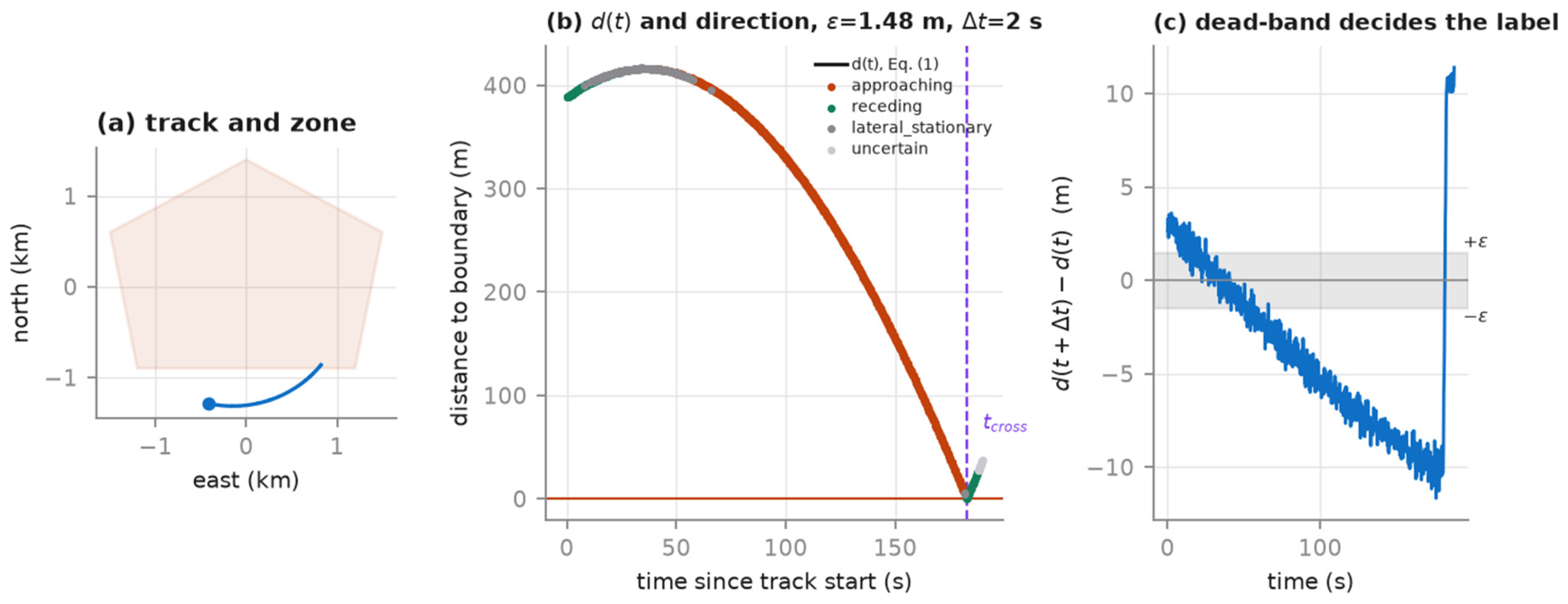
As defined by Equation (1), distance is computed to polygon edges, not only vertices, and altitude is excluded. The public value is unsigned; containment is stored separately. A signed form is used only to identify a crossing.
Over stride
, movement is approaching when
, receding when it exceeds
, and lateral/stationary otherwise. The rehearsal uses
s. With horizontal reference uncertainty
m, multiplier
, and independent fixes, the enforced floor is
When a verified crossing occurs at
, warning time is
Equation (2) defines warning time from the interpolated crossing time. Crossing time is linearly interpolated between bracketing 5 Hz reference samples;
Figure 3 illustrates the boundary geometry, distance series, movement labels, and interpolated crossing for one synthetic event. Tracks without a crossing are marked censored rather than extrapolated.
3.5. Synchronization and Association
For an observation of a shared physical synchronization marker at source time
and reference time
, absolute synchronization error is
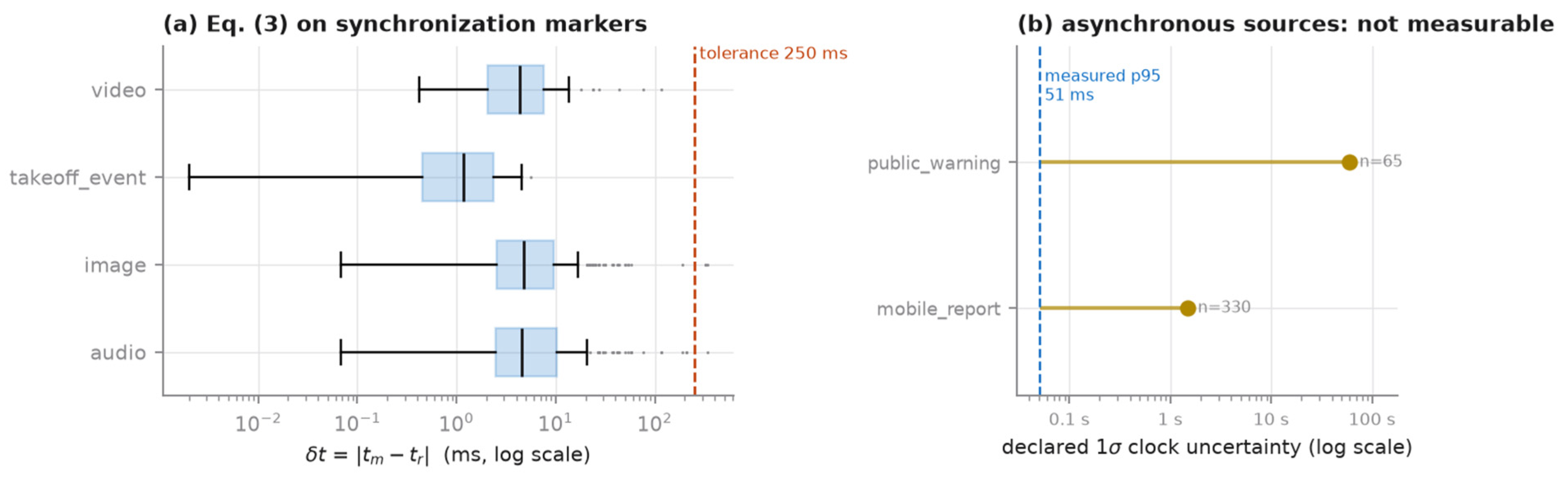
The marker is essential: comparing an arbitrary observation with an event anchor measures where the observation occurs within the event rather than clock error. Site-like sources can observe a marker; mobile-report and external-public-warning simulations cannot, so they carry declared uncertainty and a null measured error. The configuration assumes clock uncertainty of 5 ms for site PTP, 40 ms for site NTP, 1500 ms for mobile sources, and 60,000 ms for external public sources.
An observation is associated with a window when uncertainty-expanded intervals overlap by at least 1.0 s or cover at least 50% of the shorter interval. The fractional alternative is necessary for effectively instantaneous images. Intervals are expanded by two standard deviations. The rehearsal achieved an association rate of 1.0, but that is a property of generated inputs and should not be interpreted as field matching performance.
Figure 4 summarizes marker-based synchronization error for measurable source classes and declared clock uncertainty for asynchronous classes.
3.6. Completeness, Duplication, and Media Quality
For record
and its declared required-field set
, completeness is
The denominator is the schema’s required set, not the number of populated columns. This prevents a sparse record from appearing complete merely because optional fields were omitted from the calculation.
Let
be the number of media objects and
the number of unique content groups. The object-group duplicate rate is
Exact groups use SHA-256. Near-duplicate groups use a 64-bit perceptual hash with a rehearsal Hamming radius of four; true injected re-encodes were separated by at most two bits and unrelated rehearsal objects by at least twelve. Degenerate objects such as silence or saturated imagery are grouped by digest only because their perceptual signatures are uninformative.
Media quality is calculated from bytes rather than trusted metadata. Audio checks include clipping, silence, a harmonic-sum signal-to-noise estimator, and speech-like content. The estimator has a simulated null sensitivity bound and returns a reason-coded null below that bound. Image and video checks include decoding, blur, exposure, and target-pixel extent. Derived or re-encoded objects receive their own identifiers and provenance relations.
3.7. Annotation and Cross-Modal Consistency
The rehearsal simulates three judgments per annotation task, with additional judgments in some presence units. Krippendorff’s alpha is reported separately for vehicle presence and movement direction, together with unit-level bootstrap intervals [
25]. Resampling annotation units rather than individual judgments preserves within-unit dependence. Cross-modal consistency compares weak reports with the corresponding reference-supported presence and direction after association. A conflict triggers revision, exclusion, or an uncertain released value; source labels are not silently overwritten.
3.8. Privacy and Release-Policy Rehearsal
The software exercises generalization, identifier rotation, access assignment, and an export audit. The risk probe uses over location_cell, modality, and a temporary day-level derivation. It identified 621 records below the declared class-size threshold, representing 63.95% of evaluated records, despite zero residual findings in the separate blocking audit. The open Parquet export nevertheless retains nanosecond-resolution event, window, and observation times after temporary underscore-prefixed audit fields are removed; the day-level probe therefore understates the linkability exposed by the exported temporal precision. This result is important: a zero count in one audit is not proof of anonymity, and the rehearsal’s sparse quasi-identifiers and fine timestamps would require additional coarsening, withholding, or a stronger disclosure-risk analysis in a real release.
Because every person-like report and every media object is synthetic, no participant privacy claim is being validated here. The controls model data minimization, purpose limitation, storage limitation, and governed de-identification consistent with the concerns articulated in the GDPR [
26] and NIST guidance [
27]. A future empirical release must establish lawful basis, consent or exemption, human review of audiovisual redaction, operational-security review, and access governance independently of this software rehearsal.
3.9. Leakage-Resistant Manifests
Splits are built at group level and then expanded to records. Event and near-duplicate groups are universal constraints. Location, temporal block, source group, or hard-negative family adds a manifest-specific constraint. If duplicate and holdout constraints cannot both be satisfied, conflicting events are excluded and counted rather than leaked.
Five manifests are deposited: event_disjoint, location_holdout, time_holdout, source_holdout, and hard_negative_challenge. The intended split fractions are 0.60/0.15/0.25 and the temporal embargo is seven days. Embargo compliance is audited as the primary constraint of time_holdout, and any breach is counted in the leakage_violations gate (
Section 3.11.5) rather than being reported as a separate criterion. The audit checks each manifest against its own claim, following the principle that spatial and temporal dependence must match the generalization question [
28] and that leakage can produce optimistic results without explicit test labels appearing in training rows [
29].
3.10. Packaging, Integrity, and Implementation
Package assembly writes the canonical tables, manifests, metadata, provenance, RO-Crate graph, and checksums_sha256.txt. The manifest hashes every released file present at generation time except itself using SHA-256 as standardized in FIPS 180-4 [
30]; it is therefore detached rather than self-referential. The archive-level checksum list follows the same non-self-hashing principle. Integrity should be understood as exact-byte verification against a manifest, not as authenticity of the scientific claims. More elaborate collaborative-audit protocols exist [
31], but this package implements file digests and local verification rather than a distributed cryptographic audit scheme.
The package source tree code/src/uavews contains 25 Python files, of which 23 are substantive modules and two are __init__.py files, totalling 6213 lines. That count excludes the test file and the separate Zenodo build helper; it is not a count of every Python line in the archive. The 23-module count expands the four source adapters plus ingest.common and counts pipeline, cli, and viz separately. The package targets Python 3.11 or later. Declared dependencies are NumPy ≥ 1.24, pandas ≥ 2.0, PyArrow ≥ 12.0, and PyYAML ≥ 6.0; Matplotlib ≥ 3.7 is used for figures and pytest ≥ 7.0 for tests. The project contains no custom compiled extension or external service dependency, although NumPy, pandas, and PyArrow may themselves use native components.
The test file deposits 54 test functions aimed at silent defects: equation sign and domain errors, an ineffective direction dead-band, extrapolated crossings, unmeasurable synchronization, over-merged perceptual groups, split leakage, and an acoustic estimator reporting noise as a detection. This manuscript did not independently run the test suite and therefore reports the number and intent of deposited tests, not a fresh pass result or coverage percentage.
Two executions over identical inputs are documented as producing byte-identical canonical tables, split manifests, and the data dictionary. The RO-Crate manifest, provenance log, and checksum manifest legitimately differ because they contain wall-clock timestamps or digest timestamp-bearing files. Reproducibility is thus deterministic for the scientific tables and explicitly bounded for time-bearing administrative artifacts.
3.11. Technical Validation
3.11.1. Structural Integrity, Completeness, and Synchronization
Validation operates as several independent dimensions rather than one opaque score, consistent with the need to distinguish structural, semantic, quality, privacy, and integrity properties [
32]. All 180 event rows, 4119 window rows, 102 source rows, 971 observation rows, 391 media rows, and 7242 released-label rows passed declared type, range, and referential checks. Every table had median, fifth-percentile, and minimum record completeness of 1.0. This perfect structural result is expected from a generated corpus and demonstrates validator-path coverage; it is not an estimate of completeness in field collection.
Of 971 observations, 576 belonged to source classes capable of observing a synchronization marker and 395 were explicitly not measurable. Across measurable observations, the median error was 3.6705 ms, p95 was 42.184 ms, maximum was 340.344 ms, and 0.694% exceeded the 250 ms tolerance. By modality, takeoff-event records had median/p95/max of 1.186/3.891/5.620 ms; audio 4.530/50.873/340.344 ms; image 4.800/41.763/340.344 ms; and video 4.279/31.174/117.121 ms. Mobile reports (330) and public warnings (65) were not assigned fabricated measured values.
3.11.2. Duplicates and Media Quality
Among 391 media objects, the validator formed 352 unique groups; the largest contained three objects. The combined object-group duplicate rate was 9.974%, composed of 0.512% exact duplicates and 9.463% perceptual near duplicates. The rehearsal deliberately injected copies, so these rates test grouping and gate behavior. They must not be interpreted as a predicted ingestion-defect rate for a field campaign.
Audio quality was assessed for 214 objects. At least one quality flag appeared on 77.10%; clipping was flagged on 4.21%, silence on 3.27%, low SNR on 26.64%, and speech-like content on 6.07%. Median SNR was −15.38 dB, with p05 −23.88 dB and p95 7.24 dB. These values reflect the deliberately difficult synthetic audio and the estimator’s definition relative to total in-band noise. For 121 images, 12.40% carried at least one flag: blur 5.79%, over-exposure 4.96%, and under-exposure 1.65%. Median target extent was 21 pixels and p05 was 5 pixels. For 56 video objects, 8.93% carried at least one flag; blur, over-exposure, and under-exposure rates were 3.57%, 1.79%, and 3.57%, respectively, with median target extent 19 pixels and p05 4.75 pixels.
The rehearsal also compares planning-model predictions with generated media properties. For acoustic SNR (121 paired objects), predicted-minus-generated bias was 3.319 dB, median absolute deviation 3.454 dB, RMSE 8.857 dB, and Pearson correlation 0.542. For visual target extent (177 objects), bias was 3.087 px, median absolute deviation 5.737 px, RMSE 8.177 px, and correlation 0.938. These are internal coherence diagnostics between the simulator and its planning model, not calibration against physical sensors.
3.11.3. Agreement and Cross-Modal Validation
Presence agreement covered 96 annotation units and 363 judgments, with a mean of 3.781 judgments per unit. Krippendorff’s alpha was 0.324 (unit-bootstrap 95% interval 0.238–0.408); the majority class was present with prevalence 0.576. Direction agreement covered 335 units and 1005 judgments, exactly three per unit, and produced alpha 0.520 (95% interval 0.464–0.566). Both results are synthetic stress-test outputs. The presence result fails the configured 0.67 release floor and correctly indicates that the simulated evidence/annotator combination would not support publication without stronger guidance, qualification, evidence, or adjudication.
Cross-modal consistency was 89.88%, narrowly below the 90% gate. Simulated reporting errors increase near the synthetic detection boundary and affect the smaller lateral/stationary class disproportionately. The appropriate conclusion is not to relax the threshold post hoc, but to preserve the confusion structure and require a future empirical protocol to characterize it.
3.11.4. Manifest Audit
All manifests recorded zero violations of their declared primary constraints and no near-duplicate leakage. For time_holdout, the primary constraint is a seven-day embargo between the latest training event and the earliest test event. The observed gap of 13.8 days exceeds this requirement;
Table 6 therefore reports an achieved margin rather than a violation. An embargo breach would increment the leakage_violations count assessed by the corresponding
Table 7 rule (≤0). That count is zero in this rehearsal.
Table 6 nevertheless identifies two structurally weak manifests. The location and time holdouts have empty validation partitions because the rehearsal contains only three site groups and, after embargoing, three temporal blocks. Although their primary constraints pass, these manifests are unsuitable for model selection. A nested procedure is therefore recommended: split the training portion of location_holdout or time_holdout into event-disjoint inner-training and inner-validation sets (0.80/0.20 at group level), keep near-duplicate groups together, select hyperparameters and stopping rules on the inner-validation set, and evaluate the held-out location or temporal block only once. The next version will explicitly flag any empty validation partition. A robust field campaign will still require more site groups and a longer collection period, as noted in
Section 3.12.4. Exclusion counts remain part of the reported results rather than hidden attrition.
3.11.5. Release Gates
The release policy applies eleven rules. Seven pass and four fail (
Table 7). A failure is not silently discarded: it requires repair, exclusion, metadata-only treatment, or a documented decision. Exact duplicates fail a zero-tolerance rule; near duplicates exceed the 5% ceiling; cross-modal consistency misses its threshold; and presence agreement is far below the release floor. Conversely, passing structural and checksum gates does not establish scientific validity—it establishes that the package is internally formed as declared.
The acceptance rules in
Table 7 were declared in pipeline.yaml before the rehearsal. Structural-integrity rules—schema and checksum pass rates, exact-duplicate rate, privacy residual findings, and leakage violations—use zero tolerance because each failure indicates a package defect rather than statistical variation. The completeness thresholds are engineering tolerances. A median completeness of at least 0.95 means that at least half of the evaluated records contain at least 95% of their required fields. A fifth-percentile completeness of at least 0.80 means that at least 95% of the records contain at least 80% of their required fields. These thresholds allow legitimate, reason-coded nulls, such as a missing measured synchronization error for an asynchronous source. The 250 ms synchronization p95 ceiling follows from the labeling geometry: it equals one eighth of the 2.0 s direction stride and one sixth of the 1.5 s boundary tolerance. The 5% near-duplicate ceiling limits non-independent media to one object in twenty, and the 90% cross-modal consistency floor permits no more than one weak report in ten to contradict the reference motion after association. The presence-agreement floor follows the convention that Krippendorff’s alpha values of at least 0.67 support tentative conclusions and values of at least 0.80 support firm conclusions [
25]. All thresholds are externally configured. A future empirical release may justify stricter values, but a threshold must not be relaxed after a gate has failed; every change must remain visible in the versioned configuration.
The integrity validator recomputed 378 non-metadata-only released media-payload digests and matched all 378 to their manifest values. This count concerns media integrity, not the complete package. Separately, dataset/checksums_sha256.txt lists 16 generated package files and excludes itself. These two checks must not be collapsed into a broader claim that every archive object was covered by the 378-file calculation.
3.11.6. Limitations of Validation
The rehearsal is deterministic by design and cannot represent sensor drift, nonstationary weather, real operator behavior, device heterogeneity, true crowd-report bias, unanticipated file corruption, changing public-warning semantics, or the legal constraints of real data reuse. Simulated annotators and reports are useful for exercising code paths but do not validate a handbook or estimate human reliability. Synthetic media test codecs and metrics but cannot establish real detection range or target visibility. The three site groups are insufficient for a useful three-way location holdout. The k-anonymity probe shows that nominal generalization still leaves many sparse combinations. Finally, no baseline learning system is deposited, so the release supports data-engineering and protocol research rather than comparative model performance. The provenance log is a further explicit limitation: it records activity-level lineage only, with endedAtTime null and empty used and generated arrays (
Section 3.1). The planned remediation is as follows. The next rehearsal version (0.2.0-rehearsal) will populate endedAtTime from the per-stage timer already present in the pipeline driver and will emit, for each of the 16 activities, prov:used and prov:generated entity references to the canonical tables, manifests, metadata files, and media objects that the activity consumed and wrote, keyed by the same SHA-256 digests listed in checksums_sha256.txt. Object-level lineage will then be added to the release policy as a twelfth gate (all activities must have non-empty used and generated arrays and a non-null endedAtTime), so that the first empirical record cannot pass the gate system with an incomplete provenance log.
Real operating conditions are absent from the corpus. Weather, background noise, sensor error, and environmental variation affect the results only through fixed planning-model defaults (
Section 3.12.2), not through generated observations. The rehearsal therefore cannot determine how detection range, false-alarm rate, or synchronization error varies across rural, peri-urban, and urban sites; between day and night; or between calm and windy conditions.
3.12. Field-Trial Planning
3.12.1. Status of Planning Quantities
Every quantity in this section is an assumption declared in pipeline.yaml and propagated through trialdesign; none is a measurement. The purpose is to make campaign design explicit before hardware deployment and to identify which calibration measurements must replace which defaults.
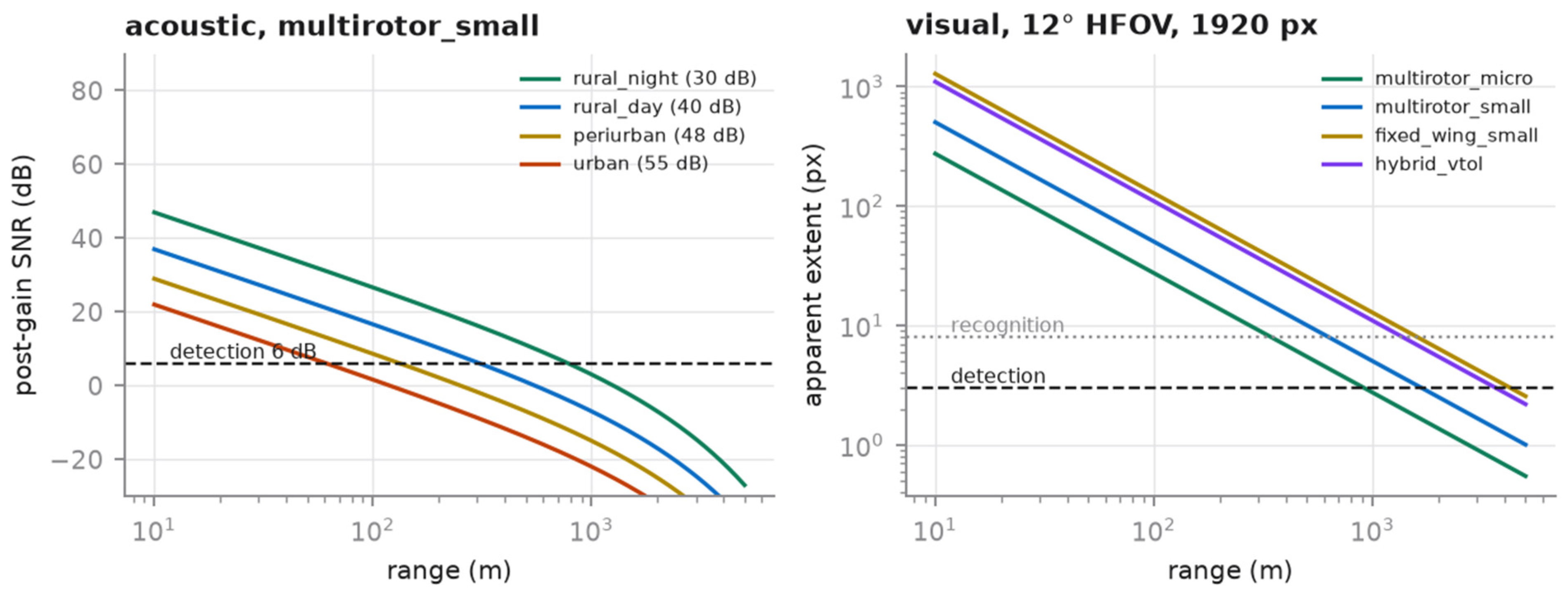
3.12.2. Acoustic and Visual Detectability
For acoustic spherical spreading with linear atmospheric absorption,
Figure 5 summarizes the resulting acoustic and visual detection curves under these declared planning assumptions.
and post-processing SNR subtracts ambient level and adds an assumed 22 dB processing gain. Source levels at 1 m are 68–77 dB by platform class; absorption is 0.004 dB/m; ambient levels are 30, 40, 48, and 55 dB for rural-night, rural-day, peri-urban, and urban scenarios; and the detection threshold is 6 dB post-gain. The largest range meeting the threshold is found by bisection.
For a pinhole visual model,
with 1920 px width, 12° horizontal field of view, a 3 px detection floor, and an 8 px recognition floor.
Table 8 shows resulting planning ranges.
The table exposes the key design risk: acoustic planning range changes by roughly an order of magnitude with ambient noise, while the visual model ignores weather and occlusion. The system may therefore depend entirely on line of sight in noisy environments. A field campaign must measure detector ROC, source level, ambient spectra, and weather effects before these ranges can guide deployment.
Sensitivity is assessed by perturbing the planning model’s assumed inputs. With the small-multirotor source level fixed at 75 dB at 1 m, the model reproduces the 783 m rural-night range reported in
Table 8. Increasing the assumed atmospheric-absorption coefficient from 0.004 to 0.008 dB/m reduces the modeled range to 629 m (−20%). Raising the assumed ambient level by 5 dB reduces the range to 501 m (−36%), while a 10 dB increase reduces it to 308 m. Reducing the assumed source level by 3 dB produces a range of 602 m. These calculations are input-perturbation scenarios, not measured effects of temperature, humidity, wind, or platform load. The visual model also excludes rain, fog, haze, changing illumination, occlusion, and glare. In field data, these conditions may reduce contrast or obscure the line of sight. Clock offsets can shift observations across analysis windows, reference-position uncertainty can alter direction labels near the dead band, and exposure or gain drift can change media-quality flags. Because rural, peri-urban, and urban sites may combine these effects differently, a field campaign must measure them before the
Table 8 values are used for deployment decisions.
3.12.3. Warning-Time Budget
For closing speed
, detection range
, decision delay
, and dissemination delay
, actionable time is
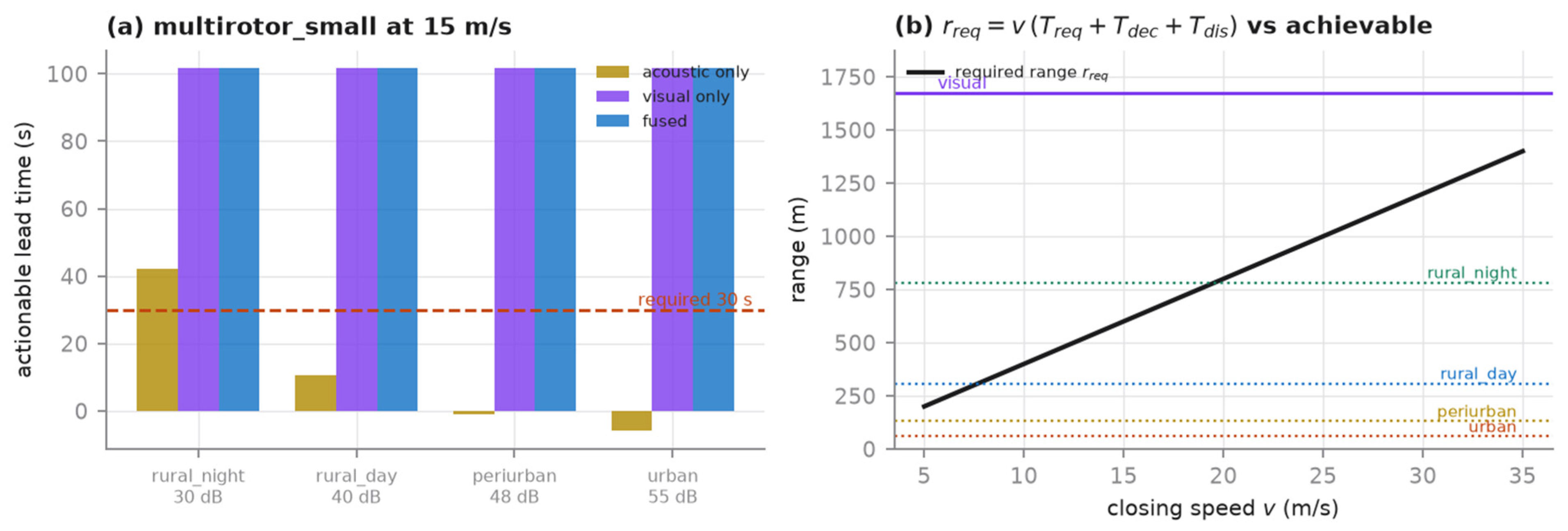
The configuration assumes 4 s for decision, 6 s for dissemination, and 30 s required actionable lead. Thus,
Figure 6 shows the corresponding actionable-lead and required-detection-range relationships.
At 15 m/s, the required range is 600 m; at 8 and 25 m/s it is 320 and 1000 m. These values are requirements derived from assumed latency, not achieved warning times.
Figure 6.
Actionable lead and required detection range under the configured planning budget. Lead-time and range values follow from the assumed 4 s decision delay, 6 s dissemination delay, and 30 s required actionable lead; they are planning assumptions, not achieved warning times. (a) Actionable lead time for the small multirotor at 15 m/s under each ambient scenario for acoustic-only, visual-only, and fused detection (bar colours as in the legend); the dashed line is the 30 s requirement. (b) Required detection range versus closing speed (solid black line) compared with the planning ranges of the visual model (solid line) and the acoustic model under each ambient scenario (dotted lines).
Figure 6.
Actionable lead and required detection range under the configured planning budget. Lead-time and range values follow from the assumed 4 s decision delay, 6 s dissemination delay, and 30 s required actionable lead; they are planning assumptions, not achieved warning times. (a) Actionable lead time for the small multirotor at 15 m/s under each ambient scenario for acoustic-only, visual-only, and fused detection (bar colours as in the legend); the dashed line is the 30 s requirement. (b) Required detection range versus closing speed (solid black line) compared with the planning ranges of the visual model (solid line) and the acoustic model under each ambient scenario (dotted lines).
3.12.4. Statistical Size and Feasible Design
A one-sided binomial planning approximation targets detection probability 0.90 against a null of 0.75 at alpha 0.05 and power 0.80. It yields 42 statistical runs per cell. Inflating for 15% expected loss produces 50 planned sorties per cell. Crossing four platform classes, four approach geometries, three speed bands, three altitude bands, three illumination levels, and three backgrounds produces 1296 cells and 64,800 sorties. The deposited code also reports a reduced result of 7200 sorties, calculated as 48 primary cells (platform × approach × speed), three illumination blocks, and 50 runs. That calculation omits altitude and background from the reduced cell/block definition, despite their presence in the configured matrix; consequently, 7200 is a reproducible software output but not yet a fully specified blocked experimental design.
Neither estimate represents a finalized field-campaign design. The deposited 7200-sortie output remains defective because its cell definition omits altitude and background. This limitation is stated in the Abstract, Summary, Conclusions, and
Section 4.2 so that the value is not reused without context. Version 0.2.0-rehearsal will replace this allocation with a reproducible mixed-level orthogonal design that retains all six configured factors. The corrected design crosses the complete 4 × 4 platform-by-approach matrix with a nine-run L9(3
4) orthogonal array for speed, altitude, illumination, and background. Using level codes 1–3, the nine rows are (1,1,1,1), (1,2,2,3), (1,3,3,2), (2,1,2,2), (2,2,3,1), (2,3,1,3), (3,1,3,3), (3,2,1,2), and (3,3,2,1). This arrangement yields 144 unique cells and 7200 planned sorties at 50 sorties per cell. Although the total equals the defective deposited output, the factor allocation is different and every pair of factor levels is balanced. For the prespecified model—six main effects plus platform-by-approach, platform-by-speed, and approach-by-speed interactions—the resulting 144 × 36 model matrix has full rank (36). Other interactions among the three-level factors may be aliased and are not primary estimands. Version 0.2.0-rehearsal will publish the design matrix, balance diagnostics, model specification, and alias structure. Until then, the deposited reduced-design output must not be treated as a valid blocked experiment. A future empirical campaign should use a hierarchical or regression model across range, platform span, ambient level, and illumination, with site and campaign effects and independent pilot data reserved for acceptance. Calibration must replace the assumed 22 dB processing gain, source levels, ambient noise, atmospheric absorption, visual pixel thresholds, operational latencies, and 0.35 m reference uncertainty. More than three site groups are required; six independent groups provide a practical lower planning bound for non-degenerate location splits.
4. User Notes
4.1. Reproduction and Verification
From the extracted archive root, the documented workflow is:

The first command installs declared dependencies; the second requests the deposited test suite; the third regenerates the synthetic corpus, ten-stage output, figures, and validation report. Their inclusion is a reproducibility instruction, not a statement that this manuscript’s authors executed them in a clean independent environment. The engineering DOCX can be rebuilt with:
The archive-level checksums can be verified with:
Users should cite the version-specific DOI [
15], retain parent identifiers or publish a mapping in derivatives, identify transformations, and publish split manifests. Synthetic augmentation should remain marked and outside any future empirical test set.
4.2. Appropriate Reuse
The record is suitable for testing ingestion adapters, schema evolution, provenance export, quality metrics, release gates, data dictionaries, reproducibility tooling, event-level joins, uncertainty-expanded association, split audits, and field-trial calculations. It can support teaching examples in data engineering and multimodal dataset governance. It may also be used to test downstream code that expects the six canonical tables, provided outputs are described as rehearsal results.
It is not suitable for estimating real detection probability, false-alarm frequency, platform recognition accuracy, acoustic range, visual range, warning-time performance, demographic reporting behavior, sensor reliability, or privacy risk. A model trained and evaluated on this generated corpus is a software demonstration, not a validated warning system. Likewise, the reduced 7200-sortie design of
Section 3.12.4 must not be reused as a blocked experimental design until the altitude and background factors are restored in the reduced cell/block definition; until then, the full 1296-cell, 64,800-sortie matrix is the only self-consistent output of the deposited planning code.
If users add probabilistic baselines for software testing, event-level grouping should be preserved and calibration should be evaluated with a proper score such as the Brier score [
33], with any post hoc calibration fitted on validation data only [
34]. Such outputs must still be labeled synthetic and must not be presented as operational performance.
4.3. Future Empirical Record
metadata/zenodo-dataset-record-template.json anticipates a separate empirical deposit. That record should receive its own DOI and version, name actual instruments and calibration, state collection authority and reuse basis, document ethics and consent where applicable, report real validation values, and link back to this rehearsal with a qualified relation. The present DOI must remain immutable in meaning: software plus synthetic rehearsal.
4.4. Positioning Relative to Existing UAV Datasets
Table 9 compares the deposited record with the anti-UAV datasets cited in
Section 1 on features relevant to an early-warning workflow. The comparison is intentionally asymmetric: the existing resources contain real sensor data and can support empirical conclusions that uavews 0.1.0-rehearsal cannot. The rehearsal instead contributes an event anchor, four normalized source families, evidence tiers and label uncertainty, warning-time semantics, PROV-O provenance, an executable privacy stage, release gates, and audited leakage-resistant manifests. A future empirical uavews release could retain this structure and, where licenses permit, ingest compatible media as S4 objects. Based on the published descriptions, the comparison datasets do not report event context, evidence strength, or warning-time labels in the form used here; adding these features would require further annotation and provenance records.
5. Conclusions
This Data Descriptor presents uavews 0.1.0-rehearsal, an openly deposited software-and-data record that implements an event-centered, multisource, multimodal early-warning schema in a ten-stage versioned pipeline. The pipeline is exercised end-to-end on a fixed-seed synthetic corpus containing 180 events, 971 observations, 391 media objects, and 7242 released labels. Its main contributions are structural rather than empirical: a logical model that links observations, media objects, and labels to events through stable identifiers; distinct representations of controlled ground truth, expert-verified evidence, and weak public reports; five equations for distance, warning time, synchronization error, completeness, and duplication; a privacy stage executed before validation; eleven release gates with documented thresholds; five leakage-resistant evaluation manifests; and a field-trial planning module whose assumptions can be replaced by calibration measurements.
The reported validation results characterize the rehearsal rather than a real sensing campaign. Structural and checksum gates passed at 100%; median and fifth-percentile completeness were 1.0; synchronization p95 was 42.18 ms; and the manifests recorded no primary-constraint or near-duplicate violations. Four gates failed by design: exact duplicates (0.512%), near duplicates (9.463%), cross-modal consistency (89.88%), and presence agreement (Krippendorff’s alpha = 0.324). These failures show that injected or simulated defects remain visible to the gate system, as required for a future empirical release. Compared with the anti-UAV datasets in
Table 9, the record adds event context, evidence tiers, warning-time semantics, provenance, privacy treatment, and auditable splits, but it contributes no real sensor signal.
The next version will address four limitations. First, the activity-level provenance log will gain object-level used/generated references and a corresponding release gate. Second, the location and time holdouts currently have empty validation partitions because the rehearsal contains only three site groups and three temporal blocks. The documented nested inner-split procedure supports model selection, but a non-degenerate location split requires more sites; six independent groups provide a practical lower planning bound. Third, the deposited 7200-sortie reduced design omits two configured factors. Version 0.2.0-rehearsal will replace it with a 144-cell mixed-level orthogonal design that retains all six factors. At 50 sorties per cell, the corrected design also totals 7200 sorties, but its factor allocation and estimable model differ from those of the defective calculation. Fourth, the corpus contains no real weather, background noise, sensor error, or environmental effects; these appear only as assumptions or sensitivity scenarios in the planning model. The record should therefore be used to design, audit, and reject a future empirical small-UAV early-warning dataset, not as evidence of detection performance.



 ,
,