


Abstract
This work presents a synthetic binary database of Dengue, Zika, Chikungunya, and Influenza constructed entirely from clinical information extracted from the scientific literature. Due to the limited availability and heterogeneity of clinical records in medical units—particularly for arboviral diseases—existing datasets are often insufficient for developing robust Machine Learning models. To address this limitation, an extensive search of PubMed and Google Scholar was conducted between February 2024 and May 2025, following strict selection criteria focused on diagnostic confirmation. The resulting dataset comprises 48,214 records and 67 standardized signs and symptoms, homogenized across all pathologies. Each record is fully binary, contains no missing values, and represents symptom presence or absence. The composition includes 22,379 Dengue records, 7135 Zika records, 7959 Chikungunya records, and 10,741 Influenza records. Symptom prevalence was analyzed, revealing consistency with patterns reported in epidemiological and clinical studies, supporting the dataset’s plausibility. This database enables statistical exploration and direct integration into Machine Learning pipelines without the need for imputation. It has been used in an in silico predictive study of arboviral diseases, employing Influenza as a negative control, and serves as a reproducible, literature-derived resource for computational modeling.
Dataset License: Creative Commons Attribution 4.0 International
1. Summary
Clinical data collected for diseases such as Dengue, Zika, and Chikungunya in medical units are often not sufficiently extensive to achieve generalization using Machine Learning (ML) techniques. Therefore, we undertook the task of gathering data from the existing literature with the purpose of employing it in ML models. This paper describes a synthetic binary database (https://doi.org/10.5281/zenodo.17902345) comprising four pathologies—Dengue, Zika, Chikungunya, and Influenza—with a total of 48,214 records. A set of 67 different signs and symptoms is presented across these diseases, and sensitive information such as age, sex, nationality, and socioeconomic status is excluded. This database was used for an in silico predictive study on arboviral diseases, employing Influenza as a negative control, currently under review, as well as in other works where F1-scores and AUC values above 90% were obtained throughout the performance of the ML models [1,2].
2. Data Description
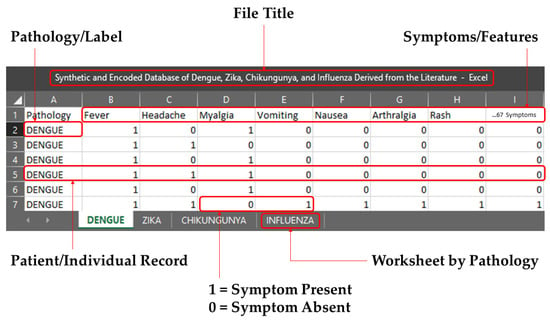
The data included in this database represent patients exhibiting symptomatology indicative of one of the aforementioned diseases. The Excel file is divided into four sheets, each corresponding to one pathology. All sheets contain the same number and type of columns, corresponding to the label (pathology) and the features (symptoms).
The pathologies included—Dengue, Zika, Chikungunya, and Influenza—share signs and symptoms during their early symptomatic phase, the febrile stage. The first three are arboviral diseases, that is, viral infections transmitted through the bite of infected arthropods, primarily Aedes aegypti and Aedes albopictus. In addition to sharing vectors and certain symptoms, these diseases also share geographic distribution and even seasonality, as vector activity increases under specific climatic conditions. Ultimately, laboratory tests are ultimately required to confirm infection; however, diagnosis for all three diseases is initially clinical [3,4,5].
Influenza was included because a previous study hypothesized that adding a negative control to predictive models would allow for a more accurate evaluation of arboviral diseases. Thus, if a patient’s data did not match any arboviral infection, Influenza could serve as the alternative diagnosis. Influenza also shares several symptoms with the three arboviral diseases and is prone to epidemic outbreaks [6], making it a meaningful comparative dataset.
The database consists of 22,379 Dengue records, 7135 Zika records, 7959 Chikungunya records, and 10,741 Influenza records: 48,214 records in total. For Dengue, data were collected from patients diagnosed with Dengue without warning signs and Dengue with warning signs, but do not include severe Dengue cases. For Influenza, records include Influenza A, B, and seasonal Influenza.
2.1. Dataset
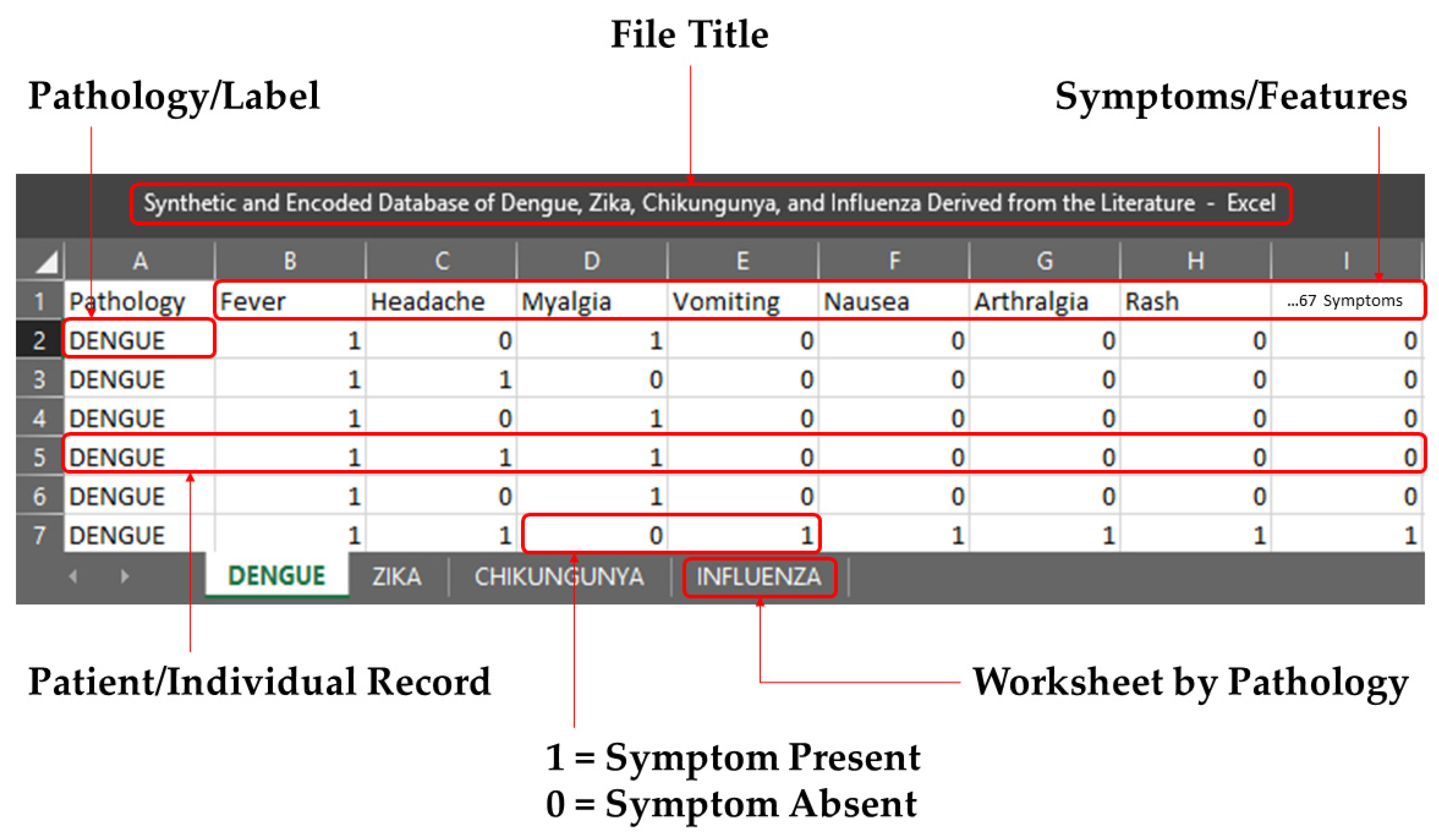
All values are binary. Each row represents an individual record, beginning with the label followed by values of 1 if the clinical sign was present and 0 if absent. No missing values or NaNs (not a number) are present. This structure allows for direct statistical analysis and integration into ML models without the need for imputation. Figure 1 shows a screenshot of the Excel file.
Figure 1.
Screenshot of the database file.
Individually, Dengue presented 37 symptoms, Zika 33, Chikungunya 31, and Influenza 35; collectively, they totaled 67 symptoms, 12 of which were shared among all four diseases. While laboratory data is not included, clinically relevant outcomes such as thrombocytopenia, leukopenia, and elevated hematocrit were incorporated as binary indicators. Table 1 summarizes the number of records and symptoms per disease.
Table 1.
Records and symptoms.
2.2. Symptom Co-Occurrence and Disease Similarity Analysis
The symptoms are grouped into those shared among the pathologies and those observed only in each pathology. Table 2 presents all observed signs and symptoms, grouped into those shared between pathologies and those specific to each pathology.
Table 2.
Symptoms observed in the synthetic database.
Since the analyzed database is composed of binary variables that indicate the presence or absence of clinical characteristics, the Jaccard similarity index (Equation (1)) was used to quantify the degree of overlap between the diseases studied. This index is particularly suitable for asymmetric binary data, as it only considers positive matches, i.e., the shared presence of a feature in the subsets, and ignores simultaneous absences, which lack clinical relevance and can introduce biases in the estimation of similarity.
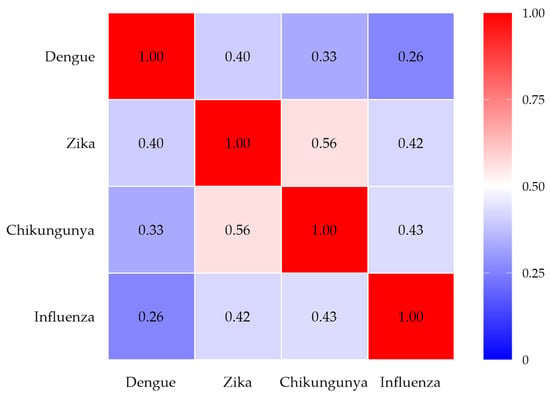
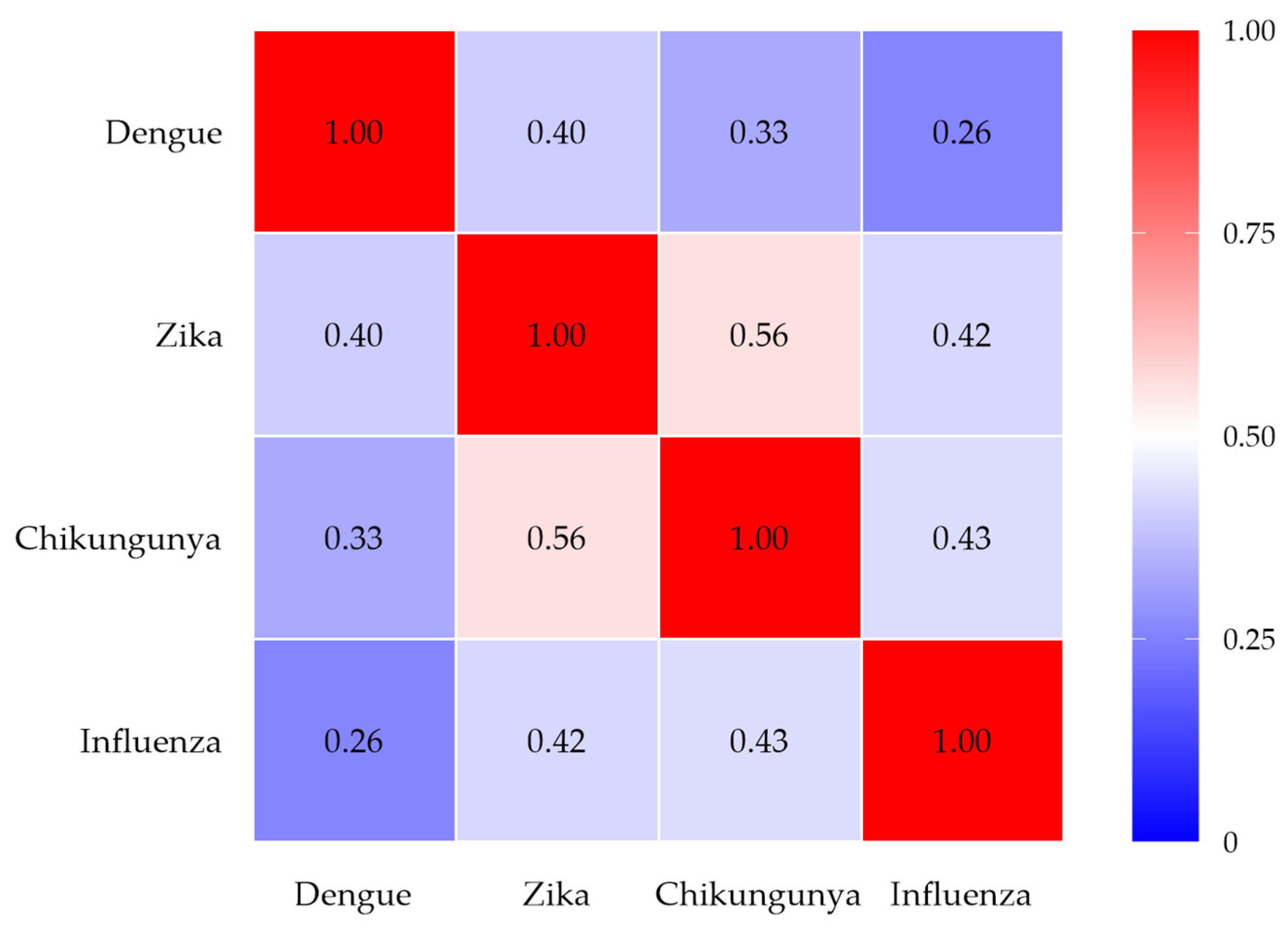
When working with binary variables, the Jaccard Index can be expressed in terms of a contingency table (Figure 2), where M11 denotes the number of features present in both pathologies, M10 the number of features present only in the first disease, and M01 the number of features present only in the second. Simultaneous absence matches (M00) are not considered in the calculation, as they do not provide relevant clinical information.
Figure 2.
Jaccard Index among this group of pathologies. This value shows how similar the data are between each subset; 1 means they are the same and 0 means they are completely different.
The Jaccard Index shows values between 0 and 1, where values close to 1 indicate a high degree of similarity, reflecting that most of the features present in at least one of them are shared. On the other hand, values close to 0 indicate low similarity, implying that the pathologies share few clinical characteristics and present clearly distinguishable profiles. In clinical terms, high values suggest significant symptomatic overlap and, therefore, a greater likelihood of diagnostic confusion, especially in the early stages of the disease.
Consequently, the use of the Jaccard Index allows not only robust quantification of the similarity between infectious diseases with partially overlapping manifestations, such as Dengue, Zika, Chikungunya, and Influenza, but also direct interpretation of the results in a clinical and epidemiological context. The combination of the similarity matrix and its graphical representation provides an intuitive tool for identifying overlapping patterns, supporting comparative analysis between diseases, and methodologically justifying subsequent analyses, such as unsupervised clustering or multiclass classification models.
2.3. Prevalence Analysis
The prevalence of symptoms described in Appendix A is calculated using Equation (2)
where is the prevalence of the symptom for disease , represents the state of the symptom for an individual patient of the specific symptom , and is the total number of patients analyzed for that specific disease.
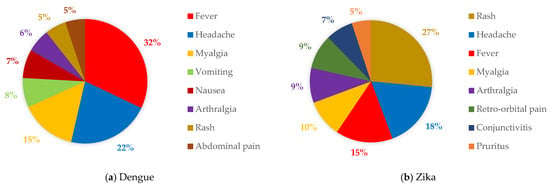
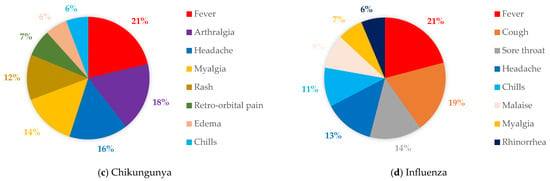
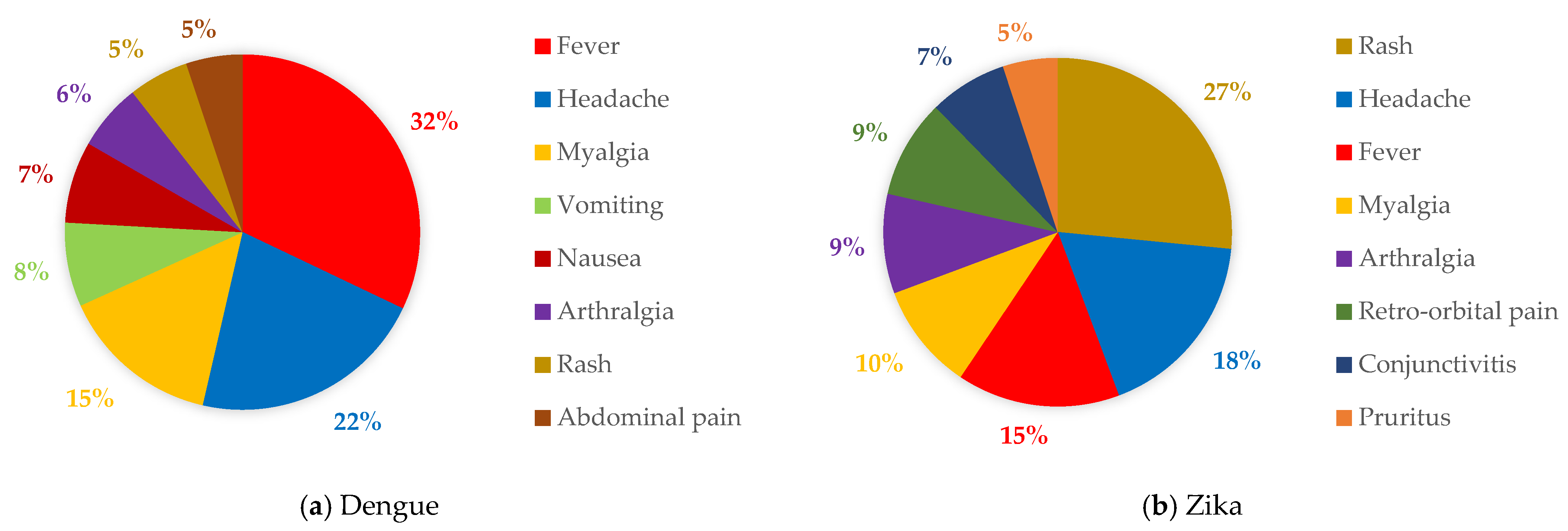
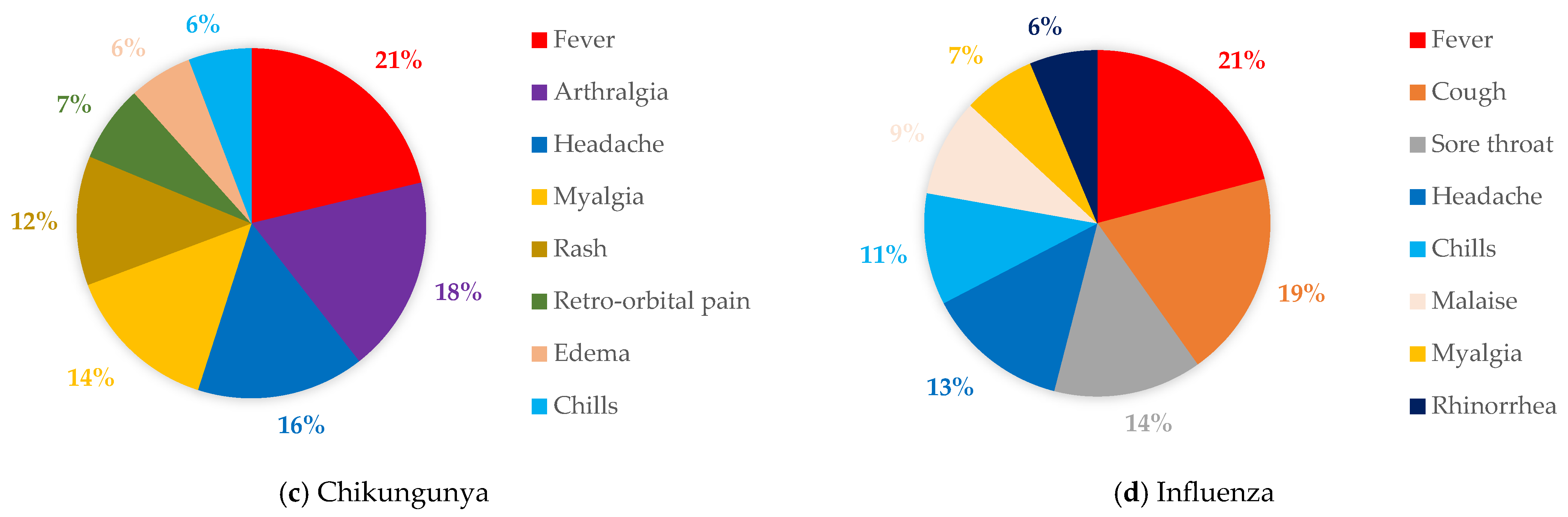
Highlighting the eight most frequent symptoms per disease, these symptoms had a prevalence greater than 0.15, meaning that 15 out of every 100 patients presented with each symptom (see Figure 3).
Figure 3.
Most prevalent symptoms for each pathology. The eight most prevalent symptoms per disease are highlighted.
3. Methods
In general, the database was compiled from existing literature; that is, the PubMed and Google Scholar search engines were used to identify papers containing clinical data on the pathologies of interest. Selection criteria were applied to the studies from this search to extract their clinical data, which were then transformed into a binary database. Figure 4 illustrates the methodological process.
Figure 4.
Methodological process of the database.
3.1. Data Collection
An exhaustive search was conducted in the PubMed and Google Scholar databases between February 2024 and May 2025. The extended duration was due to the manual nature of the search and selection process; furthermore, the database was built in blocks, one disease at a time. For this search, the following keywords were used: for Dengue: “DENGUE”, “PREVALENCE”, and “CLINICAL SYMPTOMS”; for Zika: “ZIKA”, “PREVALENCE”, and “CLINICAL SYMPTOMS”; for Chikungunya: “CHIKUNGUNA”, “PREVALENCE”, and “CLINICAL SYMPTOMS”; and for Influenza: “INFLUENZA”, “PREVALENCE”, and “CLINICAL SYMPTOMS”.
3.2. Screening
The studies retrieved from the search had to meet the following selection criteria:
- Report at least twenty patients confirmed and diagnosed with the target pathology.
- Report all symptoms and signs observed in the patients.
- Symptoms had to be observed within the first five days of illness onset.
- At least four different symptoms had to be described.
- The patients must not have presented coinfection or reinfection.
The selected studies were carefully reviewed to minimize redundancy and ensure that each offered unique and relevant information. Additionally, including studies from different countries, hospitals, and years allows for retrospective analysis of trends without interfering with the original clinical contexts.
A total of 125 studies were collected: 52 studies for Dengue [7,8,9,10,11,12,13,14,15,16,17,18,19,20,21,22,23,24,25,26,27,28,29,30,31,32,33,34,35,36,37,38,39,40,41,42,43,44,45,46,47,48,49,50,51,52,53,54,55,56,57,58], 32 for Zika [59,60,61,62,63,64,65,66,67,68,69,70,71,72,73,74,75,76,77,78,79,80,81,82,83,84,85,86,87,88,89,90], 30 for Chikungunya [91,92,93,94,95,96,97,98,99,100,101,102,103,104,105,106,107,108,109,110,111,112,113,114,115,116,117,118,119,120], and 11 for Influenza [121,122,123,124,125,126,127,128,129,130,131]. Studies originated from a wide range of scientific journals, including The American Journal of Tropical Medicine and Hygiene [17,22,55,65,105,116], Journal of Infection and Public Health [23,25,74,96], BMC Infectious Diseases [24,88,114,126], PLOS Neglected Tropical Diseases [27,43,49,50,53,56,62,66,89,91,103,107,115], Science Advances [54], and The Lancet Infectious Diseases [86], among many others. Data in the studies came from several sources, including hospital records, surveillance datasets, and open access, among others.
3.3. Symptoms and Record Extraction
Based on the selection criteria, clinical data were extracted from the selected studies, excluding sensitive information such as age, sex, nationality, socioeconomic status, and the medical center where the patient received care. Regarding the laboratory data reported in the studies, abnormal results were considered clinically indicative of the disease; for example, studies showing a circulating leukocyte count < 4000 cells/mm3 in patients were marked as “Leukopenia present” (“1”). In cases where symptoms were expressed using continuous data, such as the measured temperature, these values were converted to binary if they exceeded known limits. For example, values < 38 °C/100.4 °F were marked as fever present (“1”), and values below that limit were marked as absent (“0”). Transforming Boolean data (yes/no) to binary is simpler: affirmative values were marked as present (yes = 1), and negative values as absent (no = 0). Nominal data, such as those expressing the severity of a sign, were marked as present regardless of the severity level.
The exclusion of sensitive data is intended to generalize the dataset, making it suitable for statistical or AI modeling. The transformation to binary data allows for the standardization of the different types of data collected. This same transformation also allows for the analysis of outliers, labeling errors, and/or duplicate records—errors that can occur during manual data collection. The main objective is to ensure the quality of the synthetic database.
3.4. Encoding
Therefore, the extracted data is represented in a binary matrix, meaning that the encoding includes signs and symptoms represented by ones and zeros, indicating presence or absence. To homogenize the number of clinical features across all records, signs and symptoms belonging to other pathologies were added with a value of “0”, meaning absent. Consequently, each record for each pathology contains 67 features. The matrix is expressed by Equation (2):
where is the total number of patients, is the total number of symptoms evaluated, each row represents a patient, and each column represents a specific symptom. The binary coding is defined by Equation (3):
where the element corresponds to row and column , a value of 1 indicates the confirmed presence of the symptom, and a value of 0 indicates the absence of the symptom. In summary, the Excel sheets present a bidimensional data structure where each column contains data of the same type, each row represents a single observation, and each sheet corresponds to a specific pathology.
4. Similarity of the Synthetic Database to Public Databases
To assess similarity with existing datasets, several published datasets are described. For example, Endy et al. [132] published a dataset including Dengue, Zika, and Chikungunya cases collected in Machala, Ecuador, divided into laboratory-confirmed patients (98 records) and non-laboratory-confirmed patients (534 records). This dataset includes a mix of binary and continuous variables such as symptoms, age, sex, waist and arm circumference, and height, among others. Mahalingam et al. [133] presented a dataset of 303 infants with Dengue, containing continuous data and scaled values (1–7) for variables including sex, age, symptoms, laboratory values, and diagnostic labels (dengue fever or complicated dengue).
Wheeler et al. [134] compiled clinical data for 47 infants in Brazil diagnosed with congenital Zika syndrome, including continuous and binary variables describing measurements, symptoms, and maternal history. For Influenza, Anderson et al. [135] presented 4572 records, of which 1493 were laboratory-confirmed Influenza cases, containing variables such as age, sex, symptoms (in Boolean values), and laboratory confirmation. Finally, Kandemir (2025) [136] published a dataset of 182 Turkish patients with Influenza reporting only binary symptom data (eight symptoms). Table 3 summarizes these datasets.
Table 3.
Comparison with public databases.
Author Contributions
Conceptualization, E.C.-P. and G.V.-E.; methodology, E.C.-P. and C.M.L.-D.; software, E.C.-P., C.M.L.-D., G.V.-E., H.A.C.-F., and I.M.; validation, C.M.L.-D., L.P.-C.M., A.E.P.-R., M.T.H.-H., C.R.-D., A.D.P.-S., E.P.-C.M., I.A.G.-M., L.M.-M., H.M.-R., M.E.A.-V., H.A.C.-F., and M.M.C.; formal analysis, C.M.L.-D.; investigation, C.M.L.-D., E.C.-P., and E.L.P.-C.; writing—original draft preparation, E.C.-P., C.M.L.-D., and E.L.P.-C.; writing—review and editing, C.M.L.-D. and E.L.P.-C.; visualization, H.A.C.-F.; supervision, C.M.L.-D.; project administration, E.L.P.-C. and C.M.L.-D. All authors have read and agreed to the published version of the manuscript.
Funding
This research received no external funding.
Institutional Review Board Statement
Not applicable.
Informed Consent Statement
Not applicable.
Data Availability Statement
The synthetic database is available in the open access repository Zenodo with the following digital object identifier: https://doi.org/10.5281/zenodo.17902345.
Acknowledgments
H.A.C.-F and E.P.-C. are members of the Comité Científico de Salud de los Servicios de Salud de Oaxaca (SSO), México. H.A.C.-F and E.P.-C. are members of the Comité Oaxaqueño de Trombosis, Hemostasia y Endotelio (COTHE) de los SSO, México.
Conflicts of Interest
The authors declare no conflicts of interest.
Abbreviations
The following abbreviations are used in this manuscript:
| ML | Machine Learning |
| AUC | Area Under the Curve |
| NaN | Not a number |
| DEN | Dengue |
| ZIK | Zika |
| CHI | Chikungunya |
| FLU | Influenza |
| SBP | Systolic blood pressure |
| AKI | Acute kidney injury |
Appendix A
Table A1 shows the prevalence of the 67 symptoms in the four pathologies. Prevalence values greater than 0.15 are indicated in bold, and the order of the symptoms is alphabetical.
Table A1.
Prevalence of the sixty-seven symptoms.
References
- Cruz-Parada, E.; Vivar-Estudillo, G.; Pérez-Campos, E.; Lastre-Domínguez, C. Classification of Zika and dengue clinical data using feature encoding and machine learning techniques. Res. Comput. Sci. 2024, 153, 25–34. [Google Scholar]
- Cruz-Parada, E.; Vivar-Estudillo, G.; Mayoral, L.P.C.; Medina, M.A.S.; Pérez-Campos, E.; Lastre-Domínguez, C. Harnessing Machine Learning for Early and Accurate Diagnosis of Mosquito-Borne Diseases: A Case Study on Dengue, Zika, and Chikungunya. In Artificial Intelligence–COMIA 2025; Martínez-Villaseñor, L., Martínez-Seis, B., Pichardo, O., Eds.; Communications in Computer and Information Science; Springer: Cham, Switzerland, 2025; Volume 2554, pp. 244–254. [Google Scholar] [CrossRef] [Scilit]
- Dengue. Who.Int. Available online: https://www.who.int/news-room/fact-sheets/detail/dengue-and-severe-dengue (accessed on 1 December 2025).
- Zika: Data and Analysis. Paho.Org. Available online: https://www.paho.org/en/arbo-portal/zika-data-and-analysis (accessed on 1 December 2025).
- Chikungunya. Who.Int. Available online: https://www.who.int/news-room/fact-sheets/detail/chikungunya (accessed on 1 December 2025).
- Influenza (Seasonal). Who.Int. Available online: https://www.who.int/news-room/fact-sheets/detail/influenza-(seasonal) (accessed on 1 December 2025).
- Ahmed, S.; Arif, F.; Yahya, Y.; Rehman, A.; Abbas, K.; Ashraf, S.; Akram, D.S. Dengue fever outbreak in Karachi 2006—A study of profile and outcome of children under 15 years of age. JPMA J. Pak. Med. Assoc. 2008, 58, 4–8. [Google Scholar]
- Anwar, F.; Ullah, S.; Aziz, A.U.R.; Rehman, A.U.; Khan, J.; Tayyab, M.; Haq, I.; Mahmood, M.T. Epidemiological and hematological investigation of dengue virus infection. Microbiol. Immunol. 2022, 66, 426–432. [Google Scholar] [CrossRef] [Scilit] [PubMed]
- Asaga Mac, P.; Tadele, M.; Airiohuodion, P.E.; Nisansala, T.; Zubair, S.; Aigohbahi, J.; Anyaike, C.; Velayudha, R.; Kroeger, A.; Panning, M. Dengue and zika seropositivity, burden, endemicity, and cocirculation antibodies in Nigeria. Ann. Med. 2023, 55, 652–662. [Google Scholar] [CrossRef] [Scilit]
- Ayyub, M.; Khazindar, A.M.; Lubbad, E.H.; Barlas, S.; Alfi, A.Y.; Al-Ukayli, S. Characteristics of dengue fever in a large public hospital, Jeddah, Saudi Arabia. J. Ayub Med. Coll. Abbottabad 2006, 18, 9–13. [Google Scholar]
- Balasubramani, S.; Govindaraj, V.; Agarwal, R.; Pathania, A.; Vij, A. COVID-19 antibodies as predictor of severe dengue among hospitalized children with dengue illness in the post-third-wave period of COVID-19 infection in India. J. Assoc. Physicians India 2022, 70, 11–12. [Google Scholar] [CrossRef] [Scilit]
- Berberian, G.; Pérez, G.; Mangano, A.; Borgnia, D.; Buchovsky, A.; Costa, M.; Fabbri, C.; Luppo, V.; Mistchenko, A.S.; Deschutter, V.; et al. Dengue beyond the tropics: A time-series study comprising 2015–2016 versus 2019–2020 at a children’s hospital in the City of Buenos Aires. Arch. Argent. Pediatr. 2022, 120, 384–390. [Google Scholar] [CrossRef] [Scilit] [PubMed]
- Cárdenas-Perea, M.E.; Flores-Mendoza, L.K.; Pérez-Contreras, I.; Díaz-Orea, M.A.; Gómez-Conde, E.; Cortés-Hernández, P.; Reyes-Leyva, J.; Santos-López, G.; Sosa-Jurado, F. Primary dengue infection in patients requiring hospitalization during an outbreak in a low incidence Mexican region. Vector Borne Zoonotic Dis. 2020, 20, 380–386. [Google Scholar] [CrossRef] [Scilit] [PubMed]
- Centers for Disease Control and Prevention (CDC). Underdiagnosis of dengue—Laredo, Texas, 1999. MMWR Morb. Mortal. Wkly. Rep. 2001, 50, 57–59. [Google Scholar]
- Chen, C.-H.; Huang, Y.-C.; Kuo, K.-C.; Li, C.-C. Clinical features and dynamic ordinary laboratory tests differentiating dengue fever from other febrile illnesses in children. J. Microbiol. Immunol. Infect. 2017, 51, 614–620. [Google Scholar] [CrossRef] [Scilit]
- Chen, D.; Zhang, Y.; Wu, X.; Wu, J.; Gong, F.; Qiao, L.; Li, L.; Wang, C. A survey of clinical and laboratory characteristics of dengue fever epidemic from 2014 to 2018 in Guangzhou, China. Ann. Palliat. Med. 2020, 9, 70–81. [Google Scholar] [CrossRef] [Scilit]
- Dash, N.; Aby, R.; Kumar, M.; Abraham, A.M.; Rose, W. Infant dengue: A 10-year experience from a tertiary center in South India. Am. J. Trop. Med. Hyg. 2021, 105, 435–439. [Google Scholar] [CrossRef] [Scilit]
- Delgado-De la Mora, J.; Licona-Enríquez, J.D.; Álvarez-López, D.I.; Aguilar-León, D.E.; Álvarez-Hernández, G. Características clínicas de los pacientes con fiebre manchada de las Montañas Rocosas, infección por dengue y chikungunya. Gac. Méd. Méx. 2021, 157, 61–66. [Google Scholar] [CrossRef] [Scilit]
- Deparis, X.; Murgue, B.; Roche, C.; Cassar, O.; Chungue, E. Changing clinical and biological manifestations of dengue during the dengue-2 epidemic in French Polynesia in 1996/97—Description and analysis in a prospective study. Trop. Med. Int. Health 1998, 3, 859–865. [Google Scholar] [CrossRef] [Scilit]
- Fiora, M.B.; Gonzalvez, M.L.; Aguirre, J.P.; Bacigalupo, A.; Garnero, A.; Rosa, A.M.; Obrador, M.D.; Grecco, C. Observational study of clinical, epidemiological, and laboratory characteristics of pediatric patients with dengue in the city of Córdoba. Arch. Argent. Pediatr. 2024, 122, e202202972. [Google Scholar] [CrossRef] [Scilit]
- Gutiérrez-Aguirre, C.H.; Palomares-Leal, A.; Soto-Flores, L.; Colunga-Pedraza, P.; Jaime-Pérez, J.C.; Zambrano-Velarde, M.; Vega-Cortes, D.; Flores-Jiménez, J.A.; Gómez-Almaguer, D. Dengue during pregnancy: Less incidence of thrombocytopenia than in general population. Rev. Salud Pública 2019, 21, 549–554. [Google Scholar] [CrossRef] [Scilit] [PubMed]
- Haq, F.U.; Imran, M.; Aslam, Z.; Mukhtar, F.; Jabeen, K.; Chaudhry, M.; Rahman, S.U.; Muhammad, N. Severity of dengue viral infection based on clinical and hematological parameters among Pakistani patients. Am. J. Trop. Med. Hyg. 2023, 109, 1284–1289. [Google Scholar] [CrossRef] [Scilit] [PubMed]
- Haroon, M.; Jan, H.; Faisal, S.; Ali, N.; Kamran, M.; Ullah, F. Dengue outbreak in Peshawar: Clinical features and laboratory markers of dengue virus infection. J. Infect. Public Health 2019, 12, 258–262. [Google Scholar] [CrossRef] [Scilit] [PubMed]
- Hasan, M.J.; Tabassum, T.; Sharif, M.; Khan, M.A.S.; Bipasha, A.R.; Basher, A.; Islam, M.R.; Amin, M.R. Comparison of clinical manifestation of dengue fever in Bangladesh: An observation over a decade. BMC Infect. Dis. 2021, 21, 1113. [Google Scholar] [CrossRef] [Scilit]
- Hernández, L.M.; Durán, D.F.; Buitrago, D.A.; Garnica, C.A.; Gómez, L.F.; Bados, D.M.; Bernal, M.P.; Páez, L.M. Epidemiology and geo-referencing of dengue fever in a second-level hospital in Colombia, 2010–2014. J. Infect. Public Health 2017, 11, 558–565. [Google Scholar] [CrossRef] [Scilit]
- Jones, A.M.; Saretsky, T.L.; Panter, C.; Wells, J.R.; White, F.; Smith, V.; Kendal, H.; Russell, K.; Ruggieri, M.; Calhoun, S.R.; et al. Measuring dengue illness intensity: Development and content validity of the dengue virus daily diary (DENV-DD). J. Patient-Rep. Outcomes 2023, 7, 84. [Google Scholar] [CrossRef] [Scilit]
- Joubert, A.; Andry, F.; Bertolotti, A.; Accot, F.; Koumar, Y.; Legrand, F.; Poubeau, P.; Manaquin, R.; Gérardin, P.; Levin, C. Distinguishing non-severe cases of dengue from COVID-19 in the context of co-epidemics: A cohort study in a SARS-CoV-2 testing center on Reunion Island. PLoS Neglected Trop. Dis. 2021, 15, e0008879. [Google Scholar] [CrossRef] [Scilit]
- Karoli, R.; Fatima, J.; Siddiqi, Z.; Kazmi, K.I.; Sultania, A.R. Clinical profile of dengue infection at a teaching hospital in North India. J. Infect. Dev. Ctries. 2012, 6, 551–554. [Google Scholar] [CrossRef] [Scilit]
- Khan, M.A.S.; Al Mosabbir, A.; Raheem, E.; Ahmed, A.; Rouf, R.R.; Hasan, M.; Alam, F.B.; Hannan, N.; Yesmin, S.; Amin, R.; et al. Clinical spectrum and predictors of severity of dengue among children in the 2019 outbreak: A multicenter hospital-based study in Bangladesh. BMC Pediatr. 2021, 21, 478. [Google Scholar] [CrossRef] [Scilit]
- Khan, N.A.; Azhar, E.I.; El-Fiky, S.; Madani, H.H.; Abuljadial, M.A.; Ashshi, A.M.; Turkistani, A.M.; Hamouh, E.A. Clinical profile and outcome of hospitalized patients during the first outbreak of dengue in Makkah, Saudi Arabia. Acta Trop. 2008, 105, 39–44. [Google Scholar] [CrossRef] [Scilit] [PubMed]
- Kittitrakul, C.; Silachamroon, U.; Phumratanaprapin, W.; Krudsood, S.; Wilairatana, P.; Treeprasertsuk, S. Liver function test abnormalities and clinical severity of dengue infection in adult patients. J. Med. Assoc. Thail. 2015, 98, S1–S8. [Google Scholar]
- Lamsal, D.K.; Chaurasiya, P.S.; Khatri, A.; Karki, S.; Singh, S.; Shilpakar, G.; Sangroula, R.K. Dengue among suspected patients admitted to the Department of Medicine of a tertiary care centre: A descriptive cross-sectional study. J. Nepal Med. Assoc. 2023, 61, 132–136. [Google Scholar] [CrossRef] [Scilit] [PubMed]
- L’Azou, M.; Succo, T.; Kamagaté, M.; Ouattara, A.; Gilbernair, E.; Adjogoua, E.; Luxemburger, C. Dengue: Etiology of acute febrile illness in Abidjan, Côte d’Ivoire, in 2011–2012. Trans. R. Soc. Trop. Med. Hyg. 2015, 109, 717–722. [Google Scholar] [CrossRef] [Scilit] [PubMed]
- Malavige, G.N.; Ranatunga, P.K.; Velathanthiri, V.G.N.S.; Fernando, S.; Karunatilaka, D.H.; Aaskov, J.; Seneviratne, S.L. Patterns of disease in Sri Lankan dengue patients. Arch. Dis. Child. 2006, 91, 396–400. [Google Scholar] [CrossRef] [Scilit]
- Martínez-Vega, R.A.; Díaz-Quijano, F.A.; Villar-Centeno, L.A. Low concordance between early clinical suspicion of dengue and its serological confirmation. Rev. Méd. Chile 2006, 134, 1153–1160. [Google Scholar] [CrossRef] [Scilit]
- Masyeni, S.; Yohan, B.; Somia, I.K.A.; Myint, K.S.A.; Sasmono, R.T. Dengue infection in international travellers visiting Bali, Indonesia. J. Travel Med. 2018, 25, tay061. [Google Scholar] [CrossRef] [Scilit]
- Matta, L.; Barbosa, M.M.; Morales-Plaza, C.D. Clinical profile of dengue in patients consulting a tertiary hospital in the city of Cali, Colombia, 2013. Biomedica 2016, 36, 133–139. [Google Scholar] [CrossRef] [Scilit] [PubMed]
- Nandwani, S.; Bhakhri, B.K.; Singh, N.; Rai, R.; Singh, D.K. Early hematological parameters as predictors for outcomes in children with dengue in northern India: A retrospective analysis. Rev. Soc. Bras. Med. Trop. 2021, 54, e05192020. [Google Scholar] [CrossRef] [Scilit] [PubMed]
- Navarrete-Espinosa, J.; Gómez-Dantés, H.; Celis-Quintal, J.G.; Vázquez-Martínez, J.L. Clinical profile of dengue hemorrhagic fever cases in Mexico. Salud Publica Mex. 2005, 47, 193–200. [Google Scholar] [CrossRef] [Scilit] [PubMed]
- Padmaprakash, K.V.; Jha, V.K.; Bhushan, S.; Deepkamal; Sowmya, K.C. Demographic and clinical profile of dengue fever in a tertiary care hospital of south India. J. Assoc. Physicians India 2020, 68, 24–27. [Google Scholar]
- Pires Neto, R.J.; de Sá, S.L.B.; Pinho, S.C.; Pucci, F.H.; Teófilo, C.R.; Evangelista, P.D.; Thé, C.S.; Bezerra, D.E.G.; Lima, J.C.S.; Ponte, H.J.; et al. Dengue infection in children and adolescents: Clinical profile in a reference hospital in northeast Brazil. Rev. Soc. Bras. Med. Trop. 2013, 46, 765–768. [Google Scholar] [CrossRef] [Scilit]
- Rabbani, M.U.; Aslam, M.; Zaheer, M.S.; Ashraf, M.U. Clinical and laboratory profile of dengue fever in a North Indian tertiary hospital. J. Assoc. Physicians India 2018, 66, 37–39. [Google Scholar]
- Rafi, A.; Mousumi, A.N.; Ahmed, R.; Chowdhury, R.H.; Wadood, A.; Hossain, G. Dengue epidemic in a non-endemic zone of Bangladesh: Clinical and laboratory profiles of patients. PLoS Neglected Trop. Dis. 2020, 14, e0008567. [Google Scholar] [CrossRef] [Scilit]
- Ramírez-Zepeda, M.G.; Velasco-Mondragón, H.E.; Ramos, C.; Peñuelas, J.E.; Maradiaga-Ceceña, M.A.; Murillo-Llanes, J.; Rivas-Llamas, R.; Chaín-Castro, R. Clinical and epidemiologic characteristics of dengue cases: The experience of a general hospital in Culiacan, Sinaloa, Mexico. Rev. Panam. Salud Publica 2009, 25, 16–23. [Google Scholar] [CrossRef] [Scilit]
- Rauf, A.; Shah Kazmi, N.H.; Zaman, H.; Gillani, S.; Shah, T.; Malik, F.; Ismaeel, S. Pattern of presentation among adults hospitalized with dengue disease. J. Ayub Med. Coll. Abbottabad 2017, 29, 432–435. [Google Scholar]
- Raza, F.A.; Rehman, S.; Khalid, R.; Ahmad, J.; Ashraf, S.; Iqbal, M.; Hasnain, S. Demographic and clinico-epidemiological features of dengue fever in Faisalabad, Pakistan. PLoS ONE 2014, 9, e89868. [Google Scholar] [CrossRef] [Scilit]
- Sahana, K.S.; Sujatha, R. Clinical profile of dengue among children according to revised WHO classification: Analysis of a 2012 outbreak from Southern India. Indian J. Pediatr. 2015, 82, 109–113. [Google Scholar] [CrossRef] [Scilit]
- Sánchez Doncell, J.; Sotelo, C.A.; Menéndez, S.E.; Braga, I.; Giamperetti, S.; Francos, J.L. Analysis of indigenous dengue in an infectious diseases Hospital in Buenos Aires, Argentina. Medicina 2024, 84, 81–86. [Google Scholar]
- Schirmer, P.L.; Lucero-Obusan, C.A.; Benoit, S.R.; Santiago, L.M.; Stanek, D.; Dey, A.; Martinez, M.; Oda, G.; Holodniy, M. Dengue surveillance in Veterans Affairs healthcare facilities, 2007–2010. PLoS Neglected Trop. Dis. 2013, 7, e2040. [Google Scholar] [CrossRef] [Scilit] [PubMed]
- Sirivichayakul, C.; Limkittikul, K.; Chanthavanich, P.; Jiwariyavej, V.; Chokejindachai, W.; Pengsaa, K.; Suvannadabba, S.; Dulyachai, W.; Letson, G.W.; Sabchareon, A. Dengue infection in children in Ratchaburi, Thailand: A cohort study. II. Clinical manifestations. PLoS Neglected Trop. Dis. 2012, 6, e1520. [Google Scholar] [CrossRef] [Scilit] [PubMed]
- Teixeira, L.A.S.; Lopes, J.S.M.; Martins, A.G.C.; Campos, F.A.B.; Miranzi, S.S.C.; Nascentes, G.A.N. Persistência dos sintomas de dengue em uma população de Uberaba, Minas Gerais, Brasil. Cad. Saude Publica 2010, 26, 624–630. [Google Scholar] [CrossRef] [Scilit] [PubMed]
- Temprasertrudee, S.; Thanachartwet, V.; Desakorn, V.; Keatkla, J.; Chantratita, W.; Kiertiburanakul, S. A multicenter study of clinical presentations and predictive factors for severe manifestation of dengue in adults. Jpn. J. Infect. Dis. 2018, 71, 239–243. [Google Scholar] [CrossRef] [Scilit]
- Utama, I.M.S.; Lukman, N.; Sukmawati, D.D.; Alisjahbana, B.; Alam, A.; Murniati, D.; Utama, I.M.G.D.L.; Puspitasari, D.; Kosasih, H.; Laksono, I.; et al. Dengue viral infection in Indonesia: Epidemiology, diagnostic challenges, and mutations from an observational cohort study. PLoS Neglected Trop. Dis. 2019, 13, e0007785. [Google Scholar] [CrossRef] [Scilit]
- Williams, R.J.; Brintz, B.J.; Ribeiro Dos Santos, G.; Huang, A.T.; Buddhari, D.; Kaewhiran, S.; Iamsirithaworn, S.; Rothman, A.L.; Thomas, S.; Farmer, A.; et al. Integration of population-level data sources into an individual-level clinical prediction model for dengue virus test positivity. Sci. Adv. 2024, 10, eadj9786. [Google Scholar] [CrossRef] [Scilit]
- Wong, J.M.; Volkman, H.R.; Adams, L.E.; Oliveras García, C.; Martinez-Quiñones, A.; Perez-Padilla, J.; Bertrán-Pasarell, J.; Sainz de la Peña, D.; Tosado-Acevedo, R.; Santiago, G.A.; et al. Clinical features of COVID-19, dengue, and influenza among adults presenting to emergency departments and urgent care clinics—Puerto Rico, 2012–2021. Am. J. Trop. Med. Hyg. 2023, 108, 107–114. [Google Scholar] [CrossRef] [Scilit]
- Yang, J.; Mosabbir, A.A.; Raheem, E.; Hu, W.; Hossain, M.S. Demographic characteristics, clinical symptoms, biochemical markers and probability of occurrence of severe dengue: A multicenter hospital-based study in Bangladesh. PLoS Neglected Trop. Dis. 2023, 17, e0011161. [Google Scholar] [CrossRef] [Scilit]
- Yesmin, S.; Ahammad, A.M.; Sarmin, S.; Rafi, M.A.; Islam, S.; Hasan, M.J. Clinical profile of pediatric cases of dengue during the 2019 epidemic in Bangladesh: A multicenter cross-sectional study. Mymensingh Med. J. 2023, 32, 502–509. [Google Scholar]
- Ying, R.-S.; Tang, X.-P.; Zhang, F.-C.; Cai, W.-P.; Chen, Y.-Q.; Wang, J.; Hong, W.-X.; Long, Y.-Z. Clinical characteristics of the patients with dengue fever seen from 2002 to 2006 in Guangzhou. Zhonghua Shi Yan He Lin Chuang Bing Du Xue Za Zhi 2007, 21, 123–125. [Google Scholar]
- Adhikari, E.H.; Nelson, D.B.; Johnson, K.A.; Jacobs, S.; Rogers, V.L.; Roberts, S.W.; Sexton, T.; McIntire, D.D.; Casey, B.M. Infant outcomes among women with Zika virus infection during pregnancy: Results of a large prenatal Zika screening program. Am. J. Obstet. Gynecol. 2017, 216, 292.e1–292.e8. [Google Scholar] [CrossRef] [Scilit]
- Armstrong, P.; Hennessey, M.; Adams, M.; Cherry, C.; Chiu, S.; Harrist, A.; Kwit, N.; Lewis, L.; McGuire, D.O.; Oduyebo, T.; et al. Travel-associated Zika virus disease cases among U.S. residents—United States, January 2015–February 2016. MMWR Morb. Mortal. Wkly. Rep. 2016, 65, 286–289. [Google Scholar] [CrossRef] [Scilit]
- Bandeira, A.C.; Gois, L.L.; Campos, G.S.; Sardi, S.; Yssel, H.; Vieillard, V.; Autran, B.; Grassi, M.F.R. Clinical and laboratory findings of acute Zika virus infection in patients from Salvador during the first Brazilian epidemic. Braz. J. Infect. Dis. 2020, 24, 405–411. [Google Scholar] [CrossRef] [Scilit]
- Belaunzarán-Zamudio, P.F.; Mateja, A.; Guerra-de-Blas, P.C.; Rincón-León, H.A.; Navarro-Fuentes, K.; Ruiz-Hernández, E.; Caballero-Sosa, S.; Camas-Durán, F.; Priego-Smith, Z.; Nájera-Cancino, J.G.; et al. Comparison of clinical characteristics of Zika and dengue symptomatic infections and other acute illnesses of unidentified origin in Mexico. PLoS Neglected Trop. Dis. 2021, 15, e0009133. [Google Scholar] [CrossRef] [Scilit]
- Bhatnagar, J.; Rabeneck, D.B.; Martines, R.B.; Reagan-Steiner, S.; Ermias, Y.; Estetter, L.B.C.; Suzuki, T.; Ritter, J.; Keating, M.K.; Hale, G.; et al. Zika virus RNA replication and persistence in brain and placental tissue. Emerg. Infect. Dis. 2017, 23, 405–414. [Google Scholar] [CrossRef] [Scilit] [PubMed]
- Boggild, A.K.; Geduld, J.; Libman, M.; Yansouni, C.P.; McCarthy, A.E.; Hajek, J.; Ghesquiere, W.; Mirzanejad, Y.; Vincelette, J.; Kuhn, S.; et al. Surveillance report of Zika virus among Canadian travellers returning from the Americas. Can. Med. Assoc. J. 2017, 189, E334–E340. [Google Scholar] [CrossRef] [Scilit] [PubMed]
- Bowman, N.M.; Bucardo, F.; Collins, M.H.; Reyes, Y.; Centeno Cuadra, E.; Blette, B.; Lakshmanane, P.; Guerra, E.P.; Rubinstein, R.; Liou, G.-J.A.; et al. Clinical and epidemiological features of acute Zika virus infections in León, Nicaragua. Am. J. Trop. Med. Hyg. 2021, 105, 924–930. [Google Scholar] [CrossRef] [Scilit] [PubMed]
- Brasil, P.; Calvet, G.A.; Siqueira, A.M.; Wakimoto, M.; de Sequeira, P.C.; Nobre, A.; Quintana, M.S.B.; De Mendonça, M.C.L.; Lupi, O.; De Souza, R.V.; et al. Zika virus outbreak in Rio de Janeiro, Brazil: Clinical characterization, epidemiological and virological aspects. PLoS Neglected Trop. Dis. 2016, 10, e0004636. [Google Scholar] [CrossRef] [Scilit] [PubMed]
- Brasil, P.; Pereira, J.P., Jr.; Moreira, M.E.; Ribeiro Nogueira, R.M.; Damasceno, L.; Wakimoto, M.; Rabello, R.S.; Valderramos, S.G.; Halai, U.-A.; Salles, T.S.; et al. Zika virus infection in pregnant women in Rio de Janeiro. N. Engl. J. Med. 2016, 375, 2321–2334. [Google Scholar] [CrossRef] [Scilit]
- Cano, M.; Esquivel, R. Infección por virus Zika en el Hospital del Niño “Dr José Renán Esquivel” (Panamá): Revisión de casos desde su introducción en Latinoamérica. Pediátr. Panamá 2018, 47, 15–19. [Google Scholar]
- Cerbino-Neto, J.; Mesquita, E.C.; Souza, T.M.L.; Parreira, V.; Wittlin, B.B.; Durovni, B.; Lemos, M.C.F.; Vizzoni, A.; de Filippis, A.M.B.; Sampaio, S.A.; et al. Clinical manifestations of Zika virus infection, Rio de Janeiro, Brazil, 2015. Emerg. Infect. Dis. 2016, 22, 1318–1320. [Google Scholar] [CrossRef] [Scilit]
- Dirlikov, E.; Major, C.G.; Medina, N.A.; Lugo-Robles, R.; Matos, D.; Muñoz-Jordan, J.L.; Colon-Sanchez, C.; Garcia, M.; Olivero-Segarra, M.; Malave, G.; et al. Clinical features of Guillain-Barré syndrome with vs without Zika virus infection, Puerto Rico, 2016. JAMA Neurol. 2018, 75, 1089–1097. [Google Scholar] [CrossRef] [Scilit] [PubMed]
- Duffy, M.R.; Chen, T.-H.; Hancock, W.T.; Powers, A.M.; Kool, J.L.; Lanciotti, R.S.; Pretrick, M.; Marfel, M.; Holzbauer, S.; Dubray, C.; et al. Zika Virus Outbreak on Yap Island, Federated States of Micronesia. N. Engl. J. Med. 2009, 360, 2536–2543. [Google Scholar] [CrossRef] [Scilit] [PubMed]
- Goorhuis, A.; von Eije, K.J.; Douma, R.A.; Rijnberg, N.; van Vugt, M.; Stijnis, C.; Grobusch, M.P. Zika virus and the risk of imported infection in returned travelers: Implications for clinical care. Travel Med. Infect. Dis. 2016, 14, 13–15. [Google Scholar] [CrossRef] [Scilit]
- Griffin, I.; Zhang, G.; Fernandez, D.; Cordero, C.; Logue, T.; White, S.L.; Llau, A.; Thomas, L.; Moore, E.; Noya-Chaveco, P.; et al. Epidemiology of pediatric Zika virus infections. Pediatrics 2017, 140, e20172044. [Google Scholar] [CrossRef] [Scilit]
- Guanche Garcell, H.; Gutiérrez García, F.; Ramirez Nodal, M.; Ruiz Lozano, A.; Pérez Díaz, C.R.; González Valdés, A.; Gonzalez Alvarez, L. Clinical relevance of Zika symptoms in the context of a Zika–Dengue epidemic. J. Infect. Public Health 2020, 13, 173–176. [Google Scholar] [CrossRef] [Scilit]
- Heang, V.; Yasuda, C.Y.; Sovann, L.; Haddow, A.D.; Travassos da Rosa, A.P.; Tesh, R.B.; Kasper, M.R. Zika virus infection, Cambodia, 2010. Emerg. Infect. Dis. 2012, 18, 349–351. [Google Scholar] [CrossRef] [Scilit]
- Jimenez Corona, M.E.; De la Garza Barroso, A.L.; Rodriguez Martínez, J.C.; Luna Guzmán, N.I.; Ruiz Matus, C.; Díaz Quiñonez, J.A.; Lopez Martinez, I.; Kuri Morales, P.A. Clinical and epidemiological characterization of laboratory-confirmed autochthonous cases of Zika virus disease in Mexico. PLoS Curr. 2016, 8. [Google Scholar] [CrossRef] [Scilit]
- Kam, Y.-W.; Leite, J.A.; Lum, F.-M.; Tan, J.J.L.; Lee, B.; Judice, C.C.; Teixeira, D.A.T.; Andreata-Santos, R.; A Vinolo, M.; Angerami, R.; et al. Specific biomarkers associated with neurological complications and congenital central nervous system abnormalities from Zika virus-infected patients in Brazil. J. Infect. Dis. 2017, 216, 172–181. [Google Scholar] [CrossRef] [Scilit] [PubMed]
- Li, J.; Chong, C.Y.; Tan, N.W.; Yung, C.F.; Tee, N.W.; Thoon, K.C. Characteristics of Zika virus disease in children: Clinical, hematological, and virological findings from an outbreak in Singapore. Clin. Infect. Dis. 2017, 64, 1445–1448. [Google Scholar] [CrossRef] [Scilit] [PubMed]
- Lindsey, N.P.; Porse, C.C.; Potts, E.; Hyun, J.; Sandhu, K.; Schiffman, E.; Cervantes, K.B.; White, J.L.; Mason, K.; Owens, K.; et al. Postnatally acquired Zika virus disease among children, United States, 2016–2017. Clin. Infect. Dis. 2020, 70, 227–231. [Google Scholar] [CrossRef] [Scilit]
- Nóbrega, M.E.B.; Araújo, E.L.L.; Wada, M.Y.; Leite, P.L.E.; Dimech, G.S.; Pércio, J. Outbreak of Guillain–Barré syndrome possibly related to prior Zika virus infection, Metropolitan Region of Recife, Pernambuco, Brazil, 2015. Epidemiol. Serv. Saúde 2018, 27, e2017039. [Google Scholar] [CrossRef] [Scilit]
- Ramos, W.; Luna, M.; Alarcón, T.; Jiménez, G.; Díaz, J.; Calderón, M.; Gutierrez, E.L. Cutaneous manifestations of Zika in Peru. J. Cutan. Med. Surg. 2020, 24, 33–40. [Google Scholar] [CrossRef] [Scilit]
- Read, J.S.; Torres-Velasquez, B.; Lorenzi, O.; Rivera Sanchez, A.; Torres-Torres, S.; Rivera, L.V.; Capre-Franceschi, S.M.; Garcia-Gubern, C.; Munoz-Jordan, J.; Santiago, G.A.; et al. Symptomatic Zika virus infection in infants, children, and adolescents living in Puerto Rico. JAMA Pediatr. 2018, 172, 686–693. [Google Scholar] [CrossRef] [Scilit]
- Romer, Y.; Valadez-Gonzalez, N.; Contreras-Capetillo, S.; Manrique-Saide, P.; Vazquez-Prokopec, G.; Pavia-Ruz, N. Zika virus infection in pregnant women, Yucatan, Mexico. Emerg. Infect. Dis. 2019, 25, 1452–1460. [Google Scholar] [CrossRef] [Scilit] [PubMed]
- Sanchez Clemente, N.; Brickley, E.B.; Furquim de Almeida, M.; Witkin, S.S.; Duarte Passos, S.; the Jundiai Zika Cohort Group. Can Zika virus infection in high-risk pregnant women be differentiated on the basis of symptoms? Viruses 2020, 12, 1263. [Google Scholar] [CrossRef] [Scilit]
- Silva, M.M.O.; Tauro, L.B.; Kikuti, M.; Anjos, R.O.; Santos, V.C.; Gonçalves, T.S.F.; Paploski, I.A.D.; Moreira, P.S.S.; Nascimento, L.C.J.; Campos, G.S.; et al. Concomitant transmission of dengue, Chikungunya, and Zika viruses in Brazil: Clinical and epidemiological findings from surveillance for acute febrile illness. Clin. Infect. Dis. 2019, 69, 1353–1359. [Google Scholar] [CrossRef] [Scilit]
- Singapore Zika Study Group. Outbreak of Zika virus infection in Singapore: An epidemiological, entomological, virological, and clinical analysis. Lancet Infect. Dis. 2017, 17, 813–821. [Google Scholar] [CrossRef] [Scilit]
- Tozetto-Mendoza, T.R.; Avelino-Silva, V.I.; Fonseca, S.; Claro, I.M.; Paula, A.V.; de Levin, A.S.; Mayaud, P. Zika virus infection among symptomatic patients from two healthcare centers in Sao Paulo State, Brazil: Prevalence, clinical characteristics, viral detection in body fluids and serodynamics. Rev. Inst. Med. Trop. São Paulo 2019, 61, e19. [Google Scholar] [CrossRef] [Scilit]
- Woon, Y.L.; Lim, M.F.; Tg Abd Rashid, T.R.; Thayan, R.; Chidambaram, S.K.; Syed Abdul Rahim, S.S.; Sivasampu, S. Zika virus infection in Malaysia: An epidemiological, clinical and virological analysis. BMC Infect. Dis. 2019, 19, 152. [Google Scholar] [CrossRef] [Scilit]
- Ximenes, R.A.deA.; Miranda-Filho, D.deB.; Montarroyos, U.R.; Martelli, C.M.T.; Araújo, T.V.B.; Brickley, E.; Albuquerque, M.d.F.P.M.d.; Souza, W.V.; Ventura, L.O.; Ventura, C.V.; et al. Zika-related adverse outcomes in a cohort of pregnant women with rash in Pernambuco, Brazil. PLoS Neglected Trop. Dis. 2021, 15, e0009216. [Google Scholar] [CrossRef] [Scilit]
- Yoon, D.; Shin, S.H.; Jang, H.C.; Kim, E.S.; Song, E.H.; Moon, S.M.; Shin, S.Y.; Choe, P.G.; Sung, J.-J.; Choi, E.H.; et al. Epidemiology and clinical characteristics of Zika virus infections imported into Korea from March to October 2016. J. Korean Med. Sci. 2017, 32, 1440–1444. [Google Scholar] [CrossRef] [Scilit] [PubMed]
- Aguilar-Luis, M.A.; Watson, H.; Tarazona-Castro, Y.; Troyes-Rivera, L.; Cabellos-Altamirano, F.; Silva-Caso, W.; Aquino-Ortega, R.; Carrillo-Ng, H.; Zavaleta-Gavidia, V.; Del Valle-Mendoza, J. The Chikungunya virus: A reemerging cause of acute febrile illness in the high jungle of northern Peru. PLoS Neglected Trop. Dis. 2023, 17, e0011787. [Google Scholar] [CrossRef] [Scilit] [PubMed]
- Borgherini, G.; Poubeau, P.; Staikowsky, F.; Lory, M.; Le Moullec, N.; Becquart, J.P.; Wengling, C.; Michault, A.; Paganin, F. Outbreak of chikungunya on Reunion Island: Early clinical and laboratory features in 157 adult patients. Clin. Infect. Dis. 2007, 44, 1401–1407. [Google Scholar] [CrossRef] [Scilit]
- Brito Ferreira, M.L.; Militão de Albuquerque, M.d.F.P.; de Brito, C.A.A.; de Oliveira França, R.F.; Porto Moreira, Á.J.; de Morais Machado, M.Í.; Melo, R.d.P.; Medialdea-Carrera, R.; Mesquita, S.D.; Santos, M.L.; et al. Neurological disease in adults with Zika and chikungunya virus infection in Northeast Brazil: A prospective observational study. Lancet Neurol. 2020, 19, 826–839. [Google Scholar] [CrossRef] [Scilit]
- Bucardo, F.; Reyes, Y.; Morales, M.; Briceño, R.; González, F.; Lundkvist, Å.; Svensson, L.; Nordgren, J. Genetic polymorphisms in DC-SIGN, TLR3 and TNFα genes and the Lewis-negative phenotype are associated with Chikungunya infection and disease in Nicaragua. J. Infect. Dis. 2020, 223, 278–286. [Google Scholar] [CrossRef] [Scilit] [PubMed]
- Chatterjee, R.P.; Chatterjee, A.; Ansari, S.; Chatterjee, S.; Chatterjee, S.; Chakraborty, N. Molecular identification and phylogenetic analysis of chikungunya virus among dengue-negative patients in Kolkata, India. PLoS ONE 2024, 19, e0301644. [Google Scholar] [CrossRef] [Scilit]
- de La Roque, D.G.L.; Santos, E.V.; Policastro, L.R.; da Costa, P.N.M.; Evaristo, M.; Yamamoto, A.Y.; Giomo, D.B.; Torres, P.M.A.; Gentil, D.C.D.; Minto, E.C.M.; et al. Exploring the Chikungunya virus landscape in a dengue-endemic Brazilian area. J. Infect. Public Health 2024, 17, 102442. [Google Scholar] [CrossRef] [Scilit]
- de Morais Alves Barbosa Oliveira, R.; Kalline de Almeida Barreto, F.; Praça Pinto, G.; Timbó Queiroz, I.; Montenegro de Carvalho Araújo, F.; Wanderley Lopes, K.; Vale, R.L.S.D.; Lemos, D.R.Q.; Cavalcante, J.W.; Siqueira, A.M.; et al. Chikungunya death risk factors in Brazil, in 2017: A case-control study. PLoS ONE 2022, 17, e0260939. [Google Scholar] [CrossRef] [Scilit]
- Deepak, D.; Juneja, D.; Singh, O.; Gupta, A.; Garg, S.; Arora, V. Clinical profile, intensive care unit course, and outcome of patients admitted in intensive care unit with chikungunya. Indian J. Crit. Care Med. 2018, 22, 5–9. [Google Scholar] [CrossRef] [Scilit] [PubMed]
- Edwards, T.; Signor, L.D.C.C.; Williams, C.; Donis, E.; Cuevas, L.E.; Adams, E.R. Co-infections with Chikungunya and dengue viruses, Guatemala, 2015. Emerg. Infect. Dis. 2016, 22, 2003–2005. [Google Scholar] [CrossRef] [Scilit] [PubMed]
- Galán-Huerta, K.A.; Martínez-Landeros, E.; Delgado-Gallegos, J.L.; Caballero-Sosa, S.; Malo-García, I.R.; Fernández-Salas, I.; Ramos-Jiménez, J.; Rivas-Estilla, A.M. Molecular and clinical characterization of Chikungunya virus infections in southeast Mexico. Viruses 2018, 10, 248. [Google Scholar] [CrossRef] [Scilit]
- Gomes, P.D.; Carvalho, R.F.S.M.; Massini, M.M.; Garzon, R.H.; Schiavo, P.L.; Fernandes, R.C.d.e.S.C.; Louvain de Souza, T. High prevalence of arthralgia among infants with Chikungunya disease during the 2019 outbreak in northern Rio de Janeiro. Front. Pediatr. 2022, 10, 944818. [Google Scholar] [CrossRef] [Scilit] [PubMed]
- Gregianini, T.S.; Ranieri, T.; Favreto, C.; Nunes, Z.M.A.; Tumioto Giannini, G.L.; Sanberg, N.D.; da Rosa, M.T.M.; da Veiga, A.B.G. Emerging arboviruses in Rio Grande do Sul, Brazil: Chikungunya and Zika outbreaks, 2014–2016. Rev. Med. Virol. 2017, 27, e1943. [Google Scholar] [CrossRef] [Scilit]
- Hossain, M.S.; Hasan, M.M.; Islam, M.S.; Islam, S.; Mozaffor, M.; Khan, M.A.S.; Ahmed, N.; Akhtar, W.; Chowdhury, S.; Arafat, S.M.Y.; et al. Chikungunya outbreak (2017) in Bangladesh: Clinical profile, economic impact and quality of life during the acute phase. PLoS Neglected Trop. Dis. 2017, 12, e0006561. [Google Scholar] [CrossRef] [Scilit]
- Huits, R.; De Kort, J.; Van Den Berg, R.; Chong, L.; Tsoumanis, A.; Eggermont, K.; Bartholomeeusen, K.; Ariën, K.K.; Jacobs, J.; Van Esbroeck, M.; et al. Chikungunya virus infection in Aruba: Diagnosis, clinical features and predictors of post-chikungunya chronic polyarthralgia. PLoS ONE 2018, 13, e0196630. [Google Scholar] [CrossRef] [Scilit]
- Imad, H.A.; Phadungsombat, J.; Nakayama, E.E.; Suzuki, K.; Ibrahim, A.M.; Afaa, A.; Azeema, A.; Nazfa, A.; Yazfa, A.; Ahmed, A.; et al. Clinical features of acute Chikungunya virus infection in children and adults during an outbreak in the Maldives. Am. J. Trop. Med. Hyg. 2021, 105, 946–954. [Google Scholar] [CrossRef] [Scilit]
- Khan, N.; Bhat, R.; Jain, V.; Raghavendhar B, S.; Patel, A.K.; Nayak, K.; Chandele, A.; Murali-Krishna, K.; Ray, P. Epidemiology and molecular characterization of chikungunya virus from human cases in North India, 2016. Microbiol. Immunol. 2021, 65, 290–301. [Google Scholar] [CrossRef] [Scilit]
- Lázari, C.D.S.; Ramundo, M.S.; Ten-Caten, F.; Bressan, C.S.; de Filippis, A.M.B.; Manuli, E.R.; de Moraes, I.; Pereira, G.M.; Côrtes, M.F.; Candido, D.S.; et al. Clinical markers of post-Chikungunya chronic inflammatory joint disease: A Brazilian cohort. PLoS Neglected Trop. Dis. 2023, 17, e0011037. [Google Scholar] [CrossRef] [Scilit]
- Madewell, Z.J.; Hernandez-Romieu, A.C.; Wong, J.M.; Zambrano, L.D.; Volkman, H.R.; Perez-Padilla, J.; Rodriguez, D.M.; Lorenzi, O.; Espinet, C.; Munoz-Jordan, J.; et al. Sentinel Enhanced Dengue Surveillance System—Puerto Rico, 2012–2022. MMWR Surveill. Summ. 2024, 73, 1–29. [Google Scholar] [CrossRef] [Scilit]
- Mattar, S.; Miranda, J.; Pinzon, H.; Tique, V.; Bolanos, A.; Aponte, J.; Arrieta, G.; Gonzalez, M.; Barrios, K.; Contreras, H.; et al. Outbreak of Chikungunya virus in the north Caribbean area of Colombia: Clinical presentation and phylogenetic analysis. J. Infect. Dev. Ctries. 2015, 9, 1126–1132. [Google Scholar] [CrossRef] [Scilit] [PubMed]
- Mesquita, L.L.; Macedo, Ê.S.; Filho, S.L.A.P.; Beserra, F.L.C.N.; Girão, E.S.; Ferragut, J.M.; Neto, R.J.P.; Júnior, G.B.S.; Daher, E.D.F. Clinical outcomes of hospitalized patients with chikungunya fever: A retrospective analysis. Asian Pac. J. Trop. Med. 2021, 14, 183–186. [Google Scholar] [CrossRef] [Scilit]
- Monteiro, J.D.; Valverde, J.G.; Morais, I.C.; Souza, C.R.M.; Fagundes Neto, J.C.; Melo, M.F.; Nascimento, Y.M.; Alves, B.E.B.; Medeiros, L.G.; Pereira, H.W.B.; et al. Epidemiologic and clinical investigations during a chikungunya outbreak in Rio Grande do Norte State, Brazil. PLoS ONE 2020, 15, e0241799. [Google Scholar] [CrossRef] [Scilit]
- Murillo-Zamora, E.; Mendoza-Cano, O.; Trujillo-Hernández, B.; Trujillo, X.; Huerta, M.; Guzmán-Esquivel, J.; Higareda-Almaraz, M.A.; Lugo-Radillo, A.; Moreno-Gutiérrez, I.; Higareda-Almaraz, E.; et al. Screening for depressive mood during acute Chikungunya infection in primary healthcare settings. Int. J. Environ. Res. Public Health 2018, 15, 2552. [Google Scholar] [CrossRef] [Scilit]
- Navarrete-Espinosa, J.; Gonzalez-Ibarra, J.; Cruz-Tinoco, C.E.S.; Gonzalez-Bonilla, C.R.; Pacheco-Hernández, M.; Muñoz-Medina, J.E. Clinical behavior of dengue and Chikungunya infections in the Instituto Mexicano del Seguro Social. Open J. Med. Microbiol. 2016, 6, 23–31. [Google Scholar] [CrossRef]
- Rachmat, A.; Kelly, G.C.; Hontz, R.D.; Supaprom, C.; Heang, V.; Hip, P.; Garcia-Rivera, J.A.; Prom, S.; Chhea, C.; Sutherland, I.W.; et al. Clinical and epidemiologic evaluation of a 2020 chikungunya outbreak in Cambodia. BMC Infect. Dis. 2022, 22, 949. [Google Scholar] [CrossRef] [Scilit] [PubMed]
- Sahadeo, N.; Mohammed, H.; Allicock, O.M.; Auguste, A.J.; Widen, S.G.; Badal, K.; Pulchan, K.; Foster, J.E.; Weaver, S.C.; Carrington, C.V.F. Molecular characterisation of Chikungunya virus infections in Trinidad and comparison with dengue and other acute febrile cases. PLoS Neglected Trop. Dis. 2015, 9, e0004199. [Google Scholar] [CrossRef] [Scilit]
- Srikirin, P.; Siripoon, T.; Charoenpong, L.; Soonthornworasiri, N.; Matsee, W.; Kittitrakul, C.; Tangkijvanich, P.; Charunwatthana, P.; Poovorawan, K. Prevalence, risk factors, and prognosis of liver involvement in adult patients with Chikungunya in Thailand. Am. J. Trop. Med. Hyg. 2022, 107, 1107–1113. [Google Scholar] [CrossRef] [Scilit]
- Subhadra, S.; Sabat, J.; Dwibedi, B.; Panda, S.; Mandal, M.C.; Rath, S.; Ho, L.M.; Palo, S.K.; Pati, S.; Turuk, J. Prevalence and trend of emerging and re-emerging arboviral infections in the state of Odisha. VirusDisease 2021, 32, 504–510. [Google Scholar] [CrossRef] [Scilit]
- Tarazona-Castro, Y.; Troyes-Rivera, L.; Martins-Luna, J.; Cabellos-Altamirano, F.; Aguilar-Luis, M.A.; Carrillo-Ng, H.; Del Valle, L.J.; Kym, S.; Miranda-Maravi, S.; Silva-Caso, W.; et al. Detection of SARS-CoV-2 antibodies in febrile patients from a dengue/chikungunya endemic region of Peru. PLoS ONE 2022, 17, e0265820. [Google Scholar] [CrossRef] [Scilit]
- Tauro, L.B.; Cardoso, C.W.; Souza, R.L.; Nascimento, L.C.; Santos, D.R.D.; Campos, G.S.; Sardi, S.; Reis, O.B.; Reis, M.G.; Kitron, U.; et al. A localized outbreak of Chikungunya virus in Salvador, Bahia, Brazil. Mem. Inst. Oswaldo Cruz 2019, 114, e180597. [Google Scholar] [CrossRef] [Scilit]
- Wimalasiri-Yapa, B.M.C.R.; Stassen, L.; Huang, X.; Hafner, L.M.; Hu, W.; Devine, G.J.; Yakob, L.; Jansen, C.C.; Faddy, H.M.; Viennet, E.; et al. Chikungunya virus in Asia-Pacific: A systematic review. Emerg. Microbes Infect. 2019, 8, 70–79. [Google Scholar] [CrossRef] [Scilit]
- Anderson, K.B.; Simasathien, S.; Watanaveeradej, V.; Weg, A.L.; Ellison, D.W.; Suwanpakdee, D.; Klungthong, C.; Phonpakobsin, T.; Kerdpanich, P.; Phiboonbanakit, D.; et al. Clinical and laboratory predictors of influenza infection in Thai individuals with influenza-like illness over five years. PLoS ONE 2018, 13, e0193050. [Google Scholar] [CrossRef] [Scilit]
- Bell, C.; Goss, M.; Birstler, J.; Temte, E.; Chen, G.; Shult, P.; Reisdorf, E.; Haupt, T.; Barlow, S.; Temte, J. Potential factors influencing the sensitivity and specificity of Sofia Influenza A+B FIA in ambulatory care. PLoS ONE 2022, 17, e0268279. [Google Scholar] [CrossRef] [Scilit] [PubMed]
- Blair, P.J.; Wierzba, T.F.; Touch, S.; Vonthanak, S.; Xu, X.; Garten, R.J.; Okomo-Adhiambo, M.A.; Klimov, A.I.; Kasper, M.R.; Putnam, S.D. Influenza epidemiology and viral characterization among febrile patients in Cambodia. Epidemiol. Infect. 2010, 138, 199–209. [Google Scholar] [CrossRef] [Scilit] [PubMed]
- Delavar, M.A.; Ebrahimi, H.K.; Borhani, N.; Karimian, P.; Ehsanipour, F.; Jafarnejad, S.; Esmaeilian, S. Prevalence and features of acute viral myositis in children with influenza. J. Fam. Med. Prim. Care 2022, 11, 2744–2749. [Google Scholar] [CrossRef] [Scilit] [PubMed]
- Foulkes, S.; Munro, K.; Sparkes, D.; Broad, J.; Platt, N.; Howells, A.; Akinbami, O.; Khawam, J.; Joshi, P.; Russell, S.; et al. Adapting COVID-19 research infrastructure to capture influenza and RSV in UK healthcare workers. PLoS ONE 2025, 20, e0316131. [Google Scholar] [CrossRef] [Scilit]
- Hasan, S.; Webby, R.J.; Iqbal, M.; Rashid, H.B.; Ahmad, M.-U.-D.; Nazir, J.; DeBeauchamp, J.; Sadiq, S.; Chaudhry, M. Sentinel surveillance for influenza A in Lahore District, Pakistan (2015–2016). BMC Infect. Dis. 2022, 22, 38. [Google Scholar] [CrossRef] [Scilit] [PubMed]
- Kuo, C.-Y.; Huang, Y.-C.; Huang, C.-G.; Tsao, K.-C.; Lin, T.-Y. Symptomatic predictors of 2009 H1N1 influenza A infection with emphasis on negative rapid tests. PLoS ONE 2011, 6, e28102. [Google Scholar] [CrossRef] [Scilit] [PubMed]
- Lindblade, K.A.; Arvelo, W.; Gray, J.; Estevez, A.; Frenkel, G.; Reyes, L.; Moscoso, F.; Moir, J.C.; Fry, A.M.; Olsen, S.J. Comparison of seasonal influenza A and 2009 H1N1 pandemic influenza in Guatemala. PLoS ONE 2010, 5, e15826. [Google Scholar] [CrossRef] [Scilit] [PubMed]
- Purakayastha, D.R.; Gupta, V.; Broor, S.; Sullender, W.; Fowler, K.; Widdowson, M.-A.; Lal, R.B.; Krishnan, A. Clinical differences between influenza A(H1N1)pdm09 and influenza B in North India. Indian J. Med. Res. 2013, 138, 962–968. [Google Scholar]
- Rachmat, A.; Kelly, G.C.; Tran, L.K.; Christy, N.; Supaprom, C.; Heang, V.; Dul, S.; Garcia-Rivera, J.A.; Prom, S.; Sopheab, H.; et al. Clinical presentation and diagnostics of seasonal influenza in Cambodia, 2007–2020. Open Forum Infect. Dis. 2024, 11, ofae062. [Google Scholar] [CrossRef] [Scilit]
- Timmermans, A.; Melendrez, M.C.; Se, Y.; Chuang, I.; Samon, N.; Uthaimongkol, N.; Klungthong, C.; Manasatienkij, W.; Thaisomboonsuk, B.; Tyner, S.D.; et al. Human sentinel surveillance of influenza and respiratory viruses in western Cambodia. PLoS ONE 2016, 11, e0152529. [Google Scholar] [CrossRef] [Scilit]
- Endy, T.; Stewart-Ibarra, A. SISA/SISAL Dataset. Ann Arbor, MI: Inter-University Consortium for Political and Social Research [Distributor]. 2019. Available online: https://www.openicpsr.org/openicpsr/project/115165/version/V2/view (accessed on 1 December 2025).
- Mahalingam, S.; Bhaskar, M.; Achappa, B.; MM, H. Predictive Scoring for Risk of Complications in Pediatric Dengue Infection [Data Set]. Zenodo. 2022. Available online: https://datadryad.org/dataset/doi:10.5061/dryad.wpzgmsbpp (accessed on 1 December 2025).
- Wheeler, A.; Ventura, C.; Ridenour, T.; Toth, D.; Nobrega, L.L.; Dantas, L.C.S.d.S.; Rocha, C.; Bailey, D.B.; Ventura, L. Skills Attained by Infants with Congenital Zika Syndrome: Pilot Data from Brazil [Data Set]. Zenodo. 2018. Available online: https://zenodo.org/records/1308921 (accessed on 1 December 2025).
- Anderson, K.B.; Simasthien, S.; Watanaveeradej, V.; Weg, A.L.; Ellison, D.W.; Suwanpakdee, D.; Klungthong, C.; Phonpakobsin, T.; Kerdpanich, P.; Phiboonbanakit, D.; et al. Data From: Clinical and Laboratory Predictors of Influenza Infection Among Individuals with Influenza-Like Illness Presenting to an Urban Thai Hospital Over a Five-Year Period [Data Set]. Zenodo. 2019. Available online: https://datadryad.org/dataset/doi:10.5061/dryad.t7n48 (accessed on 1 December 2025).
- Kandemir, M.B. Symptom Dataset of 182 Influenza Patients for Soft Set and Entropy Analysis [Data Set]. Zenodo. 2025. Available online: https://zenodo.org/records/17216028 (accessed on 1 December 2025).



Disclaimer/Publisher’s Note: The statements, opinions and data contained in all publications are solely those of the individual author(s) and contributor(s) and not of MDPI and/or the editor(s). MDPI and/or the editor(s) disclaim responsibility for any injury to people or property resulting from any ideas, methods, instructions or products referred to in the content. |
© 2026 by the authors. Licensee MDPI, Basel, Switzerland. This article is an open access article distributed under the terms and conditions of the Creative Commons Attribution (CC BY) license.