



Data, Volume 10, Issue 11 (November 2025) – 26 articles
Cover Story (view full-size image):
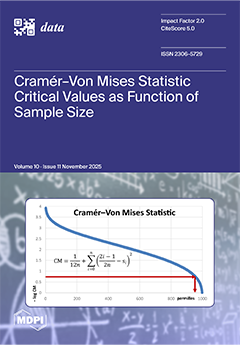
The Cramér–Von Mises statistic determines if certain data follow a theoretical distribution. An accurate probability is obtained from a Monte Carlo simulation. Here, for sample sizes from 2 to 30, 21 replicates of large sizes (5,120,000,000) have been generated, allowing us to obtain accurate permilles of the CM statistic. There is an increase in the variability from smaller to bigger values of the CM statistic obtained from the MC experiment. However, the standard deviation shows that the estimation noise is below 10−4 most of the time. The permille-level precision enables precise critical values and p-values, improving hypothesis testing confidence in quality control, bioinformatics, and financial modeling, to give only some examples. View this paper
- Issues are regarded as officially published after their release is announced to the table of contents alert mailing list.
- You may sign up for e-mail alerts to receive table of contents of newly released issues.
- PDF is the official format for papers published in both, html and pdf forms. To view the papers in pdf format, click on the "PDF Full-text" link, and use the free Adobe Reader to open them.
Previous Issue
Next Issue
