


Abstract
A redefinition of genetically modified organisms (GMOs) is presented by means of bioinformatics and artificial intelligence. Grounded on existing information, an AI framework for GMO definition and detection is proposed with quantifiable information entropy parameters, similarity metrics to feed deep learning AI systems. The proposed AI framework aims to offer a data reform paradigm to upgrade GMO definition for versatile safety assessments of current and emerging artificial organisms. It is envisioned to include recent biotechnological advances such as CRISPR editing, epigenetic modifications, and even mRNA technologies. As global GMO applications continue to expand and molecular genetic technologies evolve rapidly, updated definitions and regulatory policies upgraded in AI environments are urgently required.
1. Current Status on the Definition of GMOs and Related Safety Policies
1.1. Introduction
Human intervention in nucleic acid sequences has led to the development of what are commonly referred to as genetically modified organisms (GMOs). These organisms have been genetically modified to optimize metabolic pathways, synthesize specific target compounds, or express precise molecular quantities across diverse biotechnological applications. On one hand, GMOs are promoted as future solutions in food production, medicine, and health therapies, including human genome modifications. On the other hand, they have been criticized for potentially compromising food quality, environmental stability, and human health, particularly when DNA from distant genetic species is combined. GMOs have been alleged to accelerate unpredictable genetic alterations at rates far exceeding those observed in natural evolution [1].
Historically, GMOs in general were defined and evaluated primarily as the outcome of genetic engineering. More recently, definitions have expanded to encompass the new genetic modification technologies, broadening the scope of what qualifies as a GMO. Modern approaches such as CRISPR, directed evolution PCR, and epigenetics, which cause small-scale genetic changes that closely resemble naturally occurring genomes, complicate further GMO characterization [2,3]. Current trends favor site-specific mutations within the same species, without indicative genetic markers and avoiding interspecies genome combinations. This strategy aims to generate small-scale alterations while reducing ethical concerns associated with hybrid life forms. Beyond ethical debates, a pressing challenge is the difficulty of identifying and evaluating new generations of unapproved mutant species. As genetic modifications increasingly mimic natural evolution, laboratories often struggle to determine whether unexpected genome changes are caused by human actions applying genetic engineering or are residuals of past genetic modifications or natural processes.
1.2. Safety and Legal Issues Promoted by GMO Definition
Attempting to establish safety policies on GMOs and their products, the World Health Organization, by using propositional logic and statements, has described GMOs as “organisms (i.e., animals, plants or microorganisms) in which the genetic material (DNA) has been altered in a way that does not occur naturally by mating and/or natural recombination” [4]. Furthermore, in January 2017, the United States Department of Agriculture (USDA) submitted for public consultation a proposal to change the rules regarding the management, definition and technologies used to produce GMOs. In the USDA proposition, GMOs were defined by technology aspects suggesting that: “By genetic engineering APHIS (Animal and Plant Health Inspection Service) would mean techniques that use recombinant or synthetic nucleic acids with the intend to create or alter a genome” [5]. In the latest approach in 2020, APHIS announced the availability of the Final Rule for its biotechnology regulations (7 CFR part 340). The SECURE rule—which stands for Sustainable, Ecological, Consistent, Uniform, Responsible, Efficient—targets regulations of organisms developed using genetic engineering that may pose a pest risk to plants. The SECURE rule was in effect up to 2024, and then following the December 2024 federal court decision, the SECURE rule was vacated, causing the administrative framework under 7 CFR Part 340 to immediately revert to its pre-2020 regulatory version.
European organizations such as EFSA and the European Commission have adopted similarly strict definitions and policies [6]. A characteristic example of GMO complications is observed in Case C-528/16, where the Court of Justice of the European Union ruled that the distinction between transgenesis and mutagenesis, and the timing of their application, are critical in determining GMO status [7]. This decision raised concerns that plant products derived from mutagenic techniques, long present in markets, may now require compliance with Directive 2001/18 [8]. Such future reclassifications could disrupt food production, particularly in countries lacking historical breeding records. While older modification methods remain contentious in Europe, newer gene editing technologies such as CRISPR further complicate legal frameworks. The EU is currently reforming its rules on gene-edited crops. The European Parliament formally approved Regulation (EU) 2026/1388 on 17 June 2026, which entered into force on 16 July 2026, to modernize agricultural sustainability and biotechnology [9,10]. This legislation fully updates Directive 2001/18 for gene editing advancements, establishing a unified framework with full application across the EU mandatory by 17 July 2028. Proposed genome modification categories include NGT1: Gene-edited crops resembling natural or conventionally bred variants, exempt from GMO legislation but subject to seed labeling, and NGT2: Gene-edited crops requiring full GMO risk assessments and labeling.
In addition, the European Parliament initially proposed a ban on patents for NGT plants and related genetic tools, causing controversies with industry; but a later compromise in 2025 permits patents but requires companies to disclose them in a public database when registering NGT1 plants. To prevent market monopolies, this framework strictly maintains that natural traits and biological sequences remain unpatentable. To monitor these market dynamics, the European Commission is mandated to publish a comprehensive review by mid-2027 assessing the impact of these patents on seed affordability and diversity (Implementation Strategy of Regulation (EU) 2026/1388). It is also important to note that while GMO definitions mainly concern plants or animals used in raw or processed foods in biotech applications, GMOs increasingly could cover microbial strains used in health products such as insulin and thyroid-stimulating hormone, as well as novel mRNA vaccines [11]. The classification boundaries in modern biotechnology frequently blur the distinction between viable Genetically Modified Organisms (GMOs) and genetically modified-derived products. This contrast, modification process-versus-product, has created significant regulatory overlaps within the United States Coordinated Framework, also supporting that traditional verification paradigms are insufficient for multi-tiered biosafety standards and that the continuous expansion of GMO applications stresses the need to advance our definitions and regulatory frameworks accordingly [12]. To illustrate the expanding regulatory dynamics and legal frameworks that the proposed quantitative paradigm challenges, Table 1 maps the evolution of biotechnology legislation within the European Union, while Table 2 outlines the historical milestones and regulatory provisions in the United States.
Table 1.
Evolution of GMO and NGT legislation in the European Union.
Table 2.
Evolution of GMO and genome-edited crop regulation in the United States (1982–2026).
2. GMINT Paradigm—An Open-AI Framework for GMO Definition
2.1. Abstraction
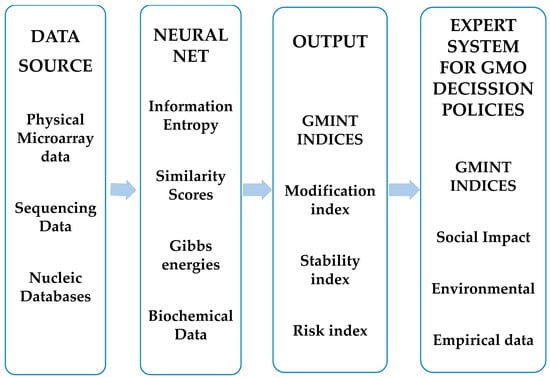
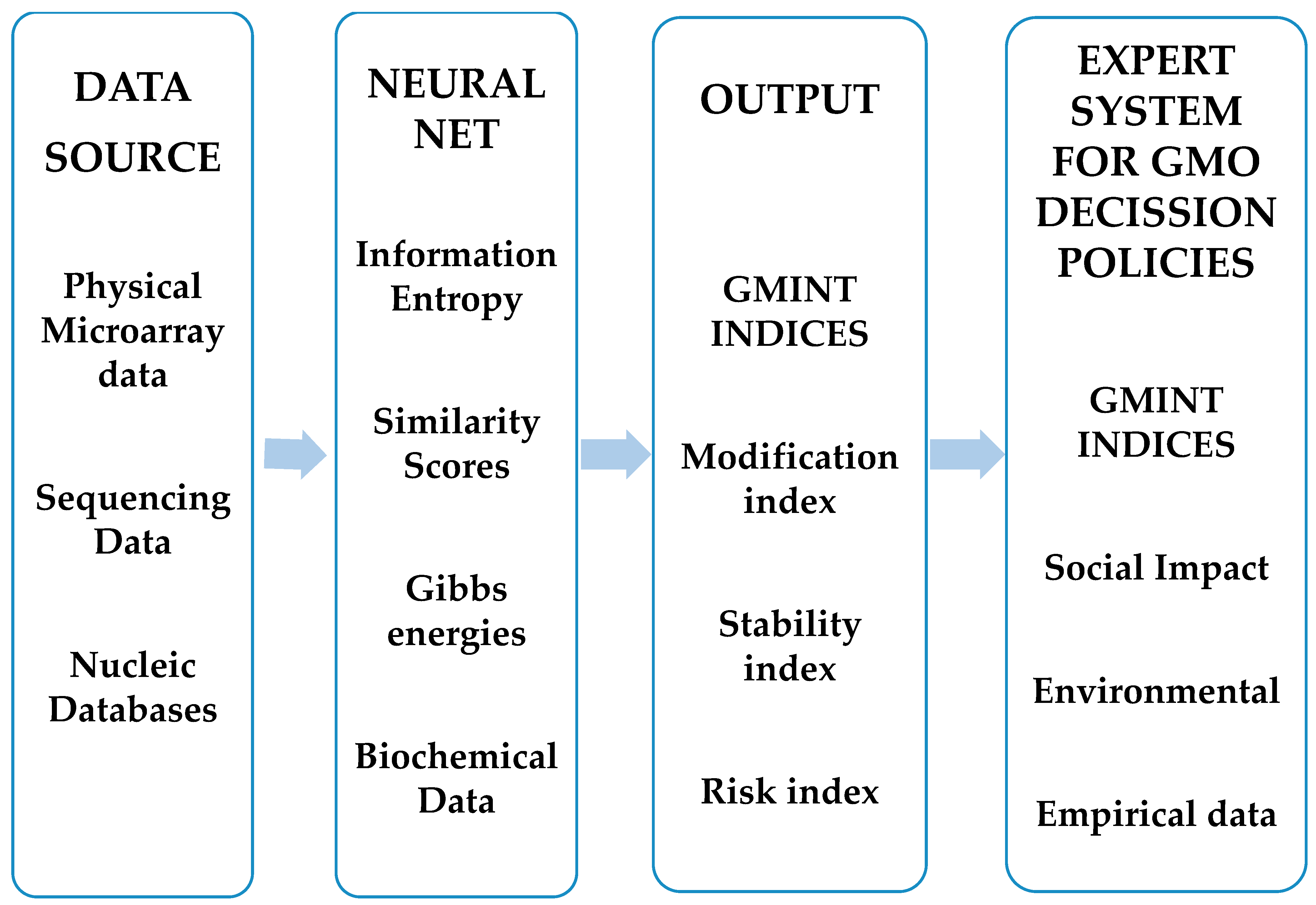
In response to the diverse concerns and numerous definitions surrounding GMOs, a mathematically abstracted paradigm is proposed, termed Genetic Modification Intensity (GMINT). The proposed framework is intended to advance GMO characterization in relation to the safety evaluation of plants, foods, and microbial products (Figure 1). Within GMINT, genetic evolution, whether natural or artificial, is conceptualized as a set of genetic functions, or morphisms, that remap the genome space. Artificially induced genetic evolution, resulting from direct human intervention, is understood as structured operations, forming a subset within this broader “morphism evolution” [13,14]. The GMINT framework allows all genetic modifications to be accounted for as GMOs and expressed through quantifiable parameters of entropic nature. By establishing measurable boundaries and thresholds, GMINT supports systematic categorization of GMOs, complemented by risk assessment evaluations. For the first time, this approach introduces a strict biophysics–mathematics foundation for GMO definition supporting quantifiable characterization and replacing indirect linguistic logic (e.g., “GMOs = outcome of genetic engineering”).
Figure 1.
Graphical representation of GMINT architecture. Quantifiable genetic values of information entropy and energetics feed deep learning systems and are transformed into GMO quantifiable scores of genetic modification levels. Training of the network is based on genetic information from already existing GM organisms, officially provided to competent authorities. Results of the neural net enriched with any supportive information from GMO usage can feed expert systems for further categorical GMO grouping and decision policies.
2.2. GMINT AI Framework Design
The proposed in silico physics–mathematics methodology aims to strengthen existing concepts across the wide spectrum of GMO products. Using set theory formalism, the framework mines data already available in nucleic acid databases of human, animal, plant, and microbial origin (GenBank, EMBL, DDBJ) [15]. At the current stage of analytical capability, an information entropy approach emerges as the most suitable first-line choice. This method aligns with the inherent nature of nucleic molecules as a “digitized code,” providing an alternative environment for defining GMOs and their associated technologies. In the proposed GMINT framework, a basic element is information entropy for digitized systems, drawing on Shannon’s theoretical perspectives and algorithms [16,17,18,19]. It can also capture genomic uncertainties [20], supported by similarity metrics derived from big data analysis and biochemical parameters such as potent amino acid sequences and Gibbs free energies [21]. The resulting data feed an artificial deep learning system integrated within the framework.
The core neural analysis is intended to transform these processed inputs into GMINT indices that quantify modification intensity, risk profiles, and nucleotide instability. These indices establish quantifiable classification for genetically modified entities including NGT organisms, thereby supporting statistically measurable differentiation of natural vs. human-induced genetic modifications. Artificial learning systems are essential for managing the continuously expanding volume of genomic data, supporting efficient analysis and inference [22,23]. The proposed GMINT abstraction is not restricted to the paradigm of a certain entropy algorithm but can incorporate diverse mathematical formulations of entropy [24], as well as future bioinformatics algorithms especially on similarity evaluation. It is proposed to function as an algorithmically evolutionary environment, continuously updated with new mathematical tools that either enhance internal functions or are adopted directly from external sources. The framework is presented as an open-source analytical system, adapting to new genomic technologies, grounded in mathematical formalism and structured through subsets of the referenced algebras, enabling quantitative GMO categorization to support risk assessments and policy decisions. This need will become increasingly evident as we enter an era of intensified genome modifications and GM products, which demand more rigorous evaluations to safeguard human health with AI analytical approaches [25,26].
3. Computational Implementation Outline: Data Preprocessing, and Regulatory Metrology for GMINT Standardization
To transition the theoretical paradigm of Genetic Modification Intensity (GMINT) from an abstract mathematical model into an operational regulatory pipeline, the workflow combines high-resolution physical screening infrastructure with robust deep learning back-ends and standardized quality management protocols. For analytical purposes, in GMINT, a hybrid analytical ecosystem is intended in order to couple advanced high-density genomic profiling microarrays or sequencing with automated computational pipelines to classify known, unknown or unauthorized genetically engineered organisms. While Whole-Genome sequencing (WGS) serves as an alternative for profiling officially declared and pre-registered NGT events, high-density photolithographic microarrays are selected as the primary baseline infrastructure for routine regulatory enforcement. National reference networks and customs facilities must process hundreds of commercial routine samples per day under fixed operational deadlines. For this routine screening workflow, high-density array matrices provide the necessary standardized throughput, lower computational preprocessing overhead, and rapid 24–48 h turnaround times, circumventing the massive bioinformatics alignment and assembly bottlenecks associated with raw genome sequencing data streams. The presented procedures are outlined for the most challenging cases, those of unknown NGT samples such as from CRISPR. Beyond that, the proposed architecture of the GMINT framework is inherently generic and unrestricted, providing robust analytical compatibility applicable to any baseline or complex genomic modification variant. It is intended as a large-scale, interdisciplinary project that will be established by international collaboration. Consequently, this collaborative approach will ensure that the framework becomes fully accessible to many accredited laboratory units worldwide. A specific flavor of the operational workflow is outlined and analyzed to a certain extent in Figure 1. It provides the foundational operational logic necessary to govern multiple ISO standards before complete deployment. This architecture functions as an open, universal core, enabling a vast number of modular variations, custom parameters, and localized algorithmic distributions to be adapted by individual laboratory units depending on their specific operational and metrological needs.
3.1. High-Density Microarray Profiling
The process in the GMINT framework begins with the extraction and screening of genomic material derived from genetically undefined organisms. To capture structural anomalies across the complete genome space without restrictive, prior sequence-specific primers, the framework can utilize high-density oligonucleotide DNA microarray platforms. Current state-of-the-art microarray technologies, such as the photolithographic high-density arrays, can provide the baseline physical infrastructure, capable of thousands of oligonucleotide synthesis features or data probe points per single physical array matrix. This unparalleled density allows for comprehensive, genome-wide comparative hybridization profiling at a resolution capable of detecting discrete nucleotide variations across highly complex genomes [27,28].
To screen for precise biotechnological interventions, such as cluster regularly interspaced short palindromic repeats gene editing (CRISPR), the selection of targeted oligonucleotide probe points on the microarray surface follows a strategic logic. Probe sets are systematically engineered to target known or potential guide RNA (gRNA) complementary binding sites, proto-spacer adjacent motifs (PAMs), and the specific surrounding flanking sequences. Because human-induced edits often introduce minute structural scars, directional nucleotide asymmetries, or localized changes in regional polymorphism frequencies, comparing the hybridization intensity patterns of the unknown sample against a validated reference organism microarray is intended to highlight specific localized hybridization differences. Consequently, in the screening of targeted genomic regions, GMINT is intended to leverage these biological constraints to accurately locate edits that are strictly defined by specific PAM motifs rather than random sequences [29,30].
3.2. Feature Selection and Deep Learning Preprocessing
The continuous signal intensity data generated from these millions of microarray probe points, combined with existing reference sequence repositories like GenBank and EMBL-EBI [15] after systematic multivariable preprocessing, will be fed into deep learning architectures. Explicitly, the raw hybridization fluorescence intensities will undergo background correction and normalization to eliminate structural noise and physical array-to-array variations. Following normalization, the filtered data matrix will be subjected to algorithmic feature transformations to form biophysical inputs for the machine learning layers, such as the following. Shannon Information Entropy: Localized rolling-window computations are executed across the aligned target and reference hybridization vectors to measure shifts in Shannon information entropy matrices, identifying abrupt drops in sequence complexity or artificial code insertions [23]. Gibbs Free Energy Changes: Hybridization intensity deltas are mathematically converted into thermodynamic stability matrices. Shifting Gibbs free energy values (ΔΔG) are computed to evaluate the melting temperatures and stability constants of the hybridized DNA–DNA or DNA–probe duplexes, highlighting structural mismatches or synthetic alterations [21]. Biochemical Oligopeptide Translation Mapping: The raw nucleic sequence matrices are computationally translated and encoded into theoretical oligopeptide chains. This step extracts structural translation properties and tracks how nucleotide-level modifications modify downstream structural biochemistry and amino acid organization. Multi-Parametric Similarity Measures: To quantify the exact evolutionary and structural divergence between the unknown sample and the baseline control, a matrix of non-linear similarity metrics is constructed. This layer evaluates localized sequence alignments concurrently with topological data patterns derived from the high-density microarrays, computing specific distance metrics across the normalized spectrum from the microarray hybridization data. Using these multi-parametric data in the process, it is intended to deduce how much the target organism has structurally drifted from its natural reference standard. These similarity measures provide a foundational profile that exposes localized artificial interventions to be used for the downstream machine learning layer [31].
3.3. Core Computational Process and Output
The preprocessed entropic, thermodynamic, biochemical and similarity vectors are subsequently structured into multi-dimensional tensor arrays to feed specialized neural network architectures. As an example, one-dimensional Convolutional Neural Networks (1D-CNNs) can ingest the sliding-window features to automatically capture localized motif anomalies and CRISPR-induced structural scars [23,32]. Concurrently, Long Short-Term Memory (LSTM) networks can utilize directional feedback loops to process long-range sequential dependencies and cumulative genomic instability across the broader genome topology [22]. Integrating genetic information from physical microarray analysis with existing information from digital databases, neural networks can output highly calibrated, reproducible GMINT indices representing attributes such as the modification intensity of the analyzed samples.
The computational process is executed via a rigorous supervised learning paradigm. The deep neural network topologies are trained on a comprehensive, highly curated calibration dataset comprising fully sequenced and quantified benchmark organisms, characterized engineered genetic constructs, and verified wild-type genetic lines. Since no finalized NGT standard specifications or commercial dossiers currently exist, officially established 0% GMO Certified Reference Materials (CRMs) provided by European standardization authorities can serve as the foundational physical baseline control to train the neural layers and mathematically lock the non-modified wild-type genomic template. By mapping the non-linear inputs directly to known, pre-established baseline intensities, the supervised model learns to output highly accurate, continuous numerical vectors rather than arbitrary classifications. This optimization enables the trained neural network to process unknown sample matrices and generate precise, generalized indices for novel biotechnological variants with predictable statistical confidence [33,34].
The terminal output of the GMINT deep neural architecture can be formally expressed through a reduced multi-dimensional matrix of standardized attributes as quantitative indices that reflect the genetic status and safety of the audited sample. The primary metric, the Modification Intensity Index, can be mathematically formulated as a continuous value bound between 0 and 1, where 0 represents absolute structural equivalence to a wild-type reference organism, and 1 denotes a heavily re-engineered synthetic construct. This intensity profile is concurrently mapped against a secondary Risk Index, which is intended to integrate the computed genomic instability, translation alterations, and target gene proximity following long-range variant prediction models. The Risk Index can serve to show how local cis-acting stability propagates across the genome [32]. By presenting these output parameters as continuous, multi-dimensional metrics, the framework provides a transparent mathematical baseline that can feed later fuzzy decision rules, enabling accredited testing facilities to finalize decisions of acceptance.
3.4. Regulatory Harmonization and Framework Verification ISO/IEC 17025:2017
For a hybrid computational–microarray system like the GMINT framework to be officially adopted by national reference laboratories and inspection authorities, the entire integrated pipeline needs to comply with the metrological validation and quality management requirements of ISO/IEC 17025:2017 [35]. Because GMINT is intended to bridge analytical DNA assays with advanced in silico algorithmic interpretations, laboratories must adapt specific ISO clauses to govern both parts: a clear distinction is maintained between initial method validation and routine operational verification. To satisfy these boundaries, the implementation pipeline directly addresses the following critical sections of the international standard ISO/IEC 17025:2017.
Validation and Verification of Methods (ISO 17025:2017 Section 7.2): Under ISO guidelines, the integration of high-density microarray screening with automated deep learning pipelines represents a non-standard, laboratory-developed method that requires comprehensive validation. Laboratories must define the formal limit of detection (LoD) for minimal base pair edits within the microarray hybridization phase and establish strict threshold values for the deep learning output. Validation protocols require testing the pipeline against blinded, fully characterized reference standards to confirm that variations in neural network parameters (such as batch size, dropout rates, or optimization algorithms) do not compromise the reproducibility of the final GMINT outputs.
Evaluation of Uncertainty (ISO 17025:2017 Section 7.6): The laboratory must calculate physical measurement uncertainty stemming from fluorescence variations, scanner calibration, and sample extraction efficiency, alongside algorithmic uncertainty derived from database annotation variances, stochastic weight initializations, and deep learning convergence tolerances. Laboratories may utilize automated modeling approaches to construct a statistically valid confidence interval around every generated GMINT score.
Control of Data and Information Management (ISO 17025:2017 Section 7.11): The operational reliance on analytical platforms like high-density array datasets and external nucleic acid reference repositories needs data integrity and software security controls. To guarantee compliance with international traceability standards, all neural network weights, preprocessing libraries, and software dependencies can be deployed within isolated software platforms. Running an identical raw microarray data file across separate accredited facilities globally matching GMINT outputs must be generated.
Reporting of Conformity Assessments and Decision Rules (ISO 17025:2017 Section 7.8.6): When an inspection authority issues an official certificate of analysis classifying an unknown sample, for example, as “Approved Product”, “Unauthorized GMO” or “NGT Variant Under Active Surveillance”, it needs to apply defined decision rules that integrate the calculated measurement uncertainty. In the GMINT framework can be included fuzzy logical inference models to smoothly transition sharp neural outputs into explicit, legally defined regulatory action zones for public utilization [36,37]. This boundary management also ensures that threshold cases where an edited crop might be precisely on the border of natural variation will be accepted or rejected with additional empirical information.
3.5. Framework Sensitivities and Implementation Limits
While the GMINT framework provides a robust conceptual roadmap, several possible operational limitations must be addressed. First, the framework depends heavily on the data integrity of universal nucleic repositories. Contingencies within databases can directly degrade verification performance. Second, computational processing may be challenging but can be readily overcome through modern high-performance hardware clusters. The primary technical bottleneck lies in the baseline sensitivity of the deep learning architecture. The system must achieve exceptional discrimination thresholds to separate discrete 1–2 base pair human interventions from naturally occurring mutations. Furthermore, computational simulations alone can be very informative but also highly limited or misleading. To resolve these issues, the framework requires the parallel establishment of physical laboratory systems, such as the proposed high-density microarrays, to generate real-world empirical data. Calibrating this complex network ultimately demands large-scale international collaboration and unified standardization across independent laboratory units.
4. Impact of GMINT on GMO Analytics and Policies
The commercial production of plant GMOs dates back to the 1990s, beginning with innovations such as long-storage tomatoes and the Flavr Savr gene. By 2020, the U.S. Food and Drug Administration reported that GMO soybeans accounted for 94% of all soybeans planted, GMO cotton for 96%, and GMO corn for 92% [38]. The global GMO food market continues to expand, excluding microbial biotechnology applications, which remain largely a black box in relation to microbial genetic engineering. Unlike agricultural crops, Genetically Modified Microorganisms (GMMs) and New Genomic Technique Microorganisms (NGT-Ms) currently lack harmonized global screening standards. Routine laboratory detection is particularly challenging for unknown cases, as enforcement laboratories have no prior knowledge of the targeted genetic modification and often lack suitable Certified Reference Materials (CRMs) for method validation and comparison. This challenge has also been highlighted in recent biotechnology forums and expert discussions, underscoring the urgent need for advanced multi-parametric detection frameworks such as GMINT [12,39].
Despite this growth, debates surrounding GMOs and their enabling technologies persist, with definitions based primarily on descriptive properties serving as the critical foundation for policy decisions. At present, GMOs are often conceptualized through propositional logic distinctions such as “human vs. natural genome intervention”, “classical mating systems vs. genetic engineering”, “in vivo vs. in vitro technologies” or “transgenic vs. mutant”. These perspectives are reflected in the presented definitions adopted by organizations such as the USDA, EFSA, WHO, and the European Commission, which attempt to balance risk and utility through linguistic propositions [10,40].
The proposed approach of a GMINT framework offers a transformative alternative by shifting GMO definitions from qualitative linguistic constructs to quantifiable attributes. This is very significant, as this transition enables more rigorous analytics, supports evidence-driven risk assessments, and provides a stronger foundation for policy development in the context of rapidly evolving biotechnologies. Within the proposed GMINT framework, GMO definitions, analytics, and policy decisions are grounded in biophysics–mathematics analysis and quantitative outputs from deep learning neural networks. This enables the establishment of upper and lower thresholds and the classification of GMOs into groups with defined quantitative attributes. The outcomes of GMINT neural networks, combined with information on the social and economic impacts of GMOs and empirical data from their use, can further feed decision-support systems such as fuzzy inference models for decisions on final public use [36,37].
Fuzzy integration is particularly valuable when finalized decisions and policies are required, for example, whether GMOs should be accepted, rejected, or placed under surveillance by public bodies that may lack extensive scientific expertise. GMINT is intended to support both national and global policy frameworks through a common analytical platform. Institutional bodies, working in synergy, can adopt GMINT with standardized ISO procedures as already stated, avoiding conflicts arising from divergent analytical methods and promoting up-to-date algorithms, ensuring consistency in GMO evaluation. Moreover, quantified parameters can be more easily communicated during public consultations or for individual decision-making, reducing bias and misinformation stemming from limited expertise to interpret scientific results.
5. Conclusions
The number of available tools for entropy and genomic similarity studies is already extensive, while bioinformatics is a well-established discipline in the biosciences. With this existing arsenal of genome analytic tools and appropriate collaboration, implementation of the proposed approach of the GMINT framework can readily begin, enabling evaluation of both established and newly introduced GMOs of plant, animal, and microbial origin (e.g., food products, enzymes, vaccines) produced with classical or NGT methods, as well as non-registered genetically modified products. The necessity of AI frameworks like GMINT will become increasingly evident as nano-technology advances, particularly with the anticipated development of modifications at atomic-level structures and novel synthetic nucleic acids. These future innovations, positioned at the interface of human–machine interactions, are expected to set new standards in genomic evolution, underscoring the importance of rigorous, quantifiable approaches to GMO definition and risk assessment with advanced AI data mining analytics.
Author Contributions
Conceptualization, D.N.A.; methodology, D.N.A. and C.P.; software, D.N.A.; formal analysis, D.N.A. and C.P. investigation, D.N.A. and C.P.; resources, D.N.A.; writing—original draft preparation, D.N.A.; writing—review and editing, C.P.; visualization, D.N.A. All authors have read and agreed to the published version of the manuscript.
Funding
This research received no external funding.
Institutional Review Board Statement
Not applicable.
Informed Consent Statement
Not applicable.
Data Availability Statement
The original contributions presented in this study are included in the article. Further inquiries can be directed to the corresponding author. All data supporting the findings of this study are available within the manuscript.
Conflicts of Interest
The authors declare no conflicts of interest.
References
- Zhang, C.; Wohlhueter, R.; Zhang, H. Genetically modified foods: A critical review of their promise and problems. Food Sci. Hum. Wellness 2016, 5, 116–123. [Google Scholar] [CrossRef] [Scilit]
- Thurtle-Schmidt, D.M.; Lo, T.W. Molecular biology at the cutting edge: A review on CRISPR/CAS9 gene editing for undergraduates. Biochem. Mol. Biol. Educ. 2018, 46, 195–205. [Google Scholar] [CrossRef] [Scilit] [PubMed]
- Faltus, T. The applicability of the European GMO legislation to epigenetically modified organisms. Front. Bioeng. Biotechnol. 2023, 11, 1124131. [Google Scholar] [CrossRef] [Scilit] [PubMed]
- Food, Genetically Modified. Available online: https://www.who.int/news-room/questions-and-answers/item/food-genetically-modified (accessed on 21 July 2026).
- Federal Register. Importation, Interstate Movement, and Environmental Release of Certain Genetically Engineered Organisms; Federal Register: Washington, DC, USA, 2017; Volume 82, p. 7015. Available online: www.aphis.usda.gov (accessed on 21 July 2026).
- EFSA. GMO. 2023. Available online: https://www.efsa.europa.eu/en/topics/genetically-modified-organisms (accessed on 21 July 2026).
- Curia. Case C-528/16. 2018. Available online: https://infocuria.curia.europa.eu/tabs/affair?lang=EN&sort=AFF_NUM-DESC&searchTerm=%2522C%252D528%252F16%2522&publishedId=C-528%2F16 (accessed on 21 July 2026).
- European Parliament; Council of the European Union. Directive 2001/18/EC of the European Parliament and of the Council of 12 March 2001 on the deliberate release into the environment of genetically modified organisms and repealing Council Directive 90/220/EEC. Off. J. Eur. Communities 2001, L 106, 1–39. Available online: https://eur-lex.europa.eu/eli/dir/2001/18/oj (accessed on 21 July 2026).
- European Parliament; Council of the European Union. Regulation (EU) 2026/1388 of the European Parliament and of the Council of 17 June 2026 on plants obtained by certain new genomic techniques and their food and feed products, and amending Regulation (EU) 2017/625. Off. J. Eur. Union 2026, L/2026/1388. Available online: https://eur-lex.europa.eu/eli/reg/2026/1388/oj (accessed on 21 July 2026).
- Ricroch, A.; Ben Rahal, W.; Genty, B.; Lherminier, R. Global status of genome editing versus transgenesis legislation in plants and the current EU situation. Nature 2026, 2, 45–58. [Google Scholar] [CrossRef] [Scilit]
- Sanchez-Garcia, L.; Martín, L.; Mangues, R.; Ferrer-Miralles, N.; Vázquez, E.; Villaverde, A. Recombinant pharmaceuticals from microbial cells: A 2015 update. Microb. Cell Fact. 2016, 15, 33. [Google Scholar] [CrossRef] [Scilit] [PubMed]
- Shams, A.; Fischer, A.; Bodnar, A.; Kliegman, M. Perspectives on Genetically Engineered Microorganisms and Their Regulation in the United States. ACS Synth. Biol. 2024, 13, 1412–1425. [Google Scholar] [CrossRef] [Scilit] [PubMed]
- Sánchez, R.; Grau, R.; Morgado, E. A novel Lie algebra of the genetic code over the Galois field of four DNA bases. Math. Biosci. 2006, 202, 156–174. [Google Scholar] [CrossRef] [Scilit] [PubMed]
- Sánchez, R.; Grau, R. A novel algebraic structure of the genetic code over the galois field of four DNA bases. Acta Biotheor. 2006, 54, 27–42. [Google Scholar] [CrossRef] [Scilit] [PubMed]
- Rigden, D.J.; Fernández, X.M. The 2018 Nucleic Acids Research database issue and the online molecular biology database collection. Nucleic Acids Res. 2018, 46, D1–D7. [Google Scholar] [CrossRef] [Scilit] [PubMed]
- Shannon, C.E. A mathematical theory of communication. Bell Labs Tech. J. 1948, 27, 379–423, 623–656. [Google Scholar]
- Li, Y.W.; Meng, S.; Yong, C.H. Application of General Information Model to DNA Identification. Biomed. J. Sci. Tech. Res. 2019, 18, 13642–13647. [Google Scholar] [CrossRef] [Scilit]
- Li, J.; Zhang, L.; Li, H.; Ping, Y.; Xu, Q.; Wang, R.; Tan, R.; Wang, Z.; Liu, B.; Wang, Y. Integrated entropy-based approach for analyzing exons and introns in DNA sequences. BMC Bioinform. 2019, 20, 283. [Google Scholar] [CrossRef] [Scilit] [PubMed]
- Chen, H.-D.; Chang, C.-H.; Hsieh, L.-C.; Lee, H.-C. Divergence and Shannon information in genomes. Phys. Rev. Lett. 2005, 94, 178103. [Google Scholar] [CrossRef] [Scilit] [PubMed]
- Baianu, I. Quantum Genetics and Quantum Automata Models of Quantum-Molecular Evolution Involved in the Evolution of Organisms and Species. Nat. Prec. 2012. [Google Scholar] [CrossRef] [Scilit]
- Lomzov, A.A.; Vorobjev, Y.N.; Pyshnyi, D.V. Evaluation of the Gibbs Free Energy Changes and Melting Temperatures of DNA/DNA Duplexes Using Hybridization Enthalpy Calculated by Molecular Dynamics Simulation. J. Phys. Chem. B 2015, 119, 15221–15234. [Google Scholar] [CrossRef] [Scilit] [PubMed]
- Tayara, H.; Chong, K.T. Improving the quantification of DNA sequences using evolutionary information based on deep learning. Cells 2019, 8, 1635. [Google Scholar] [CrossRef] [Scilit] [PubMed]
- Khodabandelou, G.; Routhier, E.; Mozziconacci, J. Genome annotation across species using deep convolutional neural networks. PeerJ Comput. Sci. 2020, 6, e278. [Google Scholar] [CrossRef] [Scilit] [PubMed]
- Nykrynova, M.; Barton, V.; Sedlar, K.; Bezdicek, M.; Lengerova, M.; Skutkova, H. Word Entropy-Based Approach to Detect Highly Variable Genetic Markers for Bacterial Genotyping. Front. Microbiol. 2021, 12, 631605. [Google Scholar] [CrossRef] [Scilit] [PubMed]
- Routhier, E.; Mozziconacci, J. Genomics enters the deep learning era. PeerJ 2022, 10, e13613. [Google Scholar] [CrossRef] [Scilit] [PubMed]
- Lee, D.H.; Park, E.G.; Lee, Y.J.; Jeong, H.S.; Roh, H.Y.; Jeong, G.R.; Kim, S.W.; Kim, H.S. Advances in Artificial Intelligence (AI) Models and Generative Algorithms Represent a New Paradigm for Genomics Research. Int. J. Mol. Sci. 2025, 26, 10925. [Google Scholar] [CrossRef] [Scilit] [PubMed]
- Santhosh, S.; Istvánffy, S.; Sabary, O.; Yaakobi, E.; Giridhar, M.; Behr, J.; Somoza, M.M. Efficiency of Digital Photolithographic Synthesis of Large, High-Quality DNA Libraries and Microarrays using a Guanine O6 Dephosphitylation Strategy. Commun. Chem. 2025, 8, 42. [Google Scholar] [CrossRef] [Scilit] [PubMed]
- Mahmud, M.I.; Banerjee, T. Artificial Intelligence in genomics: A comprehensive survey of methods, resources, challenges, and prospects. Brief. Bioinform. 2026, 27, bbag229. [Google Scholar] [CrossRef] [Scilit] [PubMed]
- Fang, T.; Bogensperger, L.; Feer, L.; Allam, A.; Bezshapkin, V.; Balázs, Z.; von Mering, C.; Sunagawa, S.; Krauthammer, M.; Schwank, G. Uncovering Cas9 PAM diversity through metagenomic mining and machine learning. Nat. Commun. 2026, 17, 2510. [Google Scholar] [CrossRef] [Scilit] [PubMed]
- Silverstein, R.A.; Kim, N.; Kroell, A.S.; Walton, R.T.; Delano, J.; Butcher, R.M.; Pacesa, M.; Smith, B.K.; Christie, K.A.; Ha, L.L.; et al. Custom CRISPR–Cas9 PAM variants via scalable engineering and machine learning. Nature 2025, 643, 539–550. [Google Scholar] [CrossRef] [Scilit] [PubMed]
- Cauteruccio, F. Alignment of Microarray Data. Methods Mol. Biol. 2022, 2401, 217–237. [Google Scholar] [CrossRef] [Scilit] [PubMed]
- Avsec, Ž.; Agarwal, V.; Visentin, D.; Ledsam, J.R.; Grabska-Barwińska, A.; Taylor, K.R.; Assael, Y.; Jumper, J.; Kohli, P.; Kelley, D.R. Effective gene expression prediction from sequence by integrating long-range interactions. Nat. Methods 2021, 18, 1196–1207. [Google Scholar] [CrossRef] [Scilit] [PubMed]
- Angermueller, C.; Parnamaa, T.; Parts, L.; Stegle, O. Deep learning for computational biology. Mol. Syst. Biol. 2016, 12, 878. [Google Scholar] [CrossRef] [Scilit] [PubMed]
- Othman, M.A. Machine learning-based DNA microarray analysis for disease detection using the MICRO-AI framework. Sci. Rep. 2026, 16, 10420. [Google Scholar]
- ISO/IEC 17025:2017; General Requirements for the Competence of Testing and Calibration Laboratories. International Organization for Standardization: Geneva, Switzerland, 2017.
- Salih, M.M.; Zaidan, B.B.; Zaidan, A.A. Fuzzy decision by opinion score method. Appl. Soft Comput. 2020, 96, 106595. [Google Scholar] [CrossRef] [Scilit]
- Yang, L.; Neagu, D.; Cronin, M.T.; Hewitt, M.; Enoch, S.J.; Madden, J.C.; Przybylak, K. Towards a Fuzzy Expert System on Toxicological Data Quality Assessment. Mol. Inform. 2013, 32, 65–78. [Google Scholar] [CrossRef] [Scilit] [PubMed]
- US FOOD & DRUG ADMINISTRATION (FDA). GMO Crops, Animal Food, and Beyond. 2024. Available online: https://www.fda.gov/food/agricultural-biotechnology/gmo-crops-animal-food-and-beyond (accessed on 11 October 2026).
- OECD. Developments in Delegations on the Safety Assessment of Novel Foods and Feeds, April 2025–March 2026, Series on the Safety of Novel Foods and Feeds. 2026, No. 42, OECD Environment, Health and Safety, Paris. Available online: https://one.oecd.org/document/ENV/CBC/MONO(2026)32/en/pdf (accessed on 11 October 2026).
- Paine, J.D. Global GMO Policy. Purdue Policy Res. Inst. (PPRI) Policy Briefs 2018, 4, 4. [Google Scholar]

Disclaimer/Publisher’s Note: The statements, opinions and data contained in all publications are solely those of the individual author(s) and contributor(s) and not of MDPI and/or the editor(s). MDPI and/or the editor(s) disclaim responsibility for any injury to people or property resulting from any ideas, methods, instructions or products referred to in the content. |
© 2026 by the authors. Licensee MDPI, Basel, Switzerland. This article is an open access article distributed under the terms and conditions of the Creative Commons Attribution (CC BY) license.