


Abstract
Children exposed to violence require a comprehensive, multidisciplinary support network operating within a well-coordinated child protection system. The effectiveness of such systems depends fundamentally on strong intersectoral collaboration and high-quality relationships among professionals from different sectors. Enhancing system performance therefore requires systematic identification and mitigation of management barriers that hinder coordinated action. This study proposes a Multi-Criteria Decision Analysis (MCDA) model to identify, analyze, and prioritize management barriers within child protection networks through an integrated MCDA framework for complex systems. The Fuzzy Delphi Method (FDM) was used to screen the most relevant barriers, swing weighting was used to elicit the relative importance of the retained barriers, the Analytic Hierarchy Process (AHP), applied in its absolute measurement mode, was used to derive priorities for the predefined performance levels and support the sector-specific evaluation of three candidate decision alternatives, and Social Network Analysis (SNA) degree centrality was used to weight the judgments of the four participating experts (one per network sector) in the final aggregation. The proposed approach was implemented in the Child Protection Network of a medium-sized Brazilian municipality. The results show that the Unified Information System alternative achieved the highest overall priority (w = 0.3525), closely followed by the Creation of an Intersectoral Management Group (0.3450) and Continuous Training for Network Professionals (0.3025); given the narrow margin (approximately 0.0075) between the two top-ranked alternatives, this prioritization should be interpreted as an indicative rather than a definitive ranking. More broadly, the results demonstrate that (i) the proposed framework was successfully applied, providing a structured and transparent process for identifying and prioritizing critical management barriers, and (ii) the resulting prioritization supports decision-makers and practitioners in allocating resources more effectively, strengthening intersectoral coordination, and improving services for children and adolescents exposed to violence.
1. Introduction
In Brazil, with the promulgation of the Child and Adolescent Statute (ECA), Law No. 8069, of 1990, efforts have been made to overcome the “Doctrine of the Irregular Situation,” which was rooted in the moral logic of family abandonment and had been in effect since 1929. The Statute stipulates that children and adolescents are holders of all fundamental rights also guaranteed to the general population. However, they are also guaranteed specific rights due to their status as developing individuals. Their integral development is promoted through public policies that ensure this development as an absolute priority [1]. Among the challenges affecting the implementation of the integral protection doctrine are acts of violence and the wide variability in the forms of child abuse.
According to Petersen, Joseph, and Feit [2], child abuse can be understood as adverse experiences capable of threatening the biopsychosocial and emotional integrity of children and adolescents. In most cases, such harmful stimuli are produced precisely by those who should provide protection, care, and emotional regulation [3]. Caregivers, who should ideally act as stress buffers and biological co-regulators, turn into sources of fear, insecurity, and suffering. Unsurprisingly, most episodes of violence occur within relationships of trust and close proximity, with perpetrators frequently being family members, neighbors, or individuals known to the victim [3].
Among the different forms of abuse, sexual abuse stands out due to its long-lasting effects on human development [4]. It involves engaging children and adolescents in sexual activities that they do not fully understand, lack the capacity to consent to, or for which they do not have adequate developmental maturity [4,5]. Characterized by asymmetrical relationships of power, trust, or authority, sexual abuse constitutes a potentially traumatic experience. Its repercussions affect cognitive, emotional, behavioral, and neurobiological domains, disrupting stress response mechanisms [2,6]. More than a physical assault, it represents a violation of sexual and reproductive rights, reducing the victim to an object for the perpetrator’s satisfaction and denying them autonomy and dignity [7].
From a didactic standpoint, this type of violence can be divided into practices with or without physical contact. Forms involving bodily contact encompass touching genitalia, masturbation, oral sex, and attempted or completed penetration. Within the Brazilian legal framework, these practices are legally addressed by the Statute of the Child and Adolescent [8] and the Penal Code, especially following the amendments introduced by Law No. 12015/2009. It is worth noting that acts often normalized in daily life, such as forced kissing or invasive bodily touching with a sexual connotation, also constitute forms of sexual violence recognized under Brazilian law [2,9]. On the other hand, the absence of physical contact does not diminish the severity of the abuse. Evidence shows that non-contact practices such as verbal sexual abuse, exhibitionism, voyeurism, and exposure to pornographic materials are equally harmful. Both modalities, regardless of physical contact, produce profound and long-term impacts on self-esteem, body perception, the development of sexuality, and the future interpersonal relationships of the victims [9,10,11].
As discussed above, addressing such a complex and multifaceted phenomenon demands collaboration among different sectors, involving professionals from multiple disciplines [11,12]. Adopting an intersectoral perspective corroborates the doctrine of integral protection set forth by the Statute of the Child and Adolescent, thereby operationalizing the principle of absolute priority. Comprehensive protection for victims of violence requires collaboration between different sectors comprising professionals from diverse backgrounds. In Brazil, this work is facilitated by the formation of Child Protection Networks (CPNs) [13]. The network-based approach aims to integrate and improve communication among the participating sectors. As more sectors join the protection network, the services offered become more extensive and diverse [14].
In Brazil, discussions regarding the effectiveness of protection networks reveal several critical challenges, namely: failures in the case-notification process, which hinder problem analysis and impair the referral of victims to the most appropriate sectors [15,16]; a lack of intersectoral collaboration and clear communication among all sectors within the network; the absence of consolidated workflows, leading to subjective and non-standardized referrals between sectors [17]; and high professional turnover, which disrupts the uniformity of methods and results in inconsistent practices [18]. In addition to these issues, many professionals are familiar with the protection network to which they belong but report difficulties and a lack of insight regarding the actual effectiveness of the system [14,19].
Selecting interventions to improve the effectiveness of child protection networks is a complex decision problem because multiple sectors must evaluate organizational, human, and infrastructural barriers from different institutional perspectives. These judgments may be uncertain, and the relative importance assigned to barriers and interventions may vary across actors. Multi-Criteria Decision Analysis (MCDA) is therefore appropriate for structuring this type of problem because it allows heterogeneous criteria and expert judgments to be organized within a transparent decision-support process.
Among MCDA methods, the Analytic Hierarchy Process (AHP) is one of the most widely studied and applied approaches [20,21]. Its main strengths include the hierarchical structuring of complex problems, the use of pairwise comparisons to elicit relative priorities, and the assessment of judgment consistency [22]. Methodological extensions and hybridizations have been developed to address limitations of stand-alone AHP and to incorporate uncertainty, interdependence, and complementary sources of information [22,23,24,25,26]. Examples include integrations of AHP with fuzzy set theory, mathematical programming, Data Envelopment Analysis (DEA), TOPSIS, Quality Function Deployment (QFD), and other decision-support techniques [26].
Hybrid approaches are particularly relevant to barrier analysis because different methods can be assigned distinct functions within the same decision process. In FDM–AHP approaches, the Fuzzy Delphi Method (FDM) is typically used to screen or validate an initial set of criteria under uncertainty, after which AHP is used to structure and prioritize the retained criteria; Bouzon et al. [27], for example, used FDM and AHP to identify and analyze reverse-logistics barriers. Other barrier-prioritization studies have combined AHP with DEMATEL (Decision Making Trial and Evaluation Laboratory) to address interdependencies [28], fuzzy logic with AHP to represent imprecise judgments [29,30], or have employed Graph Theory, TOPSIS, and Delphi-based procedures [31,32,33,34]. These studies demonstrate the value of methodological integration, but they also show that the analytical role assigned to each component must be explicitly defined.
From this functional perspective, FDM–AHP, FDM–SNA, and AHP–SNA integrations address different parts of a multi-stakeholder decision problem. FDM–AHP links uncertainty-aware expert screening to hierarchical prioritization, but it does not by itself account for the structural position of the participating actors. An FDM–SNA configuration can connect consensus-based screening with the relational structure of a network, but without an AHP component it does not provide the same hierarchical weighting and performance-level evaluation used here. Conversely, an AHP–SNA configuration can relate multicriteria priorities to the network positions of stakeholders, while omitting the FDM stage used to refine the initial set of barriers under uncertainty. In SNA, relational measures such as degree centrality provide information about actors’ structural positions and patterns of interaction [35], which is analytically distinct from the criterion-priority information generated by AHP.
The approach proposed in this study differs from these pairwise integrations by assigning a specific and sequential role to all four analytical components. First, FDM is used to refine the literature-derived set of management barriers and retain those considered relevant to the local child protection network. Second, swing weighting is used to elicit the relative importance of the retained barriers. Third, AHP in its absolute measurement mode is used to derive priorities for the predefined performance levels and support the sector-specific evaluation of the intervention alternatives. Fourth, SNA degree centrality is used not to rank the barriers themselves, but to derive actor-level weights that are applied to the sector-specific evaluations in the final aggregation. Thus, the methodological contribution is not a new MCDA method, nor merely the juxtaposition of FDM, swing weighting, AHP, and SNA, but an integrated decision-support architecture in which uncertainty-based screening, barrier-importance elicitation, multicriteria evaluation, and network-based actor weighting perform complementary functions within a single analytical chain.
This integration is particularly relevant to child protection networks because their effectiveness depends simultaneously on the barriers affecting service delivery, the priorities assigned to possible interventions, and the relational positions of the sectors responsible for coordinated action. The framework therefore seeks to improve the operationalization of expert judgments while preserving sector-specific perspectives. To illustrate its applicability, the framework was implemented in the Child Protection Network of a medium-sized municipality in the state of São Paulo, Brazil. The case study was used to identify and prioritize locally relevant management barriers and to compare three intervention alternatives for improving network performance. Accordingly, the study contributes an adapted and reproducible decision-support framework for a complex multi-stakeholder public-service setting, while recognizing that the individual methods integrated in the framework are established techniques.
2. Proposed Approaches
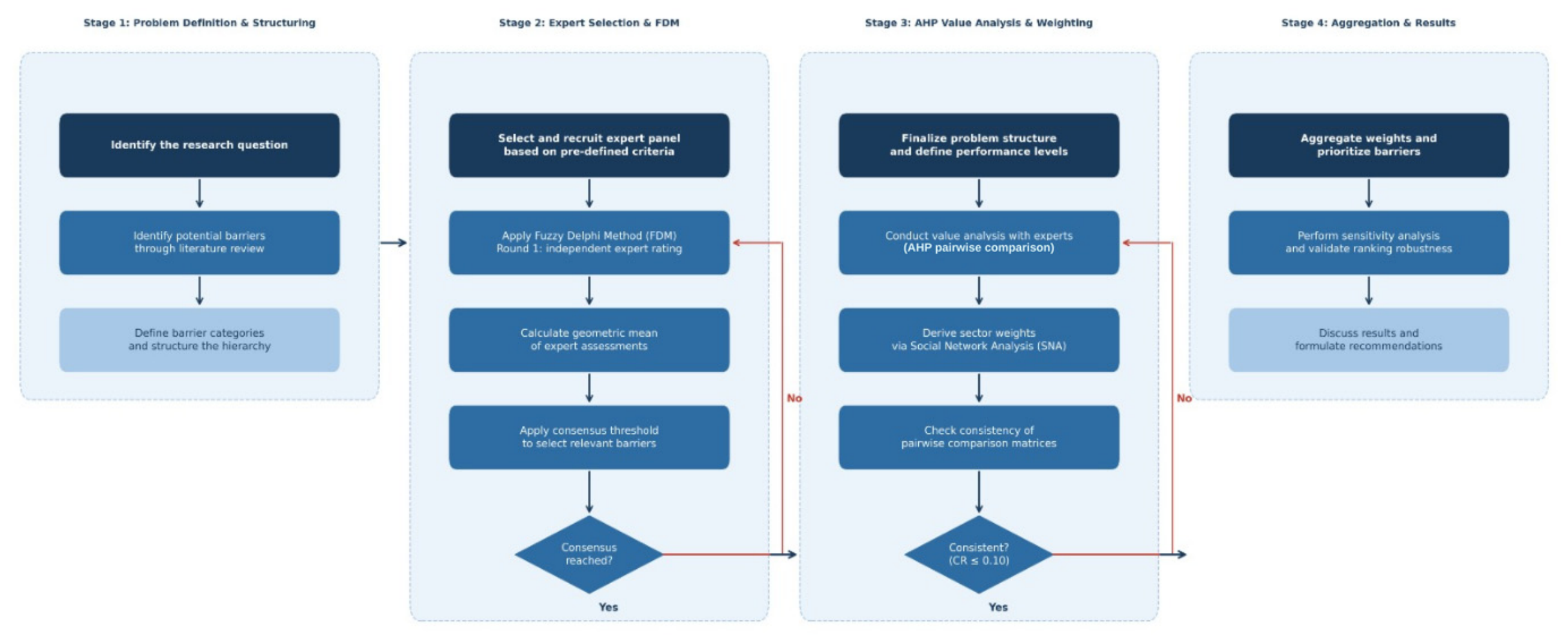
The proposed methodology is organized as a sequential integrated decision-support framework in which the Fuzzy Delphi Method (FDM), swing weighting, the Analytic Hierarchy Process (AHP), and Social Network Analysis (SNA) perform distinct but complementary functions. Figure 1 summarizes this analytical chain. The framework does not treat these analytical components as interchangeable: each addresses a different source of complexity in the decision problem and produces information required by a subsequent stage.
Figure 1.
Proposed Integrated MCDA Framework. Source: Elaborated by the authors.
Stage 1—FDM: uncertainty-aware screening of management barriers. The starting point is the set of candidate barriers identified from the literature. Experts assess the relevance of these barriers to the local child protection network using linguistic judgments represented by Triangular Fuzzy Numbers (TFNs). The FDM aggregates these judgments, converts the fuzzy evaluations into crisp values, and applies the acceptance threshold to determine which barriers are retained. Thus, the role of FDM is restricted to screening and refining the initial set of criteria under uncertainty; it does not determine the final ranking of the intervention alternatives.
Stage 2—swing weighting and AHP absolute measurement: barrier weighting and performance-level evaluation. The barriers retained by FDM become the criteria of the multicriteria model. Their relative importance is elicited separately through swing weighting. AHP in its absolute measurement mode is then used to derive priorities for the predefined performance levels and support the sector-specific evaluation of the intervention alternatives. Explicit performance levels are defined for each retained barrier and anchored by Good and Neutral reference points. Pairwise comparisons are used to derive the local performance-level priorities and to check judgment consistency. The intervention alternatives are subsequently assigned to these performance levels, generating a sector-specific priority for each alternative. Accordingly, swing weighting provides the barrier-importance weights, whereas AHP provides the performance-level evaluation component of the framework.
Stage 3—SNA: actor weighting. SNA is applied to the relationships among the participating sectors rather than to the barriers or alternatives. Weighted degree centrality captures the structural position of each sector in the child protection network on the basis of incoming and outgoing information-exchange relationships. The resulting centrality scores are normalized to obtain actor weights. Therefore, SNA does not replace the AHP priorities; instead, it provides an additional relational weighting layer that determines the contribution of each sector-specific evaluation to the collective result.
Stage 4—final aggregation. The sector-specific alternative priorities generated through the swing-weighting and AHP evaluation stage are combined using the normalized SNA actor weights. The final score of each alternative therefore reflects two analytically distinct dimensions: its multicriteria performance within each sector and the structural weight assigned to that sector in the protection network. This FDM → swing weighting → AHP → SNA sequence differentiates the proposed framework from pairwise hybrid approaches: FDM–AHP does not, by itself, incorporate network-based actor weighting; FDM–SNA does not provide the AHP-based performance-level evaluation used here; and AHP–SNA does not include the fuzzy screening stage used to refine the literature-derived barriers before multicriteria evaluation. Swing weighting adds a distinct elicitation step for the relative importance of the retained barriers rather than being treated as a numerical conversion into AHP priorities.
Accordingly, the methodological contribution of this study lies in the role-specific and sequential integration of established techniques rather than in the development of a new MCDA method. The analytical workflow is explicitly structured as follows: candidate barriers identified from the literature are screened using the FDM; the retained barriers are weighted through swing weighting; AHP absolute measurement is then used to derive the priorities of the performance levels and evaluate the alternatives within each sector; SNA is subsequently applied to derive normalized actor weights; and, finally, the sector-specific alternative priorities are aggregated using the SNA-derived actor weights to obtain the collective ranking. The following subsections describe each methodological component in the same sequence in which it is applied in the proposed decision-support framework.
2.1. Selecting Barriers in Child Protection Networks
Function of FDM in the integrated framework: FDM constitutes the screening stage of the analytical chain. Its purpose is to reduce the literature-derived set of candidate management barriers to those considered sufficiently relevant by the participating experts in the specific municipal context. The output of this stage is therefore a retained set of barriers, which becomes the set of criteria subsequently modeled with AHP.
The Fuzzy Delphi Method is used to structure and aggregate uncertain expert judgments during the screening of variables relevant to the problem under investigation [27]. In the present framework, this function is deliberately separated from the subsequent AHP weighting and alternative-evaluation stage.
Table 1 presents the linguistic variables and their corresponding Triangular Fuzzy Numbers (TFNs). For each barrier , expert assigns a TFN , where , , and denote the lower, modal, and upper values of the linguistic judgment, respectively. Following the FDM aggregation procedure adopted in this study, the individual judgments for each barrier are combined into an aggregated TFN , where
and K denotes the number of experts. Thus, the geometric mean is applied to the modal component, whereas the lower and upper bounds preserve the collective range of the experts’ fuzzy judgments. These three components correspond to the aggregated TFN values reported in Table 1.
Table 1.
Linguistic Variables and corresponding TFN.
The aggregated TFN is subsequently defuzzified using the Center of Gravity (COG) method:
The acceptance threshold is calculated as the arithmetic mean of the crisp scores obtained for all candidate barriers:
In the present application, , and the crisp scores reported in Table 2 yield , rounded to 0.5509. The decision rule is therefore defined as follows: barrier is retained if and excluded if . This formulation makes the barrier-screening procedure directly reproducible from the values reported in Table 2.
Table 2.
Crisp Number of barriers.
- Selection rule: retain barrier i if Ci ≥ V.
- Exclusion rule: barrier i is excluded if Ci < V.
Defuzzification therefore converts the aggregated fuzzy evaluations into comparable crisp scores. The COG expression used here is applied directly to each aggregated triangular fuzzy number and is consistent with the values shown in Table 2. The threshold is data-derived rather than externally imposed; consequently, its sensitivity should be considered when barriers have crisp scores close to V.
2.2. Absolute Measurement Mode of the AHP: Performance Levels and Pairwise Comparisons
Function of AHP in the integrated framework. Once FDM has identified the barriers to be retained, AHP absolute measurement is used to define and prioritize the performance levels associated with each retained barrier and to support the sector-specific evaluation of the intervention alternatives. Barrier-importance weights are elicited separately through the swing-weighting procedure described in Section 3.3. The AHP output used at this stage is therefore the set of local priorities for the predefined performance levels; these priorities are subsequently combined with the barrier weights when the alternatives are evaluated.
To operationalize the performance-level evaluation within the proposed framework, the absolute measurement mode of the Analytic Hierarchy Process (AHP) was adopted, following the procedure described by Saaty [36]. In this study, AHP absolute measurement is used specifically to derive local priorities for the predefined performance levels (D1–D4) associated with each retained barrier. These performance levels are compared pairwise using Saaty’s fundamental scale of relative importance (1–9), generating reciprocal judgment matrices from which local priorities are obtained. This procedure is analytically distinct from the elicitation of barrier-importance weights through swing weighting in Section 3.3.
Step 1: Definition of Performance Levels and Reference Points: For each selected barrier, a set of qualitative or quantitative performance levels is defined to represent different operational scenarios of the child protection network. Two reference points are established for each barrier: a Good level, representing a desirable operational state, and a Neutral level, representing a baseline or minimally acceptable state. These reference levels anchor the experts’ judgments and ensure comparability across barriers.
Step 2: Pairwise Comparison and Priority Derivation. For the performance levels associated with each retained barrier, the experts construct a positive reciprocal pairwise comparison matrix , where represents the relative importance of performance level over performance level according to Saaty’s 1–9 fundamental scale, , and [36]. The priority vector is obtained from the principal right eigenvector:
and normalized such that
Judgment consistency is evaluated using
and
where n is the order of the pairwise comparison matrix and IR is Saaty’s random index. A consistency ratio of RC < 0.10 is adopted as the acceptance criterion [36]. Each alternative is subsequently assigned to the performance level that best represents its expected impact on the corresponding barrier, and the local priority associated with that performance level is used as the alternative’s performance score for that barrier.
IC = (λmax − n)/(n − 1)
RC = IC/IR
Clarification of judgment elicitation: The AHP pairwise comparisons described above apply to the performance levels (D1–D4), not to the barrier-importance weights in Section 3.3. Those barrier weights were elicited separately through the swing-weighting procedure described in Section 3.3. The retained study records do not document a numerical swing-to-AHP conversion, and no numerical conversion between these weighting procedures is assumed.
2.3. Social Network Analysis: Degree Centrality for Actor Weighting
Function of SNA in the integrated framework. SNA is introduced after the sector-specific AHP evaluations have been obtained. Its purpose is not to select barriers or to reassess the performance of alternatives, but to quantify the relative structural position of the participating sectors within the information-exchange network. Degree-centrality scores are therefore converted into normalized actor weights that are used only in the final aggregation stage.
Degree centrality is defined by the number of direct connections a node has within a network. The greater a node’s degree centrality, the more influential its position is within the network structure [35]. A node with high degree centrality occupies a strategic structural position that enables frequent interaction with other members and facilitates the mediation of communication flows. Consequently, degree centrality reflects both the level of involvement of a node and its potential to disseminate and receive information throughout the network. This interpretation of degree centrality and the structural relevance of highly connected actors is consistent with the Social Network Analysis perspective discussed by Borgatti and Li [35].
Because the child protection network was modeled as a directed and weighted network, the degree-based measure used in this study incorporates both incoming and outgoing ties. For each sector , the weighted in-degree represents the aggregated intensity of incoming relationships, whereas the weighted out-degree represents the aggregated intensity of outgoing relationships. The total weighted degree measure used in the analysis was defined as the sum of these two components:
where and denote the weighted in-degree and weighted out-degree of sector , respectively. Accordingly, the values used in the subsequent analysis represent the combined intensity of incoming and outgoing relationships and should not be interpreted as the normalized weighted-degree measure . Because incoming and outgoing relationship intensities are aggregated, the resulting values are not bounded by the maximum value of 5 used in the individual relationship-intensity scale.
The degree-based values were calculated using NetMiner 3 and subsequently normalized across the participating sectors to derive the actor weights used in the final MCDA aggregation:
where is the normalized weight assigned to sector . These normalized actor weights sum to 1 and are used to weight the corresponding sector-specific evaluations in the final aggregation.
To characterize the intensity of information exchange among sectors, the relationship scale adapted from Gonzalez-Urango and García-Melón [37] was used. Each directed relationship was evaluated on a five-point scale, ranging from 1 to 5, with higher values indicating more frequent information exchange:
1—there is practically no exchange of information with this sector;
2—little exchange of information with this sector;
3—moderate exchange of information with this sector;
4—frequent exchange of information with this sector;
5—a lot of exchange of information with this sector.
2.4. Final Aggregation of AHP Priorities Using SNA Actor Weights
The final aggregation is the point at which the outputs of the AHP and SNA stages are integrated. For each participating sector, AHP produces a priority score for each intervention alternative based on the retained barriers and their performance levels. Independently, SNA produces a normalized actor weight from the sector’s weighted degree centrality. Equation (10) combines these two outputs: each sector-specific alternative score is multiplied by the corresponding SNA actor weight, and the weighted contributions are summed across sectors. The resulting global score is used to establish the final ranking of the intervention alternatives. In this way, FDM determines which barriers enter the model, AHP determines how the alternatives perform with respect to those barriers within each sector, and SNA determines the relative contribution of each sector to the collective aggregation.
After the sector-specific AHP scores have been obtained and the SNA degree-based values have been normalized into actor weights, the collective priority of alternative is calculated as
where is the AHP priority of alternative for sector , is the normalized SNA actor weight assigned to sector , and .
For example, using the values reported in the sector-specific scores and normalized actor weights reported in the Section 3, the collective priority of A2 is calculated as
after rounding to four decimal places. Applying the same aggregation procedure yields and , resulting in the overall ranking . This explicit aggregation provides a transparent numerical audit trail linking the sector-specific AHP priorities and normalized SNA actor weights to the final collective ranking.
3. Results and Analysis
3.1. Contextualization: Protection Network for Child Victims of Violence
The proposed methodology was applied to prioritize interventions aimed at overcoming the management barriers affecting the effectiveness of a child protection network for children and adolescents exposed to violence. The case study was conducted using data collected from the Child Protection Network of a medium-sized municipality in the state of São Paulo, Brazil. To implement the proposed framework, the following methodological steps were carried out with the participation of a panel of experts:
- (i)
- An initial analysis of the barriers identified in the literature, followed by the application of the Fuzzy Delphi Method (FDM) to select the most relevant barriers;
- (ii)
- The establishment of performance levels for the selected barriers, considering the specific context of a medium-sized municipality in the state of São Paulo, Brazil; and
- (iii)
- The application of Multi-Criteria Decision-Making (MCDM) and Social Network Analysis (SNA) methods to prioritize the barriers and propose appropriate interventions.
The Scopus database was used to identify studies addressing child protection networks and systems for preventing and responding to violence against children and adolescents. The search strategy used five predefined Boolean combinations: (i) “violence against children” AND “protection network”; (ii) “violence against children” AND “protection system”; (iii) “violence against children” AND “child protection”; (iv) “violence against children” AND treatment; and (v) “violence against children” AND referrals. Because the purpose of this stage was to identify management barriers applicable to the Brazilian child protection context, the screening was restricted to studies addressing Brazil. The retained studies were examined for reported organizational, human-factor, and infrastructure barriers affecting intersectoral child-protection practice; conceptually overlapping descriptions were consolidated into the barrier set reported in Table 3. This literature-identification stage was used to generate the candidate barrier set for subsequent expert screening by FDM, rather than to estimate a pooled effect or conduct a statistical meta-analysis.
Search-record transparency: The literature-identification stage was conducted as a targeted search to generate candidate barriers for expert screening, rather than as a systematic review. The retained project records document the database, the five Boolean combinations, the restriction to the Brazilian context, and the barrier-extraction procedure reported above. However, they do not preserve a complete systematic-review audit trail containing the exact execution date, field-specific Scopus syntax, or numerical counts for identification, duplicate removal, screening, exclusion, and final inclusion. Because these details cannot be reconstructed reliably from the available records, they are not retrospectively inferred here. This limitation should be considered when assessing the reproducibility of the literature-identification stage.
The search was restricted to studies conducted in Brazil for three main reasons: (i) the country’s distinct legal framework and terminology; (ii) the specific concept of child protection networks/systems established within the Brazilian context by the Child and Adolescent Statute (ECA) [8]; and (iii) the high incidence of violence against children and adolescents in the country [13].
The barriers identified in the selected studies were classified into three categories: Management Barriers (M), Human Factor Barriers (HF), and Infrastructure Barriers (I). Table 3 summarizes these barriers, together with their corresponding descriptions and bibliographic references.
This categorization follows the structuring of barriers commonly adopted in MCDM studies [38] and draws on the literature on public-policy implementation, intersectoral action, and violence as a public-health issue [39,40,41]. Similar barrier and critical-factor structures have been used in fuzzy multicriteria and fuzzy AHP applications [42,43,44,45,46] and in studies of inter-organizational networks [47].
Table 3.
Description of the barriers selected in the analysis.
The clear presentation of the barriers identified in the literature is essential to support the experts participating in the analysis. This enables them to assess whether the identified barriers are applicable to the context of the child protection network under study and to suggest additional barriers when appropriate.
The child protection network of the selected medium-sized municipality in the state of São Paulo, Brazil, comprises multiple sectors and professionals from diverse disciplinary backgrounds, reflecting its multidisciplinary and intersectoral nature. Accordingly, experts representing the key sectors of the network were selected to ensure a comprehensive assessment of its functioning from different professional perspectives:
- Guardianship Council (GC): The Guardianship Council plays a central role in the child protection network. Its primary responsibility is to safeguard the rights of children and adolescents; however, its effectiveness depends on close coordination and effective communication with the other sectors of the network [61]. The selected municipality has two Guardianship Council units, and the coordinator of one unit participated in the study as the representative of this sector.
- Health Sector (HEALTH): In the selected municipality, emergency departments, hospitals, primary healthcare units, nurses, and professionals from the Municipal Health Department are responsible for identifying, reporting, and managing cases of violence. Consequently, the health sector plays a critical role in the child protection network. A professional representing this sector was invited to participate in the expert panel.
- Child and Adolescent Psychosocial Care Center (CAPCC): This service provides specialized psychological care and psychosocial support to children and adolescents exposed to violence, playing a fundamental role in coordination with the health sector and other social services. A professional with decision-making authority represented this sector during the data collection process.
- Specialized Reference Center for Social Assistance (SRCSA): The Specialized Reference Center for Social Assistance is a public social welfare service that provides specialized assistance to individuals whose rights have been violated or who have experienced violence. It also supports victims of discrimination, abuse, neglect, exploitation, and other situations of social vulnerability requiring specialized social protection. A professional with decision-making authority represented this sector during the data collection process.
Consequently, the proposed multi-criteria methodology was applied with experts representing the key sectors of the child protection network. The selection of participants was based on their decision-making authority and their ability to represent their respective sectors, ensuring that the elicited judgments accurately reflected the operational realities of the network. This study was approved by the Research Ethics Committee of the Federal University of Triângulo Mineiro (UFTM) under CAAE No. 46346515.3.0000.5154 and Approval Opinion No. 1318577, in accordance with Resolution No. 466/2012 of the Brazilian National Health Council (Conselho Nacional de Saúde, CNS), which governs research involving human participants.
In the case study, the expert panel consisted of four professionals working directly in different sectors of the child protection network in the selected medium-sized municipality in the state of São Paulo, Brazil. The demographic and professional characteristics of the participants are summarized below. The panel comprised four professionals, one representing each of the four participating sectors (Guardianship Council, CAPCC, SRCSA, and HEALTH); ages ranged from 32 to 39 years.
Because expertise, professional experience, and decision-making authority are critical to the reliability of Multi-Criteria Decision Analysis (MCDA), all experts selected for this study had more than four years of experience in addressing cases of violence within the municipality.
Table 4 reports the sector-level AHP consistency information retained in the original study records. These RC values are reported as available consistency information for the AHP component; they should not be interpreted as consistency tests of the swing-weighting judgments used to obtain the barrier weights in Table 6. Complete underlying matrices for every performance-level comparison are not available in the retained records, which limits full reconstruction of this part of the analysis.
Table 4.
Consistency analysis of the AHP pairwise comparison matrices from GC, CAPCC, SRCSA and HEALTH.
3.2. Selecting Barriers for the Protection Network: Performance Levels Construction
To refine the initial set of barriers, the Fuzzy Delphi Method (FDM) was applied following the procedure described in Section 2.1. The results of the FDM analysis are presented in Table 2. A defuzzified threshold value of 0.5509 was established as the acceptance criterion, whereby barriers with values equal to or greater than the threshold were retained for subsequent analysis, while those falling below this value were excluded from the proposed decision-support framework.
A local threshold-sensitivity analysis was conducted using the crisp scores reported in Table 2. The seven-barrier set retained at the empirical threshold remains unchanged when the threshold is rounded to 0.55. The nearest excluded barrier is I2 (), whereas the retained barriers closest to the threshold are M1 and M6 (). Accordingly, under the inclusion rule , the same seven-barrier set is retained for any threshold satisfying . If , M1 and M6 are excluded, whereas if , I2 is additionally retained. These results indicate that the empirical threshold of 0.5509 lies near the upper boundary of the interval that preserves the seven-barrier solution, with M1 and M6 representing the most threshold-sensitive, retained barriers.
During the evaluation process, experts from the municipal child protection network indicated their level of agreement regarding the relevance of each barrier within the local context. These judgments, expressed using the linguistic scale presented in Table 1, were converted into Triangular Fuzzy Numbers (TFNs). The fuzzy values were then aggregated, and the Center of Gravity (CoG) method was applied to defuzzify the results, yielding a crisp value for each barrier.
By applying the Fuzzy Delphi Method (FDM) with experts from the child protection network of the selected medium-sized municipality in the state of São Paulo, Brazil, seven barriers were selected for inclusion in the decision hierarchy (i.e., the structure of the multi-criteria model). The barriers retained for the decision analysis are presented below:
- Barrier 1: Lack of flowcharts and service protocols (M1);
- Barrier 2: Lack of intersectoral coordination within the protection network (M2);
- Barrier 3: Lack of uniformity in working methods (M5);
- Barrier 4: Lack of financial resources (M6);
- Barrier 5: Insufficient number of professionals (HF1);
- Barrier 6: Failures in the case notification process (HF2);
- Barrier 7: Overstretched services (I1).
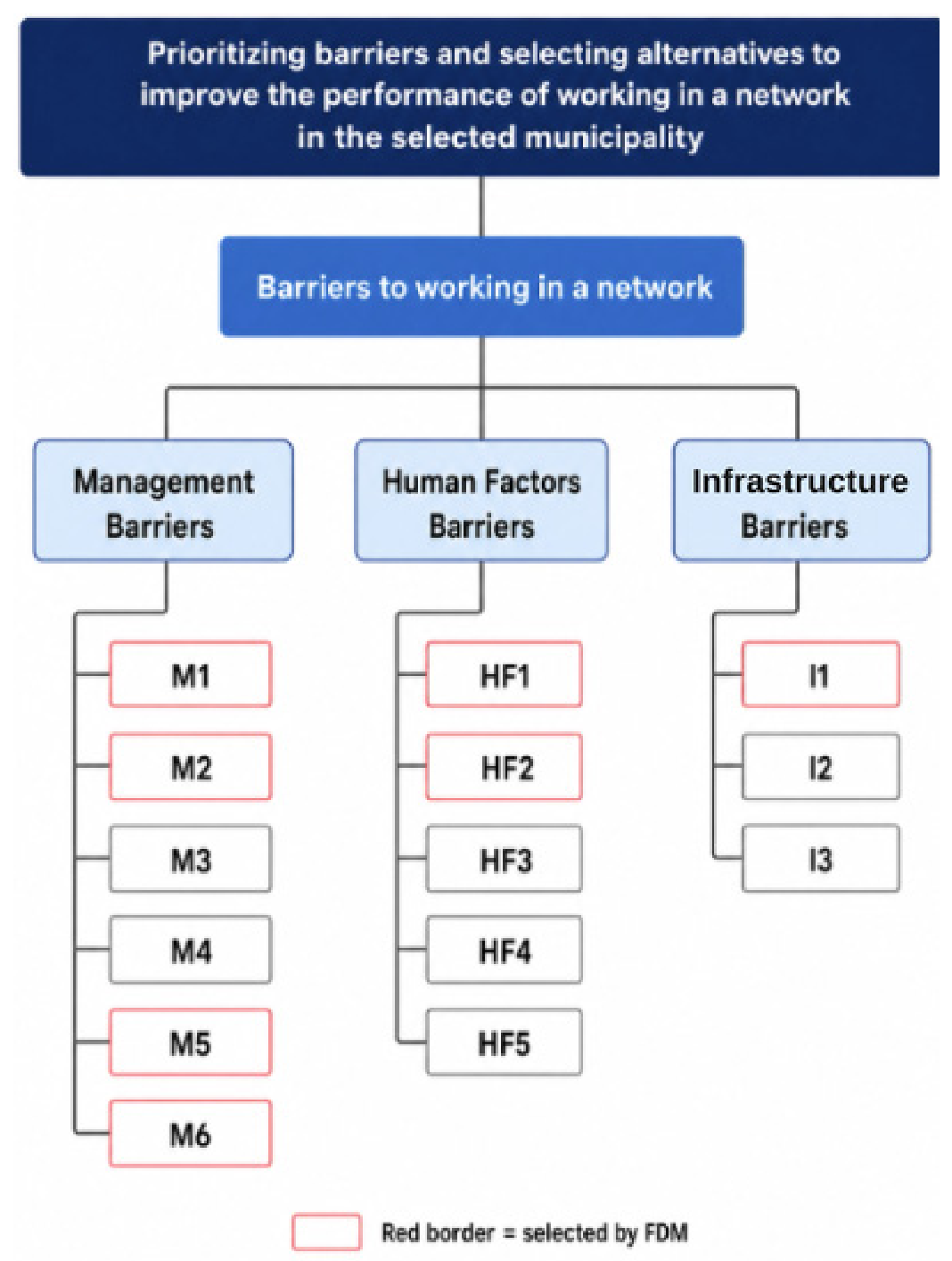
The selected barriers are predominantly related to the management of the child protection network. Following the identification of the barriers considered most relevant to the local context, the decision hierarchy was developed, as illustrated in Figure 2. Although Figure 2 includes all barriers identified in the literature, the barriers selected through the Fuzzy Delphi Method (FDM) for the selected municipality are highlighted (M1, M2, M5, M6, HF1, HF2, and I1). The proposed framework assumes that this hierarchical structure can be adapted to other contexts, depending on the level of expert consensus regarding the relevance of the barriers.
Figure 2.
Final problem structure. Source: Elaborated by the authors.
Furthermore, during the final stage of problem structuring, performance levels were established based on expert judgments. For each selected barrier, a set of performance levels representing different scenarios of the child protection network was defined. Table 5 presents these performance levels and the corresponding scenarios used in the expert evaluations. This approach improves the operationalization and interpretation of the barriers while explicitly defining the neutral and good reference levels for each criterion.
Table 5.
Barrier performance levels.
At the conclusion of the problem-structuring stage, it became evident that many studies focusing on barrier analysis do not address the prioritization of interventions within the decision model. To address this gap, the present study identified potential strategies for overcoming the barriers perceived by experts within the child protection network, hereafter referred to as decision alternatives.
These alternatives were identified through expert consultation during the barrier selection stage. For each barrier, the following question was posed: “What strategy would you recommend to overcome this barrier?” Based on the experts’ suggestions and the subsequent consensus process, three main decision alternatives were defined:
- Continuous Training for Network Professionals (A1): Implementation of a continuous professional development program that empowers individual sectors to organize and deliver their own training activities, thereby increasing staff engagement and strengthening institutional capacity across the network.
- Unified Information System (A2): Implementation of an integrated information system connecting all sectors of the child protection network to facilitate information sharing, case monitoring, and communication. Supported by standardized reporting procedures and trained personnel, such a system enhances coordination and improves the effectiveness of network management.
- Creation of an Intersectoral Management Group (A3): Establishment of a multidisciplinary management group composed of representatives from the different sectors of the child protection network. This group would coordinate intersectoral activities, balance service demands, standardize operational procedures, promote shared protection principles, and organize regular meetings to strengthen collaboration and ensure effective intersectoral governance.
3.3. Application of the Proposed Methodology
With the decision model fully structured, the next step was the application of the proposed methodology. The first stage consisted of determining the weights of the selected barriers in order to identify those with the greatest impact on the effectiveness of the child protection network.
With the decision model fully structured, the next stage was to determine the relative importance of the selected barriers. Barrier-importance weights and performance-level priorities were elicited through two distinct procedures. Barrier weights were obtained through swing weighting, whereas the priorities of the performance levels (D1–D4) were obtained separately using AHP absolute measurement as described in Section 2.2.
The retained study records preserve the final normalized swing weights reported in Table 6 but do not preserve the complete intermediate cardinal swing scores or a documented numerical rule converting those scores into another weighting representation. Accordingly, no undocumented swing-to-AHP transformation is assumed. This limitation in the retained documentation is acknowledged, and Table 6 is presented as the set of barrier weights retained from the original swing-weighting elicitation.
Table 6.
Weights of barriers for each sector.
For the swing-weighting step, the barriers were first considered at their Neutral reference levels. Each participating expert was asked to rank the hypothetical improvements obtained by moving one barrier at a time from Neutral to Good while all remaining barriers stayed at Neutral. The elicitation question was: “Assuming that all barriers are initially at the Neutral level, if you could improve only one barrier from the Neutral level to the Good level while keeping all other barriers at the Neutral level, which barrier would you prioritize?” The resulting normalized barrier-importance weights are reported in Table 6.
The AHP consistency criterion described in Section 2.2 applies to the reciprocal pairwise-comparison matrices used for the performance-level priorities. The sector-level RC values retained in the study records are below 0.10 (Table 4). However, because the complete underlying performance-level matrices are not available in the retained records, this revision does not claim a complete matrix-by-matrix reproducibility audit. The performance-level weights used in the alternative evaluation are presented in Table 7.
Table 7.
Weights of barrier performance levels in the analysis of each sector.
After establishing the performance-level weights for each barrier, the next stage of the evaluation process consisted of assessing the proposed decision alternatives. To accomplish this, the experts in each sector were asked the following question:
“If the alternative Continuous Training for Network Professionals (A1) were implemented, what level of impact would it have on the barrier Lack of Flowcharts and Service Protocols (M1)?”
The same evaluation procedure was then repeated for the other two decision alternatives: Unified Information System (A2) and Intersectoral Management Group (A3).
Based on their judgments, the experts assigned each alternative to one of the predefined performance levels for every barrier. For example, if an alternative was assessed as achieving the Good performance level for barrier M1, it received the corresponding weight previously established for the Good reference level of that barrier. Consequently, each alternative was evaluated according to the following premise: What level of impact would this alternative achieve for each barrier if it were implemented? An example of the evaluation results for the Guardianship Council (GC) sector is presented in Table 8.
Table 8.
Analysis and overall weights of the GC sector.
The normalized weights of the alternatives, derived from the analysis of each sector, are presented in Table 9.
Table 9.
Normalized weights of alternatives for each sector.
The final stage of the proposed integrated framework consists of aggregating the individual evaluations obtained in the previous stages. The results indicate that the experts expressed different opinions regarding the effectiveness of the proposed decision alternatives in overcoming the identified barriers, highlighting the complexity of the decision-making context. To integrate these heterogeneous judgments into a single prioritization, Social Network Analysis (SNA) was employed.
The degree centrality indices were calculated using NetMiner 3 based on the directed and weighted relationships among the participating sectors. For each sector, both incoming and outgoing weighted relationships were considered, as described in Section 2.3. The resulting total weighted degree centrality values ranged from 5.667 to 8.000, with a mean of 6.667 (SD = 0.85). These values represent combined incoming and outgoing relational intensity and should therefore not be interpreted as normalized centrality scores bounded by the 1–5 relationship-intensity scale. To obtain the expert weights used in the final aggregation, each sector’s centrality value was divided by the sum of the centrality values across the four sectors. Table 10 reports both the resulting total weighted degree centrality values and their normalized expert weights.
Table 10.
Degree Centrality.
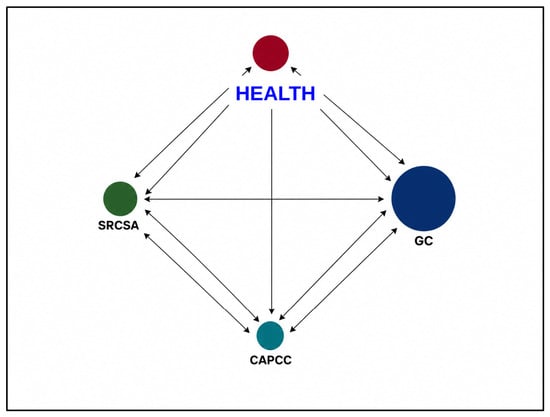
The map of the Protection Network involved the four sectors that have the greatest influence on the network. Thus, in Figure 3 the highlight is the GC (circle blue) with the highest centrality degree.
Figure 3.
Analysis of the Social Network using NetMiner software. Source: Elaborated by the authors.
Within the analyzed network, the Guardianship Council (GC) presented the highest degree centrality (8.000), considering both incoming and outgoing connections. Owing to its structural position, this sector has greater potential to access information, influence other actors, and be influenced by them through direct interactions. Accordingly, the degree centrality scores were used to weight the experts’ evaluations, and the resulting weighted aggregation produced the final prioritization of the decision alternatives.
The sectoral pattern helps explain the narrow difference between A2 and A3. A2 performs better than A3 for GC (0.3623 versus 0.3430), SRCSA (0.3881 versus 0.3303), and HEALTH (0.3752 versus 0.2920), whereas CAPCC assigns a substantially higher score to A3 (0.4064 versus 0.2878). These differences are consistent with the barrier priorities in Table 6. CAPCC assigns its largest barrier weight to M2, lack of intersectoral coordination (0.3449), which is directly aligned with the coordinating role of an Intersectoral Management Group. By contrast, the preference for A2 among the other sectors is compatible with the recurring management problems identified in the literature review, including fragmented records, referral difficulties, information discontinuity, and insufficient integration across services. A unified information system directly targets these information-sharing and case-monitoring deficiencies, whereas A3 primarily strengthens governance and coordination. The close final scores therefore reflect two complementary intervention logics rather than a large substantive advantage of one alternative over the other.
The results indicate that the Unified Information System (A2) achieved the highest overall priority, followed by the Creation of an Intersectoral Management Group (A3) and Continuous Training for Network Professionals (A1). When the results are analyzed by sector, only the Child and Adolescent Psychosocial Care Center (CAPCC) identified the Intersectoral Management Group (A3) as the most appropriate alternative for improving the effectiveness of the child protection network. In contrast, the experts representing the other sectors considered the Unified Information System (A2) to be the most beneficial intervention within the context of the selected medium-sized municipality in the state of São Paulo, Brazil.
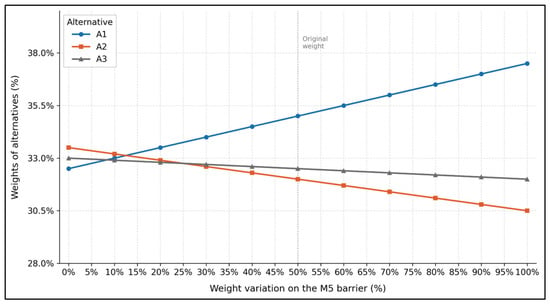
Figure 4 presents the sensitivity and robustness analysis for barrier M5 (Lack of uniformity in working methods). The analysis demonstrates the impact of varying the weight assigned to this barrier on the ranking of the decision alternatives. As the relative importance of M5 increases, Continuous Training for Network Professionals (A1) gradually improves its performance and becomes the preferred alternative. The crossover occurs when the weight of M5 reaches approximately 30%, after which A1 remains the highest-ranked option. This result suggests that continuous professional training becomes increasingly critical when the lack of standardized working methods is regarded as a dominant management problem.
Figure 4.
Sensitivity Analysis for M5 (Lack of uniformity in working methods). Source: Elaborated by the authors.
Overall, the sensitivity analysis reveals that, while the framework produces a coherent and interpretable prioritization, the ranking exhibits moderate fragility under specific weight variations. This finding reinforces the importance of periodic reassessment of barrier weights as the network evolves and suggests that decision-makers should interpret the results as indicative priorities rather than rigid prescriptions, particularly when the weight differences among alternatives are narrow.
Because the margin between the two top-ranked alternatives is narrow (A2 = 0.3525 versus A3 = 0.3450; gap = 0.0075), robustness was also examined with respect to the actor weights used in the final aggregation. The analysis varies the sector-level degree-centrality weights reported in Table 10 while retaining the sectoral alternative scores reported in Table 11, thereby assessing the stability of the A2 A3 ordering without introducing additional judgments.
Table 11.
Final Aggregation of Results.
For each sector in turn, its actor weight was varied while the remaining three weights were rescaled proportionally so that all four weights continued to sum to 1 (a standard one-at-a-time, or OAT, sensitivity procedure). Table 12 reports, for each sector, the break-even weight at which A3 would overtake A2.
Table 12.
Break-even actor weights at which A3 overtakes A2 (one-at-a-time sensitivity).
Taken together, the two sensitivity analyses address distinct sources of uncertainty in the framework. Figure 4 examines the effect of changing the importance of M5, while Table 12 examines changes in the SNA-derived actor weights. The results show that the preferred alternative is not invariant to all plausible changes: A1 becomes preferred when M5 receives sufficiently high importance, and A3 can overtake A2 when the relative influence assigned to CAPCC increases. Accordingly, the ranking should be interpreted as conditional on the elicited barrier priorities and observed network structure rather than as an immutable ordering.
Scope of the robustness assessment. In addition to the M5 barrier-weight analysis in Figure 4 and the actor-weight analysis in Table 12, the local FDM threshold-sensitivity check is reported above. The present study did not perform a systematic one-at-a-time perturbation of every barrier weight, an independent perturbation of all performance-level weights, or a re-estimation of actor weights using alternative SNA centrality measures. Therefore, no robustness claim is made for those untested dimensions. They remain appropriate extensions for future validation of the framework.
4. Conclusions
This study developed and applied an integrated decision-support framework that combines the Fuzzy Delphi Method (FDM), swing weighting, the Analytic Hierarchy Process (AHP) in its absolute measurement mode, and Social Network Analysis (SNA) for the structured evaluation of management barriers and intervention alternatives in a child protection network. In this framework, FDM screens the candidate barriers, swing weighting elicits the relative importance of the retained barriers, AHP derives priorities for the predefined performance levels and supports the sector-specific evaluation of the intervention alternatives, and SNA incorporates the relational influence of the participating sectors into the final aggregation. The case study demonstrated the applicability of this integrated sequence in a complex intersectoral setting characterized by multiple criteria and heterogeneous stakeholder judgments.
Seven barriers were retained through the FDM and subsequently incorporated into the multicriteria evaluation. Among the three intervention alternatives, the Unified Information System (A2) achieved the highest overall priority (0.3525), followed closely by the Creation of an Intersectoral Management Group (A3) (0.3450), while Continuous Training for Network Professionals (A1) ranked third (0.3025). Given the small difference between A2 and A3, these results should be interpreted as indicative priorities rather than as a definitive ordering. The sector-level analysis also revealed an important difference in institutional perspectives: CAPCC preferred A3, whereas the other participating sectors favored A2.
The sensitivity analyses further qualified these empirical findings. Increasing the weight assigned to M5 (Lack of uniformity in working methods) to approximately 30% made A1 the preferred alternative. The actor-weight sensitivity analysis also showed that the ordering between A2 and A3 is particularly sensitive to the relative influence assigned to CAPCC. Together with the local FDM threshold-sensitivity analysis, these results indicate that the final ranking is conditional on the elicited barrier priorities and the observed network structure and should therefore not be interpreted as invariant.
The principal methodological contribution of the study lies in the role-specific integration of established techniques rather than in the development of a new MCDA method. FDM supports barrier screening under uncertainty; swing weighting elicits the relative importance of the retained barriers; AHP absolute measurement derives priorities for the predefined performance levels and supports sector-specific evaluation of the intervention alternatives; and SNA incorporates the relational position of the participating sectors into the final aggregation. This integration makes explicit how barrier selection, barrier importance, alternative evaluation, and actor influence contribute to the final decision-support result. From a practical perspective, the framework provides a structured and transparent basis for supporting intervention prioritization, resource-allocation discussions, intersectoral coordination, and information-sharing strategies in child protection networks.
The findings should nevertheless be interpreted in light of the study’s limitations. The case study involved four experts representing key sectors of a single medium-sized Brazilian municipality, and the AHP-based structure does not explicitly model interdependencies among barriers. The literature-identification stage was targeted rather than a systematic review, and the retained records do not provide a complete audit trail for reconstructing all search and screening procedures. In addition, the robustness assessment was limited to the reported FDM-threshold analysis, the M5 barrier-weight analysis, and the SNA-derived actor-weight analysis; systematic perturbation of all barrier weights, performance-level weights, and alternative SNA centrality measures was not performed. Future studies should therefore validate the framework in other municipalities and network configurations, include a broader range of stakeholders, adopt fully documented literature-search procedures, and examine additional MCDA and SNA robustness scenarios.
Author Contributions
Conceptualization, H.H.d.S.; methodology, H.H.d.S.; formal analysis, H.H.d.S. and R.M.S.; investigation, H.H.d.S. and A.d.S.A.; writing—original draft preparation, R.M.S. and J.V.R.L.; writing—review and editing, A.d.S.A. and J.V.R.L. All authors have read and agreed to the published version of the manuscript.
Funding
This work was supported by the Coordenação de Aperfeiçoamento de Pessoal de Nível Superior—Brasil (CAPES) and Fundação de Amparo à Pesquisa do Estado de São Paulo (FAPESP)—project number: 2018/00780-0.
Institutional Review Board Statement
The study was conducted in accordance with the Declaration of Helsinki and approved by the Research Ethics Committee of the Federal University of Triângulo Mineiro (UFTM) under CAAE No. 46346515.3.0000.5154 and Approval Opinion No. 1318577, in accordance with Resolution No. 466/2012 of the Brazilian National Health Council (Conselho Nacional de Saúde, CNS), which governs research involving human participants.
Informed Consent Statement
Informed consent was obtained from all participants involved in the study.
Data Availability Statement
The data supporting the findings of this study are available from the corresponding author upon reasonable request, subject to applicable ethical and confidentiality restrictions. The data are not publicly available due to the sensitive nature of the research context and the need to protect participants’ confidentiality.
Conflicts of Interest
The authors declare no conflicts of interest.
References
- Leme, R.C.; Rodovalho, T. O princípio da prioridade absoluta: Sentido e repercussões práticas. Rev. Esc. Super. Minist. Público São Paulo 2025. [Google Scholar]
- Petersen, A.C.; Joseph, J.; Feit, M. (Eds.) New Directions in Child Abuse and Neglect Research; Committee on Child Maltreatment Research, Policy, and Practice for the Next Decade: Phase II; Institute of Medicine: Washington, DC, USA; National Research Council: Ottawa, ON, Canada; National Academies Press: Washington, DC, USA, 2014. [Google Scholar] [CrossRef] [Scilit] [PubMed]
- Daley, S.F.; Gutovitz, S. Child Sexual Abuse. In StatPearls; StatPearls Publishing: Treasure Island, FL, USA, 2026. Available online: https://www.ncbi.nlm.nih.gov/books/NBK470563/ (accessed on 11 June 2026).
- World Health Organization (WHO). Child Maltreatment; WHO: Geneva, Switzerland, 2026; Available online: https://www.who.int/news-room/fact-sheets/detail/child-maltreatment (accessed on 8 June 2026).
- Centers for Disease Control and Prevention (CDC). Child Abuse and Neglect Prevention. About Child Sexual Abuse; CDC: Atlanta, GA, USA, 2024. Available online: https://www.cdc.gov/child-abuse-neglect/about/index.html (accessed on 9 June 2026).
- Alves, A.C.; Leitão, M.; Sani, A.I.; Moreira, D. Impact of sexual abuse on post-traumatic stress disorder and psychopathology in children and adolescents: A systematic review. Soc. Sci. 2024, 13, 189. [Google Scholar] [CrossRef] [Scilit]
- Minayo, M.C.S.; Souza, E.R. (Eds.) Violência Sob o Olhar da Saúde: Infrapolítica da Contemporaneidade Brasileira; Editora FIOCRUZ: Rio de Janeiro, Brazil, 2003. [Google Scholar] [CrossRef] [Scilit]
- Brasil. Estatuto da Criança e do Adolescente (Lei nº 8.069); Ministério do Bem-Estar Social: Brasília, Brazil, 1990.
- Childhood Brasil. Tipos de Abuso Sexual de Crianças e Adolescentes; Childhood: São Paulo, Brazil, 2019; Available online: https://www.childhood.org.br/acoes-e-iniciativas/tipos-de-abuso-sexual-de-criancas-e-adolescentes/ (accessed on 10 June 2026).
- Brasil. Lei nº 12.015, de 7 de Agosto de 2009. Altera o Título VI da Parte Especial do Decreto-Lei no 2.848, de 7 de Dezembro de 1940—Código Penal, e o Art. 1º da Lei nº 8.072, de 25 de Julho de 1990; Governo Federal: Brasília, Brazil, 2009. Available online: https://legislacao.presidencia.gov.br/atos/?tipo=LEI&numero=12015&ano=2009&ato=13fQTWU90dVpWTaaf (accessed on 9 June 2026).
- Cleek, E.A.; Johnson, N.L.; Sheets, L.K. Interdisciplinary collaboration needed in obtaining high-quality medical information in child abuse investigations. Child Abus. Negl. 2019, 92, 167–178. [Google Scholar] [CrossRef] [Scilit] [PubMed]
- Herbert, J.L.; Bromfield, L. Multi-disciplinary teams responding to child abuse: Common features and assumptions. Child. Youth Serv. Rev. 2019, 106, 104467. [Google Scholar] [CrossRef] [Scilit]
- UNICEF. Proteção de Crianças e Adolescentes Contra Violências. Available online: https://www.unicef.org/brazil/protecao-de-criancas-e-adolescentes-contra-violencias (accessed on 5 October 2026).
- Rubio, C.A.R.; Moreira, D.B.; Sasaki, N.S.G.M.S.; Rubio, G.L.R.; Souza, L.H.; Ferraz, A.A.; Santos, M.L.S.G. Rede de proteção às crianças/adolescentes vítimas de violência: Revisão de escopo. Cien. Saude Colet. 2025, 30, e18142023. [Google Scholar] [CrossRef] [Scilit] [PubMed]
- Piovezan, L.N.C.; Diniz, L.O.; Calmeto, M.N.; Fontella, R.B.; Ferreira, R.S.B.; Vidal, C.E.L. Análise das fichas de notificação de violência emitidas por serviços de saúde da região de Barbacena. Rev. Med. Minas Gerais 2018, 28, 9–16. [Google Scholar]
- Brasil. Ministério dos Direitos Humanos. Violência Contra Crianças e Adolescentes: Análise de Cenários e Propostas de Políticas Públicas (M.T. Moreschi, Org.). 2018. Available online: https://www.gov.br/mdh/pt-br/centrais-de-conteudo/consultorias/conada/violencia-contra-criancas-e-adolescentes-analise-de-cenarios-e-propostas-de-politicas-publicas.pdf (accessed on 5 October 2026).
- Avelar, M.R.; Malfitano, A.P.S. Entre o suporte e o controle: A articulação intersetorial de redes de serviços. Cien. Saude Colet. 2018, 23, 3201–3210. [Google Scholar] [CrossRef] [Scilit] [PubMed]
- Schek, G.; Silva, M.R.S.; Lacharité, C.; Cézar-Vaz, M.R.; Bueno, M.E.N.; Ventura, J. Professional practices that silence domestic violence against children and adolescents. Texto Contexto Enferm. 2018, 27, e1680016. [Google Scholar] [CrossRef] [Scilit]
- Silva, B.P.; Camargo, D. As práticas profissionais realizadas em situações de maus-tratos infantis: Revisão integrativa. Cien. Saude Colet. 2023, 28, 1703–1715. [Google Scholar] [CrossRef] [Scilit] [PubMed]
- Emrouznejad, A.; Marra, M. The state-of-the-art development of AHP (1979–2017): A literature review with a social network analysis. Int. J. Prod. Res. 2017, 55, 6653–6675. [Google Scholar] [CrossRef] [Scilit]
- Subramanian, N.; Ramanathan, R. A review of applications of analytic hierarchy process in operations management. Int. J. Prod. Econ. 2012, 138, 215–241. [Google Scholar] [CrossRef] [Scilit]
- Ishizaka, A.; Labib, A. Review of the main developments in the analytic hierarchy process. Expert Syst. Appl. 2011, 38, 14336–14345. [Google Scholar] [CrossRef] [Scilit]
- Grzybowski, A.Z. New results on inconsistency indices and their relationship with the quality of priority vector estimation. Expert Syst. Appl. 2016, 43, 197–212. [Google Scholar] [CrossRef] [Scilit][Green Version]
- Aguarón, J.; Escobar, M.T.; Moreno-Jiménez, J.M. Reducing inconsistency measured by the geometric consistency index in the analytic hierarchy process. Eur. J. Oper. Res. 2021, 288, 576–583. [Google Scholar] [CrossRef] [Scilit]
- Ho, W. Integrated analytic hierarchy process and its applications: A literature review. Eur. J. Oper. Res. 2008, 186, 211–228. [Google Scholar] [CrossRef] [Scilit]
- Ho, W.; Ma, X. The state-of-the-art integrations and applications of the analytic hierarchy process. Eur. J. Oper. Res. 2018, 267, 399–414. [Google Scholar] [CrossRef] [Scilit]
- Bouzon, M.; Govindan, K.; Taboada Rodriguez, C.M.; Campos, L.M.S. Identification and analysis of reverse logistics barriers using fuzzy Delphi method and AHP. Resour. Conserv. Recycl. 2016, 108, 182–197. [Google Scholar] [CrossRef] [Scilit]
- Sara, J.; Stikkelman, R.M.; Herder, P.M. Assessing relative importance and mutual influence of barriers for CCS deployment of the ROAD project using AHP and DEMATEL methods. Int. J. Greenh. Gas Control 2015, 41, 336–357. [Google Scholar] [CrossRef] [Scilit]
- Prakash, C.; Barua, M.K. A multi-criteria decision-making approach for prioritizing reverse logistics adoption barriers under fuzzy environment: Case of Indian Electronics Industry. Glob. Bus. Rev. 2016, 17, 1107–1124. [Google Scholar] [CrossRef] [Scilit]
- Mangla, S.K.; Govindan, K.; Luthra, S. Prioritizing the barriers to achieve sustainable consumption and production trends in supply chains using fuzzy analytical hierarchy process. J. Clean. Prod. 2017, 151, 509–525. [Google Scholar] [CrossRef] [Scilit]
- Bhandari, D.; Singh, R.K.; Garg, S.K. Prioritisation and evaluation of barriers intensity for implementation of cleaner technologies: Framework for sustainable production. Resour. Conserv. Recycl. 2019, 146, 156–167. [Google Scholar] [CrossRef] [Scilit]
- Kabra, G.; Ramesh, A. Analyzing drivers and barriers of coordination in humanitarian supply chain management under fuzzy environment. Benchmarking 2015, 22, 559–587. [Google Scholar] [CrossRef] [Scilit]
- Belhadi, A.; Touriki, F.E.; El Fezazi, S. Prioritizing the solutions of lean implementation in SMEs to overcome its barriers. J. Manuf. Technol. Manag. 2017, 28, 1115–1139. [Google Scholar] [CrossRef] [Scilit]
- Moktadir, A.; Mithun, S.; Kumar, S.; Shukla, N. Barriers to big data analytics in manufacturing supply chains: A case study from Bangladesh. Comput. Ind. Eng. 2019, 128, 1063–1075. [Google Scholar] [CrossRef] [Scilit]
- Borgatti, S.P.; Li, X. On social network analysis in a supply chain context. J. Supply Chain Manag. 2009, 45, 5–22. [Google Scholar] [CrossRef] [Scilit]
- Saaty, T.L. How to make a decision: The analytic hierarchy process. Eur. J. Oper. Res. 1990, 48, 9–26. [Google Scholar] [CrossRef] [Scilit]
- Gonzalez-Urango, H.G.; Garcia-Melon, M. Stakeholder engagement to evaluate tourist development plans with a sustainable approach. Sustain. Dev. 2018, 26, 800–811. [Google Scholar] [CrossRef] [Scilit]
- Chowdhury, P.; Paul, S.K. Applications of MCDM methods in research on corporate sustainability: A systematic literature review. Manag. Environ. Qual. 2020, 31, 385–405. [Google Scholar] [CrossRef] [Scilit]
- Lotta, G. A política pública como ela é: Contribuições dos estudos sobre implementação para a análise de políticas públicas. In Teorias e Análises Sobre Implementação de Políticas Públicas no Brasil; Lotta, G., Ed.; ENAP: Brasília, Brazil, 2019; pp. 11–38. [Google Scholar]
- Souza, R.G.; Monnerat, G.L. Desigualdades sociais e políticas sociais: Reflexões a partir da intersetorialidade. In Proceedings of the 9th International Meeting on Social Policy and 16th National Meeting on Social Policy, Vitória, Brazil, 13–15 June 2023; pp. 1–14. Available online: https://periodicos.ufes.br/einps/article/view/41418 (accessed on 5 October 2026).
- Minayo, M.C.S. Violência e Saúde; Editora FIOCRUZ: Rio de Janeiro, Brazil, 2006; 132p. [Google Scholar] [CrossRef] [Scilit]
- Wibowo, S.; Grandhi, S. Fuzzy multicriteria analysis for performance evaluation of Internet-of-Things-based supply chains. Symmetry 2018, 10, 603. [Google Scholar] [CrossRef] [Scilit]
- Kumar, R.; Kansara, S. Information technology barriers in Indian sugar supply chain: An AHP and fuzzy AHP approach. Benchmarking Int. J. 2018, 25, 1978–1991. [Google Scholar] [CrossRef] [Scilit]
- Amrita, K.; Garg, C.P.; Singh, S. Modelling the critical success factors of women entrepreneurship using fuzzy AHP framework. J. Entrep. Emerg. Econ. 2018, 10, 81–116. [Google Scholar] [CrossRef] [Scilit]
- Mahtani, U.S.; Garg, C.P. An analysis of key factors of financial distress in airline companies in India using fuzzy AHP framework. Transp. Res. Part A Policy Pract. 2018, 117, 87–102. [Google Scholar] [CrossRef] [Scilit]
- Liu, Y.; Eckert, C.M.; Earl, C. A review of fuzzy AHP methods for decision-making with subjective judgements. Expert Syst. Appl. 2020, 161, 113738. [Google Scholar] [CrossRef] [Scilit]
- Britto, J. Cooperação interindustrial e redes de empresas. In Economia Industrial: Fundamentos Teóricos e Práticos no Brasil, 9th ed.; Kupfer, D., Hasenclever, L., Eds.; Editora Campus: Rio de Janeiro, Brazil, 2002; pp. 345–388. [Google Scholar]
- Mogaddam, M.; Kamal, I.; Merdad, L.; Alamoudi, N. Knowledge, attitudes, and behaviors of dentists regarding child physical abuse in Jeddah, Saudi Arabia. Child Abus. Negl. 2016, 54, 43–56. [Google Scholar] [CrossRef] [Scilit] [PubMed]
- Devries, K.M.; Child, J.C.; Elbourne, D.; Naker, D.; Heise, L. Ethical aspects of asking children about violence in resource-poor settings. Trials 2015, 16, 516. [Google Scholar] [CrossRef] [Scilit] [PubMed]
- Zambon, M.P.; Jacintho, A.C.A.; Medeiros, M.M.; Guglielminetti, R.; Marmo, D.B. Violência doméstica contra crianças e adolescentes: Um desafio. Rev. Assoc. Med. Bras. 2012, 58, 465–471. [Google Scholar] [CrossRef] [Scilit][Green Version]
- Costa, M.C.O.; Musse, J.O.; Reiter, J.; Cruz, N.L.A.; Amorim, H.P.L. Violência sexual perpetrada em crianças e adolescentes: Estudo dos registros de conselhos tutelares em uma década. Adolesc. Saude 2017, 14, 8–16. [Google Scholar]
- Leite, J.T.; Beserra, M.A.; Scatena, L.; Silva, L.M.P.; Ferriani, M.G.C. Enfrentamento da violência doméstica contra crianças e adolescentes na perspectiva de enfermeiros da atenção básica. Rev. Gauch. Enferm. 2016, 37, e55796. [Google Scholar] [CrossRef] [Scilit] [PubMed]
- Alberto, M.F.P.; Silva, A.C.S.; Gomes, V.C.; Santana, R.V.M.; Soares, A.M. Social agents from protection networks in fighting commercial sexual exploitation. Psicol. Reflex. Crit. 2012, 25, 130–138. [Google Scholar] [CrossRef] [Scilit]
- Bazon, M.R. Violências contra crianças e adolescentes: Análise de quatro anos de notificações feitas ao Conselho Tutelar na cidade de Ribeirão Preto, São Paulo, Brasil. Cad. Saude Publica 2008, 24, 323–332. [Google Scholar] [CrossRef] [Scilit] [PubMed][Green Version]
- Egry, E.Y.; Apostolico, M.R.; Morais, T.C.P. Notificação da violência infantil, fluxos de atenção e processo de trabalho dos profissionais da atenção primária em saúde. Cien. Saude Colet. 2018, 23, 83–92. [Google Scholar] [CrossRef] [Scilit] [PubMed]
- Mascarenhas, M.D.M.; Malta, D.C.; Silva, M.M.A.; Lima, C.M.; Carvalho, M.G.O.; Oliveira, V.L.A. Violência contra a criança: Revelando o perfil dos atendimentos em serviços de emergência, Brasil, 2006 e 2007. Cad. Saude Publica 2010, 26, 347–357. [Google Scholar] [CrossRef] [Scilit] [PubMed][Green Version]
- Faraj, S.P. Rede de proteção: O olhar de profissionais do sistema de garantia de direitos. Temas Psicol. 2016, 24, 727–741. [Google Scholar] [CrossRef] [Scilit]
- Andrade, E.M.; Martin, D. Health professionals’ views about domestic violence against children and teenagers: A qualitative study. Saude Soc. 2011, 20, 147–155. [Google Scholar] [CrossRef] [Scilit]
- Gonçalves, C.F.G.; Silva, L.M.P.; Pitangui, A.C.R.; Silva, C.C.; Santana, M.V. Network action for the care of adolescent victims of violence: Challenges and possibilities. Texto Contexto Enferm. 2015, 24, 976–983. [Google Scholar] [CrossRef] [Scilit]
- Devries, K.M.; Naker, D.; Dok, A.M.; Milligan, C.; Shirley, A. Collecting data on violence against children and young people: Need for a universal standard. Int. Health 2016, 8, 159–161. [Google Scholar] [CrossRef] [Scilit] [PubMed]
- Carlos, D.M.; Pádua, E.M.M.; Silva, L.M.P.; Silva, M.A.I.; Marques, W.E.U.; Leitão, M.N.C.; Ferriani, M.G.C. The care network of the families involved in violence against children and adolescents: The Primary Health Care perspective. J. Clin. Nurs. 2017, 26, 2452–2467. [Google Scholar] [CrossRef] [Scilit] [PubMed]
- Santos, H.H.; de Souza, R.M.; Aragão, A.S. Decision analysis in referrals of children and adolescent victims of violence: An ANP approach. J. Oper. Res. Soc. 2018, 69, 1483–1492. [Google Scholar] [CrossRef] [Scilit]

Disclaimer/Publisher’s Note: The statements, opinions and data contained in all publications are solely those of the individual author(s) and contributor(s) and not of MDPI and/or the editor(s). MDPI and/or the editor(s) disclaim responsibility for any injury to people or property resulting from any ideas, methods, instructions or products referred to in the content. |
© 2026 by the authors. Licensee MDPI, Basel, Switzerland. This article is an open access article distributed under the terms and conditions of the Creative Commons Attribution (CC BY) license.