

Agentic Artificial Intelligence in Food Science: A Conceptual Framework and Structured Synthesis for Food Safety, Shelf-Life Extension, and Environmental Sustainability


Abstract
1. Introduction
1.1. Research Gap and Positioning of This Paper
- G1—Task isolation. Prior food-AI studies optimize isolated tasks: contaminant detection, shelf-life prediction, demand forecasting, or logistics routing. Very few integrate these capabilities into one system that perceives, reasons, and acts end-to-end.
- G2—Open-loop Digital Twins. Existing DT studies in food systems stop at monitoring and prediction. The twin mirrors the process but does not act on it. The step from prediction to validated autonomous action is largely absent.
- G3—Ungrounded multi-agent systems. MAS research offers coordination theory but is rarely grounded in food physics, perishability constraints, or food-safety regulation.
- G4—Explainability as an afterthought. XAI is typically evaluated post hoc, not embedded as a runtime governance component that gates autonomous action in safety-critical decisions.
- G5—Retrospective LCA. LCA is used as an annual reporting instrument, not as an operational signal inside real-time control loops.
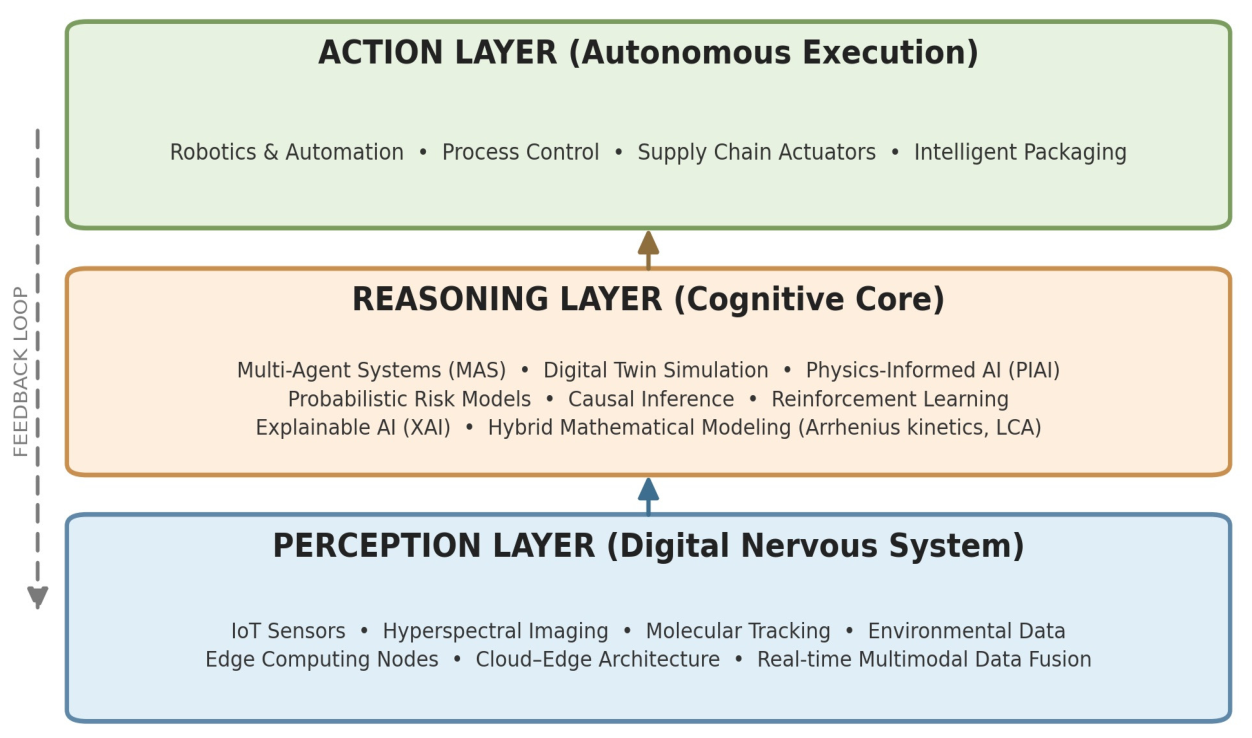
- Architectural specification. Propose a unified three-layer Perception–Reasoning–Action architecture integrating Digital Twins for food system optimization, with explicit data flows, interfaces, and boundary conditions [8].
- Critical and traceable synthesis. Synthesize reported performance ranges for agentic and traditional AI across safety, shelf-life, and sustainability domains, with source-by-source provenance [12].
- Theoretical framing. Operationalize Socio-Technical Systems (STS) theory into an adoption framework linking technology readiness, organizational capability, workforce skills, regulatory maturity, infrastructure, and SME resource constraints.
- Governance roadmap. Propose a tiered governance model mapped to HACCP, ISO 22000, FDA expectations, and the EU AI Act, with explicit accountability allocation [13].
1.2. Literature Review: A Critical Synthesis
2. An Architectural Framework for Agentic AI in Food Systems
2.1. Defining Agentic AI: Conceptual Boundaries
2.2. The Three-Layer Architecture: Operational Logic
2.3. Methodology: Structured Literature Synthesis and Proposed Validation Protocol
3. Enhancing Food Safety Through Probabilistic Risk Assessment
3.1. Real-Time Contaminant Detection
- (i)
- Robotic separation of flagged products;
- (ii)
- Cross-referencing contamination signatures against the hazard database to identify pathogen strain and source vectors;
- (iii)
- Automated notification to downstream distribution nodes;
- (iv)
- Root-cause analysis inside the Digital Twin to simulate upstream failures and recommend corrections.
3.2. Probabilistic Risk Modeling
4. Extending Shelf Life via Intelligent Systems and Predictive Modeling
5. Reducing Environmental Impact Through Integrated LCA
5.1. Methodological Boundaries of the Integrated LCA
5.2. Quantified Impacts Against Traditional Baselines
5.3. Discussion of Results and Implications for Existing Standards
6. Evidence Traceability, Comparative Benchmarking, Governance, and Adoption
6.1. Source-by-Source Evidence Traceability

| Claimed Value | Domain | Primary Source (s) | Baseline | Method/Context | Scale/Sample | Uncertainty | Tier | Agentic-Specific? |
|---|---|---|---|---|---|---|---|---|
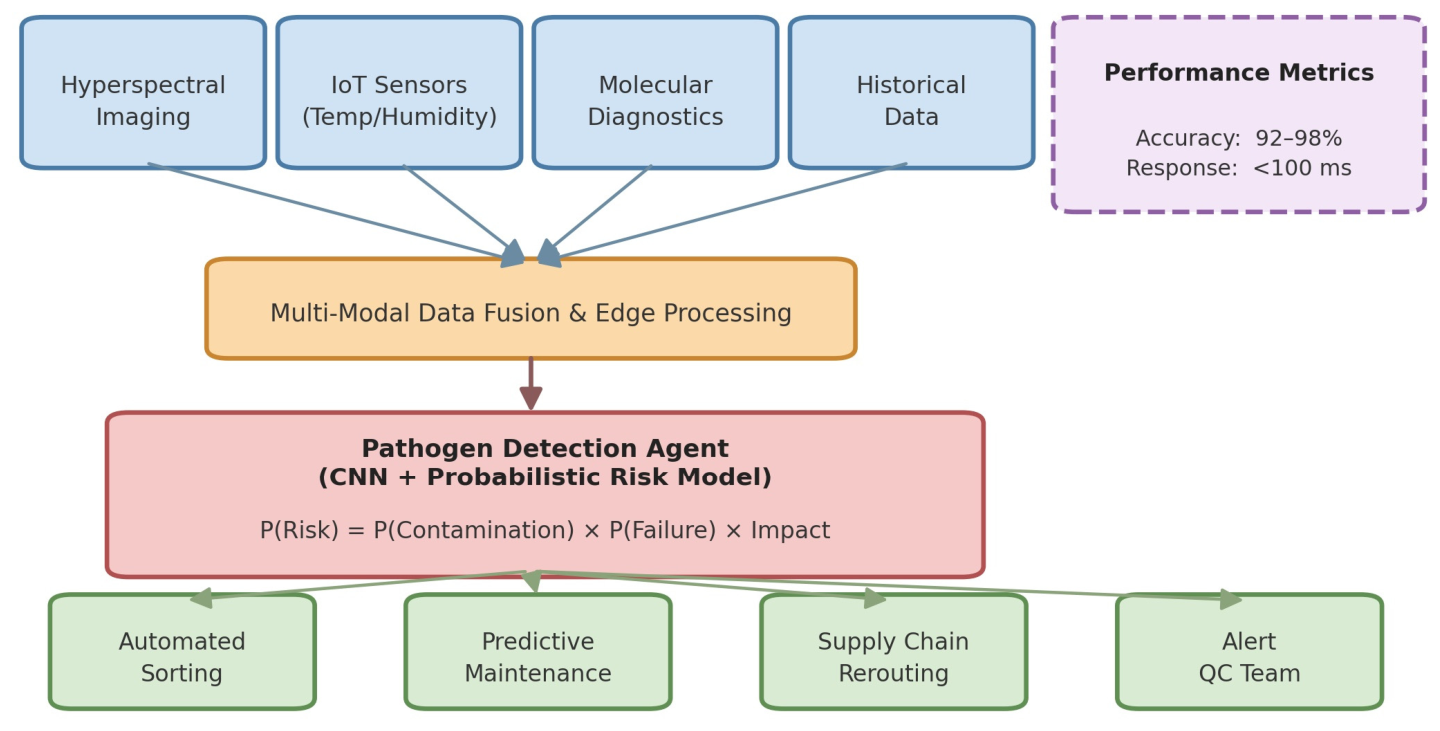
| 92–98% detection accuracy; sub-100 ms response; 90–96% precision, 91–97% recall | Safety | Kamruzzaman et al. [14]; Wang et al. [12] | Visual inspection 75–82%; culture 24–48 h | HSI/NIR + CNN, poultry and meat inspection | Lab-scale samples and pilot lines | ±3–5 pp across studies | T2/T4 | No—perception subsystem |
| 85–92% reduction in contaminated-product distribution | Safety | Simulation of cascaded containment (this framework) | Batch recall | DT simulation of detection-to-containment cascade | Simulated industrial line | Model-dependent | T3 | Yes (projected) |
| 15–25% recall-incident reduction | Safety | Wang et al. [12]; EFSA [15] | Reactive recall systems | Proactive risk-triggered mitigation | Review-level synthesis | Range across contexts | T3/T4 | Partially |
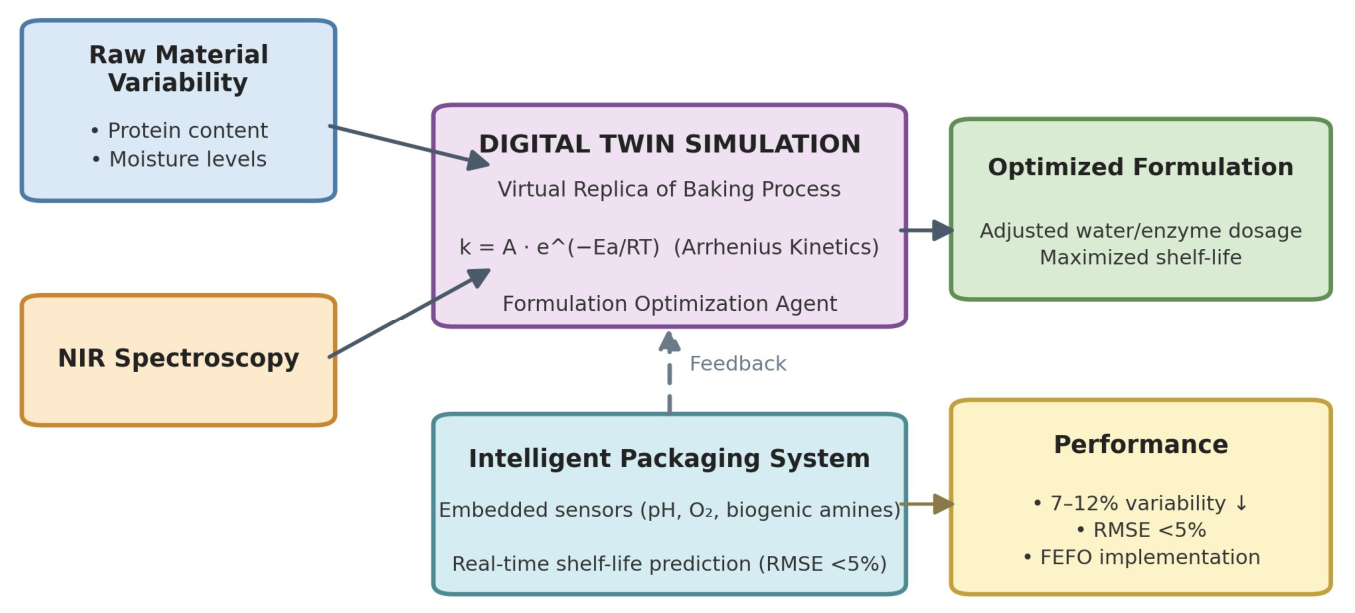
| RMSE <5% remaining shelf life; 18–22% retail waste reduction (FEFO) | Shelf life | Ghaani et al. [36]; packaging/cold-chain literature | Static date labels | Time–temperature monitoring + dynamic recalculation; retail perishables | Retail pilots (perishables) | Category-dependent | T2/T4 | No—enabler for agentic FEFO |
| 7–12% variability reduction; 3–5 days shelf-life extension; ~15% additive-waste reduction | Shelf life/formulation | Grigoryan et al. [37] | Fixed formulation | AI-driven formulation optimization (compounding; transferable to dry goods) | Platform case studies | Context-specific | T2/T4 | No |
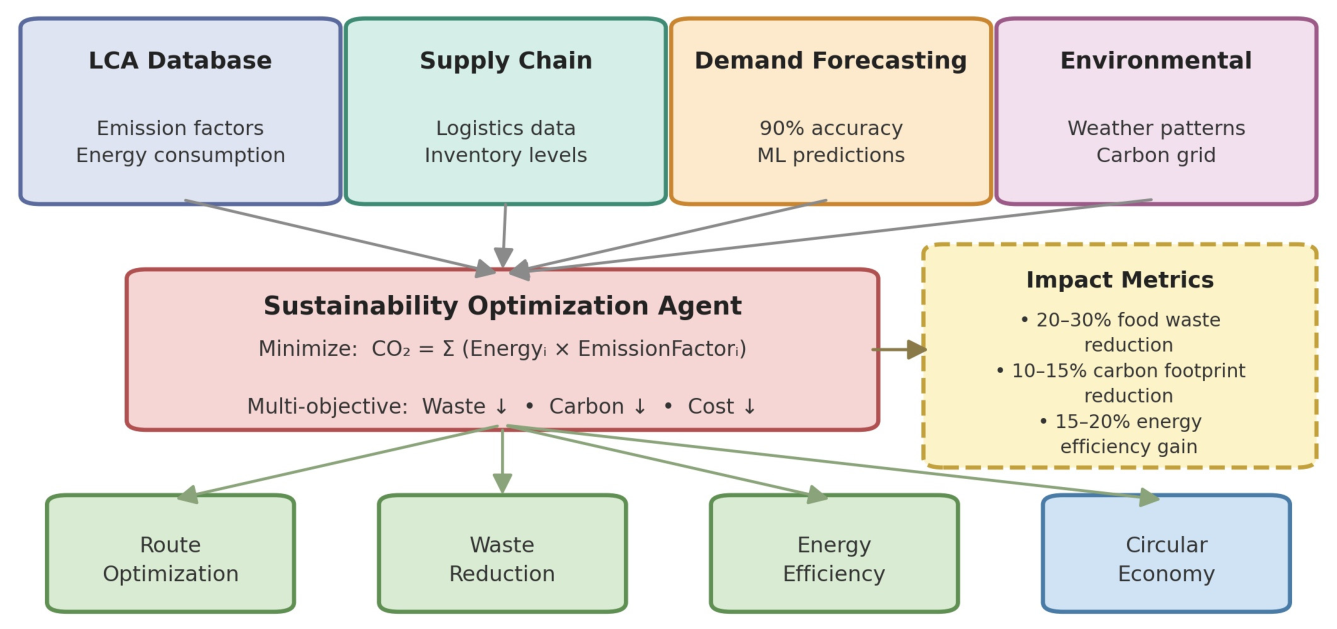
| 20–30% food-waste reduction; up to 90% forecast accuracy | Sustainability | Clark et al. [23]; Shadid et al. [24] | 5–8% reduction | LSTM forecasting + dynamic inventory; reviews of data-driven waste management | Hospitality/retail, review scale | Heterogeneous contexts | T3/T4 | Partially |
| 10–15% carbon reduction | Sustainability | Route-optimization literature (method: [7], RL foundations) | 4–7% reduction | Multi-objective routing with refrigeration constraints | Fleet studies | Route/network-dependent | T3/T4 | Partially |
| 15–20% energy-efficiency improvement | Sustainability | Cold-chain energy studies | 5–8% improvement | MPC + learning control of refrigeration | Cold-chain operations | Cold-chain scope only | T3/T4 | Partially |
| 5–10% water-use reduction | Sustainability | Processing/irrigation pilots | 2–4% reduction | Sensor-driven irrigation; demand-optimized CIP | Pilot scale | Site-dependent | T3/T4 | Partially |
| 60–80% bandwidth reduction | Infrastructure | Shi et al. [29] | Cloud-only pipelines | Edge filtering and anomaly detection | Edge-computing deployments | Workload-dependent | T4 | No—enabler |
6.2. Domain-Specific Benchmarking Against Task-Specific Baselines
6.3. Challenges
6.4. Tiered Governance Model and Regulatory Mapping
- Level 1 (Monitoring): agents recommend; humans execute. Corresponds to current HACCP/ISO 22000 practice, where critical control points require human disposition.
- Level 2 (Supervised autonomy): agents execute routine decisions inside bounded envelopes; humans retain override with guaranteed override latency; every autonomous action and override is logged.
- Level 3 (Full autonomy within envelopes): agents operate independently inside validated operational envelopes, with ex-post auditing via immutable logs [30].
6.5. A Socio-Technical Adoption Framework
7. Conclusions, Limitations, and Future Research Agenda
Author Contributions
Funding
Data Availability Statement
Conflicts of Interest
References
- WHO. Foodborne Disease Burden Epidemiology Reference Group (FERG) Estimates; World Health Organization: Geneva, Switzerland, 2022; Available online: https://www.who.int/publications/i/item/9789240100510 (accessed on 14 April 2026).
- FAO. The State of Food and Agriculture 2023; FAO: Rome, Italy, 2023. [Google Scholar] [CrossRef] [Scilit]
- Poore, J.; Nemecek, T. Reducing food’s environmental impacts through producers and consumers. Science 2018, 360, 987–992. [Google Scholar] [CrossRef] [Scilit] [PubMed]
- Crippa, M.; Solazzo, E.; Guizzardi, D.; Monforti-Ferrario, F.; Tubiello, F.N.; Leip, A. Food systems are responsible for a third of global anthropogenic GHG emissions. Nat. Food 2021, 2, 198–209. [Google Scholar] [CrossRef] [Scilit] [PubMed]
- FAO. Food Wastage Footprint: Impacts on Natural Resources; FAO: Rome, Italy, 2013. [Google Scholar]
- Pearl, J.; Mackenzie, D. The Book of Why: The New Science of Cause and Effect; Basic Books: New York, NY, USA, 2018. [Google Scholar]
- Sutton, R.S.; Barto, A.G. Reinforcement Learning: An Introduction, 2nd ed.; MIT Press: Cambridge, MA, USA, 2018. [Google Scholar]
- Gavai, A.K.; Heringa, J. Agentic artificial intelligence in food science. Food Humanit. 2026, 6, 101132. [Google Scholar] [CrossRef] [Scilit]
- Wooldridge, M. An Introduction to Multiagent Systems; John Wiley & Sons: Hoboken, NJ, USA, 2009. [Google Scholar]
- Karniadakis, G.E.; Kevrekidis, I.G.; Lu, L.; Perdikaris, P.; Wang, S.; Yang, L. Physics-informed machine learning. Nat. Rev. Phys. 2021, 3, 422–440. [Google Scholar] [CrossRef] [Scilit]
- Gavai, A.K.; Meuwissen, M.P.M. Agentic AI as a coordination paradigm in digital health and agri-food systems. Patterns 2026, 7, 101496. [Google Scholar] [CrossRef] [Scilit] [PubMed]
- Wang, K.; Mirosa, M.; Hou, Y.; Bremer, P. Advancing food safety behavior with AI: Innovations and opportunities in the food manufacturing sector. Trends Food Sci. Technol. 2025, 161, 105050. [Google Scholar] [CrossRef] [Scilit]
- Gunning, D.; Aha, D. DARPA’s explainable artificial intelligence (XAI) program. AI Mag. 2019, 40, 44–58. [Google Scholar] [CrossRef] [Scilit]
- Kamruzzaman, M.; ElMasry, G.; Sun, D.W.; Allen, P. Non-destructive prediction and visualization of chemical composition in lamb meat using NIR hyperspectral imaging and multivariate regression. Innov. Food Sci. Emerg. Technol. 2012, 16, 218–226. [Google Scholar] [CrossRef] [Scilit]
- European Food Safety Authority. Guidance on whole genome sequencing for food safety risk assessment. EFSA J. 2022, 20, e07284. [Google Scholar] [CrossRef] [Scilit]
- Yu, W.; Ouyang, Z.; Zhang, Y.; Lu, Y.; Wei, C.; Tu, Y.; He, B. Research progress on the artificial intelligence applications in food safety and quality management. Trends Food Sci. Technol. 2025, 156, 104855. [Google Scholar] [CrossRef] [Scilit]
- van Meer, F.; Takeuchi, M.; Ochieng, P.E.; Tavelli, R.; Gerssen, A.; van der Velden, B.H.M. Artificial intelligence in food safety. npj Sci. Food 2026, 10, 294. [Google Scholar] [CrossRef] [Scilit] [PubMed]
- Labuza, T.P.; Riboh, D. Time to failure of packaged foods. Food Technol. 1982, 36, 66–74. [Google Scholar]
- Du, H.; Sun, X.; Chong, X.; Yang, M.; Zhu, Z.; Wen, Y. A review on smart active packaging systems for food preservation: Applications and future trends. Trends Food Sci. Technol. 2023, 141, 104200. [Google Scholar] [CrossRef] [Scilit]
- Mobahi, N.; Razavi, M.A.; Ekrami, M.; Emam-Djomeh, Z.; Razavi, S.H. AI-integrated bio-nanocomposite food packaging: Sustainable, functional, and intelligent solutions. Trends Food Sci. Technol. 2025, 165, 105336. [Google Scholar] [CrossRef] [Scilit]
- Madhu, B. AI-driven food packaging systems: A new frontier in intelligent food safety and shelf-life management. J. Food Sci. 2025, 90, e70716. [Google Scholar] [CrossRef] [Scilit] [PubMed]
- Melikoglu, M. Artificial intelligence and deep learning in food shelf life management: A global review. Food Humanit. 2026, 6, 101089. [Google Scholar] [CrossRef] [Scilit]
- Clark, Q.M.; Kanavikar, D.B.; Clark, J.; Donnelly, P.J. Exploring the potential of AI-driven food waste management strategies used in the hospitality industry for application in household settings. Front. Artif. Intell. 2025, 7, 1429477. [Google Scholar] [CrossRef] [Scilit] [PubMed]
- Shadid, N.; Ahmed, V.; Bahroun, Z. A systematic review of data-driven approaches to food waste and loss management. Clean. Waste Syst. 2025, 12, 100448. [Google Scholar] [CrossRef] [Scilit]
- Zghair, H.; Konathala, R.G. Using AI for optimizing packing design and reducing cost in e-commerce. AI 2025, 6, 146. [Google Scholar] [CrossRef] [Scilit]
- Onyeaka, H.; Akinsemolu, A.; Miri, T.; Nnaji, N.D.; Duan, K.; Pang, G.; Tamasiga, P.; Khalid, S.; Al-Sharify, Z.T.; Ugwa, C. Artificial intelligence in food system: Innovative approach to minimizing food spoilage and food waste. J. Agric. Food Res. 2025, 21, 101895. [Google Scholar] [CrossRef] [Scilit]
- Zou, Y.; Gao, Q.; Wu, H.; Liu, N. Carbon-efficient scheduling in fresh food supply chains with a time-window-constrained deep reinforcement learning model. Sensors 2024, 24, 7461. [Google Scholar] [CrossRef] [Scilit] [PubMed]
- Salih, A.S.; Akmal, N.; Alhajri, A.; Alhabsi, A.; Al-Belushi, M.; Al-Maskari, N. A perspective on explainable artificial intelligence methods: SHAP and LIME. arXiv 2024, arXiv:2305.02012. [Google Scholar] [CrossRef] [Scilit]
- Shi, W.; Cao, J.; Zhang, Q.; Li, Y.; Xu, L. Edge computing: Vision and challenges. IEEE Internet Things J. 2016, 3, 637–646. [Google Scholar] [CrossRef] [Scilit]
- Peddareddigari, S.; Vijayan, S.V.H.; Annamalai, M. IoT, blockchain, big data and artificial intelligence (IBBA) framework—For real-time food safety monitoring. Appl. Sci. 2024, 15, 105. [Google Scholar] [CrossRef] [Scilit]
- Huang, Y.; Ghadge, A.; Yates, N. Implementation of digital twins in the food supply chain: A review and conceptual framework. Int. J. Prod. Res. 2024, 62, 6400–6426. [Google Scholar] [CrossRef] [Scilit]
- Liu, E.; Yang, H.; Sharma, S.; van Leerdam, M.B.; Niu, P.; VandeHaar, M.J.; Hostens, M. Agents are all you need: Pioneering the use of agentic artificial intelligence to embrace large language models into dairy science. J. Dairy Sci. 2025, 108, 14038–14049. [Google Scholar] [CrossRef] [Scilit] [PubMed]
- Zheng, R.; Kamruzzaman, M. Explainable AI for hyperspectral imaging in food quality decision support: Interpretability, reliability and future directions. Crit. Rev. Food Sci. Nutr. 2026, 24, 6139–6159. [Google Scholar] [CrossRef] [Scilit] [PubMed]
- Borrás-Hidalgo, O.; Ding, F.; El Sheikha, A.F. Artificial intelligence and digital twins: Pathways to climate-resilient, traceable and equitable global food supply chains. Trends Food Sci. Technol. 2026, 28, 105973. [Google Scholar] [CrossRef] [Scilit]
- U.S. Food and Drug Administration. New Era of Smarter Food Safety Blueprint; FDA: Silver Spring, MD, USA, 2021. Available online: https://www.fda.gov/food/new-era-smarter-food-safety (accessed on 14 April 2026).
- Ghaani, M.; Cozzolino, C.A.; Castelli, G.; Farris, S. An overview of the intelligent packaging technologies in the food sector. Trends Food Sci. Technol. 2020, 51, 1–11. [Google Scholar] [CrossRef] [Scilit]
- Grigoryan, A.; Helfrich, S.; Lequeux, V.; Lapras, B.; Marchand, C.; Merienne, C.; Bruno, F.; Mazet, R.; Pirot, F. Smart Formulation: AI-driven web platform for optimization and stability prediction of compounded pharmaceuticals using KNIME. Pharmaceuticals 2025, 18, 1240. [Google Scholar] [CrossRef] [Scilit] [PubMed]
- Roy, P.; Das, D. AI in food safety and traceability: Legal and ethical dimensions of next-generation food systems. Curr. Opin. Food Sci. 2026, 6, 101436. [Google Scholar] [CrossRef] [Scilit]



| Strand | Representative Works | What the Strand Delivers | Residual Gap |
|---|---|---|---|
| Contaminant detection and food safety | Kamruzzaman et al. [14]; Wang et al. [12]; EFSA [15] Yu et al. [16]; van Meer et al. [17] | Hyperspectral and NIR detection; AI-enabled safety monitoring; regulatory guidance on genomics and AI | Detection stops at flagging. No autonomous containment, no closed-loop risk mitigation, limited causal reasoning. |
| Shelf-life prediction and intelligent packaging | Labuza & Riboh [18]; Du et al. [19]; Mobahi et al. [20] Madhu [21]; Melikoglu [22] | Kinetic degradation models; active and intelligent packaging with embedded sensing | Static or batch-level prediction. Packaging senses but does not reconfigure logistics or formulation in response. |
| Logistics, demand forecasting, and waste | Clark et al. [23]; Shadid et al. [24]; Zghair & Konathala [25] Onyeaka et al. [26]; Zou et al. [27] | Data-driven forecasting and waste management; agent-based modeling elements | Isolated optimization of single objectives. Cross-objective trade-offs (safety vs. waste vs. carbon) unresolved. |
| Digital Twins, MAS, XAI, and edge infrastructure | Wooldridge [9]; Gavai & Heringa [8]; Gunning & Aha [13]; Salih et al. [28]; Shi et al. [29]; Peddareddigari et al. [30] Huang et al. [31]; Liu et al. [32]; Gavai and Meuwissen [11]; Zheng and Kamruzzaman [33]; Borrás-Hidalgo et al. [34] | Coordination theory; DT concepts; explainability methods; cloud–edge plumbing; FAIR data standards | Components exist, but perception, reasoning, action, and governance are not integrated into one governed closed loop. |
| Construct | Core Function | Acts on the Physical Process? | Adapts Objectives Online? | Relation to Agentic AI |
|---|---|---|---|---|
| Traditional predictive AI | Classify, forecast, score | No; human acts on output | No; static objectives | Perception component |
| AI-enabled automation | Execute fixed rules on model output | Yes, but only pre-programmed responses | No | Action component without reasoning |
| Rule-based control (e.g., PLC/HACCP alarms) | Threshold triggering | Yes | No | Special case of bounded action |
| Multi-agent systems (MAS) | Coordinate distributed agents | Indirectly | Partially, via negotiation | Architectural substrate [9] |
| Digital Twin (DT) | Mirror and simulate the process | No; prediction only | No | Simulation environment for the reasoning layer [8] |
| Reinforcement learning (RL) | Learn policies from reward | In silico, typically | Within a fixed reward function | Learning mechanism [7] |
| Autonomous robotics | Physical manipulation | Yes | At motion level | Actuation endpoint of the action layer |
| Agentic AI | Perceive–reason–act under governance | Yes, within bounded envelopes | Yes, via multi-objective reasoning | The construct proposed here |
| Feature | Traditional AI (Predictive) | Agentic AI (Adaptive) |
|---|---|---|
| Scope | Narrow, task-specific | Broad, multi-objective optimization |
| Autonomy | Human-in-the-loop required | Bounded autonomy with oversight tiers |
| Reasoning | Pattern recognition, correlation | Causal inference, mathematical modeling |
| Adaptability | Static or batch retraining | Continuous learning, real-time updating |
| Integration | Siloed data streams | Multimodal sensor fusion, cloud–edge |
| Governance | External to the model | Embedded (XAI, audit trails, autonomy tiers) |
| Sustainability Metric | Traditional AI Baseline (Reported) | Agentic AI (Reported Range) | Incremental Benefit Attributed to Agency | Mechanism | Provenance and Scope |
|---|---|---|---|---|---|
| Food waste | 5–8% reduction (isolated forecasting/inventory models) | 20–30% reduction | ~3–4× | Predictive demand (up to 90% accuracy) coupled to FEFO execution and dynamic repricing | T3/T4; retail and hospitality contexts |
| Carbon footprint | 4–7% reduction (static route optimization, periodic re-planning) | 10–15% reduction | ~2× | Continuous multi-objective routing, refrigeration scheduling, renewable-aware energy dispatch | T3/T4; logistics operations |
| Energy efficiency | 5–8% improvement (conventional control and scheduling) | 15–20% improvement in cold-chain operations | ~2–3× | MPC plus learning-based control of refrigeration and processing set-points | T3/T4; cold-chain-specific—see scope note below |
| Water usage | 2–4% reduction (timer/rule-based CIP and irrigation) | 5–10% reduction | ~2× | Sensor-driven precision irrigation; demand-optimized CIP cycles | T3/T4; processing and irrigation pilots |
| Domain | Task-Specific Baseline | Baseline Performance (Reported) | Agentic Approach | Reported Improvement | Evidence Tier | Key Caveat |
|---|---|---|---|---|---|---|
| Safety inspection | Computer-vision flagging, human disposition | 85–90% accuracy; hours-to-days response | Closed-loop detection-to-containment with PRA gating | 92–98% accuracy; seconds-to-minutes response (1.08–1.15× accuracy; 60–1000× latency) | T2/T4 + T3 projection | Accuracy from imaging studies; latency gain mostly from automation of response, not detection |
| Shelf-life management | Static dating; batch kinetic models | Fixed dates; no in-chain recalculation | Dynamic recalculation + FEFO execution | RMSE <5%; 18–22% retail waste reduction | T2/T4 | Perishable retail categories only |
| Demand and inventory | Conventional forecasting (ARIMA/exponential smoothing) + manual replenishment | 5–8% waste reduction | LSTM with exogenous regressors + autonomous replenishment/repricing | 15–25% waste reduction (3–5×) | T3/T4 | Retail/hospitality contexts; chain-wide effect unproven |
| Process energy control | Model predictive control with fixed set-points | 5–8% improvement | Learning-augmented MPC with continuous retuning | 15–20% improvement, cold chain only | T3/T4 | Cold-chain scope; not generalizable (Section 5.2) |
| Process optimization | Open-loop Digital Twin (monitor/predict) | Advisory only | Closed-loop twin with simulate-before-act gating | Qualitative shift: prediction → governed action | T3 | Maturity TRL 4–5 for integrated systems |
| Governance Element | Level 1 | Level 2 | Level 3 | Linked Instruments |
|---|---|---|---|---|
| Decision rights | Human | Agent, routine scope | Agent, validated envelope | HACCP CCP disposition rules; ISO 22000 FSMS |
| Human oversight | Executes all actions | Override anytime; periodic review | Exception-based supervision | EU AI Act Art. 14 human oversight; FDA New Era |
| Audit trail | Decision logs | Immutable action + override logs | Full ex-post audit; blockchain anchoring | FSMA Rule 204 traceability; EU Reg. 178/2002; EU AI Act logging |
| Validation gate to advance | — | Sustained compliance over defined observation period | Independent third-party certification | Proposed ‘Algorithmic Food Safety’ certification; Codex Alimentarius harmonization |
| Cybersecurity | Baseline | Adversarial testing; drift monitoring | Continuous red-teaming; federated updates | EU AI Act robustness; ISO/IEC security standards |
| Post-deployment monitoring | Incident reporting | Drift detection; periodic re-validation | Continuous assurance; mandatory recall-to-Level-1 triggers | EU AI Act post-market monitoring |
| Liability and accountability | Food business operator | Operator + system deployer shared, per contract | Operator, deployer, and manufacturer per accountability matrix below | Product-liability and food-law frameworks |
Disclaimer/Publisher’s Note: The statements, opinions and data contained in all publications are solely those of the individual author(s) and contributor(s) and not of MDPI and/or the editor(s). MDPI and/or the editor(s) disclaim responsibility for any injury to people or property resulting from any ideas, methods, instructions or products referred to in the content. |
© 2026 by the authors. Licensee MDPI, Basel, Switzerland. This article is an open access article distributed under the terms and conditions of the Creative Commons Attribution (CC BY) license.
Share and Cite
Tsinakos, A.A.; Tsinakou, E.M. Agentic Artificial Intelligence in Food Science: A Conceptual Framework and Structured Synthesis for Food Safety, Shelf-Life Extension, and Environmental Sustainability. Standards 2026, 6, 38. https://doi.org/10.3390/standards6040038
Tsinakos AA, Tsinakou EM. Agentic Artificial Intelligence in Food Science: A Conceptual Framework and Structured Synthesis for Food Safety, Shelf-Life Extension, and Environmental Sustainability. Standards. 2026; 6(4):38. https://doi.org/10.3390/standards6040038
Chicago/Turabian StyleTsinakos, Avgoustos A., and Elena Maria Tsinakou. 2026. "Agentic Artificial Intelligence in Food Science: A Conceptual Framework and Structured Synthesis for Food Safety, Shelf-Life Extension, and Environmental Sustainability" Standards 6, no. 4: 38. https://doi.org/10.3390/standards6040038
APA StyleTsinakos, A. A., & Tsinakou, E. M. (2026). Agentic Artificial Intelligence in Food Science: A Conceptual Framework and Structured Synthesis for Food Safety, Shelf-Life Extension, and Environmental Sustainability. Standards, 6(4), 38. https://doi.org/10.3390/standards6040038