


Abstract
The posterior shoulder endurance test (PSET) is increasingly used in clinical and sporting settings; however, substantial methodological variability limits its interpretation and application with no current standardised guidelines for the PSET. Therefore, the aim of this narrative review was to critically evaluate the methodological variability within the PSET literature and provide evidence-informed recommendations for its standardised implementation. Considerable variation was identified in shoulder abduction angle, contraction mode, external load prescription, cadence, familiarisation procedures, verbal instruction, and failure criteria. Although the PSET demonstrates moderate-to-good relative reliability in some protocols, measurement variability limits its sensitivity to detect meaningful change at the individual level. Current evidence also highlights that the PSET performance reflects an integrated task involving posterior shoulder musculature, scapulothoracic control, trunk stability, and broader neuromuscular contributions rather than an isolated measure of posterior shoulder endurance. Consequently, the PSET should be interpreted as a task-based performance assessment rather than a discrete measure of muscular endurance. A structured framework is proposed to guide standardised test selection, implementation, and reporting. At present, the PSET is best utilised as a benchmarking tool within a clearly defined protocol, with further research required to establish its role in monitoring and to clarify the construct it represents.
1. Introduction
Shoulder pain and injury are highly prevalent in both athletic and general populations [1], with particularly high incidence observed in overhead athletes due to the repetitive and high-load demands placed on the glenohumeral joint [2]. These demands require not only maximal force production but also the capacity to sustain submaximal contractions over time, highlighting the importance of strength endurance as a key physical quality underpinning both performance and injury risk [3]. While traditional assessment methods have largely focused on maximal strength [4], there is growing recognition that strength endurance may offer greater ecological validity in sports characterised by repetitive loading [5,6].
Currently, isokinetic dynamometry (IKD), which aims to assess force at a fixed angular velocity, is widely regarded as the gold standard for assessing single joint strength (including the shoulder) and fatigue-related characteristics, providing objective measures such as torque, fatigue index, and decay slope [7,8]. However, IKD utilisation is limited by the financial and time burden, with the laboratory-based nature reducing the ability to assess large number of athletes; reduced ability to replicate long-lever, multi-planar movement; and an inability to incorporate kinetic chain integrated movements that typify overhead sport [9]. These limitations have contributed to the increased use of functional performance tests (FPT) within applied practice, which aim to provide accessible, task-based assessments of upper limb function within clinically and sport-relevant contexts [10].
Among the FPT used in practice, the posterior shoulder endurance test (PSET) has emerged as a commonly used assessment designed to evaluate the endurance capacity of the posterior shoulder musculature in a long-lever position [11]. The test is typically performed in prone, with the arm elevated and externally rotated, and can be conducted using either an isometric protocol [12,13,14,15,16,17], where the position is held until fatigue, or an isotonic protocol, where repeated horizontal abduction movements are performed to failure [11,18,19,20,21,22]. Outcomes are commonly expressed as time to task failure (TTF) or repetitions to failure (RTF), and the test is often externally loaded.
Despite its increasing use in both practice in sporting and clinical and research settings, there is currently no consensus regarding the standardised application of the PSET. Substantial methodological variation exists across studies and in practice, including differences in shoulder abduction angle (e.g., 90° vs. 135°), test mode (isometric vs. isotonic), external load prescription (fixed body mass percentages vs. strength-normalised loads), cadence, failure criteria, and outcome measures. These inconsistencies are not trivial; each has the potential to alter the mechanical and physiological demands of the task, thereby influencing test performance and, critically, what the test is interpreted to measure. The absence of standardisation presents several challenges, specifically, limiting the comparability of findings across studies, restricting the development of a coherent evidence base [23]. Second, it introduces variability that may inflate measurement error, reducing the sensitivity of the test to detect meaningful change over time [24]. Third, and perhaps most importantly, methodological inconsistency risks conflating distinct constructs [25], whereby variations of the PSET may assess different combinations of strength, endurance, motor control, and task tolerance under the same test label.
Standardisation is a fundamental requirement for any clinical or performance-based assessment to ensure reliability (i.e., consistency in the rank order and variability in the measurement between trials), interpretability, and translational utility for applied practitioners. This has been clearly demonstrated in other areas of physical performance testing [26,27], where consensus-based guidelines have improved both the quality and applicability in the assessment of lower limb force production. However, no such framework currently exists for the PSET. Therefore, the aim of the present narrative review is to critically evaluate the methodological variability of the PSET and to provide evidence-informed recommendations for its standardised application in clinical, sporting, and research settings. Having increased utilisation of the PSET in clinical, sporting, and research settings and not having a standardised approach limit the current utility and application of the PSET. By identifying key sources of variability and their potential impact on test outcomes, this work seeks to support more consistent implementation, improve measurement quality, and facilitate clearer interpretation of PSET-derived data for practitioners using the PSET.
2. Posterior Shoulder Endurance Test
The PSET has been designed as an ecologically valid FPT, aimed to assess posterior shoulder strength endurance, with increasing use in research and applied practice [5,11,18,19,22,28,29]. However, the methodological consistency of the PSET remains limited. Variations in test design, including abduction angle, external load prescription, contraction mode (isometric vs. isotonic), and outcome selection, are common (Table 1). This lack of consistency presents a challenge when comparing findings across studies and limits the development of clear clinical or performance-based recommendations.
Table 1.
Reporting of relative and absolute reliability metrics across studies investigating the posterior shoulder endurance test (PSET).
2.1. Reliability
Despite the variety of PSET protocols, relative reliability is typically reported as poor to good (ICC ≈ 0.48–0.85) [11,17,20,21], indicating that the test can generally preserve the ranking of individuals across sessions [30,31]. However, confidence intervals are often wide, reflecting variability in measurement stability [31]. Absolute reliability demonstrated greater inconsistency. However, the standard error of measurement (SEM) values have only been reported in four studies [11,17,20,21], limiting comparison across protocols. Among these studies, measurement error ranged from relatively small to substantial, with coefficient of variation values reaching approximately 24% and minimal detectable change values ranging from approximately 4–30%, indicating limited sensitivity to detect small individual changes [11,17,20,21]. Collectively, these findings indicate that while the PSET may be suitable for group-level comparisons or profiling, its sensitivity to detect meaningful change at the individual level is limited. However, this could be limited by the lack of standardised protocols, including external loading and failure criteria.
2.2. Validity
The validity of the PSET is currently not well established or investigated and reflects a broader pattern observed in emerging musculoskeletal performance tests, where clinical and applied adoption has preceded rigorous construct validation (e.g., athletic shoulder test [32]). While several aspects of validity have been explored, the current evidence is limited by methodological inconsistency, small sample sizes, and a lack of clearly defined reference standards (Table 2).
Content validity refers to the extent to which a measurement instrument adequately represents the construct it is intended to assess [33]. The PSET is partially supported by electromyographic evidence demonstrating activation and fatigue of key posterior shoulder musculature, including the posterior deltoid and rotator cuff, during PSET performance [12]. However, the task is performed in a long-lever, gravity-dependent position that necessitates substantial contributions from scapulothoracic stabilisers, trunk musculature, and postural control systems. As such, the PSET cannot be considered a measure of isolated posterior shoulder strength endurance but rather a composite task reflecting integrated neuromuscular performance from the posterior kinetic chain.
Construct validity is the degree to which a test measures the theoretical construct it purports to measure, as demonstrated through patterns of relationships that are consistent with theory. Findings around the construct validity of the PSET remains inconsistent and is not yet clearly defined (Table 2). The PSET has demonstrated the ability to discriminate between symptomatic and asymptomatic shoulders (i.e., shoulder pain) and to identify functional deficits in clinical populations, suggesting sensitivity to shoulder dysfunction [17]. However, this does not confirm specificity of the underlying construct. Correlational evidence further complicates interpretation, where PSET outcomes demonstrate variable and often weak associations with laboratory-based measures, including IKD [20], particularly for fatigue-related indices [34]. In contrast, stronger associations are sometimes observed with measures of maximal or submaximal strength, raising the possibility that performance is influenced more by general force-producing capacity than by isolated endurance characteristics [34]. This is a consistent trend within the literature, with maximal strength commonly being positively associated with local muscular endurance even across different loading prescriptions [35]. Stone et al. [36] highlighted the potential of two aspects of muscular endurance assessment, specifically an absolute and relative muscular endurance. An absolute assessment of muscular endurance, where a submaximal absolute load is used, possesses a moderate-strong relationship with maximal strength with increasing magnitude of association at increasing loads. Contrastingly, a relative assessment of muscular endurance is at a given percentage of maximum strength, which typically equates the amount of relative work performed across individuals of varying levels of strength [37]. This difference in muscular endurance assessment is a key consideration for the PSET as an external load is used within the long lever position, which has currently not been standardised. However, it typically uses an absolute load but with varying prescription (Table 2).
Finally, predictive validity is similarly limited for the PSET (Table 2). Although reduced PSET performance has been associated with increased shoulder pain risk in overhead athletes [18], these findings are typically derived from multivariable models in which the independent contribution of the PSET is unclear [18]. Consequently, it remains uncertain whether the test itself is predictive of pain or injury or whether it acts as a proxy for broader functional or workload-related factors.
Table 2.
An overview of studies investigating the validity of the posterior shoulder endurance test (PSET).
2.3. Methodological Factors
Substantial methodological variability exists in the application of the PSET, representing a primary source of inconsistency in both performance outcomes and interpretation. Unlike highly constrained laboratory-based assessments, the PSET is performed in a long-lever, gravity-dependent position that integrates multiple systems, including the glenohumeral joint, scapulothoracic articulation, trunk stabilisation, and broader kinetic chain contributions [21]. As a result, relatively small variations in test execution can meaningfully alter task demands, fatigue response, and ultimately test outcomes.
2.3.1. Test Position and Shoulder Abduction Angle
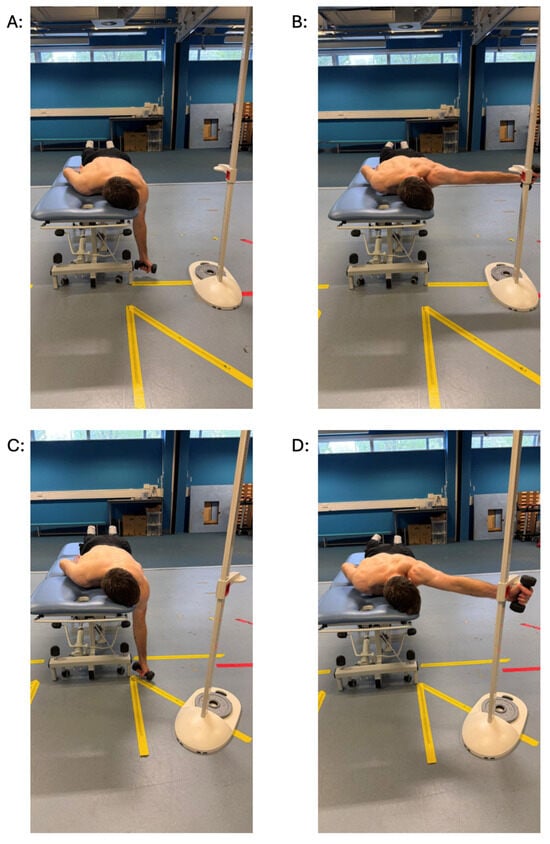
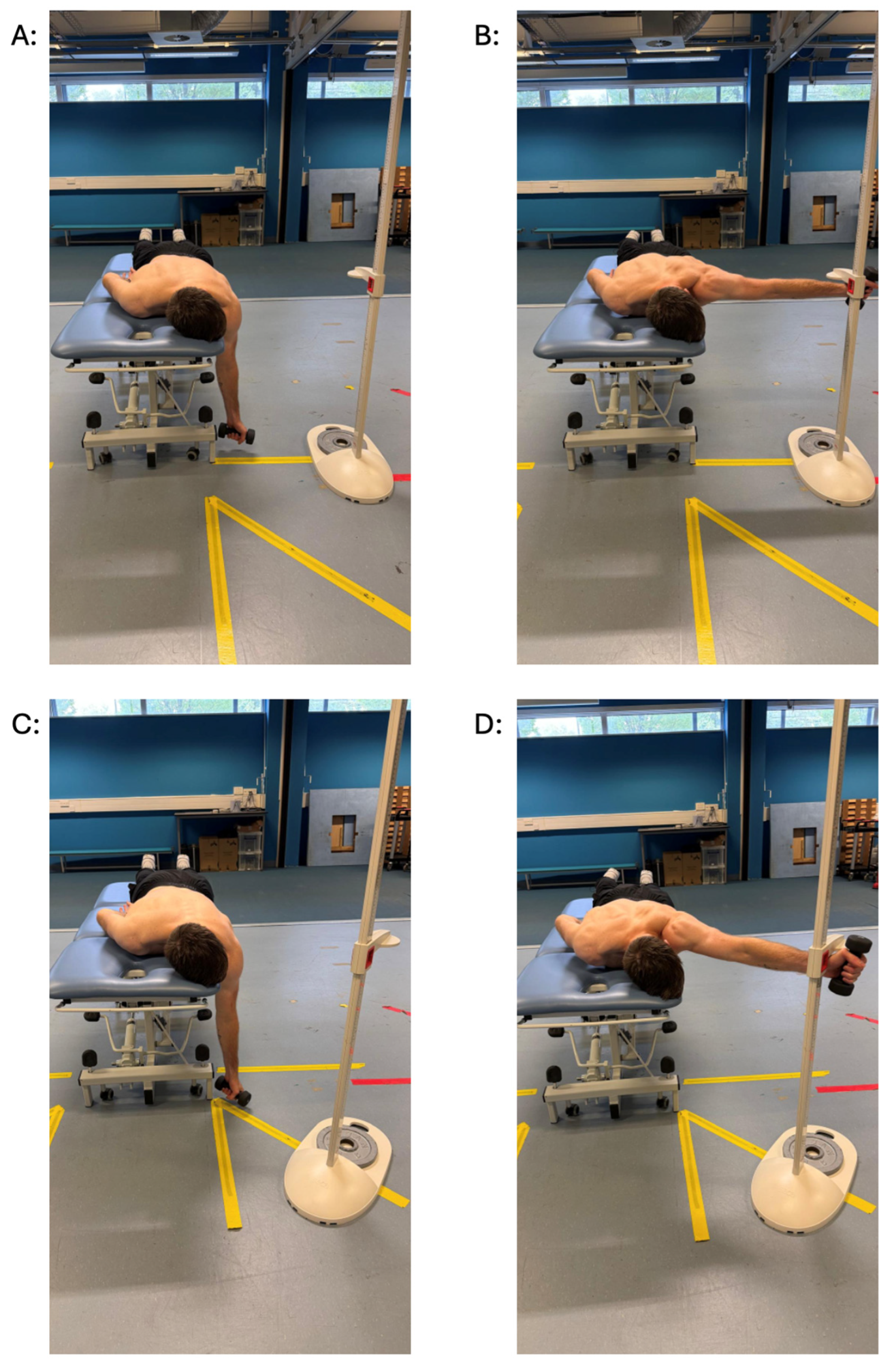
The PSET is performed in prone, with the arm positioned in horizontal abduction and external rotation (Figure 1). However, considerable variation exists in the selection of shoulder abduction angle (Figure 1); typically, researchers and practitioners have used 90° [11,21], 120° [20], and 135° [13]. Importantly, these positions are not interchangeable, as they alter muscle length–tension relationships, moment arm demands, and the relative contribution of stabilising musculature [38,39]. Higher abduction angles place the shoulder in a longer lever position, increasing the torque demand and making the task harder to sustain, which reduces time to failure [40,41]. Lower abduction angles reduce the external moment demand at the shoulder. Consequently, shoulder position should not be considered a neutral methodological choice but rather a defining feature of test execution that directly influences performance.
Figure 1.
Posterior shoulder endurance test start position (A); 90° and (C); 135°, end position (B); 90° and (D); 135°; laboratory-based set-up.
2.3.2. Contraction Mode
The PSET can be performed using either an isometric protocol, where the arm is held in a fixed position until failure (TTF), or an isotonic protocol, where repeated horizontal abduction movements are performed to fatigue (RTF). These contraction modes impose distinct physiological and mechanical demands because sustained isometric contractions are characterised by continuous force production and reduced muscle perfusion, whereas isotonic contractions involve repeated shortening and lengthening cycles that alter muscle activation patterns and fatigue behaviour [42,43]. Consequently, outcomes derived from isometric and isotonic PSET protocols may not be directly interchangeable, as they are likely to represent different aspects of posterior shoulder function rather than a single construct of shoulder endurance. Failure to account for these contraction-specific differences may contribute to the heterogeneity observed across reliability and validity findings within the PSET literature. Isometric protocols emphasise sustained force production and static limb stabilisation [44], whereas isotonic protocols introduce dynamic movement, coordination, and externally paced cadence constraints [45]. Therefore, contraction type should be considered a fundamental methodological variable, and isometric and isotonic PSET outcomes should be reported and interpreted independently rather than grouped under a single descriptor of posterior shoulder endurance.
2.3.3. External Load Prescription
External load prescription is a key determinant of task intensity and inter-individual comparability. Absolute loading strategies, including a percentage of body mass (e.g., 2% body mass), are simple to implement but do not account for individual differences in maximal strength, resulting in variable relative intensity across participants [46,47]. Anthropometric scaling approaches may improve mechanical consistency by accounting for limb length and lever characteristics but similarly fail to reflect individuals’ maximal force-generating capability. In contrast, relative loading aligns external resistance to an individual’s maximal capacity, thereby standardising relative effort and improving comparability [48,49,50].
2.3.4. Cadence
During isotonic variants of the PSET, the cadence utilised further introduces an additional layer of variability that is often inconsistently reported (Table 3). The use of a metronome to standardise movement tempo is common [51,52], typically prescribing a controlled raise–hold–lower sequence. However, variations in cadence alter time under tension, movement velocity, and fatigue characteristics, thereby influencing RTF [51,53]. Without standardisation, comparisons across studies or individuals become difficult, and the interpretation of performance is further compromised [24,54].
Table 3.
Methodological characteristics and test administration procedures reported across studies investigating the posterior shoulder endurance test (PSET).
2.3.5. Familiarisation and Warm-Up
The influence of familiarisation and warm-up procedures on physical performance tests is frequently overlooked despite evidence suggesting that inadequate standardisation can introduce learning effects, increase measurement error, and compromise the validity and reliability of performance outcomes [24,54,55,56]. Given the technical demands of maintaining a long-lever position under load, insufficient familiarisation may result in early task termination due to coordination deficits rather than physiological fatigue [57,58]. Similarly, variations in warm-up intensity and structure may influence initial performance capacity [59,60]. The absence of clearly defined and standardised preparation procedures therefore represents a potential source of measurement variability.
2.3.6. Verbal Instruction and Cueing
Verbal instruction plays a critical role in shaping task execution yet is rarely standardised within the PSET literature [61,62] (Table 3). Differences in cueing may influence movement strategy, muscle recruitment, and tolerance to fatigue. For example, instructions emphasising “holding position” may prioritise stability and endurance in contrast to a “pushing” cue [63], whereas cues focused on “movement quality” or “control” may alter pacing and coordination. Inconsistent cueing therefore introduces an additional, often unrecognised, source of variability in test performance [64].
2.3.7. Failure Criteria
Failure criteria represent one of the most important yet inconsistently defined aspects of the PSET. Across protocols, task termination may be determined by loss of arm position; visible compensatory movement from the trunk, scapula, elbow, and wrist along with the inability to maintain cadence (in isotonic protocols); or voluntary exhaustion [11,21]. The lack of standardised and operationalised definitions limits reproducibility and may contribute to variability in both relative and absolute reliability [65,66,67]. Importantly, failure in the PSET likely reflects a combination of local muscular fatigue, loss of neuromuscular control, and reduced task tolerance rather than a single physiological endpoint [57,58]. Therefore, further consideration is warranted for the utilisation, specifically for the compensatory mechanisms given the differences in compensation between positions used (e.g., 90° vs. 135°).
2.3.8. Outcome Measures
Performance in the PSET is expressed as TTF (i.e., seconds) or RTF (i.e., repetitions), protocol dependent. While these measures are practical and clinically accessible, they represent global indicators of task performance rather than isolated measures of posterior shoulder endurance [68,69]. As such, they should be interpreted within the context of the broader task demands and methodological configuration of the test. Specifically, with interest in movement compensation patterns, as the aim of a FPT is to assess function performance which should encompass all elements of performance output.
Collectively, these methodological factors highlight that the PSET is not a single, standardised test, but a group of related protocols in which changes in body position, loading, contraction mode, and test execution can meaningfully influence performance outcomes. The lack of standardisation across these factors limits comparisons between studies, increases measurement variability, and makes interpretation in clinical and sporting settings more difficult. Therefore, clear, evidence-informed recommendations for test design and reporting are needed to improve reproducibility and support the appropriate use of the PSET in both research and applied practice.
3. Standardisation Recommendations
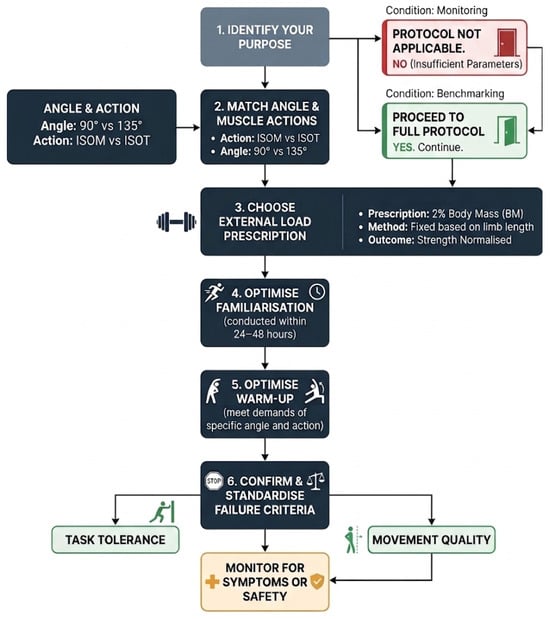
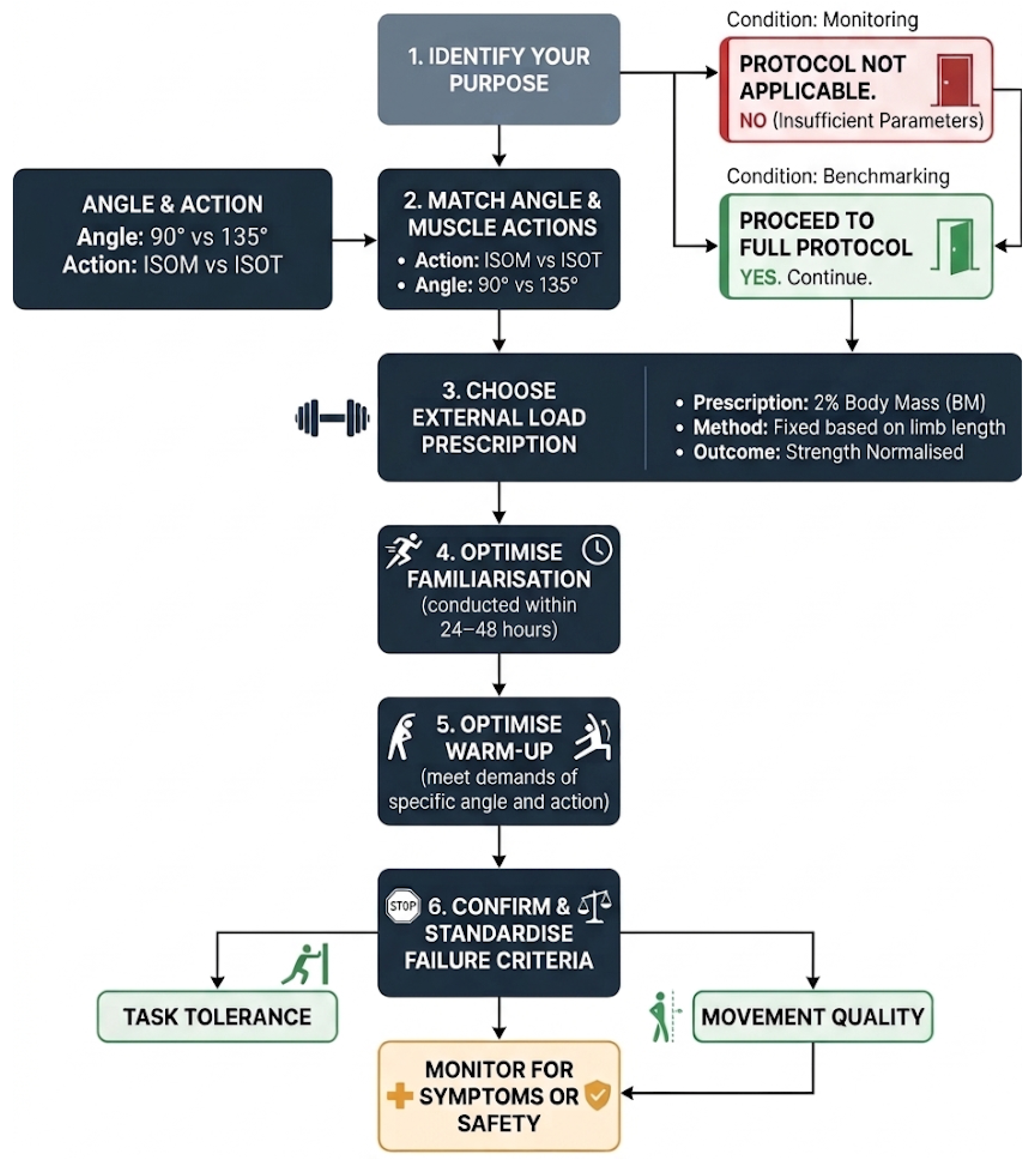
The standardisation of the PSET requires a structured, decision-based approach that reflects the interdependent nature of test configuration. The framework presented in Figure 2 provides a stepwise pathway to guide practitioners and researchers in selecting and implementing a consistent protocol for the PSET. Rather than representing isolated methodological choices, each component should be considered sequentially, as decisions made at earlier stages directly influence subsequent elements of test design and interpretation.
Figure 2.
Key considerations for practitioners when using the PSET enabling the formation of standard operating procedures.
3.1. Step 1: Define the Purpose of Testing
The first and most critical step is to establish the intended purpose of the assessment. Based on current evidence, the PSET should be positioned as a benchmarking tool rather than a monitoring assessment. While the test demonstrates acceptable relative reliability (Table 1), substantial absolute error limits its sensitivity to detect meaningful change at the individual level (Table 1). Defining the purpose at the outset ensures that subsequent decisions are interpreted within an appropriate measurement context and prevents overextension of the test beyond its current evidential support.
3.2. Step 2: Align Test Configuration to Task and Sporting Demands
Following purpose definition for implementation of the PSET, the practitioner must select the test configuration based on the specific demands or needs of the individual or sport. This includes the selection of shoulder abduction angle (90° or 135°) and modality (i.e., isometric or isotonic). These variables should not be interpreted as defining different constructs but rather as modifying the mechanical and physiological demands of the task that should be related to the expected demands.
3.3. Step 3: Prescribe External Load
External load should then be selected to define the relative intensity of the task. Three primary approaches are evident within the literature (Table 3); fixed loading (e.g., % body mass) is simple to apply but produces variable relative intensity, affecting comparison within a population. Anthropometric scaling improves mechanical consistency but does not account for strength capacity. Strength-normalised loading (e.g., % maximal voluntary isometric contraction) standardises relative effort across individuals. While current evidence is limited on the effect of load prescription impacting the underlying construct of the PSET, it has a clear influence on performance magnitude and inter-individual comparability. Accordingly, relative loading strategies are recommended, as they provide a more consistent representation of task demand without overextending claims regarding construct specificity. However, further investigation is warranted on the identification of a suitable maximal strength assessment for the posterior shoulder and the relative load prescribed.
3.4. Step 4: Standardise Test Execution
Once configuration and loading are established, the execution of the test must be standardised to minimise avoidable variability. Key elements include cadence and the use of a metronome to standardise movement tempo (e.g., 30–60 beats per min) and verbal instruction with consistent cueing to guide task execution for both isotonic and isometric protocols. Familiarisation and warm-up practices require practitioners to implement a standardised approach with structured preparation to reduce potential learning effects. Body position control is a further consideration, aiming for consistent alignment of trunk and upper limbs, including the use of visual guides for shoulder abduction. Variability in any of these factors can meaningfully alter performance outcomes, particularly given the integrated nature of the task to the posterior kinetic chain. Standardisation at this stage is therefore essential to improve reproducibility and reduce measurement error within the PSET.
3.5. Step 5: Define Failure Criteria
Failure criteria must be clearly defined and consistently applied, as they represent the endpoint of the test and directly determine the outcome measure. Across the literature, failure is variably defined; contributing to inconsistency in both reliability and interpretation. For standardised application, task termination should occur when one or more of the following criteria are met: a loss of the prescribed arm position, observable compensatory movement (e.g., trunk rotation, scapular substitution), an inability to maintain cadence (isotonic protocols), and volitional exhaustion. Importantly, failure in the PSET reflects a combination of muscular fatigue, neuromuscular control loss, and task tolerance rather than a single physiological threshold.
3.6. Step 6: Select and Report Outcome Measures
The final step is the selection and reporting of outcome measures. Performance is typically expressed as TTF for isometric protocols and RTF for isotonic protocols. These measures provide practical indicators of overall task performance but should not be interpreted as isolated measures of posterior shoulder endurance. Instead, they reflect the integrated demands of the task as configured within the preceding steps. Therefore, reporting of any compensatory patterns and changes in position or tempo should also be reported along with the global outcome measures.
4. Discussion
The aim of the present narrative review was to address the substantial methodological variability within the PSET literature and to provide a structured, evidence-informed framework for its standardised application within practice. The findings demonstrate that while the PSET is widely used across clinical and sporting contexts [11,12,13,14,15,17,18,19,20,21,22], the PSET is not a single, standardised test; rather, it is a flexible assessment in which changes in body position, contraction mode, load prescription, and test execution can meaningfully alter both the demands of the task and the resulting performance outcomes. As an FPT, which is based primarily on outcome (e.g., RTF or TTF), small alterations in the test setup and execution impact the inherent difficulty of the task impacting on the outcome, which will have potential implications on the practitioner interpretation. The areas of variability presented in the present review have important implications because differences in test design may lead to different results, making comparisons between studies, athletes, and patient populations difficult and increasing the risk of misinterpreting what the test is measuring.
A central finding of this narrative review is that the PSET should be interpreted as a task-based performance assessment rather than a discrete measure of posterior shoulder strength endurance. Although the test involves sustained or repeated use of posterior shoulder musculature, performance is influenced by a combination of factors, including scapulothoracic control, trunk stability, kinetic chain coordination [70,71], and perceptual tolerance to fatigue [58]. This integrated nature likely explains the inconsistent relationships observed between PSET outcomes and laboratory-based fatigue metrics (i.e., IKD) alongside stronger associations with measures of maximal strength [34]. Consequently, the construct underpinning the PSET is best understood as a composite representation of posterior shoulder performance within a long-lever, gravity-dependent task.
The implications of the task-based nature of the PSET are twofold; first, it challenges the assumption that the PSET provides a direct measure of isolated shoulder strength endurance. Practitioners need to acknowledge the construct of the test is not isolated shoulder strength endurance, as changes in other areas (e.g., scapulothoracic control, trunk stability, kinetic chain coordination) may enhance performance in the test but not shoulder strength endurance. However, it is yet to be noted if the changes in PSET performance outcome are clinically and practically useful for shoulder performance health and performance. Second, it highlights the importance of clearly defining the context in which the test is used. Within the current evidence, the PSET demonstrates acceptable relative reliability in some protocols (Table 1), suggesting that it can preserve the ranking of individuals within a group. However, substantial variability in absolute reliability limits its sensitivity to detect meaningful change at the individual level (Table 1). On this basis, the use of the PSET as a monitoring tool is not currently supported based on the large variability, although further investigation into the application of standardised protocols could ultimately improve the variability. Instead, its primary utility lies in benchmarking, where it can be used to profile performance, identify deficits, and compare individuals within a consistent testing framework.
The framework presented in Figure 1 addresses these issues by structuring the application of the PSET as a sequential decision-making process. Importantly, this framework moves away from viewing methodological elements as interchangeable and instead emphasises their interdependence. The selection of test purpose informs the choice of configuration, which in turn influences load prescription, execution, and ultimately the interpretation of outcomes [72]. This approach aligns with broader principles of performance testing [73], where standardisation is required not only to improve reliability but also to ensure that the data generated are meaningful and can be interpreted appropriately for their intended purpose. Within this framework, several methodological considerations warrant particular attention. Shoulder abduction angle and contraction mode are not trivial variations but fundamental determinants of task demand, influencing both mechanical loading and fatigue characteristics. Similarly, external load prescription plays a critical role in defining relative intensity. While fixed loading strategies are commonly used due to their simplicity, they introduce variability in relative effort across individuals [47]. Strength-normalised approaches offer a more consistent representation of task demand and are therefore recommended when the aim is to improve comparability. However, this requires further investigation on its applicability [74]. Equally important are factors related to test execution, including cadence, verbal instruction, familiarisation, and failure criteria. These elements are often inconsistently reported within research and practice yet directly influence performance because they inherently affect movement pace, task execution, participant preparedness, and the threshold used to define task failure. Consequently, variations in performance may be attributable to differences in test administration rather than true differences in posterior shoulder endurance. In particular, the definition of task failure represents a key source of variability, as it determines the endpoint of the assessment and therefore the outcome measure. The absence of clearly defined and consistently applied failure criteria likely contributes to the variability observed in both relative and absolute reliability across studies; furthermore, the use of TTF or RTF enhances the ecological validity the reporting of other elements of test outcome (e.g., compensation strategies or changes in test performance), which could enhance the application of the assessment (e.g., identification of dysfunction).
Several limitations within the current narrative review and evidence base should be acknowledged. Firstly, the present review is narrative in nature limiting the included evidence and increasing study selection bias and an inability to guarantee that all available published evidence has been included in formation of standardised guidelines. However, this type of review was chosen to reflect the increasing application of the PSET in clinical and sporting practice and the need to identify standardised protocol guidelines for the implementation of the PSET. It is strongly recommended that researchers should perform a structured systematic review to enable greater transparency on the identification of methods used for the PSET. Within the current evidence base, the majority of studies include small sample sizes and are often conducted in asymptomatic populations (Table 1 and Table 2), limiting generalisability to clinical or high-performance settings. Methodological heterogeneity further complicates evidence synthesis and comparison between, with variations in protocol design, reporting, and terminology reducing comparability across studies, hence the need for the present narrative review as a “call to arms” to enhance reporting and methodological design for PSET. Additionally, the absence of a recognised gold standard for posterior shoulder muscular endurance and maximal strength limits the ability to establish robust construct validity for the PSET. Future research should be performed by prioritising the clarification of the construct underlying the PSET through comparison with clearly defined reference measures, including both laboratory-based and task-specific assessments. Further investigation is also required to determine the influence of key methodological variables, such as load prescription, shoulder position, and contraction mode, on both reliability and interpretation as well as the consistency between PSET contraction modes. The responsiveness of the PSET to change over time, particularly in applied settings, remains an important area for exploration before its use in monitoring can be justified.
5. Conclusions
In conclusion, the PSET represents a practical and accessible assessment of posterior shoulder performance, but its current application is limited by substantial methodological variability and incomplete validation. Collectively, the framework presented within the present review highlights that the PSET is not a single standardised test but a configurable assessment in which methodological decisions directly shape performance outcomes. Figure 2 provides a structured pathway to guide these decisions, ensuring that the test is applied consistently with respect to the demands and needs of the individual patient or athlete, interpreted appropriately, and reported effectively within both research and applied settings. At present, the PSET is best utilised as a benchmarking tool within a clearly defined and standardised protocol, with further research required to establish its role in monitoring and to clarify the construct it represents. To ensure transparency and reproducibility, all PSET assessments should report shoulder abduction angle; contraction mode; load prescription method; cadence (if applicable); verbal instructions; and failure criteria, outcome, and additional considerations (e.g., movement compensation or intra-test performance change [e.g., angle or tempo]). From a practical perspective, the findings of this review emphasise the need for clinicians and practitioners to adopt a standardised and transparent approach to PSET implementation. Without this, comparisons across individuals, time points, or studies remain problematic. The framework and recommendations provided are intended to support the development of standard operating procedures, ensuring that the test is applied consistently and interpreted within appropriate boundaries.
Author Contributions
Conceptualisation, R.B. and N.J.R.; investigation, R.B. and G.B.; writing, original draft preparation, R.B. and N.J.R.; writing—review and editing, R.B., N.J.R. and G.B.; visualisation, R.B. and N.J.R. All authors have read and agreed to the published version of the manuscript.
Funding
This research received no external funding.
Institutional Review Board Statement
Not applicable.
Informed Consent Statement
In accordance with the Declaration of Helsinki and approval by the Institutional Review Board (or Ethics Committee) of University of Salford School of Health and Society Ethics Panel (#5129) with informed consent gained from the participant.
Data Availability Statement
No new data were created or analysed in this study.
Conflicts of Interest
The authors declare no conflicts of interest.
References
- Luime, J.; Koes, B.; Hendriksen, I.; Burdorf, A.; Verhagen, A.; Miedema, H.; Verhaar, J. Prevalence and incidence of shoulder pain in the general population; a systematic review. Scand. J. Rheumatol. 2004, 33, 73–81. [Google Scholar] [CrossRef] [Scilit] [PubMed]
- Hoppe, M.W.; Brochhagen, J.; Tischer, T.; Beitzel, K.; Seil, R.; Grim, C. Risk factors and prevention strategies for shoulder injuries in overhead sports: An updated systematic review. J. Exp. Orthop. 2022, 9, 78. [Google Scholar] [CrossRef] [Scilit] [PubMed]
- Cools, A.M.; Maenhout, A.G.; Vanderstukken, F.; Declève, P.; Johansson, F.R.; Borms, D. The challenge of the sporting shoulder: From injury prevention through sport-specific rehabilitation toward return to play. Ann. Phys. Rehabil. Med. 2021, 64, 101384. [Google Scholar] [CrossRef] [Scilit] [PubMed]
- Intelangelo, L.; Lassaga, I.; Gonzalo, E.; Mendoza, C.; Manuel Ormazabal, J.; Roulet, I.; Bevacqua, N.; Jerez-Mayorga, D. Is Strength the Main Risk Factor of Overuse Shoulder Injuries? A Cohort Study of 296 Amateur Overhead Athletes. Sports Health 2025, 17, 1028–1035. [Google Scholar] [PubMed]
- Declève, P.; Van Cant, J.; Attar, T.; Urbain, E.; Marcel, M.; Borms, D.; Cools, A.M. The shoulder endurance test (SET): A reliability and validity and comparison study on healthy overhead athletes and sedentary adults. Phys. Ther. Sport 2021, 47, 201–207. [Google Scholar] [CrossRef] [Scilit] [PubMed]
- Clarsen, B.; Bahr, R. Matching the choice of injury/illness definition to study setting, purpose and design: One size does not fit all! Br. J. Sports Med. 2014, 48, 510–512. [Google Scholar] [CrossRef] [Scilit] [PubMed]
- Bagordo, A.; Ciletti, K.; Kemp-Smith, K.; Simas, V.; Climstein, M.; Furness, J. Isokinetic dynamometry as a tool to predict shoulder injury in an overhead athlete population: A systematic review. Sports 2020, 8, 124. [Google Scholar] [CrossRef] [Scilit] [PubMed]
- Baltzopoulos, B.; King, M.; Gleeson, N.; De Ste Croix, M. The BASES expert statement on measurement of muscle strength with isokinetic dynamometry. Sport Exerc. Sci. 2012, 31, 12–13. [Google Scholar]
- Ellenbecker, T.S.; Aoki, R. Step by step guide to understanding the kinetic chain concept in the overhead athlete. Curr. Rev. Musculoskelet. Med. 2020, 13, 155–163. [Google Scholar] [CrossRef] [Scilit] [PubMed]
- Borms, D.; Cools, A. Upper-extremity functional performance tests: Reference values for overhead athletes. Int. J. Sports Med. 2018, 39, 433–441. [Google Scholar] [CrossRef] [Scilit] [PubMed]
- Moore, S.D.; Uhl, T.L.; Kibler, W.B. Improvements in shoulder endurance following a baseball-specific strengthening program in high school baseball players. Sports Health 2013, 5, 233–238. [Google Scholar] [CrossRef] [Scilit] [PubMed]
- Evans, N.A.; Dressler, E.; Uhl, T. An electromyography study of muscular endurance during the posterior shoulder endurance test. J. Electromyogr. Kinesiol. 2018, 41, 132–138. [Google Scholar] [CrossRef] [Scilit] [PubMed]
- Day, J.M.; Bush, H.; Nitz, A.J.; Uhl, T.L. Scapular muscle performance in individuals with lateral epicondylalgia. J. Orthop. Sports Phys. Ther. 2015, 45, 414–424. [Google Scholar] [CrossRef] [Scilit] [PubMed]
- Tate, A.; Sarver, J.; DiPaola, L.; Yim, J.; Paul, R.; Thomas, S.J. Changes in clinical measures and tissue adaptations in collegiate swimmers across a competitive season. J. Shoulder Elb. Surg. 2020, 29, 2375–2384. [Google Scholar] [CrossRef] [Scilit] [PubMed]
- Thomas, S.J.; Blubello, A.; Peterson, A.; Blum, D.; Sarver, J.J.; Cobb, J.; Tate, A.R. Altered Functional and Structural Measures in Masters Swimmers With Shoulder Pain and Disability. J. Athl. Train. 2021, 56, 1313–1320. [Google Scholar] [CrossRef] [Scilit] [PubMed]
- Slowik, R.; Morris, C.; Hoch, M.; Uhl, T. Identifying risk factors of upper extremity injuries in collegiate baseball players: A pilot study. Int. J. Sports Phys. Ther. 2021, 16, 797. [Google Scholar] [CrossRef] [Scilit] [PubMed]
- Evans, N.A.; Konz, S.; Nitz, A.; Uhl, T.L. Reproducibility and discriminant validity of the Posterior Shoulder Endurance Test in healthy and painful populations. Phys. Ther. Sport 2021, 47, 66–71. [Google Scholar] [CrossRef] [Scilit] [PubMed]
- Feijen, S.; Struyf, T.; Kuppens, K.; Tate, A.; Struyf, F. Prediction of shoulder pain in youth competitive swimmers: The development and internal validation of a prognostic prediction model. Am. J. Sports Med. 2021, 49, 154–161. [Google Scholar] [CrossRef] [Scilit] [PubMed]
- Savitzky, J.A.; Abrams, L.R.; Galluzzo, N.A.; Ostrow, S.P.; Protosow, T.J.; Liu, S.-A.; Handrakis, J.P.; Friel, K. Effects of a novel rotator cuff rehabilitation device on shoulder strength and function. J. Strength Cond. Res. 2021, 35, 3355–3363. [Google Scholar] [CrossRef] [Scilit] [PubMed]
- Popchak, A.; Poploski, K.; Patterson-Lynch, B.; Nigolian, J.; Lin, A. Reliability and validity of a return to sports testing battery for the shoulder. Phys. Ther. Sport 2021, 48, 1–11. [Google Scholar] [CrossRef] [Scilit] [PubMed]
- Powell, A.; Levy, E.; Heneghan, N.R.; Horsley, I. Intra-rater reliability, inter-rater reliability and minimal detectable change of the posterior shoulder endurance test in elite athletes. Phys. Ther. Sport 2021, 49, 62–67. [Google Scholar] [CrossRef] [Scilit] [PubMed]
- Grotke, J.; Alcantara, A.; Amitrano, J.; Seshadri, D.R. Functional Exercise Induces Adaptations in Muscle Oxygen Saturation in Division One Collegiate Butterfly Swimmers: A Randomized Controlled Trial. Electronics 2024, 13, 3680. [Google Scholar] [CrossRef] [Scilit]
- Williamson, P.R.; Altman, D.G.; Bagley, H.; Barnes, K.L.; Blazeby, J.M.; Brookes, S.T.; Clarke, M.; Gargon, E.; Gorst, S.; Harman, N. The COMET handbook: Version 1.0. Trials 2017, 18, 280. [Google Scholar] [CrossRef] [Scilit] [PubMed]
- Impellizzeri, F.M.; Marcora, S.M. Test validation in sport physiology: Lessons learned from clinimetrics. Int. J. Sports Physiol. Perform. 2009, 4, 269–277. [Google Scholar] [CrossRef] [Scilit] [PubMed]
- Mokkink, L.B.; Boers, M.; Van Der Vleuten, C.; Bouter, L.M.; Alonso, J.; Patrick, D.L.; De Vet, H.C.; Terwee, C.B. COSMIN Risk of Bias tool to assess the quality of studies on reliability or measurement error of outcome measurement instruments: A Delphi study. BMC Med. Res. Methodol. 2020, 20, 293. [Google Scholar] [CrossRef] [Scilit] [PubMed]
- Comfort, P.; Dos’ Santos, T.; Beckham, G.K.; Stone, M.H.; Guppy, S.N.; Haff, G.G. Standardization and methodological considerations for the isometric midthigh pull. Strength Cond. J. 2019, 41, 57–79. [Google Scholar] [CrossRef] [Scilit]
- Fahey, J.T.; Bramah, C.; Barber, R.; Williams, J.; McMahon, J.J.; Comfort, P.; Ripley, N.J. Single joint posterior chain isometric testing using force plates: A systematic review of the methodologies and reliability of testing methods. J. Sports Sci. 2026, 44, 797–819. [Google Scholar] [CrossRef] [Scilit] [PubMed]
- Decleve, P.; Attar, T.; Benameur, T.; Gaspar, V.; Van Cant, J.; Cools, A.M. The “upper limb rotation test”: Reliability and validity study of a new upper extremity physical performance test. Phys. Ther. Sport 2020, 42, 118–123. [Google Scholar] [CrossRef] [Scilit] [PubMed]
- Ford, H.; Lewis, J.; Tyros, V.; Low, D.C.; Bateman, W.R.; Lee, Y.; Sakadasariya, R.; Rex, J.; Oldfield, M.; Davare, M. The ExtRA Capacity Test: Reliability, validity and normative data of a new clinical tool for assessing shoulder muscle performance. Physiotherapy 2025, 131, 101868. [Google Scholar] [CrossRef] [Scilit] [PubMed]
- Shrout, P.E.; Fleiss, J.L. Intraclass correlations: Uses in assessing rater reliability. Psychol. Bull. 1979, 86, 420. [Google Scholar] [CrossRef] [Scilit] [PubMed]
- Koo, T.K.; Li, M.Y. A guideline of selecting and reporting intraclass correlation coefficients for reliability research. J. Chiropr. Med. 2016, 15, 155–163. [Google Scholar] [CrossRef] [Scilit] [PubMed]
- Ashworth, B.; Hogben, P.; Singh, N.; Tulloch, L.; Cohen, D.D. The Athletic Shoulder (ASH) test: Reliability of a novel upper body isometric strength test in elite rugby players. BMJ Open Sport Exerc. Med. 2018, 4, e000365. [Google Scholar] [CrossRef] [Scilit] [PubMed]
- Terwee, C.B.; Prinsen, C.A.; Chiarotto, A.; Westerman, M.J.; Patrick, D.L.; Alonso, J.; Bouter, L.M.; De Vet, H.C.; Mokkink, L.B. COSMIN methodology for evaluating the content validity of patient-reported outcome measures: A Delphi study. Qual. Life Res. 2018, 27, 1159–1170. [Google Scholar] [CrossRef] [Scilit] [PubMed]
- Evans, N.A. Clinical Measurements Of The Posterior Shoulder Endurance Test (PSET). Doctoral Dissertation, University of Kentucky, Lexington, Kentucky, 2020. [Google Scholar]
- Shaver, L.G. Maximum isometric strength and relative muscular endurance gains and their relationships. Res. Q. 1971, 42, 194–202. [Google Scholar] [CrossRef] [Scilit]
- Stone, M.H.; Stone, M.E.; Sands, W.A.; Pierce, K.C.; Newton, R.U.; Haff, G.G.; Carlock, J. Maximum Strength and Strength Training—A Relationship to Endurance? Strength Cond. J. 2006, 28, 44–53. [Google Scholar] [CrossRef] [Scilit]
- Huczel, H.A.; Clarke, D.H. A comparison of strength and muscle endurance in strength-trained and untrained women. Eur. J. Appl. Physiol. Occup. Physiol. 1992, 64, 467–470. [Google Scholar] [CrossRef] [Scilit] [PubMed]
- Ackland, D.C.; Pak, P.; Richardson, M.; Pandy, M.G. Moment arms of the muscles crossing the anatomical shoulder. J. Anat. 2008, 213, 383–390. [Google Scholar] [CrossRef] [Scilit] [PubMed]
- Ludewig, P.M.; Reynolds, J.F. The association of scapular kinematics and glenohumeral joint pathologies. J. Orthop. Sports Phys. Ther. 2009, 39, 90–104. [Google Scholar] [CrossRef] [Scilit] [PubMed]
- Escamilla, R.F.; Yamashiro, K.; Paulos, L.; Andrews, J.R. Shoulder muscle activity and function in common shoulder rehabilitation exercises. Sports Med. 2009, 39, 663–685. [Google Scholar] [CrossRef] [Scilit] [PubMed]
- Phadke, V.; Camargo, P.; Ludewig, P. Scapular and rotator cuff muscle activity during arm elevation: A review of normal function and alterations with shoulder impingement. Braz. J. Phys. Ther. 2009, 13, 1–9. [Google Scholar] [CrossRef] [Scilit] [PubMed]
- Enoka, R.M.; Duchateau, J. Muscle fatigue: What, why and how it influences muscle function. J. Physiol. 2008, 586, 11–23. [Google Scholar] [CrossRef] [Scilit] [PubMed]
- Hunter, S.K.; Duchateau, J.; Enoka, R.M. Muscle fatigue and the mechanisms of task failure. Exerc. Sport Sci. Rev. 2004, 32, 44–49. [Google Scholar] [CrossRef] [Scilit] [PubMed]
- McNeil, C.J.; Allen, M.D.; Olympico, E.; Shoemaker, J.K.; Rice, C.L. Blood flow and muscle oxygenation during low, moderate, and maximal sustained isometric contractions. Am. J. Physiol. Regul. Integr. Comp. Physiol. 2015, 309, 475–481. [Google Scholar] [CrossRef] [Scilit] [PubMed]
- Franchi, M.V.; Reeves, N.D.; Narici, M.V. Skeletal muscle remodeling in response to eccentric vs. concentric loading: Morphological, molecular, and metabolic adaptations. Front. Physiol. 2017, 8, 447. [Google Scholar] [CrossRef] [Scilit] [PubMed]
- Thompson, S.W.; Rogerson, D.; Ruddock, A.; Barnes, A. The effectiveness of two methods of prescribing load on maximal strength development: A systematic review. Sports Med. 2020, 50, 919–938. [Google Scholar] [CrossRef] [Scilit] [PubMed]
- Maté-Muñoz, J.L.; Garnacho-Castaño, M.V.; Hernández-Lougedo, J.; Maicas-Pérez, L.; Notario-Alonso, R.; Da Silva-Grigoletto, M.E.; García-Fernández, P.; Heredia-Elvar, J.R. Analysis of the use and applicability of different variables for the prescription of relative intensity in bench press exercise. Biology 2022, 11, 336. [Google Scholar] [CrossRef] [Scilit] [PubMed]
- Jaric, S. Muscle strength testing: Use of normalisation for body size. Sports Med. 2002, 32, 615–631. [Google Scholar] [PubMed]
- Mann, J.B.; Thyfault, J.P.; Ivey, P.A.; Sayers, S.P. The effect of autoregulatory progressive resistance exercise vs. linear periodization on strength improvement in college athletes. J. Strength Cond. Res. 2010, 24, 1718–1723. [Google Scholar] [CrossRef] [Scilit] [PubMed]
- Hurd, W.J.; Morrey, B.F.; Kaufman, K.R. The effects of anthropometric scaling parameters on normalized muscle strength in uninjured baseball pitchers. J. Sport Rehabil. 2011, 20, 311–320. [Google Scholar] [CrossRef] [Scilit] [PubMed]
- Wilk, M.; Zajac, A.; Tufano, J.J. The influence of movement tempo during resistance training on muscular strength and hypertrophy responses: A review. Sports Med. 2021, 51, 1629–1650. [Google Scholar] [CrossRef] [Scilit] [PubMed]
- Sakamoto, A.; Sinclair, P.J. Effect of movement velocity on the relationship between training load and the number of repetitions of bench press. J. Strength Cond. Res. 2006, 20, 523–527. [Google Scholar] [CrossRef] [Scilit] [PubMed]
- Burd, N.A.; Andrews, R.J.; West, D.W.; Little, J.P.; Cochran, A.J.; Hector, A.J.; Cashaback, J.G.; Gibala, M.J.; Potvin, J.R.; Baker, S.K. Muscle time under tension during resistance exercise stimulates differential muscle protein sub-fractional synthetic responses in men. J. Physiol. 2012, 590, 351–362. [Google Scholar] [CrossRef] [Scilit] [PubMed]
- Hopkins, W.G. Measures of reliability in sports medicine and science. Sports Med. 2000, 30, 1–15. [Google Scholar] [CrossRef] [Scilit] [PubMed]
- Musham, C.; Fitzpatrick, J.F. Familiarisation and reliability of the isometric mid-thigh pull in elite youth soccer players. Sports Perform. Sci. Rep. 2020, 85, 1–4. [Google Scholar]
- McGoldrick, C.D.; Iacono, A.D.; Morgan, O.J.; Nayler, J.; Buchanan, J.; McCart, C.; Unnithan, V.B. Reliability, familiarization effect, and comparisons between a predetermined and a self-determined isometric-squat testing protocol. Int. J. Sports Physiol. Perform. 2023, 18, 718–725. [Google Scholar] [CrossRef] [Scilit] [PubMed]
- Maffiuletti, N.A.; Aagaard, P.; Blazevich, A.J.; Folland, J.; Tillin, N.; Duchateau, J. Rate of force development: Physiological and methodological considerations. Eur. J. Appl. Physiol. 2016, 116, 1091–1116. [Google Scholar] [CrossRef] [Scilit] [PubMed]
- Enoka, R.M.; Duchateau, J. Translating fatigue to human performance. Med. Sci. Sports Exerc. 2016, 48, 2228. [Google Scholar] [CrossRef] [Scilit] [PubMed]
- Fradkin, A.J.; Zazryn, T.R.; Smoliga, J.M. Effects of warming-up on physical performance: A systematic review with meta-analysis. J. Strength Cond. Res. 2010, 24, 140–148. [Google Scholar] [CrossRef] [Scilit] [PubMed]
- Bishop, D. Warm up II: Performance changes following active warm up and how to structure the warm up. Sports Med. 2003, 33, 483–498. [Google Scholar] [PubMed]
- Wulf, G. Attentional focus and motor learning: A review of 15 years. Int. Rev. Sports Exerc. Psychol. 2013, 6, 77–104. [Google Scholar] [CrossRef] [Scilit]
- Halperin, I.; Williams, K.J.; Martin, D.T.; Chapman, D.W. The effects of attentional focusing instructions on force production during the isometric midthigh pull. J. Strength Cond. Res. 2016, 30, 919–923. [Google Scholar] [CrossRef] [Scilit] [PubMed]
- Abernethy, B.; Gill, D.P.; Parks, S.L.; Packer, S.T. Expertise and the perception of kinematic and situational probability information. Perception 2001, 30, 233–252. [Google Scholar] [CrossRef] [Scilit] [PubMed]
- Janelle, C.M.; Champenoy, J.D.; Coombes, S.A.; Mousseau, M.B. Mechanisms of attentional cueing during observational learning to facilitate motor skill acquisition. J. Sports Sci. 2003, 21, 825–838. [Google Scholar] [CrossRef] [Scilit] [PubMed]
- Banzi, R.; Varga, M.; Gelsleichter, Y.A.; Vinatier, C.; Moher, D.; Naudet, F.; Group, O.-D.S. An international consensus on core reproducibility items in research. PLoS Biol. 2026, 24, e3003726. [Google Scholar] [CrossRef] [Scilit] [PubMed]
- Warneke, K.; Gronwald, T.; Wallot, S.; Magno, A.; Hillebrecht, M.; Wirth, K. Discussion on the validity of commonly used reliability indices in sports medicine and exercise science: A critical review with data simulations. Eur. J. Appl. Physiol. 2025, 125, 1511–1526. [Google Scholar] [CrossRef] [Scilit] [PubMed]
- Francis, J.W.; Kyte, J.L.; Bateman, M.; Nicholls, S.B. The landscape of validity and reliability practices from applied performance analysts: Establishing a best practice framework. Int. J. Sports Sci. Coach. 2025, 20, 1014–1036. [Google Scholar] [CrossRef] [Scilit]
- Betti, M.; Masciulli, C.; Addazio, I.; Ballerini, C.; Bonacchi, R.; Caporali, A.; Chiappetta, F.; De Meo, E.; Fabbiani, C.; Gerli, F.; et al. Motor fatigue and fatigability in early multiple sclerosis patients: An analysis of clinical, radiological and psychological underpinnings. Neurol. Sci. 2026, 47, 379. [Google Scholar] [CrossRef] [Scilit] [PubMed]
- Refalo, M.C.; Helms, E.R.; Hamilton, D.L.; Fyfe, J.J. The Effect of Proximity-To-Failure on Perceptual Responses to Resistance Training. Eur. J. Sport Sci. 2025, 25, e12266. [Google Scholar] [CrossRef] [Scilit] [PubMed]
- Kibler, B.W.; McMullen, J. Scapular dyskinesis and its relation to shoulder pain. J. Am. Acad. Orthop. Surg. 2003, 11, 142–151. [Google Scholar] [CrossRef] [Scilit] [PubMed]
- Kibler, W.B.; Press, J.; Sciascia, A. The role of core stability in athletic function. Sports Med. 2006, 36, 189–198. [Google Scholar] [CrossRef] [Scilit] [PubMed]
- James, L.P.; Haycraftm, J.A.Z.; Careym, D.L.; Robertson, S.J. A framework for test measurement selection in athlete physical preparation. Front. Sports Act. Living 2024, 6, 1406997. [Google Scholar] [CrossRef] [Scilit] [PubMed]
- Weakley, J.; Black, G.; McLaren, S.; Scantlebury, S.; Suchomel, T.J.; McMahon, E.; Watts, D.; Read, D.B. Testing and profiling athletes: Recommendations for test selection, implementation, and maximizing information. Strength Cond. J. 2024, 46, 159–179. [Google Scholar] [CrossRef] [Scilit]
- Bishop, D.; Beck, B.; Biddle, S.; Denay, K.; Ferri, A.; Gibala, M.; Tzarimas, C. Physical activity and exercise intensity terminology: A joint ACSM Expert Statement and ESSA Consensus Statement. Med. Sci. Sports Exerc. 2025, 57, 2599–2613. [Google Scholar] [CrossRef] [Scilit] [PubMed]

Disclaimer/Publisher’s Note: The statements, opinions and data contained in all publications are solely those of the individual author(s) and contributor(s) and not of MDPI and/or the editor(s). MDPI and/or the editor(s) disclaim responsibility for any injury to people or property resulting from any ideas, methods, instructions or products referred to in the content. |
© 2026 by the authors. Licensee MDPI, Basel, Switzerland. This article is an open access article distributed under the terms and conditions of the Creative Commons Attribution (CC BY) license.