


Abstract
Background: Ambient air pollution is an established cardiovascular risk factor; however, its impact on long-term outcomes after coronary artery bypass grafting (CABG) remains insufficiently defined. We aimed to evaluate whether chronic exposure to air pollutants may influence long-term mortality following surgical revascularization. Methods: In this multicenter retrospective cohort study, 1033 consecutive patients undergoing CABG with BIMA (bilateral internal mammary arteries) grafting were analyzed with a median follow-up of 8.1 years. Individual exposure to nitrogen dioxide (NO2), particulate matter ≤10 μm (PM10), and ≤2.5 μm (PM2.5) was estimated based on residential data. Multivariable Cox proportional hazards models were used to assess associations with long-term mortality. Model performance was evaluated using receiver operating characteristic (ROC) analysis, while incremental prognostic value was quantified using net reclassification improvement (NRI) and integrated discrimination improvement (IDI). Kaplan–Meier analyses were performed using data-driven thresholds and model-based risk stratification. Results: During follow-up, 220 deaths (21.1%) occurred. In multivariable analysis, both NO2 and PM10 were associated with increased mortality (NO2: HR 2.70 per 10 μg/m3, 95% CI 2.03–3.59; PM10: HR 2.73 per 10 μg/m3, 95% CI 1.94–3.83; both p < 0.001), whereas PM2.5 was not significant. The clinical model demonstrated moderate discrimination (AUC 0.73), which improved significantly after inclusion of pollution variables (AUC 0.84; ΔAUC 0.11). Reclassification analysis showed substantial improvement (NRI 0.42, p < 0.001; IDI 0.11, p < 0.001). Kaplan–Meier analysis confirmed enhanced risk stratification, with a hazard ratio of 2.70 for the clinical model and 7.02 for the combined clinical and pollution model (both p < 0.001). Conclusions: In this retrospective cohort of patients undergoing CABG with BIMA grafting, higher long-term residential exposure to NO2 and PM10 was associated with greater all-cause mortality after adjustment for measured clinical and procedural factors. These findings support further investigation of environmental exposure as a prognostic marker in surgically treated coronary disease, pending external validation and more granular control for contextual confounding. These findings suggest that environmental exposure may represent a relevant component of long-term risk stratification, although confirmation in large-volume cohorts is required.
1. Introduction
Air pollution has emerged as a major, non-traditional associated factor of cardiovascular risk, contributing substantially to global morbidity and mortality [1,2,3,4,5,6,7]. Exposure to particulate matter and nitrogen oxides has been consistently linked to endothelial dysfunction, vascular inflammation, and accelerated atherosclerosis, thereby increasing the risk of both incident and recurrent cardiovascular events [8].
Patients treated with coronary artery bypass grafting (CABG) represent a distinct clinical phenotype in which obstructive coronary disease has been surgically corrected, yet long-term risk remains substantial [9]. In this setting, prognosis is traditionally interpreted through the lens of patients’ characteristics, ventricular function, and procedural data [10,11]. The potential novel markers and hematological parameters obtained from peripheral blood were analyzed as predictors of long-term outcomes after CABG in previous analyses [12,13,14]. However, this framework implicitly assumes that cardiovascular risk is predominantly intrinsic to the patient, with limited consideration of the external environment as a persistent modifier of disease trajectory.
This assumption may be overly simplistic. Environmental exposures, unlike conventional risk factors, act continuously and systemically, potentially influencing vascular biology long after revascularization has been achieved. Experimental and epidemiological studies have demonstrated that air pollution promotes chronic low-grade inflammation, oxidative stress, autonomic imbalance, and prothrombotic states—processes that are not directly addressed by surgical intervention [15,16]. As a result, even in anatomically revascularized patients, environmental exposures may sustain or reinitiate pathophysiological pathways leading to adverse outcomes [17,18].
A previous report [19] associated increased cardiovascular mortality with ambient air pollution, with the annual 5090 (95% CI: 4253–5888) attributable deaths mainly focusing on particulate matter with an aerodynamic diameter ≤2.5 μm (PM2.5). In the Swiss National Cohort analysis [20], natural mortality was associated with a 1.04-fold (1.03–1.04) increase per interquartile range (IQR) in NO2 for residential exposure. Long-term exposure to nitrogen dioxide (NO2) [21], a marker of traffic-related pollution, has been linked to elevated cardiovascular death risk, with meta-analyses reporting hazard ratios (HRs) of approximately 1.05–1.11, reflecting the contribution of oxidative stress, systemic inflammation, and endothelial dysfunction. Similarly, PM10 exposure is associated with both short- and long-term cardiovascular mortality. Short-term increases in PM10 are linked to acute rises in cardiovascular deaths (RR ≈ 1.006–1.01 per 10 μg/m3), while long-term exposure shows stronger associations, with HRs typically around 1.10–1.20 for higher exposure levels [22]. These pollutants promote atherosclerosis progression, trigger arrhythmias, and increase thrombogenicity, thereby contributing to fatal cardiovascular events. Given their widespread presence, NO2 and PM10 represent major modifiable environmental determinants of cardiovascular mortality at the population level.
To our knowledge, this is the first study to specifically evaluate the long-term prognostic impact of ambient air pollution in patients undergoing CABG with BIMA grafting. Furthermore, this represents the first systematic assessment of this association in a Central European (Polish) population. Notably, our findings diverge from prior literature by showing no association for PM2.5, warranting further mechanistic and epidemiological consideration.
In this context, we conducted a retrospective analysis to evaluate the association between long-term exposure to nitrogen dioxide (NO2), particulate matter ≤ 10 μm (PM10), and particulate matter ≤ 2.5 μm (PM2.5), and long-term mortality after CABG [23]. We hypothesized that ambient air pollution may be regarded as a possible predictor of long-term prognosis in this population, beyond established clinical and procedural risk factors.
2. Methods
2.1. Study Sample
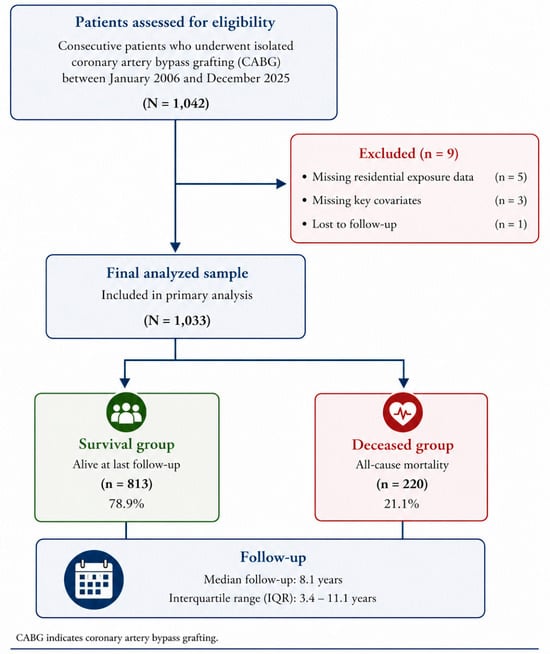
Of 1042 consecutive patients screened between January 2006 and December 2025, 9 were excluded due to: missing residential exposure data (n = 5), incomplete covariate data (n = 3), and loss to follow-up (n = 1).
Because the enrollment period spanned nearly two decades, secular changes in surgical practice, perioperative care, secondary prevention strategies, and environmental exposure patterns may have influenced outcomes. Although participating centers maintained consistent surgical protocols for BIMA grafting, residual temporal confounding cannot be excluded.
The study enrolled patients who underwent surgical arterial revascularization, defined as the use of two internal mammary arteries for coronary artery bypass grafting, resulting in a final analytic sample of 1033 patients; a study flow diagram is provided in Figure 1. The two participating centers represent distinct geographic regions (western/south and western/central Poland), enhancing environmental variability and external validity.
Figure 1.
Flow chart: Patients’ enrolment.
2.2. Exposure Assessment
Air pollution exposure was defined using annual mean concentrations in the residential areas of: NO2 (nitrogen dioxide), PM2.5 (particulate matter up to 2.5 microns in diameter), and PM10 (particulate matter up to 10 microns in diameter). Exposure was defined as the time-weighted mean concentration over the follow-up period, accounting for survival time or censoring.
Air pollution data were obtained from the National Environmental Monitoring System (Chief Inspectorate of Environmental Protection, Poland), based on ground monitoring stations complemented by validated spatial interpolation models (kriging-based). Exposure estimates were assigned at the residential municipality level (spatial resolution: ~1–5 km grid). Individual exposure was calculated as the time-weighted mean concentration over the entire follow-up period, accounting for survival time or censoring. Residential addresses were geocoded and linked to the nearest monitoring grid using GIS-based mapping. The presented method is one of the assessment techniques for environmental exposure analysis [24,25,26].
Residential mobility during follow-up could not be systematically assessed; therefore, exposure estimates were based on the recorded baseline residential address. As a result, temporal changes in individual exposure related to relocation were not captured. Additionally, exposure estimates reflected outdoor residential exposure only and did not account for occupational exposure, commuting patterns, or indoor air pollution.
The use of municipality-level exposure assignment introduces the possibility of non-differential exposure misclassification, which may have attenuated or distorted observed associations.
2.3. Data Quality, Missing Data, Multicenter Consistency
Data entry was independently verified by two investigators. Outliers were assessed using interquartile range criteria and cross-checked with source records.
The proportion of missing data was <2% for all variables; complete-case analysis was applied.
Data harmonization between centers was ensured using standardized definitions and centralized data cleaning.
Outcome: The primary endpoint was long-term all-cause mortality.
2.4. Covariates
Models were adjusted for demographics (age, sex, body mass index (BMI)), clinical comorbidities (diabetes, hypertension, renal impairment, peripheral artery disease (PVD), prior cardiovascular adverse events (CVAEs)), cardiac status (left ventricular ejection fraction (LVEF), and procedural variables (off-pump coronary artery bypass grafting (OPCAB), number of grafts). Kidney impairment was defined as a glomerular filtration rate below 60 mL/min/1.73 m2.
Hypertension and diabetes were defined based on documented diagnosis and/or active pharmacological treatment.
CVAEs were defined according to established clinical criteria (ESC guidelines), including documented myocardial infarction or cerebrovascular events [27].
Postoperative complications were excluded from the primary model.
Importantly, several potentially relevant contextual and behavioral variables were unavailable in the present dataset, including smoking status, socioeconomic status, educational attainment, occupational exposure, physical activity, dietary patterns, medication adherence, and urban–rural residence. These factors are known to correlate both with environmental exposure and cardiovascular outcomes and therefore represent potential sources of residual confounding. Consequently, the present analyses should be interpreted as evaluating associations rather than causal effects.
2.5. Statistical Analysis
Continuous variables were presented as medians with interquartile ranges and compared using appropriate non-parametric tests. Categorical variables were expressed as counts and percentages.
Time-to-event analysis was performed using Cox proportional hazards regression. Univariable models were initially constructed for all candidate variables, followed by multivariable models including demographic, clinical, and procedural covariates. Hazard ratios (HRs) with 95% confidence intervals (CIs) were reported.
Air pollution variables (NO2, PM10, PM2.5) were modeled as continuous variables using clinically interpretable scaling (per 10 µg/m3 for NO2 and PM10, per 5 µg/m3 for PM2.5). Both single-pollutant and multi-pollutant models were constructed to account for potential collinearity. Scaling (per 10 µg/m3 for NO2/PM10 and 5 µg/m3 for PM2.5) was chosen to reflect distribution ranges and ensure clinically interpretable hazard ratios.
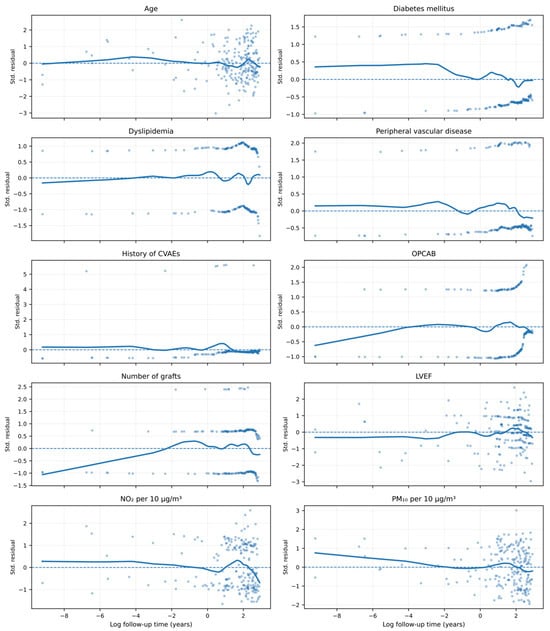
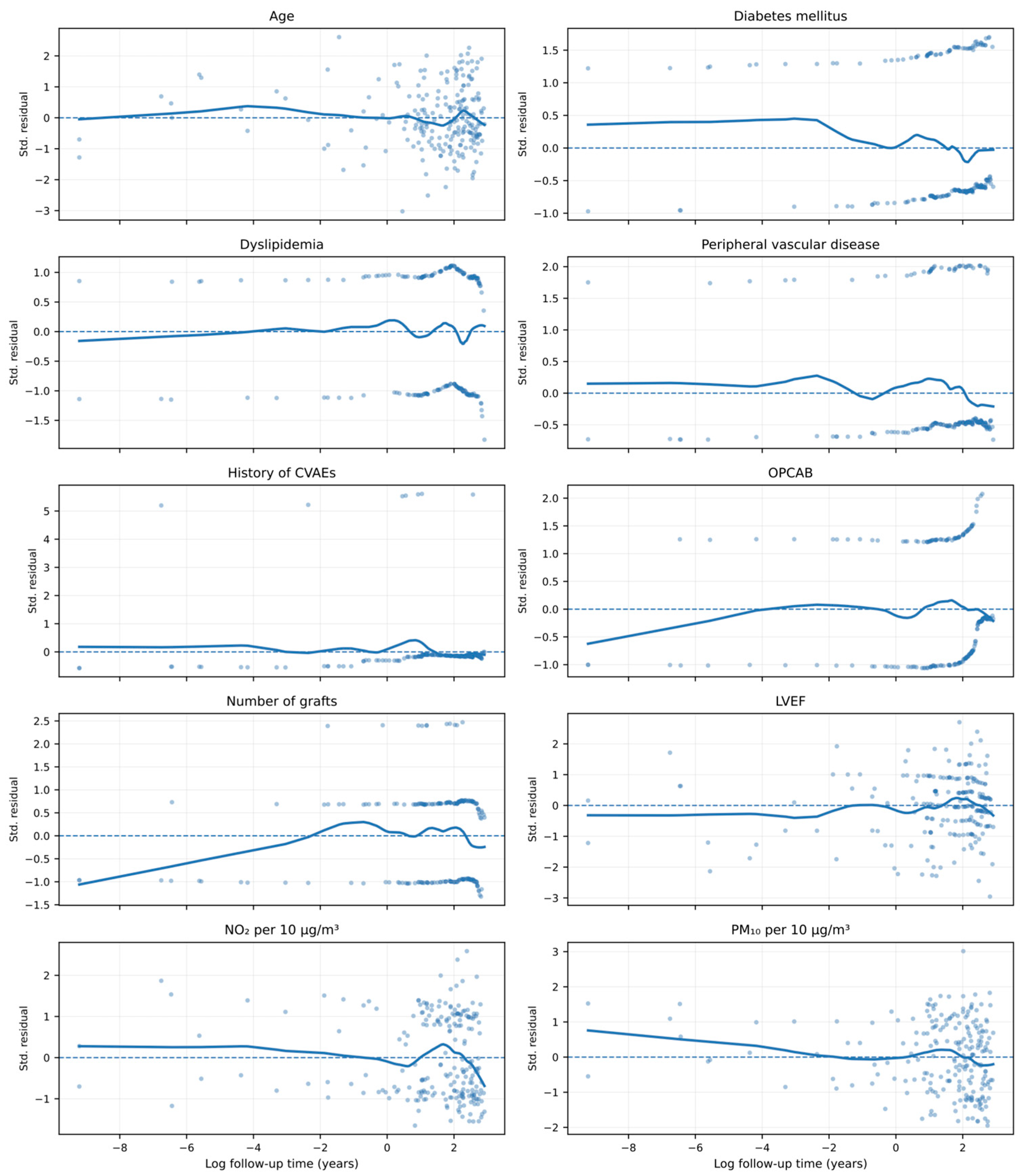
In multivariable analysis, the proportional hazards assumption was verified using Schoenfeld residuals; no significant violations were observed.
Non-linearity was explored using restricted cubic splines; no meaningful deviations from linearity were observed, supporting the use of linear terms. Non-linearity was explored using restricted cubic splines (three knots); visual inspection and model fit comparisons did not indicate meaningful deviation from linearity, supporting the use of linear terms.
2.6. Model Construction and Variable Selection
Variables included in the multivariable model were selected a priori based on clinical relevance and prior literature, rather than automated stepwise procedures. The final multivariable Cox model included 11 predictors for 220 observed deaths, yielding approximately 20 events per variable, within conventionally accepted thresholds for survival modeling.
All candidate variables were first evaluated in univariable analysis. Variables demonstrating clinical relevance or statistical significance (p < 0.10) were considered for inclusion.
To avoid multicollinearity, variance inflation factors (VIF) were calculated. Variables demonstrating collinearity (VIF > 3) were excluded from the final model. Specifically, renal impairment was excluded from the final multivariable Cox model due to collinearity with other covariates, despite being significant in univariable analysis, but still analyzed predictively. Calibration of the final model was assessed using the bootstrap-corrected calibration slope and Brier score.
Model discrimination was assessed using time-dependent receiver operating characteristics (ROC) to account for censoring, with area under the curve (AUC) reported along with 95% confidence intervals. Time-dependent ROC curves were computed using inverse probability-of-censoring weighting. Differences in AUC between models were evaluated using bootstrap resampling (1000 iterations) with percentile-based confidence intervals. Moreover, time-dependent ROC methodology was applied to account for censored survival data. Predicted risks were derived from Cox model-based survival probabilities, and inverse probability-of-censoring weighting was used for discrimination analyses.
To evaluate incremental prognostic value, net reclassification improvement (NRI) and integrated discrimination improvement (IDI) were calculated. Net reclassification improvement (NRI) was calculated using the continuous (category-free) approach, as predefined clinically meaningful risk categories for long-term mortality in this population are not established. Continuous NRI quantifies correct directional changes in predicted risk; however, it may overestimate improvement and should be interpreted cautiously. NRI quantified the proportion of individuals correctly reclassified into higher or lower risk categories, while IDI assessed improvement in separation between predicted risks for events and non-events.
The events-per-variable ratio in the primary multivariable model remained within conventionally accepted ranges for Cox regression modeling, reducing but not eliminating the possibility of overfitting.
2.7. Methodology of Decision Curve Analysis
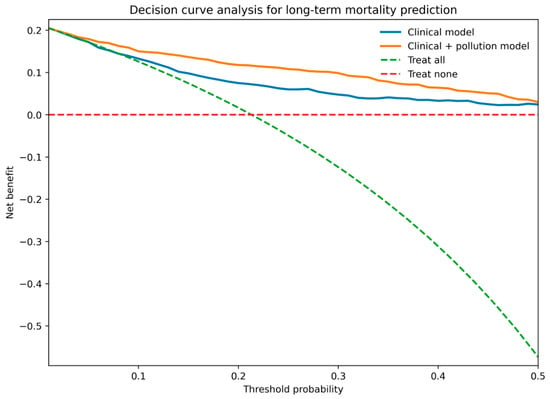
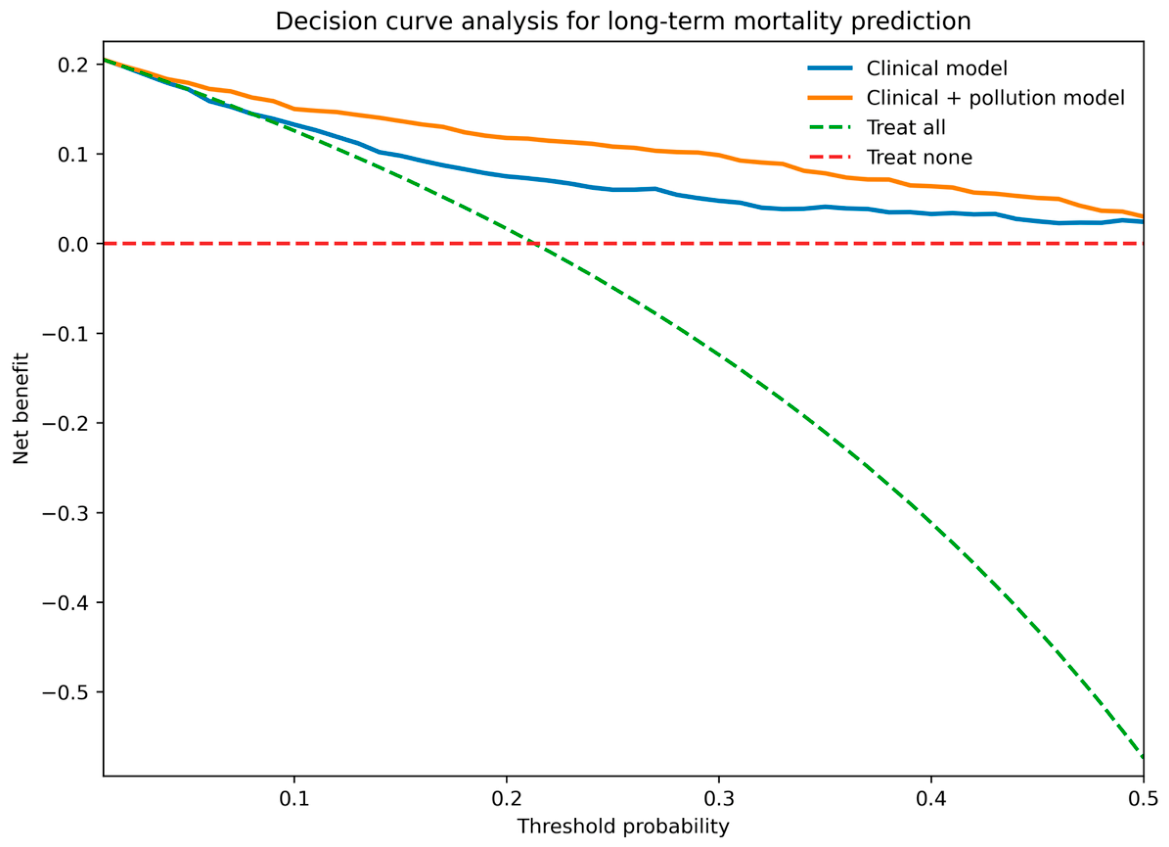
To evaluate the clinical utility of the prediction models, decision curve analysis (DCA) was performed by quantifying the net benefit across a range of clinically relevant threshold probabilities (0.01–0.50). Net benefit was calculated as the difference between the proportion of true positives and the proportion of false positives weighted by the relative harm of false-positive classifications, according to the standard formulation: net benefit = (true positives/N) − (false positives/N) × (threshold probability/(1 − threshold probability)). The clinical model and the combined clinical-plus-pollution model were compared against default strategies (treat-all and treat-none). This approach allows assessment of whether the inclusion of environmental exposure variables provides meaningful improvement in clinical decision-making across varying risk thresholds.
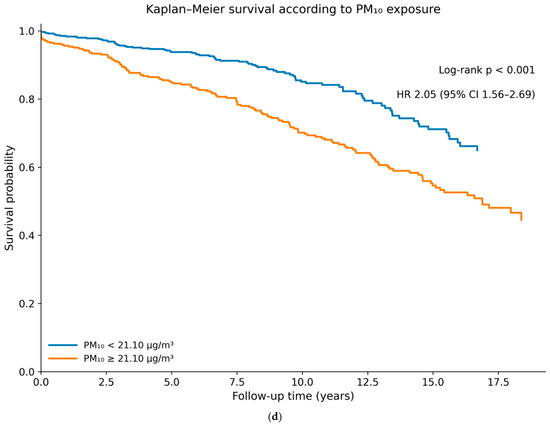
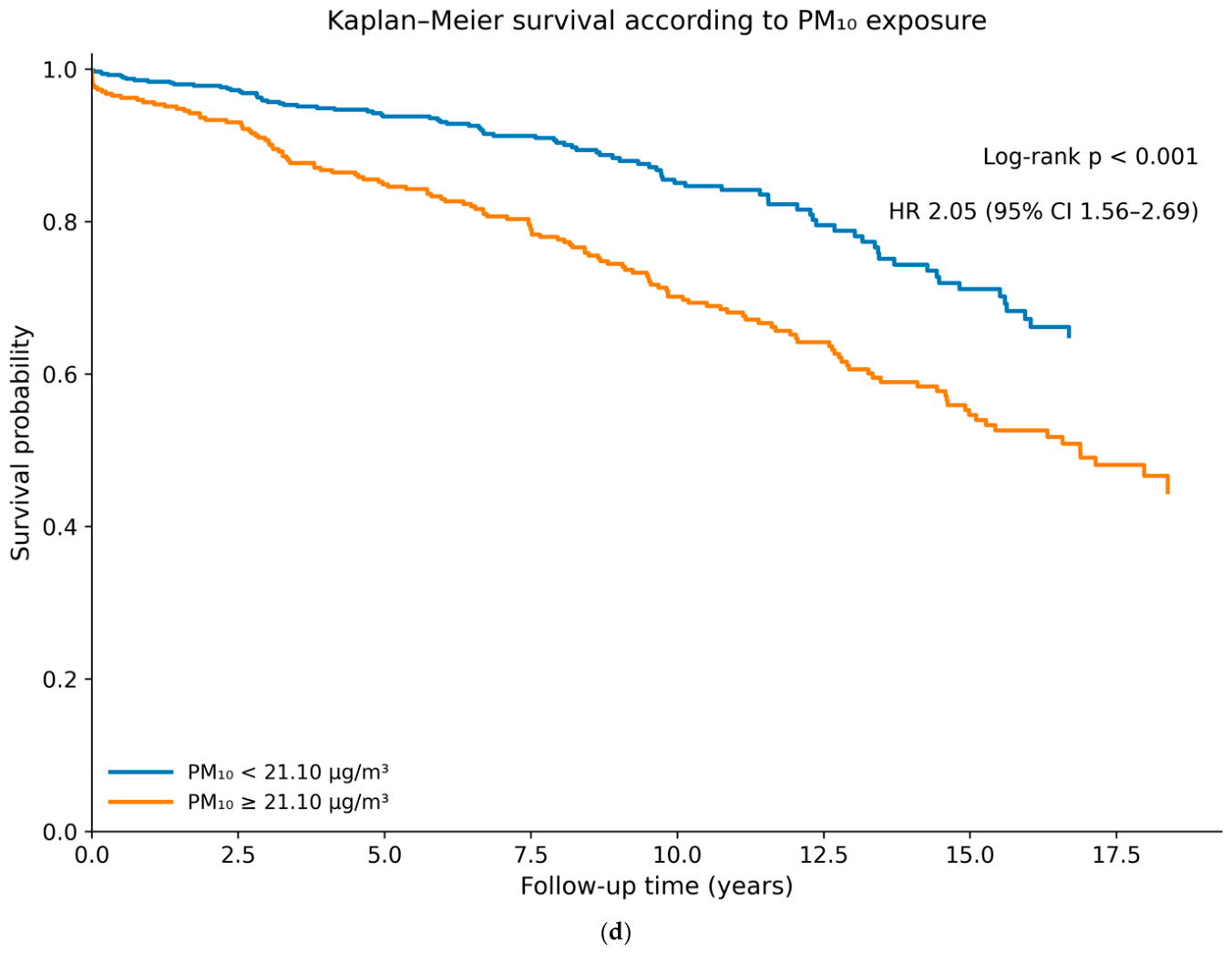
Optimal thresholds for NO2 and PM10 were determined using the Youden index, and these thresholds were used for Kaplan–Meier survival analyses. Survival curves were compared using the log-rank test, and hazard ratios were estimated using Cox regression.
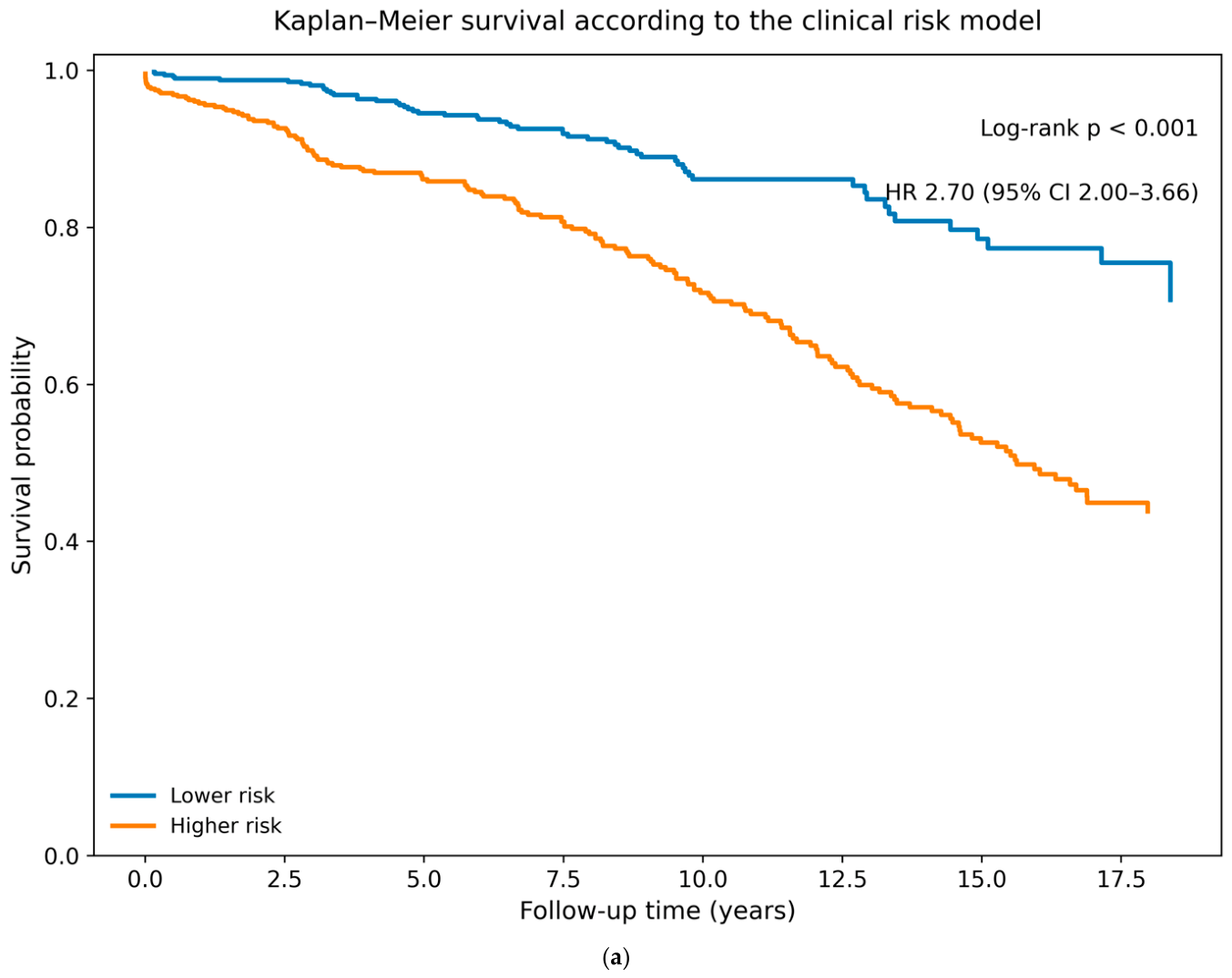
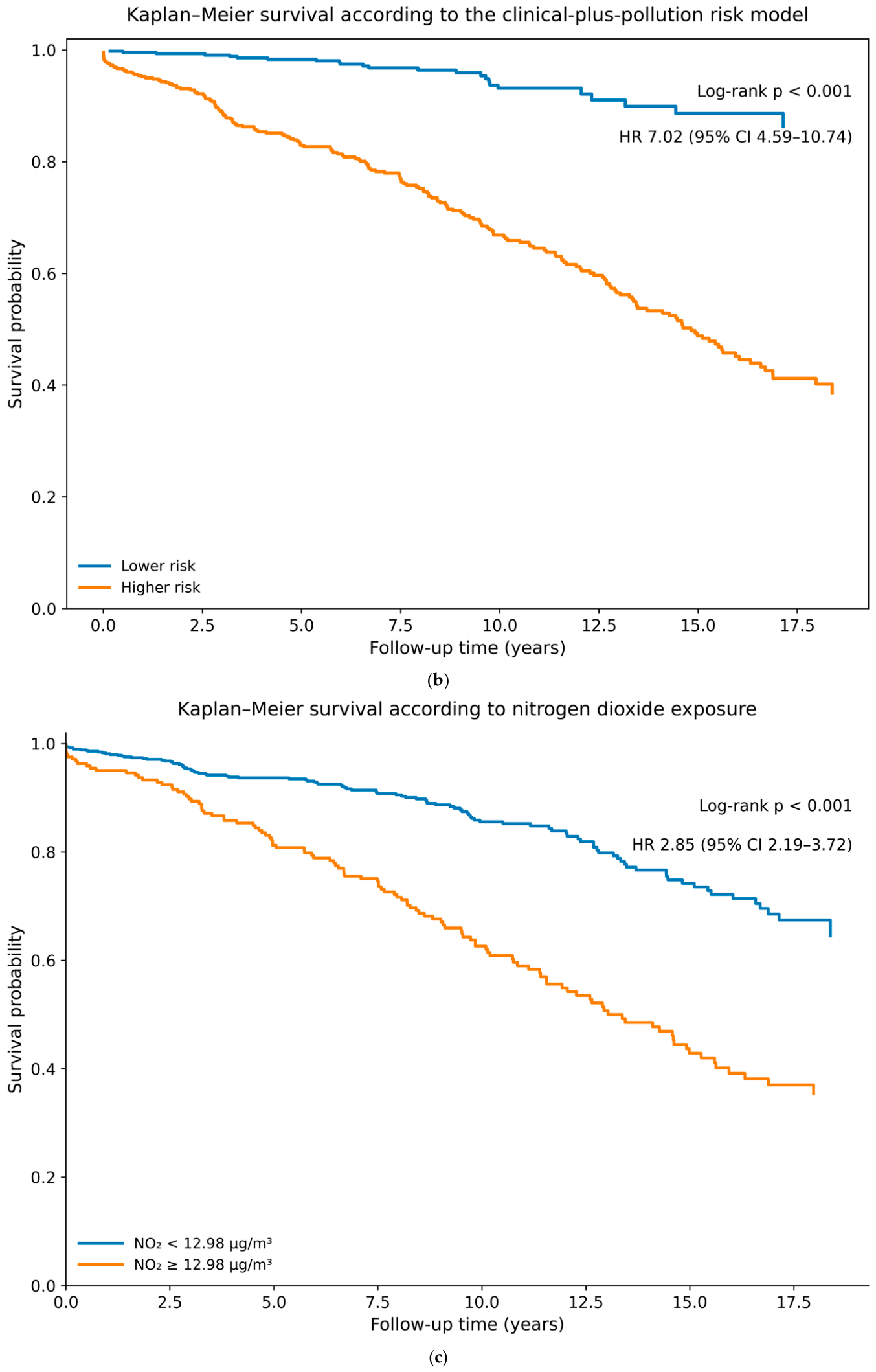
To stratify patients by multivariable risk, predicted probabilities from the clinical and clinical-plus-pollution models were dichotomized at the median, and Kaplan–Meier curves were constructed accordingly. In detail, two approaches to risk stratification were used: (1) pollutant-specific thresholds derived from the Youden index and (2) model-based stratification using median predicted risk.
Given the number of covariates relative to the number of events, potential overfitting and multicollinearity were considered. Model stability was assessed by the consistency of effect estimates across different model specifications.
All statistical analyses were performed using Python (version 3.11) with the following libraries: pandas for data handling, NumPy for numerical computations, scikit-learn for predictive modeling and receiver operating characteristic (ROC) analysis, statsmodels for survival analyses, including Cox proportional hazards modeling, and Matplotlib version 3.7.5 for graphical visualization.
Reclassification metrics, including net reclassification improvement (NRI) and integrated discrimination improvement (IDI), were calculated using custom Python implementations based on established methodological definitions.
All tests were two-sided, and p-values < 0.05 were considered statistically significant.
3. Results
The multicenter retrospective analysis included 1033 patients who underwent surgery at two cardiac surgery centers between 2006 and 2025 and were followed up for 8.1 (3.4–11.1) years. There were 813 patients (survival group) and 220 patients (deceased group). The median age was 58 (52–64) years, and off-pump surgery was performed in 47.6% (492) patients. All analyzed patients underwent an operation with two internal mammary artery grafts. The detailed information, including demographic and clinical characteristics, followed by perioperative data, was presented in Table 1.
Table 1.
Patients characteristics.
3.1. Univariate and Multivariable Analysis for Mortality Risk Prediction
In the performed models, among clinical covariates, older age (HR 1.08 per year; p < 0.001), lower left ventricular ejection fraction (HR 0.98 per 1% increase; p < 0.001), diabetes mellitus (HR 1.65; p = 0.015), peripheral vascular disease (HR 1.78; p = 0.003), prior cerebrovascular events (HR 4.24; p < 0.001), and severe renal impairment (HR 2.11; p = 0.006) were associated with increased mortality. Conversely, a higher number of grafts (HR 0.74; p = 0.018) and the off-pump CABG (OPCAB) technique (HR 0.67; p = 0.028) were associated with reduced mortality risk. The significant impact of exposure to air pollutants (NO2 and PM10) on long-term mortality was presented (Table 2).
Table 2.
Univariate and multivariable models for long-term mortality prediction.
Internal validation using bootstrap resampling demonstrated stable discrimination estimates, with bootstrap internal validation using 1000 resamples demonstrating limited optimism, with optimism-corrected AUC decreasing from 0.84 to 0.82, supporting the model’s overall robustness despite the observational design and the moderate event count. The bootstrap-corrected calibration slope was 0.94, and the Brier score was 0.16, suggesting acceptable calibration.
3.2. Multipollutant Models
To assess the effects of individual pollutants while accounting for co-exposure, multipollutant Cox proportional hazards models were constructed simultaneously for NO2, PM10, and PM2.5.
Pearson correlation analysis demonstrated moderate correlations among pollutants, particularly between NO2 and PM10 (r = 0.58–0.65, p < 0.001), supporting partial shared exposure patterns without evidence of prohibitive collinearity.
In these models, both NO2 and PM10 remained significantly associated with increased mortality, although effect sizes were modestly attenuated compared to single-pollutant models, suggesting partial collinearity between pollutants.
Specifically:
- NO2 remained associated with mortality (HR 2.21, 95% CI 1.60–3.05; p < 0.001).
- PM10 remained significant (HR 2.09, 95% CI 1.42–3.08; p < 0.001).
- PM2.5 remained non-significant (HR 1.08, 95% CI 0.85–1.39; p = 0.52).
Variance inflation factor (VIF) analysis indicated moderate collinearity (VIF range: 2.1–3.4), but below the thresholds for model instability, suggesting model stability as presented in Table 3.
Table 3.
Multipollutant models account for collinearity among exposure variables.
3.3. Air-Pollution Results
In multivariable Cox proportional hazards analysis, adjusting for demographic, clinical, and procedural characteristics, both nitrogen dioxide (NO2) and particulate matter ≤ 10 µm (PM10) were associated with increased long-term mortality. Specifically, each 10 µg/m3 increase in NO2 was associated with a significantly higher risk of mortality (hazard ratio [HR] 2.70, 95% confidence interval [CI] 2.03–3.59; p < 0.001). Similarly, each 10 µg/m3 increase in PM10 was associated with increased mortality risk (HR 2.73, 95% CI 1.94–3.83; p < 0.001). In contrast, particulate matter ≤ 2.5 µm (PM2.5) was not significantly associated with long-term mortality in the adjusted model (per 5 µg/m3: HR 1.20, 95% CI 0.96–1.50; p = 0.102).
3.4. ROC Discrimination Analysis
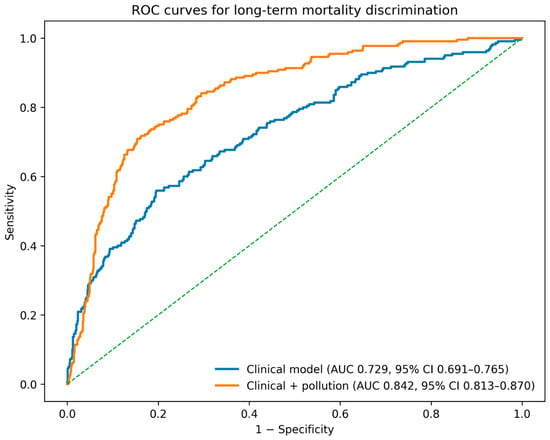
Receiver operating characteristic analysis was performed to assess discrimination for long-term mortality. The baseline clinical model, including age, sex, BMI, hypertension, diabetes mellitus, hyperlipidemia, renal impairment, peripheral vascular disease, prior cerebrovascular events, urgency status, OPCAB, number of grafts, and left ventricular ejection fraction, demonstrated moderate discrimination for the combined clinical model (AUC 0.73, 95% CI 0.69–0.77).
The addition of NO2 and PM10 substantially improved discrimination, with the clinical-plus-pollution model reaching an AUC of 0.84 (95% CI 0.81–0.87). When considered separately, the strongest single-variable discrimination was observed for NO2 (AUC 0.75, 95% CI 0.71–0.78) and PM10 (AUC 0.70, 95% CI 0.66–0.73), whereas individual clinical variables showed only modest discrimination, with AUCs ranging from 0.51 to 0.61.
The predicted ROC analyses for clinical and environmental long-term mortality risk factors were presented in Table 4.
Table 4.
Receiver operating characteristic curves for clinical and environmental factors.
Receiver operating characteristic (ROC) curves for the clinical factors (age, LVEF, diabetes, PVD, prior CVAEs, and renal impairment) were compared with ROC curves for clinical factors and pollution compounds (PM10 + NO2), as shown in Figure 2.
Figure 2.
Receiver operating characteristic (ROC), including area under the curve (AUC) and 95% confidence intervals (95% CI), analysis for clinical and clinical + pollution factors in long-term mortality prediction. The green line means: pollution factors in long-term mortality prediction.
3.5. Youden Index Thresholds
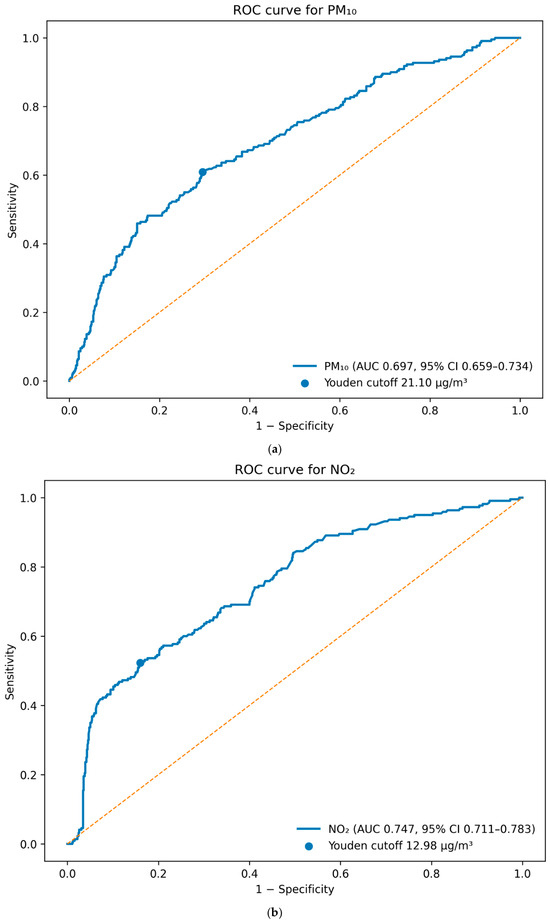
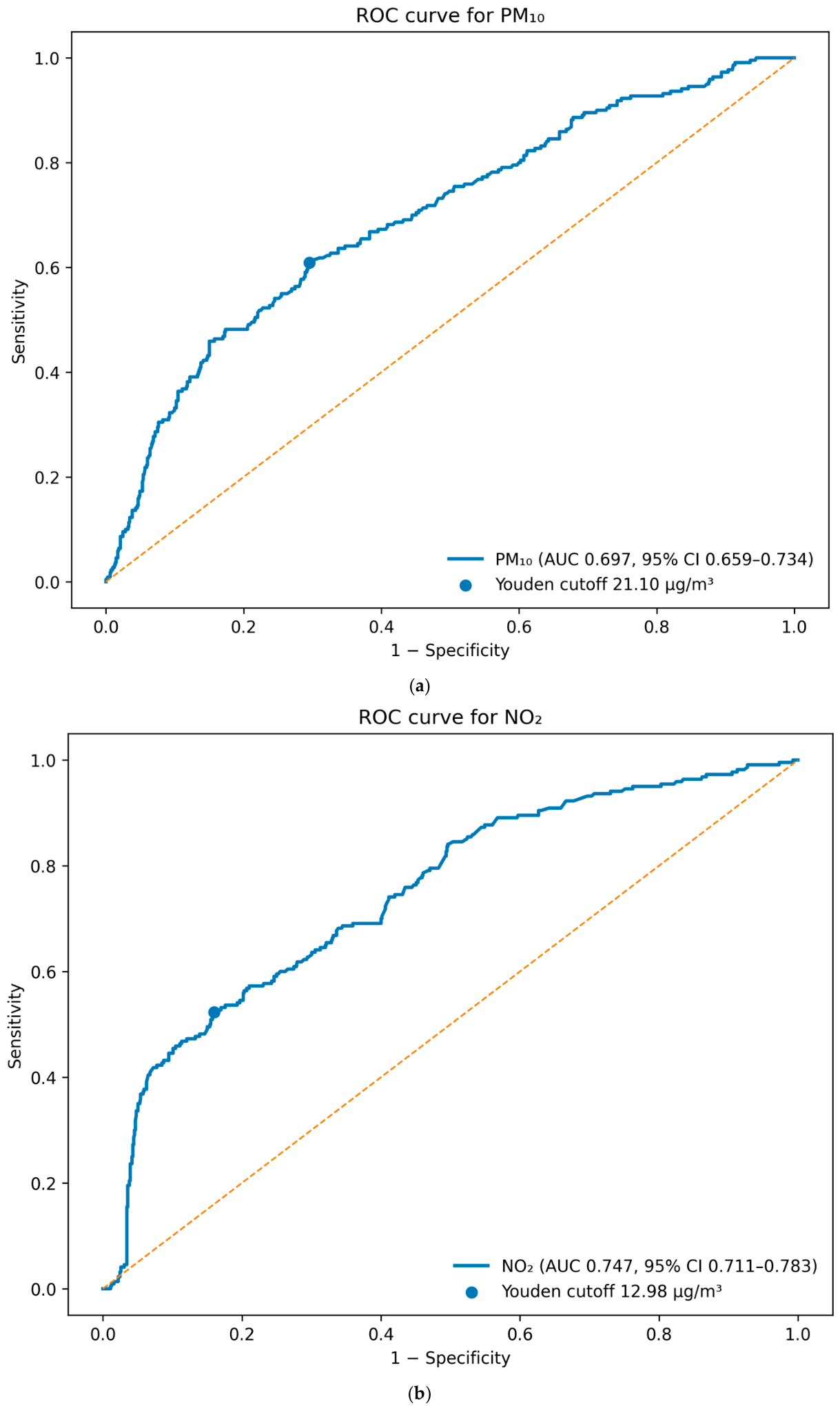
The optimal NO2 threshold identified by the Youden index was 12.98 µg/m3, corresponding to a sensitivity of 52.3% and a specificity of 84.0%. The optimal PM10 threshold was 21.10 µg/m3, corresponding to a sensitivity of 60.9% and a specificity of 70.4%, as shown in Figure 3a,b. These thresholds were used for subsequent Kaplan–Meier stratification.
Figure 3.
(a) Receiver operating characteristic (ROC) analysis (including area under the curve value (AUC) and 95 % confidence intervals (95% CI)) of PM10’s impact on long-term mortality prediction, with a calculated Youden cut-off value. (b) Receiver operating characteristic (ROC) analysis (including area under the curve value (AUC) and 95 % confidence intervals (95% CI)) of NO2 impact on long-term mortality prediction, with a calculated Youden cut-off value.
Schoenfeld residual testing showed no significant violations of the proportional hazards assumption (global test p > 0.10).
3.6. Kaplan–Meier Analysis
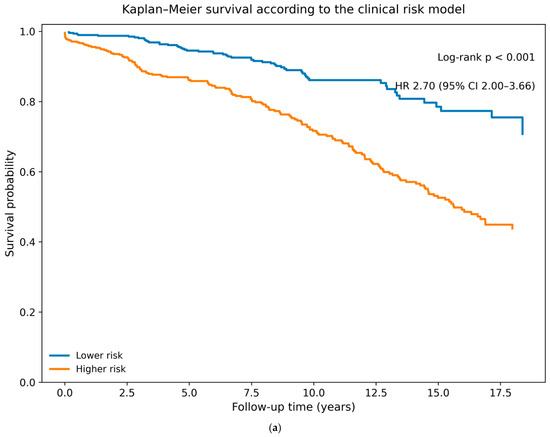
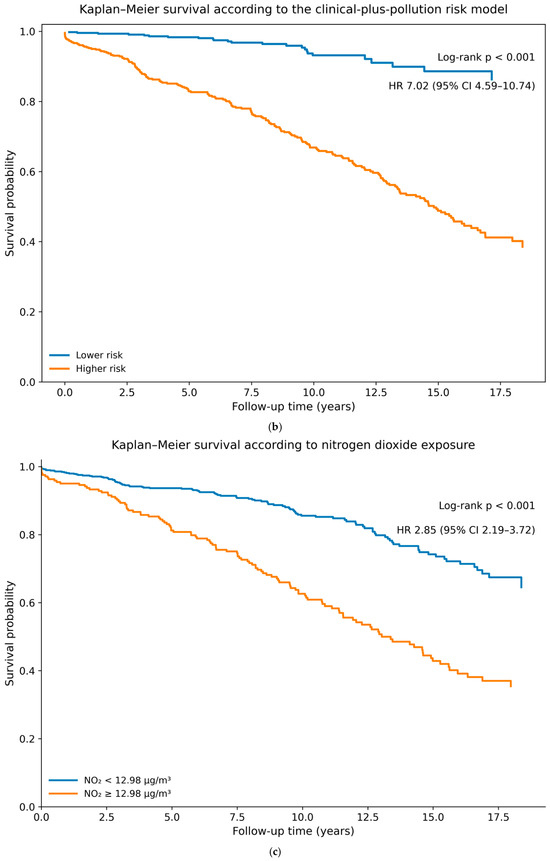
The Kaplan–Meier curves for long-term mortality prediction, stratified by the analyzed clinical and environmental factors, were constructed. The clinical model alone stratified patients into significantly different risk groups (HR 2.70, 95% CI 2.00–3.66; log-rank p < 0.001), with further improvement observed after inclusion of environmental exposure variables (Figure 4a,b).
Figure 4.
(a) Kaplan–Meier survival curves by clinical factors. (b) Kaplan–Meier survival curves by clinical and air pollution factors. (c) Kaplan–Meier survival curves by nitrogen dioxide exposure with -a presented a cut-off value of 12.98 µg/m3. (d) Kaplan–Meier survival curves by PM10 exposure, with a presented cut-off value of 21.10 µg/m3.
The Kaplan–Meier analysis showed clear separation of the long-term survival curves above and below the Youden-derived pollutant thresholds. For NO2, exposure at or above 12.98 µg/m3 was associated with significantly worse survival than lower exposure, with a log-rank p-value of <0.001 and an unadjusted hazard ratio of 2.85 (95% CI 2.19–3.72) (Figure 4c).
For PM10, exposure at or above 21.10 µg/m3 was likewise associated with significantly reduced long-term survival, with a log-rank p-value of <0.001 and an unadjusted hazard ratio of 2.05 (95% CI 1.56–2.69), as presented in Figure 4d.
The comparison of receiver operating characteristic (ROC) and Kaplan–Meier (KM) curves for clinical factors, combined clinical and pollution factors, and lone PM10 and NO2 exposure is presented in Table 5.
Table 5.
ROC and Kaplan–Meier characteristics for long-term survival after CABG procedures.
3.7. Incremental Prognostic Value
Adding environmental exposure variables to the clinical model significantly improved risk classification. Net reclassification improvement (NRI) was 0.42 (p < 0.001), indicating that 42% of patients were more accurately reclassified with respect to mortality risk.
Similarly, integrated discrimination improvement (IDI) was 0.11 (p < 0.001), demonstrating a substantial increase in the separation of predicted risk between patients who died and those who survived.
These findings confirm that air pollution exposure provides meaningful incremental prognostic information beyond traditional clinical risk factors.
3.8. Decision Curve Analysis
Decision curve analysis demonstrated that the clinical-plus-pollution model provided consistently greater net benefit than the clinical model alone, as well as the default treat-all and treat-none strategies, across the full range of examined threshold probabilities (0.01–0.50).
At selected threshold probabilities, the incremental net benefit of the clinical-plus-pollution model over the clinical model was: 0.05: +0.0071, 0.10: +0.0175, 0.15: +0.0385, 0.20: +0.0429, 0.25: +0.0481, 0.30: +0.0509. The advantage becomes more pronounced as the threshold probability increases; the maximum incremental net benefit was observed at thresholds between 0.20 and 0.30, as presented in Figure 5.
Figure 5.
Decision curve analysis for long-term mortality prediction.
The incremental net benefit associated with including environmental exposure increased progressively at higher threshold probabilities, indicating improved clinical utility of the combined model in identifying patients at elevated long-term risk.
These findings support the relevance of incorporating air pollution exposure into prognostic assessment beyond conventional clinical risk factors.
3.9. Sensitivity Analyses
Several sensitivity analyses were conducted to assess the robustness of the findings (Table 6).
Table 6.
Sensitivity results.
- Alternative Model Specifications
Results remained consistent after excluding variables with borderline significance and including all clinically relevant covariates (full model).
- 2.
- Non-linear Effects
Restricted cubic spline analysis did not demonstrate substantial non-linearity for NO2 or PM10, supporting the use of linear modeling assumptions.
- 3.
- Proportional Hazards Assumption
Schoenfeld residual testing confirmed no significant violations of the proportional hazards assumption (global test p > 0.10) as presented in Figure 6.
Figure 6.
Schoenfeld residual assessment of the proportional hazards assumption. Standardized Schoenfeld residuals are plotted against log follow-up time for covariates included in the multivariable Cox model. The global test showed no significant violation of the proportional hazards assumption (p = 0.155). Abbreviations: LVEF—left ventricular ejection fraction, m3—cubic meter, NO2—nitrogen dioxide, OPCAB—off-pump coronary artery bypass grafting, PM10—with an aerodynamic diameter ≤ 10 μm, μg—microgram.
- 4.
- Exclusion of Early Deaths
After excluding deaths within the first 12 months (n = 26), results remained materially unchanged.
- 5.
- Alternative Exposure Window
Analyses using baseline exposure (first-year exposure only) yielded consistent directions and magnitudes of association.
- 6.
- Model Stability
Bootstrap resampling (1000 iterations) confirmed the stability of hazard ratio estimates and model discrimination metrics.
Collectively, these analyses support the robustness of the association between long-term exposure to NO2 and PM10 and mortality.”
4. Discussion
The present study demonstrates that long-term exposure to NO2 and PM10 is associated with increased mortality following CABG, even after adjustment for an extensive set of clinical and procedural variables [28]. Importantly, including environmental exposure in a comprehensive clinical model led to consistent improvements across discrimination, reclassification, and decision-analytic metrics, indicating that these associations translate into meaningful differences in risk stratification.
The convergence of multiple analytical approaches strengthens the robustness of the findings. Environmental exposure remained significant in multivariable Cox regression, improved model discrimination (ΔAUC 0.11), enhanced patient reclassification (NRI 0.42; IDI 0.11), and demonstrated superior net clinical benefit in decision curve analysis. Together, these results suggest that air pollution provides incremental prognostic information beyond traditional risk factors rather than simply acting as a correlate of baseline risk. Although NRI suggested substantial improvement in risk classification, this metric should be interpreted in the context of its known methodological limitations, particularly the tendency of continuous NRI to overestimate incremental value. For this reason, NRI results were interpreted as supportive rather than definitive and were considered alongside discrimination and decision-analytic measures. The Youden-derived thresholds should be interpreted primarily as exploratory tools for visualization and risk stratification rather than clinically actionable cut-points. Dichotomization of continuous exposure variables may reduce statistical efficiency and introduce instability in threshold estimation, particularly in the absence of external validation.
These findings extend existing literature by focusing on a surgically revascularized population. While CABG addresses epicardial coronary obstruction, it does not modify systemic processes such as inflammation, oxidative stress, or endothelial dysfunction. Persistent environmental exposure may therefore continue to influence vascular biology and long-term outcomes despite successful revascularization. Our results challenge the conventional paradigm in which long-term outcomes after CABG are predominantly explained by patient-level characteristics [29,30,31,32]. While revascularization addresses epicardial coronary obstruction, it does not eliminate the systemic processes that drive cardiovascular progression. In this context, ambient air pollution may act as a chronic external stimulus that sustains vascular injury and promotes adverse remodeling, thereby influencing prognosis independently of surgical success [33]. The magnitude of the observed hazard ratios substantially exceeds that reported in most population-based environmental epidemiology studies and therefore should be interpreted cautiously. It is plausible that the estimated effect sizes partially reflect residual confounding, contextual vulnerability, exposure misclassification, or clustering of higher-risk patients within more polluted environments rather than a purely direct biological effect of pollution exposure.
Our analysis was focused on a unique subgroup of CAD patients, those who were characterized by multivessel disease and referred for surgical revascularization. The potential impact of air pollution was higher than in previous reports [34], indicating a greater environmental burden in the surgical cohort, which can be explained by less advanced coronary atherosclerosis. In our analyses [22], premature coronary disease progression, as indicated by a calculated HR of 2.0, was associated with nitrogen dioxide exposure. In the Lui et al. [35] analysis, a 1.69-fold increase in coronary disease progression was associated with a 10 µg/m3 increase in PM10 exposure. Several factors may contribute to this discrepancy, including residual confounding, exposure misclassification, clustering of higher-risk individuals in more polluted regions, model instability, and the potentially greater vulnerability of surgically treated patients with advanced coronary disease. Therefore, the absolute magnitude of the hazard ratios should be interpreted cautiously. The principal strength of the findings lies in the consistency and direction of the observed associations across multiple analytical approaches rather than the exact numerical size of the estimated effects.
Multipollutant models confirmed that NO2 and PM10 exert effects, supporting the robustness of the findings despite moderate collinearity between exposure variables.
Decision curve analysis demonstrated that incorporating environmental exposure provides incremental clinical utility across a range of threshold probabilities, particularly between 0.20 and 0.30, where the net benefit gain was most pronounced. This suggests that including air pollution metrics may improve the identification of patients at intermediate-to-high risk, where clinical decision-making is most uncertain.
Nitrogen dioxide and coarse particulate matter are known to induce oxidative stress, endothelial dysfunction, and activation of inflammatory signaling pathways [36,37,38]. These processes contribute to impaired vascular repair, increased arterial stiffness, and a prothrombotic milieu. In patients following CABG, such mechanisms may accelerate graft failure, promote microvascular dysfunction, or exacerbate non-coronary cardiovascular disease, ultimately translating into increased mortality risk. Notably, the absence of a statistically robust association for PM2.5 in the fully adjusted model suggests that not all pollutant fractions exert equivalent effects in this clinical context [39,40]. This may reflect differences in particle composition, exposure patterns, or collinearity between pollutants, rather than a true absence of biological relevance. The consistency of the direction of effect across models, however, supports a broader signal linking air pollution to adverse outcomes.
The magnitude of the observed associations is notably higher than that reported in most population-based studies, where effect sizes for similar pollutant increments are typically modest. This discrepancy may reflect differences in study design, including the use of residential-level exposure estimates, which may introduce exposure misclassification, and the potential clustering of high-risk patients in more polluted regions. Additionally, residual confounding and collinearity between pollutants may have contributed to the inflation of effect estimates. Therefore, the absolute magnitude of the hazard ratios should be interpreted cautiously, and emphasis should be placed on the direction and consistency of the associations rather than their exact size.
Importantly, the magnitude of the observed hazard ratios should not be interpreted as evidence of a direct causal effect. Given the observational design and the potential for residual and unmeasured confounding, these estimates are more appropriately viewed as reflecting the combined influence of environmental exposure and correlated contextual factors. Therefore, the strength of the present findings lies primarily in the consistency and direction of associations across multiple analytical approaches rather than the absolute size of the effect estimates.
In contrast to NO2 and PM10, PM2.5 was not associated with mortality in adjusted analyses. This finding differs from several prior population-based studies and may reflect collinearity between pollutants, regional differences in pollutant composition, exposure misclassification, or limited statistical power to detect smaller independent effects. Accordingly, the present findings should not be interpreted as evidence that PM2.5 lacks biological relevance, but rather that an association could not be demonstrated within the current analytical framework. The absence of an association between PM2.5 and cardiovascular mortality contrasts with several population-based studies that have consistently linked particulate matter to cardiovascular mortality [41,42,43].
From a clinical perspective, these findings do not imply immediate changes in patient management but suggest that environmental exposure may represent an additional dimension of risk stratification. Incorporating such variables into predictive models may improve the identification of higher-risk patients; however, these observations require external validation and prospective investigation before clinical implementation can be considered.
Traditionally, long-term prognosis after CABG has been conceptualized as primarily determined by intrinsic patient factors and procedural success. However, our findings suggest that this paradigm is incomplete. Even after surgical correction of coronary anatomy, patients remain exposed to persistent systemic stimuli that may influence vascular biology and long-term outcomes. The improvement in discrimination (ΔAUC 0.11), combined with strong NRI and IDI values, suggests that environmental exposure is not only statistically significant but also clinically actionable in risk stratification. These findings support further investigation into whether environmental exposure metrics may improve future prognostic models.
In this context, air pollution may act as a persistent environmental exposure associated with adverse cardiovascular risk profiles. The magnitude of its impact, as demonstrated by both hazard ratios and discrimination metrics, suggests that environmental exposure may represent an additional dimension of long-term cardiovascular risk that warrants consideration alongside traditional clinical factors. These findings support a broader conceptual shift in cardiovascular medicine. Rather than viewing risk as confined to patient-specific characteristics, it may be more appropriate to consider it as a dynamic interaction between the individual and their environment. In this framework, CABG represents a modification of anatomical disease, but not of the external factors that continue to influence vascular health. The present findings suggest that environmental exposure may contribute to long-term cardiovascular risk even after anatomically successful revascularization.
Given the study’s observational, retrospective design, causal inference cannot be established. The observed associations should be interpreted as hypothesis-generating and reflective of potential relationships rather than definitive evidence of causality.
Limitations
This study has several limitations. First, its observational design precludes causal inference, and residual confounding cannot be excluded. Second, environmental exposure was estimated at the regional level and may not fully reflect individual-level exposure variability. Third, the number of covariates relative to the number of events raises the possibility of model overfitting, although consistency across multiple analytical approaches supports the robustness of the findings. Residual confounding represents the most important limitation of the present analysis. Several variables strongly associated with both residential pollution exposure and cardiovascular mortality—including smoking history, socioeconomic deprivation, educational status, occupational exposure, medication adherence, and lifestyle-related behaviors—were unavailable and therefore could not be incorporated into the multivariable models. In environmental epidemiology, residential exposure may partly function as a surrogate marker of broader contextual vulnerability. Consequently, a portion of the observed association may reflect correlated social and behavioral determinants rather than a direct biological effect of pollution exposure. Finally, all analyses were internally derived and require external validation to confirm generalizability.
The authors acknowledge that residual confounding by smoking and other unmeasured lifestyle or socioeconomic factors may partly explain the observed associations and the magnitude of the effect estimates.
Exposure estimates were based on residential-level data and may not fully capture individual variability, including occupational exposure, indoor air quality, or temporal fluctuations.
The use of data-derived thresholds (Youden index) without external validation may introduce optimism bias due to overfitting, and results from Kaplan–Meier stratification should therefore be interpreted cautiously. Although multiple sensitivity analyses confirmed robustness, residual confounding cannot be excluded.
Socioeconomic status, meteorological factors (e.g., temperature, humidity), and occupational exposures were unavailable and may act as important confounders, as they are associated with both residential pollution exposure and cardiovascular outcomes. Their omission may have led to residual confounding and potential overestimation of observed associations. These factors may partially explain the observed associations and should be addressed in future studies.
We acknowledge that residual confounding cannot be excluded and may be substantial (socioeconomic status, smoking history, occupational exposures, and urban–rural differences were not available and could not be incorporated into the models). These factors are known to be associated both with environmental pollution exposure and cardiovascular outcomes, and their omission may have influenced the observed associations. As a result, the findings should be interpreted as associative rather than causal, and the possibility that part of the observed effect reflects unmeasured confounding must be acknowledged.
Cause-specific mortality data were not consistently available across participating centers, and therefore, cardiovascular mortality analyses could not be performed.
In addition, all model development, threshold derivation, and performance assessment were conducted within the same dataset. Although internal validation using bootstrap resampling demonstrated stability of the estimates, the absence of external validation limits the generalizability of the findings and introduces the possibility of optimistic bias. Future studies should confirm these results in large-volume cohorts.
5. Conclusions
In this multicenter retrospective cohort of patients undergoing CABG with BIMA grafting, higher long-term residential exposure to NO2 and PM10 was associated with increased all-cause mortality after adjustment for measured clinical and procedural factors. Environmental exposure variables improved statistical risk discrimination and reclassification; however, the observational design and potential for substantial residual confounding preclude causal inference. These findings support further investigation of environmental exposure as a possible prognostic marker in surgically treated coronary artery disease, pending external validation and more comprehensive adjustment for contextual and behavioral confounders.
Author Contributions
Conceptualization, T.U., S.S.A.-H., J.B. (Jakub Bratkowski) and K.B.; methodology, K.S. and J.B. (Jakub Bartkowski); software, M.L., Ł.M. and J.B. (Jarosław Bartkowski); validation, T.U., S.S.A.-H., K.S., J.B. (Jakub Bratkowski) and J.B. (Jarosław Bartkowski); formal analysis, T.U.; investigation, M.L., Ł.M., M.K., B.P., M.W., K.J.F., K.B., R.C. and M.J.; resources, T.U., S.S.A.-H., M.L., Ł.M., B.P., R.C. and M.J.; data curation, J.B. (Jarosław Bartkowski); writing—original draft preparation, T.U.; writing—review and editing, S.S.A.-H., K.S., M.L., Ł.M., J.B. (Jakub Bratkowski), M.K., J.B. (Jarosław Bartkowski), B.P., M.W., K.J.F., K.B., R.C. and M.J.; visualization, T.U.; supervision, M.J.; project administration, T.U. All authors have read and agreed to the published version of the manuscript.
Funding
This research received no external funding.
Institutional Review Board Statement
The study was conducted in accordance with the Declaration of Helsinki and approved by the Poznan University of Medical Sciences (protocol code 55 and date of approval: 16 January 2020) for studies involving humans.
Informed Consent Statement
Patient consent was waived due to the analysis’s retrospective nature.
Data Availability Statement
Data supporting the reported results are available upon reasonable request to the corresponding authors. The restriction is related to privacy or ethical restrictions.
Acknowledgments
During the preparation of this manuscript/study, the author(s) used the GPchat 5.5 version for the purposes of graphics creation. The authors have reviewed and edited the output and take full responsibility for the content of this publication.
Conflicts of Interest
The following authors (S.S.A-H., M.L., Ł.M., R.C.) are employed in MEDINET Heart Center Ltd., they declare no conflict of interest.
References
- Münzel, T.; Sørensen, M.; Lelieveld, J.; Landrigan, P.J.; Kuntic, M.; Nieuwenhuijsen, M.; Miller, M.R.; Schneider, A.; Daiber, A. A comprehensive review/expert statement on environmental risk factors of cardiovascular disease. Cardiovasc. Res. 2025, 121, 1653–1678. [Google Scholar] [CrossRef] [Scilit]
- Miller, M.R. The cardiovascular effects of air pollution: Prevention and reversal by pharmacological agents. Pharmacol. Ther. 2022, 232, 107996. [Google Scholar] [CrossRef] [Scilit]
- Huang, A.; Li, Z.; Song, X.; Lin, S.; Wei, J.; Qu, Y.; Hu, Q.; Dong, G.; Zhang, M.; Wang, G.; et al. Nationwide potential causal long-term effects of PM2.5 component mixture on ischemic heart disease mortality in the United States, 2000-2019. Ecotoxicol. Environ. Saf. 2026, 315, 120108–120118. [Google Scholar] [CrossRef] [Scilit] [PubMed]
- Beelen, R.; Stafoggia, M.; Raaschou-Nielsen, O.; Andersen, Z.J.; Xun, W.W.; Katsouyanni, K.; Dimakopoulou, K.; Brunekreef, B.; Weinmayr, G.; Hoffmann, B.; et al. Long-term exposure to air pollution and cardiovascular mortality: An analysis of 22 European cohorts. Epidemiology 2014, 25, 368–378. [Google Scholar] [CrossRef] [Scilit] [PubMed]
- Zhu, H.; Shan, X.; Tang, X.; Pang, L.; Pan, Z.; Li, Z.; Wang, Y.; Wang, Q.; Huang, K.; Guan, T.; et al. Long-term exposure to sandstorms-related particulate matter and risks of all-cause and cause-specific mortality in a national cohort study. J. Hazard. Mater. 2026, 510, 141982–141991. [Google Scholar] [CrossRef] [Scilit] [PubMed]
- Li, X.; Zhou, Z.; Zhou, Y.; Hao, H.; Zhou, L.; Niu, Y.; Zhang, Y.; Liu, S.; Chen, R.; Kan, H.; et al. Effects of long-term exposure to nitrogen dioxide with cardiovascular mortality: Evidence from a nationwide cohort study. Ecotoxicol. Environ. Saf. 2026, 313, 119950–119959. [Google Scholar] [CrossRef] [Scilit]
- Adeoye, M.; Evans, N.; Rahimzadeh, S.; Shrikhande, S.; Taylor, S.; Perel, P.; Shah, A.; Di Cesare, M.; Miller, M.R. Impact of Ambient Air Pollution on Cardiovascular Diseases in Low- and Lower-Middle-Income Countries: A Systematic Review and Meta-Analysis. Glob. Heart 2026, 21, 31–50. [Google Scholar] [CrossRef] [Scilit]
- Bayo Jimenez, M.T.; Hahad, O.; Kuntic, M.; Daiber, A.; Münzel, T. Noise, Air, and Heavy Metal Pollution as Risk Factors for Endothelial Dysfunction. Eur. Cardiol. 2023, 18, e09–e19. [Google Scholar] [CrossRef] [Scilit]
- Urbanowicz, T.K.; Michalak, M.; Gąsecka, A.; Olasińska-Wiśniewska, A.; Perek, B.; Rodzki, M.; Bociański, M.; Jemielity, M. A Risk Score for Predicting Long-Term Mortality Following Off-Pump Coronary Artery Bypass Grafting. J. Clin. Med. 2021, 10, 3032. [Google Scholar] [CrossRef] [Scilit]
- Löfström, U.; Linde, C.; Eriksson, M.J.; Maret, E.; Corbascio, M.; Ekström, M.; Lyngå, P.; Wallén, H.; Persson, B.; Persson, H.; et al. Baseline characteristics and 1-year outcome by left ventricular function in the CABG PREFERS. Eur. Heart J. Open. 2025, 5, oeaf014. [Google Scholar] [CrossRef] [Scilit]
- Papestiev, V.; Jovev, S.; Risteski, P.; Popov, A.F.; Sokarovski, M.; Andova, V.; Georgievska-Ismail, L. Myocardial Function after Coronary Artery Bypass Grafting in Patients with Preoperative Preserved Left Ventricular Ejection Fraction-The Role of the Left Ventricular Longitudinal Strain. Medicina 2023, 59, 932. [Google Scholar] [CrossRef] [Scilit]
- Błażejowska, E.; Urbanowicz, T.; Gąsecka, A.; Olasińska-Wiśniewska, A.; Jaguszewski, M.J.; Targoński, R.; Szarpak, Ł.; Filipiak, K.J.; Perek, B.; Jemielity, M. Diagnostic and Prognostic Value of miRNAs after Coronary Artery Bypass Grafting: A Review. Biology 2021, 10, 1350. [Google Scholar] [CrossRef] [Scilit]
- Gurbuz, O.; Kumtepe, G.; Ozkan, H.; Karal, I.H.; Velioglu, Y.; Ercan, A.; Yüksel, A.; Ener, S. Predictive Value of Neutrophil-Lymphocyte Ratio for Long-Term Cardiovascular Event Following Coronary Artery Bypass Grafting. Braz. J. Cardiovasc. Surg. 2020, 35, 274–284. [Google Scholar] [CrossRef] [Scilit] [PubMed]
- Popov, M.A.; Dabravolski, S.A.; Dontsov, V.V.; Vzvarov, S.A.; Agafonov, E.G.; Zybin, D.I.; Kharabet, A.K.; Radchenkova, O.V.; Saveliev, D.R.; Pronina, V.P.; et al. The Neutrophil-to-Albumin Ratio (NAR) Reflects the Severity of the Post-CABG Inflammatory Response and Is Associated with a Pre-Existing Pro-Inflammatory Monocyte Profile. Life 2025, 15, 1790. [Google Scholar] [CrossRef] [Scilit]
- Lin, F.; Li, G.; Wang, Y.; Dong, P.; Yang, K.; Liu, H.; Xie, N.; Liu, J.; Chen, H.; Liu, X.; et al. Impacts of air pollutions on cardiovascular and cerebrovascular diseases through inflammation: A comprehensive analysis of one million Chinese and half million UK individuals. J. Transl. Med. 2025, 23, 469–483. [Google Scholar] [CrossRef] [Scilit] [PubMed]
- Niu, Z.; Liu, F.; Yu, H.; Wu, S.; Xiang, H. Association between exposure to ambient air pollution and hospital admission, incidence, and mortality of stroke: An updated systematic review and meta-analysis of more than 23 million participants. Environ. Health Prev. Med. 2021, 26, 15–29. [Google Scholar] [CrossRef] [Scilit]
- Urbanowicz, T.; Aboul-Hassan, S.S.; Skotak, K.; Luszczyn, M.; Moskal, Ł.; Bratkowski, J.; Bartkowski, J.; Perek, B.; Wilczyński, M.; Filipiak, K.J.; et al. Winter Temperature and Long-Term Mortality After Coronary Artery Bypass Grafting: A Multicenter Cohort Study. J. Clin. Med. 2026, 15, 4216. [Google Scholar] [CrossRef] [Scilit]
- Motairek, I.; Deo, S.V.; Elgudin, Y.; McAllister, D.A.; Brook, R.D.; Chen, Z.; Su, J.; Rao, S.V.; Rajagopalan, S.; Al-Kindi, S. Particulate Matter Air Pollution and Long-Term Outcomes in Patients Undergoing Percutaneous Coronary Intervention. JACC Adv. 2023, 2, 100285–100295. [Google Scholar] [CrossRef] [Scilit]
- Nhung, N.T.T.; Duc, V.T.; Ngoc, V.D.; Dien, T.M.; Hoang, L.T.; Ha, T.T.T.; Khue, P.M.; Truong, N.X.; Thanh, N.T.N.; Jegasothy, E.; et al. Mortality benefits of reduction fine particulate matter in Vietnam, 2019. Front. Public Health 2022, 10, 1056370–1056380. [Google Scholar] [CrossRef] [Scilit]
- Ndiaye, A.; Vienneau, D.; Flückiger, B.; Probst-Hensch, N.; Jeong, A.; Imboden, M.; Schmitz, O.; Lu, M.; Vermeulen, R.; Kyriakou, K.; et al. Associations between long-term air pollution exposure and mortality and cardiovascular morbidity: A comparison of mobility-integrated and residential-only exposure assessment. Environ. Int. 2025, 198, 109387–109397. [Google Scholar] [CrossRef] [Scilit] [PubMed]
- Bourdrel, T.; Bind, M.A.; Béjot, Y.; Morel, O.; Argacha, J.F. Cardiovascular effects of air pollution. Arch. Cardiovasc. Dis. 2017, 110, 634–642. [Google Scholar] [CrossRef] [Scilit]
- Strobl, K.; Irfan, S.A.; Masood, H.; Latif, N.; Kurmi, O. Association between PM10 exposure and risk of myocardial infarction in adults: A systematic review and meta-analysis. PLoS ONE 2024, 19, e0301374–e0301391. [Google Scholar] [CrossRef] [Scilit]
- Deo, S.V.; Elgudin, Y.; Motairek, I.; Ho, F.; Brook, R.D.; Su, J.; Fremes, S.; deSouza, P.; Hahad, O.; Rajagopalan, S.; et al. Air Pollution and Adverse Cardiovascular Events After Coronary Artery Bypass Grafting: A 10-Year Nationwide Study. JACC Adv. 2023, 3, 100781–100791. [Google Scholar] [CrossRef] [Scilit]
- Zou, B.; Wilson, J.G.; Zhan, F.B.; Zeng, Y. Air pollution exposure assessment methods utilized in epidemiological studies. J. Environ. Monit. 2009, 11, 475–490. [Google Scholar] [CrossRef] [Scilit] [PubMed]
- Jerrett, M.; Arain, A.; Kanaroglou, P.; Beckerman, B.; Potoglou, D.; Sahsuvaroglu, T.; Morrison, J.; Giovis, C. A review and evaluation of intraurban air pollution exposure models. J. Expo. Anal. Environ. Epidemiol. 2005, 15, 185–204. [Google Scholar] [CrossRef] [Scilit] [PubMed]
- Wei, L.; Donaire-Gonzalez, D.; Helbich, M.; van Nunen, E.; Hoek, G.; Vermeulen, R.C.H. Validity of Mobility-Based Exposure Assessment of Air Pollution: A Comparative Analysis with Home-Based Exposure Assessment. Environ. Sci. Technol. 2024, 58, 10685–10695. [Google Scholar] [CrossRef] [Scilit] [PubMed]
- De Backer, J.; Haugaa, K.H.; Hasselberg, N.E.; de Hosson, M.; Brida, M.; Castelletti, S.; Cauldwell, M.; Cerbai, E.; Crotti, L.; de Groot, N.M.S.; et al. 2025 ESC Guidelines for the management of cardiovascular disease and pregnancy. Eur. Heart J. 2025, 46, 4462–4568. [Google Scholar] [CrossRef] [Scilit]
- Urbanowicz, T.; Skotak, K.; Olasińska-Wiśniewska, A.; Filipiak, K.J.; Bratkowski, J.; Wyrwa, M.; Sikora, J.; Tyburski, P.; Krasińska, B.; Krasiński, Z.; et al. Long-Term Exposure to PM10 Air Pollution Exaggerates Progression of Coronary Artery Disease. Atmosphere 2024, 9, 216. [Google Scholar] [CrossRef] [Scilit]
- Shimamura, J.; Miyamoto, Y.; Hibino, M.; Fukuhara, S.; Takayama, H.; Itagaki, S.; Takagi, H.; Kuno, T. Long-Term Outcomes After Hybrid Coronary Revascularization Versus Coronary Artery Bypass Grafting: Meta-Analysis of Kaplan-Meier-Derived Data. Am. J. Cardiol. 2024, 212, 13–22. [Google Scholar] [CrossRef] [Scilit]
- Dassanayake, M.T.; Norton, E.L.; Ward, A.F.; Wenger, N.K. Sex-specific disparities in patients undergoing isolated CABG. Am. Heart J. Plus. 2023, 35, 100334. [Google Scholar] [PubMed]
- Toumpoulis, I.K.; Kanistras, D.A.; Pappa, C.K.; Zagoriti, Z.; Anagnostopoulos, C.E.; Toumpoulis, S.K. Prediction of Long-Term Survival after Coronary Artery Bypass with Bilateral Internal Thoracic Artery Grafting: External Validation of A Contemporary Nomogram. J. Cardiovasc. Dev. Dis. 2022, 9, 375. [Google Scholar] [CrossRef] [Scilit]
- Li, Z.; Chen, R.; Zeng, Z.; Wang, P.; Yu, C.; Yuan, S.; Su, X.; Zhao, Y.; Zhang, H.; Zheng, Z. Association of stress hyperglycemia ratio with short-term and long-term prognosis in patients undergoing coronary artery bypass grafting across different glucose metabolism states: A large-scale cohort study. Cardiovasc. Diabetol. 2025, 24, 179–195. [Google Scholar] [CrossRef] [Scilit]
- Stafoggia, M.; Oftedal, B.; Chen, J.; Rodopoulou, S.; Renzi, M.; Atkinson, R.W.; Bauwelinck, M.; Klompmaker, J.O.; Mehta, A.; Vienneau, D.; et al. Long-term exposure to low ambient air pollution concentrations and mortality among 28 million people: Results from seven large European cohorts within the ELAPSE project. Lancet Planet. Health 2022, 6, e9–e18. [Google Scholar] [CrossRef] [Scilit]
- Islam, F.; Nukala, S.K.; Shrestha, P.; Badgery-Parker, T.; Foo, F. Air pollution and cardiovascular disease: A systematic review of the effects of air pollution, including bushfire smoke, on cardiovascular disease. Am. Heart J. Plus. 2025, 54, 100546. [Google Scholar] [CrossRef] [Scilit] [PubMed]
- Liu, T.; Huang, H.; Hu, G. A Time Series Study for Effects of PM10 on Coronary Heart Disease in Ganzhou, China. Int. J. Environ. Res. Public Health 2022, 20, 86. [Google Scholar] [CrossRef] [Scilit] [PubMed]
- Lim, E.Y.; Kim, G.-D. Particulate Matter-Induced Emerging Health Effects Associated with Oxidative Stress and Inflammation. Antioxidants 2024, 13, 1256. [Google Scholar] [CrossRef] [Scilit]
- Lelieveld, S.; Lelieveld, J.; Mishra, A.; Daiber, A.; Pozzer, A.; Pöschl, U.; Berkemeier, T. Endogenous Nitric Oxide Can Enhance Oxidative Stress Caused by Air Pollutants and Explain Higher Susceptibility of Individuals with Inflammatory Disorders. Environ. Sci. Technol. 2024, 58, 1823–1831. [Google Scholar] [CrossRef] [Scilit]
- de Bont, J.; Jaganathan, S.; Dahlquist, M.; Persson, Å.; Stafoggia, M.; Ljungman, P. Ambient air pollution and cardiovascular diseases: An umbrella review of systematic reviews and meta-analyses. J. Intern. Med. 2022, 291, 779–800. [Google Scholar] [CrossRef] [Scilit]
- Narain, M.; Breen, M.; Carll, A.P.; Hazari, M.; Farraj, A.; Ward-Caviness, C.K. Modification of associations between ambient PM2.5 and vital signs by β-blocker prescription status among individuals with heart failure. Environ. Health 2025, 24, 55–77. [Google Scholar] [CrossRef] [Scilit]
- Chowdhury, S.; Pozzer, A.; Haines, A.; Klingmüller, K.; Münzel, T.; Paasonen, P.; Sharma, A.; Venkataraman, C.; Lelieveld, J. Global health burden of ambient PM2.5 and the contribution of anthropogenic black carbon and organic aerosols. Environ. Int. 2022, 159, 107020–107034. [Google Scholar] [CrossRef] [Scilit] [PubMed]
- Yang, Y.; Deng, J.; Zhou, P.; Li, P.; Guan, T.; Xue, T.; Zhu, T. Short-Term PM2.5 Exposure and Cardiovascular Mortality: A Global Exposure-Response Analysis to Inform Alert Thresholds. J. Am. Coll. Cardiol. 2026; online ahead of print.
- Zhang, R.; Zhang, Z.; Zhou, Z.; Yi, F.; Yang, Y.; Guo, D.; Zhang, Q.; Wang, H.; Chen, Y.; Qian, J.; et al. Health Risk and Pathogenesis of PM2.5 in Human Systems. Toxics 2026, 14, 286. [Google Scholar] [CrossRef] [Scilit]
- Rao, M.; Lin, W.; Luo, L.; Chen, G.; Wang, M.; Ai, Z.; Chen, J.; Zhang, Z.; Liu, H.; Lin, H. Ambient PM2.5 and Its Components Associated with Dynamic Progression from Different Blood Pressure States to Cardiovascular Diseases and Mortality: The GOLD-Health Cohort. Environ. Health 2025, 4, 709–719. [Google Scholar] [CrossRef] [Scilit]

Disclaimer/Publisher’s Note: The statements, opinions and data contained in all publications are solely those of the individual author(s) and contributor(s) and not of MDPI and/or the editor(s). MDPI and/or the editor(s) disclaim responsibility for any injury to people or property resulting from any ideas, methods, instructions or products referred to in the content. |
© 2026 by the authors. Licensee MDPI, Basel, Switzerland. This article is an open access article distributed under the terms and conditions of the Creative Commons Attribution (CC BY) license.