


Highlights
What are the main findings?
- One-year monitoring assessed oxidative stress in male and female red swamp crayfish.
- Results revealed sex and tissue-specific differences in oxidative stress biomarkers in P. clarkii.
- Associations were recorded between oxidative stress biomarkers and lake factors.
What is the implication of the main finding?
- The main finding uncovers that biomarkers highlight the complex interactions between biological factors (sex and tissue) and environmental factors.
- The study highlights the noteworthy physiological plasticity of P. clarkii, a key factor in its success as an invasive species within fluctuating freshwater environments.
Abstract
Procambarus clarkii (red swamp crayfish) exhibits physiological plasticity that enables adaptation to variable freshwater conditions, such as those in Lake Trasimeno. This study examined whether fluctuations in hydrometric level and associated physicochemical parameters affect oxidative stress responses in the hepatopancreas and abdominal muscle of male and female individuals. Superoxide dismutase, catalase, glutathione peroxidase, and metallothionein reveal tissue, sex, and season-specific differences that indicate adaptive physiological adjustments. Temporal trends were evaluated, and multivariate analyses summarised environmental and metal gradients. Generalised Additive Models (GAMs) were used to explore relationships between oxidative responses and these gradients, with sex as a categorical factor. Associations were identified with hydrometric level, temperature, conductivity, transparency, pH, dissolved oxygen, and metals of biological relevance. These results highlight the remarkable physiological plasticity of P. clarkii, which underpins its success as an invasive species in fluctuating freshwater ecosystems.
1. Introduction
Although freshwater ecosystems cover only a small part of Earth’s surface, they support substantial levels of biodiversity [1]. However, these ecosystems face remarkable environmental pressure due to anthropogenic activities, resulting in a rapid global biodiversity decline.
In general, freshwater crayfish play key ecological roles in their natural habitats and are often considered as engineers and keystone species. Invasive crayfish species, whether introduced accidentally or intentionally, spread rapidly in freshwater ecosystems and threaten native species, causing loss of ecological stability [2,3].
The red swamp crayfish Procambarus clarkii is listed in the Delivering Alien Invasive Species Inventory for Europe (DAISIE) as one of the 100 worst invasive alien species. The species is also included in the European Union Regulation 1143/2014 list of species of concern. Originally native to southern and south-eastern USA and northern Mexico, P. clarkii has now spread widely across the globe, except in Australia and Antarctica [4].
Despite the protected status of Lake Trasimeno (Central Italy) under European directives, P. clarkii was first recorded around twenty years ago, and its population is still well established in this ecosystem [5,6]. P. clarkii is characterised by remarkable ecological adaptability, biological plasticity [5], resistance to environmental pressures [7], and strong dispersal ability [8]. The species is also among the longest-living invertebrates in temperate regions [9], often dominating freshwater communities [10]. P. clarkii has multiple impacts on freshwater ecosystems, including the spread of diseases, the alteration of wetland vegetation, and trophic state [8,11,12,13], also determining multiple negative consequences on native species [14,15,16,17,18].
Once invasive species have settled in a pristine aquatic environment, eradication becomes almost impracticable. A potential containment strategy could foresee using these invasive populations, such as P. clarkii, in a biomonitoring program to gain valuable ecological insights into environmental stress. This strategy may help preserve native populations from decline or replacement by non-native counterparts [19].
Oxidative stress in invasive crayfish is key to comprehending their physiological responses and thereby potentially controlling their spread [14,15,16,19]. Antioxidant and related pathways, which reflect normal life-history strategies, can be used as oxidative stress biomarkers of environmental stressors.
Oxidative stress biomarkers in P. clarkii have been extensively investigated to evaluate contaminant exposure and adaptive stress mechanisms [20]. Key enzymatic antioxidants include superoxide dismutase (SOD), catalase (CAT), and glutathione peroxidase (GPx), while non-enzymatic indicators encompass total glutathione and lipid-peroxidation products. These biomarkers provide insights into both natural metabolic processes and responses to anthropogenic pressures, such as heavy metals, pesticides, and organic pollutants [21].
Overall, the oxidative stress profile of P. clarkii is crucial for evaluating its physiological resilience and success as an invasive species in freshwater ecosystems. Our previous studies on the invasive red swamp crayfish P. clarkii from Lake Trasimeno established baseline patterns of antioxidant response and metal bioaccumulation. The first study [22] investigated seasonal antioxidant responses together with lead, cadmium, and chromium concentrations in the hepatopancreas between winter 2002 and autumn 2003. Despite low tissue metal levels, antioxidant biomarkers varied in relation to biological (e.g., sex) and environmental factors beyond pollutant burdens, indicating complex effects of natural stressors. A follow-up investigation conducted 15 years later [23] expanded the analyses to include a broader panel of essential and toxic elements in both the hepatopancreas and abdominal muscle, demonstrating tissue-specific accumulation patterns and sex-related differences. However, the influence of hydrometric fluctuations and associated environmental variables, including physicochemical parameters and metal exposure, on oxidative stress responses remains poorly evaluated.
Building on these findings, the present study tested the hypothesis that hydrometric and environmental variability are associated with changes in oxidative stress biomarkers in P. clarkii. Newly acquired data of oxidative stress biomarkers were integrated with previously reported metal concentrations [23], and a one-year monthly monitoring program was conducted to (i) characterise tissue and sex-specific patterns of superoxide dismutase, catalase, glutathione peroxidase, and metallothionein; (ii) assess the effects of hydrometric and physicochemical variability on oxidative stress responses; and (iii) examine associations between metal bioaccumulation and oxidative stress biomarkers.
2. Materials and Methods
Lake Trasimeno is designated as both a Special Protection Area (IT5210070) and a Special Area of Conservation (IT5210018), following the provisions of Directive Habitat 92/43. Lake Trasimeno, located in the Province of Perugia, is the fourth-largest lake in Italy by surface area. Its shallow average depth makes it the largest laminar lake in the country. The watershed, covering an area of 396 km2, is only about twice the size of the lake’s surface area of 126 km2. Classified as mesotrophic, Lake Trasimeno also exhibits a theoretical water replacement time exceeding 24 years.
More than 1800 specimens of P. clarkii were collected at Lake Trasimeno from July 2018 to July 2019 by a professional fisher within 24 h using fyke nets in a protected wildlife area in the south-east part of the lake [5,24]. A subset of 260 adult mature specimens, evenly distributed between males and females (10 each per month per sex), was selected for oxidative stress analyses. The monthly samples underwent prompt transportation to the laboratory, followed by chill-killing using an ice-water bath. Subsequently, the crayfish were sexed, and morphometric and biological parameters were recorded for each specimen. Total body length and cephalothorax length (including the rostrum) were measured with a digital calliper to the nearest 1 mm. Wet weights of the whole body were determined using an electronic balance with 0.001 g precision. Male sexual activity was evaluated by examining the presence of spines on the third and fourth walking legs, while female sexual maturity was assessed by observing the developmental stages of internal eggs. The crayfish carapace was examined by touch, and specimens with soft exoskeleton or slightly eroded gastroliths in the stomach were classified as recently moulted. Therefore, a sample of inter-moult males and females with orange gonads was selected for this investigation. Hepatopancreas and muscle were collected from each specimen and stored at −80 °C for subsequent biochemical analyses.
2.1. Chemical-Physical Analysis of Lake Trasimeno Waters
The water level of Lake Trasimeno (±0.1 cm) was monthly recorded throughout the entire sampling period (data provided by the Umbria Region, Soil Defence Service). The chemical–physical parameters of the water, including temperature, transparency, pH, dissolved oxygen, and conductivity, were measured monthly at the sampling site using specific instrumentation (Secchi disk for transparency, YSI 550A DO, and YSI Model 63 multiparameter probes for dissolved oxygen, pH, temperature, and conductivity (YSI Environmental Incorporated, Yellow Springs, OH, USA)). The parameters measured in bottom and surface waters were largely similar, hence they are reported as average values, which were used for comparison with all other data.
2.2. Oxidative Stress Analyses
A sample of 0.2 g of both tissues (hepatopancreas or muscle) was homogenised using an Ultra-Turrax homogeniser (IKA-Werke GmbH & Co. KG, Staufen im Breisgau, Germany) in potassium phosphate buffer (100 mM, pH 7.5) with 2.5% sodium chloride, aprotinin 0.008 TIU/mL, and bacitracin 0.1 mg/mL. Then the samples underwent centrifugation at 18,000× g for 15 min and then 50,000× g for 60 min at 4 °C. The resultant pellet was discarded, and the cytosolic fractions were used for measuring the activities of antioxidant enzymes. All biochemical analyses were conducted in triplicate, alongside blank samples (buffer and reagents only), and followed spectrophotometric methods using a Varian Cary 50 spectrophotometer at 25 °C. The methods employed were adapted from earlier studies on red crayfish [25,26]. All reagents used for sample preparation and biochemical analyses were purchased from Merck Life Science S.r.l., Milano, Italy.
SOD (E.C. 1.15.1.1) activity was evaluated in 50 mM Na2CO3 buffer, pH 10, with 0.1 mM EDTA, 500 mM cytochrome C, 1 mM hypoxanthine, and xanthine oxidase. Cytochrome C reduction by the xanthine/hypoxanthine complex was evaluated by comparison with a standard SOD unit curve, hypoxanthine, and xanthine oxidase at 550 nm.
CAT (E.C. 1.11.1.6) activity was measured in NaH2PO4 buffer + Na2HPO4 100 mM, pH 7 buffer, and H2O2 24 mM at 240 nm following the decrease in absorbance due to the consumption of H2O2. GPx (E.C. 1.11.1.9) activity was measured at 340 nm in NaH2PO4 + Na2HPO4 100 mM buffer, pH 7.5, 1 mM EDTA, 0.12 mM NADPH (β-nicotinamide adenine dinucleotide), 2 mM GSH, 1 U of GR (glutathione reductase), 1 mM NaN3, and 0.6 mM H2O2.
The concentration of proteins in the cytosolic fraction was used to normalise the enzymatic levels and was measured according to the Lowry method [27].
MT levels were assessed monthly in 10 individuals, utilising 5 pooled hepatopancreas or muscle tissues of 1 g each. The samples underwent homogenisation (1:4) in a buffer holding 0.02 M TRIS/HCl, 0.5 M sucrose, 0.1 mg/mL bacitracin, 0.008 TIU/mL aprotinin, 87 μg/mL phenylmethylsulfonyl fluoride (PMSF), and 0.1 μL/mL α-mercaptoethanol and then were centrifuged at 14,500× g. Following centrifugation, the cytosolic fraction was treated with chloroform/ethanol and HCl/ethanol to obtain the partially purified MTs fraction. Pellets were washed with ethanol/chloroform/Tris–HCl solution (87:1:12) and suspended in 0.25 M NaCl. Subsequently, a destabilising solution (HCl 1N + ethylenediaminetetraacetic acid [EDTA] 4 mM) and Ellman’s reagent (DTNB, 5,5′-dithiobis-(2-nitrobenzoic acid)) were added to each sample. Absorbance at 412 nm was measured and compared with a standard curve constructed with reduced glutathione (1 mg/mL GSH). The results were reported as MTs in μg/g of tissue.
Data on metal concentrations in P. clarkii tissues were taken from our previous study [23] and used here to explore correlations with oxidative stress biomarkers. Full analytical methods and QA/QC procedures are reported in the cited work.
2.3. Statistical Analysis
The Ljung–Box test with a significance level of α = 0.05 was executed to evaluate temporal autocorrelation in the biomarkers data. Principal Component Analysis (PCA) was performed separately for hepatopancreas and muscle tissue data to visualise patterns and reduce the dimensionality of environmental variables (hydrometric level, dissolved oxygen, conductivity, pH, temperature, and Secchi depth) and metal tissue concentrations (Cr, Cu, Zn, Pb, Cd, Ni, Fe). Prior to PCA, the data were square-root transformed and scaled. The first principal components explaining > 75% of total variance were retained for subsequent analysis. Generalised Additive Models (GAMs) were constructed to examine relationships between oxidative stress biomarker responses and environmental/metal gradients that emerged from PCA analyses. Sex was included as a categorical predictor, while the PCA dimensions were incorporated as smooth terms. Models were fitted using Restricted Maximum Likelihood (REML). All analyses were conducted in R (version 4.5.2) within the Positron IDE (Posit Team 2025) using the packages tidyverse [28], mgcv, FactoMineR [29], and factoextra [30].
3. Results
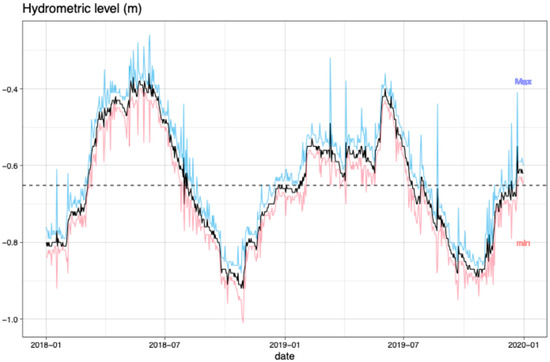
During 2018–2019, the hydrometric levels of Lake Trasimeno were higher in the warmer seasons, with the highest monthly averages recorded at −0.41 m in May 2018 and −0.47 m in June 2019. Conversely, the lowest values were observed in October of both years (−0.89 m in 2018 and −0.87 m in 2019) (Figure 1). Overall, hydrometric levels were slightly lower in 2019.
Figure 1.
Hydrometric levels of Lake Trasimeno recorded monthly from January 2018 to January 2020. The blue line shows the monthly maximum hydrological level, while the orange line shows the minimum.
The monthly average values of physical–chemical parameters of Lake Trasimeno during the biomonitoring period are shown in Table 1. Temperature exhibited the highest and the lowest values during the warmer and the colder seasons, respectively. Monthly pH values ranged from 8.3 to 8.8 units and did not show a clear seasonal trend. Transparency varied significantly between months, with a minimum of 0.25 m in October 2018 and a maximum of 1 m in May 2019. Conductivity followed a trend similar to temperature, with lower values in January and higher values in July 2018. Dissolved oxygen levels showed a clear seasonal trend, reaching the maximum value in January and the minimum value in June.
Table 1.
Physical–chemical parameters of Lake Trasimeno were recorded throughout a one-year monitoring period.
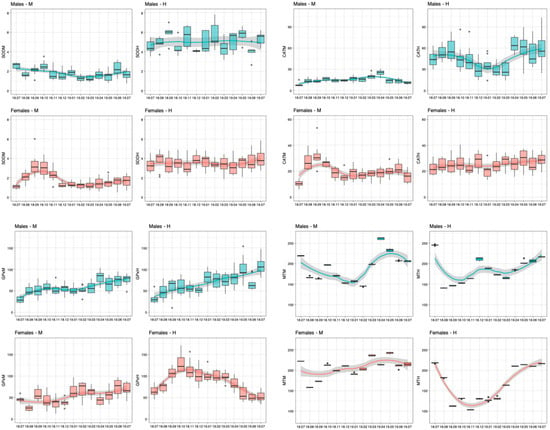
The main oxidative stress biomarkers examined in this study included MTs, SOD, CAT, and GPx (Figure 2). These temporal trends demonstrate dynamic changes in biomarker levels, allowing assessment of significant differences based on trend patterns. The temporal series of GPx activity showed significant upward trends in males in both tissues and in female muscle over time (p < 0.001). Autocorrelation analyses revealed no significant correlation between consecutive months, suggesting that the month-to-month fluctuations occurred randomly around the overall trend. In contrast, GPx activity in the female hepatopancreas, as well as MTs, SOD, and CAT in both tissues and sexes, showed no significant overall trend.
Figure 2.
Autocorrelation analyses of superoxide dismutase (SOD), catalase (CAT), glutathione peroxidase (GPx), metallothionein (MT) levels in muscle (M), and hepatopancreas (H) of both sexes of P. clarkii collected throughout a one-year monitoring period in Lake Trasimeno. Dots in figures indicate outlier values.
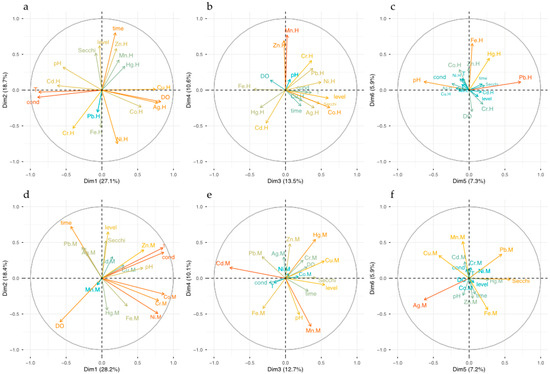
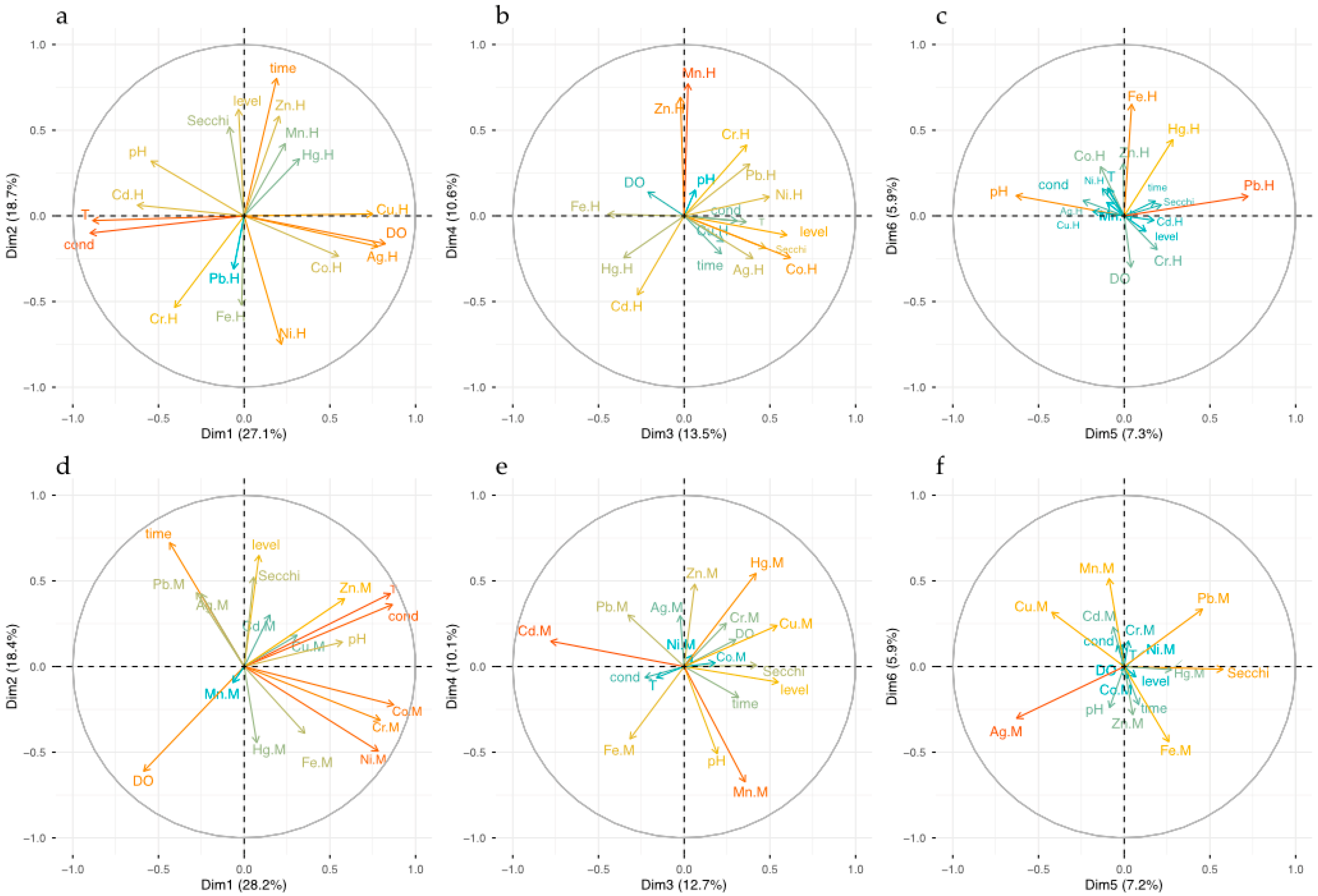
The Principal Component Analysis shows pattern plots of the first six components incorporating environmental variables and tissue metals. In the hepatopancreas PCA (Figure 3a–c), Dim1–Dim2 accounted for 27.1% and 18.7%, Dim3–Dim4 for 13.5% and 10.6%, and Dim5–Dim6 for 7.3% and 5.9% of variance, respectively. In abdominal muscle (Figure 3d–f), Dim1–Dim2 explained 28.2% and 18.4%, Dim3–Dim4 12.7% and 10.1%, and Dim5–Dim6 7.2% and 5.9%. The first five dimensions were selected, cumulatively explaining >75% of total variance per tissue. For hepatopancreas, parameters contributing to each dimension are as follows: Dim 1: conductivity (>15%); T (>15%); DO (>12%); Ag; Cu; Cd; Co; pH; Cr; Hg. Dim 2: time (>17%); Ni (>15%); level (>10%); Zn; Cr; Fe; Secchi; Mn; Hg; pH. Dim 3: Co (>15%); level (15%); Ni (>10%); Secchi; Fe; Ag; Pb; Cr; T; Hg. Dim 4: Mn (>30%); Zn (25%); Cd (>10%); Cr; Pb; Ag; Co; Hg; time; Secchi. Dim 5: Pb (40%); pH (30%); Hg (>5%); Ag; Secchi; Cr; Cu; time; Cd; Co. Concerning muscle, the parameters that contribute in different percentages to the dimensions are as follows: Dim 1: Co (15%); conductivity (15%); T (15%); Cr; Ni; Zn; DO; pH; time; Fe. Dim 2: time (>15%); level (>12%); DO (>10%); Secchi; Ni, Hg; Pb; T; Ag; Zn. Dim 3: Cd (>25%); level (>10%); Cu (>15%); Secchi; Hg; Mn; Pb; time; Fe; DO. Dim 4: Mn (25%); Hg (<15%); pH (<10%); Zn; Fe; Pb; Ag; Cr; Cu; time. Dim 5: Ag (<30%); Secchi (>20%); Pb (>10%); Cu; Hg; Fe; Mn; pH; time; level.
Figure 3.
Pattern plots of the first six components of Principal Component Analysis (PCA) incorporating environmental variables and tissue metals: (a–c) refer to the variables influencing the hepatopancreas, while (d–f) refer to those in the muscle. Variable contributions are shown on a colour scale from blue (minor) to red (major). DO: dissolved oxygen; level: hydrometric level; time: seasonality; Secchi: transparency; cond: conductivity.
Generalised additive model analysis (GAM) in hepatopancreas (Table 2) revealed that CAT activity was significantly related to Dim1 (cond, T, DO; Figure S2). GPx activity showed significance with Dim2 (time, Ni, hydrometric level; Figure S3). Co, hydrometric level, and Ni from Dim3 influenced GPx activity (Figure S3) and MT levels (Figure S4). Dim4 (Mn, Zn, Cd) affected CAT activity (Figure S2) and MT levels (Figure S4), while Dim5 (Pb, pH, Hg) influenced CAT (Figure S2), GPx (Figure S3), and MT levels (Figure S4).
Table 2.
GAM analysis between biomarkers from both tissues, sex, and PCA-derived dimensions. p values are reported; statistically significant associations are indicated by asterisks (* = p < 0.05; ** = p < 0.01; *** = p < 0.001).
GAM analysis of abdominal muscle (Table 2) revealed that Dim1 (Co, cond, T) significantly influenced SOD (Figure S5), CAT (Figure S6), and GPx (Figure S7) activities. SOD and GPx activities (Figure S7) and MT levels (Figure S8) related significantly to Dim2 (time, hydrometric level, DO). Dim3 (Cd, hydrometric level, Cu) affected SOD (Figure S5), CAT (Figure S6), GPx (Figure S7) activities, and MT levels (Figure S8). Dim4 (Mn, Hg, pH) influenced SOD, CAT (Figure S6), GPx (Figure S7), and MT, while Dim5 (Pb, pH, Hg) impacted GPx activity (Figure S7).
In the hepatopancreas (Table 2), oxidative stress biomarker levels were higher in males than in females; specifically, SOD, CAT, and GPx activities exceeded those in females by 1.16, 23, and 14 units, respectively, while MT levels differed by 12 units. In the abdominal muscle (Table 2), enzymatic activities showed significant sex differences except for GPx. SOD activity was higher in males (0.22 units), whereas males exhibited lower CAT (−1.87 units) and MT (−18 units) levels than females.
4. Discussion
In this study, oxidative stress biomarkers in the hepatopancreas and abdominal muscle of P. clarkii were related to ecological factors of Lake Trasimeno. Tissue and sex-specific differences in oxidative stress were associated with water parameters, including hydrometric level, temperature, pH, conductivity, transparency, and dissolved oxygen. Previously assessed tissue-specific metal accumulation in the red swamp crayfish [23] was related to the new acquired oxidative stress data in hepatopancreas and abdominal muscle, providing insights into the integrated physiological responses to environmental pressures.
Dynamic changes in oxidative stress biomarker, particularly in GPx, were observed, with upward trends over time in males in both tissues and in female muscles. Fluctuations in lake factors, including metals, appear to impose sex and tissue-specific oxidative challenges on P. clarkii. Due to the specific morphology of its basin and shoreline, Lake Trasimeno is regularly subjected to pronounced seasonal and interannual hydrometric fluctuations, with the highest water level occurring in summer and the lowest level in October-November (−0.47 and −0.89 m below the hydrometric zero level, respectively; ref. [6]). The overall hydrometric trend was driven by rainfall variability and drought events, leading to cascading effects on water quality parameters [31], such as salt content, dissolved oxygen, temperature, water transparency, alkalinity, and consequently on the lake biocenosis. The occurrence of organic and inorganic contaminants [32] in Lake Trasimeno, including metals [23], can further worsen this stressful scenario, causing substantial adverse effects on aquatic organisms.
It is documented that DO levels and water temperature directly influence metabolic rates and cellular ROS levels [33], while other ecological factors, such as pH, alkalinity, and conductivity, modulate metal bioavailability and toxicity, shaping the oxidative stress response in aquatic organisms. Indeed, in crustaceans, changes in salinity and pH, below or over their optimal range, may act as environmental stress factors, influencing osmoregulation and growth, thereby affecting survival [34,35,36].
In Lake Trasimeno, elevated conductivity values may be attributed to increased concentrations of sodium and other salts in the water [37,38]. Fluctuations in lake levels recorded during the present monitoring period likely influenced the variability in mineral salt concentrations within the water column. Moreover, during periods of higher hydrometric levels in winter months, lower conductivity was detected, suggesting that increased water depth diluted salt concentration, thereby lowering the pH of lake water.
Higher, stressful salinities may also increase the energy metabolism demand in P. clarkii collected at Lake Trasimeno, thereby triggering a cascading ROS mechanism. Our previous study into salinity tolerance reveals great ability of P. clarkii to endure environmental shifts while showing oxidative stress biomarker changes [26,39].
Conductivity is often used as a proxy for salinity, especially in natural waters. Based on our results, variations in conductivity are associated with changes in GPx, SOD, and CAT activity in muscle tissue, and with CAT activity in the hepatopancreas, highlighting tissue-specific response patterns in red crayfish collected from Trasimeno. Changes in DO concentrations may have influenced biomarkers such as CAT in both tissues, SOD, GPx, and MTs in the muscle of P. clarkii.
Anoxia and hypoxia-tolerant species enhance the levels of oxidative stress biomarkers during low-oxygen conditions, thereby strengthening their antioxidant ability to cope with oxidative stress upon the return to normoxia [40,41]. It is already documented that upregulation of the SOD, CAT, and MT genes and of certain respiratory chain genes in mussel may be induced by hypoxia [41,42,43]. Moreover, oxygen consumption of crab and water salinity are negatively correlated, leading to a hypoxia or hyperoxia process [44]. P. clarkii exhibits strong hypoxia tolerance, with subadults showing greater adaptability than larvae. Hypoxia stress enhanced the antioxidant responses of crayfish and induced the upregulation of antioxidant genes to adapt to hypoxia [41].
Temporal variability in environmental factors plays a key role in shaping oxidative stress and defence mechanisms across tissues and sexes in aquatic organisms. For example, temperature influences enzyme activities and immune responses in P. clarkii, with oxidative damage increasing under high thermal stress. Moreover, temperatures outside the optimal range (20–28 °C) impair gonadal development in P. clarkii [45]. Overall, tissues vary in their responsiveness to environmental changes, with the hepatopancreas maintaining a higher level of antioxidant enzymes under stress than other tissues, such as muscle, indicating tissue-specific protective roles. Seasonality drives considerable fluctuations in environmental parameters, influencing metal bioavailability and thus the biomarker profiles of aquatic organisms. The assessed oxidative stress biomarkers in P. clarkii, MT, SOD, CAT, and GPx, exhibited different temporal patterns, encompassing multifaceted physiological responses to environmental and likely endogenous oxidative challenges. In the present study, the relatively stable GPx activity in the female hepatopancreas may suggest physiological mechanisms supporting reproductive energetic investment and oxidative balance. Males, in contrast, showed more pronounced fluctuations, likely due to differences in energy metabolism or stress sensitivity [46]. Overall, oxidative stress biomarkers in the hepatopancreas were more related to sex than time. SOD and CAT exhibited positive seasonal correlations in males, which likely signal oxidative stress associated with fluctuations in temperatures and water chemistry. Seasonal variation was observed in GPx, likely reflecting oxidative stress associated with fluctuations in temperature and water chemistry. Furthermore, GPx activity in hepatopancreas was higher in females in autumn and winter, highlighting a sex-specific antioxidant strategy.
MT peaked in warmer seasons in both sexes, suggesting higher metal exposure or increased metabolic demands. In the abdominal muscle, biomarkers were influenced equally by season and sex. Females showed higher SOD and CAT activities in autumn, whereas GPx peaked in males in spring. All these time periods are associated with increased metabolic or reproductive activity for both sexes, and mainly for females, which show reproductive events in autumn [6]. MTs were higher in females in spring, likely due to greater detoxification demands or physiological changes. Finally, tissue-specific differences were evident in P. clarkii; the hepatopancreas, a key tissue for detoxification and metal accumulation, showed stable GPx activity in females, while MTs, SOD, and CAT did not display a consistent overall trend across tissues and sexes.
Lack of significant autocorrelation in biomarkers across consecutive months indicates that fluctuations were largely random, driven by immediate environmental and physiological factors rather than predictable seasonal trends. In contrast, the dynamic GPx response in abdominal muscle may reflect differing exposure pressures or metabolic demands across tissues. These outcomes indicate that oxidative stress biomarkers in P. clarkii fluctuate in response to transient factors rather than stable seasonal patterns. The significant upward trend in GPx activity observed in males across both hepatopancreas and muscle tissues, and in female muscle, suggests an adaptive enhancement of antioxidant defences over time, potentially driven by seasonal variations in metabolic activity [22] or contaminant bioavailability [47]. Oxidative stress biomarkers in P. clarkii [48,49,50] indicated sex-related differences in oxidative response mechanisms, likely prompted by reproductive status and hormonal control [45].
The integrated analysis highlights how P. clarkii counterbalances oxidative stress via season and sex-dependent modulation of key biomarkers, confirming its plasticity and capacity to ensure cellular homeostasis under changing environmental conditions.
A clear sex and tissue-dependent pattern in metal accumulation was revealed; Ag and Cu were correlated in the hepatopancreas of both sexes. This could be related to their similarity and the key role that Cu plays in crustacean respiration; Ag may be able to displace Cu from the hemocyanin complex [51]. The authors also stated that the strongest positive correlations were found between essential metal concentrations in both female tissues. No significant differences in seasonal concentrations were noticed between the two sexes, but significant differences between the seasonal concentrations were observed for some essential metals, such as Cr, Co, Mn, Ni, Cu, and Zn, and for toxic metal Ag [23].
Higher metal concentrations were recorded in the red crayfish hepatopancreas than in abdominal muscle [23]. Metal accumulation was tissue and sex-dependent, with Ni, Co, Mn, and Pb preferentially retained in the hepatopancreas and Hg in muscle. Ag and Cu were higher in males, whereas Cr and Cd predominated in females. Seasonal increases in hepatopancreas metal levels during colder months suggest modulation by environmental conditions and physiological processes.
In contrast, abdominal muscle metal profiles are less influenced by season or sex. The correlations among metals in muscle tissue differed from those in the hepatopancreas; strong positive correlations between Ag and Cu were found in hepatopancreas tissue, reflecting the same uptake or storage pathways. Seasonal metal profiles suggest links to metabolic rate, diet, and pollutant exposure, emphasising the dynamic interplay between organism physiology and environmental conditions [47,52]. Overall, our results showed a slight correlation between oxidative stress biomarkers and metal concentrations. The influence of Co, Cd, Mn, Hg, and Pb was more pronounced on muscle SOD, CAT, and GPx activities and MTs levels. In hepatopancreas Ni, Co, Mn, Zn, Cd, Pb, and Hg modulated the activity of CAT, GPx, and MT levels. These results agree with Mona et al. [51], who reported that heavy metals influence oxidative stress markers, such as SOD, CAT, and GST. Similar enhancement in SOD and GST activity after exposure to Cd, Pb, and Zn was observed in Daphnia magna and Tigriopus japonicus [53,54]. Cellular defence against metal toxicity is closely linked to the sequestration role of metallothionein. In our study, MT concentration correlated with metal levels, differing by tissue and sex. This finding agrees with Matin et al. [55], who found similar correlations in the hermit crab Clibanarius signatus. Moreover, the correlation between MT and the essential trace element Cu supports the role of this element in MT biosynthesis [51]. MT is a metal-binding protein and a useful biomarker for assessing metal contamination in the aquatic environment [56]. Previous studies have demonstrated a positive correlation between metallothionein and metal concentrations in freshwater crayfish, including P. clarkii [57,58]. Nevertheless, it is widely documented that MT concentration in aquatic invertebrates may also fluctuate in response to changes in environmental [53] and physiological conditions [54].
The slight correlations observed between metals and biomarkers in our study could be attributed to several factors. The MTs are generally overexpressed in highly polluted sites, preventing the toxic potential of non-essential metals by restricting their cellular binding [59]. Additionally, MT induction in aquatic species due to environmental metal concentrations is often difficult to detect in field investigations, because environmental conditions are less controlled and more variable than in laboratory investigations [60].
5. Conclusions
Sex and tissue-specific oxidative stress profiles in P. clarkii reflect the complex interplay between biological factors and environmental variables, including seasonal changes and metal exposure. Biomarker responses varied by tissue and sex, indicating adaptive adjustments to transient environmental conditions, rather than stable or predictable seasonal patterns. Associations between tissue metals and biomarkers were biologically meaningful, reflecting cumulative exposure over time; the hepatopancreas accumulates metals dynamically, whereas muscle maintains more stable levels. Integrating biomarker responses with environmental monitoring provides insights into ecosystem health and can inform management strategies for invasive species.
Future studies should combine long-term field monitoring with controlled experimental exposure to key environmental variables to better understand the mechanisms driving oxidative stress responses in P. clarkii. This knowledge can enhance the use of biomarkers as early-warning tools for ecosystem assessment and support targeted management of invasive populations.
Supplementary Materials
The following supporting information can be downloaded at: https://www.mdpi.com/article/10.3390/toxics14020137/s1, Figure S1: GAM analysis of hepatopancreas SOD activity. Plot showing the smooth components of fitted GAM; Figure S2: GAM analysis of hepatopancreas CAT activity. Plot showing the smooth components of fitted GAM; Figure S3: GAM analysis of hepatopancreas GPx activity. Plot showing the smooth components of fitted GAM; Figure S4: GAM analysis of hepatopancreas MT level. Plot showing the smooth components of fitted GAM; Figure S5: GAM analysis of muscle SOD activity. Plot showing the smooth components of fitted GAM; Figure S6: GAM analysis of muscle CAT activity. Plot showing the smooth components of fitted GAM; Figure S7: GAM analysis of muscle GPx activity. Plot showing the smooth components of fitted GAM; Figure S8: GAM analysis of muscle MT level. Plot showing the smooth components of fitted GAM.
Author Contributions
Conceptualisation, B.C., A.J.M.D. and A.C.E.; methodology, B.C., G.L.P., A.J.M.D., R.G., S.F., A.L., F.B. and A.C.E.; investigation, B.C., A.J.M.D., M.P., R.S. and A.C.E.; data curation, B.C., G.L.P., R.G., M.P., R.S. and F.B.; writing—original draft preparation, B.C., R.G. and A.C.E.; writing—review and editing, B.C., G.L.P., A.J.M.D., R.G., S.F., A.L., M.P., R.S., F.B. and A.C.E.; funding acquisition, A.C.E. All authors have read and agreed to the published version of the manuscript.
Funding
This research was funded by Fondazione Cassa di Risparmio di Perugia, Italy ID#8283 COD. SIME 2018.0425, Settore Ricerca Scientifica e Tecnologica- per Enti Pubblici, Bando Annuale Esercizio 2018.
Institutional Review Board Statement
Not applicable.
Informed Consent Statement
Not applicable.
Data Availability Statement
The original contributions presented in this study are included in the article/Supplementary Materials. Further inquiries can be directed to the corresponding authors.
Conflicts of Interest
The authors declare no conflicts of interest.
References
- Albert, J.S.; Destouni, G.; Duke-Sylvester, S.M.; Magurran, A.E.; Oberdorff, T.; Reis, R.E.; Winemiller, K.O.; Ripple, W.J. Scientists’ Warning to Humanity on the Freshwater Biodiversity Crisis. Ambio 2021, 50, 85–94. [Google Scholar] [CrossRef] [Scilit]
- Alcorlo, P.; Geiger, W.; Otero, M. Reproductive Biology and Life Cycle of the Invasive Crayfish Procambarus clarkii (Crustacea: Decapoda) in Diverse Aquatic Habitats of South-Western Spain: Implications for Population Control. Fundam. Appl. Limnol. 2009, 173, 197–212. [Google Scholar] [CrossRef] [Scilit]
- O’Hea Miller, S.B.; Davis, A.R.; Wong, M.Y.L. The Impacts of Invasive Crayfish and Other Non-Native Species on Native Freshwater Crayfish: A Review. Biology 2024, 13, 610. [Google Scholar] [CrossRef] [Scilit] [PubMed]
- Hobbs, H.H. The Subgenera of the Crayfish Genus Procambarus (Decapoda, Astacidae). Smithson. Contrib. Zool. 1972, 117, 1–22. [Google Scholar] [CrossRef] [Scilit]
- Dörr, A.J.M.; Scalici, M. Revisiting Reproduction and Population Structure and Dynamics of Procambarus clarkii Eight Years after Its Introduction into Lake Trasimeno (Central Italy). Knowl. Manag. Aquat. Ecosyst. 2013, 408, 10. [Google Scholar] [CrossRef] [Scilit]
- Dörr, A.J.M.; Scoparo, M.; Cardinali, I.; La Porta, G.; Caldaroni, B.; Magara, G.; Pallottini, M.; Selvaggi, R.; Cenci-Goga, B.; Goretti, E.; et al. Population Ecology and Genetic Diversity of the Invasive Alien Species Procambarus clarkii in Lake Trasimeno (Italy). Biology 2021, 10, 1059. [Google Scholar] [CrossRef] [Scilit]
- Kouba, A.; Buřič, M.; Kozák, P. Bioaccumulation and Effects of Heavy Metals in Crayfish: A Review. Water. Air. Soil Pollut. 2010, 211, 5–16. [Google Scholar] [CrossRef] [Scilit]
- Gherardi, F. Crayfish Invading Europe: The Case Study of Procambarus clarkii. Mar. Freshw. Behav. Physiol. 2006, 39, 175–191. [Google Scholar] [CrossRef] [Scilit]
- Scalici, M.; Gherardi, F. Structure and Dynamics of an Invasive Population of the Red Swamp Crayfish (Procambarus clarkii) in a Mediterranean Wetland. Hydrobiologia 2007, 583, 309–319. [Google Scholar] [CrossRef] [Scilit]
- Usio, N.; Townsend, C.R. Roles of Crayfish: Consequences of Predation and Bioturbation for Stream Invertebrates. Ecology 2004, 85, 807–822. [Google Scholar] [CrossRef] [Scilit]
- Matsuzaki, S.S.; Usio, N.; Takamura, N.; Washitani, I. Contrasting Impacts of Invasive Engineers on Freshwater Ecosystems: An Experiment and Meta-Analysis. Oecologia 2009, 158, 673–686. [Google Scholar] [CrossRef] [Scilit]
- Diéguez-Uribeondo, J.; García, M.A.; Cerenius, L.; Kozubíková, E.; Ballesteros, I.; Windels, C.; Weiland, J.; Kator, H.; Söderhäll, K.; Martín, M.P. Phylogenetic Relationships among Plant and Animal Parasites, and Saprotrophs in Aphanomyces (Oomycetes). Fungal Genet. Biol. 2009, 46, 365–376. [Google Scholar] [CrossRef] [Scilit]
- Svoboda, J.; Mrugała, A.; Kozubíková-Balcarová, E.; Petrusek, A. Hosts and Transmission of the Crayfish Plague Pathogen Aphanomyces astaci: A Review. J. Fish Dis. 2017, 40, 127–140. [Google Scholar] [CrossRef] [Scilit]
- Sala, O.E.; Stuart Chapin, F., III; Armesto, J.J.; Berlow, E.; Bloomfield, J.; Dirzo, R.; Huber-Sanwald, E.; Huenneke, L.F.; Jackson, R.B.; Kinzig, A.; et al. Global Biodiversity Scenarios for the Year 2100. Science 2000, 287, 1770–1774. [Google Scholar] [CrossRef] [Scilit] [PubMed]
- Souty-Grosset, C.; Reynolds, J.; Gherardi, F.; Schulz, R.; Edsman, L.; Füreder, L.; Taugbøl, T.; Noël, P.; Holdich, D.; Šmietana, P.; et al. Craynet Achievements in Scientific Management of European Crayfish, the Way Forward and Future Challenges. Bull. Fr. Pêche Piscic. 2006, 380–381, 1395–1405. [Google Scholar] [CrossRef] [Scilit]
- Gherardi, F.; Aquiloni, L.; Diéguez-Uribeondo, J.; Tricarico, E. Managing Invasive Crayfish: Is There a Hope? Aquat. Sci. 2011, 73, 185–200. [Google Scholar] [CrossRef] [Scilit]
- Dörr, A.J.M.; Elia, A.C.; Rodolfi, M.; Garzoli, L.; Picco, A.M.; D’Amen, M.; Scalici, M. A Model of Co-Occurrence: Segregation and Aggregation Patterns in the Mycoflora of the Crayfish Procambarus clarkii in Lake Trasimeno (Central Italy). J. Limnol. 2012, 71, 14. [Google Scholar] [CrossRef] [Scilit]
- Siesa, M.E.; Padoa-Schioppa, E.; Ott, J.; De Bernardi, F.; Ficetola, G.F. Assessing the Consequences of Biological Invasions on Species with Complex Life Cycles: Impact of the Alien Crayfish Procambarus clarkii on Odonata. Ecol. Indic. 2014, 46, 70–77. [Google Scholar] [CrossRef] [Scilit]
- Elia, A.C.; Pastorino, P.; Magara, G.; Caldaroni, B.; Dörr, A.J.M.; Esposito, G.; Menconi, V.; Prearo, M. The Invasive Sinanodonta woodiana (Bivalvia: Unionidae) as a Bioindicator to Uncover Ecological Disturbances: First Insights from Lake Candia (Northwest Italy). Environ. Sustain. Indic. 2024, 22, 100376. [Google Scholar] [CrossRef] [Scilit]
- Zhang, Y.; Li, Z.; Kholodkevich, S.; Sharov, A.; Feng, Y.; Ren, N.; Sun, K. Cadmium-Induced Oxidative Stress, Histopathology, and Transcriptome Changes in the Hepatopancreas of Freshwater Crayfish (Procambarus Clarkii). Sci. Total Environ. 2019, 666, 944–955. [Google Scholar] [CrossRef] [Scilit]
- Abdallah, S.M.; Muhammed, R.E.; Mohamed, R.E.; El Daous, H.; Saleh, D.M.; Ghorab, M.A.; Chen, S.; El-Sayyad, G.S. Assessment of Biochemical Biomarkers and Environmental Stress Indicators in Some Freshwater Fish. Environ. Geochem. Health 2024, 46, 464. [Google Scholar] [CrossRef] [Scilit]
- Elia, A.C.; Dörr, A.J.M.; Mastrangelo, C.; Prearo, M.; Abete, M.C. Glutathione and Antioxidant Enzymes in the Hepatopancreas of Crayfish Procambarus clarkii (Girard, 1852) of Lake Trasimeno (Italy). Bull. Fr. Pêche Piscic. 2006, 380–381, 1351–1361. [Google Scholar] [CrossRef] [Scilit]
- Selvaggi, R.; Pallottini, M.; Caldaroni, B.; Dörr, A.J.M.; Magara, G.; Gravina, P.; Grispoldi, L.; Cenci-Goga, B.; Goretti, E.; La Porta, G.; et al. Sex and Seasonal Differences in Metal Accumulation of Selected Tissues in Red Swamp Crayfish from Lake Trasimeno (Umbria, Italy). Environ. Sci. Pollut. Res. 2023, 30, 6234–6244. [Google Scholar] [CrossRef] [Scilit]
- Pastorino, P.; Anselmi, S.; Zanoli, A.; Esposito, G.; Bondavalli, F.; Dondo, A.; Pucci, A.; Pizzul, E.; Faggio, C.; Barceló, D.; et al. The Invasive Red Swamp Crayfish (Procambarus clarkii) as a Bioindicator of Microplastic Pollution: Insights from Lake Candia (Northwestern Italy). Ecol. Indic. 2023, 150, 110200. [Google Scholar] [CrossRef] [Scilit]
- Elia, A.C.; Galarini, R.; Dörr, A.J.M.; Taticchi, M.I. Bioaccumulation of Heavy Metals, Organochlorine Pesticides, and Detoxication Biochemical Indexes in Tissues of Ictalurus melas of Lake Trasimeno. Bull. Environ. Contam. Toxicol. 2006, 76, 132–139. [Google Scholar] [CrossRef] [Scilit]
- Dörr, A.J.M.; Scalici, M.; Caldaroni, B.; Magara, G.; Scoparo, M.; Goretti, E.; Elia, A.C. Salinity Tolerance of the Invasive Red Swamp Crayfish Procambarus clarkii (Girard, 1852). Hydrobiologia 2020, 847, 2065–2081. [Google Scholar] [CrossRef] [Scilit]
- Lowry, O.H.; Rosebrough, N.J.; Farr, A.L.; Randall, R.J. Protein measurement with the Folin phenol reagent. J. Biol. Chem. 1951, 193, 265–275. [Google Scholar] [CrossRef] [Scilit] [PubMed]
- Wickham, H.; Averick, M.; Bryan, J.; Chang, W.; McGowan, L.; François, R.; Grolemund, G.; Hayes, A.; Henry, L.; Hester, J.; et al. Welcome to the Tidyverse. J. Open Source Softw. 2019, 4, 1686. [Google Scholar] [CrossRef] [Scilit]
- Lê, S.; Josse, J.; Husson, F. FactoMineR: An R Package for Multivariate Analysis. J. Stat. Softw. 2008, 25, 1–18. [Google Scholar] [CrossRef] [Scilit]
- Kassambara, A. Rstatix: Pipe-Friendly Framework for Basic Statistical Tests 2019, Version 0.7.3. Available online: https://cran.r-project.org/web/packages/rstatix/rstatix.pdf (accessed on 15 June 2025).
- Whitehead, P.G.; Wilby, R.L.; Battarbee, R.W.; Kernan, M.; Wade, A.J. A Review of the Potential Impacts of Climate Change on Surface Water Quality. Hydrol. Sci. J. 2009, 54, 101–123. [Google Scholar] [CrossRef] [Scilit]
- Tavoloni, T.; Stecconi, T.; Galarini, R.; Bacchiocchi, S.; Dörr, A.J.M.; Elia, A.C.; Giannotti, M.; Siracusa, M.; Stramenga, A.; Piersanti, A. BFRs (PBDEs and HBCDs) in Freshwater Species from Lake Trasimeno (Italy): The Singular Case of HBCDs in Red Swamp Crayfish. Sci. Total Environ. 2021, 758, 143585. [Google Scholar] [CrossRef] [Scilit]
- Stara, A.; Zuskova, E.; Vesely, L.; Kouba, A.; Velisek, J. Single and Combined Effects of Thiacloprid Concentration, Exposure Duration, and Water Temperature on Marbled Crayfish Procambarus virginalis. Chemosphere 2021, 273, 128463. [Google Scholar] [CrossRef] [Scilit]
- Anger, K.; Spivak, E.; Luppi, T. Effects of Reduced Salinities on Development and Bioenergetics of Early Larval Shore Crab, Carcinus maenas. J. Exp. Mar. Biol. Ecol. 1998, 220, 287–304. [Google Scholar] [CrossRef] [Scilit]
- Heugens, E.H.W.; Hendriks, A.J.; Dekker, T.; Straalen, N.M.V.; Admiraal, W. A Review of the Effects of Multiple Stressors on Aquatic Organisms and Analysis of Uncertainty Factors for Use in Risk Assessment. Crit. Rev. Toxicol. 2001, 31, 247–284. [Google Scholar] [CrossRef] [Scilit]
- Henry, R.P.; Gehnrich, S.; Weihrauch, D.; Towle, D.W. Salinity-Mediated Carbonic Anhydrase Induction in the Gills of the Euryhaline Green Crab, Carcinus maenas. Comp. Biochem. Physiol. A. Mol. Integr. Physiol. 2003, 136, 243–258. [Google Scholar] [CrossRef] [Scilit] [PubMed]
- Marandi, A.; Polikarpus, M.; Jõeleht, A. A New Approach for Describing the Relationship between Electrical Conductivity and Major Anion Concentration in Natural Waters. Appl. Geochem. 2013, 38, 103–109. [Google Scholar] [CrossRef] [Scilit]
- Ludovisi, A.; Gaino, E.; Bellezza, M.; Casadei, S. Impact of Climate Change on the Hydrology of Shallow Lake Trasimeno (Umbria, Italy): History, Forecasting and Management. Aquat. Ecosyst. Health Manag. 2013, 16, 190–197. [Google Scholar] [CrossRef] [Scilit]
- Bissattini, A.M.; Traversetti, L.; Bellavia, G.; Scalici, M. Tolerance of Increasing Water Salinity in the Red Swamp Crayfish Procambarus clarkii (Girard, 1852). J. Crustac. Biol. 2015, 35, 682–685. [Google Scholar] [CrossRef] [Scilit]
- Ridgway, I.D.; Taylor, A.C.; Atkinson, R.J.A.; Stentiford, G.D.; Chang, E.S.; Chang, S.A.; Neil, D.M. Morbidity and Mortality in Norway Lobsters, Nephrops Norvegicus: Physiological, Immunological and Pathological Effects of Aerial Exposure. J. Exp. Mar. Biol. Ecol. 2006, 328, 251–264. [Google Scholar] [CrossRef] [Scilit]
- Zeng, Q.; Luo, M.; Qin, L.; Guo, C.; Liu, J.; Zhang, T.; Feng, G.; Li, W. Effects of Hypoxia Stress on Survival, Antioxidant and Anaerobic Metabolic Enzymes, and Related Gene Expression of Red Swamp Crayfish Procambarus clarkii. Biology 2024, 13, 33. [Google Scholar] [CrossRef] [Scilit] [PubMed]
- Sussarellu, R.; Fabioux, C.; Le Moullac, G.; Fleury, E.; Moraga, D. Transcriptomic Response of the Pacific Oyster Crassostrea gigas to Hypoxia. Mar. Genomics 2010, 3, 133–143. [Google Scholar] [CrossRef] [Scilit]
- Giannetto, A.; Maisano, M.; Cappello, T.; Oliva, S.; Parrino, V.; Natalotto, A.; De Marco, G.; Fasulo, S. Effects of Oxygen Availability on Oxidative Stress Biomarkers in the Mediterranean Mussel Mytilus galloprovincialis. Mar. Biotechnol. 2017, 19, 614–626. [Google Scholar] [CrossRef] [Scilit]
- Paital, B.; Chainy, G.B.N. Antioxidant Defenses and Oxidative Stress Parameters in Tissues of Mud Crab (Scylla serrata) with Reference to Changing Salinity. Comp. Biochem. Physiol. Part C Toxicol. Pharmacol. 2010, 151, 142–151. [Google Scholar] [CrossRef] [Scilit]
- Wang, Y.; Xu, D.; Guo, C.; Zhang, T.; Liu, J.; Li, W. Gonadal Development and Its Influencing Factors in the Red Swamp Crayfish (Procambarus clarkii): A Review. Biology 2025, 14, 1138. [Google Scholar] [CrossRef] [Scilit] [PubMed]
- McLaughlin, Q.R.; Gunderson, M.P. Effects of Selenium Treatment on Endogenous Antioxidant Capacity in Signal Crayfish (Pacifastacus lenisculus). Comp. Biochem. Physiol. Part C Toxicol. Pharmacol. 2022, 256, 109324. [Google Scholar] [CrossRef] [Scilit] [PubMed]
- Banaee, M.; Zeidi, A.; Mikušková, N.; Faggio, C. Assessing Metal Toxicity on Crustaceans in Aquatic Ecosystems: A Comprehensive Review. Biol. Trace Elem. Res. 2024, 202, 5743–5761. [Google Scholar] [CrossRef] [Scilit]
- Valgas, A.A.N.; Wingen, N.M.A.; Santos, S.H.D.; Oliveira, G.T.; Araujo, P.B. Biochemical-Functional Parameters of Red Swamp Crayfish Procambarus clarkii (Girard, 1852) Crustacea, Cambaridae Female throughout a Seasonal Cycle in Southeast Brazil. Mar. Freshw. Behav. Physiol. 2020, 53, 113–129. [Google Scholar] [CrossRef] [Scilit]
- Valgas, A.A.N.; Wingen, N.M.D.A.; Santos, S.H.D.D.; Oliveira, G.T.; Araujo, P.B. Biochemical-Functional Differences between Reproductive and Non-Reproductive Males of Procambarus clarkii (Girard, 1852). Nauplius 2024, 32, e20240521. [Google Scholar] [CrossRef] [Scilit]
- Su, Y.; Zheng, P.-H.; Wang, L.-X.; Lu, Y.-P.; Zhang, Z.-L.; Zhang, X.-X.; Lin, M.-T.; Xian, J.-A.; Wang, D.-M.; Li, J.-T. Effect of Temperature Stress on the Growth, Ovary Development, Antioxidant Capacity, Sex Hormone Content, and Reproductive-Related Gene Expression of Female Red Swamp Crayfish (Procambarus clarkii). Aquac. Rep. 2025, 44, 103072. [Google Scholar] [CrossRef] [Scilit]
- Mona, M.M.; Younis, M.L.; Atlam, A.I. Evaluation of Freshwater Heavy Metals Accumulation Effect on Oxidative Stress, Metallothionein Biosynthesis and Histopathology of Procambarus clarkii (Girard,1985) Collected from Three Locations in the Delta Region, Egypt. BMC Zool. 2023, 8, 21. [Google Scholar] [CrossRef] [Scilit]
- Savoca, D.; Marrone, F.; Faraone, F.P.; Giudice, V.; Messina, S.; D’Oca, G.; Arizza, V.; Maccotta, A.; Vecchioni, L. Investigating Heavy Metals and Other Elements in Procambarus clarkii and Environmental Matrices from Three Wetlands of Sicily (Italy). Environ. Sci. Pollut. Res. 2025, 32, 4754–4770. [Google Scholar] [CrossRef] [Scilit]
- Mlouka, R.; Cachot, J.; Boukadida, K.; Clérandeau, C.; Gourves, P.-Y.; Banni, M. Compared Responses to Copper and Increased Temperatures of Hybrid and Pure Offspring of Two Mussel Species. Sci. Total Environ. 2019, 685, 795–805. [Google Scholar] [CrossRef] [Scilit]
- Serafim, M.A.; Bebianno, M.J. Variation of Metallothionein and Metal Concentrations in the Digestive Gland of the Clam Ruditapes decussatus: Sex and Seasonal Effects. Environ. Toxicol. Chem. 2001, 20, 544–552. [Google Scholar] [CrossRef] [Scilit]
- Matin, M.T.; Mashinchian, A.; Sinaei, M.; Jamili, S. Metallothionein as a Biomarker of Heavy Metal (Cd, Cu, Zn, Pb, Hg, Ni, Cr) Pollution in Hermit Crab (Clibanarius signatus). EnvironmentAsia 2019, 12, 164171. [Google Scholar] [CrossRef]
- Viarengo, A.; Burlando, B.; Dondero, F.; Marro, A.; Fabbri, R. Metallothionein as a Tool in Biomonitoring Programmes. Biomarkers 1999, 4, 455–466. [Google Scholar] [CrossRef] [Scilit] [PubMed]
- Gunderson, M.P.; Nguyen, B.T.; Cervantes Reyes, J.C.; Holden, L.L.; French, J.M.T.; Smith, B.D.; Lineberger, C. Response of Phase I and II Detoxification Enzymes, Glutathione, Metallothionein and Acetylcholine Esterase to Mercury and Dimethoate in Signal Crayfish (Pacifastacus leniusculus). Chemosphere 2018, 208, 749–756. [Google Scholar] [CrossRef] [Scilit] [PubMed]
- Zhao, D.; Zhang, X.; Liu, D.; Ru, S. Cu Accumulation, Detoxification and Tolerance in the Red Swamp Crayfish Procambarus clarkii. Ecotoxicol. Environ. Saf. 2019, 175, 201–207. [Google Scholar] [CrossRef] [Scilit]
- Viarengo, A.; Nott, J.A. Mechanisms of Heavy Metal Cation Homeostasis in Marine Invertebrates. Comp. Biochem. Physiol. Part C Comp. Pharmacol. 1993, 104, 355–372. [Google Scholar] [CrossRef] [Scilit]
- Linde, A.R.; Sánchez-Galán, S.; Vallés-Mota, P.; García-Vázquez, E. Metallothionein as Bioindicator of Freshwater Metal Pollution: European Eel and Brown Trout. Ecotoxicol. Environ. Saf. 2001, 49, 60–63. [Google Scholar] [CrossRef] [Scilit]

Disclaimer/Publisher’s Note: The statements, opinions and data contained in all publications are solely those of the individual author(s) and contributor(s) and not of MDPI and/or the editor(s). MDPI and/or the editor(s) disclaim responsibility for any injury to people or property resulting from any ideas, methods, instructions or products referred to in the content. |
© 2026 by the authors. Licensee MDPI, Basel, Switzerland. This article is an open access article distributed under the terms and conditions of the Creative Commons Attribution (CC BY) license.