


Abstract
Lower-chlorinated polychlorinated biphenyls (LC-PCBs) likely act through toxicological mechanisms distinct from higher-chlorinated PCBs, which have been studied more extensively. Although LC-PCBs more readily cross the placenta and may disrupt foetal development, their contributions to neurodevelopmental disorders remain unclear. We aimed to investigate the association between prenatal exposure to LC-PCBs in indoor air and attention deficit hyperactivity disorder (ADHD) and autism spectrum disorder (ASD). We included 3797 children whose mothers lived in one of two partially PCB-contaminated housing areas in Greater Copenhagen at some point during the 3.6-year period before conception through pregnancy. PCB exposure was based on indoor air measurements of seven indicator PCBs (PCB-28, -52, -101, -118, -138, -153, and -180) and cumulated according to years of maternal residence. ADHD and ASD diagnoses were obtained from national registers. We estimated adjusted hazard ratios (aHRs) and corresponding 95% confidence intervals (CIs) using Cox regression models. Prenatal PCB exposure ≥ 300 ng/m3 × year was associated with higher risk of ADHD (aHR 1.53 95% CI: 1.09–2.15) and showed a tendency towards higher risk of ASD (aHR 1.35 95% CI: 0.87–2.08) compared with exposure < 300 ng/m3 × year. Our findings suggest that prenatal exposure to LC-PCBs in indoor air may disrupt neurodevelopmental programming and increase risk of ADHD and ASD when living one year with levels above the Danish Health Authority’s lower action level (300 ng/m3).
1. Introduction
Polychlorinated biphenyls (PCBs) were widely used in building materials from the 1950s until their ban in the late 1970s. Despite this ban, they persist in older buildings, where especially the more volatile lower-chlorinated PCB-congeners (LC-PCBs) with 1–4 chlorine atoms continue to evaporate to indoor air, leading to continuous human exposure via inhalation [1,2,3,4].
Following inhalation, LC-PCBs can enter the bloodstream and cross the placenta, thereby exposing the developing foetus [5]. The prenatal period is critical for brain development [6], and disruptions during this period may increase the risk of neurodevelopmental disorders (NDDs). Consequently, prenatal exposure to PCBs has been suggested to interfere with neurodevelopment and increase the risk of NDDs [7,8].
The underlying toxicological mechanisms of LC-PCBs are not fully understood, but experimental evidence suggests that PCBs may alter patterns of synaptic connectivity through interference with neuronal apoptosis as well as axonal and dendritic morphogenesis [8]. Such disruptions of neuronal connectivity have been implicated in the aetiology of NDDs, including attention deficit hyperactivity disorder (ADHD) and autism spectrum disorder (ASD).
Epidemiological evidence remains limited. Only a few studies have examined associations between prenatal exposure to LC-PCBs and ADHD or ASD, and the findings are inconsistent [9,10,11]. One study suggested an association between prenatal exposure to non-dioxin-like PCBs (NDL-PCBs) and ASD [12]. However, as NDL-PCBs encompass both lower- and higher-chlorinated congeners, it remains unclear whether LC-PCBs specifically contribute to this association.
The prevalence of ADHD and ASD has increased globally in recent decades [13,14]. A Danish study found that the incidence of ADHD increased from 3 to 35 per 10,000 in females and from 14 to 66 per 10,000 in males between 2000 and 2019 [15]. Similarly, the ASD incidence increased from 2.3 to 40 per 10,000 in females and from 9.5 to 61 per 10,000 in males during the period 2000–2024 [15]. Comparable trends have been observed in other countries [16,17]. Although increased awareness and changed diagnostic practices contribute to these increasing incidences, environmental exposures, including LC-PCBs in indoor air, may also be a contributing factor.
To date, no studies have to our knowledge specifically examined whether exposure to LC-PCBs in indoor air is associated with development of NDDs. We therefore aimed to investigate the association between prenatal exposure to LC-PCBs in indoor air and the risk of ADHD and ASD.
2. Materials and Methods
2.1. Setting
We used a subset of the Health Effects of PCBs in Indoor Air (HESPAIR) cohort consisting of residents from Farum Midtpunkt (Farum) and Brøndby Strand Parkerne (Brøndby). These two residential areas in Greater Copenhagen were built between 1969 and 1974. Initially, PCB-containing materials were used in the construction, whereas later sections were built using PCB-free materials. As a result, approximately one third of the apartments were contaminated with PCB in the indoor air. Considerable differences in indoor PCB concentrations have been measured between apartments constructed with and without PCB-containing materials, particularly for the LC-PCBs [18,19]. Similarly, blood samples from a subset of the residents in the two areas showed highly elevated LC-PCB levels among residents who lived in apartments built with PCB-containing materials [1,3]. The most pronounced differences were observed for the LC-PCB PCB-28 [1,3]. The setting has been described in detail in previous publications [20,21,22].
2.2. Study Population
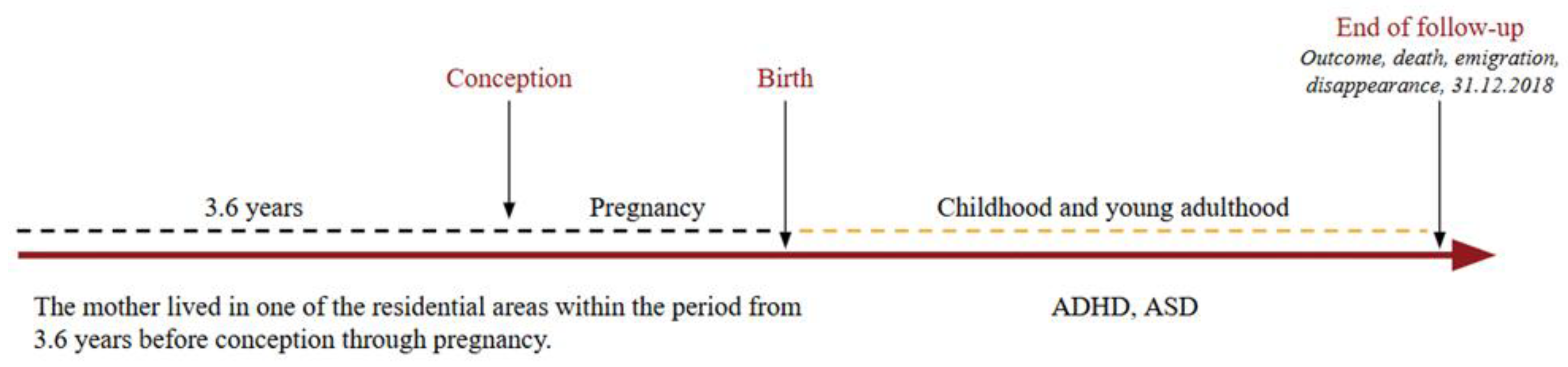
We identified 20,232 live-born children whose mothers had resided in either Farum or Brøndby at some point prior to delivery between 1970 and 2018. Residential histories and relocation dates from the Danish Civil Registration System [23], which has recorded address information since 1968, were used to determine eligibility and timing of exposure. Apartments were considered contaminated if they were built with PCB-containing materials, while the remaining apartments served as reference units. Children were included and classified as exposed if their mother had lived some time in a contaminated apartment within the period from 3.6 years before conception through pregnancy (Figure 1). The half-life of PCB-28 has been estimated to range from 0.5 to 6.7 years, with a mean of 3.6 years [24]. This average was used to approximate in utero exposure regardless of when maternal exposure occurred within this period. Children were included and classified as prenatally unexposed if their mothers met the same residential criteria, but lived in reference apartments, and had no history of residence in contaminated apartments in the housing areas. In total, 8357 children met the inclusion criteria. We excluded children whose mothers had missing information on ancestry (n < 5), and those born before 1995, as diagnostic data on ADHD and ASD were unavailable for earlier birth years. The final study population comprised 3797 children.
Figure 1.
Inclusion criteria and follow-up period for ADHD and ASD.
2.3. Maternal Exposure to PCB
Indoor air measurements were conducted in subsets of apartments in both Farum and Brøndby. In Farum, 83 contaminated and 20 reference apartments were sampled in 2011 and 24 PCB congeners measured [18]. In Brøndby, concentrations of seven PCB congeners were measured in 117 contaminated and 18 reference apartments between 2011 and 2017 [25,26]. For both areas, these seven indicator PCBs (PCB-28, -52, -101, -118, -138, -153, and -180) were included, as they are among the most common PCB congeners and are frequently used as indicators of overall PCB concentrations [27]. Their concentrations are presented in Table 1. As only a subset of apartments was sampled, we used the mean of the PCB concentrations at the building level, or from the adjacent building when measurements were unavailable. Based on a study from Brøndby [26], indoor air concentrations were assumed constant over time and thus extrapolated across the study period.
Maternal exposure was estimated by multiplying the entire duration of residence in a given apartment prior to birth with total PCB in the indoor air (ng PCB/m3 × year). Total PCB (PCBtotal) was calculated as the sum of the mean concentrations of the seven indicator PCBs multiplied with a factor of five to account for unmeasured congeners (Table 1). This is commonly applied in European studies in determination of whether exposure levels exceed action levels [27,28]. This metric captured cumulative exposure during the mother’s entire residential period in Farum and Brøndby prior to delivery. Since low PCB levels were detected in all reference apartments, all children in the study population were considered to have had some degree of prenatal exposure.
Table 1.
Concentrations of the seven indicator PCBs in indoor air in contaminated and reference apartments in Farum and Brøndby.
2.4. Outcome
We obtained information on ADHD and ASD from the Danish National Patient Register (NPR) and the Danish National Prescription Register (DNPR) from 1995 onwards. The NPR contains information on inpatient and outpatient contacts, including dates and primary and secondary diagnoses according to the Danish version of the International Classification of Diseases and Related Health Problems, 10th Revision (ICD-10). ASD was identified using ICD-10 codes F84.0, F84.1, F84.10, F84.11, F84.12, F84.5, F84.8, and F84.9 (Table S1). ADHD was identified using ICD-10 codes F90.0, F90.1, F90.8, F90.9, and F98.8c.
To capture cases treated outside of hospitals, e.g., by a private psychiatrist, we additionally used the DNPR, in which prescriptions are coded according to the Anatomical Therapeutic Chemical (ATC) Classification system. ADHD cases were identified based on redeemed prescriptions with ATC codes N06BA02, N06BA04, N06BA09, N06BA12, and C02AC02 (Table S1). As ASD is not treated medically, prescription data were not available for identification of ASD cases.
2.5. Covariates
Information on maternal age at time of birth (continuous); education level at time of birth (short 7–10 years, medium 11–12 years, long >12 years, and vocational training); and ancestry (Danish, Western, and non-Western) were acquired from the Danish Civil Registration System and Statistics Denmark. From the Danish Medical Birth Register, we further acquired information on maternal parity (1 and ≥2); smoking in the first trimester (no/yes), and pre-pregnancy Body Mass Index (BMI) (≤18.5, 18.6–24.9, and ≥25 kg/m2). For the child, we acquired information on date of birth, sex, death, emigration, and disappearance (residence unknown to Danish authorities) from the Danish Civil Registration System.
2.6. Statistical Analyses
Characteristics of the mother–child pairs are presented overall and stratified by cumulated prenatal exposure levels: <300 ng PCB/m3 × year and ≥300 ng PCB/m3 × year. For continuous variables, exact percentiles are not reported due to local data protection regulations [GDPR, EU 2016/679]. Instead, we calculated pseudo-percentiles as the mean of the five values closest to the actual percentile. We used Cox regression models with the child’s age as the underlying timescale to estimate hazard ratios (HRs) and corresponding 95% confidence intervals (CIs) for the association between prenatal PCB exposure and the risk of ADHD and ASD. HRs were estimated using dichotomised (<300 ng/m3 × year; ≥300 ng/m3 × year) and categorised (<300 ng/m3 × year; ≥300–1500 ng/m3 × year; >1.500–3.000 ng/m3 × year; >3000 ng/m3 × year) measures of PCB exposure, the latter to allow a non-linear relationship. The categorisation of PCB exposure was based on the Danish lower and upper action levels of 300 ng PCB/m3 and 3000 ng PCB/m3, respectively [30]. Follow-up began at the date of birth and ended at the date of diagnosis of ADHD or ASD, death, emigration, disappearance, or end of follow-up on 31 December 2018, whichever occurred first. We used scaled Schoenfeld residuals to assess the proportional hazards assumption and applied robust standard errors when calculating CIs in all analyses to account for correlations between siblings. The proportional hazards assumption was met for PCB exposure. Although some evidence of non-proportionality was observed for sex and ancestry, additional analyses including time-varying effects for these covariates yielded similar estimates for PCB exposure and did not alter the study conclusions. Therefore, results from the simpler model are presented. Based on confounders identified a priori and depicted in our Directed Acyclic Graph (Figure S1), all analyses were adjusted for maternal age at time of birth, ancestry, parity, and calendar period categorised into five-year intervals. We also adjusted for the child’s sex, as symptom presentation in ADHD and ASD is sex-specific and may lead to differential diagnostic practices. Adjustment for maternal education at time of birth was included in a separate step, as 6% of the mothers had missing data on educational attainment.
We conducted six sensitivity analyses based on our dichotomised PCB exposure variable to assess the robustness of our findings. First, we conducted complete-case analyses in which we included all mother–child pairs with information on maternal education at birth. This was done to investigate whether potential changes in effect estimates were more likely due to confounding by educational attainment or to differences in the study population. Second, we adjusted analyses for maternal smoking in the first trimester to account for potential confounding, since smoking in residences with elevated PCB levels may raise indoor PCB concentration [31], and smoking may be associated with a higher risk of ADHD and ASD in the child [32,33]. Third, we performed analyses with adjustment for maternal pre-pregnancy BMI. PCBs are lipophilic, therefore differences in body fat composition may lead to variation in maternal blood levels of PCBs [34]. Maternal pre-pregnancy overweight has also been associated with risk of ADHD and ASD in the offspring [35,36]. We adjusted for maternal smoking during the first trimester and pre-pregnancy BMI in separate sensitivity analyses due to the relatively large proportion of mothers with missing information on smoking (9%) and pre-pregnancy BMI (51%), as systematic registration hereof did not begin until 1997 and 2003, respectively [37]. Fourth, to mitigate potential bias from postnatal PCB exposure within the first years of life, we carried out a sensitivity analysis excluding children who had resided in PCB-contaminated apartments during the first five years of their life. Fifth, we stratified the analyses of ADHD and ASD by diagnosis year (≤2006 and >2006) given the substantial increase in the incidence during the study period. The year 2006 was chosen as the cut-off based on the ADHD incidence curve reported by Grøntved et al. 2025 [38]. Sixth, we restricted the analysis of ADHD to diagnoses based solely on ICD-10 codes, as diagnoses registered in the NPR may be more accurate than diagnoses based on ATC codes. In our interpretation of the results, we considered the precision, magnitude, and direction of effect estimates rather than binary statistical significance testing. All analyses were performed using R-studio version 2025.05.1+513.
3. Results
Characteristics of the mother–child pairs are presented in Table 2. Among the 3797 included children, 23% were prenatally exposed to ≥300 ng PCB/m3 × year. Of these, 74% of the mothers had lived in a contaminated apartment. Approximately half of the children were born between 1995 and 2004 (49%). In the ≥300 ng PCB/m3 × year group, there was a slightly lower proportion of boys than in the <300 ng PCB/m3 × year group. The median maternal age at birth was 28 years across exposure groups. Among children with prenatal exposure ≥ 300 ng PCB/m3 × year, a slightly higher proportion had mothers of non-Western ancestry (45% vs. 43%), with a lower educational level, who smoked during the first trimester (28% vs. 24%), and had a BMI ≥ 25 (41% vs. 37%) than the children with prenatal exposure < 300 ng PCB/m3 × year.
Table 2.
Characteristics of the study population (n = 3797) overall and according to prenatal exposure <300 ng PCB/m3 × year and ≥300 ng PCB/m3 × year.
3.1. Cumulative Prenatal PCB Exposure and ADHD
In total, 4.5% of the children were diagnosed with ADHD. The median age at diagnosis was 9.5 years (interquartile range (IQR): 7.2–14.1). Of the ADHD cases, 14% were identified solely through redeemed prescriptions. A higher percentage of children were diagnosed among those prenatally exposed to ≥300 ng PCB/m3 × year (6.7%) compared with children in the reference group (3.9%) (Table 3). For the dichotomised PCB exposure, children prenatally exposed to ≥300 ng PCB/m3 × year had a higher risk of ADHD (aHR 1.53, 95% CI: 1.09–2.15) compared with children in the reference group. When PCB exposure was categorised, the most pronounced association was observed in the exposure group ≥ 300–1500 ng PCB/m3 × year (aHR 1.90, 95% CI: 1.26–2.84) compared with the reference group. We also observed a tendency toward a higher risk of ADHD among children prenatally exposed to 1500–3000 ng PCB/m3 × year (aHR 1.70, 95% CI: 0.89–3.22), whereas children prenatally exposed to >3000 ng PCB/m3 × year had a similar risk (aHR 0.97, 95% CI: 0.55–1.74) to the reference group.
Table 3.
Cumulative prenatal exposure to PCB in indoor air and hazard ratio of developing ADHD among 3797 children.
In sensitivity analyses for dichotomised PCB exposure, the results generally remained similar to those of the main analyses (Tables S2–S7). The association between PCB exposure and ADHD became more pronounced when adjusting for maternal pre-pregnancy BMI (aHR 1.92, 95% CI: 1.04–3.54) and in analysis based on diagnoses ≤ 2006 (aHR 2.42, 95% CI: 1.00–5.82), but the CIs overlapped with the estimate for diagnoses > 2006 (aHR 1.46, 95% CI: 1.02–2.10).
3.2. Cumulative Prenatal PCB Exposure and ASD
Overall, 2.8% of the children were diagnosed with ASD, with a higher proportion among those with exposure ≥ 300 ng PCB/m3 × year (3.6%) (Table 4). The median age at diagnosis was 10.4 years (IQR: 5.6–14.0). The results for the dichotomised PCB exposure indicated an association between prenatal exposure to ≥300 ng PCB/m3 × year and a higher risk of ASD (aHR 1.35, 95% CI: 0.87–2.08), compared with the reference group. For the categorised PCB exposure, we observed indications of an exposure-response relationship between prenatal PCB exposure and ASD, with aHRs of 1.23 (95% CI: 0.67–2.26) for the exposure group ≥ 300–1500 ng PCB/m3 × year, 1.40 (95% CI: 0.56–3.49) for 1500–3000 ng PCB/m3 × year, and 1.49 (95% CI: 0.80–2.77) for >3000 ng PCB/m3 × year, compared with the reference group. However, the CIs were consistent with both a lower and a higher risk, as well as with similar effect estimates across exposure groups.
Table 4.
Cumulative prenatal exposure to PCB in indoor air and hazard ratio of developing ASD among 3797 children.
In sensitivity analyses for dichotomised PCB exposure, we observed a more pronounced association between prenatal PCB exposure and ASD when adjusting for maternal smoking during the first trimester (aHR 1.54, 95% CI: 0.99–2.42) and a weaker association after exclusion of children who lived in a contaminated apartment during the first five years of their lives (aHR 1.06, 95% CI: 0.62–1.81) (Tables S2–S6).
4. Discussion
In this large population-based study, prenatal exposure to LC-PCBs in indoor air was associated with a higher risk of ADHD. We also observed a higher risk of ASD, although the CIs were consistent with both a lower and a higher risk. We observed an indication of an exposure-response association for ASD, but not for ADHD. The absence of an exposure-response pattern for ADHD does not necessarily argue against an association and may reflect a small number of cases in the exposure group > 1500–3000 ng/m3 × year, (n = 10) and the exposure group > 3000 ng/m3 × year (n = 13), a non-linear effect, or a threshold effect. Alternatively, greater diagnostic and ascertainment variability for ADHD may have attenuated differences across exposure levels.
Only one previous study has investigated the association between prenatal exposure to LC-PCBs and ADHD [11]. Similar to our findings, this case-control study, including 718 Finnish mother–child pairs, observed a tendency of higher odds of ADHD between the age 2 and 13 years for children prenatally exposed to LC-PCB-74 measured in maternal serum. They reported tendencies, whereas we found statistically significant HR estimates for our dichotomised PCB and categorised PCB exposure group ≥ 300–1500 ng PCB/m3 × year. The exposure levels are not directly comparable, as they measured LC-PCBs in maternal serum and not in indoor air, as in our study. However, the exposure levels in the study by Cheslack-Postava et al. 2022 [11] may be lower than in our study, as there are no indications that mothers in their study were exposed to higher levels of PCB, e.g., at home or at work, than the general population, which is one possible explanation for the lack of statistically significant findings.
Three studies have investigated the association between prenatal exposure to LC-PCBs and ASD with conflicting results [9,10,12]. In a case-control study of 963 mother–child pairs in the United States, Lyall et al. (2017) observed a tendency toward an exposure-response relationship between prenatal exposure to PCB-28 and ASD [9], similar to our findings. Granillo et al. (2019) examined prenatal exposure to specific PCB-congeners in 104 mother–child pairs and ASD in a prospective cohort study in the United States [12]. They reported a tendency of PCB-11 and PCB-52 to be associated with higher odds of ASD, with the highest OR observed for PCB-52 at prenatal exposure levels above 8.9 ng/g lipid in blood serum (OR 2.44 95% CI: 0.86; 6.92). For PCB-77, they found a tendency toward lower odds of ASD. This may be explained by PCB-77 being a dioxin-like PCB (DL-PCB) that likely acts through different mechanisms than NDL-PCBs, such as activation of the aryl hydrocarbon receptor [8], and there is less evidence implicating a role for DL-PCBs in neurotoxic outcomes compared with NDL-PCBs [7]. Our findings for ASD contrast those of a prospective cohort study of 175 mother–child pairs from the United States, that found no indication of association between the two LC-PCBs, PCB-28 or PCB-66, and autistic behavioural patterns in the children [10]. These differences in findings may be explained by the small sample size or the use of maternal self-report to assess autistic behavioural patterns, which may have introduced social desirability bias. Moreover, they measured specific LC-PCBs in maternal serum, whereas we measured the sum of seven indicator PCBs in indoor air, limiting direct comparison. Levels in serum reflect not only external exposure but also PCB metabolism and individual body composition, as PCB is lipophilic and accumulates in fatty tissue [34]. Furthermore, they also observed a tendency toward fewer autistic behavioural patterns in relation to prenatal exposure to PCB-74 [10]. There is, however, no clear biological rationale to suggest that the NDL-PCB-74 would reduce autistic traits. The existing evidence on the mechanisms of neurodevelopment underlying NDL-PCBs suggests that altered regulation of intracellular calcium and increased levels of intracellular reactive oxygen species are particularly responsible for disrupting synaptic connections in the brain through neuronal apoptosis as well as axonal and dendritic morphogenesis [8]. Since individuals with ADHD and ASD experience symptoms related to changes in synaptic connectivity in different regions of the brain [7], associations between PCB and risk of ADHD and ASD are biologically plausible.
Methodological Considerations
Given the register-based nature of this study, we were not able to account for potential confounding from factors such as maternal diet or occupational exposure, which may influence the mother’s total body burden of PCB. Therefore, we cannot exclude the risk of some residual confounding. However, the study is structured as a natural experiment, where residents unknowingly took up residence in either contaminated or reference apartments and thereby assigned themselves to PCB exposure. Thus, we assume that children with higher and lower exposure levels are fairly comparable, which may reduce the influence of potential unmeasured confounding. Information on maternal smoking during the first trimester was limited prior to 1997, and data on maternal pre-pregnancy BMI only became available in late 2003. We did, however, conduct sensitivity analyses in which we included children whose mothers had available information on smoking and BMI, respectively. Although the estimates changed to some extent, indicating some possible confounding, the overall conclusions remained unchanged. For ASD, the changes in estimates may rather reflect differences in the study population, as the estimates in the complete-case analyses were nearly identical after adjustment for smoking and BMI, respectively. We also adjusted for maternal education, which is generally regarded as the most valid measure of socioeconomic status among young individuals [39]. Since socioeconomic status is closely related to health behaviours, this likely further minimizes the impact of potential residual confounding from factors such as smoking and diet. Finally, we adjusted for the calendar period to account for improved diagnostics of neurodevelopmental disorders, changes in smoking prevalence, and changes in the socioeconomic characteristics of residents, thereby reducing the risk of time-related bias.
We used PCB concentrations measured in indoor air as an indirect indicator of prenatal PCB exposure. Because airborne PCB levels do not directly reflect the internal PCB body burden, some individuals classified as highly exposed (≥300 ng PCB/m3 × year) may in fact have had low body burdens, and vice versa. This may introduce a risk of non-differential misclassification of PCB exposure. Such misclassification would likely bias the associations toward the null, as it would reduce the contrast between exposure groups. Furthermore, we extrapolated measurements of PCB exposure from selected apartments to neighbouring apartments or adjacent buildings, and across the study period. This constitutes another potential source of non-differential misclassification of PCB exposure because indoor air levels may be influenced by factors such as ventilation, temperature, season, and cleaning practices [26,27]. A study from Brøndby, however, found no clear temporal trends in indoor PCB levels, suggesting that extrapolation over time is likely to be of limited concern [26]. Moreover, we did not have information about the actual time the mothers spent in their apartments, which may also have introduced non-differential exposure misclassification. Finally, we did not have information on whether the mothers could have lived in a PCB-contaminated apartment before or after residing in Farum and Brøndby. Therefore, it is possible that some of the mothers classified as unexposed may in fact have been exposed, which would likely attenuate the effect estimates. However, given the natural experimental design of the study, we assume that residents in contaminated and reference apartments have similar probabilities of having lived in PCB-contaminated homes previously or subsequently, thereby maintaining the same exposure contrast.
We used nationwide registers that have generally been found to have high validity for the ascertainment of our two outcomes, ADHD and ASD [40]. However, the large increase in incidence during the study period, together with the substantial geographical variation, makes it unclear what medical conditions are actually being captured by these diagnoses. Although substantial regional variation in ADHD and ASD incidence has been reported across Denmark [41], most likely due to differences in diagnostic practices, this is unlikely to have affected the present study, since the study population was recruited exclusively from two confined areas of Copenhagen. Changes in diagnostic practices and increased awareness of ADHD and ASD over time may have led to the identification of individuals with milder symptoms later in the study period. If the inclusion of milder cases occurred similarly across exposure groups, it may also have attenuated the estimates for the entire study period towards the null. This may be the case for ADHD, where stratification by diagnosis year (≤2006 and >2006) showed a more pronounced association with prenatal PCB exposure earlier in the study period. However, the CIs were wide, and the hazard of ADHD may not differ between the two periods. As we are relying on register-based diagnoses, there is still a risk that individuals in both exposure groups are misclassified as false negatives, thereby introducing non-differential misclassification, as we assume that not all individuals with milder symptoms of ADHD and ASD have received a diagnosis. This indicates reduced sensitivity, which means we may have underestimated the association between prenatal PCB exposure and ADHD and ASD, respectively. However, to capture children diagnosed by private psychiatrists, we also identified cases of ADHD through redeemed medication in the DNPR. This approach may increase sensitivity but reduce specificity if some individuals have been misclassified as false positives, as several of the ATC codes used to identify ADHD also encompass medications prescribed for other conditions, such as narcolepsy [42]. Nevertheless, we consider this unlikely to affect our results considerably, as narcolepsy is a rare condition [43], which is supported by our sensitivity analysis restricted to ADHD diagnosis based solely on ICD-10 codes. Finally, there is a risk of differential misclassification in our study if the mothers were aware that they had lived in a PCB-contaminated apartment and were thus more likely to seek medical attention for their children. This could lead to an overestimation of the association. However, we consider this risk limited, as the PCB contamination was identified later in the follow-up period. Thus, nondifferential misclassification, and consequently conservative effect estimates, is more likely, since the probability of receiving a diagnosis is unlikely to depend on individual PCB exposure levels.
5. Conclusions
Our findings suggest that prenatal exposure to LC-PCBs may disrupt neurodevelopmental programming and increase the risk of ADHD and potentially ASD, when living one year with concentrations above the Danish Health Authority’s lower action level of 300 ng PCB/m3 air. For ASD, we also found indications of an exposure-response pattern. The findings of this study contribute to the growing evidence on adverse health effects of LC-PCBs. As nearly all the potential biases we identified would more likely attenuate the associations toward the null, the observed associations are expected to represent an underestimation rather than an overestimation of the true associations. Together, these findings suggest that the Danish action levels for PCBs in indoor air may need to be reevaluated, similar to Germany, which recently reduced its lower (precautionary) and upper (health hazard value) action levels to 80 and 800 ng PCB/m3, respectively. However, more studies are warranted.
Supplementary Materials
The following supporting information can be downloaded at https://www.mdpi.com/article/10.3390/toxics14110959/s1, Figure S1: Directed Acyclic Graph (DAG) of assumed causal relationships between prenatal exposure to PCBs in indoor air and ADHD and ASD; Table S1: ICD-10 codes and ATC codes to identify ADHD and ASD in the Danish registers; Table S2: Complete case analyses for cumulative prenatal exposure to PCB in indoor air and hazard ratio of developing ADHD and ASD among those with information on maternal education at birth (n = 3577); Table S3: Cumulative prenatal exposure to PCB in indoor air and hazard ratio of developing ADHD and ASD with information on maternal smoking in the first trimester (n = 3264); Table S4: Cumulative prenatal exposure to PCB in indoor air and hazard ratio of developing ADHD and ASD with information on maternal pre-pregnancy BMI (n = 1778); Table S5: Cumulative prenatal exposure to PCB in indoor air and hazard ratio of developing ADHD and ASD with no stay in contaminated apartments in the first five years of life (n = 3328); Table S6: Cumulative prenatal exposure to PCB in indoor air and hazard ratio of developing ADHD and ASD, stratified by diagnosis year ≤ 2006 (n = 2153) and >2006 (n = 3712); Table S7: Cumulative prenatal exposure to PCB in indoor air and hazard ratio of developing ADHD based solely on ICD-10 codes among 3797 children.
Author Contributions
N.L.F.: writing—original draft preparation, writing—review and editing, conceptualization, methodology, formal analysis, data curation, visualization; A.B.C.: writing—original draft preparation, writing—review and editing, conceptualization, methodology, formal analysis, data curation, visualization; R.S.W.: writing—review and editing, conceptualization, methodology, supervision; H.W.M.: writing—review and editing, conceptualization, methodology, funding acquisition; K.S.H.: writing—review and editing, conceptualization, methodology; J.P.E.B.: writing—review and editing, conceptualization, methodology, funding acquisition; L.D.: writing—review and editing, conceptualization, methodology, data curation, funding acquisition, supervision, project administration; S.S.T.: writing—review and editing, conceptualization, methodology, data curation, funding acquisition, supervision, project administration. All authors have read and agreed to the published version of the manuscript.
Funding
This study was funded by Helsefonden (ref. no. 21-B-0412), The National Building Foundation, Realdania (ref. no. PRJ-2017-00176), and The Landowners’ Investment Foundation (ref. no. 18–58).
Institutional Review Board Statement
Not applicable.
Informed Consent Statement
Informed consent was waived due to the use of register-based data and the study being conducted without direct contact with the participants.
Data Availability Statement
The data underlying the findings of this study are not openly available. The data are stored in a protected server environment hosted by Statistics Denmark; the authors do not have permission to share data.
Acknowledgments
Thomas Hougaard, Lars Gunnarsen, and Helle Vibeke Andersen provided PCB exposure data and contributed with knowledge of the contaminated buildings. During the preparation of this manuscript, the author(s) used Microsoft Copilot (https://copilot.microsoft.com; accessed on 1 April 2026) for the purposes of spelling and grammar in the first draft. The authors have reviewed and edited the output and take full responsibility for the content of this publication.
Conflicts of Interest
The authors declare no conflicts of interest.
Abbreviations
The following abbreviations are used in this manuscript:
| ADHD | Attention deficit hyperactivity disorder |
| ASD | Autism spectrum disorder |
| ATC | Anatomical Therapeutic Chemical (ATC) Classification system |
| BMI | Body Mass Index |
| CI | Confidence interval |
| DL-PCB | Dioxin-like polychlorinated biphenyl |
| DNPR | Danish National Prescription Register |
| HESPAIR | Health Effects of PCBs in Indoor Air |
| HR | Hazard ratio |
| ICD-10 | International Classification of Diseases and Related Health Problems, 10th Revision |
| IQR | Interquartile range |
| LC-PCBs | Lower-chlorinated polychlorinated biphenyls |
| NDDs | Neurodevelopmental disorders |
| NDL-PCBs | Non-dioxin-like polychlorinated biphenyls |
| NPR | Danish National Patient Register |
| PCBs | Polychlorinated biphenyls |
References
- Meyer, H.W.; Frederiksen, M.; Göen, T.; Ebbehøj, N.E.; Gunnarsen, L.; Brauer, C.; Kolarik, B.; Müller, J.; Jacobsen, P. Plasma polychlorinated biphenyls in residents of 91 PCB-contaminated and 108 non-contaminated dwellings—An exposure study. Int. J. Hyg. Environ. Health 2013, 216, 755–762. [Google Scholar] [CrossRef] [Scilit]
- Faroon, O.; Ruiz, P. Polychlorinated biphenyls: New evidence from the last decade. Toxicol. Ind. Health 2016, 32, 1825–1847. [Google Scholar] [CrossRef] [Scilit]
- Frederiksen, M.; Andersen, H.V.; Haug, L.S.; Thomsen, C.; Broadwell, S.L.; Egsmose, E.L.; Kolarik, B.; Gunnarsen, L.; Knudsen, L.E. PCB in serum and hand wipes from exposed residents living in contaminated high-rise apartment buildings and a reference group. Int. J. Hyg. Environ. Health 2020, 224, 113430. [Google Scholar] [CrossRef] [Scilit]
- Weitekamp, C.A.; Phillips, L.J.; Carlson, L.M.; DeLuca, N.M.; Cohen Hubal, E.A.; Lehmann, G.M. A state-of-the-science review of polychlorinated biphenyl exposures at background levels: Relative contributions of exposure routes. Sci. Total Environ. 2021, 776, 145912. [Google Scholar] [CrossRef] [Scilit]
- Vizcaino, E.; Grimalt, J.O.; Fernández-Somoano, A.; Tardon, A. Transport of persistent organic pollutants across the human placenta. Environ. Int. 2014, 65, 107–115. [Google Scholar] [CrossRef] [Scilit]
- Stiles, J.; Jernigan, T.L. The Basics of Brain Development. Neuropsychol. Rev. 2010, 20, 327–348. [Google Scholar] [CrossRef] [Scilit]
- Pessah, I.N.; Lein, P.J.; Seegal, R.F.; Sagiv, S.K. Neurotoxicity of polychlorinated biphenyls and related organohalogens. Acta Neuropathol. 2019, 138, 363–387. [Google Scholar] [CrossRef] [Scilit]
- Klocke, C.; Lein, P.J. Evidence Implicating Non-Dioxin-like Congeners as the Key Mediators of Polychlorinated Biphenyl (PCB) Developmental Neurotoxicity. Int. J. Mol. Sci. 2020, 21, 1013. [Google Scholar] [CrossRef] [Scilit]
- Lyall, K.; Croen, L.A.; Sjödin, A.; Yoshida, C.K.; Zerbo, O.; Kharrazi, M.; Windham, G.C. Polychlorinated Biphenyl and Organochlorine Pesticide Concentrations in Maternal Mid-Pregnancy Serum Samples: Association with Autism Spectrum Disorder and Intellectual Disability. Environ. Health Perspect. 2017, 125, 474–480. [Google Scholar] [CrossRef] [Scilit]
- Braun, J.M.; Kalkbrenner, A.E.; Just, A.C.; Yolton, K.; Calafat, A.M.; Sjödin, A.; Hauser, R.; Webster, G.M.; Chen, A.; Lanphear, B.P. Gestational Exposure to Endocrine-Disrupting Chemicals and Reciprocal Social, Repetitive, and Stereotypic Behaviors in 4- and 5-Year-Old Children: The HOME Study. Environ. Health Perspect. 2014, 122, 513–520. [Google Scholar] [CrossRef] [Scilit]
- Cheslack-Postava, K.; Rantakokko, P.; Kiviranta, H.; Hinkka-Yli-Salomäki, S.; Surcel, H.-M.; Vivio, N.; Falabella, G.; McKeague, I.W.; Sourander, A.; Brown, A.S. Maternal serum persistent organic pollutant exposure and offspring diagnosed ADHD in a national birth cohort. Environ. Res. 2022, 212, 113145. [Google Scholar] [CrossRef] [Scilit]
- Granillo, L.; Sethi, S.; Keil, K.P.; Lin, Y.; Ozonoff, S.; Iosif, A.-M.; Puschner, B.; Schmidt, R.J. Polychlorinated biphenyls influence on autism spectrum disorder risk in the MARBLES cohort. Environ. Res. 2019, 171, 177–184. [Google Scholar] [CrossRef] [Scilit]
- Issac, A.; Halemani, K.; Shetty, A.; Thimmappa, L.; Vijay, V.; Koni, K.; Mishra, P.; Kapoor, V. The global prevalence of autism spectrum disorder in children: A systematic review and meta-analysis. Osong Public Health Res. Perspect. 2025, 16, 3–27. [Google Scholar] [CrossRef] [Scilit]
- Tuncer-Ebetürk, I.; Kim, J.; Soysal, Y.N. The global rise in children’s attention-deficit/hyperactivity disorder prevalence: A macro-sociological explanation. Soc. Forces 2026, 104, 1607–1629. [Google Scholar] [CrossRef] [Scilit]
- Bliddal, M.; Gram, E.B.; Sonne, H.; Krumborg, J.R.; Lundgaard, K.M.; Wesselhoeft, R.; Kildegaard, H. Trends and incidence rates of neurodevelopmental disorders in Danish children and adolescents 2000–2024: Short title: Neurodevelopmental disorders in children and adolescents. Eur. Child Adolesc. Psychiatry 2026, 35, 1667–1675. [Google Scholar] [CrossRef] [Scilit]
- Myers, S.M.; Voigt, R.G.; Colligan, R.C.; Weaver, A.L.; Storlie, C.B.; Stoeckel, R.E.; Port, J.D.; Katusic, S.K. Autism Spectrum Disorder: Incidence and Time Trends Over Two Decades in a Population-Based Birth Cohort. J. Autism Dev. Disord. 2019, 49, 1455–1474. [Google Scholar] [CrossRef] [Scilit]
- McKechnie, D.G.J.; O’Nions, E.; Dunsmuir, S.; Petersen, I. Attention-deficit hyperactivity disorder diagnoses and prescriptions in UK primary care, 2000–2018: Population-based cohort study. BJPsych Open 2023, 9, e121. [Google Scholar] [CrossRef] [Scilit]
- Frederiksen, M.; Meyer, H.W.; Ebbehøj, N.E.; Gunnarsen, L. Polychlorinated biphenyls (PCBs) in indoor air originating from sealants in contaminated and uncontaminated apartments within the same housing estate. Chemosphere 2012, 89, 473–479. [Google Scholar] [CrossRef] [Scilit]
- Andersen, H.V.; Gunnarsen, L.; Knudsen, L.E.; Frederiksen, M. PCB in air, dust and surface wipes in 73 Danish homes. Int. J. Hyg. Environ. Health 2020, 229, 113429. [Google Scholar] [CrossRef] [Scilit]
- Deen, L.; Clark, A.; Hougaard, K.S.; Petersen, K.U.; Frederiksen, M.; Wise, L.A.; Wesselink, A.K.; Meyer, H.W.; Bonde, J.P.; Tøttenborg, S.S. Exposure to airborne polychlorinated biphenyls and type 2 diabetes in a Danish cohort. Environ. Res. 2023, 237, 117000. [Google Scholar] [CrossRef] [Scilit]
- Deen, L.; Clark, A.; Hougaard, K.S.; Meyer, H.W.; Frederiksen, M.; Pedersen, E.B.; Petersen, K.U.; Flachs, E.M.; Bonde, J.P.E.; Tøttenborg, S.S. Risk of cardiovascular diseases following residential exposure to airborne polychlorinated biphenyls: A register-based cohort study. Environ. Res. 2023, 222, 115354. [Google Scholar] [CrossRef] [Scilit]
- Deen, L.; Hougaard, K.S.; Clark, A.; Meyer, H.W.; Frederiksen, M.; Gunnarsen, L.; Andersen, H.V.; Hougaard, T.; Petersen, K.K.U.; Ebbehøj, N.E.; et al. Cancer Risk following Residential Exposure to Airborne Polychlorinated Biphenyls: A Danish Register-Based Cohort Study. Environ. Health Perspect. 2022, 130, 107003. [Google Scholar] [CrossRef] [Scilit]
- Pedersen, C.B. The Danish Civil Registration System. Scand. J. Public Health 2011, 39, 22–25. [Google Scholar] [CrossRef] [Scilit]
- Idowu, I.G.; Megson, D.; Tiktak, G.; Dereviankin, M.; Sandau, C.D. Polychlorinated biphenyl (PCB) half-lives in humans: A systematic review. Chemosphere 2023, 345, 140359. [Google Scholar] [CrossRef] [Scilit]
- Golder Associates. Resultatoversigter over PCB-Målinger I Indeluften; Consultancy Report: Summary of PCB Measurement in Indoor Air; Golder Associates A/S:Kgs.: Lyngby, Denmark, 2015; pp. 1–24. (In Danish) [Google Scholar]
- Andersen, H.V.; Kolarik, B.; Nielsen, N.S.; Hougaard, T.; Gunnarsen, L.; Knudsen, L.E.; Frederiksen, M. Indoor air concentrations of PCB in a contaminated building estate and factors of importance for the variance. Build. Environ. 2021, 204, 108135. [Google Scholar] [CrossRef] [Scilit]
- Jensen, A.A. Health Risks of PCB in the Indoor Climate in Denmark–Background for Setting Recommended Action Levels; Danish Health and Medicines Authority: Copenhagen, Denmark, 2013. [Google Scholar]
- Verein Deutscher Ingenieure. Ambient Air Measurement–Indoor Air Measurement–Measurement of Polychlorinated Biphenyls (PCBs)–GC/MS Method for PCB 28, 52, 101,138, 153, 180; Part 1 (VDI 2464); VDI–The Association of German Engineers: Düsseldorf, Germany, 2009. [Google Scholar]
- Tøttenborg, S.S.; Wise, L.A.; Wesselink, A.K.; Nielsen, H.S.; Petersen, K.U.; Fox, M.P.; Frederiksen, M.; Flachs, E.M.; Meyer, H.W.; Hougaard, K.S.; et al. Exposure to airborne polychlorinated biphenyls and risk of uterine leiomyomata, endometriosis, and polycystic ovarian syndrome: A register-based Danish cohort study. Environ. Toxicol. Pharmacol. 2025, 117, 104738. [Google Scholar] [CrossRef] [Scilit]
- The Danish Social and Housing Agency. Fakta om PCB: Aktionsværdier for Indeluften [Facts About PCB: Action Levels for Indoor Air]. 2025. Available online: https://www.pcb-guiden.dk/fakta-om-pcb/aktionsvaerdier-for-indeluften (accessed on 22 April 2026). (In Danish)
- Andersen, H.V.; Bramming Jørgensen, R.; Gunnarsen, L. Impact of smoking and candle burning on air concentrations of PCB in a PCB contaminated indoor environment. Atmos. Environ. 2023, 309, 119922. [Google Scholar] [CrossRef] [Scilit]
- Huang, L.; Wang, Y.; Zhang, L.; Zheng, Z.; Zhu, T.; Qu, Y.; Mu, D. Maternal Smoking and Attention-Deficit/Hyperactivity Disorder in Offspring: A Meta-analysis. Pediatrics 2018, 141, e20172465. [Google Scholar] [CrossRef] [Scilit]
- Peltekidi, A.; Jotautis, V.; Tzitiridou-Chatzopoulou, M.; Georgakopoulou, V.E.; Sousamli, A.; Diamanti, A.; Vivilaki, V.; Orovou, E.; Sarantaki, A. Maternal Smoking During Pregnancy and Risk of Autism Spectrum Disorder in Offspring: A Systematic Review and Meta-Analysis. J. Clin. Med. 2025, 14, 8584. [Google Scholar] [CrossRef] [Scilit]
- Mullerova, D.; Kopecky, J.; Matejkova, D.; Muller, L.; Rosmus, J.; Racek, J.; Sefrna, F.; Opatrna, S.; Kuda, O.; Matejovic, M. Negative association between plasma levels of adiponectin and polychlorinated biphenyl 153 in obese women under non-energy-restrictive regime. Int. J. Obes. 2008, 32, 1875–1878. [Google Scholar] [CrossRef] [Scilit]
- Li, L.; Lagerberg, T.; Chang, Z.; Cortese, S.; Rosenqvist, M.A.; Almqvist, C.; D’onofrio, B.M.; Hegvik, T.-A.; Hartman, C.; Chen, Q.; et al. Maternal pre-pregnancy overweight/obesity and the risk of attention-deficit/hyperactivity disorder in offspring: A systematic review, meta-analysis and quasi-experimental family-based study. Int. J. Epidemiol. 2020, 49, 857–875. [Google Scholar] [CrossRef] [Scilit]
- Getz, K.D.; Anderka, M.T.; Werler, M.M.; Jick, S.S. Maternal Pre-pregnancy Body Mass Index and Autism Spectrum Disorder among Offspring: A Population-Based Case–Control Study. Paediatr. Perinat. Epid 2016, 30, 479–487. [Google Scholar] [CrossRef] [Scilit]
- Bliddal, M.; Broe, A.; Pottegård, A.; Olsen, J.; Langhoff-Roos, J. The Danish Medical Birth Register. Eur. J. Epidemiol. 2018, 33, 27–36. [Google Scholar] [CrossRef] [Scilit]
- Grøntved, S.; Hald, K.; Mohr-Jensen, C.; Johnsen, S.P.; Mainz, J.; Valentin, J.B. Prevalence and Incidence of Attention Deficit/Hyperactivity Disorder in Denmark. A National Register-Based Open Cohort Study. Acta Psychiatr. Scand. 2025, 152, 27–38. [Google Scholar] [CrossRef] [Scilit]
- Galobardes, B.; Shaw, M.; Lawlor, D.A.; Lynch, J.W.; Davey Smith, G. Indicators of socioeconomic position (part 1): Figure 1. J. Epidemiol. Community Health 2006, 60, 7–12. [Google Scholar] [CrossRef] [Scilit]
- Plana-Ripoll, O.; Liu, X.; Köhler-Forsberg, O.; Sørensen, H.; Momen, N. Mental Disorders in Danish Hospital Registers: A Review of Content and Possibilities for Epidemiological Research. Clin. Epidemiol. 2025, 17, 387–407. [Google Scholar] [CrossRef] [Scilit]
- Madsen, K.B.; Antonsen, S.; Wesselhøft, R.T.; Thomsen, P.H.; Thompson, W.K.; Fan, C.C.; Mortensen, P.B.; Pedersen, C.B.; Horsdal, H.T. Geographic variation of recorded neurodevelopmental disorders in children and adults. Dan Med. J. 2024, 71, A02240144. [Google Scholar] [CrossRef] [Scilit]
- The Danish Health Data Authority. MEDSTAT.DK: ADHD Behandling [ADHD Treatment]. 2025. Available online: https://medstat.dk/da/viewDataTables/medicalTreatments/%7B%22year%22:[%222024%22,%222023%22,%222022%22,%222021%22,%222020%22,%222019%22,%222018%22,%222017%22,%222016%22,%222015%22,%222014%22,%222013%22,%222012%22,%222011%22,%222010%22,%222009%22,%222008%22,%222007%22,%222006%22,%222005%22,%222004%22,%222003%22,%222002%22,%222001%22,%222000%22],%22region%22:[%220%22],%22gender%22:[%22A%22],%22ageGroup%22:[%22A%22],%22searchVariable%22:[%22people_count%22],%22errorMessages%22:[],%22treatmentGroup%22:[%22ADHD%22]%7D (accessed on 23 April 2026). (In Danish)
- Ovesen, J. Narkolepsi [Narcolepsy]. Sundhed.dk. 2025. Available online: https://www.sundhed.dk/borger/patienthaandbogen/hjerne-og-nerver/sygdomme/oevrige-sygdomme/narkolepsi/ (accessed on 23 April 2026). (In Danish)

Disclaimer/Publisher’s Note: The statements, opinions and data contained in all publications are solely those of the individual author(s) and contributor(s) and not of MDPI and/or the editor(s). MDPI and/or the editor(s) disclaim responsibility for any injury to people or property resulting from any ideas, methods, instructions or products referred to in the content. |
© 2026 by the authors. Licensee MDPI, Basel, Switzerland. This article is an open access article distributed under the terms and conditions of the Creative Commons Attribution (CC BY) license.