


Abstract
Background: Humanitarian logistics decisions extend beyond immediate relief delivery to include preparedness, recovery, service continuity and the development of durable local capabilities. Simulation can support these decisions under uncertainty, yet the evidence remains fragmented across logistics domains, modelling approaches and phases of the relief–development continuum. This review synthesises how simulation has been used in humanitarian logistics and identifies where the evidence is concentrated and where important gaps remain. Methods: A systematic scoping review was conducted in accordance with PRISMA-ScR and PRISMA-S, using multi-disciplinary and specialist database searches supplemented by backward and forward citation searching. Included studies were coded by logistics decision problem, continuum phase, decision level, performance outcome, simulation approach and operational grounding. Results: The literature is concentrated in preparedness and response, particularly around coordination, network design, inventory, allocation, transport and capacity. System dynamics, agent-based modelling and discrete-event simulation are well established, whereas hybrid simulation and digital twin applications remain limited. Early recovery, reconstruction, development-oriented transition and practice-embedded modelling are comparatively underdeveloped. Conclusions: Simulation-supported humanitarian logistics is strongest for structured preparedness and response problems. Future research should connect decisions across phases and strengthen beneficiary-sensitive, operationally grounded modelling of recovery, localisation, service continuity and longer-term logistics capability.
1. Introduction
Effective humanitarian response depends on timely decisions about how scarce resources, information and operational capacity are coordinated, positioned and delivered under crisis conditions. Such decisions are made under urgency, uncertainty and severe resource constraints [1,2,3,4,5], often through multi-organisational arrangements involving actors with different mandates, capacities and information systems [4,5,6]. Humanitarian logistics therefore presents a complex and interconnected decision environment.
Simulation enables dynamic processes, resource constraints, delays and changing operating conditions to be examined through experimentation with models rather than direct intervention in the systems being studied [7,8,9]. Previous reviews and critical syntheses establish its relevance to disaster management and humanitarian operations, while differing in scope between broad disaster management simulation, direct humanitarian logistics applications and system dynamics-focused analysis [10,11,12,13]. Comparison of these scopes indicates a need for a current cross-paradigm synthesis that maps humanitarian logistics decisions, the representation of multiple decision domains, relief–development continuum phases and operational grounding within a common analytical framework [10,11,12,13]. Section 2 develops the conceptual and review background supporting this positioning.
This study addresses that need through a systematic scoping review of peer-reviewed journal articles on simulation-supported humanitarian logistics published between January 2010 and January 2026. It covers discrete-event simulation, agent-based modelling, and system dynamics. The review maps logistics decision problems, application domains, continuum phases, decision levels, actors, crisis contexts, commodities and services, performance outcomes and operational grounding. The review is guided by five research questions.
- RQ1: What humanitarian logistics decision problems and application domains have been modelled using simulation?
- RQ2: How are these applications distributed across the phases of preparedness, response, early recovery, recovery/reconstruction and development-oriented transition?
- RQ3: What decision levels, actors, crisis contexts, commodities/services and performance outcomes are represented?
- RQ4: How do simulation approaches support different humanitarian logistics applications?
- RQ5: What logistics research gaps emerge from the mapped evidence?
The paper makes three contributions. First, it provides an updated logistics-focused evidence map across the principal simulation paradigms, identifying the decision problems, applications and decision levels represented in the literature and examining how decision domains occur within the same studies. Second, it uses the relief–development continuum to map evidence across preparedness, response, early recovery, recovery/reconstruction, and development-oriented transition. Third, it identifies underdeveloped decision spaces and develops a research agenda focused on cross-phase modelling, recovery, service continuity, localisation, beneficiary-sensitive performance, operational grounding and longer-term resilience.
The paper therefore provides an integrated, continuum-based account of simulation-supported humanitarian logistics, showing where evidence is concentrated, how major decision domains are represented across the corpus and where further modelling research is required. Section 2 presents the conceptual and review background. Section 3 describes the review methods. Section 4 reports the results. Section 5 discusses implications for humanitarian logistics research and practice. Section 6 concludes the paper.
2. Conceptual and Review Background
2.1. Humanitarian Logistics and the Relief–Development Continuum
Humanitarian logistics is the operational system through which relief items, services, information and response capacity are procured, positioned, transported, allocated and delivered to populations affected by disasters, conflict, displacement and other crisis conditions. Its importance lies in the simple operational reality that humanitarian value is only realised when resources reach affected populations in the right place, at the right time and in a usable form. For this reason, humanitarian logistics has long been treated as a central function in humanitarian response, rather than as a secondary support activity [1,2,3]. Delays, shortages, poorly located facilities, constrained transport capacity and inappropriate allocation rules can increase deprivation among affected populations, making logistics decisions directly relevant to survival, dignity and access to essential services [14]. Recent review evidence continues to identify distribution delay, demand uncertainty and high operating costs as persistent problems in humanitarian logistics and supply chain management [15].
These decisions are difficult because humanitarian logistics systems operate under urgency, uncertainty and severe constraint. Demand is often incomplete, spatially dispersed and changing; infrastructure and access conditions may be unstable; and response systems frequently depend on temporary configurations of public agencies, humanitarian organisations, commercial providers and community actors [4,5,6]. Decision-makers must balance speed, coverage, cost, equity, robustness and accountability while working with partial information and limited resources. Coordination is especially challenging because humanitarian relief chains involve organisations with different mandates, capacities, procedures, information systems and accountability structures [6]. Humanitarian logistics is therefore best understood as a complex inter-organisational system in which performance depends on physical flows, information flows, actor behaviour and operating context [5]. This also explains why recent work continues to identify field implementation, innovation and practice-facing research gaps in humanitarian logistics and supply chain management [16].
A further challenge is that humanitarian logistics decisions are not confined to a single crisis phase. Preparedness decisions shape response capacity before demand materialises; response decisions influence early recovery; and recovery decisions affect whether logistics systems return to fragile pre-crisis arrangements or develop more resilient local capabilities. Prepositioning, warehouse location, supplier contracting, transport planning and contingency network design can determine how quickly relief operations scale when a crisis occurs [17,18]. During response, allocation, routing, fleet deployment, distribution frequency and prioritisation influence whether essential goods and services reach affected populations in time [3,14]. In recovery/reconstruction, logistics decisions increasingly intersect with service continuity, infrastructure restoration, local procurement, community capability, market recovery, reverse flows, environmental performance and the transition toward more durable supply arrangements [19,20,21,22,23].
This paper uses the relief–development continuum as an analytical lens for examining these cross-phase logistics dependencies. The continuum is used to map logistics decisions across preparedness, response, early recovery, recovery/reconstruction and development-oriented transition. Preparedness is treated as analytically adjacent to the continuum because pre-event logistics decisions directly shape response feasibility and downstream recovery options. This framing is consistent with arguments that humanitarian aid supply chains require agility, and that agility requirements change across relief and development activity [20,24]. It is also relevant in protracted crises, fragile settings and recurrent disaster contexts, where emergency distribution, infrastructure restoration, service continuity, local procurement and capacity development may occur simultaneously.
The continuum is important because each phase creates different logistics decision problems and performance priorities. Preparedness involves network design, facility location, inventory prepositioning, supplier arrangements and contingency planning [18,25]. Response emphasises time-critical allocation, dispatching, routing, warehousing, congestion management, fleet use and last-mile distribution under demand and access uncertainty [3,6]. Early recovery and recovery/reconstruction connect relief delivery with service restoration, market recovery, infrastructure repair, procurement and logistics-capacity rebuilding. Development-oriented transition extends the logistics problem toward resilience, localisation, institutional capability and locally embedded supply systems [19,20].
Performance criteria also shift across these phases. Acute response is commonly judged through timeliness, coverage, unmet demand, response reliability and access to essential goods and services. Preparedness places greater emphasis on readiness, robustness, prepositioned capacity, network reach and scenario resilience. Recovery and transition require additional attention to service continuity, local capability, equity, sustainability, environmental impact, cost-effectiveness and the avoidance of dependency or market disruption. Recent reviews reinforce this broader performance agenda by showing that green practices, reverse flows, waste management, surplus redistribution, emissions monitoring and environmental performance remain inconsistently operationalised and reported in humanitarian supply chains [22,23]. Holguín-Veras et al. [14] argue that post-disaster logistics models should not rely only on conventional logistics-cost objectives, but should also account for deprivation costs associated with delayed or unmet relief. A model that performs well against short-term delivery, fulfilment or cost metrics may still underrepresent the social consequences of delayed access. More broadly, when viewed across the relief–development continuum, logistics performance may also involve consequences for local supply systems, service continuity, environmental burden and recovery capability [19,20,22,23].
Humanitarian logistics should therefore be understood as a decision problem with important consequences beyond the immediate response phase. Efficient movement of goods during response remains essential, but logistics decisions made before, during and after crisis conditions can also affect response feasibility, recovery trajectories, local capability and durable service arrangements. This provides the rationale for examining how simulation has been used to support humanitarian logistics decision-making across the relief–development continuum, and where the existing modelling evidence remains concentrated or underdeveloped.
2.2. Simulation as a Decision-Support Lens for Humanitarian Logistics
The dynamic and time-dependent character of humanitarian logistics provides a strong rationale for simulation-based evidence synthesis. Humanitarian logistics systems are dynamic, uncertain and capacity-constrained, with performance shaped by the interaction of actors, resources, infrastructure and affected populations. Decisions are often made before reliable information is available, while demand, access conditions, resource availability and operational priorities may change rapidly. These conditions make static representations of logistics performance insufficient on their own and increase the value of methods that can examine system behaviour over time, under uncertainty and across alternative operating conditions.
Simulation is well suited to this setting because it allows real or proposed logistics systems to be represented, tested and compared without intervening directly in the field [7,9]. This decision-support role also depends on how the problem is conceptually modelled and how simulation tools support experimentation, communication and use by decision-makers [7,26]. In logistics and supply chain management, simulation has been used to support strategic, tactical and operational decision-making, including process improvement, resource allocation, inventory behaviour, system redesign and policy testing [8]. In humanitarian logistics, this capability is especially valuable because field experimentation is often impractical, disruptive or ethically inappropriate. Simulation can therefore support scenario analysis, bottleneck identification, disruption analysis and the comparison of alternative policies, while making trade-offs between speed, cost, coverage, equity and robustness more explicit. Its practical usefulness also depends on the availability, structure and readiness of operational data, since poorly represented data can limit both model credibility and decision-support value [27]. This is particularly important in humanitarian logistics, where operational data may be incomplete, fragmented, sensitive, rapidly changing or distributed across multiple organisations.
Different simulation approaches offer different forms of insight. In this review, simulation is defined narrowly around three core paradigms used to represent dynamic system behaviour: discrete-event simulation, agent-based modelling or agent-based simulation, and system dynamics. Discrete-event simulation (DES) represents systems as sequences of events that change system state over time, making it suited to process-flow and capacity problems, including queues, resources, event sequencing, facility throughput, vehicle turnaround, warehousing and service capacity [8,28]. Agent-based modelling or agent-based simulation (ABM/ABS, hereafter ABM) represents systems from the bottom up through autonomous or semi-autonomous agents whose interactions can generate emergent system behaviour; it is therefore useful where outcomes depend on heterogeneous actors, such as organisations, responders, suppliers, communities or affected individuals following local rules or adaptive behaviours [29]. System dynamics (SD) represents systems through stocks, flows, feedback loops and delays, making it appropriate for feedback-rich problems involving accumulation, delay and policy response, including stock depletion, replenishment delays, capacity erosion and longer-term recovery dynamics [30]. Hybrid simulation is used here only where a model explicitly combines two or more of these simulation paradigms, namely DES, ABM and SD; models using Monte Carlo sampling, scenario analysis or optimisation alongside a single simulation paradigm were not treated as hybrid unless they coupled at least two of these paradigms. Hybrid simulation can therefore connect process-level flows, actor-level behaviour and system-level feedback where humanitarian logistics problems span multiple decision levels, with prior humanitarian relief-chain work illustrating its relevance for coordination analysis [31,32]. Simulation–optimisation is relevant where uncertain logistics performance must be evaluated alongside the selection of policies, capacities, routes, locations or allocation rules [33]. Digital-twin-oriented work further indicates a recent movement toward operationally updated and field-facing decision support, including frameworks that integrate real-time data, AI analytics and simulation for humanitarian logistics [33,34]. In this review, however, digital-twin-oriented work is treated only as a corpus-specific decision-support extension, and the analysis does not make a field-level claim about the maturity of digital twin research across humanitarian logistics more broadly.
This paper treats simulation as a decision-support lens for understanding humanitarian logistics, but does so specifically through DES, ABM, SD, and hybrid combinations of these paradigms. The review examines which logistics decision problems have been modelled, which phases of the relief–development continuum are represented, which actors and operating contexts are included, and how these simulation approaches support humanitarian logistics applications. The analysis is centred on the logistics contribution of simulation: what kinds of decisions it has helped researchers examine, where the evidence is concentrated, and where modelling remains underdeveloped across the relief–development continuum.
2.3. Prior Syntheses and Review Positioning
Humanitarian logistics and humanitarian supply chain management have developed into substantial research domains, supported by reviews that define the field’s main operational challenges, decision areas and methodological directions. Earlier syntheses positioned disaster operations as an operations research and production/operations management domain and helped establish humanitarian logistics as a distinct supply chain field [17,21,25,35,36]. More recent reviews have examined specific themes such as performance measurement, distribution, innovation, prioritisation, temporary facility location, sustainability, green practices and reverse logistics in humanitarian logistics and supply chain management [15,16,22,23,37,38]. This literature provides the broader logistics context for the present study, while also showing that several important humanitarian logistics sub-domains have been reviewed without being synthesised specifically through a cross-paradigm simulation lens.
A related body of work has reviewed optimisation, stochastic programming and other operational-research models in disaster and emergency logistics. These studies provide important insight into areas such as emergency logistics, temporary facility location, stock prepositioning, routing, allocation, evacuation, relief distribution, healthcare coordination and transportation planning [39,40,41,42,43]. Their contribution is substantial, particularly in clarifying decision variables, constraints, objective functions and solution approaches. Simulation, however, has a distinct role in humanitarian logistics research. While optimisation, stochastic programming and analytical modelling can also address feasibility, uncertainty and system performance, simulation is especially useful for examining how logistics systems behave over time under alternative assumptions, policies and operating conditions. It can represent process dynamics, actor interaction, feedback, bottlenecks and evolving system states. For this reason, simulation evidence merits separate synthesis as a complementary way of analysing dynamic humanitarian logistics decision problems.
Table 1 narrows the discussion to the closest prior syntheses at the intersection of simulation, humanitarian logistics, disaster operations and supply-chain decision-making. The broader humanitarian logistics, optimisation and performance-measurement reviews discussed above establish the parent decision domains of the field, but they do not directly map how simulation has been used to support humanitarian logistics decisions. Accordingly, Table 1 focuses on the smaller set of prior syntheses that examine simulation in disaster management, humanitarian logistics or closely related humanitarian operations contexts, including disaster management simulation reviews, direct reviews of simulation in humanitarian logistics, and method-specific syntheses or critical analyses of system dynamics in humanitarian operations [10,11,12,13].
Table 1.
Prior syntheses of simulation in humanitarian logistics and disaster supply-chain contexts.
The existing synthesis base shows that simulation is recognised as relevant to humanitarian and disaster operations, but coverage remains fragmented across publication types, simulation paradigms and problem framings. Some studies review disaster management simulation broadly, some focus specifically on humanitarian logistics simulation, and others examine system dynamics as a method for understanding humanitarian operational complexity. The closest direct review by Pareja Yale et al. [11] provides an important foundation, but there remains scope for an updated journal article synthesis that maps simulation evidence more explicitly by logistics decision problem, simulation approach, decision level, performance outcome, operational grounding and relief–development continuum phase.
The present review addresses this narrower gap by examining peer-reviewed journal articles on simulation-supported humanitarian logistics between 2010 and 2026. It maps the evidence across discrete-event simulation, agent-based modelling, system dynamics, hybrid simulation and simulation–optimisation, with attention to logistics decision problems, decision levels, performance outcomes, operational grounding and phases of the relief–development continuum. The aim is to provide a logistics-focused and continuum-based evidence map, rather than a method-specific review or a general humanitarian logistics synthesis.
These features position the review between method-specific simulation syntheses and broader reviews of humanitarian logistics. Its distinctive contribution lies in bringing the mapped dimensions into a single configurational account of where simulation evidence is concentrated, how logistics decision domains are represented together, and where operational grounding and longer-term applications across the relief–development continuum remain underdeveloped. This positioning provides the conceptual basis for the research questions stated in Section 1 and the scoping review design described in Section 3.
3. Materials and Methods
3.1. Review Design and Reporting
This study was conducted as a systematic scoping review of peer-reviewed journal articles on simulation applications in humanitarian logistics across the relief–development continuum. A scoping review design was appropriate because the evidence base is methodologically heterogeneous, spans several simulation paradigms, and covers diverse crisis contexts, logistics decisions, actors and application domains. The purpose was therefore to map the extent, characteristics and distribution of research rather than to estimate the effect of a defined intervention, consistent with guidance on scoping reviews as an approach for clarifying concepts, examining research conduct and identifying knowledge gaps [44,45,46].
The review was designed and reported in accordance with the PRISMA Extension for Scoping Reviews (PRISMA-ScR) (see Supplementary Materials in [47]), covering the review design, eligibility criteria, study selection, data charting and synthesis. The completed PRISMA-ScR checklist is provided in Table S1.The search process additionally followed PRISMA-S [48], which provides more detailed guidance on reporting information sources, database-specific strategies, limits, dates and supplementary search methods. Together, these frameworks supported transparent review reporting and reproducibility of the interdisciplinary search. The study selection process is presented in a PRISMA-style flow diagram in Section 4.1, consistent with PRISMA 2020 conventions [49]. A review record was also maintained on the Open Science Framework (OSF).
3.2. Eligibility Criteria
Eligibility criteria were specified using the Population–Concept–Context framework recommended for scoping reviews [45]. The Population/Problem was humanitarian logistics, disaster logistics and humanitarian supply chains, including logistics or supply chain decisions in sudden-onset disasters, complex emergencies, protracted crises, displacement settings and other humanitarian or disaster contexts. The Concept was simulation modelling used for analysis, evaluation, experimentation or decision support. Eligible simulation approaches included discrete-event simulation, agent-based modelling or agent-based simulation, system dynamics, explicitly coupled hybrid simulation involving two or more of these paradigms, and simulation–optimisation where discrete-event simulation, agent-based modelling/agent-based simulation or system dynamics formed a substantive part of the modelling design. Monte Carlo simulation, scenario analysis or optimisation alone were not treated as eligible simulation approaches unless combined with a substantive discrete-event simulation, agent-based modelling/agent-based simulation or system dynamics model. The Context was humanitarian logistics across crisis and post-crisis decision settings. Relief–development continuum positioning was treated as an analytical coding dimension rather than as a required author terminology or standalone screening criterion.
Studies were included if they were English-language, peer-reviewed journal articles published between January 2010 and January 2026; examined an explicit humanitarian, disaster, crisis, displacement or emergency setting; addressed a logistics, supply chain, relief flow, capacity, coordination, distribution, transport, inventory, facility, allocation, procurement, warehousing, service delivery or operational resource decision; and included an eligible simulation model relevant to logistics or supply chain decision-making.
The review period begins in January 2010, aligning the temporal boundary with the field’s transition from emergence to rapid expansion. Foundational studies in the mid-2000s established humanitarian logistics and disaster operations as distinct research domains [1,2,17]; Apte described humanitarian logistics as a new field in 2010 [50], subsequent reviews documented strong publication growth after 2009 [25,51], and a dedicated journal was launched in 2011 [52]. January 2026 corresponds to completion of the final database searches and includes all eligible studies available at the search cut-off.
Studies were excluded if they lacked an eligible simulation model, used optimisation without a substantive eligible simulation component, fell outside the date or language limits, or lacked a clear humanitarian or disaster logistics or supply chain decision focus. Conference papers, proceedings, theses, dissertations, book chapters, editorials, abstracts, reports and grey literature were excluded to maintain a peer-reviewed journal article corpus with more consistent reporting depth. Some relevant work published through specialist simulation conferences or practitioner-facing outlets may therefore fall outside the review.
Relief–development continuum terminology was not required for inclusion. Many relevant simulation papers model phase-specific humanitarian logistics decisions without using continuum language. After inclusion, each study was coded for continuum positioning using the study’s stated objective, operational context, decision time horizon, modelled intervention and reported performance outcomes. The resulting analytical phase categories were preparedness, response, early recovery, recovery/reconstruction and development-oriented transition.
3.3. Information Sources and Search Strategy
Searches were conducted in Scopus, Web of Science Core Collection, EBSCOhost, IEEE Xplore and ACM Digital Library. Scopus and Web of Science were treated as the core multi-disciplinary databases. EBSCOhost extended business and management coverage, while IEEE Xplore and ACM Digital Library were included because simulation, digital decision support and computational modelling studies may appear outside conventional logistics and management journals.
The search strategy combined three concept blocks: humanitarian/disaster terms, logistics/supply chain terms and simulation/modelling terms. Humanitarian and disaster terms were combined with logistics and supply chain terms relating to distribution, routing, transport, inventory, warehousing, prepositioning, facility location, network design, coordination, capacity and decision support. These were intersected with simulation terms including simulation, discrete-event simulation, agent-based modelling, system dynamics, hybrid simulation, simulation–optimisation and digital twin. Search strings were adapted to each database interface by modifying field codes, proximity operators and document-type filters while preserving conceptual equivalence. Searches were limited to English-language journal articles published between 2010 and 2026 where database filters allowed. Where filters were incomplete or unreliable, the publication type and language were checked during screening.
Backward and forward citation chasing was conducted from the included full-text seed set using citationchaser [53], with records retrieved from Lens.org, filtered in Zotero and imported into Covidence for screening using the same eligibility criteria as database records.
3.4. Screening and Study Selection
All records were imported into Covidence for deduplication, screening and audit trail management. Title and abstract screening was conducted independently by two reviewers. Before full screening, a calibration exercise was completed using the first 50 records. Conflicts were resolved by discussion, and the decision rule was confirmed as liberal inclusion at the title/abstract stage, with unclear records progressed to full-text screening.
Full-text screening was also conducted independently by two reviewers using the same eligibility criteria. Disagreements at both stages were resolved through discussion to consensus in Covidence. Inter-reviewer agreement was exported from Covidence and reported for both title/abstract and full-text screening. The full study selection flow, including records identified, records screened, full texts assessed, exclusion reasons and final included studies, is reported in Section 4.1 and Figure 1.
3.5. Data Charting and Coding
A structured charting form was developed to capture bibliographic, contextual, logistics, simulation and reported modelling-practice characteristics from each included article. The charting framework was derived from the review questions and protocol, then refined through pilot extraction. The extraction form was piloted on three included studies and amended to improve conceptual clarity and coding consistency.
Charted variables were grouped into five domains. The first captured bibliographic and contextual characteristics, including publication year, journal, DOI, crisis type, geography and degree of case contextualisation. The second captured humanitarian logistics characteristics, included application domain, primary decision-problem class, secondary decision-problem tags, decision level, actor perspective, commodity/service focus, intervention or policy lever tested, and performance outcomes. The third captured continuum positioning, included primary continuum phase, additional phases represented, basis for phase coding and whether the study explicitly modelled transition between phases. The fourth captured simulation approach and model purpose, including primary simulation paradigm, hybrid type where applicable, simulation–optimisation, digital-twin-oriented framing, model execution style and software or programming environment where reported. The fifth captured selected reported modelling-practice indicators relevant to operational grounding and interpretation, including parameter provenance, data sources, expert or practitioner elicitation, calibration, verification, validation, uncertainty or sensitivity analysis, reproducibility artefacts, and evidence of practitioner evaluation, pilot testing or operational embedding.
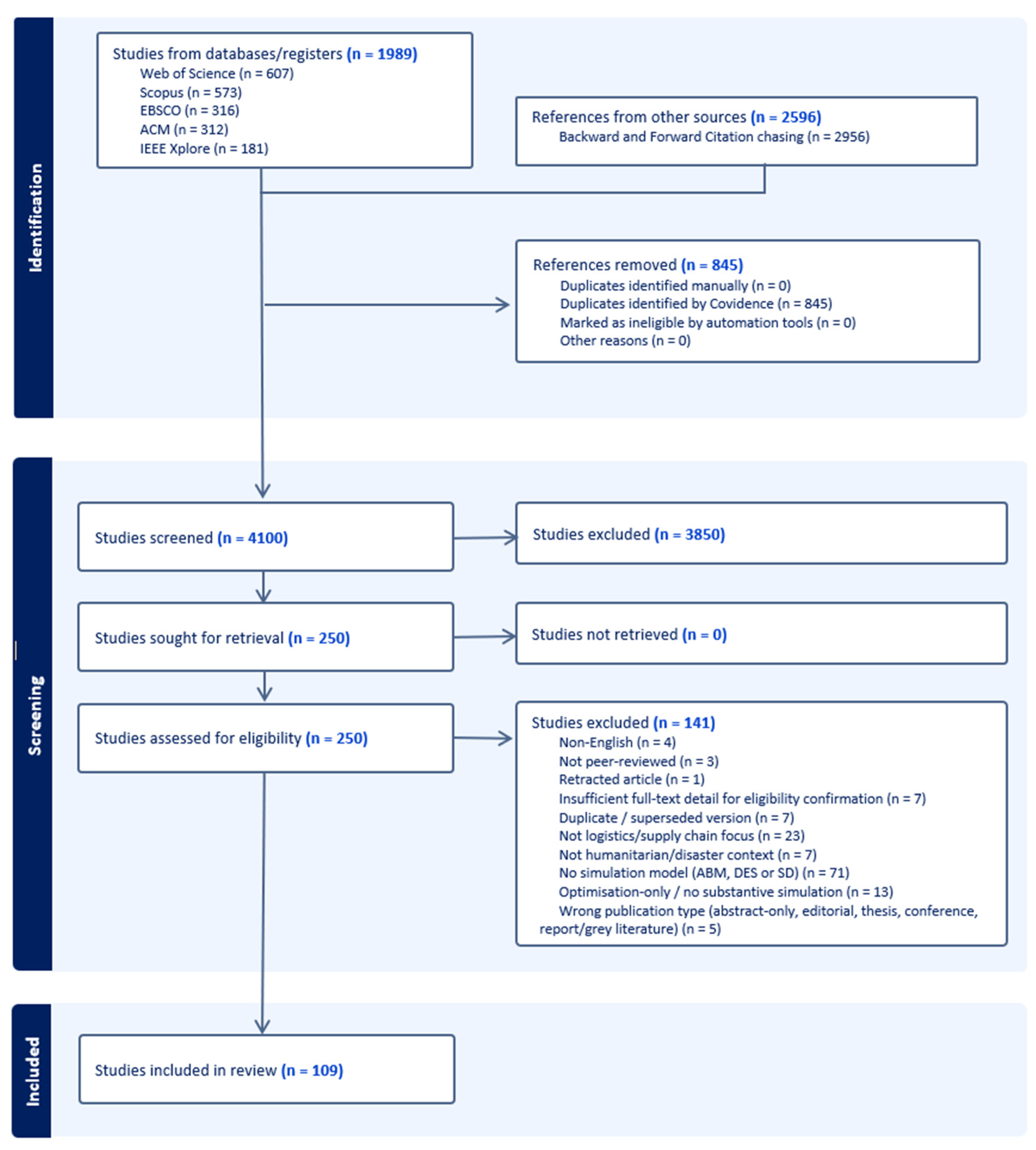
Figure 1.
PRISMA-ScR flow diagram of study identification, screening, eligibility and inclusion.
Primary categories were coded as mutually exclusive where required for quantitative mapping. Each study was assigned one primary decision-problem class, one primary continuum phase and one primary simulation approach. Additional phase and decision-problem tags retained information about multi-dimensional studies without double-counting them in primary descriptive summaries, while hybrid simulation and simulation–optimisation were recorded separately. To examine how logistics decisions were represented together, the primary decision-problem class and all standardised secondary decision-problem tags for each study were treated as a single set of decision domains. Where information was absent, it was coded as not reported. Where terminology was ambiguous, the operational rules in Table 2 were applied. The continuum phase could be inferred using the prespecified criteria, while cases that remained unresolved were coded as unclear. Table 2 summarises the operational rules applied to the principal coding dimensions.
Table 2.
Operational rules for the principal coding dimensions.
Some interpretive judgement was unavoidable because continuum phases and logistics decision domains were not always stated explicitly and could overlap within individual studies. To support consistent classification, coding followed the operational definitions in Table 2 and considered the study objective, model structure, decision horizon, intervention timing, experimental design and reported results. Author terminology was used where sufficiently explicit. Where interpretation was required, the prespecified rules were applied and the classification was checked against the source article. Information that remained unresolved was recorded as unclear or not reported. The charting form was piloted and refined before full extraction, consistent with methodological guidance supporting transparent, iterative and team-based data charting in scoping reviews [46,47].
Data charting used an extract-and-check process in Covidence, aligned with established practice [46]. Each included study was initially coded by one reviewer, after which every completed record was checked against the source article by the second reviewer. Discrepancies were resolved through discussion, and recurring ambiguities informed refinement of the coding rules. This process provided second-reviewer verification across the complete corpus and supported consistent application of the final operational definitions.
3.6. Synthesis Approach
The synthesis was descriptive and mapping based. Descriptive statistics were used to summarise publication trends, crisis settings, geographies, actors, commodities/services, decision levels, logistics decision-problem classes, continuum phases and simulation approaches. Cross-tabulations and evidence maps were then used to examine relationships between the main analytical dimensions, particularly decision-problem class × continuum phase, simulation approach × decision-problem class and decision level × decision-problem class. This synthesis reflects the purpose of scoping reviews in mapping the extent and distribution of evidence, examining how research is organised across a field and identifying areas where evidence remains limited [44,45,46,47].
Relationships among decision domains were examined descriptively using the combined primary and standardised secondary decision-problem codes assigned to each study. Every unique unordered pair within a study was counted once, including primary–secondary and secondary–secondary combinations. Repeated codes within a study were removed, while free-text “Other” and “Unclear/not reported” entries were excluded because they did not constitute comparable standardised domains. Pair counts were non-mutually exclusive because individual studies could contribute to several combinations. Co-occurrence indicates joint representation within a study and does not establish causality, direction of effect or explicit testing of an interaction.
4. Results
4.1. Study Selection and Evidence Base Profile
The study selection process is summarised in Figure 1. Across database searching and citation searching, 4945 records were identified before deduplication. Database searches contributed 1989 records, comprising Web of Science (n = 607), Scopus (n = 573), EBSCOhost (n = 316), ACM Digital Library (n = 312) and IEEE Xplore (n = 181). Citation searching contributed a further 2956 records. After deduplication, 845 records were removed, leaving 4100 records for title and abstract screening.
Title and abstract screening excluded 3850 records. A total of 250 reports were sought for retrieval and assessed for eligibility. At the full-text stage, 141 reports were excluded, leaving 109 studies in the final review corpus. The largest recorded exclusion category was the absence of an eligible simulation model (n = 71), followed by the absence of a logistics or supply chain focus (n = 23), optimisation-only or no substantive simulation component (n = 13), absence of a humanitarian or disaster context (n = 7), insufficient full-text detail for eligibility confirmation (n = 7), a duplicate or superseded version (n = 7), the wrong publication type (n = 5), non-English full text (n = 4), not being peer reviewed (n = 3), or a retracted article (n = 1).
The screening process showed acceptable consistency between reviewers. Title and abstract screening achieved 95.83% agreement with Cohen’s κ = 0.681, while full-text screening achieved 89.92% agreement with Cohen’s κ = 0.799. The lower kappa at the title and abstract stage, despite high proportionate agreement, reflects the expected imbalance between excluded and potentially includable records in a broad scoping search. All conflicts were resolved by discussion to consensus.
The full review corpus comprised the studies cited here [31,54,55,56,57,58,59,60,61,62,63,64,65,66,67,68,69,70,71,72,73,74,75,76,77,78,79,80,81,82,83,84,85,86,87,88,89,90,91,92,93,94,95,96,97,98,99,100,101,102,103,104,105,106,107,108,109,110,111,112,113,114,115,116,117,118,119,120,121,122,123,124,125,126,127,128,129,130,131,132,133,134,135,136,137,138,139,140,141,142,143,144,145,146,147,148,149,150,151,152,153,154,155,156,157,158,159,160,161]. The included studies were published between January 2010 and January 2026. Figure 2 presents the annual publication volume for the 16 complete publication years from 2010 to 2025. Publication activity remained relatively modest and variable during the 2010s, ranging from one to eight included studies per year, before increasing more consistently from 2020. Annual output reached 9 studies in 2020, 13 in 2022 and a peak of 15 in 2023, before decreasing to 11 in 2024 and 8 in 2025. These later counts nevertheless remained above those recorded in most earlier years. A linear regression across the complete publication years, excluding the partial year 2026, indicated an average increase of approximately 0.62 included studies per year (R2 = 0.573, p = 0.0007). This pattern supports an overall expansion of simulation-supported humanitarian logistics research within the reviewed corpus, although the year-to-year variation and decline following the 2023 peak caution against interpreting the pattern as uninterrupted growth.
Figure 2.
Annual publication volume of included studies, January 2010–January 2026.
The evidence base was dispersed across 71 distinct journals. The most frequent outlet was the Journal of Humanitarian Logistics and Supply Chain Management (n = 14; 12.8%), followed by the International Journal of Disaster Risk Reduction and Production and Operations Management (each n = 6; 5.5%), the International Journal of Production Economics (n = 5; 4.6%), and Annals of Operations Research (n = 4; 3.7%). Only 12 journals contributed two or more included studies, while 59 journals contributed one study each. Figure 3 summarises this outlet distribution by listing repeated outlets and aggregating single-publication outlets into a long-tail category.
Figure 3.
Journal outlet distribution of included studies.
The long-tail outlet pattern shows that simulation-supported humanitarian logistics is dispersed across humanitarian logistics, disaster risk, operations management, OR/MS, systems modelling, transportation, health, computing and applied modelling journals. This supports the use of a broad database strategy, since a narrower outlet- or discipline-based search would likely have missed relevant studies. It also indicates that the literature remains interdisciplinary and not yet fully consolidated within a single journal community.
The geographic profile was similarly uneven. Fifty-nine studies were grounded in local or sub-national named settings (54.1%), fifteen used a single-country named setting (13.8%), eight used cross-border, multi-country or regional named settings (7.3%), and four used global named settings (3.7%). A further 23 studies were geography-agnostic or stylised (21.1%). Figure 4 maps the 82 studies with mappable local, national or cross-border named settings, corresponding to 51 distinct countries. Country-level concentrations were most visible in the United States (n = 14), China (n = 9), Iran (n = 9), Japan (n = 8), Indonesia (n = 7) and Colombia (n = 7). The map also shows that geographic concentration was associated with different crisis contexts: geophysical hazards were prominent in several Asian and Middle Eastern settings, while hydrological, meteorological and climatological hazards were more visible in parts of the Americas and selected island or coastal contexts. Conflict, displacement and biological/public health settings were present, but more dispersed.
Figure 4.
Geographic profile of included studies by targeted country and dominant crisis family.
The mapped distribution reinforces the point that the literature is selective not only by method and outlet, but also by geography and crisis setting. The corpus contains a broad international spread, but it is not geographically balanced. It is shaped by countries and events that are more frequently used as simulation cases, by the availability of usable data, and by the disciplinary communities in which disaster logistics modelling is published. Simulation findings are often context-sensitive. Infrastructure density, governance arrangements, humanitarian access, local logistics capacity, hazard type and data availability can all shape model structure and interpretation.
Crisis settings were dominated by sudden-onset geophysical hazards, such as earthquakes and tsunamis (n = 32; 29.4%), and generic all-hazards emergency or disaster settings, where the model was framed around disaster response without a single specified hazard type (n = 30; 27.5%). Hydrological, meteorological and climatological hazards, such as floods, hurricanes, storms and drought-related conditions, accounted for 13 studies (11.9%), while epidemic or public health emergencies, including pandemic and disease-response contexts, accounted for 9 studies (8.3%). Conflict, displacement, slow-onset crises, industrial/technological incidents and mass-casualty settings were less represented. This distribution indicates that simulation-supported humanitarian logistics remains most developed around sudden-onset and generic disaster-response settings, with lighter coverage of protracted, conflict-related and displacement contexts.
The modelled actor perspective showed a strong coordination orientation. Studies with no single dominant actor or a coordination-network perspective formed the largest category (n = 41; 37.6%). NGO or humanitarian organisation perspectives accounted for 18 studies (16.5%), followed by local government or municipality perspectives (n = 13; 11.9%) and national government, civil protection or emergency management agency perspectives (n = 12; 11.0%). Commodity and service focus was similarly varied. Twenty-nine studies had no single dominant commodity or service focus (26.6%), and fifteen addressed general humanitarian logistics without being commodity-specific (13.8%). Food or nutrition appeared in 13 studies (11.9%), transport/evacuation/casualty movement in 10 (9.2%), non-food or general relief items in 9 (8.3%), coordination/information services in 9 (8.3%), and medical or health supplies/services in 7 (6.4%). Table 3 summarises these descriptive characteristics.
Table 3.
Descriptive characteristics of included studies (n = 109).
Decision-level coding indicated a relatively balanced evidence base: tactical studies accounted for 35 studies (32.1%), operational studies for 33 (30.3%), strategic studies for 31 (28.4%), and 10 had no single dominant decision level (9.2%). Most studies had some real-world contextualisation. Fifty-nine studies were based on a real case, event, exercise or operational system (54.1%), while twenty-eight used a hypothetical scenario with real geography or network structure (25.7%). Twenty-two studies were generic, stylised or illustrative (20.2%).
4.2. Humanitarian Logistics Decision Problems and Application Domains
Figure 5 maps the dominant humanitarian logistics decision problem addressed by each included simulation study. Each study was assigned one primary decision-problem class based on the main logistics decision lever modelled. Secondary tags were retained where studies addressed additional decision levers, but Figure 5 reports the primary class only to avoid double-counting. The counts therefore represent the main modelling emphasis of each article rather than every topic mentioned or incorporated. Application-domain coding was retained in the extraction dataset but is not presented as a separate main-text distribution because it substantially overlapped with decision-problem class and added limited interpretive value to the main logistics synthesis.
Figure 5.
Distribution of primary humanitarian logistics decision-problem classes. Bars show the number and percentage of included studies assigned to each primary class.
The evidence base was concentrated around a relatively small number of logistics decision-problem classes. Coordination and information sharing was the most frequent primary class (n = 19; 17.4%), followed by facility location and network design (n = 17; 15.6%). Resilience, preparedness and recovery planning (n = 13; 11.9%), inventory, replenishment and prepositioning (n = 12; 11.0%), and allocation and prioritisation (n = 11; 10.1%) also formed substantial clusters. Transport, fleet and flow management accounted for 10 studies (9.2%), while scheduling and capacity management accounted for 8 (7.3%). Smaller clusters addressed digital decision support and situational awareness, routing and last-mile distribution, and evacuation and casualty transport (each n = 4; 3.7%), risk assessment and scenario ranking (n = 3; 2.8%), warehousing and material handling (n = 2; 1.8%), needs assessment and demand estimation (n = 1; 0.9%), and humanitarian service-system design (n = 1; 0.9%).
This distribution indicates that simulation-supported humanitarian logistics is most developed around decision structures that can be formalised as flows, stocks, capacities, locations, allocation rules, schedules or coordination protocols. These are core logistics decision structures and are well suited to simulation because they involve congestion, uncertainty, resource constraints, time-dependent behaviour and interdependence between actors. The prominence of coordination and information sharing is particularly important because it shows that the evidence base is not limited to the physical movement and storage of relief items. It also addresses the information and decision structures through which humanitarian logistics systems operate.
Low primary counts should be interpreted as limited modelling concentration rather than limited operational importance. Several lower-frequency areas are central to humanitarian logistics when viewed across the relief–development continuum. Needs assessment, warehousing and material handling, procurement, local supply capacity, repair and maintenance, service continuity and recovery-oriented logistics appear less frequently as the primary simulation focus. Some of these issues are represented within broader allocation, transport, inventory or network models, although they are rarely the central object of modelling.
The primary classification therefore identifies the dominant decision focus of each study but does not capture the full range of logistics decisions represented within the same model. When the primary class and all standardised secondary decision-problem tags were considered together, 105 of the 109 studies (96.3%) represented at least two decision domains and 94 studies (86.2%) represented at least three.
Across the 13 standardised domains, 78 unique unordered combinations were theoretically possible. The analysis identified 1053 within-study pair occurrences across 76 of these combinations. This breadth reflects the multifaceted nature of humanitarian logistics, where models commonly represent several connected decisions concerning resources, information, stock, capacity and physical flows. The pair occurrences record repeated representation of these combinations across the corpus and are not independent observations. Table 4 reports the ten most frequent pairings, ranked by the number of studies in which both domains were represented. A study contributed no more than one count to a given pairing. The reported percentages describe overlap within the corpus and should not be interpreted as measures of statistical association.
Table 4.
Ten most frequent co-occurring humanitarian logistics decision domains.
Allocation and prioritisation appeared in five of the ten most frequent pairings, transport, fleet and flow management in four, inventory, replenishment and prepositioning in four, coordination and information sharing in three, scheduling and capacity management in two, and resilience, preparedness and recovery planning in two. The most frequent pairing was allocation and prioritisation with transport, fleet and flow management, represented in 36 studies. More than half of the studies representing either domain also represented the other. Allocation was also frequently represented with coordination and scheduling or capacity, while coordination commonly appeared with transport and inventory.
The dominant multi-domain structure of the corpus centres on the orchestration of scarce resources. Prioritisation, information exchange, stock availability, operational capacity and physical delivery repeatedly appeared within the same model scopes. Preparedness and resilience appeared among the ten most frequent pairings principally through their connections with allocation and inventory. These patterns show how the literature frames connected logistics decisions, although they do not demonstrate that individual studies formally tested interaction effects.
Several decision areas that were infrequent as primary classes become particularly relevant in early recovery, reconstruction, localisation and development-oriented transition. Section 4.3 therefore examines how the primary decision-problem classes are distributed across the relief–development continuum and whether the concentration around preparedness and response persists.
4.3. Continuum Positioning and Cross-Phase Coverage
Continuum positioning was coded to examine where simulation-supported humanitarian logistics decisions sit across preparedness, response, early recovery, recovery/reconstruction and development-oriented transition. The phase structure was informed by disaster and humanitarian logistics classifications that distinguish pre-event, response and post-event activities, including facility location, stock prepositioning, evacuation, relief distribution, casualty transportation, prevention/mitigation, humanitarian logistics, casualty management, recovery and restoration [21,39]. The use of a relief–development framing is also consistent with work arguing that humanitarian aid supply-chain design and agility requirements change across phases of relief and development activity [20].
Each study was assigned one primary continuum phase based on its dominant decision horizon and operational objective. Additional phase tags were retained where studies explicitly represented more than one phase. These categories classify the dominant modelling emphasis of each study while recognising that humanitarian operations often overlap across phases. Two studies were coded as ‘Mitigation/disaster risk reduction’ because their dominant framing concerned pre-event risk reduction rather than readiness capacity. This adjacent category was retained for transparency rather than merged into ‘Preparedness’. Figure 6 presents the primary and broader phase distributions.
Figure 6.
Continuum phase coverage in the included studies. “Primary continuum phase” and “any phase represented or tagged” bars show the number and percentage of included studies; the “any phase represented or tagged” series is non-mutually exclusive.
The primary phase distribution indicates a strongly response-oriented evidence base. The coded category ‘Response’ accounted for 79 studies (72.5%), while ‘Preparedness’ accounted for 18 studies (16.5%). Later-phase and longer-horizon categories were much less represented: ‘Development-oriented transition’ accounted for five studies (4.6%), ‘Recovery/reconstruction’ for three studies (2.8%), ‘Early recovery’ for two studies (1.8%), and ‘Mitigation/disaster risk reduction’ for two studies (1.8%). This pattern is understandable given the time-critical nature of humanitarian logistics, where allocation, distribution, transport, coordination, routing and surge-capacity decisions are central to acute operations. However, it also indicates that simulation evidence is more limited for logistics decisions whose consequences unfold after the acute response phase, including service continuity, infrastructure restoration, local procurement, logistics-capacity rebuilding and transition toward more durable supply arrangements.
The broader phase-tag analysis confirms this pattern rather than overturning it. When primary and additional phase tags were counted together, ‘Response’ appeared in 100 studies (91.7%) and ‘Preparedness’ in 50 studies (45.9%). This shows that many models address preparedness-to-response relationships, particularly where pre-event decisions are evaluated through response-period outcomes. By contrast, ‘Early recovery’ (n = 7; 6.4%), ‘Recovery/reconstruction’ (n = 7; 6.4%) and ‘Development-oriented transition’ (n = 11; 10.1%) remained weakly represented even under this broader coding. The broader phase-tag analysis therefore indicates that recovery and development-oriented transition are generally less developed in the simulation evidence base. In Figure 6, the ‘any phase represented or tagged’ series is not mutually exclusive, so percentages indicate the proportion of the 109-study corpus in which each phase appeared and do not sum to 100%.
Phase assignment was supported directly by author framing in 61 studies (56.0%) and inferred from objectives, time horizon or decision framing in 48 studies (44.0%). This is methodologically important because many simulation studies model phase-specific logistics decisions without using explicit continuum terminology. The continuum coding therefore captures the operational emphasis of each model rather than the vocabulary used by the original authors.
To avoid overstating phase coverage, studies were also coded for the extent to which they represented relationships between phases. References to preparedness, response and recovery were therefore distinguished from explicit modelling of how decisions, resources, system states or performance effects carry forward from one phase to another. The resulting cross-phase categories are summarised in Table 5.
Table 5.
Cross-phase representation in included studies.
Table 5 shows that explicit cross-phase representation remains limited. Just under half of the corpus comprised single-phase models (n = 54; 49.5%), while a further 13 studies (11.9%) referred to multiple phases only conceptually. Static carry-over was the most common form of cross-phase representation (n = 30; 27.5%), usually where preparedness decisions such as facility location, stock placement or capacity configuration were evaluated through response-period outcomes. More dynamic forms of cross-phase representation were rare. Across the corpus, only a small number of studies represented phase changes through externally imposed stages or scenarios (n = 7; 6.4%), endogenous system change, observed mainly in recovery or restoration contexts (n = 3; 2.8%), or time-varying policy regimes and phase-specific rules (n = 2; 1.8%). This suggests that simulation has been used more often to test phase-specific humanitarian logistics decisions than to examine how logistics choices alter system conditions across preparedness, response, recovery and development-oriented transition. Figure 7 shows how primary decision-problem classes are distributed across continuum phases.
Figure 7.
Primary humanitarian logistics decision-problem class by primary continuum phase. Cell values show the number of included studies in each decision-problem and phase combination.
The phase-by-problem distribution reinforces this conclusion. ‘Response’ dominated across most decision-problem classes, including coordination and information sharing, allocation and prioritisation, facility location and network design, inventory, replenishment and prepositioning, transport, fleet and flow management, scheduling and capacity management, and resilience, preparedness and recovery planning. ‘Preparedness’ evidence was more concentrated, particularly around facility location and network design, resilience, preparedness and recovery planning, coordination and information sharing, inventory, replenishment and prepositioning, and digital decision support and situational awareness. ‘Early recovery’, ‘Recovery/reconstruction’ and ‘Development-oriented transition’ were sparse across almost all decision-problem classes.
The continuum analysis therefore identifies two related patterns. The first is a phase imbalance: simulation-supported humanitarian logistics remains heavily weighted toward ‘Response’, with comparatively limited modelling of ‘Early recovery’, ‘Recovery/reconstruction’ and ‘Development-oriented transition’. The second is that, even where studies represent more than one phase, they rarely model how logistics decisions carry consequences forward into recovery, local capability, service continuity or durable supply arrangements. The evidence base is therefore strongest for acute response and preparedness-to-response questions, and weaker for later-phase logistics consequences.
4.4. Decision Horizons and Performance Measurement
Decision horizon was coded to examine whether simulation studies primarily supported operational execution, tactical planning, strategic system design or cross-level decision-making. Operational studies were defined as those focused on execution-time decisions, including dispatching, routing, queueing, service delivery and resource use. Tactical studies addressed medium-horizon planning or policy choices, including allocation, replenishment, prioritisation and capacity deployment. Strategic studies addressed longer-horizon system design, facility location, network configuration, preparedness investment and resilience planning. These distinctions are consistent with humanitarian logistics and disaster operations reviews that classify emergency logistics decisions by activity, phase, decision horizon and performance-measurement orientation [21,37,39]. Figure 8 shows the distribution of these decision levels across primary decision-problem classes.
Figure 8.
Decision level by primary humanitarian logistics decision-problem class. Cell values show the number of included studies in each decision-level and decision-problem combination.
The evidence base was relatively balanced across decision horizons, but the distribution was not uniform across decision-problem classes. Tactical studies accounted for 35 studies (32.1%), operational studies for 33 (30.3%), while strategic studies accounted for 31 (28.4%). A further 10 studies (9.2%) had no single dominant decision level, usually because they modelled system-wide behaviour, cross-level coordination or multi-stage policy effects. Operational studies were concentrated in execution-oriented problems such as coordination and information sharing, transport and fleet management, scheduling and capacity management, inventory execution, routing, and evacuation or casualty transport. Tactical studies were most visible in allocation and prioritisation, inventory and replenishment, resilience, preparedness and recovery planning, and digital decision support. Strategic studies were dominated by facility location and network design, resilience, preparedness and recovery planning, and risk or scenario assessment. This pattern indicates that simulation has been used across the main layers of humanitarian logistics decision-making, but with a clear relationship between decision horizon and logistics problem structure.
Performance outcomes were coded using recurring metric families, with multiple families permitted per study. The dominant metrics were time, lead time or response time (n = 74; 67.9%), coverage or service level (n = 65; 59.6%), delivery success or fulfilment (n = 64; 58.7%), and unmet demand or shortage (n = 57; 52.3%). Efficiency-oriented metrics were also common, particularly utilisation or throughput (n = 44; 40.4%) and cost (n = 39; 35.8%). These measures are appropriate for humanitarian logistics because they capture whether resources reach affected populations quickly, whether service coverage is maintained, and whether shortages are reduced under constraint. They also reflect the response-oriented structure of the wider evidence base identified in Section 4.3.
However, the metric profile also shows a narrower representation of humanitarian value. Although many studies reported at least one direct or indirect beneficiary-facing measure, richer beneficiary-sensitive constructs were much less consistently operationalised. Equity or fairness appeared as a metric family in only nine studies (8.3%), while environmental impact appeared in three studies (2.8%). Measures of vulnerability-sensitive service, deprivation duration, dignity, local capability, service continuity and longer-term welfare were less visible than time, coverage, fulfilment and cost.
Performance measures influence how simulation results are understood. Time, coverage, fulfilment and unmet demand are necessary indicators for response-oriented logistics models because they show whether assistance can be delivered quickly and whether needs can be met. However, these measures do not fully capture who receives support, who waits longest, whether vulnerable groups are reached, or whether logistics decisions support recovery and service continuity after the immediate response period. A policy that improves average response time or overall coverage may still leave remote, insecure or marginalised groups underserved. This concern is consistent with humanitarian performance measurement research, which emphasises responsiveness, efficiency and effectiveness while also calling for beneficiary-oriented and multi-dimensional performance criteria [14,37,162].
Simulation is used across operational, tactical and strategic humanitarian logistics problems, but the dominant performance measures remain concentrated on immediate flows, service levels and efficiency. The evidence base is consequently stronger for assessing short-term logistics performance during acute response than for evaluating how logistics decisions shape equity, recovery, service continuity, local capability and durable supply arrangements across phases.
4.5. Simulation Approaches and Decision-Support Extensions
Simulation approaches were coded for all included studies as mutually exclusive primary paradigms, while selected decision-support extensions were coded separately. The primary paradigm captures the main simulation logic used in each study: discrete-event simulation, agent-based modelling, system dynamics or explicitly coupled hybrid simulation. Simulation–optimisation, digital-twin-oriented framing and non-coupled multi-method use were treated as additional features because they can be combined with different primary simulation paradigms rather than functioning as mutually exclusive approaches. This distinction allows the review to show both the dominant simulation logic and the extent to which studies extend simulation toward optimisation, operational updating or broader methodological integration. Figure 9 summarises the primary simulation approaches and these additional decision-support extensions.
Figure 9.
Primary simulation approaches and selected decision-support extensions in the included studies. Bars show the number and percentage of included studies. Primary simulation approaches are mutually exclusive; simulation–optimisation, digital-twin-oriented framing and non-coupled multi-method use were coded separately and are not mutually exclusive.
The evidence base showed a broad simulation-method profile rather than dominance by a single approach. System dynamics was the most frequent primary paradigm (n = 41; 37.6%), followed by agent-based modelling (n = 34; 31.2%) and discrete-event simulation (n = 28; 25.7%). Explicitly coupled hybrid simulation appeared in six studies (5.5%). Simulation–optimisation was present in 35 studies (32.1%), indicating that around one-third of the corpus used simulation in combination with an optimisation component rather than as a standalone experimental method. Digital-twin-oriented framing appeared in three studies (2.8%), while non-coupled multi-method use was rare (n = 1; 0.9%).
Method use broadly aligned with the logistics problem structure. System dynamics was most visible in studies concerned with inventory, resilience and continuity planning, coordination and allocation, reflecting its suitability for stock-flow structures, feedback, delay, capacity erosion and longer-horizon system behaviour in humanitarian operations and supply-chain contexts [8,12]. Agent-based modelling was most visible where decentralised actors, behavioural rules, interaction, local adaptation and information exchange were central, particularly in coordination, transport, facility/network, scheduling and routing applications [29]. Discrete-event simulation was most visible in facility and network design, scheduling and capacity management, allocation, warehousing, evacuation and casualty transport, reflecting its suitability for event sequences, queues, constrained resources, facility throughput and process bottlenecks in logistics systems [8]. Figure 10 shows the relationship between primary simulation approach and decision-problem class.
Figure 10.
Primary simulation approach by primary humanitarian logistics decision-problem class. Cell values show the number of included studies in each simulation-approach and decision-problem combination.
The lower prevalence of hybrid simulation is notable because many humanitarian logistics problems combine process flows, actor interaction and system-level feedback. Hybrid approaches can connect DES-style process representation, ABM-style actor behaviour and SD-style feedback or accumulation, making them particularly relevant where logistics decisions span multiple decision levels or phases [31,32]. Because explicitly coupled hybrid models appeared in only six studies, relatively few studies were positioned to represent these dynamics jointly within a single simulation framework. This is particularly relevant for cross-phase logistics problems, where immediate distribution, local actor behaviour, infrastructure recovery, capacity rebuilding and service continuity may interact over time.
Simulation–optimisation was comparatively more established. Its presence in about one-third of the corpus (n = 35; 32.1%) indicates that simulation is often combined with optimisation components, supporting the evaluation or comparison of candidate decisions under uncertainty. This is valuable for humanitarian logistics because many decisions require selecting among feasible configurations while accounting for uncertain demand, disrupted access, scarce resources and changing operating conditions [33]. However, simulation–optimisation was still concentrated mainly around formalised preparedness and response decisions, rather than recovery, localisation or transition-oriented logistics capability.
Within the included corpus, explicitly digital-twin-oriented framing was rare. Three studies used digital-twin terminology or framing: one reported an architected digital-twin design with a clearer operational data-update logic, while two used the terminology more rhetorically. The distinction is relevant because operationally useful digital-twin approaches depend on more than attaching a digital-twin label to a simulation model. They require mechanisms for data updating, integration with decision workflows, model governance and interpretation by users. On this basis, digital-twin-oriented framing appears emergent rather than mature within the specific corpus reviewed here. This should not be read as a claim about the wider digital twin and humanitarian logistics literature.
The distribution of simulation approaches also reinforces the continuum findings. All major paradigms were concentrated in response-oriented studies, reflecting the dominance of acute logistics decision problems in the corpus. System dynamics had the clearest connection to later-phase and longer-horizon questions because it can represent feedback, delay, recovery trajectories and capacity accumulation. However, the small number of explicitly hybrid and operationally updated models limits the field’s ability to represent how process-level flows, actor behaviour and system-level recovery dynamics interact across phases.
Simulation-supported humanitarian logistics has developed a diverse methodological base. DES, ABM and SD support different forms of logistics reasoning: process and capacity analysis, decentralised interaction, and feedback-rich system behaviour. Simulation–optimisation extends this capability into policy and configuration selection under uncertainty. The methodological profile therefore aligns with the wider pattern identified in the review: the evidence base is strongest for formalised preparedness and response decisions, and more limited for modelling multi-level, cross-phase and operationally updated logistics problems linked to recovery, localisation, service continuity and durable logistics capability.
4.6. Operational Grounding of the Simulation Evidence
Operational grounding and decision-support readiness were coded to assess how far the included studies moved from abstract simulation experimentation toward practically usable humanitarian logistics decision support. These indicators were treated descriptively rather than as formal quality scores. The review did not conduct a technical validation audit of each model, but it did examine what studies reported about data provenance, empirical grounding, calibration, verification, validation, uncertainty analysis, reproducibility and practical use. These issues are central to simulation credibility and model use in decision-support settings [28,163]. Figure 11 summarises the selected operational-grounding and practice-facing indicators.
Figure 11.
Selected operational grounding and practice-facing credibility indicators in the included studies. Bars show the number and percentage of studies reporting each non-mutually exclusive indicator.
The evidence base displayed a clear distinction between contextual realism and direct operational parameterisation. Most studies had some form of real-world contextual anchor (n = 87; 79.8%), and 59 studies (54.1%) were based on a real case, event, exercise or operational system. Expert, practitioner, stakeholder or survey elicitation was reported in 58 studies (53.2%). However, only 12 studies (11.0%) used direct operational or case data as the primary parameter source. This suggests that much of the literature is contextually grounded, but a smaller subset is strongly parameterised through direct operational evidence.
Reported practice-facing checks were less consistent. Moderate or high uncertainty, sensitivity or robustness analysis was reported in 77 studies (70.6%), and validation was reported in 54 studies (49.5%). Practitioner evaluation, pilot testing or operational embedding was reported in 22 studies (20.2%). These indicators do not establish whether models are ready for operational deployment. Rather, they show that many studies provide some basis for interpreting model behaviour under uncertainty, while fewer report direct engagement with the practitioners or operational settings in which the modelled decisions would be used.
Overall, the operational-grounding profile shows a literature with substantial applied relevance but uneven empirical and practice-facing depth. Simulation is frequently used to examine recognisable humanitarian logistics decisions in real or realistic settings, yet fewer studies draw primarily on direct operational data or report practitioner-facing evaluation. For the logistics literature, the implication is specific: future simulation studies should not only model relevant humanitarian logistics decisions but also strengthen the operational basis on which those models are parameterised, interpreted and connected to practice.
5. Discussion
5.1. Implications for Theory
This review mapped 109 peer-reviewed journal articles on simulation-supported humanitarian logistics across decision problems, continuum phases, decision levels, performance outcomes, simulation approaches and operational grounding. The evidence reveals a clear analytical centre. Simulation is most developed where humanitarian logistics problems can be represented through flows, stocks, capacities, facilities, allocation rules, routing structures and coordination arrangements. This aligns with established classifications of disaster and emergency logistics, in which facility location, prepositioning, evacuation, relief distribution, casualty transportation, allocation and recovery or restoration are recognised as central decision domains [17,21,25,39]. The conceptual contribution of this review lies in showing how these domains are represented through simulation, how they occur together within studies and how their coverage changes across the relief–development continuum.
The strongest concentration of evidence is found in preparedness and response. Coordination and information sharing, facility and network design, resilience, preparedness and recovery planning, inventory and prepositioning, allocation, transport, scheduling and capacity management account for much of the corpus. This concentration reflects the operational conditions of humanitarian logistics, where resources must be positioned, prioritised and moved under uncertainty, often with incomplete information, disrupted infrastructure and multiple organisations operating under time pressure. The evidence includes simulation studies of humanitarian coordination and inter-organisational behaviour [127,129,138], relief-chain decision support [59], disaster-team positioning [130], and inventory and prepositioning strategies [118,119,131]. These applications demonstrate how simulation supports the examination of policy alternatives, bottlenecks and operational trade-offs before decisions are implemented.
The co-occurrence analysis adds a multi-domain interpretation of this evidence. Most studies represented several logistics decision domains, with 105 of the 109 studies including at least two standardised domains and 94 including at least three. Allocation and prioritisation appeared repeatedly with transport, coordination, capacity, inventory and resilience planning. Coordination connected organisational and informational concerns with physical flows and stock decisions, while inventory connected response-oriented delivery with preparedness-oriented planning. Facility location and network design occupied a more structural position, appearing principally with preparedness and recovery planning, transport, allocation and inventory. Humanitarian logistics is therefore represented as a multifaceted decision system in which prioritisation, information, stock, capacity, network structure and physical movement are closely connected. At a theoretical level, this supports a configurational view of humanitarian logistics: decision performance depends on combinations of interdependent domains rather than on isolated logistics functions. The co-occurrence results identify joint representation within studies and do not establish causal relationships among these domains.
Coordination and pre-event operational readiness emerge as prominent, although not exhaustive, challenges within this wider decision environment. Coordination and information sharing were coded as a distinct decision-problem class, whereas readiness was not a standalone class; it was represented across facility and network design, inventory prepositioning, surge capacity, preparedness investment, contingency planning and resilience analysis. Simulation addresses coordination by representing information exchange, actor interaction, resource allocation and relief flows across inter-organisational networks. It addresses readiness by testing whether facilities, stocks, capacities and contingency arrangements remain adequate under alternative demand, disruption and access conditions. The evidence nevertheless remains concentrated in phase-specific preparedness and response applications. Less attention has been given to how coordination and readiness interact across strategic, tactical and operational levels or how these decisions influence recovery and longer-term logistics capability.
The relief–development continuum provides a further conceptual insight. Preparedness is visible in the evidence base, although it is often represented through preparedness-to-response models in which pre-event location, inventory or capacity decisions are evaluated through response-period outcomes. Early recovery, recovery/reconstruction, and development-oriented transition are much less developed. The cross-phase results sharpen this imbalance: 67 studies (61.5%) were either single-phase models or referred to multiple phases only conceptually, while only 12 studies (11.0%) dynamically represented phase-related change. This imbalance is consequential because humanitarian logistics extends beyond the acute movement of relief items. Relief–development research has emphasised agility, local capability, durable supply arrangements and service continuity across changing operational conditions [19,20]. The simulation literature has only partially incorporated this cross-phase logic. A small number of studies explicitly connect short-term response with longer-term development, socioeconomic recovery or organisational capacity [81,85,102,160], while studies of housing recovery, post-disaster material supply and migration internalisation demonstrate that later-phase logistics can be modelled dynamically [112,144,161]. These remain isolated contributions rather than a consolidated cross-phase body of research.
The relationship between simulation paradigm and decision problem also clarifies the structure of the field. Discrete-event simulation supports reasoning about queues, event sequences, throughput and constrained service systems. Agent-based modelling supports the analysis of decentralised actors, behavioural rules, information exchange and adaptation. System dynamics supports the examination of feedback, delay, accumulation and longer-horizon policy effects [8,12,29]. Each paradigm therefore foregrounds a different form of humanitarian logistics complexity. Explicitly coupled hybrid simulation remained limited within the corpus, despite its capacity to connect process flows, actor behaviour and system-level feedback [31,32]. Simulation–optimisation was more established, appearing in 35 studies (32.1%), but remained concentrated mainly in formalised preparedness and response applications. Digital-twin-oriented modelling was also limited and early-stage within the included evidence [92,93]. This observation is specific to the reviewed corpus and does not imply equivalent levels of development across the wider emergency management or infrastructure-resilience literature. The findings indicate phase-conditioned paradigm–problem alignment: the appropriate modelling logic depends jointly on the continuum phase, decision level and whether the focal mechanism concerns process flow, actor interaction, system feedback or policy selection.
Performance measurement provides another conceptual contribution. Time, coverage, fulfilment, unmet demand, utilisation and cost dominate the evidence base. These indicators are central to immediate logistics performance, particularly during response, but they provide a narrower account of humanitarian value than is required across the full continuum. Equity, deprivation duration, vulnerability-sensitive access, dignity, service continuity, local capability and longer-term welfare are less consistently operationalised. Environmental impact appeared in only three studies (2.8%), despite the relevance of emissions, waste, reverse flows and environmental burden to longer-term humanitarian logistics. Improvements in average response time or aggregate fulfilment can coexist with persistent disadvantage among remote, insecure or marginalised populations. One system-dynamics study, for example, showed how media attention concentrated relief goods in a highly visible disaster area while surrounding affected areas remained undersupplied [153]. The findings reinforce calls to incorporate social costs, deprivation and beneficiary-oriented performance into disaster logistics modelling [14,37]. Simulation-supported humanitarian logistics therefore needs to connect immediate operational performance with the wider humanitarian, environmental and developmental consequences of logistics decisions.
5.2. Implications for Practice and Policy
For humanitarian organisations and policymakers, the findings identify the decision settings in which simulation currently provides the strongest support. Its use is most established for structured preparedness and response problems involving facility and network design, stock positioning, allocation rules, transport flows, capacity constraints and coordination arrangements. In these settings, simulation allows policies and configurations to be tested under uncertainty, congestion and resource scarcity before operational resources are committed.
The readiness findings support the use of simulation in decisions concerning facilities, prepositioned inventory, surge capacity and contingency planning. Studies within the corpus compare relief-chain configurations [59], preparedness investment with inventory prepositioning [118], and the positioning of disaster-relief teams under dynamic service demand [130]. Facility, inventory and fleet configurations have also been assessed through transportation cost, lead time and service-level outcomes [117], while transport-focused models have identified queues, congestion and bottlenecks within disaster-relief networks [157]. These applications can help organisations assess whether planned networks, stocks and capacities remain adequate under alternative demand, disruption and access conditions.
The findings also position coordination as both an operational and governance concern. Simulation has been used to examine post-earthquake last-mile distribution [114], satisfaction of logistics needs and resource utilisation across humanitarian organisations [129], and the effects of communication on demand, inventory, transport, oversupply, cost and fatalities [132]. These studies show how information, prioritisation, stock, capacity and physical flows can influence one another within a model. Coordination design also involves trade-offs: different structures perform differently across efficiency, flexibility and coverage [90], while horizontal stock-sharing may create dependency by encouraging organisations to reduce their own inventories [156]. Effective application requires shared assumptions about data, decision authority, organisational behaviour and responsibility for interpreting and acting on results. Models of coordination therefore need to be embedded within inter-organisational decision processes rather than treated only as technical representations of relief flows.
Simulation can already support preparedness stress testing, scenario comparison, bottleneck analysis, surge-capacity estimation, allocation-rule comparison and response planning. Its outputs are most appropriately used as structured comparative evidence. Direct operational deployment requires stronger empirical grounding, transparent data provenance, appropriate verification and validation, uncertainty analysis, stakeholder interpretation and governance of model-supported decisions [28,163]. Although 87 studies (79.8%) had some form of real-world contextual anchor, only 12 (11.0%) used direct operational or case data as the primary parameter source, and only 22 (20.2%) reported practitioner evaluation, pilot testing or operational embedding. Analytical usefulness and operational readiness should therefore be distinguished clearly. Practice-facing examples include a non-profit food supply chain simulation that informed implemented warehouse changes and increased throughput without additional space [115], a DES policy model applied by disaster-responsive ambulance services in Austria [136], a fuel distribution model used to support US federal disaster preparedness [126], and the São Paulo funerary system model, whose scenario outputs were used by the São Paulo State Civil Defense during the COVID-19 pandemic to support resource dimensioning and preparedness [121].
Data limitations should be interpreted in relation to the purpose for which simulation is used. The corpus does not indicate that models generally depended on complete live-emergency datasets. Expert, practitioner, stakeholder or survey elicitation was reported in 58 studies (53.2%), while moderate or high uncertainty, sensitivity or robustness analysis was reported in 77 studies (70.6%) and validation in 54 studies (49.5%). Taken together with the limited use of direct operational data and practitioner-facing evaluation, these patterns indicate that much of the literature uses simulation for preparedness, scenario comparison and analytical exploration rather than for direct real-time prescription. Preparedness-oriented models can examine alternative plans and system configurations using available historical, contextual, elicited or scenario-based evidence, whereas models intended for live response require more frequent updating of assumptions and system states as operational information becomes available. Incomplete, delayed or fragmented data therefore limit confidence in parameterisation, transferability and operational use. The indicators mapped in this review do not, however, establish whether the verification or validation conducted in individual studies was technically sufficient, nor do they demonstrate that the resulting models were ready for deployment.
For organisations considering simulation-supported decision-making, the evidence map points to several implementation considerations rather than a single validated implementation pathway. These include clarifying the decision to be supported, its time horizon, the intended users and the relevant stakeholders; assessing the availability, ownership, quality and uncertainty of the required data; matching the simulation approach to the focal process, actor or feedback structure; examining the reported verification, validation, sensitivity analysis and stakeholder review; and assigning responsibility for interpretation, updating, maintenance and governance. These considerations are especially relevant in local and grassroots humanitarian settings, where unreliable connectivity or power, fragmented data ownership, limited local analytical capacity, language differences, staff turnover, access and security restrictions, scarce maintenance resources and dependence on external specialists may constrain implementation. These operational constraints were not systematically coded across the corpus and should therefore be treated as priorities for future practice-facing research and evaluation rather than as quantified findings of the review. The practical implication is that model complexity and technological sophistication should be proportionate to the data, skills, infrastructure and maintenance arrangements available in the intended setting. This is consistent with evidence that simple, field-implementable heuristics can remain comparatively robust as uncertainty increases [109].
The selection of performance indicators also has direct policy implications. Time, cost, coverage, fulfilment, utilisation and unmet demand capture important dimensions of logistics performance. They should be accompanied where feasible by measures of deprivation duration, equity, vulnerability-sensitive access, dignity, service continuity and longer-term welfare [14,37,162]. Aggregate performance measures can obscure adverse outcomes on other measures [111]. Disaggregated and beneficiary-sensitive measures can help organisations assess who receives assistance, who remains underserved and whether short-term efficiency creates longer-term dependency or exclusion.
A broader temporal perspective is also required. Decisions about facilities, inventory, transport, procurement and external logistics capacity can affect infrastructure restoration, market recovery, local supplier capability and continuity of essential services after the acute response period. Studies of housing recovery and material supply [112,144], water distribution restoration [87], disaster recovery mobility [154] and migration internalisation [161] demonstrate that these processes can be represented dynamically. Wider application of this perspective would allow organisations to examine how response decisions affect recovery speed, local systems and the transition towards durable service arrangements.
Localisation introduces additional policy considerations. Over-reliance on external supply chains can create dependency, while premature withdrawal of emergency logistics capacity can weaken recovery. Simulation can support examination of local procurement, supplier reliability, market restoration, logistics handover and the balance between external support and local capability. Recent models also show that localisation choices are context-dependent: local-actor capacity and aid modality interact with conflict intensity [86], while the relative performance of centralised, hybrid and decentralised supply settings varies with product and disaster characteristics and the performance indicator used [145]. Such modelling also raises institutional questions concerning who controls logistics capacity, whose data are used and whose knowledge and priorities are represented within the model. Engagement with local organisations, public agencies and affected communities is therefore relevant to both model quality and the legitimacy of model-supported decisions.
5.3. Limitations of the Study and Future Research Directions
This review was deliberately bounded to English-language, peer-reviewed journal articles published between January 2010 and January 2026. This boundary supported greater consistency in reporting depth and methodological detail. Relevant work may have been excluded where it appeared in conference proceedings, technical reports, theses, practitioner publications, preprints or non-English outlets. This is particularly relevant to simulation research because emerging models and applied decision-support tools are often first reported through specialist conferences, operational-research proceedings or organisational reports.
The search strategy combined humanitarian and disaster terms, logistics and supply chain terms, and simulation and modelling terms across several databases and citation-searching procedures. Retrieval nevertheless depends on database coverage, indexing and terminology. Some relevant research may use adjacent language such as emergency management, crisis operations, evacuation systems, infrastructure restoration, public safety logistics, resilience modelling or service systems without explicitly referring to humanitarian logistics or supply chains. Backward and forward citation searching reduced this risk but could not eliminate it.
The coding and synthesis depended on the information reported in the included articles. Continuum phase, decision level, operational grounding and decision-support orientation sometimes required interpretation where authors used different terminology. Because data charting followed an extract-and-check rather than fully independent duplicate-coding process, formal inter-reviewer agreement statistics were not calculated for the core coding dimensions, although all records were verified by a second reviewer. Continuum coding should therefore be read as an analytical classification of dominant modelling emphasis rather than as evidence that humanitarian operations occur in fully discrete or mutually exclusive phases. Indicators of calibration, verification, validation, uncertainty analysis, operational-data use, practitioner elicitation and practitioner evaluation describe reported practices. They are not technical model quality scores or evidence that a model is ready for operational deployment.
The co-occurrence analysis identifies decision domains represented within the same studies. It does not determine whether the relationships were formally modelled, whether one decision enabled or restricted another, or whether the relationships were causal. More generally, the review maps the distribution and characteristics of the evidence. No formal risk-of-bias appraisal or technical model quality audit was conducted. The review therefore does not estimate intervention effects, rank the performance of simulation paradigms or determine the effectiveness or operational readiness of individual models.
These limitations also indicate the principal directions for future research. A first priority is stronger cross-phase and connected-decision modelling. The evidence remains concentrated in preparedness and response, while early recovery, recovery/reconstruction, and development-oriented transition are less developed. Future studies should examine how coordination, readiness, allocation, facilities, inventory, capacity and transport decisions interact across strategic, tactical and operational levels and how they affect later recovery options.
Recovery logistics and service continuity require particular attention. Future models could represent recovery trajectories, restoration sequencing, repair capacity, spare parts availability, material supply, infrastructure dependencies and continuity of essential services. Existing studies of housing recovery, post-disaster material supply, water network restoration and recovery mobility demonstrate the feasibility of this work [87,112,144,154]. A larger and more connected body of research is required before recovery/reconstruction can be regarded as established simulation domains.
Localisation, procurement and local logistics capability form a related priority. Simulation should examine how local suppliers, public agencies, communities, logistics providers and infrastructure systems recover and adapt over time. Relevant decisions include local procurement [82,128], market recovery, supplier reliability, dependence on international pipelines and the transfer from emergency logistics to locally embedded arrangements. Existing work on humanitarian capacity building, vehicle supply chains, food insecurity logistics and migration internalisation provides a basis for this wider capability perspective [85,115,160,161]. This agenda also has an institutional dimension because localisation depends on control of logistics capacity and on whose knowledge is incorporated into modelling and decision processes.
Beneficiary-sensitive and cross-phase performance should be developed as part of the same research programme. Future studies should operationalise equity, deprivation duration, vulnerability-sensitive access, dignity, service continuity, local capability and longer-term welfare alongside conventional indicators of time, cost, coverage and fulfilment. Environmental outcomes, including emissions, waste, reverse flows and market effects, should also be integrated where relevant. Value-sensitive design and humanitarian service-ecosystem perspectives within the corpus indicate possible routes for broadening the modelling lens [75,155]. Participatory model development and validation with affected communities and local actors could further improve the relevance and accountability of these measures.
Context diversity and transferability require further attention. The corpus was concentrated in sudden-onset geophysical and generic all-hazards settings, while conflict, displacement, slow-onset and protracted crises were less represented. Geographic coverage was broad but uneven, and model assumptions may not transfer across settings with different infrastructure, governance, access conditions, local logistics capability and data availability. Future research should therefore test models across more diverse crisis and geographic contexts and report explicitly which assumptions are context-specific and which are intended to be transferable.
Operational credibility cuts across all of these priorities. Future studies should report data provenance, assumptions, calibration, verification, validation, uncertainty analysis and model use context more consistently. Greater use of direct operational data, practitioner knowledge and practice-facing evaluation would strengthen the relationship between analytical models and humanitarian decision processes. Hybrid simulation, simulation–optimisation and digital-twin-oriented approaches may be particularly valuable where process flows, actor behaviour, optimisation and operational data updating need to be connected [31,32]. Existing studies of hybrid relief-chain decision support and emerging digital-twin-oriented crisis logistics demonstrate this direction, although operational embedding remains limited [59,93]. Computational efficiency and scalability were not reported consistently enough to support comparison across simulation paradigms. Future studies intended for large-scale or real-time humanitarian operations should report the model size, runtime, hardware requirements, update latency and how computational performance changes with scenario complexity.
Artificial intelligence, machine learning, Internet of Things data and real-time analytics provide a focused opportunity to strengthen simulation-supported humanitarian logistics. Early examples within the corpus include coupled simulation and machine learning for pre-crisis predictive analytics [92], RFID-supported casualty tracking [139] and learning-based adaptive vehicle dispatch [97], although these remain analytical or simulation-based demonstrations rather than established operational deployments. When integrated with substantive discrete-event simulation, agent-based modelling or system-dynamics models, these technologies could support demand estimation, parameter updating and state estimation using evolving operational, sensor or remote observation data. This could enable more adaptive simulation and strengthen digital-twin-oriented applications for preparedness, situational assessment and operational decision support. Such integration would also require explicit treatment of data quality, interoperability, uncertainty, bias, privacy, security and decision governance. The present review did not examine these technologies as standalone research fields; studies without a substantive eligible simulation component were outside the prespecified scope. Table 6 consolidates the principal future research directions arising from the review.
Table 6.
Future research directions for simulation-supported humanitarian logistics.
The future agenda builds on the established strengths of simulation in preparedness and response while extending its application to recovery, service continuity, localisation, context-diverse settings and durable humanitarian outcomes. Acute response modelling remains essential; the priority is to complement it with stronger cross-phase, beneficiary-sensitive, environmentally aware and operationally grounded research. The absolute evidence base remains modest, comprising 109 studies over a 16-year period. Simulation therefore has substantial scope to develop further by deepening established preparedness and response applications and by extending more systematically into later-phase and underrepresented logistics problems.
6. Conclusions
This scoping review mapped 109 peer-reviewed journal articles on simulation-supported humanitarian logistics across decision-problem classes, relief–development continuum phases, decision horizons, performance measures, simulation approaches and decision-support readiness. Its main contribution is a continuum-based evidence map that shows not only where simulation has been applied in humanitarian logistics but also where the evidence remains uneven, fragmented and underdeveloped.
The review shows that simulation has developed a substantial analytical base for formalised preparedness and response decisions. The strongest areas of evidence relate to coordination and information sharing, facility and network design, resilience, preparedness and recovery planning, inventory and prepositioning, allocation and prioritisation, transport and fleet management, and scheduling and capacity management. These are logistics problems where simulation is particularly useful because decisions involve uncertainty, resource scarcity, congestion, interdependence, time pressure and trade-offs between competing operational objectives.
The evidence base is methodologically diverse. Discrete-event simulation, agent-based modelling and system dynamics each support different forms of humanitarian logistics reasoning, including process and capacity analysis, decentralised actor interaction, and feedback-rich system behaviour. Simulation–optimisation further extends this capability by supporting policy and configuration comparison under uncertainty. However, within the included corpus, explicitly hybrid simulation, digital-twin-oriented modelling and operationally embedded approaches remained limited, despite their potential relevance to multi-level and data-updated humanitarian logistics systems.
The most important gap is cross-phase. Simulation evidence remains concentrated in response and, to a lesser extent, preparedness, while early recovery, recovery/reconstruction and development-oriented transition are much less developed. Humanitarian logistics decisions have consequences beyond the acute response window. Choices about inventory, facilities, transport, coordination, procurement and actor involvement can shape recovery capacity, local supply systems, service continuity and longer-term dependence on external logistics support.
The review also shows that performance measurement and operational grounding remain narrower than the humanitarian logistics problem requires. Time, coverage, fulfilment, unmet demand, utilisation and cost are necessary indicators, but they do not fully capture equity, deprivation duration, vulnerability-sensitive access, local capability, dignity, service continuity or longer-term welfare. Many studies are decision-relevant and contextually anchored, but fewer are parameterised primarily with direct operational data or evaluated with practitioners.
The co-occurrence analysis further shows that simulation studies frequently represent connected decisions concerning allocation, transport, coordination, capacity and inventory. Allocation occupied the most prominent position among the ten leading combinations, while preparedness and resilience were linked particularly with allocation and inventory. The facility location and network design domain was represented principally with preparedness, physical flows and stock positioning. These patterns reflect the multifaceted and complex nature of humanitarian logistics, where decisions are rarely made in isolation and outcomes depend on how several operational domains interact.
The findings therefore support a broader research agenda that retains the field’s strengths in preparedness and response while extending simulation further into recovery, service continuity and local logistics capability. Future work should develop empirically grounded, beneficiary-sensitive and operationally credible simulations that examine how logistics decisions affect recovery trajectories, local supply systems and durable humanitarian service arrangements. Simulation can therefore contribute not only to immediate response decisions but also to understanding their longer-term consequences for recovery, local supply systems and durable service arrangements.
Supplementary Materials
The following supporting information can be downloaded at: https://www.mdpi.com/article/10.3390/logistics10070150/s1, Table S1: Preferred Reporting Items for Systematic Reviews and Meta-Analyses extension for Scoping Reviews (PRISMA-ScR) Checklist [47].
Author Contributions
Author Contributions: Conceptualisation, J.B. and P.L.; methodology, J.B. and P.L.; validation, J.B. and P.L.; formal analysis, J.B. and P.L.; investigation, J.B. and P.L.; data curation, J.B. and P.L.; writing—original draft preparation, J.B. and P.L.; writing—review and editing, J.B. and P.L.; visualisation, J.B. and P.L.; project administration, J.B. and P.L. All authors have read and agreed to the published version of the manuscript.
Funding
This research received no external funding.
Data Availability Statement
The protocol and initial study materials were registered on the Open Science Framework at https://osf.io/dr3zf. The final coded dataset, search documentation, extraction framework and supporting materials corresponding to this article are archived at 10.17605/OSF.IO/7TRHQ.
Conflicts of Interest
The authors declare no conflicts of interest.
Abbreviations
The following abbreviations are used in this manuscript:
| ABM | Agent-based modelling |
| AI | Artificial intelligence |
| DES | Discrete-event simulation |
| NGO | Non-governmental organisation |
| OSF | Open Science Framework |
| PRISMA-S | Preferred Reporting Items for Systematic Reviews and Meta-Analyses Literature Search Extension |
| PRISMA-ScR | Preferred Reporting Items for Systematic Reviews and Meta-Analyses Extension for Scoping Reviews |
| SD | System dynamics |
References
- Van Wassenhove, L.N. Humanitarian Aid Logistics: Supply Chain Management in High Gear. J. Oper. Res. Soc. 2006, 57, 475–489. [Google Scholar] [CrossRef] [Scilit]
- Kovács, G.; Spens, K.M. Humanitarian Logistics in Disaster Relief Operations. Int. J. Phys. Distrib. Logist. Manag. 2007, 37, 99–114. [Google Scholar] [CrossRef] [Scilit]
- Holguín-Veras, J.; Jaller, M.; Van Wassenhove, L.N.; Pérez, N.; Wachtendorf, T. On the Unique Features of Post-disaster Humanitarian Logistics. J. Oper. Manag. 2012, 30, 494–506. [Google Scholar] [CrossRef] [Scilit]
- Kovács, G.; Spens, K. Identifying Challenges in Humanitarian Logistics. Int. J. Phys. Distrib. Logist. Manag. 2009, 39, 506–528. [Google Scholar] [CrossRef] [Scilit]
- Schiffling, S.; Hannibal, C.; Tickle, M.; Fan, Y. The Implications of Complexity for Humanitarian Logistics: A Complex Adaptive Systems Perspective. Ann. Oper. Res. 2022, 319, 1379–1410. [Google Scholar] [CrossRef] [Scilit]
- Balcik, B.; Beamon, B.M.; Krejci, C.C.; Muramatsu, K.M.; Ramirez, M. Coordination in Humanitarian Relief Chains: Practices, Challenges and Opportunities. Int. J. Prod. Econ. 2010, 126, 22–34. [Google Scholar] [CrossRef] [Scilit]
- Robinson, S.; Brooks, R.; Kotiadis, K.; Van Der Zee, D.-J. Conceptual Modeling for Discrete-Event Simulation; CRC Press: Boca Raton, FL, USA, 2010; ISBN 978-1-4398-1038-5. [Google Scholar] [CrossRef] [Scilit]
- Tako, A.A.; Robinson, S. The Application of Discrete Event Simulation and System Dynamics in the Logistics and Supply Chain Context. Decis. Support Syst. 2012, 52, 802–815. [Google Scholar] [CrossRef] [Scilit]
- Law, A.M. Simulation Modeling and Analysis, 5th ed.; McGraw-Hill: New York, NY, USA, 2015; ISBN 978-0-07-340132-4. [Google Scholar]
- Mishra, D.; Kumar, S.; Hassini, E. Current Trends in Disaster Management Simulation Modelling Research. Ann. Oper. Res. 2019, 283, 1387–1411. [Google Scholar] [CrossRef] [Scilit]
- Pareja Yale, C.L.; da Silva Frazão, M.L.; de Mesquita, M.A.; Yoshizaki, H.T.Y. Simulation Applications in Humanitarian Logistics: A Systematic Literature Review. In Proceedings of the 2020 Winter Simulation Conference (WSC), Orlando, FL, USA, 14 December 2020; pp. 2589–2600. [Google Scholar] [CrossRef] [Scilit]
- Besiou, M.; Van Wassenhove, L.N. System Dynamics for Humanitarian Operations Revisited. J. Humanit. Logist. Supply Chain Manag. 2021, 11, 599–608. [Google Scholar] [CrossRef] [Scilit]
- Cunha, L.R.A.; Leiras, A.; Goncalves, P. Looking Back and beyond the Complex Dynamics of Humanitarian Operations. J. Humanit. Logist. Supply Chain Manag. 2024, 14, 328–345. [Google Scholar] [CrossRef] [Scilit]
- Holguín-Veras, J.; Pérez, N.; Jaller, M.; Van Wassenhove, L.N.; Aros-Vera, F. On the Appropriate Objective Function for Post-disaster Humanitarian Logistics Models. J. Oper. Manag. 2013, 31, 262–280. [Google Scholar] [CrossRef] [Scilit]
- Sentia, P.D.; Abdul Shukor, S.; Wahab, A.N.A.; Mukhtar, M. Logistic Distribution in Humanitarian Supply Chain Management: A Thematic Literature Review and Future Research. Ann. Oper. Res. 2023, 323, 175–201. [Google Scholar] [CrossRef] [Scilit]
- Altay, N.; Heaslip, G.; Kovács, G.; Spens, K.; Tatham, P.; Vaillancourt, A. Innovation in Humanitarian Logistics and Supply Chain Management: A Systematic Review. Ann. Oper. Res. 2024, 335, 965–987. [Google Scholar] [CrossRef] [Scilit] [PubMed]
- Altay, N.; Green, W.G. OR/MS Research in Disaster Operations Management. Eur. J. Oper. Res. 2006, 175, 475–493. [Google Scholar] [CrossRef] [Scilit]
- Balcik, B.; Beamon, B.M. Facility Location in Humanitarian Relief. Int. J. Logist. Res. Appl. 2008, 11, 101–121. [Google Scholar] [CrossRef] [Scilit]
- Bealt, J.; Mansouri, S.A. From Disaster to Development: A Systematic Review of Community-driven Humanitarian Logistics. Disasters 2018, 42, 124–148. [Google Scholar] [CrossRef] [Scilit] [PubMed]
- Oloruntoba, R.; Kovács, G. A Commentary on Agility in Humanitarian Aid Supply Chains. Supply Chain Manag. Int. J. 2015, 20, 708–716. [Google Scholar] [CrossRef] [Scilit]
- Gupta, S.; Starr, M.K.; Farahani, R.Z.; Matinrad, N. Disaster Management from a POM Perspective: Mapping a New Domain. Prod. Oper. Manag. 2016, 25, 1611–1637. [Google Scholar] [CrossRef] [Scilit]
- Garcia, A.M.C.; Alves, V.S.D.S.; Cunha, L.R.A.; Bianchini, V.K.; Razzino, C.D.A.; Bezerra, B.S.; De Brito, I. Approaches, Challenges, and Opportunities in Humanitarian Logistics Integrated with Reverse Logistics and Sustainability. Logistics 2026, 10, 9. [Google Scholar] [CrossRef] [Scilit]
- Ramirez-Villamil, A.; Jaegler, A. Transforming Humanitarian Supply Chains Through Green Practices: A Systematic Review. Logistics 2025, 9, 115. [Google Scholar] [CrossRef] [Scilit]
- Oloruntoba, R.; Gray, R. Humanitarian Aid: An Agile Supply Chain? Supply Chain Manag. Int. J. 2006, 11, 115–120. [Google Scholar] [CrossRef] [Scilit]
- Leiras, A.; de Brito, I., Jr.; Queiroz Peres, E.; Bertazzo, T.R.; Yoshizaki, H.T.Y. Literature Review of Humanitarian Logistics Research: Trends and Challenges. J. Humanit. Logist. Supply Chain Manag. 2014, 4, 95–130. [Google Scholar] [CrossRef] [Scilit]
- Byrne, J.; Heavey, C.; Byrne, P.J. A Review of Web-Based Simulation and Supporting Tools. Simul. Model. Pract. Theory 2010, 18, 253–276. [Google Scholar] [CrossRef] [Scilit]
- Ivers, A.M.; Byrne, J.; Byrne, P. Analysis of SME Data Readiness: A Simulation Perspective. J. Small Bus. Enterp. Dev. 2016, 23, 163–188. [Google Scholar] [CrossRef] [Scilit]
- Robinson, S. Simulation: The Practice of Model Development and Use, 2nd ed.; Palgrave Macmillan: Basingstoke, UK; New York, NY, USA, 2014; ISBN 978-1-137-32802-1. [Google Scholar]
- Macal, C.M.; North, M.J. Tutorial on Agent-Based Modelling and Simulation. J. Simul. 2010, 4, 151–162. [Google Scholar] [CrossRef] [Scilit]
- Sterman, J.D. Business Dynamics: Systems Thinking and Modeling for a Complex World; Irwin/McGraw-Hill: Boston, MA, USA, 2000; ISBN 978-0-07-238915-9. [Google Scholar]
- Krejci, C.C. Hybrid Simulation Modeling for Humanitarian Relief Chain Coordination. J. Humanit. Logist. Supply Chain Manag. 2015, 5, 325–347. [Google Scholar] [CrossRef] [Scilit]
- Brailsford, S.C.; Eldabi, T.; Kunc, M.; Mustafee, N.; Osorio, A.F. Hybrid Simulation Modelling in Operational Research: A State-of-the-Art Review. Eur. J. Oper. Res. 2019, 278, 721–737. [Google Scholar] [CrossRef] [Scilit]
- Figueira, G.; Almada-Lobo, B. Hybrid Simulation–Optimization Methods: A Taxonomy and Discussion. Simul. Model. Pract. Theory 2014, 46, 118–134. [Google Scholar] [CrossRef] [Scilit]
- Akpınar, M.T. AI-Enhanced Digital Twin Framework for Humanitarian Logistics: A Decision Support Approach for Crisis Response. Veriml. Derg. 2026, 60, 21–38. [Google Scholar] [CrossRef] [Scilit]
- Chiappetta Jabbour, C.J.; Sobreiro, V.A.; Lopes De Sousa Jabbour, A.B.; De Souza Campos, L.M.; Mariano, E.B.; Renwick, D.W.S. An Analysis of the Literature on Humanitarian Logistics and Supply Chain Management: Paving the Way for Future Studies. Ann. Oper. Res. 2019, 283, 289–307. [Google Scholar] [CrossRef] [Scilit]
- Behl, A.; Dutta, P. Humanitarian Supply Chain Management: A Thematic Literature Review and Future Directions of Research. Ann. Oper. Res. 2019, 283, 1001–1044. [Google Scholar] [CrossRef] [Scilit]
- Anjomshoae, A.; Banomyong, R.; Mohammed, F.; Kunz, N. A Systematic Review of Humanitarian Supply Chains Performance Measurement Literature from 2007 to 2021. Int. J. Disaster Risk Reduct. 2022, 72, 102852. [Google Scholar] [CrossRef] [Scilit]
- Carnero Quispe, M.F.; Chambilla Mamani, L.D.; Yoshizaki, H.T.Y.; de Brito, I.D., Jr. Temporary Facility Location Problem in Humanitarian Logistics: A Systematic Literature Review. Logistics 2025, 9, 42. [Google Scholar] [CrossRef] [Scilit]
- Caunhye, A.M.; Nie, X.; Pokharel, S. Optimization Models in Emergency Logistics: A Literature Review. Socio-Econ. Plan. Sci. 2012, 46, 4–13. [Google Scholar] [CrossRef] [Scilit]
- Hoyos, M.C.; Morales, R.S.; Akhavan-Tabatabaei, R. OR Models with Stochastic Components in Disaster Operations Management: A Literature Survey. Comput. Ind. Eng. 2015, 82, 183–197. [Google Scholar] [CrossRef] [Scilit]
- Grass, E.; Fischer, K. Two-Stage Stochastic Programming in Disaster Management: A Literature Survey. Surv. Oper. Res. Manag. Sci. 2016, 21, 85–100. [Google Scholar] [CrossRef] [Scilit]
- Esposito Amideo, A.; Scaparra, M.P.; Kotiadis, K. Optimising Shelter Location and Evacuation Routing Operations: The Critical Issues. Eur. J. Oper. Res. 2019, 279, 279–295. [Google Scholar] [CrossRef] [Scilit]
- Tippong, D.; Petrovic, S.; Akbari, V. A Review of Applications of Operational Research in Healthcare Coordination in Disaster Management. Eur. J. Oper. Res. 2022, 301, 1–17. [Google Scholar] [CrossRef] [Scilit] [PubMed]
- Munn, Z.; Peters, M.D.J.; Stern, C.; Tufanaru, C.; McArthur, A.; Aromataris, E. Systematic Review or Scoping Review? Guidance for Authors When Choosing between a Systematic or Scoping Review Approach. BMC Med. Res. Methodol. 2018, 18, 143. [Google Scholar] [CrossRef] [PubMed]
- Peters, M.D.J.; Marnie, C.; Tricco, A.C.; Pollock, D.; Munn, Z.; Alexander, L.; McInerney, P.; Godfrey, C.M.; Khalil, H. Updated Methodological Guidance for the Conduct of Scoping Reviews. JBI Evid. Synth. 2020, 18, 2119–2126. [Google Scholar] [CrossRef] [Scilit] [PubMed]
- Pollock, D.; Peters, M.D.J.; Khalil, H.; McInerney, P.; Alexander, L.; Tricco, A.C.; Evans, C.; De Moraes, É.B.; Godfrey, C.M.; Pieper, D.; et al. Recommendations for the Extraction, Analysis, and Presentation of Results in Scoping Reviews. JBI Evid. Synth. 2023, 21, 520–532. [Google Scholar] [CrossRef] [Scilit] [PubMed]
- Tricco, A.C.; Lillie, E.; Zarin, W.; O’Brien, K.K.; Colquhoun, H.; Levac, D.; Moher, D.; Peters, M.D.J.; Horsley, T.; Weeks, L.; et al. PRISMA Extension for Scoping Reviews (PRISMA-ScR): Checklist and Explanation. Ann. Intern. Med. 2018, 169, 467–473. [Google Scholar] [CrossRef] [Scilit] [PubMed]
- Rethlefsen, M.L.; Kirtley, S.; Waffenschmidt, S.; Ayala, A.P.; Moher, D.; Page, M.J.; Koffel, J.B.; Blunt, H.; Brigham, T.; Chang, S.; et al. PRISMA-S: An Extension to the PRISMA Statement for Reporting Literature Searches in Systematic Reviews. Syst. Rev. 2021, 10, 39. [Google Scholar] [CrossRef] [Scilit] [PubMed]
- Page, M.J.; McKenzie, J.E.; Bossuyt, P.M.; Boutron, I.; Hoffmann, T.C.; Mulrow, C.D.; Shamseer, L.; Tetzlaff, J.M.; Akl, E.A.; Brennan, S.E.; et al. The PRISMA 2020 Statement: An Updated Guideline for Reporting Systematic Reviews. BMJ 2021, 372, n71. [Google Scholar] [CrossRef] [Scilit] [PubMed]
- Apte, A. Humanitarian Logistics: A New Field of Research and Action. Found. Trends® Technol. Inf. Oper. Manag. 2010, 3, 1–100. [Google Scholar] [CrossRef] [Scilit]
- Kunz, N.; Reiner, G. A Meta-analysis of Humanitarian Logistics Research. J. Humanit. Logist. Supply Chain Manag. 2012, 2, 116–147. [Google Scholar] [CrossRef] [Scilit]
- Kovács, G.; Spens, K.M. Humanitarian Logistics and Supply Chain Management: The Start of a New Journal. J. Humanit. Logist. Supply Chain Manag. 2011, 1, 5–14. [Google Scholar] [CrossRef] [Scilit]
- Haddaway, N.R.; Grainger, M.J.; Gray, C.T. Citationchaser: A Tool for Transparent and Efficient Forward and Backward Citation Chasing in Systematic Searching. Res. Synth. Methods 2022, 13, 533–545. [Google Scholar] [CrossRef] [Scilit] [PubMed]
- Paz-Orozco, H.; de Brito, I., Jr.; Chong, M.; Anacona-Mopan, Y.; Segura Dorado, J.A.; Moyano, M. Earthquake Decision-Making Tool for Humanitarian Logistics Network: An Application in Popayan, Colombia. Logistics 2023, 7, 68. [Google Scholar] [CrossRef] [Scilit]
- Ghasemi, P.; Goodarzian, F.; Muñuzuri, J.; Abraham, A. A Cooperative Game Theory Approach for Location-Routing-Inventory Decisions in Humanitarian Relief Chain Incorporating Stochastic Planning. Appl. Math. Model. 2022, 104, 750–781. [Google Scholar] [CrossRef] [Scilit]
- Fikar, C.; Gronalt, M.; Hirsch, P. A Decision Support System for Coordinated Disaster Relief Distribution. Expert Syst. Appl. 2016, 57, 104–116. [Google Scholar] [CrossRef] [Scilit]
- Majima, T.; Watanabe, D.; Takadama, K.; Katuhara, M. A Development of Transportation Simulator for Relief Supply in Disasters. SICE J. Control Meas. Syst. Integr. 2013, 6, 131–136. [Google Scholar] [CrossRef] [Scilit]
- Reyes, P.; Man, J.; Jaska, P. A Disaster Relief Inventory Model Based on Transshipment. Indep. J. Manag. Prod. 2013, 4, 481–509. [Google Scholar] [CrossRef] [Scilit]
- Sahebjamnia, N.; Torabi, S.A.; Mansouri, S.A. A Hybrid Decision Support System for Managing Humanitarian Relief Chains. Decis. Support Syst. 2017, 95, 12–26. [Google Scholar] [CrossRef] [Scilit]
- Xu, Z.; Wu, Y.; Hao, X.; Li, N.; Fang, D. A Joint Analysis Method for Capability and Demand of Post-Earthquake Medical Rescue in a City. Int. J. Disaster Risk Reduct. 2022, 80, 103249. [Google Scholar] [CrossRef] [Scilit]
- Espejo-Díaz, J.A.; Guerrero, W.J. A Multiagent Approach to Solving the Dynamic Postdisaster Relief Distribution Problem. Oper. Manag. Res. 2021, 14, 177–193. [Google Scholar] [CrossRef] [Scilit]
- Babaei, A.; Shahanaghi, K. A Novel Algorithm for Identifying and Analyzing Humanitarian Relief Logistics Problems: Studying Uncertainty on the Basis of Interaction with the Decision Maker. Process Integr. Optim. Sustain. 2018, 2, 27–45. [Google Scholar] [CrossRef] [Scilit]
- Golshani, F.; Kashani, H. A Probabilistic Framework to Simulate the Dynamics of Post-Earthquake Rescue Operations. Reliab. Eng. Syst. Saf. 2025, 264, 111393. [Google Scholar] [CrossRef] [Scilit]
- Zheng, Y.; Liu, L.; Shi, V.; Huang, W.; Liao, J. A Resilience Analysis of a Medical Mask Supply Chain during the COVID-19 Pandemic: A Simulation Modeling Approach. Int. J. Environ. Res. Public Health 2022, 19, 8045. [Google Scholar] [CrossRef] [Scilit] [PubMed]
- Ghasemi, P.; Khalili-Damghani, K. A Robust Simulation-Optimization Approach for Pre-Disaster Multi-Period Location–Allocation–Inventory Planning. Math. Comput. Simul. 2021, 179, 69–95. [Google Scholar] [CrossRef] [Scilit]
- Guzmán-Cortés, D.C.; Gonzaléz-Rodríguez, L.; Franco, C.; Guerrero, W.J. A Simulation Approach for Collaborative Humanitarian Aid Distribution Management: The Case of Bogotá City. Heliyon 2022, 8, e11465. [Google Scholar] [CrossRef] [Scilit] [PubMed]
- Ghelichi, Z.; Gentili, M.; Mirchandani, P. A Simulation-Based Performance Evaluation Model for Decision Support on Drone Location and Delivery Scheduling. J. Humanit. Logist. Supply Chain Manag. 2024, 14, 304–327. [Google Scholar] [CrossRef] [Scilit]
- Khalili-Damghani, K.; Tavana, M.; Ghasemi, P. A Stochastic Bi-Objective Simulation-Optimization Model for Cascade Disaster Location-Allocation-Distribution Problems. Ann. Oper. Res. 2022, 309, 103–141. [Google Scholar] [CrossRef] [Scilit]
- Shirazi, H.; Kia, R.; Ghasemi, P. A Stochastic Bi-Objective Simulation-Optimization Model for Plasma Supply Chain in Case of COVID-19 Outbreak. Appl. Soft Comput. 2021, 112, 107725. [Google Scholar] [CrossRef] [Scilit] [PubMed]
- Cruz-Cantillo, Y. A System Dynamics Approach to Humanitarian Logistics and the Transportation of Relief Supplies. Int. J. Syst. Dyn. Appl. 2014, 3, 96–126. [Google Scholar] [CrossRef] [Scilit]
- Izadi, E.; Nikbakht, M.; Feylizadeh, M.R.; Shahin, A. A System Dynamics Model in the Humanitarian Supply Chain Based on Blockchain Technology. Int. J. Disaster Risk Reduct. 2023, 96, 103977. [Google Scholar] [CrossRef] [Scilit]
- Wang, Z.; Zhang, J. Agent-Based Evaluation of Humanitarian Relief Goods Supply Capability. Int. J. Disaster Risk Reduct. 2019, 36, 101105. [Google Scholar] [CrossRef] [Scilit]
- Suárez-Moreno, J.D.; Osorio-Ramírez, C.; Adarme-Jaimes, W. Agent-Based Model for Material Convergence in Humanitarian Logistics. Rev. Fac. Ing.-Univ. Antioq. 2016, 81, 24–34. [Google Scholar] [CrossRef] [Scilit]
- Shafiee, M.E.; Berglund, E.Z. Agent-Based Modeling and Evolutionary Computation for Disseminating Public Advisories about Hazardous Material Emergencies. Comput. Environ. Urban Syst. 2016, 57, 12–25. [Google Scholar] [CrossRef] [Scilit]
- Boshuijzen-van Burken, C.; Gore, R.; Dignum, F.; Royakkers, L.; Wozny, P.; Shults, F.L. Agent-Based Modelling of Values: The Case of Value Sensitive Design for Refugee Logistics. J. Artif. Soc. Soc. Simul. 2020, 23, 6. [Google Scholar] [CrossRef] [Scilit]
- Paret, K.; Rodriguez, S.A.; Mayorga, M.E.; Velotti, L.; Lodree, E.J. Agent-Based Simulation of Spontaneous Volunteer Convergence to Improve Disaster Planning. Nat. Hazards Rev. 2023, 24, 04023016. [Google Scholar] [CrossRef] [Scilit]
- Fikar, C.; Hirsch, P.; Nolz, P.C. Agent-Based Simulation Optimization for Dynamic Disaster Relief Distribution. Cent. Eur. J. Oper. Res. 2018, 26, 423–442. [Google Scholar] [CrossRef] [Scilit]
- Othman, S.B.; Zgaya, H.; Dotoli, M.; Hammadi, S. An Agent-Based Decision Support System for Resources’ Scheduling in Emergency Supply Chains. Control Eng. Pract. 2017, 59, 27–43. [Google Scholar] [CrossRef] [Scilit]
- Kaddoussi, A.; Zoghlami, N.; Hammadi, S.; Zgaya, H. An Agent-Based Distributed Scheduling For Crisis Management Supply Chain. Int. J. Comput. Intell. Syst. 2013, 6, 156–173. [Google Scholar] [CrossRef] [Scilit]
- Das, R.; Hanaoka, S. An Agent-Based Model for Resource Allocation during Relief Distribution. J. Humanit. Logist. Supply Chain Manag. 2014, 4, 265–285. [Google Scholar] [CrossRef] [Scilit]
- Harpring, R.; Maghsoudi, A.; Fikar, C.; Piotrowicz, W.D.; Heaslip, G. An Analysis of Compounding Factors of Epidemics in Complex Emergencies: A System Dynamics Approach. J. Humanit. Logist. Supply Chain Manag. 2021, 11, 198–226. [Google Scholar] [CrossRef] [Scilit]
- Ertem, M.A.; Buyurgan, N. An Auction-Based Framework for Resource Allocation in Disaster Relief. J. Humanit. Logist. Supply Chain Manag. 2011, 1, 170–188. [Google Scholar] [CrossRef] [Scilit]
- Katsoras, E.; Georgiadis, P. An Integrated System Dynamics Model for Closed Loop Supply Chains under Disaster Effects: The Case of COVID-19. Int. J. Prod. Econ. 2022, 253, 108593. [Google Scholar] [CrossRef] [Scilit] [PubMed]
- Icarte-Ahumada, G.; Riveros, E. Application of a Multiagent System for Resource Distribution in Humanitarian Logistics. Ingeniare Rev. Chil. Ing. 2023, 31, 1–9. [Google Scholar] [CrossRef] [Scilit]
- Gonçalves, P. Balancing Provision of Relief and Recovery with Capacity Building in Humanitarian Operations. Oper. Manag. Res. 2011, 4, 39–50. [Google Scholar] [CrossRef] [Scilit]
- Tajalsir, A. Cash-Based Assistance Versus In-Kind Aid in Conflict Zone: A System Dynamics Evaluation of Humanitarian Effectiveness in Sudan. Syst. Dyn. Rev. 2026, 42, e70017. [Google Scholar] [CrossRef] [Scilit]
- Tada, S.; Wakayama, K.; Kanno, T.; Kawase, Y.; Furuta, K. Co-Evolution Framework Between Humans and Simulations: Planning Post-Disaster Restoration of a Water Distribution Network. J. Disaster Res. 2023, 18, 89–103. [Google Scholar] [CrossRef] [Scilit]
- Liao, H.; Holguín-Veras, J.; Calderon, O. Comparative Analysis of the Performance of Humanitarian Logistic Structures Using Agent-Based Simulation. Socio-Econ. Plan. Sci. 2023, 90, 101751. [Google Scholar] [CrossRef] [Scilit]
- Cunha, L.R.A.; de Brito, I., Jr.; Yoshizaki, H.T.Y.; Fontainha, T.C. Contributions of Humanitarian Operations for National Security: A Perspective of the Brazilian Armed Forces Action in Three Cases. Production 2024, 34, e20230090. [Google Scholar] [CrossRef] [Scilit]
- López-Vargas, J.C.; Meisel, J.D.; Cardenas-Aguirre, D.M.; Medina, P. Coordination Mechanisms Applied to Logistical Systems for Local Disaster Preparedness: A Latin American Case. J. Humanit. Logist. Supply Chain Manag. 2025, 15, 87–106. [Google Scholar] [CrossRef] [Scilit]
- Octavia, T.; Halim, C.; Widyadana, I.G.A.; Palit, H. Coordination of Humanitarian Logistic Model Plan for Natural Disaster in East Java, Indonesia. Int. J. Supply Chain Manag. 2016, 5, 52–60. [Google Scholar]
- Zhang, T.; Lauras, M.; Zacharewicz, G.; Rabah, S.; Benaben, F. Coupling Simulation and Machine Learning for Predictive Analytics in Supply Chain Management. Int. J. Prod. Res. 2024, 62, 8397–8414. [Google Scholar] [CrossRef] [Scilit]
- Mharzi, R.K.; Kacem, A.B.; Mharzi, H.; Elouadi, A. Crisis Logistics and Natural Hazards Risk Management in Morocco: A Discrete-Event Simulation—Based Assessment of Proactiveness and Responsiveness. OPSEARCH 2025, 1–30. [Google Scholar] [CrossRef] [Scilit]
- Ahmadi Choukolaei, H.; Jahangoshai Rezaee, M.; Ghasemi, P. Data-Driven Modeling Using System Dynamics Simulation to Provide Relief in Earthquake Based on Different Scenarios. Environ. Sci. Pollut. Res. Int. 2024, 31, 35266–35282. [Google Scholar] [CrossRef] [Scilit] [PubMed]
- Stewart, M.; Ivanov, D. Design Redundancy in Agile and Resilient Humanitarian Supply Chains. Ann. Oper. Res. 2022, 319, 633–659. [Google Scholar] [CrossRef] [Scilit]
- Dulam, R.; Furuta, K.; Kanno, T. Development of an Agent-Based Model for the Analysis of the Effect of Consumer Panic Buying on Supply Chain Disruption Due to a Disaster. J. Adv. Simul. Eng. 2020, 7, 102–116. [Google Scholar] [CrossRef] [Scilit]
- Hssini, I. Distributionally Robust and Learning-Based Vehicle Routing for Disaster Blood Logistics. IEEE Access 2025, 13, 119538–119550. [Google Scholar] [CrossRef] [Scilit]
- Iakovou, E.; Vlachos, D.; Keramydas, C.; Partsch, D. Dual Sourcing for Mitigating Humanitarian Supply Chain Disruptions. J. Humanit. Logist. Supply Chain Manag. 2014, 4, 245–264. [Google Scholar] [CrossRef] [Scilit]
- Paredes-Rodríguez, A.M.; Peña-Orozco, D.L.; Rojas-Reyes, J.J. Dynamic Analysis of a Humanitarian Aid Delivery System in Disaster Situations. Ing. Univ. 2024, 28, 16. [Google Scholar] [CrossRef] [Scilit]
- Lu, Y.; Wang, Y. Dynamic Analysis of NGO Emergency Relief Goods Supply: 2020 Hubei COVID-19 as a Case. Front. Public Health 2023, 11, 1037846. [Google Scholar] [CrossRef] [Scilit] [PubMed]
- Mills, A.F.; Argon, N.T.; Ziya, S. Dynamic Distribution of Patients to Medical Facilities in the Aftermath of a Disaster. Oper. Res. 2018, 66, 716–732. [Google Scholar] [CrossRef] [Scilit]
- Mas, E.; Felsenstein, D.; Moya, L.; Grinberger, A.Y.; Das, R.; Koshimura, S. Dynamic Integrated Model for Disaster Management and Socioeconomic Analysis (DIM2SEA). J. Disaster Res. 2018, 13, 1257–1271. [Google Scholar] [CrossRef] [Scilit]
- Delgado-Maciel, J.; Cortes-Robles, G.; Grande-Ramirez, J.R.; Guarneros-Nolasco, L.R.; Dominguez-Herrera, J.E.; Alvarado-Juarez, R.; Delgado-Alvarado, E. Dynamic Simulation Model to Monitor Flow Growth Rivers in Rapid-Response Catchments Using Humanitarian Logistic Strategies. Technologies 2025, 13, 213. [Google Scholar] [CrossRef] [Scilit]
- Wei, S.; Zhou, Q.; Luo, Z.; She, Y.; Wang, Q.; Chen, J.; Qu, S.; Wei, Y. Economic Impacts of Multiple Natural Disasters and Agricultural Adaptation Measures on Supply Chains in China. J. Clean. Prod. 2023, 418, 138095. [Google Scholar] [CrossRef] [Scilit]
- Hu, J.; Zhao, L. Emergency Logistics Strategy in Response to Anthrax Attacks Based on System Dynamics. Int. J. Math. Oper. Res. 2011, 3, 490–509. [Google Scholar] [CrossRef] [Scilit]
- Heaslip, G.; Sharif, A.M.; Althonayan, A. Employing a Systems-Based Perspective to the Identification of Inter-Relationships within Humanitarian Logistics. Int. J. Prod. Econ. 2012, 139, 377–392. [Google Scholar] [CrossRef] [Scilit]
- Guo, X.; Kapucu, N. Engaging Stakeholders for Collaborative Decision Making in Humanitarian Logistics Using System Dynamics. J. Homel. Secur. Emerg. Manag. 2019, 17, 20180061. [Google Scholar] [CrossRef] [Scilit]
- Kirac, E.; Shaltayev, D.; Wood, N. Evaluating the Impact of Citizen Collaboration with Government Agencies in Disaster Response Operations: An Agent-Based Simulation Study. Int. J. Disaster Risk Reduct. 2024, 106, 104469. [Google Scholar] [CrossRef] [Scilit]
- Hakimifar, M.; Balcik, B.; Fikar, C.; Hemmelmayr, V.C.; Wakolbinger, T. Evaluation of Field Visit Planning Heuristics during Rapid Needs Assessment in an Uncertain Post-Disaster Environment. Ann. Oper. Res. 2021, 319, 517–558. [Google Scholar] [CrossRef] [Scilit]
- Aros, S.K.; Gibbons, D.E. Exploring Communication Media Options in an Inter-Organizational Disaster Response Coordination Network Using Agent-Based Simulation. Eur. J. Oper. Res. 2018, 269, 451–465. [Google Scholar] [CrossRef] [Scilit]
- Crooks, A.; Wise, S. GIS and Agent-Based Models for Humanitarian Assistance. Comput. Environ. Urban Syst. 2013, 41, 100–111. [Google Scholar] [CrossRef] [Scilit]
- Diaz, R.; Kumar, S.; Behr, J.G. Housing Recovery in the Aftermath of a Catastrophe. Comput. Ind. Eng. 2015, 81, 130–139. [Google Scholar] [CrossRef] [Scilit]
- Rezeq, M.; Aouam, T.; Gailly, F. Hybrid Simulation-Optimization Approach for Planning Relief-Aid Distribution with a Real-World Case Study. J. Humanit. Logist. Supply Chain Manag. 2024, 14, 419–444. [Google Scholar] [CrossRef] [Scilit]
- Lebcir, R.M.; Priyanka, R. Impact of Coordination on Post-Earthquake Last Mile Relief Distribution Operations in India. Int. J. Emerg. Manag. 2023, 18, 293–316. [Google Scholar] [CrossRef] [Scilit]
- Mohan, S.; Gopalakrishnan, M.; Mizzi, P.J. Improving the Efficiency of a Non-Profit Supply Chain for the Food Insecure. Int. J. Prod. Econ. 2013, 143, 248–255. [Google Scholar] [CrossRef] [Scilit]
- Altay, N.; Pal, R. Information Diffusion among Agents: Implications for Humanitarian Operations. Prod. Oper. Manag. 2014, 23, 1015–1027. [Google Scholar] [CrossRef] [Scilit]
- Timperio, G.; Tiwari, S.; Lee, C.K.; Samvedi, A.; de Souza, R. Integrated Decision Support Framework for Enhancing Disaster Preparedness: A Pilot Application in Indonesia. Int. J. Disaster Risk Reduct. 2020, 51, 101773. [Google Scholar] [CrossRef] [Scilit]
- Kunz, N.; Reiner, G.; Gold, S. Investing in Disaster Management Capabilities versus Pre-Positioning Inventory: A New Approach to Disaster Preparedness. Int. J. Prod. Econ. 2014, 157, 261–272. [Google Scholar] [CrossRef] [Scilit]
- Voyer, J.; Dean, M.D.; Pickles, C.B.; Robar, C.R. Leveraging System Dynamics Modeling to Help Understand Humanitarian Food Supply During Disaster Response. J. Strateg. Innov. Sustain. 2018, 13, 52–70. [Google Scholar] [CrossRef] [Scilit]
- Cohen Kadosh, S.; Sinuany-Stern, Z.; Bitan, Y. Location of Emergency Treatment Sites after Earthquake Using Hybrid Simulation. Teh. Glas.—Tech. J. 2023, 17, 391–396. [Google Scholar] [CrossRef] [Scilit]
- de Brito, I.; Cunha, M.H.C.; Tozi, L.A.; Franzese, L.A.; da Silva Frazão, M.L.; Bressane, A. Managing Funerary Systems in the Pandemic: Lessons Learned and an Application of a Scenario Simulation in São Paulo City, Brazil. J. Humanit. Logist. Supply Chain Manag. 2021, 11, 481–492. [Google Scholar] [CrossRef] [Scilit]
- Abualkhair, H.; Lodree, E.J.; Davis, L.B. Managing Volunteer Convergence at Disaster Relief Centers. Int. J. Prod. Econ. 2020, 220, 107399. [Google Scholar] [CrossRef] [Scilit]
- Xue, Y.; Li, M.; Arabnejad, H.; Suleimenova, D.; Jahani, A.; Geiger, B.C.; Boesjes, F.; Anagnostou, A.; Taylor, S.J.E.; Liu, X.; et al. Many-Objective Simulation Optimization for Camp Location Problems in Humanitarian Logistics. Int. J. Netw. Dyn. Intell. 2024, 3, 100017. [Google Scholar] [CrossRef] [Scilit]
- Cunha, L.R.A.; Antunes, B.B.P.; Rodrigues, V.P.; Ceryno, P.S.; Leiras, A. Measuring the Impact of Donations at the Bottom of the Pyramid (BoP) amid the COVID-19 Pandemic. Ann. Oper. Res. 2024, 335, 1209–1239. [Google Scholar] [CrossRef] [Scilit] [PubMed]
- Falagara Sigala, I.; Sirenko, M.; Comes, T.; Kovács, G. Mitigating Personal Protective Equipment (PPE) Supply Chain Disruptions in Pandemics—A System Dynamics Approach. Int. J. Oper. Prod. Manag. 2022, 42, 128–154. [Google Scholar] [CrossRef] [Scilit]
- Rana, S.; Russell, T.; Boutilier, J.J.; Goentzel, J. Modeling Operational Flow Capacity and Evaluating Disaster Interventions for Fuel Distribution. Prod. Oper. Manag. 2024, 33, 682–700. [Google Scholar] [CrossRef] [Scilit]
- Sopha, B.M.; Achsan, R.E.D.; Asih, A.M.S. Mount Merapi Eruption: Simulating Dynamic Evacuation and Volunteer Coordination Using Agent-Based Modeling Approach. J. Humanit. Logist. Supply Chain Manag. 2019, 9, 292–322. [Google Scholar] [CrossRef] [Scilit]
- Ertem, M.A.; Buyurgan, N.; Rossetti, M.D. Multiple-buyer Procurement Auctions Framework for Humanitarian Supply Chain Management. Int. J. Phys. Distrib. Logist. Manag. 2010, 40, 202–227. [Google Scholar] [CrossRef] [Scilit]
- Ruesch, L.; Tarakci, M.; Besiou, M.; Van Quaquebeke, N. Orchestrating Coordination among Humanitarian Organizations. Prod. Oper. Manag. 2022, 31, 1977–1996. [Google Scholar] [CrossRef] [Scilit]
- Widener, M.J.; Horner, M.W.; Ma, K. Positioning Disaster Relief Teams Given Dynamic Service Demand: A Hybrid Agent-Based and Spatial Optimization Approach. Trans. GIS 2015, 19, 279–295. [Google Scholar] [CrossRef] [Scilit]
- Peng, M.; Peng, Y.; Chen, H. Post-Seismic Supply Chain Risk Management: A System Dynamics Disruption Analysis Approach for Inventory and Logistics Planning. Comput. Oper. Res. 2014, 42, 14–24. [Google Scholar] [CrossRef] [Scilit]
- Diedrichs, D.R.; Phelps, K.; Isihara, P.A. Quantifying Communication Effects in Disaster Response Logistics: A Multiple Network System Dynamics Model. J. Humanit. Logist. Supply Chain Manag. 2016, 6, 24–45. [Google Scholar] [CrossRef] [Scilit]
- Long, Q.; Wu, X.; Peng, J. Recovery Strategies for Government-Led Food Supply Chain in COVID-19 Pandemic: A Simulation Study. Front. Eng. Manag. 2025, 12, 581–605. [Google Scholar] [CrossRef] [Scilit]
- Han, S.; Jeong, H. Research on Efficient Relief Logistics Planning under Massive Natural Disasters. Sci. Rep. 2025, 15, 11595. [Google Scholar] [CrossRef] [Scilit] [PubMed]
- Berariu, R.; Fikar, C.; Gronalt, M.; Hirsch, P. Resource Deployment under Consideration of Conflicting Needs in Times of River Floods. Disaster Prev. Manag. Int. J. 2016, 25, 649–663. [Google Scholar] [CrossRef] [Scilit]
- Rauner, M.S.; Schaffhauser-Linzatti, M.M.; Niessner, H. Resource Planning for Ambulance Services in Mass Casualty Incidents: A DES-Based Policy Model. Health Care Manag. Sci. 2012, 15, 254–269. [Google Scholar] [CrossRef] [Scilit] [PubMed]
- Kosmas, V.; Acciaro, M.; Besiou, M. Saving Migrants’ Lives at Sea: Improving Search and Rescue Operations. Prod. Oper. Manag. 2022, 31, 1872–1889. [Google Scholar] [CrossRef] [Scilit]
- Zhao, K.; Yen, J.; Ngamassi, L.-M.; Maitland, C.; Tapia, A.H. Simulating Inter-Organizational Collaboration Network: A Multi-Relational and Event-Based Approach. Simulation 2012, 88, 617–633. [Google Scholar] [CrossRef] [Scilit]
- Caglayan, N.; Satoglu, S.I. Simulation Analysis of Critical Factors of Casualty Transportation for Disaster Response: A Case Study of Istanbul Earthquake. Int. J. Disaster Resil. Built Environ. 2022, 13, 632–647. [Google Scholar] [CrossRef] [Scilit]
- Ibarra, M.X.R.; Valdés, D.; Holguín-Veras, J. Simulation Framework for Analysis of Relief Distribution Efforts after Hurricane Maria in Puerto Rico. Transp. Res. Rec. J. Transp. Res. Board 2021, 2675, 729–739. [Google Scholar] [CrossRef] [Scilit]
- Chang, K.-H.; Chen, T.-L.; Yang, F.-H.; Chang, T.-Y. Simulation Optimization for Stochastic Casualty Collection Point Location and Resource Allocation Problem in a Mass Casualty Incident. Eur. J. Oper. Res. 2023, 309, 1237–1262. [Google Scholar] [CrossRef] [Scilit]
- Loo, P.S.; Aguiar, A.; Kopainsky, B. Simulation-Based Assessment of Cholera Epidemic Response: A Case Study of Al-Hudaydah, Yemen. Systems 2023, 11, 3. [Google Scholar] [CrossRef] [Scilit]
- Ghasemi, P.; Khalili-Damghani, K.; Hafezalkotob, A.; Raissi, S. Stochastic Optimization Model for Distribution and Evacuation Planning (A Case Study of Tehran Earthquake). Socio-Econ. Plan. Sci. 2020, 71, 100745. [Google Scholar] [CrossRef] [Scilit]
- Diaz, R.; Behr, J.G.; Longo, F.; Padovano, A. Supply Chain Modeling in the Aftermath of a Disaster: A System Dynamics Approach in Housing Recovery. IEEE Trans. Eng. Manag. 2020, 67, 531–544. [Google Scholar] [CrossRef] [Scilit]
- Stumpf, J.; Besiou, M.; Wakolbinger, T. Supply Chain Preparedness: How Operational Settings, Product and Disaster Characteristics Affect Humanitarian Responses. Prod. Oper. Manag. 2023, 32, 2491–2509. [Google Scholar] [CrossRef] [Scilit]
- Sopha, B.M.; Triasari, A.I.; Cheah, L. Sustainable Humanitarian Operations: Multi-Method Simulation for Large-Scale Evacuation. Sustainability 2021, 13, 7488. [Google Scholar] [CrossRef] [Scilit]
- Sundara, G.Y.; Ariningsih, P.K. System Dynamic Approach to Improve Emergency Response in Humanitarian Logistics in Indonesia. J. Ind. Eng. Res. Appl./J. Tek. Ind. 2020, 22, 111–122. [Google Scholar] [CrossRef] [Scilit]
- Giedelmann, L.N.; Guerrero, W.J.; Solano-Charris, E.L. System Dynamics Approach for Food Inventory Policy Assessment in a Humanitarian Supply Chain. Int. J. Disaster Risk Reduct. 2022, 81, 103286. [Google Scholar] [CrossRef] [Scilit]
- Bhushan, S. System Dynamics Base-Model of Humanitarian Supply Chain (HSCM) in Disaster Prone Eco-Communities of India: A Discussion on Simulation and Scenario Results. Int. J. Syst. Dyn. Appl. 2017, 6, 20–37. [Google Scholar] [CrossRef] [Scilit]
- Besiou, M.; Stapleton, O.; Van Wassenhove, L.N. System Dynamics for Humanitarian Operations. J. Humanit. Logist. Supply Chain Manag. 2011, 1, 78–103. [Google Scholar] [CrossRef] [Scilit]
- Qiu, Y.; Shi, M.; Zhao, X.; Jing, Y. System Dynamics Mechanism of Cross-Regional Collaborative Dispatch of Emergency Supplies Based on Multi-Agent Game. Complex Intell. Syst. 2023, 9, 2321–2332. [Google Scholar] [CrossRef] [Scilit]
- Ahmadi Choukolaei, H.; Mirani, S.E.; Ghasemi, P.; Jahangoshai Rezaee, M. System Dynamics Simulation Follow-up Fuzzy Cognitive Map for Investigating the Effect of Risks on Relief in Crisis Management. Eng. Appl. Artif. Intell. 2024, 136, 109002. [Google Scholar] [CrossRef] [Scilit]
- Wang, Y.; Zhang, L.; Li, R.; Lu, Y. The Celebrity Disaster Area Effect: Exploring the Impact of Social Media on the Distribution of Humanitarian Goods. Humanit. Soc. Sci. Commun. 2025, 12, 463. [Google Scholar] [CrossRef] [Scilit]
- Qiu, Q.; Chen, C.; Idziorek, K.; Wong, S.D. The Dynamics of Bicycles for Disaster Recovery and Relief. Sci. Rep. 2026, 16, 3903. [Google Scholar] [CrossRef] [Scilit] [PubMed]
- Obaze, Y. The Transformative Community-Based Humanitarian Service Ecosystem. J. Humanit. Logist. Supply Chain Manag. 2019, 9, 410–437. [Google Scholar] [CrossRef] [Scilit]
- Mochizuki, J.; Toyasaki, F.; Falagara Sigala, I. Toward Resilient Humanitarian Cooperation: Examining the Performance of Horizontal Cooperation among Humanitarian Organizations Using an Agent-Based Modeling (ABM) Approach. J. Nat. Disaster Sci. 2015, 36, 35–52. [Google Scholar] [CrossRef] [Scilit]
- Majima, T.; Takadama, K.; Watanabe, D.; Aratani, T.; Sato, K. Transportation Simulator for Disaster Circumstance and Bottleneck Analysis. Artif. Life Robot. 2018, 23, 593–599. [Google Scholar] [CrossRef] [Scilit]
- Mishra, V.; Sharma, M.G. Understanding Humanitarian Supply Chain Through Causal Modelling. South Asian J. Bus. Manag. Cases 2020, 9, 317–329. [Google Scholar] [CrossRef] [Scilit]
- Liu, Z.; Suzuki, T. Using Agent Simulations to Evaluate the Effect of a Regional BCP on Disaster Response. J. Disaster Res. 2018, 13, 387–395. [Google Scholar] [CrossRef] [Scilit]
- Besiou, M.; Pedraza-Martinez, A.J.; Van Wassenhove, L.N. Vehicle Supply Chains in Humanitarian Operations: Decentralization, Operational Mix, and Earmarked Funding. Prod. Oper. Manag. 2014, 23, 1950–1965. [Google Scholar] [CrossRef] [Scilit]
- Ribeiro, T.P.; de Brito, I., Jr.; Yoshizaki, H.T.Y.; Froese Buzogany, R. Venezuelan Migration in Northern Brazil: A System Dynamics Approach for the Internalization Program. J. Humanit. Logist. Supply Chain Manag. 2023, 13, 293–310. [Google Scholar] [CrossRef] [Scilit]
- Beamon, B.M.; Balcik, B. Performance Measurement in Humanitarian Relief Chains. Int. J. Public Sect. Manag. 2008, 21, 4–25. [Google Scholar] [CrossRef] [Scilit]
- Sargent, R.G. Verification and Validation of Simulation Models. J. Simul. 2013, 7, 12–24. [Google Scholar] [CrossRef] [Scilit]
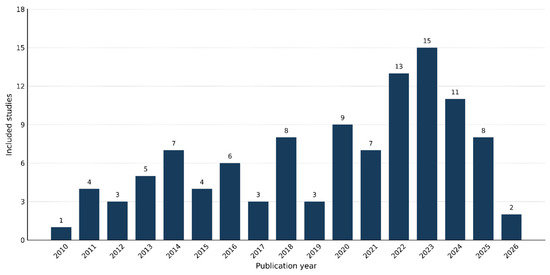
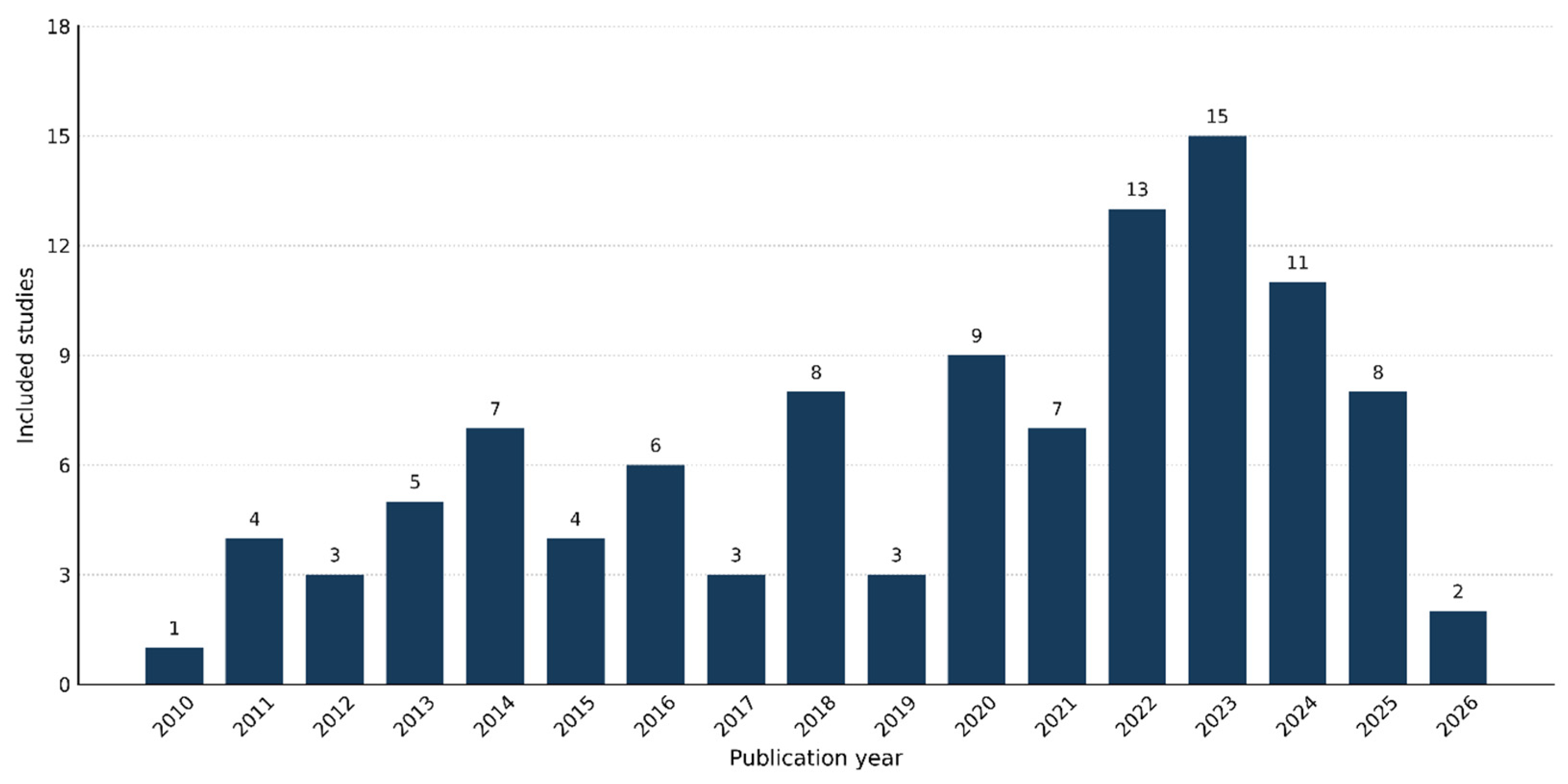
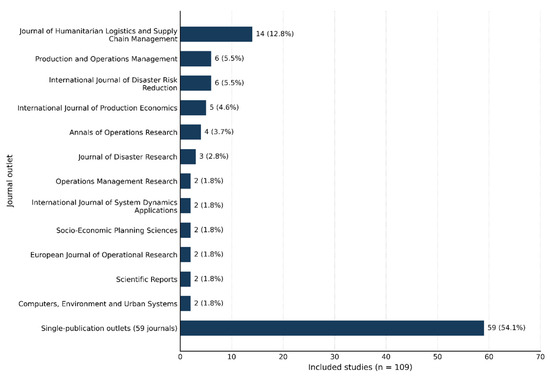
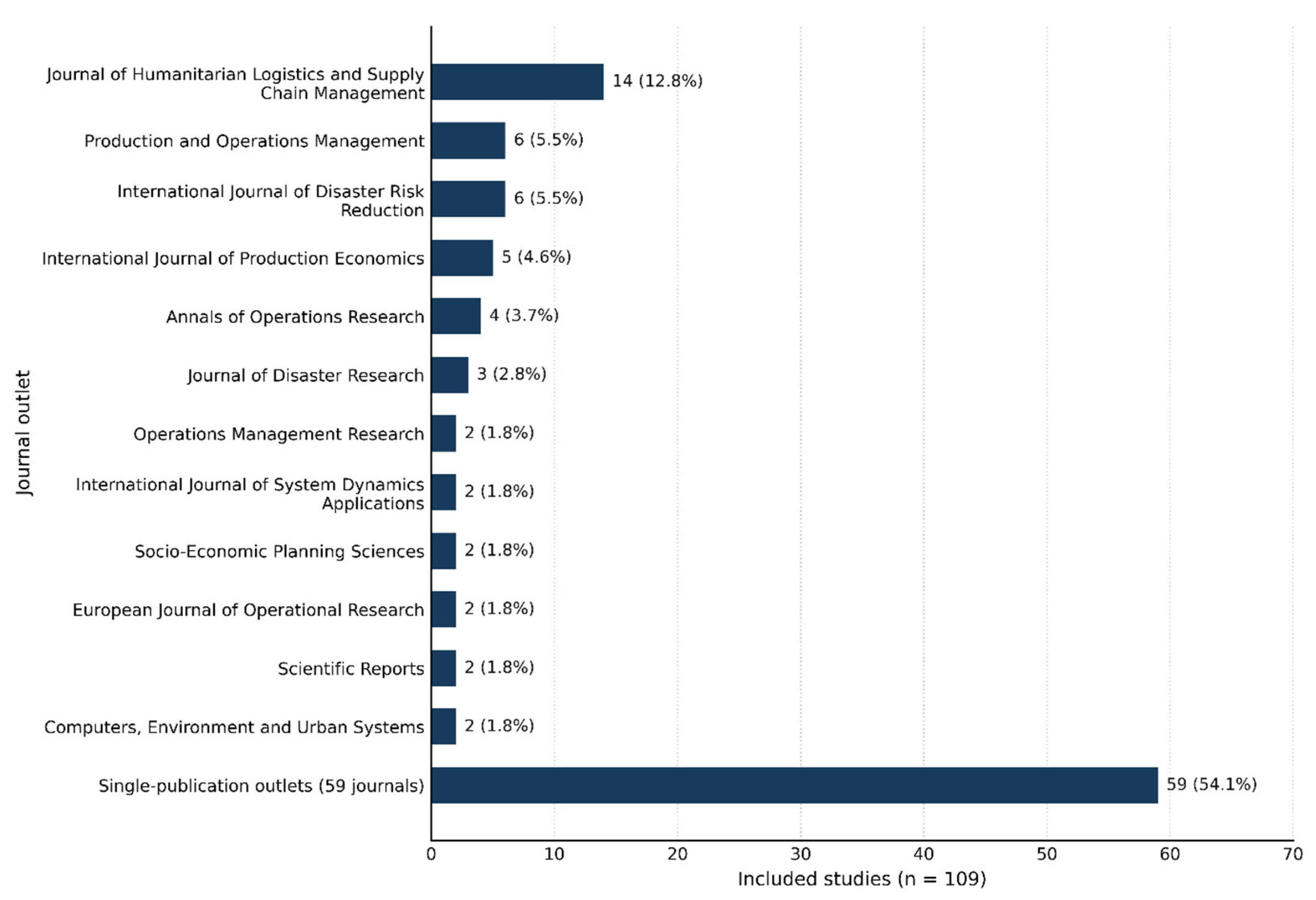
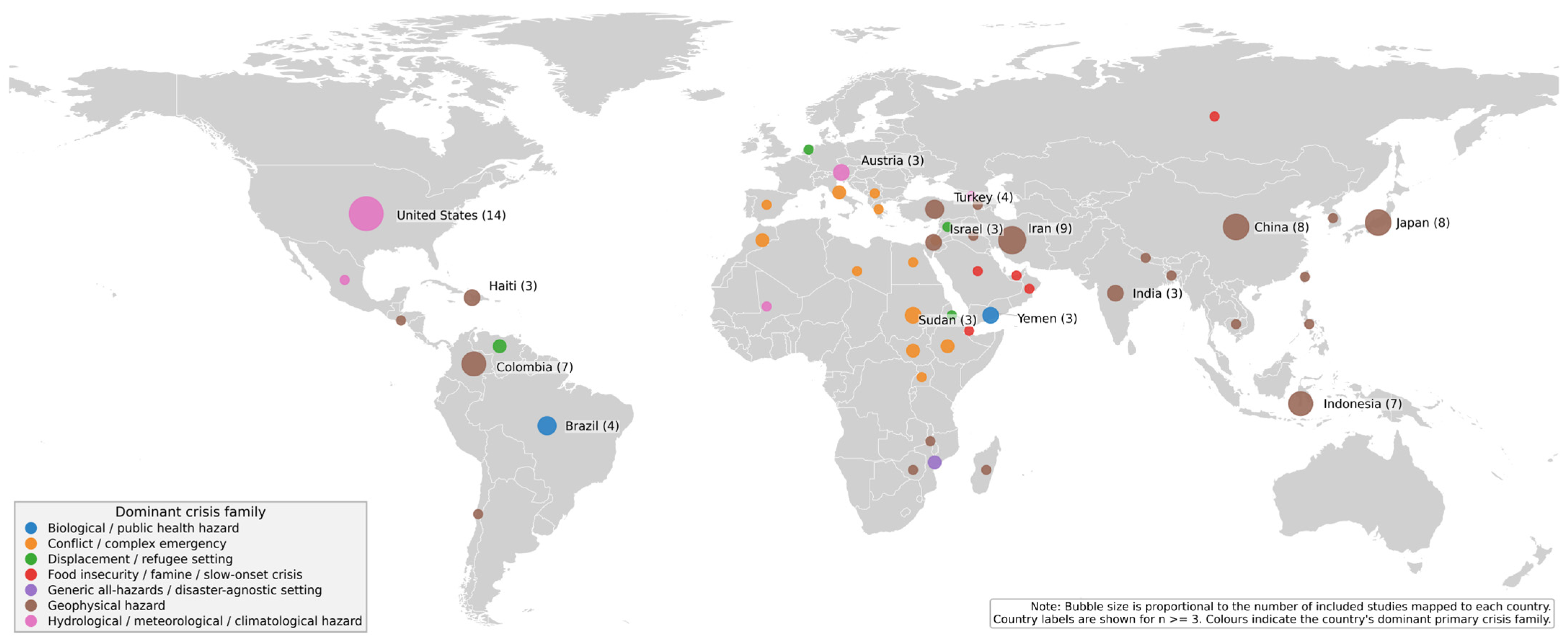
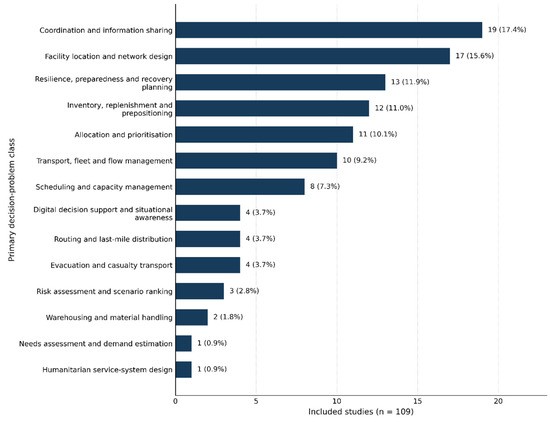
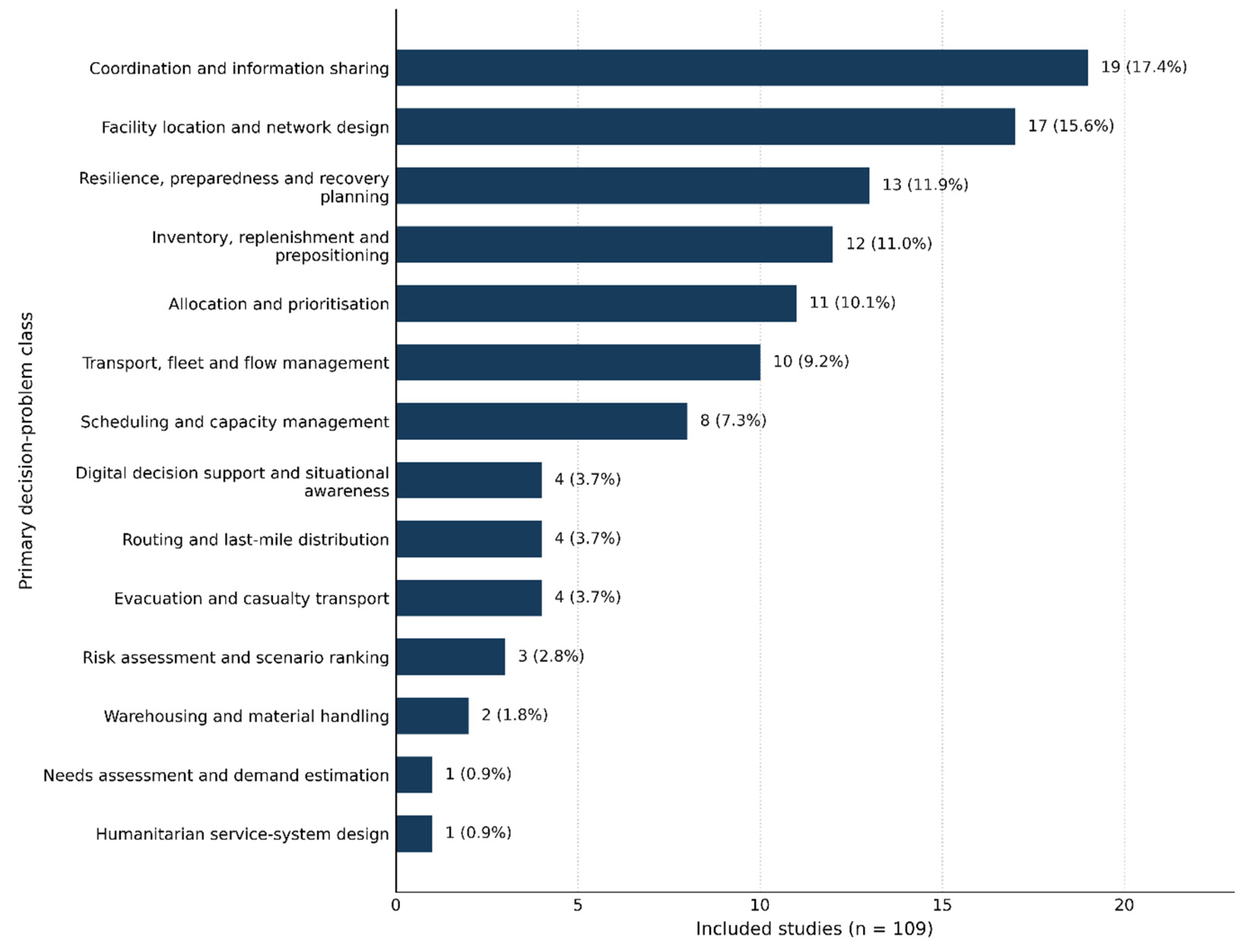
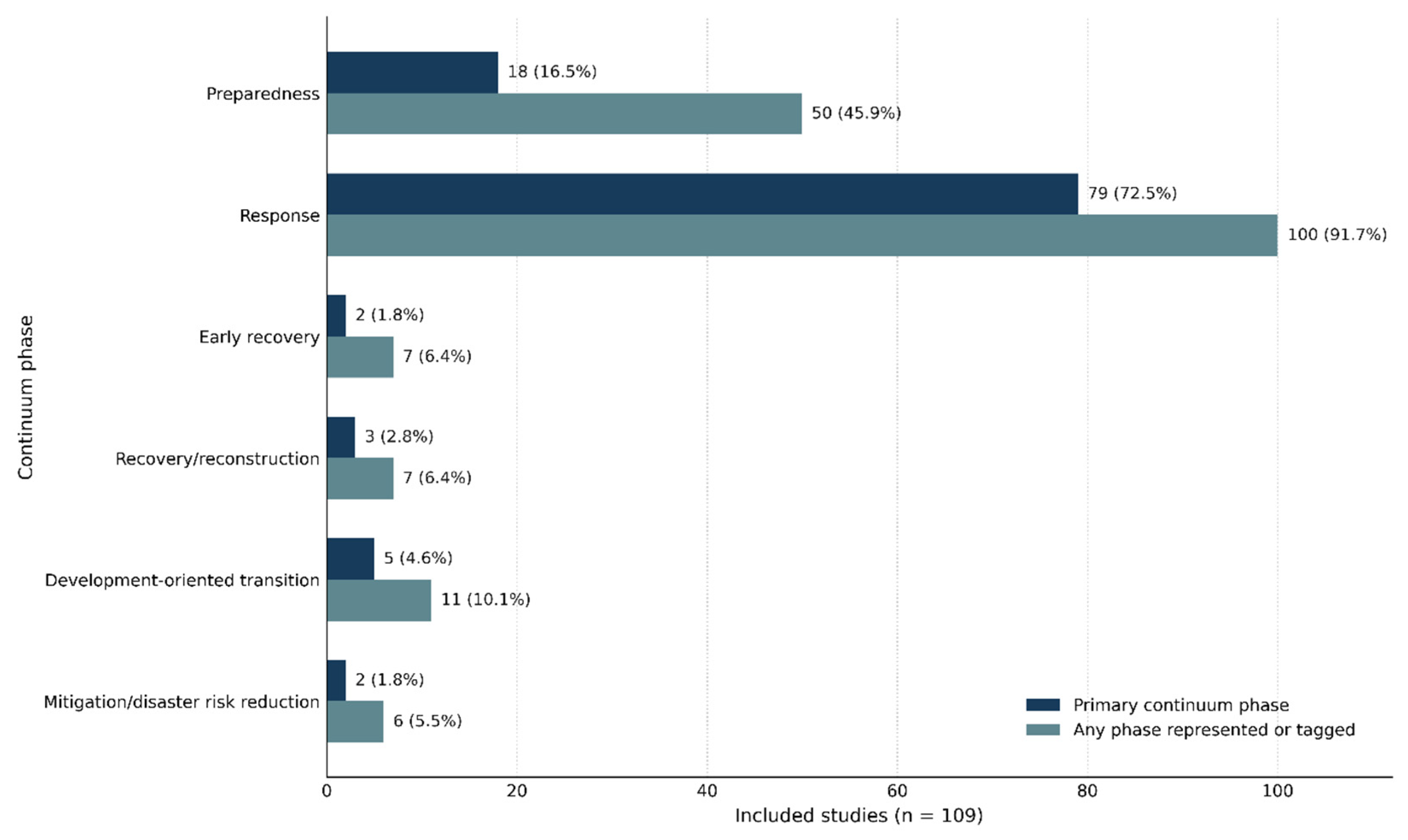
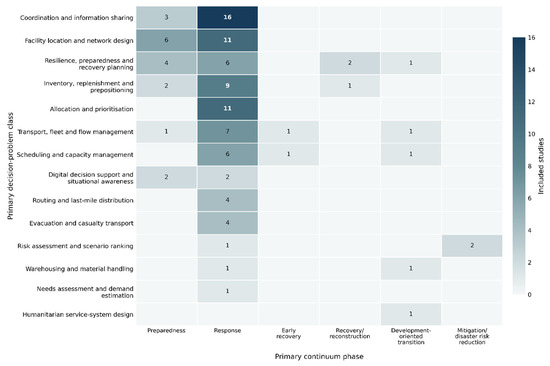
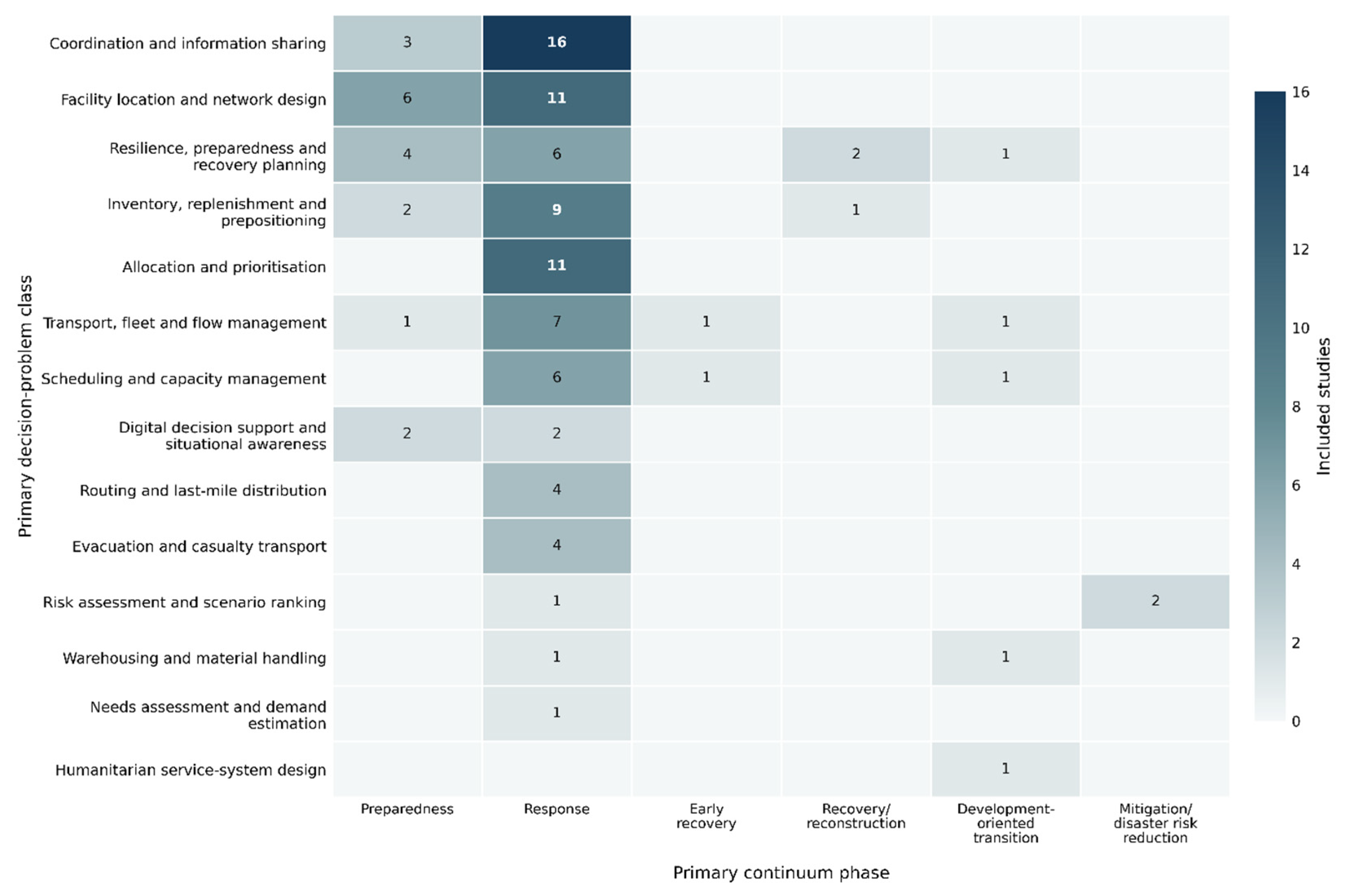
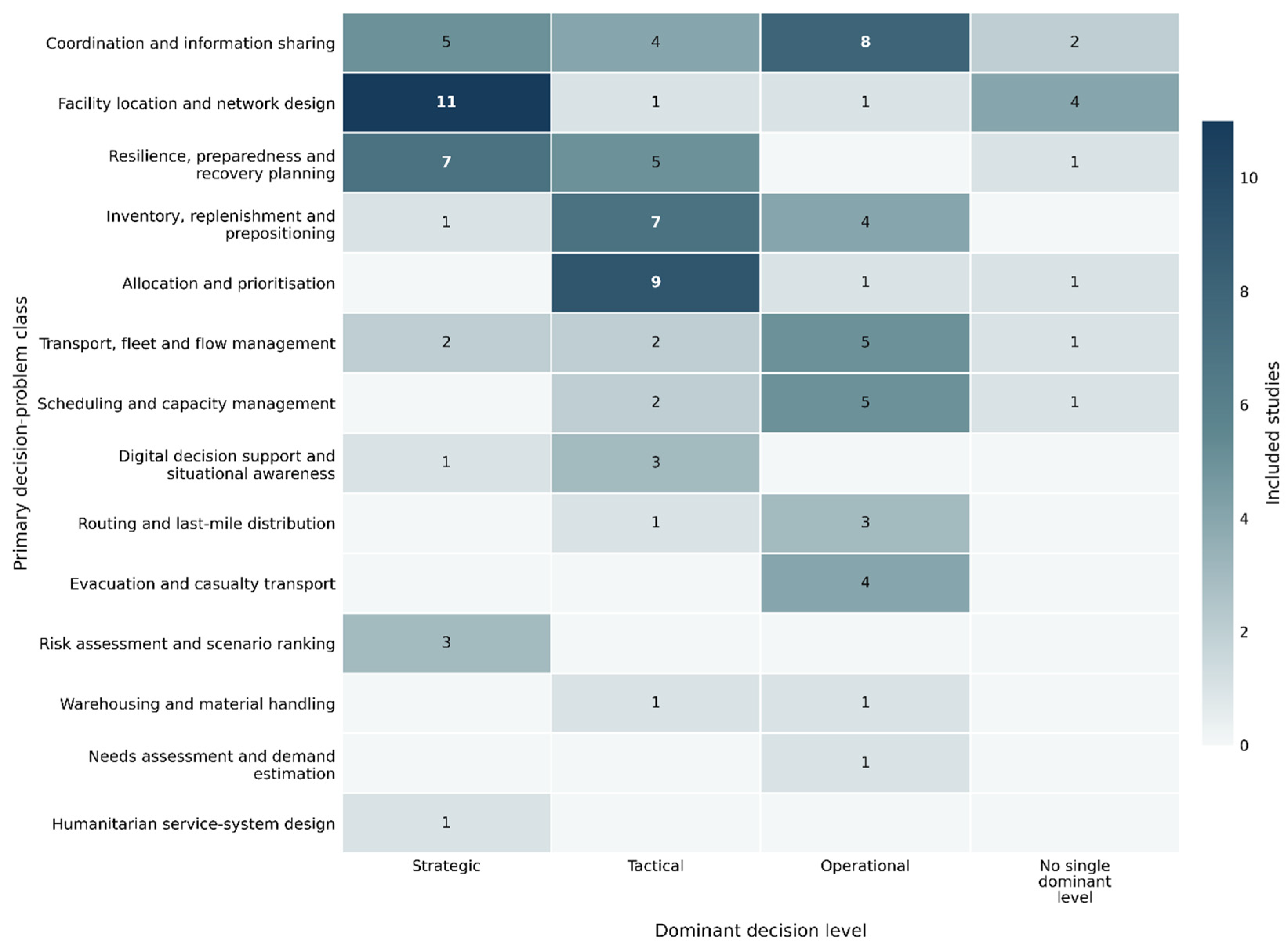
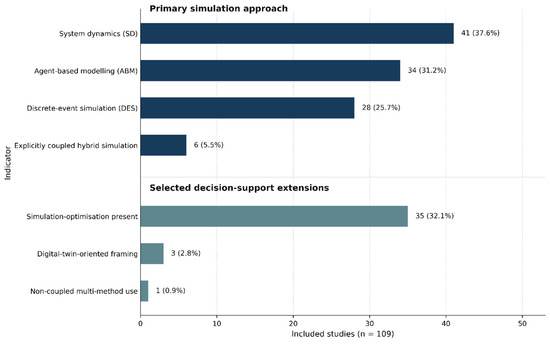
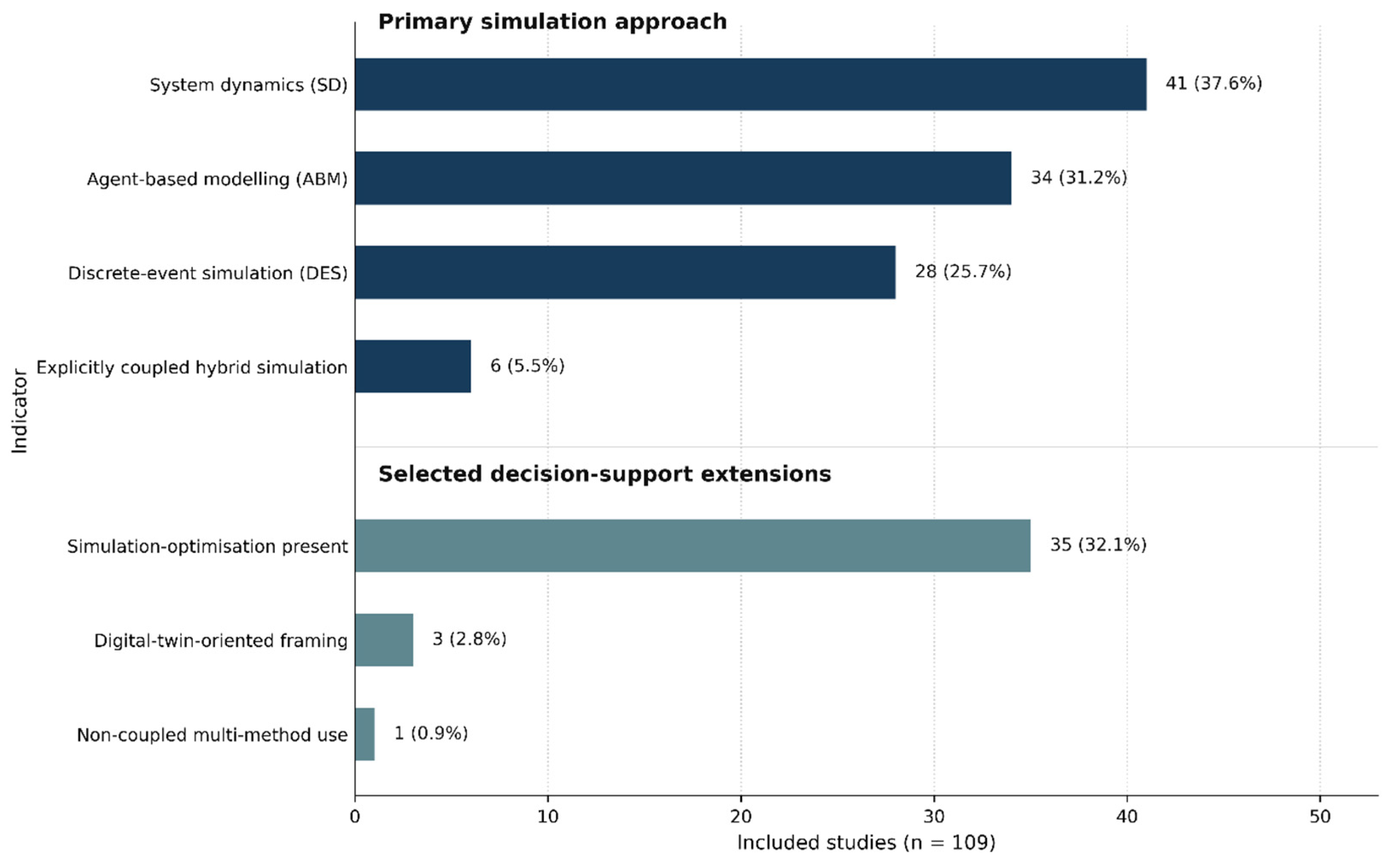
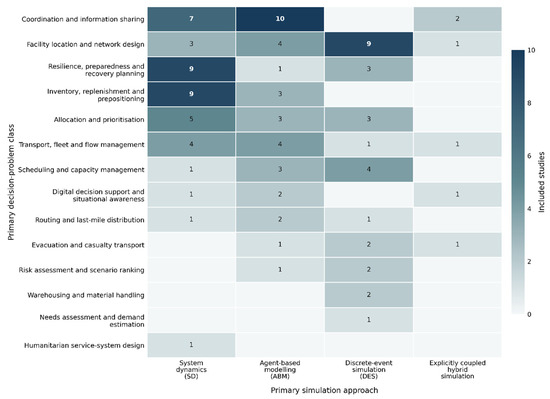
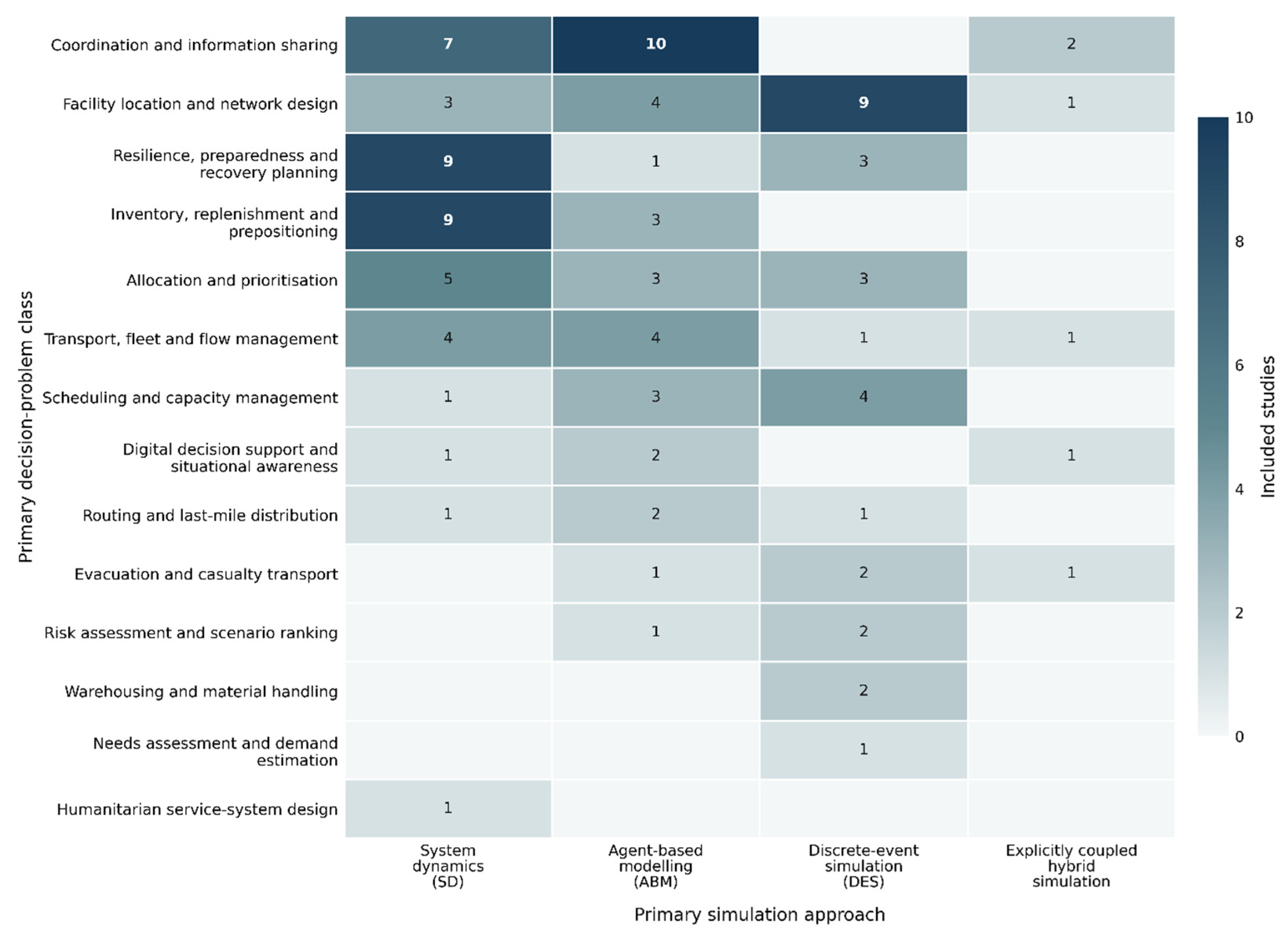
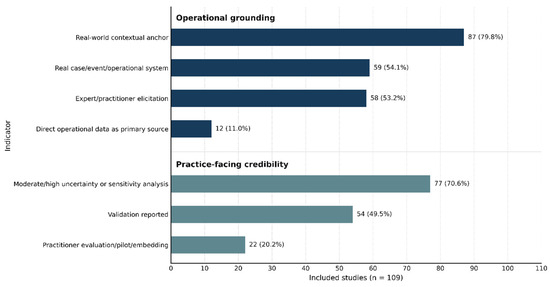
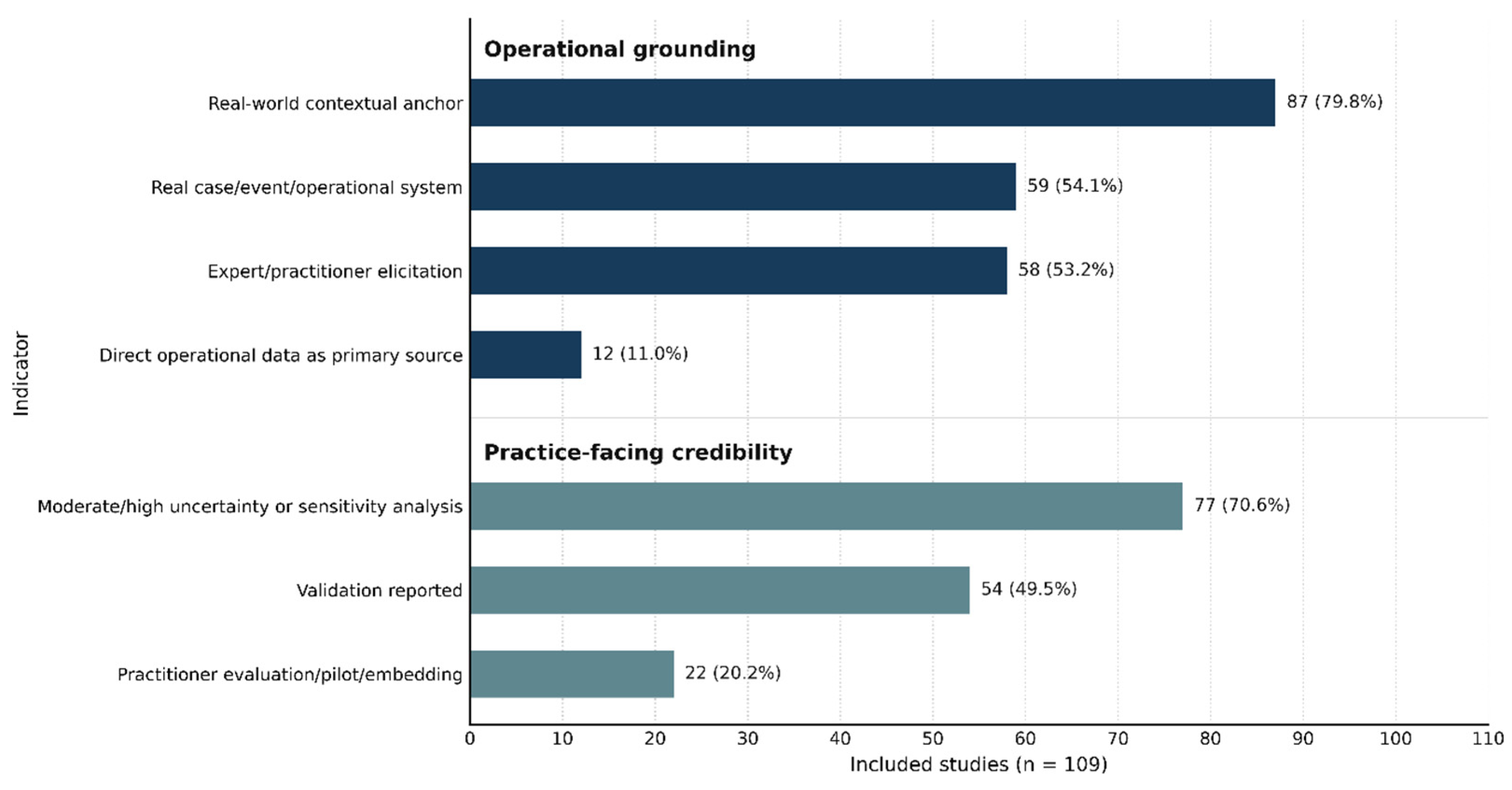

Disclaimer/Publisher’s Note: The statements, opinions and data contained in all publications are solely those of the individual author(s) and contributor(s) and not of MDPI and/or the editor(s). MDPI and/or the editor(s) disclaim responsibility for any injury to people or property resulting from any ideas, methods, instructions or products referred to in the content. |
© 2026 by the authors. Licensee MDPI, Basel, Switzerland. This article is an open access article distributed under the terms and conditions of the Creative Commons Attribution (CC BY) license.