
Efficiency and Fairness in Physical Internet Logistics Coordination Under Shared Capacity Constraints

Abstract
1. Introduction
- A coordinated logistics planning framework is developed for multi-player logistics networks under shared transportation capacity constraints.
- The role of compensation mechanisms in ensuring voluntary participation in coordinated logistics systems is analyzed.
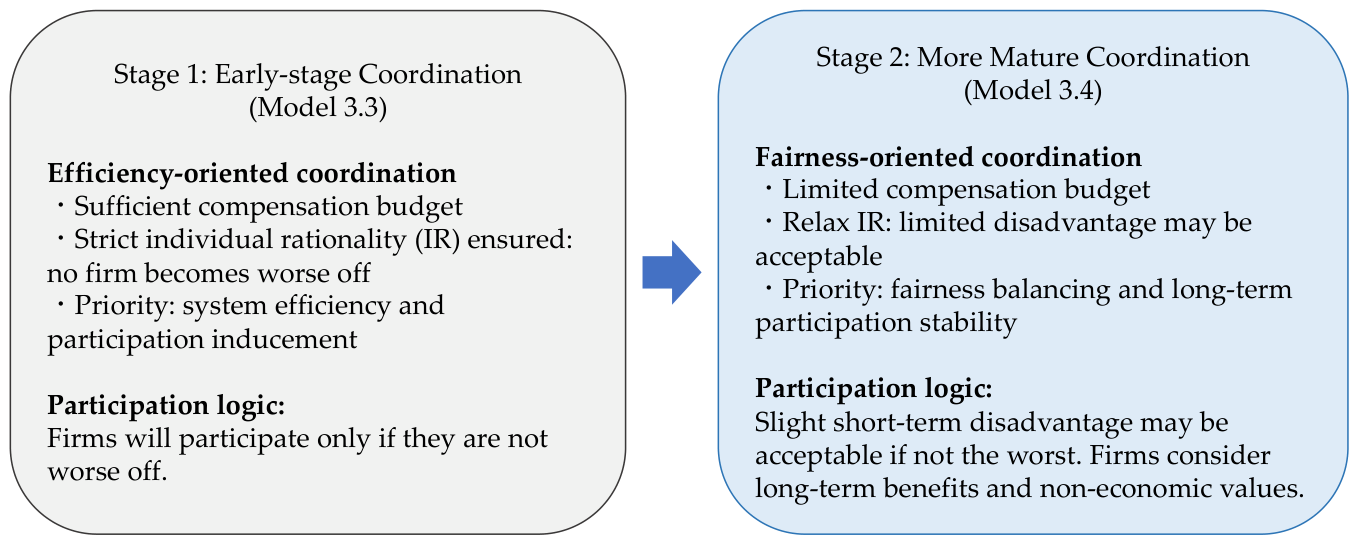
- A two-rule coordination framework is introduced. Model 3.3 guarantees that no firm becomes worse off after compensation. Model 3.4 reduces the worst firm-level disadvantage when this strict guarantee is difficult to provide in every period because compensation resources are limited.
2. Literature Review
2.1. Coordination and Cooperation in Logistics Systems
2.2. Optimization-Based Logistics Coordination
2.3. Fairness-Oriented Optimization
2.4. Gaps
3. Model Formulation
3.1. Problem Setting
3.2. Sets, Parameters, and Decision Variables
3.3. Efficiency-Oriented Coordination Model
3.4. Fairness-Oriented Min–Max Model
4. Numerical Experiments
4.1. Experimental Setting
4.1.1. Target Network
4.1.2. Benchmark Scenario and Compared Models
4.1.3. Parameter Settings
4.2. Results
4.2.1. Results Across Different Problem Sizes
4.2.2. Detailed Analysis of the Base Case
- (1)
- Firm-level fairness outcomes
- (2)
- System-level efficiency
- (3)
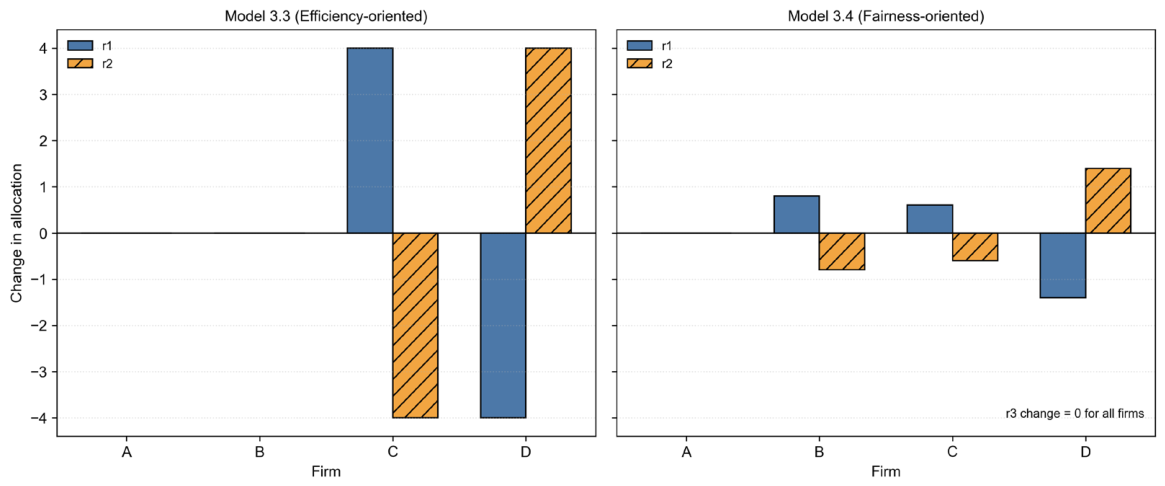
- Allocation adjustment mechanism
- (4)
- Relationship between allocation adjustment and fairness
4.3. Sensitivity Analysis
4.3.1. Impact of Compensation Budget
- (1)
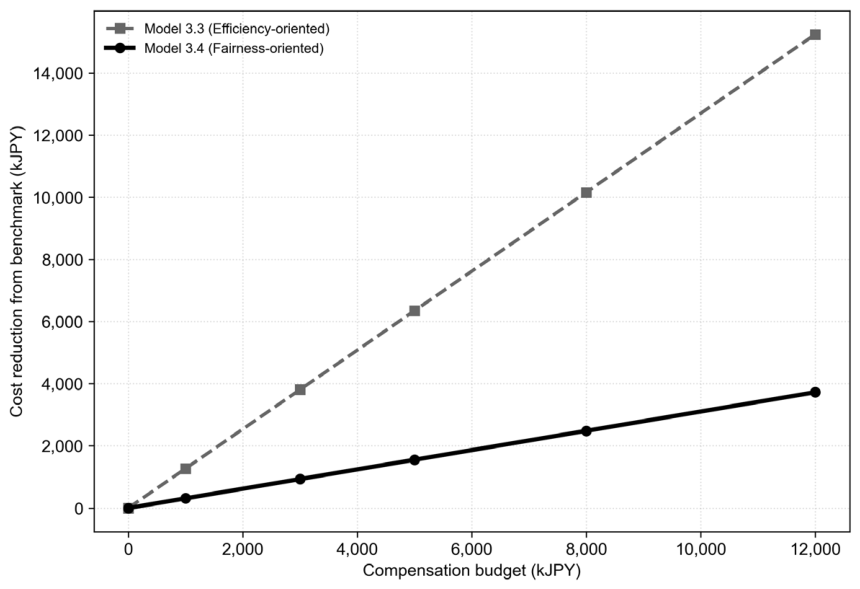
- Impact on System Efficiency
- (2)
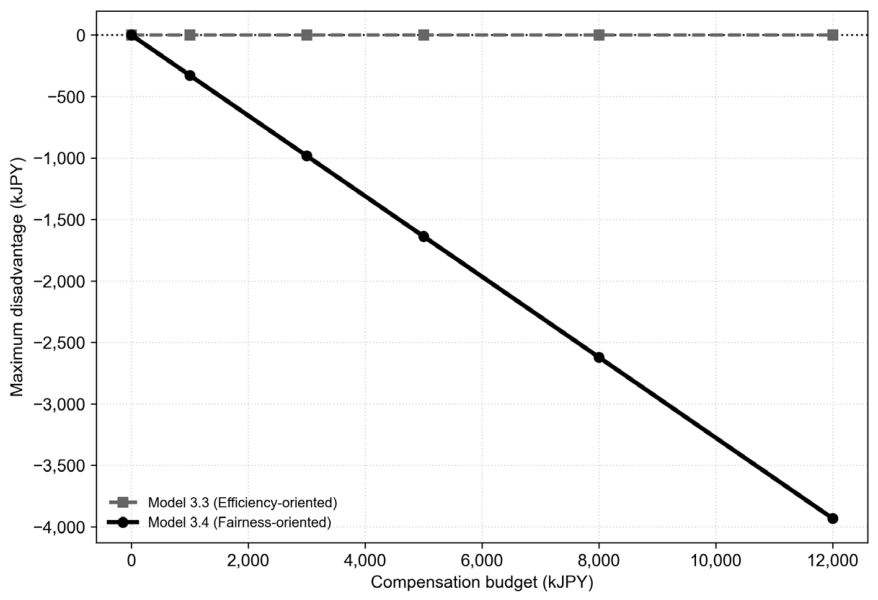
- Impact on Fairness
4.3.2. Impact of Shared Route Capacity Reduction
- (1)
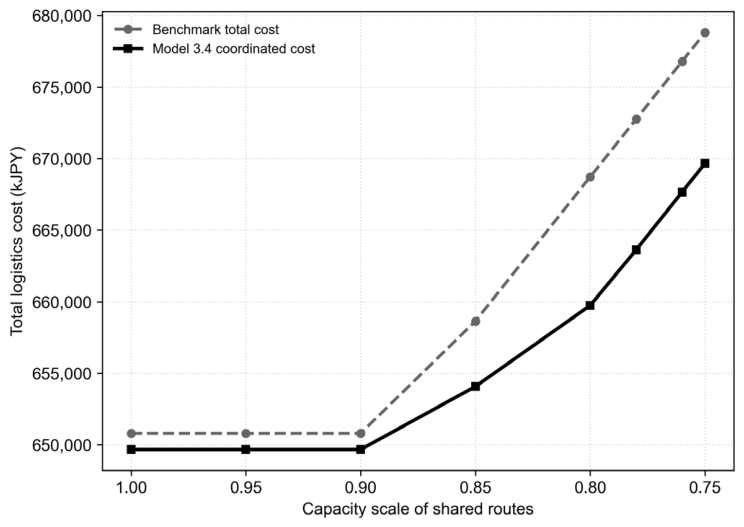
- Impact on System Efficiency
- (2)
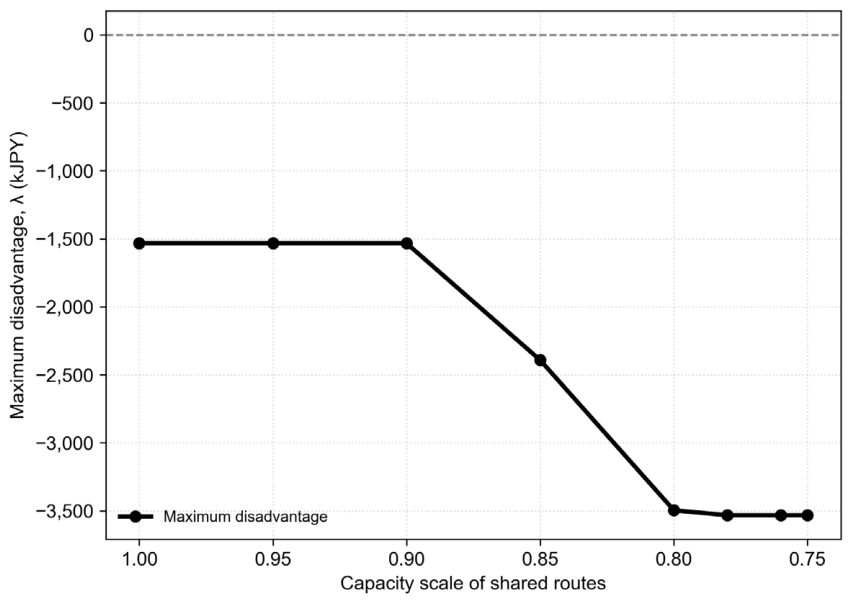
- Impact on Fairness
4.3.3. Integrated Insights from Budget and Capacity Sensitivity
5. Discussion
5.1. Implications for Theory
5.2. Implications for Practice and Policy
5.3. Limitations of the Study and Future Research Directions
6. Conclusions
Author Contributions
Funding
Institutional Review Board Statement
Informed Consent Statement
Data Availability Statement
Acknowledgments
Conflicts of Interest
References
- Cachon, G.P.; Lariviere, M.A. Supply chain coordination with revenue-sharing contracts: Strengths and limitations. Manag. Sci. 2005, 51, 30–44. [Google Scholar] [CrossRef]
- Bart, N.; Chernonog, T.; Avinadav, T. Revenue-sharing contracts in supply chains: A comprehensive literature review. Int. J. Prod. Res. 2021, 59, 6633–6658. [Google Scholar]
- Cruijssen, F.; Cools, M.; Dullaert, W. Horizontal cooperation in logistics: Opportunities and impediments. Transp. Res. Part E 2007, 43, 129–142. [Google Scholar] [CrossRef]
- Badraoui, I.; Van der Vorst, J.G.; Boulaksil, Y. Horizontal logistics collaboration: An exploratory study in Morocco’s agri-food supply chains. Int. J. Logist. Res. Appl. 2020, 23, 85–102. [Google Scholar]
- Xu, L.; Mak, S.; Schoepf, S.; Ostroumov, M.; Brintrup, A. Multi-agent digital twinning for collaborative logistics: Framework and implementation. J. Ind. Inf. Integr. 2025, 45, 100799. [Google Scholar] [CrossRef]
- Krajewska, M.A.; Kopfer, H.; Laporte, G.; Ropke, S.; Zaccour, G. Horizontal cooperation among freight carriers: Request allocation and profit sharing. J. Oper. Res. Soc. 2008, 59, 1483–1491. [Google Scholar] [CrossRef]
- Ferrell, W.; Ellis, K.; Kaminsky, P.; Rainwater, C. Horizontal collaboration: Opportunities for improved logistics planning. Int. J. Prod. Res. 2020, 58, 4267–4284. [Google Scholar]
- Montreuil, B. Toward a Physical Internet: Meeting the global logistics sustainability grand challenge. Logist. Res. 2011, 3, 71–87. [Google Scholar] [CrossRef]
- Ballot, E.; Montreuil, B.; Meller, R.D. The Physical Internet: The Network of Logistics Networks; La Documentation Française: Paris, France, 2014. [Google Scholar]
- Matusiewicz, M. Framework for Physical Internet deployment in cities. Urban Plan. Transp. Res. 2024, 12, 2303341. [Google Scholar] [CrossRef]
- Crainic, T.G.; Laporte, G. Planning models for freight transportation. Eur. J. Oper. Res. 1997, 97, 409–438. [Google Scholar] [CrossRef]
- Yang, Y.; Pan, S.; Ballot, E. Innovative vendor-managed inventory strategy exploiting interconnected logistics services in the Physical Internet. Int. J. Prod. Res. 2017, 55, 2685–2702. [Google Scholar]
- Sternberg, H.S.; Denizel, M. Toward the physical internet—Logistics service modularity and design implications. J. Bus. Logist. 2021, 42, 144–166. [Google Scholar]
- Naganawa, H.; Hirata, E.; Firdausiyah, N.; Thompson, R.G. Logistics hub and route Optimization in the Physical Internet paradigm. Logistics 2024, 8, 37. [Google Scholar] [CrossRef]
- Boysen, N.; Briskorn, D.; Montreuil, B.; Zey, L. The pi-transportation problem: On the value of split transports for the Physical Internet concept. Eur. J. Oper. Res. 2025, 324, 629–643. [Google Scholar] [CrossRef]
- Crainic, T.G.; Feliu, J.G.; Ricciardi, N.; Semet, F.; Van Woensel, T. Operations research for planning and managing city logistics systems. In Handbook on City Logistics and Urban Freight; Edward Elgar Publishing: Cheltenham, UK, 2023; pp. 190–223. [Google Scholar]
- Radunovic, B.; Le Boudec, J.Y. A unified framework for max-min and min-max fairness with applications. IEEE/ACM Trans. Netw. 2007, 15, 1073–1083. [Google Scholar] [CrossRef]
- Bertsimas, D.; Farias, V.F.; Trichakis, N. The price of fairness. Oper. Res. 2011, 59, 17–31. [Google Scholar] [CrossRef]
- Ye, Q.C.; Zhang, Y.; Dekker, R. Fair task allocation in transportation. Omega 2017, 68, 1–16. [Google Scholar] [CrossRef]
- Huang, Q.; Ohmori, S. A study on transfer pricing considering fairness and profitability. Oper. Supply Chain Manag. Int. J. 2021, 14, 496–506. [Google Scholar] [CrossRef]
- Harada, T.; Ito, S.; Sumita, H. Bandit max-min fair allocation. In Joint European Conference on Machine Learning and Knowledge Discovery in Databases; Springer Nature: Cham, Switzerland, 2025; pp. 380–397. [Google Scholar]
- Hooker, J.N.; Williams, H.P. Combining equity and utilitarianism in a mathematical programming model. Manag. Sci. 2012, 58, 1682–1693. [Google Scholar] [CrossRef]
- Karsu, Ö.; Morton, A. Inequity averse optimization in operational research. Eur. J. Oper. Res. 2015, 245, 343–359. [Google Scholar] [CrossRef]
- Babaioff, M.; Ezra, T.; Feige, U. Fair-share allocations for agents with arbitrary entitlements. Math. Oper. Res. 2024, 49, 2180–2211. [Google Scholar] [CrossRef]
- Lai, M.; Wu, Y.; Cai, X. Core-based cost allocation for collaborative multi-stop truckload shipping problem. IISE Trans. 2025, 57, 938–956. [Google Scholar]
- Gückel, J.; Crainic, T.G.; Fontaine, P. Tactical planning in cooperative two-tier city logistics systems with fairness constraints. Sustain. Anal. Model. 2025, 5, 100046. [Google Scholar] [CrossRef]



| Study Category | Fairness Concept | Application Domain | Compensation Mechanism | Shared Transportation Capacity |
|---|---|---|---|---|
| Collaborative logistics allocation studies [6] | Request allocation and profit sharing | Horizontal freight carrier cooperation | Yes, through profit-sharing allocation | Not the main focus |
| Communication network fairness studies [17] | Max–min fairness | Communication networks/bandwidth allocation | No | Shared resource capacity |
| OR fairness trade-off studies [18] | Various fairness measures | General optimization problems | No explicit mechanism | No |
| Transportation allocation studies [19] | Weighted/normalized fairness | Transportation systems | No explicit mechanism | Yes (task/resource sharing) |
| Collaborative profitability studies [20] | Fairness-oriented pricing | Supply chain coordination | compensation-like transfer pricing | No |
| Collaborative cost-allocation study [25] | Least-core cost allocation | Collaborative multi-stop truckload shipping | Yes, through ex-post cost allocation | Vehicle capacity is embedded in routing |
| Cooperative city logistics study [26] | Cost- and workload-based fairness constraints | Cooperative two-tier city logistics | No explicit compensation budget | Shared services and resources; route capacity is not the main focus |
| This study | Min–max disadvantage balancing | Collaborative logistics systems/Physical Internet | Yes, limited compensation budget | Yes, shared route capacity |
| Parameter | Base Case | Large-Scale Instances |
|---|---|---|
| Number of firms | 4 | 8, 12, 20, 30, 50 |
| Origin–destination corridors | 1 common OD pair | Up to 7 Japan-inspired OD corridors |
| Demand per firm | 60–90 container units | 35–105 container units |
| Expected delivery time | 14–22 h | 10.0–50.8 h |
| Parameter | Base Case | Large-Scale Instances |
|---|---|---|
| Route cost | 600–800 kJPY/unit | 518.4–1273.9 kJPY/unit |
| Travel time | 12–22 h | 8.6–58.4 h |
| CO2 emission index | 6–20 index/unit | 4.6–33.5 index/unit |
| Route capacity | 90–180 container units | 64.5–848.3 container units |
| Route availability | All firms share r1–r3 | Only OD-matching routes are available to each firm |
| Firms | Avg. Active OD | Avg. Routes | Benchmark Cost | M3.3 Cost Red. (%) | M3.4 Cost Red. (%) | Wall Time (s) |
|---|---|---|---|---|---|---|
| 4 | 1.0 | 3.0 | 566,800 | 1.12 | 0.27 | 0.0010 |
| 8 | 5.2 | 15.6 | 841,562 | 0.16 | 0.02 | 0.0011 |
| 12 | 5.8 | 17.4 | 1,075,528 | 0.52 | 0.10 | 0.0014 |
| 20 | 6.2 | 18.6 | 1,908,953 | 4.68 | 0.27 | 0.0018 |
| 30 | 6.8 | 20.4 | 2,770,949 | 2.40 | 0.18 | 0.0022 |
| 50 | 7.0 | 21.0 | 4,341,069 | 1.13 | 0.13 | 0.0031 |
Disclaimer/Publisher’s Note: The statements, opinions and data contained in all publications are solely those of the individual author(s) and contributor(s) and not of MDPI and/or the editor(s). MDPI and/or the editor(s) disclaim responsibility for any injury to people or property resulting from any ideas, methods, instructions or products referred to in the content. |
© 2026 by the authors. Licensee MDPI, Basel, Switzerland. This article is an open access article distributed under the terms and conditions of the Creative Commons Attribution (CC BY) license.
Share and Cite
Huang, Q.; Hu, Y.; Ohmori, S. Efficiency and Fairness in Physical Internet Logistics Coordination Under Shared Capacity Constraints. Logistics 2026, 10, 151. https://doi.org/10.3390/logistics10070151
Huang Q, Hu Y, Ohmori S. Efficiency and Fairness in Physical Internet Logistics Coordination Under Shared Capacity Constraints. Logistics. 2026; 10(7):151. https://doi.org/10.3390/logistics10070151
Chicago/Turabian StyleHuang, Qian, Yao Hu, and Shunichi Ohmori. 2026. "Efficiency and Fairness in Physical Internet Logistics Coordination Under Shared Capacity Constraints" Logistics 10, no. 7: 151. https://doi.org/10.3390/logistics10070151
APA StyleHuang, Q., Hu, Y., & Ohmori, S. (2026). Efficiency and Fairness in Physical Internet Logistics Coordination Under Shared Capacity Constraints. Logistics, 10(7), 151. https://doi.org/10.3390/logistics10070151