Cascade Valorisation of Lemon Processing Residues (Part II): Integrated Biorefinery Design, Circular Economy, and Techno-Economic Feasibility

 ,
,  , ,
, ,  ,
,  ,
,  and
and 
Abstract
1. Introduction
1.1. From Waste Management to Value Creation
1.2. Circular Economy Principles in Citrus Processing
1.3. The Biorefinery Concept Applied to Lemon Waste
1.4. Research Gaps in Implementation and Commercial Deployment
1.4.1. Regulatory Approval Timelines and Procedural Uncertainties
1.4.2. Market Development Challenges for Novel Bioproducts
1.4.3. Financing Mechanisms for Biorefinery Investments
1.4.4. Supply Chain Integration and Logistics Optimisation
1.5. Research Objectives and Scope
- (1)
- (2)
- (3)
- (4)
- (5)
- (6)
2. Cascade Valorisation Integration
2.1. Brief Recap of Cascade Principles
- Minimisation of Waste: Each process stage is designed to exhaustively convert waste streams into valuable inputs for subsequent operations, thereby reducing environmental burden and landfill dependency [67].
- Sequential Product Hierarchy: Products are extracted in order of highest added value, beginning with essential oils and pectin, and continuing with polyphenols, bioactive fibres, protein isolates, and finally, bioenergy intermediates [2].
- Life Cycle and Sustainability: The sustainability of the cascade is rigorously monitored through Life Cycle Assessment (LCA) and techno-economic modelling, enabling the selection of optimal product portfolios and minimising energy and material consumption [57].
2.2. Integration Considerations for Industrial Systems
- Utility Recovery Systems: Closed-loop water and heat recovery schemes lower overall environmental impact [76,77], while the recirculation of effluents and by-products supports downstream fermentation and nutrient recycling [78]. Quantitative assessments indicate that heat integration in cascade biorefineries—for instance, using waste heat from steam distillation for downstream drying operations—reduces overall energy consumption by 25–40% relative to standalone operations [70,71]. Regarding water efficiency, closed-loop recycling systems incorporating membrane filtration and process water recirculation have been reported to achieve water reuse rates of 60–80%, reducing freshwater consumption from 12–15 L per kg of dry peel in open-circuit operations to fewer than 5 L per kg. Similarly, ethanol recovery via distillation in pectin extraction processes achieves solvent recovery rates of greater than 90%, reducing solvent procurement costs by approximately 70–80% relative to single-use operation.
- Life Cycle and Techno-Economic Modelling: Rigorous monitoring and modelling of energy flows, emissions, and economic returns ensures that process integration delivers both environmental and financial sustainability [45].
2.3. Process Flow Configurations
2.3.1. Comparison of Schemes: “Extract-First” vs. “Hydrolyse-First”
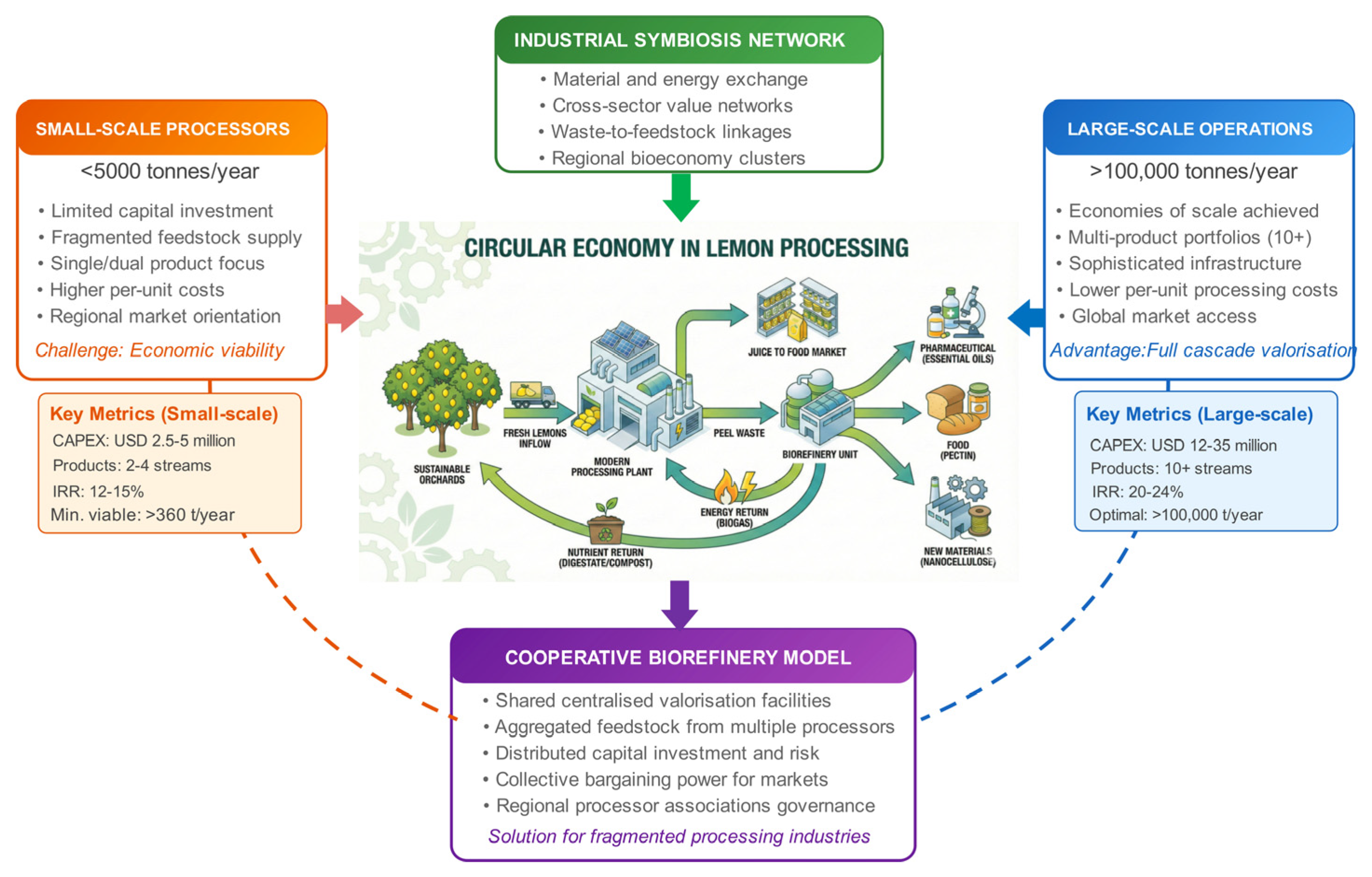
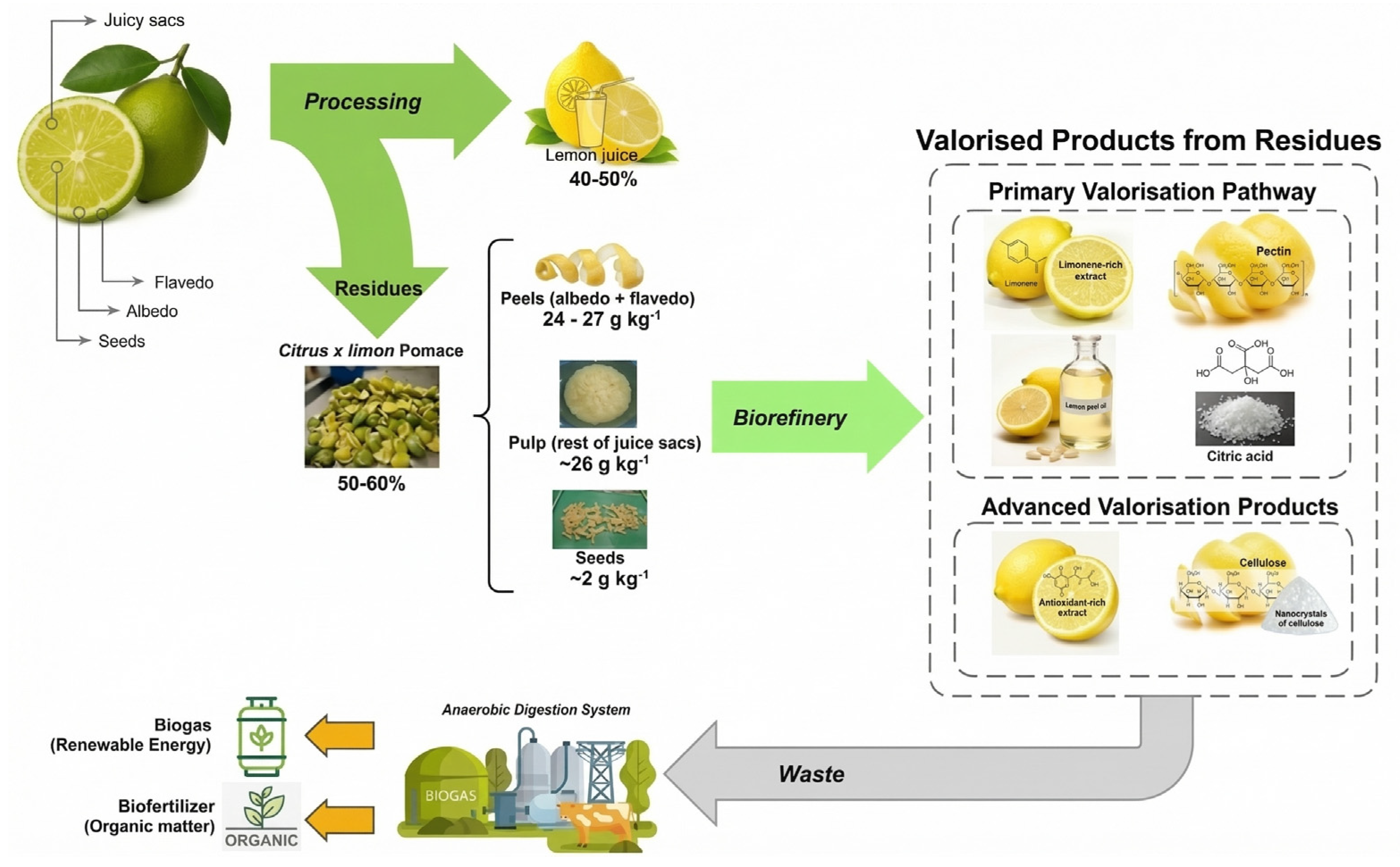
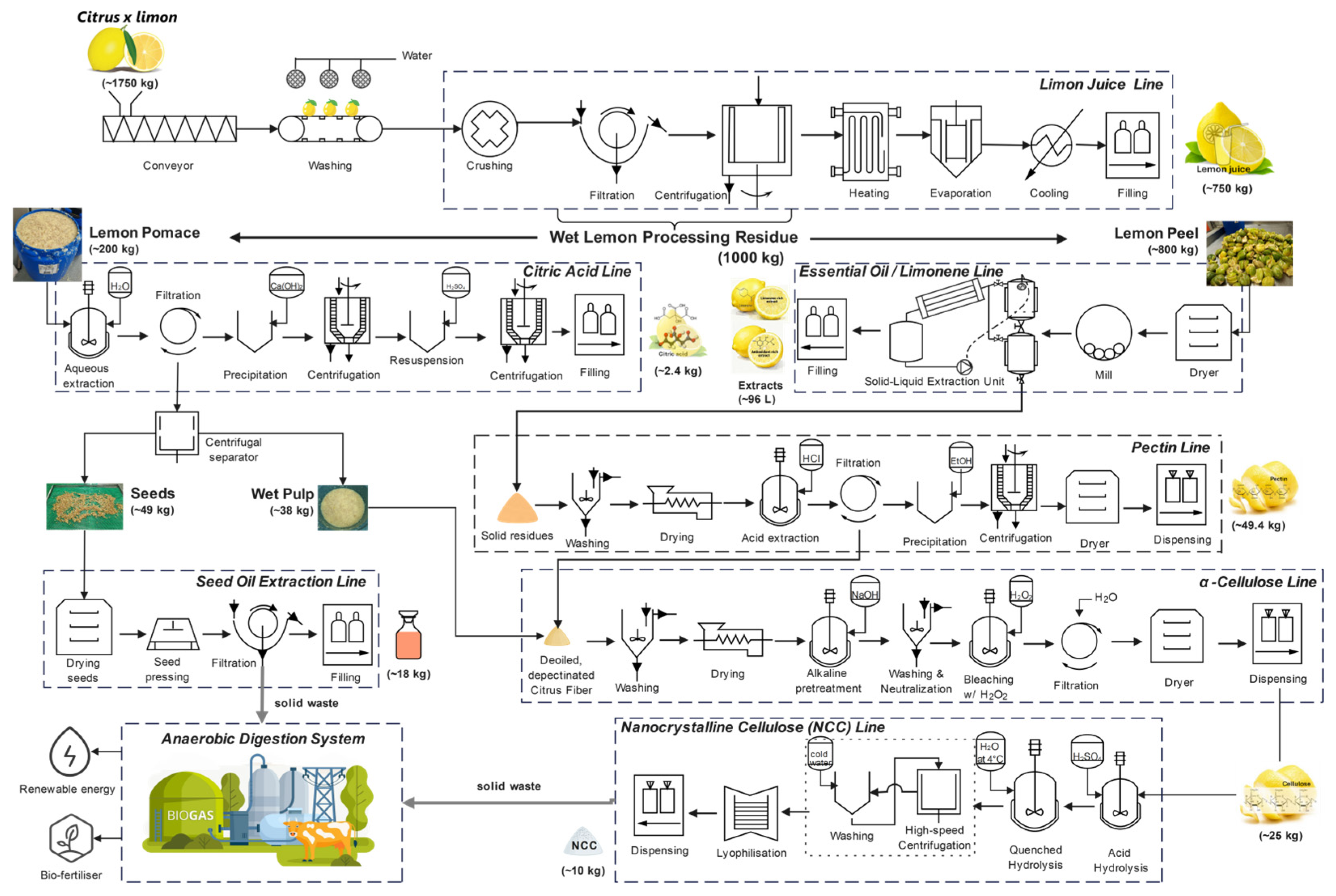
2.3.2. Intersectoral Integrated Model for Citrus Valorisation
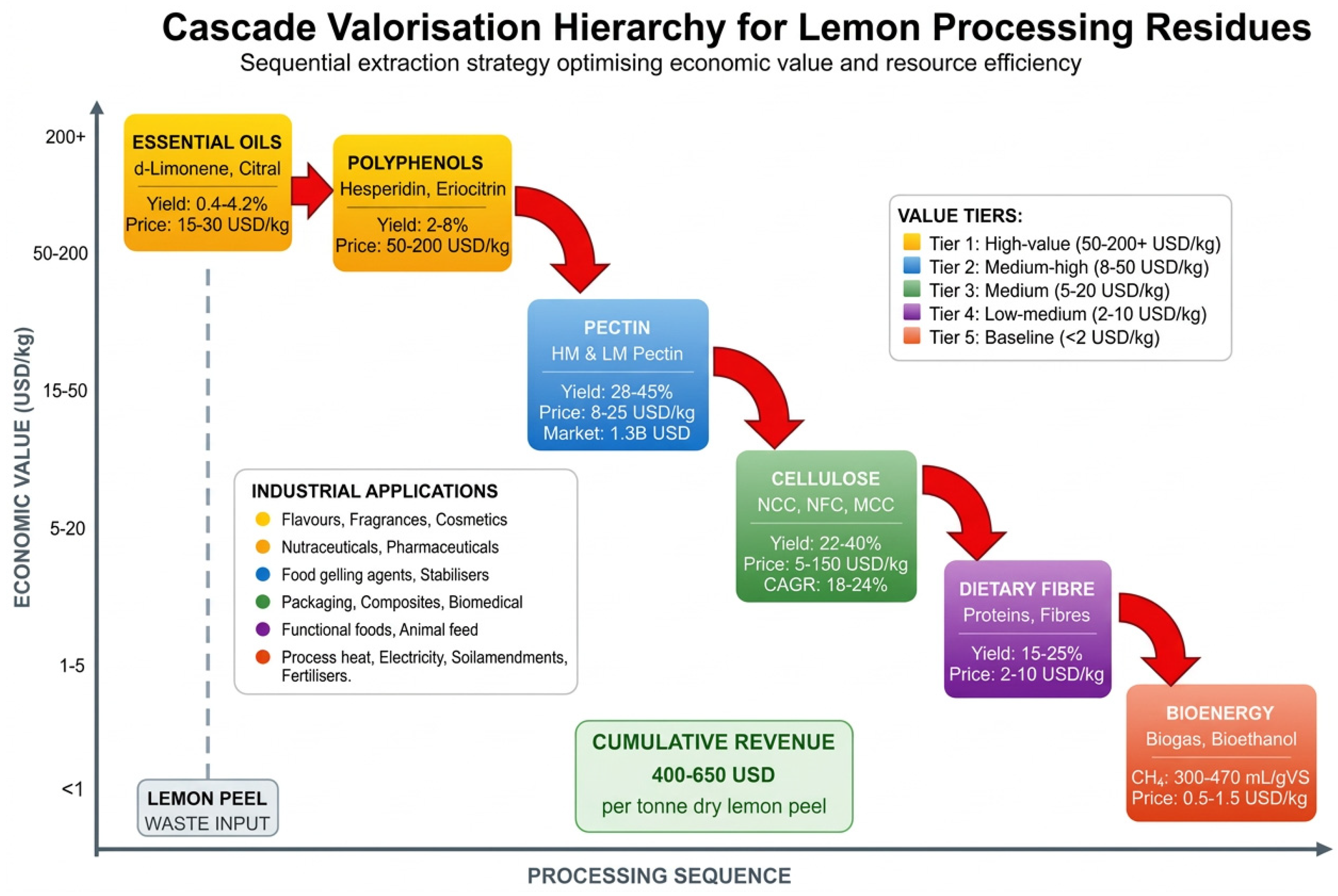
2.3.3. Economic Hierarchy and Recovery Logic
- i.
- Essential Oils and Volatiles: The initial recovery of essential oils is technically mandatory to prevent microbial inhibition in subsequent fermentation steps. Economically, this fraction represents the first high-value stream (USD 15–30 kg−1), capturing volatile revenue prior to thermal degradation steps [10,95,96].
- ii.
- Pectin: Pectin recovery constitutes the economic backbone of the biorefinery due to its substantial global market volume (approximately 60,000 metric tonnes annually, valued at USD 1.1–1.3 billion in 2024, with projections reaching USD 2.1 billion by 2034 at a 5.5–7.0% CAGR). Its extraction logic involves using the de-oiled solid residue to amortise the operational costs (OPEX) of the acid/enzymatic hydrolysis stage. Cascade valorisation enhances pectin’s techno-economic feasibility by integrating upstream oil separation with extraction and downstream polyphenol recovery [97,98].
- iii.
- Polyphenols and Flavonoids: Targeting high-purity polyphenols shifts the biorefinery into the pharmaceutical value tier. While volumes are lower, the unit value is significantly higher, justifying the investment in purification technologies (e.g., membrane filtration) after bulk pectin removal [99,100].
- iv.
- Cellulose and Nanocellulose: After pectin extraction, the remaining lemon biomass converts the final solid residue into Nanocellulose, creating a value leap (USD 50–150 kg−1) compared to traditional low-value routes like animal feed or compost, maximising the total revenue per tonne of processed fruit [3,20].
- v.
- Lignocellulosic Biomass Valorisation: Following the removal of limonene, pectin, polyphenols, and cellulose derivatives, the residual solid matrix—composed mainly of cellulose, hemicellulose, and lignin—is well-suited for biotechnological upgrading. Solid-state fermentation (SSF) enables the use of specialised fungi (e.g., Trichoderma reesei, Aspergillus niger) and yeasts (Saccharomyces cerevisiae, Candida utilis) to produce industrially relevant enzymes (cellulases, xylanases) and single-cell protein (SCP) for food, feed, or biocatalytic applications [73,101].
- vi.
- Bioenergy, Biochar, and Soil Amendments: The final valorisation step transforms recalcitrant residues (pomace, seeds, effluent solids) through anaerobic digestion [102], pyrolysis [87], and composting [103], providing bioethanol [23], biohydrogen [104], and biofertilisers [105] that closes the resource recovery loop.
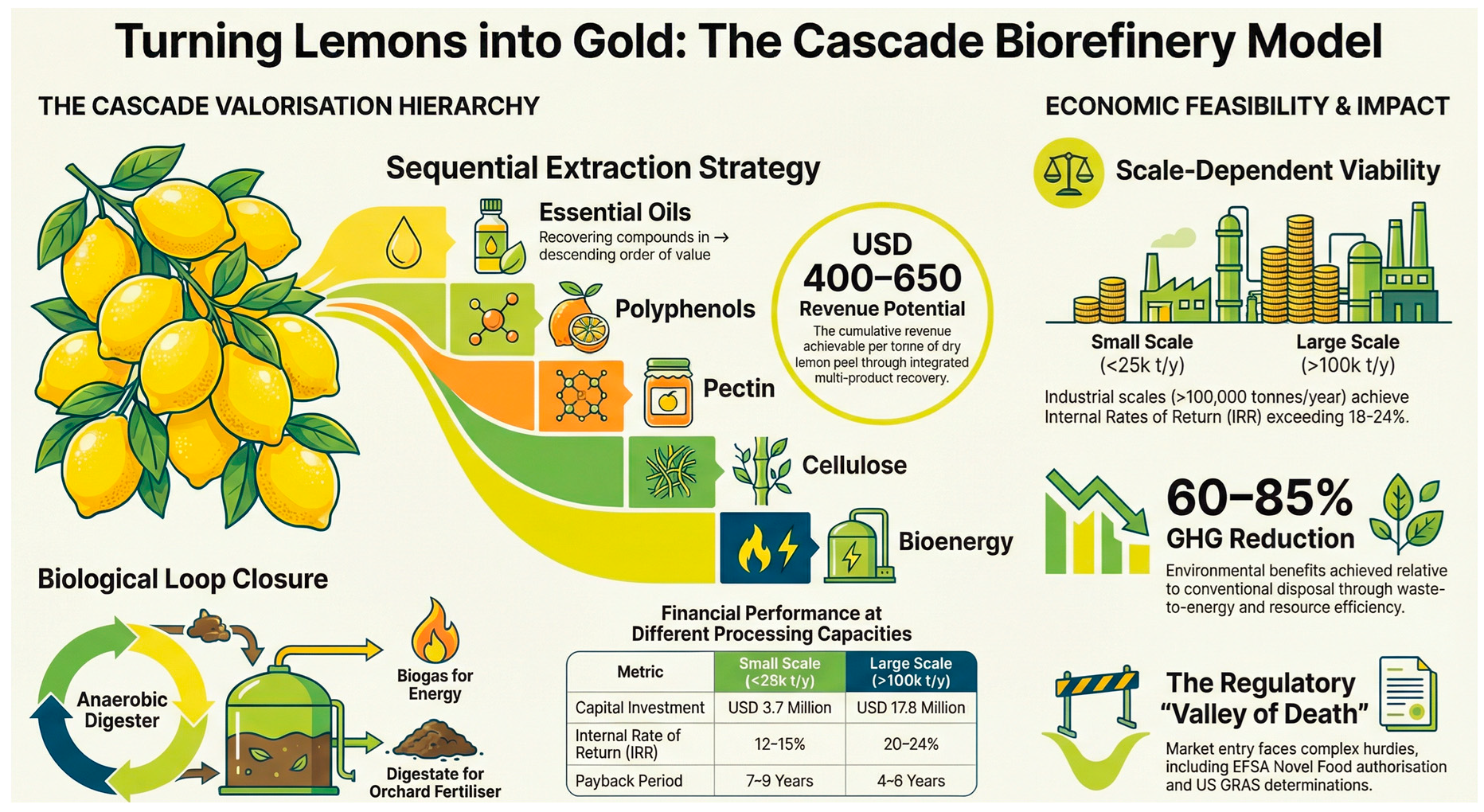
- Firstly, economic viability is strongly correlated with product portfolio diversification, whereby biorefineries recovering four or more distinct product streams achieve substantially higher profitability metrics than single-product or dual-product configurations [14,70,108,109]. This finding underscores the fundamental importance of cascade valorisation approaches that systematically extract multiple value fractions rather than targeting isolated high-value compounds [26].
- Secondly, capital investment requirements exhibit non-linear scaling relationships, with per-tonne processing capacity costs declining substantially as annual throughput increases from small scale (~5000 tonnes per year) through intermediate scale (10,000–50,000 tonnes per year) to large scale (>100,000 tonnes per year), suggesting that cooperative models enabling smaller processors to share centralised valorisation facilities merit serious consideration in regions characterised by fragmented processing industries [110,111].
- Thirdly, environmental performance metrics consistently favour integrated biorefinery configurations over conventional disposal practices across all impact categories assessed, including global warming potential, eutrophication potential, acidification potential, and resource depletion indicators, with emission reductions ranging from 60 to 85%, depending on specific processing schemes and energy sources employed [17].
- Fourthly, technology readiness levels remain distributed across a broad spectrum, with essential oil extraction and pectin recovery having achieved commercial maturity (TRL 8–9), enabling immediate implementation, whilst advanced products, including nanocrystalline cellulose, industrial enzymes, and platform chemicals, remain predominantly at pilot scale (TRL 5–7), requiring additional development before routine commercial deployment becomes feasible [22]. This technology maturity distribution suggests phased implementation strategies in which initial biorefinery configurations emphasise established products to secure reliable revenue streams, whilst progressively incorporating emerging products as technical risks diminish and markets mature [4,112].
- Fifthly, sensitivity analyses consistently identify feedstock cost, product market prices, and processing scale as the three parameters exerting dominant influence on profitability metrics, with secondary importance attributed to energy costs, solvent recovery efficiency, and labour requirements [2,14,113].
3. Circular Economy Integration: Closing the Loop
3.1. Anaerobic Digestion for Final Residues
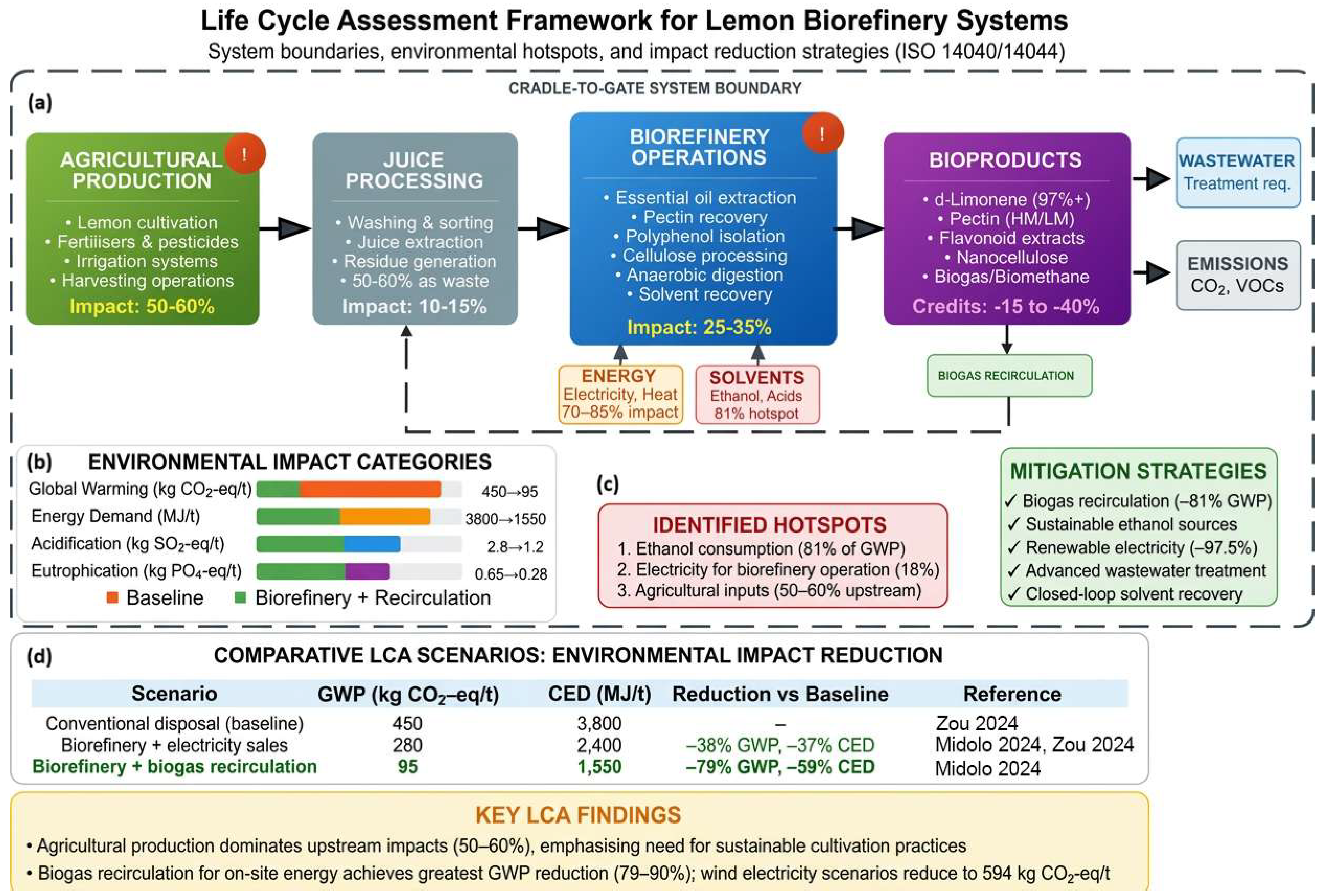
3.2. Life Cycle Assessment (LCA) Considerations
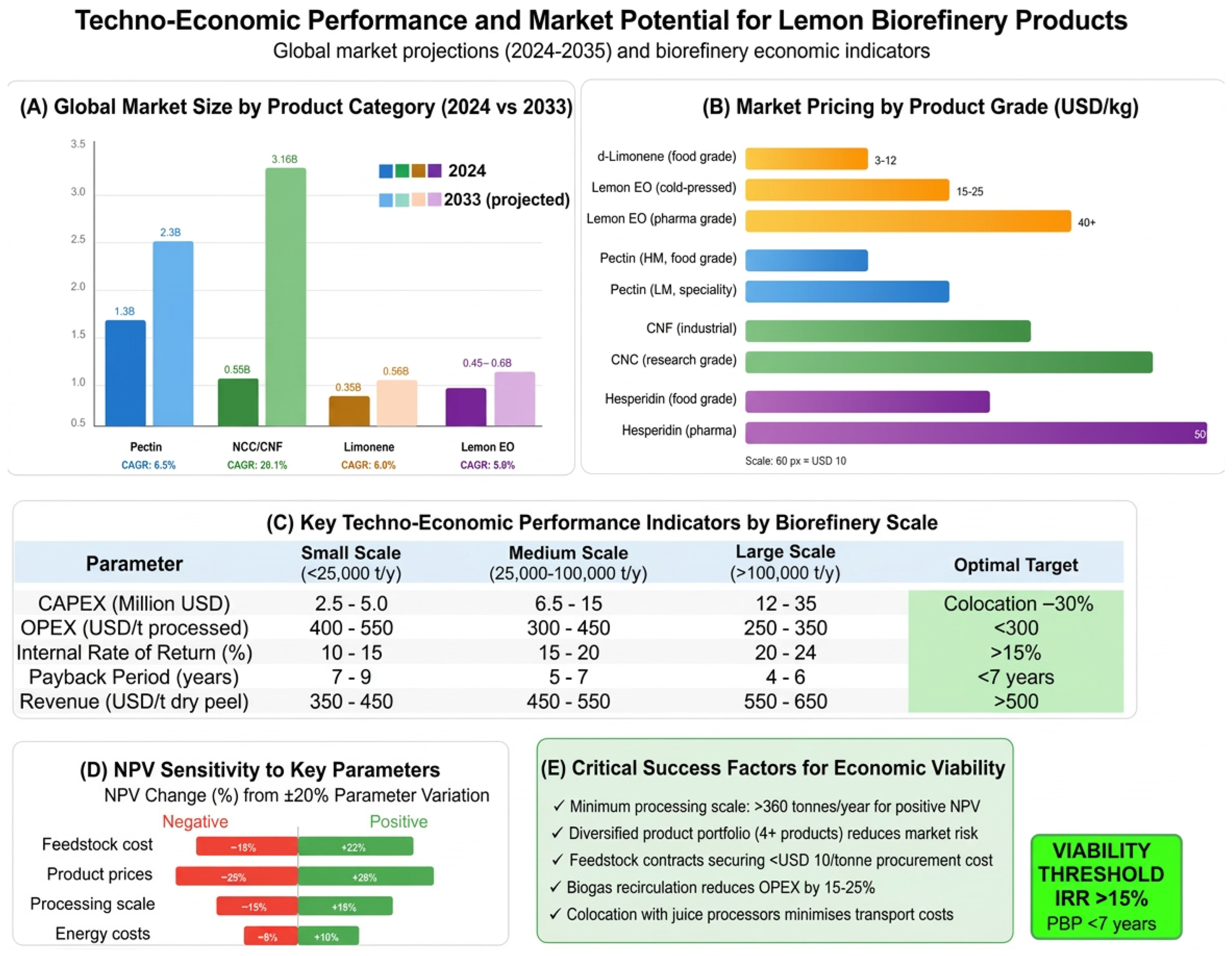
3.3. Techno-Economic Analysis
- Price assumptions: Product prices are based on 2024–2025 market data for each product category (essential oils: USD 15–30/kg; pectin: USD 10–15/kg; polyphenolic extracts: USD 50–200/kg; nanocellulose: USD 5–15/kg at commercial scale). Sensitivity analyses (Figure 6D,E) demonstrate the impact of ±20% price fluctuations on IRR and NPV.
- Market volatility: The cumulative revenue range (USD 400–650 per tonne) already encompasses scenarios from conservative to optimistic market conditions. D-limonene price volatility (historical range: USD 3–15/kg) represents the primary source of revenue uncertainty, as noted in Section 4.4.
- Plant lifetime: Economic parameters assume a 10-year project lifetime, an 8% discount rate, and 330 operating days per year (as stated in the Figure 6 caption). Payback periods of 5–9 years fall within this assumed project horizon.
3.4. Business Models and Value Chain Integration
4. Industrial Implementation: Challenges and Opportunities
4.1. Scalability Issues
4.2. Regulatory Aspects
4.3. Market Potential for Each Product
4.4. Market Development and Demand Analysis
4.5. Scale-Up Challenges and Technology Transfer
5. Future Perspectives and Research Needs
5.1. Advanced Process Integration
5.2. Regulatory Frameworks for Citrus-Derived Products
5.2.1. Food and Beverage Applications
5.2.2. Pharmaceutical and Nutraceutical Applications
5.2.3. Cosmetic and Personal Care Applications
5.2.4. Nanomaterial-Specific Regulations
5.2.5. Environmental and Occupational Safety Regulations
5.3. Comprehensive Sustainability Assessment Frameworks
5.4. Market Development and Value Chain Coordination
5.5. Policy and Regulatory Research Needs
5.6. Concluding Remarks on Research Priorities
5.7. Artificial Intelligence and Machine Learning in Lemon Biorefinery Optimisation
6. Conclusions
Author Contributions
Funding
Institutional Review Board Statement
Informed Consent Statement
Data Availability Statement
Acknowledgments
Conflicts of Interest
Abbreviations
| AD | Anaerobic Digestion |
| AI | Artificial Intelligence |
| ANN | Artificial Neural Networks |
| AP | Acidification Potential |
| B2B | Business-to-Business |
| B2C | Business-to-Consumer |
| CAGR | Compound Annual Growth Rate |
| CAPEX | Capital Expenditure |
| CED | Cumulative Energy Demand |
| CHP | Combined Heat and Power |
| CNC | Cellulose Nanocrystals |
| CNF | Cellulose Nanofibrils |
| DES | Deep Eutectic Solvents |
| DW | Dry Weight |
| EAE | Enzyme-Assisted Extraction |
| EFSA | European Food Safety Authority |
| EO | Essential Oil |
| EP | Eutrophication Potential |
| FDA | Food and Drug Administration (United States) |
| GRAS | Generally Recognized as Safe |
| GWP | Global Warming Potential |
| HM | High Methoxyl |
| IGP | Indicazione Geografica Protetta (Protected Geographical Indication) |
| INS | International Numbering System |
| IoT | Internet of Things |
| IRR | Internal Rate of Return |
| ISO | International Organization for Standardization |
| LCA | Life Cycle Assessment |
| LM | Low Methoxyl |
| MAE | Microwave-Assisted Extraction |
| MCC | Microcrystalline Cellulose |
| ML | Machine Learning |
| NCC | Nanocrystalline Cellulose |
| NFC | Nanofibrillated Cellulose |
| NPV | Net Present Value |
| OLR | Organic Loading Rate |
| OPEX | Operating Expenditure |
| PBP | Payback Period |
| PDO | Protected Designation of Origin |
| PEF | Pulsed Electric Field |
| PLA | Polylactic Acid |
| RSM | Response Surface Methodology |
| SC-CO2 | Supercritical Carbon Dioxide |
| SCP | Single-Cell Protein |
| SFE | Supercritical Fluid Extraction |
| SME | Small and Medium Enterprise |
| SSF | Solid-State Fermentation |
| TEA | Techno-Economic Analysis |
| TRL | Technology Readiness Level |
| UAE | Ultrasound-Assisted Extraction |
| UAEE | Ultrasound-Assisted Enzymatic Extraction |
| UASB | Upflow Anaerobic Sludge Blanket |
| USP | United States Pharmacopoeia |
| VS | Volatile Solids |
| WTP | Willingness to Pay |
References
- Kumar, H.; Guleria, S.; Kimta, N.; Nepovimova, E.; Dhanjal, D.S.; Sethi, N.; Suthar, T.; Shaikh, A.M.; Bela, B.K.; Harsányi, E. Applications of Citrus Peels Valorisation in Circular Bioeconomy. J. Agric. Food Res. 2025, 20, 101780. [Google Scholar] [CrossRef] [Scilit]
- Kundu, D.; Banerjee, S.; Karmakar, S.; Banerjee, R. Valorization of Citrus Lemon Wastes through Biorefinery Approach: An Industrial Symbiosis. Bioresour. Technol. Rep. 2021, 15, 100717. [Google Scholar] [CrossRef] [Scilit]
- AlZahabi, S.; Mamdouh, W. Valorization of Citrus Processing Waste into High-Performance Bionanomaterials: Green Synthesis, Biomedicine, and Environmental Remediation. RSC Adv. 2025, 15, 36534–36595. [Google Scholar] [CrossRef] [Scilit] [PubMed]
- Leong, H.Y.; Chang, C.K.; Khoo, K.S.; Chew, K.W.; Chia, S.R.; Lim, J.W.; Chang, J.S.; Show, P.L. Waste Biorefinery towards a Sustainable Circular Bioeconomy: A Solution to Global Issues. Biotechnol. Biofuels 2021, 14, 87. [Google Scholar] [CrossRef] [Scilit] [PubMed]
- Olmedo-Galarza, V.; Pinto-Mosquera, N.; Pineda-Flores, H.; Manosalvas-Quiroz, L. Citrus Waste Valorization: Unconventional Pathways for Sustainable Biomaterials and Bioactive Products. Sustainability 2025, 17, 10887. [Google Scholar] [CrossRef] [Scilit]
- Núñez-Pérez, J.; Burbano-García, J.L.; Espín-Valladares, R.; Lara-Fiallos, M.V.; DelaVega-Quintero, J.C.; Cevallos-Vallejos, M.A.; Pais-Chanfrau, J.-M. Cascade Valorisation of Lemon-Processing Residues (Part I): Current Trends in Green Extraction Technologies and High-Value Bioactive Recovery. Foods 2026, 15, 491. [Google Scholar] [CrossRef] [Scilit]
- Jiang, C.; Zhang, P.; Jiang, P.; Zhang, X.-E. Crossing the Valley of Death: The Mechanism Through Which Searching Drives Green Product Development. Systems 2025, 13, 959. [Google Scholar] [CrossRef] [Scilit]
- Zema, D.A.; Calabrò, P.S.; Folino, A.; Tamburino, V.; Zappia, G.; Zimbone, S.M. Valorisation of Citrus Processing Waste: A Review. Waste Manag. 2018, 80, 252–273. [Google Scholar] [CrossRef] [Scilit] [PubMed]
- Mahato, N.; Sharma, K.; Sinha, M.; Cho, M.H. Citrus Waste Derived Nutra-/Pharmaceuticals for Health Benefits: Current Trends and Future Perspectives. J. Funct. Foods 2018, 40, 307–316. [Google Scholar] [CrossRef] [Scilit]
- Patsalou, M.; Chrysargyris, A.; Tzortzakis, N.; Koutinas, M. A Biorefinery for Conversion of Citrus Peel Waste into Essential Oils, Pectin, Fertilizer and Succinic Acid via Different Fermentation Strategies. Waste Manag. 2020, 113, 469–477. [Google Scholar] [CrossRef] [Scilit]
- Lohrasbi, M.; Pourbafrani, M.; Niklasson, C.; Taherzadeh, M.J. Process Design and Economic Analysis of a Citrus Waste Biorefinery with Biofuels and Limonene as Products. Bioresour. Technol. 2010, 101, 7382–7388. [Google Scholar] [CrossRef] [Scilit] [PubMed]
- The Circular Economy: A Transformative COVID-19 Recovery Strategy|Ellen MacArthur Foundation. Available online: https://www.ellenmacarthurfoundation.org/a-transformative-covid-19-recovery-strategy (accessed on 21 November 2025).
- Circular Economy—Environment—European Commission. Available online: https://environment.ec.europa.eu/strategy/circular-economy_en (accessed on 21 November 2025).
- Alejandra Muñoz-Briones, P.; Almeida-Streitwieser, D.; Fonseca-Ashton, J.D.; Alvarez-Barreto, J.F. Estudio de Pre-Factibilidad Técnica y Económica de La Implementación de Una Biorrefinería Para La Conversión de Residuos de Cáscara de Naranja. ACI Av. En Cienc. E Ing. 2021, 13, 14. [Google Scholar] [CrossRef] [Scilit]
- Rajendran, N.; Kang, D.; Han, J.; Gurunathan, B. Process Optimization, Economic and Environmental Analysis of Biodiesel Production from Food Waste Using a Citrus Fruit Peel Biochar Catalyst. J. Clean. Prod. 2022, 365, 132712. [Google Scholar] [CrossRef] [Scilit]
- Kiteto, M.K.; Vidija, B.M.; Mecha, C.A. Production of Bioethanol from Citrus Peel Waste: A Techno—Economic Feasibility Study. Energy Convers. Manag. X 2025, 26, 100916. [Google Scholar] [CrossRef] [Scilit]
- Jimenez-Lopez, C.; Fraga-Corral, M.; Carpena, M.; García-Oliveira, P.; Echave, J.; Pereira, A.G.; Lourenço-Lopes, C.; Prieto, M.A.; Simal-Gandara, J. Agriculture Waste Valorisation as a Source of Antioxidant Phenolic Compounds within a Circular and Sustainable Bioeconomy. Food Funct. 2020, 11, 4853–4877. [Google Scholar] [CrossRef] [Scilit]
- Fidalgo, A.; Ciriminna, R.; Carnaroglio, D.; Tamburino, A.; Cravotto, G.; Grillo, G.; Ilharco, L.M.; Pagliaro, M. Eco-Friendly Extraction of Pectin and Essential Oils from Orange and Lemon Peels. ACS Sustain. Chem. Eng. 2016, 4, 2243–2251. [Google Scholar] [CrossRef] [Scilit]
- Ciriminna, R.; Fidalgo, A.; Scurria, A.; Sciortino, M.; Lino, C.; Meneguzzo, F.; Ilharco, L.M.; Pagliaro, M. The Case for a Lemon Bioeconomy. Adv. Sustain. Syst. 2020, 4, 2000006. [Google Scholar] [CrossRef] [Scilit]
- Ciriminna, R.; Petri, G.L.; Angellotti, G.; Fontananova, E.; Luque, R.; Pagliaro, M. Nanocellulose and Microcrystalline Cellulose from Citrus Processing Waste: A Review. Int. J. Biol. Macromol. 2024, 281, 135865. [Google Scholar] [CrossRef] [Scilit]
- Sun, S.; Yu, Y.; Jo, Y.; Han, J.H.; Xue, Y.; Cho, M.; Bae, S.J.; Ryu, D.; Park, W.; Ha, K.T.; et al. Impact of Extraction Techniques on Phytochemical Composition and Bioactivity of Natural Product Mixtures. Front. Pharmacol. 2025, 16, 1615338. [Google Scholar] [CrossRef] [Scilit]
- Meneguzzo, F.; Brunetti, C.; Fidalgo, A.; Ciriminna, R.; Delisi, R.; Albanese, L.; Zabini, F.; Gori, A.; Nascimento, L.B.d.S.; De Carlo, A.; et al. Real-Scale Integral Valorization of Waste Orange Peel via Hydrodynamic Cavitation. Processes 2019, 7, 581. [Google Scholar] [CrossRef] [Scilit]
- Patsalou, M.; Samanides, C.G.; Protopapa, E.; Stavrinou, S.; Vyrides, I.; Koutinas, M. A Citrus Peel Waste Biorefinery for Ethanol and Methane Production. Molecules 2019, 24, 2451. [Google Scholar] [CrossRef] [Scilit]
- Qadoos, K.; Nawaz, A.; Mukhtar, H. Advances in Lignocellulosic Biomass Pretreatment Strategies. In Studies in Systems, Decision and Control; Springer: Berlin/Heidelberg, Germany, 2022; Volume 395. [Google Scholar]
- Błaszczyk, A.; Sady, S.; Pachołek, B.; Jakubowska, D.; Grzybowska-Brzezińska, M.; Krzywonos, M.; Popek, S. Sustainable Management Strategies for Fruit Processing Byproducts for Biorefineries: A Review. Sustainability 2024, 16, 1717. [Google Scholar] [CrossRef] [Scilit]
- Sharma, K.; Mahato, N.; Cho, M.H.; Lee, Y.R. Converting Citrus Wastes into Value-Added Products: Economic and Environmently Friendly Approaches. Nutrition 2017, 34, 29–46. [Google Scholar] [CrossRef] [Scilit] [PubMed]
- Chandrasekar, C.M.; Carullo, D.; Saitta, F.; Krishnamachari, H.; Bellesia, T.; Nespoli, L.; Caneva, E.; Baschieri, C.; Signorelli, M.; Barbiroli, A.G.; et al. Valorization of Citrus Peel Industrial Wastes for Facile Extraction of Extractives, Pectin, and Cellulose Nanocrystals through Ultrasonication: An in-Depth Investigation. Carbohydr. Polym. 2024, 344, 122539. [Google Scholar] [CrossRef] [Scilit]
- Durán-Aranguren, D.D.; Yamakawa, C.K.; Ordeñana, J.; Sierra, R.; Posada, J.A.; Mussatto, S.I. An Experimental Cascade Biorefinery from Orange Residues: Sequential Recovery of Bioactive Compounds, Pectin, and Fermentation of Sugar-Rich Side Streams Using Conventional and Non-Conventional Yeasts. Biomass Bioenergy 2025, 193, 107514. [Google Scholar] [CrossRef] [Scilit]
- Makepa, D.C.; Chihobo, C.H. Barriers to Commercial Deployment of Biorefineries: A Multi-Faceted Review of Obstacles across the Innovation Chain. Heliyon 2024, 10, e32649. [Google Scholar] [CrossRef] [Scilit]
- Turck, D.; Bohn, T.; Castenmiller, J.; de Henauw, S.; Hirsch-Ernst, K.I.; Maciuk, A.; Mangelsdorf, I.; McArdle, H.J.; Naska, A.; Pentieva, K.; et al. Guidance on the Scientific Requirements for an Application for Authorisation of a Novel Food in the Context of Regulation (EU) 2015/2283. EFSA J. 2024, 22, e8961. [Google Scholar] [CrossRef] [Scilit]
- Le Bloch, J.; Rouault, M.; Langhi, C.; Hignard, M.; Iriantsoa, V.; Michelet, O. The Novel Food Evaluation Process Delays Access to Food Innovation in the European Union. NPJ Sci. Food 2025, 9, 117. [Google Scholar] [CrossRef] [Scilit] [PubMed]
- Novel Food Application—FoodChain ID. Available online: https://www.foodchainid.com/supplements/novel-food-application/ (accessed on 2 February 2026).
- Reinhardt, T.; Monaco, A. How Innovation-Friendly Is the EU Novel Food Regulation? The Case of Cellular Agriculture. Future Foods 2024, 11, 100574. [Google Scholar] [CrossRef] [Scilit]
- Novel Food and Generally Recognized as Safe (GRAS) Regulatory Submissions in an Evolving World—What’s Required?|Knoell. Available online: https://www.knoell.com/en/news/novel-food-and-generally-recognized-as-safe-gras-regulatory-submissions-in-an-evolving-world (accessed on 2 February 2026).
- Regulatory Challenges of New Foods: EU and US Perspective—ChemSafe. Available online: https://www.chemsafe-consulting.com/en/2024/10/15/regulatory-challenges-of-new-foods-eu-and-us-perspective/ (accessed on 2 February 2026).
- Miazzi, M.M.; Dellino, M.; Fanelli, V.; Mascio, I.; Nigro, D.; De Giovanni, C.; Montemurro, C. Novel Foods in the European Framework: Benefits and Risks. Crit. Rev. Food Sci. Nutr. 2025, 65, 6460–6469. [Google Scholar] [CrossRef] [Scilit]
- Novel Foods Classification: An EU and Global Perspective|RAPS. Available online: https://www.raps.org/news-and-articles/news-articles/2025/11/novel-foods-classification-an-eu-and-global-perspe (accessed on 2 February 2026).
- Authorisations—Food Safety—European Commission. Available online: https://food.ec.europa.eu/food-safety/novel-food/authorisations_en (accessed on 2 February 2026).
- EFSA Panel on Nutrition, Novel Foods and Food Allergens (NDA); Turck, D.; Bohn, T.; Castenmiller, J.; de Henauw, S.; Engel, K.H.; Hirsch-Ernst, K.I.; Kearney, J.; Knutsen, H.K.; Maciuk, A.; et al. Guidance on the Scientific Requirements for a Notification and Application for Authorisation of Traditional Foods from Third Countries in the Context of Regulation (EU) 2015/2283. EFSA J. 2024, 22, e8966. [Google Scholar] [CrossRef] [Scilit]
- Novel Food Regulations Around the World. Available online: https://gfi-apac.org/novel-food-regulations-around-the-world/ (accessed on 2 February 2026).
- EU Making Mistake by Cutting Novel Foods out of Regulatory Sandbox. Available online: https://www.foodnavigator.com/Article/2025/12/18/eu-making-mistake-by-cutting-novel-foods-out-of-regulatory-sandbox/ (accessed on 2 February 2026).
- Approval and Commercialization of Novel Foods in the EU. Available online: https://agqlabs.com/en/approval-novel-foods-eu/ (accessed on 2 February 2026).
- Biorefinery Market Report 2024–2034—National Policies On Biofuel to Open New Avenues for the Market. Available online: https://www.globenewswire.com/news-release/2024/10/21/2966275/28124/en/Biorefinery-Market-Report-2024-2034-National-Policies-on-Biofuel-to-Open-New-Avenues-for-the-Market.html (accessed on 2 February 2026).
- Selvaprasad, D.E.J.; Hegde, K.R.; Somasundaram, K.D.; Manickam, L. Recent Advancements in Citrus By-Product Utilization for Sustainable Food Production. Food Biomacromol. 2025, 2, 377–389. [Google Scholar] [CrossRef] [Scilit]
- Midolo, G.; Cutuli, G.; Porto, S.M.C.; Ottolina, G.; Paini, J.; Valenti, F. LCA Analysis for Assessing Environmental Sustainability of New Biobased Chemicals by Valorising Citrus Waste. Sci. Rep. 2024, 14, 21418. [Google Scholar] [CrossRef] [Scilit]
- Pattnaik, F.; Patra, B.R.; Nanda, S.; Mohanty, M.K.; Dalai, A.K.; Rawat, J. Drivers and Barriers in the Production and Utilization of Second-Generation Bioethanol in India. Recycling 2024, 9, 19. [Google Scholar] [CrossRef] [Scilit]
- Bertolo, M.R.V.; Pereira, T.S.; dos Santos, F.V.; Facure, M.H.M.; dos Santos, F.; Teodoro, K.B.R.; Mercante, L.A.; Correa, D.S. Citrus Wastes as Sustainable Materials for Active and Intelligent Food Packaging: Current Advances. Compr. Rev. Food Sci. Food Saf. 2025, 24, e70144. [Google Scholar] [CrossRef] [Scilit] [PubMed]
- Nazzaro, C.; Uliano, A.; Lerro, M.; Stanco, M. From Claims to Choices: How Health Information Shapes Consumer Decisions in the Functional Food Market. Foods 2025, 14, 699. [Google Scholar] [CrossRef] [Scilit]
- Alsubhi, M.; Blake, M.; Nguyen, T.; Majmudar, I.; Moodie, M.; Ananthapavan, J. Consumer Willingness to Pay for Healthier Food Products: A Systematic Review. Obes. Rev. 2023, 24, e13525. [Google Scholar] [CrossRef] [Scilit]
- Gendron, R. De-Risking the U.S. Bioeconomy—A National Imperative for Innovation, Security, and Global Leadership. Ind. Biotechnol. 2025, 21, 131. [Google Scholar] [CrossRef] [Scilit]
- Feedstock Logistics|Department of Energy. Available online: https://www.energy.gov/eere/bioenergy/feedstock-logistics (accessed on 2 February 2026).
- Hess, J.R.; Tumuluru, J.S. Biomass Supply Chain Logistics: Challenges and Technological Advancements. In Handbook of Biorefinery Research and Technology: Biomass Logistics to Saccharification; Springer: Berlin/Heidelberg, Germany, 2024; pp. 1–22. [Google Scholar] [CrossRef] [Scilit]
- Liu, Z.; Wang, S.; Ouyang, Y. Reliable Biomass Supply Chain Design under Feedstock Seasonality and Probabilistic Facility Disruptions. Energies 2017, 10, 1895. [Google Scholar] [CrossRef] [Scilit]
- Valipour, M.; Mafakheri, F.; Gagnon, B.; Prinz, R.; Bergström, D.; Brown, M.; Wang, C. Integrating Bio-Hubs in Biomass Supply Chains: Insights from a Systematic Literature Review. J. Clean. Prod. 2024, 467, 142930. [Google Scholar] [CrossRef] [Scilit]
- Lucarini, M.; Durazzo, A.; Nazhand, A.; Kiefer, J.; Bernini, R.; Romani, A.; Souto, E.B.; Santini, A. Lemon (Citrus Limon) Bio-Waste: Chemistry, Functionality and Technological Applications. In Mediterranean Fruits Bio-wastes: Chemistry, Functionality and Technological Applications; Springer: Berlin/Heidelberg, Germany, 2022. [Google Scholar]
- Gómez-Mejía, E.; Dias, M.I.; Pereira, C.; Pires, T.C.S.P.; Palá-Paúl, J.; Rosales-Conrado, N.; León-González, M.E.; Calhelha, R.; Roriz, C.L. A Biorefinery Approach for the Simultaneous Obtention of Essential Oils, Organic Acids and Polyphenols from Citrus Peels: Phytochemical Characterization and Bioactive Potential. Food Chem. 2025, 486, 144641. [Google Scholar] [CrossRef] [Scilit]
- Falcone, G.; Fazari, A.; Vono, G.; Gulisano, G.; Strano, A. Application of the LCA Approach to the Citrus Production Chain—A Systematic Review. Clean. Environ. Syst. 2024, 12, 100156. [Google Scholar] [CrossRef] [Scilit]
- Martinez-Hernandez, E.; Magdaleno Molina, M.; Melgarejo Flores, L.A.; Palmerín Ruiz, M.E.; Zermeño EguiaLis, J.A.; Rosas Molina, A.; Aburto, J.; Amezcua-Allieri, M.A. Energy-Water Nexus Strategies for the Energetic Valorization of Orange Peels Based on Techno-Economic and Environmental Impact Assessment. Food Bioprod. Process. 2019, 117, 380–387. [Google Scholar] [CrossRef] [Scilit]
- Hardy, A.; Benford, D.; Halldorsson, T.; Jeger, M.J.; Knutsen, H.K.; More, S.; Naegeli, H.; Noteborn, H.; Ockleford, C.; Ricci, A.; et al. Guidance on Risk Assessment of the Application of Nanoscience and Nanotechnologies in the Food and Feed Chain: Part 1, Human and Animal Health. EFSA J. 2018, 16, e05327. [Google Scholar] [CrossRef] [Scilit]
- Ciriminna, R.; Angellotti, G.; Luque, R.; Pagliaro, M. Green Chemistry and the Bioeconomy: A Necessary Nexus. Biofuels Bioprod. Biorefining 2024, 18, 347–355. [Google Scholar] [CrossRef] [Scilit]
- Yadav, V.; Sarker, A.; Yadav, A.; Miftah, A.O.; Bilal, M.; Iqbal, H.M.N. Integrated Biorefinery Approach to Valorize Citrus Waste: A Sustainable Solution for Resource Recovery and Environmental Management. Chemosphere 2022, 293, 133459. [Google Scholar] [CrossRef] [Scilit] [PubMed]
- Medina-Herrera, N.; Martínez-Ávila, G.C.G.; Robledo-Jiménez, C.L.; Rojas, R.; Orozco-Zamora, B.S. From Citrus Waste to Valuable Resources: A Biorefinery Approach. Biomass 2024, 4, 784–808. [Google Scholar] [CrossRef] [Scilit]
- Hajji-Hedfi, L.; Rhouma, A.; Tawfeeq Al-Ani, L.K.; Bargougui, O.; Tlahig, S.; Jaouadi, R.; Zaouali, Y.; Degola, F.; Abdel-Azeem, A.M. The Second Life of Citrus: Phytochemical Characterization and Antifungal Activity Bioprospection of C. Limon and C. Sinensis Peel Extracts Against Potato Rot Disease. Waste Biomass Valorization 2025, 16, 6863–6875. [Google Scholar] [CrossRef] [Scilit]
- Kaur, S.; Singh, V.; Vern, P.; Panesar, P.S. From Citrus Waste to Value-Added Products: Exploring Biochemical Routes for Sustainable Valorization. Process Biochem. 2025, 158, 81–98. [Google Scholar] [CrossRef] [Scilit]
- Negrea, M.; Cocan, I.; Jianu, C.; Alexa, E.; Berbecea, A.; Poiana, M.-A.; Silivasan, M. Valorization of Citrus Peel Byproducts: A Sustainable Approach to Nutrient-Rich Jam Production. Foods 2025, 14, 1339. [Google Scholar] [CrossRef] [Scilit] [PubMed]
- Patil, P.; Jhalegar, J.; Hiremath, V.; Shinde, L.; Pattepur, S.; Haveri, N.; Vishweshwar, S. Recent Strategies for Citrus Fruits Valorization: A Comprehensive Overview of Innovative Approaches and Application. Plant Arch. 2025, 25, 924–933. [Google Scholar] [CrossRef] [Scilit]
- Cinardi, G.; D’Urso, P.R.; Arcidiacono, C.; Muradin, M.; Ingrao, C. A Systematic Literature Review of Environmental Assessments of Citrus Processing Systems, with a Focus on the Drying Phase. Sci. Total Environ. 2025, 974, 179219. [Google Scholar] [CrossRef] [Scilit] [PubMed]
- Marinello, F.; Cinardi, G.; D’urso, R.; Cascone, G.; Arcidiacono, C. Citrus Waste Valorisation Processes from an Environmental Sustainability Perspective: A Scoping Literature Review of Life Cycle Assessment Studies. AgriEngineering 2025, 7, 335. [Google Scholar] [CrossRef] [Scilit]
- Venkatesh, G. Circular Bio-economy—Paradigm for the Future: Systematic Review of Scientific Journal Publications from 2015 to 2021. Circ. Econ. Sustain. 2022, 2, 231–279. [Google Scholar] [CrossRef] [Scilit]
- Kumar, R.; Ali, A.; Sheoran, S.S. Challenges and Opportunities in Citrus Waste Valorization. In Valorization Citrus Food Waste; Springer: Berlin/Heidelberg, Germany, 2025; pp. 435–447. [Google Scholar] [CrossRef] [Scilit]
- González-Miquel, M.; Díaz, I. Valorization of Citrus Waste through Sustainable Extraction Processes. In Food Industry Wastes: Assessment and Recuperation of Commodities; Academic Press: New York, NY, USA, 2020; pp. 113–133. [Google Scholar] [CrossRef] [Scilit]
- Domínguez-Rodríguez, G.; Amador-Luna, V.M.; Castro-Puyana, M.; Ibáñez, E.; Marina, M.L. Sustainable Strategies to Obtain Bioactive Compounds from Citrus Peels by Supercritical Fluid Extraction, Ultrasound-Assisted Extraction, and Natural Deep Eutectic Solvents. Food Res. Int. 2025, 202, 115713. [Google Scholar] [CrossRef] [Scilit]
- Salzano, F.; Aulitto, M.; Maione, A.; Galdiero, E.; Di Gaetano, S.; Capasso, D.; Contursi, P.; Fiorentino, G.; Pedone, E.; Limauro, D. High-Value Products from Ground Spent Coffee, Sunflower, and Citrus Waste Using Enzyme Technology. Discov. Sustain. 2025, 6, 450. [Google Scholar] [CrossRef] [Scilit]
- Sharma, P.; Osama, K.; Varjani, S.; Farooqui, A.; Younis, K. Microwave-Assisted Valorization and Characterization of Citrus Limetta Peel Waste into Pectin as a Perspective Food Additive. J. Food Sci. Technol. 2023, 60, 1284–1293. [Google Scholar] [CrossRef] [Scilit]
- Dikmetas, D.N.; Devecioglu, D.; Karbancioglu-Guler, F.; Kahveci, D. Sequential Extraction and Characterization of Essential Oil, Flavonoids, and Pectin from Industrial Orange Waste. ACS Omega 2024, 9, 14442–14454. [Google Scholar] [CrossRef] [Scilit] [PubMed]
- Joglekar, S.N.; Pathak, P.D.; Mandavgane, S.A.; Kulkarni, B.D. Process of Fruit Peel Waste Biorefinery: A Case Study of Citrus Waste Biorefinery, Its Environmental Impacts and Recommendations. Environ. Sci. Pollut. Res. Int. 2019, 26, 34713–34722. [Google Scholar] [CrossRef] [Scilit] [PubMed]
- Satari, B.; Karimi, K. Citrus Processing Wastes: Environmental Impacts, Recent Advances, and Future Perspectives in Total Valorization. Resour. Conserv. Recycl. 2018, 129, 153–167. [Google Scholar] [CrossRef] [Scilit]
- Pourbafrani, M.; McKechnie, J.; Maclean, H.L.; Saville, B.A. Life Cycle Greenhouse Gas Impacts of Ethanol, Biomethane and Limonene Production from Citrus Waste. Environ. Res. Lett. 2013, 8, 015007. [Google Scholar] [CrossRef] [Scilit]
- Duhan, L.; Kumari, D.; Pasrija, R. Citrus Waste Valorization for Value Added Product Production. In Waste Valorization for Value-added Products; Bentham Science Publishers: Sharjah, United Arab Emirates, 2023. [Google Scholar]
- Suri, S.; Singh, A.; Nema, P.K. Recent Advances in Valorization of Citrus Fruits Processing Waste: A Way Forward towards Environmental Sustainability. Food Sci. Biotechnol. 2021, 30, 1601–1626. [Google Scholar] [CrossRef] [Scilit]
- Panwar, D.; Saini, A.; Panesar, P.S.; Chopra, H.K. Unraveling the Scientific Perspectives of Citrus By-Products Utilization: Progress towards Circular Economy. Trends Food Sci. Technol. 2021, 111, 549–562. [Google Scholar] [CrossRef] [Scilit]
- Mateus, A.R.S.; Mariño-Cortegoso, S.; Barros, S.C.; Sendón, R.; Barbosa, L.; Pena, A.; Sanches-Silva, A. Citrus By-Products: A Dual Assessment of Antioxidant Properties and Food Contaminants towards Circular Economy. Innov. Food Sci. Emerg. Technol. 2024, 95, 103737. [Google Scholar] [CrossRef] [Scilit]
- Romano, R.; De Luca, L.; Aiello, A.; Rossi, D.; Pizzolongo, F.; Masi, P. Bioactive Compounds Extracted by Liquid and Supercritical Carbon Dioxide from Citrus Peels. Int. J. Food Sci. Technol. 2022, 57, 3826–3837. [Google Scholar] [CrossRef] [Scilit]
- Saini, R.K.; Ranjit, A.; Sharma, K.; Prasad, P.; Shang, X.; Gowda, K.G.M.; Keum, Y.S. Bioactive Compounds of Citrus Fruits: A Review of Composition and Health Benefits of Carotenoids, Flavonoids, Limonoids, and Terpenes. Antioxidants 2022, 11, 239. [Google Scholar] [CrossRef] [Scilit] [PubMed]
- Calvo-Flores, F.G.; Martin-Martinez, F.J. Achievements and Challenges for a Bio-Based Economy. Front. Chem. 2022, 10, 973417. [Google Scholar] [CrossRef] [Scilit]
- Karanicola, P.; Patsalou, M.; Stergiou, P.Y.; Kavallieratou, A.; Evripidou, N.; Christou, P.; Panagiotou, G.; Damianou, C.; Papamichael, E.M.; Koutinas, M. Ultrasound-Assisted Dilute Acid Hydrolysis for Production of Essential Oils, Pectin and Bacterial Cellulose via a Citrus Processing Waste Biorefinery. Bioresour. Technol. 2021, 342, 126010. [Google Scholar] [CrossRef] [Scilit] [PubMed]
- Selvarajoo, A.; Wong, Y.L.; Khoo, K.S.; Chen, W.H.; Show, P.L. Biochar Production via Pyrolysis of Citrus Peel Fruit Waste as a Potential Usage as Solid Biofuel. Chemosphere 2022, 294, 133671. [Google Scholar] [CrossRef] [Scilit]
- Azmy, R.M. Nanoformulated Materials from Citrus Wastes. In Topics in Mining, Metallurgy and Materials Engineering; Springer: Berlin/Heidelberg, Germany, 2021. [Google Scholar]
- Laudani, F.; Campolo, O.; Caridi, R.; Latella, I.; Modafferi, A.; Palmeri, V.; Sorgonà, A.; Zoccali, P.; Giunti, G. Aphicidal Activity and Phytotoxicity of Citrus Sinensis Essential-Oil-Based Nano-Insecticide. Insects 2022, 13, 1150. [Google Scholar] [CrossRef] [Scilit]
- Kim, I.J.; Jeong, D.; Kim, S.R. Upstream Processes of Citrus Fruit Waste Biorefinery for Complete Valorization. Bioresour. Technol. 2022, 362, 127776. [Google Scholar] [CrossRef] [Scilit]
- Ng, D.K.S.; Ng, K.S.; Ng, R.T.L. Integrated Biorefineries. In Encyclopedia of Sustainable Technologies; Abraham, M.A., Ed.; Elsevier: Amsterdam, The Netherlands, 2017; pp. 299–314. [Google Scholar]
- Ortiz-Sanchez, M.; Solarte-Toro, J.C.; Inocencio-García, P.J.; Cardona Alzate, C.A. Sustainability Analysis of Orange Peel Biorefineries. Enzyme Microb. Technol. 2024, 172, 110327. [Google Scholar] [CrossRef] [Scilit]
- Gianico, A.; Gallipoli, A.; Gazzola, G.; Pastore, C.; Tonanzi, B.; Braguglia, C.M. A Novel Cascade Biorefinery Approach to Transform Food Waste into Valuable Chemicals and Biogas through Thermal Pretreatment Integration. Bioresour. Technol. 2021, 338, 125517. [Google Scholar] [CrossRef] [Scilit] [PubMed]
- Garcia-Maza, S.; Alviz-Meza, A.; Gonzalez-Delgado, A.D. Techno-Economic Analysis of a Cascade Biorefinery for Valorizing Agro-Industrial Waste: A Case Study of Avocado Hass Seed (Persea Americana) from the Amazon Region, Colombia. Chem. Eng. Trans. 2025, 117, 559–564. [Google Scholar] [CrossRef]
- Petretto, G.L.; Vacca, G.; Addis, R.; Pintore, G.; Nieddu, M.; Piras, F.; Sogos, V.; Fancello, F.; Zara, S.; Rosa, A. Waste Citrus Limon Leaves as Source of Essential Oil Rich in Limonene and Citral: Chemical Characterization, Antimicrobial and Antioxidant Properties, and Effects on Cancer Cell Viability. Antioxidants 2023, 12, 1238. [Google Scholar] [CrossRef] [Scilit] [PubMed]
- Visakh, N.U.; Pathrose, B.; Chellappan, M.; Ranjith, M.T.; Sindhu, P.V.; Mathew, D. Chemical Characterisation, Insecticidal and Antioxidant Activities of Essential Oils from Four Citrus Spp. Fruit Peel Waste. Food Biosci. 2022, 50, 102163. [Google Scholar] [CrossRef] [Scilit]
- Sathish, S.; Narendrakumar, G.; Sundari, N.; Amarnath, M.; Thayyil, P.J. Extraction of Pectin from Used Citrus Limon and Optimization of Process Parameters Using Response Surface Methodology. Res. J. Pharm. Technol. 2016, 9, 2246. [Google Scholar] [CrossRef] [Scilit]
- John, I.; Muthukumar, K.; Arunagiri, A. A Review on the Potential of Citrus Waste for D-Limonene, Pectin, and Bioethanol Production. Int. J. Green Energy 2017, 14, 599–612. [Google Scholar] [CrossRef] [Scilit]
- Sharma, K.; Mahato, N.; Lee, Y.R. Extraction, Characterization and Biological Activity of Citrus Flavonoids. Rev. Chem. Eng. 2019, 35, 265–284. [Google Scholar] [CrossRef] [Scilit]
- Addi, M.; Elbouzidi, A.; Abid, M.; Tungmunnithum, D.; Elamrani, A.; Hano, C. An Overview of Bioactive Flavonoids from Citrus Fruits. Appl. Sci. 2022, 12, 29. [Google Scholar] [CrossRef] [Scilit]
- Warghane, A.; Saini, R.; Dhiman, N.K.; Khan, K.; Koche, M.; Sharma, A.; Gade, R.M.; Halami, P.; Das, A. Value-Addition in Citrus Processing Industry Waste through Enzyme Technology. In Value-Addition in Agri-Food Industry Waste Through Enzyme Technology; Academic Press: New York, NY, USA, 2023. [Google Scholar]
- Vallejo-Cantú, N.A.; Galván-Hernández, A.; Alvarado-Vallejo, A.; Méndez-Contreras, J.M.; Rosas-Mendoza, E.S.; Landeta-Escamilla, O. Enhancing Biomethane Production from Citrus Waste: An Integrated Approach of Hydrothermal Carbonization and Anaerobic Digestion for Sustainable Waste Management. Renew. Energy Biomass Sustain. 2023, 5, 40–46. [Google Scholar] [CrossRef] [Scilit]
- van Heerden, I.; Cronjé, C.; Swart, S.H.; Kotzé, J.M. Microbial, Chemical and Physical Aspects of Citrus Waste Composting. Bioresour. Technol. 2002, 81, 71–76. [Google Scholar] [CrossRef] [Scilit] [PubMed]
- Torquato, L.D.M.; Pachiega, R.; Crespi, M.S.; Nespeca, M.G.; de Oliveira, J.E.; Maintinguer, S.I. Potential of Biohydrogen Production from Effluents of Citrus Processing Industry Using Anaerobic Bacteria from Sewage Sludge. Waste Manag. 2017, 59, 181–193. [Google Scholar] [CrossRef] [Scilit] [PubMed]
- Lucia, C.; Pampinella, D.; Palazzolo, E.; Badalucco, L.; Laudicina, V.A. From Waste to Resources: Sewage Sludges from the Citrus Processing Industry to Improve Soil Fertility and Performance of Lettuce (Lactuca sativa L.). Agriculture 2023, 13, 913. [Google Scholar] [CrossRef] [Scilit]
- Magalhães, D.; Vilas-Boas, A.A.; Teixeira, P.; Pintado, M. Functional Ingredients and Additives from Lemon By-Products and Their Applications in Food Preservation: A Review. Foods 2023, 12, 1095. [Google Scholar] [CrossRef] [Scilit]
- Dellapina, G.; Poli, G.; Moscatelli, V.; Magalhães, D.; Vilas-Boas, A.A.; Pintado, M. Flavonoid-Rich Extracts from Lemon and Orange By-Products: Microencapsulation and Application in Functional Cookies. Foods 2025, 14, 3346. [Google Scholar] [CrossRef] [Scilit] [PubMed]
- Sanli, I.; Ozkan, G.; Şahin-Yeşilçubuk, N. Green Extractions of Bioactive Compounds from Citrus Peels and Their Applications in the Food Industry. Food Res. Int. 2025, 212, 116352. [Google Scholar] [CrossRef] [Scilit]
- Mruthunjaya, K.; Manjula, S.N.; Anand, A.; Kenchegowda, M.; Sharma, H. Valorization of Citrus Waste for the Synthesis of Value Added Products. In Valorization of Citrus Food Waste; Chauhan, A., Imran, A., Islam, F., Singh Aswal, J., Eds.; Springer: Cham, Switzerland, 2025; pp. 179–213. [Google Scholar]
- Albanese, L.; Meneguzzo, F. Hydrodynamic Cavitation Technologies: A Pathway to More Sustainable, Healthier Beverages, and Food Supply Chains. In Processing and Sustainability of Beverages; Woodhead Publishing: Cambridge, UK, 2019. [Google Scholar]
- Albanese, L.; Bonetti, A.; D’Acqui, L.P.; Meneguzzo, F.; Zabini, F. Affordable Production of Antioxidant Aqueous Solutions by Hydrodynamic Cavitation Processing of Silver Fir (Abies alba Mill.) Needles. Foods 2019, 8, 65. [Google Scholar] [CrossRef] [Scilit]
- Roy, P.; Mohanty, A.K.; Dick, P.; Misra, M. A Review on the Challenges and Choices for Food Waste Valorization: Environmental and Economic Impacts. ACS Environ. Au 2023, 3, 58–75. [Google Scholar] [CrossRef] [Scilit]
- Mahato, N.; Sharma, K.; Sinha, M.; Baral, E.R.; Koteswararao, R.; Dhyani, A.; Hwan Cho, M.; Cho, S. Bio-Sorbents, Industrially Important Chemicals and Novel Materials from Citrus Processing Waste as a Sustainable and Renewable Bioresource: A Review. J. Adv. Res. 2020, 23, 61–82. [Google Scholar] [CrossRef] [Scilit]
- Stavrakakis, I.; Melidis, P.; Kavroulakis, N.; Goliomytis, M.; Simitzis, P.; Ntougias, S. Bioeconomy-Based Approaches for the Microbial Valorization of Citrus Processing Waste. Microorganisms 2025, 13, 1891. [Google Scholar] [CrossRef] [Scilit]
- Divyasakthi, M.; Sarayu, Y.C.L.; Shanmugam, D.K.; Karthigadevi, G.; Subbaiya, R.; Karmegam, N.; Kaaviya, J.J.; Chung, W.J.; Chang, S.W.; Ravindran, B.; et al. A Review on Innovative Biotechnological Approaches for the Upcycling of Citrus Fruit Waste to Obtain Value-Added Bioproducts. Food Technol. Biotechnol. 2025, 63, 238–261. [Google Scholar] [CrossRef] [Scilit]
- Guerrero-Martin, C.A.; Rojas-Sanchez, A.N.; Cruz-Pinzón, D.F.; Milquez-Sanabria, H.A.; Sotelo-Tobon, D.L.; da Cunha, A.L.R.; Salinas-Silva, R.; Camacho-Galindo, S.; Costa Gomes, V.J.; Cunha Malagueta, D. The Advantage of Citrus Residues as Feedstock for Biogas Production: A Two-Stage Anaerobic Digestion System. Energies 2024, 17, 1315. [Google Scholar] [CrossRef] [Scilit]
- Szaja, A.; Montusiewicz, A.; Cydzik-Kwiatkowska, A.; Pasieczna-Patkowska, S.; Lebiocka, M. Enhancing Methane Production Through Co-Digestion of Sewage Sludge, Citrus Waste and Brewery Spend Grain with Natural Zeolite: Mechanisms and Microbiome Analysis. GCB Bioenergy 2025, 17, e70029. [Google Scholar] [CrossRef] [Scilit]
- Santiago, B.; Moreira, M.T.; Feijoo, G.; González-García, S. Identification of Environmental Aspects of Citrus Waste Valorization into D-Limonene from a Biorefinery Approach. Biomass Bioenergy 2020, 143, 105844. [Google Scholar] [CrossRef] [Scilit]
- Ruiz, B.; Flotats, X. Citrus Essential Oils and Their Influence on the Anaerobic Digestion Process: An Overview. Waste Manag. 2014, 34, 2063–2079. [Google Scholar] [CrossRef] [Scilit] [PubMed]
- Zema, D.A.; Fòlino, A.; Zappia, G.; Calabrò, P.S.; Tamburino, V.; Zimbone, S.M. Anaerobic Digestion of Orange Peel in a Semi-Continuous Pilot Plant: An Environmentally Sound Way of Citrus Waste Management in Agro-Ecosystems. Sci. Total Environ. 2018, 630, 401–408. [Google Scholar] [CrossRef] [Scilit]
- Wikandari, R.; Millati, R.; Cahyanto, M.N.; Taherzadeh, M.J. Biogas Production from Citrus Waste by Membrane Bioreactor. Membranes 2014, 4, 596–607. [Google Scholar] [CrossRef] [Scilit]
- Wikandari, R.; Youngsukkasem, S.; Millati, R.; Taherzadeh, M.J. Performance of Semi-Continuous Membrane Bioreactor in Biogas Production from Toxic Feedstock Containing d-Limonene. Bioresour. Technol. 2014, 170, 350–355. [Google Scholar] [CrossRef] [Scilit]
- Pramanik, S.K.; Suja, F.B.; Porhemmat, M.; Pramanik, B.K. Performance and Kinetic Model of a Single-Stage Anaerobic Digestion System Operated at Different Successive Operating Stages for the Treatment of Food Waste. Processes 2019, 7, 600. [Google Scholar] [CrossRef] [Scilit]
- Patinvoh, R.J.; Lundin, M.; Taherzadeh, M.J.; Sárvári Horváth, I. Dry Anaerobic Co-Digestion of Citrus Wastes with Keratin and Lignocellulosic Wastes: Batch And Continuous Processes. Waste Biomass Valorization 2020, 11, 423–434. [Google Scholar] [CrossRef] [Scilit]
- Magare, M.E.; Sahu, N.; Kanade, G.S.; Chanotiya, C.S.; Thul, S.T. An Integrated Process of Value Addition to Citrus Waste and Performance of Fenton Process for Its Conversion to Biogas. Waste Biomass Valorization 2020, 11, 165–172. [Google Scholar] [CrossRef] [Scilit]
- ISO 14040:2006; Environmental Management—Life Cycle Assessment—Principles and Framework. ISO Publishing: Geneve, Switzerland, 2006. Available online: https://www.iso.org/standard/37456.html (accessed on 5 March 2026).
- ISO 14044:2006; Environmental Management—Life Cycle Assessment—Requirements and Guidelines. ISO Publishing: Geneve, Switzerland, 2006. Available online: https://www.iso.org/standard/38498.html (accessed on 5 March 2026).
- Teigiserova, D.A.; Tiruta-Barna, L.; Ahmadi, A.; Hamelin, L.; Thomsen, M. A Step Closer to Circular Bioeconomy for Citrus Peel Waste: A Review of Yields and Technologies for Sustainable Management of Essential Oils. J. Environ. Manag. 2021, 280, 111832. [Google Scholar] [CrossRef] [Scilit]
- Machin Ferrero, L.M.; Wheeler, J.; Mele, F.D. Life Cycle Assessment of the Argentine Lemon and Its Derivatives in a Circular Economy Context. Sustain. Prod. Consum. 2022, 29, 672–684. [Google Scholar] [CrossRef] [Scilit]
- Machin Ferrero, L.M.; Cabrera Jiménez, R.; Wheeler, J.; Pozo, C.; Mele, F.D. An Integrated Approach to the Optimal Design of Sustainably Efficient Biorefinery Supply Chains. Comput. Chem. Eng. 2025, 198, 109104. [Google Scholar] [CrossRef] [Scilit]
- Mwamba, B.W.; Brobbey, M.S.; Maritz, R.F.; Leodolff, B.; Peters, S.; Teke, G.M.; Mapholi, Z. Valorising Waste Cooking Oil and Citrus Peel Waste for Sustainable Soap Production: A Techno-Economic and Environmental Life Cycle Assessment Study. Waste Biomass Valorization 2025, 16, 6205–6220. [Google Scholar] [CrossRef] [Scilit]
- Marchette, I.R.; Cavallari, R.B.C.; Rothier, F.D.C.; Bojorge, N.I.B.R.; Alhadeff, E.M.; Young, A.F.; dos Santos, B.F. Economic Assessment and Process Design to Valorize Citrus Juice Industry Waste. Biofuels Bioprod. Biorefining 2025, 19, 616–633. [Google Scholar] [CrossRef] [Scilit]
- Suarez-Velázquez, G.G.; Lugo-Lugo, V.; Meléndez-González, P.C.; Pech-Rodríguez, W.J. Carbon Derived from Citrus Peel Waste: Advances in Synthesis Methods and Emerging Trends for Potential Applications—A Review. Biomass Convers. Biorefin. 2025, 15, 30705–30731. [Google Scholar] [CrossRef] [Scilit]
- Ortiz-Sanchez, M.; Solarte-Toro, J.C.; Orrego-Alzate, C.E.; Acosta-Medina, C.D.; Cardona-Alzate, C.A. Integral Use of Orange Peel Waste through the Biorefinery Concept: An Experimental, Technical, Energy, and Economic Assessment. Biomass Convers. Biorefinery 2020, 11, 645–659. [Google Scholar] [CrossRef] [Scilit]
- Lee, S.-H.; Park, S.H.; Park, H. Assessing the Feasibility of Biorefineries for a Sustainable Citrus Waste Management in Korea. Molecules 2024, 29, 1589. [Google Scholar] [CrossRef] [Scilit]
- Rao, M.; Bilić, L.; Bast, A.; de Boer, A. What Does It Take to Close the Loop? Lessons from a Successful Citrus Waste Valorisation Business. Br. Food J. 2024, 126, 143–161. [Google Scholar] [CrossRef] [Scilit]
- Ciriminna, R.; Angellotti, G.; Luque, R.; Pagliaro, M. The Citrus Economy in Sicily in the Early Bioeconomy Era: A Case Study for Bioeconomy Practitioners. Biofuels Bioprod. Biorefining 2024, 18, 356–364. [Google Scholar] [CrossRef] [Scilit]
- Manakas, P.; Balafoutis, A.T.; Kottaridi, C.; Vlysidis, A. Sustainability Assessment of Orange Peel Waste Valorization Pathways from Juice Industries. Biomass Convers. Biorefinery 2024, 15, 6525–6544. [Google Scholar] [CrossRef] [Scilit]
- Durmus, N.; Gulsunoglu-Konuskan, Z.; Kilic-Akyilmaz, M. Recovery, Bioactivity, and Utilization of Bioactive Phenolic Compounds in Citrus Peel. Food Sci. Nutr. 2024, 12, 9974–9997. [Google Scholar] [CrossRef] [Scilit] [PubMed]
- Ortiz-Sanchez, M.; Cardona Alzate, C.A.; Solarte-Toro, J.C. Orange Peel Waste as a Source of Bioactive Compounds and Valuable Products: Insights Based on Chemical Composition and Biorefining. Biomass 2024, 4, 107–131. [Google Scholar] [CrossRef] [Scilit]
- Bijon, N.; Wassenaar, T.; Junqua, G.; Dechesne, M. Towards a Sustainable Bioeconomy through Industrial Symbiosis: Current Situation and Perspectives. Sustainability 2022, 14, 1605. [Google Scholar] [CrossRef] [Scilit]
- Junge, L.; Adam, N.; Morris, J.C.; Guenther, E. Building a Biodiversity-Positive Circular Economy: The Potential of Recycling Using Industrial Symbiosis. Circ. Econ. Sustain. 2023, 3, 2037–2060. [Google Scholar] [CrossRef] [Scilit]
- Jeong, D.; Park, H.; Jang, B.K.; Ju, Y.; Shin, M.H.; Oh, E.J.; Lee, E.J.; Kim, S.R. Recent Advances in the Biological Valorization of Citrus Peel Waste into Fuels and Chemicals. Bioresour. Technol. 2021, 323, 124603. [Google Scholar] [CrossRef] [Scilit]
- Siddiqui, S.A.; Pahmeyer, M.J.; Assadpour, E.; Jafari, S.M. Extraction and Purification of D-Limonene from Orange Peel Wastes: Recent Advances. Ind. Crops Prod. 2022, 177, 114484. [Google Scholar] [CrossRef] [Scilit]
- Bartling, A.W.; Stone, M.L.; Hanes, R.J.; Bhatt, A.; Zhang, Y.; Biddy, M.J.; Davis, R.; Kruger, J.S.; Thornburg, N.E.; Luterbacher, J.S.; et al. Techno-Economic Analysis and Life Cycle Assessment of a Biorefinery Utilizing Reductive Catalytic Fractionation. Energy Environ. Sci. 2021, 14, 4147–4168. [Google Scholar] [CrossRef] [Scilit]
- Yuan, L.; Ding, Z.; Pan, X.; Shi, C.; Lao, F.; Grundmann, P.; Wu, J. Greenhouse Gas Emissions and Reduction Potentials in the Crop Processing By-Products Utilization Chains: A Review on Citrus and Sugarcane by-Products. Renew. Sustain. Energy Rev. 2025, 217, 115758. [Google Scholar] [CrossRef] [Scilit]
- Vickram, S.; Infant, S.S.; Balamurugan, B.S.; Jayanthi, P.; Sivasubramanian, M. Techno-Economic and Life Cycle Analysis of Biorefineries: Assessing Sustainability and Scalability in the Bioeconomy. Environ. Qual. Manag. 2025, 34, e70077. [Google Scholar] [CrossRef] [Scilit]
- FDA’s GRAS Rule Reform: What It Means for Food Safety and Ingredient Transparency in 2025. Available online: https://www.provisionfda.com/post/fda-s-gras-rule-reform-what-it-means-for-food-safety-and-ingredient-transparency-in-2025 (accessed on 8 November 2025).
- Lisa Cleaver FDA Proposes End to Self-Affirmed GRAS Rule | PetfoodIndustry. Available online: https://www.petfoodindustry.com/nutrition/pet-food-ingredients/news/15755101/fda-proposes-end-to-selfaffirmed-gras-rule (accessed on 11 November 2025).
- Regulation—1334/2008—EN—EUR-Lex. Available online: https://eur-lex.europa.eu/eli/reg/2008/1334/oj (accessed on 5 December 2025).
- Wohlleben, W.; Mielke, J.; Bianchin, A.; Ghanem, A.; Freiberger, H.; Rauscher, H.; Gemeinert, M.; Hodoroaba, V.D. Reliable Nanomaterial Classification of Powders Using the Volume-Specific Surface Area Method. J. Nanoparticle Res. 2017, 19, 61. [Google Scholar] [CrossRef] [Scilit] [PubMed]
- EUR-Lex—32022H0614(01)—EN—EUR-Lex. Available online: https://eur-lex.europa.eu/legal-content/EN/TXT/?uri=CELEX:32022H0614(01) (accessed on 5 December 2025).
- L-Limonene Oil Market | Global Market Analysis Report—2035. Available online: https://www.futuremarketinsights.com/reports/l-limonene-oil-market (accessed on 8 November 2025).
- Limonene Market—Industry Analysis & Forecast (2025–2032). Available online: https://www.stellarmr.com/report/Limonene-Market/1446 (accessed on 8 November 2025).
- Mordor Intelligence Limonene Market—Size, Share & Analysis 2025—2030. Available online: https://www.mordorintelligence.com/industry-reports/limonene-market (accessed on 10 November 2025).
- Cardona Alzate, C.A.; Ortiz-Sanchez, M.; Solarte-Toro, J.C. Design Strategy of Food Residues Biorefineries Based on Multifeedstocks Analysis for Increasing Sustainability of Value Chains. Biochem. Eng. J. 2023, 194, 108857. [Google Scholar] [CrossRef] [Scilit]
- IMARC Group Pectin Price Trend, Chart, Index and Forecast 2025. Available online: https://www.imarcgroup.com/pectin-pricing-report (accessed on 10 November 2025).
- Duggal, M.; Singh, D.P.; Singh, S.; Khubber, S.; Garg, M.; Krishania, M. Microwave-Assisted Acid Extraction of High-Methoxyl Kinnow (Citrus Reticulata) Peels Pectin: Process, Techno-Functionality, Characterization and Life Cycle Assessment. Food Chem. Mol. Sci. 2024, 9, 100213. [Google Scholar] [CrossRef] [Scilit]
- Wang, X.; Qian, J.Q.; Yin, J.L.; Gong, F.; Guo, H. Preparation and Antibacterial Properties of High-Methoxy Pectin Oligosaccharide -Nisin Nanoparticles. Eur. Polym. J. 2023, 200, 112472. [Google Scholar] [CrossRef] [Scilit]
- Xie, F.; Gu, B.J.; Saunders, S.R.; Ganjyal, G.M. High Methoxyl Pectin Enhances the Expansion Characteristics of the Cornstarch Relative to the Low Methoxyl Pectin. Food Hydrocoll. 2021, 110, 106131. [Google Scholar] [CrossRef] [Scilit]
- Wu, C.L.; Qi, J.R.; Liao, J.S.; Liu, Z.W.; He, C.A. ai Study on Low Methoxyl Pectin (LMP) with Varied Molecular Structures Cross-Linked with Calcium Inducing Differences in the Gel Properties. Food Hydrocoll. 2024, 146, 109271. [Google Scholar] [CrossRef] [Scilit]
- Sharma, A. Nanocellulose Market Size, Demand, Top Share And Regional Analysis by 2033. Available online: https://straitsresearch.com/report/nanocellulose-market (accessed on 10 November 2025).
- Bidwai, S. Nanocellulose Market Size to Hit Around USD 3162.42 Mn by 2034. Available online: https://www.precedenceresearch.com/nanocellulose-market (accessed on 10 November 2025).
- Market Report Analytics Citrus Limon Peel Oil Market’s Role in Emerging Tech: Insights and Projections 2025–2033. Available online: https://www.marketreportanalytics.com/reports/citrus-limon-peel-oil-31136 (accessed on 10 November 2025).
- Bedoya Betancur, S.; Amar Gil, S.; Barrera, Z.R.; Arriola, V.E.; Ardila, A.A.N. Technical and Economic Scenario for the Integral Small-Scale Valorization of Orange Waste in Colombia. Ingenieria 2021, 26, 367–380. [Google Scholar] [CrossRef] [Scilit]
- Mordor Intelligence Citric Acid Market Size, Trends, Share & Growth Drivers 2030. Available online: https://www.mordorintelligence.com/industry-reports/citric-acid-market (accessed on 11 November 2025).
- Grand View Research Citric Acid Market Size, Share & Trends Analysis Report 2030. Available online: https://www.grandviewresearch.com/industry-analysis/citric-acid-market (accessed on 11 November 2025).
- Global Market Insights Citrus Pectin Market Size & Share, Analysis Report 2025–2034. Available online: https://www.gminsights.com/industry-analysis/citrus-pectin-market (accessed on 10 November 2025).
- Straits Research Pectin Market Size, Trend & Growth to 2025–2033. Available online: https://straitsresearch.com/report/pectin-market (accessed on 10 November 2025).
- Market Analysis Report Flavonoids Market Size, Share and Trends Report. 2024. Available online: https://www.grandviewresearch.com/industry-analysis/flavonoids-market (accessed on 11 November 2025).
- Mordor Intelligence Flavonoid Market Size, Share Analysis & Research Trends Report. 2026. Available online: https://www.mordorintelligence.com/industry-reports/flavonoid-market (accessed on 11 November 2025).
- Maqbool, Z.; Khalid, W.; Atiq, H.T.; Koraqi, H.; Javaid, Z.; Alhag, S.K.; Al-Shuraym, L.A.; Bader, D.M.D.; Almarzuq, M.; Afifi, M.; et al. Citrus Waste as Source of Bioactive Compounds: Extraction and Utilization in Health and Food Industry. Molecules 2023, 28, 1636. [Google Scholar] [CrossRef] [Scilit] [PubMed]
- Citrus Essential Oil Market Size, Growth & Forecast to 2032. Available online: https://www.credenceresearch.com/report/citrus-essential-oil-market (accessed on 5 December 2025).
- Frosi, I.; Balduzzi, A.; Moretto, G.; Colombo, R.; Papetti, A. Towards Valorization of Food-Waste-Derived Pectin: Recent Advances on Their Characterization and Application. Molecules 2023, 28, 6390. [Google Scholar] [CrossRef] [Scilit]
- Madureira, M.B.; Concato, V.M.; Cruz, E.M.S.; Bitencourt de Morais, J.M.; Inoue, F.S.R.; Concimo Santos, N.; Gonçalves, M.D.; Cremer de Souza, M.; Basso Scandolara, T.; Fontana Mezoni, M.; et al. Naringenin and Hesperidin as Promising Alternatives for Prevention and Co-Adjuvant Therapy for Breast Cancer. Antioxidants 2023, 12, 586. [Google Scholar] [CrossRef] [Scilit]
- Industrial Enzymes Market Share|Growth Report. 2025. Available online: https://www.thebusinessresearchcompany.com/report/industrial-enzymes-global-market-report (accessed on 5 December 2025).
- Penloglou, G.; Basna, A.; Pavlou, A.; Kiparissides, C. Techno-Economic Considerations on Nanocellulose’s Future Progress: A Short Review. Processes 2023, 11, 2312. [Google Scholar] [CrossRef] [Scilit]
- Consumer Interest in Biodegradable Packaging Increased Significantly Leading up to 2020. Available online: https://www.statifacts.com/chart-detail/packaging-materials-and-packaging-solutions (accessed on 28 February 2026).
- Sarker, A.; Ahmmed, R.; Ahsan, S.M.; Rana, J.; Ghosh, M.K.; Nandi, R. A Comprehensive Review of Food Waste Valorization for the Sustainable Management of Global Food Waste. Sustain. Food Technol. 2023, 2, 48–69. [Google Scholar] [CrossRef] [Scilit]
- Stegmann, P.; Londo, M.; Junginger, M. The Circular Bioeconomy: Its Elements and Role in European Bioeconomy Clusters. Resour. Conserv. Recycl. X 2020, 6, 100029. [Google Scholar] [CrossRef] [Scilit]
- Bioeconomy Strategy—Environment—European Commission. Available online: https://environment.ec.europa.eu/strategy/bioeconomy-strategy_en (accessed on 5 December 2025).
- Hiloidhari, M.; Bhuyan, N.; Gogoi, N.; Seth, D.; Garg, A.; Singh, A.; Prasad, S.; Kataki, R. Agroindustry Wastes: Biofuels and Biomaterials Feedstocks for Sustainable Rural Development. In Refining Biomass Residues for Sustainable Energy and Bioproducts: Technology, Advances, Life Cycle Assessment, and Economics; Praveen Kumar, R., Gnansounou, E., Kenthorai Raman, J., Baskar, G., Eds.; Academic Press: London, UK, 2020; pp. 357–388. [Google Scholar]
- Vilas-Boas, A.A.; Magalhães, D.; Campos, D.A.; Porretta, S.; Dellapina, G.; Poli, G.; Istanbullu, Y.; Demir, S.; San Martín, Á.M.; García-Gómez, P.; et al. Innovative Processing Technologies to Develop a New Segment of Functional Citrus-Based Beverages: Current and Future Trends. Foods 2022, 11, 3859. [Google Scholar] [CrossRef] [Scilit]
- Ben Hsouna, A.; Sadaka, C.; Generalić Mekinić, I.; Garzoli, S.; Švarc-Gajić, J.; Rodrigues, F.; Morais, S.; Moreira, M.M.; Ferreira, E.; Spigno, G.; et al. The Chemical Variability, Nutraceutical Value, and Food-Industry and Cosmetic Applications of Citrus Plants: A Critical Review. Antioxidants 2023, 12, 481. [Google Scholar] [CrossRef] [Scilit]
- Butean, A.; Cutean, I.; Barbero, R.; Enriquez, J.; Matei, A. A Review of Artificial Intelligence Applications for Biorefineries and Bioprocessing: From Data-Driven Processes to Optimization Strategies and Real-Time Control. Processes 2025, 13, 2544. [Google Scholar] [CrossRef] [Scilit]
- Clauser, N.M.; Felissia, F.E.; Area, M.C.; Vallejos, M.E. Integrating the New Age of Bioeconomy and Industry 4.0 into Biorefinery Process Design. Bioresources 2022, 17, 5510–5531. [Google Scholar] [CrossRef] [Scilit]
- Herzyk, F.; Piłakowska-Pietras, D.; Korzeniowska, M. Supercritical Extraction Techniques for Obtaining Biologically Active Substances from a Variety of Plant Byproducts. Foods 2024, 13, 1713. [Google Scholar] [CrossRef] [Scilit]
- Díaz, G.V.; Coniglio, R.O.; Ortellado, L.E.; Zapata, P.D.; Martínez, M.A.; Fonseca, M.I. Low-Cost Extraction of Multifaceted Biological Compounds from Citrus Waste Using Enzymes from Aspergillus Niger LBM 134. Food Prod. Process. Nutr. 2025, 7, 12. [Google Scholar] [CrossRef] [Scilit]
- Xuereb, M.A.; Psakis, G.; Attard, K.; Lia, F.; Gatt, R. A Comprehensive Analysis of Non-Thermal Ultrasonic-Assisted Extraction of Bioactive Compounds from Citrus Peel Waste Through a One-Factor-at-a-Time Approach. Molecules 2025, 30, 648. [Google Scholar] [CrossRef] [Scilit]
- Teke, G.M.; De Vos, L.; Smith, I.; Kleyn, T.; Mapholi, Z. Development of an Ultrasound-Assisted Pre-Treatment Strategy for the Extraction of d-Limonene toward the Production of Bioethanol from Citrus Peel Waste (CPW). Bioprocess Biosyst. Eng. 2023, 46, 1627–1637. [Google Scholar] [CrossRef] [Scilit]
- López-Gómez, J.P.; Alexandri, M.; Schneider, R.; Venus, J. A Review on the Current Developments in Continuous Lactic Acid Fermentations and Case Studies Utilising Inexpensive Raw Materials. Process Biochem. 2019, 79, 1–10. [Google Scholar]
- Satari, B.; Palhed, J.; Karimi, K.; Lundin, M.; Taherzadeh, M.J.; Zamani, A. Process Optimization for Citrus Waste Biorefinery via Simultaneous Pectin Extraction and Pretreatment. Bioresources 2017, 12, 1706–1722. [Google Scholar] [CrossRef] [Scilit]
- Di Rauso Simeone, G.; Di Matteo, A.; Rao, M.A.; Di Vaio, C. Variations of Peel Essential Oils during Fruit Ripening in Four Lemon (Citrus Limon (L.) Burm. F.) Cultivars. J. Sci. Food Agric. 2020, 100, 193–200. [Google Scholar] [CrossRef] [Scilit]
- Kim, S.Y.; Hong, S.J.; Kim, E.; Lee, C.H.; Kim, G. Application of Ensemble Neural-Network Method to Integrated Sugar Content Prediction Model for Citrus Fruit Using Vis/NIR Spectroscopy. J. Food Eng. 2023, 338, 111254. [Google Scholar] [CrossRef] [Scilit]
- DelaVega-Quintero, J.C.; Nuñez-Pérez, J.; Troya, B.; Lara-Fiallos, M.; Pais-Chanfrau, J.M.; Espín-Valladares, R. AI Meets Citrus Waste: Coffee Bean Processing with Orange Peel Flour. Sustainability 2025, 17, 2152. [Google Scholar] [CrossRef] [Scilit]
- Ahmad, T.; Zhang, D.; Huang, C.; Zhang, H.; Dai, N.; Song, Y.; Chen, H. Artificial Intelligence in Sustainable Energy Industry: Status Quo, Challenges and Opportunities. J. Clean. Prod. 2021, 289, 125834. [Google Scholar] [CrossRef] [Scilit]
- Nizami, A.S.; Rehan, M.; Waqas, M.; Naqvi, M.; Ouda, O.K.M.; Shahzad, K.; Miandad, R.; Khan, M.Z.; Syamsiro, M.; Ismail, I.M.I.; et al. Waste Biorefineries: Enabling Circular Economies in Developing Countries. Bioresour. Technol. 2017, 241, 1101–1117. [Google Scholar] [CrossRef] [Scilit]
- Precup, G.; Marini, E.; Zakidou, P.; Beneventi, E.; Consuelo, C.; Fernández-Fraguas, C.; Garcia Ruiz, E.; Laganaro, M.; Magani, M.; Mech, A.; et al. Novel Foods, Food Enzymes, and Food Additives Derived from Food by-Products of Plant or Animal Origin: Principles and Overview of the EFSA Safety Assessment. Front. Nutr. 2024, 11, 1390734. [Google Scholar] [CrossRef] [Scilit] [PubMed]
- Rao, M.; Bast, A.; de Boer, A. Valorized Food Processing By-Products in the EU: Finding the Balance between Safety, Nutrition, and Sustainability. Sustainability 2021, 13, 4428. [Google Scholar] [CrossRef] [Scilit]
- Vettorazzi, A.; de Cerain, A.L.; Sanz-Serrano, J.; Gil, A.G.; Azqueta, A. European Regulatory Framework and Safety Assessment of Food-Related Bioactive Compounds. Nutrients 2020, 12, 613. [Google Scholar] [CrossRef] [Scilit]
- Ververis, E.; Ackerl, R.; Azzollini, D.; Colombo, P.A.; de Sesmaisons, A.; Dumas, C.; Fernandez-Dumont, A.; Ferreira da Costa, L.; Germini, A.; Goumperis, T.; et al. Novel Foods in the European Union: Scientific Requirements and Challenges of the Risk Assessment Process by the European Food Safety Authority. Food Res. Int. 2020, 137, 109515. [Google Scholar] [CrossRef] [Scilit]
- Intrasook, J.; Tsusaka, T.W.; Anal, A.K. Trends and Current Food Safety Regulations and Policies for Functional Foods and Beverages Containing Botanicals. J. Food Drug Anal. 2024, 32, 118–145. [Google Scholar] [CrossRef] [Scilit] [PubMed]
- Šafranko, S.; Šubarić, D.; Jerković, I.; Jokić, S. Citrus By-Products as a Valuable Source of Biologically Active Compounds with Promising Pharmaceutical, Biological and Biomedical Potential. Pharmaceuticals 2023, 16, 1081. [Google Scholar] [CrossRef] [Scilit]
- Mahato, N.; Sharma, K.; Koteswararao, R.; Sinha, M.; Baral, E.R.; Cho, M.H. Citrus Essential Oils: Extraction, Authentication and Application in Food Preservation. Crit. Rev. Food Sci. Nutr. 2019, 59, 611–625. [Google Scholar] [CrossRef] [Scilit]
- Heo, S.; Lee, G.; Na, H.E.; Park, J.H.; Kim, T.; Oh, S.E.; Jeong, D.W. Current Status of the Novel Food Ingredient Safety Evaluation System. Food Sci. Biotechnol. 2023, 33, 1–11. [Google Scholar] [CrossRef] [Scilit]
- Le Bloch, J.; Rouault, M.; Iriantsoa, V.; Michelet, O. Polyphenols in Human Nutrition: European Regulations and Potential Classification as a Novel Food or Food Additive. J. Agric. Food Chem. 2024, 72, 26936–26942. [Google Scholar] [CrossRef] [Scilit]
- Good Manufacturing Practice | European Medicines Agency (EMA). Available online: https://www.ema.europa.eu/en/human-regulatory-overview/research-development/compliance-research-development/good-manufacturing-practice (accessed on 5 December 2025).
- Flynn, R.; Plueschke, K.; Quinten, C.; Strassmann, V.; Duijnhoven, R.G.; Gordillo-Marañon, M.; Rueckbeil, M.; Cohet, C.; Kurz, X. Marketing Authorization Applications Made to the European Medicines Agency in 2018–2019: What Was the Contribution of Real-World Evidence? Clin. Pharmacol. Ther. 2022, 111, 90–97. [Google Scholar] [CrossRef] [Scilit]
- Sertkaya, A.; Beleche, T.; Jessup, A.; Sommers, B.D. Costs of Drug Development and Research and Development Intensity in the US, 2000–2018. JAMA Netw. Open 2024, 7, e2415445. [Google Scholar] [CrossRef] [Scilit]
- Zhou, E.W.; Jackson, M.J.; Ledley, F.D. Spending on Phased Clinical Development of Approved Drugs by the US National Institutes of Health Compared with Industry. JAMA Health Forum 2023, 4, e231921. [Google Scholar] [CrossRef] [Scilit] [PubMed]
- Zovi, A.; Vitiello, A.; Sabbatucci, M.; Musazzi, U.M.; Sagratini, G.; Cifani, C.; Vittori, S. Food Supplements Marketed Worldwide: A Comparative Analysis Between the European and the U.S. Regulatory Frameworks. J. Diet. Suppl. 2025, 22, 25–40. [Google Scholar] [CrossRef] [Scilit]
- Tuohy, K.; Vaughan, E.E.; Harthoorn, L.F.; Blaak, E.E.; Burnet, P.W.J.; Busetti, A.; Chakrabarti, A.; Delzenne, N.; de Vos, P.; Dye, L.; et al. Prebiotics in Food and Dietary Supplements: A Roadmap to EU Health Claims. Gut Microbes 2024, 16, 2428848. [Google Scholar] [CrossRef] [Scilit] [PubMed]
- Warda, R.; Purnhagen, K.; Molitorisová, M. Has Mutual Recognition in the EU Failed?—A Legal-Empirical Analysis on the Example of Food Supplements Containing Botanicals and Other Bioactive Substances. J. Consum. Policy 2024, 47, 425–443. [Google Scholar] [CrossRef] [Scilit]
- Wallace, T.C.; Koturbash, I. DSHEA 1994–Celebrating 30 Years of Dietary Supplement Regulation in the United States. J. Diet. Suppl. 2025, 22, 1–8. [Google Scholar] [CrossRef] [Scilit] [PubMed]
- Bekker, J.L.; Flores, A.; Sinha, M.S. Re-Regulating Dietary Supplements. J. Food Law Policy 2023, 19, 3. [Google Scholar] [CrossRef] [Scilit]
- Komala, M.G.; Ong, S.G.; Qadri, M.U.; Elshafie, L.M.; Pollock, C.A.; Saad, S. Investigating the Regulatory Process, Safety, Efficacy and Product Transparency for Nutraceuticals in the USA, Europe and Australia. Foods 2023, 12, 427. [Google Scholar] [CrossRef] [Scilit]
- Xu, Y.; He, P.; He, B.; Chen, Z. Bioactive Flavonoids Metabolites in Citrus Species: Their Potential Health Benefits and Medical Potentials. Front. Pharmacol. 2025, 16, 1552171. [Google Scholar] [CrossRef] [Scilit]
- Regulation—1223/2009—EN—Cosmetic Products Regulation—EUR-Lex. Available online: https://eur-lex.europa.eu/eli/reg/2009/1223/oj (accessed on 4 December 2025).
- Sodano, V.; Sodano, V. Nanotechnology and Food System: Assessing the European Union Regulatory System. Eur. J. Dev. Stud. 2023, 3, 25–31. [Google Scholar] [CrossRef] [Scilit]
- García-Villegas, A.; Rojas-García, A.; Villegas-Aguilar, M.D.C.; Fernández-Moreno, P.; Fernández-Ochoa, Á.; Cádiz-Gurrea, M.D.L.L.; Arráez-Román, D.; Segura-Carretero, A. Cosmeceutical Potential of Major Tropical and Subtropical Fruit By-Products for a Sustainable Revalorization. Antioxidants 2022, 11, 203. [Google Scholar] [CrossRef] [Scilit] [PubMed]
- Almeida, T.; Silvestre, A.J.D.; Vilela, C.; Freire, C.S.R. Bacterial Nanocellulose toward Green Cosmetics: Recent Progresses and Challenges. Int. J. Mol. Sci. 2021, 22, 2836. [Google Scholar] [CrossRef] [Scilit]
- Zhang, W.; Zhang, Y.; Cao, J.; Jiang, W. Improving the Performance of Edible Food Packaging Films by Using Nanocellulose as an Additive. Int. J. Biol. Macromol. 2021, 166, 288–296. [Google Scholar] [CrossRef] [Scilit]
- Qin, Z.; Ng, W.; Ede, J.; Shatkin, J.A.; Feng, J.; Udo, T.; Kong, F. Nanocellulose and Its Modified Forms in the Food Industry: Applications, Safety, and Regulatory Perspectives. Compr. Rev. Food Sci. Food Saf. 2024, 23, e70049. [Google Scholar] [CrossRef] [Scilit] [PubMed]
- FDA Authority Over Cosmetics: How Cosmetics Are Not FDA-Approved, but Are FDA-Regulated|FDA. Available online: https://www.fda.gov/cosmetics/cosmetics-laws-regulations/fda-authority-over-cosmetics-how-cosmetics-are-not-fda-approved-are-fda-regulated (accessed on 5 December 2025).
- Shatkin, J.A.; Kim, B. Cellulose Nanomaterials: Life Cycle Risk Assessment, and Environmental Health and Safety Roadmap. Environ. Sci. Nano 2015, 2, 477–499. [Google Scholar] [CrossRef] [Scilit]
- EUR-Lex—32011H0696—EN—EUR-Lex. Available online: https://eur-lex.europa.eu/eli/reco/2011/696/oj (accessed on 4 December 2025).
- Phanthong, P.; Reubroycharoen, P.; Hao, X.; Xu, G.; Abudula, A.; Guan, G. Nanocellulose: Extraction and Application. Carbon Resour. Convers. 2018, 1, 32–43. [Google Scholar] [CrossRef] [Scilit]
- Rauscher, H.; Rasmussen, K.; Sokull-Klüttgen, B. Regulatory Aspects of Nanomaterials in the EU. Chem. Ing. Tech. 2017, 89, 224–231. [Google Scholar] [CrossRef] [Scilit]
- Santonja, G.; Environ, K.; Eur, S.; Santonja, G.G.; Karlis, P. Developing EU Environmental Standards for the Food, Drink and Milk Industries: Key Environmental Issues and Data Collection. Environ. Sci. Eur. 2020, 32, 152. [Google Scholar] [CrossRef] [Scilit]
- Zema, D.A.; Calabro, P.S.; Folino, A.; Tamburino, V.; Zappia, G.; Zimbone, S.M. Wastewater Management in Citrus Processing Industries: An Overview of Advantages and Limits. Water 2019, 11, 2481. [Google Scholar] [CrossRef] [Scilit]
- Tsegaye, B.; Jaiswal, S.; Jaiswal, A.K. Food Waste Biorefinery: Pathway towards Circular Bioeconomy. Foods 2021, 10, 1174. [Google Scholar] [CrossRef] [Scilit] [PubMed]
- Lange, L.; Connor, K.O.; Arason, S.; Bundgård-Jørgensen, U.; Canalis, A.; Carrez, D.; Gallagher, J.; Gøtke, N.; Huyghe, C.; Jarry, B.; et al. Developing a Sustainable and Circular Bio-Based Economy in EU: By Partnering Across Sectors, Upscaling and Using New Knowledge Faster, and For the Benefit of Climate, Environment & Biodiversity, and People & Business. Front. Bioeng. Biotechnol. 2021, 8, 619066. [Google Scholar] [CrossRef] [Scilit] [PubMed]
- Martinelli, A.; Salamon, F.; Scapellato, M.L.; Trevisan, A.; Vianello, L.; Bizzotto, R.; Crivellaro, M.A.; Carrieri, M. Occupational Exposure to Flour Dust. Exposure Assessment and Effectiveness of Control Measures. Int. J. Environ. Res. Public Health 2020, 17, 5182. [Google Scholar] [CrossRef] [Scilit] [PubMed]
- United Nations Environment Programme (Unepe). UNEP Life Cycle Initiative: Social LC Alliance Guidelines for Social Life Cycle Assessment of Products and Organizations. 2020. Available online: https://www.unep.org/ (accessed on 4 December 2025).
- Biggs, E.M.; Bruce, E.; Boruff, B.; Duncan, J.M.A.; Horsley, J.; Pauli, N.; McNeill, K.; Neef, A.; Van Ogtrop, F.; Curnow, J.; et al. Sustainable Development and the Water-Energy-Food Nexus: A Perspective on Livelihoods. Environ. Sci. Policy 2015, 54, 389–397. [Google Scholar] [CrossRef] [Scilit]
- Liu, J.; Yang, H.; Gosling, S.N.; Kummu, M.; Flörke, M.; Pfister, S.; Hanasaki, N.; Wada, Y.; Zhang, X.; Zheng, C.; et al. Water Scarcity Assessments in the Past, Present, and Future. Earths Future 2017, 5, 545–559. [Google Scholar] [CrossRef] [Scilit]
- Siegrist, M.; Hartmann, C. Consumer Acceptance of Novel Food Technologies. Nat. Food 2020, 1, 343–350. [Google Scholar] [CrossRef] [Scilit]
- Asioli, D.; Aschemann-Witzel, J.; Caputo, V.; Vecchio, R.; Annunziata, A.; Næs, T.; Varela, P. Making Sense of the “Clean Label” Trends: A Review of Consumer Food Choice Behavior and Discussion of Industry Implications. Food Res. Int. 2017, 99. [Google Scholar] [CrossRef] [Scilit]
- Ghisellini, P.; Cialani, C.; Ulgiati, S. A Review on Circular Economy: The Expected Transition to a Balanced Interplay of Environmental and Economic Systems. J. Clean. Prod. 2016, 114, 11–32. [Google Scholar] [CrossRef] [Scilit]
- Cortes-Peña, Y.; Kumar, D.; Singh, V.; Guest, J.S. BioSTEAM: A Fast and Flexible Platform for the Design, Simulation, and Techno-Economic Analysis of Biorefineries under Uncertainty. ACS Sustain. Chem. Eng. 2020, 8, 3302–3310. [Google Scholar] [CrossRef] [Scilit]
- Jain, K.; Nimbalkar, P.; Malik, A.; Suthar, M.; Verma, S.; Marwal, A. Artificial Intelligence and Machine Learning Models in Transformation of Biorefineries: Current Perspectives. Plant Mol. Farming 2026, 399–417. [Google Scholar] [CrossRef] [Scilit]
- Arias, A.; Feijoo, G.; Moreira, M.T. How Could Artificial Intelligence Be Used to Increase the Potential of Biorefineries in the near Future? A Review. Environ. Technol. Innov. 2023, 32, 103277. [Google Scholar] [CrossRef] [Scilit]
- Djerri, R.; Himed, L.; Khodja, E.A.T.; Merniz, S.; Barkat, M.; Bensouici, C.; Berkani, M.; Alqahtani, N.K.; Alsanei, W.A.; Sami, R.; et al. Low Cost Green Pectin Extraction from Lemon Peels Using Ultrasound Technique: Artificial Intelligence—Genetic Algorithm Modeling and Characterization. Ital. J. Food Sci. 2025, 37, 96–107. [Google Scholar] [CrossRef] [Scilit]
- Gupta, R.; Ouderji, Z.H.; Uzma; Yu, Z.; Sloan, W.T.; You, S. Machine Learning for Sustainable Organic Waste Treatment: A Critical Review. NPJ Mater. Sustain. 2024, 2, 5. [Google Scholar] [CrossRef] [Scilit] [PubMed]
- Ling, J.Y.X.; Chan, Y.J.; Chen, J.W.; Chong, D.J.S.; Tan, A.L.L.; Arumugasamy, S.K.; Lau, P.L. Machine Learning Methods for the Modelling and Optimisation of Biogas Production from Anaerobic Digestion: A Review. Environ. Sci. Pollut. Res. 2024, 31, 19085–19104. [Google Scholar] [CrossRef] [Scilit] [PubMed]
- Zou, J.; Lü, F.; Chen, L.; Zhang, H.; He, P. Machine Learning for Enhancing Prediction of Biogas Production and Building a VFA/ALK Soft Sensor in Full-Scale Dry Anaerobic Digestion of Kitchen Food Waste. J. Environ. Manag. 2024, 371, 123190. [Google Scholar] [CrossRef] [Scilit]



| Parameter | Mesophilic Single Stage | Thermophilic Single Stage | Stage System | Ref. |
|---|---|---|---|---|
| Operating Temperature (°C) | 37–42 | 51–55 | 55 (Stage 1) 37 (Stage 2) | [116,120] |
| Optimal OLR 1 (g VS·L−1·day−1) | 1.00 | 0.600 | 1.20 | [117,120] |
| Maximum Essential Oil Load (mg·L−1·day−1) | 47.60 | 35.20 | 88.10 | [120] |
| Methane Yield (L CH4·(g VS)−1) | 0.46 | 0.12 | 0.52 | [116,120] |
| Methane Content (% vol.) | 55–62 | 48–55 | 58–65 | [118] |
| Hydraulic Retention Time (days) | 30–40 | 25–35 | 35 (total) | [116,123] |
| Process Stability | Good | Moderate | Excellent | [116] |
| Inhibition Threshold (g VS·L−1·day−1) | 1.98 | 1.50 | 2.50 | [120] |
| Impact Category | Baseline Scenario (Conventional) | Biorefinery with Biogas Sale | Biorefinery with Biogas Recirculation | Ref. |
|---|---|---|---|---|
| Global Warming Potential (kg CO2 eq per tonne) | 450 | 280 | 95 | [129] |
| Cumulative Energy Demand (MJ per tonne) | 3800 | 2400 | 1550 | [129] |
| Acidification Potential (kg SO2 eq per tonne) | 2.8 | 2.1 | 1.2 | [47] |
| Eutrophication Potential (kg PO4 eq per tonne) | 0.65 | 0.42 | 0.28 | [45] |
| Photochemical Oxidation (kg C2H4 eq per tonne) | 0.15 | 0.11 | 0.07 | [68] |
| Terrestrial Ecotoxicity (kg 1,4-dichlorobenzene (1,4-DB) eq per tonne) | 18.5 | 12.3 | 8.4 | [45] |
| Parameter | Small Scale (25,000 Tonnes per Year) | Medium Scale (100,000 Tonnes per Year) | Large Scale (400,000 Tonnes per Year) | Ref. |
|---|---|---|---|---|
| Capital Investment (Million USD) 1 | 3.7 | 9.6 | 17.8 | [11] |
| Ethanol Production Cost (USD per litre) 1 | 3.80 | 1.34 | 0.68 | [11] |
| Internal Rate of Return (%) | 12–15 | 16–19 | 20–24 | [131] |
| Transportation Cost Sensitivity (USD per litre of ethanol) 2 | High (+0.51) | Moderate (+0.25) | Low (+0.11) | [11] |
| Minimum Pectin Price for Viability (USD per kilogram) | 12 | 8 | 6 | [2] |
| Challenge Category | Specific Issues | Potential Solutions | Ref. |
|---|---|---|---|
| Process Scale-Up | Energy-intensive extraction and separation processes; solvent recovery demands up to 73% of biomass energy content | Implementation of heat integration strategies; adoption of low-energy separation technologies; utilisation of residual biomass for process heat generation | [135,145] |
| Feedstock Management | Seasonal availability of lemon processing residues; rapid quality deterioration due to microbial activity; inconsistent chemical composition | Establishment of efficient cold-chain logistics; implementation of short-term preservation methods (cooling, grinding, drying, pH adjustment); development of flexible processing schedules; feedstock standardisation protocols | [62,143] |
| Capital Investment | High initial capital expenditure (CAPEX) on specialised equipment; biorefinery equipment costs represent 57% of total capital requirements | Modular biorefinery designs enabling phased implementation; co-location with existing citrus processing facilities to share infrastructure; public–private partnerships and green financing mechanisms | [2,134] |
| Technology Maturity | Variable technological readiness levels across valorisation pathways; nanocellulose and bioactive extraction at pilot scale | Prioritised commercialisation of mature technologies (essential oils, pectin); sustained R&D investment in emerging pathways; establishment of demonstration facilities | [143,147] |
| Market Establishment | Absence of established demand channels for novel bioproducts; limited market awareness of lemon-derived ingredients | Development of strategic partnerships with end-user industries; marketing campaigns emphasising sustainability and performance benefits; participation in industry trade shows and technical forums | [135] |
| Process Integration | Complexity of coordinating sequential extraction steps; optimisation of multi-product biorefineries | Implementation of cascade biorefinery configurations; process simulation and optimisation using advanced software tools; adoption of Industry 4.0 technologies for real-time monitoring | [2,45] |
| Product Category | United States | European Union | Key Specifications | Typical Approval Timeline |
|---|---|---|---|---|
| Essential Oils/ D-limonene | GRAS status under 21 CFR Part 582; mandatory notification under revised GRAS rule (2025) | Approved flavouring substance under Regulation EC No. 1334/2008; compliance with purity specifications | Minimum 95% D-limonene purity for food-grade; heavy metal limits (Pb < 2 ppm); peroxide value specifications | 6–12 months (notification pathway) |
| Pectin (HM and LM) | Food additive status: compliance with Food Chemicals Codex specifications | Codex Alimentarius INS 440; compliance with EU purity criteria (Directive 2008/84/EC) | Galacturonic acid content ≥ 65%; degree of esterification specifications; microbiological limits | 3–6 months (established ingredient) |
| Bioactive Compounds (Flavonoids) | Novel food ingredient requiring GRAS notification with comprehensive safety data | Novel food authorisation through EFSA; extensive toxicological evaluation required | Identity and purity specifications; absence of genotoxicity; acceptable daily intake determination | 18–36 months (EFSA evaluation) |
| Nanocellulose (CNC/CNF) | Nanomaterial-specific risk assessment required; potential food contact substance notification | Compliance with Recommendation 2011/696/EU on nanomaterial definition; nano-specific safety assessment | Particle size characterisation; surface chemistry analysis; migration testing for food contact applications | 24–48 months (comprehensive evaluation) |
| Citric Acid | GRAS status for food-grade applications; USP specifications for pharmaceutical grade | Approved food additive E330; compliance with EU specifications for food-grade material | Assay ≥ 99.5% (anhydrous); clarity of solution; heavy metal limits | 3–6 months (established ingredient) |
| Performance Indicator | Value Range | Optimal Conditions | Critical Success Factors | Ref. |
|---|---|---|---|---|
| Minimum Processing Scale for Economic Viability | 360–500 tonnes of dry peel per year | ≥500 tonnes per year for positive NPV | Secured long-term feedstock supply contracts; established markets for multiple co-products | [134,135] |
| Capital Expenditure (CAPEX) | USD 15–35 million for a 500 tonne per year facility | Optimised through colocation with existing citrus processing | Integration with existing infrastructure; modular design implementation; equipment standardisation | [2] |
| Operating Expenditure (OPEX) | USD 250–450 per tonne of dry peel processed | Process integration to minimise energy costs; efficient solvent recovery | Energy efficiency improvements; automation of labour-intensive steps; economies of scale in chemical procurement | [147] |
| Revenue Potential | USD 400–650 per tonne of dry lemon peel | Diversified product portfolio including essential oils, pectin, bioactive compounds, and nanocellulose | Achieving premium product quality, securing high-value market segments, and sustainability certification | [164] |
| Energy Efficiency | 25–45% of the biomass energy content is consumed in processing | <30% through heat integration and residual biomass combustion | Implementation of energy recovery systems; optimised separation technologies; combined heat and power generation | [145] |
| Greenhouse Gas Emissions | 0.9–1.5 kg CO2-eq per kg of products | <1.0 kg CO2-eq through optimised process design | Renewable energy utilisation; efficient solvent recovery; avoided emissions from waste disposal | [68,145] |
| Water Consumption | 8–15 litres per kg of dry peel | <10 litres through water recycling | Implementation of closed-loop water systems; membrane-based separation technologies | [45,57] |
| Payback Period | 5–9 years | <7 years with favourable financing | Rapid market penetration; achievement of design capacity; stable feedstock and product prices | [165] |
| Internal Rate of Return (IRR) | 8–18% | >15% for an attractive investment | Diversified revenue streams; operational excellence; sustainability premium pricing | [165] |
| Product | Global Market Value 2024 (Million USD) | Projected Market Value 2030–2035 (Million USD) | CAGR (%) | Primary Applications | Key Market Drivers | Ref. |
|---|---|---|---|---|---|---|
| D-limonene | 351 | 469–559 (2032–2035) | 5.1–6.0 | Food flavouring (52%), cosmetics and personal care (25%), industrial cleaning (15%) | Consumer preference for natural ingredients, regulatory phase-out of synthetic solvents, and the expanding aromatherapy market | [155] |
| Lemon Essential Oil | 450 | 600 (2029) | 5.0 | Aromatherapy and wellness products, the fragrance industry, and pharmaceutical applications | Growing health and wellness sector; scientific validation of therapeutic properties; premium positioning in the natural products market | [164] |
| Citrus Pectin | 1300 | 2100–2300 (2033–2035) | 5.5–7.0 | Food and beverages (62%), pharmaceuticals (18%), personal care (8%) | Increasing demand for clean-label food additives, expansion of reduced-sugar food products, and pharmaceutical applications in drug delivery | [168,169] |
| Nano- cellulose (CNC/CNF) | 490–580 | 2260–3160 (2033–2034) | 18.5–20.1 | Packaging (31%), composites (24%), biomedical applications (18%), electronics (12%) | Sustainability mandates driving bio-based material adoption; superior mechanical properties; emerging applications in advanced materials | [162] |
| Bioactive Compounds (Flavonoids) | 180–250 (estimated) | 400–550 (2033) | 8.5–10.0 | Dietary supplements, functional foods, and pharmaceutical formulations | Increasing consumer awareness of health benefits, scientific evidence supporting therapeutic efficacy, and the growing nutraceutical sector | [170,171] |
| Citric Acid | 3500 (total market; lemon-derived represents <5%) | 4200–4500 (2030) | 4.0–5.0 | Food and beverages (60%), pharmaceuticals (18%), industrial applications (15%) | Growing food processing industry, pharmaceutical excipient demand, and industrial chelating agent applications | [166,167] |
Disclaimer/Publisher’s Note: The statements, opinions and data contained in all publications are solely those of the individual author(s) and contributor(s) and not of MDPI and/or the editor(s). MDPI and/or the editor(s) disclaim responsibility for any injury to people or property resulting from any ideas, methods, instructions or products referred to in the content. |
© 2026 by the authors. Licensee MDPI, Basel, Switzerland. This article is an open access article distributed under the terms and conditions of the Creative Commons Attribution (CC BY) license.
Share and Cite
Núñez-Pérez, J.; Burbano-García, J.L.; Espín-Valladares, R.; Lara-Fiallos, M.V.; DelaVega-Quintero, J.C.; Cevallos-Vallejos, M.; Pais-Chanfrau, J.-M. Cascade Valorisation of Lemon Processing Residues (Part II): Integrated Biorefinery Design, Circular Economy, and Techno-Economic Feasibility. Foods 2026, 15, 1041. https://doi.org/10.3390/foods15061041
Núñez-Pérez J, Burbano-García JL, Espín-Valladares R, Lara-Fiallos MV, DelaVega-Quintero JC, Cevallos-Vallejos M, Pais-Chanfrau J-M. Cascade Valorisation of Lemon Processing Residues (Part II): Integrated Biorefinery Design, Circular Economy, and Techno-Economic Feasibility. Foods. 2026; 15(6):1041. https://doi.org/10.3390/foods15061041
Chicago/Turabian StyleNúñez-Pérez, Jimmy, Jhomaira L. Burbano-García, Rosario Espín-Valladares, Marco V. Lara-Fiallos, Juan Carlos DelaVega-Quintero, Marcelo Cevallos-Vallejos, and José-Manuel Pais-Chanfrau. 2026. "Cascade Valorisation of Lemon Processing Residues (Part II): Integrated Biorefinery Design, Circular Economy, and Techno-Economic Feasibility" Foods 15, no. 6: 1041. https://doi.org/10.3390/foods15061041
APA StyleNúñez-Pérez, J., Burbano-García, J. L., Espín-Valladares, R., Lara-Fiallos, M. V., DelaVega-Quintero, J. C., Cevallos-Vallejos, M., & Pais-Chanfrau, J.-M. (2026). Cascade Valorisation of Lemon Processing Residues (Part II): Integrated Biorefinery Design, Circular Economy, and Techno-Economic Feasibility. Foods, 15(6), 1041. https://doi.org/10.3390/foods15061041