Comparative Microbiome Profiles of Korean Fermented Foods Based on Production Type and Additive Use



Abstract
1. Introduction
2. Materials and Methods
2.1. Selection of Korean Fermented Foods
2.2. Sampling and Preparation of Fermented Foods
2.3. Genomic DNA (gDNA) Extraction and Amplicon Sequencing of Bacterial and Fungal Communities
2.4. pH Measurement During Kimchi Fermentation
2.5. Statistical Analysis
3. Results and Discussion
3.1. Microbial Succession During Fermentation of Cabbage and Radish Kimchi Prepared by Traditional and Commercial Methods
3.1.1. Cabbage Kimchi
3.1.2. Radish Kimchi
3.2. Comparative Microbial Communities in Other Fermented Foods Prepared by Traditional and Commercial Methods
3.2.1. Soy Sauce
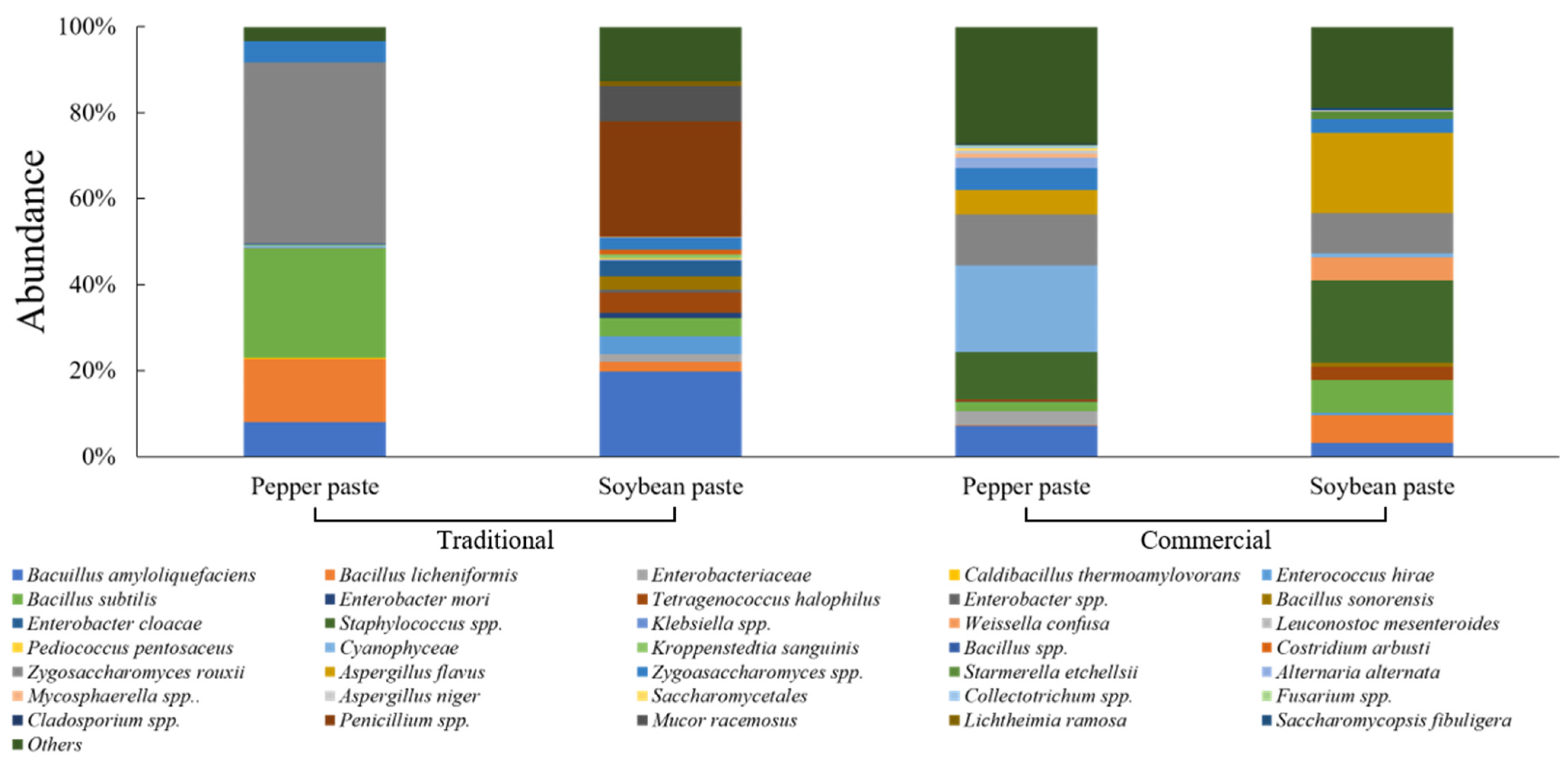
3.2.2. Soybean Paste and Pepper Paste
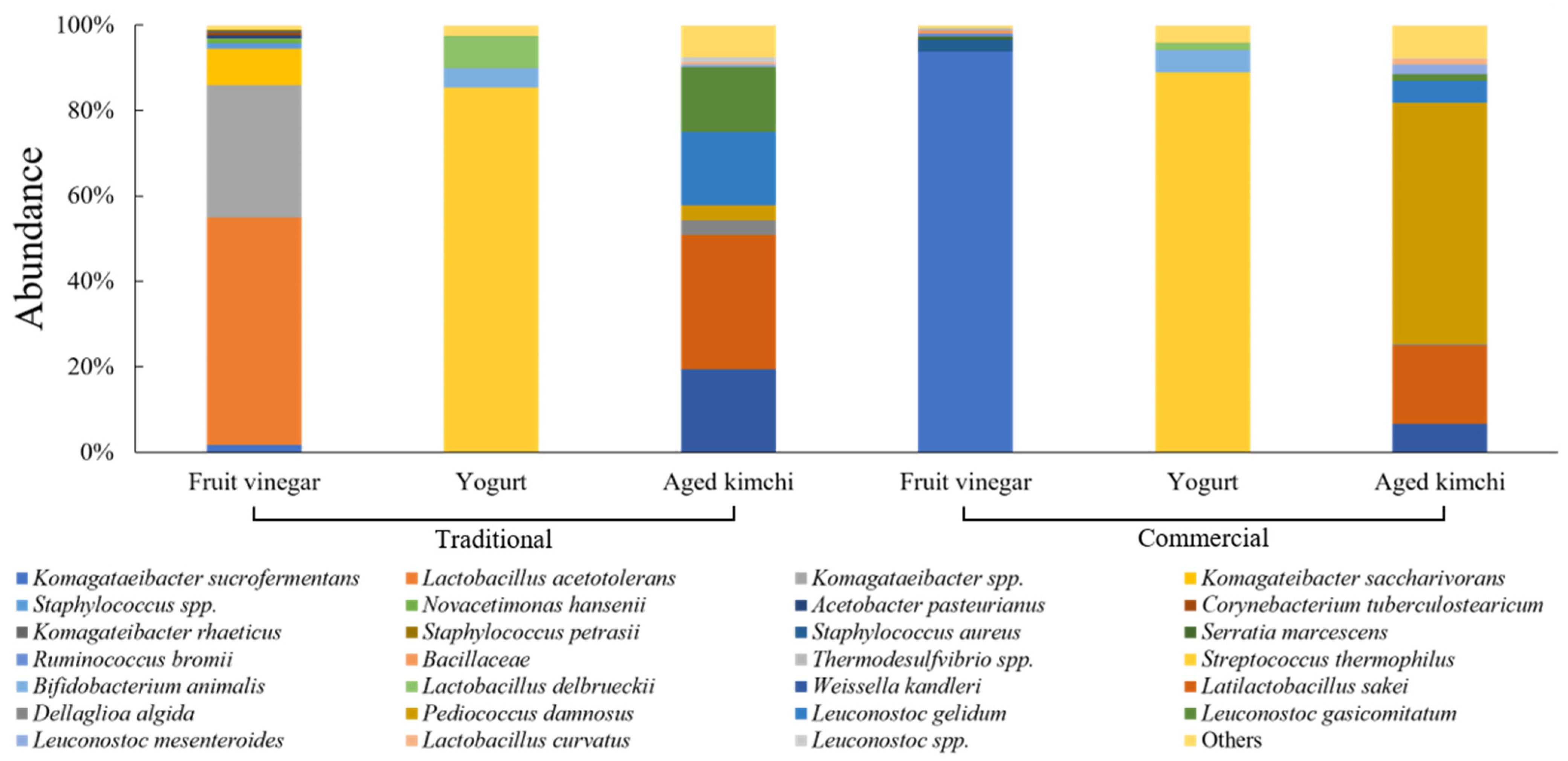
3.2.3. Other Fermented Foods
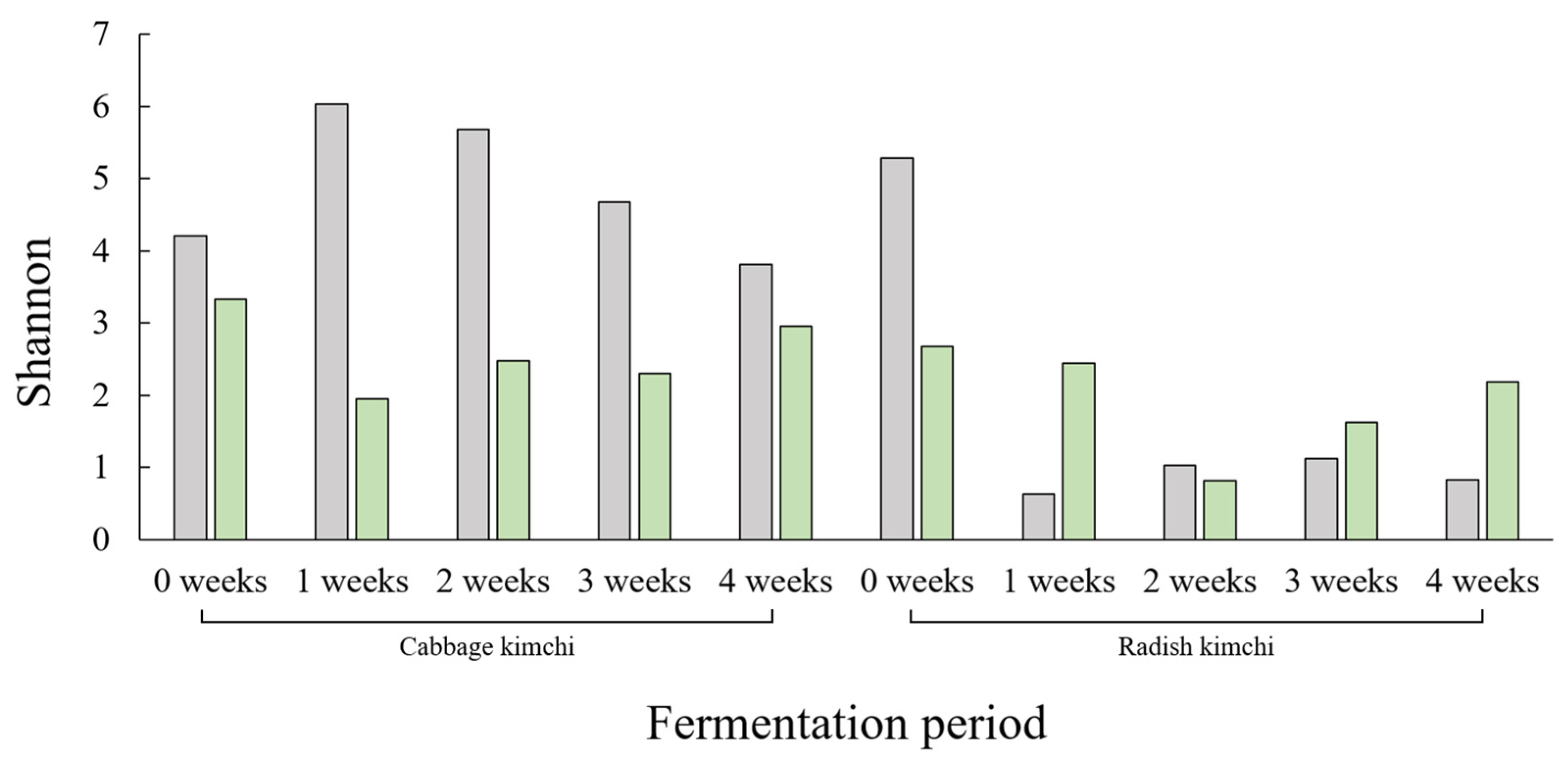
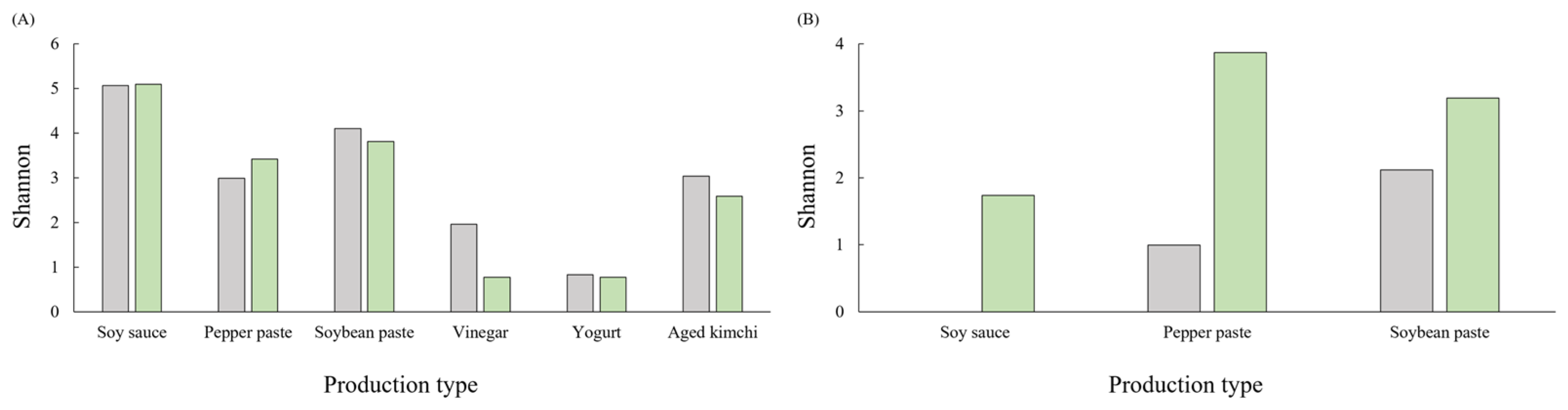
3.3. Shannon Diversity Indices in Traditional and Commercial Fermented Foods
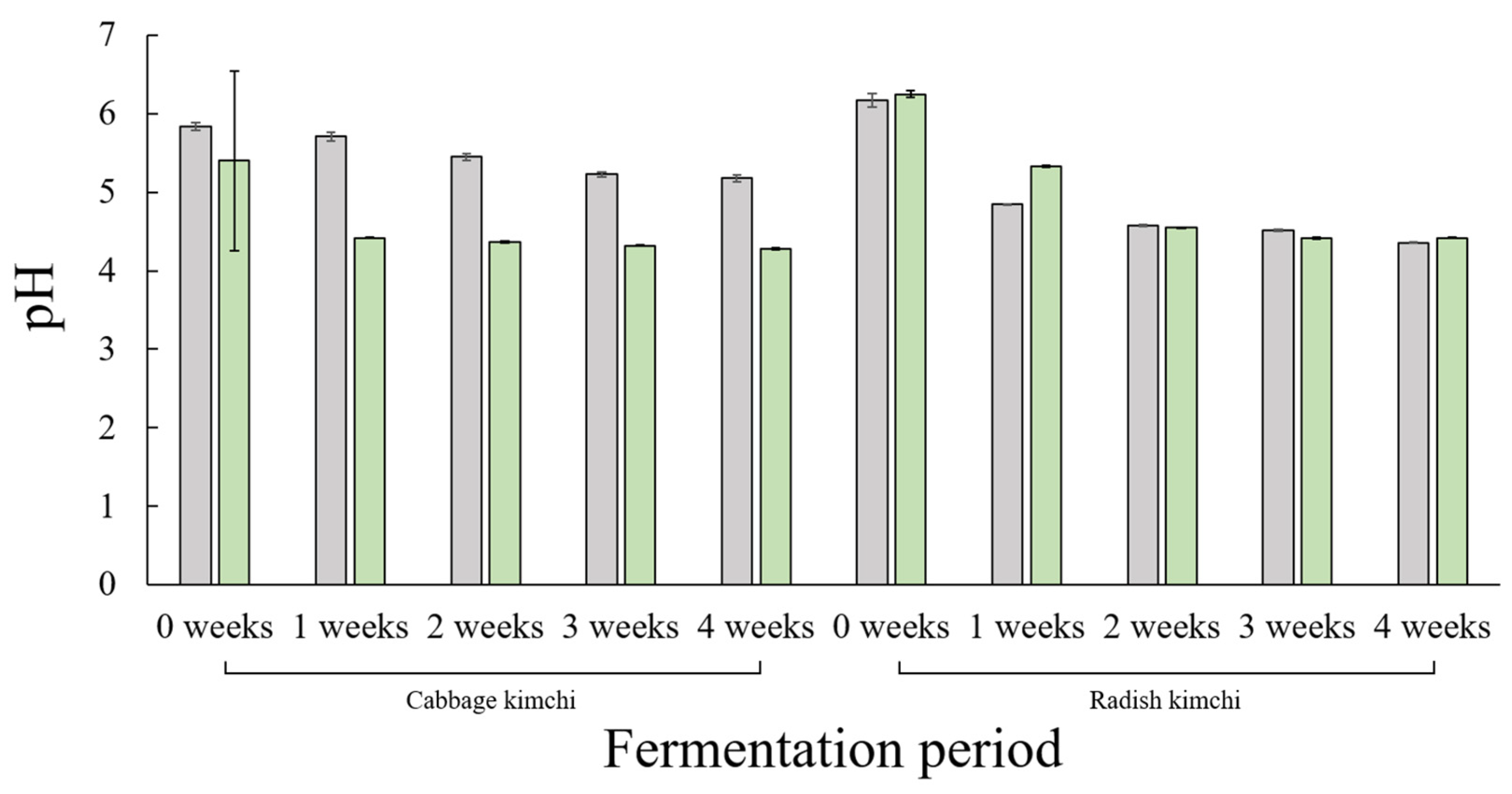
3.4. pH Changes During the Fermentation of Cabbage Kimchi and Radish Kimchi
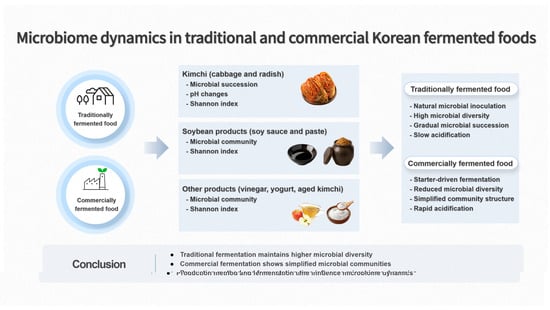
4. Conclusions
Supplementary Materials
Author Contributions
Funding
Institutional Review Board Statement
Informed Consent Statement
Data Availability Statement
Conflicts of Interest
References
- Marco, M.L.; Heeney, D.; Binda, S.; Cifelli, C.J.; Cotter, P.D.; Foligne, B.; Ganzle, M.; Kort, R.; Pasin, G.; Pihlanto, A.; et al. Health benefits of fermented foods: Microbiota and beyond. Curr. Opin. Biotechnol. 2017, 44, 94–102. [Google Scholar] [CrossRef] [PubMed]
- Rezac, S.; Kok, C.R.; Heermann, M.; Hutkins, R. Fermented Foods as a Dietary Source of Live Organisms. Front. Microbiol. 2018, 9, 1785. [Google Scholar] [CrossRef] [PubMed]
- Beermann, C.; Hartung, J. Physiological properties of milk ingredients released by fermentation. Food Funct. 2013, 4, 185–199. [Google Scholar] [CrossRef] [PubMed]
- Dimidi, E.; Cox, S.R.; Rossi, M.; Whelan, K. Fermented Foods: Definitions and Characteristics, Impact on the Gut Microbiota and Effects on Gastrointestinal Health and Disease. Nutrients 2019, 11, 1806. [Google Scholar] [CrossRef]
- David, L.A.; Maurice, C.F.; Carmody, R.N.; Gootenberg, D.B.; Button, J.E.; Wolfe, B.E.; Ling, A.V.; Devlin, A.S.; Varma, Y.; Fischbach, M.A.; et al. Diet rapidly and reproducibly alters the human gut microbiome. Nature 2014, 505, 559–563. [Google Scholar] [CrossRef]
- De Filippis, F.; Vitaglione, P.; Cuomo, R.; Berni Canani, R.; Ercolini, D. Dietary Interventions to Modulate the Gut Microbiome-How Far Away Are We From Precision Medicine. Inflamm. Bowel Dis. 2018, 24, 2142–2154. [Google Scholar] [CrossRef]
- Graf, D.; Di Cagno, R.; Fak, F.; Flint, H.J.; Nyman, M.; Saarela, M.; Watzl, B. Contribution of diet to the composition of the human gut microbiota. Microb. Ecol. Health Dis. 2015, 26, 26164. [Google Scholar] [CrossRef]
- Valentino, V.; Magliulo, R.; Farsi, D.; Cotter, P.D.; O’Sullivan, O.; Ercolini, D.; De Filippis, F. Fermented foods, their microbiome and its potential in boosting human health. Microb. Biotechnol. 2024, 17, e14428. [Google Scholar] [CrossRef]
- Derrien, M.; Veiga, P. Rethinking Diet to Aid Human-Microbe Symbiosis. Trends Microbiol. 2017, 25, 100–112. [Google Scholar] [CrossRef]
- Shanahan, F.; van Sinderen, D.; O’Toole, P.W.; Stanton, C. Feeding the microbiota: Transducer of nutrient signals for the host. Gut 2017, 66, 1709–1717. [Google Scholar] [CrossRef]
- Lin, L.; Zhang, J. Role of intestinal microbiota and metabolites on gut homeostasis and human diseases. BMC Immunol. 2017, 18, 2. [Google Scholar] [CrossRef] [PubMed]
- Lozupone, C.A.; Li, M.; Campbell, T.B.; Flores, S.C.; Linderman, D.; Gebert, M.J.; Knight, R.; Fontenot, A.P.; Palmer, B.E. Alterations in the gut microbiota associated with HIV-1 infection. Cell Host Microbe 2013, 14, 329–339. [Google Scholar] [CrossRef] [PubMed]
- Bourdichon, F.; Arias, E.; Babuchowski, A.; Buckle, A.; Bello, F.D.; Dubois, A.; Fontana, A.; Fritz, D.; Kemperman, R.; Laulund, S.; et al. The forgotten role of food cultures. FEMS Microbiol. Lett. 2021, 368, fnab085. [Google Scholar] [CrossRef] [PubMed]
- Biçer, Y.; Telli, A.E.; Sönmez, G.; Turkal, G.; Telli, N.; Uçar, G. Comparison of commercial and traditional kefir microbiota using metagenomic analysis. Int. J. Dairy Technol. 2021, 74, 528–534. [Google Scholar] [CrossRef]
- Gao, X.; Liu, H.; Yi, X.; Liu, Y.; Wang, X.; Xu, W.; Tong, Q.; Cui, Z. Microbial floral dynamics of Chinese traditional soybean paste (doujiang) and commercial soybean paste. J. Microbiol. Biotechnol. 2013, 23, 1717–1725. [Google Scholar] [CrossRef]
- Soung, S.H.; Lee, S.; Lee, S.H.; Kim, H.J.; Lee, N.R.; Lee, C.H. Metabolomic-Based Comparison of Traditional and Industrial Doenjang Samples with Antioxidative Activities. Foods 2021, 10, 1377. [Google Scholar] [CrossRef]
- Kazou, M.; Grafakou, A.; Tsakalidou, E.; Georgalaki, M. Zooming Into the Microbiota of Home-Made and Industrial Kefir Produced in Greece Using Classical Microbiological and Amplicon-Based Metagenomics Analyses. Front. Microbiol. 2021, 12, 621069. [Google Scholar] [CrossRef]
- Lee, M.; Song, J.H.; Jung, M.Y.; Lee, S.H.; Chang, J.Y. Large-scale targeted metagenomics analysis of bacterial ecological changes in 88 kimchi samples during fermentation. Food Microbiol. 2017, 66, 173–183. [Google Scholar] [CrossRef]
- Liang, H.; Chen, H.; Ji, C.; Lin, X.; Zhang, W.; Li, L. Dynamic and Functional Characteristics of Predominant Species in Industrial Paocai as Revealed by Combined DGGE and Metagenomic Sequencing. Front. Microbiol. 2018, 9, 2416. [Google Scholar] [CrossRef]
- Papadimitriou, K.; Anastasiou, R.; Georgalaki, M.; Bounenni, R.; Paximadaki, A.; Charmpi, C.; Alexandraki, V.; Kazou, M.; Tsakalidou, E. Comparison of the Microbiome of Artisanal Homemade and Industrial Feta Cheese through Amplicon Sequencing and Shotgun Metagenomics. Microorganisms 2022, 10, 1073. [Google Scholar] [CrossRef]
- Röling, W.F.M.; Apriyantono, A.; Van Verseveld, H.W. Comparison between traditional and industrial soy sauce (kecap) fermentation in Indonesia. J. Ferment. Bioeng. 1996, 81, 275–278. [Google Scholar] [CrossRef]
- Kamilari, E.; Stanton, C.; Tsaltas, D.; Ross, R.P. Regional microbial content of fermented traditional and industrial East Mediterranean sausages from the islands of Cyprus and Mytilini. Microbiome Res. Rep. 2024, 3, 3. [Google Scholar] [CrossRef]
- Jung, W.Y.; Jung, J.Y.; Lee, H.J.; Jeon, C.O. Functional Characterization of Bacterial Communities Responsible for Fermentation of Doenjang: A Traditional Korean Fermented Soybean Paste. Front. Microbiol. 2016, 7, 827. [Google Scholar] [CrossRef]
- Jung, S.-J.; Chae, S.-W.; Shin, D.-H. Fermented Foods of Korea and Their Functionalities. Fermentation 2022, 8, 645. [Google Scholar] [CrossRef]
- Jung, J.Y.; Lee, S.H.; Lee, H.J.; Seo, H.Y.; Park, W.S.; Jeon, C.O. Effects of Leuconostoc mesenteroides starter cultures on microbial communities and metabolites during kimchi fermentation. Int. J. Food Microbiol. 2012, 153, 378–387. [Google Scholar] [CrossRef] [PubMed]
- Singh, D.; Lee, S.; Lee, C.H. Metabolomics for empirical delineation of the traditional Korean fermented foods and beverages. Trends Food Sci. Technol. 2017, 61, 103–115. [Google Scholar] [CrossRef]
- Jung, J.Y.; Lee, S.H.; Jeon, C.O. Kimchi microflora: History, current status, and perspectives for industrial kimchi production. Appl. Microbiol. Biotechnol. 2014, 98, 2385–2393. [Google Scholar] [CrossRef] [PubMed]
- Lee, S.H.; Whon, T.W.; Roh, S.W.; Jeon, C.O. Unraveling microbial fermentation features in kimchi: From classical to meta-omics approaches. Appl. Microbiol. Biotechnol. 2020, 104, 7731–7744. [Google Scholar] [CrossRef]
- Patra, J.K.; Das, G.; Paramithiotis, S.; Shin, H.S. Kimchi and Other Widely Consumed Traditional Fermented Foods of Korea: A Review. Front. Microbiol. 2016, 7, 1493. [Google Scholar] [CrossRef]
- Ministry of Agriculture, Food and Rural Affairs. Market Report on Processed Food Segmentation: Fermented Soybean Products 2013. Available online: https://www.atfis.or.kr/home/board/FB0027.do?act=read&bpoId=628&bcaId=0&subSkinYn=N%2CN&pageIndex=13 (accessed on 10 February 2026).
- Ministry of Food and Drug Safety of the Republic of Korea. Food Code (No. 2021-54). Available online: https://www.mfds.go.kr/eng/brd/m_15/view.do?seq=72437 (accessed on 10 February 2026).
- Illumina, I. 16S Metagemonic Sequencing Library Preparation Guide; Illumina, Inc.: San Diego, CA, USA, 2013. [Google Scholar]
- Illumina, I. Sequencing Library qPCR Quantification Guide; Illumina, Inc.: San Diego, CA, USA, 2017. [Google Scholar]
- Martin, M. Cutadapt removes adapter sequences from high-throughput sequencing reads. EMBnet. J. 2011, 17, 10–12. [Google Scholar] [CrossRef]
- Callahan, B.J.; McMurdie, P.J.; Rosen, M.J.; Han, A.W.; Johnson, A.J.; Holmes, S.P. DADA2: High-resolution sample inference from Illumina amplicon data. Nat. Methods 2016, 13, 581–583. [Google Scholar] [CrossRef]
- Katoh, K.; Standley, D.M. MAFFT multiple sequence alignment software version 7: Improvements in performance and usability. Mol. Biol. Evol. 2013, 30, 772–780. [Google Scholar] [CrossRef] [PubMed]
- Price, M.N.; Dehal, P.S.; Arkin, A.P. FastTree 2—Approximately maximum-likelihood trees for large alignments. PLoS ONE 2010, 5, e9490. [Google Scholar] [CrossRef] [PubMed]
- Lee, M.-A.; Choi, Y.-J.; Kim, Y.-S.; Chon, S.-Y.; Chung, Y.B.; Park, S.-H.; Yun, Y.-R.; Min, S.G.; Yang, H.-C.; Seo, H.-Y. Effects of salt type on the metabolites and microbial community in kimchi fermentation. Heliyon 2022, 8, e11360. [Google Scholar] [CrossRef]
- Song, H.S.; Lee, S.H.; Ahn, S.W.; Kim, J.Y.; Rhee, J.K.; Roh, S.W. Effects of the main ingredients of the fermented food, kimchi, on bacterial composition and metabolite profile. Food Res. Int. 2021, 149, 110668. [Google Scholar] [CrossRef] [PubMed]
- Jung, S.; Hwang, I.M.; Lee, J.H. Temperature impact on microbial and metabolic profiles in kimchi fermentation. Heliyon 2024, 10, e27174. [Google Scholar] [CrossRef]
- Song, H.S.; Whon, T.W.; Kim, J.; Lee, S.H.; Kim, J.Y.; Kim, Y.B.; Choi, H.J.; Rhee, J.K.; Roh, S.W. Microbial niches in raw ingredients determine microbial community assembly during kimchi fermentation. Food Chem. 2020, 318, 126481. [Google Scholar] [CrossRef]
- Chaillou, S.; Champomier-Verges, M.C.; Cornet, M.; Crutz-Le Coq, A.M.; Dudez, A.M.; Martin, V.; Beaufils, S.; Darbon-Rongere, E.; Bossy, R.; Loux, V.; et al. The complete genome sequence of the meat-borne lactic acid bacterium Lactobacillus sakei 23K. Nat. Biotechnol. 2005, 23, 1527–1533. [Google Scholar] [CrossRef]
- Won, S.-M.; Chen, S.; Park, K.W.; Yoon, J.-H. Isolation of lactic acid bacteria from kimchi and screening of Lactobacillus sakei ADM14 with anti-adipogenic effect and potential probiotic properties. Lwt 2020, 126, 109296. [Google Scholar] [CrossRef]
- Castellano, P.; Aristoy, M.C.; Sentandreu, M.A.; Vignolo, G.; Toldra, F. Lactobacillus sakei CRL1862 improves safety and protein hydrolysis in meat systems. J. Appl. Microbiol. 2012, 113, 1407–1416. [Google Scholar] [CrossRef]
- Vermeulen, A.; Devlieghere, F.; Bernaerts, K.; Van Impe, J.; Debevere, J. Growth/no growth models describing the influence of pH, lactic and acetic acid on lactic acid bacteria developed to determine the stability of acidified sauces. Int. J. Food Microbiol. 2007, 119, 258–269. [Google Scholar] [CrossRef]
- Raman, J.; Kim, J.S.; Choi, K.R.; Eun, H.; Yang, D.; Ko, Y.J.; Kim, S.J. Application of Lactic Acid Bacteria (LAB) in Sustainable Agriculture: Advantages and Limitations. Int. J. Mol. Sci. 2022, 23, 7784. [Google Scholar] [CrossRef]
- Jung, J.Y.; Lee, S.H.; Jeon, C.O. Microbial community dynamics during fermentation of doenjang-meju, traditional Korean fermented soybean. Int. J. Food Microbiol. 2014, 185, 112–120. [Google Scholar] [CrossRef]
- Lee, D.Y.; Kim, E.J.; Park, S.E.; Cho, K.M.; Kwon, S.J.; Roh, S.W.; Kwak, S.; Whon, T.W.; Son, H.S. Impact of essential and optional ingredients on microbial and metabolic profiles of kimchi. Food Chem. X 2024, 22, 101348. [Google Scholar] [CrossRef]
- Carlisle, G.E.; Falkinham, J.O., 3rd. Enzyme activities and antibiotic susceptibility of colonial variants of Bacillus subtilis and Bacillus licheniformis. Appl. Environ. Microbiol. 1989, 55, 3026–3028. [Google Scholar] [CrossRef]
- Larsen, N.; Thorsen, L.; Kpikpi, E.N.; Stuer-Lauridsen, B.; Cantor, M.D.; Nielsen, B.; Brockmann, E.; Derkx, P.M.; Jespersen, L. Characterization of Bacillus spp. strains for use as probiotic additives in pig feed. Appl. Microbiol. Biotechnol. 2014, 98, 1105–1118. [Google Scholar] [CrossRef]
- Prfiest, F.G. Extracellular enzyme synthesis in the genus Bacillus. Bacteriol. Rev. 1977, 41, 711–753. [Google Scholar] [CrossRef]
- Ohata, M.; Kohama, K.; Morimitsu, Y.; Kubota, K.; Sugawara, E. The formation mechanism by yeast of 4-hydroxy-2(or 5)-ethyl-5(or 2)-methyl-3(2H)-furanone in Miso. Biosci. Biotechnol. Biochem. 2007, 71, 407–413. [Google Scholar] [CrossRef]
- Tan, G.; Wang, Y.; Hu, M.; Li, X.; Li, X.; Pan, Z.; Li, M.; Li, L.; Zheng, Z. Comparative evaluation of the microbial diversity and metabolite profiles of Japanese-style and Cantonese-style soy sauce fermentation. Front. Microbiol. 2022, 13, 976206. [Google Scholar] [CrossRef]
- Cho, K.M.; Seo, W.T. Bacterial diversity in a Korean traditional soybean fermented foods (Doenjang and Ganjang) by 16S rRNA gene sequence analysis. Food Sci. Biotechnol. 2007, 16, 320–324. [Google Scholar]
- Pei, R.; Lv, G.; Guo, B.; Li, Y.; Ai, M.; He, B.; Wan, R. Physiological and transcriptomic analyses revealed the change of main flavor substance of Zygosaccharomyces rouxii under salt treatment. Front. Nutr. 2022, 9, 990380. [Google Scholar] [CrossRef]
- Kim, S.; Park, S.-Y.; Hong, S.; Lim, S.-D. Quality Characteristics of Regional Traditional and Commercial Soy Sauce (Ganjang). Korean J. Food Cook. Sci. 2017, 33, 45–53. [Google Scholar] [CrossRef]
- Kim, D.H.; Kim, S.H.; Kwon, S.W.; Lee, J.K.; Hong, S.B. Fungal diversity of rice straw for meju fermentation. J. Microbiol. Biotechnol. 2013, 23, 1654–1663. [Google Scholar] [CrossRef] [PubMed]
- Gil, N.Y.; Jang, Y.J.; Gwon, H.M.; Jeong, W.S.; Yeo, S.H.; Kim, S.Y. Comparative Evaluation of Quality and Metabolite Profiles in Meju Using Starter Cultures of Bacillus velezensis and Aspergillus oryzae. Foods 2021, 11, 68. [Google Scholar] [CrossRef] [PubMed]
- Chin, Y.W.; Hong, S.P.; Lim, S.D.; Yi, S.H. Investigation of Microbial Community of Korean Soy Sauce (Ganjang) Using Shotgun Metagenomic Sequencing and Its Relationship with Sensory Characteristics. Microorganisms 2024, 12, 2559. [Google Scholar] [CrossRef]
- Jung, S.-J.; Shin, D.-H. Gochujang, a Korean traditional fermented soybean product: History, preparation and functionality. J. Ethn. Foods 2024, 11, 43. [Google Scholar] [CrossRef]
- Gutierrez, D.; Delgado, S.; Vazquez-Sanchez, D.; Martinez, B.; Cabo, M.L.; Rodriguez, A.; Herrera, J.J.; Garcia, P. Incidence of Staphylococcus aureus and analysis of associated bacterial communities on food industry surfaces. Appl. Environ. Microbiol. 2012, 78, 8547–8554. [Google Scholar] [CrossRef]
- Hedayati, M.T.; Pasqualotto, A.C.; Warn, P.A.; Bowyer, P.; Denning, D.W. Aspergillus flavus: Human pathogen, allergen and mycotoxin producer. Microbiology 2007, 153, 1677–1692. [Google Scholar] [CrossRef]
- Liu, W.; Tang, Y.; Zhang, J.; Bai, J.; Zhu, Y.; Zhu, L.; Zhao, Y.; Daglia, M.; Xiao, X.; He, Y. Microbial Interactions in Food Fermentation: Interactions, Analysis Strategies, and Quality Enhancement. Foods 2025, 14, 2515. [Google Scholar] [CrossRef]
- Oh, S.J.; Kang, G.S.; Lee, H.R.; Yu, S.J.; Jeong, S.U.; So, Y.S.; Park, C.S.; Shin, D.; Seo, D.H. Microbial communities in the fermentation of Meju, a Korean traditional soybean brick. Food Sci. Biotechnol. 2024, 33, 2815–2823. [Google Scholar] [CrossRef]
- Kong, H.; Kim, S.-H.; Jeong, W.-S.; Kim, S.-Y.; Yeo, S.-H. Microbiome Analysis of Traditional Grain Vinegar Produced under Different Fermentation Conditions in Various Regions in Korea. Foods 2022, 11, 3573. [Google Scholar] [CrossRef]
- Yassunaka Hata, N.N.; Surek, M.; Sartori, D.; Serrato, R.V.; Spinosa, W.A. Role of Acetic Acid Bacteria in Food and Beverages. Food Technol. Biotechnol. 2022, 61, 85–103. [Google Scholar] [CrossRef]
- El-Askri, T.; Yatim, M.; Sehli, Y.; Rahou, A.; Belhaj, A.; Castro, R.; Duran-Guerrero, E.; Hafidi, M.; Zouhair, R. Screening and Characterization of New Acetobacter fabarum and Acetobacter pasteurianus Strains with High Ethanol-Thermo Tolerance and the Optimization of Acetic Acid Production. Microorganisms 2022, 10, 1741. [Google Scholar] [CrossRef]
- Andres-Barrao, C.; Saad, M.M.; Cabello Ferrete, E.; Bravo, D.; Chappuis, M.L.; Ortega Perez, R.; Junier, P.; Perret, X.; Barja, F. Metaproteomics and ultrastructure characterization of Komagataeibacter spp. involved in high-acid spirit vinegar production. Food Microbiol. 2016, 55, 112–122. [Google Scholar] [CrossRef]
- Fisberg, M.; Machado, R. History of yogurt and current patterns of consumption. Nutr. Rev. 2015, 73, 4–7. [Google Scholar] [CrossRef]
- Ge, Y.; Yu, X.; Zhao, X.; Liu, C.; Li, T.; Mu, S.; Zhang, L.; Chen, Z.; Zhang, Z.; Song, Z.; et al. Fermentation characteristics and postacidification of yogurt by Streptococcus thermophilus CICC 6038 and Lactobacillus delbrueckii ssp. bulgaricus CICC 6047 at optimal inoculum ratio. J Dairy Sci 2024, 107, 123–140. [Google Scholar] [CrossRef]
- Yamauchi, R.; Maguin, E.; Horiuchi, H.; Hosokawa, M.; Sasaki, Y. The critical role of urease in yogurt fermentation with various combinations of Streptococcus thermophilus and Lactobacillus delbrueckii ssp. bulgaricus. J. Dairy. Sci. 2019, 102, 1033–1043. [Google Scholar] [CrossRef]
- Hong, Y.; Li, J.; Qin, P.; Lee, S.-Y.; Kim, H.-Y. Predominant lactic acid bacteria in mukeunji, a long-term-aged kimchi, for different aging periods. Food Sci. Biotechnol. 2015, 24, 545–550. [Google Scholar] [CrossRef]
- Jung, J.Y.; Lee, S.H.; Kim, J.M.; Park, M.S.; Bae, J.W.; Hahn, Y.; Madsen, E.L.; Jeon, C.O. Metagenomic analysis of kimchi, a traditional Korean fermented food. Appl. Environ. Microbiol. 2011, 77, 2264–2274. [Google Scholar] [CrossRef]
- Hugo, C.J.; Hugo, A. Current trends in natural preservatives for fresh sausage products. Trends Food Sci. Technol. 2015, 45, 12–23. [Google Scholar] [CrossRef]
- Lee, S.Y.; Lee, D.Y.; Kim, O.Y.; Hur, S.J. Analysis for change in microbial contents in five mixed Kimchi starter culture and commercial lactic acid bacterial-fermented sausages and biological hazard in manufacturing facilities. Food Sci. Biotechnol. 2019, 28, 787–794. [Google Scholar] [CrossRef]
- Chang, H.W.; Kim, K.H.; Nam, Y.D.; Roh, S.W.; Kim, M.S.; Jeon, C.O.; Oh, H.M.; Bae, J.W. Analysis of yeast and archaeal population dynamics in kimchi using denaturing gradient gel electrophoresis. Int. J. Food Microbiol. 2008, 126, 159–166. [Google Scholar] [CrossRef]
- Mannaa, M.; Han, G.; Seo, Y.-S.; Park, I. Evolution of Food Fermentation Processes and the Use of Multi-Omics in Deciphering the Roles of the Microbiota. Foods 2021, 10, 2861. [Google Scholar] [CrossRef]
- Shim, S.-M.; Kim, J.Y.; Lee, S.M.; Park, J.-B.; Oh, S.-K.; Kim, Y.-S. Profiling of fermentative metabolites in kimchi: Volatile and non-volatile organic acids. J. Korean Soc. Appl. Biol. Chem. 2012, 55, 463–469. [Google Scholar] [CrossRef]
- Kim, K.H.; Chun, B.H.; Baek, J.H.; Roh, S.W.; Lee, S.H.; Jeon, C.O. Genomic and metabolic features of Lactobacillus sakei as revealed by its pan-genome and the metatranscriptome of kimchi fermentation. Food Microbiol. 2020, 86, 103341. [Google Scholar] [CrossRef]
- Ojokoh, A.O. A comparative study on the effect of traditional and improved methods of fermentation in the production of Ogi food. Orient. J. Chem. 2009, 25, 471–476. [Google Scholar]
- Tamang, J.P.; Shin, D.H.; Jung, S.J.; Chae, S.W. Functional Properties of Microorganisms in Fermented Foods. Front. Microbiol. 2016, 7, 578. [Google Scholar] [CrossRef]
- Fitsum, S.; Gebreyohannes, G.; Sbhatu, D.B. Bioactive compounds in fermented foods: Health benefits, safety, and future perspectives. Appl. Food Res. 2025, 5, 101097. [Google Scholar] [CrossRef]
- Chen, X.; Zhang, S.; Shi, M.; Wang, L.; Liu, Q.; Liu, B.; Lin, D.; Lin, Z. Effects of Additives on the Fermentation Quality and Bacterial Community of Silage Prepared from Giant Juncao Grass Grown in Saline–Alkali Soil. Agronomy 2026, 16, 225. [Google Scholar] [CrossRef]
- Moonga, H.B.; Schoustra, S.E.; van den Heuvel, J.; Linnemann, A.R.; Samad, M.S.; Shindano, J.; Smid, E.J. Composition and Diversity of Natural Bacterial Communities in Mabisi, a Traditionally Fermented Milk. Front. Microbiol. 2020, 11, 1816. [Google Scholar] [CrossRef]


Disclaimer/Publisher’s Note: The statements, opinions and data contained in all publications are solely those of the individual author(s) and contributor(s) and not of MDPI and/or the editor(s). MDPI and/or the editor(s) disclaim responsibility for any injury to people or property resulting from any ideas, methods, instructions or products referred to in the content. |
© 2026 by the authors. Licensee MDPI, Basel, Switzerland. This article is an open access article distributed under the terms and conditions of the Creative Commons Attribution (CC BY) license.
Share and Cite
Lee, H.; Na, W.; Sohn, C. Comparative Microbiome Profiles of Korean Fermented Foods Based on Production Type and Additive Use. Foods 2026, 15, 1010. https://doi.org/10.3390/foods15061010
Lee H, Na W, Sohn C. Comparative Microbiome Profiles of Korean Fermented Foods Based on Production Type and Additive Use. Foods. 2026; 15(6):1010. https://doi.org/10.3390/foods15061010
Chicago/Turabian StyleLee, Huyong, Woori Na, and Cheongmin Sohn. 2026. "Comparative Microbiome Profiles of Korean Fermented Foods Based on Production Type and Additive Use" Foods 15, no. 6: 1010. https://doi.org/10.3390/foods15061010
APA StyleLee, H., Na, W., & Sohn, C. (2026). Comparative Microbiome Profiles of Korean Fermented Foods Based on Production Type and Additive Use. Foods, 15(6), 1010. https://doi.org/10.3390/foods15061010