


Abstract
Coconut water is a beverage valued for its nutritional composition, although its high water activity and nutrient content can promote microbial growth and shorten its shelf life. This study optimized the preservation conditions of thermally treated coconut water inoculated with Escherichia coli CECT 5947 by evaluating the effects of thermal treatments and storage conditions on the microbiological and physicochemical stability of the product. Acidified Tryptic Soy Broth (TSB, pH 5.0) was selected as the reference laboratory medium, whereas coconut water served as the test beverage. The study combined the analysis of microbial growth during refrigerated storage and thermal inactivation kinetics. Namely, isothermal treatments at 55, 57.5, 60 and 62.5 °C were used to fit the Bigelow and Mafart models, comparing model predictions against data obtained under dynamic conditions (heating ramps of 2 or 10 °C/min). Results showed evidence for matrix effect, as well as for dynamic stress acclimation, with the isothermal models successfully describing data at the higher heating rate but failing to describe the response at the lower. Growth kinetics during storage were analyzed using the gamma approach with pH and temperature as factors, showing a significant impact by storage temperature: at 5 °C the population remained stable (3.1–3.3 log CFU/mL over 40 days), whereas at 12 and 25 °C it reached 7–8 log CFU/mL within progressively shorter time periods, accompanied by increased acidification (ΔpH of −0.09, −0.70 and −1.15). The predictive models developed can guide risk management for coconut water, identifying adequate processing and storage conditions to reach safety targets for E. coli.
1. Introduction
Coconut water, the liquid contained in the endosperm of immature Cocos nucifera fruits, has established itself in the functional beverage market due to a nutritional profile rich in electrolytes, low molecular weight sugars, vitamins, minerals and antioxidant compounds [1]. Consumers perceive it as a natural, minimally processed alternative to reconstituted or carbonated drinks as it is widely consumed fresh in producing countries [2]. However, its physicochemical attributes make it an inherently unstable matrix from a microbiological standpoint: a high water activity (0.98 to 0.99), a moderate acidity with pH values between 4.5 and 5.5, and an appreciable content of fermentable soluble solids [3,4]. This combination of conditions can provide favorable conditions for microbial growth and enzymatic activity, contributing to the rapid deterioration of coconut water in the absence of adequate preservation or processing technologies [5,6].
The pH of coconut water is not low enough to inhibit the growth of contaminating microbiota, particularly acid-tolerant bacteria, yeasts or foodborne pathogenic bacteria. At room temperature, spoilage may become apparent in less than twenty-four hours, accompanied by gas production, increased acidity and changes in color, aroma and flavor [7]. Thermal processing remains the most widely adopted preservation strategy in industry, as it reduces the microbial load and inactivates enzymes with extensively validated technical support [6]. The application of heat nonetheless carries a dual effect: microbial inactivation and chemical changes, such as non-enzymatic browning, loss of heat-labile vitamins and changes in pH, soluble solids and electrolyte balance. Designing an appropriate treatment therefore requires a balance between the severity needed to ensure safety and the restraint required to preserve quality [8].
Among the microorganisms of interest in food safety, pathogenic strains of Escherichia coli occupy a central position. The FDA requires that pasteurization treatments ensure a 5 log reduction for relevant pathogenic bacteria, including E. coli, where it is evident that it poses a serious hazard in fruit beverages, as they are acid-tolerant [9]. Non-toxigenic strains that are closely related to the most prevalent pathogenic ones (typically with serotype O157:H7) can provide valuable information to optimize preservation. In this study, the strain E. coli CECT 5947 was used as a as surrogate of E. coli O157:H7, as it presents a similar physiological behavior in terms of its thermal resistance and its tolerance to acidic conditions. These characteristics afford a reproducible experimental system for quantifying the microbial response to temperature, time and matrix composition without requiring the use of pathogenic strains. The inactivation of an organism of intermediate resistance also serves as a conservative reference from which the elimination of more sensitive populations can be inferred [5,10,11].
Precise information remains scarce regarding the thermal parameters required for the effective inactivation of relevant microorganisms in this matrix, as well as the microbial behavior during the storage that follows treatment. This gap hinders the design of processes that reconcile microbiological safety with quality. Kinetic characterization using different well recognized inactivation models, together with the monitoring of population dynamics during isothermal storage, provides a quantitative basis for defining process parameters, estimating shelf life and supporting the identification of critical control points [12].
On this basis, the present study optimized the preservation conditions of thermally treated coconut water inoculated with E. coli CECT 5947. The effect of isothermal and dynamic treatments on microbial survival was evaluated, the evolution of the population during storage at 5, 12 and 25 °C was analyzed, and the variations in pH were examined. The use of acidified TSB as a comparative matrix made it possible to contrast the behavior observed in coconut water with that of a medium of controlled composition, to distinguish the effect attributable to the food matrix itself.
2. Materials and Methods
2.1. Raw Material and Comparative Matrix
Coconut water was obtained from immature Cocos nucifera fruits at an estimated maturity of six to eight months, the range in which water content is highest and the concentration of sugars and fats is comparatively low. The fruits were purchased at the MERCA Panama wholesale market and visually inspected, discarding any fruit showing physical damage or signs of spoilage. The water was extracted aseptically by perforating the pericarp with a sterilized drill; it was then filtered through a fine mesh, transferred to sterile glass containers and held at 4 °C for no more than 24 h before processing.
Tryptic soy broth (TSB) acidified with hydrochloric acid to a pH of 5.0 (±0.1), equivalent to that of the initial pH of coconut water, was used as a comparative matrix. This acidification removed pH as a confounding variable and allowed for a consistent comparison between the real matrix and a medium of controlled composition, as opposed to organic acids [13]. Media were prepared according to the manufacturer’s instructions and sterilized by autoclaving at 121 °C for 30 min.
2.2. Microorganism and Inoculum Preparation
Escherichia coli CECT 5947 (provided by the Spanish Cultura Collection) was chosen due to its physiological similarity to STEC strains, as it is a mutation of strain E. coli O157:H7 strain 3538/95 where the toxin production gene has been replaced [14]. It was maintained in cryovials with 15% (v/v) glycerol at −70 °C. Reactivation was carried out by inoculating an aliquot of approximately 100 µL into TSB and incubating at 37 °C for 24 h under aerobic conditions until the stationary phase was reached. The resulting culture reached an approximate concentration of 109 CFU/mL, that was quantified by optical density (OD600) and verified by plate counting on tryptic soy agar (TSA). The standardized inoculum was subsequently used to inoculate both matrices. All microbial handling was performed in a class II biosafety cabinet.
2.3. Thermal Treatments
Treatments were carried out in a Mastia thermoresistometer (UPCT, Cartagena, Spain) [15] in acidified TSB and in coconut water. Before inoculation, each matrix was heated at 90 °C to inactivate existing microbiota and enzymes. In the isothermal assays, the matrix was subsequently cooled to the target treatment temperature (55, 57.5, 60 and 62.5 °C) and thermal equilibrium was reached before starting the experiments. A 1 mL aliquot of the standardized E. coli culture in early stationary phase was then aseptically introduced directly into the thermoresistometer. Sampling was performed at regular time intervals, depending on the treatment temperatures (shorter times at higher temperatures). Samples were enumerated by decimal dilutions, mass plating in Tryptone Soy Agar (TSA) and incubated at 30 °C for 48 h.
In the dynamic treatments, samples received the same pre-heating step; the temperature was then lowered to 40 °C, at which point inoculation was performed with 1 mL of culture in early stationary phase. Heating ramps from 40 to 65 °C were subsequently applied at two rates, 2 °C/min and 10 °C/min, with samples collected at different times to assess the cumulative effect of heating. Enumeration of viable microorganisms was performed as described above.
2.4. Storage Conditions
For the storage assays, the matrices were treated at 90 °C for 1 min, cooled and aseptically inoculated with 100 µL of culture per tube; this design made it possible to examine the behavior of E. coli CECT 5947 during storage in the absence of direct lethal treatment. Samples were distributed into sterile 20 mL tubes and stored in calibrated temperature chambers at 5 ± 0.5 °C (optimal refrigeration), 12 ± 0.5 °C (abuse temperature condition) and 25 ± 0.5 °C (room temperature). Samples were taken in sterile conditions at established sampling times, and serial decimal dilutions were performed, plated and stored at 30 °C for 48 h. Then, counts were obtained and data were extracted, taking into consideration the dilutions performed. The monitoring period was interrupted when growth was evidenced, with a maximum that depended on temperature: 40 days at 5 °C, 30 days at 12 °C and 15 days at 25 °C.
2.5. Microbiological and Physicochemical Analyses
The viability of E. coli CECT 5947 was quantified by plate count on TSA using serial dilutions and spread plating, with plates yielding 30 to 300 colonies considered valid; plates were incubated at 37 °C for 48 h. During storage periodic sampling was performed, according to the storage temperature: three times per week at 25 °C, twice per week at 12 °C and once per week at 5 °C. Results are expressed as log10(CFU/mL) and as relative log reduction (log10(N/N0), where N is the microbial concentration at any given time and N0 the one at inoculation). The pH was the principal physicochemical variable monitored, measured with a potentiometer(ATAGO Co., Ltd., Tokyo, Japan) calibrated with pH 4.0 and 7.0 buffer solutions; total soluble solids (°Brix) were also determined with a PAL-1 digital refractometer (ATAGO Co., Ltd., Tokyo, Japan). All equipment was sterilized with sterile distilled water and ethanol after each measurement.
2.6. Kinetic Modeling of Microbial Inactivation
2.6.1. Predictive Microbiology Models for Isothermal and Dynamic Inactivation
Microbial inactivation was described using the Bigelow and Mafart models, both commonly used in predictive microbiology [16,17]. The Bigelow model assumes for isothermal treatments a log linear reduction in microbial concentration (N) from its initial concentration (N0) with respect to treatment time (t). As represented in Equation (1), the inactivation kinetics are quantified by the D-value (D), which represents the treatment time required to reduce the microbial concentration in one log reduction.
As secondary model, the Bigelow model assumes a log linear relationship between the D-value and the treatment temperature (T). The strength of the relationship is quantified by the z-value, which stands for the temperature increase required to reduce the D-value a 90% (Equation (2)). It also introduces a reference temperature (Tref) that has no biological meaning but improves interpretability [18].
The Mafart model [16] modifies the Bigelow model by introducing a curvature parameter, p (Equation (3)). For values of p = 1, the Mafart and Bigelow model are equivalent, resulting in log linear survivor curves. For 0 < p < 1, survivor curves show an upwards curvature, whereas p > 1 results in the opposite curvature direction.
The Mafart model substitutes the D-value by the δ-value, which represents the time for the first log reduction in an isothermal experiment. It also defines a log linear model for the δ-value (Equation (4)), where the z-value represents the temperature increase needed to cause a 90% reduction in δ-value.
Isothermal predictive microbiology models can be differentiated to represent dynamic inactivation [19]. The Bigelow model results in Equation (5), where model parameters have the same interpretation as for isothermal conditions.
In a similar fashion, the Mafart model can be derived into Equation (6).
2.6.2. Parameter Estimation, Computational Methods and Statistical Analysis for Microbial Inactivation
Isothermal inactivation experiments were estimated using both a two-step and one-step fitting approach. In the two-steps approach, primary models are fitted independently for each experiment, obtaining a table of primary model parameters (D; δ, p) for each temperature tested. Then, on a second step, secondary models are fitted from the parameter table (obtaining an estimate for z). On the one-step approach, both primary and secondary models are fitted it the same time using non-linear regression. Although the one-step approach is generally more robust, it is recommended to also apply a two-step fitting to ensure the validity of primary and secondary models [20,21].
Dynamic inactivation models were fitted using the algorithm implemented in the bioinactivation package for R(version 1.3.1) [19], which interfaces the regression algorithms implemented in FME [22]. All calculations were performed using the web version of bioinactivation [23], available online at https://foodlab-upct.shinyapps.io/bioinactivation4/(accessed on 15 July 2026). This application also includes functions for calculating isothermal and dynamic predictions with suitable numerical methods.
Experiments were done at least in triplicate for all conditions. Kinetic parameters were interpreted as estimators of the population mean for each condition, normally distributed with mean and standard deviation matching the estimated value and standard error of regression [20]. Conditions were compared using classical statistical models, such as t-test and ANOVA to identify significant differences (α = 0.05) between means of populations.
2.7. Kinetic Modeling of Microbial Growth
2.7.1. Predictive Microbiology Models for Growth
Microbial growth was described using the Baranyi primary growth model [24] combined with gamma-type secondary models. This primary model describes the changes in microbial concentration (N) with respect to time (t) based on an extension of the exponential growth model, where the lag phase is modeled based on a hypothetical substance (Q) that must be produced before exponential growth onset. This model introduces a logistic term that causes the microbial concentration to converge towards a maximum concentration (Nmax). This results in the system of ordinary differential equations shown in Equation (7).
It is common to consider in the Baranyi model that Q0 is a proxy for the physiological state of the microbial population. Therefore, it is constant for experiments with similar culture preparation methods.
The experiments showed significant pH variation through storage that may potentially impact the growth kinetics. Therefore, a gamma-type secondary model was used, including both effects of pH and temperature (T). As shown in Equation (8), this approach assumes that each environmental factor (Xi) has an independent effect on the specific growth rate under optimal conditions μopt, quantified by a gamma function γi(X) that is bounded between zero and one [25,26].
The changes in the environmental conditions observed experimentally (5 to 25 °C for temperature; 3.9 to 5.3 for pH) remained below the optimal conditions for the growth of E. coli. Therefore, reduced gamma functions were used for both parameters [27]. As illustrated in Equation (9), these models use a minimum cardinal parameter (Xmin), a reference temperature (Xref) and a curvature parameter (n).
Therefore, the growth models were characterized by the initial values of both variables in the Baranyi model (Q0; N0), the parameter for the stationary growth phase (Nmax) and the parameters of the secondary model (pHmin; Tmin; μopt; nT; npH; Tref; pHref).
2.7.2. Computational Methods, Parameter Estimation and Statistical Analysis for Microbial Growth
Model parameters were estimated using the one-step fitting algorithm implemented in the biogrowth package for R (version 1.0.8) [28]. Namely, we used an Adaptive Monte Carlo algorithm [29] with 4000 iterations and a burn-in length of 500 iterations. The convergence of the algorithm was checked using conventional methods [30]. The curvature parameters were fixed to nT = 2 for temperature because it is generally accepted that for suboptimal conditions the relationship between and temperature is linear. In a similar fashion, npH = 1 as the specific growth rate is often considered linear with temperature for acidic conditions [17].
The reference parameters were set at values close to the optimal growth limits of these species (Tref = 37; pHref = 7) to facilitate interpretation. For comparison, the models were also fitted without including the gamma effect for pH (i.e., setting γpH = 1), as this approach is common in the field.
Model predictions were also calculated in biogrowth using its numerical method for solving ordinary differential equations. All calculations were implemented in R version 4.2.3 [31]. The code is available as a GitHub repository (https://github.com/albgarre/predmicro_tropical (accessed on 20 June 2026)).
Statistical analysis was also done following a similar methodology to microbial inactivation, interpreting kinetic parameters were interpreted as normally distributed estimators of the population mean for each condition. Based on them, conditions were compared based on t-test and ANOVA.
3. Results and Discussion
3.1. Thermal Inactivation of E. coli in Coconut Water
3.1.1. Isothermal Inactivation
Inactivation kinetics of E. coli CECT 5947 in acidified TSB medium and coconut water were estimated using two models (Bigelow and Mafart) and two model fitting approaches (in one and two steps). The selection of model fitting approach had an influence on parameter estimates (Figure 1). In general, higher uncertainty was observed for the D (or δ in Mafart) and z values estimated using a two-step approach, especially for the results obtained in coconut water. This is aligned with previous studies, which concluded that the two-step approach could be effective as a first impression on model suitability, but that the two-step approach produced more reliable parameter estimates [20,32,33,34]. This is due to the fact that the one-step approach uses the data as a whole, whereas the two-step approach builds secondary models based on the parameter estimates of primary models, disregarding the estimation uncertainty [35]. Therefore, model parameters obtained following the one-step approach were used for further analysis.
Figure 1.
Isothermal inactivation parameters for the Bigelow and Mafart models ((A) D55 or δ55; (B) z) of E. coli CECT 5947 in coconut water and acidified TSB analyzed by two-step or one-step fitting. Parameter uncertainty is illustrated as error bars around the estimates.
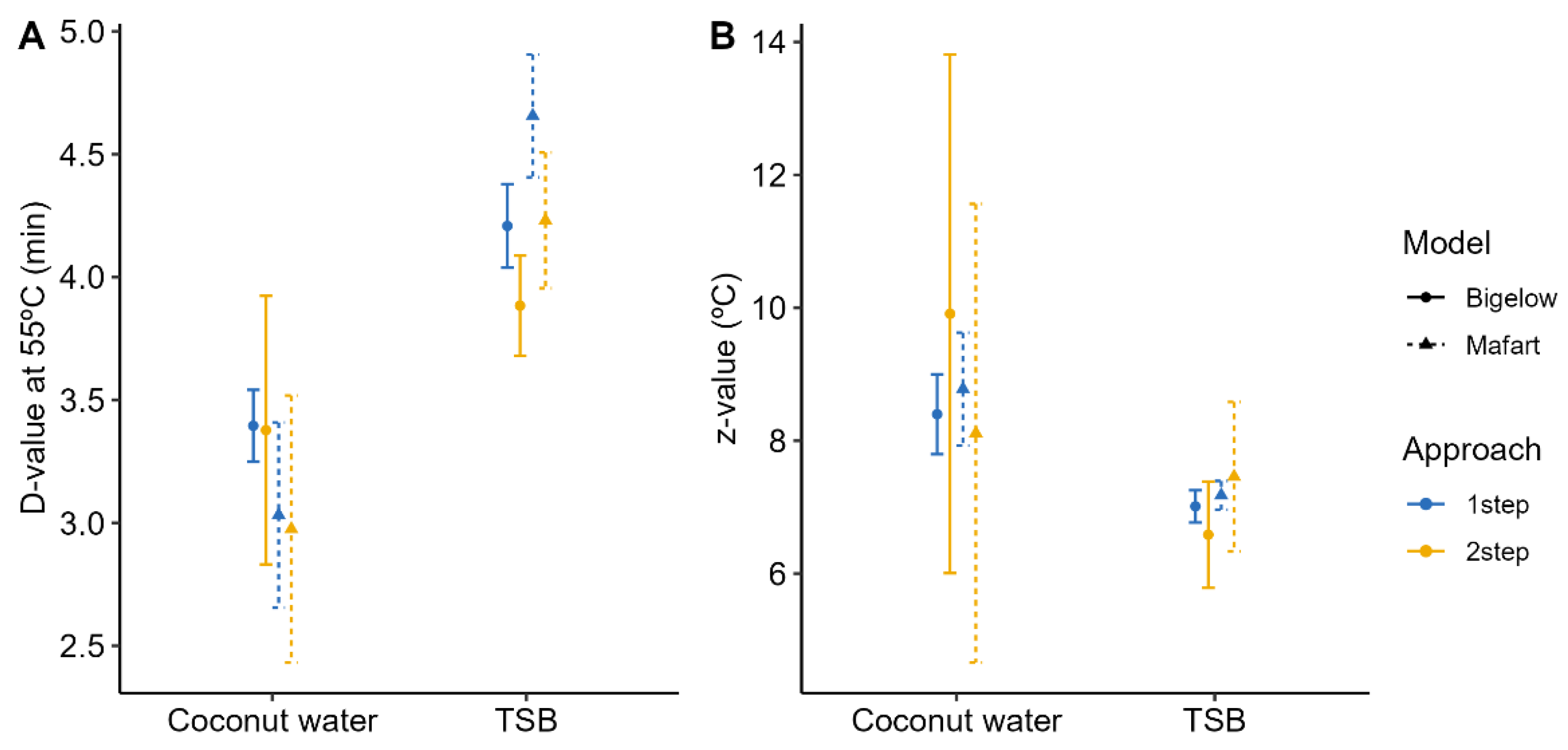
Both the model selection based on AIC and the analysis of the statistical significance of parameter p concluded that the microbial inactivation kinetics were log linear in TSB and coconut water (Table 1). Parameter estimates varied between both media, with D55 estimates of 4.46 ± 0.28 min in TSB against 3.07 ± 0.09 min in coconut water, while z-value estimates ranged from 7.24 ± 0.39 °C in TSB against 8.91 ± 0.33 °C in coconut water. The comparison, conducted under equivalent pH conditions, indicates that constituents intrinsic to the real matrix, and not its acidity alone, modulate the thermal response of the microorganism, in agreement with evidence that the sugars and minerals of complex matrices alter bacterial physiology, with different responses at increasing temperatures [36,37,38,39].
Table 1.
Estimated values (with standard error in parentheses) for D55 °C, p and z values of E. coli CECT 5947 using Bigelow or Mafart models, following a one-step or a two-step approach.
Comparable curves have been reported for the inactivation of E. coli O157:H7 in apple juice (pH 3.5), where lower p at 60 °C (0.30) and z (4.56) values were obtained. In this study, the Weibull model provided a good representation of the data [14], providing model parameters in the similar range as previous studies [40,41,42]. The variation in heat resistance with the physiological state of the cells and the composition of the medium [12] points to a transient protective effect of the sugars and minerals of the matrix, consistent with its characterization as a substrate favorable to microbial development [43].
Based on the parameters estimated in coconut water (D55 of 0.90 min), a five-log reduction would require approximately 4. 50 min at 60 °C. Since the strain used is derived from the pathogenic serotype O157:H7, which has been extensively studied in different matrices, such as apple (z = 5.9 °C), orange (z = 4.9 °C), white grape (z = 5.7 °C) [41], carrot–apple (z-values range from 5.4–8.6 according to pH) [44], pineapple, and avocado [45], that present a lower heat resistance. This criterion provides a conservative approximation of the behavior of virulent strains in the matrix. Immediate thermal assays do not, however, capture subsequent phenomena such as the recovery of sublethally injured cells or the growth of residual microbiota, so that the definition of safe preservation conditions requires these results to be integrated with storage monitoring [46,47,48,49].
3.1.2. Dynamic Inactivation
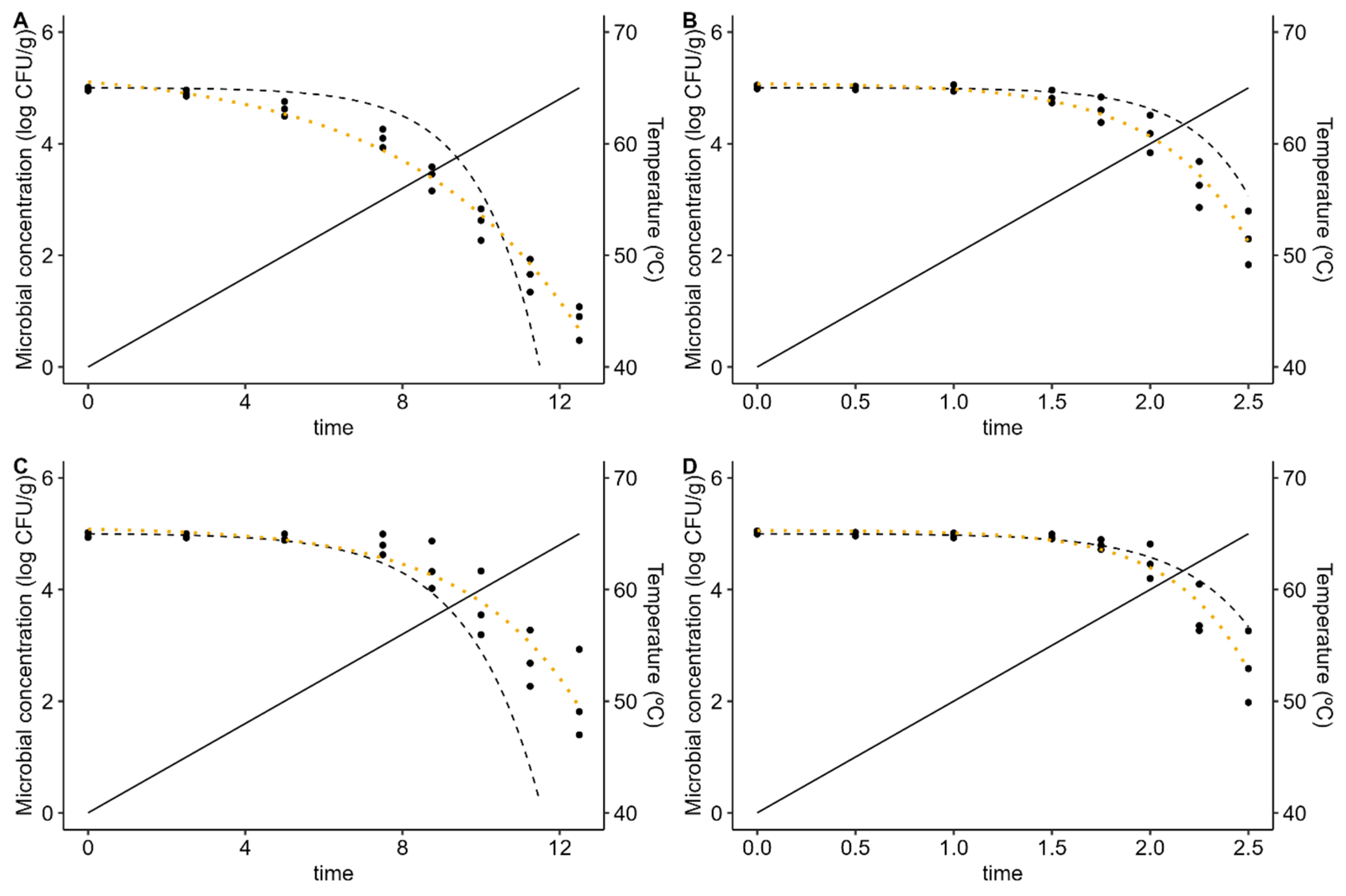
Experiments performed under dynamic heating conditions showed that the inactivation kinetics were influenced by the heating rate (Figure 2). For treatments with a heating rate of 10 °C/min, the changes in microbial concentration were in agreement with the predictions of models built from isothermal data. On the other hand, experiments with a heating rate of 2 °C/min showed an increase in heat resistance, resulting in higher concentrations than observed under isothermal conditions. This result is compatible with previous studies on E. coli and other microorganisms, which observed that heating rates lower than 5 °C/min induced an increase in thermal resistance. It has been hypothesized that this empirical effect would be the result of dynamic stress acclimation [5,50,51,52,53]. The exposure to sublethal temperatures would induce the activation of stress response mechanisms within the cells of the bacterial population. Accordingly, if cells are exposed to sublethal temperatures for a long time, they would develop stress acclimation and increase their survival to posterior, lethal temperatures.
Figure 2.
Inactivation of E. coli CECT 5479 under dynamic heating profiles (temperature shown as a solid line), in acidified TSB with an increasing heating rate of 2 °C/min (A) and 10 °C/min (B); and in coconut water with a heating rate of 2 °C/min (C) and 10 °C/min (D); (----) predicted survival according to D and z values in isothermal conditions; (····) predicted survival according to D and z values estimated in dynamic conditions.
Microbial inactivation models were fitted directly to data obtained under dynamic conditions, to quantify the magnitude of stress acclimation. As illustrated in Figure 3, experiments performed at a heating rate of 2 °C/min resulted in higher D55 than at 10 °C/min in both substrates, confirming the impact of the heating rate on bacterial thermal resistance. The z-value was also influenced by the heating rate, being higher on the experiments at 2 °C/min, underlining the higher thermal resistance observed under these conditions.
Figure 3.
Estimated log D values (A) and log z values (B) of Escherichia coli heated in dynamic conditions (see profiles in Figure S1) suspended in coconut water or in acidified TSB.
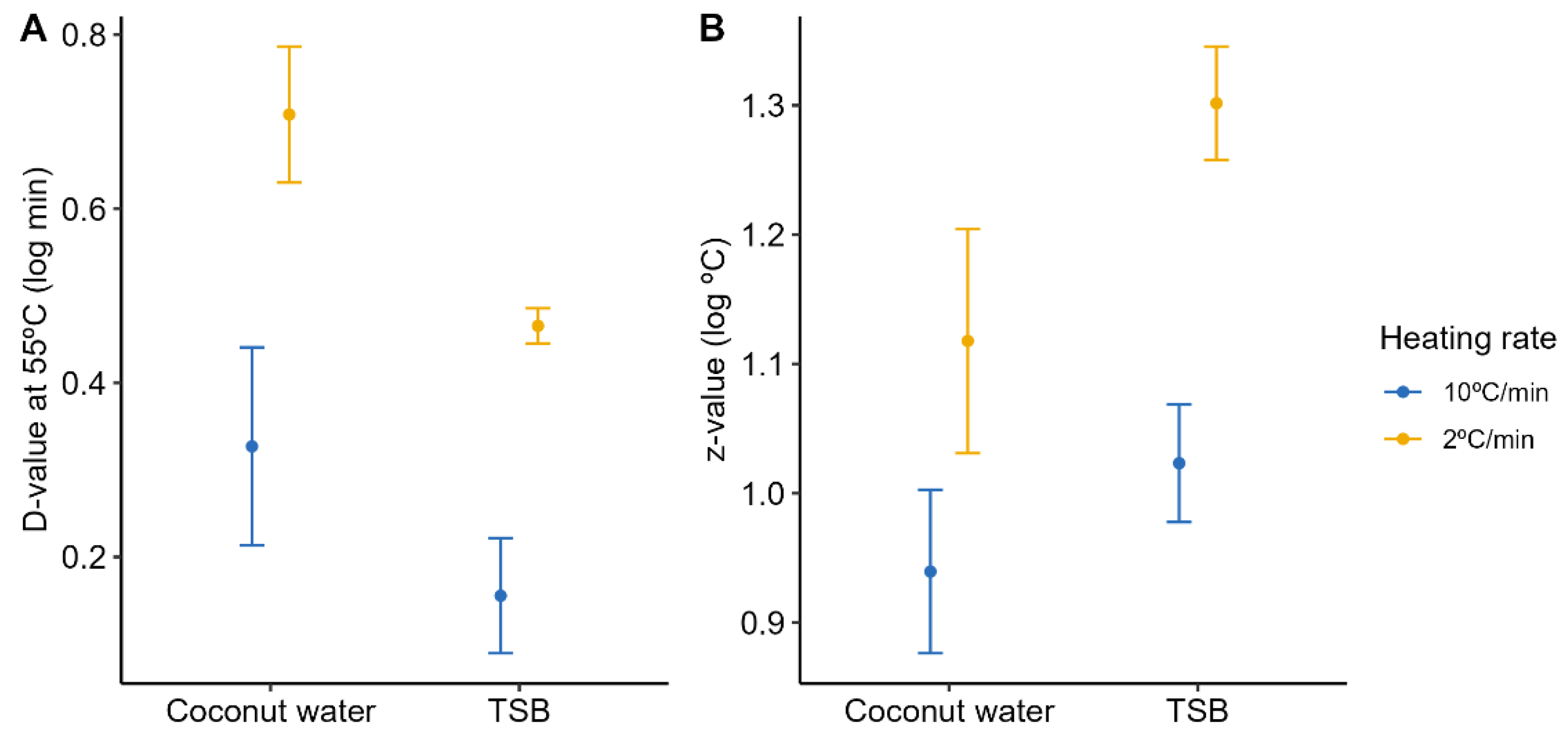
The dynamic experiments also show an influence of the heating media, with experiments in coconut water showing between 50 and 75% increase in estimates of D55 with respect to those obtained in TSB media (2.92 min in TSB vs. 5.11 min in coconut water at 2 °C/min; 1.42 min in TSB vs. 2.12 min in coconut water at 10 °C/min). This coincides with the observation of higher heat resistance in coconut water in isothermal conditions, showing that the composition of this product includes compounds that enhance the thermal resistance of E. coli. It is also feasible that the media has an influence on the level of stress acclimation, although this hypothesis would require additional empirical work that is outside of the scope of this study.
3.2. Growth Kinetics of E. coli in Coconut Water During Storage
3.2.1. Changes in pH During Storage
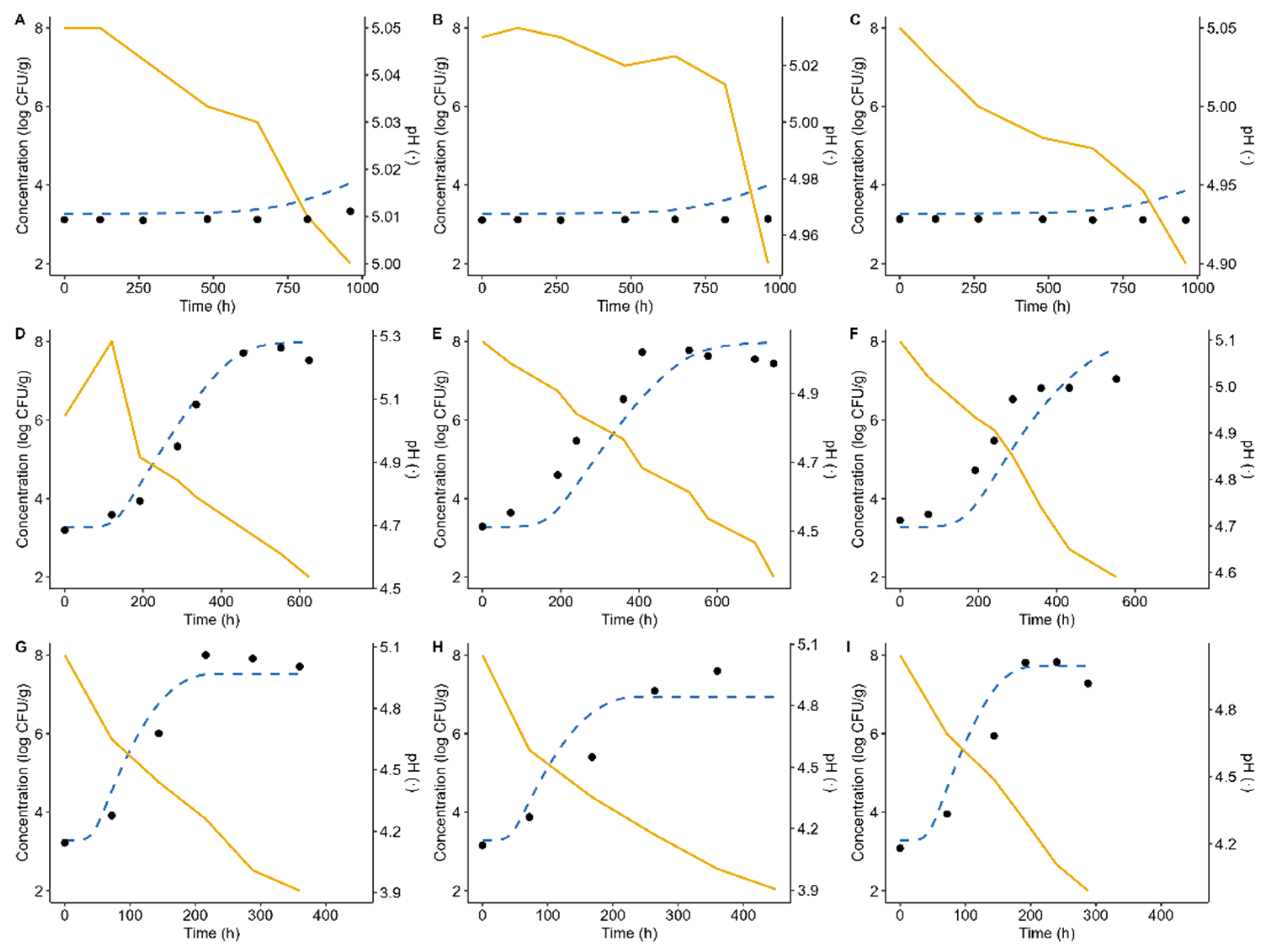
The pH value served as an indirect readout of the metabolic activity coupled to growth. In coconut water, acidification followed the order 5 °C < 12 °C < 25 °C, starting from similar initial values (5.04–5.06). The mean net change was −0.09 units at 5 °C (from 5.04 to 4.95 over 40 days), −0.70 at 12 °C (from 5.06 to 4.37 over 31 days) and −1.15 at 25 °C (from 5.05 to 3.90 over 19 days), with final values per replicate between 3.90 and 3.99 (Table 2). These results are aligned with previous studies [54,55] and show that the stability of pH and of the count at 5 °C indicates that refrigeration effectively controlled metabolic activity, in agreement with the stability reported for coconut water inoculated with E. coli only when the cold chain was adequate [56,57].
Table 2.
Summary of pH during the isothermal storage of coconut water (mean of replicates per temperature).
The drop in pH at 25 °C coincided temporally with the growth of E. coli 5947, linking the metabolic activity of the microorganism to the fermentation of the sugars of the matrix and supporting the direct relationship between the rate of acidification and storage temperature recognized as an indicator of spoilage [6,58]. The acidity achieved at room temperature does not, on its own, guarantee product stability, since many acid-tolerant bacteria survive and even proliferate under such conditions [59]. Acidified TSB reproduced the same hierarchy, with values close to 3.9 at 25 °C, confirming that storage temperature was the determining factor and that matrix composition modulates—without reversing—the observed response [60].
3.2.2. Populations Dynamics of E. coli on Coconut Water During Storage
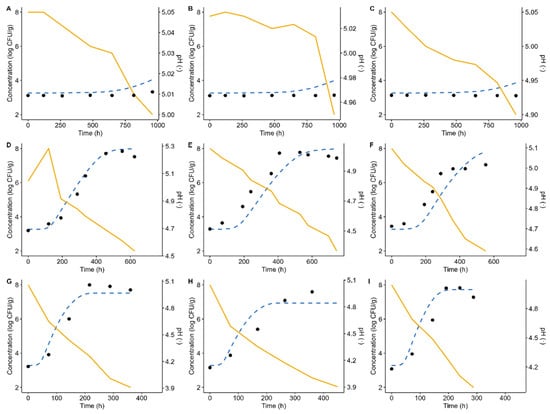
The growth kinetics of E. coli were influenced by both storage temperature and the dynamic pH changes in the food product. As illustrated in Figure 1, at 5 °C practically no growth was recorded over 40 days. At 12 °C growth was sustained, reaching values of 7.1 log CFU/mL, and at 25 °C proliferation attained a maximum of 7.5 log CFU/mL. The changes in pH are most likely related to microbial metabolism. At 5 °C, where no significant growth occurred, the pH of coconut water only decreased slightly, whereas a decrease in pH was evidenced for temperatures where growth took place (12 and 25 °C). The slow acidification at 12 °C is consistent with the persistence of a basal metabolism under suboptimal conditions [61,62], whereas the richness of the medium in fermentable nutrients accounts for the marked acidification at 25 °C [63,64].
E. coli growth kinetics followed typical sigmoidal shapes at 12 and 25 °C, with clear lag and stationary phases, as evidenced by the primary Baranyi model fitted to each individual replicate successfully describing the changes in microbial concentration. As illustrated in Figure 4, the complete Baranyi model considering the effect of pH and temperature was successful at describing the overall trend in the data, with parameter estimates reported in Table 3.
Figure 4.
Mean microbial concentrations of E. coli (dots) during growth in coconut water at different temperatures ((A–C); 5 °C), ((D–F); 12 °C), ((G–I); 25 °C). Each subplot represents an independent replicate, where the pH variation was measured independently (solid yellow line). The fit of the Baranyi + gamma (pH, T) is shown as a dashed blue line.
Table 3.
Parameter estimates of the Baranyi model with gamma functions for pH and temperature fitted to the data on growth of E. coli on coconut water.
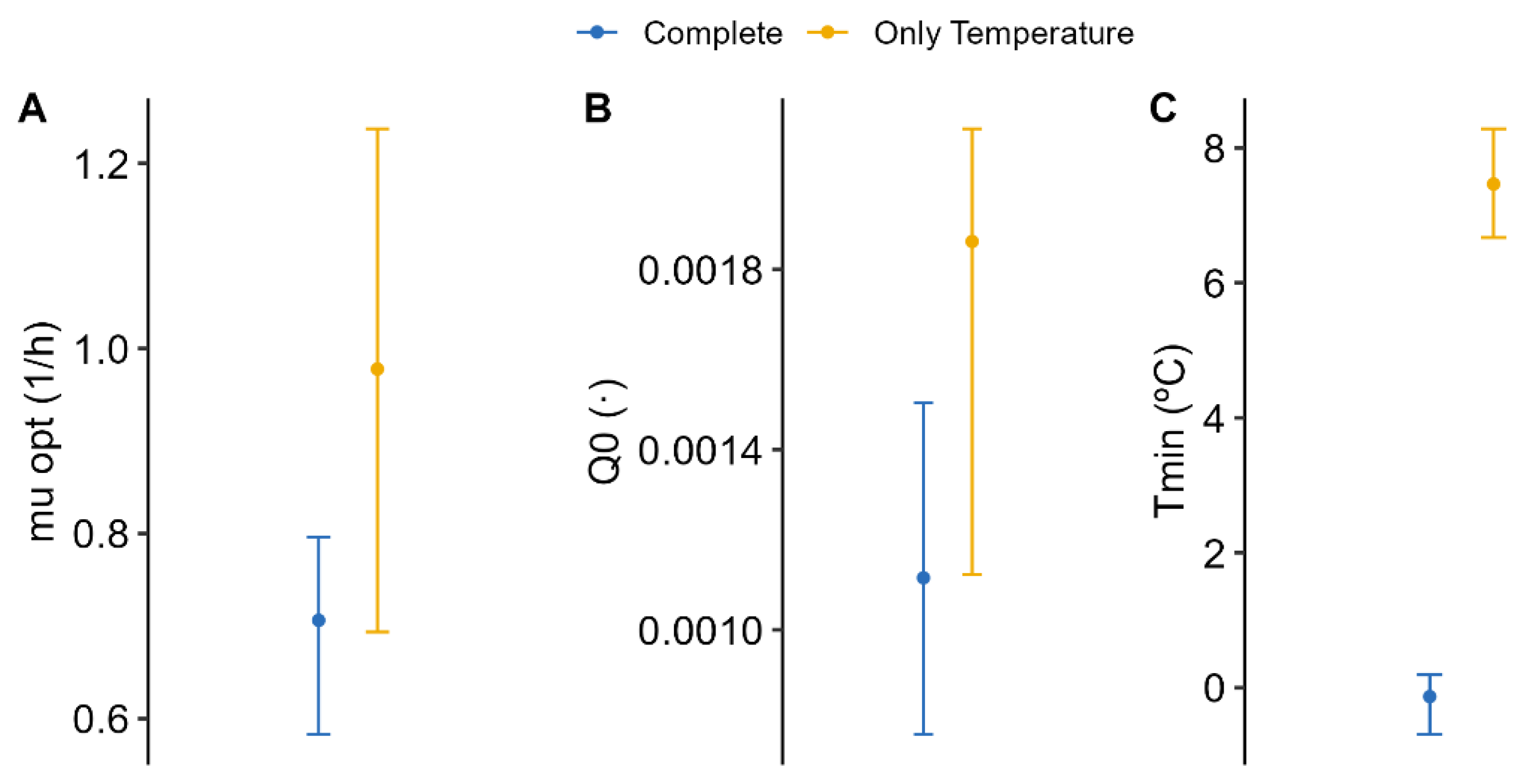
Although it is not evident from the figures, the pH had a strong influence in the growth kinetics. Omitting the impact of this factor on the specific growth rate (i.e., setting γpH = 1), resulted in the model failing to describe the overall trend in the data (Figure 5). This is due to pH constantly decreasing through the duration of each independent replicate. As this results in a reduction in the specific growth rate, its effect may be mistaken with a slow transition from the exponential to stationary growth phases.
Figure 5.
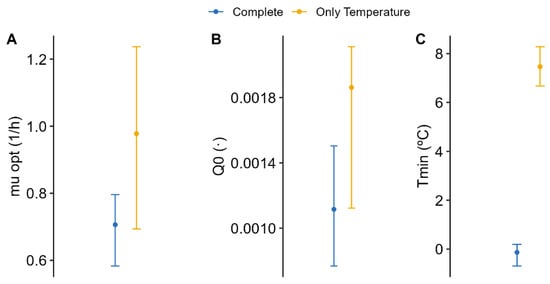
Comparison of the parameter estimates ((A) for specific growth rate, (B) for Q0 and (C) for Tmin) obtained for the complete Baranyi model (blue) against those obtained using the reduced model without the pH effect (yellow) for the growth of E. coli on coconut water.
The comparison of the model parameters obtained for both models (with and without including gamma functions for pH) reveals that omitting the pH may cause a misinterpretation of microbial kinetics. As illustrated in Figure 5, the model that excluded the pH showed no significant differences in parameters C0 (N0) and μopt (mu opt) with respect to the complete model. However, this model estimated higher values of Tmin. A possible interpretation of this deviation is that excluding the pH effect distorts the secondary model for temperature, trying to include the effect of the factor that was excluded.
These results are of great methodological importance for predictive microbiology. It is rare for studies in the field to include measurements of the dynamic changes in physicochemical properties of food products. However, foods are dynamic systems, where factors such as pH and water activity may vary within ranges that affect microbial kinetics. This study demonstrates that, if pH is not integrated in the modelling approach, an unrealistically high value of Tmin may be estimated, leading to an unsuitable interpretation of the effect of temperature on the growth kinetics. This could bias risk assessments based on these models, resulting in an unrealistic identification of critical risk factors. This additional source of uncertainty has been recently called “inferential uncertainty” [35].
Hence, it is strongly recommended for future studies to measure dynamic changes in physicochemical properties of the foods (and other factors that may be relevant for growth kinetics, such as competing microbiota), even if the focus of the study is to model the effect of temperature. This can be challenging from an experimental point of view, as microbial metabolism may also influence physicochemical properties. Therefore, they should ideally be measured independently for each individual replicate. This could not be attainable in some scenarios, such as experiments using microbial pathogens where direct measurements may not be possible, so the use of non-pathogenic surrogates can cover those data gaps.
4. Conclusions
Predictive microbiology models can be a useful tool to support risk management, guiding decisions on food processing and storage. However, the robustness of these models can be affected by decisions regarding experimental design and model fitting approaches. In general, one-step model fitting approaches seem to be more robust than two-step ones, reducing parameter uncertainty. Moreover, specifically for growth models, excluding relevant environmental factors can bias parameter estimates. In particular, the omission of the dynamic pH changes observed during isothermal storage resulted in higher estimates for cardinal parameter Tmin. Accordingly, the gamma model that excludes the pH effect would imply a misinterpretation of the growth limits and biased predictions.
Besides numerical aspects, experimental design decisions can also impact model robustness. Most microbial inactivation models are based on isothermal data, but this study evidences that the heating rate can impact thermal inactivation kinetics, likely due to dynamic stress acclimation. Therefore, the heating rate should be accounted for when designing pasteurization treatments and monitored through operation. The combination of both growth and inactivation models can help establish optimal conditions for the management of E. coli on coconut water.
Supplementary Materials
The following supporting information can be downloaded at: https://www.mdpi.com/article/10.3390/foods15224178/s1, Figure S1: Changes in microbial concentration of E. coli on isothermal treatments in TSB (A) or coconut water (B).
Author Contributions
Conceptualization, G.G.-T. and A.G.; methodology, P.M.P.; software, J.E.C. and A.G.; validation, M.J.R. and G.G.-T.; formal analysis, J.E.C. and P.M.P.; investigation, G.G.-T. and J.E.C.; data curation, A.E. and M.J.R.; writing—original draft preparation, P.S.F. and G.G.-T.; writing—review and editing, M.J.R. and A.G.; visualization, A.G. and A.E.; supervision, P.M.P. and G.G.-T.; project administration, P.S.F., G.G.-T. and A.G.; funding acquisition, G.G.-T. and P.S.F. All authors have read and agreed to the published version of the manuscript.
Funding
The authors gratefully acknowledge the Secretaría Nacional de Ciencia, Tecnología e Innovación (SENACYT) and the Sistema Nacional de Investigación (SNI) of Panama for the financial support provided for the execution of this research project. Alberto Garre acknowledges being funded by a Ramon y Cajal Fellowship (RYC-2021-034612-I) from the Spanish Ministry of Science.
Institutional Review Board Statement
Not applicable.
Informed Consent Statement
Not applicable.
Data Availability Statement
The raw data supporting the conclusions of this article will be made available by the authors on request.
Conflicts of Interest
The authors declare no conflicts of interest.
References
- Rethinam, P. International Scenario of Coconut Sector. In The Coconut Palm (Cocos nucifera L.)-Research and Development Perspectives; Krishnakumar, V., Thampan, P.K., Nair, M.A., Eds.; Springer: Singapore, 2018; pp. 21–56. [Google Scholar]
- Steckley, M. Making and Masking Natures: A Commodification Story of Coconut Water. Food Cult. Soc. 2026, 0, 1–25. [Google Scholar] [CrossRef] [Scilit]
- Shi, S.; Wang, W.; Wang, F.; Yang, P.; Yang, H.; He, X.; Liao, X. Research Progress in Coconut Water: A Review of Nutritional Composition, Biological Activities, and Novel Processing Technologies. Foods 2025, 14, 1503. [Google Scholar] [CrossRef] [Scilit] [PubMed]
- Prades, A.; Dornier, M.; Diop, N.; Pain, J.-P. Coconut Water Uses, Composition and Properties: A Review. Fruits 2012, 67, 87–107. [Google Scholar] [CrossRef] [Scilit]
- González-Tejedor, G.A.; Garre, A.; Iguaz, A.; Wong-Zhang, R.; Fernández, P.S.; Possas, A. Dynamic Thermal Treatments in Green Coconut Water Induce Dynamic Stress Adaptation of Listeria Innocua That Increases Its Thermal Resistance. Foods 2023, 12, 4015. [Google Scholar] [CrossRef] [Scilit] [PubMed]
- Naik, M.; Sunil, C.K.; Rawson, A.; Venkatachalapathy, N. Tender Coconut Water: A Review on Recent Advances in Processing and Preservation. Food Rev. Int. 2022, 38, 1215–1236. [Google Scholar] [CrossRef] [Scilit]
- Prades, A.; Dornier, M.; Diop, N.; Pain, J.-P. Coconut Water Preservation and Processing: A Review. Fruits 2012, 67, 157–171. [Google Scholar] [CrossRef] [Scilit]
- Xu, L.; Zhang, J.; Zhang, X.; Xie, M.; Zhang, W.; Wang, J.; Chen, L.; Yun, Y.-H. Effects of Cold Plasma and Pasteurization on Flavor and Primary Metabolites of Aromatic Coconut Water Based on Flavoromics and Metabolomics. Food Front. 2025, 6, 1409–1422. [Google Scholar] [CrossRef] [Scilit]
- Cody, S.H.; Glynn, M.K.; Farrar, J.A.; Cairns, K.L.; Griffin, P.M.; Kobayashi, J.; Fyfe, M.; Hoffman, R.; King, A.S.; Lewis, J.H.; et al. An Outbreak of Escherichia coli O157:H7 Infection from Unpasteurized Commercial Apple Juice. Ann. Intern Med. 1999, 130, 202–209. [Google Scholar] [CrossRef] [Scilit] [PubMed]
- Hildebrandt, I.M.; Marks, B.P. Improving the Utility of Surrogates Intended for Foodborne Pathogen Preventive Control Validations. Curr. Opin. Food Sci. 2024, 57, 101153. [Google Scholar] [CrossRef] [Scilit]
- Busta, F.; Suslow, T.; Parish, M.; Beuchat, L.; Farber, J.; Garrett, E.H.; Harris, L. The Use of Indicators and Surrogate Microorganisms for the Evaluation of Pathogens in Fresh and Fresh-Cut Produce. Compr. Rev. Food Sci. Food Saf. 2003, 2, 179–185. [Google Scholar] [CrossRef] [Scilit]
- den Besten, H.M.W.; Wells-Bennik, M.H.J.; Zwietering, M.H. Natural Diversity in Heat Resistance of Bacteria and Bacterial Spores: Impact on Food Safety and Quality. Annu. Rev. Food Sci. Technol. 2018, 9, 383–410. [Google Scholar] [CrossRef] [Scilit] [PubMed]
- Uljas, H.E.; Ingham, S.C. Survival of Escherichia coli O157:H7 in Synthetic Gastric Fluid after Cold and Acid Habituation in Apple Juice or Trypticase Soy Broth Acidified with Hydrochloric Acid or Organic Acids. J. Food Prot. 1998, 61, 939–947. [Google Scholar] [CrossRef] [Scilit] [PubMed]
- Siguemoto, É.S.; Gut, J.A.W.; Martinez, A.; Rodrigo, D. Inactivation Kinetics of Escherichia coli O157:H7 and Listeria Monocytogenes in Apple Juice by Microwave and Conventional Thermal Processing. Innov. Food Sci. Emerg. Technol. 2018, 45, 84–91. [Google Scholar] [CrossRef] [Scilit]
- Conesa, R.; Andreu, S.; Fernández, P.S.; Esnoz, A.; Palop, A. Nonisothermal Heat Resistance Determinations with the Thermoresistometer Mastia. J. Appl. Microbiol. 2009, 107, 506–513. [Google Scholar] [CrossRef] [Scilit] [PubMed]
- Mafart, P.; Couvert, O.; Gaillard, S.; Leguerinel, I. On Calculating Sterility in Thermal Preservation Methods: Application of the Weibull Frequency Distribution Model. Int. J. Food Microbiol. 2002, 72, 107–113. [Google Scholar] [CrossRef] [Scilit] [PubMed]
- Perez-Rodriguez, F.; Valero, A. Predictive Microbiology in Foods; Springer: New York, NY, USA, 2012. [Google Scholar]
- Peñalver-Soto, J.L.; Garre, A.; Esnoz, A.; Fernández, P.S.; Egea, J.A. Guidelines for the Design of (Optimal) Isothermal Inactivation Experiments. Food Res. Int. 2019, 126, 108714. [Google Scholar] [CrossRef] [Scilit] [PubMed]
- Garre, A.; Fernández, P.S.; Lindqvist, R.; Egea, J.A. Bioinactivation: Software for Modelling Dynamic Microbial Inactivation. Food Res. Int. 2017, 93, 66–74. [Google Scholar] [CrossRef] [Scilit] [PubMed]
- Garre, A.; Tsagkaropoulou, T.; Guillén, S.; Karatzas, K.A.G.; Palop, A. Optimal Strategies for Estimating the Parameters of the Baranyi-Ratkowsky Model: From (Optimal) Experiment Design to Model Fitting Methods. Food Res. Int. 2025, 221, 117288. [Google Scholar] [CrossRef] [Scilit] [PubMed]
- Georgalis, L.; Fernandez, P.S.; Garre, A. A Protocol for Predictive Modeling of Microbial Inactivation Based on Experimental Data. In Basic Protocols in Predictive Food Microbiology; Alvarenga, V.O., Ed.; Methods and Protocols in Food Science; Springer: New York, NY, USA, 2023; pp. 79–119. [Google Scholar]
- Soetaert, K.; Petzoldt, T. Inverse Modelling, Sensitivity and Monte Carlo Analysis in R Using Package FME. J. Stat. Softw. 2010, 33, 1–28. [Google Scholar] [CrossRef] [Scilit]
- Garre, A.; Georgalis, L.; Lindqvist, R.; Fernandez, P.S. Development and Validation of Microbial Inactivation Models Using Bioinactivation4. In Basic Protocols in Predictive Microbiology Softwares; Pérez-Rodríguez, F., Valero, A., Bolivar, A., Eds.; Springer: New York, NY, USA, 2025; pp. 13–58. [Google Scholar]
- Baranyi, J.; Roberts, T.A. A Dynamic Approach to Predicting Bacterial Growth in Food. Int. J. Food Microbiol. 1994, 23, 277–294. [Google Scholar] [CrossRef] [Scilit] [PubMed]
- Wijtes, T.; McClure, P.J.; Zwietering, M.H.; Roberts, T.A. Modelling Bacterial Growth of Listeria Monocytogenes as a Function of Water Activity, pH and Temperature. Int. J. Food Microbiol. 1993, 18, 139–149. [Google Scholar] [CrossRef] [Scilit] [PubMed]
- Wijtzes, T.; Rombouts, F.M.; Kant-Muermans, M.L.T.; van ’t Riet, K.; Zwietering, M.H. Development and Validation of a Combined Temperature, Water Activity, pH Model for Bacterial Growth Rate of Lactobacillus Curvatus. Int. J. Food Microbiol. 2001, 63, 57–64. [Google Scholar] [CrossRef] [Scilit] [PubMed]
- Zwietering, M.H.; Wijtzes, T.; De Wit, J.C.; Riet, K.V. A Decision Support System for Prediction of the Microbial Spoilage in Foods. J. Food Prot. 1992, 55, 973–979. [Google Scholar] [CrossRef] [Scilit] [PubMed]
- Garre, A.; Koomen, J.; den Besten, H.M.W.; Zwietering, M.H. Modeling Population Growth in R with the Biogrowth Package. J. Stat. Softw. 2023, 107, 1–51. [Google Scholar] [CrossRef] [Scilit]
- Haario, H.; Laine, M.; Mira, A.; Saksman, E. DRAM: Efficient Adaptive MCMC. Stat. Comput. 2006, 16, 339–354. [Google Scholar] [CrossRef] [Scilit]
- Brooks, S.; Gelman, A.; Jones, G.L.; Meng, X.-L. Handbook of Markov Chain Monte Carlo; Brooks, S., Gelman, A., Jones, G.L., Meng, X.-L., Eds.; Chapman & Hall/CRC Handbooks of Modern Statistical Methods; CRC Press: Boca Raton, FL, USA; Taylor & Francis: London, UK, 2011. [Google Scholar]
- R Core Team. R: A Language and Environment for Statistical Computing; R Foundation for Statistical Computing: Vienna, Austria, 2022. [Google Scholar]
- Fernández, A.; Ocio, M.J.; Fernández, P.S.; Rodrigo, M.; Martinez, A. Application of Nonlinear Regression Analysis to the Estimation of Kinetic Parameters for Two Enterotoxigenic Strains ofBacillus Cereus Spores. Food Microbiol. 1999, 16, 607–613. [Google Scholar] [CrossRef] [Scilit]
- Hwang, C.-A.; Huang, L. Growth and Survival of Bacillus Cereus from Spores in Cooked Rice–One-Step Dynamic Analysis and Predictive Modeling. Food Control 2019, 96, 403–409. [Google Scholar] [CrossRef] [Scilit]
- Huang, L.; Li, C. Growth of Clostridium Perfringens in Cooked Chicken during Cooling: One-Step Dynamic Inverse Analysis, Sensitivity Analysis, and Markov Chain Monte Carlo Simulation. Food Microbiol. 2020, 85, 103285. [Google Scholar] [CrossRef] [Scilit] [PubMed]
- Garre, A.; Possas, A.; Guillén, S.; Bover-Cid, S.; Bolívar, A.; Valero, A.; Costa, J.C.C.P.; Cebrián, G.; Fernández, P.S.; Palop, A.; et al. A Novel Statistical Framework for Variability and Uncertainty in Predictive Microbiology Demonstrates the Impact of the Fitting Method in Prediction Uncertainty. Food Res. Int. 2026, 245, 120974. [Google Scholar] [CrossRef] [Scilit] [PubMed]
- Cheng, T.; Tang, J.; Yang, R.; Xie, Y.; Chen, L.; Wang, S. Methods to Obtain Thermal Inactivation Data for Pathogen Control in Low-Moisture Foods. Trends Food Sci. Technol. 2021, 112, 174–187. [Google Scholar] [CrossRef] [Scilit]
- Verheyen, D.; Govaert, M.; Seow, T.K.; Ruvina, J.; Mukherjee, V.; Baka, M.; Skåra, T.; Van Impe, J.F.M. The Complex Effect of Food Matrix Fat Content on Thermal Inactivation of Listeria Monocytogenes: Case Study in Emulsion and Gelled Emulsion Model Systems. Front. Microbiol. 2020, 10, 3149. [Google Scholar] [CrossRef] [Scilit] [PubMed]
- Verheyen, D.; Xu, X.M.; Govaert, M.; Baka, M.; Skåra, T.; Van Impe, J.F. Food Microstructure and Fat Content Affect Growth Morphology, Growth Kinetics, and Preferred Phase for Cell Growth of Listeria Monocytogenes in Fish-Based Model Systems. Appl. Environ. Microbiol. 2019, 85, e00707-19. [Google Scholar] [CrossRef] [Scilit] [PubMed]
- Austrich-Comas, A.; Serra-Castelló, C.; Viella, M.; Gou, P.; Jofré, A.; Bover-Cid, S. Growth and Non-Thermal Inactivation of Staphylococcus Aureus in Sliced Dry-Cured Ham in Relation to Water Activity, Packaging Type and Storage Temperature. Foods 2023, 12, 2199. [Google Scholar] [CrossRef] [Scilit] [PubMed]
- Gabriel, A.A.; Cruz, K.G.S.; De Guzman, J.A.D. Thermal Death Times of Escherichia coli in Young Coconut Endosperm Beverage. J. Food Process. Preserv. 2009, 33, 136–144. [Google Scholar] [CrossRef] [Scilit]
- Mazzotta, A.S. Thermal Inactivation of Stationary-Phase and Acid-Adapted Escherichia coli O157:H7, Salmonella, and Listeria Monocytogenes in Fruit Juices. J. Food Prot. 2001, 64, 315–320. [Google Scholar] [CrossRef] [Scilit] [PubMed]
- van Asselt, E.D.; Zwietering, M.H. A Systematic Approach to Determine Global Thermal Inactivation Parameters for Various Food Pathogens. Int. J. Food Microbiol. 2006, 107, 73–82. [Google Scholar] [CrossRef] [Scilit] [PubMed]
- Deak, T.; Mohácsi-Farkas, C. Chapter 20-Thermal Treatment. In Food Safety Management, 2nd ed.; Andersen, V., Lelieveld, H., Motarjemi, Y., Eds.; Academic Press: San Diego, CA, USA, 2023; pp. 405–419. [Google Scholar]
- Usaga, J.; Worobo, R.W.; Padilla-Zakour, O.I. Thermal Resistance Parameters of Acid-Adapted and Unadapted Escherichia coli O157:H7 in Apple-Carrot Juice Blends: Effect of Organic Acids and pH. J. Food Prot. 2014, 77, 567–573. [Google Scholar] [CrossRef] [Scilit] [PubMed]
- Mutaku, I.; Erku, W.; Ashenafi, M. Growth and Survival of Escherichia coli O157:H7 in Fresh Tropical Fruit Juices at Ambient and Cold Temperatures. Int. J. Food Sci. Nutr. 2005, 56, 133–139. [Google Scholar] [CrossRef] [Scilit] [PubMed]
- Donsingha, S.; Assatarakul, K. Kinetics Model of Microbial Degradation by UV Radiation and Shelf Life of Coconut Water. Food Control 2018, 92, 162–168. [Google Scholar] [CrossRef] [Scilit]
- Shao, L.; Sun, Y.; Zou, B.; Zhao, Y.; Li, X.; Dai, R. Sublethally Injured Microorganisms in Food Processing and Preservation: Quantification, Formation, Detection, Resuscitation and Adaption. Food Res. Int. 2023, 165, 112536. [Google Scholar] [CrossRef] [Scilit] [PubMed]
- Serra-Castelló, C.; Jofré, A.; Belletti, N.; Garriga, M.; Bover-Cid, S. Modelling the Piezo-Protection Effect Exerted by Lactate on the High Pressure Resistance of Listeria Monocytogenes in Cooked Ham. Food Res. Int. 2021, 140, 110003. [Google Scholar] [CrossRef] [Scilit] [PubMed]
- Truchado, P.; Gil, M.I.; Larrosa, M.; Allende, A. Detection and Quantification Methods for Viable but Non-Culturable (VBNC) Cells in Process Wash Water of Fresh-Cut Produce: Industrial Validation. Front. Microbiol. 2020, 11, 673. [Google Scholar] [CrossRef] [Scilit] [PubMed]
- Valdramidis, V.P.; Geeraerd, A.H.; Bernaerts, K.; Van Impe, J.F. Microbial Dynamics versus Mathematical Model Dynamics: The Case of Microbial Heat Resistance Induction. Innov. Food Sci. Emerg. Technol. 2006, 7, 80–87. [Google Scholar] [CrossRef] [Scilit]
- Dolan, K.D.; Valdramidis, V.P.; Mishra, D.K. Parameter Estimation for Dynamic Microbial Inactivation: Which Model, Which Precision? Food Control 2013, 29, 401–408. [Google Scholar] [CrossRef] [Scilit]
- Hassani, M.; Cebrián, G.; Mañas, P.; Condón, S.; Pagán, R. Induced Thermotolerance under Nonisothermal Treatments of a Heat Sensitive and a Resistant Strain of Staphylococcus Aureus in Media of Different pH. Lett. Appl. Microbiol. 2006, 43, 619–624. [Google Scholar] [CrossRef] [Scilit] [PubMed]
- Stasiewicz, M.J.; Marks, B.P.; Orta-Ramirez, A.; Smith, D.M. Modeling the Effect of Prior Sublethal Thermal History on the Thermal Inactivation Rate of Salmonella in Ground Turkey. J. Food Prot. 2008, 71, 279–285. [Google Scholar] [CrossRef] [Scilit] [PubMed]
- Appaiah, P.; Sunil, L.; Kumar, P.K.P.; Krishna, A.G.G. Physico-Chemical Characteristics and Stability Aspects of Coconut Water and Kernel at Different Stages of Maturity. J. Food Sci. Technol. 2015, 52, 5196–5203. [Google Scholar] [CrossRef] [Scilit] [PubMed]
- Jackson, J.C.; Gordon, A.; Wizzard, G.; McCook, K.; Rolle, R. Changes in Chemical Composition of Coconut (Cocos nucifera) Water during Maturation of the Fruit. J. Sci. Food Agric. 2004, 84, 1049–1052. [Google Scholar] [CrossRef] [Scilit]
- Aba, R.P.M.; Gelido, E.M.L.; Yatco, K.M.R.S.; Gabriel, A.A. Microbial Shelf Life of Coconut Water Subjected to Various Inoculation Levels of Listeria Monocytogenes and Storage Conditions. Int. J. Food Microbiol. 2021, 344, 109108. [Google Scholar] [CrossRef] [Scilit] [PubMed]
- Awua, A.K.; Doe, E.D.; Agyare, R. Potential Bacterial Health Risk Posed to Consumers of Fresh Coconut (Cocos nucifera L.) Water. Food Nutr. Sci. 2012, 3, 1136–1143. [Google Scholar] [CrossRef]
- Sekar, N.; Veetil, S.K.; Neerathilingam, M. Tender Coconut Water an Economical Growth Medium for the Production of Recombinant Proteins in Escherichia coli. BMC Biotechnol. 2013, 13, 70. [Google Scholar] [CrossRef] [Scilit] [PubMed]
- Lima, V.; Pinto, C.A.; Saraiva, J.A. The Dependence of Microbial Inactivation by Emergent Nonthermal Processing Technologies on pH and Water Activity. Innov. Food Sci. Emerg. Technol. 2023, 89, 103460. [Google Scholar] [CrossRef] [Scilit]
- Jacob, A.; Sudagar, I.P.; Pandiselvam, R.; Rajkumar, P.; Rajavel, M. Effect of Packaging Materials and Storage Temperature on the Physicochemical and Microbial Properties of Ultrasonicated Mature Coconut Water during Storage. Food Control 2023, 149, 109693. [Google Scholar] [CrossRef] [Scilit]
- Van Impe, J.; Smet, C.; Tiwari, B.; Greiner, R.; Ojha, S.; Stulić, V.; Vukušić, T.; Režek Jambrak, A. State of the Art of Nonthermal and Thermal Processing for Inactivation of Micro-organisms. J. Appl. Microbiol. 2018, 125, 16–35. [Google Scholar] [CrossRef] [Scilit] [PubMed]
- Gonzalez, J.M.; Aranda, B. Microbial Growth under Limiting Conditions-Future Perspectives. Microorganisms 2023, 11, 1641. [Google Scholar] [CrossRef] [Scilit] [PubMed]
- Basavaraju, M.; Gunashree, B.S. Escherichia coli: An Overview of Main Characteristics. In Escherichia coli-Old and New Insights; IntechOpen: London, UK, 2022. [Google Scholar]
- Baev, M.V.; Baev, D.; Radek, A.J.; Campbell, J.W. Growth of Escherichia coli MG1655 on LB Medium: Monitoring Utilization of Sugars, Alcohols, and Organic Acids with Transcriptional Microarrays. Appl. Environ. Microbiol. 2006, 71, 310–316. [Google Scholar] [CrossRef] [Scilit] [PubMed]

Disclaimer/Publisher’s Note: The statements, opinions and data contained in all publications are solely those of the individual author(s) and contributor(s) and not of MDPI and/or the editor(s). MDPI and/or the editor(s) disclaim responsibility for any injury to people or property resulting from any ideas, methods, instructions or products referred to in the content. |
© 2026 by the authors. Licensee MDPI, Basel, Switzerland. This article is an open access article distributed under the terms and conditions of the Creative Commons Attribution (CC BY) license.