


Abstract
Identifying peptide sequences responsible for the bioactivity of complex food protein hydrolysates remains a challenge in the development of functional food ingredients, especially from novel protein sources such as duckweed (Lemnoideae) hydrolysates. A dataset comprising 407 peptides, their features as well as the ACE and DPP-IV inhibitory activities of the different global fractions was constructed, and four complementary statistical and machine learning approaches, Random Forest regression, Partial Least Squares regression, Linear Regression, and Pearson correlation, were applied to associate peptide ion volumes with bioactivities. The different hydrolysate fractions displayed marked differences in ACE and DPP-IV inhibition, reflecting their distinct peptide compositions. The combined model identified several peptides potentially linked to ACE and DPP-IV inhibition, including short hydrophobic or aromatic sequences and longer peptides sharing structural motifs. Among the 20 selected peptides, 16 showed measurable ACE-inhibitory activity and were identified as novel ACE-inhibitory peptides, as their activity had never been experimentally reported. WKLPMF and IAYKPT inhibited both enzymes, with ACE IC50 values of 13.40 ± 0.40 and 162.52 ± 6.44 µM, respectively, and DPP-IV IC50 values of 216.89 ± 5.15 and 266.82 ± 10.71 µM, respectively. The combined models also identified GIFF, IRI, ATNFVPGK, IYI and TSI as active peptides, with IC50 values ranging from 17.5 to 34.2 µM. Overall, this integrated workflow provides a robust strategy for identifying bioactive peptides from complex food protein-derived peptide mixtures and highlights duckweed hydrolysates as a promising source of multifunctional peptides for functional food applications.
1. Introduction
Food-derived protein hydrolysates are highly complex and heterogeneous mixtures composed of peptides varying in length, sequence, and physicochemical properties. This complexity originates from the enzymatic hydrolysis process that generate a broad spectrum of peptides with overlapping mass and partially redundant sequence motifs [1]. Peptides are short amino acid chains that can exhibit a wide range of biological activities depending on their composition and structural features. Their bioactivity is primarily governed by sequence-dependent properties such as hydrophobicity, charge, chain length, and the presence of specific residues or motifs [1]. The prediction and identification of bioactive peptides remain challenging because of the large diversity of possible sequences and the context-dependent nature of peptide-target interactions. As a result, hydrolysates are difficult to interpret at the molecular level, particularly when multiple bioactivities are simultaneously present and potentially driven by distinct peptides.
The identification of specific bioactive sequences, such as potential antihypertensive and antidiabetic peptides, within such mixture is of particular interest, as it enables a mechanistic understanding of functional properties and provides insight into the digestive processing of novel protein sources [2]. In this study, duckweed was selected as an alternative protein source due to its relevance as a sustainable, emerging plant biomass with potential for generating bioactive protein hydrolysates [3,4]. Consequently, associating individual peptide sequences with biological effects is essential for elucidating structure–function relationships and for predicting the stability and functionality of food-derived peptides under physiological conditions.
To address these limitations, peptide discovery has increasingly relied on integrated analytical workflows combining mass spectrometry-based peptidomics with computational modeling. LC-MS/MS enables high-throughput identification and relative quantification of peptides within complex hydrolysates; however, the resulting datasets require advanced analytical strategies to extract biologically relevant information [5]. In this context, machine learning approaches have emerged as powerful tools to associate peptide abundance patterns with measured bioactivities [6]. Hence, recently, combined-model strategies integrating outputs from multiple algorithms have been proposed to improve robustness and reduce method-dependent bias in feature selection [6]. By integrating feature importance across different models, these approaches enhance the reliability of peptide prioritization and better capture complementary linear and nonlinear relationships within the data. Such ensemble-like frameworks are especially relevant for complex biological mixtures such as protein hydrolysates, where bioactivity is likely driven by multifactorial and interacting peptide features.
In this context, the present work aims to investigate peptides derived from duckweed protein hydrolysates and their potential inhibitory activities against angiotensin-converting enzyme (ACE) and dipeptidyl peptidase-IV (DPP-IV). A machine learning-driven framework was applied to link MS/MS-derived peptide profiles with bioactivity data. The objectives of this study were (1) to build a structured peptidomic dataset from different hydrolysate fractions, (2) to evaluate and compare multiple machine learning models for predicting peptide ion volume and bioactivity relationships, (3) to integrate model outputs through a combined importance score approach to improve peptide prioritization, and (4) to select and experimentally validate candidate peptides prioritized by the models. This integrative strategy aims to improve the reliability of bioactive peptide discovery and to provide deeper insights into structure–activity relationships in duckweed-derived hydrolysates.
2. Materials and Methods
2.1. Materials
Defatted duckweed powder was obtained from Seta Organic (Piedmont, QC, Canada). Enzymatic hydrolysis was performed using four proteolytic enzymes: chymotrypsin (≥40.0 U/mg protein), trypsin (≥7500 BAEE U/mg protein), pepsin (≥3200 U/mg protein), and papain (≥8.0 U/mg protein), all purchased from Sigma-Aldrich (Oakville, ON, Canada). Hydrochloric acid (HCl) and sodium hydroxide (NaOH), used for pH adjustment during hydrolysis, were obtained from Fisher Scientific (Nepean, ON, Canada). Reagents used for reversed-phase ultrahigh-performance liquid chromatography coupled with tandem mass spectrometry (RP-UPLC-MS/MS) analyses were of analytical grade and were also purchased from Fisher Scientific (Ottawa, ON, Canada).
Candidate bioactive peptides were synthesized by SynPeptide Co., Ltd. (Shanghai, China). Peptide sequences were assembled by automated solid-phase peptide synthesis (SPPS) using Fmoc (9-fluorenylmethoxycarbonyl) chemistry and protected amino acid derivatives, as previously described [6,7]. After chain assembly and cleavage, the crude peptides were purified by reversed-phase high-performance liquid chromatography (RP-HPLC). Their molecular identity was confirmed by mass spectrometry, and all peptides had a reported purity of ≥95%. Purified peptides were freeze-dried and stored at −20 °C until further experimental use.
2.2. Duckweed Hydrolysates and Fractions Production
Duckweed hydrolysates were prepared from a 1% (w/w) suspension of defatted duckweed powder using four different proteolytic enzymes for 4 h under specific conditions [3,4]. Hydrolyses with chymotrypsin and trypsin were performed at pH 8.0, whereas hydrolysis with pepsin and papain were performed at pH 2.0 and 6.5, respectively. All of them were conducted at 37 °C and an enzyme-to-substrate (E/S) ratio of 1:100 was used. Enzyme inactivation was achieved by heat treatment at 85 °C for 15 min. Following hydrolysis, samples were centrifuged at 13,200× g for 15 min at 4 °C using an Avanti J-E centrifuge (Beckman Coulter, Brea, CA, USA), resulting in two fractions: the supernatant (DS), and the pellet (DP), also compared to the whole final hydrolysate (DFH) [3,4]. Three independent hydrolysis were prepared for each treatment and fraction.
2.3. Characterization of Duckweed Hydrolysates and Fractions
Duckweed hydrolysates and fractions were analyzed by UPLC-MS/MS as described by Bernier et al. (2024) [3] and Cournoyer et al. (2025) [4]. Briefly, samples were adjusted to 1% protein, filtered through 0.45 µm PVDF membranes, and injected (3 µL) into an Agilent 1290 Infinity II UPLC system coupled to a 6560 IM-Q-TOF mass spectrometer. (Agilent, Montréal, QC, Canada) Peptides were separated on an InfinityLab Poroshell 120 SB-AQ column using water and acetonitrile containing 0.1% formic acid as mobile phases, with detection at 214 nm and MS/MS acquisition in positive ESI mode. Data were acquired and processed using Agilent MassHunter softwares (version 13.0), and peptide sequences were identified with Spectrum Mill against the Lemna protein database from NCBI (Taxonomy ID 4469; accessed 15 September 2024) [3,4].
2.4. Peptide Ion-Volume from Duckweed Hydrolysates and Bioactivities of Fractions
2.4.1. Peptide Population and Ion-Volume
The peptide population data used in this study were derived from the MS/MS spectra dataset previously reported by Bernier et al. (2024) [3] and Cournoyer et al. (2025) [4]. To ensure compatibility with the present analysis, the raw MS/MS spectra of each fraction were reanalyzed. A total of 407 peptides were identified and selected as reference entries for constructing the peptide population ion-volume dataset. Data cleaning was performed to enhance accuracy and reliability. When peptides were detected at multiple retention times, only the instance with the highest volume of ions was retained. Peptides with ambiguous identifications or conflicting identifications (e.g., multiple identifications for the same compound) were discarded. This process minimized noise and ensured a consistent and robust dataset.
2.4.2. Bioactivity Data
ACE- and DPP-IV-inhibitory activities were used as response variables for prioritizing candidate bioactive peptides. For this purpose, the IC50 values of each duckweed hydrolysate and associated fractions were used (Table 1). Values are experimentally determined in mg/mL and are presented on a reversed scale, such that higher values correspond to higher bioactivity. IC50 values are provided both individually, as used in the machine learning models, and as the mean, as reported in the previous study. All IC50 values were obtained from Cournoyer et al. (2025) [4] and are summarized in the following Table 1.
Table 1.
ACE- and DPP-IV inhibitory activities of duckweed hydrolysate and fractions, expressed as IC50 * values (mg/mL) (data from Cournoyer et al., 2025 [4]).
2.4.3. Preparation of Machine Learning Dataset
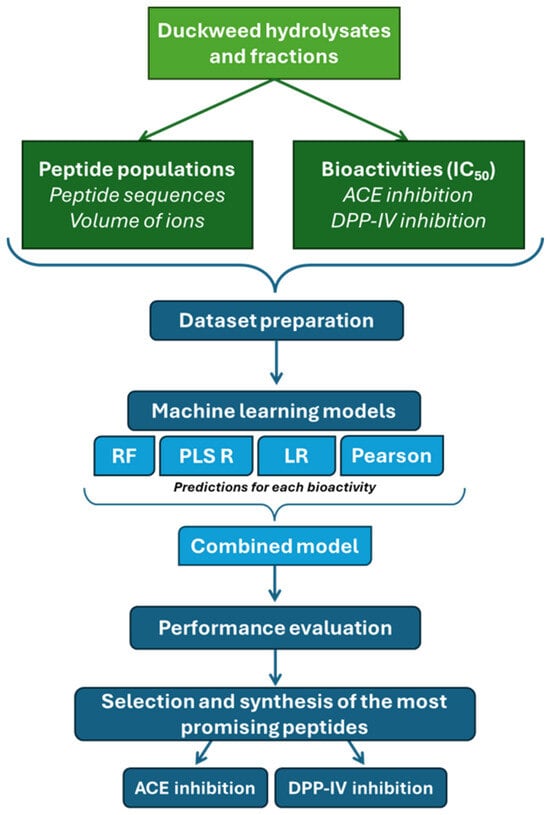
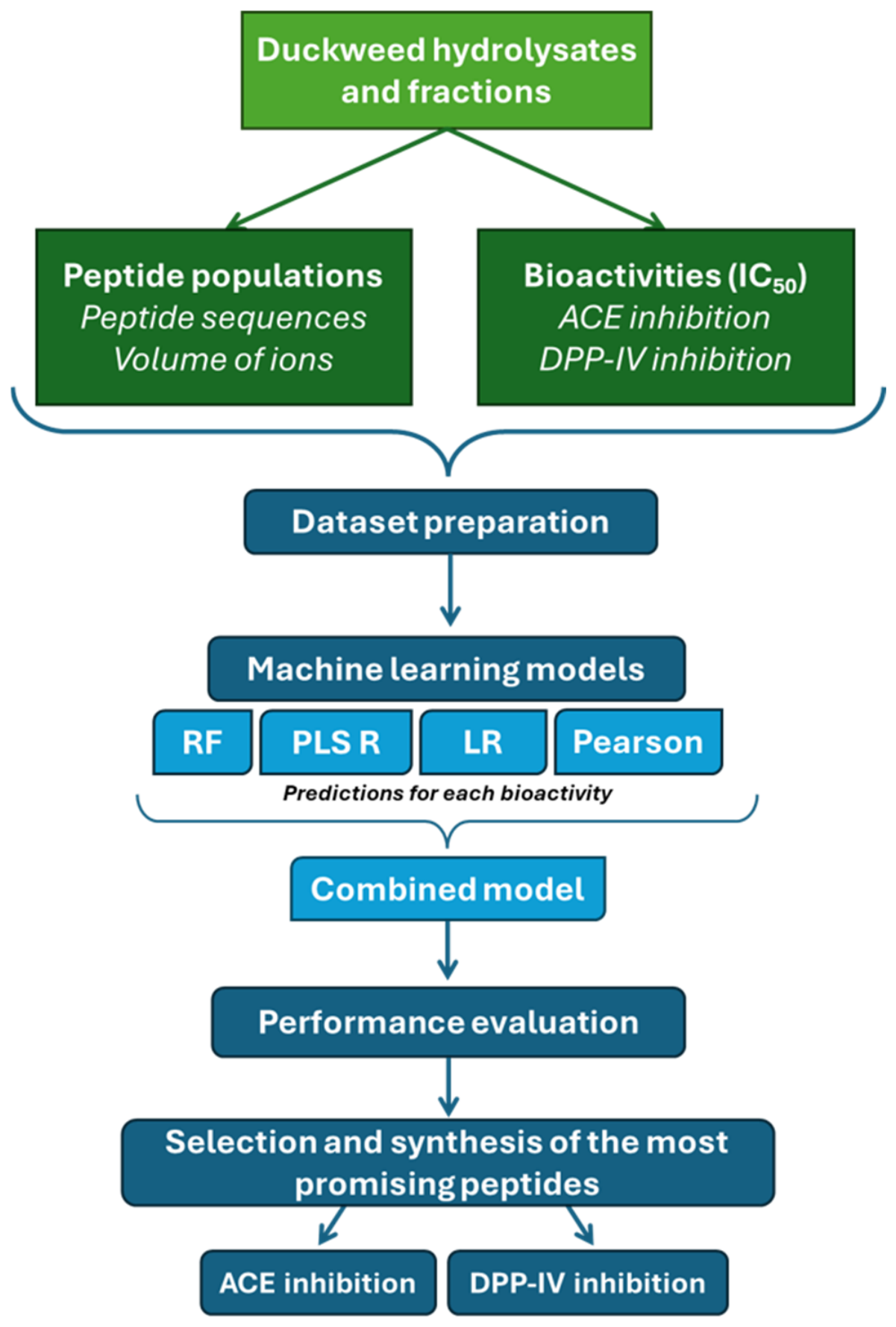
The overall study workflow, including dataset preparation, and the selection of bioactive peptides using four machine learning approaches as well as a combined model, is presented in Figure 1. The dataset is organized into two components. The first component comprises the peptide profiles of each hydrolysate and fraction, including peptide sequences and their corresponding ion volumes across samples (Table 2). A total of 12 distinct sample conditions were generated from the combination of four enzymes and three fractions. Since each sample type was produced in three independent repetitions, this resulted in 36 samples overall. For each sample, ion volumes values were obtained for the 407 peptides, yielding a high-dimensional dataset. The second component contains the measured ACE and DPP-IV inhibitory activities for each sample.
Figure 1.
Machine learning workflow for the identification of potential bioactive peptides. RF: Random Forest, PLS R: Partial Least Squares Regression, LR: Linear Regression and Pearson: Pearson correlation. ACE: angiotensin-converting enzyme; DPP-IV: dipeptidyl peptidase IV; IC50: concentration required to inhibit 50% of the measured enzymatic activity.
Table 2.
Representative excerpt of the predictor matrix used for statistical and machine-learning analyses (peptide ion volumes).
2.5. Relation Between MS/MS Data and Bioactivities
A total of four complementary statistical and machine learning approaches (Random Forest regression (RF), Partial Least Squares regression (PLS R), Linear Regression (LR), and Pearson correlation (Pearson)) were used to investigate associations between peptide populations and the ACE- or DPP-IV-inhibitory activities. Separate analyses were performed for the two inhibitory activities. For each hydrolysate and fraction (DFH, DS, and DP), the inhibitory activity was expressed as the reciprocal of the IC50 (1/IC50) as a function of peptide predictors, defined by their relative abundances (Vi) derived from MS spectra. The regression models were trained and evaluated by nested cross-validation. In an outer loop, each enzyme/fraction condition was held out in turn as the test set (leave-one-condition-out). In the inner loop, hyperparameters were tuned by 5-fold cross-validation on the training samples only. For the RF, the number of trees (n_estimators) was evaluated at 20, 50, 100, 250, and 500. For the PLS R regression model, the number of latent components (n_components) was tested at 2, 3, 5, 8, and 10. LR was used as a baseline model without additional hyperparameter optimization.
Model performance and peptide contributions were assessed using feature importance analysis, which identifies the peptides that contribute most to the bioactivity prediction. The feature importance data were min–max normalized to ensure comparability and improve interpretability [8].
RF was applied to capture nonlinear relationships and rank peptide importance using an ensemble of decision trees. The model was implemented using the RandomForestRegressor function from the Scikit-Learn 1.0.2 package in Python 3.7 [9]. PLS Regression was used to reduce dimensionality while modeling linear correlations between peptide features and the bioactivity [10]. LinearRegression allowed to assess simple linear associations and was computed using the LinearRegression module of the Scikit-Learn 1.0.2 package in Python 3.7 [9]. Additionally, Pearson correlation coefficients were calculated for each peptide feature to identify direct linear associations with bioactivity [11]. The magnitude of the coefficient (absolute value) was used to assess the strength of the relationship. This approach provides a rapid initial screening of linear associations between peptide abundance and inhibitory activity. The Pearson correlation coefficient was calculated as follows (Equation (1)):
where n denotes the number of observations; xi and yi represent the ith observed values of variables x and y, respectively; and
and ȳ correspond to their mean values.
In a second step, a combined model was generated by averaging the normalized feature-importance scores obtained from all four methods, following the approach proposed by Sanchez-Reinoso et al. (2025) [8] for calf cruor peptides. Each importance score was rescaled between 0 and 1 using min–max normalization to ensure comparability across models. Then, the combined importance score was calculated for each peptide, as follows (Equation (2)):
where RF, PLS R, LR, and Pearson refer to Random Forest regression, Partial Least Squares regression, Linear Regression, and Pearson correlation, respectively.
2.6. Characterization of Selected and Synthetized Peptides
2.6.1. In Silico Physicochemical Properties
The selected peptides were characterized based on 10 physicochemical properties, including peptide length and molecular weight, calculated using RDKit [12]. The isoelectric point (pI), net charge at pH 7.0, and grand average of hydropathicity (GRAVY) score were determined using ExPASy [13]. The relative proportions of hydrophobic, basic, acidic, and polar amino acid residues were also calculated. In addition, aromaticity, which is defined as the proportion of phenylalanine, tyrosine and tryptophan residues within the peptide sequence was also evaluated.
2.6.2. Peptide Sequences Alignments
A multiple sequence alignment of the 20 selected peptides was performed using the software Clustal Omega [14] to assess sequence similarity and identify conserved motifs. Clustal Omega is a multiple sequence alignment program that integrates guide tree approaches with hidden Markov model (HMM) profile-profile alignment to handle datasets of three or more sequences [15,16]. Alignments were generated using default parameters, and the resulting output was visualized and manually inspected to identify conserved residues and recurring sequence patterns.
2.6.3. Secondary Structure and 3D Conformation Prediction
Structure prediction was performed only for peptides containing more than five amino acid residues as allowed by the software. Three-dimensional structures were generated using PEP-FOLD 4.0 [17,18] at pH 7.0, following the methodology described by Cournoyer et al. (2025) [4]. The predicted models were used to examine predicted secondary structure elements and overall three-dimensional conformations.
2.6.4. Bioactivities
ACE from rabbit lung (catalogue No. A6778), recombinant human DPP-IV (catalogue No. D4943), Gly-Pro-AMC (catalogue No. G2761), and Ile-Pro-Ile (IPI, diprotin A; catalogue No. I9759) were purchased from Sigma-Aldrich. The fluorescent ACE substrate Abz-Gly-p-nitro-Phe-Pro-OH was obtained from Bachem (catalogue No. 4003531), and captopril from ACROS Organics (catalogue No. 3437050). PBS and DMEM were purchased from PAN-Biotech. According to the manufacturer’s specifications, one unit of ACE activity produces 1.0 µmol of hippuric acid from hippuryl-His-Leu per minute in 50 mM HEPES containing 300 mM NaCl, at pH 8.3 and 37 °C. Captopril and IPI served as positive inhibitor controls for ACE and DPP-IV, respectively, and were systematically included to verify assay performance.
- •
- ACE inhibitory activity
The ACE inhibitory activity of peptide was determined according to the method of Sentandreu and Toldrá [19]. Briefly, chemically synthesized peptides were dissolved in Tris buffer (150 mM, pH 8.3) and diluted to obtain five final assay concentrations ranging from 0.01 to 0.333 mM. For each reaction, 50 µL of peptide solution was mixed with 50 µL of ACE solution (50 mU/mL, working concentration) in a black 96-well plate. Wells containing enzyme and substrate without inhibitor served as uninhibited activity controls. After incubation for 10 min at 37 °C, the reaction was initiated by adding 200 µL of fluorescent substrate Abz-Gly-Phe(NO2)-Pro (0.45 mM, working concentration). Fluorescence was monitored every 2 min for 1 h, at excitation and emission wavelengths of 365 and 415 nm, respectively, using SpectraMax® iD3 microplate reader (Molecular Devices, San Jose, CA, USA). The slopes of fluorescence intensity versus time were determined from the linear portion of the kinetic curves and used to calculate the percentage of ACE inhibition relative to the control. The percentage of ACE inhibition was then plotted against the natural logarithm of the final peptide concentration in the well, expressed in µM, and a linear regression model was fitted to the data. IC50 values, defined as the peptide concentrations required to inhibit 50% of ACE activity, were calculated from the parameters of the linear regression model. The complete experiment was independently repeated three times (N = 3), with three technical replicates per concentration. IC50 values are reported as means ± standard deviation (SD) in µM.
- •
- DPP-IV inhibitory activity
Two DPP-IV inhibitions activities were evaluated using both an in vitro enzymatic assay and a Caco-2 cell-based assay. For both assays, four peptide concentrations were tested in technical triplicate.
The in vitro assay was performed according to Caron et al. (2016) [20]. Briefly, 25 µL of peptide solution, corresponding to final assay concentrations ranging from 0.054 to 0.429 mM, was mixed with 75 µL of PBS (pH 8.0) and 25 µL of recombinant human DPP-IV solution (0.018 U/mL, working concentration) in a black 96-well plate. Control wells contained PBS instead of the peptide solution. After incubation for 5 min at 37 °C, the reaction was initiated by adding 50 µL of Gly-Pro-AMC solution (1 mM, working concentration). The higher concentration investigated (429 µM) exceeded the IC50 < 100 µM benchmark used by Nongonierma and FitzGerald (2019) [21] to describe potent food-derived DPP-IV inhibitory peptides. Nevertheless, weaker inhibitors may require higher concentrations for IC50 determination. Fluorescence was measured every 2 min for 60 min at 37 °C at excitation and emission wavelengths of 360 and 438 nm, respectively, using the same microplate reader as described for the ACE-inhibitory assay. DPP-IV IC50 values were calculated from the linear regression of inhibition percentage against the natural logarithm of the final peptide concentration, as described for the ACE-inhibitory assay.
The Caco-2 cell-based assay was performed according to Caron et al. (2017) [22]. Cells were cultured in black 96-well plates for 15 days, washed with PBS, and incubated with four peptide concentrations prepared in PBS (pH 7.4), corresponding to final assay concentrations ranging from 0.071 to 2.857 mM, together with Gly-Pro-AMC (1 mM). Caco-2 cells (ECACC, accession No. 86010202; lot 18H002) were thawed at passage 13. A minimum of two passages after thawing was required to allow recovery and restoration of a stable physiological state following cryopreservation. Cells were maintained in DMEM containing 4.5 g/L glucose, supplemented with 10% (v/v) fetal bovine serum, 100 U/mL penicillin, 100 µg/mL streptomycin, and 2 mM L-glutamine, at 37 °C in a humidified atmosphere containing 5% CO2. For the DPP-IV assays, cells were seeded at passages 16 (N1), 17 (N2), and 18 (N3) in black 96-well plates at 8000 cells/well and cultured for until reaching confluence before the assay (approx. seven days). Cells were washed with PBS before incubation with the peptide solutions and Gly-Pro-AMC substrate. Control wells received PBS without peptide. Fluorescence kinetics were monitored under the same conditions as for the in vitro DPP-IV assay, and IC50 values were calculated as described above. For both DPP-IV inhibition assays, the complete experiment was independently repeated three times (N = 3), with three technical replicates per concentration. IC50 values are reported as means ± SD in µM.
3. Results and Discussion
3.1. Dataset Construction
To investigate the relationship between peptide composition and bioactivity, a structured dataset was built from the bioactivity measurements and peptide profiles of the duckweed hydrolysate fractions. The ACE and DPP-IV inhibitory activities of each fraction (DFH, DS, and DP) were previously determined (Table 1) and used as response variables for subsequent modeling analyses. In parallel, peptides identified within each fraction by UPLC-MS/MS were quantified based on their corresponding ion signal intensities. For each fraction, the ion volume of every detected peptide was extracted and organized into a dataset. It should be noted that MS-derived ion volumes provide a relative, semi-quantitative estimate of peptide abundance rather than an absolute peptide concentration. However, quantification of each peptides would need a standard curve between concentration and ion-volume for each peptide, which would be very expansive for the 407 peptides. Differences in ionization efficiency among peptide sequences may therefore influence the measured signal intensities and, consequently, the associations established between peptide abundance and inhibitory activity. An excerpt from the dataset is presented in Table 2 to illustrate the organization of the peptide features.
Substantial differences were observed in both ACE and DPP-IV inhibitory activities among the duckweed hydrolysate fractions (Table 1). These variations were linked with differences in peptide composition and ion volumes (Table 2), indicating that distinct peptide profiles were observed across the different fractions. Notably, fractions exhibiting similar bioactivities displayed distinct peptide profiles, suggesting that inhibitory effects may be mediated by different peptides or combinations of peptides. This compositional and functional heterogeneity supports the application of multivariate and machine-learning approaches to better capture the complex relationships between peptide abundance and inhibitory activity and to identify the peptides most strongly associated with ACE and DPP-IV inhibition.
3.2. Comparison of Each Individual Model Results
Peptide-related characteristics were used as predictor variables to model the ACE- and DPP-IV-inhibitory activities of duckweed hydrolysates. Associations were assessed using Pearson correlation (Pearson), Linear Regression (LR), Partial Least Squares (PLS) regression, and Random Forest (RF). Feature-importance scores were extracted from each model to quantify the contribution of individual peptides to predicted bioactivity. Model-specific results for ACE- and DPP-IV-inhibitory activities are presented in Table 3 and Table 4, respectively, with only the 30 highest-ranked peptides reported for clarity. In both tables, the sequence of Peptide 1 (Pep 1), identified in a previous study by Cournoyer et al. (2025) [4], is not disclosed since it remains confidential due to its high potential for further application and ongoing considerations regarding intellectual property protection.
3.2.1. ACE-Inhibitory Activity
Across the RF, PLS-R, LR, and Pearson-correlation analyses, several peptides were consistently top-ranked for ACE-inhibitory activity, although ranking patterns varied between modeling approaches. Peptides such as RAI, IYI, Pep 1, INI, ISIV, IRI, and RVTPQPGVPPEEAGA appeared among the top-ranked peptides in several analyses, suggesting a relatively robust association with ACE inhibition independent of the statistical framework applied. Several of these peptides contain sequence characteristics commonly reported in ACE inhibitory peptides, particularly short sequences containing hydrophobic or aromatic residues at the C-terminal position [23,24]. Particularly, peptides containing isoleucine (I), valine (V), phenylalanine (F), and tyrosine (Y), as observed in IYI and ISIV, are consistent with established structure–activity relationships for ACE inhibition, where hydrophobic residues at terminal positions are known to enhance binding affinity toward the ACE catalytic site [25,26].
As expected, the importance assigned to each peptide varied across the different approaches, reflecting the different underlying assumptions and computational principles of the methods. Pearson correlation is a straightforward statistical metric for detecting pairwise linear relationships between peptide abundance and bioactivity [11], but it is restricted to linear associations and is sensitive to outliers. LR extends linear modelling by quantifying how changes in peptide abundance contribute to bioactivity, yet it still assumes linearity and can be influenced by multicollinearity [27]. PLS regression, in contrast, is specifically designed to handle datasets with many, potentially collinear predictors, making it well suited to high-dimensional peptide datasets; however, it remains primarily linear in nature [10]. RF differs from the other three approaches by capturing nonlinear and interaction effects, although its feature-importance estimates may also be affected by correlated predictors. These methodological differences were reflected in the ranking patterns and results. For instance, RF strongly prioritized short hydrophobic peptides such as IYI and AAF, whereas PLS-R and LR additionally highlighted longer sequences such as FTSIVGNVFGFKALRA and RVTPQPGVPPEEAGA. Pearson correlation identified peptides such as VRIIGF and GFF as highly associated with ACE inhibition. However, these low-ranked peptides in multivariate models, suggesting that part of their explanatory signal may be shared with other correlated peptide features. This observation indicates potential redundancy or interaction effects among peptide predictors.
Table 3.
Relative importance and association scores of peptide-derived features for ACE-inhibitory activity.
Table 4.
Relative importance and association scores of peptide-derived features for DPP-IV-inhibitory activity.
Interestingly, several peptides previously reported as bioactive from duckweed or other protein sources were also identified by the models. The models ranked several known bioactive peptides, supporting the potential utility of these approaches for peptide prioritization (such as Pep 1) [4] and KF [28] within the top 10 peptides, as well as ATF [29], IAK [30,31,32], IKF [30], or LPLQDVYK [4] within the top 30 peptides. Known peptides were particularly highlighted by the RF model (see highlighted sequences in Table 3). In contrast, peptides previously identified specifically from duckweed using partial-least squares discriminant analysis (PLS-DA) as an alternative machine learning classification approach [4]) were not consistently highlighted. For example, highly bioactive peptides such as FAR and TYY [4] were not highlighted by the approaches applied in the present study, underscoring the complementarity of different modeling strategies and the importance of using multiple approaches for comprehensive bioactive-peptide prioritization.
3.2.2. DPP-IV Inhibitory Activity
For DPP-IV inhibitory activity, feature-importance and association analyses similarly revealed both shared and model-specific peptide rankings. Peptides such as IAI, VIAE, VEYI, RVTPQPGVPPEEAGA, ARELGVPIVM, and INI were recurrently identified among the high-ranked peptides across multiple approaches. Several of these sequences contain characteristics commonly reported for DPP-IV inhibitory peptides, which often contain hydrophobic and small aliphatic residues and may include proline or branched-chain amino acids [33]. The frequent identification of IAI, IVI, III, and VIAE highlights the strong enrichment in isoleucine- and valine-containing motifs, suggesting that short aliphatic sequences may be associated with DPP-IV inhibition in duckweed hydrolysates.
The results were strongly model dependent. As observed for ACE results, RF emphasized short peptides such as TSI, VTI, ITI, and ASI, whereas PLS-R and LR assigned high importance to longer sequences including LRIPPAYSKT and RVTPQPGVPPEEAGA, the latter of which was already highlighted for ACE inhibition. Pearson correlation identified strong individual associations for peptides such as INI and AEI, yet some of these showed reduced importance in multivariate contexts. Only two previously reported bioactive peptides, API and Pep 1, were identified among the highest-ranked peptides [4]. This result may partly reflect the limited information currently available on DPP-IV-inhibitory peptides derived specifically from duckweed.
As observed for ACE, some peptides like RVTPQPGVPPEEAGA and IAI, were consistently prioritized across the different approaches, whereas others appeared model-specific. This variability reinforces the idea that DPP-IV inhibition is influenced by both linear and nonlinear relationships among peptide abundances.
3.2.3. Comparative Analysis of Peptide Importance for ACE and DPP-IV Inhibition
A comparison of the two bioactivities revealed both overlapping and distinct peptide signatures. Peptides such as RAI, INI, RVTPQPGVPPEEAGA, and IAYKPT were high-ranked for both ACE and DPP-IV inhibition, suggesting that they may represent potential multifunctional candidates. The presence of these peptides in top rankings across activities supports the hypothesis that certain hydrophobic motifs may be associated with the inhibition of multiple enzymatic targets. However, structural differences were also apparent. ACE-associated peptides appeared to show a stronger enrichment in aromatic residues (Y, F) and hydrophobic C-terminal motifs, consistent with classical ACE inhibitory mechanisms. In contrast, DPP-IV predictors displayed a higher prevalence of repetitive isoleucine/valine motifs (IAI, III, IVI), indicating differences in structural determinants. These findings suggest that, although hydrophobicity may be shared sequence characteristics, the specific patterns associated with ACE and DPP-IV inhibition differ.
To further integrate the information obtained from the different modeling approaches and reduce model-specific variability, a combined peptide-ranking analysis based on averaged normalized feature-importance scores was subsequently performed.
3.3. Results of Peptide Combined Importance Scores
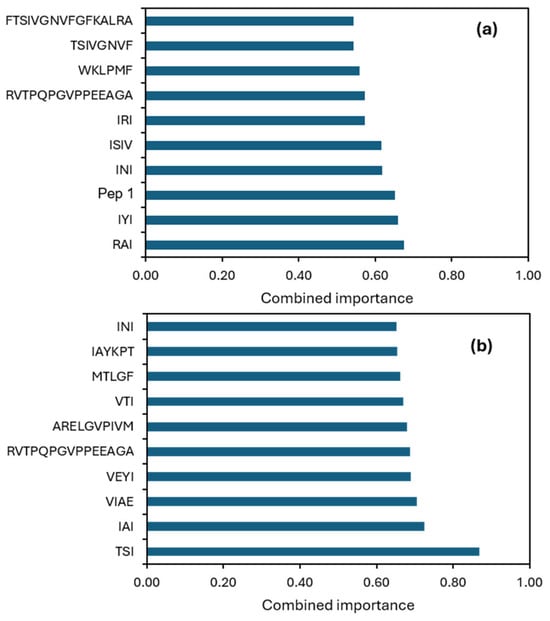
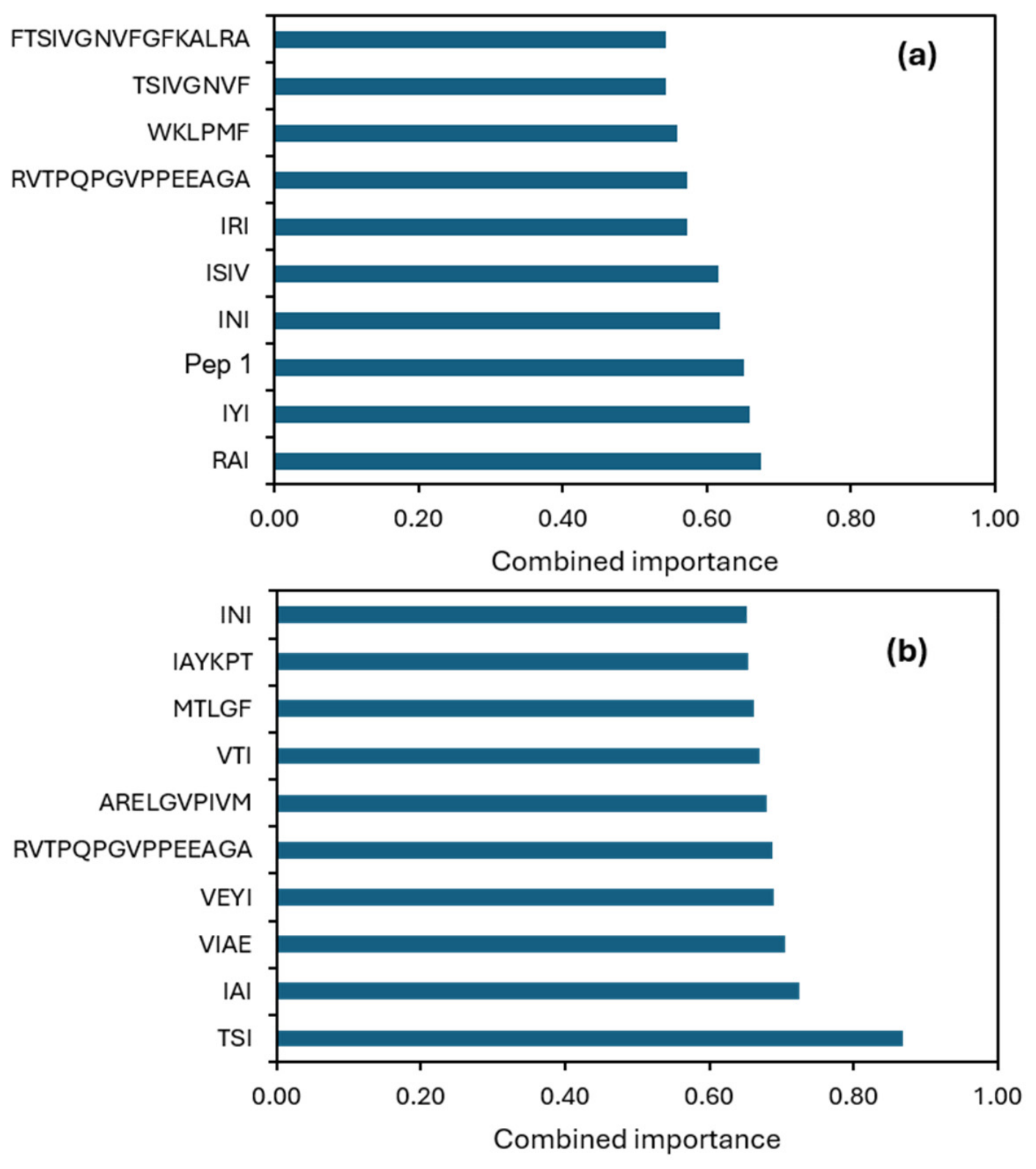
Based on the results obtained from each individual model and their respective peptide importance scores, the normalized scores were averaged to identify the peptides most strongly associated with each bioactivity [8]. The combined-model analysis confirmed several peptides highlighted by the individual models while providing a clearer prioritization of the candidate sequences (Figure 2).
Figure 2.
Combined importance scores of the 10 highest-ranked peptides for each bioactivity: (a) angiotensin-converting enzyme (ACE) inhibition, and (b) dipeptidyl peptidase-IV (DPP-IV) inhibition, obtained by averaging the normalized scores from the four analytical approaches: Pearson correlation (Pearson), Linear Regression (LR), Partial Least Squares (PLS) regression, and Random Forest (RF).
For ACE inhibition, peptides such as RAI, IYI, Pep 1, INI, and ISIV remained among the highest-ranked contributors, reinforcing their consistent association with the observed inhibitory activity. For DPP-IV inhibition, the combined analysis highlighted peptides including TSI, IAI, VIAE, VEYI, and RVTPQPGVPPEEAGA, which were consistently identified across multiple models. Many of these sequences contain branched-chain amino acids such as isoleucine and valine, consistent with the previously observed association between short aliphatic motifs and DPP-IV inhibition.
Interestingly, some peptides, including RAI, INI, and RVTPQPGVPPEEAGA, were highly ranked for both ACE and DPP-IV inhibition. This overlap suggests that these sequences may represent potential multifunctional peptides candidates within the duckweed hydrolysates. However, their inhibitory activities against both enzymes require confirmation using the corresponding synthesized peptides.
3.4. Selection of the Highest-Ranked Peptides
Based on the combined-model results, candidate peptides were first prioritized according to their model-derived ranking. The ten highest-ranked peptides for each bioactivity were initially considered for synthesis and experimental testing (Figure 2a,b). The initial ranking was data-driven, whereas the final selection also considered expert-based criteria. Indeed, peptides Pep 1 and IAI were excluded, as they had already been synthesized and tested for these bioactivities in a previous study [4]. To maintain the selection pool of 20 peptides, the 11th-ranked peptides: ATNFVPGK from the ACE combined-models list and IEPVA from the DPP-IV combined models list, were included, because neither had previously been experimentally evaluated for the corresponding bioactivity (Table 3 and Table 4). Duplicate sequences, such as INI and RVTPQPGVPPEEAGA were subsequently removed. To maintain the total number of selected peptides, the 12th-ranked untested peptides were selected instead: WVSMPGVIPVASGGIHVWHMPAL (ACE) and FEEGSVTNM (DPP-IV). However, WVSMPGVIPVASGGIHVWHMPAL was subsequently excluded because its long sequence may reduce the likelihood of gastrointestinal stability and intestinal absorption in its intact form [34]. It was replaced by GIFF, the 13th-ranked in the ACE-inhibition list.
Finally, the 20 selected peptides were systematically searched against established peptide databases and the scientific literature to determine whether their ACE- or DPP-IV-inhibitory activities had previously been evaluated. The databases searched included APD3 (https://aps.unmc.edu/), DBAASP (https://dbaasp.org/search), BioPepDB (http://bis.zju.edu.cn/biopepdbr/), Peplab (https://www.pep-lab.info/), and DFBP (http://www.cqudfbp.net/). Sequence matching was performed using a similarity threshold of 0.9, and the database search was conducted on 9 November 2025. In parallel, the scientific literature was searched using PubMed, Scopus, and Google Scholar. Searches combined each peptide sequence with the terms “ACE inhibitory”, “angiotensin-converting enzyme”, “DPP-IV inhibitory”, “DPP-4 inhibitory”, “dipeptidyl peptidase-IV”, and “bioactive peptide”. Two sequences, IYI [35] and VIAE [36], had previously been associated with Etk/Bmx tyrosine-kinase inhibition and antibacterial activity, respectively; however, these activities were distinct from the endpoints investigated in the present study. These selection steps resulted in a list of 20 previously untested peptides (Table 5), which were subsequently synthesized for experimental evaluation.
3.5. Bioactivities of the Synthetized Peptides
The ACE- and DPP-IV-inhibitory activities of the 20 synthesized peptides are presented in Table 5.
Table 5.
ACE- and DPP-IV-inhibitory activities of the 20 selected peptides, expressed as IC50 values.
For ACE inhibition, several peptides exhibited relatively low IC50 values, including IRI (21.11 μM), WKLPMF (13.40 μM), IYI (27.73 μM), ATNFVPGK (23.01 μM), and GIFF (17.54 μM). In contrast, VEYI exhibited substantially lower potency, with an IC50 of 1118.03 μM. IC50 could not be determined for ISIV, VIAE, RVTPQPGVPPEEAGA, and FEEGSVTNM, because 50% inhibition was not reached within the tested concentration range.
For DPP-IV inhibition, only two peptides produced sufficient inhibition for IC50 determination. WKLPMF and IAYKPT exhibited IC50 values of 216.89 and 266.82 μM, respectively, in the cell-free assay. Their apparent inhibitory potency was lower in the Caco-2 assay, with IC50 values of 414.81 and 436.45 µM, respectively. This difference may reflect peptide degradation, reduced accessibility to membrane-associated DPP-IV, or other effects associated with the cellular environment [20]. WKLPMF is particularly promising, as it demonstrated the highest activity toward both ACE and DPP-IV among the peptides tested. The cell-free upper concentration limit of 429 µM may have restricted the identification of weaker inhibitors. Testing up to 1–2 mM would provide a more complete characterization. Although higher concentrations were evaluated using Caco-2 cells, these cells express additional membrane-associated and intracellular peptidases that can modify peptide sequences and thereby alter their inhibitory activity [22,37]. This processing may reduce activity or generate active fragments; its contribution was not examined for the present peptides. Therefore, the cellular results cannot exclude inhibition at higher concentrations in the cell-free assay. But such high concentrations would be not realistic for real in-vivo tests.
The comparison of Pearson correlation, LR, PLS, and RF highlights that no single method fully captures the complexity of the relationships between peptide abundance and bioactivities. Some peptides were consistently highlighted across the different approaches, whereas others ranked highly in only one or two methods, reflecting the differing assumptions and sensitivities of each method. Overall, these results highlight the importance of experimentally validating peptides prioritized through machine-learning analyses, as high model rankings did not consistently translate into measurable inhibitory activity. Experimental validation therefore remains essential for confirming the intrinsic bioactivity of candidate peptides. Furthermore, the ML experiments were used as a discovery tool rather than to develop a predictive model for deployment. Model performance was therefore not the object of evaluation, and no held-out validation was performed. Given the small sample size relative to the number of peptides, the non-validated results should be interpreted as hypothesis-generating. Future studies should assess the stability of peptide rankings using K-fold cross-validation or bootstrap resampling and, ultimately, external validation on independent datasets.
An additional limitation concerns the transition from model-based peptide ranking to the final selection of candidates for experimental validation. The overall peptide-selection workflow is better described as a hybrid machine learning-expert knowledge approach, as expert-based criteria were applied after the initial data-driven ranking. Future studies could incorporate physiological criteria, such as predicted gastrointestinal stability, earlier in the workflow to reduce post-ranking curation.
3.6. Characterisation of the Synthetized Peptides
To gain deeper insight into the selected peptides, a multiple sequence alignment was first conducted to explore potential sequence similarities and identify similar motifs among the peptides. This was followed by the analysis of their physicochemical properties and the prediction of three-dimensional structures for the most promising peptides containing more than five amino acids.
3.6.1. Multiple Sequence Alignment
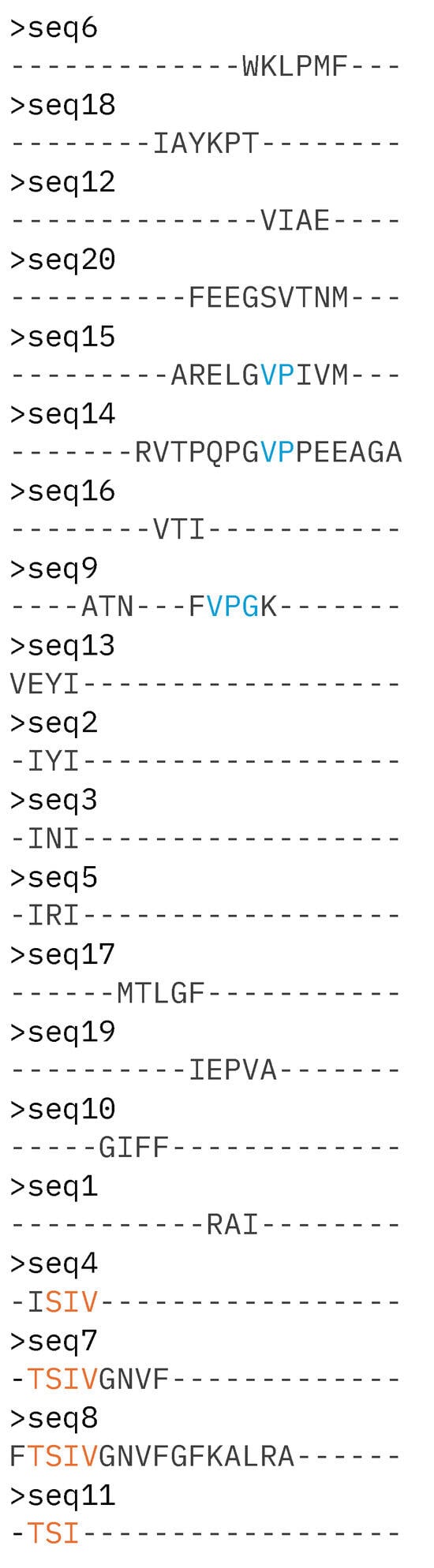
As the peptide lengths ranged from 3 to 16 amino acids, the alignment contained numerous gaps introduced to maximize positional correspondence. Despite this variability, several recurring sequence patterns could be observed (Figure 3).
Figure 3.
Multiple sequence alignment of the 20 selected peptides. Colored residues highlight the main recurring sequence patterns identified in the alignment: SIV/TSI and VP/VPG-containing motifs.
A first group of peptides displayed a clear enrichment in hydrophobic residues, particularly isoleucine (I), valine (V), and phenylalanine (F). This group includes peptides such as ISIV (seq4), TSIVGNVF (seq7), FTSIVGNVFGFKALRA (seq8), and TSI (seq11), as well as shorter variants such as IYI (seq2), INI (seq3), and IRI (seq5). The alignment suggests the presence of a conserved core motif centered around the sequence SIV/TSI. Notably, the longer peptide FTSIVGNVFGFKALRA contains the subsequence TSIVGNVF, which is identical to seq7 and encompasses the shorter motif observed in seq11, suggesting that some peptides may correspond to fragments derived from a common parent sequence.
A second group of peptides showed the presence of proline-containing motifs, particularly sequences containing VP or VPG. This group includes ATNFVPGK (seq9), RVTPQPGVPPEEAGA (seq14), and ARELGVPIVM (seq15).
A third group consisted mainly of short hydrophobic peptides enriched in aromatic or nonpolar residues, including WKLPMF (seq6), MTLGF (seq17), and GIFF (seq10). These peptides are characterized by a high proportion of hydrophobic amino acids such as phenylalanine, leucine, methionine, and tryptophan, indicating that they originate from internal hydrophobic regions of larger proteins. Their origin cannot be concluded from composition alone and would require parent-protein mapping.
3.6.2. Physicochemical Properties
Despite the classification of these peptides into groups based on shared amino acids motifs, their inhibitory activities varied considerably (Table 5). These differences likely arise from variations in physicochemical properties such as hydrophobicity, peptide length, charge distribution, aromaticity, and amino acid positioning within the sequence, all of which are known to strongly influence peptide bioactivity. In particular, the nature and position of terminal residues, as well as the accessibility of specific motifs, appear to play critical roles in modulating ACE and DPP-IV inhibitory activities. The main physicochemical characteristics of the identified peptides are summarized in Table 6.
Table 6.
Physicochemical properties of the 20 peptides selected using the combined importance scores.
The alignment revealed a recurring pattern centered around the sequence SIV/TSI in the first peptide group (Figure 3). Several peptides from this group exhibited activities ranging from no determinable ACE inhibition to comparatively strong inhibition, supporting the potential role of hydrophobic amino acids in ACE inhibition. In agreement with previously reported structure–activity relationship studies [38,39,40], the most active peptides identified in this work were generally short sequences enriched in hydrophobic and aromatic residues. Hydrophobic and branched-chain amino acids, such as leucine, isoleucine and valine, may favor interactions with the hydrophobic pockets of the ACE catalytic site, consistent with the inhibitory activities observed for IYI, IRI, and TSI. Several of the most active peptides also possessed hydrophobic residues at the C-terminal position, a structural feature frequently associated with enhanced ACE inhibitory potency [24,39].
However, the results also demonstrate that hydrophobicity and motif presence alone are insufficient to guarantee activity. For example, an IC50 could not be determined for ISIV within the concentration range, whereas TSI displayed measurable ACE-inhibitory activity. This difference may indicate that the TSI sequence itself represents an important bioactive motif for ACE inhibition. The absence of the N-terminal threonine (T) residue in ISIV may alter peptide polarity and hydrogen-bonding capacity, potentially disrupting favorable interactions with the ACE active site. In addition, the extra valine residue may modify peptide conformation and residue positioning within the catalytic cleft. These observations suggest that both motif conservation and amino acid arrangement may influence activity and that even minor sequence modifications can strongly affect peptide-enzyme interactions.
Similarly, marked differences were observed among the tripeptides INI, IYI, and IRI. Although all three peptides possess terminal isoleucine residues, their activities varied considerably depending on the central amino acid. The stronger activity of IYI relative to INI may be attributed to the aromatic tyrosine residue, which may promote favorable hydrophobic and potential π-π interactions within the ACE binding pockets [39,40]. Likewise, the positively charged arginine residue in IRI may promote favorable electrostatic interactions with charged regions near the catalytic site. In contrast, the polar but non-aromatic asparagine residue in INI likely provides fewer favorable interactions with ACE, resulting in weaker inhibition. Altogether, these results indicate that hydrophobicity alone does not determine ACE inhibitory potency and that residue identity and positioning strongly influence peptide activity. The experimental results also revealed discrepancies between model-based ranking and peptide activity. For example, VIAE and VEYI were highly ranked for DPP-IV inhibition but did not show measurable activity within the tested concentration range. This highlights a limitation of the current approach, as high feature importance reflects an association between peptide abundance and the activity of the hydrolysates or fractions, but does not necessarily indicate intrinsic activity of the isolated peptide. Future models incorporating sequence or structure-related descriptors could provide a more direct link between peptide characteristics and intrinsic inhibitory activity.
In contrast to the hydrophobic SIV/TSI-related cluster, the second peptide group was characterized by the presence of proline-containing motifs, particularly sequences containing VP or VPG. Among these peptides, ATNFVPGK exhibited a relatively low ACE IC50 value. This peptide combines several potentially favorable sequence characteristics, including the hydrophobic VPG motif, the presence of an aromatic phenylalanine residue, and a relatively short peptide length, all of which may facilitate interactions with the ACE catalytic site. Proline residues are frequently identified in ACE-inhibitory peptides because their cyclic structure may enhance resistance to proteolysis and promote conformations favorable for enzyme binding [24,38].
In contrast, an IC50 could not be determined for RVTPQPGVPPEEAGA, which belonged to the second group described in Section 3.6.1 and Figure 3. Its larger size and the presence of several polar and acidic residues may reduce favorable interactions with the ACE active site. In addition, the VP motifs are embedded within a flexible sequence lacking strong hydrophobic or aromatic terminal residues, which may limit productive enzyme interactions. In this second group, ARELGVPIVM displayed lower ACE-inhibitory potency than ATNFVPGK. Although this peptide contains the hydrophobic GVPIV motif and several nonpolar residues, its longer length and the presence of charged residues near the N-terminus may reduce binding efficiency compared with ATNFVPGK. Furthermore, the absence of aromatic residues may contribute to its lower potency. Altogether, these results indicate that the presence of VP/VPG motifs alone does not determine activity, and that surrounding residues, peptide length, and overall peptide architecture may influence ACE inhibition.
The third group, which lacked a common recurring motif, included WKLPMF and GIFF, which exhibited the lowest IC50 values among all peptides tested. Their high activity may be associated with the abundance of aromatic and hydrophobic residues, especially phenylalanine and tryptophan, which may promote strong hydrophobic interactions and potential π- π stacking interactions within the ACE catalytic pocket [40]. Aromatic residues located near the peptide C-terminus are frequently reported as favorable sequence characteristics for ACE inhibition. Interestingly, WKLPMF was also one of the two peptides for which DPP-IV IC50 values could be determined in both the cell-free and Caco-2 assays. Although proline-containing sequences are commonly associated with DPP-IV inhibition [41], hydrophobic and aromatic residues may also contribute significantly to peptide binding within the DPP-IV catalytic site. Overall, the present results demonstrate that ACE inhibitory activity depends on a complex interplay between hydrophobicity, aromaticity, peptide length, charge distribution, and residue positioning, rather than on the presence of conserved motifs alone.
3.6.3. Peptide 3D Structure
The predicted 3D conformations of the most promising peptides, containing more than five amino acid residues, revealed notable differences in their predicted secondary-structure organization. These differences may be associated with their inhibitory activities against ACE and DPP-IV, although the predicted structures alone cannot establish the underlying inhibition mechanisms (Table 7).
Table 7.
Predicted 3D conformations of the most promising peptides containing more than five amino acid residues.
Several peptides, including WKLPMF, TSIVGNVF, and FTSIVGNVFGFKALRA, were predicted to contain substantial α-helical regions, whereas ATNFVPGK and IAYKPT appeared to adopt more flexible conformations enriched in coils and turns. Although these secondary-structure features are not sufficient to explain bioactivity, they are consistent with known ACE-inhibitory structure–activity relationships, in which short peptides enriched in hydrophobic and aromatic residues often show stronger activity, and hydrophobic or aromatic residues at the C-terminal position are frequently favored. In this context, the relatively low ACE IC50 values measured for WKLPMF, TSIVGNVF, and FTSIVGNVFGFKALRA may reflect not only their amino acid composition, but possibly the predicted spatial arrangement of key hydrophobic residues [38,39,40].
By contrast, peptides with greater proportions of unordered or turn-rich regions may benefit from conformational adaptability that facilitates binding to diverse enzymatic pockets. This may be relevant for IAYKPT, which showed dual ACE and DPP-IV inhibitory activity despite not containing an extended hydrophobic sequence. DPP-IV recognition is known to depend strongly on peptide sequence and conformation, and proline-containing or structurally constrained motifs often contribute to favorable binding features [42].
ATNFVPGK is also notable because proline-containing motifs may impose local conformational constraints that favor ACE binding and influence peptide stability, even when α-helical content is limited. Similarly, the mixed secondary structure predicted for FTSIVGNVFGFKALRA may provide a combination of structural stability and flexibility. This characteristic could partly contribute to its lower ACE IC50 value compared with that of the shorter related peptide TSIVGNVF. Overall, these predictions suggest that peptide bioactivity is shaped not only by recurring sequence motifs and amino acid composition, but also by the three-dimensional arrangement and flexibility of the peptide chain [38,39,42]. Finally, the inhibitory activities observed for the synthesized peptides were evaluated under controlled in-vitro conditions and do not account for their stability during gastrointestinal digestion or their intestinal absorption and bioavailability. Consequently, whether these peptides remain intact and retain their inhibitory activity under physiological conditions remains to be established.
4. Conclusions
The present study highlights the potential of an integrated statistical and machine-learning strategy for the identification and prioritization of bioactive peptides derived from complex duckweed protein hydrolysates. Among the 20 selected peptides, 16 exhibited measurable ACE-inhibitory activity, with considerable differences in activity. WKLPMF, GIFF, IRI, ATNFVPGK, and IYI showed the strongest ACE-inhibitory activity, with IC50 values ranging from 13.40 to 27.73 µM. WKLPMF and IAYKPT also exhibited DPP-IV-inhibitory activity. By integrating peptidomic data with multiple predictive approaches, including Pearson correlation, linear regression, partial least squares regression, and random forest modeling, the relationship between peptide abundance and inhibitory activities against ACE and DPP-IV was systematically explored. The combination of linear and nonlinear approaches captured complementary aspects of the data, while the integration of feature importance across models provided a more robust and less method-dependent prioritization of candidate bioactive peptides.
The analyses revealed consistent patterns across approaches, despite differences in model assumptions and sensitivity. Short hydrophobic peptides enriched in branched chain and aromatic amino acids were repeatedly associated with ACE inhibitory activity. The DPP-IV rankings frequently highlighted compact aliphatic sequences; however, only two new peptides displayed measurable DPP-IV inhibition experimentally, indicating that high model rankings did not consistently translate into intrinsic DPP-IV-inhibitory activity. The activity of the remaining candidates at higher concentrations remains unresolved, limiting conclusions about the effectiveness of computational prioritization. Some of the observed sequence patterns were consistent with previously reported structure–activity relationships, illustrating the potential of data-driven analyses to prioritize relevant candidates within complex peptide mixtures.
The combined ranking strategy integrated results across models, enabling the convergence of independent signals toward a smaller subset of peptides for experimental validation. Several sequences were consistently identified across multiple models and showed measurable activity, particularly for ACE inhibition. In contrast, the limited experimental validation of DPP-IV-inhibitory candidates highlights the need for further refinement of the approach. Overall, ACE-inhibitory activity was stronger and more frequently observed than DPP-IV inhibition. However, their precise molecular mechanisms require further investigation.
By linking computational prediction with experimental validation, this study provides a workflow that may be transferable to the investigation of functional peptides from other complex protein hydrolysates or mixtures. This strategy underscores the potential of data-driven modeling as a powerful tool for accelerating peptide-based nutraceutical development from sustainable protein resources, such as duckweed.
Future studies should validate the identified peptides under physiologically relevant conditions, including simulated gastrointestinal digestion, and intestinal absorption to determine whether their ACE- and DPP-IV-inhibitory activities are retained and whether the peptides remain bioavailable. In vivo validation will also be required before antihypertensive, or antidiabetic effects can be claimed.
Author Contributions
Conceptualization: A.C., P.-L.P. and L.B.; methodology: A.C., P.-L.P., R.R., B.C. and L.B.; validation: A.C., P.-L.P., R.R., B.C. and L.B.; formal analysis: A.C., P.-L.P., H.A., B.C. and L.B.; investigation: A.C., P.-L.P., H.A., R.R., B.C. and L.B.; resources: B.C. and L.B.; data curation: A.C., B.C. and L.B.; writing—original draft preparation: A.C. and L.B.; writing—review and editing: A.C., P.-L.P., H.A., R.R., B.C. and L.B.; supervision: B.C. and L.B.; project administration: L.B. and B.C.; funding acquisition: L.B. and B.C. All authors have read and agreed to the published version of the manuscript.
Funding
This research was funded by the Pôle Bioalimentaire—Fonds de Recherche du Québec—Nature et Technologies (FRQ-NT) (Grant «Développement d’outils d’apprentissage automatique permettant l’identification des peptides bioactifs au sein d’hydrolysats complexes de lentilles d’eau en vue du développement de nutraceutiques durables» to Laurent Bazinet) and the Natural Sciences and Engineering Research Council of Canada (NSERC) through the Discovery Grants Program (Grant RGPIN-2024-03929 to Laurent Bazinet). This work was also carried out within the framework of the International Research Network (RRI) SEBioVA and as part of the BiHauts Eco de France CPER/FEDER 2021–2027 program. The latter is funded by the European Union, the French State, and the Hauts-de-France Region.
Institutional Review Board Statement
Not applicable.
Informed Consent Statement
Not applicable.
Data Availability Statement
The original contributions presented in this study are included in the article. Further inquiries can be directed to the corresponding author.
Acknowledgments
Acknowledgment is given to Institute of Nutrition and Functional Foods (INAF) Metabolomics Platform for their support and training in data analysis. The authors also express gratitude to Jacinthe Thibodeau from Université Laval for her technical assistance and laboratory support.
Conflicts of Interest
The authors declare no conflicts of interest.
References
- Karami, Z.; Akbari-adergani, B. Bioactive Food Derived Peptides: A Review on Correlation between Structure of Bioactive Peptides and Their Functional Properties. J. Food Sci. Technol. 2019, 56, 535–547. [Google Scholar] [CrossRef] [Scilit]
- Zhao, C.; He, Z.; Regenstein, J.M.; Ashaolu, T.J. Structure-Activity Relationships of Bioactive Peptides Derived from Legumes: Significance and Perspectives. Crit. Rev. Food Sci. Nutr. 2026, 66, 2825–2837. [Google Scholar] [CrossRef] [Scilit]
- Bernier, M.-È.; Thibodeau, J.; Bazinet, L. Enzymatic Hydrolysis of Water Lentil (Duckweed): An Emerging Source of Proteins for the Production of Antihypertensive Fractions. Foods 2024, 13, 323. [Google Scholar] [CrossRef] [Scilit]
- Cournoyer, A.; Bernier, M.-È.; Aboubacar, H.; de Toro-Martín, J.; Vohl, M.-C.; Ravallec, R.; Cudennec, B.; Bazinet, L. Machine Learning-Driven Discovery of Bioactive Peptides from Duckweed (Lemnaceae) Protein Hydrolysates: Identification and Experimental Validation of 20 Novel Antihypertensive, Antidiabetic, and/or Antioxidant Peptides. Food Chem. 2025, 482, 144029. [Google Scholar] [CrossRef] [Scilit]
- Agyei, D.; Tsopmo, A.; Udenigwe, C.C. Bioinformatics and Peptidomics Approaches to the Discovery and Analysis of Food-Derived Bioactive Peptides. Anal. Bioanal. Chem. 2018, 410, 3463–3472. [Google Scholar] [CrossRef] [Scilit]
- Sanchez-Reinoso, Z.; Thibodeau, J.; de Toro-Martín, J.; García-Vela, S.; Clément, J.-P.; Vohl, M.-C.; Fliss, I.; Bazinet, L. Upcycling Calf Cruor Slaughterhouse By-Product by Peptic Hydrolysis and Identification of Three Novel Antifungal Peptides Following a Regression Based-Machine Learning Approach. Food Res. Int. 2024, 196, 115045. [Google Scholar] [CrossRef] [Scilit]
- Appenroth, K.-J.; Sree, K.S.; Böhm, V.; Hammann, S.; Vetter, W.; Leiterer, M.; Jahreis, G. Nutritional Value of Duckweeds (Lemnaceae) as Human Food. Food Chem. 2017, 217, 266–273. [Google Scholar] [CrossRef] [Scilit]
- Sanchez-Reinoso, Z.; García-Vela, S.; Clément, J.-P.; Bazinet, L. Combining Statistical, Machine Learning and Experimental Approaches for Screening of Novel Antimicrobial Peptides of Calf Cruor Hydrolysates. Food Biosci. 2025, 65, 105734. [Google Scholar] [CrossRef] [Scilit]
- Pedregosa, F.; Pedregosa, F.; Varoquaux, G.; Varoquaux, G.; Org, N.; Gramfort, A.; Gramfort, A.; Michel, V.; Michel, V.; Fr, L.; et al. Scikit-Learn: Machine Learning in Python. J. Mach. Learn. Res. 2011, 12, 2825–2830. [Google Scholar]
- Boulesteix, A.-L.; Strimmer, K. Partial Least Squares: A Versatile Tool for the Analysis of High-Dimensional Genomic Data. Brief. Bioinform. 2007, 8, 32–44. [Google Scholar] [CrossRef] [Scilit]
- Li, Y.; Ruan, S.; Zhou, A.; Xie, P.; Azam, S.M.R.; Ma, H. Ultrasonic Modification on Fermentation Characteristics of Bacillus Varieties: Impact on Protease Activity, Peptide Content and Its Correlation Coefficient. LWT 2022, 154, 112852. [Google Scholar] [CrossRef] [Scilit]
- RDKit: Open-Source Cheminformatics 2023, version 2023.03.1; Zenodo: Geneva, Switzerland, 2023.
- Gasteiger, E.; Hoogland, C.; Gattiker, A.; Duvaud, S.; Wilkins, M.R.; Appel, R.D.; Bairoch, A. Protein Identification and Analysis Tools on the ExPASy Server. In The Proteomics Protocols Handbook; Walker, J.M., Ed.; Humana Press: Totowa, NJ, USA, 2005; pp. 571–607. [Google Scholar]
- EMBL-EBI; Institute, E.B. Clustal Omega—Multiple Sequence Alignment (MSA). Available online: https://www.ebi.ac.uk/jdispatcher/msa/clustalo (accessed on 8 March 2026).
- Sievers, F.; Wilm, A.; Dineen, D.; Gibson, T.J.; Karplus, K.; Li, W.; Lopez, R.; McWilliam, H.; Remmert, M.; Söding, J.; et al. Fast, Scalable Generation of High-Quality Protein Multiple Sequence Alignments Using Clustal Omega. Mol. Syst. Biol. 2011, 7, 539. [Google Scholar] [CrossRef] [Scilit]
- Madeira, F.; Madhusoodanan, N.; Lee, J.; Eusebi, A.; Niewielska, A.; Tivey, A.R.N.; Lopez, R.; Butcher, S. The EMBL-EBI Job Dispatcher Sequence Analysis Tools Framework in 2024. Nucleic Acids Res. 2024, 52, W521–W525. [Google Scholar] [CrossRef] [Scilit]
- Rey, J.; Murail, S.; de Vries, S.; Derreumaux, P.; Tuffery, P. PEP-FOLD4: A pH-Dependent Force Field for Peptide Structure Prediction in Aqueous Solution. Nucleic Acids Res. 2023, 51, W432–W437. [Google Scholar] [CrossRef] [Scilit]
- Binette, V.; Mousseau, N.; Tuffery, P. A Generalized Attraction-Repulsion Potential and Revisited Fragment Library Improves PEP-FOLD Peptide Structure Prediction. J. Chem. Theory Comput. 2022, 18, 2720–2736. [Google Scholar] [CrossRef] [Scilit]
- Ángel Sentandreu, M.; Toldrá, F. A Fluorescence-Based Protocol for Quantifying Angiotensin-Converting Enzyme Activity. Nat. Protoc. 2006, 1, 2423–2427. [Google Scholar] [CrossRef] [Scilit]
- Caron, J.; Domenger, D.; Belguesmia, Y.; Kouach, M.; Lesage, J.; Goossens, J.-F.; Dhulster, P.; Ravallec, R.; Cudennec, B. Protein Digestion and Energy Homeostasis: How Generated Peptides May Impact Intestinal Hormones? Food Res. Int. 2016, 88, 310–318. [Google Scholar] [CrossRef] [Scilit]
- Nongonierma, A.B.; FitzGerald, R.J. Features of Dipeptidyl Peptidase IV (DPP-IV) Inhibitory Peptides from Dietary Proteins. J. Food Biochem. 2019, 43, e12451. [Google Scholar] [CrossRef] [Scilit]
- Caron, J.; Domenger, D.; Dhulster, P.; Ravallec, R.; Cudennec, B. Using Caco-2 Cells as Novel Identification Tool for Food-Derived DPP-IV Inhibitors. Food Res. Int. 2017, 92, 113–118. [Google Scholar] [CrossRef] [Scilit]
- He, Z.; Liu, G.; Qiao, Z.; Cao, Y.; Song, M. Novel Angiotensin-I Converting Enzyme Inhibitory Peptides Isolated From Rice Wine Lees: Purification, Characterization, and Structure-Activity Relationship. Front. Nutr. 2021, 8, 746113. [Google Scholar] [CrossRef] [Scilit]
- Murray, B.A.; FitzGerald, R.J. Angiotensin Converting Enzyme Inhibitory Peptides Derived from Food Proteins: Biochemistry, Bioactivity and Production. Curr. Pharm. Des. 2007, 13, 773–791. [Google Scholar] [CrossRef] [Scilit]
- Pripp, A.H. Initial Proteolysis of Milk Proteins and Its Effect on Formation of ACE-Inhibitory Peptides during Gastrointestinal Proteolysis: A Bioinformatic, in Silico, Approach. Eur. Food Res. Technol. 2005, 221, 712–716. [Google Scholar] [CrossRef] [Scilit]
- FitzGerald, R.J.; Murray, B.A.; Walsh, D.J. Hypotensive Peptides from Milk Proteins. J. Nutr. 2004, 134, 980S–988S. [Google Scholar] [CrossRef] [Scilit]
- Venkatesh, K.A.; Mishra, D.; Manimozhi, T. Model Selection and Regularization. In Statistical Modeling in Machine Learning; Elsevier: Amsterdam, The Netherlands, 2023; pp. 159–178. [Google Scholar]
- Suetsuna, K.; Maekawa, K.; Chen, J.-R. Antihypertensive Effects of Undaria Pinnatifida (Wakame) Peptide on Blood Pressure in Spontaneously Hypertensive Rats. J. Nutr. Biochem. 2004, 15, 267–272. [Google Scholar] [CrossRef] [Scilit]
- Gu, Y.; Majumder, K.; Wu, J. QSAR-Aided in Silico Approach in Evaluation of Food Proteins as Precursors of ACE Inhibitory Peptides. Food Res. Int. 2011, 44, 2465–2474. [Google Scholar] [CrossRef] [Scilit]
- Kumar, R.; Chaudhary, K.; Sharma, M.; Nagpal, G.; Chauhan, J.S.; Singh, S.; Gautam, A.; Raghava, G.P.S. AHTPDB: A Comprehensive Platform for Analysis and Presentation of Antihypertensive Peptides. Nucleic Acids Res. 2015, 43, D956–D962. [Google Scholar] [CrossRef] [Scilit]
- Qin, D.; Bo, W.; Zheng, X.; Hao, Y.; Li, B.; Zheng, J.; Liang, G. DFBP: A Comprehensive Database of Food-Derived Bioactive Peptides for Peptidomics Research. Bioinformatics 2022, 38, 3275–3280. [Google Scholar] [CrossRef] [Scilit]
- Minkiewicz, P.; Iwaniak, A.; Darewicz, M. BIOPEP-UWM Database of Bioactive Peptides: Current Opportunities. Int. J. Mol. Sci. 2019, 20, 5978. [Google Scholar] [CrossRef] [Scilit]
- Nongonierma, A.B.; Mooney, C.; Shields, D.C.; FitzGerald, R.J. In Silico Approaches to Predict the Potential of Milk Protein-Derived Peptides as Dipeptidyl Peptidase IV (DPP-IV) Inhibitors. Peptides 2014, 57, 43–51. [Google Scholar] [CrossRef] [Scilit]
- Lee, S.Y.; Hur, S.J. Antihypertensive Peptides from Animal Products, Marine Organisms, and Plants. Food Chem. 2017, 228, 506–517. [Google Scholar] [CrossRef] [Scilit]
- Hsieh, C.-Y.; Marik, J.; Kung, J.; Sweeney, C.; Lam, K.S.; Kung, H.-J. Etk/Bmx Tyrosine Kinase Peptide Substrates and Inhibitors Derived from the Autophosphorylation Site of the Enzyme. In Understanding Biology Using Peptides; Blondelle, S.E., Ed.; Springer: New York, NY, USA, 2006; pp. 415–416. [Google Scholar]
- Pérez-Míguez, R.; Plaza, M.; Castro-Puyana, M.; Marina, M.L. Separation and Identification of Peptides in Hydrolysed Protein Extracts from Edible Macroalgae by HPLC-ESI-QTOF/MS. Algal Res. 2019, 39, 101465. [Google Scholar] [CrossRef] [Scilit]
- Fleury, L.; Deracinois, B.; Dugardin, C.; Nongonierma, A.B.; FitzGerald, R.J.; Flahaut, C.; Cudennec, B.; Ravallec, R. In Vivo and In Vitro Comparison of the DPP-IV Inhibitory Potential of Food Proteins from Different Origins after Gastrointestinal Digestion. Int. J. Mol. Sci. 2022, 23, 8365. [Google Scholar] [CrossRef] [Scilit]
- Daskaya-Dikmen, C.; Yucetepe, A.; Karbancioglu-Guler, F.; Daskaya, H.; Ozcelik, B. Angiotensin-I-Converting Enzyme (ACE)-Inhibitory Peptides from Plants. Nutrients 2017, 9, 316. [Google Scholar] [CrossRef] [Scilit]
- Wu, J.; Aluko, R.E.; Nakai, S. Structural Requirements of Angiotensin I-Converting Enzyme Inhibitory Peptides: Quantitative Structure-Activity Relationship Study of Di- and Tripeptides. J. Agric. Food Chem. 2006, 54, 732–738. [Google Scholar] [CrossRef] [Scilit]
- Najafpour, R.; Ghasemi, A.; Dehghanbanadaki, N.; Mehralitabar, H. Computational Exploration of Naturally Derived Peptides Inhibitory Mechanisms against ACE Enzyme, from Interactions to Structural-Dynamics. Biochem. Biophys. Res. Commun. 2024, 735, 150812. [Google Scholar] [CrossRef] [Scilit]
- Nongonierma, A.B.; FitzGerald, R.J. Inhibition of Dipeptidyl Peptidase IV (DPP-IV) by Proline Containing Casein-Derived Peptides. J. Funct. Foods 2013, 5, 1909–1917. [Google Scholar] [CrossRef] [Scilit]
- Wang, C.; Zheng, L.; Udenigwe, C.C.; Lin, L.; Zhao, M. Molecular Mechanistic Insights into Dipeptidyl Peptidase-IV Inhibitory Peptides to Decipher the Structural Basis of Activity. J. Agric. Food Chem. 2024, 72, 11230–11240. [Google Scholar] [CrossRef] [Scilit]






Disclaimer/Publisher’s Note: The statements, opinions and data contained in all publications are solely those of the individual author(s) and contributor(s) and not of MDPI and/or the editor(s). MDPI and/or the editor(s) disclaim responsibility for any injury to people or property resulting from any ideas, methods, instructions or products referred to in the content. |
© 2026 by the authors. Licensee MDPI, Basel, Switzerland. This article is an open access article distributed under the terms and conditions of the Creative Commons Attribution (CC BY) license.