


Abstract
The massive seasonal accumulation of olive oil by-products poses severe waste management challenges. Understanding how cultivar characteristics and fruit ripening dynamically affect their chemical profile remains a critical gap for industrial upcycling. This study characterized fresh olive pomace (orujo) from two representative cultivars of the Extremadura region (‘Morisca’ and ‘Picual’) at two distinct ripening stages (green and ripe) to evaluate their potential as functional food ingredients. Response Surface Methodology (RSM) by using a Central Composite Design (CCD) was utilized to optimize phenolic recovery, demonstrating that extraction requirement dynamically shifts depending on the matrix’s ontogenic state. Microbiological analysis confirmed the baseline safety of all raw matrices, with Enterobacteriaceae counts below detection limits (<10 Colony-Forming Units (CFU) g−1). Physico-chemical profiling revealed that olive pomace from ‘Picual’ maintains a more stable lipid profile, maintaining higher oleic acid levels (approx. 75%) regardless of ripeness. On the other hand, ripe ‘Morisca’ olive pomace exhibited a significant increase in total fat in fresh weight (6.94%) and hydroxytyrosol concentration (111.01 ppm). However, this mature matrix presented a critical technological hurdle, evidenced by a severe spike in endogenous polyphenol oxidase (PPO) activity (0.18 UA). Conversely, Principal Component Analysis (PCA) successfully clustered the batches, accounting for 87.3% of the total variance and highlighting that ripening index is the primary driver of the biochemical variance. These results provide a factor for the selection of olive pomace: ‘Picual’ batches are suitable for applications requiring broad-spectrum antioxidants and lipid stability, while ripe ‘Morisca’ batches are an adequate source for the selective extraction of hydroxytyrosol, provided that targeted enzymatic stabilization is implemented.
1. Introduction
Olive oil has been the main source of lipid consumption in Mediterranean countries for thousands of years. Furthermore, these countries consume about 58% of the olive oil produced worldwide [1]. As an essential ingredient in healthy nutrition and the Mediterranean diet, its recognized health benefits and nutritional values have contributed to a significant increase in global consumption in recent years. This fact has led to the rapid growth of the olive oil industry, mainly in Mediterranean countries, with Spain being one of the leading producers and exporters [2].
However, in addition to olive oil, the olive mill industry generates massive volumes of waste products annually, primarily concentrated in a short period (from November to March) [3,4]. While modern centrifugation processes yield various by-products, most notably wet pomace or alperujo [5], their heavy organic load and environmental impact remain a severe challenge for the extraction sector [3].
In recent times, greater social awareness of environmental and economic sustainability, along with the involvement of the pomace industry in developing a bio-circular economy, has led to the promotion of secondary uses for olive pomaces and wastewater from oil mills [6]. Thus, the residual fat content of the olive pomace is currently extracted and commercialized in the food market [7], and from wastewater, the hydroxytyrosol, the main active phenol in the olive products with great value in the pharmaceutical and cosmetic industries, is extracted and purified [8]. Furthermore, the residual solid product, once dried, can be used as fuel, animal feed, or fertilizer [9]. However, the long storage periods and the optimization of the required treatments for these olive wastes are the main challenges in the pomace industry. The high costs they imply, the high risk of environmental contamination, and the low value added to the final products make these issues the main blockage to achieving total sustainability [10]. As a result, to contribute to the sustainability of these resources, the valorization of the olive mill wastes and the optimization of their management, by transforming them into profitable by-products, are required. In this sense, the solid pomace obtained from olive and pomace agro-industries can serve as a low-cost source of bioactive components with antioxidant and antimicrobial properties, such as phenols and tocopherols, but also a nutritive matrix rich in unsaturated fatty acids and dietary fiber [11]. This fact, together with an increasing current social health concern, makes the olive pomace an interesting waste to be explored to develop as a natural ingredient for food [12], biomedical, or cosmetic industries [13], for addressing the consumer trend and turning these pomaces into a cheap and natural substitute for synthetic additives, through the use of their extracts or by their direct use [14].
Despite this large potential, a major bottleneck in the industrial valorization of olive pomace is its heterogeneous nature. The chemical composition of olive pomace varies significantly, largely depending on the quality of the original olives. The composition in olive fruits is closely linked to their ripening index and the olive cultivar [15,16], with most compounds influenced by the ripening stage or the harvest year. In addition, the evolution of chemical compounds during maturation differs between olive cultivars. In particular, these changes affect both the nutritional and fatty acid composition [15,17], as well as the secondary metabolites such as chlorophylls, carotenoids [18], or tocopherols [17]. The enzymatic [16] and the phenolic [15] profiles also experience significant fluctuations along the ripening, particularly the contents of hydroxytyrosol and tyrosol and their precursors [19]. Consequently, the ripening date and the cultivar may result in variations in both the antioxidant [19] and the color characteristics of the olive fruits [18].
From a production perspective, Spain is the main producer of olive oil, with nearly 40% of the global production with over 1.4 million tonnes in the 2024/2025 harvest [1]. While most of this production is concentrated in Andalusia (80.8%), Extremadura stands as the third-largest producing region [20]. Nationally, olive oil production is mainly linked to four predominant cultivars, Picual, Hojiblanca, Arbequina and Cornicabra, which represent 67% of the 2.7 million hectares of Spanish olive groves. Among the remaining cultivars, the ‘Morisca’ cultivar is an autochthonous variety whose agricultural extension is limited to southwestern Spain (Extremadura). Despite its regional socioeconomic relevance, the specific by-products of ‘Morisca’ cultivar remain understudied compared to widely grown varieties like ‘Picual’.
Furthermore, while compositional shifts during fruit ripening are well documented, there is a lack of studies analyzing how these variables dynamically transfer to the resulting pomace and dictate its subsequent industrial processing. Profiling these autochthonous matrices is not only a descriptive exercise; it is essential to uncover hidden technological hurdles—such as species-specific enzymatic browning driven by polyphenol oxidase (PPO) activity—that dictates the viability of the upcycling process. Alongside this, the agri-food sector often relies on standardized, “one-size-fits-all” extraction protocols for olive mill wastes. This generic approach overlooks a physicochemical situation: the thermodynamic requirements for maximizing bioactive recovery strongly depend on the matrix’s ontogenic state, particularly the transition from complex secoiridoids in green stages to simple aglycones in mature stages. Finally, the initial microbiological safety of these raw matrices—a mandatory prerequisite for their direct application as food ingredients under EU Regulation (EC) No 2073/2005 [21] and Codex Alimentarius standards—is frequently overlooked.
Therefore, aligning with the shift towards a bio-circular economy, the present study aimed to transition from generic characterizations to a targeted, matrix-specific approach. By coupling physicochemical, microbial, and enzymatic profiling of fresh olive pomace with statistical optimization via Response Surface Methodology (RSM), this research provides a predictive framework. Ultimately, this demonstrates that extraction parameters must be dynamically tailored to the specific cultivar and ripening index, establishing a baseline to safely upcycle these regional by-products into high-value functional ingredients.
2. Materials and Methods
2.1. Pomace Obtention
The olives were sourced from the local industrial olive mill Cooperativa Virgen de la Estrella, Los Santos de Maimona (Extremadura, Spain). For the experimental design, samples of two different cultivars (‘Morisca’ and ‘Picual’), and two stages of ripeness (green (October 2024) and ripe (January 2025)) were used. Ripeness index, health status, and physical characteristics of the fruits were determined (Table 1).
Table 1.
Characteristics of olive fruits.
After washing, the fruits were ground in a hammer mill, mesh size 5 mm (Abencor MM-100, MC2, Seville, Spain). The resulting paste was homogenized at 25 °C in a thermomixer for 30 min (Abencor TB-100, MC2, Seville, Spain) and finally centrifuged at 3500 rpm (Abencor CF-100, MC2, Seville, Spain) to separate the solid olive pomace from the olive oil and wastewater. This process yielded four different batches of olive pomace: ‘Morisca’ green (MG), ‘Morisca’ ripe (MR), ‘Picual’ green (PG), and ‘Picual’ ripe (PR). The microbiological analysis, color, dry matter, ash content, and water activity (w.a.) of the fresh pomaces were determined immediately after processing. The obtained pomace was frozen at −80 °C until its chemical characterization.
2.2. Optimization of Phenolic Extraction
Prior to the characterization of the pomace batches, a Response Surface Methodology (RSM) was employed to optimize the extraction conditions and maximize the recovery of total phenolic content (TPC) in both green and ripe pomaces. A Central Composite Design (CCD) was used to evaluate the effect of three independent variables: ethanol–water ratio (10–90%, v/v), temperature (25–80 °C), and extraction time (0–125 min). Extractions were performed by macerating 2.5 g of pomace in 22.5 mL of ethanolic solvents, acidified with 1% (w/v) citric acid. Statistical modeling and analysis of variance (ANOVA) were performed using Design-Expert software (Version 11.1.2.0, Stat-Ease Inc., Minneapolis, MN, USA). The full experimental matrix, model coefficients, ANOVA evaluation, and 3D response surface plots are detailed in the Supplementary Material (S1).
Based on the optimized mathematical models, all subsequent extractions for green pomaces were standardized using 72% (v/v) ethanol at 69 °C for 82 min, whereas mature pomaces were extracted using 82% (v/v) ethanol at 60 °C for 80 min. The final extracts were centrifuged at 4 °C for 15 min and filtered. The ethanol was removed by via rotary evaporation, and the final volume was adjusted to 25 mL with distilled water. The aqueous extract was frozen at −80 °C until further use.
2.3. Physical-Chemical Characterization
Color parameters (L*, a*, b*) were measured directly on the fresh pomace using a Konica Minolta CM-5 spectrophotometer (Konica Minolta, Tokyo, Japan) equipped with a D65 illuminant and a 10° viewing angle. Water activity (aw) was determined directly on the fresh pomace, at 25 °C using a Novasina water activity meter (Novasina AG, Lachen, Switzerland). The quantification of total chlorophyll was determined spectrophotometrically, after extraction with acetone, as described by Fernández-León (2010) [22]. Chlorophylls were extracted from fresh 3.5 g pomaces by homogenizing with 7 mL of cold acetone for 1 min using a disperser (T18 digital ULTRA-TURRAX, Staufen, Germany) under cool conditions. The extraction took place in an ultrasound bath (J.P. SELECTA, Barcelona, Spain) for 10 min. The samples were centrifuged (3.000 rpm for 5 min, at 4 °C) (5920R centrifuge, Eppendorf, Hamburg, Germany), and the supernatant was carefully recovered and filtered (filters 1300/80. Filter lab, Filtros Ainoa, Barcelona, Spain). The remaining pellet was subjected to two additional extractions with acetone under the same conditions described above. The pooled and filtered supernatants were then adjusted to a final volume of 25 mL with acetone. The absorbances of the extracts were measured at wavelengths of 646 nm and 661 nm. The contents of chlorophyll a and b were quantified using specific equations derived from the Multiple Linear Regression (MLR) model, as described in the methodology by Fernández-León et al. (2010) [22] (see Supplementary Material, S2). Moisture and ash contents were analyzed gravimetrically following the standard or the Association of Official Analytical Chemists (AOAC) procedures [23]. Total fat was extracted according to a modified Folch method [24]. Briefly, 5 g of fresh sample was homogenized in 15 mL of cold chloroform:methanol (2:1, v/v) containing 0.05% BHT using an ULTRA-TURRAX T25 (IKA-Werke GmbH, Staufen, Germany). After centrifugation (3000 rpm, 3 min), the remaining pellet was subjected to a secondary wash with 10 mL of chloroform, and the supernatant was recovered. Subsequently, the organic phase was purified by adding 10 mL of pure water to the extracted solution. The solution was vigorously mixed and centrifuged (3.000 rpm for 3 min). Finally, after removing the aqueous phase, the organic solution was evaporated to dryness (Buchi R-300 rotavapor, Flawil, Switzerland). The total fat content was determined gravimetrically and expressed as the g of total fat 100 g−1 of the fresh sample. The fatty acid profile was determined by gas chromatography, after methylation of the fatty acid esters of the pomace fat. The methylation was carried out over the fat residues diluted in hexane in a proportion of 1:20 (w/v), by adding 50 μL KOH in methanol (2 M) for each mL of hexane. The obtained fatty acid methyl esters (FAMES) were finally analysed using an Agilent 6890 gas chromatograph (Agilent Technologies, Santa Clara, CA, USA), equipped with a flame ionization detector (FID) and a column Agilent Technologies DB-23 (60 m × 0.25 mm I.D. × 0.5 µm). Identification and quantification were carried out by the analysis of commercial standards. Results are expressed as a percentage of total fatty acid methyl esters. The defatted dried pellets obtained from fat extraction were used to assess the neutral detergent fiber (NDF) and total protein content. The NDF was measured via an Ankom Delta analyzer (ANKOM Technology, NY, USA) following the Van Soest methodology [25], from 0.5 g of the sample. To determine total protein, the Dumas method was employed with an N-Realyzer (Gerhardt, Königswinter, Germany) on 0.2 g of defatted dried sample, using a nitrogen-to-protein conversion factor of 6.25. The results of NDF and total protein were expressed as g from 100 g−1 defatted dried pomace.
2.4. Determination of the Polyphenol Oxidase (PPO) Activity
The polyphenol oxidase (PPO) activity was determined spectrophotometrically, according to García Palazón et al. (2004) assay [26], with modifications. Enzymes were extracted from 3 g of fresh pomace using a 0.2 M phosphate buffer (pH 6.5) containing 1 M NaCl, 4% (w/v) PVPP, and 1% Triton X-100. Following centrifugation (14.000× g, 3 min, 4 °C), 40 µL of the enzymatic supernatant was reacted with 160 µL of a 70 mM catechol solution. The analysis was performed using a Tecan Spark multimode microplate reader (Tecan Trading AG. Grödig, Austria). The oxidation rate was continuously monitored at 410 nm for 5 min, defining the enzymatic units of activity (UA) as the maximum initial rate of absorbance increase per minute (Δabs/min).
2.5. Total Phenolic Content, Total Antioxidant Activity and Phenolic Profile
From the aqueous extracts obtained from the ethanolic extractions, the total phenolic content (TPC), total antioxidant activity (TAA), and individual phenolic profile were assessed. TPC was determined with the Folin–Ciocalteu reagent, based on the method described by Singleton et al. (1999) [27]. Therefore, to 100 μL of the extract, diluted with 1.6 mL of distilled water, 100 μL of Folin–Ciocalteu solution was added. After mixing and resting for 3 min, 200 μL of calcium carbonate (30% w/v) was added and mixed. After 1 h of reaction at room temperature in the dark, total phenolic content was measured at 760 nm in a multiplate reader (Tecan, Grödig, Austria), using gallic acid as a standard compound (standard curve ranging from 0.0 to 300.0 μg mL−1). The final results were expressed as μg of gallic acid equivalent (GAE) g−1 of fresh pomace.
The spectroscopic assay based on the scavenging of the radical ABTS+ [28] was used to determine the TAA linked to the olive pomaces. The ABTS+ was prepared in an initial solution of ABTS (7 mM) in potassium persulfate (2.5 mM), and after 12–16 h in the dark at 4 °C, the final solution was diluted (50 mM phosphate-buffered saline (PBS), pH 7.5) to a final absorbance at 734 nm of 1.5 ± 0.1. The AAT was determined using a multimode microplate reader (Tecan Spark, Tecan, Grödig, Austria) by adding 10 μL of pomace extract to 200 μL ABTS+ solution in a microplate. The final decrease in absorbance at 734 nm at 30 min was measured using Trolox as the reference standard (0.0–2.0 mM). The TAA results were reported as μmol Trolox equivalents g−1 of fresh olive pomace.
The individual phenolic profile was identified and quantified by HPLC, from the pomace extracts filtered at 0.45 μm. The chromatographic separation and the detection were carried out with an Agilent 1200 LC system (Palo Alto, CA, USA), with a reversed-phase Licrospher® 100 RP-18 column (250 × 4.0 mm, 5 µm), a UV–Vis photo diode array detector (DAD) G1315C (Agilent, Palo Alto, CA, USA), and a fluorescence detector (FLD) G1321C (Agilent, Palo Alto, CA, USA). Operating conditions were as follows: column temperature, 40 °C; injection volume, 20 μL; and a constant flow rate of 1 mL min−1. The gradient elution for phase A (0.1% formic acid in water) and phase B (0.1% formic acid in acetonitrile): 0–1 min 97% of A; 1–30 min from 97% to 65% of A; 30–33 min from 65% to 50% of A; 33–34 min from 50% to 100% of A. The detection of compounds was carried out with DAD (scanning spectra from 210 to 370) or fluorescence (excitation 275 nm, emission 315 nm) detectors. In particular, the oleuropein (255 nm), verbascoside and phenolic acids (320 nm), and flavonoids (350 nm) were detected with DAD, and hydroxytyrosol and tyrosol were accurately quantified by fluorescence. All quantifications were determined by using specific commercial calibration curves. Results for every compound are expressed as μg mL−1 of extract.
2.6. Microbiological Analysis
To observe the EU normative [21], microbial loads were evaluated following the international standards. Briefly, 10 g of each pomace was homogenized in sterile peptone water (1:10 w/v) using a Stomacher® 400 blender (IUL, Barcelona, Spain), followed by adequate serial decimal dilutions. Aliquots (1 mL) were plated on each specific selective media (all supplied by Scharlab, Barcelona, Spain). The aerobic mesophilic bacteria were cultured in standard plate count agar (PCA) at 30 °C for 72 h (ISO 4833-1:2013) [29], moulds and yeasts in yeast glucose chloramphenicol (YGC) agar at 25 °C for 6 days (ISO 21527-2:2008) [30], and total enterobacteria in violet red bile dextrose (VRBD) agar at 37 °C for 24 h (ISO 21528-1:2017) [31]. Since no enterobacteria were detected, further confirmation steps were unnecessary. All the analyses were performed in triplicate. Results are expressed as log CFU g−1 with a detection limit of 10 CFU.
2.7. Statistical Analysis
All extractions and analytical measurements were performed in triplicate (n = 3), and results are expressed as mean ± standard deviation. The effects and interactions of olive fruit cultivar and ripeness on the studied variables were evaluated using a two-way analysis of variance (ANOVA), with a significance threshold of p ≤ 0.05. In the case of significant differences for more than two groups, a Tukey’s test was applied to compare their mean values. To assess the relationship between total phenolic content and antioxidant activity, the Pearson correlation coefficient was calculated. A partial least squares (PLS) model was sought to estimate the chlorophyll a and chlorophyll b contents. To decrease the complexity of the data and detect relevant structures in the pomace samples, a multivariate analysis was conducted using principal component analysis (PCA). All analyses were performed using SPSS software (IBM Corp., Version 27.0, Armonk, NY, USA).
3. Results and Discussion
3.1. Optimization of the Extraction Process by RSM
Prior to the comparative characterization of the olive pomace batches, extraction parameters were optimized using a Central Composite Design (CCD) to ensure maximum phenolic recovery (Supplementary Material, S1). Second-order polynomial models were successfully developed using multiple regression analysis. The predictive models for both green and ripe pomaces demonstrated a high goodness-of-fit for the TPC response, yielding coefficients of determination (R2) of 0.9836 and 0.9919, respectively. The robustness of both models was further confirmed by significant F-values (79.12 for green and 68.26 for ripe pomace) and low p-values (≤0.0001).
The statistical analysis revealed that the ripening stage significantly influences both extraction efficiency and parameter sensitivity, dictating distinct optimal conditions. Specifically, maximizing TPC in green pomace required a higher temperature and a more aqueous solvent (69 °C, 72% ethanol, 82 min), yielding a predicted maximum of 6.36 mg GAE g−1. Conversely, ripe pomace required a lower temperature but a higher ethanol concentration (60 °C, 82% ethanol, 80 min) to achieve its theoretical maximum of 4.92 mg GAE g−1. The complete statistical validation (ANOVA) and the 3D surface plots demonstrating the interactive effects of the independent variables are provided in the Supplementary Material (S1).
These optimal conditions align with the thermodynamic consensus for phenolic recovery from olive wastes and other agro-industrial by-products, which consistently favor hydroalcoholic mixtures at 50–80 °C to maximize yields without triggering thermal degradation [32,33]. Where our conventional maceration protocol diverges from emerging technologies is mainly a matter of kinetics. These emerging techniques, such as High Hydrostatic Pressure (HHP), Microwave/Ultrasound-Assisted extractions (MAE/UAE), or deep eutectic solvents (NADES), physically disrupt the cellular matrix to drastically cut processing times to 5–30 min [34]. However, by meticulously fine-tuning the time-temperature-solvent coordinates through our CCD model, we successfully compensated for the absence of mechanical disruption, requiring approximately 80 min to achieve maximum release. This mathematically proves that high-yield phenolic recovery from alperujo can be efficient using well-known industrial equipment, provided the thermodynamic profile is strictly tailored to the raw matrix’s ripening stage.
3.2. Physical–Chemical Characterization
3.2.1. Color Parameters and Chlorophyll Content
The visual appearance of fresh olive pomace is a critical technological attribute, serving as a direct indicator of its pigment composition, oxidation state, and overall suitability as a natural food ingredient. According to the two-way ANOVA (Table 2), all evaluated chromatic parameters—luminosity (L*), redness (a*), yellowness (b*), Chroma, and Hue angle—were significantly influenced (p ≤ 0.001) by both the olive cultivar and the ripening stage. Furthermore, a significant interaction between cultivar and ripening was observed for L*, a*, and the derived saturation indices.
Table 2.
Two-way ANOVA. Interaction of the olive cultivar and ripeness factors on the color, chemical composition, and microbiological loads of olive pomace.
Generally, all pomace batches exhibited greenish and brownish colorations, but their specific trajectories diverged markedly throughout the ripening process (Table 3). As maturation progressed, the pomaces evolved towards darker, less luminous tones, with L* values decreasing significantly from 44.48 in the greenest batch (‘Picual’ Green, PG) to 34.07 in the darkest (‘Morisca’ Ripe, MR). Concomitantly, a pronounced shift from greenness to redness occurred, evidenced by the a* coordinate transitioning from negative values in the green batches (−1.11 in MG and −1.93 in PG) to positive values in the ripe ones (8.45 in MR and 5.55 in PR). Moreover, the colors turn more purplish and less green, with a significant decrease of b* at the ripe state. These specific L* and b* ranges align closely with those reported by Sinrod et al. (2019) [35] for pitted fresh pomace. All these variations led to color changes from greenish colorations (with Hue close to 90°) toward brownish colorations (with Hue below 65°).
Table 3.
Effect of cultivar and ripeness on the color, and chemical composition of the olive pomaces.
The origin of the color in pomace samples is associated with the color from the original olive fruit, being linked to several pigment compounds like the chlorophylls, carotenoids, or flavonoids, contained in the rest of the skin, flesh, and pits of the fresh pomace [36,37]. Therefore, this chromatic evolution mirrors the natural pigmentation changes documented in whole olive fruits during ripening in previous literature across diverse Mediterranean cultivars [36,38], and even the ripening index of olive fruits has been defined throughout the olive fruit coloration [39,40]. Moreover, in the olive oil extraction, carotenoids predominantly partition into the lipid fraction, whereas most chlorophylls are retained in the aqueous and solid by-products [41], making them the primary pigmentary compounds defining the pomace’s color [18], particularly in early ripening stages. Thus, the macroscopic color shift is intrinsically linked to the biochemical fate of these natural pigments—primarily chlorophylls and carotenoids— during both fruit maturation and the oxidation of the chromatic compounds during the industrial milling process of pomace [42].
Due to the close relationship of the final color of olive pomace with its chemical composition, the determination and quantification of chlorophylls were of interest in the present study. The contents of chlorophyll a and chlorophyll b obtained in the present study (Table 3) were consistent with the previous literature concerning the olive pomace [41] and olive fruits [18,43]. Specifically, chlorophyll a was predominant in all the batches, resulting in similar ratios of chlorophyll a/chlorophyll b than those reported by Roca et al. (2001) [43] in the olive fruits during the ripening stages assayed in four olive cultivars. On the other hand, consistent with the visual loss of greenness, with decreases in both Hue and a*, our analytical quantification revealed a significant decline (p ≤ 0.001) in both chlorophyll a and chlorophyll b concentrations as the fruits transitioned from green to ripe. Specifically, chlorophyll a plummeted from values exceeding 30.00 µg g−1 in the green pomaces to under 9.00 µg g−1 in the ripe counterparts. Similarly, chlorophyll b decreased from over 12.00 µg g−1 to less than 5.00 µg g−1.
Interestingly, while the cultivar factor alone did not show a statistically significant main effect on total chlorophylls (Table 2), a strong cultivar × ripeness interaction dictated the pigment degradation pattern. At the green stage, ‘Morisca’ pomaces exhibited significantly higher chlorophyll a concentration than ‘Picual’ (36.09 vs. 30.66 µg g−1); however, at the ripe stage, this relationship inverted, with ‘Picual’ retaining significantly more chlorophyll a than ‘Morisca’ (8.97 vs. 3.35 µg g−1) (Table 3). This physiological divergence can be largely explained by the distinct Ripening Indices (RI) of the harvested fruits, detailed in Table 1. Although both green batches possessed nearly identical initial RIs (0.30 and 0.35), the ‘Morisca’ olives reached a far more advanced ripening stage (RI 4.96) than the ‘Picual’ olives (RI 3.12) by the time of the winter harvest. This advanced senescence in the ‘Morisca’ cultivar naturally exacerbates the enzymatic breakdown of chloroplasts. These findings strongly corroborate the observations of Gandul-Rojas et al. [18] and Roca et al. [43], who demonstrated that chlorophyll degradation profiles and the resulting chlorophyll a/b ratios are specific to the olive cultivar and its discrete ripening progression.
Beyond the natural physiological degradation of pigments, the final color of the fresh pomace is also heavily modulated by technological factors during the extraction process. During malaxation, cell compartmentalization is mechanically disrupted. This exposes residual chlorophylls and phenolic compounds to environmental oxygen and endogenous oxidative enzymes [44,45]. Specifically, polyphenol oxidase (PPO) drives the primary oxidative activity, whereas peroxidase (POD) plays a secondary role [46]. PPO enzymes and their precursors are mainly located in the chloroplasts [47,48]. Consequently, these oxidation reactions are immediately triggered when the fruits are milled to obtain the olive oil and the pomace by-products. This enzymatic browning is a primary driver behind the significant increase in the redness (a*) and darkness (lower L*) observed in the olive pomaces. Ultimately, these color shifts define the aesthetic quality and technological suitability of the pomace. From an industrial perspective, green pomaces (particularly PG) offer a chlorophyll-rich matrix. This makes them ideal for applications requiring natural green colorants. Conversely, ripe pomaces present a browner, oxidized matrix that requires targeted technological management.
3.2.2. Proximate Composition and Fatty Acid Profile
According to FEDNA (Spanish Foundation for the Development of Animal Nutrition), olive pomace is traditionally characterized as a by-product with more than 50% humidity, low protein content, and high fiber concentration. However, the current literature highlights that the chemical composition of the solid residue from olive mills can vary significantly depending on the oil extraction system employed and the specific final by-product obtained, such as wet pomace [49], pitted pomace [35,50], olive cake [51,52], processed pomace [17] or pomace pâté [53]. Overall, the values observed in the present study (Table 3) fall within the ranges reported in recent reviews and are particularly consistent with the composition of olive pomace derived from three-phase extraction systems [54].
The proximate composition of the olive pomace revealed that the structural and nutritional matrix of this by-product is primarily defined by the cultivar, with the ripening stage playing a secondary yet significant role in specific mineral and lipid accumulations (Table 3). According to the two-way ANOVA (Table 2), the cultivar significantly influenced (p ≤ 0.01) dry matter (DM), ash, total fat, and total protein content. As shown in Table 3, ‘Picual’ pomace exhibited higher DM levels (approx. 43.7%) compared to ‘Morisca’ (approx. 39.5%), suggesting a more concentrated matrix in the former. Ash content, reflecting the mineral fraction, was notably affected by the interaction of both factors (p ≤ 0.001). While green batches showed similar values (2.78% and 2.97%, for MG and PG), the ‘Morisca’ Ripe (MR) batch reached the highest mineral concentration (4.67%), significantly outperforming the ‘Picual’ Ripe (PR) batch (3.45%). Regarding the protein fraction, ‘Morisca’ samples contained significantly more total protein than ‘Picual’ (p ≤ 0.001), both cultivars showing stability throughout the ripening process. Despite the scarcity of specific literature regarding maturity-induced variations in the proximate composition of solid olive pomace, these results were expected. In this sense, previous studies have extensively reported a profound effect of cultivar, ripening date, and harvesting year on the chem [55]. In this context, Nunes et al. (2021) and Lanza et al. (2020) [17,53] also documented significant variations in the nutritive profile of processed pomace and pomace pâté, heavily dependent on the olive cultivar.
The lipid fraction and its corresponding fatty acid profile represent a cornerstone of the pomace functional value, mirroring the healthy attributes of virgin olive oil. Total fat content significantly differed between batches (p ≤ 0.001), with the ‘Morisca’ cultivar showing a significant increase during ripening, reaching 6.94% in the ripe stage, while ‘Picual’ maintained a stable fat content (approx. 5.3%) (Table 3). The fatty acid profile was dominated by oleic acid (C18:1), which accounted for 60.4% to 75.5% of the total FAMEs, followed by palmitic (C16:0) and linoleic (C18:2) acids. For the industrial selection of these ingredients, a critical parameter is the evolution of the MUFA/PUFA (monounsaturated fatty acids/polyunsaturated fatty acids) ratio, with high interest in the conservation or minimal decrease in this ratio over time. In this sense, ‘Picual’ pomace displayed a stable and high oleic acid content (approx. 75%) regardless of ripeness. In contrast, ‘Morisca’ pomace exhibited a sharp decrease in oleic acid, concomitantly with a significant increase in linoleic acid, as ripening progressed (p ≤ 0.05), with C18:2 values rising from 11.7% to 18.5%. This inverse relationship between C18:1 and C18:2 reflects the physiological shift in desaturase activity during advanced ripening.
This differential lipid evolution among ‘Morisca’ and ‘Picual’ pomaces can be partly attributed to the distinct ripening indices (RI) at harvest (Table 1). While both green batches had similar RIs (0.30–0.35), the ‘Morisca’ ripe olives were significantly riper (RI 4.96) than the ‘Picual’ ripe ones (RI 3.12). This advanced maturation in ‘Morisca’ likely accelerated the degradation of oleic acid into linoleic acid, which would be consistent with findings by Beltrán et al. (2004) and Navajas-Porras et al. (2020) [56,57] for diverse Mediterranean cultivars. From a technological standpoint, the high stability of the ‘Picual’ profile makes its pomace an ideal candidate for food products that require a long shelf-life and an adequate resistance to oxidation. Conversely, ripe ‘Morisca’ pomace, with its higher total fat and polyunsaturated fatty acid (PUFA) content, offers a distinct nutritional profile that could be leveraged for rapid-consumption functional foods. Ultimately, these results underscore that the choice of olive pomace as a food ingredient must be tailored to the specific lipid requirements of the final product. In particular, it would be important to consider that the “Picual-Green” and “Picual-Ripe” batches provide the most consistent monounsaturated fatty acid (MUFA) baseline, while “Morisca-Ripe” helps to maximize total lipid yield and PUFA intake.
3.3. Enzymatic Activity and Bioactive Profile
3.3.1. Polyphenol Oxidase (PPO) Activity
The enzymatic browning of olive products is a naturally occurring oxidative process primarily driven by endogenous enzymes, with Polyphenol Oxidase (PPO) playing the most critical role [58]. Since these enzymes are compartmentalized within the chloroplasts [47], their oxidative activity is triggered upon cellular disruption during the mechanical milling of the fruits [48], directly affecting the phenolic profile and the final color of the pomace.
In the present study, the two-way ANOVA (Table 2) revealed that PPO activity was significantly affected by both the olive cultivar and the ripening stage (p ≤ 0.001), being the only evaluated bioactive parameter to display a significant interaction (p ≤ 0.001) between these two main factors. As detailed in Table 3, while the green pomaces (MG, PG) and the ripe ‘Picual’ pomace (PR) exhibited a slight and statistically similar baseline activity (ranging from 0.02 to 0.04 UA), the ripe ‘Morisca’ batch (MR) demonstrated a dramatic and significant spike in enzymatic oxidation, reaching 0.18 UA (p ≤ 0.001).
This pronounced interaction and the differential PPO activity among batches align comprehensively with recent literature, which highlights that variations between cultivars are fundamentally driven by the differential genetic expression of PPO isoforms. As demonstrated by Liu et al. (2023) [58], specific PPO genotypes are closely correlated with higher enzymatic activity and browning rates depending on the olive cultivar. Furthermore, the natural progression of fruit ripening inherently upregulates total enzymatic activity, including PPO, as reported by Ortega-García et al. (2009) [16]. However, Ortega-García et al. (2008) [59] also noted that at extremely advanced ripening stages, a denaturation of PPO proteins can occur, leading to a subsequent drop-in activity. The specific spike observed in the MR batch can therefore be attributed to its particular physiological state (Ripening Index of 4.96). From an industrial perspective, this elevated PPO activity in the ripe ‘Morisca’ pomace presents a technological hurdle; if this specific batch is to be upcycled as a color-stable food ingredient, it will strictly require a targeted blanching or thermal stabilization step immediately after milling to inactivate the enzyme and prevent further degradation of its valuable phenolic compounds.
3.3.2. Total Antioxidant Activity and Phenolic Profile
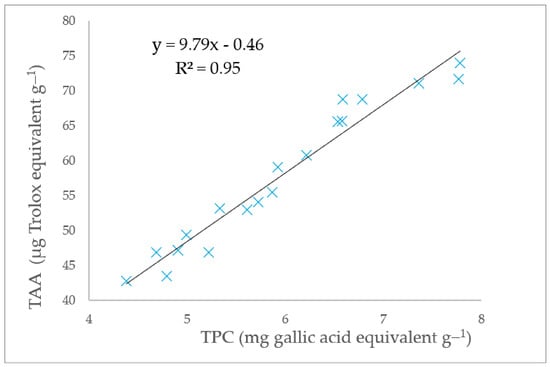
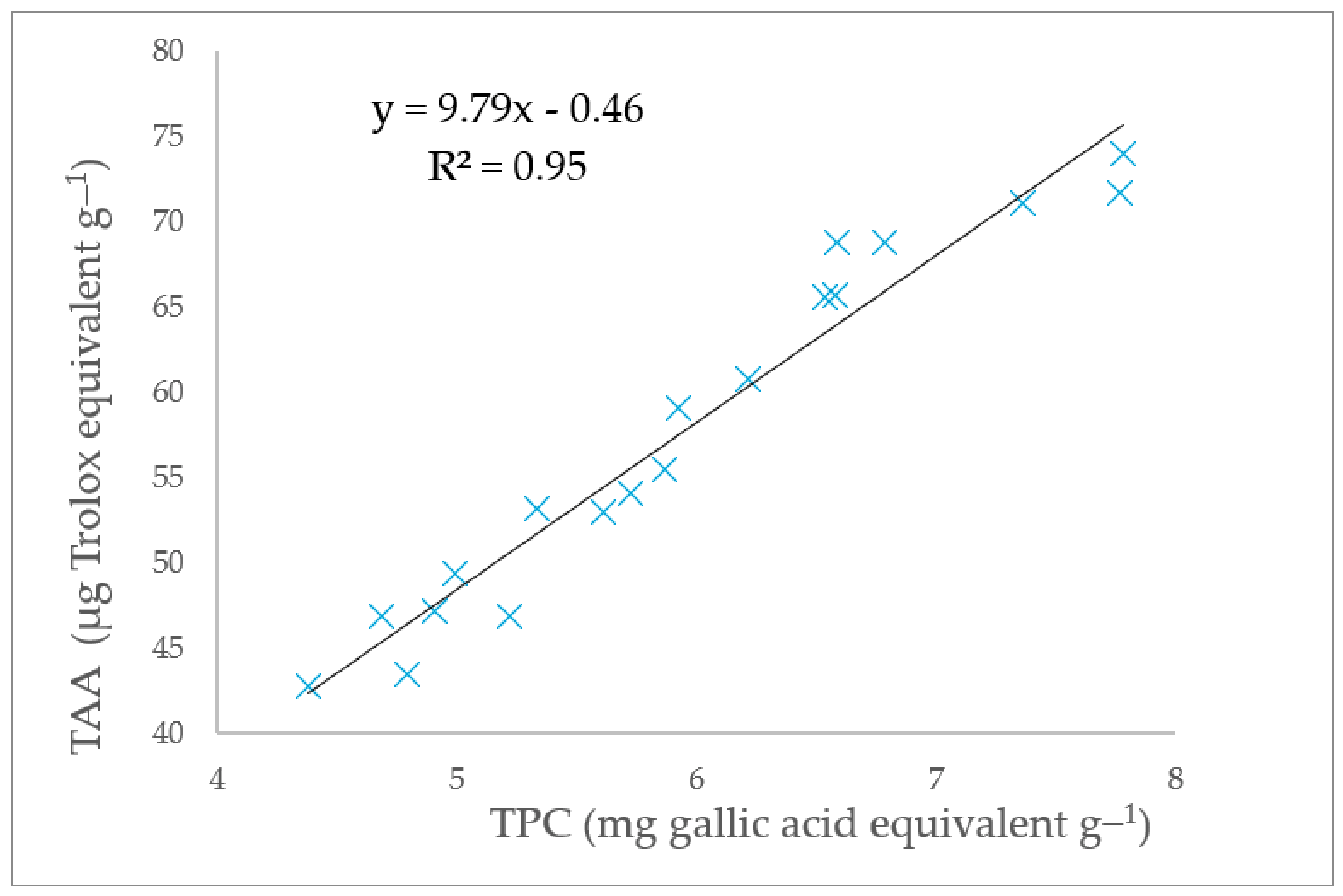
During the mechanical extraction of virgin olive oil, most of the hydrophilic phenolic compounds are retained in the aqueous phase and, to a lesser extent, in the solid by-products [60,61,62], rendering the pomace exceptionally matrix-rich in phenolic compounds with an important antioxidant [63], antimicrobial [17] and antiproliferative [60,64] activity. Our spectrophotometric evaluation (Table 3) corroborates this potential, revealing a high Total Antioxidant Activity (TAA) ranging from 46.72 to 70.21 µmol Trolox equivalent g−1, and an elevated Total Phenolic Content (TPC), spanning from 4.82 to 7.21 mg GAE g−1. Furthermore, as illustrated in Figure 1, a strong significant positive Pearson’s correlation (r = 0.975, p ≤ 0.001) was established between TPC and TAA. This validates that the antioxidant capacity of the pomace is directly governed by its phenolic fraction, a relationship previously reported in olive cake [65] and wet pomace [66].
Figure 1.
Correlation between total phenolic compounds (TPC) and total antioxidant activity (TAA) of the olive pomaces (Pearson’s correlation coefficient R = 0.975, significance ≤ 0.001).
Statistically, both TAA and TPC were heavily influenced by the olive cultivar and ripening stage (p ≤ 0.001) (Table 2). The highest bioactive concentrations were strictly linked to the early maturation stages (Table 3). Specifically, the green pomaces (PG and MG) exhibited the maximum TAA and TPC values, with the ‘Picual’ green batch leading significantly (7.21 mg GAE g−1). As the fruits transitioned to the ripe stage, a generalized and significant decline in total phenols occurred in both cultivars, converging at lower, statistically similar values (4.82 mg GAE g−1 for MR and 5.48 mg GAE g−1 for PR) (p > 0.05). This progressive depletion of total phenolic pools during ripening is a widely acknowledged physiological phenomenon, heavily dependent on the cultivar’s specific enzymatic machinery, and it is consistent with the evolution [15,16].
However, the macroscopic measurement of TPC masks the complex biotransformation occurring at the molecular level, which was elucidated via HPLC profiling, an effective approach for olive pomace, as has been demonstrated by Malapert et al. (2018) [67]. As shown in the statistical evaluation (Table 4), the individual phenolic profile was significantly dictated by cultivar and ripeness. Specifically, significant differences (p ≤ 0.05) were detected for hydroxytyrosol, oleuropein, tyrosol, luteolin-7-O-glucoside, and p-coumaric acid, while verbascoside + rutin and apigenin-7-O-glucoside remained unaffected by these factors. Interestingly, oleuropein was the only individual compound to present a significant interaction (p ≤ 0.001) between cultivar and ripeness.
Table 4.
Interaction between olive cultivar and ripeness factors on the individual phenolic compounds profile of the olive pomaces.
Consistent with the literature that characterizes the olive by-products, the phenolic profile was overwhelmingly dominated by simple phenolic alcohols, predominantly hydroxytyrosol (3,4-DHPEA) and other derivatives of oleuropein hydrolysis [53,67,68].
As quantified in Table 5, hydroxytyrosol represented a staggering 70–85% of the total quantified individual phenols across all batches. Crucially, the evolution of specific compounds highlighted the classic hydrolytic pathways active during ripening and milling [69]. Oleuropein, the primary bitter secoiridoid in unripe olives, reached its maximum concentration in the PG pomace (15.52 μg mL−1 extract), being significantly higher (p ≤ 0.001) than in all other batches. Conversely, hydroxytyrosol concentrations spiked significantly (p ≤ 0.01) as maturation advanced, particularly in the MR batch, yielding a maximum of 111.01 μg mL−1 extract.
Table 5.
Effect of cultivar and ripening on the individual phenolic compounds profile of the olive pomaces (μg mL−1 extract).
This inverse dynamic illustrates the endogenous enzymatic hydrolysis of complex secoiridoids (like oleuropein) into their simpler aglycones and ultimately into hydroxytyrosol as the fruit senesces. Specifically, this process is governed by the sequential action of endogenous β-glucosidases and esterases; as cellular compartmentalization naturally breaks down during advanced ripening, these enzymes gain access to oleuropein, cleaving their glucose moiety and ester bonds to release free hydroxytyrosol [19]. The advanced Ripening Index of the ‘Morisca’ ripe olives (RI 4.96) fundamentally explains this maximized accumulation of hydroxytyrosol, reflecting behaviors extensively described by Bouaziz et al. (2004) and Gómez-Rico et al. (2008) [19,69] for diverse Spanish cultivars. Other minor compounds, such as tyrosol and trans-ferulic acid, consistently decreased with ripeness (p ≤ 0.01), further illustrating the complex, compound-specific metabolic shifts.
Lastly, this comprehensive bioactive characterization provides crucial baseline data for the rational valorization of olive pomace. For broad-spectrum applications requiring maximal total antioxidant coverage and intact complex polyphenols, the green batches (particularly ‘Picual’) are the optimal choice. Conversely, despite its lower total phenolic content, the ripe ‘Morisca’ pomace emerges as an unparalleled, high-yield matrix for the targeted extraction and purification of bioactive hydroxytyrosol.
3.4. Microbial Quality of Fresh Olive Pomace
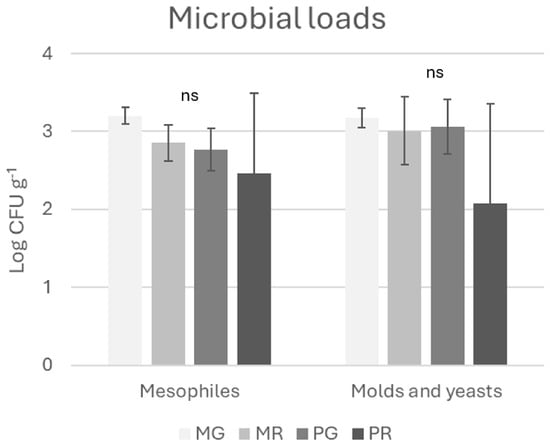
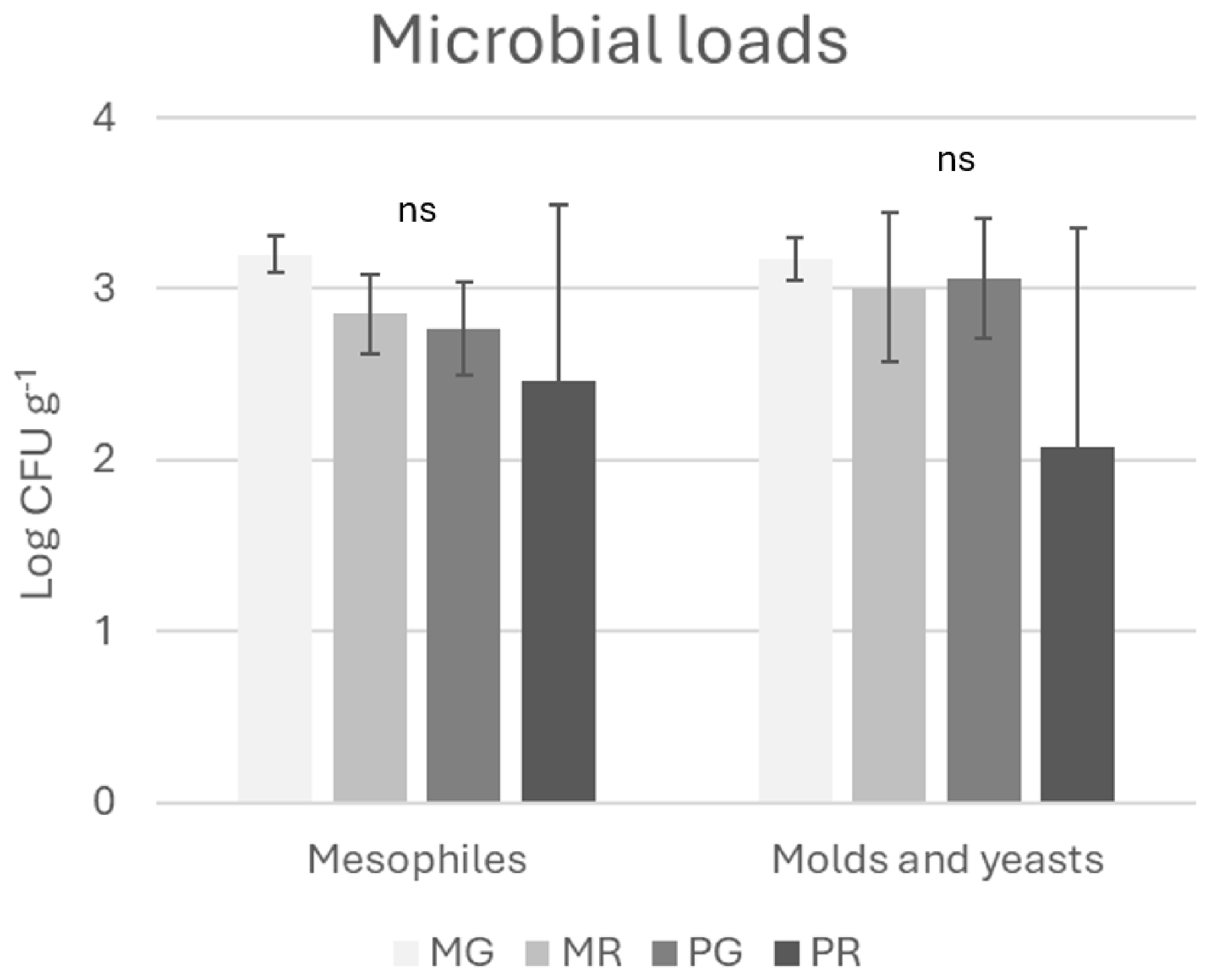
The microbiological safety of raw by-products is a mandatory prerequisite for their reintroduction into the food chain. As shown in Figure 2, the microbial loads were not affected by the olive batch, exhibiting similar loads (p > 0.05) across all evaluated pomace batches, regardless of the olive cultivar or ripening stage.
Figure 2.
Microbiological loads on olive pomace. CFU: colony-forming units. MG: ‘Morisca’-Green, MR: ‘Morisca’-Ripe, PG: ‘Picual’-Green, PR: ‘Picual’-Ripe. Significance levels: ns p > 0.05.
Specifically, total aerobic mesophilic bacteria ranged from 2.46 to 3.20 log CFU g−1, and molds and yeasts ranged from 2.08 to 3.17 log CFU g−1. Crucially, Enterobacteriaceae were not detected in any of the samples (<10 CFU g−1). Despite the scarcity of literature regarding the precise quantification of microbial loads in solid olive pomace, the presence of mesophiles and yeasts was expected. This is primarily due to their natural presence in the olive fruit microbiome [70]. Furthermore, it is worth considering that the standard hygiene conditions of industrial milling facilities inherently differ from strictly controlled laboratory environments. Consequently, this native microbiota is easily transferred during the industrial oil extraction process into the resulting by-products, such as wastewater [71], wet pomace [72], and solid pomace [73].
Low microbial counts and Enterobacteriaceae absent in these fresh matrices may have originated from the physicochemical environment inherent to the pomace itself. The natural acidity of the fresh matrix, coupled with the massive concentration of bioactive phenols we detected in the extracts (reaching up to 7.21 mg GAE g−1), could be the cause of an antimicrobial hurdle. Phenolic compounds—particularly hydroxytyrosol and complex secoiridoids—are well-documented for their capacity to disrupt bacterial cell membranes and effectively inhibit microbial proliferation. This intrinsic bio-preservative effect corroborates the findings of Nunes et al. (2021) and Wahdan et al. (2018) [17,64], who highlighted the antibacterial properties derived from olive pomace phenolic profiles.
Consequently, this restrictive microenvironment naturally controls the microbial populations, ensuring they remain strictly within the safety thresholds recommended by international guidelines like the Codex Alimentarius. These results confirm that raw pomace from both ‘Morisca’ and ‘Picual’ cultivars possesses the baseline microbiological safety required for direct upcycling into functional food additives. This definitely overcomes a critical yet frequently overlooked barrier in olive waste valorization, strongly echoing the safety and nutritional viability assessments recently proposed by Ribeiro et al. (2021) [60] for olive pomace powders.
3.5. Principal Components Analysis (PCA)
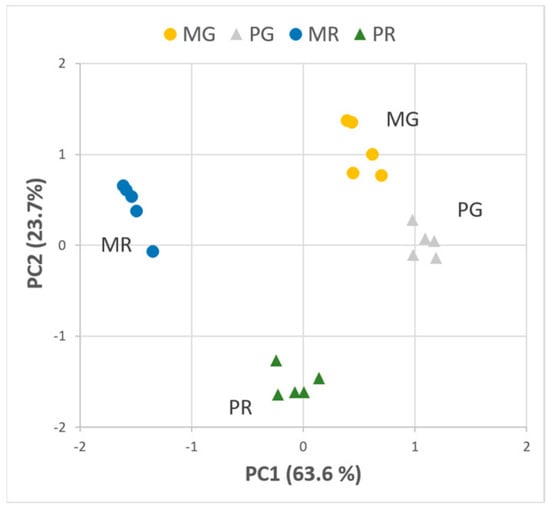
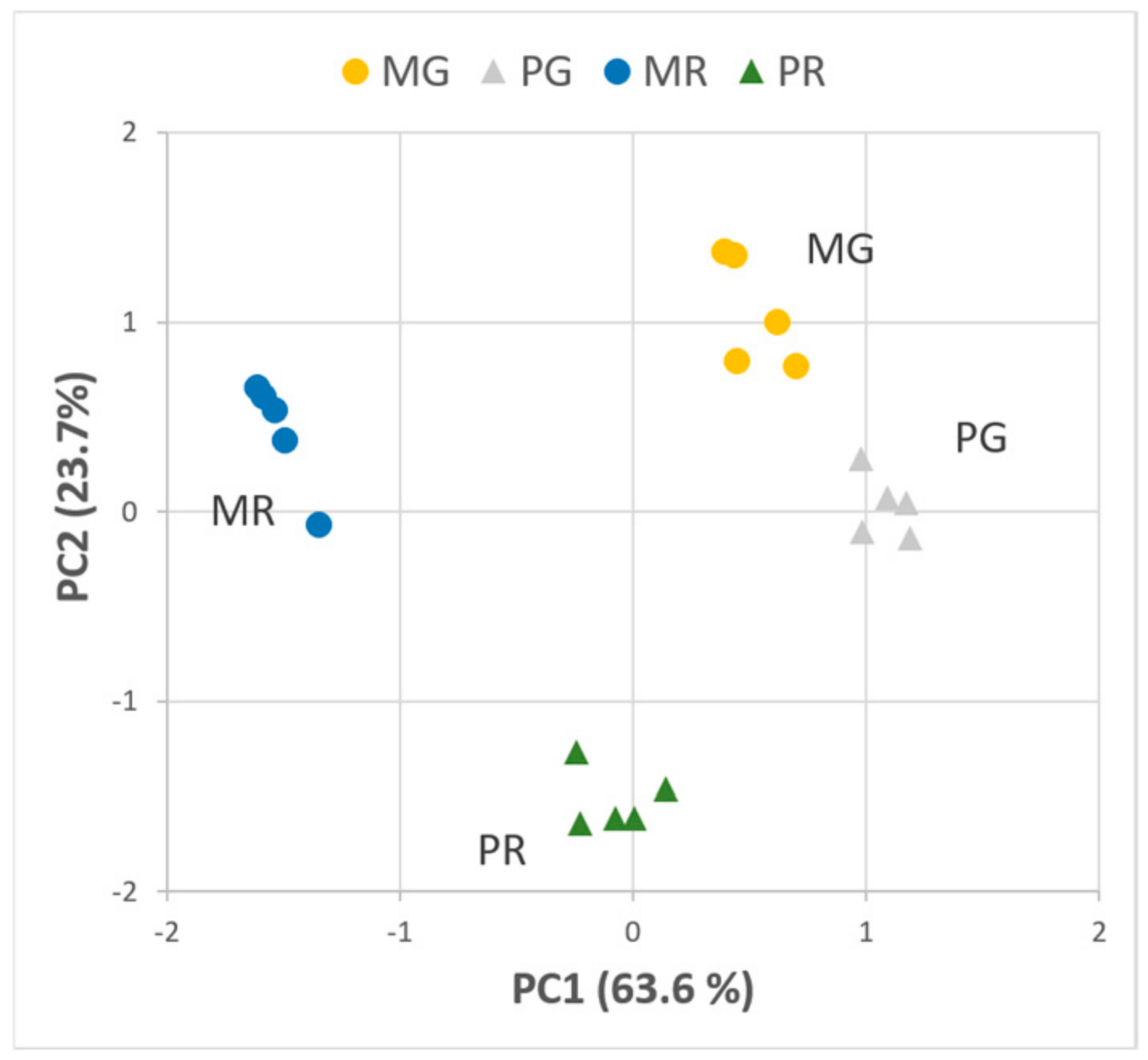
To facilitate a clearer vision of the complex multivariate dataset obtained and to identify the underlying structural patterns driving the differentiation of the olive pomace batches, a Principal Component Analysis (PCA) was performed. The first two principal components (PC1 and PC2) accounted for 87.3% of the total variance (63.6% and 23.7%, respectively), ensuring a robust representation of the original multidimensional data in a simplified two-dimensional space.
The score plot of the samples (Figure 3) reveals a distinct and complete spatial separation of the four evaluated batches.
Figure 3.
Score spot of the samples, obtained in the principal component analysis (PCA). MG: ‘Morisca’-Green, MR: ‘Morisca’-Ripe, PG: ‘Picual’-Green, PR: ‘Picual’-Ripe.
This visual clustering supports the univariate ANOVA results, confirming that both olive cultivar and ripening stage profoundly dictate the overall physicochemical and bioactive profile of the pomace. Interestingly, while the green batches (MG and PG) clustered relatively closely together in the right quadrants, the ripe batches (MR and PR) exhibited a drastic divergence, being located in extreme opposite quadrants (left and bottom, respectively). This geometric distribution is coherent with the physiological states detailed previously in Table 1. The initial physiological similarity of the green fruits (RI 0.30 and 0.35) yielded comparable pomace matrices. Conversely, the significant ontogenetic gap between the harvested ripe ‘Morisca’ (RI 4.96) and ripe ‘Picual’ (RI 3.12) fruits drove a massive physicochemical differentiation.
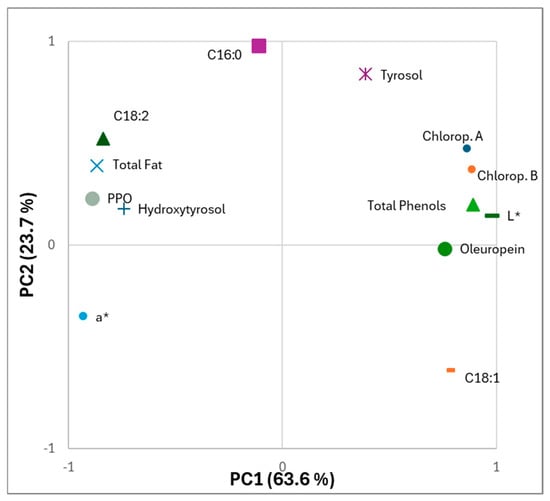
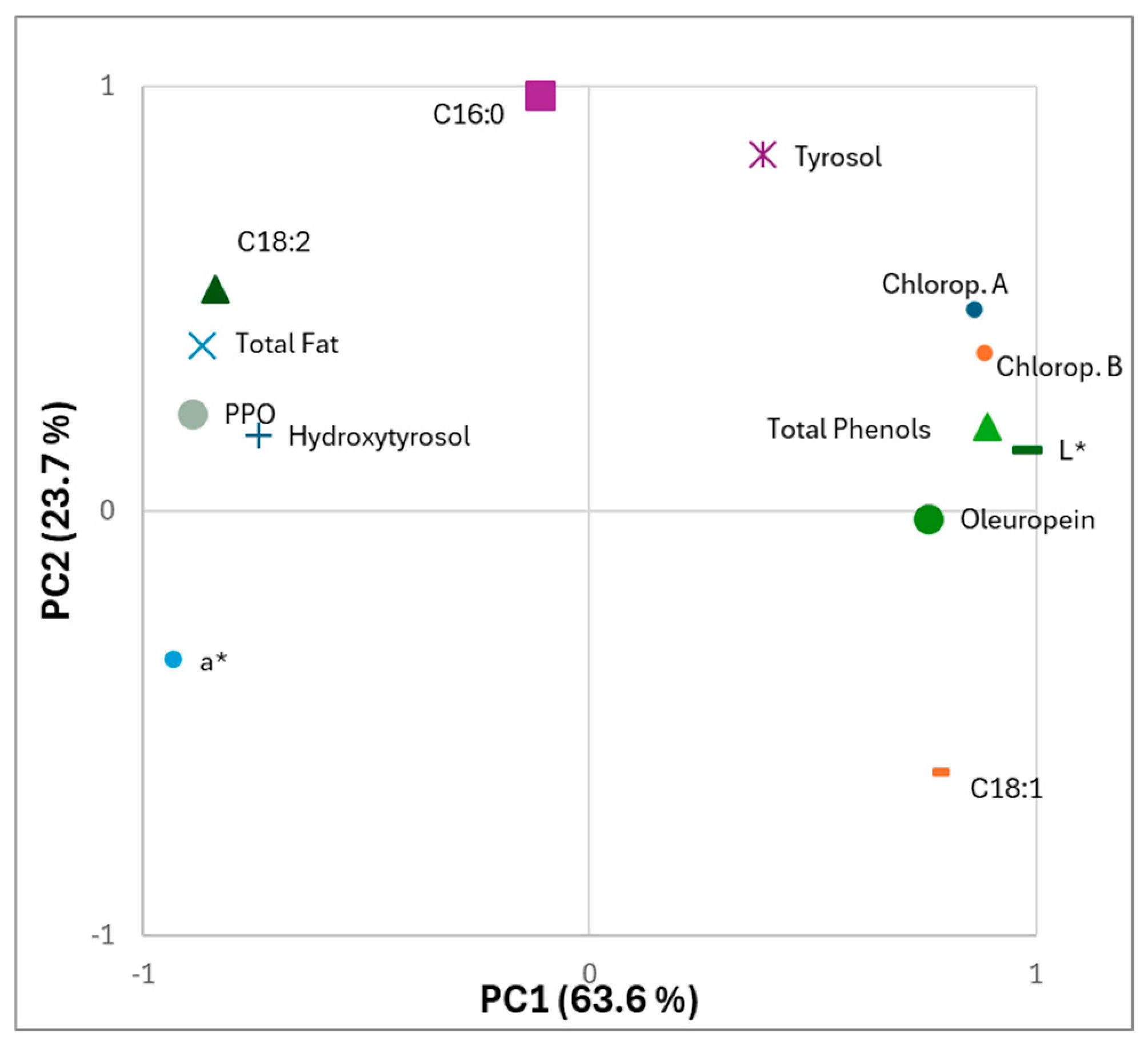
The variable loadings plot (Figure 4) elucidates the specific biochemical markers responsible for this multivariate separation. PC1, which explains most of the variance (63.6%), is primarily driven by the maturation process and oxidative enzymatic activity. Specifically, PC1 is heavily negatively correlated with redness (a*), total fat, PPO activity, linoleic acid (C18:2), and hydroxytyrosol. This specific combination of factors strongly pulls the ‘Morisca’ Ripe (MR) batch to the far-left quadrant, identifying it as a highly oxidized matrix rich in specific PUFAs and simple phenolic aglycones.
Figure 4.
Score spot of the variables according to the principal component analysis (PCA).
Conversely, PC1 is positively correlated with luminosity (L*), total phenolic content (TPC), total antioxidant activity (TAA), oleuropein, and both chlorophylls a and b. This strong positive loading heavily influences the placement of the green batches (MG and PG) on the right side of the plot. PCA visually characterizes these early-harvest pomaces as luminous, unoxidized matrices, exceptionally rich in intact complex secoiridoids and natural green pigments.
Finally, PC2 (23.7%) primarily drives the vertical separation between the two distinct ripe batches. The ‘Picual’ Ripe (PR) batch is pulled into the lower-left quadrant by its high retention of oleic acid (C18:1) and the a* color coordinate, while being distinctly separated from compounds exhibiting high positive loadings on PC2, such as palmitic acid (C16:0) and tyrosol.
Ultimately, this multivariate model encapsulates the univariate findings discussed in previous sections. It visually confirms that industrial upcycling strategies for olive pomace must be adequately selective: early-harvest (green) pomaces inherently group as optimal sources for broad-spectrum antioxidants and natural pigments, whereas late-harvest (ripe) pomaces—especially from the ‘Morisca’ cultivar— diverge structurally, serving as specialized matrices. This makes them ideal candidates for sustainable fractionation methods, such as those proposed by Ribeiro et al. (2020) [61], which allows for the selective extraction of hydroxytyrosol, a highly valuable compound.
4. Conclusions
The valorization of fresh olive pomace from ‘Morisca’ and ‘Picual’ cultivars as a natural food additive appears to be both microbiologically safe and technologically viable. Regardless of the cultivar or ripening stage, baseline microbial loads strictly comply with international safety guidelines for food ingredients, such as the Codex Alimentarius. Crucially, Enterobacteriaceae were absent in all evaluated batches. This confirms the baseline safety required to directly upcycle these regional by-products into the food chain.
Furthermore, this study demonstrates that standardizing a single extraction protocol for olive pomace is thermodynamically flawed. Extraction requirements dynamically shift depending on the matrix’s ontogenic state. Based on this predictive framework, we identified two targeted industrial strategies. Green pomaces, particularly from the ‘Picual’ cultivar, offer maximum total antioxidant capacity and a highly stable oleic acid profile. Therefore, they are the optimal choice for broad-spectrum functional applications. Conversely, mature ‘Morisca’ pomace provides a highly specific matrix. Despite a general decline in total phenols during ripening, it yields exceptionally high concentrations of hydroxytyrosol.
However, exploiting this mature ‘Morisca’ pomace reveals a critical technological hurdle. This specific matrix exhibits a severe spike in endogenous polyphenol oxidase (PPO) activity. This rapid enzymatic browning threatens the stability of its valuable phenolic fraction during industrial processing. To overcome this barrier, biorefineries must integrate targeted stabilization steps immediately after milling. Future research should prioritize non-thermal technologies, such as High Hydrostatic Pressure (HHP), to effectively inactivate these oxidative enzymes while preserving thermolabile bioactives. Implementing these advanced treatments is essential to ensure the functional quality of olive pomace as a high-value ingredient.
Supplementary Materials
The following supporting information can be downloaded at: https://www.mdpi.com/article/10.3390/foods15224123/s1, Table S1: Experimental design layout. Central Composite Design (CCD) matrix and the observed responses for Total Phenolic Content (TPC) in green olive pomace; Table S2: Experimental design layout. Central Composite Design (CCD) matrix and the observed responses for Total Phenolic Content (TPC) in ripe olive pomace; Table S3: Analysis of Variance (ANOVA) and fit statistics for the TPC response surface models; Table S4: Experimental design layout of reference samples; Table S5: Statistical Validation of the Predictive MLR model for Chlorophyll a; Table S6: Statistical Validation of the Predictive MLR model for Chlorophyll b; Figure S1: 3D response surface plots illustrating the interactive effects of temperature and ethanol concentration on the Total Phenolic Content (TPC) for (A) green olive pomace and (B) mature olive pomace, at their respective optimal extraction times; Figure S2: Representative Gas Chromatography (GC-FID) chromatogram of the standard mixture used for the identification and quantification of. Fatty Acid Methyl Esters (FAMEs) derived from the olive pomace. (A) Chromatogram of the standard mix (Supelco, 37 FAME mix); (B) table of calibration of peaks-FAME; (C) Fatty profile of the four types of olive pomaces; Figure S3: Representative HPLC-DAD/FLD chromatogram of the standards used for the identification and quantification of phenolic compounds. (A) (255 nm) Oleuropein standard; (B) (320 nm) Verbascoside Standard; (C) (320 nm) standard mix; (D) (350 nm) standard mix; (E) Fluorescent standard mix; Figure S4: Representative high-performance liquid chromatography (HPLC) profiles of the olive pomace phenolic extracts. (A) 255 nm; (B) 320 nm; (C) 350 nm; (D) Fluorescence. Equation (S1): Obtained equations for chlorophylls quantification.
Author Contributions
Conceptualization, J.J.G.-P. and M.A.M.-C.; methodology, M.C.d.V. and B.N.; software, M.C.d.V. and B.N.; validation, M.C.d.V.; formal analysis, M.C.d.V. and A.M.T.; investigation, M.C.d.V. and J.J.G.-P.; data curation, M.C.d.V. and B.N.; writing—original draft preparation, M.C.d.V.; writing—review and editing, M.C.d.V., B.N. and J.J.G.-P.; project administration, J.J.G.-P.; funding acquisition, J.J.G.-P. All authors have read and agreed to the published version of the manuscript.
Funding
The results of this study were obtained as part of the “InnoTecConEx” project, which falls under the Operational Program for Extremadura FEDER 2021–2027. Action 1A1103: Development of capacity for scientific research, technological development, and innovation, 85% co-financed.
Institutional Review Board Statement
Not applicable.
Informed Consent Statement
Not applicable.
Data Availability Statement
The original contributions presented in this study are included in the article/Supplementary Material. Further inquiries can be directed to the corresponding author.
Acknowledgments
We thank P. Redondo and S. Ardila for their technical assistance. The project falls “InnoTecConEx” within the framework of the ERDF Operational Programme Extremadura 2021–2027. Action 1A1103. Development of scientific research capacity, technological development and innovation, co-financed at 85%.
Conflicts of Interest
The authors declare no conflicts of interest.
Abbreviations
The following abbreviations are used in this manuscript:
| RSM | Response surface methodology |
| CCD | Central composite design |
| PPO | Polyphenol oxidase |
| CFU | Colony-forming units |
| PCA | Principal component analysis |
| RI | Ripening index |
| MG | ‘Morisca’ green |
| MR | ‘Morisca’ ripe |
| PG | ‘Picual’ green |
| PR | ‘Picual’ ripe |
| GAE | Gallic acid equivalent |
| MLR | Multiple Linear Regression |
| AOAC | Association of Official Analytical Chemists |
| FAMEs | Fatty acid methyl esters |
| FID | Flame ionization detector |
| NDF | Neutral detergent fiber |
| TPC | Total phenolic content |
| TAA | Antioxidant activity |
| ABTS | 2,2′-azino-bis(3-ethylbenzothiazoline-6-sulfonic acid) |
| DAD | Diode array detector |
| FLD | Fluorescence detector |
| ANOVA | Analysis of variance |
| MAE/UAE | Microwave/Ultrasound-Assisted extractions |
| NADES | Deep eutectic solvents |
| POD | Peroxidase |
| FEDNA | Spanish Foundation for the Development of Animal Nutrition |
| DM | Dry matter |
| PUFA | Polyunsaturated fatty acid |
| MUFA | Monounsaturated fatty acid |
| UA | Units of activity |
| PC1 | Principal component 1 |
| PC2 | Principal component 2 |
References
- International Olive Council KEY-Figures on the World Market for Olive Oils. 2025. Available online: https://www.internationaloliveoil.org/what-we-do/statistics/#introduction (accessed on 5 November 2026).
- International Olive Council Olive and Olive Oil Health Information System. 2026. Available online: https://www.internationaloliveoil.org/wp-content/uploads/2025/12/122-HO-2025.pdf (accessed on 5 November 2026).
- Souabi, S.; Anouzla, A. Springer Water Wastewater from Olive Oil Production Environmental Impacts, Treatment and Valorisation; Springer International Publishing AG: Cham, Switzerland, 2023. [Google Scholar]
- Nergiz, C.; Ergönül, P.G. Organic Acid Content and Composition of the Olive Fruits during Ripening and Its Relationship with Oil and Sugar. Sci. Hortic. 2009, 122, 216–220. [Google Scholar] [CrossRef] [Scilit]
- Foti, P.; Pino, A.; Romeo, F.V.; Vaccalluzzo, A.; Caggia, C.; Randazzo, C.L. Olive Pomace and Pâté Olive Cake as Suitable Ingredients for Food and Feed. Microorganisms 2022, 10, 237. [Google Scholar] [CrossRef] [Scilit] [PubMed]
- Ramadan, M.F.; Farag, M.A. Mediterranean Fruits Bio-Wastes: Chemistry, Functionality and Technological Applications; Springer International Publishing: Cham, Switzerland, 2022. [Google Scholar]
- Mateos, R.; Sarria, B.; Bravo, L. Nutritional and Other Health Properties of Olive Pomace Oil. Crit. Rev. Food Sci. Nutr. 2019, 60, 3506–3521. [Google Scholar] [CrossRef] [Scilit] [PubMed]
- Franzen Ramos, L.; Pluschke, J.; Bernardes, A.M.; Geißen, S.U. Polyphenols in Food Processing Wastewaters: A Review on Their Identification and Recovery. Clean. Circ. Bioecon. 2023, 5, 100048. [Google Scholar] [CrossRef] [Scilit]
- Gómez-Cruz, I.; del Mar Contreras, M.; Romero, I.; Castro, E. Towards the Integral Valorization of Olive Pomace-Derived Biomasses through Biorefinery Strategies. ChemBioEng Rev. 2024, 11, 253–277. [Google Scholar] [CrossRef] [Scilit]
- United Nations Department of Economic and Social Affairs. The Sustainable Development Goals Report 2025; Beltran, L.M.C., Ed.; United Nations Department of Economic and Social Affairs: New York, NY, USA, 2025. [Google Scholar]
- Chabni, A.; Bañares, C.; Sanchez-Rey, I.; Torres, C.F. Active Biodegradable Packaging Films Based on the Revalorization of Food-Grade Olive Oil Mill By-Products. Appl. Sci. 2025, 15, 312. [Google Scholar] [CrossRef] [Scilit]
- García-Pastor, M.E.; Ródenas-Soriano, M.; Dobón-Suárez, A.; Zapata, P.J.; Giménez, M.J. Use of Olive Industry By-Products for Value-Added Food Development. Agronomy 2023, 13, 718. [Google Scholar] [CrossRef] [Scilit]
- Dauber, C.; Parente, E.; Zucca, M.P.; Gámbaro, A.; Vieitez, I. Olea Europea and By-Products: Extraction Methods and Cosmetic Applications. Cosmetics 2023, 10, 112. [Google Scholar] [CrossRef] [Scilit]
- Difonzo, G.; Troilo, M.; Squeo, G.; Pasqualone, A.; Caponio, F. Functional Compounds from Olive Pomace to Obtain High-Added Value Foods—A Review. J. Sci. Food Agric. 2021, 101, 15–26. [Google Scholar] [CrossRef] [Scilit] [PubMed]
- Emmanouilidou, M.G.; Koukourikou-Petridou, M.; Gerasopoulos, D.; Kyriacou, M.C. Evolution of Physicochemical Constitution and Cultivar-Differential Maturity Configuration in Olive (Olea europaea L.) Fruit. Sci. Hortic. 2020, 272, 109516. [Google Scholar] [CrossRef] [Scilit]
- Ortega-García, F.; Peragón, J. Phenylalanine Ammonia-Lyase, Polyphenol Oxidase, and Phenol Concentration in Fruits of Olea europaea L. Cv. Picual, Verdial, Arbequina, and Frantoio during Ripening. J. Agric. Food Chem. 2009, 57, 10331–10340. [Google Scholar] [CrossRef] [Scilit] [PubMed]
- Nunes, M.A.; Palmeira, J.D.; Melo, D.; Machado, S.; Lobo, J.C.; Costa, A.S.G.; Alves, R.C.; Ferreira, H.; Oliveira, M.B.P.P. Chemical Composition and Antimicrobial Activity of a New Olive Pomace Functional Ingredient. Pharmaceuticals 2021, 14, 913. [Google Scholar] [CrossRef] [Scilit] [PubMed]
- Gandul-Rojas, B.; Cepero, M.R.L.; Mínguez-Mosquera, M.I. Chlorophyll and Carotenoid Patterns in Olive Fruits, Olea europaea Cv. Arbequina. J. Agric. Food Chem. 1999, 47, 2207–2212. [Google Scholar] [CrossRef] [Scilit] [PubMed]
- Bouaziz, M.; Chamkha, M.; Sayadi, S. Comparative Study on Phenolic Content and Antioxidant Activity during Maturation of the Olive Cultivar Chemlali from Tunisia. J. Agric. Food Chem. 2004, 52, 5476–5481. [Google Scholar] [CrossRef] [Scilit] [PubMed]
- Barranco Navero, D.; Fernandez Escobar, R.; Rallo Romero, L. El Cultivo del Olivo, 8th ed.; Ediciones Mundi-Prensa: Madrid, Spain, 2025. [Google Scholar]
- Regulation (EC) No 2073/2005 Commission Regulation (EC) No 2073/2005 of 15 November 2005 on Microbiological Criteria for Foodstuffs. 2005. Available online: https://eur-lex.europa.eu/eli/reg/2005/2073/oj/eng (accessed on 5 November 2026).
- Fernández-León, M.F.; Lozano, M.; Ayuso, M.C.; Fernández-León, A.M.; González-Gómez, D. Fast and Accurate Alternative UV-Chemometric Method for the Determination of Chlorophyll A and B in Broccoli (Brassica Oleracea Italica) and Cabbage (Brassica Oleracea Sabauda) Plants. J. Food Compos. Anal. 2010, 23, 809–813. [Google Scholar] [CrossRef] [Scilit]
- AOAC. Official Methods of Analysis of the Association of Official Analytical Chemists, 20th ed.; AOAC Inc., Ed.; AOAC: Washington, DC, USA, 2016. [Google Scholar]
- Folch, J.; Lees, M.; Sloane, G.H. A simple method for the isolation and purification of total lipides from animal tissues. J. Biol. Chem. 1957, 226, 497–509. [Google Scholar] [CrossRef] [Scilit]
- Van Soest, P.J.; Robertson, J.B.; Lewis, B.A. Methods for Dietary Fiber, Neutral Detergent Fiber, and Nonstarch Polysaccharides in Relation to Animal Nutrition. J. Dairy Sci. 1991, 74, 3583–3597. [Google Scholar] [CrossRef] [Scilit] [PubMed]
- Garcia-Palazon, A.; Suthanthangjai, W.; Kajda, P.; Zabetakis, I. The Effects of High Hydrostatic Pressure on β-Glucosidase, Peroxidase and Polyphenoloxidase in Red Raspberry (Rubus Idaeus) and Strawberry (Fragaria x Ananassa). Food Chem. 2004, 88, 7–10. [Google Scholar] [CrossRef] [Scilit]
- Singleton, V.L.; Orthofer, R.; Lamuela-Raventós, R.M. Analysis of Total Phenols and Other Oxidation Substrates and Antioxidants by Means of Folin-Ciocalteu Reagent. Methods Enzymol. 1999, 299, 152–178. [Google Scholar] [CrossRef] [Scilit]
- Re, R.; Pellegrini, N.; Proteggente, A.; Pannala, A.; Yang, M.; Rice-Evans, C. Antioxidant Activity Applying an Improved ABTS Radical Cation Decolorization Assay. Free Radic. Biol. Med. 1999, 26, 1231–1237. [Google Scholar] [CrossRef] [Scilit] [PubMed]
- ISO 4833-1:2013; Microbiology of the Food Chain. International Organization for Standardization: Geneva, Switzerland, 2013.
- ISO 21527-2:2008; Microbiology of Food and Animal Feeding Stuffs—Horizontal Method for the Enumeration of Yeasts and Moulds 2008. International Organization for Standardization: Geneva, Switzerland, 2018.
- ISO 21528-1:2017; Microbiology of the Food Chain—Horizontal Method for the Detection and Enumeration of Enterobacteriaceae—Part 1: Detection of Enterobacteriaceae 2017. International Organization for Standardization: Geneva, Switzerland, 2017.
- Conidi, C.; Egea-Corbacho, A.; Cassano, A. A Combination of Aqueous Extraction and Polymeric Membranes as a Sustainable Process for the Recovery of Polyphenols from Olive Mill Solid Wastes. Polymers 2019, 11, 1868. [Google Scholar] [CrossRef] [Scilit] [PubMed]
- Zamani, S.; Agu, O.S.; Meda, V. Valorization of Fruit and Vegetable Waste and By-Products into Bioactive-Rich Powders for Functional Food Applications: A Review. Food Bioproc. Tech. 2026, 19, 213. [Google Scholar] [CrossRef] [Scilit]
- Okur, I.; Oztop, M.H.; Alpas, H. Optimization and Comparison of High-Pressure-Assisted Extraction of Phenolic Compounds from Olive Pomace. ACS Food Sci. Technol. 2022, 2, 1862–1869. [Google Scholar] [CrossRef] [Scilit]
- Sinrod, A.J.G.; Avena-Bustillos, R.J.; Olson, D.A.; Crawford, L.M.; Wang, S.C.; McHugh, T.H. Phenolics and Antioxidant Capacity of Pitted Olive Pomace Affected by Three Drying Technologies. J. Food Sci. 2019, 84, 412–420. [Google Scholar] [CrossRef] [Scilit] [PubMed]
- Barros, A.I.; Freire, I.; Goncalves, B.; Bacelar, E.; Gomes, S.; Lopes, J.; Guedes-Pinto, H.; Martins-Lopes, P. Evaluation of Chemical and Phenotypic Changes in Blanqueta, Cobrancosa, and Galega during Olive Fruits Ripening. CYTA-J. Food 2013, 11, 136–141. [Google Scholar] [CrossRef] [Scilit]
- Issaoui, M.; Mechri, B.; Echbili, A.; Dabbou, S.; Yangui, A.; Belguith, H.; Trigui, A.; Hammami, M. Chemometric characterization of five tunisian varietals of Olea europaea L. olive fruit according to different maturation indices. J. Food Lipids 2008, 15, 277–296. [Google Scholar] [CrossRef] [Scilit]
- Yousfi, K.; Cert, R.M.; García, J.M. Changes in Quality and Phenolic Compounds of Virgin Olive Oils during Objectively Described Fruit Maturation. Eur. Food Res. Technol. 2006, 223, 117–124. [Google Scholar] [CrossRef] [Scilit]
- Ezenarro, J.; García-Pizarro, Á.; Busto, O.; de Juan, A.; Boqué, R. Analysing Olive Ripening with Digital Image RGB Histograms. Anal. Chim. Acta 2023, 1280, 341884. [Google Scholar] [CrossRef] [Scilit] [PubMed]
- Ortenzi, L.; Figorilli, S.; Costa, C.; Pallottino, F.; Violino, S.; Pagano, M.; Imperi, G.; Manganiello, R.; Lanza, B.; Antonucci, F. A Machine Vision Rapid Method to Determine the Ripeness Degree of Olive Lots. Sensors 2021, 21, 2940. [Google Scholar] [CrossRef] [Scilit] [PubMed]
- Gallardo-Guerrero, L.; Roca, M.; Mínguez-Mosquera, M.I. Distribution of Chlorophylls and Carotenoids in Ripening Olives and Between Oil and Alperujo When Processed Using a Two-Phase Extraction System. J. Am. Oil Chem. Soc. 2002, 79, 105–109. [Google Scholar] [CrossRef] [Scilit]
- Hachicha Hbaieb, R.; Kotti, F.; García-Rodríguez, R.; Gargouri, M.; Sanz, C.; Pérez, A.G. Monitoring Endogenous Enzymes during Olive Fruit Ripening and Storage: Correlation with Virgin Olive Oil Phenolic Profiles. Food Chem. 2015, 174, 240–247. [Google Scholar] [CrossRef] [Scilit] [PubMed]
- Roca, M.; Mínguez-Mosquera, M.I. Changes in Chloroplast Pigments of Olive Varieties during Fruit Ripening. J. Agric. Food Chem. 2001, 49, 832–839. [Google Scholar] [CrossRef] [Scilit] [PubMed]
- Ramírez, E.; Medina, E.; Brenes, M.; Romero, C. Endogenous Enzymes Involved in the Transformation of Oleuropein in Spanish Table Olive Varieties. J. Agric. Food Chem. 2014, 62, 9569–9575. [Google Scholar] [CrossRef] [Scilit] [PubMed]
- Isabel Minguez-Mosquera, M.; Gallardo-Guerrero, L. Role of chlorophyllase in chlorophyll metabolism in olives cv. gordal. Phytochemistry 1996, 41, 691–697. [Google Scholar] [CrossRef] [Scilit]
- Sciancalepore, V.; Longone, V. Polyphenol Oxidase Activity and Browning in Green Olives. J. Agric. Food Chem. 1984, 32, 320–321. [Google Scholar] [CrossRef] [Scilit]
- Sommer, A.; Ne’eman, E.; Steffens, J.C.; Mayer, A.M.; Harel, E. Import, Targeting, and Processing of a Plant Polyphenol Oxidase. Plant Physiol. 1994, 105, 1301. [Google Scholar] [CrossRef] [Scilit] [PubMed]
- Goldental-Cohen, S.; Biton, I.; Many, Y.; Ben-Sason, S.; Zemach, H.; Avidan, B.; Ben-Ari, G. Green Olive Browning Differ Between Cultivars. Front. Plant Sci. 2019, 10, 1260. [Google Scholar] [CrossRef] [Scilit] [PubMed]
- Jovanovichs, M.R.C.; dos Santos, B.A.; Sant’Anna Monteiro, C.; Pedro, D.; Correa, L.P.; Cordeiro, M.W.S.; Pinton, M.B.; Cichoski, A.J.; Mallmann, C.A.; Wagner, R.; et al. Micronized Olive Pomace: A Sustainable and Innovative Strategy to Improve the Oxidative Stability of Omega-3 Enriched Salamis. Meat Sci. 2025, 221, 109715. [Google Scholar] [CrossRef] [Scilit] [PubMed]
- Benincasa, C.; Pellegrino, M.; Veltri, L.; Claps, S.; Fallara, C.; Perri, E. Dried Destoned Virgin Olive Pomace: A Promising New by-Product from Pomace Extraction Process. Molecules 2021, 26, 4337. [Google Scholar] [CrossRef] [Scilit] [PubMed]
- Molina-Alcaide, E.; Yáñez-Ruiz, D.R. Potential Use of Olive By-Products in Ruminant Feeding: A Review. Anim. Feed Sci. Technol. 2008, 147, 247–264. [Google Scholar] [CrossRef] [Scilit]
- Uribe, E.; Lemus-Mondaca, R.; Vega-Gálvez, A.; López, L.A.; Pereira, K.; López, J.; Ah-Hen, K.; Di Scala, K. Quality Characterization of Waste Olive Cake During Hot Air Drying: Nutritional Aspects and Antioxidant Activity. Food Bioproc. Tech. 2013, 6, 1207–1217. [Google Scholar] [CrossRef] [Scilit]
- Lanza, B.; Cellini, M.; Di Marco, S.; D’amico, E.; Simone, N.; Giansante, L.; Pompilio, A.; Di Loreto, G.; Bacceli, M.; Del Re, P.; et al. Olive Pâté by Multi-Phase Decanter as Potential Source of Bioactive Compounds of Both Nutraceutical and Anticancer Effects. Molecules 2020, 25, 5967. [Google Scholar] [CrossRef] [Scilit] [PubMed]
- Schú, A.I.; Righi, D.C.B.F.; Marcuzzo, N.P.; Souza, O.F.; Stefanello, C.; Speroni, C.S.; Cordeiro, M.W.S.; Pozzatti, M.; Pinton, M.B.; Wagner, R.; et al. Exploring the Benefits of Olive Pomace in Poultry Nutrition: Effects on Egg Quality and Composition. J. Food Compos. Anal. 2025, 145, 107789. [Google Scholar] [CrossRef] [Scilit]
- Ahmed, I.A.M.; AlJuhaimi, F.; Karrar, E.; Uslu, N.; Özcan, M.M. Effect of Fruit Size on Physico-Chemical Properties, Bioactive Components, Phenolics, Fatty Acids and Tocopherol Profiles of ‘Gemlik’ Olive Fruits. Appl. Fruit. Sci. 2025, 67, 77. [Google Scholar] [CrossRef] [Scilit]
- Navajas-Porras, B.; Pérez-Burillo, S.; Morales-Pérez, J.; Rufián-Henares, J.A.; Pastoriza, S. Relationship of Quality Parameters, Antioxidant Capacity and Total Phenolic Content of EVOO with Ripening State and Olive Variety. Food Chem. 2020, 325, 126926. [Google Scholar] [CrossRef] [Scilit] [PubMed]
- Beltrán, G.; Del Río, C.; Sánchez, S.; Martínez, L. Seasonal Changes in Olive Fruit Characteristics and Oil Accumulation during Ripening Process. J. Sci. Food Agric. 2004, 84, 1783–1790. [Google Scholar] [CrossRef] [Scilit]
- Liu, Q.; Wang, C.; Cui, Q.; Fan, Y.; Zhang, J.; Rao, G. Genome-Wide Analysis of the Polyphenol Oxidase Gene Family in Olea europaea Provides Insights into the Mechanism of Enzymatic Browning in Olive Fruit. Antioxidants 2023, 12, 1661. [Google Scholar] [CrossRef] [Scilit] [PubMed]
- Ortega-García, F.; Blanco, S.; Peinado, M.A.; Peragón, J. Polyphenol Oxidase and Its Relationship with Oleuropein concentration in Fruits and Leaves of Olive (Olea europaea) Cv. ‘Picual’ Trees during fruit Ripening. Tree Physiol. 2008, 28, 45–54. [Google Scholar] [CrossRef] [Scilit] [PubMed]
- Ribeiro, T.B.; Oliveira, A.; Coelho, M.; Veiga, M.; Costa, E.M.; Silva, S.; Nunes, J.; Vicente, A.A.; Pintado, M. Are Olive Pomace Powders a Safe Source of Bioactives and Nutrients? J. Sci. Food Agric. 2021, 101, 1963–1978. [Google Scholar] [CrossRef] [Scilit] [PubMed]
- Ribeiro, T.B.; Oliveira, A.L.; Costa, C.; Nunes, J.; Vicente, A.A.; Pintado, M. Total and Sustainable Valorisation of Olive Pomace Using a Fractionation Approach. Appl. Sci. 2020, 10, 6785. [Google Scholar] [CrossRef] [Scilit]
- Suárez, M.; Romero, M.P.; Ramo, T.; Macià, A.; Motilva, M.J. Methods for Preparing Phenolic Extracts from Olive Cake for Potential Application as Food Antioxidants. J. Agric. Food Chem. 2009, 57, 1463–1472. [Google Scholar] [CrossRef] [Scilit] [PubMed]
- Fernández-Prior, M.Á.; Fatuarte, J.C.P.; Oria, A.B.; Viera-Alcaide, I.; Fernández-Bolaños, J.; Rodríguez-Gutiérrez, G. New Liquid Source of Antioxidant Phenolic Compounds in the Olive Oil Industry: Alperujo Water. Foods 2020, 9, 962. [Google Scholar] [CrossRef] [Scilit] [PubMed]
- Wahdan, P.; Taha, T.F.; Dept, B.; Agric, F. In Vitro Antioxidant, Antimicrobial and Anticancer Activities of Olive (Oleaeuropaea L.). J. Agric. Chem. Biotechnol. 2018, 9, 77–83. [Google Scholar] [CrossRef] [Scilit]
- Aludatt, M.H.; Alli, I.; Ereifej, K.; Alhamad, M.; Al-Tawaha, A.R.; Rababah, T. Optimisation, Characterisation and Quantification of Phenolic Compounds in Olive Cake. Food Chem. 2010, 123, 117–122. [Google Scholar] [CrossRef] [Scilit]
- Antónia Nunes, M.; Costa, A.S.G.; Bessada, S.; Santos, J.; Puga, H.; Alves, R.C.; Freitas, V.; Oliveira, M.B.P.P. Olive Pomace as a Valuable Source of Bioactive Compounds: A Study Regarding Its Lipid- and Water-Soluble Components. Sci. Total Environ. 2018, 644, 229–236. [Google Scholar] [CrossRef] [Scilit] [PubMed]
- Malapert, A.; Reboul, E.; Loonis, M.; Dangles, O.; Tomao, V. Direct and Rapid Profiling of Biophenols in Olive Pomace by UHPLC-DAD-MS. Food Anal. Methods 2018, 11, 1001–1010. [Google Scholar] [CrossRef] [Scilit]
- Peršurić, Ž.; Saftić Martinović, L.; Zengin, G.; Šarolić, M.; Kraljević Pavelić, S. Characterization of Phenolic and Triacylglycerol Compounds in the Olive Oil By-Product Pâté and Assay of Its Antioxidant and Enzyme Inhibition Activity. LWT 2020, 125, 109225. [Google Scholar] [CrossRef] [Scilit]
- Gómez-Rico, A.; Fregapane, G.; Salvador, M.D. Effect of Cultivar and Ripening on Minor Components in Spanish Olive Fruits and Their Corresponding Virgin Olive Oils. Food Res. Int. 2008, 41, 433–440. [Google Scholar] [CrossRef] [Scilit]
- Georgalaki, M.; Ferrocino, I.; Buzzanca, D.; Anastasiou, R.; Zoumpopoulou, G.; Giabasakou, D.; Ziova, D.; Kokkali, A.; Paraskevakos, G.; Tsakalidou, E. The Natural Fermentation of Greek Tsounati Olives: Microbiome Analysis. Foods 2025, 14, 2568. [Google Scholar] [CrossRef] [Scilit] [PubMed]
- Ammari, M.; Merzouki, M.; Zoufri, I.; El-Byari, Y.; Faiz, K. Assessment of the Impact of the Three Different Methods of Crushing Olives on the Microbiological and Physicochemical Properties of Wastewater in Olive Mills. Environ. Monit. Assess. 2025, 197, 315. [Google Scholar] [CrossRef] [Scilit] [PubMed]
- Avesani, M.; Zapparoli, G. New Records of Fungi in Oleic Ecosystems through Analyzing Olive Oil, Paste, and Pomace from an Olive Oil Production Area in Northern Italy. J. Appl. Microbiol. 2025, 136, lxaf092. [Google Scholar] [CrossRef] [Scilit] [PubMed]
- Jmeii, L.; Soufi, L.; Abid, N.; Mahjoubi, M.; Roussos, S.; Ouzari, H.I.; Cherif, A.; Garna, H. Assessment of Biotechnological Potentials of Strains Isolated from Repasso Olive Pomace in Tunisia. Ann. Microbiol. 2019, 69, 1177–1190. [Google Scholar] [CrossRef] [Scilit]

Disclaimer/Publisher’s Note: The statements, opinions and data contained in all publications are solely those of the individual author(s) and contributor(s) and not of MDPI and/or the editor(s). MDPI and/or the editor(s) disclaim responsibility for any injury to people or property resulting from any ideas, methods, instructions or products referred to in the content. |
© 2026 by the authors. Licensee MDPI, Basel, Switzerland. This article is an open access article distributed under the terms and conditions of the Creative Commons Attribution (CC BY) license.