


Abstract
Background: The gap between positive attitudes toward organic food and actual purchase behaviour remains a puzzle for consumer research. This study asks why some consumers reject organic products despite favourable attitudes, and whether antagonistic and avoidant schemas are associated with this gap. Methods: The sample consisted of 422 adults who completed 20 forced-choice vignettes about organic food scenarios, together with the Pathological Narcissism Inventory (PNI-28), Generalized Anxiety Disorder scale (GAD-7), and Social Desirability Scale (SDS-16). A behavioural domain of the VEGA instrument captured narcissistic schemas. Results: The domain showed moderate internal consistency (α = 0.61, ω = 0.63) and a two-factor structure (KMO = 0.73, p < 0.001). Antagonistic schemas were linked to rejection of organic products (r = 0.28, p < 0.001), and criterion validity was supported through behavioural decision-making vignettes (VN-6) (r = 0.28, p < 0.001, n = 360). Social desirability was not associated with the domain (r = 0.04, p = 0.43). Confirmatory factor analysis indicated good absolute fit (RMSEA = 0.039; χ2/df = 1.65) and near-acceptable incremental fit (CFI = 0.83; TLI = 0.81). Conclusions: Behavioural schemas appear to be associated with organic purchases, though the VEGA domain requires further refinement.
1. Introduction
Organic food consumption occupies an uncomfortable position in consumer research. Surveys consistently show that consumers value organic products, endorse their environmental and health benefits, and express willingness to buy them [1,2]. Yet actual purchase rates remain low, and the gap between stated attitudes and observed behaviour has proven stubborn [3,4,5]. This attitude–behaviour gap is not a marginal anomaly: it constrains the growth of organic food systems and limits the environmental gains that organic production is meant to deliver.
Most explanations of the gap focus on the actor’s perspective—attitudes, values, and perceived behavioural control [6]. These factors matter, but they leave a substantial portion of the variance unexplained. Two consumers with identical positive attitudes toward organic food may behave in opposite ways: one buys organic regularly, the other avoids it entirely. This divergence suggests that something beyond attitudes is at work—something that shapes how individuals interpret organic products and their own likely behaviour in food-choice situations.
One candidate explanation lies in cognitive schemas—stable patterns of interpretation that shape how individuals read situations before deliberate reasoning takes over [2]. Schemas operate beneath conscious evaluation and guide what a person notices, what they expect, and how they respond. In food choice, schemas may determine whether an organic product is perceived as a reasonable option, an unnecessary expense, or a threat to one’s social standing.
Among the schema-level constructs studied in personality research, narcissistic schemas are particularly relevant to food choices that carry moral and status connotations. Narcissism captures individual differences in entitlement, self-enhancement, and sensitivity to social judgment—features that shape how people respond to products framed as virtuous or responsible. In contrast to broader constructs such as the Dark Triad or status consumption [7], narcissism taps specific schema-level processes that shape how individuals interpret morally charged situations. The Narcissism Spectrum Model differentiates two related yet distinct dimensions: grandiose narcissism, marked by overt self-enhancement and devaluation of others, and vulnerable narcissism, marked by hypersensitivity to criticism and defensive withdrawal [8]. Both dimensions share a common core of entitled self-importance but manifest it differently in consumer behaviour [9]. Grandiose narcissists may dismiss organic products as inferior—”It’s just a marketing scam”—thereby sustaining their sense of superiority over those who “fall for” such appeals [10,11,12]. Vulnerable narcissists, by contrast, may experience social comparison anxiety—”What if they think I can’t afford it?”—which can lead to avoidance or defensive justifications [13]. Schema-level research supports this divergence: narcissism is consistently linked to early maladaptive schemas that shape how individuals interpret social situations [2].
The moral dimension of organic consumption complicates this picture further. Buying organic is no longer a purely practical decision: it has become associated with moral virtue and social responsibility [14]. For some consumers, this moral signal is appealing; for others, it is threatening. A person who buys organic may be seen as virtuous—or as pretentious, depending on who is watching. This makes organic food a particularly charged domain, where a simple purchase can carry implications for self-image and social standing.
Work on moral emotions indicates that this moral signal can trigger defensive reactions. The “do-gooder derogation” effect—the tendency to disparage those who display conspicuous moral virtue—may be particularly pronounced among individuals whose self-esteem hinges on maintaining superiority over others [15]. In the context of organic food, such reactions are not abstract: they translate directly into rejection or avoidance of products that carry a moral signal.
Before turning to the empirical study, it is worth clarifying why narcissism, rather than other personality constructs, is the appropriate lens for this question. Status consumption centres on the acquisition of high-prestige goods, whereas organic food is typically marketed as a moral, rather than a status, signal. Moral identity, although relevant to ethical consumption, does not address the defensive and self-protective mechanisms that characterise narcissistic schemas. Narcissism, in contrast, encompasses both the grandiose tendency to devalue moral signals and the vulnerable tendency to avoid them out of fear of judgment, making it especially well suited to understanding divergent responses to organic food.
These considerations lead to a schema-based account of the organic attitude–behaviour gap. In this account, narcissistic schemas—not attitudes—determine how consumers respond to organic products. Two pathways are possible: one organised around active rejection, the other around passive avoidance. Both would reduce organic purchases, but for different reasons—and this distinction is what a schema-level measure should be able to detect.
Measuring these schemas in the context of organic food choice poses a specific methodological challenge. Standard Likert-type questionnaires are susceptible to social desirability bias: respondents are hesitant to acknowledge entitled or contemptuous thoughts, especially when the topic carries moral weight [16,17]. This issue is particularly acute in organic consumption, where moral judgements are salient and self-presentation concerns are strong.
Forced-choice vignettes provide an alternative. Participants read scenarios and select between competing responses, which lowers self-presentation pressure and taps schema-driven decisions [18,19]. Unlike Likert scales, on which respondents can adjust their level of agreement, forced-choice formats require commitment to one interpretation or action, rendering them more sensitive to underlying schemas. In the present study, this format is used to capture how consumers respond to organic food scenarios and to detect the schemas that shape behaviour.
To test this account, we need a measure that can detect schemas in organic food choice. This article introduces and evaluates such a measure: the behavioural domain of the VEGA instrument (Vignette-based Evaluation of Grandiose and Avoidant schemas), a forced-choice vignette tool developed to capture narcissistic schemas in organic food scenarios. The domain consists of 20 vignettes depicting everyday situations involving organic products, in which respondents choose between two responses: one reflecting an antagonistic (grandiose) schema and the other reflecting an avoidant (vulnerable) schema. The VEGA behavioural domain was administered together with the Pathological Narcissism Inventory (PNI-28), the Generalized Anxiety Disorder scale (GAD-7), the Social Desirability Scale (SDS-16), and a criterion measure of behavioural narcissism in decision-making vignettes (VN-6) in a sample of 422 participants.
Three contributions follow from this work. First, it offers a schema-based account of the organic attitude–behaviour gap, shifting attention from attitudes to the interpretive patterns that shape behaviour. Second, it introduces a new forced-choice measure for detecting these patterns in organic food choice. Third, it provides preliminary evidence that narcissistic schemas are systematically linked to organic food decisions, while identifying items that call for refinement.
Three hypotheses were tested, focusing on associations rather than causal or incremental effects:
- H1: Antagonistic schemas are positively associated with rejection of organic food.
- H2: Avoidant schemas are positively associated with anxiety and avoidance in organic food choice.
- H3: Narcissistic schemas are positively associated with self-reported behavioural responses in organic food scenarios.
Because this is an initial test of a new measure, all hypotheses were treated as exploratory rather than confirmatory. To assess the plausibility of the hypothesised two-factor structure of the VEGA behavioural domain, exploratory and confirmatory factor analyses were also performed. Given the exploratory character of the study, the instrument should be regarded as a preliminary version that requires further validation. All findings should be interpreted with this limitation in mind.
2. Materials and Methods
2.1. Participants and Procedure
Participants were recruited through Prolific (www.prolific.co, accessed on 31 August 2026) and completed an online survey in August 2026. Eligibility criteria were: age 18 or above, fluency in English, and no previous participation in similar research on food choice. The target sample size was set before data collection, following the common heuristic of roughly ten respondents per item for factor analysis [20]. The analytical sample consisted of 422 adults.
Table 1 summarises demographic characteristics and descriptive statistics for the key variables.
Table 1.
Sample characteristics and descriptive statistics for key variables.
The sample was 49.3% female (n = 208), with a mean age of 42.2 years (SD = 13.5, n = 417). Most respondents (43.4%) held a bachelor’s degree, and 61.4% had completed at least a bachelor’s degree. Full-time employment was the most common status (53.1%), followed by part-time (14.0%) and self-employed or freelance work (10.0%). The largest share of participants lived in the United Kingdom (46.2%) or the United States (14.5%), with smaller groups in Canada (8.1%) and Australia (4.0%). The sample was therefore predominantly Western, educated, and English-speaking; this limits generalisability, as discussed in Section 4.6.
The VN-6 criterion measure was collected in a supplementary wave. Of the 422 participants, 360 completed this wave; the remaining 62 did not and were excluded from criterion validity analyses. Completers and non-completers are compared in Section 3. All respondents gave informed consent before taking part. Attention checks were included in the survey; no participant failed more than one, so no cases were excluded.
2.2. Design
The study used a cross-sectional survey design. Respondents completed the instruments in a fixed sequence: (1) the VEGA behavioural vignettes, (2) the Pathological Narcissism Inventory (PNI-28), (3) the Generalized Anxiety Disorder scale (GAD-7), (4) the Social Desirability Scale (SDS-16), and (5) sociodemographic items. Placing the vignettes first was intended to reduce the influence of self-report priming on schema-driven responses [18,21]. The fixed order, however, may introduce order effects, and future work should consider counterbalancing. Completion time was approximately 20–25 min.
2.3. Measures
VEGA—Behavioural Domain. The behavioural domain of the VEGA instrument (Vignette-based Evaluation of Grandiose and Avoidant schemas) consists of 20 forced-choice vignettes. Each vignette presents an everyday situation involving organic food—for example, choosing between organic and conventional products, responding to social pressure about food choices, or reacting to price differences. Respondents select one of two responses, each representing a different interpretation of their own likely behaviour.
In every vignette, one option reflects an antagonistic (grandiose) schema and the other an avoidant (vulnerable) schema. Items 1–10 were designed to capture antagonistic responses; items 11–20 were designed to capture avoidant responses. Antagonistic responses express grandiosity, entitlement, devaluation, and rejection of socially desirable behaviour—for instance, dismissing organic products as “overpriced hype” or “a marketing scam for naive people.” These items draw on the conceptualisation of grandiose narcissism as involving derogation of others and attribution of negative motives to socially desirable behaviour [8,11]. Avoidant responses express anxiety, upward social comparison, self-criticism, and withdrawal—for example, anxiety about being judged for buying conventional products or fear of appearing pretentious for buying organic. These items reflect the conceptualisation of vulnerable narcissism as involving hypersensitivity to social comparison and fear of negative evaluation [13,22].
Responses were scored dichotomously (1 = narcissistic response, 0 = neutral or healthy). To reduce response set bias, the narcissistic option was counterbalanced across items (10 items with option A as narcissistic, 10 items with option B as narcissistic). Total scores range from 0 to 20, with higher values indicating stronger endorsement of narcissistic schemas in organic food choice. In the present sample, observed scores ranged from 0 to 18. The full vignette texts appear in Appendix A. During instrument development, some avoidant items were refined so that the healthy option was clearly distinguishable from the avoidant option. These refinements did not affect data coding or analysis. The original formulations are available on request.
Pathological Narcissism Inventory (PNI-28). Trait pathological narcissism was assessed with the 28-item short form of the PNI [22]. Respondents rated each item on a 7-point scale (1 = strongly disagree, 7 = strongly agree). Cronbach’s alpha in the present sample was 0.93.
Generalized Anxiety Disorder Scale (GAD-7). Anxiety symptoms over the preceding two weeks were measured with the GAD-7 [23]. Items were rated on a 4-point scale. Cronbach’s alpha was 0.92.
Social Desirability Scale (SDS-16). Social desirability bias was captured with the 16-item version of the Social Desirability Scale-17 (SDS-17; hereafter SDS-16) [24]. As in the original validation study [24], Item 4 (“I have tried illegal drugs”) was omitted from total scores because of its low item-total correlation in the original validation sample. Cronbach’s alpha was 0.77.
Behavioural Narcissism Vignettes (VN-6). As a criterion measure, respondents completed six decision-making vignettes assessing narcissistic behavioural tendencies in work-related situations (for example, responding to public criticism, admitting mistakes, or choosing between competence and loyalty when hiring). The VN-6 was developed for this study as an independent criterion measure. Items were adapted from established decision-making paradigms and reviewed for face validity by two researchers. Responses were scored dichotomously (1 = narcissistic choice, 0 = healthy choice). Total scores range from 0 to 6. The full VN-6 vignettes appear in Appendix B. VN-6 data were available for 360 of the 422 participants (85.3%).
Demographic Variables. Sociodemographic items covered age, gender, education, employment status, country of residence, native language, English proficiency, and any prior experience with agriculture or farming.
2.4. Attention Checks
Three attention checks were included in the survey to monitor data quality [25]. Respondents were asked either to choose a designated response option (for example, “Please select option B for this item”) or to answer a simple factual question (for example, “What is the capital of France?”). No respondent failed more than one check, so no cases were excluded on this basis.
2.5. Analytical Strategy
Analyses were performed in Python 3.13 using pandas, numpy, scipy, factor_analyzer, semopy, and statsmodels. Descriptive statistics, reliability estimates, and Pearson correlations were computed for all key variables.
Descriptive Statistics. Means, standard deviations, and ranges were computed for the VEGA behavioural domain, PNI-28, GAD-7, SDS-16, and VN-6.
Reliability. Internal consistency was evaluated with Cronbach’s alpha and McDonald’s omega. Because the vignette items are binary, alpha values between 0.60 and 0.70 were treated as acceptable for exploratory work [26].
Item Analysis. For each of the 20 VEGA items, item difficulty, item-total correlations, and alpha-if-item-deleted were examined to identify poorly performing items.
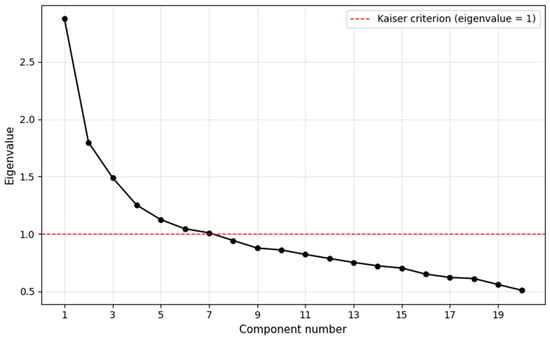
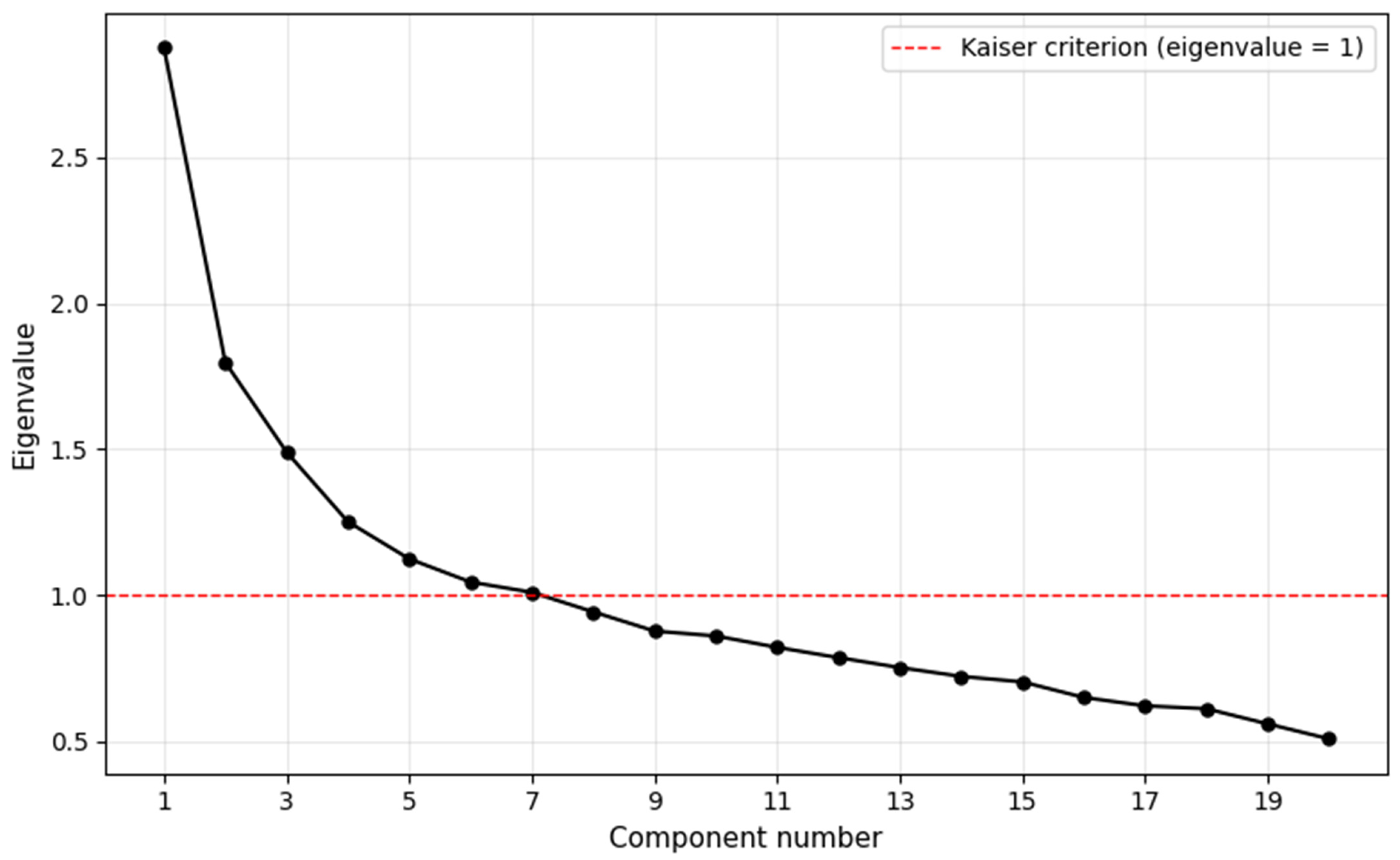
Exploratory Factor Analysis (EFA). To examine the hypothesised structure, an exploratory factor analysis with varimax rotation was performed, specifying a two-factor solution based on theoretical predictions (antagonistic and avoidant schemas). Data suitability was assessed using the Kaiser–Meyer–Olkin (KMO) measure (values above 0.70 are considered acceptable, and above 0.80 good [27]) and Bartlett’s test of sphericity [28]. Factor loadings of 0.40 or above were treated as acceptable. Communalities were also inspected. The scree plot was examined to determine the number of factors to retain (Figure 1). Although the Kaiser criterion suggested a larger number of components, the scree plot and theoretical considerations supported a two-factor solution.
Figure 1.
Scree plot for the VEGA behavioural domain (N = 422). The plot shows eigenvalues for the first 20 components. The clear break after the second component supports the two-factor solution.
Confirmatory Factor Analysis (CFA). A confirmatory factor analysis (CFA) was performed using maximum likelihood estimation with weighted adjustments (MLW) to test the hypothesised two-factor structure, with items 1–10 assigned to the Antagonistic factor and items 11–20 assigned to the Avoidant factor. Model fit was evaluated using CFI, TLI, RMSEA, and χ2/df. Because the items are binary, MLW served as an approximation; WLSMV estimation with a larger sample is recommended for future validation (see Appendix C).
Convergent Validity. Convergent validity was assessed through Pearson correlations between the VEGA behavioural domain and the PNI-28 total score.
Discriminant Validity. Discriminant validity was examined through Pearson correlations between the VEGA behavioural domain and the SDS-16.
Criterion Validity. Criterion validity was assessed through Pearson correlations between the VEGA behavioural domain and the VN-6 total score.
Subgroup Analyses. Subgroup correlations were computed for gender, age, education, anxiety, and PNI level. To control for multiple comparisons, p-values were adjusted using the Benjamini–Hochberg false discovery rate (FDR) procedure [29].
Acquiescence Bias. Acquiescence bias was assessed by examining the mean proportion of narcissistic responses across items.
Correlation Matrix. A full Pearson correlation matrix was computed among all key variables.
2.6. Ethics Statement
The study collected anonymous survey data and posed minimal risk to respondents. Lomonosov Moscow State University does not have a dedicated ethics committee for non-interventional social science research involving anonymous surveys. Because the research involved no sensitive personal data, no vulnerable populations, and no interventions, formal ethical review was not required. All procedures were conducted in accordance with the principles of the 1964 Helsinki Declaration and its later amendments. Every respondent gave informed consent before taking part. Respondents were informed about the purpose of the study, the voluntary nature of participation, and their right to withdraw at any time without penalty. Data were collected anonymously, and no personally identifiable information was recorded.
3. Results
3.1. Descriptive Statistics
Table 1 reports descriptive statistics for the main variables. The VEGA behavioural domain had a mean of 4.47 (SD = 2.71, range 0–18). The PNI-28 total averaged 97.65 (SD = 27.60). The GAD-7 mean was 5.12 (SD = 5.11), below the clinical cutoff of 10. The SDS-16 averaged 6.86 (SD = 3.52). The VN-6 mean was 0.96 (SD = 1.19, range 0–6, n = 360).
3.2. Completers vs. Non-Completers
A comparison of VN-6 completers (n = 360) and non-completers (n = 62) showed significant differences for education (p = 0.002), PNI-28 (p = 0.019), and GAD-7 (p = 0.005), but not for age, gender, VEGA scores, or SDS-16 (all p > 0.05). Completers reported a higher mean education level (M = 2.75 vs. M = 2.14), lower PNI-28 scores (M = 96.91 vs. M = 109.34), and lower GAD-7 scores (M = 4.86 vs. M = 7.59) than non-completers. The VN-6 subsample was therefore slightly more educated and less anxious than the full sample. However, given the unequal sample sizes (360 vs. 62), this comparison should be interpreted cautiously.
3.3. Item Analysis
Item difficulty ranged from 0.03 (VEGA_2) to 0.52 (VEGA_1 and VEGA_3), with a mean of 0.22. Item-total correlations ranged from 0.03 (VEGA_3) to 0.40 (VEGA_16). Eight items had item-total correlations below 0.20, indicating weak discrimination. As noted in Section 3.5, removing any single item did not raise alpha above 0.63, which suggests that the low internal consistency reflects the heterogeneous content of the vignettes rather than specific problematic items. The mean proportion of narcissistic responses was 0.22 (SD = 0.14), below the 0.50 expected by chance, indicating that respondents did not display a systematic acquiescence bias.
3.4. Factor Structure
An exploratory factor analysis with varimax rotation was performed on the 20 VEGA behavioural vignette items. The Kaiser–Meyer–Olkin (KMO) measure of sampling adequacy was 0.73, and Bartlett’s test of sphericity was significant, χ2(190) = 814.2, p < 0.001, indicating that the data were suitable for factor analysis. The first five eigenvalues were 2.88, 1.80, 1.49, 1.25, and 1.12. Although the Kaiser criterion (eigenvalue > 1) suggested up to seven components [30], the scree plot (Figure 1) showed a clear break after the second factor, supporting a two-factor solution.
As shown in Table 2,six items loaded strongly (≥0.40) on Factor 1 (Antagonistic Schema) and three items on Factor 2 (Avoidant Schema). Items loading on Factor 1 reflected dismissal of organic products as overpriced, distrust of organic labelling, and rejection of organic consumption as a status signal. Items loading on Factor 2 reflected social anxiety, fear of judgment, and self-consciousness about purchasing organic products. Communalities ranged from 0.01 (VEGA_3) to 0.42 (VEGA_16), with a mean of 0.16, indicating that the two-factor solution left a substantial proportion of item variance unexplained.
The two-factor solution explained 23.4% of the total variance (Factor 1: 14.4%; Factor 2: 9.0%). This relatively low proportion is consistent with the heterogeneous content of the forced-choice vignettes, which sample diverse behavioural contexts.
Table 2.
Factor loadings for the VEGA behavioural domain (varimax rotation, two-factor solution).
A confirmatory factor analysis (CFA) was then performed, with items 1–10 assigned to the Antagonistic factor and items 11–20 assigned to the Avoidant factor. The model showed good absolute fit (RMSEA = 0.039; χ2/df = 1.65) and near-acceptable incremental fit (CFI = 0.83; TLI = 0.81). Standardised loadings ranged from 0.08 (VEGA_5) to 0.59 (VEGA_10). Three items on the Antagonistic factor (VEGA_4, VEGA_7, VEGA_10) and six items on the Avoidant factor (VEGA_14, VEGA_15, VEGA_16, VEGA_17, VEGA_19, VEGA_20) had loadings above 0.40. These results suggest that while the general two-factor structure is plausible and broadly consistent with the data, the Antagonistic factor requires further refinement. Full CFA results are reported in Appendix C.
3.5. Reliability
Internal consistency for the VEGA behavioural domain was α = 0.61 (ω = 0.63; Table 1). This falls below the conventional threshold of 0.70 but remains within the range considered acceptable for exploratory work with binary forced-choice items [19]. Item analysis showed that eight of the 20 items had item-total correlations below 0.20, and communalities ranged from 0.01 to 0.42 (mean = 0.16). Removing any single item did not raise alpha above 0.63, which suggests that the low internal consistency reflects the heterogeneous content of the vignettes rather than specific problematic items. The PNI-28 (α = 0.93), GAD-7 (α = 0.92), and SDS-16 (α = 0.77) showed acceptable reliability.
3.6. Convergent and Discriminant Validity
The VEGA behavioural domain correlated significantly with the PNI-28 total score (r = 0.28, p < 0.001), indicating that organic-specific narcissistic schemas are associated with trait pathological narcissism. This supports the convergent validity of the instrument. Discriminant validity was examined through the correlation between the VEGA behavioural domain and the SDS-16. This correlation was non-significant and near zero (r = 0.04, p = 0.43), indicating that the instrument is not contaminated by social desirability bias.
These correlations appear in Table 3. The VEGA domain correlated significantly with the PNI-28 total and with VN-6, supporting convergent and criterion validity, while remaining uncorrelated with the SDS-16 and the GAD-7, supporting discriminant validity.
Table 3.
Pearson correlations between the VEGA behavioural domain and validity measures.
The full correlation matrix among all key variables appears in Table 4, which also includes inter-scale correlations.
Table 4.
Full Pearson correlation matrix among key variables.
The full matrix (Table 4) shows that the PNI-28 correlated significantly with the GAD-7 (r = 0.35, p < 0.001) and the SDS-16 (r = 0.21, p < 0.001), consistent with prior work on the overlap between pathological narcissism, anxiety, and social desirability. The VEGA domain, by contrast, was uncorrelated with the SDS-16 (r = 0.04, p = 0.430) and the GAD-7 (r = 0.05, p = 0.285), supporting its discriminant validity and indicating that the instrument captures narcissistic schemas rather than general negative affect.
3.7. Criterion-Related Evidence
The association between the VEGA behavioural domain and the VN-6 behavioural decision-making vignettes was examined next. The correlation was significant (r = 0.28, p < 0.001, n = 360), indicating that organic-specific narcissistic schemas generalise to narcissistic decision-making in work-related scenarios. This supports criterion validity. Because both VEGA and VN-6 use a forced-choice vignette format, however, the observed correlation may partly reflect shared method variance. Future studies should validate VEGA against non-vignette criterion measures (for example, behavioural observations, informant reports, or real-world purchase data).
3.8. Subgroup Analyses
To explore criterion validity further, subgroup analyses were conducted across gender, age, education, anxiety, and narcissism levels. To control for multiple comparisons, p-values were adjusted using the Benjamini–Hochberg false discovery rate (FDR) procedure. The VEGA behavioural domain correlated significantly with VN-6 in all ten subgroups after FDR correction (Table 5): women (r = 0.33, p_FDR < 0.001), men (r = 0.23, p_FDR = 0.002), younger adults (<40 years; r = 0.34, p_FDR < 0.001), older adults (≥40 years; r = 0.25, p_FDR < 0.001), respondents with higher education (r = 0.26, p_FDR < 0.001), respondents without higher education (r = 0.32, p_FDR < 0.001), low anxiety (r = 0.34, p_FDR < 0.001), high anxiety (r = 0.21, p_FDR = 0.005), low PNI (r = 0.26, p_FDR < 0.001), and high PNI (r = 0.25, p_FDR = 0.001).
Table 5.
Subgroup correlations between VEGA behavioural domain and VN-6.
The subgroup correlations, while statistically significant, were modest in magnitude (r = 0.21–0.34) and should be interpreted as exploratory. They suggest consistent associations but do not establish measurement equivalence across groups.
4. Discussion
This study examined whether narcissistic schemas help explain the organic attitude–behaviour gap. The findings offer preliminary support for a schema-based account: the VEGA behavioural domain captured two distinct patterns—antagonistic and avoidant—and these patterns were associated with trait narcissism and with behavioural decision-making. At the same time, the psychometric evidence indicates that the instrument requires further refinement before it can be used as a standalone measure.
4.1. Factor Structure and Reliability
Exploratory factor analysis broadly supported the two-factor structure (antagonistic and avoidant schemas). Six items loaded strongly on the antagonistic factor, reflecting devaluation, distrust, and dismissal of organic consumption, and three items loaded on the avoidant factor, reflecting social anxiety and fear of judgment. This structure aligns with the Narcissism Spectrum Model, which distinguishes between grandiose and vulnerable expressions of narcissism [8].
As reported in Section 3.4, the CFA showed good absolute fit and near-acceptable incremental fit. Several items, however, had low standardised loadings (for example, VEGA_5 = 0.08, VEGA_3 = 0.09, VEGA_8 = 0.10), suggesting that the two-factor structure is plausible and broadly consistent with the data, but that the Antagonistic factor requires refinement. This pattern is consistent with the heterogeneous content of the forced-choice vignettes, which sample diverse behavioural contexts. It should be noted, however, that the EFA-identified factors did not perfectly align with the theoretical assignment of items to antagonistic and avoidant schemas. Three items designed to capture antagonistic responses (VEGA_4, VEGA_7, VEGA_10) loaded on the Avoidant factor, while six items designed to capture avoidant responses (VEGA_14–VEGA_17, VEGA_19, VEGA_20) loaded on the Antagonistic factor. This pattern may reflect the fact that both schema types share a common core of entitled self-importance [8], and that behavioural manifestations of antagonistic and avoidant schemas can overlap in food choice contexts. For example, dismissing organic products as “overpriced” (designed as antagonistic) may also serve an avoidant function by reducing anxiety about social comparison. Conversely, anxiety about being judged for buying organic (designed as avoidant) may also involve antagonistic elements, such as resentment toward those who judge.
These findings align with the Narcissism Spectrum Model [8], which posits that grandiose and vulnerable narcissism share a common core of entitled self-importance. The overlap between antagonistic and avoidant responses observed here is consistent with Morf and Rhodewalt’s [11] self-regulatory processing model, which emphasizes that narcissistic behaviours can serve both self-enhancement and defensive functions. This overlap may explain why some items designed to capture one schema loaded on the other.
Future iterations of the instrument should refine items to differentiate the two schema types more clearly.
Internal consistency was moderate (Section 3.5): below the conventional 0.70 threshold, yet within the range considered acceptable for exploratory work with binary forced-choice items. Forced-choice vignettes deliberately introduce heterogeneity by presenting different situational contexts, which can suppress alpha while preserving construct validity [19]. As reported in Section 3.5, removing any single item did not raise alpha above 0.63, indicating that the low internal consistency reflects the instrument’s broad content coverage rather than specific problematic items. The reliability estimate nonetheless suggests that further refinement of the vignette items is needed.
4.2. Convergent Validity
Convergent validity with trait narcissism was supported. The VEGA behavioural domain correlated significantly with the PNI-28 total score (Section 3.6), indicating that organic-specific narcissistic schemas are meaningfully associated with pathological narcissism. This is notable given the domain-specific nature of the vignettes: while the PNI-28 measures global trait narcissism, the VEGA behavioural domain captures how narcissistic schemas manifest in food choice contexts specifically. The moderate correlation (r = 0.28) suggests that the instrument measures related but not identical constructs—which is theoretically expected for a domain-specific measure. The PNI-28, however, was designed for clinical and subclinical populations, and its sensitivity to subclinical variation in a general-population sample may be limited. Future studies should include alternative measures of subclinical narcissism (for example, NPI-13 or NARQ) to provide a more comprehensive assessment of convergent validity. The modest correlation (r = 0.28) is consistent with previous work [9,10] suggesting that the VEGA captures a contextualized expression of narcissism that is not fully reducible to global trait measures.
4.3. Discriminant Validity
The VEGA behavioural domain was unrelated to social desirability (Section 3.6), indicating that the forced-choice format reduces self-presentation bias effectively. This is a key advantage of vignette methodology over Likert-type scales, on which respondents can adjust their answers to appear more socially desirable [16,18]. The absence of social desirability contamination suggests that respondents were willing to endorse antagonistic or avoidant responses without concern for how they would be perceived.
4.4. Criterion Validity
The VEGA behavioural domain correlated significantly with the VN-6 behavioural decision-making vignettes (Section 3.7). This indicates that organic-specific narcissistic schemas generalise to narcissistic decision-making in other domains, such as responses to criticism, willingness to admit mistakes, and preferences for competence versus loyalty in hiring. The magnitude of this correlation (Section 3.7) is typical for cross-domain associations in personality research and provides evidence that the VEGA instrument captures a generalisable narcissistic tendency rather than purely context-specific responses. Future studies should validate VEGA against non-vignette criterion measures, such as behavioural observations, informant reports, or real-world purchase data (see Section 4.6).
Subgroup analyses with FDR correction further supported the robustness of criterion validity. The VEGA behavioural domain correlated significantly with the VN-6 across all ten demographic and psychological subgroups examined, including gender, age, education, anxiety level, and PNI level. This consistency indicates that the instrument performs similarly across diverse population segments and is not driven by any particular subgroup.
4.5. Implications for Food Choice Research
These findings carry preliminary implications for understanding organic food consumption. The VEGA behavioural domain captures antagonistic schemas (dismissal of organic as overpriced hype) and avoidant schemas (anxiety about social judgment), both of which may act as barriers to organic consumption. Traditional attitude measures do not capture these schemas, because they focus on conscious evaluations rather than underlying personality-driven predispositions. While these findings require validation against real-world purchase behaviour before applied recommendations can be made, while these findings require validation, they tentatively point to a direction for future research: testing whether different messaging strategies are effective for consumers with different schema profiles. Consumers with elevated antagonistic schemas may respond to messages that address their scepticism directly, whereas those with avoidant schemas may benefit from social norm interventions that reduce anxiety about judgment.
4.6. Limitations and Future Directions
Several limitations should be noted. First, the cross-sectional design precludes causal inferences about the relationship between narcissistic schemas and food choice behaviour. Second, the sample was predominantly Western, educated, and English-speaking, which limits generalisability to other cultural contexts. Third, internal consistency (α = 0.61; ω = 0.63) fell below conventional standards, and a confirmatory factor analysis showed good absolute fit (Section 3.4) but near-acceptable incremental fit (CFI = 0.83; TLI = 0.81), indicating that the vignette items require further refinement. Future iterations should aim for more homogeneous item content within each schema type or incorporate conflict-based scenarios to increase response variance. Pearson correlations were used for binary vignette items; tetrachoric correlations [31] may provide more accurate estimates for such data and should be considered in future studies. Fourth, criterion validity was established using vignette-based scenarios rather than real-world purchase behaviour; future studies should validate VEGA against actual food purchases or observed consumer behaviour. Fifth, because both VEGA and VN-6 use a forced-choice vignette format, the observed correlation may partly reflect shared method variance; future studies should include non-vignette criterion measures. Sixth, the absence of alternative narcissism measures limits conclusions about whether VEGA captures grandiose narcissism, vulnerable narcissism, or a broader schema-based response style (Section 4.2). Seventh, the present study did not assess incremental validity; future research should examine whether VEGA predicts food choice outcomes above and beyond established measures of narcissism and attitudes. Eighth, the study did not directly measure attitudes toward organic food or actual purchase behaviour. Therefore, H3 was tested as an association, not as an incremental validity test. Future studies should include direct attitude measures to examine whether schemas explain variance beyond attitudes. Ninth, the criterion measure (VN-6) is vignette-based, which may introduce shared method variance with the VEGA instrument; future studies should include non-vignette criterion measures. Finally, the use of an online panel (Prolific) may introduce self-selection bias and limit generalisability to broader consumer populations.
5. Conclusions
This study offers preliminary evidence that narcissistic schemas are associated with organic food choice. However, the absence of direct attitude and behavioural measures limits conclusions about their incremental validity. The VEGA behavioural domain showed moderate internal consistency (α = 0.61; ω = 0.63), a two-factor structure separating antagonistic and avoidant schemas, convergent validity with trait narcissism (r = 0.28, p < 0.001), discriminant validity from social desirability (r = 0.04, p = 0.43), and criterion validity with behavioural decision-making vignettes (r = 0.28, p < 0.001, n = 360). A confirmatory factor analysis indicated good absolute fit (RMSEA = 0.039; χ2/df = 1.65) and near-acceptable incremental fit (CFI = 0.83; TLI = 0.81), showing that the factor structure requires refinement. The forced-choice vignette format appears to capture domain-specific narcissistic schemas in organic food choice without social desirability contamination. The instrument requires further refinement, particularly through conflict-based scenarios, item revision, and validation against real-world purchase behaviour. Future research should also examine whether the instrument predicts organic food choice outcomes above and beyond established measures of narcissism and attitudes.
Author Contributions
Conceptualization, A.K.; methodology, A.K.; software, A.K.; validation, A.K. and S.S.; formal analysis, A.K.; investigation, A.K.; resources, A.K.; data curation, A.K.; writing—original draft preparation, A.K.; writing—review and editing, A.K. and S.S.; visualization, A.K.; supervision, A.K.; project administration, A.K. All authors have read and agreed to the published version of the manuscript.
Funding
This research was carried out as part of the State Assignment of Lomonosov Moscow State University (project no. 122041800058-5).
Institutional Review Board Statement
The study was conducted in accordance with the Declaration of Helsinki. Ethical review and approval were waived for this study because it involved anonymous survey data collection with no interventions and no collection of personal data. Data were collected via Prolific from participants in the United Kingdom, the United States, Canada, Australia, New Zealand, and Ireland. Because all data were fully anonymised, they do not constitute personal data under any of the applicable national data protection laws, including the UK General Data Protection Regulation (UK GDPR), the EU General Data Protection Regulation (GDPR, applicable in Ireland), and the New Zealand Privacy Act 2020. Specifically, Recital 26 of the UK GDPR states that the principles of data protection do not apply to anonymous information, including for research purposes. Additionally, as the authors are affiliated with Lomonosov Moscow State University, Federal Law No. 152-FZ ‘On Personal Data’ (Article 3, Clause 1) confirms that anonymised data are not considered personal data. No formal ethics approval was therefore required for this study.
Informed Consent Statement
Informed consent was obtained from all subjects involved in the study. Written informed consent for publication is not applicable because no identifiable personal data are reported.
Data Availability Statement
The data presented in this study are available on request from the corresponding author. The raw survey data are not publicly available due to privacy restrictions and the absence of participant consent for public sharing of individual-level responses. The coding script is available from the corresponding author on request.
Acknowledgments
The authors thank the participants of the study. During the preparation of this manuscript, the authors used Deepseek-V3 for text editing and formatting, and for generating Python code and performing the statistical analyses. The tool was not used for data collection. All analyses and their outputs were reviewed, checked, and verified by the authors, who take full responsibility for the results and their interpretation. The authors have reviewed and edited the output and take full responsibility for the content of this publication.
Conflicts of Interest
The authors declare no conflicts of interest. The funders had no role in the design of the study; in the collection, analysis, or interpretation of data; in the writing of the manuscript; or in the decision to publish the results.
Abbreviations
The following abbreviations are used in this manuscript:
| VEGA | Vignette-based Evaluation of Grandiose and Avoidant schemas |
| PNI-28 | Pathological Narcissism Inventory, 28-item version |
| GAD-7 | Generalized Anxiety Disorder, 7-item scale |
| SDS-16 | Social Desirability Scale, 16-item version |
| VN-6 | Behavioural narcissism vignettes, 6 items |
| EFA | Exploratory Factor Analysis |
| CFA | Confirmatory Factor Analysis |
| KMO | Kaiser–Meyer–Olkin |
| FDR | False Discovery Rate |
| SD | Standard Deviation |
| M | Mean |
| MLW | Maximum Likelihood with Weighted adjustments |
| CFI | Comparative Fit Index |
| TLI | Tucker–Lewis Index |
| RMSEA | Root Mean Square Error of Approximation |
Appendix A
Table A1.
VEGA behavioural vignettes: Organic food choice domain (items 1–20).
Appendix B
Table A2.
VN-6 decision-making vignettes (criterion measure).
Appendix C
- Confirmatory Factor Analysis of the VEGA Behavioural Domain
A confirmatory factor analysis (CFA) was performed to test the hypothesised two-factor structure, with items 1–10 assigned to the Antagonistic factor and items 11–20 assigned to the Avoidant factor, following the original instrument design. The analysis used maximum likelihood estimation with weighted adjustments (MLW) in Python (semopy package).
Table A3.
CFA model fit indices.
Table A4.
Standardised factor loadings.
The Avoidant factor showed satisfactory loadings (six items ≥ 0.40), whereas the Antagonistic factor showed weaker loadings (three items ≥ 0.40). The model showed good absolute fit (RMSEA = 0.039; χ2/df = 1.65) and near-acceptable incremental fit (CFI = 0.83; TLI = 0.81). These results suggest that the two-factor structure is broadly consistent with the data, although the Antagonistic factor requires further refinement through item revision.
References
- Beck, A.T.; Haigh, E.A.P. Advances in cognitive theory and therapy: The generic cognitive model. Annu. Rev. Clin. Psychol. 2014, 10, 1–24. [Google Scholar] [CrossRef] [Scilit] [PubMed]
- Zeigler-Hill, V.; Green, B.A.; Arnau, R.C.; Sisemore, T.B.; Myers, E.M. Trouble ahead, trouble behind: Narcissism and early maladaptive schemas. J. Behav. Ther. Exp. Psychiatry 2011, 42, 96–103. [Google Scholar] [CrossRef] [Scilit] [PubMed]
- Aertsens, J.; Verbeke, W.; Mondelaers, K.; Van Huylenbroeck, G. Personal determinants of organic food consumption: A review. Br. Food J. 2009, 111, 1140–1167. [Google Scholar] [CrossRef] [Scilit]
- Hughner, R.S.; McDonagh, P.; Prothero, A.; Shultz, C.J.; Stanton, J. Who are organic food consumers? A compilation and review of why people purchase organic food. J. Consum. Behav. 2007, 6, 94–110. [Google Scholar] [CrossRef] [Scilit]
- Vermeir, I.; Verbeke, W. Sustainable food consumption: Exploring the consumer attitude–behavioral intention gap. J. Agric. Environ. Ethics 2006, 19, 169–194. [Google Scholar] [CrossRef] [Scilit]
- Peattie, K. Green consumption: Behavior and norms. Annu. Rev. Environ. Resour. 2010, 35, 195–228. [Google Scholar] [CrossRef] [Scilit]
- Paulhus, D.L.; Williams, K.M. The Dark Triad of personality: Narcissism, Machiavellianism, and psychopathy. J. Res. Personal. 2002, 36, 556–563. [Google Scholar] [CrossRef] [Scilit]
- Krizan, Z.; Herlache, A.D. The Narcissism Spectrum Model: A synthetic view of narcissistic personality. Personal. Soc. Psychol. Rev. 2018, 22, 3–31. [Google Scholar] [CrossRef] [Scilit] [PubMed]
- Sedikides, C.; Gregg, A.P.; Cisek, S.; Hart, C.M. The I that buys: Narcissists as consumers. J. Consum. Psychol. 2007, 17, 254–257. [Google Scholar] [CrossRef] [Scilit]
- Cisek, S.Z.; Sedikides, C.; Hart, C.M.; Godwin, H.J.; Benson, V.; Liversedge, S.P. Narcissism and consumer behaviour: A review and preliminary findings. Front. Psychol. 2014, 5, 232. [Google Scholar] [CrossRef] [Scilit] [PubMed]
- Morf, C.C.; Rhodewalt, F. Unraveling the paradoxes of narcissism: A dynamic self-regulatory processing model. Psychol. Inq. 2001, 12, 177–196. [Google Scholar] [CrossRef] [Scilit] [PubMed]
- Campbell, W.K.; Bonacci, A.M.; Shelton, J.; Exline, J.J.; Bushman, B.J. Psychological entitlement: Interpersonal consequences and validation of a self-report measure. J. Personal. Assess. 2004, 83, 29–45. [Google Scholar] [CrossRef] [Scilit] [PubMed]
- Besser, A.; Priel, B. Grandiose narcissism versus vulnerable narcissism in threatening situations: Emotional reactions to achievement failure and interpersonal rejection. J. Soc. Clin. Psychol. 2010, 29, 874–902. [Google Scholar] [CrossRef] [Scilit]
- Rozin, P.; Markwith, M.; Stoess, C. Moralization and becoming a vegetarian: The transformation of preferences into values and the recruitment of disgust. Psychol. Sci. 1997, 8, 67–73. [Google Scholar] [CrossRef] [Scilit]
- Minson, J.A.; Monin, B. Do-gooder derogation: Disparaging morally motivated minorities to defuse anticipated reproach. Soc. Psychol. Personal. Sci. 2012, 3, 200–207. [Google Scholar] [CrossRef] [Scilit]
- Paulhus, D.L. Two-component models of socially desirable responding. J. Personal. Soc. Psychol. 1984, 46, 598–609. [Google Scholar] [CrossRef]
- Krumpal, I. Determinants of social desirability bias in sensitive surveys: A literature review. Qual. Quant. 2013, 47, 2025–2047. [Google Scholar] [CrossRef] [Scilit]
- Aguinis, H.; Bradley, K.J. Best practice recommendations for designing and implementing experimental vignette methodology studies. Organ. Res. Methods 2014, 17, 351–371. [Google Scholar] [CrossRef] [Scilit]
- Kreitchmann, R.S.; Abad, F.J.; Ponsoda, V.; Nieto, M.D.; Morillo, D. Controlling for response biases in self-report scales: Forced-choice vs. psychometric modeling of Likert items. Front. Psychol. 2019, 10, 2309. [Google Scholar] [CrossRef] [Scilit] [PubMed]
- Guadagnoli, E.; Velicer, W.F. Relation of sample size to the stability of component patterns. Psychol. Bull. 1988, 103, 265–275. [Google Scholar] [CrossRef] [PubMed]
- Steiner, P.M.; Atzmüller, C.; Su, D. Designing valid and reliable vignette experiments for survey research: A case study on the fair gender income gap. J. Methods Meas. Soc. Sci. 2017, 7, 52–94. [Google Scholar] [CrossRef] [Scilit]
- Pincus, A.L.; Ansell, E.B.; Pimentel, C.A.; Cain, N.M.; Wright, A.G.C.; Levy, K.N. Initial construction and validation of the Pathological Narcissism Inventory. Psychol. Assess. 2009, 21, 365–379. [Google Scholar] [CrossRef] [Scilit] [PubMed]
- Spitzer, R.L.; Kroenke, K.; Williams, J.B.W.; Löwe, B. A brief measure for assessing generalized anxiety disorder: The GAD-7. Arch. Intern. Med. 2006, 166, 1092–1097. [Google Scholar] [CrossRef] [Scilit] [PubMed]
- Stöber, J. The Social Desirability Scale-17 (SDS-17): Convergent validity, discriminant validity, and relationship with age. Eur. J. Psychol. Assess. 2001, 17, 222–232. [Google Scholar] [CrossRef] [Scilit]
- Meade, A.W.; Craig, S.B. Identifying careless responses in survey data. Psychol. Methods 2012, 17, 437–455. [Google Scholar] [CrossRef] [Scilit] [PubMed]
- Brown, A.; Maydeu-Olivares, A. Item response modeling of forced-choice questionnaires. Educ. Psychol. Meas. 2011, 71, 460–502. [Google Scholar] [CrossRef] [Scilit]
- Kaiser, H.F. An index of factorial simplicity. Psychometrika 1974, 39, 31–36. [Google Scholar] [CrossRef] [Scilit]
- Bartlett, M.S. The effect of standardization on a χ2 approximation in factor analysis. Biometrika 1951, 38, 337–344. [Google Scholar] [CrossRef] [Scilit]
- Benjamini, Y.; Hochberg, Y. Controlling the false discovery rate: A practical and powerful approach to multiple testing. J. R. Stat. Soc. Ser. B 1995, 57, 289–300. [Google Scholar] [CrossRef] [Scilit]
- Zwick, W.R.; Velicer, W.F. Comparison of five rules for determining the number of components to retain. Psychol. Bull. 1986, 99, 432–442. [Google Scholar] [CrossRef]
- Olsson, U. Maximum likelihood estimation of the polychoric correlation coefficient. Psychometrika 1979, 44, 443–460. [Google Scholar] [CrossRef] [Scilit]

Disclaimer/Publisher’s Note: The statements, opinions and data contained in all publications are solely those of the individual author(s) and contributor(s) and not of MDPI and/or the editor(s). MDPI and/or the editor(s) disclaim responsibility for any injury to people or property resulting from any ideas, methods, instructions or products referred to in the content. |
© 2026 by the authors. Licensee MDPI, Basel, Switzerland. This article is an open access article distributed under the terms and conditions of the Creative Commons Attribution (CC BY) license.