


Abstract
Frozen seafood plays an important role in the global food supply, but maintaining its quality during frozen storage and cold-chain distribution remains a significant challenge. Although freezing effectively slows microbial growth and enzymatic activity, it cannot completely prevent quality deterioration. During frozen storage, seafood undergoes a series of interconnected physicochemical changes, including ice crystal growth, protein denaturation and oxidation, lipid oxidation, water redistribution, and texture deterioration. These changes gradually reduce sensory quality, nutritional value, and overall commercial acceptability. Conventional quality assessment methods, including destructive laboratory analyses and sensory evaluation, are still widely used. However, they are often labor-intensive, time-consuming, and unsuitable for rapid or real-time monitoring in modern cold-chain systems. As a result, increasing attention has been given to non-destructive sensing technologies that can evaluate seafood quality quickly and objectively. This review summarizes the major mechanisms responsible for quality deterioration in frozen seafood, together with recent advances in sensing technologies used to monitor these changes. The sensing approaches discussed include near-infrared (NIR) and Raman spectroscopy, hyperspectral and fluorescence imaging, low-field nuclear magnetic resonance (LF-NMR), electronic nose (E-nose), electronic tongue (E-tongue), colorimetric sensor arrays (CSAs), and biosensors. This review also discusses the growing role of artificial intelligence in frozen seafood quality assessment, including chemometrics, machine learning, deep learning, and multi-sensor data fusion. Particular attention is given to their applications in quality prediction, industrial implementation, and decision support. Finally, current challenges and future research needs are highlighted, with emphasis on the development of interpretable, transferable, and real-time monitoring systems that can support more reliable quality assurance throughout the frozen seafood supply chain.
1. Introduction
The global seafood industry plays a vital role in food security and human nutrition by supplying high-quality protein, long-chain omega-3 polyunsaturated fatty acids, essential vitamins, and trace minerals to billions of people worldwide [1,2,3,4,5]. With the continued expansion of aquaculture, increasing international trade, and rising consumer demand for safe and convenient foods, freezing has become the preferred preservation method for extending shelf life, reducing post-harvest losses, and enabling the global distribution of seafood products [1,6,7].
Although freezing effectively inhibits microbial growth and considerably slows enzymatic activity, it cannot completely prevent quality deterioration. During frozen storage and repeated freeze–thaw (F-T) cycles, seafood experiences a series of interconnected physical, chemical, and biochemical changes. These include ice crystal formation and recrystallization, protein denaturation and oxidation, lipid oxidation, water redistribution, increased drip loss, texture softening, and pigment degradation [7,8,9]. Many of these changes develop gradually and are difficult to detect by visual inspection. Conventional seafood quality evaluation mainly relies on destructive laboratory analyses, including total volatile basic nitrogen (TVB-N), thiobarbituric acid reactive substances (TBARS), K value, and aerobic plate count, together with sensory evaluation by trained panels [10,11,12]. While these techniques remain the benchmark for quality assessment, they require laboratory facilities, are labor-intensive, and are often too slow for routine monitoring.
In recent years, non-destructive sensing technologies have provided new opportunities for monitoring seafood quality more rapidly and objectively. Techniques such as near-infrared (NIR) spectroscopy, Raman spectroscopy, hyperspectral imaging (HSI), fluorescence spectroscopy, low-field nuclear magnetic resonance (LF-NMR), electronic nose (E-nose), electronic tongue (E-tongue), colorimetric sensor arrays (CSAs), and biosensors can detect changes in chemical composition, water distribution, tissue structure, oxidation, and volatile compounds without damaging the sample [13,14,15,16,17,18]. Chemometric techniques, machine learning, deep learning, and multi-sensor data fusion are now widely applied to extract useful information from sensing data and improve the prediction of quality attributes [19,20,21].
Despite these advances, research on frozen seafood remains relatively fragmented. Quality evaluation in frozen seafood is particularly challenging because deterioration is influenced not only by storage time but also by ice crystal formation, freeze concentration, repeated freeze–thaw cycles, and the complex interactions among multiple deterioration mechanisms. In addition, many sensing technologies have only been evaluated under controlled laboratory conditions, with limited validation under real industrial cold-chain environments.
This review aims to address these issues by providing a comprehensive overview of recent developments in frozen seafood quality monitoring. Specifically, it (i) examines the physicochemical and biochemical mechanisms responsible for quality deterioration, with emphasis on ice crystal damage, protein denaturation and oxidation, lipid oxidation, and water redistribution; (ii) reviews recent advances in non-destructive sensing technologies, including their principles, advantages, limitations, and potential for industrial application; (iii) discusses current AI-based approaches for quality prediction, including chemometrics, machine learning, deep learning, and multi-sensor data fusion; and (iv) highlights current challenges and future research priorities for developing practical, interpretable, and real-time quality monitoring systems. The overall framework of this review is illustrated in Figure 1.
Figure 1.
Conceptual framework for frozen seafood quality assessment using advanced sensing technologies and artificial intelligence. The figure summarizes the background and importance of frozen seafood preservation, major quality deterioration mechanisms, representative non-destructive sensing technologies, AI and data-analysis approaches, and practical applications for cold-chain monitoring, process control, quality grading, shelf-life prediction, and traceability. Arrows shows the flow and the connection between the different part. Bidirectional arrows show interactions between deterioration mechanisms.
2. Quality Deterioration Mechanisms in Frozen Seafood
Frozen storage is widely used to extend the shelf life of seafood by inhibiting microbial growth and slowing enzymatic and chemical reactions. However, freezing does not completely prevent quality deterioration. Instead, the freezing process itself, together with prolonged frozen storage, gradually introduces a series of physical, chemical, and biochemical changes that reduce product quality over time [22,23]. The extent of these changes depends on several interacting factors, including freezing rate, storage temperature and its stability, storage duration, species characteristics such as lipid content and muscle fiber structure, and processing conditions before freezing, including handling and packaging [7,24].
The major deterioration pathways include ice crystal formation and recrystallization, protein denaturation and oxidation, lipid oxidation, water migration and redistribution, drip loss, texture softening, and pigment degradation. These processes are closely interconnected rather than occurring independently, and their interactions often accelerate the overall deterioration of frozen seafood during storage [24,25].
Understanding how these quality changes develop is essential for effective quality control throughout frozen storage and distribution. This section reviews the main quality attributes of frozen seafood together with the key deterioration mechanisms, providing a scientific basis for selecting appropriate sensing indicators and developing reliable non-destructive monitoring technologies.
2.1. Key Quality Attributes
Frozen seafood quality is assessed using a combination of physical, chemical, microbiological, and sensory attributes. Physical characteristics, including texture, water-holding capacity (WHC), drip loss, and muscle microstructure, are strongly influenced by ice crystal formation and the functional properties of muscle proteins [24,26,27]. Among the chemical indicators, protein and lipid oxidation are particularly important because they are closely associated with quality deterioration during frozen storage.
While microbial activity is largely suppressed under frozen conditions, spoilage microorganisms may become active again after thawing or when products are exposed to temperature abuse during distribution. Sensory properties, including color, odor, texture, and overall acceptability, reflect the combined effects of these physical and biochemical changes and remain the primary factors influencing consumer acceptance and commercial value. Recent kinetic modeling studies further show that texture softening and color fading follow predictable changes during storage and are closely related to storage time and pre-treatment conditions, highlighting their value as quantitative quality indicators [28]. Texture and color are therefore the most practically tractable targets for non-destructive sensing approaches.
In summary, frozen seafood quality is determined by the interaction of physical, chemical, and sensory attributes. Among these, texture and color are particularly sensitive to storage-related deterioration and therefore serve as important targets for quality monitoring using non-destructive sensing technologies.
2.2. Protein Oxidation and Denaturation
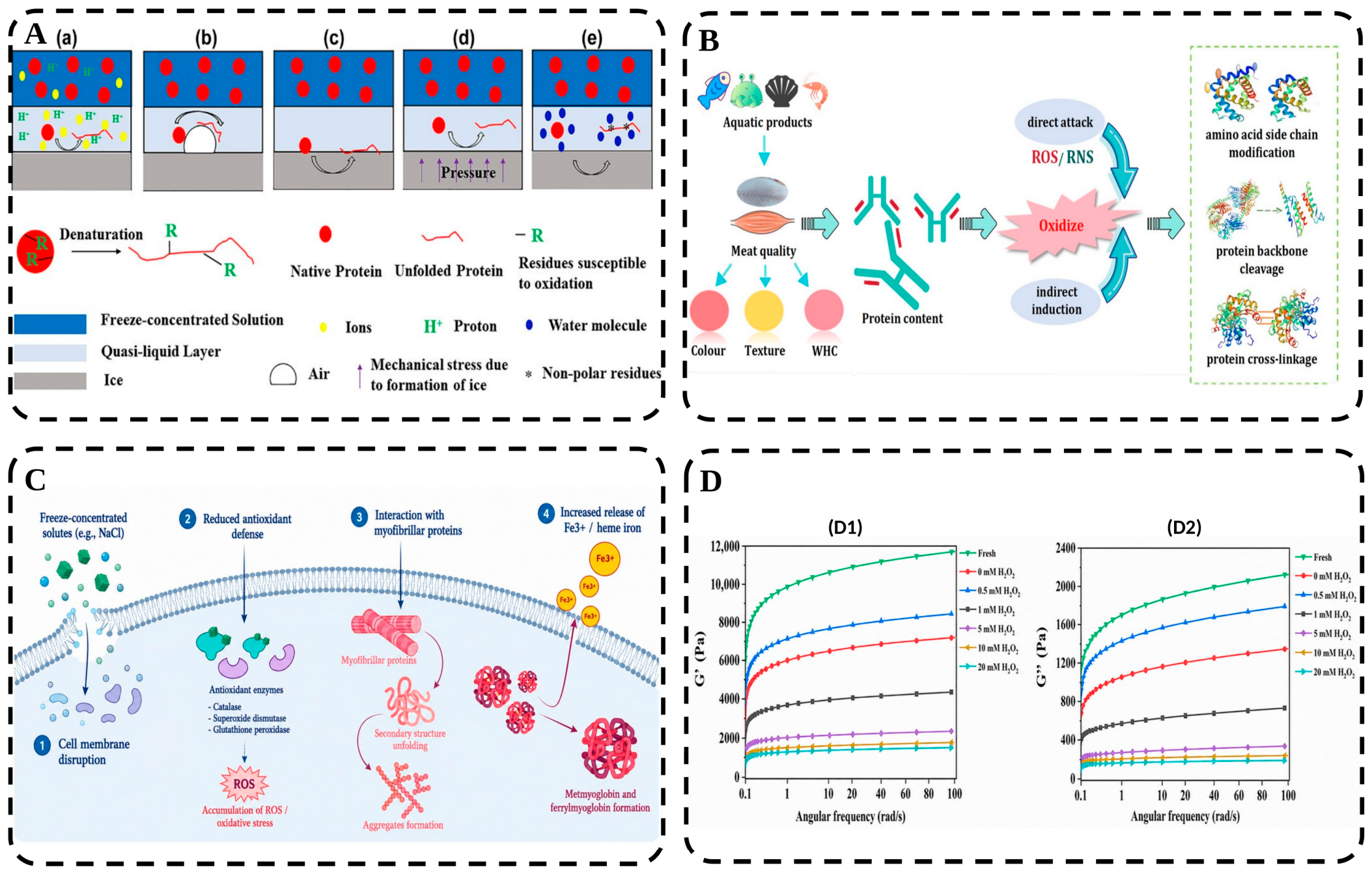
Protein denaturation is one of the primary biochemical processes responsible for quality deterioration in frozen seafood. It results from the combined effects of physical damage caused by freezing and oxidative reactions that continue throughout frozen storage and subsequent thawing [6,29,30]. Ice crystal formation and recrystallization disrupt the native three-dimensional structure of muscle proteins, particularly the myofibrillar proteins myosin, actin, and tropomyosin. As these proteins partially unfold, previously buried hydrophobic regions become exposed, increasing the likelihood of intermolecular aggregation and cross-linking [31]. These structural changes reduce important functional properties, especially water-holding capacity and gel-forming ability, which ultimately lead to greater drip loss, firmer texture, and reduced tenderness in frozen seafood [6,32,33]. The extent of protein damage depends largely on freezing conditions. Rapid freezing produces numerous small ice crystals that are distributed more uniformly within the muscle, minimizing structural disruption. In contrast, slow freezing promotes the formation of larger extracellular ice crystals that rupture cell membranes and damage muscle fibers [24]. During prolonged storage, fluctuations in temperature accelerate ice recrystallization through Ostwald ripening, where smaller ice crystals gradually disappear while larger ones continue to grow. As a result, mechanical damage to muscle tissue becomes more severe over time [6,25]. Figure 2 summarizes the sequence of events linking freezing-induced structural damage with protein oxidation. As illustrated in Figure 2A, freeze concentration and ice crystal formation expose hydrophobic regions and amino acid residues that are particularly susceptible to oxidation. These structural changes increase the vulnerability of proteins to reactive oxygen species, which subsequently promote amino acid side-chain oxidation, peptide backbone cleavage, and protein cross-linking (Figure 2B). At the same time, membrane disruption caused by ice crystals releases pro-oxidative iron species while reducing endogenous antioxidant protection, further accelerating protein aggregation and oxidative deterioration (Figure 2C). Figure 2D presents rheological evidence that different oxidation levels alter myofibrillar protein gelation, as reflected by changes in the storage modulus (G′), loss modulus (G″), and overall gel-forming ability.
As oxidation progresses, the structural and functional properties of muscle proteins continue to decline [34,35]. Typical indicators include carbonyl accumulation, sulfhydryl loss, increased surface hydrophobicity, altered water distribution, and reduced water-holding capacity, all of which contribute to deterioration in texture and overall functionality during frozen storage [25,36,37,38,39]. These structural changes manifest as increased hardness, decreased elasticity, and loss of the characteristic texture properties valued in fresh seafood products [25].
These molecular changes are reflected in poorer eating quality, with frozen seafood becoming harder, less elastic, and less capable of retaining moisture after thawing. Oxidative damage is largely driven by reactive oxygen species, which preferentially attack amino acid residues such as methionine, histidine, lysine, and cysteine. These reactions generate carbonyl compounds, promote disulfide bond formation, consume sulfhydryl groups, and encourage protein aggregation through covalent cross-linking [38,40,41,42,43]. Protein solubility decreases, enzyme activity is impaired, and important quality attributes such as tenderness, juiciness, and water-holding capacity continue to decline [29]. The rate of oxidation is further influenced by factors including residual oxygen, storage temperature, and secondary products generated during lipid oxidation [44]. Oxidation of myoglobin is another important consequence of frozen storage, particularly in red and dark-fleshed fish species. During storage, oxymyoglobin containing ferrous iron (Fe2+) is gradually converted to ferric metmyoglobin (Fe3+), causing the characteristic bright red color to fade into undesirable brown or gray tones that reduce consumer acceptance [45]. This process is accelerated by reactive aldehydes such as malondialdehyde (MDA), together with free iron released during lipid oxidation, highlighting the close relationship between protein and lipid oxidative pathways [46].
Overall, protein denaturation and oxidation occur simultaneously throughout frozen storage and together contribute to reduced water-holding capacity, texture deterioration, and color instability. Changes such as carbonyl accumulation, myoglobin oxidation, increased surface hydrophobicity, and protein aggregation therefore provide valuable indicators of frozen storage damage and serve as important targets for non-destructive quality assessment. Having an understanding of these mechanisms also provides a foundation for developing spectroscopic, imaging, and electrochemical sensing techniques capable of monitoring protein oxidation in real time.
Figure 2.
Mechanisms of protein denaturation and oxidation in frozen seafood. (A) possible mechanisms of ice induced protein denaturation: (a) Change of pH and ionic strength. (b) Accumulation of air bubbles at the ice interface. (c) Adsorption at the ice interface. (d) Pressure due to ice growth. (e) Enhance cold denaturation. (B) Reactive oxygen and nitrogen species induce protein oxidation through amino acid modification, peptide backbone cleavage, and protein cross-linking. (C) Ice crystal-induced membrane disruption enhances oxidative stress, leading to antioxidant depletion, protein aggregation, and the release of pro-oxidative iron species. (D) Oxidation-dependent changes in myofibrillar protein gelation: (D1) storage modulus (G′) and (D2) loss modulus (G″) of myofibrillar protein gel. Adapted from [25,47,48,49].
2.3. Lipid Oxidation
Lipid oxidation is one of the major causes of quality deterioration in frozen seafood, particularly in fatty species rich in polyunsaturated fatty acids (PUFAs), such as eicosapentaenoic acid (EPA) and docosahexaenoic acid (DHA). Although freezing slows oxidative reactions, it cannot completely prevent them, allowing lipid oxidation to continue gradually throughout frozen storage [50,51]. During this process, primary oxidation products (lipid hydroperoxides) are formed and subsequently decompose into secondary compounds, including malondialdehyde (MDA), 4-hydroxynonenal (4-HNE), aldehydes, and ketones. These compounds contribute to rancid odors, off-flavors, nutritional losses, and reduced sensory quality [50,52].
Lipid oxidation is closely linked with other deterioration mechanisms. Reactive oxidation products, particularly aldehydes and hydroperoxides, readily interact with muscle proteins, promoting carbonyl formation, structural modification, and protein cross-linking, which further weakens muscle integrity [48].
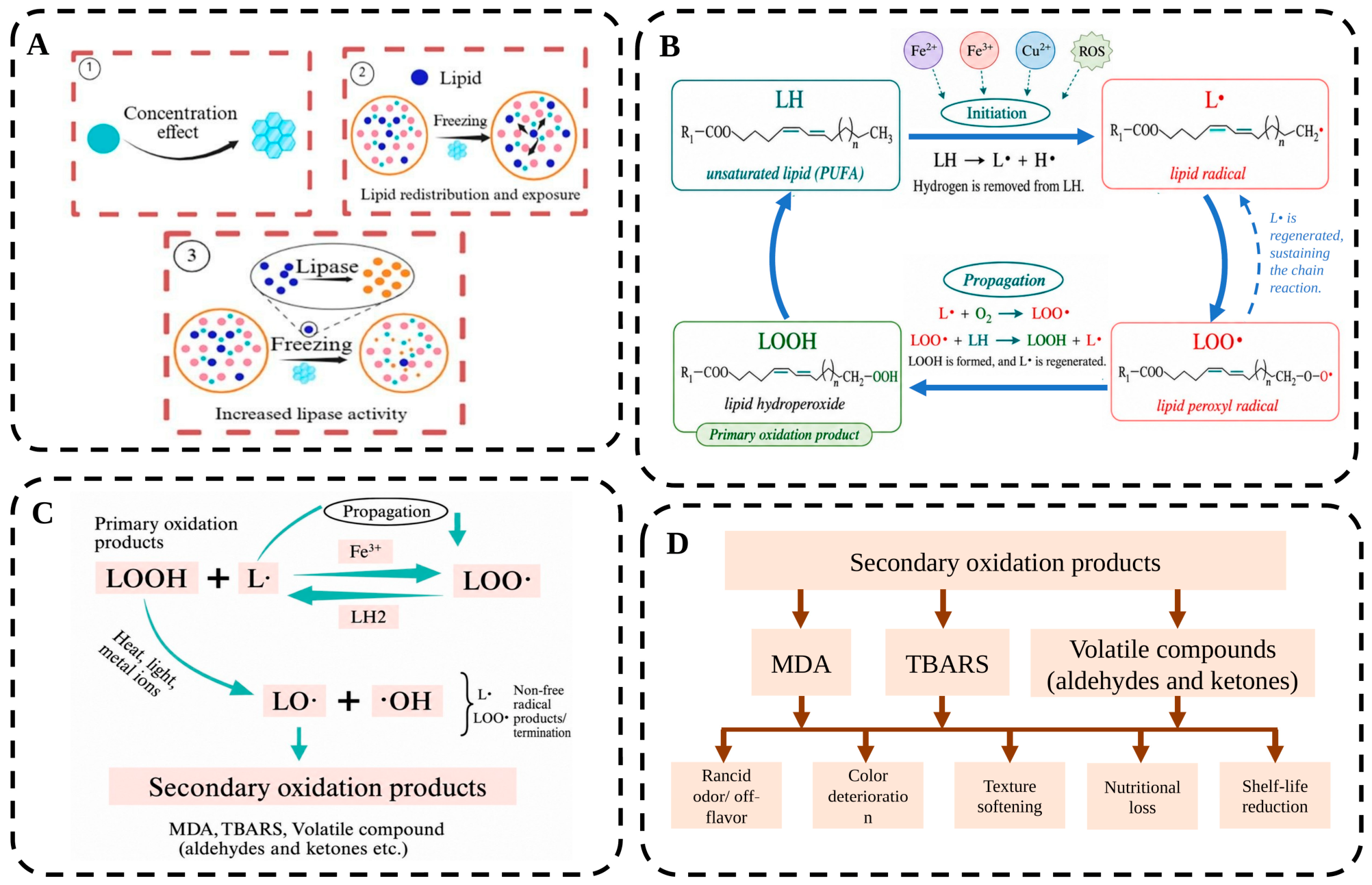
Common quality indicators such as TBARS, peroxide value, and carbonyl content increase progressively during frozen storage and are widely used to evaluate oxidative deterioration [53,54,55,56]. Their sensitivity to storage temperature, packaging atmosphere, and lipid composition also makes them valuable targets for non-destructive sensing technologies. In addition, antioxidant treatments have been shown to reduce oxidation by lowering TBARS and protein carbonyl levels, preserving sulfhydryl groups, and improving water retention and texture stability [57]. Figure 3 illustrates the main pathway of lipid oxidation in frozen seafood. As shown in Figure 3A, freezing promotes lipid oxidation through freeze concentration, lipid redistribution, greater lipid exposure, and increased lipase activity. These changes facilitate free-radical reactions that generate lipid radicals, lipid peroxyl radicals, and lipid hydroperoxides as primary oxidation products (Figure 3B). The unstable hydroperoxides subsequently decompose into secondary products, including MDA, aldehydes, ketones, and other volatile compounds (Figure 3C). These compounds are directly associated with rancid odor, off-flavor development, discoloration, texture deterioration, nutritional loss, and reduced shelf life (Figure 3D). Lipid oxidation plays a central role in the deterioration of frozen seafood. Because it is closely associated with protein oxidation and sensory quality loss, lipid-derived oxidation products remain important indicators for quality assessment and represent key targets for non-destructive monitoring during frozen storage.
Figure 3.
Mechanism of lipid oxidation in frozen seafood. (A) Freezing promotes lipid oxidation through freeze concentration, lipid redistribution, increased lipid exposure, and lipase activity. (B) Free-radical reactions generate lipid radicals, lipid peroxyl radicals, and lipid hydroperoxides as primary oxidation products. (C) Lipid hydroperoxides decompose into secondary oxidation products under the influence of heat, light, metal ions, and radical reactions. (D) Secondary oxidation products contribute to rancid odor, off-flavor development, discoloration, texture deterioration, nutritional loss, and reduced shelf life. Arrows indicate the direction of the processes and interactions illustrated. Adapted from [58].
2.4. Ice Crystal Formation and Mechanical Damage
Ice crystal formation is the defining physical process during seafood freezing and has a major influence on the final quality of frozen products. The size, number, and distribution of ice crystals are determined largely by the freezing rate and the stability of the storage temperature [59]. Slow freezing favors the formation of large extracellular ice crystals, which generate mechanical stress, rupture cell membranes, disrupt myofibrils, and damage connective tissues. In contrast, rapid freezing produces numerous small intracellular ice crystals that cause less structural damage and better preserve the native muscle architecture [6,24]. During frozen storage, ice crystals continue to change through recrystallization. Small crystals gradually dissolve while larger crystals grow, a process driven by Ostwald ripening. Temperature fluctuations, which commonly occur during transportation and retail distribution, accelerate this process and increase mechanical damage to muscle tissues [25,60]. As structural damage progresses, muscle proteins lose their ability to retain water, resulting in greater drip loss after thawing, softer texture, reduced firmness, and lower juiciness. Membrane disruption also releases free iron and endogenous enzymes that promote both lipid and protein oxidation, further accelerating quality deterioration [25,26]. In turn, oxidation weakens the protein network, making the muscle more susceptible to additional ice crystal damage during storage. This physical deterioration process is illustrated in Figure 4. Ice formation first concentrates solutes in the unfrozen phase, increasing ionic strength, protein concentration, pro-oxidant levels, and local pH changes (Figure 4A). The freezing rate then determines the extent of structural damage: rapid freezing produces smaller, more uniformly distributed ice crystals, whereas slow freezing forms larger crystals that cause greater cell disruption and protein denaturation (Figure 4B). During storage, repeated ice crystal growth and recrystallization progressively increase mechanical stress within the muscle (Figure 4C). Microscopic observations further demonstrate that slow freezing and temperature fluctuations lead to more severe disruption of muscle fibers and tissue structure after thawing (Figure 4D,E).
Figure 4.
Ice crystal formation and microstructural damage in frozen seafood muscle. (A) Ice formation concentrates solutes in the unfrozen phase, increasing ionic strength, protein concentration, pro-oxidant levels, and local pH changes. (B) Rapid freezing produces smaller ice crystals with less protein damage, whereas slow freezing forms larger crystals that increase cell disruption and protein denaturation. (C) Ice crystal nucleation, growth, and recrystallization progressively damage muscle structure during frozen storage. (D,E) Microscopic images showing the effects of freezing rate and storage temperature on muscle tissue before and after thawing. Adapted from [7,61,62].
In summary, ice crystal formation and recrystallization are major contributors to structural damage in frozen seafood. Their effects on water retention, texture, and muscle integrity make them critical indicators of frozen storage quality and important targets for cold-chain quality monitoring.
2.5. Interplay of Deterioration Mechanisms
The deterioration mechanisms described above do not occur independently but interact throughout freezing, frozen storage, and thawing, collectively accelerating quality loss [26,36]. Ice crystal-induced damage to cell membranes and muscle structure releases free iron, heme proteins, and endogenous enzymes into the muscle matrix. These pro-oxidative components promote both lipid and protein oxidation, amplifying quality deterioration beyond the direct effects of mechanical damage. The interaction between protein denaturation, protein oxidation, and lipid oxidation is particularly important in frozen seafood. Reactive lipid oxidation products, including malondialdehyde (MDA) and 4-hydroxynonenal (4-HNE), readily react with amino acid residues in myofibrillar proteins, promoting carbonyl formation, cross-linking, aggregation, and further structural deterioration accumulation, Schiff base and Michael adduct formation, cross-linking, and aggregation [25,42,63,64]. At the same time, protein denaturation weakens the muscle structure and reduces water-holding capacity, making the tissue more susceptible to ice crystal damage during subsequent freeze–thaw cycles. These interconnected processes also contribute to discoloration, off-flavor development, drip loss, and texture deterioration, leading to a gradual decline in consumer acceptance. Figure 5 summarizes these coupled deterioration pathways. Freezing initiates ice nucleation, ice crystal growth, recrystallization, freeze concentration, and temperature-fluctuation effects (Figure 5A). These physical changes destabilize muscle proteins by disrupting hydration layers and promoting protein denaturation (Figure 5B). Simultaneously, lipid redistribution and increased lipid exposure accelerate lipid oxidation and the formation of primary and secondary oxidation products (Figure 5C). Reactive aldehydes, including MDA and 4-HNE, then interact with proteins, promoting carbonylation, aggregation, and additional structural damage (Figure 5D). Together, these processes demonstrate that ice crystal damage, protein denaturation, and lipid oxidation function as closely connected rather than independent deterioration mechanisms.
Figure 5.
Integrated mechanisms of quality deterioration in frozen seafood. (A) Freezing initiates ice nucleation, ice crystal growth, recrystallization, freeze concentration, and temperature fluctuations. (B) Ice crystal formation disrupts hydration layers and promotes protein denaturation. (C) Lipid redistribution and exposure initiate lipid oxidation and the formation of primary and secondary oxidation products. (D) Reactive lipid oxidation products and reactive oxygen species promote protein oxidation, carbonylation, aggregation, and structural deterioration, illustrating the interconnected nature of quality loss during frozen storage. Adapted from [58].
The strong interaction among these quality changes highlights the limitations of relying on a single quality indicator, such as TBARS, TVB-N, or texture, to evaluate frozen seafood. Because each indicator reflects only part of the deterioration process, combining complementary sensing techniques provides a more complete assessment of product quality [65]. For example, Li et al. [20] demonstrated that integrating E-nose, E-tongue, and colorimeter data improved the prediction of K value, carbonyl content, TBARS, and Ca2+-ATPase activity in frozen horse mackerel, illustrating the advantages of multi-sensor data fusion for monitoring complex quality changes. Frozen seafood deterioration is a multidimensional process driven by the close interaction of ice crystal damage, protein denaturation, lipid oxidation, and water redistribution. This provides the scientific basis for using advanced sensing technologies together with multi-sensor data fusion to achieve more reliable quality assessment than conventional single-parameter methods.
3. Advances in Sensing Technologies for Frozen Seafood Quality Monitoring
Advanced sensing technologies have significantly expanded the tools available for evaluating frozen seafood quality, providing rapid, non-destructive alternatives to conventional laboratory methods. Because quality deterioration in frozen seafood is often complex, unevenly distributed, and difficult to detect visually, these technologies offer an effective way to monitor changes in molecular composition, water distribution, tissue structure, and freshness without damaging the product [66,67,68]. The major sensing technologies and the quality attributes they monitor are summarized in Figure 6. Spectroscopic and spectral imaging techniques are widely used to evaluate freshness, freeze–thaw damage, protein deterioration, lipid oxidation, and changes in water distribution. Electronic nose and electronic tongue mainly assess volatile compounds, odor, and taste-related quality changes, while emerging technologies, including smart packaging, colorimetric sensor arrays, biosensors, and time–temperature indicators, provide additional support for cold-chain monitoring, shelf-life prediction, and rapid quality screening. Together, these approaches provide complementary information for a more comprehensive assessment of frozen seafood quality.
Figure 6.
Overview of non-destructive sensing technologies used for frozen seafood quality assessment. Spectroscopic and spectral imaging techniques, sensory technologies, and emerging sensing modalities are linked to their major applications, including freshness evaluation, freeze–thaw detection, water migration, protein and lipid oxidation, texture assessment, flavor deterioration, shelf-life prediction, and quality grading.
3.1. Spectroscopic and Spectral Imaging Techniques
Spectroscopic and spectral imaging techniques are widely used for non-destructive food quality assessment because they provide molecular information and, in imaging-based systems, reveal the spatial distribution of quality changes across the sample surface [69,70]. In frozen seafood systems, these methods are especially effective for monitoring storage- and freeze–thaw-induced changes in proteins, lipids, and water distribution, the principal chemical drivers of quality deterioration [71,72].
3.1.1. Near-Infrared (NIR) Spectroscopy
Near-infrared (NIR) spectroscopy measures the absorption of overtone and combination bands of C–H, O–H, and N–H functional groups within the 780–2500 nm spectral range. As these bonds are abundant in water, lipids, and proteins, NIR is well suited for evaluating the main quality components of seafood. In frozen seafood, it is commonly used to detect changes in water distribution, freeze–thaw history, freshness, and storage-related tissue alterations, as these changes influence the spectral response of muscle tissues [66].
NIR spectroscopy has several practical advantages, including rapid analysis, minimal sample preparation, simple operation, and the availability of portable and at-line instruments. For example, Giró-Candanedo et al. [66] evaluated two low-cost NIR devices to distinguish fresh mackerel from samples subjected to one and two freeze–thaw cycles. The devices achieved classification rates of 90.3% and 94.1%, demonstrating the potential of NIR spectroscopy for identifying frozen–thawed fish marketed as fresh. However, performance declined when distinguishing different freezing systems after thawing, and seasonal and biological variability reduced model robustness. A representative NIR-based quality prediction workflow is presented in Figure 7. As illustrated in Figure 7A, the workflow includes sample preparation, spectral acquisition, preprocessing, dataset splitting, model development, and SHAP-based model interpretation. Figure 7B shows changes in reference quality indicators during frozen storage, including non-protein nitrogen, TVB-N, phospholipids, and free fatty acids. The corresponding raw, preprocessed, and derivative NIR spectra are presented in Figure 7C, while Figure 7D compares the performance of different machine learning models. Figure 7E highlights the wavelengths that contribute most to model predictions through SHAP analysis.
Figure 7.
Representative NIR spectroscopy and machine learning workflow for frozen seafood quality prediction. (A) Sample preparation, NIR spectral acquisition, spectral preprocessing, dataset splitting, model development, and SHAP-based model interpretation. (B) Changes in reference quality indicators during frozen storage, including non-protein nitrogen, TVB-N, phospholipids, and free fatty acids. (C) Raw, preprocessed, and derivative NIR spectra used for model construction. (D) Prediction performance of different machine learning models for storage-related quality changes. (E) SHAP analysis identifying important wavelengths and their contribution to model outputs. Adapted from [73].
3.1.2. Raman Spectroscopy
Raman spectroscopy is a vibrational technique that provides molecular fingerprint information through inelastic light scattering. Because water only has a weak Raman signal, this method is suitable for high-moisture foods such as seafood [74,75]. In frozen seafood, Raman spectroscopy has been used to monitor changes in protein secondary structures, lipid oxidation, and pigment states during freezing, frozen storage, and freeze–thaw cycles. Raman bands associated with myofibrillar proteins, unsaturated lipids, and myoglobin can provide useful information on texture deterioration, oxidative stability, and color changes [53,76]. For example, Guo et al. [53] combined.
NIR and Raman spectroscopy with a CNN model to predict TBARS values in salmon stored at static and dynamic temperatures. The fused model outcome of single-spectrum models, achieving = 0.866, RMSEP = 0.103 mg MDA/kg, and RPD = 4.136, demonstrated the value of complementary spectral information for monitoring lipid oxidation. Its practical limitations include the tradeoff between model complexity and predictive accuracy, as well as the lack of validation across different packaging types, which may restrict broader industrial application.
3.1.3. Hyperspectral and Multispectral Imaging
Hyperspectral imaging (HSI) combines spectroscopy with spatial imaging by acquiring a complete spectrum for every pixel in a two-dimensional image, producing three-dimensional data cubes (x, y, λ) that contain both spatial and spectral information. This combination distinguishes HSI from point-based spectroscopic techniques and allows visualization of quality changes that develop unevenly across frozen seafood during storage [77,78].
HSI has been widely applied to frozen seafood quality assessment. It has been used to evaluate freshness indicators such as TVB-N and K value, monitor moisture migration, color and texture changes, identify freeze–thaw history, and visualize the spatial distribution of spoilage across seafood surfaces [77,78,79].
Yan et al. [79] used hyperspectral imaging of fish-eye information and deep learning to non-destructively determine after zero to freeze–thaw cycles in large yellow croaker; the spectral model achieved 87.5% accuracy, while fusion of spectral and eye-image features increased accuracy to 92.5%, showing that the two data types provided complementary information. However, the model still had difficulty distinguishing later freeze–thaw stages because the F2 and F3 samples showed similar changes.
Recent developments in HSI data analysis, including spectral–spatial feature extraction, machine learning, and deep learning, have further improved the ability to convert hyperspectral images into quantitative quality predictions and chemical distribution maps [78,79,80]. Multispectral imaging, which captures images at selected wavelengths, offers a more practical and cost-effective alternative for industrial applications while retaining the most informative spectral features. Figure 8 illustrates the main HSI workflow used in seafood quality assessment. Figure 8A shows a typical HSI acquisition system consisting of a light source, conveyor platform, hyperspectral camera, spectrograph, and image collection system. After image acquisition, hyperspectral cubes are processed through region-of-interest selection and spectral extraction. Figure 8B presents the complete processing workflow, including preprocessing, dimensionality reduction, and outlier detection, whereas Figure 8C shows spectral extraction and preprocessing from selected regions of interest. Figure 8D,E demonstrate a deep learning framework for freeze–thaw detection. Multispectral imaging, which acquires images at a limited number of pre-selected wavelengths, offers a cost-effective alternative to full HSI systems for industrial implementation while retaining spatial quality information at the most informative wavebands.
Figure 8.
Hyperspectral imaging workflows and applications for seafood quality assessment. (A) Typical HSI acquisition system including a light source, conveyor platform, hyperspectral camera, spectrograph, and image collection system. (B) HSI data-processing workflow: (a) hyperspectral image cube and sample representation; (b) image-cube unfolding and spectral extraction; (c) raw spectra; (d) preprocessed spectra; (e) principal-component/eigenvalue analysis using ROBPCA; and (f) outlier detection based on score and orthogonal distances. (C) Spectral extraction and preprocessing from selected regions of interest. (D) Deep learning framework for detecting freeze–thaw history in fish products. (E) Representative visualization maps: (a) fresh fillet, flesh side; (b) fresh fillet, skin side; (c) frozen–thawed fillet, flesh side; and (d) frozen–thawed fillet, skin side. Adapted from [77,79].
3.1.4. Fluorescence Spectroscopy and Imaging
Fluorescence spectroscopy measures the natural fluorescence emitted by endogenous food components, including aromatic amino acids such as tryptophan and tyrosine, NADH, porphyrins, vitamins, and lipid oxidation products such as Schiff bases. The excitation–emission matrix (EEM) provides a two-dimensional fluorescence fingerprint that reflects protein conformational changes, oxidative degradation, and pigment transitions during frozen storage and freeze–thaw cycles [16,68]. Rahman et al. [68] demonstrated that fluorescence fingerprints evaluate the pre-freezing freshness of frozen spotted mackerel without thawing. The method clearly showed the differences between white and dark muscle and predicted the K-value more accurately in white meat than in dark meat . However, prediction of pH and IMP was much weaker in dark muscle. The authors also emphasized the need for longer postmortem storage periods, larger sample sets, validation in different value-added fish products, and a smaller portable fluorescence spectrometer.
3.1.5. Low-Field Nuclear Magnetic Resonance
Low-field nuclear magnetic resonance (LF-NMR) directly measures the distribution and mobility of water within muscle tissue, making it a valuable non-destructive technique for frozen seafood quality assessment [15,81,82]. By measuring proton transverse relaxation times (T2) using the Carr–Purcell–Meiboom–Gill (CPMG) pulse sequence, LF-NMR distinguishes different water populations, including tightly bound water (T2b, ~0.1–10 ms), immobilized water within the myofibrillar protein network (T21, ~10–100 ms), and free water in the extracellular space (T22, >100 ms) [83,84].
During frozen storage and repeated freeze–thaw cycles, protein denaturation and muscle damage cause water to shift from the immobilized fraction to the free-water fraction. These changes appear as shifts in LF-NMR relaxation signals and are commonly associated with increased drip loss and reduced texture quality [81,85]. Figure 9 illustrates the relationship between freeze–thaw treatment, water migration, microstructural damage, and water-holding capacity. Figure 9A shows the experimental workflow, including fish processing, filet preparation, freezing or partial freezing, and quality evaluation. Progressive tissue damage after repeated freeze–thaw cycles is shown in Figure 9B, while Figure 9C presents LF-NMR relaxation profiles corresponding to bound, immobilized, and free-water fractions. The resulting water redistribution is reflected by increased thawing loss and reduced water-holding capacity in Figure 9D. Luo et al. [81] reported that LF-NMR relaxation parameters were closely associated with water-holding capacity, drip loss, and texture changes in frozen fish, demonstrating the usefulness of LF-NMR for monitoring internal water migration and structural deterioration.
Figure 9.
Freeze–thaw-induced water migration and structural deterioration in frozen fish muscle. (A) Experimental workflow showing fish processing, filet preparation, freezing or partial freezing, and quality analysis. (B) Microscopic evidence of progressive tissue damage during repeated freeze–thaw cycles. (C) (a,b) T2 relaxation-time distribution curves of tilapia fillets subjected to different numbers of freeze–thaw cycles (FTCs) at −4 and −18 °C. (D) Repeated freeze–thaw cycles increase thawing loss and reduce water-holding capacity, indicating progressive deterioration of muscle structure and water retention. Adapted from [81,86].
3.2. Sensor Arrays for Volatile, Taste, and Gas Detection
3.2.1. Electronic Nose (E-Nose)
Electronic nose (E-nose) systems consist of arrays of gas sensors, commonly metal oxide semiconductor (MOS), conductive polymer, or quartz crystal microbalance sensors, combined with pattern recognition algorithms. During frozen storage and thawing, seafood releases a changing mixture of volatile organic compounds (VOCs), including aldehydes, ketones, alcohols, sulfur-containing compounds, and biogenic amines, which are mainly produced by lipid oxidation, protein degradation, and microbial activity [20,87].
E-nose systems have been widely used to distinguish frozen storage periods and classify freshness in frozen fish. Changes in the response patterns of the sensor array reflect the accumulation of VOCs during storage, allowing rapid freshness evaluation and semi-quantitative estimation of shelf life [20]. For example, Li et al. [20] combined E-nose, E-tongue, and colorimeter data with machine learning models to predict the freshness of horse mackerel stored at −18 °C for 90 days. The integrated sensing approach improved the prediction of K value, carbonyl content, TBA, and -ATPase activity, with values of 0.936–0.994, demonstrating the advantages of combining multiple sensing techniques for frozen seafood quality assessment. A key limitation is that the method required partial thawing and mincing. Moreover, the models were developed from only 30 sensor observations using an internal 7:3 split, without independent external validation.
3.2.2. Electronic Tongue (E-Tongue)
Electronic tongue (E-tongue) systems use arrays of electrochemical sensors, including potentiometric, amperometric, and voltammetric sensors, to detect taste-related dissolved compounds such as free amino acids, nucleotides, organic acids, salts, and bitter substances in seafood extracts [88]. In frozen seafood, protein denaturation and proteolysis during storage and thawing, ATP degradation through the IMP–inosine–hypoxanthine pathway, and oxidative reactions alter the composition of these taste-active compounds, allowing E-tongue systems to assess quality changes rapidly and objectively [20,89]. For example, Fan et al. [89] used an E-tongue to evaluate taste changes in the gonads of female Chinese mitten crab stored at −20, −40, and −80 °C. PCA explained 98.06% of the variance and produced a discrimination index of 96, indicating clear separation among storage conditions. A methodological limitation was that no established Hx threshold was available, so its fuzzy membership ranges were defined from the experimental results. Moreover, the model was applicable for only frozen gonads and would require new taste indicators and membership functions for fresh samples.
3.2.3. Colorimetric Sensor Arrays (CSAs)
Colorimetric sensor arrays (CSAs) use different dye materials, including metal–porphyrin complexes, pH-sensitive dyes, and redox-responsive compounds, immobilized on a solid substrate. These dyes change color when they interact with volatile spoilage compounds such as amines, sulfur compounds, aldehydes, and organic acids [90,91,92]. In frozen seafood, CSAs are most useful during thawing and packaged storage, when volatile amines and other spoilage-related gases become more abundant. They provide a simple visual or digital indication of freshness and can be incorporated into smart packaging systems [91,93,94].
Recent advances in dye chemistry, printable substrates, and camera-based color analysis have improved the sensitivity and practicality of CSA-based freshness indicators. For example, Baptista et al. [91] developed a polysaccharide-based screen-printed colorimetric sensor for detecting amines in packaged fish, demonstrating the potential of on-package color indicators for monitoring fish spoilage. Ameri et al. [93] further showed a black rice anthocyanin on-package indicator for pangasius filets stored at 4 °C. The indicator provided four visible freshness stages, and its color response correlated strongly with TVB-N and pH . Its main weakness was that the color response plateaued at high spoilage levels, reducing its ability to differentiate advanced spoilage stages.
3.3. Emerging Sensing Modalities
Biosensors combine biological recognition elements, such as enzymes, antibodies, aptamers, or nucleic acids, with signal transducers to detect specific freshness- or safety-related compounds. Compared with spectroscopic and imaging techniques, their application in frozen seafood is still limited. Early studies showed that biosensors could detect biochemical quality indicators in refrigerated and frozen sea bass, suggesting their potential for fish quality assessment under cold-storage conditions [95]. More recent studies have focused on freshness biomarkers, including hypoxanthine, histamine, and biogenic amines, which are better suited for targeted post-thaw inspection than continuous monitoring of frozen products [96]. At present, biosensors are more suitable for detecting specific biomarkers than for routine quality assessment throughout the frozen seafood cold chain.
Ultrasound-based approaches have also attracted attention for assessing the internal structure of frozen seafood. Ultrasonic wave propagation is affected by tissue density, elasticity, water distribution, and microstructure, making it useful for detecting internal quality changes that are difficult to identify from surface appearance alone [97,98]. These features make ultrasound potentially useful for detecting internal quality differences that are difficult to evaluate from surface appearance alone [99,100,101]. For example, Yagi et al. [102] combined ultrasound inspection with machine learning to evaluate frozen albacore tuna. Their model achieved 84.2% accuracy in identifying fat-rich albacore, compared with 73.6% using the conventional tail-cutting method, demonstrating the potential of ultrasound for non-destructive quality grading. The study was limited by its relatively small dataset of 57 fish and the manual acquisition of signals from 24 probe positions per sample. The authors therefore emphasized the need for larger datasets and automated batch inspection or robotic systems before industrial application.
Smart packaging is becoming an important tool for monitoring frozen seafood during cold-chain distribution, particularly through time–temperature indicators (TTIs), freshness indicators, sensor-based labels, and RFID-assisted tracking systems. Tsironi et al. [103] carried out a pilot study using frozen blue shark slices and arrow squid under commercial cold-chain conditions from production to consumption. UV-activatable and enzymatic TTIs were attached to the products to monitor shelf life during frozen distribution. The indicators translated cumulative temperature exposure into product-specific shelf-life information instead of relying only on fixed expiry dates. A key limitation is that each TTI requires validated product-specific deterioration models and careful matching between the activation energy of the indicator and that of the selected quality index. More recent studies and reviews have also shown that freshness indicators, TTIs, amine-responsive labels, and digital tracking systems can support seafood quality and shelf-life monitoring, although validation under frozen seafood cold-chain conditions is still relatively limited [91,93,104,105].
Table 1 compares the main non-destructive sensing technologies used for frozen seafood quality assessment. Spectroscopic and imaging techniques, including NIR, Raman spectroscopy, HSI/MSI, fluorescence imaging, and LF-NMR, provide information on molecular composition, spatial variation, and water distribution associated with quality deterioration. Sensory and emerging approaches, such as E-nose, E-tongue, colorimetric sensor arrays, biosensors, smart packaging, and ultrasound, provide complementary information on volatile compounds, taste changes, freshness indicators, cold-chain history, and internal structural quality. Since no single technique can capture every aspect of frozen seafood quality, the choice of method depends on the target quality attribute, detection accuracy, measurement speed, cost, portability, industrial readiness, and practical limitations.
Table 1.
Comprehensive comparison of non-destructive sensing technologies for frozen seafood quality monitoring.
The sensing technologies summarized in Table 1 differ not only in the quality indicators they target and their analytical capabilities but also in their readiness for industrial application. Figure 10 compares these technologies based on validation evidence, portability, industrial feasibility, and suitability for frozen seafood cold-chain monitoring, providing an overview of their current level of practical implementation.
Figure 10.
Technology readiness of sensing modalities for frozen seafood quality assessment. Technologies are ranked according to validation evidence, portability, industrial feasibility, and cold-chain suitability, from emerging laboratory approaches to mature methods for industrial application.
3.4. Laboratory to Industry: Cost, Robustness, and Regulatory Challenges
In addition to the analytical performance, the usage of these sensing technologies in the industrial field depends on several practical factors, including calibration stability, cost, maintenance, measurement speed, standardization, and ease of operation.
Calibration transfer and sensor robustness. Methods such as NIR and Raman spectroscopy often face calibration transfer problems; a model that is trained on one instrument may not generalize well to another instrument with the same type because of variations in optical components and detectors. It requires recalibration whenever hardware is replaced or deployed to deferent production sites [111,112,113]. Beyond instrument-level recalibration, there is currently no industry-wide standard comparable to AOAC or ISO reference methods for validating any of these sensing technologies against frozen seafood quality endpoints, which means each research group effectively defines its own calibration and validation criteria [114]. HSI has additional calibration challenges because differences in lighting and camera position between sites can affect the image quality and reduce the accuracy of the model [114]. LF-NMR is comparatively more stable once calibrated, but it requires temperature control to maintain accuracy [115]. Sensor array systems face a related issue, which is sensor drift. The responses of MOS and electrochemical sensors may change with repeated use, humidity, and environmental exposure. Without regular recalibration or drift correction, this can reduce classification accuracy [116,117]. Biosensors also have stability problems because enzymes and antibodies can lose activity over time and must be stored under controlled conditions [118,119]. The challenge of ultrasound is that the probe must maintain consistent contact with the sample, which can be difficult to reproduce across operators [120,121]. Smart packaging indicators are stable during use since TTIs and colorimetric labels do not require recalibration after activation. Species and different products create another challenge [103,104]. Models that are developed for one kind of seafood species, muscle type, or product may not perform well when they are applied to another because of water content, lipid composition, muscle structure, and volatile profiles of the products [66].
Cost and maintenance. Portable NIR and colorimetric sensor arrays are generally closer to industrial use because they are affordable, easy to operate, and suitable for measurements outside the laboratory. HSI, Raman spectroscopy, and LF-NMR usually require more expensive equipment and require more controlled operating environments. Their use is therefore concentrated mainly in research laboratories or pilot-scale applications. E-nose and E-tongue systems are in the middle in terms of cost, but the sensor arrays gradually wear out and need replacement. Biosensors have similar ongoing costs because their enzyme and antibody components have a limited shelf life and must be replaced regularly. Ultrasound equipment may cost about the same as NIR systems, but its cost-performance profile for frozen seafood specifically is still not well established. The equipment cost is not the only concern; sensor replacement, cleaning, recalibrations, and software maintenance can create additional expenses. Beyond the equipment itself, sensor and enzyme replacement for E-nose, E-tongue, and biosensor systems is typically a simple part swap, while HSI and Raman systems require optical realignment and lens cleaning to maintain measurement accuracy, usually performed by trained technicians rather than production line staff. So, maintenance adds ongoing labor costs beyond the sensor replacement itself.
Online monitoring. Readiness for continuous, in-line monitoring is very different across these technologies, and little of it has been tested on real production lines. NIR and colorimetric sensors are the most suitable for in-line or at-line use because they are fast and use simple optics [66,93]. Raman spectroscopy is slower to adapt to line speed because of its weak signal and longer acquisition time [74]. HSI requires a large amount of data processing, which currently limits real-time use [77]. LF-NMR depends on a stable magnetic field, which makes in-line integration difficult with current hardware [122]. E-nose and E-tongue systems are portable but usually need discrete sampling and short equilibration time, so they are better suited for at-line spot-checks than continuous inspection [20,89]. Biosensors currently target specific biomarkers for post-thaw inspection rather than continuous monitoring [96]. Ultrasound-based methods are promising for internal quality grading, but they still need more validation before they can be used at line speed [121]. Smart packaging is the exception: because TTIs, freshness labels, and RFID tracking are built into the package itself instead of needing a separate instrument, they are naturally suited to continuous, real-time cold-chain monitoring, although standardized validation for frozen seafood specifically is still limited [103,104]. This gap between laboratory testing and continuous production monitoring is one of the clearest barriers to industrial use across the field.
Regulatory approval and standardization. At present, regulatory acceptance of advanced sensing technologies for frozen seafood remains limited, particularly for quality and fraud determination comparable to wet-chemistry methods such as TVB-N or TBARS. Part of the barrier is procedural: in the United States, official recognition typically requires validation against AOAC International’s Official Methods of Analysis, while in the EU, food-fraud control methods fall under Regulation (EU) 2017/625 [123], and neither framework has an approved pathway specific to sensor- or model-based non-destructive methods for seafood yet. NIR has been formally reviewed in this regulatory context for other food categories, such as nuts [124], but no comparable regulatory pathway currently exists for frozen seafood sensing technologies. Because these methods rely on chemometric or machine learning models rather than a single fixed chemical threshold, validating them against existing regulatory frameworks, which were built around fixed endpoint reference methods, it is a challenge by itself. As a result, these sensing methods are used today as screening tools rather than replacements for laboratory testing.
Operator training and commercialization. Even when instruments are affordable and portable, their results often depend on chemometric or machine learning models that typically require standardized sample presentation or operating protocols, which is difficult to distinguish from genuine quality differences [125]. Portable NIR systems and colorimetric indicators are the most commercially mature and have shown good potential in seafood quality assessment [125]. This is reflected in the instrument market itself: several established manufacturers (e.g., Thermo Fisher Scientific, VIAVI Solutions) now sell handheld and miniaturized NIR units marketed for on-site food quality screening, whereas no equivalent commercial product exists yet for HSI, Raman, or LF-NMR systems specifically designed for frozen seafood. Smart packaging tools such as TTIs and RFID tags are among the most commercially established technologies reviewed here and already deployed in real cold-chain logistics [103,104]. E-nose and E-tongue systems are commercially available but remain largely confined to quality-control laboratories rather than production lines [126]. HSI, Raman spectroscopy, LF-NMR, biosensor-based systems, and ultrasound-based methods remain predominantly at the research and pilot-scale technologies [114,121,125]; the absence of dedicated commercial product lines for these technologies, in contrast to NIR, is itself evidence of how far they remain from routine industrial deployment. This suggests that further validation and standardization are needed before wider industrial application.
4. Data Integration and Artificial Intelligence for Quality Prediction
Artificial intelligence (AI) has become an important tool for analyzing the large datasets generated by advanced sensing technologies, helping convert them into reliable predictions, classifications, and quality assessments [73,127]. In frozen seafood, AI is applied to spectroscopic, imaging, and sensor data, either individually or in combination, to predict physicochemical quality indicators, classify freshness, detect quality changes, and estimate shelf life. Depending on the application, different approaches can be used, ranging from classical chemometric methods and machine learning to deep learning and explainable AI.
4.1. Chemometrics and Classical Machine Learning
Chemometric methods are widely used to analyze the large amount of data generated by spectroscopic and sensor-based techniques. Data obtained from NIR spectroscopy, Raman spectroscopy, HSI, NMR, E-nose, and E-tongue are often high-dimensional and highly correlated, making direct interpretation difficult. Chemometric analysis helps simplify these datasets and identify relationships between sensing signals and seafood quality attributes [66,67].
Principal component analysis (PCA) is one of the most common tools used to explore spectral datasets. It reduces data complexity, making it easier to visualize sample groupings, detect outliers, and examine sources of variation. In frozen seafood studies, PCA has been used to distinguish fresh and frozen–thawed fish and to investigate clustering patterns in spectral and NMR data. For example, Kaltenbach et al. [67] combined NMR with multivariate analysis to differentiate fresh fish from frozen–thawed samples. Their results showed that multivariate analysis could detect freeze–thaw differences that were difficult to identify from the raw data alone. Since PCA is an unsupervised method, it is generally used together with supervised models when quantitative prediction is required. Partial least squares regression (PLSR) and partial least squares discriminant analysis (PLS-DA) are among the most frequently used chemometric methods for prediction and classification. They are well suited to spectral data because they can handle highly correlated variables while linking spectral information with reference quality measurements. In frozen seafood, Giró-Candanedo et al. [66] used a portable NIR device together with PLS-DA to distinguish fresh mackerel from fish that had undergone one or two freeze–thaw cycles. This study showed that chemometric models can help identify frozen–thawed fish that could otherwise be sold as fresh.
Classical machine learning methods, including support vector machines (SVMs), random forest (RF), extreme gradient boosting (XGBoost), and artificial neural networks (ANNs), are increasingly used to model the complex relationships found in seafood quality data. Li et al. [20] combined E-nose, E-tongue, and colorimeter measurements with ANN, XGBoost, random forest regression, and support vector regression models to predict freshness indicators in horse mackerel stored for 90 days under frozen conditions. Using data from multiple sensors improved the prediction of K value, lipid oxidation, protein oxidation, and protein denaturation. Feature selection methods such as competitive adaptive reweighted sampling (CARS), genetic algorithms (GAs), and the successive projections algorithm (SPA) can further improve model performance by selecting the most informative wavelengths or sensor signals while reducing unnecessary variables.
Careful model validation is essential before these methods can be applied in practice. Cross-validation, independent test sets, and external validation using samples collected from different instruments, batches, or storage facilities help ensure that prediction models remain reliable under real operating conditions [128,129]. Without proper validation, models that perform well in the laboratory may not achieve the same level of accuracy when applied to commercial seafood products. Classical chemometrics and machine learning remain important tools for analyzing spectral and sensor data in frozen seafood quality assessment. They offer a good balance between prediction accuracy, model interpretability, and practical application, making them well suited for many current quality monitoring tasks.
4.2. Deep Learning for Feature Extraction and Quality Modeling
Deep learning approaches, especially convolutional neural networks (CNNs), are now widely used to analyze image-rich and high-dimensional sensing datasets in frozen seafood quality assessment. Unlike classical methods that rely on manually selected features and predefined statistical relationships, deep learning models learn useful features directly from raw images, spectral–spatial data, and sensor inputs. This allows them to recognize visual, textural, and structural patterns associated with freshness loss, freeze–thaw damage, and other quality changes. In frozen seafood quality monitoring, CNN-based and hybrid deep learning models have been applied to freshness grading, quality classification, and freeze–thaw cycle detection. For example, Genç et al. [127] evaluated several machine learning and deep learning models for classifying the freshness of frozen–thawed shrimp during refrigerated storage, highlighting the value of explainable AI for seafood quality assessment. Yan et al. [79] also combined hyperspectral imaging of fish-eye information with a cross-modal deep learning approach to determine freeze–thaw cycles in large yellow croaker. Their findings showed that deep learning could detect hidden temperature-abuse history that is difficult to identify using conventional methods.
Beyond CNNs, hybrid models such as CNN–LSTM combine spatial feature extraction with temporal or sequential information, making them useful for monitoring quality changes that occur gradually during frozen storage. Explainable AI can further improve model transparency by showing which image regions, spectral features, or sensor variables contribute most to prediction results. This makes model outputs easier to understand and provides useful support for freshness grading, freeze–thaw detection, and quality control [130].
Deep learning models still have some limitations. They often require large, annotated datasets, careful validation, and substantial computational resources. They may also overfit small laboratory datasets and perform less consistently across different species, batches, instruments, storage conditions, or processing facilities. For this reason, future studies should include external validation, explainability analysis, and testing under realistic cold-chain conditions. These validation issues are well recognized in spectral data modeling and are essential for translating deep learning models from laboratory studies into practical quality-control applications [128].
Deep learning has become an important tool for analyzing complex sensing data in frozen seafood quality assessment, particularly for image-based freshness classification, hyperspectral detection of freeze–thaw cycles, and other high-dimensional sensing applications. Its successful application, however, depends on reliable validation, interpretable models, and consistent performance under practical cold-chain conditions.
4.3. Multi-Sensor Data Fusion
Multi-sensor data fusion strategies integrate complementary information from multiple sensing modalities to achieve quality predictions that are complete and more robust than those obtained from a single sensor. Three fusion architectures are commonly recognized: low-level fusion, which combines raw or preprocessed signals from different sensors into one feature matrix before modeling; mid-level fusion, which extracts key features from each modality before integration; and high-level fusion, which combines the outputs of separate modality-specific models through ensemble strategies [19]. In frozen seafood applications, data fusion has shown clear improvements in prediction performance. Guo et al. [53] reported that combining NIR and Raman spectra improved the non-destructive prediction of TBARS values in salmon flesh compared with single-modality models because the two techniques provide complementary information on water, lipids, and molecular structural changes. Similarly, Guo et al. [54] found that NIR–Raman fusion improved the prediction of TVB-N in salmon filets stored under different temperature conditions, highlighting the value of multimodal spectroscopy for freshness assessment in frozen and temperature-fluctuated seafood systems. This NIR–Raman fusion strategy is illustrated in Figure 11, where NIR and Raman spectra are first collected and preprocessed separately before being combined through low-level fusion of spectral variables and mid-level fusion of selected informative features. The fused spectral data are then used to develop prediction models for quality indicators such as TVB-N, showing how the combination of chemical and structural information can improve frozen seafood quality assessment.
Figure 11.
NIR–Raman spectral data fusion workflow for frozen seafood quality prediction. (A) Acquisition of raw NIR and Raman spectra from salmon fillets. (B) Spectral preprocessing and feature extraction, including 2D-COS analysis and selection of informative spectral variables. (C) Low-level fusion of preprocessed NIR and Raman spectra and mid-level fusion of selected spectral features for TVB-N prediction. (D) Prediction results obtained using different data-fusion strategies and comparison of model performance. Adapted from [54].
However, multi-sensor data fusion also increases data complexity. Different sensing techniques generate signals with different scales, dimensions, noise levels, and acquisition conditions, making data integration more challenging. As a result, inappropriate fusion strategies may increase model complexity without improving prediction performance. Future studies should therefore focus not only on improving prediction accuracy, but also on selecting complementary sensors, reducing redundant variables, improving model interpretability, and validating fusion models under practical cold-chain conditions [131].
Multi-sensor data fusion remains an important approach for frozen seafood quality assessment. By combining information from different sensing technologies, it can improve the detection of lipid oxidation, freshness loss, color changes, volatile compounds, and other storage-related quality changes. Its successful application, however, depends on practical model design, reliable validation, and suitability for industrial use.
Beyond the methods discussed above, several emerging AI approaches are starting to be used in food quality assessment, although they have not yet been applied to frozen seafood specifically. Vision transformers are used for grading food quality from images, achieving high accuracy while running efficiently on edge devices, unlike CNNs, which use local filters; ViTs use self-attention to capture spatial relationships across the whole image, which could help detect spread-out spoilage or freeze–thaw damage rather than just localized defects. [132]. This has not been tested on frozen seafood yet, but it is a natural extension of image-based quality grading.
Foundation models and multimodal transformers combine images, spectra, and sensor data using attention mechanisms, and they have been used in food safety systems for fast and real-time results. Foundation models are pretrained on large, diverse datasets and then fine-tuned with comparatively little new data, rather than trained separately for each instrument or species, which could reduce the need to rebuild models for different sensors or species [133]. It could help address the frozen seafood species- and instrument-specific calibration limitations.
Self-supervised learning has been used to combine data from multiple spectral sources without needing large labeled datasets; its methods learn useful patterns directly from the structure of the unlabeled spectral data itself, which is valuable given how costly and time-consuming labeled freshness or freeze–thaw data collection can be. It could reduce the labeling burden that currently limits many of the deep learning approaches [134].
Transfer learning may help adapt models across different instruments or conditions. Instead of training a new model from scratch for each new instrument, species, or storage condition, transfer learning reuses an existing trained model and fine-tunes it with a smaller new dataset, which can substantially reduce data collection and training time. This has been demonstrated for general food quality models [135], but its use to adapt models specifically across frozen seafood species, instruments, or storage conditions remains largely unexplored.
Federated learning is becoming more common because it allows models to be trained across different facilities without sharing raw data. Instead of sending sensor data to a central location, each facility trains a local copy of the model and only shares the updated model parameters, which addresses data privacy without requiring processors to expose proprietary quality or production data [136]. It could allow different processors, species, or regions to jointly improve model performance without pooling raw data.
Edge AI allows models to run directly on local devices quickly, which is useful for production lines, rather than sending data to a remote server for processing. The model runs directly on the sensor or nearby hardware, which avoids network delays and keeps sensitive data on site, making it well suited to the in-line monitoring gap [133]. It directly addresses the online monitoring limitations for several sensing technologies in this review.
Digital twins are also being developed as tools that combine sensor data with models to predict shelf-life and quality changes during the cold chain; they continuously update a virtual model of the product using real-time sensor data, which allows shelf-life or quality predictions to adjust dynamically as actual storage conditions change, rather than relying on fixed shelf-life estimates set at the start of storage [137]. They could integrate the sensing technologies discussed throughout this review into a single predictive system for the cold chain. As these methods develop further, combining them with sensing technologies could be a useful direction for frozen seafood quality monitoring in the future.
The main artificial intelligence and chemometric approaches used for frozen seafood quality prediction are summarized in Table 2. Classical chemometric methods, including PCA, PLSR, LDA, and SVM, are commonly used for spectral preprocessing, dimensionality reduction, classification, and regression. Machine learning models such as random forest, support vector regression, and gradient-boosting methods improve the prediction of freshness, oxidation, storage time, and freeze–thaw history. Deep learning models, including CNN-based and spectral–spatial approaches, further improve the analysis of hyperspectral and imaging data. Table 2 also summarizes recent advances in explainable AI and multi-sensor data fusion, reflecting the growing emphasis on improving model interpretability, reliability, and practical application in frozen seafood quality monitoring.
Table 2.
Comprehensive summary of artificial intelligence and chemometric approaches for frozen seafood quality prediction.
5. Applications in Frozen Seafood Quality Monitoring
Frozen seafood quality changes in many ways during storage. Freshness loss, volatile formation, texture deterioration, moisture redistribution, and biochemical changes occur at the same time and influence one another [7]. Because of this, practical quality monitoring systems need to evaluate several quality attributes quickly and, where possible, without damaging the product. The following sections summarize the main applications of sensing technologies and artificial intelligence in frozen seafood quality monitoring, focusing on different quality targets, the sensing methods used, the AI approaches applied, and their reported performance.
5.1. Freshness and Spoilage Assessment
Freshness and spoilage assessment is one of the most important applications of sensing technologies and artificial intelligence (AI) in frozen seafood. Although freezing slows microbial growth and biochemical deterioration, quality continues to decline during frozen storage and becomes more noticeable after thawing or under temperature-abuse conditions. ATP degradation, protein and lipid oxidation, volatile accumulation, moisture loss, and structural changes all contribute to freshness loss and are commonly evaluated using quality indicators such as K value, total volatile basic nitrogen (TVB-N), thiobarbituric acid reactive substances (TBARS), carbonyl content, Ca2+-ATPase activity, color, odor, and texture [7]. Because these quality changes occur together, there is increasing interest in sensing platforms that can evaluate several freshness attributes at the same time rather than relying on a single indicator.
Recent studies show that optical sensing technologies, electronic sensors, and AI algorithms can provide rapid and reliable freshness assessment while overcoming many of the limitations of conventional laboratory methods. Spectroscopic techniques detect biochemical changes related to protein degradation and lipid oxidation, imaging methods capture visible quality changes, while electronic noses and electronic tongues evaluate volatile compounds and taste-related changes that develop during storage. When combined with machine learning or deep learning models, these sensing technologies provide a more complete picture of seafood quality than conventional destructive analyses. Image-based AI methods have also shown good potential for rapid freshness grading after thawing. For example, Genç et al. [127] used machine learning and deep learning models to classify the freshness of frozen–thawed shrimp during refrigerated storage. Their study showed that visual features, including surface color and melanosis-related changes, can support rapid and non-destructive freshness classification in frozen–thawed seafood. Similarly, Wu et al. [143] combined odor imaging with hyperspectral imaging to monitor freshness changes in large yellow croaker. Although this work focused mainly on freshness rather than frozen storage, it demonstrates how different sensing technologies can be combined to improve seafood quality assessment.
These studies show that freshness assessment is gradually moving from single-indicator measurements to integrated sensing systems supported by AI. By combining spectral, visual, odor, and taste information, these approaches provide a more complete evaluation of quality deterioration than conventional methods based on individual chemical indicators. However, further validation under commercial frozen storage conditions, repeated freeze–thaw cycles, and temperature-abuse scenarios is still needed before these technologies can be widely adopted throughout the seafood industry.
5.2. Protein, Texture, and Water-Holding Capacity Evaluation
Protein stability, texture, and water-holding capacity (WHC) are closely linked and largely determine the sensory quality and commercial value of frozen seafood. During frozen storage and repeated freeze–thaw (F–T) cycles, ice crystal formation and recrystallization disrupt muscle structure, promote protein denaturation and aggregation, weaken protein–water interactions, and eventually reduce WHC and textural integrity [28,33]. Since these changes occur at the same time, effective evaluation requires sensing technologies that can monitor both protein structural changes and water distribution within muscle tissue. Among the available sensing methods, Raman spectroscopy is especially useful for monitoring protein structural changes because it directly measures molecular vibrations associated with protein secondary structures. Changes in the amide I and amide III regions reflect alterations in α-helix, β-sheet, and random coil structures that occur during protein denaturation in frozen storage [74,107,144]. These structural changes are closely related to reduced protein solubility, lower gel-forming ability, and gradual texture deterioration, making Raman spectroscopy a valuable tool for evaluating protein functionality in frozen seafood [145].
LF-NMR complements Raman spectroscopy by providing direct information on water mobility and protein–water interactions without damaging the sample [146]. Progressive shifts in the T21 relaxation peak reflect the movement of immobilized water to the free-water fraction as protein denaturation weakens the myofibrillar network, providing a reliable indication of declining WHC and increasing drip loss during thawing [81,83]. The close relationship between LF-NMR relaxation behavior and moisture migration has been reported in different seafood species, supporting its use as a rapid, non-destructive indicator of structural deterioration.
More recently, sensing technologies have been combined with AI to improve the evaluation of protein- and texture-related quality attributes. The study by Yan et al. [79] showed that hyperspectral imaging combined with a cross-modal deep learning framework accurately identified the freeze–thaw history of large yellow croaker using spectral information collected from fish eyes. Because repeated freeze–thaw cycles accelerate protein denaturation, moisture migration, and structural damage over time, identifying freeze–thaw history also provides useful information about cumulative quality deterioration. Attention-based deep learning architectures further demonstrate the ability of AI to detect subtle structural changes that are difficult to identify using conventional analytical methods. No single sensing technique can fully capture changes in protein integrity, water distribution, and texture. Combining spectroscopic methods, imaging, and AI provides a broader assessment of these quality attributes than any individual sensing technique. Future studies should focus on integrating complementary sensing technologies with explainable AI models that can directly predict functional quality attributes, including water-holding capacity, texture stability, and protein functionality, under practical industrial storage conditions.
5.3. Lipid Oxidation and Flavor-Related Quality Monitoring
Lipid oxidation is one of the main causes of quality deterioration in frozen seafood, particularly in fatty fish species. During frozen storage, the oxidation of unsaturated fatty acids produces hydroperoxides, aldehydes, ketones, alcohols, and other volatile compounds that contribute to rancid flavors, undesirable odors, color deterioration, and nutritional losses [147]. Since these chemical changes develop gradually during storage, rapid and non-destructive monitoring of lipid oxidation is essential for quality control and shelf-life management. Spectroscopic techniques combined with artificial intelligence offer an effective way to predict lipid oxidation without relying solely on conventional laboratory assays. Rather than measuring oxidation products directly through destructive methods such as TBARS or peroxide value, spectroscopic techniques detect molecular changes that accompany oxidative deterioration. Guo et al. [53] showed that combining near-infrared (NIR) and Raman spectroscopy with a convolutional neural network (CNN) significantly improved the prediction of TBARS values in frozen salmon stored under both constant and fluctuating temperature conditions. The improved performance was due to the complementary strengths of the two sensing techniques. NIR spectroscopy was more sensitive to changes associated with moisture redistribution and lipid functional groups, whereas Raman spectroscopy better detected structural changes in unsaturated fatty acids and the formation of oxidation products. Combining both techniques therefore provided a more reliable assessment of lipid oxidation than either method alone.
Flavor deterioration extends beyond lipid oxidation. Protein degradation, microbial metabolism after thawing, and interactions among oxidation products also contribute to the complex volatile profile responsible for seafood flavor. Electronic nose (E-nose) systems have become valuable tools for rapidly characterizing volatile organic compound (VOC) patterns generated during frozen storage and thawing [51,87]. However, E-nose responses are pattern-based and cannot identify individual off-flavor compounds. For this reason, flavor assessment should go beyond general proxy indicators such as TVB-N, which reflects overall freshness but cannot fully describe the complexity of flavor deterioration [148]. Recent studies combining GC–MS profiling with lipidomics have shown how specific volatile compounds are associated with lipid oxidation and sensory quality in frozen fish products, including frozen grass carp subjected to freeze–thaw cycles [149]. These integrated approaches improve our understanding of flavor deterioration by linking specific chemical reactions with measurable changes in aroma and consumer perception, bringing flavor prediction closer to practical application.
Research in this area is gradually moving beyond predicting individual quality indicators such as TBARS or TVB-N toward a broader evaluation of flavor deterioration using integrated sensing platforms. Future work will likely combine spectroscopic techniques, volatile profiling, and intelligent data analysis to develop more reliable prediction models that directly relate oxidative chemistry to sensory quality under commercial frozen storage conditions.
5.4. Shelf-Life Prediction and Quality Grading
Shelf-life prediction and quality grading are among the most valuable applications of sensing technologies and artificial intelligence (AI) in the frozen seafood industry. Knowing how much shelf life remains helps producers, distributors, and retailers make better decisions during storage and transportation, reducing unnecessary waste while ensuring products reaching consumers meet quality and safety requirements. Unlike conventional approaches that rely on fixed expiration dates, AI-based models estimate product quality dynamically by considering its actual condition throughout the cold chain [23,110].
Recent work has shown that combining spectroscopy with machine learning algorithms can accurately estimate storage time and product quality without destructive testing. For instance, the study by Li et al. [73] combined near-infrared (NIR) spectroscopy with an explainable machine learning model to predict the storage time of frozen Antarctic krill over 12 months of frozen storage. In addition to achieving good prediction accuracy, the study identified the wavelengths that contributed most to the model predictions through SHAP analysis. This not only improved model performance but also provided a clearer understanding of how changes in moisture and protein structure influenced quality during storage. AI has also been integrated with smart packaging technologies. Time–temperature indicators, freshness labels, and intelligent packaging sensors continuously record storage conditions and provide additional information that improves shelf-life prediction [91,93,104,110,150]. When combined with spectroscopic sensing, these technologies make it possible to monitor product quality continuously instead of relying only on predetermined storage periods. This is particularly valuable for frozen seafood because temperature fluctuations and repeated freeze–thaw cycles can accelerate quality deterioration even when products remain within their labeled shelf life.
Despite these advances, several challenges still limit practical application. Most published models have been developed using samples from a single seafood species under carefully controlled laboratory conditions. Their performance under commercial storage and transportation conditions, where temperature, packaging, and product characteristics vary considerably, has received much less attention. In addition, differences among seafood species make it difficult to develop prediction models that perform consistently across a wide range of products. Future studies should therefore validate these models using larger and more diverse datasets collected under real cold-chain conditions while improving their robustness and wider applicability. Sensing technologies combined with AI continue to improve shelf-life prediction and quality grading in frozen seafood. Continued progress in sensor development, explainable AI, and smart packaging is expected to support the transition from traditional date-based shelf-life estimation to real-time quality monitoring throughout the cold chain.
6. Challenges and Future Directions
6.1. Species- and Product-Specific Quality Deterioration
Different seafood products do not deteriorate in the same way during frozen storage, making quality assessment particularly challenging. Fish, shrimp, shellfish, whole fish, filets, minced products, and surimi differ in lipid content, muscle structure, water distribution, and enzyme activity. As a result, the main quality concern varies from one product to another.
Fatty fish, such as salmon and Atlantic mackerel, are especially susceptible to lipid oxidation during low-temperature or frozen storage because of their high content of unsaturated lipids. Oxidation reduces sensory quality by causing rancidity, off-flavors, color changes, and overall quality deterioration [52,151,152].
Variation can also occur within the same species. For example, Li et al. [153] examined different muscle regions of bighead carp during 180 days of frozen storage and found that quality changes were associated with differences in lipid and protein oxidation among muscle regions. This suggests that a sensing model developed from a single sampling site may not accurately represent the quality of the whole product.
Shrimp provides a similar example. In Pacific white shrimp, repeated freeze–thaw cycles accelerate moisture migration, protein degradation, microstructural damage, and overall quality deterioration. These changes become more pronounced after several freeze–thaw cycles, even when the product still appears acceptable after refreezing [154].
Product form also influences quality assessment. Whole fish, gutted fish, filets, minced fish, and surimi products each have different quality characteristics. Whole chilled or frozen fish generally retain quality longer than gutted or fileted products, although the final outcome depends on species, handling practices, temperature, and storage conditions [155]. In surimi, quality is closely related to gel strength, protein stability, whiteness, and water-holding capacity, while freeze-induced deterioration mainly involves ice crystal formation, protein denaturation, lipid oxidation, and weakening of gel properties [58].
These examples show that a single general model is unlikely to perform well for all frozen seafood products. Future work should focus on developing species- and product-specific models validated with samples from different batches, production origins, product forms, storage temperatures, and freeze–thaw histories. Such models would improve the reliability of sensing and AI-based prediction under practical cold-chain conditions.
6.2. Sensor Stability in Cold-Chain Monitoring
Sensor stability remains a major challenge in frozen seafood quality monitoring. Many sensors perform well under laboratory conditions, but real cold-chain environments are far more demanding. During storage and transport, frozen seafood is exposed to low temperatures, high humidity, condensation, surface frost, packaging interference, vibration, and temperature fluctuations. These factors can affect sensor signals and reduce model accuracy.
Electronic noses, electronic tongues, biosensors, flexible sensors, and smart packaging have all been explored for monitoring the freshness of aquatic products during cold-chain logistics. However, their performance can be affected by environmental conditions, signal drift, cross-sensitivity, long-term use, calibration requirements, and limited validation under real operating conditions [11,107,156].
High accuracy under laboratory conditions does not necessarily mean that a sensor will perform equally well in seafood processing plants, transport vehicles, warehouses, or retail freezers. Sensor performance therefore needs to be evaluated under realistic cold-chain conditions rather than only in controlled laboratory environments.
Future work should focus on improving humidity compensation, drift correction, anti-condensation design, low-temperature-resistant sensing materials, and automatic calibration. For frozen seafood, sensor stability should also be assessed together with storage time, packaging type, temperature history, and freeze–thaw exposure. This would improve the reliability of sensing systems for practical industrial applications.
6.3. Difficulty Monitoring Coupled Quality Changes
Monitoring frozen seafood quality is challenging because several changes often occur at the same time. Ice crystal growth, water migration, protein oxidation, lipid oxidation, texture loss, color change, and flavor deterioration are closely interconnected. For example, a study on frozen tilapia filets showed that ice crystal formation and protein oxidative denaturation acted together to reduce texture and color stability, while water shifted from bound or immobilized water to the free-water fraction during storage [26]. This interaction is also observed in shrimp and shellfish. In frozen Penaeus monodon, water migration was associated with changes in protein quality indicators and volatile compounds, showing that water loss, protein deterioration, and flavor changes are closely linked rather than occurring independently [51]. Likewise, a study on scallops found that freeze–thaw cycles caused protein oxidation and degradation, leading to muscle fiber breakage and reduced texture quality [29].
These findings highlight why frozen seafood quality cannot be reliably evaluated using a single sensor or quality indicator. Individual indicators, such as TVB-N, TBARS, drip loss, color, or texture, describe only part of the deterioration process. A more reliable monitoring strategy requires combining multiple quality indicators with different sensing methods to capture these interconnected changes. For AI models, the goal should not only be to predict a single quality parameter but also to explain how water migration, oxidation, microstructural damage, and sensory quality change together during frozen storage.
6.4. Detecting Thawing, Refreezing, and Temperature Fluctuations
Detecting thawing, refreezing, and temperature fluctuations remains a major challenge in frozen seafood quality monitoring. In real cold-chain systems, seafood may partially thaw during transport, retail display, or household storage before being refrozen. This can damage muscle structure, increase water loss, accelerate protein denaturation, and reduce texture quality. Once the product is refrozen, however, these changes are often difficult to identify by visual inspection, creating challenges for both quality control and fraud detection.
Research has shown that this is a common practical problem. Liu et al. [84] investigated prepackaged Penaeus vannamei subjected to repeated freeze–thaw cycles and found that temperature fluctuations reduced water-holding capacity, promoted protein denaturation, altered texture, and affected freshness indicators. In fish, portable NIR devices have been used to distinguish fresh and frozen–thawed mackerel, including samples exposed to one or two freeze–thaw cycles, with classification rates above 90% [66]. Likewise, NMR combined with multivariate analysis has been used to differentiate fresh and frozen–thawed fish across different species, although additional samples are still needed to improve model robustness [67].
These findings show that future monitoring systems should do more than estimate storage time; they should also identify hidden temperature-abuse history. Validation under realistic cold-chain conditions should include partial thawing, repeated freeze–thaw cycles, different packaging types, and fluctuating storage temperatures. Combining temperature loggers, smart indicators, spectroscopic techniques, electronic nose systems, and AI models could provide a more reliable approach for identifying thawing and refreezing events in frozen seafood.
6.5. Limited Transferability of Prediction Models
Limited model transferability remains a major challenge in AI-based frozen seafood quality assessment. Many models achieve high accuracy within a single study, but they are often trained under fixed conditions, such as one species, one storage temperature, one instrument, one imaging background, or one sample batch. For example, Genç et al. [127] reported high classification accuracy for frozen–thawed shrimp freshness, but the samples were collected under controlled refrigerated storage using a fixed imaging setup. Although these results demonstrate good model performance, they do not necessarily show that the model will perform equally well with other shrimp batches, seafood species, cameras, storage temperatures, or industrial environments. A similar limitation has been reported for spectroscopic methods. Giró-Candanedo et al. [66] used low-cost portable NIR devices to distinguish fresh and frozen–thawed mackerel with good classification accuracy. However, the study also showed that models developed from a single batch can be more accurate but less robust because the fish originated from one season and shared similar characteristics. Misclassification may therefore be related to differences among fish or batches collected in different seasons. This is particularly important for frozen seafood, as product composition can vary with season, origin, size, fat content, processing method, and freezing history.
Another factor affecting transferability is the sensitivity of spectral and imaging signals to external conditions. In food quality control, calibration transfer is commonly used to reduce the loss of model performance caused by changes in instruments, temperature, humidity, orientation, and measurement conditions. Studies on visible/NIR spectroscopy have also shown that calibration models may lose predictive ability when different instruments or external conditions are introduced, limiting their application on a larger scale [111].
Model evaluation should therefore extend beyond internal accuracy and cross-validation. Prediction models need to be tested using independent samples representing different batches, seasons, origins, product forms, instruments, and storage conditions. Transfer learning, calibration transfer, and regular model updating may improve robustness, but these approaches still require external validation. For frozen seafood, a reliable prediction model should perform consistently not only under laboratory conditions but also in factories, warehouses, transport vehicles, and retail freezers.
6.6. Practical Difficulties in Multi-Sensor Fusion
Multi-sensor fusion has attracted considerable interest because frozen seafood quality is influenced by multiple changes occurring simultaneously, including water loss, oxidation, texture deterioration, color changes, and the formation of volatile compounds. By integrating complementary information from gas sensors, imaging systems, spectroscopic techniques, and three-dimensional (3D) data, multimodal data fusion can provide a more comprehensive assessment of food quality than any single sensing technique alone [131].
Despite these advantages, implementing multi-sensor fusion in practice remains challenging. Different sensors generate data with different dimensions, noise characteristics, acquisition speeds, and preprocessing requirements. If these datasets are not properly aligned, normalized, and selected, combining them may increase model complexity without delivering meaningful improvements in prediction accuracy [157]. For example, Wang et al. [158] integrated hyperspectral imaging with electronic nose data to predict the moisture content of Penaeus vannamei. Although the fusion strategy improved overall prediction performance, the authors also reported that the contribution of the electronic nose was limited and that its measurements were sensitive to humidity. These findings highlight that adding more sensors does not necessarily translate into better performance.
Rather than increasing the number of sensing modalities, multi-sensor fusion should be designed around clearly defined quality objectives. The selection of sensors should reflect the specific quality attribute being monitored. For instance, NMR and hyperspectral imaging are particularly valuable for evaluating water migration and texture-related changes, whereas electronic noses and colorimetric sensors are better suited for monitoring volatile compounds and spoilage-related odors. For industrial implementation, fusion models should remain simple, robust, computationally efficient, and easy to operate. Greater emphasis should therefore be placed on sensor selection, data alignment, feature reduction, model interpretability, and validation under realistic frozen seafood cold-chain conditions.
6.7. Industrial Cost, Speed, and Usability
Industrial implementation remains one of the final challenges for frozen seafood quality monitoring. A sensing method may perform well under laboratory conditions, but successful industrial adoption also depends on affordability, speed, robustness, and ease of operation. In seafood processing plants, cold-storage warehouses, transportation vehicles, and retail freezers, quality inspection cannot rely on lengthy sample preparation, expensive instrumentation, or highly specialized personnel. Although advanced sensing technologies provide excellent analytical performance, many still face practical limitations. Hyperspectral imaging, for example, offers rich chemical and spatial information, but its high equipment cost, large data volumes, and computationally intensive analysis continue to restrict routine industrial use [77,79,159]. Electronic nose and electronic tongue systems are generally faster, more portable, and easier to deploy, yet their wider adoption is still constrained by sensor drift, the lack of standardized protocols, relatively high costs, and the need for extensive validation under real operating conditions [11,116].
For successful industrial deployment, monitoring systems should be designed with practical application rather than laboratory performance alone in mind. Portable NIR spectrometers, simplified imaging systems, colorimetric labels, time–temperature indicators, and low-cost gas sensors are often more suitable for rapid on-site screening. More sophisticated techniques, such as hyperspectral imaging and low-field NMR, may be better reserved for detailed quality evaluation, model development, or high-value seafood products. Ultimately, the most effective industrial solution is not necessarily the most technologically advanced one, but the one that delivers reliable results rapidly, at a reasonable cost, and in a format that operators can interpret and apply with confidence.
7. Conclusions
Frozen seafood quality deteriorates through a series of closely interconnected physical, chemical, and structural changes that occur throughout frozen storage and thawing. Ice crystal formation, water migration, protein denaturation and oxidation, lipid oxidation, texture softening, color deterioration, and flavor loss do not occur independently but continuously influence one another. Because these quality changes develop simultaneously, relying on a single quality indicator rarely provides a complete assessment of product conditions. This complexity explains why non-destructive sensing technologies, combined with artificial intelligence (AI) and multi-sensor data fusion, have become increasingly important for frozen seafood quality monitoring. Over the past decade, remarkable progress has been made in both sensing technologies and intelligent data analysis. Techniques such as near-infrared (NIR) and Raman spectroscopy, hyperspectral imaging, fluorescence imaging, low-field nuclear magnetic resonance (LF-NMR), electronic nose (E-nose), electronic tongue (E-tongue), biosensors, and colorimetric sensing each provide different but complementary information about frozen seafood quality. At the same time, machine learning and deep learning models have greatly improved the ability to interpret these complex datasets. Deep learning models, particularly convolutional neural networks (CNNs), have demonstrated excellent performance for spectral and imaging analysis, while conventional chemometric and machine learning methods remain valuable because of their interpretability and effectiveness with relatively small datasets. More recently, explainable AI has helped bridge the gap between prediction accuracy and scientific understanding by identifying the spectral and sensor features that influence model decisions. Integrating multiple sensing techniques within a single AI framework has further improved prediction performance by providing a more comprehensive representation of seafood quality than any individual sensing method alone.
The studies reviewed in this paper clearly demonstrate that these integrated approaches can successfully evaluate multiple aspects of frozen seafood quality, including freshness, spoilage, protein denaturation, water-holding capacity, lipid oxidation, flavor deterioration, shelf-life prediction, and product grading. Together, these advances show that intelligent sensing is moving beyond proof-of-concept laboratory research toward practical applications in industrial quality control. Nevertheless, several important challenges remain before widespread commercial adoption can be achieved.
Future research should focus on developing larger and more diverse datasets that include different seafood species, product forms, production batches, geographical origins, and realistic cold-chain conditions. Such datasets are essential for building models that remain accurate when applied outside the laboratory. Greater attention should also be given to explainable AI, physics-informed learning, transfer learning, calibration transfer, and robust external validation to improve model reliability across different instruments and processing environments. At the same time, sensing systems should become more affordable, portable, and easier to operate so that they can be adopted by seafood processors of different sizes rather than remaining confined to research laboratories. Establishing standardized validation protocols and regulatory guidelines will also be critical for building confidence in AI-assisted quality assessment and supporting future industrial implementation. Major research gaps include the lack of standardized datasets and the limited reproducibility of sensing and AI models across seafood species, production batches, instruments, and storage conditions.
Looking ahead, the greatest advances are likely to come not from individual sensing technologies, but from their seamless integration into intelligent digital cold-chain management systems. Combining sensing platforms with edge AI, Internet of Things (IoT) connectivity, cloud computing, and blockchain-based traceability has the potential to provide continuous, real-time, and transparent monitoring throughout the entire seafood supply chain. Such systems could improve shelf-life management, reduce food waste, strengthen food safety through earlier detection of quality deterioration, and enhance consumer confidence through reliable product traceability. Achieving this vision will require close collaboration among researchers, technology developers, seafood producers, regulators, and industry stakeholders. Although important challenges remain, the rapid progress made in sensing technologies and artificial intelligence suggests that intelligent, non-destructive quality monitoring is well positioned to become a key component of future frozen seafood quality management.
Author Contributions
M.T.O.M.: Conceptualization, Investigation, Writing—original draft, Visualization, Writing—review and editing. X.N.: Conceptualization, Investigation, Validation, Writing—original draft, Writing—review and editing. N.Y.A.P.: Writing—review and editing. W.J.: Writing—review and editing. H.L.: Supervision, Conceptualization, Investigation, Writing—review and editing. All authors have read and agreed to the published version of the manuscript.
Funding
This work has been financially supported by the Zhenjiang Key Research and Develop Project (NY2024009).
Institutional Review Board Statement
Not applicable.
Informed Consent Statement
Not applicable.
Data Availability Statement
No new data were created or analyzed in this study. Data sharing is not applicable to this article.
Acknowledgments
During the preparation of this manuscript, the authors used ChatGPT (https://chatgpt.com) by OpenAI for language polishing, grammar correction, and improving the clarity of selected sentences. The authors have reviewed and edited the output and take full responsibility for the content of this publication.
Conflicts of Interest
The author declares no conflicts of interest.
References
- Boyd, C.E.; McNevin, A.A.; Davis, R.P. The contribution of fisheries and aquaculture to the global protein supply. Food Secur. 2022, 14, 805–827. [Google Scholar] [CrossRef] [Scilit] [PubMed]
- Liu, Y.; Smith, M.D.; Abbott, J.K.; Dietz, D.; Colson Leaning, D.; Smyth, A.; Yamashita, T. The global seafood trade, embodied nutrients, and nutritional affordability. Nat. Commun. 2025, 16, 5868. [Google Scholar] [CrossRef] [Scilit] [PubMed]
- Tufail, T.; Bader Ul Ain, H.; Ashraf, J.; Mahmood, S.; Noreen, S.; Ijaz, A.; Ikram, A.; Arshad, M.T.; Abdullahi, M.A. Bioactive Compounds in Seafood: Implications for Health and Nutrition. Food Sci. Nutr. 2025, 13, e70181. [Google Scholar] [CrossRef] [Scilit] [PubMed]
- Gao, R.; Yu, Q.; Shen, Y.; Chu, Q.; Chen, G.; Fen, S.; Yang, M.; Yuan, L.; McClements, D.J.; Sun, Q. Production, bioactive properties, and potential applications of fish protein hydrolysates: Developments and challenges. Trends Food Sci. Technol. 2021, 110, 687–699. [Google Scholar] [CrossRef] [Scilit]
- Muzaffar, H.; Faisal, M.N.; Anwar, H.; Hussain, A.; Khan, J.A.; Muhammad, F.; Aslam, B.; Mahmood, A.; Abdelsadik, A.; Aslam, J.; et al. Fish protein intake is a novel dietary approach for managing diabetes-associated complications in diabetic Wistar rat model. Food Sci. Nutr. 2021, 9, 1017–1024. [Google Scholar] [CrossRef] [Scilit] [PubMed]
- Sun, L.; Zhu, Z.; Sun, D.-W. Regulating ice formation for enhancing frozen food quality: Materials, mechanisms and challenges. Trends Food Sci. Technol. 2023, 139, 104116. [Google Scholar] [CrossRef] [Scilit]
- Nakazawa, N.; Okazaki, E. Recent research on factors influencing the quality of frozen seafood. Fish. Sci. 2020, 86, 231–244. [Google Scholar] [CrossRef] [Scilit]
- Kumar, P.K.; Rasco, B.A.; Tang, J.; Sablani, S.S. State/Phase Transitions, Ice Recrystallization, and Quality Changes in Frozen Foods Subjected to Temperature Fluctuations. Food Eng. Rev. 2020, 12, 421–451. [Google Scholar] [CrossRef] [Scilit]
- Cheng, J.; Sun, J.; Yao, K.; Xu, M.; Dai, C. Multi-task convolutional neural network for simultaneous monitoring of lipid and protein oxidative damage in frozen-thawed pork using hyperspectral imaging. Meat Sci. 2023, 201, 109196. [Google Scholar] [CrossRef] [Scilit] [PubMed]
- Duarte, C.M.; Agusti, S.; Barbier, E.; Britten, G.L.; Castilla, J.C.; Gattuso, J.-P.; Fulweiler, R.W.; Hughes, T.P.; Knowlton, N.; Lovelock, C.E.; et al. Rebuilding marine life. Nature 2020, 580, 39–51. [Google Scholar] [CrossRef] [Scilit] [PubMed]
- Saeed, R.; Feng, H.; Wang, X.; Zhang, X.; Fu, Z. Fish quality evaluation by sensor and machine learning: A mechanistic review. Food Control 2022, 137, 108902. [Google Scholar] [CrossRef] [Scilit]
- Nimbkar, S.; Auddy, M.; Manoj, I.; Shanmugasundaram, S. Novel Techniques for Quality Evaluation of Fish: A Review. Food Rev. Int. 2023, 39, 639–662. [Google Scholar] [CrossRef] [Scilit]
- Liu, Y.; Pu, H.; Sun, D.-W. Hyperspectral imaging technique for evaluating food quality and safety during various processes: A review of recent applications. Trends Food Sci. Technol. 2017, 69, 25–35. [Google Scholar] [CrossRef] [Scilit]
- Kharbach, M.; Alaoui Mansouri, M.; Taabouz, M.; Yu, H. Current Application of Advancing Spectroscopy Techniques in Food Analysis: Data Handling with Chemometric Approaches. Foods 2023, 12, 2753. [Google Scholar] [CrossRef] [Scilit] [PubMed]
- Wang, X.Y.; Xie, J.; Chen, X.J. Applications of Non-invasive and Novel Methods of Low-Field Nuclear Magnetic Resonance and Magnetic Resonance Imaging in Aquatic Products. Front. Nutr. 2021, 8, 651804. [Google Scholar] [CrossRef] [Scilit] [PubMed]
- Hassoun, A.; Sahar, A.; Lakhal, L.; Aït-Kaddour, A. Fluorescence spectroscopy as a rapid and non-destructive method for monitoring quality and authenticity of fish and meat products: Impact of different preservation conditions. LWT 2019, 103, 279–292. [Google Scholar] [CrossRef] [Scilit]
- Kutsanedzie, F.Y.H.; Guo, Z.; Chen, Q. Advances in Nondestructive Methods for Meat Quality and Safety Monitoring. Food Rev. Int. 2019, 35, 536–562. [Google Scholar] [CrossRef] [Scilit]
- Sun, J.; Liu, Y.; Wu, G.; Zhang, Y.; Zhang, R.; Li, X.J. A Fusion Parameter Method for Classifying Freshness of Fish Based on Electrochemical Impedance Spectroscopy. J. Food Qual. 2021, 2021, 6664291. [Google Scholar] [CrossRef] [Scilit]
- Xiao, Y.; Li, Y.; Cui, G.; Zhang, H.; Zhang, W. A systematic review of multimodal fusion technologies for food quality and safety assessment: Recent advances and future trends. Trends Food Sci. Technol. 2025, 164, 105277. [Google Scholar] [CrossRef] [Scilit]
- Li, H.; Wang, Y.; Zhang, J.; Li, X.; Wang, J.; Yi, S.; Zhu, W.; Xu, Y.; Li, J. Prediction of the freshness of horse mackerel (Trachurus japonicus) using E-nose, E-tongue, and colorimeter based on biochemical indexes analyzed during frozen storage of whole fish. Food Chem. 2023, 402, 134325. [Google Scholar] [CrossRef] [Scilit] [PubMed]
- Lun, Z.; Wu, X.; Dong, J.; Wu, B. Deep Learning-Enhanced Spectroscopic Technologies for Food Quality Assessment: Convergence and Emerging Frontiers. Foods 2025, 14, 2350. [Google Scholar] [CrossRef] [Scilit] [PubMed]
- Yang, J.; Huang, P.; Sun, B.; Yang, W.; Ou, C.; Yuan, C.; Huang, T.; Wei, H. Comparison of freezing and heating treatment sequence on biochemical properties and flavor of swimming crabs (Portunus Trituberculatus) meat during freeze-thaw cycles. Food Res. Int. 2024, 175, 113758. [Google Scholar] [CrossRef] [Scilit] [PubMed]
- Giannakourou, M.; Taoukis, P. Changes during Food Freezing and Frozen Storage. Foods 2021, 10, 2525. [Google Scholar] [CrossRef] [Scilit] [PubMed]
- Zhu, S.; Yu, J.; Chen, X.; Zhang, Q.; Cai, X.; Ding, Y.; Zhou, X.; Wang, S. Dual cryoprotective strategies for ice-binding and stabilizing of frozen seafood: A review. Trends Food Sci. Technol. 2021, 111, 223–232. [Google Scholar] [CrossRef] [Scilit]
- Bao, Y.; Ertbjerg, P.; Estévez, M.; Yuan, L.; Gao, R. Freezing of meat and aquatic food: Underlying mechanisms and implications on protein oxidation. Compr. Rev. Food Sci. Food Saf. 2021, 20, 5548–5569. [Google Scholar] [CrossRef] [Scilit] [PubMed]
- Wu, Q.; Xiang, H.; Hao, S.; Cen, J.; Chen, S.; Zhao, Y.; Li, C.; Huang, H.; Wei, Y. Quality changes and deterioration mechanisms during frozen storage of starching tilapia fillets based on quality characteristics, protein properties and microstructure analysis. Food Chem. 2025, 487, 144265. [Google Scholar] [CrossRef] [Scilit] [PubMed]
- Li, J.; Shi, J.; Huang, X.; Zou, X.; Li, Z.; Zhang, D.; Zhang, W.; Xu, Y. Effects of pulsed electric field on freeze-thaw quality of Atlantic salmon. Innov. Food Sci. Emerg. Technol. 2020, 65, 102454. [Google Scholar] [CrossRef] [Scilit]
- Guerra-Rodríguez, E.; Cazón, P.; Aubourg, S.P.; Vázquez, M. Kinetic modelling of texture and colour changes in frozen fish: Effect of high pressure processing as a pre-freezing treatment. J. Food Eng. 2026, 408, 112866. [Google Scholar] [CrossRef] [Scilit]
- Hu, Y.; Wang, Z.; Quan, Z.; Li, J.; Liu, Z.; Guo, X.; Dong, X.; Zhou, D.; Zhu, B. Effects of freeze-thaw cycles on texture and protein digestive properties of scallop adductor muscles: Role of protein oxidative changes. Food Chem. 2025, 475, 143351. [Google Scholar] [CrossRef] [Scilit] [PubMed]
- Gao, R.; Liu, L.; Monto, A.R.; Su, K.; Zhang, H.; Shi, T.; Xiong, Z.; Xu, G.; Luo, Y.; Bao, Y.; et al. Metabolomic profile of muscles from tilapia cultured in recirculating aquaculture systems and traditional aquaculture in ponds and protein stability during freeze-thaw cycles. Food Chem. 2024, 451, 139325. [Google Scholar] [CrossRef] [Scilit] [PubMed]
- Li, Y.; Zhang, Z.; Ren, W.; Wang, Y.; Mintah, B.K.; Dabbour, M.; Hou, Y.; He, R.; Cheng, Y.; Ma, H. Inhibition Effect of Ultrasound on the Formation of Lysinoalanine in Rapeseed Protein Isolates during pH Shift Treatment. J. Agric. Food Chem. 2021, 69, 8536–8545. [Google Scholar] [CrossRef] [Scilit] [PubMed]
- Li, F.; Du, X.; Ren, Y.; Kong, B.; Wang, B.; Xia, X.; Bao, Y. Impact of ice structuring protein on myofibrillar protein aggregation behaviour and structural property of quick-frozen patty during frozen storage. Int. J. Biol. Macromol. 2021, 178, 136–142. [Google Scholar] [CrossRef] [Scilit] [PubMed]
- Zhang, Y.; Jin, H.; Rahman, Z.; Xiong, S.; Yin, T.; Liu, R.; Huang, Q.; You, J. Effect of ice crystal formation on the mechanical and protein properties of grass carp (Ctenopharyngodon idella) flesh: Contributions of salt ions and freezing rate. Food Chem. 2025, 488, 144884. [Google Scholar] [CrossRef] [Scilit] [PubMed]
- Günal-Köroğlu, D.; Yılmaz, H.; Gultekin Subasi, B.; Capanoglu, E. Protein oxidation: The effect of different preservation methods or phenolic additives during chilled and frozen storage of meat/meat products. Food Res. Int. 2025, 200, 115378. [Google Scholar] [CrossRef] [Scilit] [PubMed]
- Yan, D.; Xu, W.; Yu, Q.; You, J.; Gao, R.; Bao, Y. Pre-rigor salting improves gel strength and water-holding of surimi gel made from snakehead fish (Channa argus): The role of protein oxidation. Food Chem. 2024, 450, 139269. [Google Scholar] [CrossRef] [Scilit] [PubMed]
- Zhang, Y.; Bai, G.; Wang, J.; Wang, Y.; Jin, G.; Teng, W.; Geng, F.; Cao, J. Myofibrillar protein denaturation/oxidation in freezing-thawing impair the heat-induced gelation: Mechanisms and control technologies. Trends Food Sci. Technol. 2023, 138, 655–670. [Google Scholar] [CrossRef] [Scilit]
- Zhang, L.; You, J.; Ye, Y.; Bao, Y.; Tan, Y.; Hong, H.; Li, Q. Variations in oxidation profiles of myofibrillar protein from silver carp (Hypophthalmichthys molitrix) by frozen storage and hydroxyl radicals: A proteomic insight. Food Chem. 2025, 493, 145674. [Google Scholar] [CrossRef] [Scilit] [PubMed]
- Xu, W.; Bao, Y.; Zhou, Y.; Hong, H.; Gao, R. Effect of protein oxidation on the structure and emulsifying properties of fish gelatin. Food Res. Int. 2024, 195, 114963. [Google Scholar] [CrossRef] [Scilit] [PubMed]
- Wang, H.; Wang, Y.; Wu, D.; Gao, S.; Jiang, S.; Tang, H.; Lv, G.; Zou, X.; Meng, X. Changes in physicochemical quality and protein properties of porcine longissimus lumborum during dry ageing. Int. J. Food Sci. Technol. 2022, 57, 5954–5965. [Google Scholar] [CrossRef] [Scilit]
- Jomova, K.; Alomar, S.Y.; Alwasel, S.H.; Nepovimova, E.; Kuca, K.; Valko, M. Several lines of antioxidant defense against oxidative stress: Antioxidant enzymes, nanomaterials with multiple enzyme-mimicking activities, and low-molecular-weight antioxidants. Arch. Toxicol. 2024, 98, 1323–1367. [Google Scholar] [CrossRef] [Scilit] [PubMed]
- Wang, J.; Wu, N.; Yao, Y.; Chen, S.; Xu, L.; Zhao, Y.; Tu, Y. Protein oxidation and its effect on functional properties of livestock products during the processing and storage: A review. Food Chem. X 2025, 27, 102454. [Google Scholar] [CrossRef] [Scilit] [PubMed]
- Liu, Y.; Zhang, L.; Gao, S.; Bao, Y.; Tan, Y.; Luo, Y.; Li, X.; Hong, H. Effect of protein oxidation in meat and exudates on the water holding capacity in bighead carp (Hypophthalmichthys nobilis) subjected to frozen storage. Food Chem. 2022, 370, 131079. [Google Scholar] [CrossRef] [Scilit] [PubMed]
- Zhang, L.; Li, Q.; Bao, Y.; Tan, Y.; Lametsch, R.; Hong, H.; Luo, Y. Recent advances on characterization of protein oxidation in aquatic products: A comprehensive review. Crit. Rev. Food Sci. Nutr. 2024, 64, 1572–1591. [Google Scholar] [CrossRef] [Scilit] [PubMed]
- Nawaz, A.; Irshad, S.; Ali Khan, I.; Khalifa, I.; Walayat, N.; Muhammad Aadil, R.; Kumar, M.; Wang, M.; Chen, F.; Cheng, K.-W.; et al. Protein oxidation in muscle-based products: Effects on physicochemical properties, quality concerns, and challenges to food industry. Food Res. Int. 2022, 157, 111322. [Google Scholar] [CrossRef] [Scilit] [PubMed]
- Xu, C.; Chen, G.; Chen, X.; Chen, C.; Xia, Q.; Sun, Q.; Wei, S.; Han, Z.; Wang, Z.; Liu, S. Oxidized myoglobin: Revealing new perspectives and insights on factors affecting the water retention of myofibrillar proteins. Food Chem. 2024, 441, 138332. [Google Scholar] [CrossRef] [Scilit] [PubMed]
- Zhu, S.; Zhang, C.; Liu, Y.; Jiang, D.; Zhao, Q.; Mao, X.; Hu, X.; Jiang, B. Effect of protein oxidation on the quality of abalone (Haliotis discus hannai) during frozen storage under different packaging conditions. Food Chem. X 2025, 27, 102357. [Google Scholar] [CrossRef] [Scilit] [PubMed]
- Yu, Y.; Zhao, Y.; Zhang, Y.; Simpson, B.K.; Chen, S.; Wang, Y.; Li, C.; Wang, D.; Pan, C. Recent advances in the effects of protein oxidation on aquatic products quality: Mechanism and regulation. Int. J. Food Sci. Technol. 2024, 59, 1968–1978. [Google Scholar] [CrossRef] [Scilit]
- Domínguez, R.; Pateiro, M.; Munekata, P.E.S.; Zhang, W.; Garcia-Oliveira, P.; Carpena, M.; Prieto, M.A.; Bohrer, B.; Lorenzo, J.M. Protein Oxidation in Muscle Foods: A Comprehensive Review. Antioxidants 2022, 11, 60. [Google Scholar] [CrossRef] [Scilit] [PubMed]
- Li, D.-Y.; Tan, Z.-F.; Liu, Z.-Q.; Wu, C.; Liu, H.-L.; Guo, C.; Zhou, D.-Y. Effect of hydroxyl radical induced oxidation on the physicochemical and gelling properties of shrimp myofibrillar protein and its mechanism. Food Chem. 2021, 351, 129344. [Google Scholar] [CrossRef] [Scilit] [PubMed]
- Wu, H.; Richards, M.P.; Undeland, I. Lipid oxidation and antioxidant delivery systems in muscle food. Compr. Rev. Food Sci. Food Saf. 2022, 21, 1275–1299. [Google Scholar] [CrossRef] [Scilit] [PubMed]
- Pan, C.; Shi, S.; Yang, X.; Xiang, H.; Wang, D.; Zhao, Y.; Ouyang, Q. Effect of water migration on changes of quality and volatile compounds in frozen Penaeus monodon. Food Chem. 2024, 457, 140425. [Google Scholar] [CrossRef] [Scilit] [PubMed]
- Suárez-Medina, M.D.; Sáez-Casado, M.I.; Martínez-Moya, T.; Rincón-Cervera, M.Á. The Effect of Low Temperature Storage on the Lipid Quality of Fish, Either Alone or Combined with Alternative Preservation Technologies. Foods 2024, 13, 1097. [Google Scholar] [CrossRef] [Scilit] [PubMed]
- Guo, M.; Lin, H.; Feng, H.; Cao, L.; Sui, J.; Wang, X.; Wang, K. Deep learning algorithm-assisted non-destructive detection of TBARS values of salmon flesh using multi-modal molecular spectra fusion. Food Chem. 2025, 492, 145649. [Google Scholar] [CrossRef] [Scilit] [PubMed]
- Guo, M.; Lin, H.; Wang, K.; Cao, L.; Sui, J. Data fusion of near-infrared and Raman spectroscopy: An innovative tool for non-destructive prediction of the TVB-N content of salmon samples. Food Res. Int. 2024, 189, 114564. [Google Scholar] [CrossRef] [Scilit] [PubMed]
- Iqbal, N.; Kibtia, M.; Khoder, R.M.; Javed, M.; Khalifa, I.; Kanwal, R.; Zheng, R.; Xiong, S.; Liu, Y. Valorization of peanut shell polyphenols as natural antioxidants for preserving silver carp mince during refrigerated storage. Food Chem. 2025, 493, 145762. [Google Scholar] [CrossRef] [Scilit] [PubMed]
- Manzoor, M.F.; Shabbir, U.; Gilani, S.M.; Sameen, A.; Ahmad, N.; Siddique, R.; Ahmed, Z.; Qayyum, A.; Rehman, A. Characterization of bioactive fatty acids and oxidative stability of microwave vacuum dried fish powder supplemented extruded product. Food Sci. Technol. 2022, 42, e22720. [Google Scholar] [CrossRef] [Scilit]
- Wang, H.; Gao, S.; Zhang, D.; Wang, Y.; Zhang, Y.; Jiang, S.; Li, B.; Wu, D.; Lv, G.; Zou, X.; et al. Encapsulation of catechin or curcumin in co-crystallized sucrose: Fabrication, characterization and application in beef meatballs. LWT 2022, 168, 113911. [Google Scholar] [CrossRef] [Scilit]
- Yang, Z.; Xiong, Q.; Yin, T.; You, J.; Xiong, S.; Liu, R. Molecular insights into freeze–induced quality deterioration in surimi: Mechanisms and mitigation strategies. Food Chem. 2025, 493, 146083. [Google Scholar] [CrossRef] [Scilit] [PubMed]
- Xu, B.-G.; Zhang, M.; Bhandari, B.; Sun, J.; Gao, Z. Infusion of CO2 in a solid food: A novel method to enhance the low-frequency ultrasound effect on immersion freezing process. Innov. Food Sci. Emerg. Technol. 2016, 35, 194–203. [Google Scholar] [CrossRef] [Scilit]
- Zhang, B.; Cao, H.-J.; Wei, W.-Y.; Ying, X.-G. Influence of temperature fluctuations on growth and recrystallization of ice crystals in frozen peeled shrimp (Litopenaeus vannamei) pre-soaked with carrageenan oligosaccharide and xylooligosaccharide. Food Chem. 2020, 306, 125641. [Google Scholar] [CrossRef] [Scilit] [PubMed]
- Tan, M.; Zhou, Y.; Chen, Z.; Zheng, H.; Cao, W. Clear insight into myofibrillar protein denaturation under freezing stress to improved muscle food quality: A review. Food Biosci. 2025, 71, 107152. [Google Scholar] [CrossRef] [Scilit]
- Liu, R.; Tan, C.; Tu, Z.; Nie, S.; Yu, Y.; Hu, J.; Zhang, L. Research progress on the mechanism of fish quality deterioration during frozen storage and novel control technologies. Food Sci. Anim. Prod. 2025, 3, 9240105. [Google Scholar] [CrossRef] [Scilit]
- Bao, Y.; Gou, H.; Sánchez-Terrón, G.; Zhang, L.; Zamora, R.; Hidalgo, F.J.; Estévez, M. Reactions between dicarbonyls and food proteins: When lipid oxidation and the maillard reaction meet protein oxidation. Food Chem. 2025, 495, 146446. [Google Scholar] [CrossRef] [Scilit] [PubMed]
- Feng, R.; Yu, Q.; Bao, Y.; Chen, L.; Luo, Y.; Tan, Y.; Hong, H. Myofibrillar protein lipoxidation in fish induced by linoleic acid and 4-hydroxy-2-nonenal: Insights from LC-MS/MS analysis. Food Res. Int. 2024, 187, 114357. [Google Scholar] [CrossRef] [Scilit] [PubMed]
- Khoshnoudi-Nia, S.; Moosavi-Nasab, M. Prediction of various freshness indicators in fish fillets by one multispectral imaging system. Sci. Rep. 2019, 9, 14704. [Google Scholar] [CrossRef] [Scilit] [PubMed]
- Giró-Candanedo, M.; Cruz, J.; Comaposada, J.; Barnés-Calle, C.; Gou, P.; Fulladosa, E. Differentiation between fresh and frozen-thawed mackerel fish using low-cost portable near infrared spectrometry devices. J. Food Eng. 2024, 379, 112131. [Google Scholar] [CrossRef] [Scilit]
- Kaltenbach, K.H.; Kuballa, T.; Schröder, U.; Fritsche, J.; Bunzel, M.; Haase, I. Evaluation of NMR-based strategies to differentiate fresh from frozen-thawed fish supported by multivariate data analysis. Eur. Food Res. Technol. 2024, 250, 239–251. [Google Scholar] [CrossRef] [Scilit]
- Rahman, M.M.; Shibata, M.; Nakazawa, N.; Rithu, M.N.A.; Okazaki, E.; Nakauchi, S. Potential of fluorescence fingerprints for fish meat authentication: Differences in freshness evaluation in white and dark meat at frozen state. J. Food Sci. 2023, 88, 5339–5354. [Google Scholar] [CrossRef] [Scilit] [PubMed]
- Jiang, Y.; Wang, D.; Wang, Z.; Dai, H.; Wang, C.; Wang, Y. Recent Advances in Spectroscopy and Imaging Techniques for Nondestructive Detection of Meat Quality and Safety. Food Sci. Nutr. 2025, 13, e71303. [Google Scholar] [CrossRef] [Scilit] [PubMed]
- Wu, X.; Liang, X.; Wang, Y.; Wu, B.; Sun, J. Non-Destructive Techniques for the Analysis and Evaluation of Meat Quality and Safety: A Review. Foods 2022, 11, 3713. [Google Scholar] [CrossRef] [Scilit] [PubMed]
- Cheng, J.-H.; Dai, Q.; Sun, D.-W.; Zeng, X.-A.; Liu, D.; Pu, H.-B. Applications of non-destructive spectroscopic techniques for fish quality and safety evaluation and inspection. Trends Food Sci. Technol. 2013, 34, 18–31. [Google Scholar] [CrossRef] [Scilit]
- Falahatnejad, S.; Arabi, Z.; Ghafari, S.; Sheikh-Akbari, A. Fish Quality Assessment Using Hyperspectral Imaging and Computer Vision: A Review. IEEE Sens. J. 2025, 25, 26255–26268. [Google Scholar] [CrossRef] [Scilit]
- Li, L.; Cao, R.; Zhao, L.; Liu, N.; Sun, H.; Zhang, Z.; Sun, Y. Near-Infrared Spectroscopy Combined with Explainable Machine Learning for Storage Time Prediction of Frozen Antarctic Krill. Foods 2025, 14, 1293. [Google Scholar] [CrossRef] [Scilit] [PubMed]
- He, Y.; Xu, W.; Qu, M.; Zhang, C.; Wang, W.; Cheng, F. Recent advances in the application of Raman spectroscopy for fish quality and safety analysis. Compr. Rev. Food Sci. Food Saf. 2022, 21, 3647–3672. [Google Scholar] [CrossRef] [Scilit] [PubMed]
- Sun, Y.; Tang, H.; Zou, X.; Meng, G.; Wu, N. Raman spectroscopy for food quality assurance and safety monitoring: A review. Curr. Opin. Food Sci. 2022, 47, 100910. [Google Scholar] [CrossRef] [Scilit]
- Wang, W.; Bu, Y.; Li, W.; Zhu, W.; Li, J.; Li, X. Effects of nano freezing-thawing on myofibrillar protein of Atlantic salmon fillets: Protein structure and label-free proteomics. Food Chem. 2024, 442, 138369. [Google Scholar] [CrossRef] [Scilit] [PubMed]
- Ismail, A.; Yim, D.-G.; Kim, G.; Jo, C. Hyperspectral Imaging Coupled with Multivariate Analyses for Efficient Prediction of Chemical, Biological and Physical Properties of Seafood Products. Food Eng. Rev. 2023, 15, 41–55. [Google Scholar] [CrossRef] [Scilit]
- Park, J.-J.; Kim, H.; Cho, J.-S.; Park, S.-K.; Lee, G.; Park, K.-J.; Lim, J.-H. Freshness assessment of olive flounder fillets using hyperspectral imaging with data fusion strategies. LWT 2025, 237, 118772. [Google Scholar] [CrossRef] [Scilit]
- Yan, K.; Yang, W.; Wen, T.; Wang, W.; He, S.; Tan, M.; He, X.; Liu, Y.; Wang, H. Non-destructive determination of freeze-thaw cycles in Larimichthys crocea using hyperspectral imaging of fish eye and a cross-modal deep learning approach. Food Control 2026, 187, 112136. [Google Scholar] [CrossRef] [Scilit]
- Xi, Q.; Chen, Q.; Ahmad, W.; Pan, J.; Zhao, S.; Xia, Y.; Ouyang, Q.; Chen, Q. Quantitative analysis and visualization of chemical compositions during shrimp flesh deterioration using hyperspectral imaging: A comparative study of machine learning and deep learning models. Food Chem. 2025, 481, 143997. [Google Scholar] [CrossRef] [Scilit] [PubMed]
- Luo, K.; Feng, A.; Lin, X.; Fu, R.; Wei, H. Analysis of the water state and microfractal dimension of tilapia fillets during freezing and thawing. J. Food Sci. 2023, 88, 1089–1100. [Google Scholar] [CrossRef] [Scilit] [PubMed]
- Jiang, Q.; Liu, M.; Wang, Z.; Zhang, R.; Wang, Y.; Guo, F.; Sun, Q.; Ren, C. Low-field NMR-based deep learning for non-destructive quality assessment of frozen model foods. Food Chem. 2025, 489, 145181. [Google Scholar] [CrossRef] [Scilit] [PubMed]
- Sánchez-Alonso, I.; Moreno, P.; Careche, M. Low field nuclear magnetic resonance (LF-NMR) relaxometry in hake (Merluccius merluccius, L.) muscle after different freezing and storage conditions. Food Chem. 2014, 153, 250–257. [Google Scholar] [CrossRef] [Scilit] [PubMed]
- Liu, S.; Zhang, L.; Chen, J.; Li, Z.; Liu, M.; Hong, P.; Zhong, S.; Li, H. Effect of Freeze–Thaw Cycles on the Freshness of Prepackaged Penaeus vannamei. Foods 2024, 13, 305. [Google Scholar] [CrossRef] [Scilit] [PubMed]
- Duflot, M.; Sánchez-Alonso, I.; Duflos, G.; Careche, M. LF 1H NMR T2 relaxation rate as affected by water addition, NaCl and pH in fresh, frozen and cooked minced hake. Food Chem. 2019, 277, 229–237. [Google Scholar] [CrossRef] [Scilit] [PubMed]
- Lv, Y.; Xie, J. Effects of Freeze–Thaw Cycles on Water Migration, Microstructure and Protein Oxidation in Cuttlefish. Foods 2021, 10, 2576. [Google Scholar] [CrossRef] [Scilit] [PubMed]
- Buratti, S.; Grassi, S.; Ubaldi, P.G.; Pianezzola, A.; Benedetti, S. E-nose based control charts for fish freshness evaluation. Food Res. Int. 2025, 209, 116313. [Google Scholar] [CrossRef] [Scilit] [PubMed]
- Sun, J.; Zhang, R.; Zhang, Y.; Liang, Q.; Zhang, F.; Xu, P.; Li, G. Evaluation of fish freshness using impedance spectroscopy based on the characteristic parameter of orthogonal direction difference. J. Sci. Food Agric. 2020, 100, 4124–4131. [Google Scholar] [CrossRef] [Scilit] [PubMed]
- Fan, L.; Xiao, T.; Xian, C.; Ding, W.; Wang, X. Effect of short-term frozen storage on taste of gonads of female Eriocheir sinensis and the classification of taste quality combined with sensory evaluation and fuzzy logic model. Food Chem. 2022, 378, 132105. [Google Scholar] [CrossRef] [Scilit] [PubMed]
- Liu, H.; Zhang, Y.; Huang, L.; Wang, M. A colorimetric gas-sensitive array sensor using filter paper for the analysis of fish freshness. Food Chem. 2022, 377, 132029. [Google Scholar] [CrossRef] [Scilit] [PubMed]
- Baptista, H.; Dekker, M.; Ferreira, P.; Nunes, C. Polysaccharide-based screen-printed colorimetric sensor for amines detection in packaged fish. Carbohydr. Polym. 2025, 367, 124012. [Google Scholar] [CrossRef] [Scilit] [PubMed]
- Lv, R.; Huang, X.; Aheto, J.H.; Dai, C.; Tian, X. Research on reaction mechanism of colorimetric sensor array with lead and its application for determination of lead content of fish. J. Food Process Eng. 2019, 42, e13075. [Google Scholar] [CrossRef] [Scilit]
- Ameri, M.; Ajji, A.; Kessler, S. Enhancing seafood freshness monitoring: Integrating color change of a food-safe on-package colorimetric sensor with mathematical models, microbiological, and chemical analyses. Curr. Res. Food Sci. 2024, 9, 100934. [Google Scholar] [CrossRef] [Scilit] [PubMed]
- Zhai, X.; Xue, Y.; Sun, Y.; Ma, X.; Ban, W.; Marappan, G.; Tahir, H.E.; Huang, X.; Wu, K.; Chen, Z.; et al. Colorimetric Food Freshness Indicators for Intelligent Packaging: Progress, Shortcomings, and Promising Solutions. Foods 2025, 14, 2813. [Google Scholar] [CrossRef] [Scilit] [PubMed]
- Poli, B.M.; Zampacavallo, G.; Parisi, G.; Poli, A.; Mascini, M. Biosensors applied to biochemical fish qualityindicators in refrigerated and frozen sea bass reared in aerated or hyperoxic conditions. Aquac. Int. 2000, 8, 335–348. [Google Scholar] [CrossRef] [Scilit]
- Xiong, X.; Tan, Y.; Mubango, E.; Shi, C.; Regenstein, J.M.; Yang, Q.; Hong, H.; Luo, Y. Rapid freshness and survival monitoring biosensors of fish: Progress, challenge, and future perspective. Trends Food Sci. Technol. 2022, 129, 61–73. [Google Scholar] [CrossRef] [Scilit]
- Wang, Y.-Y.; Yan, J.-K.; Rashid, M.T.; Ding, Y.; Chikari, F.; Huang, S.; Ma, H. Dual-frequency sequential ultrasound thawing for improving the quality of quick-frozen small yellow croaker and its possible mechanisms. Innov. Food Sci. Emerg. Technol. 2021, 68, 102614. [Google Scholar] [CrossRef] [Scilit]
- Wang, Y.-Y.; Yan, J.-K.; Ding, Y.; Rashid, M.T.; Ma, H. Effect of sweep frequency ultrasound and fixed frequency ultrasound thawing on gelling properties of myofibrillar protein from quick-frozen small yellow croaker and its possible mechanisms. LWT 2021, 150, 111922. [Google Scholar] [CrossRef] [Scilit]
- Wang, Y.-Y.; Yan, J.-K.; Ding, Y.; Ma, H. Effects of ultrasound on the thawing of quick-frozen small yellow croaker (Larimichthys polyactis) based on TMT-labeled quantitative proteomic. Food Chem. 2022, 366, 130600. [Google Scholar] [CrossRef] [Scilit] [PubMed]
- Wu, B.; Qiu, C.; Guo, Y.; Zhang, C.; Guo, X.; Bouhile, Y.; Ma, H. Ultrasonic-assisted flowing water thawing of frozen beef with different frequency modes: Effects on thawing efficiency, quality characteristics and microstructure. Food Res. Int. 2022, 157, 111484. [Google Scholar] [CrossRef] [Scilit] [PubMed]
- Prempeh, N.Y.A.; Nunekpeku, X.; Murugesan, A.; Li, H. Ultrasound in the Food Industry: Mechanisms and Applications for Non-Invasive Texture and Quality Analysis. Foods 2025, 14, 2057. [Google Scholar] [CrossRef] [Scilit] [PubMed]
- Yagi, M.; Sakai, A.; Yasutomi, S.; Suzuki, K.; Kashikura, H.; Goto, K. Assessment of Tail-Cutting in Frozen Albacore (Thunnus alalunga) Through Ultrasound Inspection and Chemical Analysis. Foods 2024, 13, 3860. [Google Scholar] [CrossRef] [Scilit] [PubMed]
- Tsironi, T.; Giannoglou, M.; Platakou, E.; Taoukis, P. Evaluation of Time Temperature Integrators for shelf-life monitoring of frozen seafood under real cold chain conditions. Food Packag. Shelf Life 2016, 10, 46–53. [Google Scholar] [CrossRef] [Scilit]
- Abedi-Firoozjah, R.; Salim, S.A.; Hasanvand, S.; Assadpour, E.; Azizi-Lalabadi, M.; Prieto, M.A.; Jafari, S.M. Application of smart packaging for seafood: A comprehensive review. Compr. Rev. Food Sci. Food Saf. 2023, 22, 1438–1461. [Google Scholar] [CrossRef] [Scilit] [PubMed]
- Zhang, W.; Yang, Z.-Q.; Xiao, L.; Xu, X.; Guan, T.; Zhou, W.; Gong, X.; Hu, Q. Colorimetric and fluorescent paper indicator for seafood freshness monitoring using gas-sensitive carbon dots-based paper indicator. J. Food Compos. Anal. 2025, 141, 107321. [Google Scholar] [CrossRef] [Scilit]
- Park, S.K.; Cho, J.S.; Won, D.H.; Kim, S.S.; Lim, J.H.; Choi, J.H.; Yun, D.Y.; Park, K.J.; Lee, G. Quality Differences in Frozen Mackerel According to Thawing Method: Potential Classification via Hyperspectral Imaging. Foods 2024, 13, 4005. [Google Scholar] [CrossRef] [Scilit] [PubMed]
- Wang, B.; Liu, K.; Wei, G.; He, A.; Kong, W.; Zhang, X. A review of advanced sensor technologies for aquatic products freshness assessment in cold chain logistics. Biosensors 2024, 14, 468. [Google Scholar] [CrossRef] [Scilit] [PubMed]
- He, Y.; Zhao, Z.; Wu, Y.; Lu, Z.; Zhao, C.; Xiao, J.; Guo, Z. Effects of Quality Enhancement of Frozen Tuna Fillets Using Ultrasound-Assisted Salting: Physicochemical Properties, Histology, and Proteomics. Foods 2024, 13, 525. [Google Scholar] [CrossRef] [Scilit] [PubMed]
- Wang, Y.-Y.; Wang, H.; Zhou, F.; Wu, Y.; Ma, H.; Zhao, R.; He, J.; Gu, Z. Effect of ultrasonic thawing temperature on the quality of quick-frozen small yellow croaker (Larimichthys polyactis) and its possible mechanisms. LWT 2023, 179, 114620. [Google Scholar] [CrossRef] [Scilit]
- Rashvand, M.; Ren, Y.; Sun, D.-W.; Senge, J.; Krupitzer, C.; Fadiji, T.; Miró, M.S.; Shenfield, A.; Watson, N.J.; Zhang, H. Artificial intelligence for prediction of shelf-life of various food products: Recent advances and ongoing challenges. Trends Food Sci. Technol. 2025, 159, 104989. [Google Scholar] [CrossRef] [Scilit]
- Liu, P.; Qian, Y.; An, C.; Yao, Y.; Zheng, Y.; Xu, H.; Xie, L. Broadening the scope of food quality control: A calibration transfer strategy for minimizing external influences on spectral analysis. Food Control 2025, 168, 110899. [Google Scholar] [CrossRef] [Scilit]
- Tengstrand, E.; Solberg, L.E.; Dankel, K.; Lintvedt, T.A.; Afseth, N.K.; Wold, J.P. Calibration transfer between different spectrometers by wavelength correspondence. Vib. Spectrosc. 2024, 132, 103667. [Google Scholar] [CrossRef] [Scilit]
- Lintvedt, T.A.; Andersen, P.V.; Afseth, N.K.; Wold, J.P. Raman and NIR spectroscopy: A discussion of calibration robustness for food quality measurements through two case studies. Anal. Chim. Acta 2025, 1379, 344658. [Google Scholar] [CrossRef] [Scilit] [PubMed]
- Medina–García, M.; Amigo, J.M.; Martínez-Domingo, M.A.; Valero, E.M.; Jiménez–Carvelo, A.M. Strategies for analysing hyperspectral imaging data for food quality and safety issues—A critical review of the last 5 years. Microchem. J. 2025, 214, 113994. [Google Scholar] [CrossRef] [Scilit]
- Sharma, R.; Patel, A.; Sapariya, P.K.; Mirudhula, S.R.; Pawase, P.A. A Comprehensive Review on Applications of Magnetic Resonance in Various Aspects of Food Processing. J. Food Process Eng. 2026, 49, e70474. [Google Scholar] [CrossRef] [Scilit]
- Ijaz, U.; Ali, M.; Ahmad, I.; Hamza, S.A.; Kim, H.-D. A comprehensive review of electronic nose systems: Design, sensors, and future directions. Chem. Eng. J. 2025, 524, 169482. [Google Scholar] [CrossRef] [Scilit]
- Cai, M.; Xu, S.; Zhou, X.; Lu, H. Electronic Nose Humidity Compensation System Based on Rapid Detection. Sensors 2024, 24, 5881. [Google Scholar] [CrossRef] [Scilit] [PubMed]
- Somchob, B.; Promphet, N.; Rodthongkum, N.; Hoven, V.P. Zwitterionic hydrogel for preserving stability and activity of oxidase enzyme for electrochemical biosensor. Talanta 2024, 270, 125510. [Google Scholar] [CrossRef] [Scilit] [PubMed]
- Shank-Retzlaff, M.; Abdeen, S.J.; Bronsart, L.; Cieslak, A.N.; Cruse, J.K.; Kinne, A.S.; Mohanty, P.; Parmer, E.S.; Radford, S.; Bowsher, R.R. Capillary mediated vitrification is a novel technique that enables storage of antibody critical reagents at ambient temperature: Impact on binding, structure, and laboratory sustainability. J. Pharm. Biomed. Anal. 2024, 251, 116409. [Google Scholar] [CrossRef] [Scilit] [PubMed]
- Facundo-Flores, L.; Baltazar, A.; Treesatayapun, C. Force and pose control of a hemispherical ultrasonic probe in contact with viscoelastic gelatine. Meccanica 2025, 60, 39–54. [Google Scholar] [CrossRef] [Scilit]
- Shi, X.; Chen, H.; Gao, P.; Shao, R.; Zou, X.; Shi, J. Mechanisms and Integration of Ultrasonic Monitoring and Processing for Intelligent Food Manufacturing. Food Bioprocess Technol. 2026, 19, 231. [Google Scholar] [CrossRef] [Scilit]
- Di Matteo, G.; Grassi, S.; Emanuele, M.C.; Scioli, G.; Brigante, F.I.; Bontempo, L.; Ingallina, C.; Guillou, C.; Sobolev, A.P.; Mannina, L. Current applications of benchtop FT-NMR in food science: From quality control to adulteration detection. Food Res. Int. 2025, 209, 116327. [Google Scholar] [CrossRef] [Scilit] [PubMed]
- European Parliament; Council of the European Union. Regulation (EU) 2017/625 of the European Parliament and of the Council of 15 March 2017 on official controls and other official activities performed to ensure the application of food and feed law. Off. J. Eur. Union 2017, L 95, 1–142. [Google Scholar]
- Vega-Castellote, M.; Sánchez, M.-T.; Torres-Rodríguez, I.; Entrenas, J.-A.; Pérez-Marín, D. NIR Sensing Technologies for the Detection of Fraud in Nuts and Nut Products: A Review. Foods 2024, 13, 1612. [Google Scholar] [CrossRef] [Scilit] [PubMed]
- Prempeh, N.Y.A.; Nunekpeku, X.; Kutsanedzie, F.Y.H.; Murugesan, A.; Li, H. A Comprehensive Review of Non-Destructive Monitoring of Food Freshness and Safety Using NIR Spectroscopy and Biosensors: Challenges and Opportunities. Chemosensors 2025, 13, 393. [Google Scholar] [CrossRef] [Scilit]
- Akimsha, R.; Sharmilan, T.; Wanniarachchi, D. Sustainable innovations in e-nose sensor arrays for meat and seafood preservation: Advances in volatile compound detection. Results Eng. 2026, 30, 110266. [Google Scholar] [CrossRef] [Scilit]
- Genç, İ.Y.; Gürfidan, R.; Açikgözoğlu, E. Quality determination of frozen-thawed shrimp using machine learning algorithms powered by explainable artificial intelligence. Food Anal. Methods 2025, 18, 935–945. [Google Scholar] [CrossRef] [Scilit]
- Gariso, R.; Coutinho, J.P.L.; Rato, T.J.; Reis, M.S. A comparative analysis of deep learning and chemometric approaches for spectral data modeling. Anal. Chim. Acta 2025, 1347, 343766. [Google Scholar] [CrossRef] [Scilit] [PubMed]
- Fearn, T.; Beleites, C.; Fernández Pierna, J.A.; Baeten, V.; Lagerholm, M.; Roger, J.-M.; Koidis, A. Multivariate calibration of non-destructive spectral sensors with a particular focus on food applications: Validation issues and guidelines. TrAC Trends Anal. Chem. 2025, 192, 118410. [Google Scholar] [CrossRef] [Scilit]
- Genç, İ.Y.; Gürfidan, R.; Yiğit, T. Quality prediction of seabream Sparus aurata by deep learning algorithms and explainable artificial intelligence. Food Chem. 2025, 474, 143150. [Google Scholar] [CrossRef] [Scilit] [PubMed]
- Zhang, H.; Lin, Y.; Cao, S.; Cheng, J.-H.; Zeng, X.-A. Artificial intelligence boosting multi-dimensional information fusion: Data collection, processing and modeling for food quality and safety assessment. Trends Food Sci. Technol. 2025, 163, 105138. [Google Scholar] [CrossRef] [Scilit]
- Jrondi, Z.; Moussaid, A.; Hadi, M.Y. Interpretable Citrus Fruit Quality Assessment Using Vision Transformers and Lightweight Large Language Models. AgriEngineering 2025, 7, 286. [Google Scholar] [CrossRef] [Scilit]
- Chen, Z.; Zhang, G.; Zhang, F. Multimodal AI for Real-Time Food Safety and Quality: From Sensors to Foundation Models, Edge Deployment, and Regulation. Food Sci. Nutr. 2026, 14, e71534. [Google Scholar] [CrossRef] [Scilit] [PubMed]
- Zhang, L.; Liu, J.; Wei, Y.; An, D.; Ning, X. Self-supervised learning-based multi-source spectral fusion for fruit quality evaluation: A case study in mango fruit ripeness prediction. Inf. Fusion 2025, 117, 102814. [Google Scholar] [CrossRef] [Scilit]
- Xiao, Y.; Zhou, L.; Zhao, Y.; Qi, H.; Pu, Y.; Zhang, C. Deep learning-based regression of food quality attributes using near-infrared spectroscopy and hyperspectral imaging: A review. Food Chem. 2025, 493, 145932. [Google Scholar] [CrossRef] [Scilit] [PubMed]
- Fendor, Z.; van der Velden, B.H.M.; Wang, X.; Carnoli, A., Jr.; Mutlu, O.; Hürriyetoğlu, A. Federated learning in food research. J. Agric. Food Res. 2025, 23, 102238. [Google Scholar] [CrossRef] [Scilit]
- Ugwu, C.N.; Ogenyi, F.C.; Ugwu, O.P.-C.; Ugwu, J.N.; Okon, M.B. Digital twins for food processing and shelf-life: Linking mechanistic models, sensors, and AI to predict quality, safety, and waste through near-real-time decision support. Front. Food Sci. Technol. 2026, 6, 1813819. [Google Scholar] [CrossRef] [Scilit]
- Hong, Y.; Birse, N.; Quinn, B.; Li, Y.; Jia, W.; McCarron, P.; Wu, D.; da Silva, G.R.; Vanhaecke, L.; van Ruth, S.; et al. Data fusion and multivariate analysis for food authenticity analysis. Nat. Commun. 2023, 14, 3309. [Google Scholar] [CrossRef] [Scilit] [PubMed]
- Zhao, X.; Wang, L.; Zhang, Y.; Han, X.; Deveci, M.; Parmar, M. A review of convolutional neural networks in computer vision. Artif. Intell. Rev. 2024, 57, 99. [Google Scholar] [CrossRef] [Scilit]
- Ren, L.; Wang, H.; Wang, Y.; Huang, K.; Wang, L.; Li, B. Foundation Models for the Process Industry: Challenges and Opportunities. Engineering 2025, 52, 53–59. [Google Scholar] [CrossRef] [Scilit]
- Tang, S.; Zhang, L.; Tian, X.; Zheng, M.; Zhang, H.; Zhong, N. Synergizing meat science and interpretable AI: Quantifying crispness gradients for quality authentication of Tilapia fillet processing. Food Chem. 2025, 484, 144252. [Google Scholar] [CrossRef] [Scilit] [PubMed]
- Ding, H.; Xie, Z.; Yu, W.; Cui, X.; Wilson, D.I. Artificial intelligence enhances food testing process: A comprehensive review. Food Biosci. 2025, 68, 106404. [Google Scholar] [CrossRef] [Scilit]
- Wu, J.; Xia, Y.; Kang, C.; Li, D.; Wei, J.; Xu, Y.; Jiao, T.; Chen, X.; Chen, Q.; Chen, Q. Application of odor imaging sensor coupled with hyperspectral imaging technology in monitoring the large yellow croaker (Larimichthys crocea) freshness. Spectrochim. Acta Part A Mol. Biomol. Spectrosc. 2025, 330, 125651. [Google Scholar] [CrossRef] [Scilit] [PubMed]
- Wang, H.; Zhang, J.; Xu, Y.; Mi, H.; Yi, S.; Gao, R.; Li, X.; Li, J. Effects of chickpea protein-stabilized Pickering emulsion on the structure and gelling properties of hairtail fish myosin gel. Food Chem. 2023, 417, 135821. [Google Scholar] [CrossRef] [Scilit] [PubMed]
- Wang, Y.-Y.; Wang, H.; Zhou, F.; Ma, H.; Ding, Y.; Hu, Y. Possible mechanisms of sequential and simultaneous ultrasonic thawing modes affecting the quality of small yellow croaker. LWT 2024, 198, 116046. [Google Scholar] [CrossRef] [Scilit]
- Bi, J.; Li, Y.; Cheng, S.; Dong, X.; Kamal, T.; Zhou, D.; Li, D.; Jiang, P.; Zhu, B.-W.; Tan, M. Changes in Body Wall of Sea Cucumber (Stichopus japonicus) during a two-Step Heating Process Assessed by Rheology, LF-NMR, and Texture Profile Analysis. Food Biophys. 2016, 11, 257–265. [Google Scholar] [CrossRef] [Scilit]
- Sun, L.; Lv, J.; Liu, Y.; Zang, M.; Li, P.; Wang, D.; Zhu, Y.; Xu, W. Effects of combined carnosine and ultra-high pressure on the inhibition of fishy off-odor of snakehead fillets and the possible mechanism. Food Chem. 2022, 395, 133615. [Google Scholar] [CrossRef] [Scilit] [PubMed]
- Tian, Z.; Wu, Y.; Wei, Y.; Zhao, Y.; Pan, C.; Wang, Y. Fusion of near-infrared and Raman spectroscopy with machine learning strategies: Non-destructive rapid assessment of freshness and TVB-N value prediction in Pacific white shrimp (Litopenaeus vannamei). Food Res. Int. 2025, 214, 116561. [Google Scholar] [CrossRef] [Scilit] [PubMed]
- Zhou, Y.; Xu, Y.; Xia, W.; Yu, D.; Wang, B.; Xu, J. Insight into the role of lipids in odor changes of frozen grass carp (Ctenopharyngodon idella) based on lipidomics and GC–MS analysis: Impact of freeze-thaw cycles and heat treatment. Food Chem. 2024, 459, 140436. [Google Scholar] [CrossRef] [Scilit] [PubMed]
- Tsironi, T.N.; Stoforos, N.G.; Taoukis, P.S. Quality and Shelf-Life Modeling of Frozen Fish at Constant and Variable Temperature Conditions. Foods 2020, 9, 1893. [Google Scholar] [CrossRef] [Scilit] [PubMed]
- Fernandes, C.M.; Sveinsdóttir, H.I.; Tómasson, T.; Arason, S.; Gudjónsdóttir, M. Impact of frozen storage on quality and cold storage stability of smoked deep-skinned fillets from well-fed Atlantic mackerel. J. Food Compos. Anal. 2024, 125, 105771. [Google Scholar] [CrossRef] [Scilit]
- Cheng, Y.; Li, Y.; Yang, H.; Wu, L.; Dong, Z.; Lou, Y.; Fu, S. Spoilage mechanism and preservation technologies on the quality of salmon: An overview. Food Biosci. 2025, 69, 107006. [Google Scholar] [CrossRef] [Scilit]
- Li, Q.; Sun, X.; Mubango, E.; Zheng, Y.; Liu, Y.; Zhang, Y.; Tan, Y.; Luo, Y.; Hong, H. Effects of protein and lipid oxidation on the water holding capacity of different parts of bighead carp: Eye, dorsal, belly and tail muscles. Food Chem. 2023, 423, 136238. [Google Scholar] [CrossRef] [Scilit] [PubMed]
- Lan, W.; Hu, X.; Sun, X.; Zhang, X.; Xie, J. Effect of the number of freeze-thaw cycles number on the quality of Pacific white shrimp (Litopenaeus vannamei): An emphasis on moisture migration and microstructure by LF-NMR and SEM. Aquac. Fish. 2020, 5, 193–200. [Google Scholar] [CrossRef] [Scilit]
- Duarte, A.M.; Silva, F.; Pinto, F.R.; Barroso, S.; Gil, M.M. Quality Assessment of Chilled and Frozen Fish-Mini Review. Foods 2020, 9, 1739. [Google Scholar] [CrossRef] [Scilit] [PubMed]
- Han, F.; Huang, X.; Aheto, J.H.; Zhang, D.; Feng, F. Detection of Beef Adulterated with Pork Using a Low-Cost Electronic Nose Based on Colorimetric Sensors. Foods 2020, 9, 193. [Google Scholar] [CrossRef] [Scilit] [PubMed]
- Adade, S.Y.-S.S.; Lin, H.; Johnson, N.A.N.; Nunekpeku, X.; Aheto, J.H.; Ekumah, J.-N.; Kwadzokpui, B.A.; Teye, E.; Ahmad, W.; Chen, Q. Advanced food contaminant detection through multi-source data fusion: Strategies, applications, and future perspectives. Trends Food Sci. Technol. 2025, 156, 104851. [Google Scholar] [CrossRef] [Scilit]
- Wang, J.; Wang, W.; Xu, W.; An, H.; Ma, Q.; Sun, J.; Wang, J. Fusing hyperspectral imaging and electronic nose data to predict moisture content in Penaeus vannamei during solar drying. Front. Nutr. 2024, 11, 1220131. [Google Scholar] [CrossRef] [Scilit] [PubMed]
- Yang, C.; Guo, Z.; Fernandes Barbin, D.; Dai, Z.; Watson, N.; Povey, M.; Zou, X. Hyperspectral Imaging and Deep Learning for Quality and Safety Inspection of Fruits and Vegetables: A Review. J. Agric. Food Chem. 2025, 73, 10019–10035. [Google Scholar] [CrossRef] [Scilit] [PubMed]
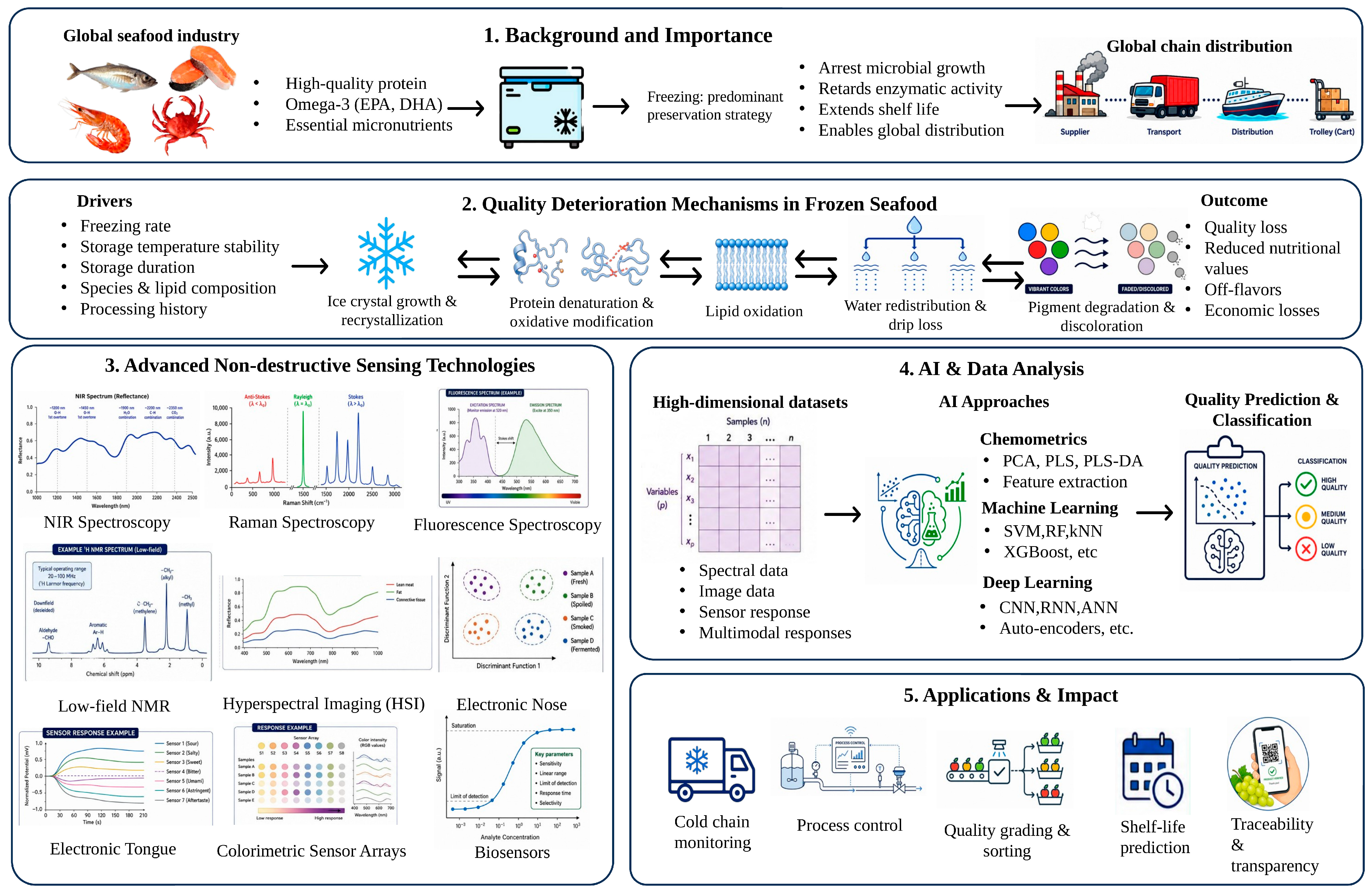
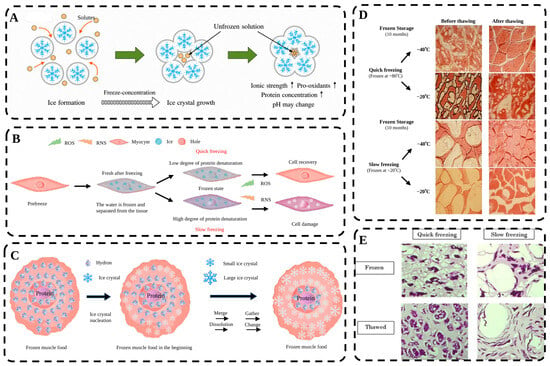
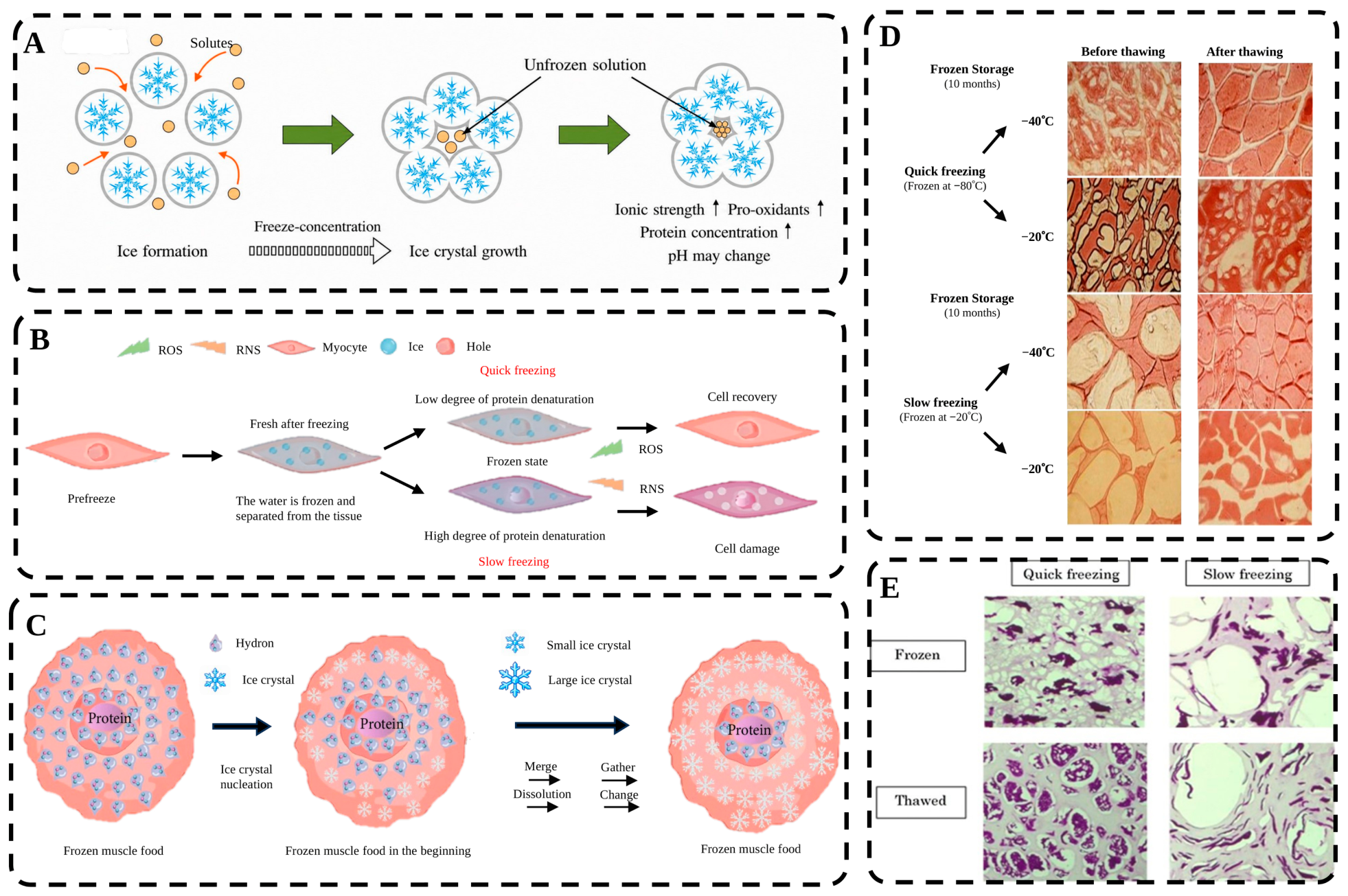
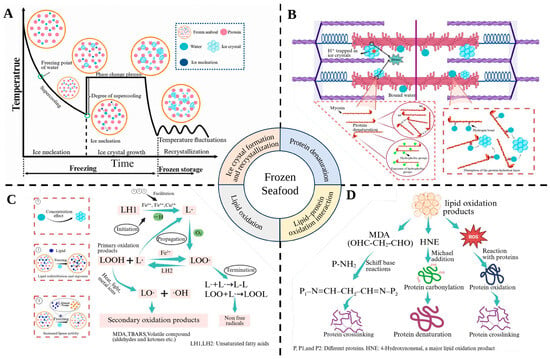
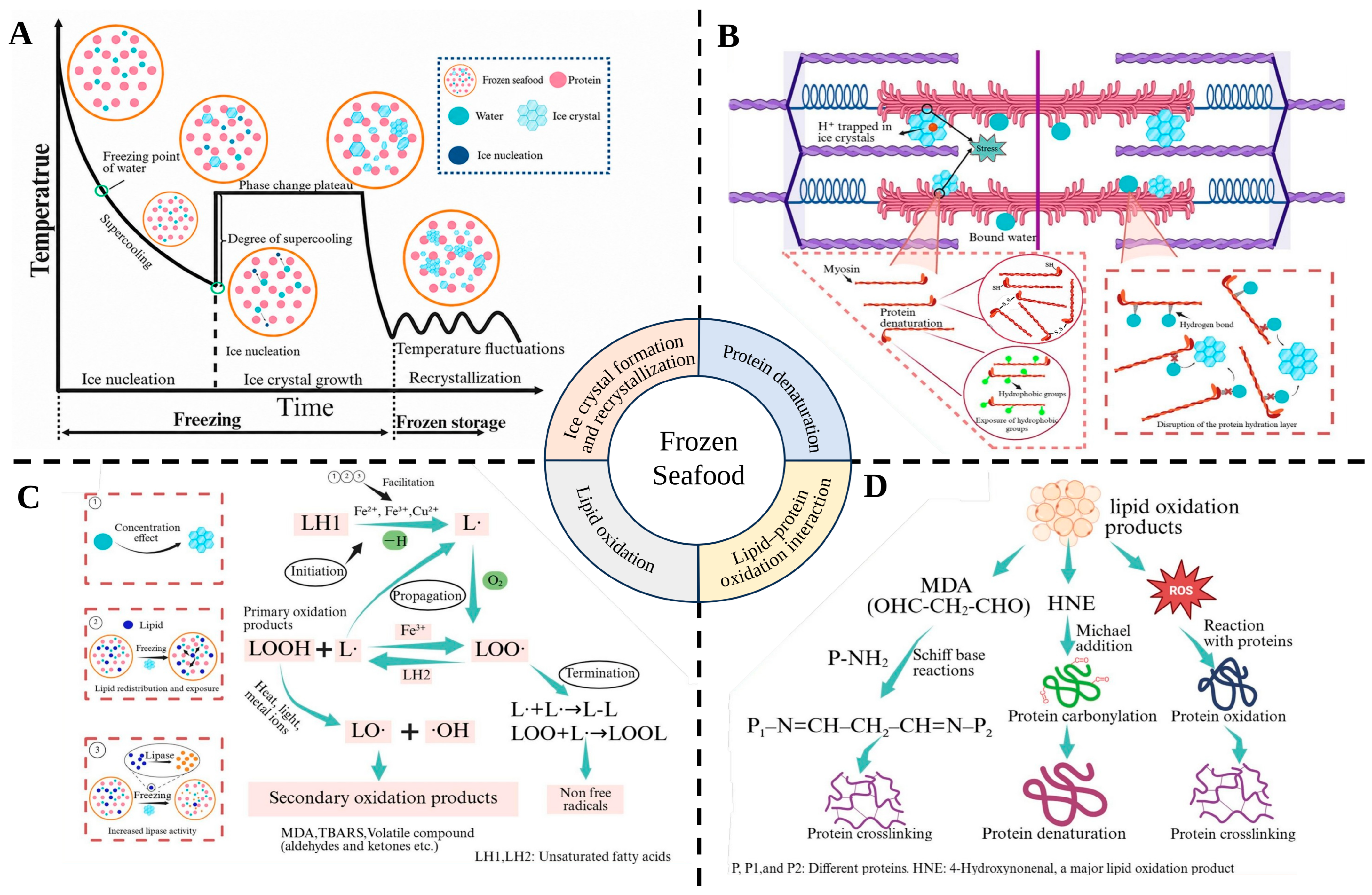
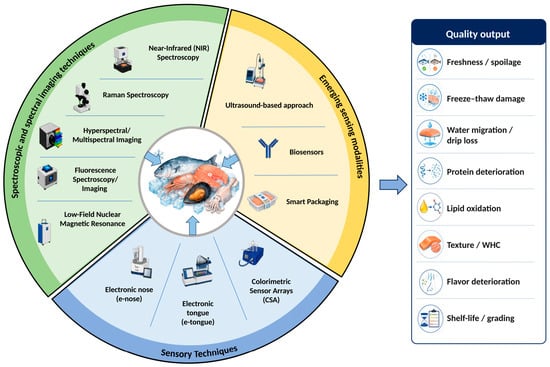
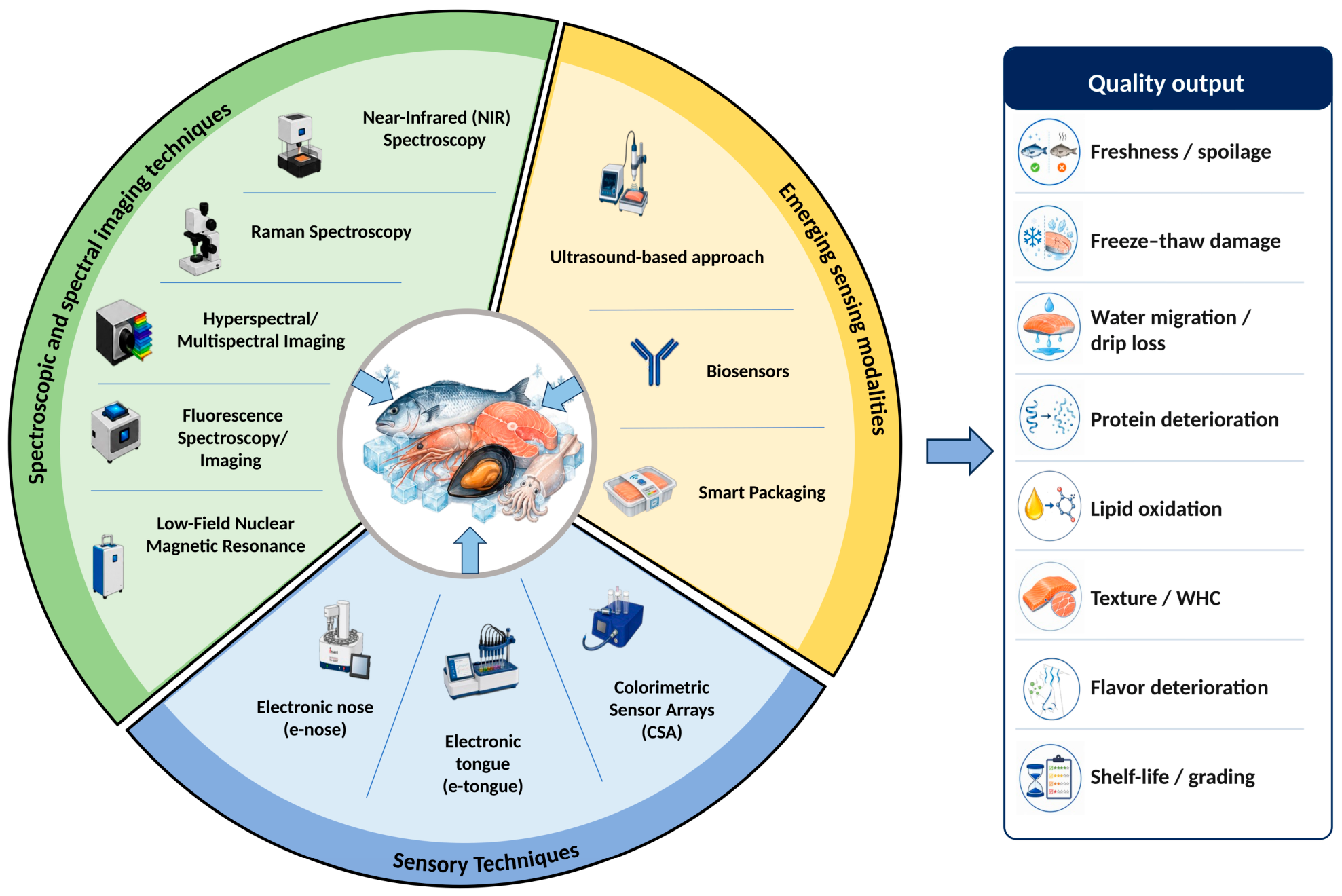
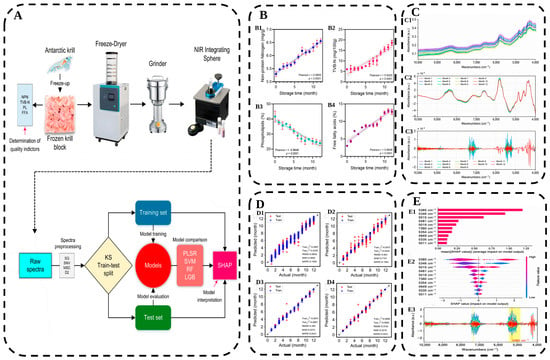
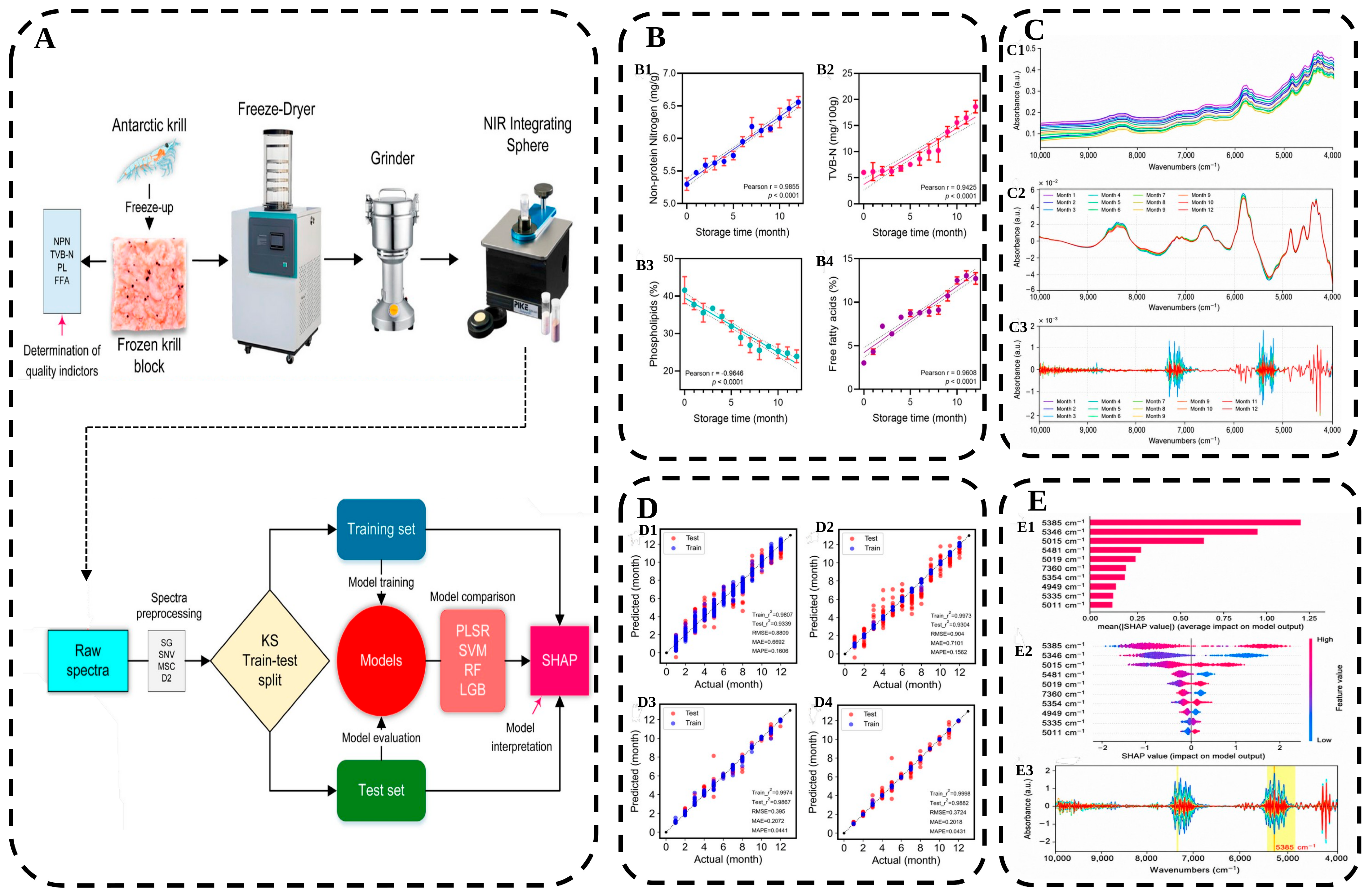
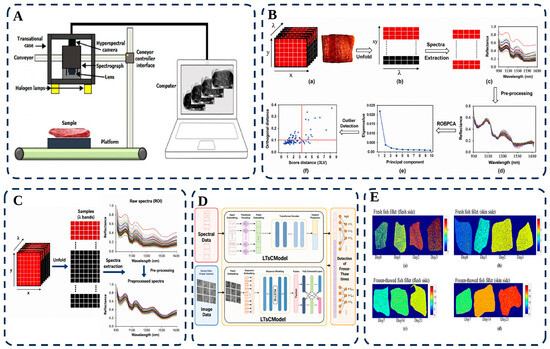
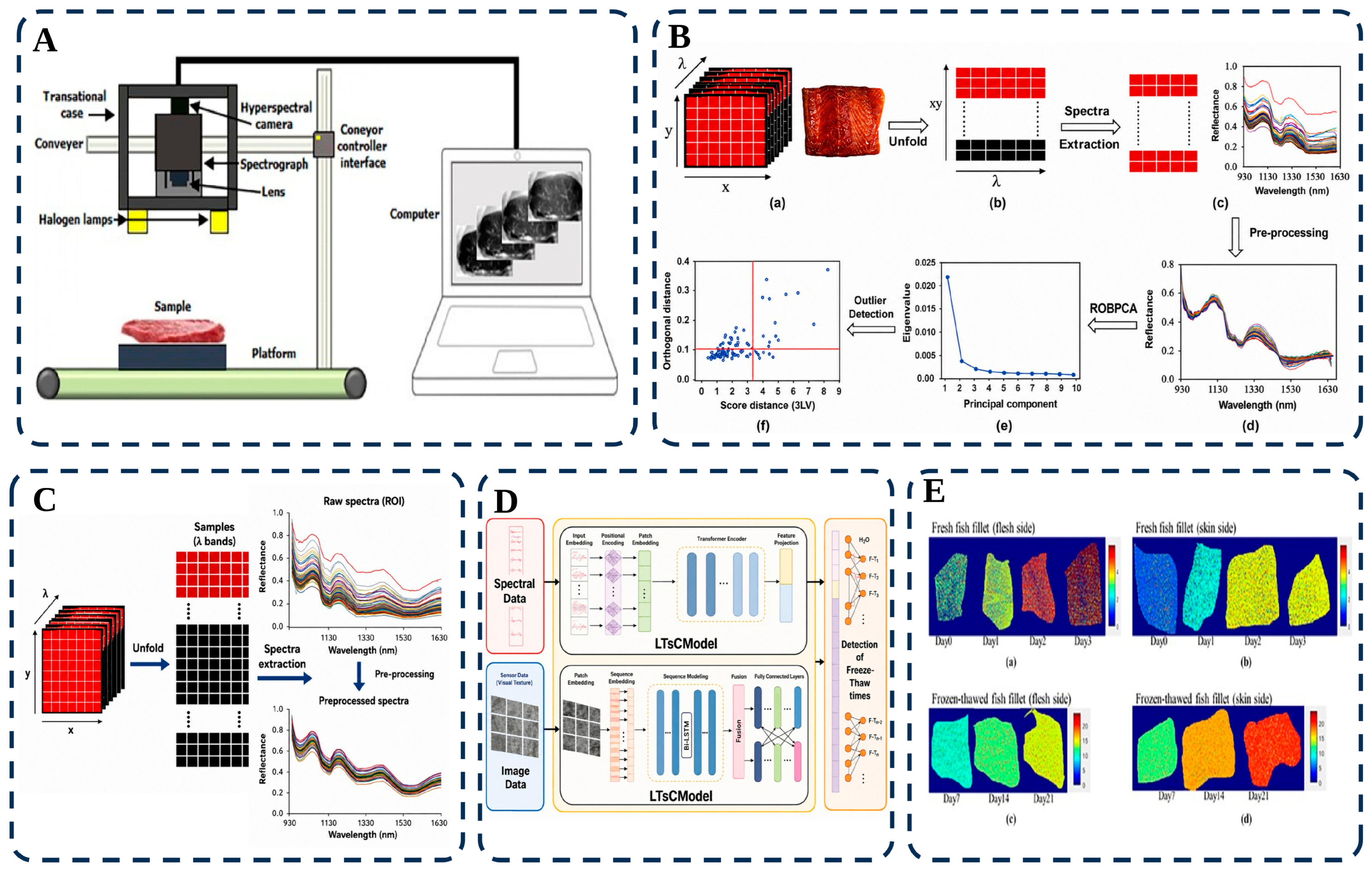
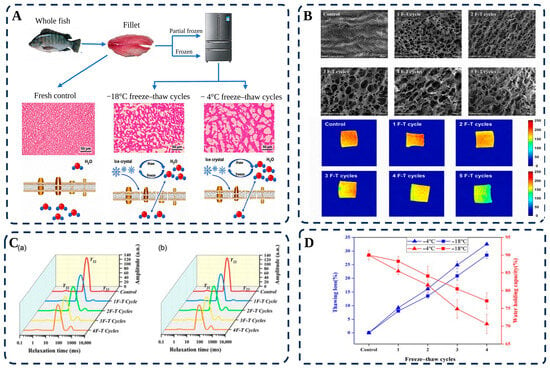
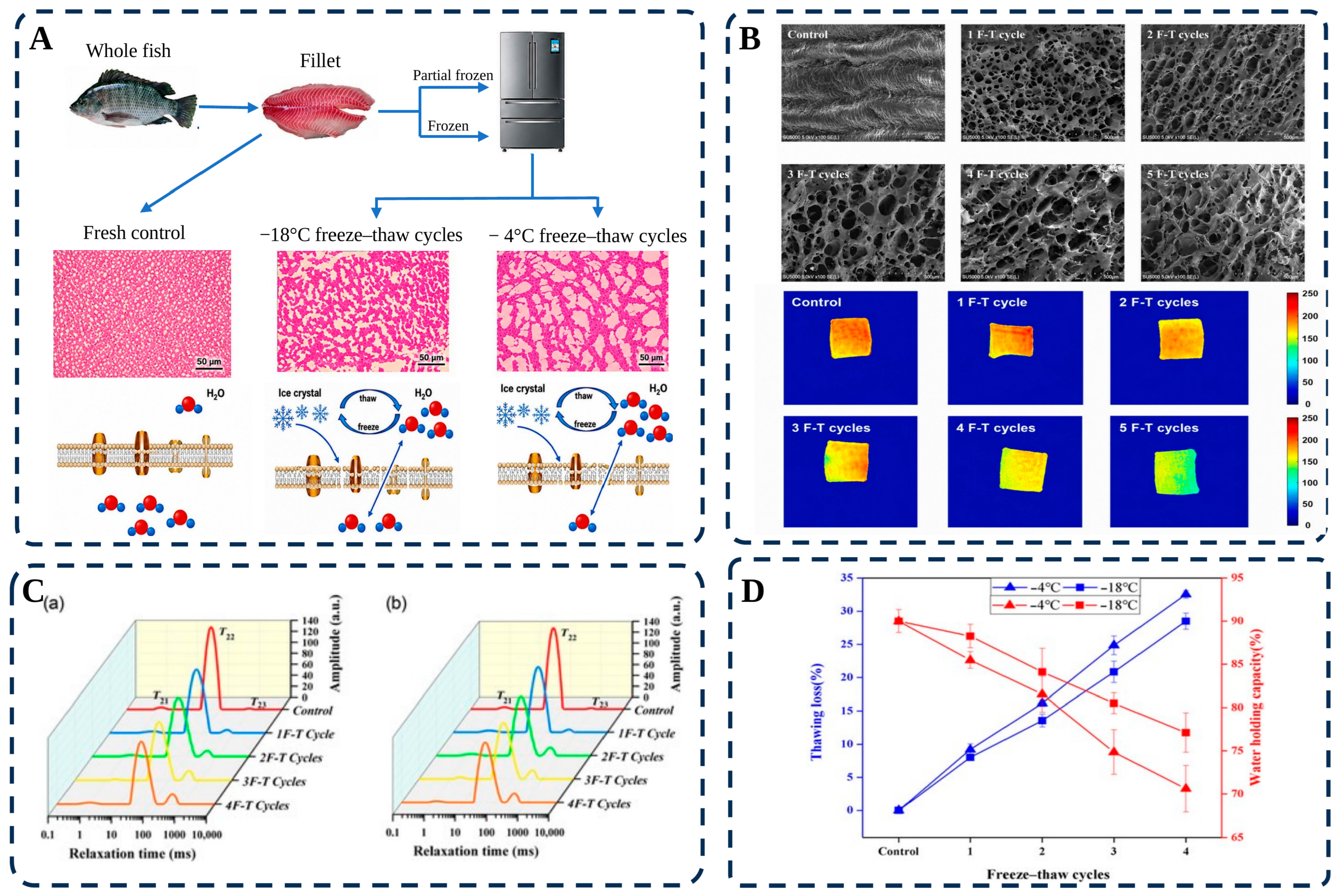
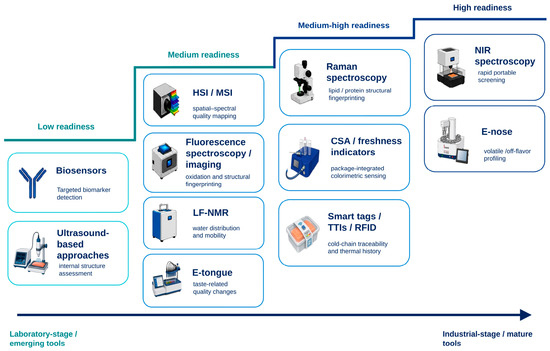
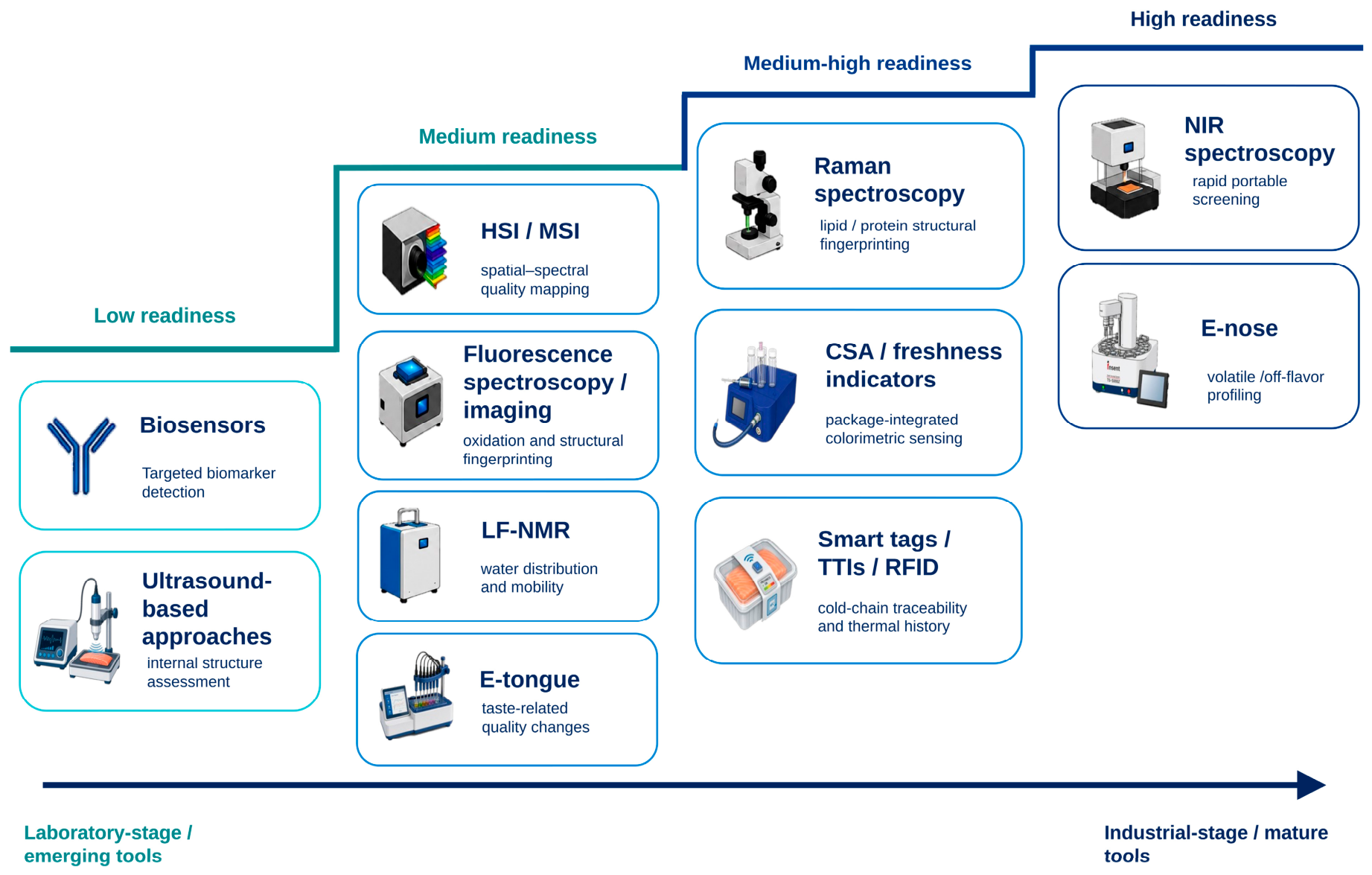
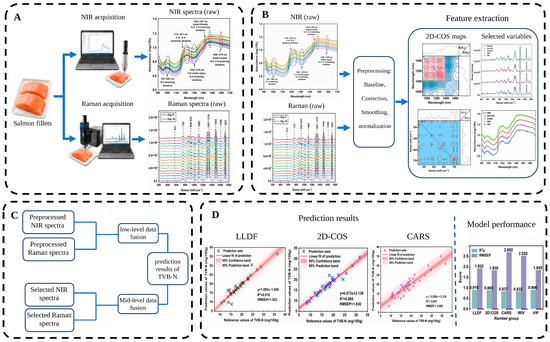
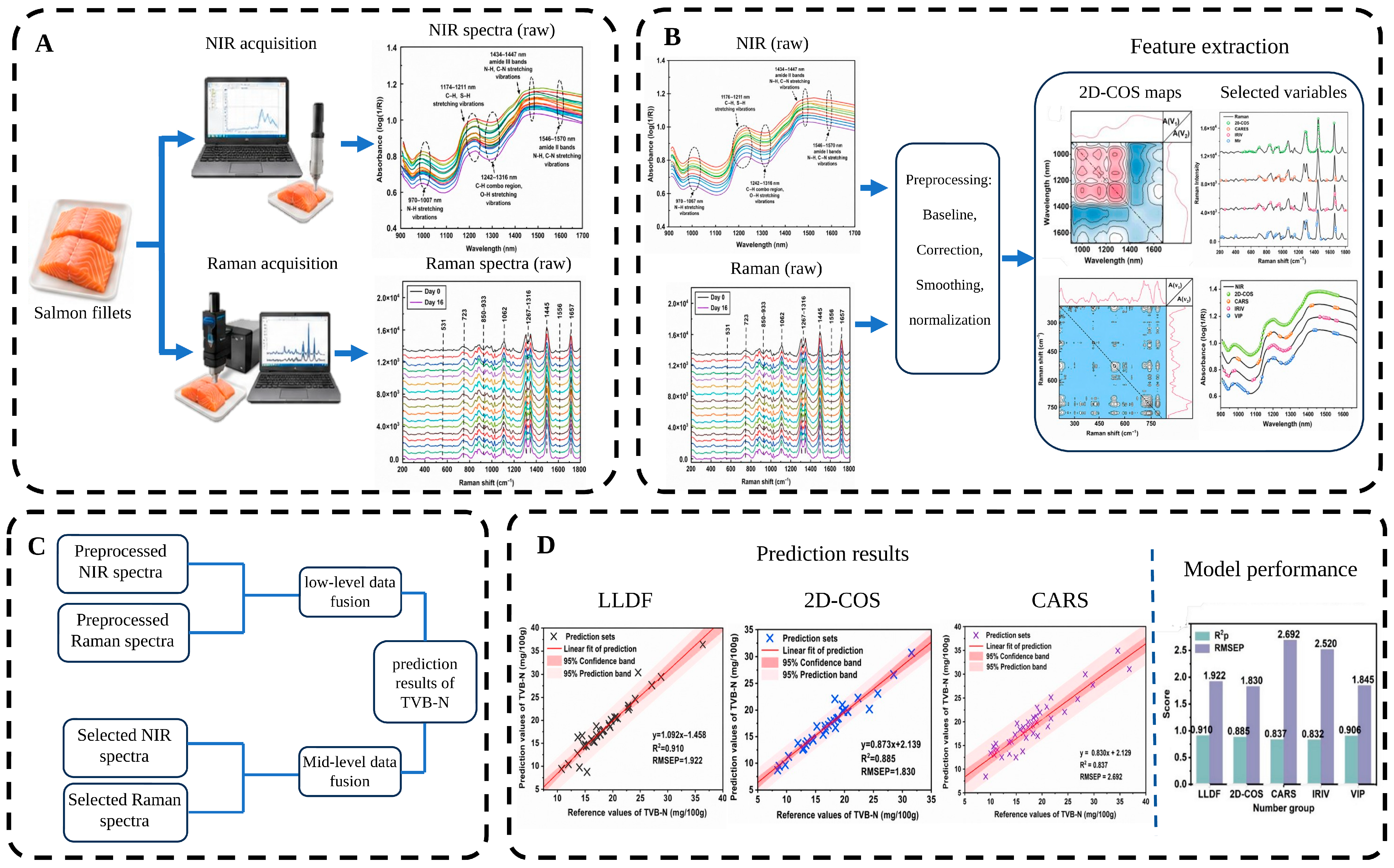

Disclaimer/Publisher’s Note: The statements, opinions and data contained in all publications are solely those of the individual author(s) and contributor(s) and not of MDPI and/or the editor(s). MDPI and/or the editor(s) disclaim responsibility for any injury to people or property resulting from any ideas, methods, instructions or products referred to in the content. |
© 2026 by the authors. Licensee MDPI, Basel, Switzerland. This article is an open access article distributed under the terms and conditions of the Creative Commons Attribution (CC BY) license.