


Abstract
Sauce-aroma Baijiu is produced through a one-year cyclic process involving multiple fermentations and distillations. However, the dynamic changes and correlations among fermented grains (FG), distilled fermented grains (DG), heart liquor (HL) and tail liquor (TL) remain unclear. In this study, the physicochemical indicators and volatile compounds (VCs) from the 3rd to 6th distillation rounds were systematically analyzed. Across successive rounds, FG and DG exhibited similar trends in key physicochemical indicators, as did HL and TL. Headspace solid-phase microextraction coupled with gas chromatography–mass spectrometry (HS-SPME/GC-MS) identified 76, 73, 80 and 93 VCs in FG, DG, HL and TL, respectively. Multivariate statistical analyses revealed significant inter-round differences in volatile profiles, and further indicated that total acids and water contents in FG were positively correlated with the majority of VCs in liquor. These results clarify the dynamic change of physicochemical and flavor components during Baijiu production and provide a basis for quality evaluation.
1. Introduction
Chinese Baijiu, alongside brandy, whisky, rum, vodka, and gin, is recognized as one of the six most famous distilled spirits in the world [1]. It is produced primarily from cereal materials such as sorghum, rice and wheat, and is brewed via solid-state fermentation, distillation, aging and blending, with a production and consumption history over thousands of years [2,3,4]. Based on the flavor characteristics, Chinese Baijiu is classified into twelve aroma types: sauce-aroma, strong-aroma, light-aroma, rice-aroma, mixed-aroma, Dong-aroma, Feng-aroma, Te-aroma, sesame-aroma, Laobaigan-aroma, Fuyu-aroma and Chi-aroma [5]. Among these liquors, sauce-aroma Baijiu has gained wide consumer preference due to its distinctive flavor profile, which is dominated by a prominent “sauce” aroma, complemented by elegant and delicate notes, a mellow and full-bodied taste, and a prolonged aftertaste [5,6]. These flavor compounds, such as ethyl acetate, butanol and ethyl caprylate, exhibit significant positive correlations with enhanced ethanol clearance and better post-drink comfort [7]. Consequently, sauce-aroma Baijiu has commanded strong consumer demand, as reflected in its 2024 output of approximately 650,000 kiloliters and revenue of 240 billion yuan, underscoring its considerable importance in the overall liquor market [8].
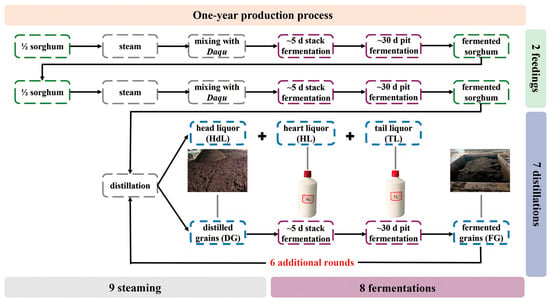
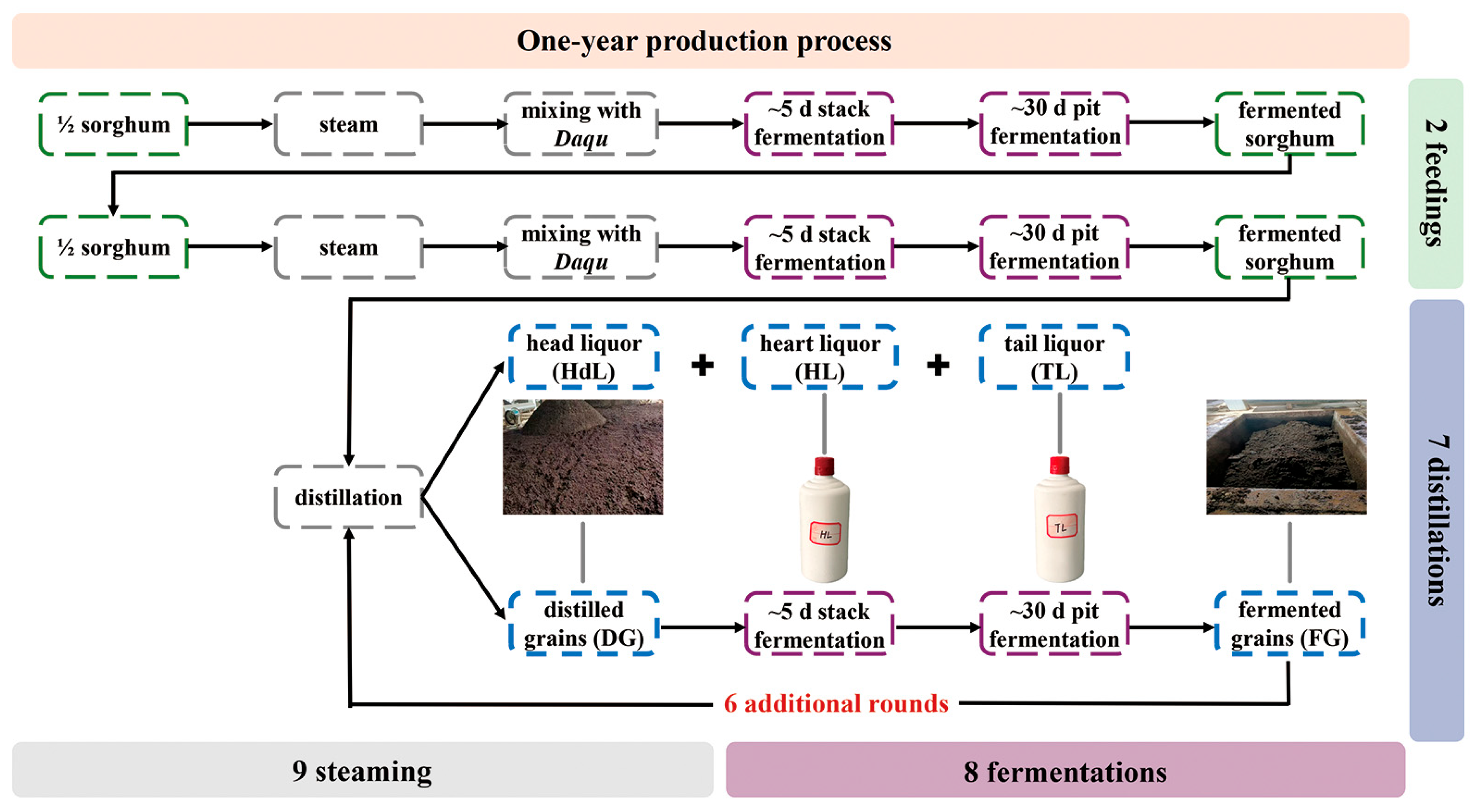
The brewing process of sauce-aroma Baijiu is highly complex [4,9], which is typically made by a special type of glutinous sorghum with a hard and thick hull and amylopectin content exceeding 90%. As shown in Figure 1, the brewing process of sauce-aroma Baijiu generally begins at the Chinese Chongyang Festival (Senior’s Day), which falls on the ninth day of the ninth lunar month. At the beginning, half of the sorghum (raw material) is steamed and, after cooling to approximately 30 °C, mixed with the fermentation starter Daqu. The mixture is then stacked on the ground in a conical shape for about 5 days until the inner temperature rises to over 50 °C. This open process, known as stack fermentation, facilitates the recruitment of microorganisms from the surrounding environment [10]. After the stack fermentation, the material is transferred to a stone-lined underground pit (Jiao) for anaerobic fermentation. After approximately 30 days fermentation, the fermented material will be taken out and combined with the remaining half of the raw sorghum. The mixture is then again steamed, cooled and mixed with Daqu, subjected to another round of stack fermentation, and subsequently returned to the pit for continued anaerobic fermentation. The brewing process then enters a cyclic stage, with each fermentation cycle lasting about 35 days. At the end of each cycle, the fermented materials are taken out and distilled to obtain liquor fractions. The solid residues remaining after distillation are mixed with Daqu, undergo a short period of stack fermentation, and are then returned to the pit for the next round of anaerobic fermentation. This fermentation and distillation process is repeated for other 6 rounds, and after the final distillation, the solid residues are not reused for further fermentation [11]. Consequently, the entire brewing process of sauce-aroma Baijiu extends about “1” year, consisting of “2” material feedings, “9” steaming, “8” fermentations and “7” distillations to extract liquors, which is commonly referred to as the “12987” brewing technology of sauce-aroma Baijiu [4].
Figure 1.
One-year production process of sauce-aroma Baijiu. Dashed boxes indicate the main steps of the brewing cycle. The process comprises two feedings (green), nine steaming (grey), eight fermentations (purple), and seven liquor extractions (blue). In the final cycle, the process terminates after steaming and liquor extraction, without further fermentation of distilled grains. The entire production process spans approximately one year.
During the process of sauce-aroma Baijiu, the fermented materials directly retrieved from the pit after each cycle of fermentation is Jiupei and also named as fermented grains (FG). The FG is distilled to obtain the liquid fraction, namely raw liquor, while the remaining solid residue, termed Jiuzao and also known as distilled grains (DG), is reused in the next fermentation cycle. According to the sequence of outflow, the raw liquor can be divided into head liquor (HdL), heart liquor (HL) and tail liquor (TL). HdL and TL are liquid by-products of sauce-aroma Baijiu. HdL, the beginning distilled fraction of raw liquor, is characterized by a low yield, pungent and bitter taste, liquid turbidity, but high concentration of low-boiling-point VCs [12], and is mainly used for blending Baijiu final product. In contrast, the final fraction TL, has a high yield but low alcohol content, and is generally applied in a Pojiao process [10], in which TL is splashed onto the pit walls and bottom to inhibit harmful microorganisms and regulate moisture during the anaerobic fermentation. In addition, TL can also be utilized as a raw material for vinegar and other fermented products [13]. HL, the fraction collected after HdL, is the main part of raw liquor with a moderate alcohol concentration and relatively high yield. After being aged for at least three years, transformations such as esterification, hydrolysis, oxidation, Maillard reaction and volatilization occur and contribute to the development of desirable aroma [14,15], making the aged HL qualified to serves as the base liquor for producing the Baijiu final product.
Researches have proven that the composition and quality of HL differ substantially across different rounds. For instance, HL from the 1st and 2nd rounds possess a strong grain flavor, while those from the 3rd to 5th rounds are enriched in characteristic sauce-aroma VCs. In contrast, HL from the 6th and 7th rounds contain distinct roasted and baked flavors [2]. In the complex brewing system of sauce-aroma Baijiu, the presence and succession of microbial communities are the core driving forces for shaping its unique flavor profile. For instance, Lactobacillus spp. boosts the production of ethyl acetate and ethyl lactate, thereby enhancing the fruity aroma and establishing a balanced acid-ester profile in sauce-aroma Baijiu [16]. Leuconostoc spp. and Bradyrhizobium spp., both of which correlate positively with tetramethyl-pyrazine, an important flavor compound for sauce-aroma Baijiu [17]. On the other hand, throughout the entire fermentation process, the succession of the microbial community is tightly correlated with FG [18]. The microbial community in the FG is influenced by water contents, acidity, levels of reducing sugars and starch, as well as oxygen availability, leading to variations in both microbial population size and species composition that may ultimately affect the formation of flavor compounds in Baijiu [19,20]. Sauce-aroma Baijiu features a unique and highly complex multi-round fermentation and distillation process. However, existing studies have predominantly concentrated on single fermentation rounds or individual production stages [21,22], while the systematic characterization of the dynamic changes in physicochemical properties and volatile compounds at different production stages during multi-round fermentation, as well as the correlations among them, remain poorly understood.
This study aimed to elucidate the correlations between physicochemical factors and volatile compounds across different production stages during multi-round fermentation of sauce-aroma Baijiu, and to provide insights into the VC compositional differences of raw liquors across distillation rounds. To this end, the physicochemical indicators and VCs profiles in FG, DG, HL and TL from the 3rd to 6th rounds were systematically investigated and compared.
2. Materials and Methods
2.1. Experimental Materials
Samples of FG, DG, HL and TL were collected during the 3rd to 6th distillation rounds from a sauce-aroma Baijiu production company located in Maotai Town, Guizhou Province, China, a widely recognized representative production region for sauce-aroma Baijiu. Samples were labeled according to the material type and distillation round (e.g., FG3 represents FG collected from the 3rd distillation round). Three independent fermentation pits that fermented for one month from the same workshop were analyzed, and sampling was conducted in 2023. HL and TL were stored in opaque glass bottles, whereas FG and DG were collected in sterile bags. All samples were stored at 4 °C prior to analysis. For subsequent analyses, grain samples were thoroughly mashed and mixed, while liquor samples were homogenized before processing.
2.2. Determination of Physicochemical Indicators
2.2.1. Water Contents
Water content was determined using the drying method. A pre-dried beaker of constant weight was filled with an appropriate amount of FG or DG and weighed, then dried at 100 °C to a constant weight. The water content was calculated according to Formula (1):
where m0 is the weight of the weighing bottle (g); m1 is the weight of the bottle plus sample before drying (g); m2 is the weight after drying (g).
2.2.2. Reducing Sugar Contents
Fresh FG and DG samples equivalent to 100 g dry weight were immersed in 1 L of distilled water for 30 min with stirring every 10 min. The mixture was filtered, and the filtrate volume was adjusted to 1 L with distilled water, yielding a solution equivalent to 0.1 g/mL FG or DG, and this solution was used for subsequent analyses.
The Fehling’s method was applied to detect the reducing sugar contents. Briefly, 5 mL each of Fehling’s reagent solution A and B (Shanghai Yaji Biological Technology Co., Ltd., Shanghai, China) was titrated with 1 mg/mL glucose standard solution until the blue color disappeared, and the consumed volume was recorded. For sample analysis, 2 mL of the filtrate, which is equivalent to 0.2 g of FG or DG, was titrated under same conditions as the standard solution. Reducing sugar contents was calculated by Formula (2):
where c is the glucose concentration (mg/mL); V0 is the volume of glucose solution consumed in blank titration (mL); and V1 is the volume consumed for sample titration (mL).
2.2.3. Alcohol Contents
Alcohol content in HL and TL was measured using an alcoholmeter with temperature correction. Samples were transferred into a 100 mL graduated cylinder, the alcoholmeter and thermometer were inserted, equilibrated for 5 min, and readings were recorded.
2.2.4. Total Acids
For FG and DG, the filtrates prepared in Section 2.2.2 were used for the total acid determination. A 50 mL filtrate, which is equivalent to 5 g of FG or DG, was titrated with 0.1 M NaOH to pH 8.2 using a PHS-3E pH meter (Shanghai Yidian Scientific Instrument Co., Ltd., Shanghai, China). The result was calculated according to Formula (3):
For HL and TL, 10 mL of sample was diluted with 20 mL distilled water, and titrated with 0.1 M NaOH to pH 8.2. The result was calculated according to Formula (4):
where c is concentration of NaOH standard solution (mol/L); V is the titrant volume (mL); and 60 is the molar mass of acetic acid (g/mol).
2.2.5. Total Esters
After total acid titration, 25 mL of 0.1 M NaOH solution was added to the flask, mixed, and refluxed for 30 min in boiling water. After cooling, the solution was titrated with 0.1 M H2SO4 until pH 8.7. Meanwhile, a blank titration using distilled water was conducted. The total esters were calculated:
For FG and DG, was calculated by Formula (5):
For HL and TL, was calculated by Formula (6):
where c1 is the concentration of H2SO4 standard solution (mol/L); Va and Vb are the titrant volumes for sample and blank (mL); and 88 is the molar mass of ethyl acetate (g/mol).
2.3. Analysis of VCs
2.3.1. SPME Extraction
Samples were placed in 20 mL headspace vials under the optimal extraction conditions determined by preliminary single-factor experiments (Table 1), with saturated NaCl solution or solid NaCl added. Menthol (Shanghai Aladdin Biochemical Technology Co., Ltd., Shanghai, China) was used as the internal standard for all samples [23]. It was added at 0.835 µg/mL for FG and DG, and at 200 µg/mL for HL and TL. After the vials were sealed, they were put into a magnetic stirring water bath (Shanghai Lichen Bangxi Instrument Technology Co., Ltd., Shanghai, China) to equilibrate for 10 min. Then a 50/30 µm DVB/CAR/PDMS SPME fiber (Supelco, Bellefonte, PA, USA) preconditioned at 250 °C for 20 min, was used to extract the VCs. Following extraction, the VCs on the fiber were desorbed in the GC-MS injection port at 230 °C for 5 min.
Table 1.
Headspace solid-phase microextraction conditions (HS-SPME) for volatile compounds from fermented grains (FG), distilled fermented grains (DG), heart liquor (HL) and tail liquor (TL).
2.3.2. GC-MS Analysis
VCs were analyzed using an Agilent 7890B GC coupled to a 5977B MSD (Agilent Technologies, Santa Clara, CA, USA) with a DB-WAX capillary column (30 m × 250 µm, 0.25 µm). The oven temperature program was as follows: initial temperature of 40 °C was maintained for 2 min, followed by an increase to 230 °C at a rate of 5 °C/min, with a final hold for 5 min. The injector and detector temperatures were both maintained at 250 °C. High-purity helium (He) was used as the carrier gas at a constant flow rate of 2.0 mL/min. Samples were analyzed in splitless mode. Mass spectrometric detection was performed in EI mode (70 eV), while ion source, quadrupole and transfer line temperatures were 230 °C, 150 °C and 280 °C, respectively. Full scan spectra were recorded from m/z 33 to 500. Compounds were identified by matching the mass spectra of each component with the NIST 17 mass spectra database. At last, their relative contents were calculated by dividing the isolated compound’s peak area by the internal standard’s peak area [24].
2.4. Statistical Analysis
Orthogonal partial least squares discriminate analysis (OPLS-DA) is a supervised multivariate statistical method widely applied in flavoromics [25]. OPLS-DA and variable importance in projection (VIP) were conducted using SIMCA 14.1 (Umetrics, Umeå, Sweden). Peak areas of VCs were imported into SIMCA 14.1 (Umetrics, Umeå, Sweden) and normalized using UV scaling. The model robustness is further assessed by 200 random permutation tests. Model performance was evaluated using R2 (goodness-of-fit) and Q2 (predictive ability), with Q2 derived from 7-fold cross-validation. Typically, both R2 and Q2 values are required to be greater than 0.5, with values closer to 1 indicating better performance [26]. VCs were performed using SIMCA 14.1 (Umetrics, Umeå, Sweden) to calculate VIP values. Normality and homogeneity of variance were examined for the VCs data. As both assumptions were violated, non-parametric Kruskal-Wallis tests were subsequently performed in SPSS 25 (IBM, Armonk, NY, USA) on VCs with VIP > 1 [27]. VCs simultaneously meeting both criteria (VIP > 1 and p < 0.05) were considered significantly different.
Line plots and stacked bar charts were generated with Origin 2022 (OriginLab Corporation, Northampton, MA, USA). Heatmaps and Upset plots were constructed using TBtools v2.1 (South China Agricultural University, Guangzhou, China). Redundancy analysis (RDA) was performed in R 4.3.3 (the R Foundation for Statistical Computing, Vienna, Austria).
3. Results and Discussion
3.1. Physicochemical Indicators
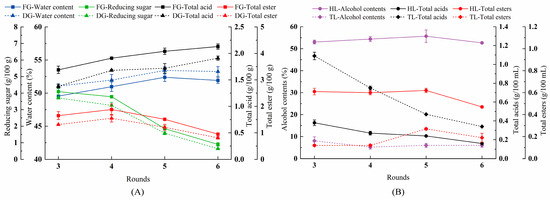
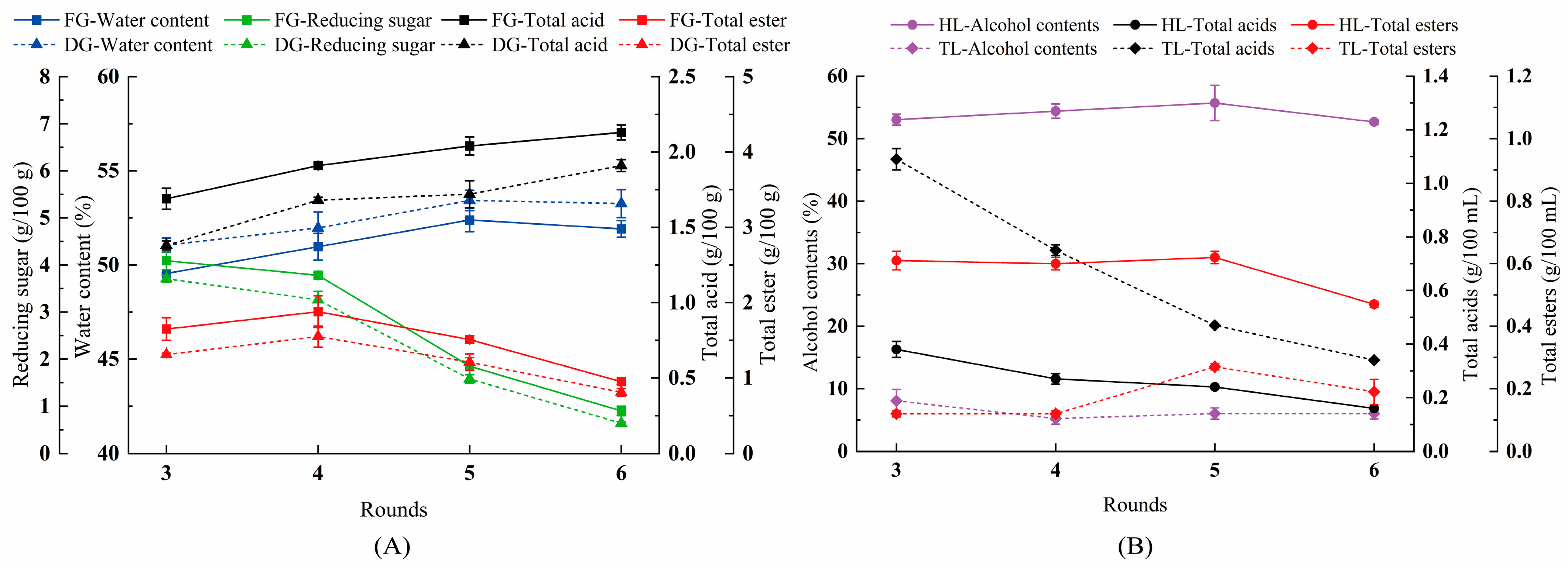
From the 3rd to the 6th round, the water contents of FG and DG first increased and then declined (Figure 2A), varying from 49.55% to 52.39% in FG and 51.05% to 53.43% in DG. Maintaining an appropriate water content is crucial for supporting the fermentation process, as excessive moisture may inhibit the growth of anaerobic microorganisms, while insufficient moisture may prevent adequate hydration of the grains [28,29]. In contrast, the reducing sugar contents decreased sharply across the rounds, falling from 4.09 to 0.90 g/100 g in FG and from 3.71 to 0.64 g/100 g in DG, with the most pronounced reduction occurring from the 4th to 5th round. Within the same round, DG consistently contained lower reducing sugar levels than FG. Throughout fermentation, microorganisms continuously consume reducing sugars to sustain their growth, which gradually lowers the sugar content in FG as the process advances [29]. In the subsequent distillation stage, sugars in the complex matrix may participate in Maillard reactions, undergo caramelization, or thermally decompose [30], further reducing the reducing sugar levels in DG. As for the alcohol content, it remained relatively stable, ranging from 52.67% to 55.70% in HL and from 5.23% to 8.07% in TL (Figure 2B).
Figure 2.
Changes of physicochemical indicators from the 3rd to the 6th rounds. (A) Water contents, reducing sugars, total acids, and total esters in fermented grains (FG) and distilled fermented grains (DG). (B) Alcohol contents, total acids, and total esters in heart liquor (HL) and tail liquor (TL). Colors represent different parameters: blue for water content, green for reducing sugars, black for total acids, red for total esters, and purple for alcohol content.
Total acid contents in FG and DG increased with successive rounds, from 1.69 to 2.13 g/100 g in FG and from 1.38 to 1.91 g/100 g in DG (Figure 2A). In contrast, the total acid contents decreased in HL and TL from the 3rd to the 6th rounds (Figure 2B). The increased acid content in FG primarily originated from the activity of acid producing bacteria [9]. Within the same round, DG always contained less acid than FG, reflecting the migration of volatile acids in FG into HL and TL, while TL invariably exhibited higher acid content than HL. The elevated acid in TL is likely due to the accumulation of high-boiling-point acids in later distillation fractions [31]. For example, the high-boiling-point octanoic acid in TL was consistently higher than that in HL within the same round (Table S1) [3,6,9,32,33,34,35,36,37,38,39,40].
The total ester contents in FG, DG, HL and TL exhibited a similar trend, rising initially and then declining from the 3rd to the 6th rounds. Within the same round, FG always contained more esters than DG, while HL exhibited higher ester contents than TL. The higher ester content in FG compared with DG can be attributed to the transfer of partial esters into liquors during distillation, whereas the higher ester content in HL compared to TL is mainly due to the preferential migration of low-boiling-point esters into earlier distillation fraction (HL). For example, ethyl hexanoate, which has a lower boiling point, was present in higher amounts in HL than that in TL within each round (Table S1).
During the fermentation of sauce-aroma Baijiu, microorganisms consume reducing sugars from cereal materials while substantial amounts of organic acids are produced [11,41]. These acids not only act as important flavor compounds in Baijiu, but also participate in esterification reaction, which facilitates ester VCs formation [27,42]. Therefore, the total acid contents in FG and DG increased substantially while the total ester contents reached to it maximum in HL5 and TL5 (Figure 2).
3.2. Profiling and Quantification of VCs
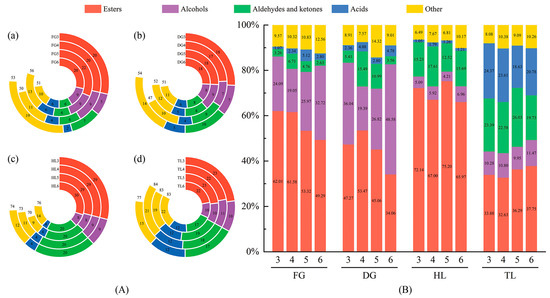
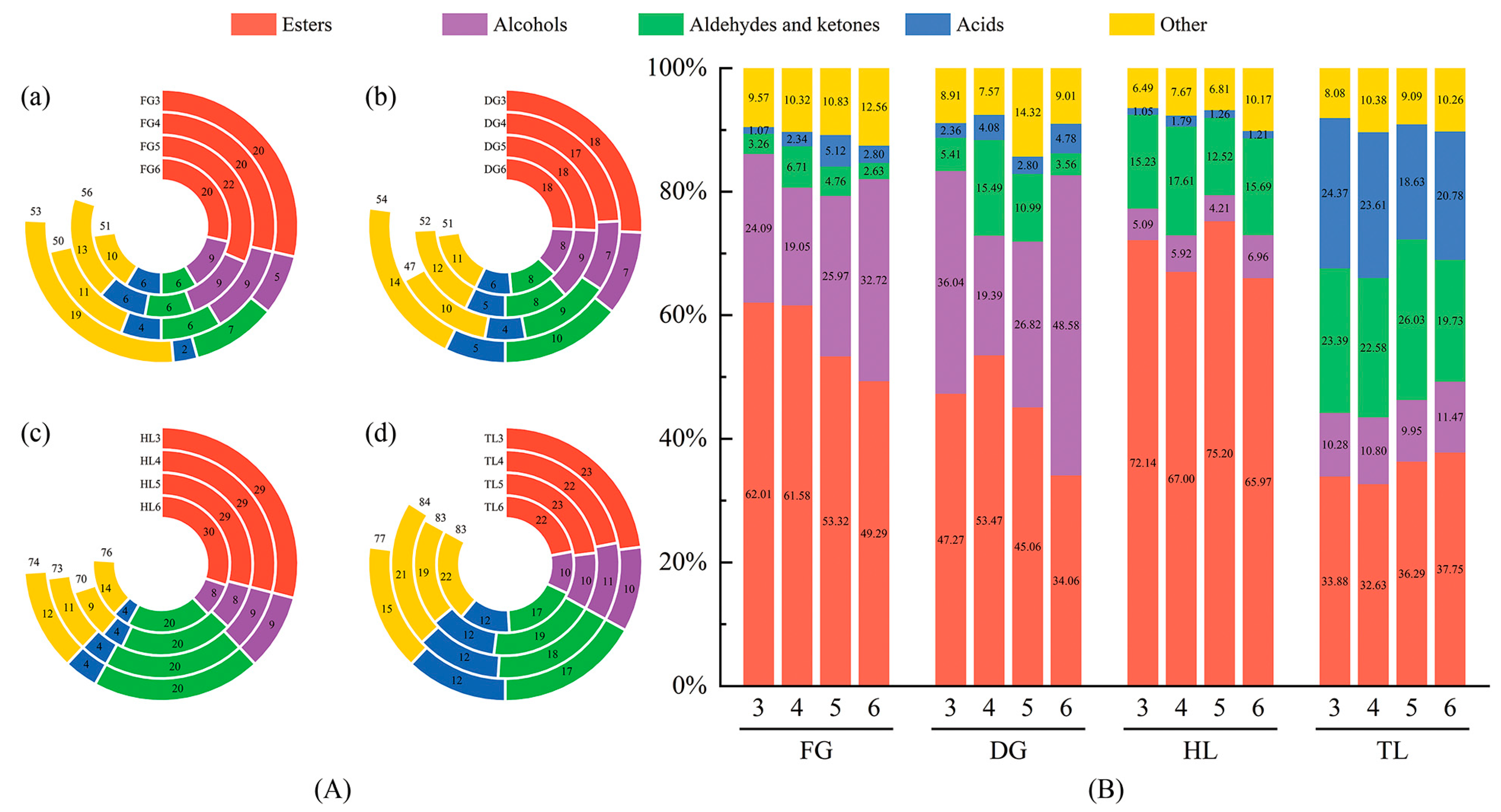
A total of 76, 73, 80 and 93 VCs were identified in FG, DG, HL and TL, respectively (Table S1). Esters, alcohols, aldehydes and ketones, and acids were the dominant VC classes and their content proportional distributions were shown in Figure 3. Esters were consistently the most diverse class of VCs across all rounds and sample types. In FG and DG, no obvious differences were observed in the numbers of alcohol VCs and aldehyde and ketone VCs (Figure 3A). In contrast, in HL and TL, aldehyde and ketone VCs outnumbered alcohol VCs. Notably, TL contained substantially more acid VCs than FG, DG, or HL (Figure 3A,B).
Figure 3.
Quantity (A) and relative content proportion (B) of volatile compound categories. In panel (A), (a) fermented grains (FG), (b) distilled fermented grains (DG), (c) heart liquor (HL) and (d) tail liquor (TL) represent the number of compounds in each group. Colors indicate compound categories: red for esters, purple for alcohols, green for aldehydes and ketones, blue for acids, and yellow for other.
In addition to having the highest diversity, ester VCs were also the most abundant VCs, accounting for 49.29–62.01% of total VCs in FG, 34.06–53.47% in DG, 65.97–75.20% in HL, and 32.63–37.75% in TL, respectively (Figure 3B). In FG and DG, ester contents gradually decreased with successive rounds, whereas they peaked in HL5 and TL6. In FG and DG, the major ester components were ethyl lactate, ethyl phenylacetate, and ethyl hexadecanoate, which primarily originate from microbial metabolism [43]. On the other hand, the dominant esters in HL and TL included ethyl hexanoate, ethyl pentanoate, ethyl phenylacetate, and ethyl caprylate (Table S1). And these dominant compounds are recognized as key aroma-active esters contributing to the characteristic flavor of sauce-aroma Baijiu [5,44]. Notably, several medium-chain fatty acid ethyl esters, such as ethyl decanoate and dodecanoic acid ethyl ester, were abundant in FG and DG but not detected in HL and TL (Table S1). Due to their high boiling points [45], these esters are difficult to distill and therefore cannot be efficiently transferred into the liquor. In addition, the high temperature during distillation can promote thermal degradation or transformation reactions, resulting in a decrease content of ester from FG to DG in the same round. Compared with FG and DG, more unique esters appeared in HL and TL. For example, ethyl hexanoate and ethyl pentanoate, both are important flavor compounds in sauce-aroma Baijiu, were consistently detected in all HL and TL rounds but were completely absent in FG and DG (Table S1). These newly formed esters after distillation may arise from chemical reactions occurring within the complex matrix of FG. In the presence of acids, alcohols, and high-temperature catalytic conditions, extensive esterification reactions can generate large amounts of esters [27], which play crucial roles in shaping the characteristic aroma of sauce-aroma Baijiu.
Alcohol VCs are another flavor category, serving as auxiliary components that modulate the aroma and flavor of Baijiu [46]. The alcohol VCs abundant in FG and DG but less in HL and TL (Figure 3B). Among them, 3-methyl-1-butanol was most abundant in HL, whereas phenylethyl alcohol predominated in FG, DG, and TL (Table S1). 3-methyl-1-butanol is a key characteristic marker of sauce aroma Baijiu [9]. In our study, its content increased from HL3 to HL6, consistent with the typical profile of southern sauce-aroma Baijiu [9]. In addition, the phenylethyl alcohol, 3-octanol, 2-nonanol and 2-methyl-1-propanol are also important contributors to the mellow texture and enhanced aftertaste of Baijiu [47,48], which also shared the same increasing pattern as 3-methyl-1-butanol (Table S1). In contrast, propylene glycol and 2,3-butanediol were abundant in grains but disappeared in liquors. However, their strong hydrophilicity prevents their mass transfer from being enhanced by the ethanol “solvent effect” [49], causing them to remain largely in DG after the distillation process (Table S1).
Different from alcohol VCs, the aldehyde and ketone VCs were abundant in HL and TL but scarce in FG and DG (Figure 3B). Generally, aldehyde and ketone VCs are important in enhancing the fragrance and mouthfeel and contribute to the distinctive flavor of sauce aroma Baijiu [26]. Furfural, detected in DG, HL and TL, but absent in FG, which reached 6586.88 ± 342.17 µg/L in HL5 but decreased to 5632.7 ± 506.11 µg/L in HL6 (Table S1). Furfural, like 3-methyl-1-butanol, is a characteristic flavor compound in southern sauce-aroma Baijiu and is strongly associated with roasted aromas [9]. While high-quality Baijiu often contains relatively high amounts of furfural, an overabundance can introduce undesirable burnt notes and lead to an unpleasant drinking experience [24]. Apart from furfural, benzaldehyde and benzeneacetaldehyde are two other aldehydes strongly associated with base liquor quality [24], and their contents increased progressively across the fermentation rounds (Table S1). Benzaldehyde is mainly responsible for the characteristic “sauce” aroma [50], while benzeneacetaldehyde contributes floral notes that enhances the distinctive flavor profile of sauce-aroma Baijiu [33].
Acid VCs were least abundant in FG, DG, and HL but accounted for up to 24.37% of total VCs in TL. As illustrated in Figure 3, acid VCs accounted for only 1.07–5.12% of total VCs in FG, 2.36–4.78% in DG, and 1.21–1.79% in HL, whereas they contributed 18.63–24.37% of total VCs in TL. In addition to participating in esterification reactions with alcohols, these accumulated acids in the liquid fraction also help prolong the aftertaste of sauce-aroma Baijiu [14]. Acetic acid was the most abundant acid in HL, followed by hexanoic acid (Table S1). Besides contributing to Baijiu aroma, acetic acid also serves as a key precursor for the formation of acetate esters and plays an important role in regulating the microbial community during fermentation [15,51]. Hexanoic acid, characterized by sour, sweaty, and cheesy notes, is considered an important aroma marker of sauce-aroma Baijiu. Compared with FG and DG, many acid VCs were present only in HL and TL (Table S1), which may be likely formed or released through chemical reactions occurring during distillation. Furthermore, the greater diversity of acids in TL relative to HL can be attributed to differences in their physicochemical properties. The acids with lower boiling points and higher ethanol solubility tend to accumulate in HL, where the alcohol content is higher, whereas higher-boiling and higher water-soluble acids are more likely to concentrate in TL [52]. Although the specific acids in TL have not been identified as key aroma contributors in Baijiu, some of them, such as heptanoic acid, which are known to be important volatile components in other fermented products, such as vinegar [53].
Furthermore, other classes of VCs were also detected in the tested samples (Table S1), contributing to the enrichment of the flavor of sauce-aroma Baijiu. For instance, 2,3,5-trimethylpyrazine with sweet, nutty and smoky notes [39], 2,4-di-tert-butylphenol with phenol note [3,54], and 2-acetyl-5-methylfuran contributed to green and roast notes [32], were also found in HL and TL.
Considering all VCs, esters were the dominant aroma constituents in Baijiu, and their diversity and abundance largely determined the quality of the final Baijiu product [5,27]. Consistent with previous studies [55], the HL5 in our work also exhibited the highest ester contents. In addition, a balanced composition of alcohols, aldehydes and ketones, acids, and other minor compounds is indispensable for Baijiu quality. The insufficient levels of them lead to weak aroma, whereas excessive levels may cause undesirable off-odors and unhealthy effect [56,57]. Therefore, when considering the overall VC profile, the precise proportions among different classes of compounds make HL4, HL5, and HL6 generally recognized as the best base liquors for producing the final product [58]. On the other hand, the particularly high levels of acids in TL, together with its unique VC composition, indicate that TL could be further utilized for producing fermented by-products such as vinegar [13]. Moreover, the grains remaining after brewing contain not only oligopeptides but also characteristic aroma compounds. Thus, they have the potential to be developed into value-added products rather than being used solely as livestock feed [59].
3.3. Screening of Key Differential VCs
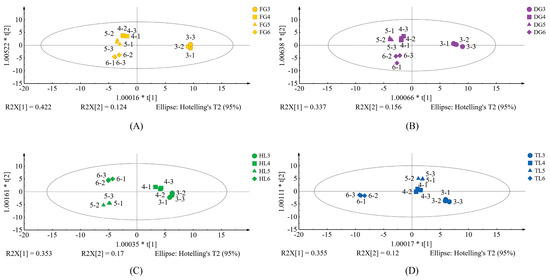
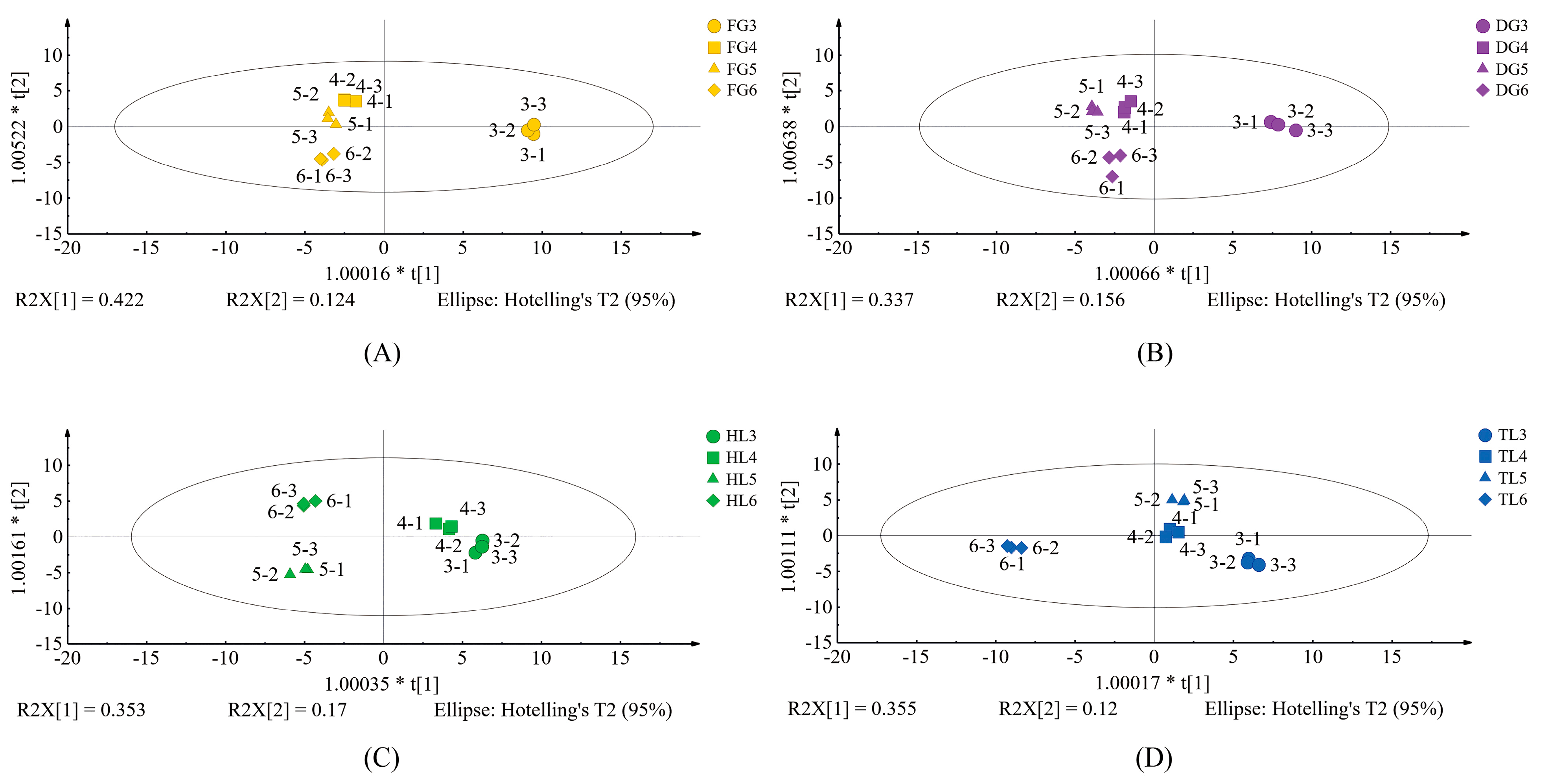
OPLS-DA revealed clear inter-round differentiation among FG, DG, HL, and TL samples, with all models showing good performance (R2 and Q2 > 0.5) and no evidence of overfitting (Figure S1; Table S2) [56]. The results also revealed that the VCs profiles of FG and DG exhibited the same trend, in which VCs profiles from the 3rd round showed the greatest divergence, whereas those from the 4th to 6th rounds were similar (Figure 4). In addition, VCs from HL and TL exhibited comparable variation patterns, with being the most distinct in both at the 6th round. However, the VCs of TL3, TL4 and TL5 clustered together, whereas the VCs in HL3 and HL4 were similar but diverged markedly in HL5 (Figure 4).
Figure 4.
Orthogonal partial least squares discriminate analysis (OPLS-DA) score plots of fermented grains (FG), distilled fermented grains (DG), heart liquor (HL) and tail liquor (TL) from the 3rd to 6th rounds. (A) FG, (B) DG, (C) HL, and (D) TL. Each symbol represents a sample from a specific round, with 95% confidence ellipses shown. Clear separation among rounds indicates significant differences in volatile compounds.
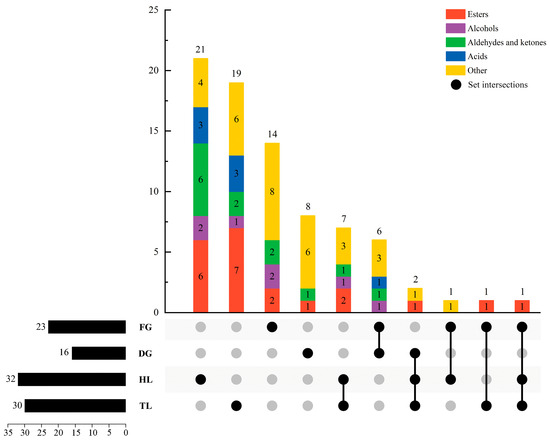
VCs with VIP > 1 were tested by the Kruskal-Wallis test (p < 0.05). Consequentially a total of 23, 16, 32 and 30 key differential VCs were identified in FG, DG, HL and TL, respectively (Figure 5). Among them, HL contained the largest number of unique key differential VCs, followed by TL, FG, and DG, with 21, 19, 14, and 8 compounds, respectively. In terms of shared VCs, 10 were common to HL and TL, 6 to FG and DG, 2 to DG, HL, and TL, 2 to FG and HL, 2 to FG and TL, and 1 to FG, HL, and TL, as shown in Figure 5 and listed in Table S3.
Figure 5.
Upset plot of key differential volatile compounds (VCs) of fermented grains (FG), distilled fermented grains (DG), heart liquor (HL) and tail liquor (TL). Upset plot showing the distribution of key differential VCs among sample types. Black dots indicate set intersections, the black bar at the lower left gives the total number of key differential VCs for samples, and the colored bars show the number of compounds shared across intersections: red for esters, purple for alcohols, green for aldehydes and ketones, blue for acids, and yellow for other.
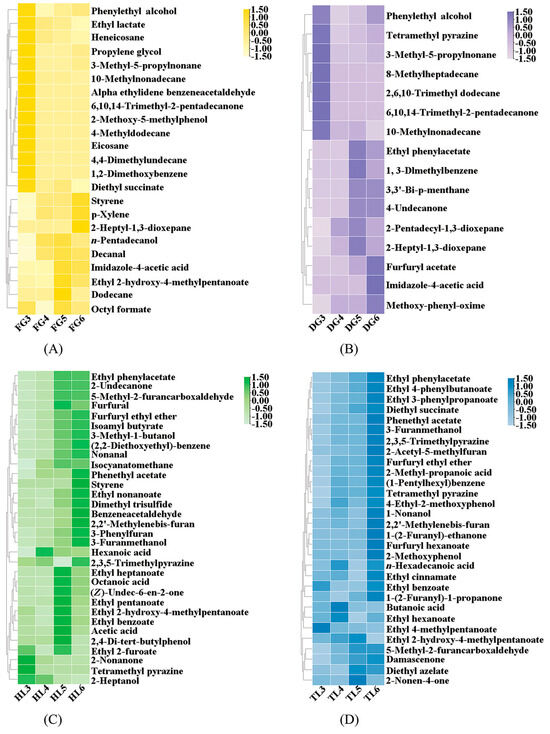
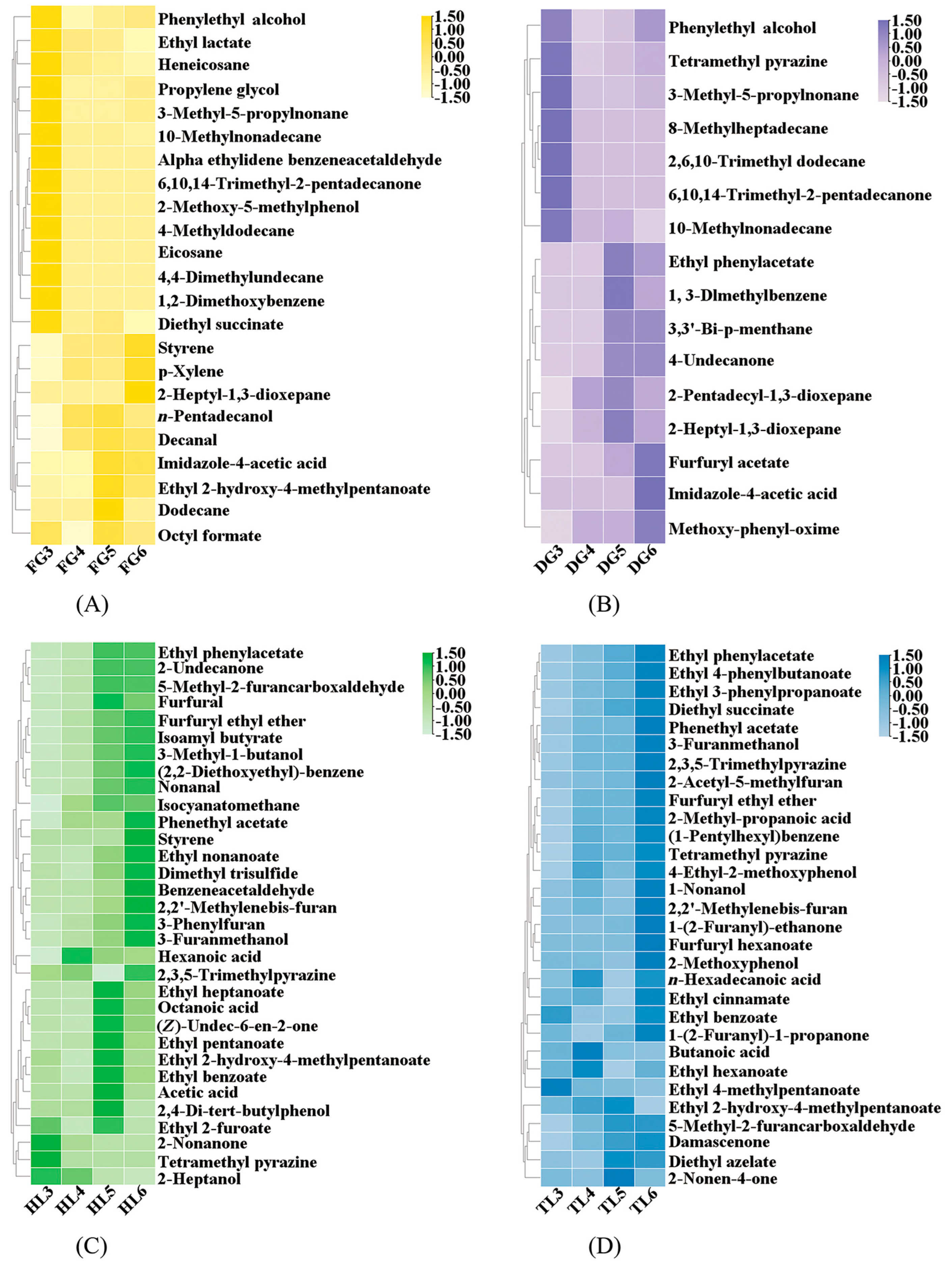
The key differential VCs in all samples were normalized and visualized in a clustered heatmap (Figure 6). As shown in Figure 6A, most key differential VCs from in FG were concentrated in FG3, with phenylethyl alcohol and ethyl lactate exhibiting the strongest signal intensity. In DG, the key differential VCs were primarily concentrated in DG3 and DG5, among which phenylethyl alcohol and ethyl phenylacetate showed the highest abundance (Figure 6B). Consistently, Zeng et al. [19] also identified phenylethyl alcohol, ethyl lactate, and ethyl phenylacetate as key differential VCs in sauce-aroma Baijiu across different rounds. In addition, relatively high levels of diethyl succinate and octyl formate impart fruity notes to FG [33], while tetramethyl pyrazine contributes nutty and roasted notes to DG [40], collectively enhancing the overall flavor profile of the Baijiu.
Figure 6.
Heatmaps of key differential VCs of fermented grains (FG), distilled fermented grains (DG), heart liquor (HL) and tail liquor (TL). (A) FG, (B) DG, (C) HL, and (D) TL. Color gradients from light to dark represent relative abundance from low to high based on row-normalized data; vertical comparisons are not applicable.
For HL, the differential VCs were mainly concentrated in HL5 and HL6, whereas for TL they were concentrated in TL6 (Figure 6C,D). In HL, ethyl phenylacetate and furfural were abundant but displaying a rise-fall trend from the 3rd to 6th rounds. Ethyl phenylacetate, a key aroma component in sauce-aroma Baijiu [44], peaked in HL5 and then declined slightly, consistent with the findings of Wu et al. [9]. This compound not only differentiates distillation rounds but also imparts characteristic nutty and bean-like notes to HL. Meanwhile, esters such as ethyl heptanoate, ethyl pentanoate, and ethyl benzoate also peaked in HL5, contributing predominantly floral and fruity aromas to HL. Furfural, another important VC in HL, is mainly derived from the decomposition of pentoses in auxiliary materials such as rice husks during fermentation [60] and contributes almond-like notes [34]. In addition, hexanoic acid, 3-furanmethanol, 2,3,5-trimethylpyrazine and tetramethyl pyrazine are also key contributors to the aroma of sauce-aroma Baijiu [61]. Collectively, the pronounced enrichment of these differential aroma compounds suggests that HL from these rounds exhibits a more abundant aroma-active compound profile, making it more suitable for use in the production of the final Baijiu product.
Although TL contains several odor-active VCs such as 1-(2-furanyl)-ethanone and 1-(2-furanyl)-1-propanone [62], it also has a high alcohol contents, abundant organic acids, and other pleasant VCs with floral, fruity, and creamy notes, including ethyl phenylacetate, diethyl succinate, and acetoin [9,34], making it a promising substrate to produce other fermented products [13]. Moreover, as the rounds progressed, the contents of 2-acetyl-5-methylfuran, 3-furanmethanol, 2,3,5-trimethylpyrazine and tetramethyl pyrazine gradually increased, all of which contribute to the characteristic aroma of sauce-aroma Baijiu [61]. Notably, TL6 exhibited the highest total concentration of flavor compounds and the greatest proportion of esters (Figure 3B and Figure 6D), highlighting its considerable potential for further utilization.
3.4. Correlation Analysis Between Physicochemical Indicators and VCs
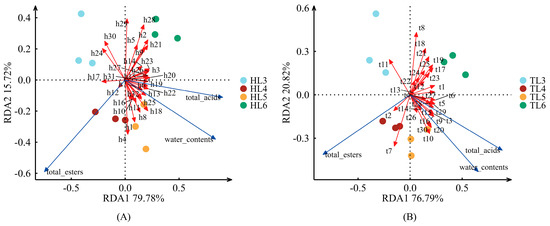
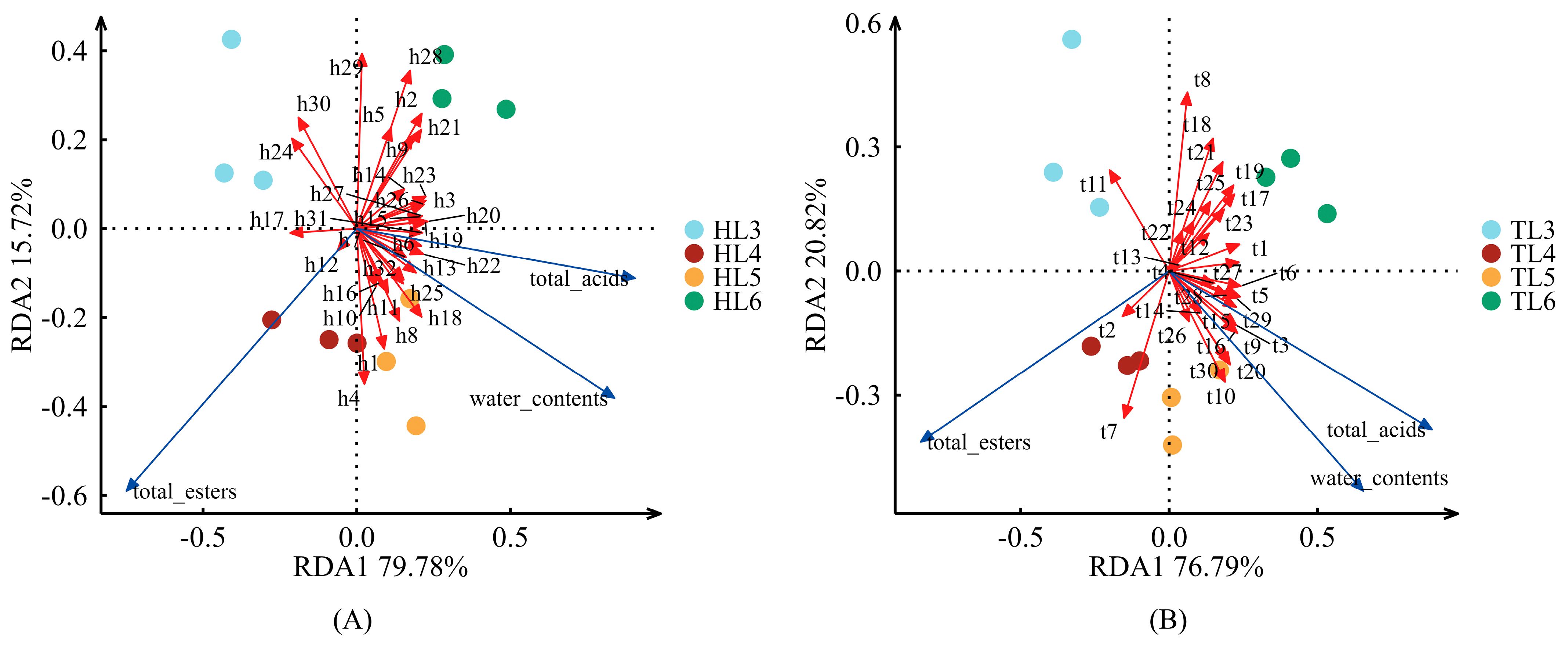
To further explore the relationships between the physicochemical indicators of FG and the VCs of liquors, RDA was performed. After screening, water contents, total acids, and total esters were retained for subsequent analysis [42]. Figure 7 showed the relationship between the three physicochemical indicators of FG and the key differential VCs of HL and TL, in which arrow length represents the magnitude of the correlation, while the angle between arrows indicates the direction of the relationship [42].
Figure 7.
Redundancy analysis (RDA) between physicochemical indicators of fermented grains (FG) and the key differential volatile compounds (VCs) in (A) heart liquor (HL) and (B) tail liquor (TL). Physicochemical indicators and VCs are represented by blue and red lines with arrow. Compounds h1–h32 denote the key differential VCs of HL, and t1–t30 denote those of TL. Colored dots represent the samples from different rounds: blue for the 3rd round, red for the 4th round, yellow for the 5th round, green for the 6th round.
The RDA results showed that the two axes explained 95.5% (Figure 7A) and 97.61% (Figure 7B) of the total variance in key differential VCs, respectively, indicating strong associations between physicochemical indicators and VC profiles. Based on the arrow lengths, most VCs in HL and TL were associated with the 5th and 6th rounds, suggesting that their concentrations increased in later stages. The angles between vectors indicated that total acids and water contents were positively correlated with ester VCs such as h6, h26 and t4, alcohol VCs such as h20, aldehyde and ketone VCs such as h13, h23 and h31, as well as other compounds including t15, t29 and t30. In addition, total esters were positively correlated with VCs such as h12, h17, t2, and t7 (Figure 7 and Table S4). The acute angles formed between the vectors of water contents and most VCs, as well as between total acids and most VCs, indicating that these two parameters from FG were positively correlated with the majority of VCs and were key physicochemical indicators linked to the flavor profile of HL and TL.
The essence of Baijiu brewing is essentially the process of microbial growth and the accumulation of their metabolic products [1], and the growth and metabolic activities of these microorganisms are strongly governed by the physicochemical properties of the fermentation environment [46,63]. During solid-state fermentation, physicochemical properties such as starch content, moisture, acidity, and reducing sugars change continuously as fermentation progresses; these changes affect microbial metabolic processes and consequently influence the formation of flavor compounds [9]. During stacking fermentation, reducing sugars serve as the key driver of microbial succession; during pit fermentation, acidity and related parameters act as critical regulatory factors. Previous studies identified total acids and water contents as the primary environmental factors driving the evolution of bacterial and fungal communities [46,64]. As fermentation progresses, both water and acid contents generally increase throughout the entire process [22,65]. Changes in water content not only affect the levels of VCs but also influence the overall flavor profile and structural characteristics of the base liquor [66]. Moreover, increasing acidity favors the dominance of acid-tolerant microorganisms, leading to marked shifts in microbial community composition [65,66]. For instance, acid-tolerant microorganisms such as Lactobacillus spp. multiply rapidly and become the prevailing population [63], which actively drive fermentation and generate organic acid precursors for ester synthesis. Huang et al. [67] found that Lactobacillus spp. is significantly positively correlated with esters including ethyl phenylacetate and plays an important role in ester synthesis during the fermentation of sauce-aroma Baijiu. Aspergillus, the core fungal genus in sauce-aroma Baijiu fermentation, is central to saccharification, fermentation and esterification [68] and shows positive correlations with both water content and acidity [19,46]. This genus produces proteolytic enzymes and various lyases that not only facilitate starch saccharification and protein hydrolysis but also promote the formation of VCs such as 3-methyl-1-butanol [69].
In summary, strong correlations exist between physicochemical indicators of FG and key VCs in HL and TL. Accordingly, precise control of these key parameters during fermentation is expected to contribute to improvements in liquor aroma complexity and overall quality.
4. Conclusions
The dynamic changes of physicochemical indicators and VCs profiles were systematically investigated and compared from FG, DG, HL and TL of the 3rd to 6th rounds in the brewing process of sauce-aroma Baijiu. The results demonstrate that the physicochemical indicators of both FG and DG exhibited consistent dynamic trends across the rounds and the indicators of FG were strongly associated with key differential VCs in HL and TL. Notably, HL5 contained the highest total VCs and the greatest proportion of pleasant esters, suggesting that it may represent the most favorable raw liquor for final Baijiu production, whereas the by-product TL6 with high acid content and the greatest proportion of esters appeared most suitable for further applications such as vinegar production.
Overall, this study elucidates the interrelationships among FG, DG, HL and TL, as well as the correlation between the physicochemical indicators of the FG and the resulting liquor, thereby providing a theoretical basis for Baijiu quality control, evaluating HL quality across different rounds, and promoting the efficient utilization of TL. However, it should be noted that although aroma-related compounds were extensively analyzed in this study, sensory evaluation was not performed, and thus the direct relationship between the identified VCs and human sensory perception remains to be further validated. Additionally, as this study focused on sauce-aroma Baijiu, the generalizability of the findings to other Baijiu varieties is limited. Future research may integrate sensory analysis and omics methods to validate the relationship between VCs and human sensory perception, uncover the formation pathways of key VCs and the interplay between microbial communities and VCs, and to validate these findings across multiple Baijiu types.
Supplementary Materials
The following supporting information can be downloaded at: https://www.mdpi.com/article/10.3390/foods15122211/s1, Table S1: VCs contents of FG, DG, HL and TL; Table S2: Performance statistics of the OPLS-DA models; Table S3: Upset-plot dataset of unique and shared key differential VCs; Table S4: Key differential VCs used in RDA; Figure S1: OPLS-DA permutation test.
Author Contributions
S.X.: Writing—original draft, Visualization, Investigation, Formal analysis, Data curation; J.X.: Writing—review & editing, Resources; Q.W.: Investigation, Formal analysis; H.Z.: Investigation, Formal analysis, Data curation; D.L.: Methodology, Formal analysis; L.J.: Writing—review & editing, Supervision, Visualization, Conceptualization; F.C.: Writing—review & editing, Project administration, Funding acquisition. All authors have read and agreed to the published version of the manuscript.
Funding
This work was funded by the Doctoral Research Startup Fund of Guizhou Normal University (NO. 0523092).
Institutional Review Board Statement
Not applicable.
Informed Consent Statement
Not applicable.
Data Availability Statement
The original contributions presented in this study are included in the article/Supplementary Material. Further inquiries can be directed to the corresponding authors.
Conflicts of Interest
Author Jun Xu was employed by Sichuan Liquor Group Co., Ltd. He participated in writing—review & editing and resources in the study. The role of the company was limited solely to providing the author’s employment. The remaining authors declare that the research was conducted in the absence of any commercial or financial relationships that could be construed as a potential conflict of interest.
Abbreviations
The following abbreviations are used in this manuscript:
| FG | Fermented grains |
| DG | Distilled fermented grains |
| HL | Heart liquor |
| TL | Tail liquor |
| HdL | Head liquor |
| VCs | Volatile compounds |
| OPLS-DA | Orthogonal partial least squares discriminate analysis |
| HS-SPME/GC-MS | Headspace solid-phase microextraction coupled with gas chromatography–mass spectrometry |
| VIP | Variable importance in projection |
| RDA | Redundancy analysis |
References
- Tu, W.; Cao, X.; Cheng, J.; Li, L.; Zhang, T.; Wu, Q.; Xiang, P.; Shen, C.; Li, Q. Chinese Baijiu: The Perfect Works of Microorganisms. Front. Microbiol. 2022, 13, 919044. [Google Scholar] [CrossRef] [Scilit] [PubMed]
- Li, W.; Zhang, H.; Wang, R.; Zhang, C.; Li, X. Temporal Profile of the Microbial Community and Volatile Compounds in the Third-Round Fermentation of Sauce-Flavor Baijiu in the Beijing Region. Foods 2024, 13, 670. [Google Scholar] [CrossRef] [Scilit] [PubMed]
- Dong, W.; Lin, W.; Chen, X.; Lian, X.; Shen, C.; Liu, M.; Lin, F.; Sun, X.; Xu, Y.; Xiong, Y.; et al. Reducing the Background Interference of Liquid-Liquid Extraction Method During Baijiu Aroma Analysis. Food Chem. 2023, 404, 134557. [Google Scholar] [CrossRef] [Scilit] [PubMed]
- Duan, J.; Yang, S.; Li, H.; Qin, D.; Shen, Y.; Li, H.; Sun, J.; Zheng, F.; Sun, B. Why the Key Aroma Compound of Soy Sauce Aroma Type Baijiu Has Not Been Revealed Yet? LWT-Food Sci. Technol. 2022, 154, 112735. [Google Scholar] [CrossRef] [Scilit]
- Niu, Y.; Zhu, Q.; Xiao, Z. Characterization of Perceptual Interactions among Ester Aroma Compounds Found in Chinese Moutai Baijiu by Gas Chromatography-Olfactometry, Odor Intensity, Olfactory Threshold and Odor Activity Value. Food Res. Int. 2020, 131, 108986. [Google Scholar] [CrossRef] [Scilit] [PubMed]
- Niu, J.; Liu, R.; Li, W.; Lang, Y.; Li, X.; Sun, W.; Sun, B. Characterize and Explore the Dynamic Changes in the Volatility Profiles of Sauce-Flavor Baijiu During Different Rounds by GC-IMS, GC-MS and GC×GC-MS Combined with Machine Learning. Food Res. Int. 2025, 213, 116568. [Google Scholar] [CrossRef] [Scilit] [PubMed]
- Dai, Y.; Fan, X.; Yang, Z.; Wu, L.; Zhou, X.; Fang, X.; Ge, X.; Zhao, L. Characteristics and Correlation of Flavor Substances and Hangover Indexes in Chinese Baijiu During Storage. Curr. Res. Food Sci. 2024, 9, 100887. [Google Scholar] [CrossRef] [Scilit] [PubMed]
- Ma, L.; Tu, T.; Niu, M.; Tong, Y.; Zhao, X.; Jia, J.; Zheng, L.; Tu, R.; Wang, S.; Zhang, S.; et al. Revealing Regional Markers of Sauce Aroma Baijiu in the Chishui River Basin: Integrating Multi-Detection Technologies with Molecular Sensory Science and Chemometrics. Food Chem. X 2026, 35, 103821. [Google Scholar] [CrossRef] [Scilit] [PubMed]
- Wu, Y.; Duan, Z.; Niu, J.; Zhu, H.; Zhang, C.; Li, W.; Li, X.; Sun, B. Spatial Heterogeneity of Microbiota and Flavor Across Different Rounds of Sauce-Flavor Baijiu in Northern China. Food Chem. X 2023, 20, 100970. [Google Scholar] [CrossRef] [Scilit] [PubMed]
- Lu, Y.; Zhang, C.; Zhao, H.; Min, W.; Zhu, H.; Wang, H.; Lu, H.; Li, X.; Xu, Y.; Li, W. Effect of Environmental Microorganisms on Fermentation Microbial Community of Sauce-Flavor Baijiu. Foods 2022, 12, 10. [Google Scholar] [CrossRef] [Scilit] [PubMed]
- Wu, Q.; Zhu, Y.; Xu, Y. Regulation of the Microbiota in Chinese Liquor Fermentation Process. In Science and Engineering of Chinese Liquor (Baijiu) Microbiology, Chemistry and Process Technology; Springer Nature: Singapore, 2023; pp. 569–593. [Google Scholar] [CrossRef] [Scilit]
- Xiang, Y.; Shang, H.; Xiang, S.; Qiu, X.; Yu, J.; Ni, X.; Guan, T. Why Is the “Cutting Heads and Tails” Process Used in the Production of Strong-Flavor Baijiu? J. Chromatogr. A 2025, 1768, 466634. [Google Scholar] [CrossRef] [Scilit] [PubMed]
- Sun, Y.; Huang, Y.; Tang, D.; Wu, X. Analysis of Flavor Characteristics of Vinegar Brewed by Honeysuckle Tail Liquor Based on Odor Activity Value and Sensory Attributes. Food Ferment. Ind. 2019, 45, 233–242. (In Chinese) [Google Scholar] [CrossRef]
- Wang, S.; Li, C.; Li, Y.; Liu, G.; Lu, Z.; Chai, L.; Xu, H.; Shi, J.; Wang, S.; Shen, C.; et al. Evolution of Aroma Compounds in Round Soy Sauce Aroma Type Baijiu During Aging and the Effect of Aging Markers on the Lasting Aroma in Finished Glass. Food Chem. X 2025, 25, 102193. [Google Scholar] [CrossRef] [Scilit] [PubMed]
- Niu, J.; Yang, S.; Shen, Y.; Cheng, W.; Li, H.; Sun, J.; Huang, M.; Sun, B. What Are the Main Factors That Affect the Flavor of Sauce-Aroma Baijiu. Foods 2022, 11, 3534. [Google Scholar] [CrossRef] [Scilit] [PubMed]
- Liu, X.; Ma, D.; Yang, C.; Yin, Q.; Liu, S.; Shen, C.; Mao, J. Microbial Community Succession Patterns and Drivers of Luxiang-Flavor Jiupei During Long Fermentation. Front. Microbiol. 2023, 14, 1109719. [Google Scholar] [CrossRef] [Scilit] [PubMed]
- Wang, D.; Wu, C.; Hu, J.; Hu, F.; Liu, L.; Huang, H.; Yang, J.; Zhao, W.; Xie, D.; Zhang, J.; et al. Exploring the Impact Mechanisms on Different Mechanized Airing Approaches During Second Round Heap Fermentation of Sauce-Flavor Baijiu: From Physicochemical Parameters, Microbial Diversity to Volatile Flavor Compounds. Food Res. Int. 2025, 199, 115359. [Google Scholar] [CrossRef] [Scilit] [PubMed]
- Guan, T.; Lin, Y.; Chen, K.; Ou, M.; Zhang, J. Physicochemical Factors Affecting Microbiota Dynamics During Traditional Solid-State Fermentation of Chinese Strong-Flavor Baijiu. Front. Microbiol. 2020, 11, 2090. [Google Scholar] [CrossRef] [Scilit] [PubMed]
- Zeng, X.; Zou, Y.; Li, D.; Wei, C.; Li, D.; Yan, Y.; Lin, Q. Systematically Exploring and Evaluating Core Fungal Composition and Their Flavor Profile in Fermented Grains of Jiang-Flavor Baijiu. Food Chem. X 2025, 31, 103067. [Google Scholar] [CrossRef] [Scilit] [PubMed]
- Wu, C.; Hu, J.; Xie, D.; Fan, E.; Yang, J.; You, X.; Cheng, P.; Huang, W.; Hu, F.; Wang, D. Comparison of Physicochemical Parameters, Microbial Community Composition and Flavor Substances During Mechanical and Traditional Brewing Process of Jiang-Flavor Baijiu. Food Sci. Biotechnol. 2024, 33, 1909–1919. [Google Scholar] [CrossRef] [Scilit] [PubMed]
- Niu, J.; Yan, Y.; Zhang, G.; Shen, Y.; Cheng, W.; Li, H.; Duan, Z.; Sun, J.; Wang, B.; Wu, J.; et al. Temporal and Workshop Heterogeneity of Microbial Communities with Physicochemical Properties and Flavor Substances During Stacked Fermentation of Sauce-Flavor Baijiu. Foods 2025, 14, 924. [Google Scholar] [CrossRef] [Scilit] [PubMed]
- Liu, X.; Mu, Y.; Lv, X.; Chen, N.; Chen, L.; Wen, T.; Su, W. Analysis of Fermentation Characteristics in Fermented Grains across Seven Rounds of Sauce-Flavored Baijiu: Microbial Communities Structure, Physicochemical Parameters, Volatile and Non-Volatile Flavor Compounds. Food Chem. X 2025, 25, 102228. [Google Scholar] [CrossRef] [Scilit] [PubMed]
- Zhang, H.; Zhang, H.; Du, H.; Zhang, Y.; Zhang, M.; Yu, X.; Xu, Y. Unraveling the Multiple Interactions Between Phages, Microbes and Flavor in the Fermentation of Strong-Flavor Baijiu. Bioresour. Bioprocess. 2025, 12, 14. [Google Scholar] [CrossRef] [Scilit] [PubMed]
- Wu, J.; Chen, R.; Li, X.; Fu, Z.; Xian, C.; Zhao, W.; Zhao, C.; Wu, X. Comprehensive Identification of Key Compounds in Different Quality Grades of Soy Sauce-Aroma Type Baijiu by HS-SPME-GC-MS Coupled with Electronic Nose. Front. Nutr. 2023, 10, 1132527. [Google Scholar] [CrossRef] [Scilit] [PubMed]
- Ouyang, J.; Zhao, J.; Huang, M.; Liu, H.; Sun, B.; Wu, J.; Li, H.; Zhao, D. Interpretable Machine Learning for the Grade Prediction of Strong Flavor Yuanjiu (Crude Baijiu) Based on HS-GC-IMS. Food Chem. X 2026, 35, 103780. [Google Scholar] [CrossRef] [Scilit] [PubMed]
- Peng, X.; Wu, W.; Ma, Y.; Shao, F.; Zhang, Y.; Feng, Y.; Wang, H. Differential Analysis of Stable Isotopes and Volatile Flavor Substances in Jiangxiangxing Baijiu from Two Different Processes. LWT-Food Sci. Technol. 2024, 211, 116913. [Google Scholar] [CrossRef] [Scilit]
- Cai, W.; Wang, Y.; Wang, W.; Shu, N.; Hou, Q.; Tang, F.; Shan, C.; Yang, X.; Guo, Z. Insights into the Aroma Profile of Sauce-Flavor Baijiu by GC-IMS Combined with Multivariate Statistical Analysis. J. Anal. Methods Chem. 2022, 2022, 4614330. [Google Scholar] [CrossRef] [Scilit] [PubMed]
- Shi, X.; Fan, C.; Hui, M.; Tian, Q.; Zhang, F.; Pan, C. Multiomics Analysis of Microbial Succession and Flavor Formation Mechanism During the Fermentation Process of Maotai-Flavour Baijiu. Food Chem. X 2025, 32, 103236. [Google Scholar] [CrossRef] [Scilit] [PubMed]
- Mao, F.; Huang, J.; Zhou, R.; Qin, H.; Zhang, S.; Cai, X.; Qiu, C. Effects of Daqu Properties on the Microbial Community and Their Metabolites in Fermented Grains in Baijiu Fermentation System. Can. J. Microbiol. 2023, 69, 170–181. [Google Scholar] [CrossRef] [Scilit] [PubMed]
- Ajandouz, E.; Puigserver, A. Nonenzymatic Browning Reaction of Essential Amino Acids: Effect of pH on Caramelization and Maillard Reaction Kinetics. J. Agric. Food Chem. 1999, 47, 1786–1793. [Google Scholar] [CrossRef] [Scilit] [PubMed]
- Li, H.; Wang, C.; Zhu, L.; Huang, W.; Yi, B.; Zhang, L.; Shen, C.; Zhang, S.; Xu, D. Variations of Flavor Substances in Distillation Process of Chinese Luzhou-Flavor Liquor. J. Food Process. Eng. 2012, 35, 314–334. [Google Scholar] [CrossRef] [Scilit] [PubMed]
- Niu, Y.; Kong, J.; Xiao, Z.; Chen, F.; Ma, N.; Zhu, J. Characterization of Odor-Active Compounds of Various Chinese “Wuliangye” Liquors by Gas Chromatography-Olfactometry, Gas Chromatography-Mass Spectrometry and Sensory Evaluation. Int. J. Food Prop. 2017, 20, S735–S745. [Google Scholar] [CrossRef] [Scilit]
- Zhou, Y.; Wang, Y.; Zheng, J.; Pan, S.; Xu, X.; Yuan, F. Influences of Non-Volatile Components on the Aroma of Strong-Aroma Baijiu by Gas Chromatography-Olfactometry and Recombination-Omission Test. Foods 2025, 14, 2490. [Google Scholar] [CrossRef] [Scilit] [PubMed]
- Wang, L.; Han, Y.; Zhang, X.; Gao, X.; Xu, Y.; Wu, Q.; Tang, K. Characterization of Key Aroma Compounds of Zhuyeqing by Aroma Extract Dilution Analysis, Quantitative Measurements, Aroma Recombination, and Omission Studies. Foods 2025, 14, 344. [Google Scholar] [CrossRef] [Scilit] [PubMed]
- Jiang, L.; Su, W.; Mu, Y.; Mu, Y. Major Metabolites and Microbial Community of Fermented Black Glutinous Rice Wine with Different Starters. Front. Microbiol. 2020, 11, 593. [Google Scholar] [CrossRef] [Scilit] [PubMed]
- Falcao, L.D.; Lytra, G.; Darriet, P.; Barbe, J.C. Identification of Ethyl 2-Hydroxy-4-Methylpentanoate in Red Wines, a Compound Involved in Blackberry Aroma. Food Chem. 2012, 132, 230–236. [Google Scholar] [CrossRef] [Scilit] [PubMed]
- Zheng, Y.; Sun, B.; Zhao, M.; Zheng, F.; Huang, M.; Sun, J.; Sun, X.; Li, H. Characterization of the Key Odorants in Chinese Zhima Aroma-Type Baijiu by Gas Chromatography-Olfactometry, Quantitative Measurements, Aroma Recombination, and Omission Studies. J. Agric. Food Chem. 2016, 64, 5367–5374. [Google Scholar] [CrossRef] [Scilit] [PubMed]
- Misnawi; Ariza, B.T.S. Use of Gas Chromatography-Olfactometry in Combination with Solid Phase Micro Extraction for Cocoa Liquor Aroma Analysis. Int. Food Res. J. 2011, 18, 829–835. Available online: https://bit.ly/40GKWKy (accessed on 12 June 2026).
- Yan, Y.; Chen, S.; Nie, Y.; Xu, Y. Quantitative Analysis of Pyrazines and Their Perceptual Interactions in Soy Sauce Aroma Type Baijiu. Foods 2021, 10, 441. [Google Scholar] [CrossRef] [Scilit] [PubMed]
- Shao, D.; Cheng, W.; Jiang, C.; Pan, T.; Li, N.; Li, M.; Li, R.; Lan, W.; Du, X. Machine-Learning-Assisted Aroma Profile Prediction in Five Different Quality Grades of Nongxiangxing Baijiu Fermented During Summer Using Sensory Evaluation Combined with GC×GC-TOF-MS. Foods 2025, 14, 1714. [Google Scholar] [CrossRef] [Scilit] [PubMed]
- Folch, P.; Bisschops, M.; Weusthuis, R. Metabolic Energy Conservation for Fermentative Product Formation. Microb. Biotechnol. 2021, 14, 829–858. [Google Scholar] [CrossRef] [Scilit] [PubMed]
- Li, X.; Rao, W.; Hu, S.; Zhu, S.; Ouyang, L.; Zhou, J. Study on the Relationship Between Microbial Community Succession and Physicochemical Factors in the Fermentation of Rice-Flavor Baijiu Based on High-Throughput and Redundancy Analysis Techniques. LWT-Food Sci. Technol. 2024, 213, 117031. [Google Scholar] [CrossRef] [Scilit]
- Huang, Z.; Zeng, B.; Deng, J.; Ren, Z.; Xie, J.; Wei, C. Succession of Microbial Community Structure in Fermented Grains During the Fermentation of Strong-Flavor Baijiu and Its Impact on the Metabolism of Acids, Alcohols, and Esters. Food Sci. Biotechnol. 2024, 33, 3501–3513. [Google Scholar] [CrossRef] [Scilit] [PubMed]
- Xiong, X.; Li, L.; Ma, Y.; Huang, Y.; You, X.; Cheng, P. Flavor Analysis of Alcohol-Sweetness Typical Body Base Baijiu in Sauce-Flavor Baijiu from Fermentation Rounds. Food Ferment. Ind. 2022, 48, 261–267. (In Chinese) [Google Scholar] [CrossRef]
- Esteban-Decloux, M.; Tano, N.; Grangeon, H. Simulation of the Behaviour of Volatile Compounds During Batch Multi-Stage Distillation of Whisky. J. Inst. Brew. 2022, 128, 171–187. [Google Scholar]
- Ren, T.; Su, W.; Mu, Y.; Qi, Q.; Zhang , D. Study on the Correlation Between Microbial Communities with Physicochemical Properties and Flavor Substances in the Xiasha Round of 37 Cave-Brewed Sauce-Flavor Baijiu. Front. Microbiol 2023, 14, 1124817. [Google Scholar]
- Gong, J.; Ma, Y.; Li, L.; Cheng, Y.; Huang, Y. Comparative Characterization and Contribution of Key Aroma Compounds in the Typical Base Liquor of Jiang-Flavor Baijiu from Different Distributions in the Chinese Chishui River Basin. Food Chem. X 2023, 20, 100932. [Google Scholar]
- Holt, S.; Miks, M.H.; de Carvalho, B.T.; Foulquie-Moreno, M.R.; Thevelein, J.M. The Molecular Biology of Fruity and Floral Aromas in Beer and Other Alcoholic Beverages. FEMS Microbiol. Rev. 2019, 43, 193–222. [Google Scholar]
- Gao, Y.; Chen, S.; Jin, G.; Song, S.; Wang, X.; Zhang, R.; Xu, Y. Solvent Effects and Mass Transfer on Aroma Extraction During Solid-State Distillation. Food Biosci. 2023, 53, 102682. [Google Scholar] [CrossRef] [Scilit]
- Xiao, Z.; Yu, D.; Niu, Y.; Ma, N.; Zhu, J. Characterization of Different Aroma-Types of Chinese Liquors Based on Their Aroma Profile by Gas Chromatography-Mass Spectrometry and Sensory Evaluation. Flavour Fragr. J. 2016, 31, 217–227. [Google Scholar] [CrossRef] [Scilit]
- Zhang, H.; Wang, L.; Wang, H.; Yang, F.; Chen, L.; Hao, F.; Lv, X.; Du, H.; Xu, Y. Effects of Initial Temperature on Microbial Community Succession Rate and Volatile Flavors During Baijiu Fermentation Process. Food Res. Int. 2021, 141, 109887. [Google Scholar] [CrossRef] [Scilit] [PubMed]
- Coldea, T.; Mudura, E.; Socaciu, C. Advances in Distilled Beverages Authenticity and Quality Testing. In Ideas and Applications Toward Sample Preparation for Food and Beverage Analysis; Stauffer, M.T., Ed.; IntechOpen: London, UK, 2017; p. 109. [Google Scholar] [CrossRef] [Scilit]
- Liu, R.; Li, R.; Wang, Y.; Jiang, Z. Analysis of Volatile Odor Compounds and Aroma Properties of European Vinegar by the Ultra-Fast Gas Chromatographic Electronic Nose. J. Food Compos. Anal. 2022, 112, 104673. [Google Scholar] [CrossRef] [Scilit]
- Rao, S.; Santhakumar, A.; Chinkwo, K.; Wu, G.; Johnson, S.; Blanchard, C. Characterization of Phenolic Compounds and Antioxidant Activity in Sorghum Grains. J. Cereal Sci. 2018, 84, 103–111. [Google Scholar] [CrossRef] [Scilit]
- Zhang, X.; Li, X.; Zhao, Y.; Wu, Q.; Wan, Y.; Yu, Y. Endogenous Peptides Identified in Soy Sauce Aroma Style Baijiu Which Interacts with the Main Flavor Compounds During the Distillation Process. Foods 2022, 11, 3339. [Google Scholar] [CrossRef] [Scilit] [PubMed]
- Ding, H.; Yang, J.; Cheng, M.; Li, X.; Zeng, M.; Yang, W.; Wu, Q.; Luo, X.; Zhao, J.; Li, X.; et al. Comparative Characterization of Key Compounds of Sauce-Flavored Rounded-Baijiu in Northern and Southern China and the Potential Possibility of Similar Quality of Their Combined Products. Food Chem. X 2024, 24, 101970. [Google Scholar] [CrossRef] [Scilit] [PubMed]
- Fan, X.; Pan, L.; Chen, R. Characterization of Flavor Frame in Grape Wines Detected by HS-SPME-GC-MS Coupled with HPLC, Electronic Nose, and Electronic Tongue. Food Mater. Res. 2023, 3, 9. [Google Scholar] [CrossRef] [Scilit]
- Wang, L.; Zhong, K.; Luo, A.; Chen, J.; Shen, Y.; Wang, X.; He, Q.; Gao, H. Dynamic Changes of Volatile Compounds and Bacterial Diversity During Fourth to Seventh Rounds of Chinese Soy Sauce Aroma Liquor. Food Sci. Nutr. 2021, 9, 3500–3511. [Google Scholar] [CrossRef] [Scilit] [PubMed]
- Hong, J.; Zhao, D.; Sun, B. Research Progress on the Profile of Trace Components in Baijiu. Food Rev. Int. 2023, 39, 1666–1693. [Google Scholar] [CrossRef] [Scilit]
- Delbecq, F.; Wang, Y.; Muralidhara, A.; El Ouardi, K.; Marlair, G.; Len, C. Hydrolysis of Hemicellulose and Derivatives-A Review of Recent Advances in the Production of Furfural. Front. Chem. 2018, 6, 146. [Google Scholar] [CrossRef] [Scilit] [PubMed]
- Zhang, B.; Lin, L.; Zheng, C.; Liu, X.; Cui, W.; Li, X.; Lyu, X.; Zhang, C. Using In Situ Untargeted Flavoromics Analysis to Unravel the Empty Cup Aroma of Jiangxiang-Type Baijiu: A Novel Strategy for Geographical Origin Traceability. Food Chem. 2024, 438, 137932. [Google Scholar] [CrossRef] [Scilit] [PubMed]
- Yang, L.; He, J.; Luo, C.; Zhang, C. Analysis of Volatile Flavor Compounds from Defective Product of Sauce-Flavor Baijiu by GC×GC-TOF-MS. China Brew. 2019, 38, 67–72. (In Chinese) [Google Scholar] [CrossRef]
- Hao, F.; Tan, Y.; Lv, X.; Chen, L.; Yang, F.; Wang, H.; Du, H.; Wang, L.; Xu, Y. Microbial Community Succession and Its Environment Driving Factors During Initial Fermentation of Maotai-Flavor Baijiu. Front. Microbiol. 2021, 12, 669201. [Google Scholar] [CrossRef] [Scilit] [PubMed]
- Yang, L.; Xian, C.; Li, P.; Wang, X.; Song, D.; Zhao, L.; Zhang, C. The Spatio-Temporal Diversity and Succession of Microbial Community and Its Environment Driving Factors During Stacking Fermentation of Maotai-Flavor Baijiu. Food Res. Int. 2023, 169, 112892. [Google Scholar] [CrossRef] [Scilit] [PubMed]
- Lu, L.; Zuo, Q.; Cheng, Y.; Huang, Y. The Mechanism of Microbial Structure and Flavor Characteristics in Qing-Jiang-Flavor Jiupei Regulated by Different Fermentation Seasons. Food Chem. X 2024, 22, 101392. [Google Scholar] [CrossRef] [Scilit] [PubMed]
- Wang, H.; Sun, C.; Yang, S.; Ruan, Y.; Lyu, L.; Guo, X.; Wu, X.; Chen, Y. Exploring the Impact of Initial Moisture Content on Microbial Community and Flavor Generation in Xiaoqu Baijiu Fermentation. Food Chem. X 2023, 20, 100981. [Google Scholar] [CrossRef] [Scilit] [PubMed]
- Huang, H.; Xu, Y.; Li, W.; Zhang, C.; Zhu, H.; Wang, H.; Li, X. Changes of Microorganisms and Flavor Compounds in the Fourth Round Jiupei of Sauce-Flavored Baijiu in Beijing. Sci. Technol. Food Ind. 2024, 45, 97–107. (In Chinese) [Google Scholar] [CrossRef]
- Lu, Y.; Li, Y.; Wan, B.; Li, Y.; Su, J.; Zheng, J.; Zhao, D.; Xu, Y. Correlation Analysis Between Volatile Flavor Compounds and Microbial Communities During the Fermentation from Different Ages Mud Pits of Wuliangye Baijiu. Fermentation 2025, 11, 388. [Google Scholar] [CrossRef] [Scilit]
- Zhuansun, W.; Xu, J.; Li, Z.; Liu, H.; Zhao, Y.; Chen, L.; Shan, S.; Zeng, X.; Xin, B.; Qiao, J.; et al. Dynamic Changes in the Microbial Community, Flavour Components in Jiupei of a Novel Maotai-Luzhou-Flavoured Liquor under Various Daqu Blending Modes and Their Correlation Analysis. LWT-Food Sci. Technol. 2022, 172, 114167. [Google Scholar] [CrossRef] [Scilit]

Disclaimer/Publisher’s Note: The statements, opinions and data contained in all publications are solely those of the individual author(s) and contributor(s) and not of MDPI and/or the editor(s). MDPI and/or the editor(s) disclaim responsibility for any injury to people or property resulting from any ideas, methods, instructions or products referred to in the content. |
© 2026 by the authors. Licensee MDPI, Basel, Switzerland. This article is an open access article distributed under the terms and conditions of the Creative Commons Attribution (CC BY) license.