Review

Novel Ingredients: Hydroxytyrosol as a Neuroprotective Agent; What Is New on the Horizon?

by
Lorena Martínez-Zamora
Applied Biology Department, Miguel Hernández University, Avda. de la Universidad, s/n, Ed. Vinalopó, 03202 Elche, Spain
Foods 2025, 14(21), 3624; https://doi.org/10.3390/foods14213624
Submission received: 24 September 2025 / Revised: 20 October 2025 / Accepted: 22 October 2025 / Published: 24 October 2025
(This article belongs to the Special Issue Advances on Functional Foods with Antioxidant Bioactivity)

Abstract

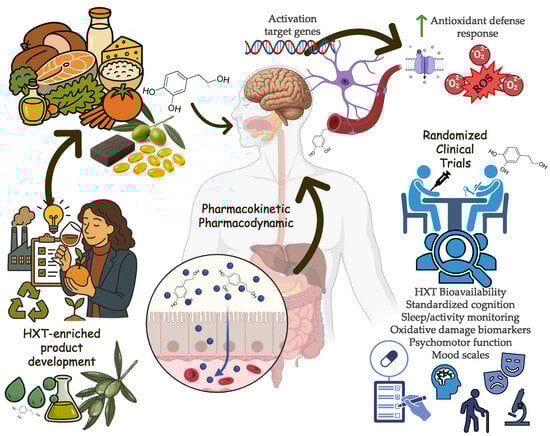
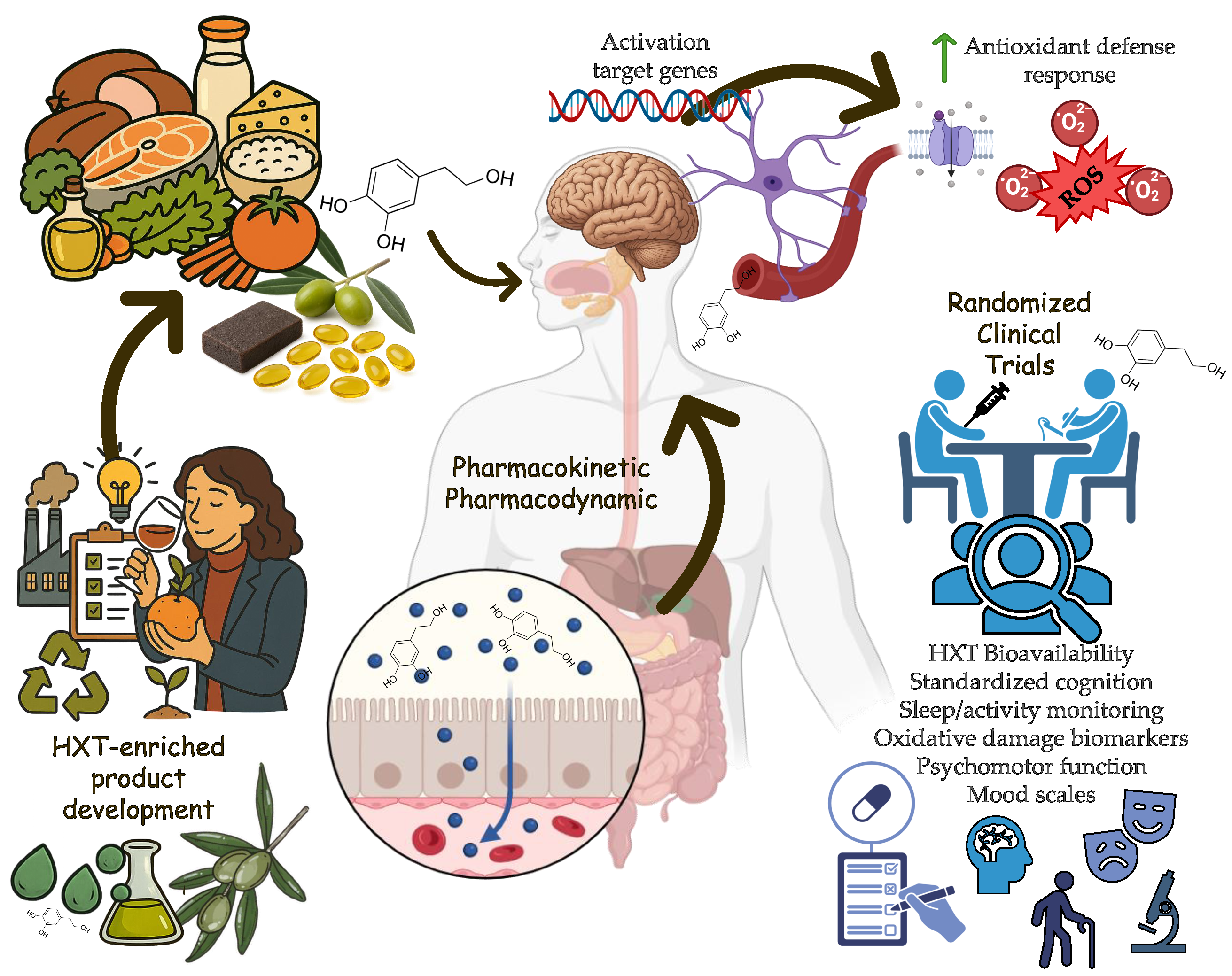
Hydroxytyrosol (HXT), a phenolic compound from olive, shows great potential as a neuroprotective agent and a translational target for claim-ready nutrition and food products. Human studies increasingly report benefits for vascular function, inflammatory tone, and early cognitive/psychomotor outcomes, consistent with engagement of redox and signalling pathways (Keap1–Nrf2–ARE, PI3K/Akt–ERK, and AMPK–SIRT1–PGC-1α). HXT is rapidly absorbed and likely reaches the brain, acting on endothelial and microglial targets. On the neurovascular axis, it reduces oxidative stress, preserves nitric-oxide bioavailability, lower inflammatory markers, and favourable intrinsic connectivity. For product development, bitterness from oleuropein-rich inputs can be mitigated by hydrolysis, followed by structure-guided delivery to balance sensory quality with exposure. Viable formats include cyclodextrin inclusion, microencapsulation, and (micro)emulsions in lipid matrices, plus stability engineering for aqueous systems (acidification, chelation, low-oxygen handling, or barrier packaging). Matrix effects are consequential; some proteins and fibers may decrease HXT bioaccessibility, whereas lipid phases and microstructured carriers often enhance it. Clinically, recommended doses are ~7–15 mg/day chronically and ~30–60 mg acutely. As conclusions of this review, future work should prioritize harmonized pharmacokinetics–pharmacodynamics readouts, cognition anchored to a compact neurovascular/blood–brain barrier biomarker core, and head-to-head comparisons of manufacturable delivery formats.
Keywords: mediterranean Diet; cognitive function; olive oil; polyphenols; brain; neuroinflammation; oxidative stress; antioxidant activity; functionality mediterranean Diet; cognitive function; olive oil; polyphenols; brain; neuroinflammation; oxidative stress; antioxidant activity; functionality
Graphical Abstract