

A Comprehensive Evaluation of Flavor Instability of Beer (Part 2): The Influence of De Novo Formation of Aging Aldehydes
 , ,
, ,
Abstract
1. Introduction
2. Materials and Methods
2.1. Chemicals
2.2. Malt, Wort, and Beer Production
2.3. Aging and Sample Treatment
2.4. Quantitation of Free Aldehydes via HS-SPME-GC-MS
2.5. Quantitation of 1,2-Dicarbonyl Compounds
2.6. Quantitation of Amino Acids
2.7. Quantitation of Glycated Amino Acids
2.8. Determination of Higher Alcohols and Esters
2.9. Statistical Analysis
3. Results and Discussion
3.1. Oxidation of Higher Alcohols
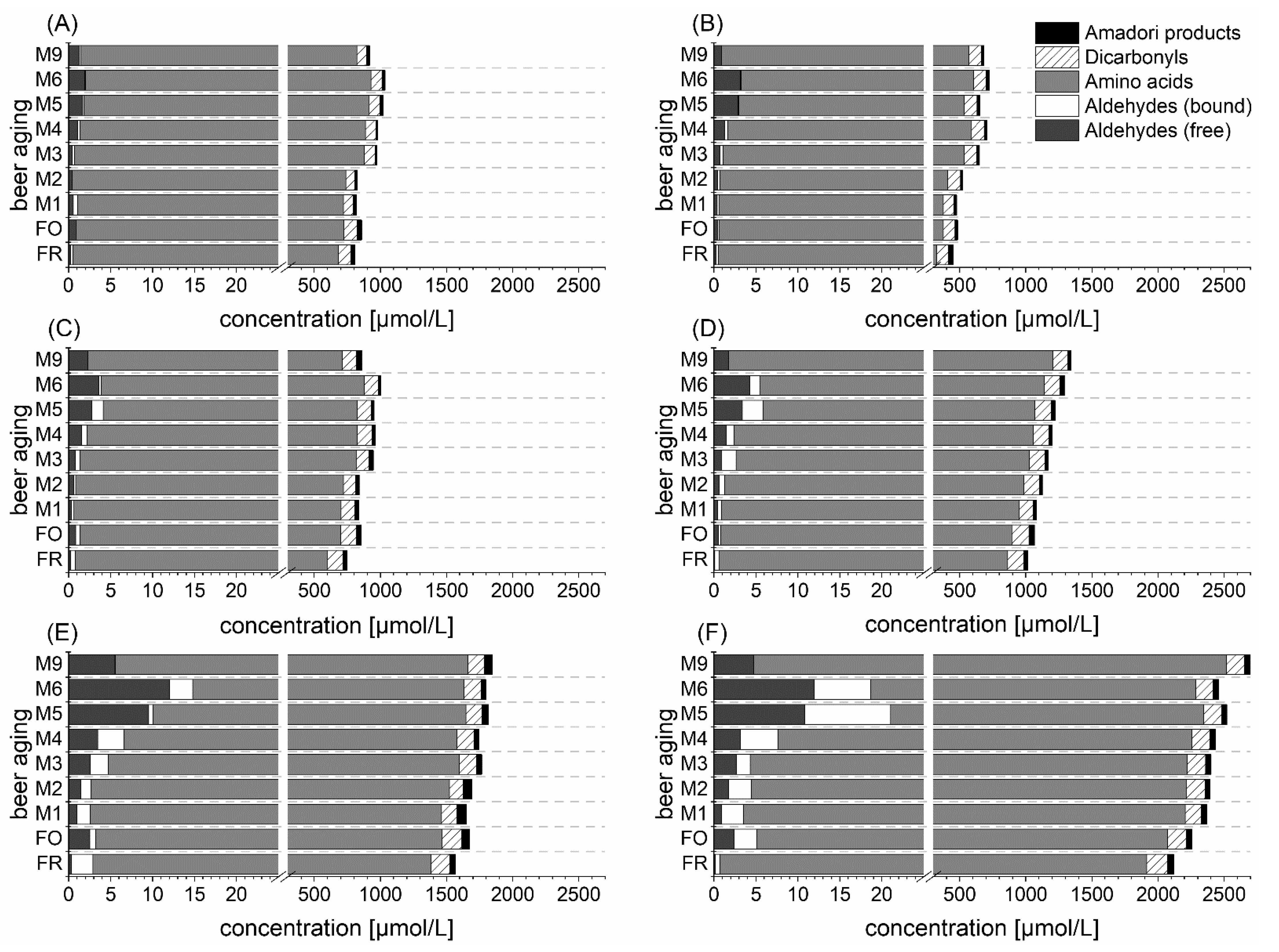
3.2. Reactivity of Precursor Compounds in the Maillard Reaction
3.3. Formation of Free Aging Aldehydes during Beer Aging
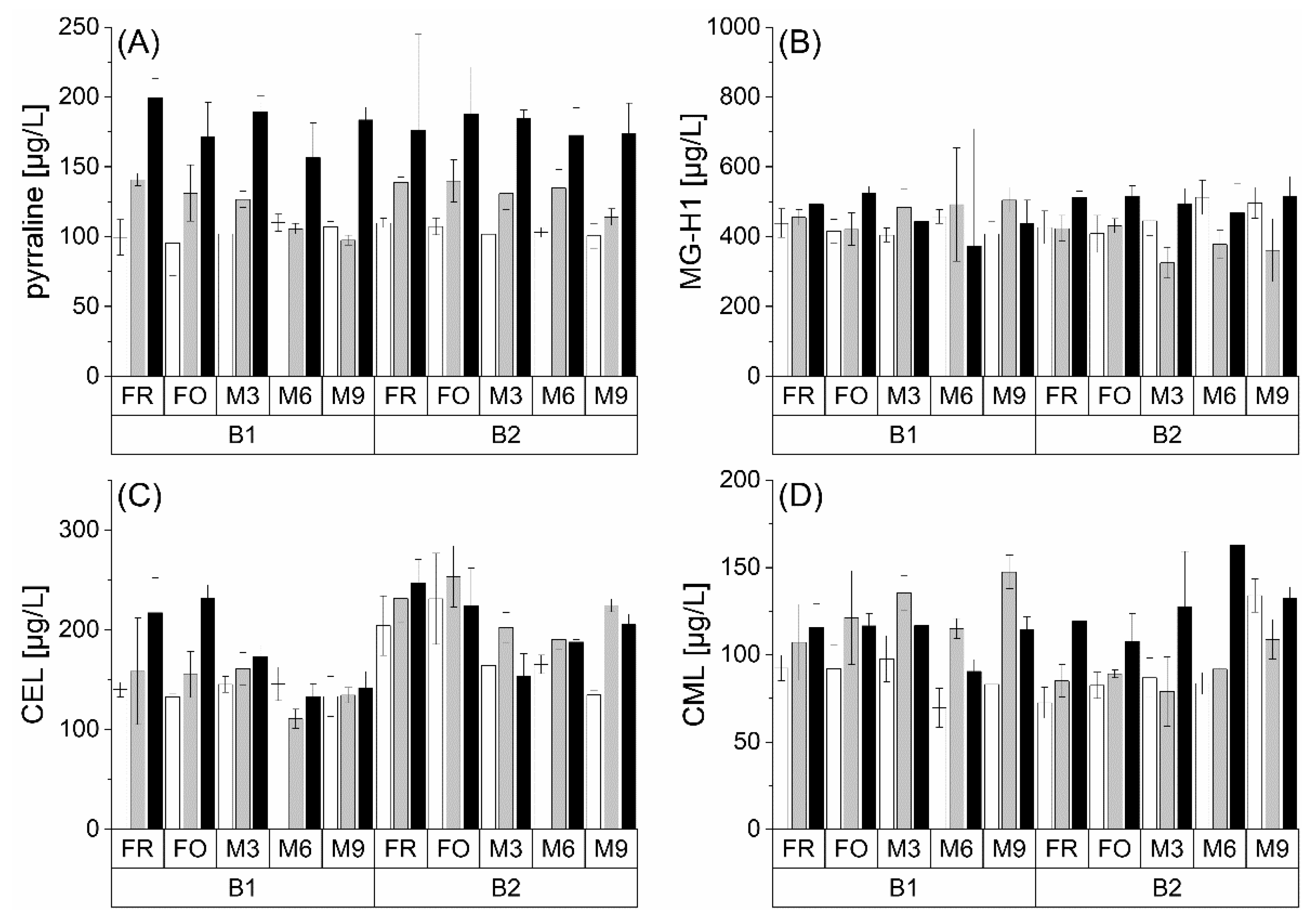
3.4. Formation of AGEs
3.5. Influence of the Proteolytic Malt Modification Level on De Novo Formation
4. Conclusions
Supplementary Materials
Author Contributions
Funding
Data Availability Statement
Acknowledgments
Conflicts of Interest
References
- Lehnhardt, F.; Nobis, A.; Skornia, A.; Becker, T.; Gastl, M. A Comprehensive Evaluation of Flavor Instability of Beer (Part 1): Influence of Release of Bound State Aldehydes. Foods. 2021, 10, 2432. [Google Scholar] [CrossRef] [Scilit]
- Lehnhardt, F.; Gastl, M.; Becker, T. Forced into aging: Analytical prediction of the flavor-stability of lager beer. A review. Crit. Rev. Food Sci. Nutr. 2019, 59, 2642–2653. [Google Scholar] [CrossRef] [Scilit] [PubMed]
- Baert, J.J.; De Clippeleer, J.; Hughes, P.S.; De Cooman, L.; Aerts, G. On the Origin of Free and Bound Staling Aldehydes in Beer. J. Agric. Food Chem. 2012, 60, 11449–11472. [Google Scholar] [CrossRef] [Scilit] [PubMed]
- Vanderhaegen, B.; Neven, H.; Verachtert, H.; Derdelinckx, G. The chemistry of beer aging—A critical review. Food Chem. 2005, 95, 357–381. [Google Scholar] [CrossRef] [Scilit]
- Hellwig, M.; Henle, T. Baking, ageing, diabetes: A short history of the Maillard reaction. Angew. Chem. Int. Ed. Engl. 2014, 53, 10316–10329. [Google Scholar] [CrossRef] [Scilit] [PubMed]
- Rizzi, G.P. The Strecker Degradation of Amino Acids: Newer Avenues for Flavor Formation. Food Rev. Int. 2008, 24, 416–435. [Google Scholar] [CrossRef] [Scilit]
- Yaylayan, V.A. Recent advances in the chemistry of Strecker degradation and Amadori rearrangement: Implications to aroma and color formation. Food Sci. Technol. Res. 2003, 9, 1–6. [Google Scholar] [CrossRef] [Scilit]
- Cremer, D.R.; Vollenbroeker, M.; Eichner, K. Investigation of the formation of Strecker aldehydes from the reaction of Amadori rearrangement products with α-amino acids in low moisture model systems. Eur. Food Res. Technol. 2000, 211, 400–403. [Google Scholar] [CrossRef] [Scilit]
- Ferreira, I.M.; Guido, L.F. Impact of wort amino acids on beer flavour: A review. Fermentation 2018, 4, 23. [Google Scholar] [CrossRef] [Scilit]
- Krüger, E.; Anger, H.-M. Kennzahlen zur Betriebskontrolle und Qualitatsbeschreibung in der Brauwirtschaft: Daten uber Roh-Und Hilfsstoffe, Halbfertig-Und Fertigprodukte bei der Bierbereitung; Behr: Hamburg, Germany, 1990. [Google Scholar]
- Bueno, M.; Marrufo-Curtido, A.; Carrascon, V.; Fernandez-Zurbano, P.; Escudero, A.; Ferreira, V. Formation and accumulation of acetaldehyde and strecker aldehydes during red wine oxidation. Front. Chem. 2018, 6, 20. [Google Scholar] [CrossRef] [Scilit] [PubMed]
- Henle, T. Protein-bound advanced glycation endproducts (AGEs) as bioactive amino acid derivatives in foods. Amino Acids 2005, 29, 313–322. [Google Scholar] [CrossRef] [Scilit]
- Henle, T.; Bachmann, A. Synthesis of pyrraline reference material. Z. Für Lebensm.-Unters. Forsch. 1996, 202, 72–74. [Google Scholar] [CrossRef] [Scilit] [PubMed]
- Manig, F.; Hellwig, M.; Pietz, F.; Henle, T. Quantitation of free glycation compounds in saliva. PLoS ONE 2019, 14, e0220208. [Google Scholar] [CrossRef] [Scilit]
- Nobis, A.; Kunz, O.S.; Gastl, M.; Hellwig, M.; Henle, T.; Becker, T. Influence of 3-DG as a Key Precursor Compound on Aging of Lager Beers. J. Agric. Food Chem. 2021, 69, 3732–3740. [Google Scholar] [CrossRef] [Scilit] [PubMed]
- Lund, M.N.; Petersen, M.A.; Andersen, M.L. Effect of protease treatment during mashing on protein-derived thiol content and flavor stability of beer during storage. J. Am. Soc. Brew. Chem. 2015, 73, 287–295. [Google Scholar] [CrossRef] [Scilit]
- Vesely, P.; Bohac, J.; Basarova, G. Effect of amino acid content in beer on its sensory stability. Kvas. Prum. 2001, 47, 276–279. [Google Scholar] [CrossRef] [Scilit]
- Nobis, A.; Roehrig, A.; Hellwig, M.; Henle, T.; Becker, T.; Gastl, M. Formation of 3-deoxyglucosone in the malting process. Food Chem. 2019, 290, 187–195. [Google Scholar] [CrossRef] [Scilit]
- Nobis, A.; Lehnhardt, F.; Gebauer, M.; Becker, T.; Gastl, M. The Influence of Proteolytic Malt Modification on the Aging Potential of Final Wort. Foods 2021, 10, 2320. [Google Scholar] [CrossRef] [Scilit]
- Krause, R.; Knoll, K.; Henle, T. Studies on the formation of furosine and pyridosine during acid hydrolysis of different Amadori products of lysine. Eur. Food Res. Technol. 2003, 216, 277–283. [Google Scholar] [CrossRef] [Scilit]
- Hellwig, M.; Geissler, S.; Matthes, R.; Peto, A.; Silow, C.; Brandsch, M.; Henle, T. Transport of Free and Peptide-Bound Glycated Amino Acids: Synthesis, Transepithelial Flux at Caco-2 Cell Monolayers, and Interaction with Apical Membrane Transport Proteins. ChemBioChem 2011, 12, 1270–1279. [Google Scholar] [CrossRef] [Scilit] [PubMed]
- Hellwig, M.; Degen, J.; Henle, T. 3-Deoxygalactosone, a “New” 1,2-Dicarbonyl Compound in Milk Products. J. Agric. Food Chem. 2010, 58, 10752–10760. [Google Scholar] [CrossRef] [Scilit]
- Hellwig, M.; Henle, T. Maillard Reaction Products in Different Types of Brewing Malt. J. Agric. Food Chem. 2020, 68, 14274–14285. [Google Scholar] [CrossRef] [Scilit] [PubMed]
- Lehnhardt, F.; Steiner, J.; Gastl, M.; Becker, T. Prediction Power and Accuracy of Forced Ageing-Matching Sensory and Analytical Results for Lager Beer. Brew. Sci. 2018, 71, 39–48. [Google Scholar]
- Degen, J.; Hellwig, M.; Henle, T. 1,2-Dicarbonyl Compounds in Commonly Consumed Foods. J. Agric. Food Chem. 2012, 60, 7071–7079. [Google Scholar] [CrossRef] [Scilit] [PubMed]
- Sonntag, T.; Kunert, C.; Dunkel, A.; Hofmann, T. Sensory-Guided Identification of N-(1-Methyl-4-oxoimidazolidin-2-ylidene)-α-amino Acids as Contributors to the Thick-Sour and Mouth-Drying Orosensation of Stewed Beef Juice. J. Agric. Food Chem. 2010, 58, 6341–6350. [Google Scholar] [CrossRef] [Scilit]
- Jacob, F. (Ed.) MEBAK Brautechnische Analysemethoden—Würze, Bier, Biermischgetränke: Methodensammlung der Mitteleuropäischen Brautechnischen Analysenkommission; MEBAK: Freising-Weihenstephan, Germany, 2012. [Google Scholar]
- Klosowski, G.; Mikulski, D.; Macko, D.; Miklaszewska, B.; Kotarska, K.; Czuprynski, B. Influence of various yeast strains and selected starchy raw materials on production of higher alcohols during the alcoholic fermentation process. Eur. Food Res. Technol. 2015, 240, 233–242. [Google Scholar] [CrossRef] [Scilit]
- Schehl, B.; Mueller, C.; Senn, T.; Heinisch, J.J. A laboratory yeast strain suitable for spirit production. Yeast 2004, 21, 1375–1389. [Google Scholar] [CrossRef] [Scilit] [PubMed]
- Gastl, M.; Schuell, F.; Becker, T. Malting and malt quality data for early malting of the 2010 crop. Brauwelt 2010, 150, 1540–1546. [Google Scholar]
- Rakete, S.; Klaus, A.; Glomb, M.A. Investigations on the Maillard Reaction of Dextrins during Aging of Pilsner Type Beer. J. Agric. Food Chem. 2014, 62, 9876–9884. [Google Scholar] [CrossRef] [Scilit]
- Hellwig, M.; Nobis, A.; Witte, S.; Henle, T. Occurrence of (Z)-3,4-Dideoxyglucoson-3-ene in Different Types of Beer and Malt Beer as a Result of 3-Deoxyhexosone Interconversion. J. Agric. Food Chem. 2016, 64, 2746–2753. [Google Scholar] [CrossRef] [Scilit] [PubMed]
- Nobis, A.; Wendl, S.; Becker, T.; Gastl, M. Formation and degradation of 3-deoxyglucosone as a key intermediate for ageing indicators during wort boiling. J. Inst. Brew. 2021. [Google Scholar] [CrossRef] [Scilit]
- Saison, D.; De Schutter, D.P.; Uyttenhove, B.; Delvaux, F.; Delvaux, F.R. Contribution of staling compounds to the aged flavour of lager beer by studying their flavour thresholds. Food Chem. 2009, 114, 1206–1215. [Google Scholar] [CrossRef] [Scilit]
- Hellwig, M.; Witte, S.; Henle, T. Free and Protein-Bound Maillard Reaction Products in Beer: Method Development and a Survey of Different Beer Types. J Agric. Food Chem. 2016, 64, 7234–7243. [Google Scholar] [CrossRef] [Scilit] [PubMed]
- Bravo, A.; Herrera, J.C.; Scherer, E.; Yon, E.; Rubsam, H.; Madrid, J.; Zufall, C.; Rangel-Aldao, R. Formation of α-dicarbonyl compounds in beer during storage of pilsner. J. Agric. Food Chem. 2008, 56, 4134–4144. [Google Scholar] [CrossRef] [Scilit] [PubMed]
- Wittmann, R.; Eichner, K. Detection of Maillard products in malts, beers, and brewing colorants. Z. Lebensm.-Unters. Forsch. 1989, 188, 212–220. [Google Scholar] [CrossRef] [Scilit]



| Malt Variation | Steeping Degree (%) | Target Soluble N (mg/100 g malt d. m.) | Real Soluble N (mg/100 g malt d. m.) |
|---|---|---|---|
| B1P1 | 38 | 550 ± 25 | 573 ± 10 |
| B1P2 | 41 | 625 ± 25 | 601 ± 1 |
| B1P3 | 44 | 700 ± 25 | 660 ± 1 |
| B2P1 | 39 | 550 ± 25 | 569 ± 3 |
| B2P2 | 43 | 625 ± 25 | 620 ± 14 |
| B2P3 | 47 | 700 ± 25 | 731 ± 1 |
| Variation | Release Dominant Period of Natural Aging |
|---|---|
| B1P1 | 0–4 months |
| B1P2 | 0–4 months |
| B1P3 | 0–4 months |
| B2P1 | 0–3 months |
| B2P2 | 0–2 months |
| B2P3 | 0–1 months |
Publisher’s Note: MDPI stays neutral with regard to jurisdictional claims in published maps and institutional affiliations. |
© 2021 by the authors. Licensee MDPI, Basel, Switzerland. This article is an open access article distributed under the terms and conditions of the Creative Commons Attribution (CC BY) license (https://creativecommons.org/licenses/by/4.0/).
Share and Cite
Nobis, A.; Kwasnicki, M.; Lehnhardt, F.; Hellwig, M.; Henle, T.; Becker, T.; Gastl, M. A Comprehensive Evaluation of Flavor Instability of Beer (Part 2): The Influence of De Novo Formation of Aging Aldehydes. Foods 2021, 10, 2668. https://doi.org/10.3390/foods10112668
Nobis A, Kwasnicki M, Lehnhardt F, Hellwig M, Henle T, Becker T, Gastl M. A Comprehensive Evaluation of Flavor Instability of Beer (Part 2): The Influence of De Novo Formation of Aging Aldehydes. Foods. 2021; 10(11):2668. https://doi.org/10.3390/foods10112668
Chicago/Turabian StyleNobis, Arndt, Melanie Kwasnicki, Florian Lehnhardt, Michael Hellwig, Thomas Henle, Thomas Becker, and Martina Gastl. 2021. "A Comprehensive Evaluation of Flavor Instability of Beer (Part 2): The Influence of De Novo Formation of Aging Aldehydes" Foods 10, no. 11: 2668. https://doi.org/10.3390/foods10112668
APA StyleNobis, A., Kwasnicki, M., Lehnhardt, F., Hellwig, M., Henle, T., Becker, T., & Gastl, M. (2021). A Comprehensive Evaluation of Flavor Instability of Beer (Part 2): The Influence of De Novo Formation of Aging Aldehydes. Foods, 10(11), 2668. https://doi.org/10.3390/foods10112668