



Inorganics, Volume 7, Issue 9 (September 2019) – 11 articles
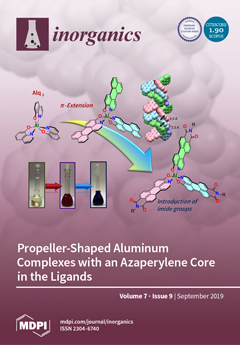
Cover Story (view full-size image):
Tris(8-hydroxyquinoline) aluminum(III) (Alq3) and its derivatives, characterized by a propeller-shaped three-dimensionally π-conjugated structure, have been intensively studied in the few past decades on account of their potential utility in optoelectronic applications. Reported herein, are the synthesis and properties of π-extended Alq3 complexes that contain an azaperylene core in each ligand. Intramolecular palladium-catalyzed direct C–H arylations or base-promoted arylations were employed to prepare these large Alq3 analogues. A single-crystal X-ray diffraction analysis of one of the obtained Al complexes revealed a unique three-dimensional packing structure within the crystal. An Alq3 analogue with azaperylene-dicarboximide ligands exhibited a deep blue color in solution with an intense absorption band that extended to 780 nm (λmax = 634 nm; ε = 58000 M–1 cm–1).
- Issues are regarded as officially published after their release is announced to the table of contents alert mailing list.
- You may sign up for e-mail alerts to receive table of contents of newly released issues.
- PDF is the official format for papers published in both, html and pdf forms. To view the papers in pdf format, click on the "PDF Full-text" link, and use the free Adobe Reader to open them.
Previous Issue
Next Issue
