Skip to Content

Inorganics, Volume 7, Issue 10

2019 October - 12 articles

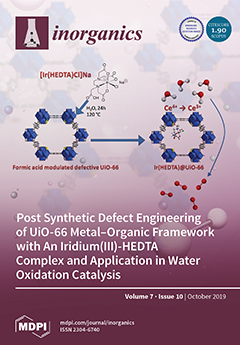
Cover Story: Defective Zr- based metal–organic framework UiO-66 was prepared by adding a large amount of formic acid as a monocarboxylic modulator. Then, it was employed as support for anchoring, with an exchange reaction, an Ir(III)–HEDTA complex by means of post-synthetic defect functionalization. The catalytic properties of the hybrid system for the water oxidation reaction, with Ce(IV) as the oxidant, were evaluated. View this paper.
  • Issues are regarded as officially published after their release is announced to the table of contents alert mailing list .
  • You may sign up for email alerts to receive table of contents of newly released issues.
  • PDF is the official format for papers published in both, html and pdf forms. To view the papers in pdf format, click on the "PDF Full-text" link, and use the free Adobe Reader to open them.

Articles (12)

  • Article
  • Open Access
4,174 Views
11 Pages

21 October 2019

The heterometallic chromium-manganese carbonyl nitrosyls CrMn(NO)(CO)n (n = 9, 8) have been investigated by density functional theory. The lowest energy CrMn(NO)(CO)9 structures have unbridged staggered conformations with a ~2.99 Å Cr–Mn...

  • Article
  • Open Access
3 Citations
3,524 Views
15 Pages

An Optical Power Limiting and Ultrafast Photophysics Investigation of a Series of Multi-Branched Heavy Atom Substituted Fluorene Molecules

  • Hampus Lundén,
  • Delphine Pitrat,
  • Jean-Christophe Mulatier,
  • Cyrille Monnereau,
  • Iulia Minda,
  • Adrien Liotta,
  • Pavel Chábera,
  • Didrik K. Hopen,
  • Cesar Lopes and
  • Mikael Lindgren
  • + 3 authors

18 October 2019

A common molecular design paradigm for optical power limiting (OPL) applications is to introduce heavy atoms that promote intersystem crossing and triplet excited states. In order to investigate this effect, three multi-branched fluorene molecules we...

  • Communication
  • Open Access
2 Citations
3,975 Views
8 Pages

17 October 2019

Synthesis and reactivities of a new mononuclear hydroxidoiridium(III) complex with a pentamethylcyclopentadienyl (Cp*) ligand are reported. The hydroxido ligand was introduced into an iridium complex having a nonprotic amine chelate derived from N-me...

  • Review
  • Open Access
20 Citations
5,785 Views
12 Pages

Highlights on Gold TADF Complexes

  • João Carlos Lima and
  • Laura Rodríguez

11 October 2019

Thermally activated delayed fluorescence (TADF) and TADF-organic light-emitting diodes (OLEDs) systems are being given increasing attention in research nowadays. Much more work has been done for organic-based materials in this field, but the use of T...

  • Article
  • Open Access
15 Citations
7,817 Views
12 Pages

10 October 2019

Clean production of renewable fuels is a great challenge of our scientific community. Iridium complexes have demonstrated a superior catalytic activity in the water oxidation (WO) reaction, which is a crucial step in water splitting process. Herein,...

  • Article
  • Open Access
3 Citations
3,306 Views
12 Pages

9 October 2019

Divalent metal oxidoarsenates(V) with compositions M(H2AsO4)2(H3AsO4)2 (M = Mg, Mn, Co, Ni), M(HAsO4)(H3AsO4)(H2O)0.5 (M = Mn, Cd) and Zn(HAsO4)(H3AsO4) were obtained from solutions containing an excess of arsenic acid. Single crystal X-ray diffracti...

  • Article
  • Open Access
1 Citations
4,061 Views
10 Pages

3 October 2019

The reaction of [(Cp*Ir)2(μ-dmpm)(μ-H)][OTf] (2) [Cp* = η5-C5Me5, dmpm = bis(dimethylphosphino)methane] with 2,3-dihydrofuran gives [(Cp*IrH)2(μ-dmpm){μ-(2,3-dihydrofuranyl)}][OTf] (3) in an isolated yield of 70% via the C–H bon...

  • Article
  • Open Access
14 Citations
3,980 Views
17 Pages

AgCl-ZnAl Layered Double Hydroxides as Catalysts with Enhanced Photodegradation and Antibacterial Activities

  • Morena Nocchetti,
  • Monica Pica,
  • Berardo Ridolfi,
  • Anna Donnadio,
  • Elisa Boccalon,
  • Giulia Zampini,
  • Donatella Pietrella and
  • Mario Casciola

3 October 2019

Surface-modified ZnAl layered double hydroxides (LDHs) were prepared by reaction of AgNO3, with both ZnAlCl (LDH1) and ZnAlCO3 exchanged on the surface with chloride anions (LDH3). In this way, AgCl nanoparticles with crystalline domains ranging from...

  • Article
  • Open Access
8 Citations
5,458 Views
17 Pages

A Raman Spectroscopic and Computational Study of New Aromatic Pyrimidine-Based Halogen Bond Acceptors

  • April E. S. Hardin,
  • Thomas L. Ellington,
  • Suong T. Nguyen,
  • Arnold L. Rheingold,
  • Gregory S. Tschumper,
  • Davita L. Watkins and
  • Nathan I. Hammer

2 October 2019

Two new aromatic pyrimidine-based derivatives designed specifically for halogen bond directed self-assembly are investigated through a combination of high-resolution Raman spectroscopy, X-ray crystallography, and computational quantum chemistry. The...

  • Article
  • Open Access
22 Citations
4,049 Views
10 Pages

Morphology and Structural Stability of Bismuth-Gadolinium Co-Doped Ceria Electrolyte Nanopowders

  • Grazia Accardo,
  • Luca Spiridigliozzi,
  • Gianfranco Dell’Agli,
  • Sung Pil Yoon and
  • Domenico Frattini

28 September 2019

The reduction of the sintering temperature of doped ceria ceramics remains an open challenge for their real exploitation as electrolytes for intermediate temperature solid oxide fuel cell (IT-SOFCs) at the industrial level. In this work, we have used...

  • Article
  • Open Access
26 Citations
6,786 Views
22 Pages

Reduction of 2,2′-Bipyridine by Quasi-Linear 3d-Metal(I) Silylamides—A Structural and Spectroscopic Study

  • Igor Müller,
  • Christian Schneider,
  • Clemens Pietzonka,
  • Florian Kraus and
  • C. Gunnar Werncke

25 September 2019

Quasi-linear anionic 3d-metal(I) silylamides are a new and promising class of molecules. Due to their highly negative reduction potential we wanted to test their capability to reduce substrates under coordination of their monoanionic radicaloid form....

  • Article
  • Open Access
6 Citations
4,303 Views
20 Pages

20 September 2019

Two dinitrosyl iron and cobalt complexes [Fe(NO)2(L1”)](BF4) and [Co(NO)2(L1”)](BF4) are synthesized and characterized, supported by a less hindered bidentate nitrogen ligand bis(3,5-diisopropyl-1-pyrazolyl)methane (denoted as L1”),...

Get Alerted

Add your email address to receive forthcoming issues of this journal.

XFacebookLinkedIn
Inorganics - ISSN 2304-6740