


Abstract
Benefiting from outstanding thermal durability at elevated temperatures and eco-friendly characteristics, oxide-based thermoelectric substances exhibit great application potential in residual heat recycling and intelligent textile defect inspection. Zinc oxide (ZnO) exhibits excellent thermal stability but suffers from high lattice thermal conductivity and low carrier concentration. Herein, we systematically investigate Ni-doped ZnO ceramics. XRD(X-ray diffraction) confirms homogeneous wurtzite solid solutions with lattice contraction following Vegard’s law. Ni doping enhances electrical conductivity from 45.45 to 145.80 S·cm−1 by promoting oxygen vacancy formation, while first-principles calculations reveal a narrowed bandgap. For specimens with x ranging from 0.0040 to 0.0044, the power factor attains approximately 8.0 μW·cm−1·K−2 at 873 K, representing a 41% enhancement. Meanwhile, intensified phonon scattering leads to an evident suppression of lattice thermal conductivity, which lowers the overall thermal conductivity down to 2.38 W·m−1·K−1 under 873 K. Benefiting from the above optimizations, the sample delivers a peak thermoelectric figure of merit (ZT) value of 0.27 at this temperature, which is 170% greater than that of undoped ZnO. In addition, the Vickers hardness rises from 242.70 HV to 281.45 HV. Such observations verify that nickel doping can successfully decouple charge and heat transport behaviors. This approach provides a feasible route toward developing oxide thermoelectric systems with upgraded thermoelectric performance.
1. Introduction
Oxide thermoelectrics have shown broad application prospects in waste heat recovery, intelligent fabric defect detection and solid-state cooling fields in recent years [1,2,3]. (Its working mechanism relies on thermoelectric oxides transforming temperature micro-differences from fabric surface defects into characteristic electrical signals for defect discrimination.) Since NaCo2O4 was discovered to have an exceptionally high thermoelectric potential in 1997, the research on oxide thermoelectric materials has entered a rapid development stage [4]. Currently, researchers have conducted in-depth exploration on various systems such as layered cobalt-based oxides (such as Ca3Co4O9) [5], strontium titanate-based ceramics (SrTiO3) [6], calcium manganese oxide systems (CaMnO3) [7], and zinc oxide-based materials, continuously optimizing their electrical and thermal transport properties through strategies such as band engineering, nanocomposite, and defect control.
However, the current field of thermoelectric materials still faces several key bottlenecks. On one hand, traditional thermoelectric materials contain toxic elements or scarce heavy metals, severely restricting their large-scale commercial application [8]. On the other hand, these materials are prone to oxidation, decomposition or element volatilization under high-temperature conditions, resulting in degradation of device performance or failure [9]. Against this backdrop, zinc oxide (ZnO) has excellent structural stability (with a melting point of up to 2248 K), good antioxidant capacity, abundant raw material reserves and is non-toxic and harmless, making it an ideal high-temperature thermoelectric conversion material [10]. ZnO features a straightforward crystal architecture and favorable chemical matching capability, which allows researchers to modulate its thermoelectric behaviors via dopant engineering. Nevertheless, intrinsic ZnO suffers from prominent limitations. Excessively high thermal conductance triggers substantial heat flux transfer from high-temperature regions toward cold zones. Meanwhile, insufficient charge carrier density leads to poor electrical conduction, and its ZT value cannot satisfy the criteria for industrial utilization. Accordingly, preserving the innate merits of ZnO while synchronously suppressing lattice thermal conductivity and elevating the power factor constitutes the primary bottleneck for exploring ZnO-based thermoelectric systems.
Transition metal element doping serves as a promising strategy to overcome the above obstacles and tune the thermoelectric performances of ZnO. Nickel (Ni) doping stands out with distinctive research prospects and a creative exploration space. To begin with, Ni2+ shares analogous ionic radii and an identical valence state with Zn2+. Such characteristics facilitate the preferential substitution of Zn lattice sites by Ni ions, avoiding the generation of extra defects for charge compensation. On this basis, manipulation of carrier density enables the optimization of charge transport characteristics, while the crystalline framework remains largely intact, which contributes to the prominent promotion of power factor. Furthermore, the disparities in atomic mass and ionic dimension between Ni and Zn bring about mass fluctuation and strain-field fluctuation within the crystal lattice. These effects strengthen phonon scattering remarkably, lowering lattice thermal conductance and disrupting the inherent trade-off between electrical and thermal transport parameters. More importantly, moderate Ni incorporation is capable of triggering lattice deformation, generating nanoprecipitates or modulating electronic band configurations. These modifications may realize multi-band carrier transportation or energy filtering effects, further reconciling the conflicting trend between Seebeck coefficient and electrical conductivity. Overall, Ni doping delivers novel insights into realizing coordinated optimization of high electrical conduction and suppressed thermal conductivity in ZnO-based thermoelectric systems. Meanwhile, it establishes a vital research orientation for developing low-cost, eco-friendly oxide thermoelectric candidates with outstanding performance, possessing profound scientific implications and practical prospects.
2. Results and Discussion
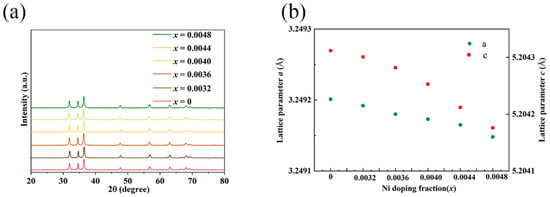
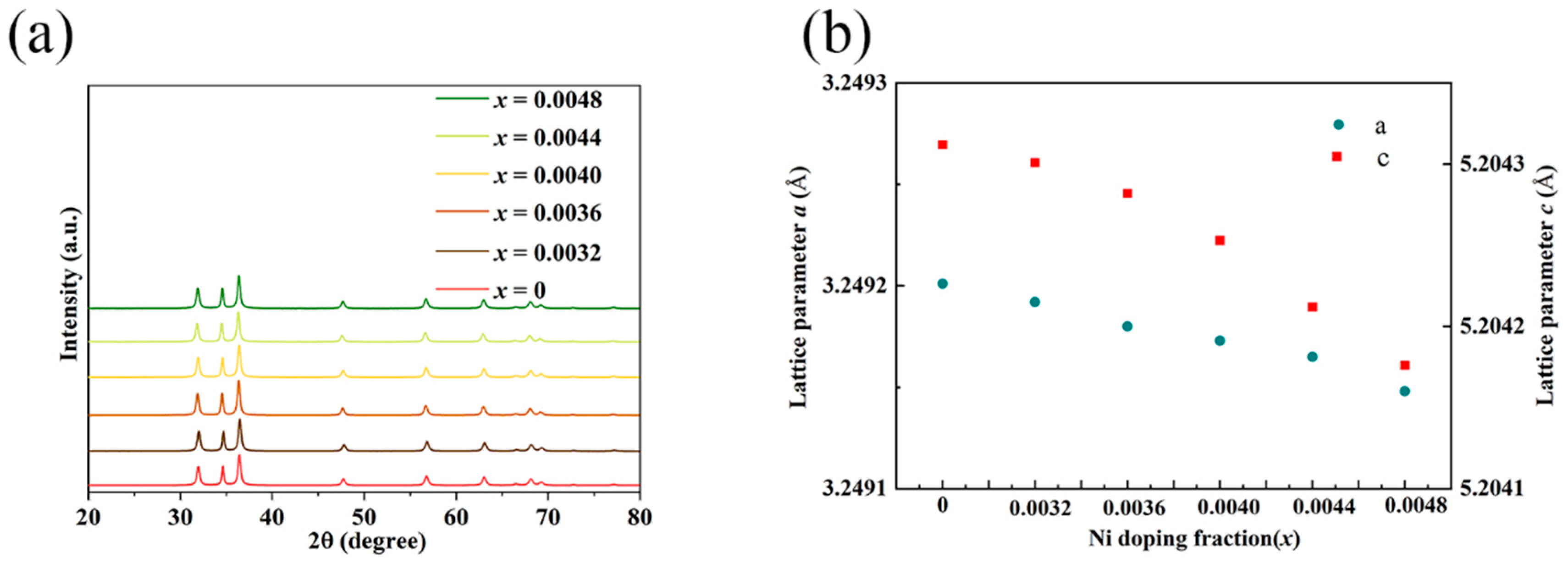
To characterize the effect of Ni doping on the crystal structure and phase composition of ZnO, X-ray diffraction (XRD) tests were conducted on ZnO thermoelectric samples with different Ni doping concentrations. The results are shown in Figure 1a. Within the experimental Ni doping concentration range, all samples exhibited a single hexagonal wurtzite ZnO phase (PDF# 36-1451), and no impurity diffraction peaks were detected [11]. The diffraction peaks were sharp and had good symmetry, indicating the excellent crystallization quality and high lattice integrity of all samples. No obvious diffraction signals were detected at the characteristic positions corresponding to NiO, Ni2O3, or nickel–zinc composite oxide standard cards. Combined with the XRD detection limit (~5 wt.%), it was confirmed that there were no detectable nickel-based secondary phases in the samples, and a uniform single-phase Ni-doped ZnO solid solution was successfully prepared. At the same time, as the Ni doping concentration gradually increased, the main diffraction peaks of the samples shifted slightly towards higher angles. Through lattice parameter fitting calculations, it was found that the lattice constant of the ZnO matrix gradually decreased with the doping amount, which was attributed to the substitution of smaller Ni ions for Zn ions in the lattice, causing local lattice contraction. This further confirmed that the Ni ions were successfully solid-solved into the ZnO lattice. The change in the lattice constant is shown in Figure 1b: with the increase in Ni doping amount x, both the lattice constants a and c of ZnO show a monotonically decreasing trend, reflecting the typical solute lattice contraction behavior of the solid solution. The radius of the four-coordinated ion of Ni2+ (~0.55 Å) is smaller than that of Zn2+ (~0.60 Å) [12]. When Ni enters the ZnO lattice in a substitution form to occupy the Zn site, due to the “small ion replacing large ion” effect, uniform negative chemical stress is generated in the ab plane of the unit cell, resulting in a general decrease in the a-axis and c-axis. This trend directly confirmed that Ni was successfully solid-solved into the ZnO matrix rather than remaining at the grain boundary or forming a second phase. The experimental data conform to Vegard’s law, indicating that Ni effectively solid-solved into the ZnO lattice to form an alternative solid solution, and no obvious second-phase segregation occurred [13]. Quantitative XRD characterization quantifies the structural evolution of Ni-doped wurtzite ZnO, where the average crystallite size of each sample is calculated by extracting the full width at half maximum of the main diffraction peak and substituting the calibrated Bragg angle and X-ray wavelength into the Scherrer equation, while the hexagonal unit cell volume is calculated by plugging the precise lattice parameters a and c acquired from diffraction peak calibration into the hexagonal crystal volume formula. Undoped pure ZnO has an average crystallite size of 608.92 nm and a unit cell volume of 47.5823 Å3. With Ni doping fraction increasing from 0 to 0.0048, the lattice parameters a and c decrease gradually, leading to a continuous reduction in unit cell volume to 47.5785 Å3. This lattice contraction arises from smaller Ni2+ substituting Zn2+ and generating compressive strain, accompanied by a high-angle shift in the (101) diffraction peak. The FWHM of the main peak broadens monotonically, and the average crystallite size declines steadily to 423.93 nm at x = 0.0048, because substitutional Ni ions restrain atomic diffusion and grain boundary migration during crystal growth. All samples exhibit only standard wurtzite ZnO diffraction peaks without impurity secondary phases, confirming single-phase substitutional doping within the tested doping range. The shrunk unit cell volume, widened diffraction peak and reduced crystallite size jointly verify that high-concentration Ni doping introduces severe lattice distortion and massive crystal defects into the ZnO host matrix. The systematic decrease in lattice constants confirmed that the Ni ions successfully occupied the Zn sites, laying a crystal structure foundation for the subsequent study of thermoelectric transport properties.
Figure 1.
Subfigure (a) shows the X-ray diffraction (XRD) patterns of Ni-doped ZnO, and subfigure (b) presents the variation in lattice parameters a and c after Ni doping.
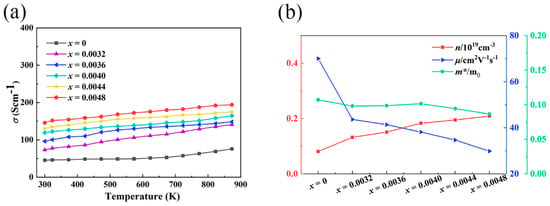
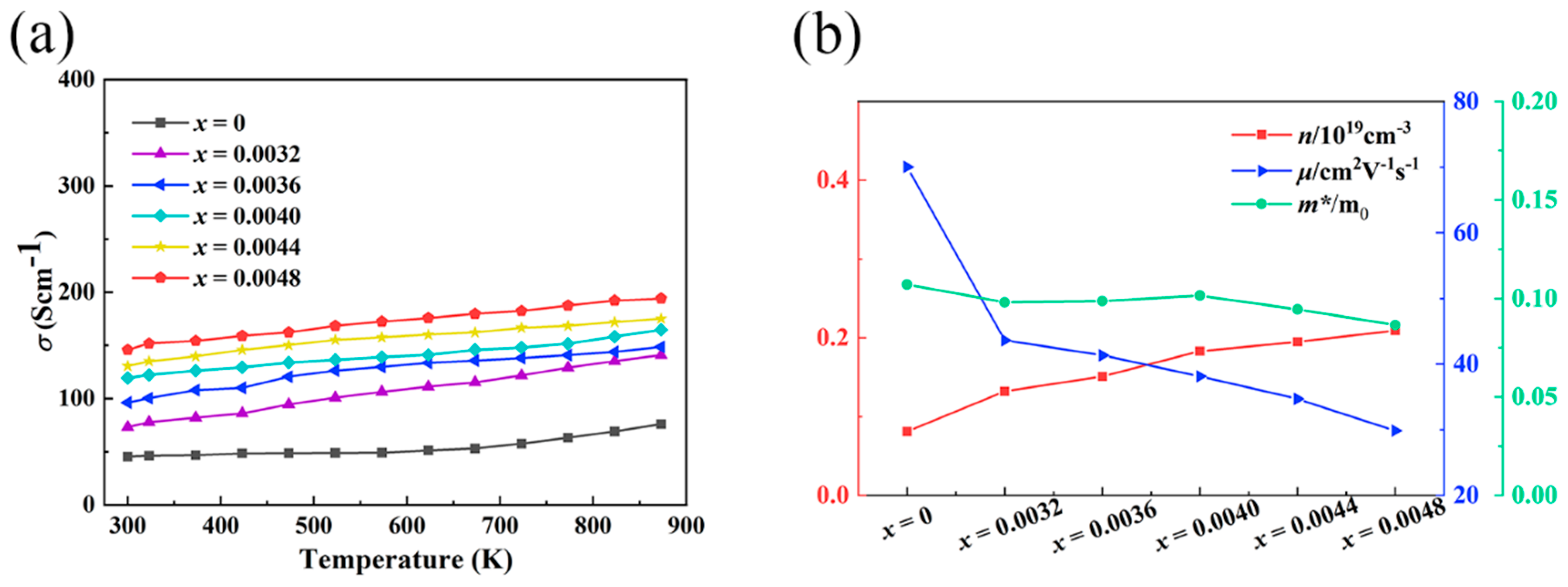
As shown in Figure 2a, the electrical conductivity (σ) of all samples increases monotonically with the increase in temperature. The electrical conductivity of undoped ZnO (x = 0) is extremely low, being only approximately 45.45 S·cm−1 at room temperature, due to the low undoped carrier concentration caused by its wide-bandgap property. With the increase in Ni doping amount, the conductivity significantly increases: at x = 0.0032, σ rises to approximately 73.17 S·cm−1, and at x = 0.0048, it can reach up to 145.80 S·cm−1. This trend indicates that Ni doping effectively activates the n-type conductivity of ZnO. However, the increase in conductivity is closely related to the changes in carrier concentration and mobility. As shown in Figure 2b, the carrier concentration n monotonically increases with the doping amount, from 8.1 × 1017 cm−3 at x = 0 to 2.09 × 1018 cm−3 at x = 0.0048, confirming the role of Ni doping in introducing additional electron donors. However, the mobility μ shows an opposite trend: from 70.01 cm2·V−1·s−1 at x = 0, it drops sharply to 43.62 cm2·V−1·s−1 at x = 0.0032, and then continues to decrease to 29.85 cm2·V−1·s−1 at x = 0.0048. According to σ = neμ, the final increase in conductivity is the result of the competition between the increase in n and the decrease in μ—in the low-doping region (x ≤ 0.0040), the growth rate of n exceeds the decay rate of μ, and σ increases significantly, while in the high-doping region (x > 0.0040), the continuous decrease in μ begins to restrict the increase in σ, resulting in a slower growth of σ [14]. Ni2+ has the same oxidation state as Zn2+, and substitutional doping itself does not introduce additional charges. Therefore, Ni doping does not enhance the carrier concentration by directly providing electrons. First-principles calculations and defect chemical analysis indicate that the introduction of Ni significantly reduces the formation energy of oxygen vacancies and promotes the thermodynamic generation of intrinsic donor defects; these oxygen vacancies contribute electrons as shallow donors, resulting in a monotonic increase in carrier concentration with Ni content [15]. The continuous decrease in mobility is due to the synergistic enhancement of alloy scattering and defect scattering: first, the atomic mass difference (58.69 vs. 65.38) and the difference in four-coordinated ion radius (0.55 Å vs. 0.60 Å) between Ni and Zn introduce strong mass fluctuations and strain fields in the lattice, significantly enhancing the alloy scattering intensity [16]; second, the oxygen vacancies generated by Ni doping and other point defects on the carrier produce additional Coulomb scattering, further inhibiting the mobility [17]. In addition, the effective mass m*/m0 from x = 0 to x = 0.0048 fluctuates slightly from 0.10 to 0.08, remaining basically stable, indicating that the band structure has not undergone significant changes, and the decrease in mobility is mainly attributed to the strengthening of the scattering mechanism rather than changes in the effective mass m* of the band. The evolution of conductivity and carrier transport parameters provides a key basis for optimizing the power factor (PF = S2σ).
Figure 2.
Subfigure (a) depicts the conductivity of Ni-doped ZnO as a function of temperature and doping content, and subfigure (b) presents the variations in carrier concentration, mobility and effective mass with doping amount.
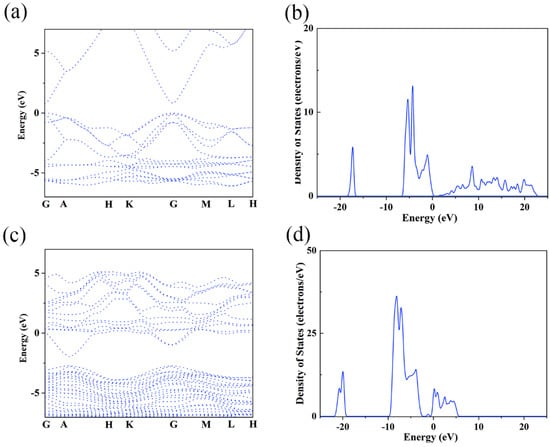
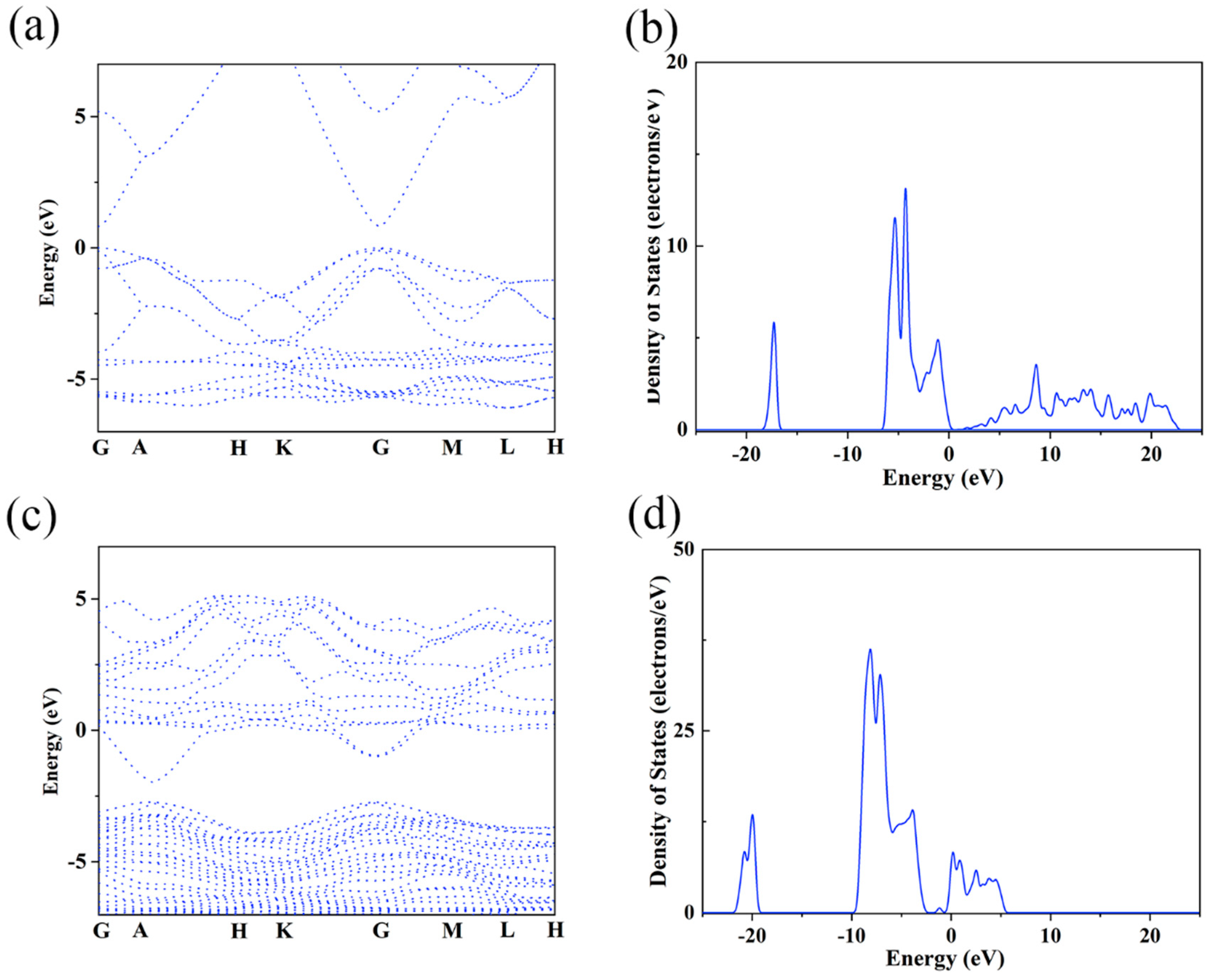
As displayed in Figure 3a, pristine ZnO behaves as a canonical direct semiconductor with a broad bandgap. An evident energy separation exists between the valence band maximum (VBM) and conduction band minimum (CBM). In addition, pronounced energy dispersion can be detected for the valence and conduction bands, which corresponds to substantial energy fluctuation against wave vectors. This feature makes clear that pure ZnO possesses low electron effective mass and favorable carrier mobility. Distinct bandgap evolution emerges following Ni incorporation (Figure 3c), where the energy separation between VBM and CBM shrinks, corresponding to bandgap narrowing. The underlying mechanism lies in cation substitution: Ni atoms occupy Zn lattice sites, and Ni 3d orbitals hybridize with O 2p and Zn 4s orbitals within the ZnO matrix. This process generates impurity-related states (localized states originating from d-d electronic transitions), which drive upward shift in VBM or downward movement of CBM and ultimately narrow the bandgap. Apart from that, emergent localized electronic states are observed within 0–3 eV adjacent to CBM. This phenomenon proves Ni doping introduces resonant impurity states or band tail states at conduction band boundaries, accelerating thermal excitation and migration of charge carriers. Meanwhile, the density of states at Fermi energy rises remarkably, rendering the system a degenerate n-type semiconductor. This theoretical outcome matches experimental measurements regarding elevated carrier concentrations. For the density of states curve of intrinsic ZnO (Figure 3b), spectral peaks mainly originate from O 2p and Zn 3d, as well as Zn 4s/O 2p orbital contributions. The profiles exhibit simple shapes without any characteristic impurity signals. After Ni modification (Figure 3d), extra DOS peaks emerge at specific energy ranges (around −15 eV and −5 eV), which stem from Ni 3d orbitals. Hybridization occurs between Ni 3d electrons and ZnO’s O 2p and Zn 3d orbitals, generating localized d orbit states and diversifying electronic configurations. Peak intensities associated with initial O 2p and Zn 3d orbitals also undergo observable variations. All electronic structure variations originate from substitutional doping introduced by Ni2+. The four-coordinate ionic radius of Ni2+ (0.55 Å) is inferior to that of Zn2+ (0.60 Å). Substitution triggers local lattice shrinkage, consistent with lattice parameter characterization, shortening Ni–O bond distances and strengthening orbital overlap and hybridization strength between Ni 3d and O 2p. Lattice deformation destroys local structural symmetry and modulates the crystal field splitting patterns of Ni 3d orbitals. Portions of d-related energy states shift toward bandgap boundaries or CBM, producing resonant impurity states. Such resonant orbit states boost the density of states near the Fermi level. Furthermore, they modulate defect formation energies and facilitate the generation of native donor defects including oxygen vacancies. This provides a reasonable interpretation for experimental trends that carrier density and electrical conductivity continuously grow with rising Ni dopant fractions.
Figure 3.
Subfigures (a,b) display the band structure and density of states (DOS) of pure ZnO, while subfigures (c,d) present the band structure and DOS of Ni-doped ZnO.
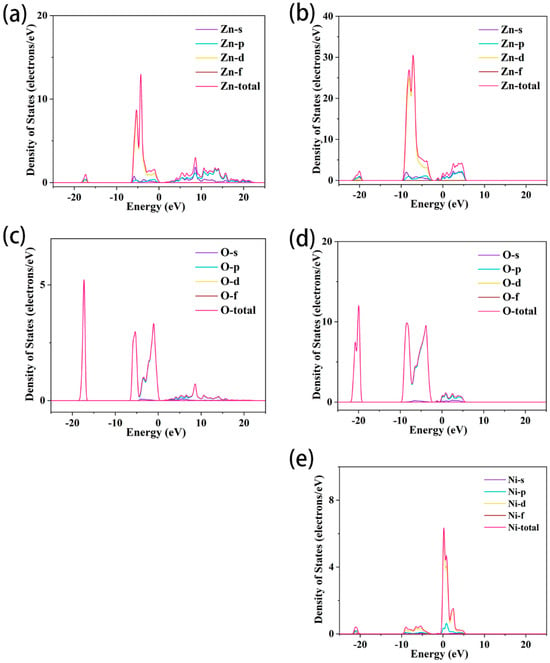
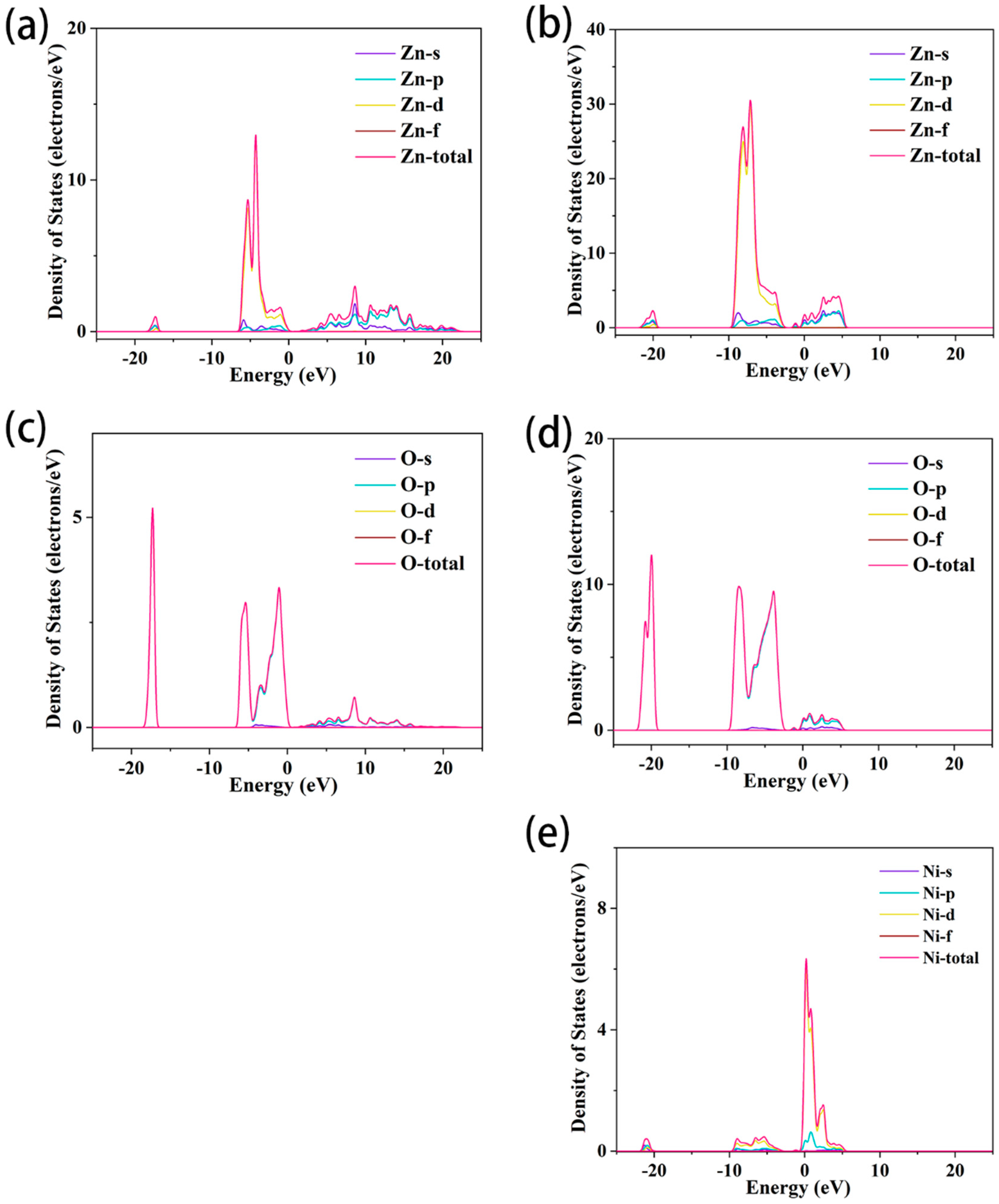
Contrastive analysis of atomic orbital charge density contours for undoped and modified systems (Figure 4a–e) enables precise identification of variations in chemical bonding surroundings. Evolution characteristics of Zn sites (Figure 4a versus Figure 4b): Upon elemental incorporation, Zn-d-related peaks undergo drastic intensification accompanied by spectral broadening. This phenomenon reveals that Ni-triggered lattice deformation breaks the perfect tetrahedral coordination symmetry around Zn ions. Such perturbation rearranges the crystal field acting on Zn 3d orbitals and lifts partial degeneracy of d-electron energy levels, thereby triggering peak splitting and widening in density of states profiles. Meanwhile, Zn-d characteristic peaks shift moderately toward lower energies, shortening the energy interval separating these peaks from the valence band maximum. This signal manifests reinforced pd orbital coupling between Zn 3d and O 2p orbitals. Variations originating from oxygen ions (Figure 4c versus Figure 4d): O-s spectral signals remain nearly invariant, demonstrating that deep-level electronic configurations of the crystalline backbone suffer negligible perturbation. Modifications mainly concentrate within the valence band maximum domain. The amplitude of O-p peaks rises remarkably, and emergent shoulder features emerge within −5~−8 eV. These newly formed structures coincide energetically with Ni-d states, verifying strengthened pd hybridization between Ni 3d and O 2p orbitals. The intensified coupling renders O-p states more delocalized near the valence band edge and elevates energy-level degeneracy. Furthermore, observable O-p orbital contributions emerge within 0–5 eV adjacent to the conduction band minimum, suggesting partial extension of O 2p orbitals into conduction band domains to construct antibonding orbitals and create extra pathways for electronic transitions. Dominant impacts originating from Ni dopants (Figure 4e): Intense, sharp Ni-d spectral signals emerge in the −5~−8 eV energy range (peak magnitude ~6 electrons/eV), overlapping energetically with O-p and Zn-d features. This observation corroborates robust orbital interactions between Ni 3d electrons and neighboring O 2p as well as Zn 3d orbitals. The high peak intensity and narrow bandwidth demonstrate strong localization of Ni-associated electronic states, matching the partially occupied d-electron shell configuration of Ni2+ (3d8). Obvious tail-like states of Ni-d appear between −2 eV and Fermi energy (0 eV). These partially occupied d energy levels function as resonant impurity states and participate in charge transportation around the Fermi surface. The localized nature of Ni-d orbitals yields dual favorable effects: Ni incorporation boosts electrical conduction, and localized vibrational modes derived from dopants act as efficient phonon scatterers to suppress lattice thermal conductance.
Figure 4.
Subfigures (a,c) exhibit the partial density of states (PDOS) of pristine ZnO, while (b,d,e) present the PDOS of Ni-doped ZnO.
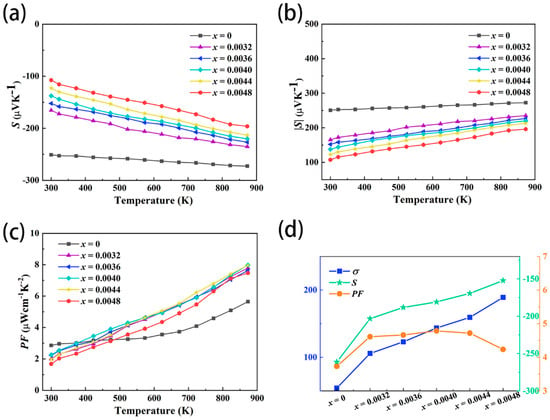
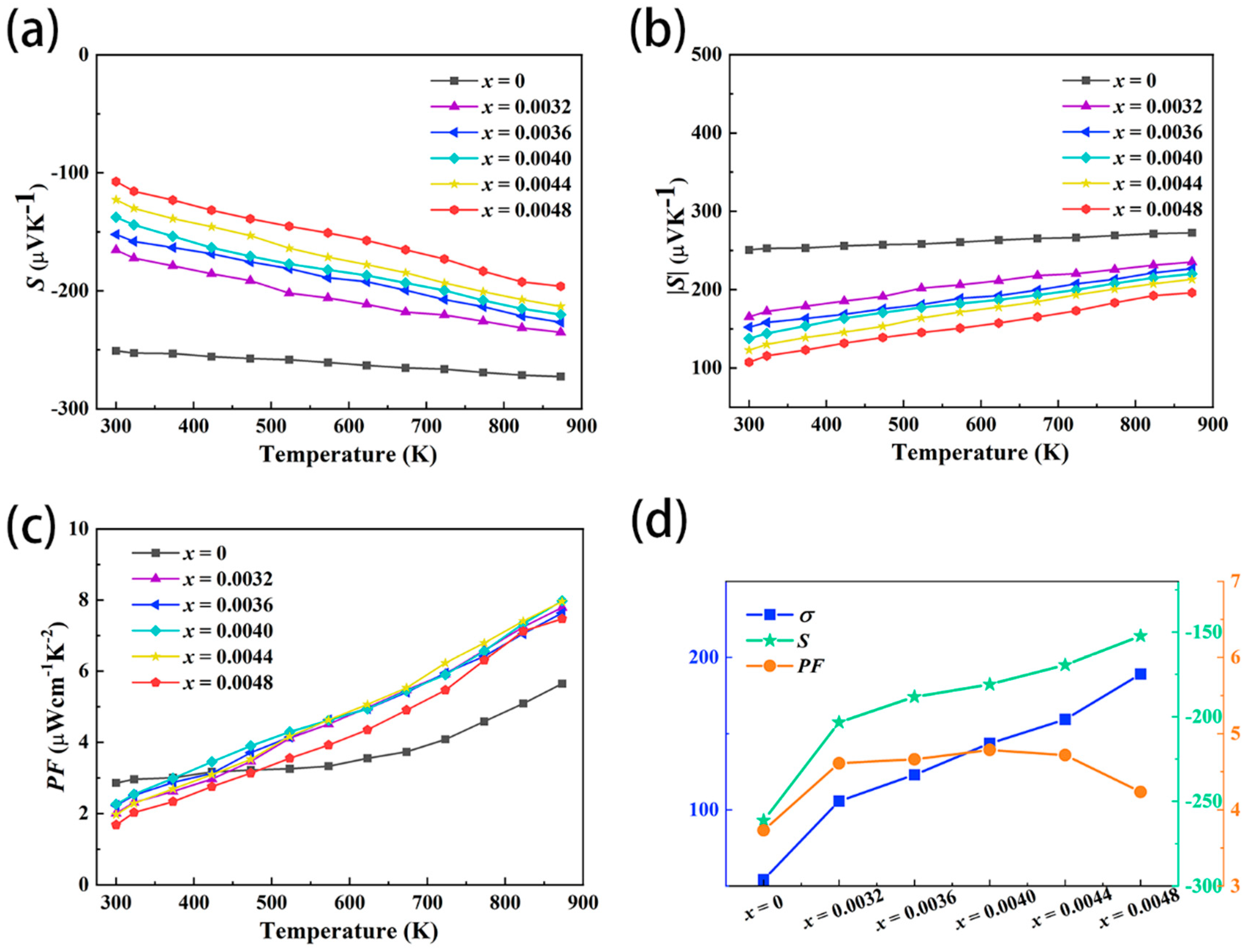
Figure 5a plots temperature-dependent Seebeck coefficient (S) profiles for ZnO thermoelectric specimens with varied Ni substitution fractions. Negative S values were captured for all tested samples, which confirms the intrinsic n-type conduction behavior in the material system. The pure ZnO sample (x = 0) delivers the maximum absolute Seebeck coefficient, reaching roughly 250 μV·K−1 under ambient temperature, and this parameter varies mildly upon heating. Such behavior originates from the ultra-low carrier density within undoped ZnO. Its Fermi energy stays far away from the conduction band minimum, and the thermopower is predominantly governed by carrier concentration gradients. Raising the Ni dopant fraction induces a steady decline in |S|: the value falls to around 165 μV·K−1 for x = 0.0032 and further reduces to nearly 107 μV·K−1 at x = 0.0048. Meanwhile, the temperature dependence of the Seebeck coefficient becomes much more pronounced, whereby |S| declines persistently as temperature rises. This evolutionary trend can be interpreted via carrier density modulation and Fermi-level shift. In line with Mott’s transport formalism, thermopower is tightly correlated with Fermi-level density of states and charge carrier population. Ni incorporation facilitates the formation of native donor-type imperfections, including oxygen vacancies, which drastically elevate carrier density. The Fermi level consequently shifts toward the conduction band minimum and lowers the average thermal activation energy of charge carriers, yielding a universal reduction in |S|. Moreover, Ni 3d localized orbitals introduced by doping generate resonant energy levels adjacent to the conduction band edge. These states boost the density of states at Fermi energy and further suppress thermopower magnitudes. In terms of thermal response, the continuous drop in |S| for doped samples at elevated temperatures stems from enhanced thermal excitation of carriers and inward migration of the Fermi level deep into the conduction band. In contrast, pristine ZnO possesses scarce charge carriers, rendering its |S| insensitive to thermal fluctuations. Even though heavy doping (x = 0.0048) causes remarkable attenuation of |S|, electrical conductivity undergoes synchronous prominent enhancement. The two parameters should be balanced comprehensively under the evaluation criterion of power factor. The precise tuning of carrier concentration and Fermi-level position enabled by Ni doping realizes coordinated optimization between thermopower and electrical conduction. This strategy offers an efficient route to boost the power factor of ZnO-based thermoelectric systems.
Figure 5.
Panel (a) depicts how the Seebeck coefficient of Ni-modified ZnO varies with temperature and dopant concentration. Panel (b) displays temperature- and doping-dependent curves for the absolute thermopower values of Ni-incorporated ZnO samples. Panel (c) captures the evolutionary tendency of power factor under identical experimental conditions. Panel (d) plots averaged electrical transport parameters, including electrical conductivity, thermopower and power factor, against Ni doping fractions.
Figure 5b illustrates the temperature-dependent power factor (PF) profiles of ZnO thermoelectric samples with varying Ni dopant concentrations. As a pivotal evaluation index for the electrical transport capability of thermoelectric candidates, PF is determined by the formula PF = S2σ, where S denotes the Seebeck coefficient and σ represents electrical conductivity. All tested samples exhibit a consistent uptrend in PF values with rising temperature, which conforms to the thermal activation transport behavior inherent to semiconductor materials. The pristine ZnO sample (x = 0) delivers a low PF value of 2.85 μW·cm−1·K−2 at 300 K. Its PF grows sluggishly under thermal stimulation, only attaining 5.65 μW·cm−1·K−2 at 873 K. Such inferior performance stems from the intrinsically sparse charge carriers and poor electrical conduction of pure ZnO, which severely restrict the enhancement of power factor. Ni modification fundamentally alters the temperature and composition dependence of the material’s PF characteristics. Within the low-temperature range of 300–400 K, Ni-substituted samples exhibit even lower PF values than undoped ZnO. Specifically, the room-temperature PF values for the x = 0.0032 and x = 0.0048 samples are 1.97 μW·cm−1·K−2 and 1.68 μW·cm−1·K−2, respectively. This counterintuitive variation originates from the competitive trade-off between electrical parameters. Although Ni incorporation effectively boosts electrical conductivity, the simultaneous surge in carrier density triggers a sharp drop in absolute Seebeck coefficient. At low temperatures, the conductivity improvement is insufficient to offset the pronounced decay of S2, thereby inducing an abnormal reduction in overall PF. With the elevation of ambient temperature, doped samples enter a rapid PF growth stage. The x = 0.0040 sample surpasses its pure ZnO counterpart at 373 K and achieves a peak PF of 7.96 μW·cm−1·K−2 at 873 K, which is 41% higher than that of undoped ZnO. The non-linear variation in PF with dopant content reflects the competitive coupling relationship among multiple transport parameters. The doping ranges of x = 0.0040 and x = 0.0044 deliver optimal thermoelectric behavior in medium and high-temperature zones, with PF values approaching 8.0 μW·cm−1·K−2 at 873 K. This indicates that the above doping dosage realizes the optimal balance between electrical conductivity and thermopower. In this optimal doping system, the increased carrier density induced by Ni substitution effectively activates electrical conduction. Meanwhile, the emergent resonant states near the Fermi level and enhanced band degeneracy moderately restrain the excessive attenuation of thermopower, achieving synergistic optimization of electrical transport performance. Nevertheless, further increasing the doping concentration to x = 0.0048 leads to a decline in high-temperature PF, with the value dropping to approximately 7.46 μW·cm−1·K−2 at 873 K. Excessive doping introduces massive lattice disorders and intensified alloy scattering. Additionally, abundant point defects such as oxygen vacancies generate extra Coulomb scattering effects, which drastically reduce carrier mobility and limit the further improvement of electrical conductivity. Moreover, the overhigh carrier density causes severe deterioration of the Seebeck coefficient, ultimately weakening the synergistic optimization effect of the S2σ index. The evolutionary rules of electrical properties for Ni-doped ZnO are summarized in Figure 5c. With the rise in Ni doping dosage, electrical conductivity increases monotonically, while the absolute Seebeck coefficient presents a continuous downward trend. By contrast, the power factor exhibits a non-monotonic variation tendency, which is governed by the competitive mechanism between the two core parameters. Ni doping induces abundant donor-type defects represented by oxygen vacancies, greatly elevating the system’s carrier concentration and further improving electrical conductivity. However, the increased carrier density pushes the Fermi level toward the conduction band minimum, resulting in reduced thermopower. The final PF value is determined by the dynamic balance between conductivity and Seebeck coefficient. In the low-doping region (x ≤ 0.0040), the enhancement of electrical conductivity dominates the transport behavior, driving PF upward. In the high-doping region (x > 0.0040), the sharp decay of thermopower becomes the dominant factor, leading to PF degradation. The maximum power factor is obtained at x = 0.0040, corresponding to the most balanced state of thermoelectric transport parameters in this material system.
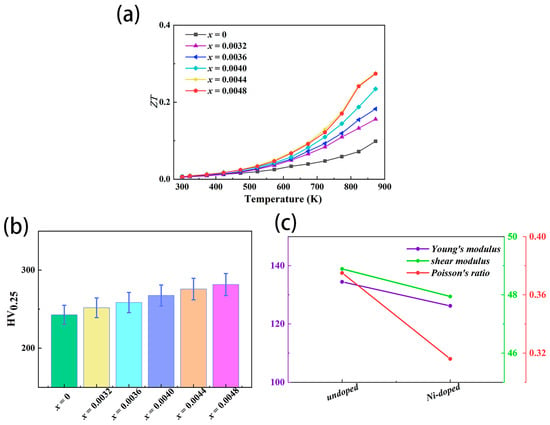
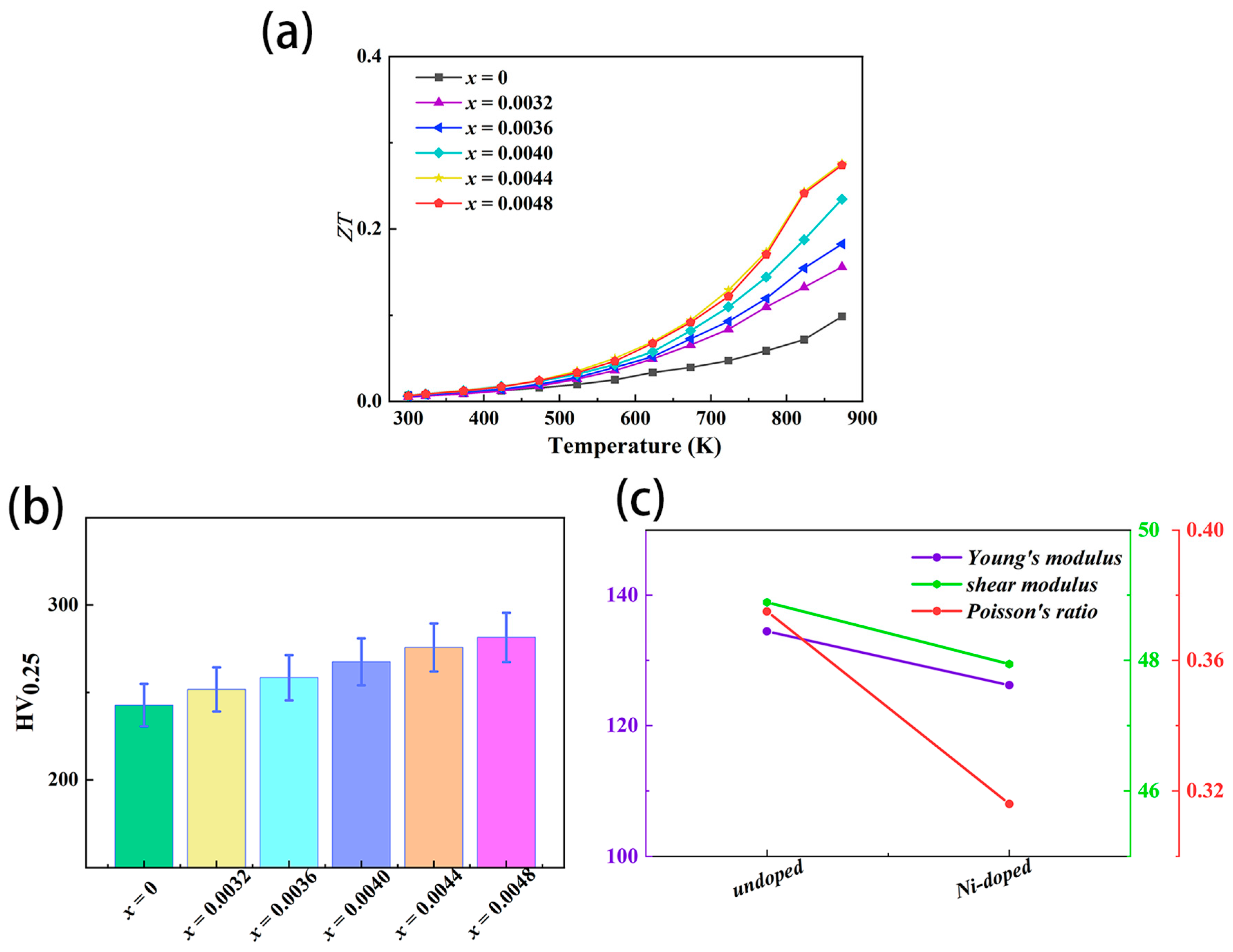
Figure 5d shows the comparative evolution of Young’s modulus, Poisson’s ratio, and the shear modulus of ZnO before and after Ni doping. From the figure, it can be seen that all three parameters show a downward trend after Ni doping: Young’s modulus decreases from 134.45 GPa to 126.18 GPa, the shear modulus decreases from approximately 48.89 GPa to 47.94 GPa, and Poisson’s ratio decreases from approximately 0.38 to 0.32. Among them, the decrease in Poisson’s ratio is significant, while the decrease in shear modulus is relatively small, indicating that Ni doping has a stronger weakening effect on the shear deformation resistance and lateral deformation response of the lattice. This change is due to the microstructural reconstruction caused by the substitution of Ni2+ for Zn2+. Firstly, the radius of Ni2+’s four-coordinated ions (0.55 Å) is smaller than that of Zn2+ (0.60 Å). Although the substitution causes lattice contraction, the bond length and bond energy of Ni–O bonds are different from those of Zn–O bonds, and the local bonding strength is weakened, resulting in a decrease in macroscopic elastic modulus. Secondly, although Ni and Zn ions are similar in size overall, subtle differences in ionic radius, combined with the differences in ion mass and electronegativity between the two elements, will produce local lattice fluctuations. These tiny microscopic fluctuations can effectively destroy the periodicity of the crystal lattice, strongly scatter high-frequency phonons, and significantly reduce the lattice thermal conductivity of the material. Ni doping introduces point defects and mass fluctuations, which disrupt the periodic potential field of the wurtzite lattice, increasing the tendency of atomic face slip and shear deformation, so the decrease in shear modulus is more obvious [18]. Moreover, the anisotropic contraction of lattice constants causes the imbalance of stress responses along different directions, reducing the efficiency of lateral strain transmission, and resulting in a decrease in Poisson’s ratio [19]. From the perspective of thermoelectric properties, the moderate decrease in elastic modulus means that the frequency of lattice phonon branches softens and the phonon group velocity decreases, which is conducive to enhancing phonon scattering and suppressing lattice thermal conductivity. At the same time, Young’s modulus still remains at a relatively high level (>120 GPa), indicating that Ni doping weakens heat transport without sacrificing the excellent high-temperature structural stability of ZnO, providing mechanical reliability assurance for its application in the high-temperature thermoelectric field.
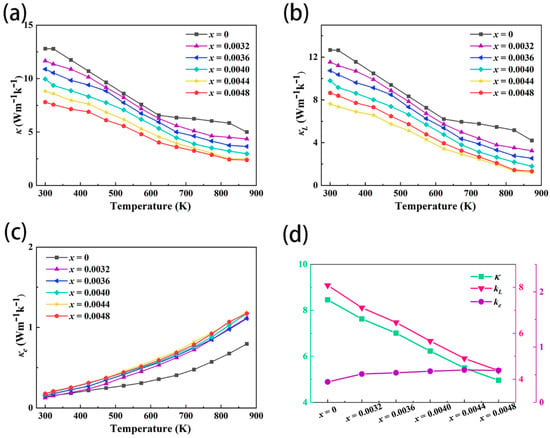
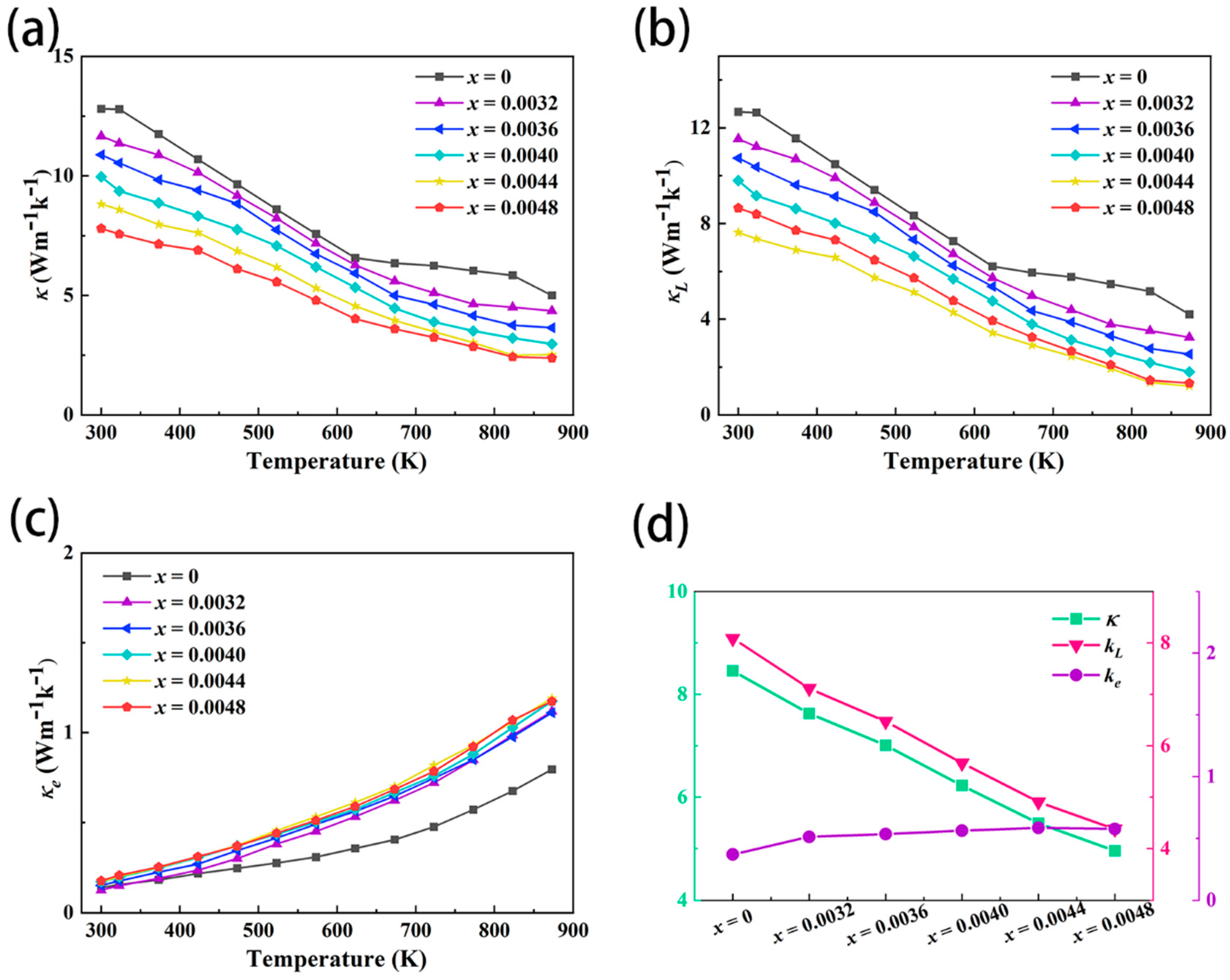
Figure 6 illustrates the varied thermal transport behaviors of Ni-modified ZnO thermoelectric systems, including total thermal conductivity (κ), lattice thermal conductivity (κ), and electronic thermal conductivity (κ), as functions of ambient temperature and dopant dosage. As displayed in Figure 6b,c, all tested specimens exhibit a gradual reduction in overall thermal conductivity with elevated temperature, which corresponds to the typical high-temperature transport feature dominated by phonon Umklapp scattering. For pure undoped ZnO, the room-temperature total thermal conductivity reaches 12.80 W·m·K at 300 K and decreases substantially to 5.00 W·m·K when the temperature rises to 873 K. Nickel incorporation serves as an effective strategy to tailor the thermal conduction capability of ZnO matrices, where increased Ni doping content leads to a systematic reduction in κ values. Specifically, the sample with a doping fraction of x = 0.0048 presents a reduced κ of 7.80 W·m·K at 300 K and only 2.38 W·m·K at 873 K, representing a 69% thermal conductivity reduction relative to the pristine counterpart. Further analysis confirms that the macroscopic variation in total thermal conductivity is predominantly governed by lattice thermal conduction. The pure ZnO possesses a κ of 12.67 W·m·K under ambient conditions, while Ni doping induces prominent suppression of lattice heat transfer. The κ value drops to 8.65 W·m·K for the x = 0.0048 sample at room temperature, with much more pronounced attenuation observed at high temperatures. Such significant suppression of lattice thermal conductivity originates from multi-scale phonon scattering mechanisms triggered by Ni substitution. First, the distinct disparities in atomic mass (58.69 for Ni versus 65.38 for Zn) and ionic radius (0.69 Å for Ni versus 0.74 Å for Zn) introduce intensive mass fluctuations and local stress field distortions within the crystal lattice, thereby strengthening point-defect scattering for mid- and short-wavelength phonons. Second, the anisotropic shrinkage of lattice parameters disrupts the intrinsic lattice periodicity, which lowers phonon group velocity and restricts the propagation of lattice heat. Third, the generation of oxygen vacancies and localized lattice distortion after Ni doping further enhances phonon–defect scattering, shortens the phonon mean free path, and ultimately suppresses lattice thermal transmission. In contrast to the declining trend of κ, electronic thermal conductivity shows a progressive increase with both rising temperature and increasing Ni doping level. In accordance with the Wiedemann–Franz law (κ = LσT), the improved electrical conductivity induced by Ni doping contributes to the elevation of κ. The pristine ZnO delivers a κ of 0.15 W·m·K at 300 K, whereas the x = 0.0048 sample achieves a slightly higher κ of 0.17 W·m·K, with a more remarkable increment detected at high temperatures. Nevertheless, κ occupies only a minor proportion of the total thermal conductivity, and its limited enhancement is insufficient to offset the dramatic decrease in lattice thermal conductivity. Figure 6d clearly reveals the competitive relationship among the three thermal conductivity components against Ni doping levels. With continuous growth in Ni concentration, both κ and κ decrease monotonically, while κ rises mildly and eventually saturates. This unique behavior, characterized by prominent κ reduction and negligible κ improvement, verifies the successful decoupling of electrical and thermal transport in Ni-doped ZnO systems. The optimized doping strategy simultaneously promotes electrical conduction and suppresses lattice heat dissipation, which provides a favorable thermal foundation for boosting the thermoelectric figure of merit (ZT) of ZnO-based thermoelectric materials.
Figure 6.
Subfigure (a) presents the variation in total thermal conductivity of Ni-doped ZnO with temperature and doping content; (b,c) depict the corresponding lattice thermal conductivity and electronic thermal conductivity; and (d) illustrates the average values of total, lattice and electronic thermal conductivity versus doping content.
Figure 7a depicts the temperature-dependent variation in the thermoelectric figure of merit (ZT) for ZnO specimens with varying Ni substitution contents. All prepared samples exhibit a continuous upward trend in ZT values as temperature rises, which is a typical performance characteristic of oxide-based thermoelectric materials operated at high-temperature conditions. The pristine ZnO sample without Ni doping delivers the poorest ZT performance; its ZT value is nearly negligible at room temperature and only achieves a low magnitude of 0.10 at 873 K. Such inferior thermoelectric performance originates from the dual limitations of unsatisfactory power factor and excessive lattice thermal conductivity, which jointly restrict the thermoelectric conversion efficiency of pure ZnO. Nickel element modification can effectively boost the ZT parameter of ZnO matrices, and the optimization effect is progressively magnified under high-temperature environments. In the low-temperature interval of 300–500 K, all Ni-doped samples display comparable ZT values below 0.05. This phenomenon suggests that the synergistic improvement of enhanced electrical transport performance and suppressed thermal conduction has not been fully activated at relatively low temperatures, resulting in an insignificant promotion of comprehensive thermoelectric properties. In contrast, the medium-to-high-temperature region above 600 K witnesses a sharp acceleration in ZT growth in doped specimens. Notably, the samples with doping ratios of x = 0.0044 and x = 0.0048 attain a maximum ZT of 0.27 at 873 K, which is approximately 2.7 times that of pure ZnO, corresponding to a 170% performance enhancement. The remarkable ZT improvement is attributed to the coordinated optimization of electrical and thermal transport behaviors. Based on the fundamental thermoelectric formula ZT = S2σT/κ, Ni doping introduces abundant donor-type defects, including oxygen vacancies, which efficiently elevate electrical conductivity and optimize the power factor of the material system. Meanwhile, the atomic mass discrepancy and ionic radius mismatch between Ni and Zn atoms, as well as the induced local lattice distortion, collectively strengthen multi-scale phonon scattering. This effect greatly suppresses lattice thermal transmission and reduces overall thermal conductivity. At elevated temperatures, the simultaneous enhancement of power factor and attenuation of thermal conductivity creates a dual synergistic driving effect, enabling the rapid growth of ZT values. The inconsistent ZT variation against dopant concentration reflects the competitive balance among multiple thermoelectric parameters. The x = 0.0044 and x = 0.0048 samples present nearly identical optimal ZT performance at high temperatures, demonstrating that the doping level of x = 0.0044 approximates the optimal substitution dosage. At this doping concentration, the trade-off relationship between power factor and thermal conductivity reaches the best equilibrium state. Although the x = 0.0048 sample possesses a lower thermal conductivity, the excessive decline in the Seebeck coefficient restricts further promotion of the power factor, thereby failing to achieve additional ZT improvement. By comparison, the x = 0.0040 specimen exhibits slightly inferior ZT performance due to the insufficient suppression of thermal conduction.
Figure 7.
Panel (a) illustrates how the thermoelectric figure of merit (ZT) for nickel-substituted ZnO evolves as a function of temperature and dopant concentration. Panel (b) describes the dependence of Vickers hardness on the introduced doping fraction. Panel (c) delivers a comparative analysis of Young’s modulus, shear modulus and Poisson’s ratio between pure ZnO and its Ni-modified counterpart.
Figure 7b shows the evolution law of Vickers hardness (HV) in Ni-doped ZnO thermoelectric materials with doping amount. From the figure, it can be seen that the Vickers hardness shows a monotonically increasing trend with an increase in Ni doping amount: the hardness of undoped ZnO (x = 0) is 242.70 HV, which increases to 251.69 HV when x = 0.0032, and further increases to approximately 281.45 HV when x = 0.0048. The overall increase is about 15%. The fundamental mechanism of the hardness increase lies in the multiple strengthening effects introduced by Ni doping. Firstly, solid-solution strengthening plays a dominant role: the radius of Ni2+ tetrahedral coordinated ions (0.55 Å) is smaller than that of Zn2+ (0.60 Å), and after substitution, local lattice distortion and stress fields are generated, which interact with dislocation stress fields, significantly increasing the resistance to dislocation slip [20]. Secondly, point-defect strengthening contributes in synergy: Ni doping promotes the generation of intrinsic defects such as oxygen vacancies, and the increase in defect density further hinders dislocation movement, enhancing the material’s ability to resist local plastic deformation [21]. Moreover, the synchronous contraction of lattice constants leads to a reduction in atomic face spacing and an increase in the critical shear stress required for interfacial sliding, resulting in a macroscopic increase in hardness. After Ni doping, the hardness increases while Young’s modulus and shear modulus show decreasing trends. These two do not contradict each other. The elastic modulus reflects the overall bond stiffness of the lattice and is reduced due to the weaker Ni–O bond energy than Zn–O bond energy; Vickers hardness characterizes the local resistance to indentation plastic deformation, which is mainly determined by the degree of dislocation obstruction, and solid-solution strengthening and defect pinning effects dominate in this range. Therefore, Ni doping weakens the elastic modulus moderately while significantly enhancing the surface hardness, achieving a synergistic optimization of thermoelectric performance and mechanical durability, providing a guarantee for the long-term service reliability of ZnO-based thermoelectric materials under high-temperature conditions.
3. Experimental Section
The present work adopted powder metallurgy routes to prepare raw oxide powders, followed by hot consolidation processing to fabricate bulk Ni-modified ZnO specimens. High-purity NiO and ZnO precursors (99.99%, Sinopharm Group) were proportioned inside an inert-atmosphere glove box according to predefined molar fractions (x = 0, 0.0032, 0.0036, 0.0040, 0.0044, 0.0048). After weighing, the blended powders were transferred into milling vessels. Under continuous argon shielding, high-energy grinding was implemented at 400 rpm over 12 h with a ball–powder weight ratio fixed at 15:1. Anhydrous ethanol was subsequently supplemented, and low-speed milling was maintained for another hour. The resulting mixture was extracted and subjected to 48 h of drying to acquire composite oxide powder precursors. For bulk consolidation, the obtained powders were loaded into high-strength graphite molds and transferred into a spark plasma sintering facility under vacuum conditions, with argon deployed as a protective atmosphere. The heating procedure was set at a constant ramp rate of 50 K/min until reaching 1273 K; this peak temperature was sustained for 60 min. Afterwards, the system cooled down to ambient temperature with an identical cooling gradient, yielding cylindrical bulk samples ready for subsequent characterizations. A series of characterization techniques were carried out on all fabricated samples:
- (1)
- Phase identification via X-ray diffraction (XRD, Bruker AXS, Karlsruhe, Germany) to verify the existence of impurity secondary phases. Characterizations were performed using a Bruker AXS D8 diffractometer. Cu Kα radiation with a wavelength of 1.5406 Å was adopted for diffraction scanning. Data were collected within the angular range of 10–80°, adopting a step interval of 0.20°. Operational parameters were configured as 20 mA tube current and 40 kV tube voltage.
- (2)
- Electronic transport characterization to record Seebeck coefficient and electrical conductivity, aiming to uncover dopant-induced variations in power factor. Measurements were completed using ZEM-3 equipment (Ulvac-Riko, Yokohama, Japan).
- (3)
- Hall-effect testing (HMS-5500, Ecopia Corporation, Anyang, Republic of Korea) to trace the evolution of carrier concentration and carrier mobility upon nickel incorporation.
- (4)
- Thermophysical property evaluation covering heat capacity and thermal diffusivity. A NETZSCH LFA457 (NETZSCH-Gerätebau, Selb, Germany) instrument was utilized to quantify the regulation effect of elemental doping on thermal conductivity.
First-principles simulations were accomplished with the CASTEP module embedded within Materials Studio 8.0, relying on a constructed 2 × 2 × 1 supercell model. The plane-wave cutoff energy was fixed at 550 eV. Convergence thresholds were defined: total energy fluctuation below 2.0 × 10⁻⁵ eV per atom, maximum residual stress under 0.05 GPa, and residual force limited to 0.3 eV/nm. The self-consistent field convergence criterion was set as 10−6 eV/atom. Generalized gradient approximation with PBE parametrization (GGA-PBE) served as the exchange-correlation functional. In the Bi-containing computational supercell, the doping fraction of Bi was fixed at x = 0.0625, and this doped configuration exhibited semiconductor characteristics.
Measurement uncertainties are clarified as follows: Errors for Seebeck coefficient and electrical conductivity remain within 5%. Integrative deviations of thermal conductivity were controlled below 8%, originating from the detection errors of thermal diffusivity, specific heat capacity and specimen density. The overall uncertainty for calculated ZT values was suppressed under 15%.
Prior to mechanical testing, all samples were ground to form two mutually parallel surfaces. Regions near the sample central zone were selected for Vickers hardness measurement. The HV-10008 tester (Laizhou Laihua Testing Instrument Factory, Laizhou, China) was applied under a 25 g indentation load with a dwell duration of 15 s. Five separate indentation positions were selected on each specimen, and averaged hardness values were adopted to describe material mechanical performance.
4. Conclusions
This work investigates how nickel incorporation modifies crystal architectures and carrier transport behaviors of ZnO thermoelectric systems from a mechanistic perspective. Combined characterizations via X-ray diffraction and first-principles simulations verify that Ni2+ ions are incorporated into the ZnO crystal framework in substitutional mode to generate homogeneous solid solutions. This doping behavior triggers lattice shrinkage and generates resonant impurity states adjacent to the conduction band minimum. Regarding charge transport characteristics, Ni incorporation lowers the formation energy of oxygen vacancies, which greatly elevates carrier density and accordingly boosts electrical conductivity. As the Fermi level shifts closer to the conduction band bottom, the Seebeck coefficient declines. Nevertheless, the optimal trade-off between electrical conductivity and Seebeck coefficient emerges within the doping fraction x = 0.0040–0.0044. The power factors of optimized samples are roughly 41% larger than that of pristine ZnO. For heat conduction performance, Ni doping induces mass fluctuation, strain-field phonon scattering and crystal lattice deformation. These effects strengthen phonon dissipation and drastically suppress lattice thermal conductivity. Meanwhile, mild growth in electronic thermal conductivity cannot compensate the aforementioned reduction. Benefiting from the synergistic regulation of electrical and thermal transport parameters, the peak ZT parameter reaches 0.27 at 873 K, representing a 170% enhancement relative to undoped specimens. Moreover, solid-solution hardening and dislocation pinning induced by crystal defects raise the Vickers hardness by nearly 15%, improving structural mechanical reliability. Overall, Ni element modification offers a feasible strategy to overcome the inherent electrothermal trade-off limitation of ZnO thermoelectric materials, revealing great potential for high-temperature operational scenarios. Follow-up research can adopt multi-element co-doping, nanocomposite construction and band structure modulation to further tailor thermal conduction performances, accelerating the practical industrialization of oxide thermoelectric devices.
Author Contributions
Conceptualization, L.Z., D.K., J.Z. (Jie Zhang) and R.Z.; methodology, B.F.; software, Y.C.; validation, J.Z. (Jiang Zhu), W.D. and Y.H.; formal analysis, Z.Y. and T.X.; investigation, L.Z., D.K., J.Z. (Jie Zhang) and R.Z.; resources, L.Z., D.K., J.Z. (Jie Zhang) and R.Z.; data curation, L.Z., D.K., J.Z. (Jie Zhang) and R.Z.; writing—original draft preparation, X.H., H.C., Z.W. and W.H.; writing—review and editing, X.H., H.C. and D.L.; visualization, J.F. and X.L.; supervision, J.F. and X.L.; project administration, Z.W. and W.H.; funding acquisition, X.H. All authors have read and agreed to the published version of the manuscript.
Funding
This research was funded by the Guiding Project of Hubei Provincial Department of Education, grant number [B2024300].
Data Availability Statement
All data generated or analyzed during this study are included in this published article.
Conflicts of Interest
The authors declare that they have no conflicts of interest relevant to this work. We declare that we do not have any commercial or associative interests that represent conflicts of interest in connection with the work submitted.
References
- Zhang, P.; Xu, J.; Gao, F. Development and Applications of Thermoelectric Oxide Ceramics and Devices. Energies 2023, 16, 4475. [Google Scholar] [CrossRef] [Scilit]
- Liu, Y.; Zhi, J.; Li, W.; Yang, Q.; Zhang, L.; Zhang, Y. Oxide Materials for Thermoelectric Conversion. Molecules 2023, 28, 5894. [Google Scholar] [CrossRef] [Scilit] [PubMed]
- Wang, Q.; Zhou, Z.; Liu, C.; Zheng, Y.; Shi, Z.; Wei, B.; Zhang, W.; Nan, C.-W.; Lin, Y.-H. Advances in oxide thermoelectric materials: Strategies, applications and beyond. Chem. Soc. Rev. 2026, 55, 358–399. [Google Scholar] [CrossRef] [Scilit] [PubMed]
- Terasaki, I.; Sasago, Y.; Uchinokura, K. Large thermoelectric power in NaCo2O4 single crystals. Phys. Rev. B 1997, 56, R12685. [Google Scholar]
- Masset, A.C.; Michel, C.; Maignan, A.; Hervieu, M.; Toulemonde, O.; Studer, F.; Raveau, B.; Hejtmanek, J. Misfit-layered cobaltite with an anisotropic giant magnetoresistance: Ca3Co4O9. Phys. Rev. B 2000, 62, 166. [Google Scholar]
- Ohta, H.; Sugiura, K.; Koumoto, K. Recent progress in oxide thermoelectric materials: P-type Ca3Co4O9 and n-type SrTiO3−. Inorg. Chem. 2008, 47, 8429–8436. [Google Scholar] [CrossRef] [Scilit] [PubMed]
- Zhan, B.; Lan, J.; Liu, Y.; Lin, Y.; Shen, Y.; Nan, C. High temperature thermoelectric properties of Dy-doped CaMnO3 ceramics. J. Mater. Sci. Technol. 2014, 30, 821–825. [Google Scholar] [CrossRef] [Scilit]
- Zhang, X.; Zhang, Y.; Wu, L.; Tsuruta, A.; Mikami, M.; Cho, H.J.; Ohta, H. Ba1/3CoO2: A Thermoelectric Oxide Showing a Reliable ZT of ∼0.55 at 600 °C in Air. ACS Appl. Mater. Interfaces 2022, 14, 33355–33360. [Google Scholar] [CrossRef] [Scilit] [PubMed]
- Chen, Y.; Hou, X.; Ma, C.; Dou, Y.; Wu, W. Review of development status of Bi2Te3-based semiconductor thermoelectric power generation. Adv. Mater. Sci. Eng. 2018, 2018, 1210562. [Google Scholar] [CrossRef] [Scilit]
- Sootsman, J.R.; Chung, D.Y.; Kanatzidis, M.G. New and old concepts in thermoelectric materials. Angew. Chem. Int. Ed. 2009, 48, 8616–8639. [Google Scholar] [CrossRef] [Scilit] [PubMed]
- Walia, S.; Balendhran, S.; Nili, H.; Zhuiykov, S.; Rosengarten, G.; Wang, Q.H.; Bhaskaran, M.; Sriram, S.; Strano, M.S.; Kalantar-Zadeh, K. Transition metal oxides–Thermoelectric properties. Prog. Mater. Sci. 2013, 58, 1443–1489. [Google Scholar] [CrossRef] [Scilit]
- Jan, R.; Fayaz, M.; Ayoub, N.; Islam, I.; Ghosh, S.; Rubab, S.; Khandy, S.A. Oxide thermoelectric materials: A review of emerging strategies for efficient waste heat recovery. J. Power Sources 2025, 654, 237806. [Google Scholar] [CrossRef] [Scilit]
- Myungwoo, C.; Juyoung, A.; Hyejeong, L.; Hanhwi, J.; Hong, P.J.; Donghwi, C.; Yong, S.J.; Min, K.S.; Min-Wook, O.; Hosun, S.; et al. High figure-of-merit for ZnO nanostructures by interfacing lowly-oxidized graphene quantum dots. Nat. Commun. 2024, 15, 1996. [Google Scholar] [CrossRef] [Scilit] [PubMed]
- Yin, Y.; Yuan, M.; Tan, X.; Shuai, J.; Tiwari, A. Role of dual doping in zinc oxide for optimizing thermoelectric performance. Ceram. Int. 2023, 49, 22753–22759. [Google Scholar] [CrossRef] [Scilit]
- Ouyang, T.; Yang, W. Review of the Nanostructuring and Doping Strategies for High-Performance ZnO Thermoelectric Materials. Materials 2022, 12, 1076. [Google Scholar] [CrossRef] [Scilit]
- Li, Y.; Zhang, L.; Wang, H. The structural, electronic and magnetic properties of the 3d transition-metal (V, Cr, Mn, Fe, Co, Ni, Cu) doped ZnO nanotubes: A first-principles study. Phys. Status Solidi 2025, 262, 2500178. [Google Scholar]
- Saleem, A.; Butt, S.; Irfan, M.; Masoud, M.F.; Iqbal, M.U.; Iqbal, N.; Khan, A.F.; Basit, M.A. Enhanced thermoelectric performance of yttrium-doped ZnO ceramics via secondary phase formation and conventional sintering. RSC Adv. 2025, 15, 33365–33373. [Google Scholar] [CrossRef] [Scilit] [PubMed]
- Colder, H.; Guilmeau, E.; Harnois, C.; Marinel, S.; Retoux, R.; Savary, E. Preparation of Ni-doped ZnO ceramics for thermoelectric applications. J. Eur. Ceram. Soc. 2011, 31, 2957–2963. [Google Scholar] [CrossRef] [Scilit]
- Li, H.; Naeem, U.; Li, P.-J.; Wu, L.-J.; Yue, H.-W.; Alshoaibi, A.; Wang, D.; Deghfel, B.; Kheawhom, S.; Mohamad, A.A. Structural Analysis by X-Ray Diffraction Technique of Transition Metal Doped Zinc Oxide and Its Applications in Energy Storage Systems: A Critical Review. Int. J. Energy Res. 2025, 2025, 2587682. [Google Scholar] [CrossRef] [Scilit]
- Subhash, S.; Kooriyattil, S. Structural, morphological and dielectric properties of Ni-doped ZnO nanoceramics prepared by Sol-gel method. Z. Für Phys. Chem. 2025, 239, 1273–1295. [Google Scholar]
- Shannon, R.D. Revised effective ionic radii and systematic studies of interatomic distances in halides and chalcogenides. Found. Crystallogr. 1976, 32, 751–767. [Google Scholar] [CrossRef] [Scilit]
Disclaimer/Publisher’s Note: The statements, opinions and data contained in all publications are solely those of the individual author(s) and contributor(s) and not of MDPI and/or the editor(s). MDPI and/or the editor(s) disclaim responsibility for any injury to people or property resulting from any ideas, methods, instructions or products referred to in the content. |
© 2026 by the authors. Licensee MDPI, Basel, Switzerland. This article is an open access article distributed under the terms and conditions of the Creative Commons Attribution (CC BY) license.