


Abstract
Photocatalytic degradation of organic pollutants has emerged as a promising approach for wastewater treatment due to its environmental friendliness and high efficiency under mild conditions. This study focuses on evaluating materials for the decolorization of methylene blue (MB) and methyl orange (MO), which are commonly used cationic and anionic dyes, respectively, known for their persistence and toxicity in aquatic environments. The research investigates the synthesis of a Mott–Schottky junction at the interface of two materials using MXene as a dopant. We synthesized three MXene-containing Porous Organic Polymers (POP-2MX, POP-6MX, and POP-10MX), incorporating 2%, 6%, and 10% MXene, respectively. UV–Vis spectroscopy tests revealed that all polymers exhibited high degradation efficiency; however, POP-6MX demonstrated the best overall activity. Under illumination of a 500 W Xenon lamp (λ > 420 nm) with a catalyst loading of 1 mg/mL, POP-6MX achieved complete adsorption-corrected degradation of MB and MO within 10 and 45 min, respectively. This research also investigated the influence of pH on photocatalytic performance under homogeneous aqueous conditions, revealing that neutral pH provides the optimal environment for degradation activity. The photocatalytic mechanism follows a reactive oxygen species (ROS)-dominated pathway, primarily driven by superoxide radicals (•O2−) and hydroxyl radicals generated through photochemical reactions. These results demonstrate the potential of POP-1/MXene composites as efficient and recyclable photocatalysts for sustainable dye wastewater treatment applications.
1. Introduction
Due to the rapid expansion of various industries such as chemical, pharmaceutical, and agricultural sectors, water contamination caused by the release of various pollutants, including pesticides, steroids, hormones, and organic dyes, has significantly increased. Industrial dye production involves over 100,000 different dyes. Notably, 70% of the dyes used today are azo dyes characterized by their azo bond (N=N) [1]. Among these, approximately 12% include commonly used dyes such as methylene blue and methyl orange, generating about 0.7 million tons of dye waste annually, which represents almost 20% of the dyes generated worldwide, much of which is lost during the dyeing process or discharged into water bodies without proper treatment, causing widespread environmental damage [2,3]. Once released in water bodies, these organic dyes can break down into highly toxic persistent compounds that resist degradation, posing serious threats to human health and the ecosystem through contaminated water sources [4]. Due to the increasing environmental and health risks posed by toxic wastewater, there is a growing need to address this issue by focusing on green, effective removal strategies for wastewater treatment and dye degradation. Notably, the most environmentally friendly approaches either aim to recycle dyes back into the production process or to break them down into non-toxic, biodegradable components. This led scientists to develop visible light photocatalyst technologies that work by converting solar energy into chemical energy and stand out for their potential to catalyze various chemicals, including removing water contaminants [5].
Within this field, semiconductors have been widely studied and applied for their photocatalytic properties, particularly because of their ability to promote various chemical reactions under light irradiation [6]. Their ability to degrade organic pollutants into harmless byproducts such as carbon dioxide (CO2) and water (H2O) offers a sustainable approach to water purification. This method avoids the need to add chemical agents to break down pollutants; the photocatalysts can easily be recycled, ensuring that the treated effluent product remains free from toxic contaminants and minimizes the introduction of additional secondary pollutants directly coming from the photocatalyst material. Recently, various metal oxides and metal complexes have been used as semiconductors. However, their widespread applications are limited by their cost and metal leaching potential, rendering them less practical for real-world applications [7,8]. On the other hand, porous organic polymers (POPs), known as rationally tailored π-conjugated organic networks, represent a class of amorphous, highly conjugated materials with a high surface area and tunable porosity. Their unique properties address key challenges such as metal leaching and inefficiency in band gap configuration [9]. Despite their advantage, they face several recyclability limitations, such that some POPs exhibit limited visible light absorption depending on their band gap structure and are often only active under UV light since not all of them have the right band gap to absorb visible light radiation. Additionally, the photogenerated electrons and holes during the process tend to recombine rapidly before participating in the degradation of the pollutant, reducing the efficiency of the process [10]. A potential solution is to dope the photocatalysts with different materials into photocatalytic systems to tailor their physicochemical properties and enhance their photocatalytic performance. Among these strategies, the incorporation of highly conductive materials, such as MXene, into the semiconductor’s framework provides an intensive surface area that promotes catalytic reactions while simultaneously improving charge transport properties. Additionally, tuning the electrical properties provides precise control over the electrical behavior and results in excellent ionic conductivity. For example, in the study introduced by Zhang et al. in 2023 [11], MXene was incorporated within the TiO2 semiconductor to overcome its low photocatalytic activity under visible light irradiation. The resulting catalyst exhibited enhanced photocatalytic activity in the visible spectrum, thereby opening new possibilities for the development of efficient, solar-driven water purification technologies. Similarly, a BiVO4/Ti3C2 MXene heterojunction nanocomposite was synthesized through the integration of MXene into pristine BiVO4 [12]. The incorporation of MXene effectively reduced the bandgap energy of BiVO4 from its original value of 2.4 eV to 1.99 eV, leading to better visible light absorption and reducing the electron-hole pair recombination rate. Research has revealed that the use of highly disordered two-dimensional nanomaterials, such as MXenes, can substantially enhance the photocatalytic activity of semiconductor systems. Owing to their unique properties and notable conductivity, MXenes are able to solve one of the most intriguing challenges in the field of photocatalytic materials [13,14,15,16].
Earlier, our group made significant progress in the field of photocatalysis by synthesizing an engineered POP material, called POP-1. POP-1 is a hierarchical conjugated porous organic polymer network synthesized via Sonogashira cross-coupling reaction using 1,4-diethynylbenzene as the linear alkyne linker and 1,3,5-tribromobenzene as the trigonal node, with Pd (PPh3)4/CuI as catalyst. Synthesized using a high-dilution technique, POP-1 possesses low density, high dispersibility, impressive surface area, large mesopores for efficient mass transport, and wide UV-Vis absorption covering a significant portion of the solar spectrum, making it a highly promising photocatalytic platform. for the degradation of various organic pollutants under both natural and visible sunlight, offering a promising solution for wastewater [17]. By combining POP-1 with MXene, we expect a significant enhancement of its photocatalytic properties, making it a promising material for tackling environmental challenges and organic pollutant degradation.
This study explores the synthesis and application of an MXene-doped POP-1 composite material with exceptional photocatalytic properties for the degradation of organic dyes in aqueous environments. The photocatalyst synthesized in this work exhibited a high surface area, which significantly contributes to its photocatalytic performance. Additionally, it exhibited remarkable degradation ability for various classes of organic dyes, including both cationic and anionic pollutants, such as methylene blue and methyl orange, under visible light illumination.
2. Results
Offering an insight into the stoichiometry and the chemical state of elements presented in the sample. XPS analyses were performed using Thermo Fisher ESCALAB 250Xi to measure the chemical state of the elements. The resulting spectra were deconvoluted and fitted using a Lorentzian-Gaussian line shape to get a precise peak identification. Before peak deconvolution, a calculated baseline subtraction was applied to ensure an accurate quantitative analysis of the binding states. Survey scan spectra were obtained across the binding range of 0–800 eV, showing a major C1s peak at 284.8 eV and a minor oxygen peak at 529.5 eV that can be attributed to surface-absorbed oxygen. Due to the low amount of MXene being present in the composite materials and its homogenous dispersion throughout the sample, titanium was not detected by the XPS analysis. The deconvolution of the C1s peak resulted in two peaks: a graphitic C=C peak at 284.8 eV and a C≡C peak at 286.0 eV, confirming the presence of a triple bond within the material’s skeleton attributed to the acetylene group in the POP-1 (Figures S1 and S2). Moreover, solid-state 13C NMR spectroscopic analysis was conducted to further analyze the structure of the synthesized material. Both spectra, POP-1 and MXene-containing POP with 10%, exhibited similar features by detecting a medium-intensity peak at 89.76 ppm, corresponding to acetylene (C≡C) bonds. Additionally, a high intensity and sharp peak were observed in the aromatic regions between 120 and 132 ppm [8], attributed to the presence of C=C from the aromatic benzene rings within the photocatalysts’ framework, as represented in Figure S3. These findings are consistent with XPS analysis, further validating the structural composition and confirming the intended polymer’s framework [17].
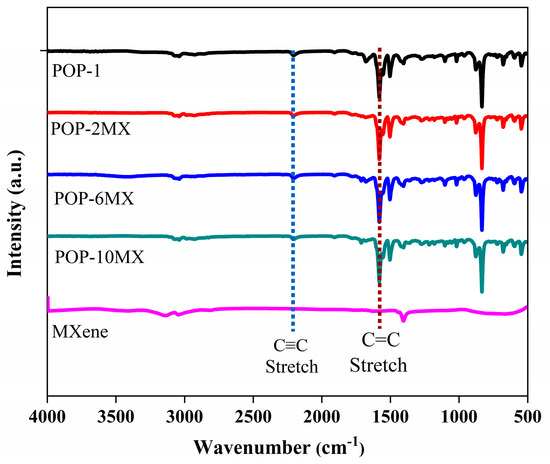
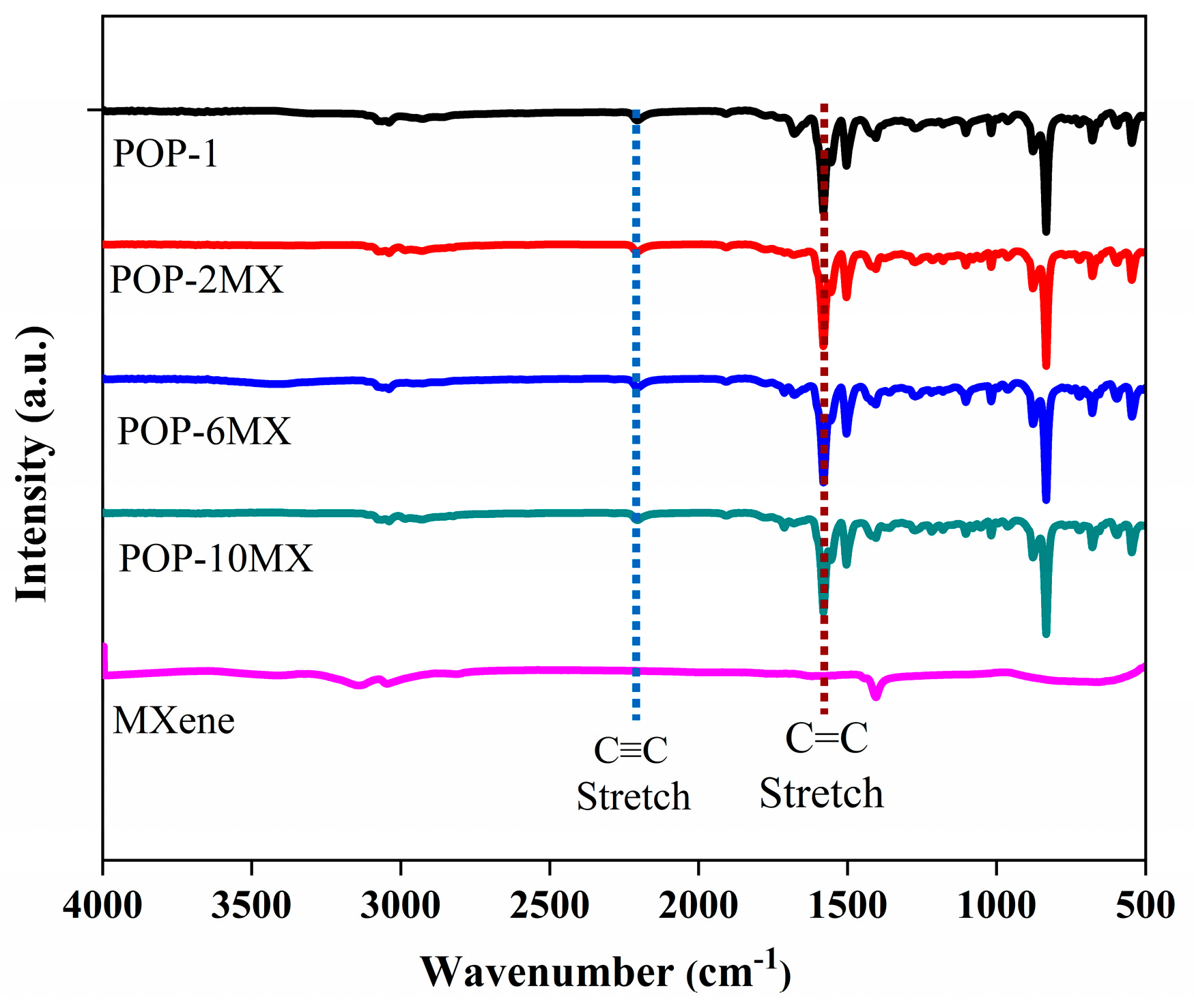
Additionally, Fourier Transform Infrared (FT-IR) spectroscopy was employed to analyze the chemical transformation of the material. A strong absorption peak was detected in the double bond range between 1500 and 1650 cm−1, corresponding to the aromatic bond conjugation within the polymer’s framework [18]. The spectra also exhibit a small peak within the triple bond range from 2000 to 2500 cm−1 that is attributed to the C≡C stretching [19], confirming the successful coupling of the monomers (Figure 1). The combination of XPS and 13C NMR analyses, as shown in Figure S1, further validates the successful formation of the composite material [20]. In the 500–1000 cm−1 region, aromatic C–H out-of-plane bending and ring deformation bands of the POP backbone overlap with Ti–O (~560–605 cm−1) and Ti–F (~640–690 cm−1) stretching vibrations of MXene, the latter becoming more prominent at higher MXene loading. The broad band at 3000–3600 cm−1 is assigned to O–H stretching of surface hydroxyl groups and adsorbed water. This band is far more pronounced in MXene than in POP-1, since etching of the Ti3AlC2 MAX phase generates abundant hydrophilic –OH/–O/–F terminations absent in the purely organic POP-1 framework; its intensity increases steadily from POP-2MX to POP-10MX, confirming successful incorporation of MXene into the composites [21,22].
Figure 1.
Comparative FT-IR spectral pattern of MXene, POP-1, POP-2MX, POP-6MX, and POP-10MX.
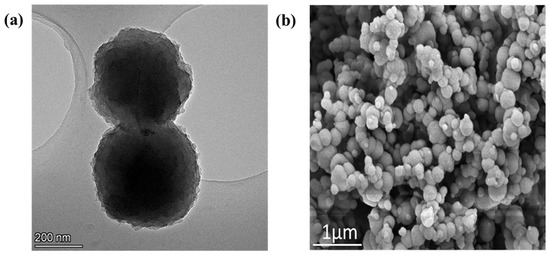
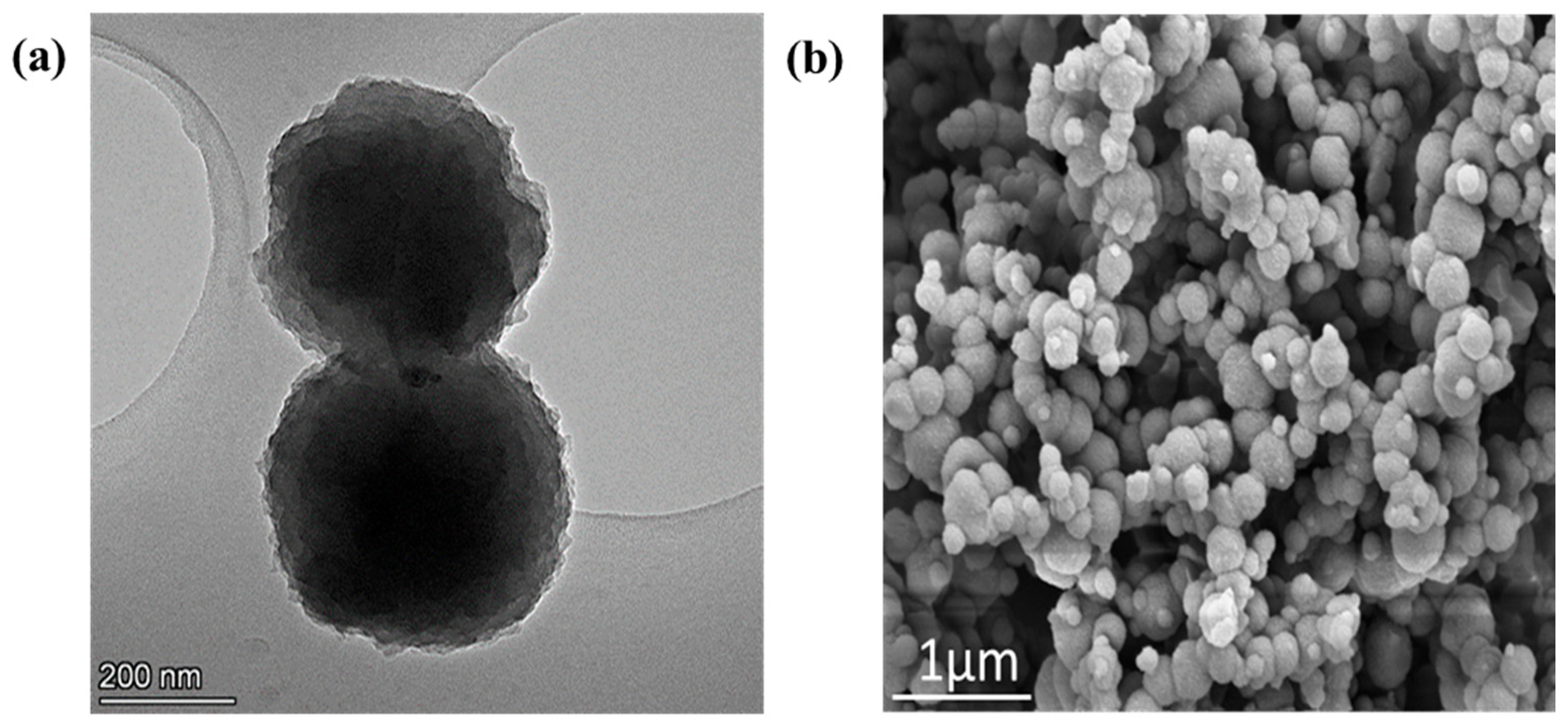
The X-ray diffraction (XRD) analysis patterns of POP-1, POP-2MX, POP-6MX, and POP-10MX indicate the absence of sharp reflection peaks (Figure S4); instead, a large broad hump in the range of 15° to 20° is observed, indicating the amorphous nature of the highly cross-linked porous organic polymer framework [20]. Moreover, scanning electron microscopy (SEM) analysis was employed to investigate the morphological transformations induced by the synthesis process. The SEM images revealed that both samples exhibit a sphere-like morphology with an average size of ~50 nm, suggesting the incorporation of MXene does not significantly alter the overall morphology of the polymer framework (Figure 2 and Figure S5). To further examine the microstructure of the synthesized composites, we conducted transmission electron microscopy (TEM) analysis. The TEM images revealed dense particulate morphology with relatively smooth structural features, while no distinct MXenes lattice fringes or layered nanosheet structures were clearly observed, which is attributed to the low MXenes quantities and their homogeneous dispersion within the POP matrix, which can limit the direct visualization of individual MXene domains. However, the energy dispersive X-ray spectroscopy (EDS) analysis of POP-6MX clearly detected the presence of titanium (Ti), providing supportive evidence for the incorporation of Ti3C2Br MXene within the composite framework. Additionally, the absence of any detectable aluminum (Al) peaks in the EDS spectra confirms the effective removal of the MAX phase precursor during the MXene synthesis process [23]. The complementary findings from SEM, TEM, and EDS collectively confirm the successful formation of porous POP/MXenes hybrid composites with uniformly dispersed MXene species throughout the polymer matrix.
Figure 2.
(a) TEM images 200 nm scale, (b) SEM images at a scale of 1 μm, of POP-6MX.
The specific surface area of the synthesized composites was determined using the Brunauer–Emmett–Teller (BET) method, a widely employed technique that measures surface area based on nitrogen adsorption–desorption isotherms at 77 K. The study was carried out to evaluate the influence of MXene’s incorporation on the porosity and adsorption capacity of the synthesized composites. The results revealed that POP-1 exhibited the largest surface area of 857 m2/g. However, as the proportion of MXene increased, the surface area decreased, as summarized in Table 1. This reduction suggests that the crystallized MXene domains partially occupy the intrinsic pores of the porous organic polymer, thereby diminishing the number of accessible adsorption sites. However, this interfacial contact increases the connection between POP-1 and MXene, which may enhance the charge transfer efficiency at the heterojunction interface, potentially benefiting photocatalytic performance.
Table 1.
BET analysis results.
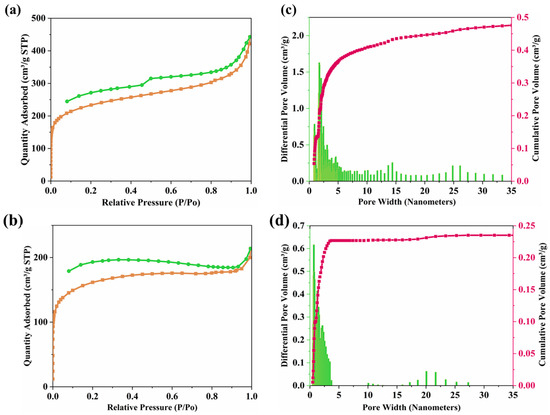
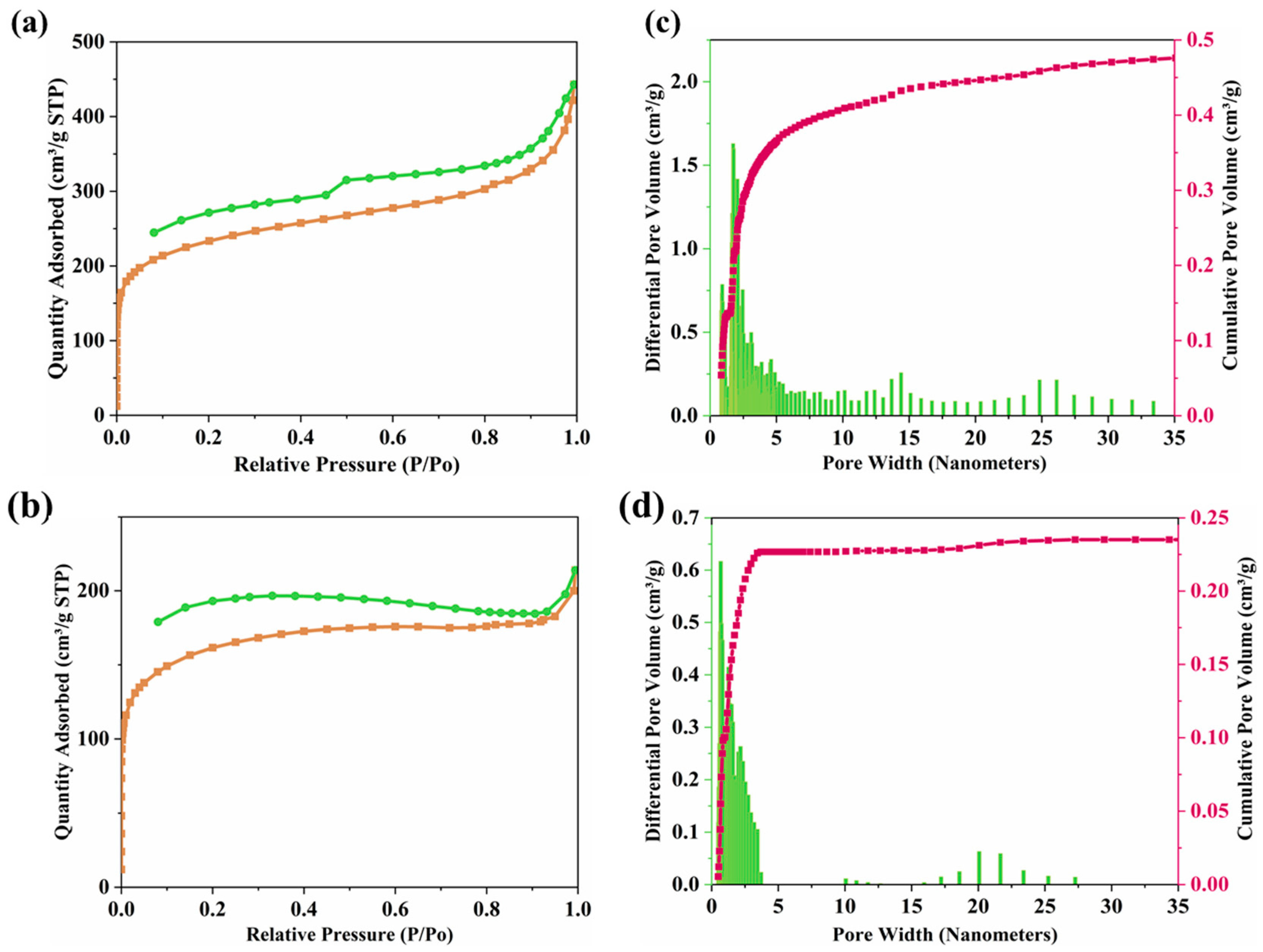
Additionally, the synthesized materials demonstrated notable differences in pore volume and pore size, indicating that the integration of MXene within POP-1’s framework modifies the porosity of the resulting composites, which could influence the interaction of reactants with the material’s surface during photocatalytic processes. As represented in Figure 3b, POP-1 displays a type IV adsorption isotherm behavior with H4-type hysteresis loops which indicates the coexistence of mesoporous and microporous structures, confirming the presence of a porous range of 2–50 nm. The H4 hysteresis suggests the presence of slit-shaped pores typically formed due to the aggregation of the layered MXene sheets and porous polymer framework. Meanwhile, with the MXene incorporation, the MXene/POP-1 composite exhibited a type IV isotherm [23], which is typical for microporous materials that are highly effective in applications like gas separation and storage due to their large surface area and microporous volume also The incomplete closure of the hysteresis loop is attributed primarily to pore-blocking effects and restricted nitrogen desorption within narrow slit-shaped pores formed by the porous polymer network and layered MXene structure [24,25] (Figure 3). The N2 adsorption–desorption isotherms and NLDFT pore size distributions of POP-2MX and POP-10MX are represented in Figure S6.
Figure 3.
(a) N2 adsorption–desorption plot (inset) of POP-1, (b) N2 adsorption–desorption plot (inset) of POP-6MX, (c) NLDFT porosity pattern of POP-1, (d) NLDFT porosity pattern of POP-6MX.
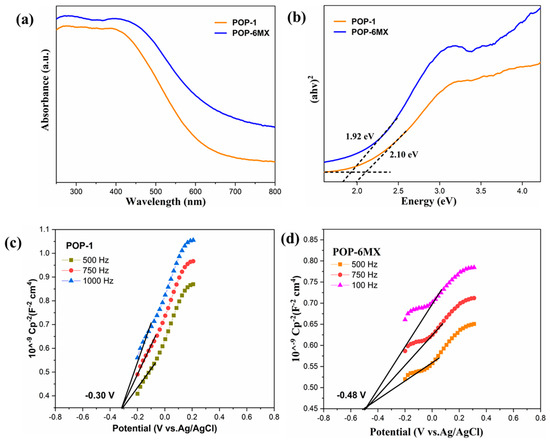
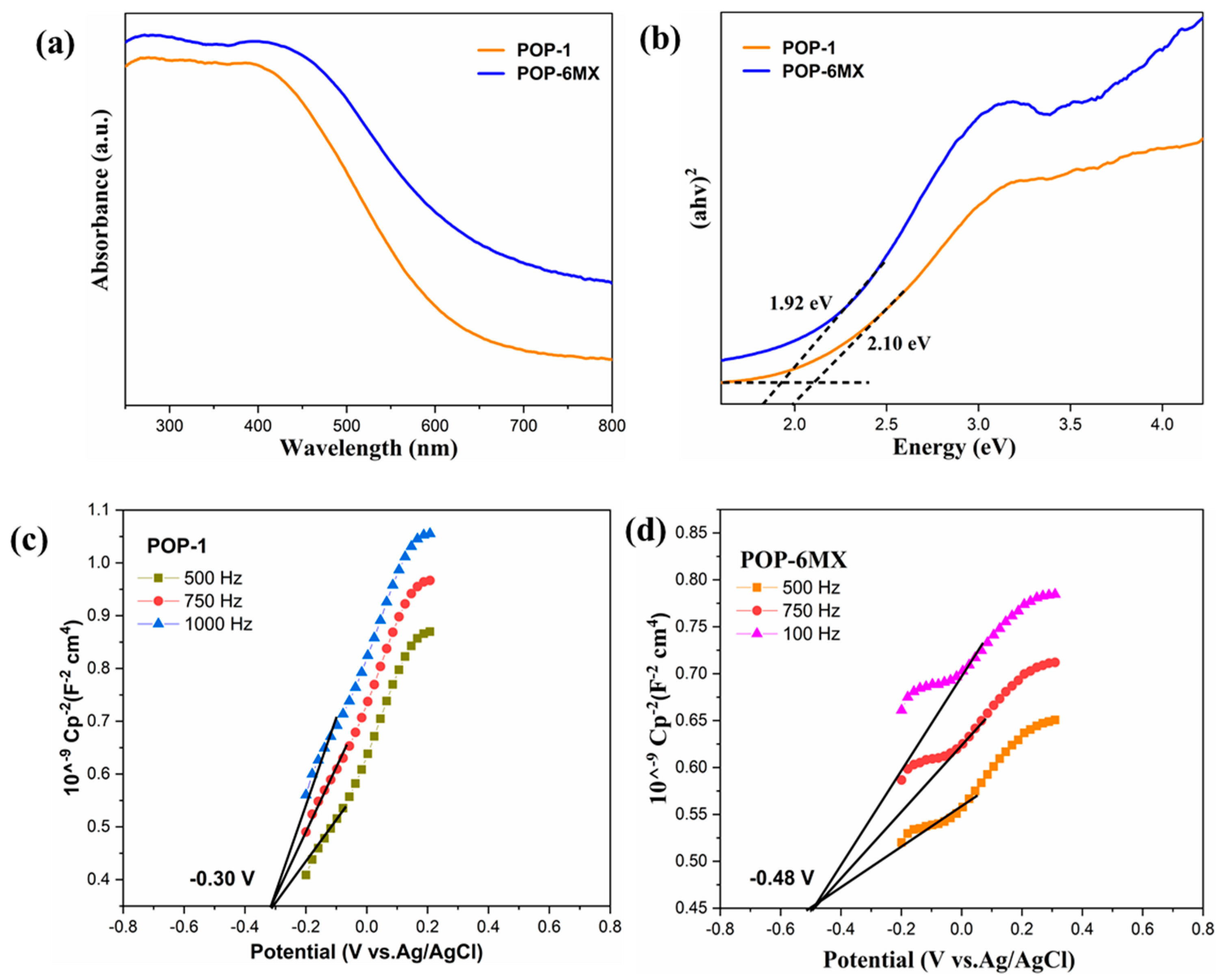
The UV-DRS spectra of POP-1 and POP-6MX are presented in Figure 4. POP-6MX exhibits significantly enhanced and broadened light absorption across the entire UV-visible range (250–800 nm) compared to POP-1, particularly in the visible region (420–800 nm), which is attributed to the incorporation of Ti3C2Tx MXene, extending the light harvesting capability of the polymer framework. The optical band gaps calculated from the Tauc plots were 2.10 eV and 1.92 eV for POP-1 and POP-6MX, respectively, confirming that MXene incorporation narrows the band gap and improves visible light utilization. The LUMO levels from Mott–Schottky analysis were −0.30 V and −0.48 V vs. Ag/AgCl, corresponding to −0.103 V and −0.283 V vs. NHE for POP-1 and POP-6MX, respectively, and the HOMO levels were calculated to be +1.997 V and +1.637 V vs. NHE. The more negative LUMO of POP-6MX indicates stronger reducing power of photogenerated electrons, enabling efficient reduction in dissolved oxygen to superoxide radicals (O2•−), while the sufficiently positive HOMO levels confirm hydroxyl radical (•OH) generation, which is responsible for superior photocatalytic dye degradation.
Figure 4.
(a) UV-DRS spectra of POP-1 and POP-6MX, (b) Tauc plots for the estimation of optical band gaps of POP-1 and POP-6MX, (c) Mott–Schottky plots of POP-1, (d) POP-6MX measured at different frequencies of 500 Hz, 750 Hz, and 1000 Hz.
2.1. Photocatalytic Efficiency
The photocatalytic activity of the synthesized catalysts was evaluated under visible light irradiation, considering specific concentrations of both dye solution and catalyst. The effectiveness of the photocatalyst degradation depends on several key factors, including the initial dye concentration and the catalyst dosage. In the first experiment, 30 mL of 10 ppm dye with 30 mg of catalyst was tested; the dye was totally adsorbed due to the higher catalyst dosage that provides more active sites, promoting the interaction with a large amount of dye molecules at once.
To investigate the degradation of two different dyes with different ionic natures, one cationic (methylene blue, MB) and one anionic (methyl orange, MO), with different concentrations under identical experimental conditions in the presence of several photocatalysts. POP-1 and MXene-containing POP-1 composite with various MXene weight percentages (2%, 6%, 10%) were tested to find the optimal composition that enhances visible light-driven photocatalysis, where a 500 W Xe-lamp equipped with a 420 nm cutoff filter was used as a visible light source.
Before initiating the photocatalytic degradation process, the catalyst-dye mixture was stirred in the dark for 120 min to achieve the adsorption–desorption equilibrium, ensuring that any decrease in the dye concentration once put in the light is due to the photocatalytic degradation, not just adsorption. The experiment was carried out using a 30 mL solution of 30 ppm MB and 25 ppm MO with the aforementioned photocatalysts. After adsorption, the solution was subjected to light irradiation for periods of time, then tested with a UV-Vis spectrometer to evaluate how much dye was degraded in order to evaluate the photocatalytic efficiency of each catalyst (Figures S7 and S8). The simultaneous disappearance of absorption peaks in both the visible and UV regions confirms that the photocatalytic degradation proceeds beyond decolorization toward complete mineralization of MB and MO. To confirm that the observed degradation was indeed due to the photocatalyst and not to photolysis, a control experiment was conducted in which the dye solution with no catalyst was exposed to visible light for 8 h straight, where no noticeable change in concentration took place.
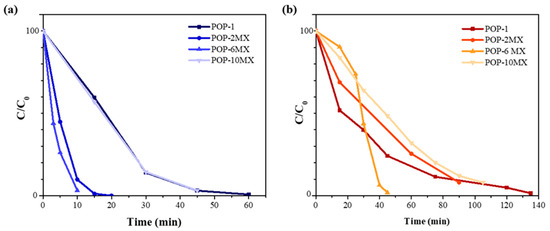
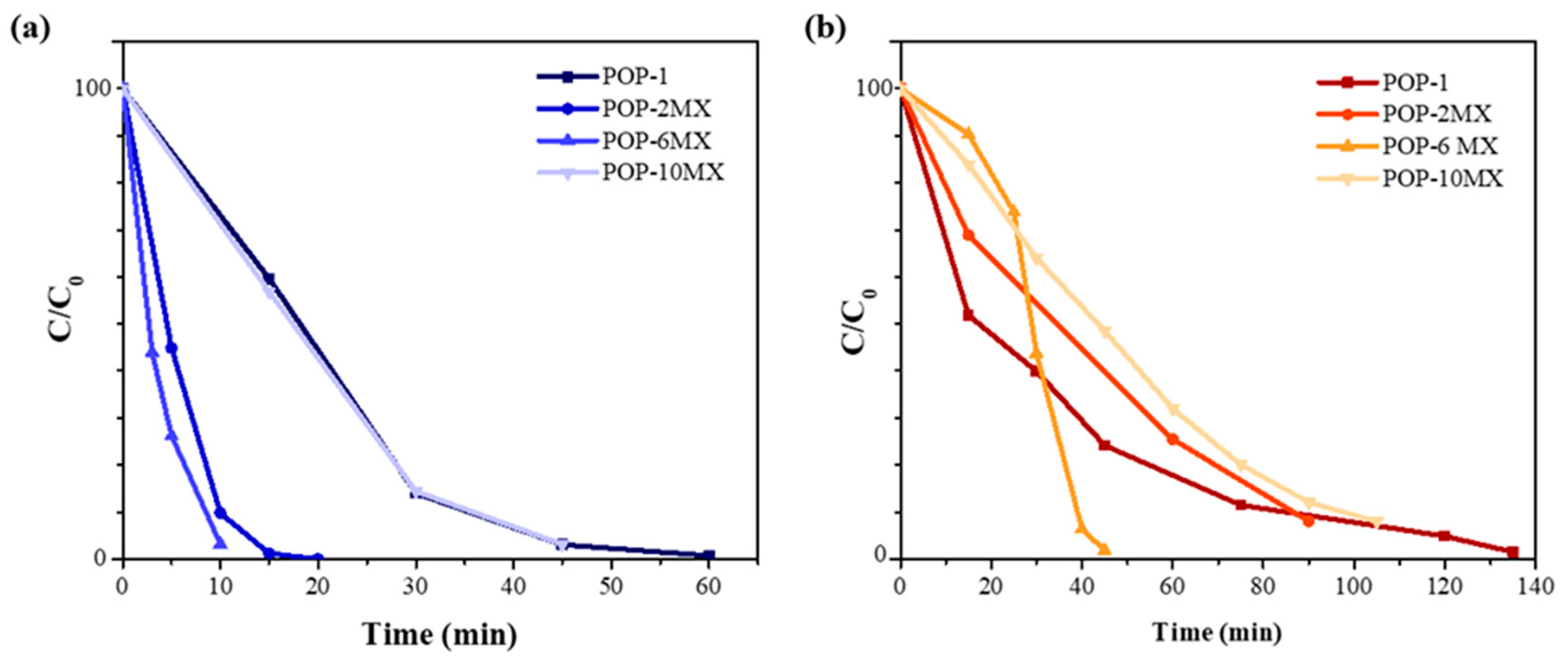
The results demonstrated that 99.25% of MB was degraded within 60 min by POP-1, while POP-2MX and POP-10MX achieved similar degradation efficiencies of 96.86% within 45 min. However, POP-6MX demonstrated the best performance among all catalysts with a degradation efficiency of 96.81% within 10 min. Additionally, the catalyst also showed an effective degradation of MO, leading to a nearly complete disappearance of the dye with the following efficiencies—POP-1: 98.5% in 135 min, POP-2MX and POP-10MX represented nearly similar results, respectively, 91.97% within 90 min, and POP-6MX again demonstrated superior performance, achieving 98.14% degradation within 45 min, representing nearly double the efficiency of POP-2MX and triple the efficiency of POP-1. When comparing the photocatalytic efficiencies of the photocatalysts, POP-6MX achieved the highest degradation efficiency across both tested dyes within a significantly shorter time. Conversely, the performance of the other photocatalysts required longer durations to attain comparable levels of degradation. Notably, the degradation of MB was observed to be more efficient than that of MO, with a shorter reaction time for MB, although the dye-to-catalyst concentration ratio for MB was 1.2 times higher than for MO. This difference in performance can be attributed to the dye-catalyst interactions, molecular structure and bonding characteristics of the dyes and the sensitivity toward the oxidative attack by reactive oxygen species generated during photocatalysis. Since MO is an anionic azo dye, it demonstrates a strong resonance-stabilized π-conjugated structure containing the –N=N– chromophore. These features enhance its structural stability and resistance to oxidative cleavage compared to MB. Conversely, MB is more susceptible to O2− induced degradation under identical photocatalytic conditions. In addition, differences in dye–surface interactions between the cationic MB and anionic MO molecules may also influence the overall degradation efficiency, as MXene with its negatively charge surface has a stronger attraction to cationic dyes.
The enhanced photocatalytic performance of the POP-1/MXene composite can be attributed to the extended π-conjugation of the porous organic framework, which broadens the visible light absorption range and facilitates efficient photoinduced charge separation through donor–acceptor interactions, consistent with recent reports on conjugation-engineered COF photocatalysts where well-optimized conjugation and pore structures are considered critical for photocatalytic efficiency [26]. Moreover, this phenomenon may be attributed to enhanced interfacial charge transfer between POP-1 and MXene, which facilitates charge-carrier separation and reduces electron–hole recombination.
The photocatalytic degradation of both dyes by the synthesized photocatalysts was quantitatively evaluated by pseudo-first-order kinetics analysis, providing more profound insight into the catalytic deficiencies of various samples. The pseudo-first-order approximation assumes that the reaction rate depends primarily on the concentration of one reactant while the concentration of the other reactant remains relatively constant, following the equation:
As mentioned before, the degradation of both dyes with all the synthesized catalysts aligns well initially with the pseudo-first-order kinetic model, indicating that the reaction is proceeding predictably under standard conditions. However, as the C/C0 concentration of the dyes becomes very low, the data starts to deviate from the original model (Figure 5), which suggests that at later stages of the reaction, the concentration of the dye becomes very low compared to the available dissolved oxygen, leading the reaction kinetics to follow another path of mechanism influenced by the availability of the active sites [27].
Figure 5.
Degradation rate plot of (a) MB, (b) MO.
Among all the samples, POP-6MX displayed the highest photocatalytic activity toward MB degradation with a calculated rate constant of k = 0.277 min−1, substantially higher than that of POP-1 (k = 0.082 min−1). The superior kinetics can be attributed to the synergistic effect arising from the synergistic interaction between MXene and POP-1, which enhances charge carrier separation, improves charge-carrier separation and reduces recombination loss. Photocatalytic degradation of MB and MO over all catalysts, with corresponding linear fits, R2 values, and rate constants (k) summarized in Table S1 and fitting plots provided in Figures S9 and S10. Notably, the photocatalytic activity of MXene/POP-1 composite exceeded that of POP-1 under similar conditions, thereby highlighting the considerable potential of MXene/POP-1 heterostructures in the field of environmental remediation and wastewater treatment.
2.2. Reusability
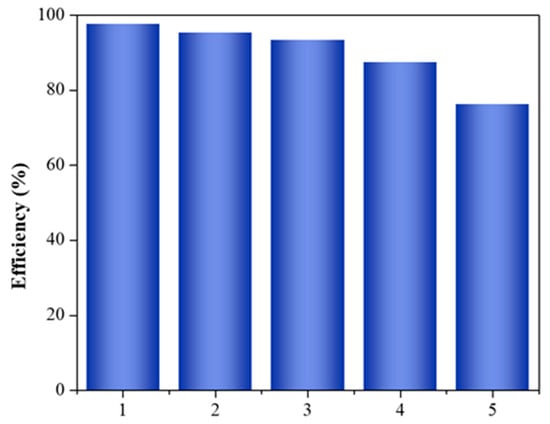
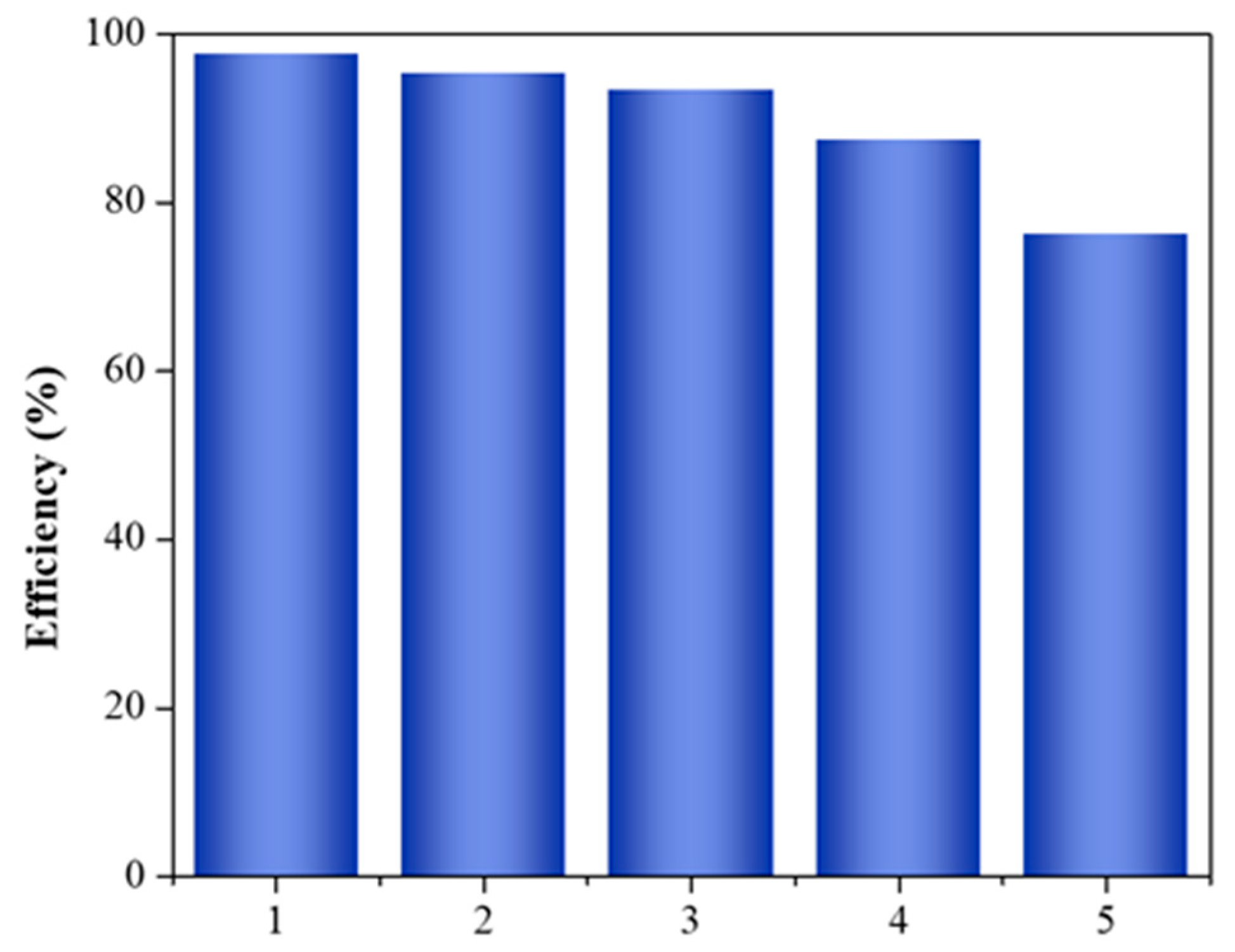
The reusability of photocatalysts is critical in evaluating their practical applicability for environmental remediation applications, particularly in the degradation of persistent organic pollutants such as synthetic dyes. In this context, we evaluated the reusability of the POP-6MX photocatalyst under optimized operational parameters, such that the optimal reusability process did not involve washing; in contrast, the same photocatalyst was reused with the re-addition of the dye at the beginning of each cycle. As represented in Figure 6, the regenerated photocatalyst demonstrated consistent photocatalytic activity for the degradation of the dye across five cycles. However, after each cycle, a slight decline was noted in the performance of the material, which is attributed to the potential blockage of active sites by intermediate degradation byproducts. (Figure S11). XRD and FT-IR analysis of POP-6MX before and after 5 reusability cycles showed no noticeable changes, confirming the structural and chemical stability of the catalyst (Figure S11).
Figure 6.
Reusability tests for POP-6MX in the degradation of methylene blue (MB) dye results.
2.3. Multiple Dye Degradation
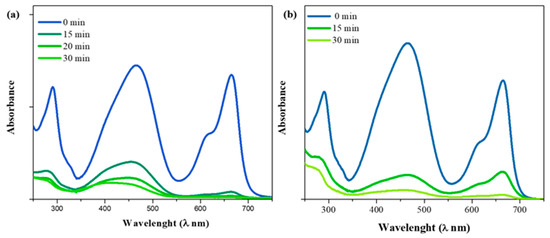
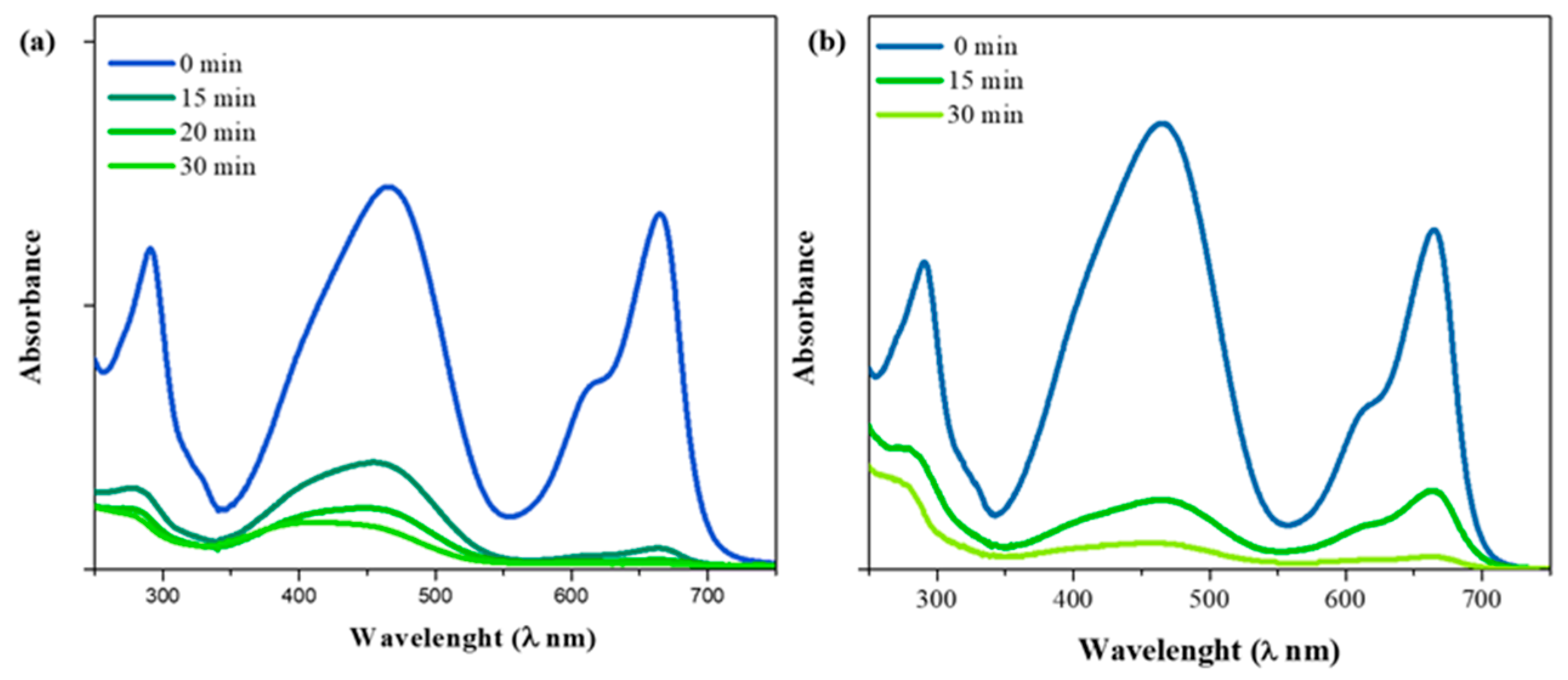
To get further insight into dye degradation, a multiple dye degradation study was conducted using a binary dye mixture of methylene blue and methyl orange dyes. Even though the absolute removal rates were modest, the catalysts showed real promise for practical applications in wastewater treatment. To push this evaluation further, we tested the catalysts’ performance in a mixed dye system containing both anionic and cationic dyes, aiming to mimic more realistic conditions, mentioning that the starting concentrations were 30 ppm for MB and 25 ppm for MO. As represented in Figure S8, it was clear that all the synthesized catalysts demonstrated better degradation with MB, the cationic dye. However, to gain more insight into their applicability to operate in more general and reflective real-world conditions, we compared how quickly each catalyst removed the dyes. POP-1 demonstrated nearly total degradation of the dye mixture within 30 min, reaching removal efficiencies of 87.8% for MO and 98.3% for MB (Figure 7a). POP-6MX, on the other hand, reached 85% degradation for MO and 76% for MB within 15 min of light generation. After 30 min under light, the catalyst achieved nearly the total degradation of both dyes, with 94% for MO and 96% for MB (Figure 7b). Importantly, POP-6MX demonstrated a unique capability of multiple dyes photodegradation, especially in complex dye mixtures, which represents an issue rarely addressed by conventional photocatalysts, which typically show no multiple dyes activity. These findings underscore the advanced functionality of POP-6MX in photocatalytic applications, which makes it an attractive candidate for multi-component wastewater treatment. To benchmark the photocatalytic performance of POP-6MX, a comparison of k values and degradation efficiency with recently reported MXene-based and POP-based photocatalysts is presented in Table 2.
Figure 7.
UV-Vis absorption pattern for a time-dependent multiple degradation of MO and MB in a MO + MB binary solution by (a) POP-1, (b) POP-6MX.
Table 2.
Comparison of photocatalytic dye degradation performance of POP-6MX with reported porous organic polymer/MXene-containing photocatalysts.
2.4. pH Effect
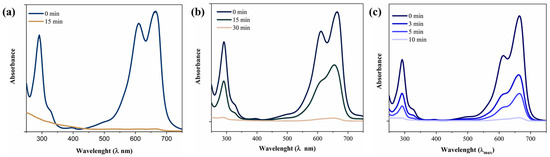
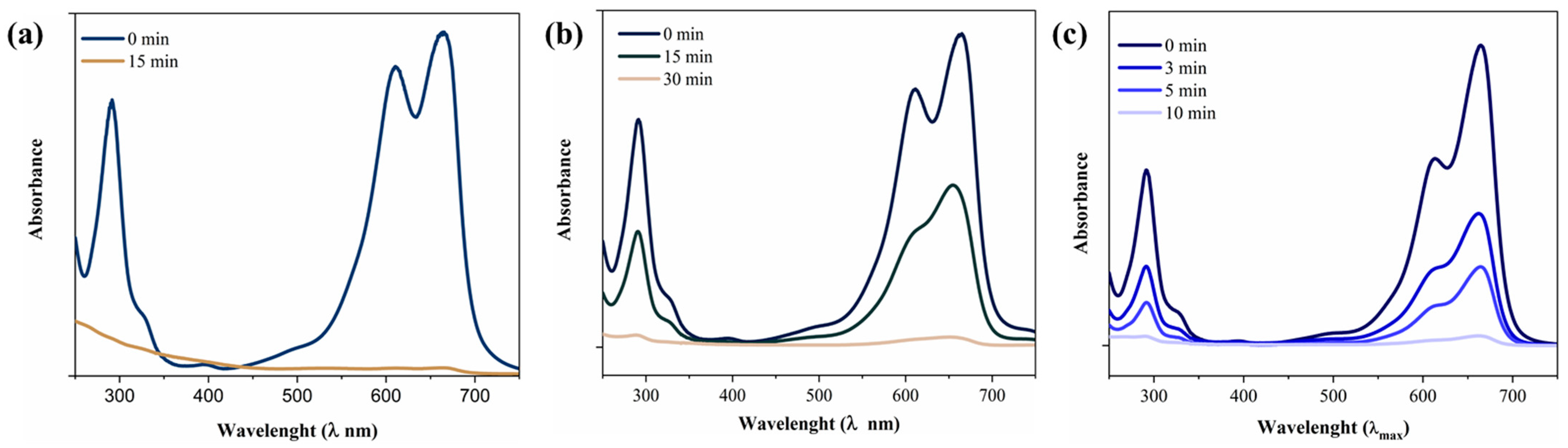
Aqueous reaction conditions, including pH, ionic strength, and the presence of dissolved species, can significantly influence the stabilization of intermediate species generated during the photocatalytic process. The reaction environment, primarily the choice of acidic and basic environments, represents a crucial influence on the overall photocatalytic behavior by affecting the interfacial interactions between the photocatalyst surface and reactants, which in turn impacts both the activity and the selectivity of the photocatalytic reaction. To further explore the impact of reaction conditions, we investigated the pH effect on the performance of the POP-6MX composite. The study involves preparing an acidic dye solution and a basic dye solution using HCl and NaOH until reaching the desired pH of 2.0 and 11.0. The degradation efficiency of MB was measured under these conditions to understand how the pH of the reaction medium affects the photocatalytic process.
The experiment results demonstrated that POP-6MX achieves a higher photocatalytic efficiency in an alkaline environment compared to an acidic environment. At pH = 11, the degradation of MB was very efficient, with 97.6% of the dye decolorized in 15 min. Meanwhile, at pH = 2, the effectiveness dropped sharply with a degradation efficiency of only 48.32% within 15 min, and after 30 min, the catalyst reached 96.7% of dye degradation. In basic media, the photocatalyst surface is more negatively charged, which enhances the electrostatic attraction toward the cationic methylene blue molecules. While these conditions can also facilitate the formation of reactive species, our experimental results, as discussed in Figure 8, a mechanistic explanation, suggest that the enhanced performance at pH = 11 mainly stems from the synergy between the surface charge and the dye molecules, as the hydroxyl radicals (•OH) are only a minor contributing factor to the overall degradation.
Figure 8.
A comparative study of the degradation efficiency of MB in alkaline, acidic, and neutral media catalyzed by POP-6MX. (a) pH = 11, (b) pH = 2, (c) Neutral environment.
Interestingly, in a neutral environment, POP-6MX demonstrated an even faster degradation of MB, reaching a similar degradation efficiency in only 10 min, which indicates the optimal environment for the photocatalytic activity of POP-6MX is a neutral environment. Potential explanations are the lower stability of superoxide radicals at high pH or too strongam attraction between the negative surface and the cationic MB dye [34].
3. Mechanistic Explanation
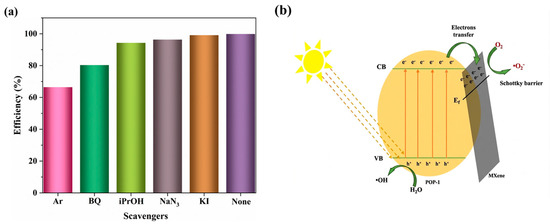
In the photocatalytic process, when the photocatalysts are exposed to sufficient energy from light, electron-hole (e−/h+) pairs are generated. These charge carriers interact with surrounding oxygen molecules to form reactive superoxide radicals O2−, which then attack a wide range of organic molecules non-selectively, by oxidizing all types of organic matter rather than specific bonds or functional groups. To understand the role of O2− in the photocatalytic degradation of MB using POP-6MX, we conducted a series of experiments with selective scavengers to identify the key reactive oxygen species and pathways involved under light irradiation. To assess the role of molecular oxygen O2 within the reaction process, the dye degradation was conducted in an inert argon atmosphere. The inert environment blocks the accessibility of O2, which leads to a significant decrease in dye degradation, demonstrating that O2 plays a crucial role during the process, supporting the hypothesis that O2 acts as an electron acceptor, participating in the generation of O2− via reduction pathways.
To determine O2− superoxide radicals’ involvement in the degradation, benzoquinone was introduced to the catalyst dye solution. The experiment resulted in a significant decrease in the photocatalytic activity, confirming that O2− has a major contribution to the degradation process. In contrast, the addition of isopropanol to scavenge hydroxyl radicals (•OH) and sodium azide (NaN3) to scavenge singlet oxygen (1O2) resulted in negligible changes to the degradation rate, implying that neither •OH nor 1O2 radicals are key factors in the dye degradation process.
Finally, potassium iodide (KI) was introduced to scavenge the photogenerated holes h+. The presence of KI did not hinder the degradation performance, which indicates that the hole species are not directly responsible for dye oxidation. The overall experiment suggests that the main active species in the system are superoxide radicals •O2−, with hydroxyl radicals contributing secondarily to the degradation; meanwhile, holes and singlet oxygen contribute minimally to the degradation mechanism. Therefore, the photocatalytic degradation mechanism likely follows a ROS-dominant pathway, primarily driven by •O2− species (Figure 9).
Figure 9.
(a) Role of different scavengers on the degradation efficiency of MB catalyzed by POP6MX after 60 min of reaction. (b) Proposed charge transfer mechanism of the POP−MX composite under visible light exposure.
The incorporation of MXene as a conductive substrate facilitates the formation of an interfacial charge transfer pathway at the POP-1/MXene interface. This barrier promotes efficient charge separation by allowing photoexcited electrons to transfer rapidly to the MXene surface while hindering their recombination with holes (h+) by acting as an electron sink, increasing the lifetime of charge carriers, and promoting the generation of ROS.
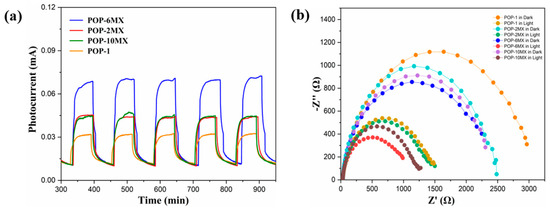
POP-6MX exhibits the smallest semicircle diameter in the Nyquist plot, indicating the lowest charge transfer resistance (Rct) among all samples, confirming the most efficient interfacial charge transfer. Furthermore, POP-6MX shows the highest photocurrent density under visible light irradiation, demonstrating superior charge separation efficiency. These results are fully consistent with the highest photocatalytic degradation performance for both MB and MO (Figure 10).
Figure 10.
(a) Photocurrent response (light on/off cycles); (b) Nyquist Plot of POP−1, POP−2MX, POP−6MX and POP−10MX under visible light irradiation (on/off).
Once spatially separated, charge carriers initiate redox reactions that lead to the formation of ROS. The excited electrons transferred to the MXenes surface reduced dissolved molecular oxygen to form superoxide radicals (•O2−) following reaction (1) [35]:
O2 + e− → •O2−
While the photogenerated holes could potentially generate hydroxyl radicals, the scavenger experiment strongly suggests that the holes play a minor role in the photodegradation. Hence, the holes likely generate oxygen, which can indirectly be used as a molecular oxygen source for the formation of superoxide radicals, ensuring a rapid and efficient photocatalytic degradation.
4. Materials and Methods
Incorporating MXene within the semiconductor’s framework to generate MXene-containing composites helps boost the overall photocatalytic activity [36]. This enhancement is attributed to the divergence of Fermi energy levels of the two materials, which facilitates the formation of a robust internal electric field in the interplanar regions. This electric field drives electron transfer, leading to the bending of the semiconductor’s conduction band (CB) and the creation of an interface barrier that acts as a one-way electron gate between the two materials, ensuring that the electrons remain delocalized on the MXene’s surface, known as the Schottky barrier [37,38,39,40]. The Mott–Schottky barrier promotes exciton dissociation and charge carrier separation, thereby limiting the electrons/holes (e−/h+) recombination, which addresses a key issue that hinders the efficiency of photocatalysis. Recently, research about combining MXene with other substances such as Ti3C2-TiO2, N-doped TiO2@C, In2S3/TiO2@Ti3C2Tx, and so on has been explored, resulting in a significant photocatalytic performance within the environmental remediation after MXene incorporation [31]. In this study, a novel approach is presented to enhance the photocatalytic activity of POPs by generating an MXene/POP-1 composite in a sandwich interlayer system, following a Sonogashira–Hagihara cross-coupling. The synthetic process also employs a high dilution technique, which involves lowering the concentration of the monomers to promote intramolecular cyclisation and reduce the likelihood of forming a dense network of intermolecular side reactions. This technique facilitates the creation of more stable and porous polymers by slowing the reaction rate, allowing sufficient time for the structure to organize into stable, low-density polymers with varied porosity distributions. As a result, the ultra-microporous content was reduced while the mesoporous content increased, leading to a surface area characterized by enhanced mesoporosity. This improvement in mesoporosity facilitates mass diffusion during catalysis, promoting the free movement of reactants and thereby enhancing the photocatalytic activity of the porous organic polymers (POPs).
4.1. Synthesis Method
MXene
- Br surface termination
The synthesis of MXene was conducted utilizing a molten salt method where the Titanium aluminum carbide Ti3AlC2 (Adamas Reagent Co., Ltd., Shanghai, China) powder was selectively etched to remove Al atoms and result in MXene sheets. In particular, 3 mol of Ti3AlC2 and 2.01 mol of CuBr (Adamas Reagent Co., Ltd., Shanghai, China) were carefully ground within a glove box under nitrogen protection to prevent oxidation. The resultant mixture was transferred to an alumina crucible and subjected to thermal treatment in a tubular furnace at 700 °C for a duration of 7 h under an argon flow. Following the conclusion of the heat treatment, the product underwent thorough washing with deionized water and a solution of NH4Cl/NH4OH (Aladdin Biochemical Technology Co., Ltd., Shanghai, China) to eliminate any remaining CuCl2 and CuBr2 byproducts. The final product was subsequently dried under vacuum at a temperature of 40 °C prior to its utilization for further applications [41].
- POP-1:
In a round-bottom, two-necked flask, the monomers 1,4-diethynylbenzene (1.5 mol) (Aladdin Biochemical Technology Co., Ltd., Shanghai, China) and 1,3,5-bromobenzene (1 mol) (Aladdin Biochemical Technology Co., Ltd., Shanghai, China) were added, accompanied by 0.05 mol of tetrakis(triphenylphosphine)palladium (Aladdin Biochemical Technology Co., Ltd., Shanghai, China) and 0.08 M of cuprous iodide(Aladdin Biochemical Technology Co., Ltd., Shanghai, China) serving as catalysts. The reaction components were solubilized in a 3:1 mixture of N, N-Dimethylformamide (DMF) (Sinopharm Chemical Reagent Co., Ltd., Shanghai, China) and triethylamine (TEA) (Sinopharm Chemical Reagent Co., Ltd., Shanghai, China), and the reaction was conducted under an inert atmosphere at a temperature of 80 °C for a duration of 72 h, in accordance with the Sonogashira–Hagihara reaction protocol. Upon completion, the resultant polymer (POP-1) underwent a comprehensive washing process utilizing water and acetone, followed by treatment in a Soxhlet extractor with methanol and acetone for a duration of 24 h, and was subsequently dried under vacuum conditions [42].
- POP-1/MXene composite
For the synthesis of MXene-containing composites, Ti3C2Tx MXene was added as a weight percentage of the total monomer mass (504.0 mg). Specifically, 10.08 mg (2 wt%), 30.4 mg (6 wt%), and 50.4 mg (10 wt%) of MXene were dispersed in the reaction solvent by spin mixing prior to the addition of 1,3,5-tribromobenzene (314.8 mg, 1 mmol) and 1,4-diethynylbenzene (189.2 mg, 1.5 mmol). Each sample was synthesized under identical conditions to POP-1, with the concentration of the MXene serving as the sole variable. This method enables a comparative analysis to determine the most favorable concentration for the photocatalyst, with the objective of determining the impact of the MXene concentration on the reaction’s overall efficiency and performance.
4.2. Structural Characterization
The XRD spectra were recorded using a Bruker-D8 ADVANCE (Bruker AXS GmbH, Karlsruhe, Germany) with a scanning rate of 10°/min. The chemical bonds of polymers were studied using X-ray Photoelectron spectroscopyESCALAB 250Xi (VG Scientific, Thermo Fisher Scientific, Waltham, MA, USA). All binding energies were calibrated and corrected by setting the C1s peak to a binding energy of 284.80 eV, tested on a VG Scientific ESCALAB 250 Xi electron spectrometer with two ultrahigh vacuum chambers and a Kratos Axis-ULTRA. The adsorption and band gap of both materials were determined using UV-Vis DRS (JASCO V-700 Series, JASCO Corporation, Tokyo, Japan)with BaSO4 as a reference in the 250–800 nm wavelength range. Solid-state NMR spectra were acquired using a Bruker AVANCE III HD (400 MHz) (Bruker BioSpin GmbH, Rheinstetten, Germany). The surface morphology of the MXene-containing composite was investigated using a Zeiss Ultra Plus FE-SEM (Carl Zeiss Microscopy GmbH, Oberkochen, Germany). The internal microstructure and elemental distribution of the composites were further examined using a JEM-F200 FE-TEM equipped with EDS (JEOL Ltd., Tokyo, Japan). The specific surface area and pore size distribution of composites were determined by nitrogen adsorption–desorption measurements using a Micromeritics ASAP 2020 (Micromeritics Instrument Corporation, Norcross, GA, USA) based on the Brunauer–Emmett–Teller (BET) method.
4.3. Photocatalytic Dye Degradation
Photocatalytic degradation experiments were performed in a long cuvette reactor (height: 5.6 cm, width: 2.7 cm, volume: ~30 mL) under visible light irradiation using a 500 W Xenon lamp equipped with a 420 nm cutoff filter (λ > 420 nm) at a light intensity of 300 mW/cm2 as the visible light source. In each experiment, 30 mg of catalyst was dispersed in 30 mL of dye solution with continuous magnetic stirring at 40 rpm. The photocatalytic activity of the synthesized catalysts was evaluated under visible light irradiation, considering specific concentrations of both dye solution and catalyst. The effectiveness of the photocatalyst degradation depends on several key factors, including the initial dye concentration and the catalyst dosage. In the first experiment, 30 mL of 10 ppm dye with 30 mg of catalyst was tested; the dye was totally adsorbed due to the higher catalyst dosage that provides more active sites, promoting the interaction with a large amount of dye molecules at once.
To investigate the degradation of two different dyes with different ionic natures, one cationic (methylene blue MB) and one anionic (methyl orange MO), with different concentrations under identical experimental conditions in the presence of several photocatalysts. POP-1 and MXene-containing POP-1 composite with various MXene weight percentages (2%, 6%, 10%) were tested to find the optimal composition that enhances visible light-driven photocatalysis.
Before initiating the photocatalytic degradation process, the catalyst-dye mixture was stirred in the dark for 120 min to achieve the adsorption–desorption equilibrium, ensuring that any decrease in the dye concentration once put in the light is due to the photocatalytic degradation, not just adsorption. The experiment was carried out using a 30 mL solution of 30 ppm MB and 25 ppm MO with the aforementioned photocatalysts. After the adsorption, the solution was subjected to light irradiation for periods of time, then tested with a UV-1800 UV Spectrophotometer (Shimadzu Corporation, Kyoto, Japan) to evaluate how much dye was degraded in order to evaluate the photocatalytic efficiency of each catalyst (Figures S7 and S8) To confirm that the observed degradation was indeed due to the photocatalyst and not to photolysis, a control experiment was conducted in which the dye solution with no catalyst was exposed to visible light for 8 h straight, where no noticeable change in concentration took place (Figure S12).
4.4. Materials
All chemicals were purchased from commercially available sources and were used without further purification. The materials were synthesized according to the previous reports with slight modifications.
5. Conclusions
In this research, we aimed to develop an advanced design strategy to generate a Mott–Schottky junction by doping MXene into the POP-1 framework in order to enhance the efficiency of the photocatalyst. The synthesized catalyst was specifically designed to degrade organic dyes in aquatic environments by using visible light to trigger chemical reactions that attack the dyes present in contaminated water. In order to generate the most effective photocatalyst, we synthesized three composite materials with different MXene contents (2%, 6%, and 10%) via the Sonogashira coupling reaction. The resulting materials were subjected to a suite of standard characterization techniques, which confirmed the successful synthesis and structural integrity of the composites. Among the synthesized catalysts, POP-6MX exhibited the highest degradation efficiency for both dyes, indicating that 6% MXene is the optimal loading for enhancing photocatalytic activity. POP-6MX maintained its performance over five consecutive cycles, suggesting excellent chemical and structural stability, which is essential for practical wastewater treatment. To promote its application in real-world scenarios, we conducted a mixed dye degradation experiment using a solution containing both MO and MB. POP-6MX was able to degrade nearly 95% of both dyes within 30 min. Further evaluation revealed that the photocatalyst’s activity is influenced by environmental pH, with enhanced performance under basic conditions compared to acidic ones. However, its peak activity occurred under neutral pH conditions. To gain insight into the degradation mechanism, we performed additional experiments which confirmed that the main reactive oxygen species (ROS) involved in the degradation process are superoxide radicals and hydroxyl radicals, while holes and singlet oxygen played minimal roles.
However, challenges such as stability, reusability, and scalability need to be further addressed to facilitate large-scale implementations. Future research has to focus on improving photocatalytic design, exploring novel materials, and integrating photocatalysis with other treatment technologies for enhanced efficiency, such as immobilizing it to other materials like TiO2, which would allow for heterogeneous catalysis that can be easily removed and reused, making it more practical for real-world wastewater treatment.
Supplementary Materials
The following supporting information can be downloaded at: https://www.mdpi.com/article/10.3390/inorganics14070176/s1, Figure S1: XPS survey pattern of POP-1 and POP-MX-6 showing carbon as the only element present in the network. A tiny amount of surface adsorbed oxygen is present as well; Figure S2: Deconvoluted C1s peak of POP-MX6; Figure S3: Solid state 13C NMR spectrum of POP-10MX; Figure S4 XRD pattern of POP-1, POP-2MX, POP-6MX and POP-10MX; Figure S5: (a) TEM images 200nm scale, (b) SEM images at scale of 01μm, of POP-1; Figure S6: (a) N2 adsorption-desorption plot (inset) of POP-2MX (b) N2 adsorption-desorption plot (inset) of POP-10MX. (c) NLDFT porosity pattern of POP-2MX, (d) NLDFT porosity pattern of POP-10MX; Figure S7: Degradation plots of MB (a) POP-1, (b) POP-6MX, (c) POP-2MX, (d) POP-MX10; Figure S8: Degradation plots of MO (a) POP-1, (b) POP-6MX, (c) POP-2MX, (d) POP-MX10; Figure S9: Kinetic fitting plots for degradation of MB (a) POP-1, (b) POP-2MX, (c) POP-6MX, (d) POP-MX10; Figure S10: Kinetic fitting plots for degradation of MO (a) POP-1, (b) POP-2MX, (c) POP-6MX, (d) POP-MX10; Figure S11: (a) FTIR Spectra (b) XRD patterns of POP-6MX before and after 5 reusability cycles; Figure S12. Photolysis control experiment of (a,b) MO (25 ppm) and (c,d) MB (30 ppm) under visible light irradiation without a catalyst at t = 0 h and t = 8 h; Table S1: Linear regression equations, R2 values, and rate constants (k) for the degradation of MB and MO over all catalysts.
Author Contributions
Conceptualization, M.A., S.C. (Selsabil Chikhi) and F.V.; methodology, S.D.; software, S.D., and S.C. (Somboon Chaemcheun); validation, S.D., S.C. (Somboon Chaemcheun) and C.-M.K.; formal analysis, S.D. and M.A.; investigation, M.A., S.C. (Selsabil Chikhi) and S.D.; resources, F.V.; data curation, M.A., S.C. (Selsabil Chikhi) and S.D.; writing—original draft preparation, M.A., S.C. (Selsabil Chikhi) and S.D.; writing—review and editing, C.-M.K. and F.V.; visualization, S.C. (Somboon Chaemcheun); supervision, F.V.; project administration, F.V.; funding acquisition, F.V. All authors have read and agreed to the published version of the manuscript.
Funding
This research received no external funding.
Data Availability Statement
The original contributions presented in this study are included in the article/Supplementary Material. Further inquiries can be directed to the corresponding author.
Acknowledgments
The authors are grateful for the financial support from Wuhan University of Technology.
Conflicts of Interest
Author Francis Verpoort was employed by Scientific, Academic & Industrial Services (SAIS) Ltd. The remaining authors declare that the research was conducted in the absence of any commercial or financial relationships that could be construed as a potential conflict of interest.
References
- Liu, T.; Wang, L.; Lu, X.; Fan, J.; Cai, X.; Gao, B.; Miao, R.; Wang, J.; Lv, Y. Comparative study of the photocatalytic performance for the degradation of different dyes by ZnIn2S4: Adsorption, active species, and pathways. RSC Adv. 2017, 7, 12292–12300. [Google Scholar]
- Farhan Hanafi, M.; Sapawe, N. A review on the water problem associate with organic pollutants derived from phenol, methyl orange, and remazol brilliant blue dyes. Mater. Today Proc. 2020, 31, A141–A150. [Google Scholar] [CrossRef] [Scilit]
- Kalaycıoğlu, Z.; Uysal, B.Ö.; Pekcan, Ö.; Erim, F.B. Efficient photocatalytic degradation of methylene blue dye from aqueous solution with cerium oxide nanoparticles and graphene oxide-doped polyacrylamide. ACS Omega 2023, 8, 13004–13015. [Google Scholar] [CrossRef] [Scilit] [PubMed]
- Islam, M.M.; Aidid, A.R.; Mohshin, J.N.; Mondal, H.; Ganguli, S.; Chakraborty, A.K. A critical review on textile dye-containing wastewater: Ecotoxicity, health risks, and remediation strategies for environmental safety. Clean. Chem. Eng. 2025, 11, 100165. [Google Scholar] [CrossRef] [Scilit]
- Navalón, S.; Dhakshinamoorthy, A.; Álvaro, M.; Ferrer, B.; García, H. Metal–Organic Frameworks as Photocatalysts for Solar-Driven Overall Water Splitting. Chem. Rev. 2023, 123, 445–490. [Google Scholar] [PubMed]
- Ameta, R.; Solanki, M.S.; Benjamin, S.; Ameta, S.C. Chapter 6-Photocatalysis. In Advanced Oxidation Processes for Waste Water Treatment; Ameta, S.C., Ameta, R., Eds.; Academic Press: Cambridge, MA, USA, 2018; pp. 135–175. [Google Scholar]
- Zhang, T.; Xing, G.; Chen, W.; Chen, L. Porous organic polymers: A promising platform for efficient photocatalysis. Mater. Chem. Front. 2020, 4, 332–353. [Google Scholar]
- Bildirir, H.; Gregoriou, V.G.; Avgeropoulos, A.; Scherf, U.; Chochos, C.L. Porous organic polymers as emerging new materials for organic photovoltaic applications: Current status and future challenges. Mater. Horiz. 2017, 4, 546–556. [Google Scholar] [CrossRef] [Scilit]
- Lal, H.M.; Uthaman, A.; Thomas, S. Fundamentals of Porous Materials. In Advanced Functional Porous Materials: From Macro to Nano Scale Lengths; Uthaman, A., Thomas, S., Li, T., Maria, H., Eds.; Springer International Publishing: Cham, Switzerland, 2022; pp. 1–15. [Google Scholar]
- Luo, J.; Li, W.; Yin, R.; Liu, Q.; Xin, X.; Yang, L.; He, K.; Ma, D.; Lv, S.; Xing, D. Photocatalyst degradation of perfluorooctanoic acid in water: Mechanisms, approaches, and perspectives. Sep. Purif. Technol. 2024, 338, 126503. [Google Scholar] [CrossRef] [Scilit]
- Zhang, S.; Cai, M.; Wu, J.; Wang, Z.; Lu, X.; Li, K.; Lee, J.-M.; Min, Y. photocatalytic degradation of TiO2 via incorporating Ti3C2 MXene for methylene blue removal from water. Catal. Commun. 2023, 174, 106594. [Google Scholar]
- Sajid, M.M.; Khan, S.B.; Javed, Y.; Amin, N.; Zhang, Z.; Shad, N.A.; Zhai, H. Bismuth vanadate/MXene (BiVO4/Ti3C2) heterojunction composite: Enhanced interfacial control charge transfer for highly efficient visible light photocatalytic activity. Environ. Sci. Pollut. Res. 2021, 28, 35911–35923. [Google Scholar]
- Yuan, Y.; Zhu, G. Porous Aromatic Frameworks as a Platform for Multifunctional Applications. ACS Cent. Sci. 2019, 5, 409–418. [Google Scholar] [CrossRef] [Scilit] [PubMed]
- Luo, Y.; Mei, Y.; Xu, Y.; Huang, K. Hyper-Crosslinked Porous Organic Nanomaterials: Structure-Oriented Design and Catalytic Applications. Nanomaterials 2023, 13, 2514. [Google Scholar] [PubMed]
- Seling, T.R.; Songsart-Power, M.; Shringi, A.K.; Paudyal, J.; Yan, F.; Limbu, T.B. Ti3C2Tx MXene-based hybrid photocatalysts in organic dye degradation: A review. Molecules 2025, 30, 1463. [Google Scholar] [PubMed]
- Li, X.; Bai, Y.; Shi, X.; Su, N.; Nie, G.; Zhang, R.; Nie, H.; Ye, L. Applications of MXene (Ti3C2Tx) in photocatalysis: A review. Mater. Adv. 2021, 2, 1570–1594. [Google Scholar]
- Nath, I.; Chakraborty, J.; Heynderickx, P.M.; Verpoort, F. Engineered synthesis of hierarchical porous organic polymers for visible light and natural sunlight induced rapid degradation of azo, thiazine and fluorescein based dyes in a unique mechanistic pathway. Appl. Catal. B Environ. 2018, 227, 102–113. [Google Scholar] [CrossRef] [Scilit]
- Wong, K.C. Review of Spectrometric Identification of Organic Compounds; ACS Publications: Washington, DC, USA, 2015. [Google Scholar]
- Yang, S.; Chen, Q.; Liu, J.; Miao, P.; Wang, C.; Guo, P.; Wang, X. Exothermic behavior and structural transformation of large-tow polyacrylonitrile fibers during thermo-oxidative stabilization. Ind. Eng. Chem. Res. 2023, 62, 4399–4409. [Google Scholar]
- Akbari, M.; Rasouli, J.; Rasouli, K.; Ghaedi, S.; Mohammadi, M.; Rajabi, H.; Sabbaghi, S. MXene-based composite photocatalysts for efficient degradation of antibiotics in wastewater. Sci. Rep. 2024, 14, 31498. [Google Scholar] [CrossRef] [Scilit] [PubMed]
- Larkin, P. Infrared and Raman Spectroscopy: Principles and Spectral Interpretation; Elsevier: Amsterdam, The Netherlands, 2017. [Google Scholar]
- Socrates, G. Infrared and Raman Characteristic Group Frequencies: Tables and Charts; John Wiley & Sons: Hoboken, NJ, USA, 2004. [Google Scholar]
- Chen, L.; Chen, B.; Kang, J.; Yan, Z.; Jin, Y.; Yan, H.; Chen, S.; Xia, C. The synthesis of a novel conjugated microporous polymer and application on photocatalytic removal of uranium(VI) from wastewater under visible light. Chem. Eng. J. 2022, 431, 133222. [Google Scholar]
- Thommes, M.; Kaneko, K.; Neimark, A.V.; Olivier, J.P.; Rodriguez-Reinoso, F.; Rouquerol, J.; Sing, K.S.W. Physisorption of gases, with special reference to the evaluation of surface area and pore size distribution (IUPAC Technical Report). Pure Appl. Chem. 2015, 87, 1051–1069. [Google Scholar] [CrossRef] [Scilit]
- Anasori, B.; Lukatskaya, M.R.; Gogotsi, Y. 2D metal carbides and nitrides (MXenes) for energy storage. In Mxenes; Jenny Stanford Publishing: Singapore, 2023; pp. 677–722. [Google Scholar]
- Lin, X.; Cai, X.; Zheng, H.; Zheng, J.; Umar, A.B.; Yuan, Z. Conjugated-engineering covalent organic framework for synergistic artificial photosynthesis of hydrogen peroxide and high-value chemicals. Energy Mater. 2025, 5, 500148. [Google Scholar]
- Wang, Q.; Wang, W.; Zhong, L.; Liu, D.; Cao, X.; Cui, F. Oxygen vacancy-rich 2D/2D BiOCl-g-C3N4 ultrathin heterostructure nanosheets for enhanced visible-light-driven photocatalytic activity in environmental remediation. Appl. Catal. B Environ. 2018, 220, 290–302. [Google Scholar]
- Dhruv, L.; Agarwal, S.; Das, A.K. Metal-free polydiacetylene-functionalized polymer for photocatalytic anionic and cationic dye degradation and CO2 capture. ACS Appl. Polym. Mater. 2024, 6, 9130–9141. [Google Scholar]
- Wang, J.H.; Gaber, T.A.; Kuo, S.-W.; El-Mahdy, A.F.M. π-Electron-extended triazine-based covalent organic framework as photocatalyst for organic pollution degradation and H2 production from water. Polymers 2023, 15, 1685. [Google Scholar] [PubMed]
- Far, H.S.; Najafi, M.; Moradi, E.; Atighi, M.; Rabbani, M.; Hasanzadeh, M. Metal-organic frameworks decorated Ti3C2Tx MXene nanosheets (MXene@UiO-66) for enhanced photocatalytic dye degradation. J. Mol. Struct. 2024, 1312, 138627. [Google Scholar]
- Singh, A.; Gogoi, R.; Sharma, K.; Jena, S.K.; Fourati, N.; Zerrouki, C.; Remita, S.; Siril, P.F. Continuous flow synthesis of visible light-active conjugated porous polymer for pollutant degradation and plastic waste photoreforming. J. Clean. Prod. 2023, 428, 139476. [Google Scholar] [CrossRef] [Scilit]
- Kashif, S.; Akram, S.; Murtaza, M.; Amjad, A.; Shah, S.S.A.; Waseem, A. Development of MOF-MXene composite for the removal of dyes and antibiotic. Diam. Relat. Mater. 2023, 136, 110023. [Google Scholar] [CrossRef] [Scilit]
- Zeng, G.; He, Z.; Wan, T.; Wang, T.; Yang, Z.; Liu, Y.; Lin, Q.; Wang, Y.; Sengupta, A.; Pu, S. A self-cleaning photocatalytic composite membrane based on g-C3N4@MXene nanosheets for the removal of dyes and antibiotics from wastewater. Sep. Purif. Technol. 2022, 292, 121037. [Google Scholar]
- Xiong, L.; Tang, J. Strategies and Challenges on Selectivity of Photocatalytic Oxidation of Organic Substances. Adv. Energy Mater. 2021, 11, 2003216. [Google Scholar] [CrossRef] [Scilit]
- Ranjith, K.S.; Mohammadi, A.; Raju, G.S.R.; Huh, Y.S.; Han, Y.-K. Interfacial charge transfer on hierarchical synergistic shell wall of MXene/MoS2 on CdS nanospheres: Heterostructure integrity for visible light responsive photocatalytic H2 evolution. Nano Converg. 2024, 11, 51. [Google Scholar] [PubMed]
- Fang, H.; Pan, Y.; Yin, M.; Pan, C. Enhanced photocatalytic activity and mechanism of Ti3C2−OH/Bi2WO6:Yb3+, Tm3+ towards degradation of RhB under visible and near infrared light irradiation. Mater. Res. Bull. 2020, 121, 110618. [Google Scholar]
- Biswal, L.; Mohanty, R.; Nayak, S.; Parida, K. Review on MXene/TiO2 nanohybrids for photocatalytic hydrogen production and pollutant degradations. J. Environ. Chem. Eng. 2022, 10, 107211. [Google Scholar]
- Quyen, V.T.; Thanh, D.M.; Van Le, Q.; Viet, N.M.; Nham, N.T.; Thang, P.Q. Advanced synthesis of MXene-derived nanoflower-shaped TiO2@Ti3C2 heterojunction to enhance photocatalytic degradation of Rhodamine B. Environ. Technol. Innov. 2021, 21, 101286. [Google Scholar]
- Prasad, C.; Yang, X.; Liu, Q.; Tang, H.; Rammohan, A.; Zulfiqar, S.; Zyryanov, G.V.; Shah, S. Recent advances in MXenes supported semiconductors based photocatalysts: Properties, synthesis and photocatalytic applications. J. Ind. Eng. Chem. 2020, 85, 1–33. [Google Scholar] [CrossRef] [Scilit]
- Zhang, M.; Zhang, Y.; Chang, H.; Wang, W.; Wu, L.; Li, C.; Li, Y.; Jing, X.; Yang, W.; Xie, H.; et al. Unraveling the mystery of sandwich structure: Emerging photocatalytic hydrogen production by g-C3N5 coupled Nb2C MXene forming Schottky heterojunction. Sep. Purif. Technol. 2025, 354, 128883. [Google Scholar]
- Li, M.; Li, X.; Qin, G.; Luo, K.; Lu, J.; Li, Y.; Liang, G.; Huang, Z.; Zhou, J.; Hultman, L.; et al. Halogenated Ti3C2 MXenes with Electrochemically Active Terminals for High-Performance Zinc Ion Batteries. ACS Nano 2021, 15, 1077–1085. [Google Scholar] [PubMed]
- Heravi, M.M.; Zadsirjan, V. Chapter 8-Applications of the Sonogashira reaction in the total synthesis of alkaloids. In Recent Applications of Selected Name Reactions in the Total Synthesis of Alkaloids; Heravi, M.M., Zadsirjan, V., Eds.; Elsevier: Amsterdam, The Netherlands, 2021; pp. 295–323. [Google Scholar]

Disclaimer/Publisher’s Note: The statements, opinions and data contained in all publications are solely those of the individual author(s) and contributor(s) and not of MDPI and/or the editor(s). MDPI and/or the editor(s) disclaim responsibility for any injury to people or property resulting from any ideas, methods, instructions or products referred to in the content. |
© 2026 by the authors. Licensee MDPI, Basel, Switzerland. This article is an open access article distributed under the terms and conditions of the Creative Commons Attribution (CC BY) license.