Article

Carbon-Supported Pt-Based Quaternary Alloy Nanocatalysts for the Selective Electro-Oxidation of Glycerol


1
School of Food Science and Engineering, South China University of Technology, Guangzhou 510641, China
2
Guangzhou Institute of Energy Conversion, Chinese Academy of Sciences, Guangzhou 510640, China
3
Guangdong Provincial Key Laboratory of Green Processing of Natural Products and Product Safety, Guangzhou 510641, China
4
College of Chemistry and Chemical Engineering, Mudanjiang Normal University, Mudanjiang 157011, China
*
Authors to whom correspondence should be addressed.
Inorganics 2026, 14(7), 175; https://doi.org/10.3390/inorganics14070175
Submission received: 17 April 2026 / Revised: 23 June 2026 / Accepted: 23 June 2026 / Published: 27 June 2026
(This article belongs to the Special Issue Featured Papers in Inorganic Materials 2026)

Abstract

The selective electrocatalytic conversion of glycerol into value-added products provides a sustainable and efficient strategy for addressing the surplus of biomass-derived waste generated from the biodiesel production. In this paper, a series of carbon-supported PtPdRhRu quaternary alloy nanocatalysts (PtPdRhRu/C) with different atomic ratios (Equi, Pt-rich, Pd-rich, Rh-rich and Ru-rich) were prepared via a one-pot polyol method. The effects of these atomic ratios on the catalytic performance and the selectivity of the glycerol conversion to high-value products were investigated. The as-prepared PtPdRhRu/C nanocatalysts all possess a single-phase face-centered cubic (fcc) structure. Specifically, their mass activities are 10.5, 9.4, 8.1, 1.9 and 6.4 times higher than that of commercial Pt/C (20 wt%) for the Pt-rich, equimolar, Pd-rich, Rh-rich, and Ru-rich catalysts, respectively. This enhancement is suggested to be associated with the unique electronic modulation and synergistic effects inherent in the multicomponent surface. The Pd-rich catalyst exhibits a selectivity of 72% for glyceraldehyde, while the Rh-rich catalyst shows 53% selectivity for oxalic acid. The C2/C3 product ratio for the Rh-rich catalyst reaches 1.13, compared to 0.82 for the Ru-rich catalyst, suggesting that the presence of Rh and Ru atoms promotes C-C bond cleavage. In contrast, the C2/C3 ratios of the Pt-rich and Pd-rich catalysts are relatively low; notably, the C2/C3 ratio of the Pd-rich catalyst is only 0.20. This implies that the inclusion of Pt and Pd elements in the quaternary alloy is more conductive to the retention of C3 frameworks. These findings highlight the PtPdRhRu platform as a versatile framework for tuning the geometric and electronic environment of catalysts, providing a strategic approach for the selective electro-conversion of complex polyols.

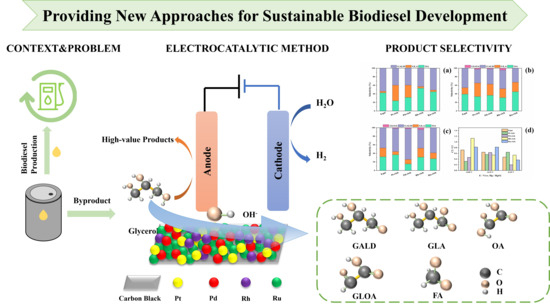
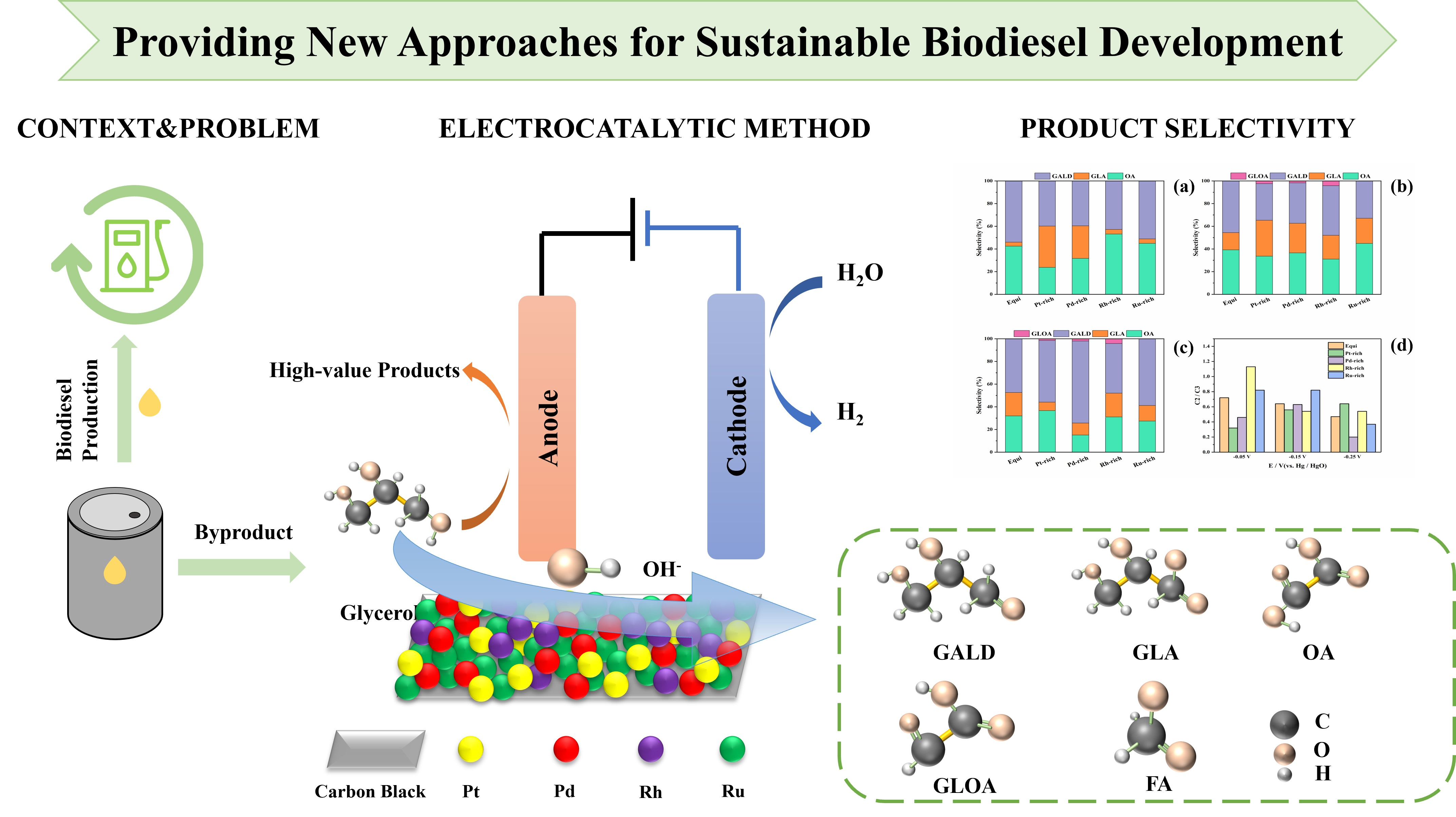
Graphical Abstract

1. Introduction

Due to the depletion of fossil fuels, the use of biodiesel fuel is continuously increasing worldwide. With the increase in global biodiesel production, the large surplus of by-product glycerol produced from the production of biodiesel has led to a significant decline in its price [1,2]. Meanwhile, the glycerol produced during the biodiesel production process contains various impurities such as water, methanol, salts, and fatty acids [3,4,5,6]. This makes it necessary to undergo an expensive purification process before it can be used in the food, pharmaceutical, and cosmetic industries. Therefore, the by-product crude glycerol is usually treated as waste, leading to severe environmental pollution and higher production costs for biodiesel [7,8,9,10]. Converting the crude glycerol into high-value-added products for reuse is crucial for promoting the further development of biodiesel technology. The transformation of glycerol into high-value chemicals via selective catalytic processes has thus emerged as a critical frontier for industrial sustainability [6,11,12,13,14,15].
The valorization of glycerol typically proceeds through catalytic oxidation or hydrogenolysis, yielding an array of oxygenated C2 and C3 derivatives with market values up to 4000 times higher than the raw feedstock [7,16,17,18,19,20,21,22,23]. For instance, glyceric acid (GLA) is a vital precursor for bioplastics, while oxalic acid (OA) and formic acid (FA) find extensive applications in the pharmaceutical and energy sectors [9,24,25,26,27,28,29]. Among various conversion technologies, electrochemical glycerol oxidation (GEOR) in alkaline media is particularly attractive due to its ability to operate under ambient conditions and the potential to couple chemical production with green hydrogen evolution. However, the primary bottleneck remains the design of electrocatalysts capable of achieving high selectivity toward specific C-C or C-H bond cleavage while maintaining high current densities and resisting CO-like intermediate poisoning [12,30,31,32,33,34,35].
Platinum-group metals (PGMs) serve as the benchmark catalysts for GEOR, yet each suffers from inherent limitations. Pt-based catalysts exhibit high initial activity but are prone to deactivation by strongly adsorbed intermediates. They typically favor C1 pathways (CO2 and formic acid) in alkaline media [16,36,37,38,39]. Pd-based systems generally preserve the C3 backbone, favoring GLA and dihydroxyacetone (DHA). The most prominent feature of Au-based catalysts is their extremely high selectivity. Especially under alkaline conditions, they can efficiently and highly selectively oxidize glycerol into glyceric acid [6,40,41,42,43,44,45]. Au catalysts usually exhibit relatively low activity for breaking C-C bonds and are more inclined to generate high-value-added products such as dihydroxypropionic acid and hydroxypropionic acid, which can be applied in the pharmaceutical field during the electrocatalytic oxidation of glycerol [6,46,47,48]. In contrast, Ru-based materials, despite their high activity, frequently promote excessive C-C scission toward lactic acid [19]. The most widely studied glycerol oxidation catalysts are binary and ternary metal catalysts. Monometallic catalysts often suffer from relatively low catalytic activity and also have disadvantages such as being prone to poisoning [49,50,51]. The addition of a second or third metal can significantly promote the re-oxidation of adsorbed toxic intermediates, exposing the active centers of the catalyst again and greatly improving the reaction kinetics [52,53,54,55]. For example, Caglar et al. studied the performance of single-metal Pt/C, Co/C, Ni/C, and Cu/C catalysts loaded on porous carbon cloth, as well as dual-metal PtCo/C, PtNi/C, and PtCu/C catalysts. Compared with the single-metal catalysts, the dual-metal catalysts exhibited better electro-oxidation activity and stability towards glycerol. Among them, the PtCu/C electrode had the highest activity. This was due to the fact that the surface of the PtCu/C electrode had a higher electrochemical active surface area and also formed more hydroxides, thereby enhancing the oxidation kinetics of glycerol [14]. The Pd5Au1/C catalyst prepared by Hernández et al. achieved a catalytic current density of 140.1 mA mgPdAu−1 for the electro-oxidation of glycerol, and its catalytic performance was 2.73, 2.79 and 2.2 times higher than that of the Pd/C, Au/C catalysts prepared by their research group and commercial Pd/C [15]. While binary (e.g., PdAu/C) and ternary (e.g., AuAgPd/C) systems have been developed to leverage the bifunctional mechanism and electronic effects, most still struggle to achieve the fine-tuned control over product distribution required for industrial applications [20,21]. The complexity of the GEOR mechanism—involving multiple proton-coupled electron transfer steps—suggests that the limited active site configurations in binary/ternary alloys may be unable to break the traditional scaling relations that hinder performance [56,57].
The design and preparation of multi-component alloy nano-catalysts is a promising approach for developing highly efficient and selective catalysts for glycerol oxidation, with the aim of enhancing the selective conversion of glycerol into high-value-added products. The main objective is to achieve superior catalytic performance—such as activity, selectivity, and stability—exceeding that of single metals or simple alloys by controlling the composition, structure, and interfaces of multiple metal elements. Additionally, loading these alloy nanoparticles onto high-specific-surface-area carriers (e.g., carbon materials) can prevent agglomeration and leverage strong metal-carrier interactions to further boost activity and stability [57,58]. In this context, quaternary alloy nano-catalysts are expected to provide a more versatile platform by integrating four different metal elements, creating a multicomponent environment that may break traditional scaling relations.
In this study, a series of carbon-supported PtPdRhRu quaternary alloy nanocatalysts (PtPdRhRu/C) with different metal ratios (Equi, Pt-rich, Pd-rich, Rh-rich and Ru-rich) were prepared by a one-pot polyol method using carbon black as support. The effects of different metal ratios in the quaternary alloy catalysts on the catalytic activity of glycerol oxidation and the selectivity of the conversion of high-value-added products were investigated. The results show that the catalytic activities of as-obtained PtPdRhRu/C catalysts are significantly superior to commercial Pt/C (20 wt%) catalyst. The quaternary alloy catalysts with different metal ratios also exhibit different selectivities for conversion glycerol to high-value products. This work provides new insights into the synergistic roles of Pt, Pd, Rh, and Ru in governing C-C bond cleavage and hydroxyl group carbonylation, offering a strategic framework for the selective electro-valorization of complex polyols.

2. Results and Discussion

2.1. Structural and Morphological Characterization

2.1.1. Crystalline Properties (XRD)

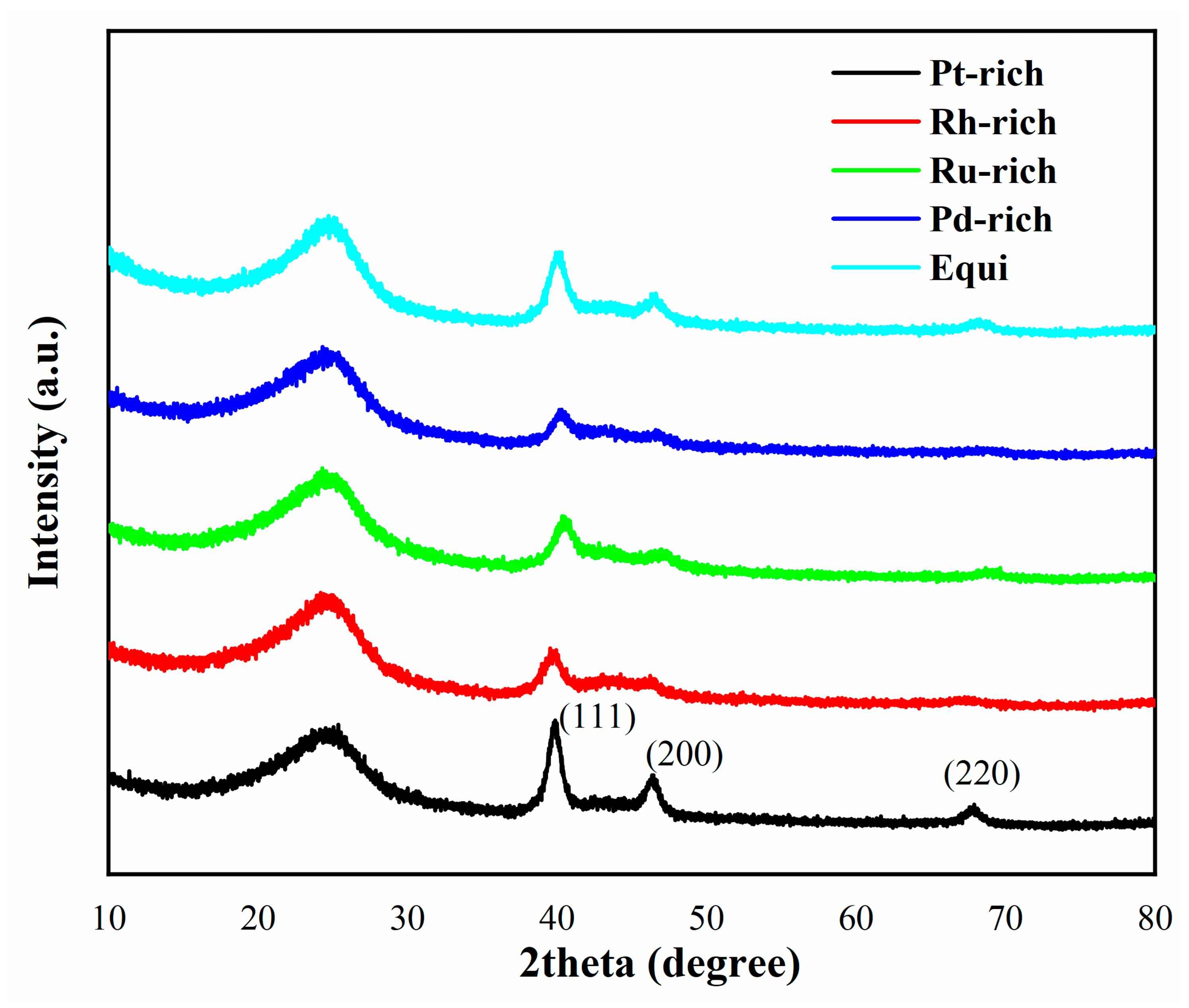
The phase purity and crystalline structure of the carbon-supported PtPdRhRu quaternary alloy nanocatalysts—comprising Equi (1:1:1:1), Pt-rich (5:1:1:1), Pd-rich (1:5:1:1), Rh-rich (1:1:5:1), and Ru-rich (1:1:1:5) variants—were systematically evaluated via X-ray diffraction (XRD). As shown in Figure 1, all catalysts exhibit a broad diffraction peak at approximately 2θ = 24.5°, which is indexed to the (002) reflection of the Vulcan XC-72R carbon. The diffraction profiles of all quaternary variants reveal three primary characteristic reflections at about 39.5°, 46.4°, and 67.6°, corresponding to the (111), (200), and (220) planes, respectively. These features are characteristic of a single-phase face-centered cubic (fcc) lattice structure. The dominance of the (111) peak intensity aligns with the thermodynamically stable, close-packed nature of fcc systems. Notably, no discrete diffraction peaks corresponding to monometallic Pt, Pd, Rh, or Ru, nor their respective oxide phases, were detected within the sensitivity limits of the instrument. This absence of phase separation provides evidence for the successful integration of the four elements into a single-phase fcc framework, exhibiting quaternary alloy-like features. The symmetry of the (111) diffraction peak and the lack of any discernible secondary phase peaks further suggest the formation of a structurally integrated quaternary system rather than a mixture of individual metals. A closer examination reveals significant peak broadening and a reduction in peak intensity across all samples. According to the Scherrer equation, this broadening indicates the formation of ultra-small crystalline domains. Such nanostructural refinement is highly desirable in electrocatalysis, as it correlates with a significantly increased surface-to-volume ratio and a higher density of unsaturated surface coordination sites.
To further investigate the alloying effect, the lattice parameters (a) were calculated from the (111) diffraction peaks. As summarized in Table 1, the Pt-rich sample exhibits a 2θ value of 39.88°, corresponding to a lattice parameter of 0.3913 nm, which represents a 0.25% contraction compared to bulk Pt (a = 0.3923 nm). Notably, the Ru-rich and Pd-rich samples show even more pronounced contractions of 1.55% and 1.27%, respectively. This lattice contraction suggests the successful incorporation of smaller Pd, Rh, and Ru atoms into the Pt fcc framework, inducing a compressive strain on the catalyst surface [7,57]. These structural refinements indicate a multicomponent atomic environment. Such lattice-level modifications are often associated with the modulation of the electronic structure (e.g., d-band center shifts), which may play a crucial role in optimizing the adsorption–desorption energy of glycerol-derived intermediates.

2.1.2. Morphological and Elemental Analysis (STEM and HAADF-STEM)

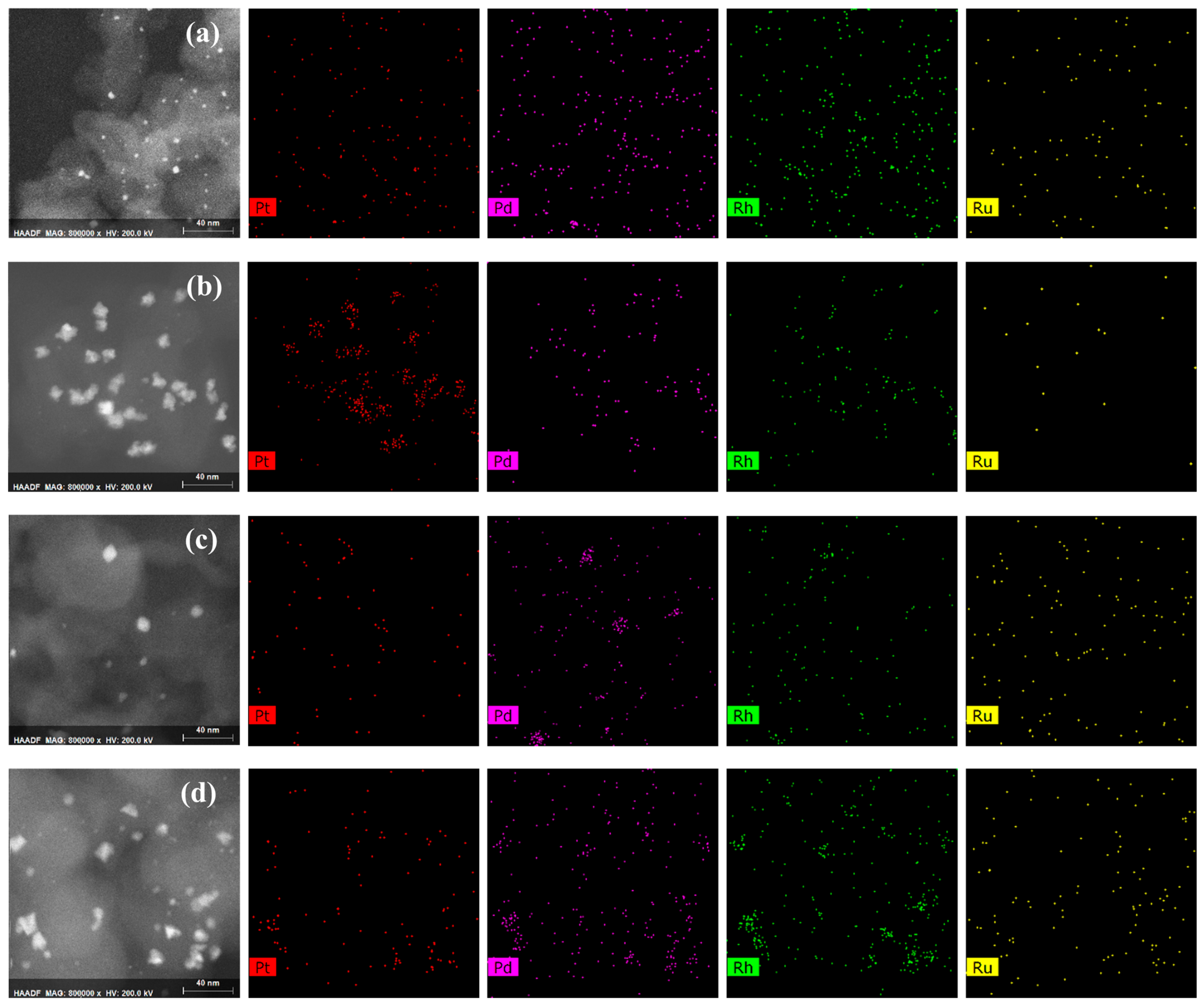
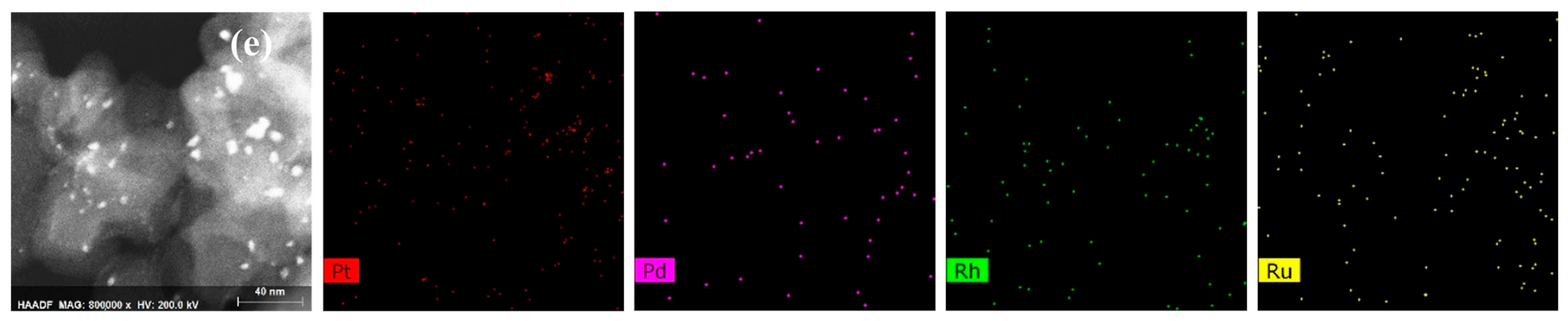
The morphological evolution and elemental architecture of the PtPdRhRu/C series catalysts were further elucidated using Scanning Transmission Electron Microscopy in Dark-Field mode (STEM-DF) and High-Angle Annular Dark-Field Scanning Transmission Electron Microscopy (HAADF-STEM) mapping. As shown in Figure 2 and Figure S1, the images of as-prepared PtPdRhRu/C catalysts display that all quaternary alloy nanoparticles with different metal ratios are uniformly anchored across the carbon black matrix. They maintain a high degree of dispersion without discernible evidence of secondary phase segregation, and the particle sizes of several types of alloy catalyst are close. Quantitative size distribution analysis reveals that the average particle sizes of the several PtPdRhRu/C catalysts are 3.90 nm (Equi), 5.76 nm (Pt-rich), 3.48 nm (Pd-rich), 4.49 nm (Rh-rich), and 4.58 nm (Ru-rich), respectively. It can also be observed that the microscopic morphologies of the catalysts changed significantly with the adjustment of the proportion of the metal precursor. For the PtPdRhRu/C (Equi) catalyst with an equal metal ratio, the prepared catalyst is in the form of spherical particles. When the elemental molar ratio deviates from the equal ratio, the catalyst takes on a tetrahedral shape. This morphological transformation suggests that the varying concentrations of metal precursors significantly alter the crystal growth kinetics. In the polyol process, the final nanocrystal shape is governed by the relative growth rates of different crystallographic facets—specifically the (111) and (100) planes—driven by a complex interplay of surface energy minimization, electronic perturbations, and facet-specific ligand adsorption.
The HAADF-STEM image and corresponding EDS mapping (Figure 2) provide visual evidence of the quaternary alloying, with characteristic X-ray signals for Pt, Pd, Rh, and Ru appearing superimposed within individual nanoparticles. The HAADF-line scan profiles (Figure S2) suggest a high degree of elemental integration at the nanometer scale. These results and Inductively coupled Plasma-Optical Emission Spectroscopy (ICP-OES) analysis (Table 2) are similar. The atomic ratio of Pt, Pd, Rh and Ru in the PtPdRhRu/C (Equi) catalyst is 38:29:26:7. The content of Pt is the highest, while that of Ru is the lowest. This indicates that during the co-reduction process of several precursors, Pt is the easiest to be reduced, while Ru is the most difficult to be reduced.
From the data in Table 2, it can be seen that the element content determined by the HAADF-Line scan is basically consistent with the results of ICP-OES method. The ICP-OES analysis results show that the atomic ratios of PtPdRhRu/C (Pt-rich), PtPdRhRu/C, (Pd-rich), PtPdRhRu/C (Rh-rich), and PtPdRhRu/C (Ru-rich) catalysts are 71:8:14:7, 17:60:18:5, 16:12:61:11, 19:15:19:47, respectively. It can be seen from this that the content of Pt in the Pt-rich catalyst reaches 71, while the contents of Pd and Rh in the Pd-rich and Rh-rich catalysts are both around 60, and Ru loading in the Ru-rich variant was limited to 47%. This further indicates that the actual atomic ratio of Ru is lower than the nominal concentration. The chemical properties of Ru itself are relatively stable, and it has a relatively low standard reduction potential. This means that under normal mild reduction conditions, common reducing agents are unable to provide sufficient reducing power to break the chemical bonds between Ru and other elements (such as oxygen), and it is difficult to completely reduce Ru from its compound state (such as Ru precursor salts) to its metallic state (zero valence). The alcohol reduction method is beneficial for controlling the morphology of nanoparticles, but the reducing ability of the polyol system is relatively mild. For Ru precursors, a mild alcohol reduction environment often fails to drive their complete reduction. Similar challenges in achieving nominal loading for Ru in multi-metallic nanocatalysts have been documented in previous literature [59,60]. Among the four metals, platinum has the higher standard reduction potential, so it is the easiest to be reduced. Meanwhile, these deviations are fundamentally rooted in the disparate standard reduction potentials (E0) of the transition metal complexes in the triethylene glycol (TEG) medium. The reduction hierarchy follows the order:
Pt (E0 ≈ 1.18 V) > Pd (0.95 V) > Rh (0.76 V) > Ru (0.45 V)
Values are approximate for aqueous environments; TEG coordination may shift these values but the hierarchy remains. The recalcitrance of the Ru precursor toward reduction in the TEG matrix at 220 °C explains its lower-than-nominal incorporation. Despite the deviation in Ru content, the incorporation of multiple elements into the Pt lattice increases the configuration entropy of the system, which theoretically favors the formation of a single-phase solid solution over phase-separated states. The consistent lattice contraction observed in XRD patterns supports the effective incorporation of alloyed elements.

2.2. Electrocatalytic Evaluation and Glycerol Oxidation Kinetics

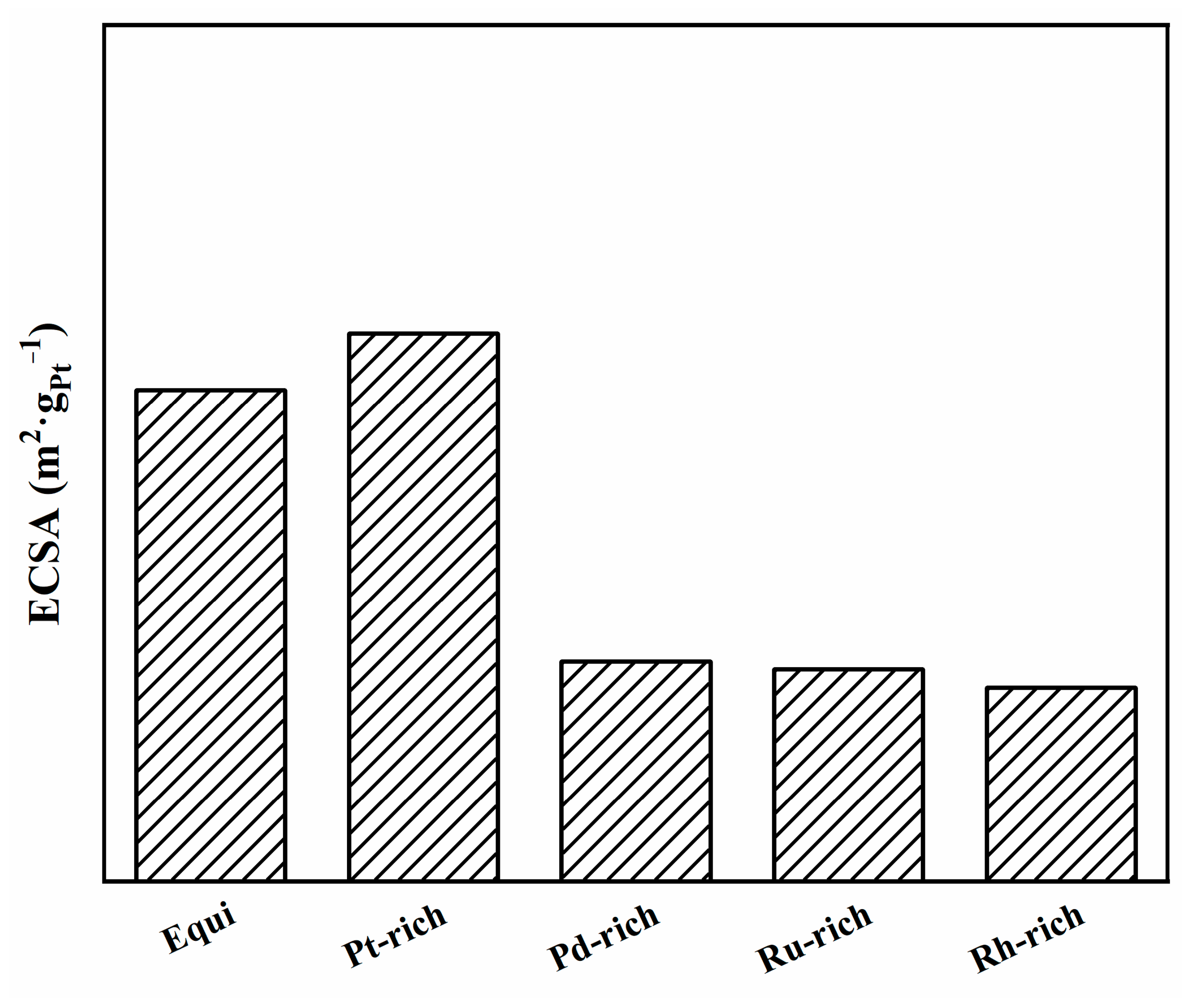
Electrochemical active surface area (ECSA) is a key parameter for evaluating the performance of a catalyst, directly influencing its activity and reaction efficiency. A larger ECSA indicates that the catalyst can provide more active sites, thereby helping to increase the reaction rate and improve the catalytic effect. The intrinsic catalytic capability of the carbon-supported PtPdRhRu quaternary alloy catalysts was initially benchmarked by determining their ECSA via cyclic voltammetry (CV) in a nitrogen-saturated 1.0 M KOH electrolyte (Figure S3). The CV curves profiles exhibit the characteristic hydrogen underpotential deposition (Hupd) regions associated with platinum-group metals. By integrating the (Hupd) desorption charge, the ECSA values were calculated to evaluate surface site accessibility. The ECSA calculation results are shown in Figure 3 and Table 3.
From the data of Figure 3 and Table 3, it can be seen that the ECSA values of the PtPdRhRu/C (Equi), PtPdRhRu/C (Pt-rich), PtPdRhRu/C (Pd-rich), PtPdRhRu/C (Rh-rich), and PtPdRhRu/C (Ru-rich) catalysts are 48.72 m2·gPt−1, 54.38 m2·gPt−1, 21.76 m2·gPt−1, 19.15 m2·gPt−1, and 21.02 m2·gPt−1, respectively. Among them, PtPdRhRu/C (Pt-rich) has the highest ECSA value, followed by the PtPdRhRu/C (Equi) catalyst, while the ECSA value of PtPdRhRu/C (Rh-rich) catalyst is the smallest. The ECSA values of the other two catalysts are similar, indicating that the Pt-rich and equi-proportional catalysts can provide more active sites in the electrocatalytic reaction.
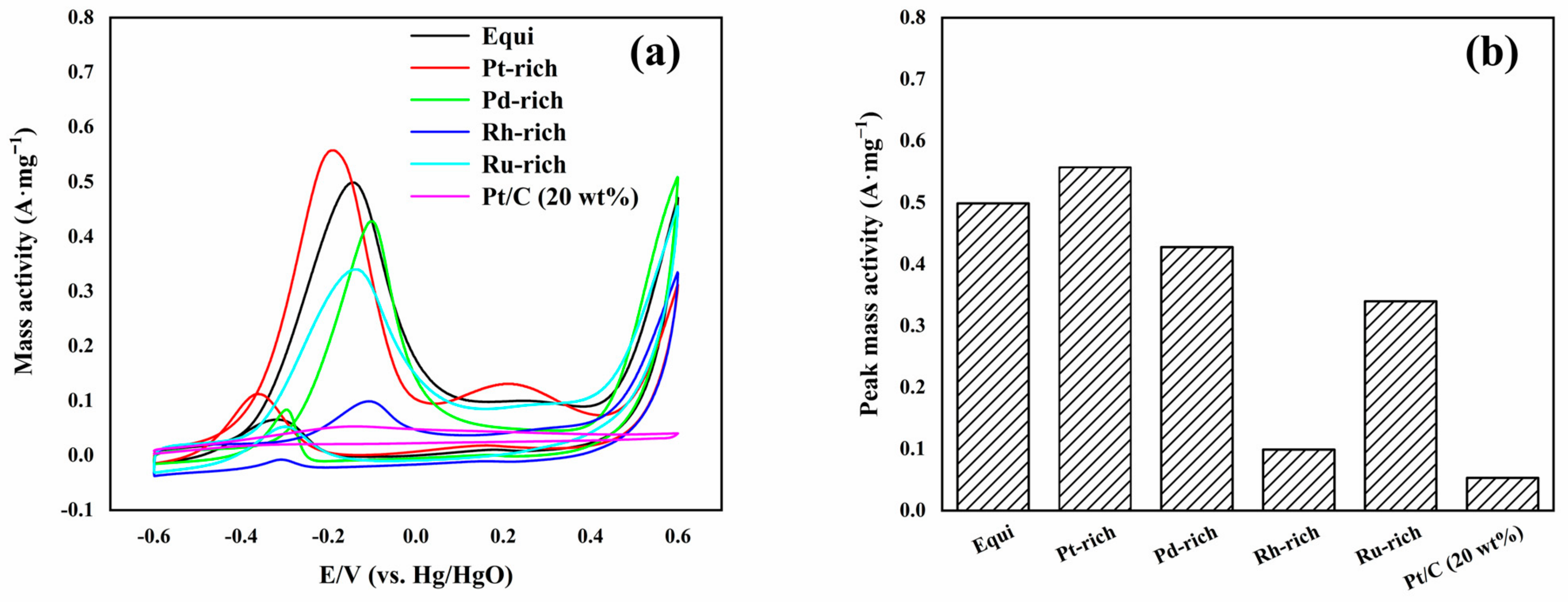
In order to evaluate the catalytic performance of PtPdRhRu/C quaternary alloy nano-catalysts with different metal ratios in glycerol oxidation, CV tests were conducted at a scanning rate of 50 mV·s−1 in a 1.0 M KOH and 1.0 M glycerol mixed solution. The results are shown in Figure 4. From the CV curves of the catalyst for glycerol oxidation in Figure 4a, it can be observed that all catalysts with different metal ratios display the characteristic dual-peak, which corresponds to the typical characteristic peaks of alcohol oxidation. This indicates that as the oxidation reaction proceeds, the C-C bonds in the glycerol molecule structure break, the -OH group is oxidized, and various intermediates and high-value-added products are generated. From the data of Figure 4b and Table 3, it can be seen that the order of catalytic oxidation ability of glycerol by different catalysts is as follows: PtPdRhRu/C (Pt-rich) > PtPdRhRu/C (Equi) > PtPdRhRu/C (Pd-rich) > PtPdRhRu/C (Ru-rich) > PtPdRhRu/C (Rh-rich) > Pt/C (20 wt%), which is consistent with the order of ECSA values obtained previously. It is worth noting that the morphologies of several catalysts (Pt-rich, Pd-rich, Rh-rich and Ru-rich) are all tetrahedral shape and their particle sizes are similar, but their catalytic performances are different. The catalytic ability of the Pt-rich catalyst is best, while that of the Rh-rich catalyst is the lowest. This indicates that in the catalyst system prepared in this paper, the composition of the catalyst has a much greater impact on the catalytic performance than the shape and particle size.
It can also be seen from Figure 4 and Table 3 that the catalytic ability of the prepared catalysts towards glycerol is all higher than that of the commercial Pt/C (20 wt%) catalyst, indicating that the electrocatalytic performance of the quaternary alloy catalysts composed of different metal atoms has been significantly improved. Among them, the PtPdRhRu/C (Pt-rich) catalyst shows outstanding catalytic activity, with a mass activity reaching 0.56 A·mg−1, which is 10.5 times higher than that of the commercial Pt/C (20 wt%) catalyst; the mass activity of the PtPdRhRu/C (Equi) catalyst is 0.5 A·mg−1, which is 9.4 times that of the commercial Pt/C (20 wt%) catalyst. The mass activity of the Pd-rich and Ru-rich catalysts is 8.1 and 6.4 times higher than that of commercial Pt/C (20 wt%) catalyst, respectively. The mass activity of the Rh-rich catalyst is the lowest, yet it is still higher than that of the commercial Pt/C (20 wt%) catalyst (1.9 times), underscoring the profound synergistic effect of the four-component alloy system. These results indicate that the metal ratio in the catalyst has a significant impact on its electrocatalytic performance, and the related achievements can provide an important theoretical basis for further optimizing the design and application of multi-component alloy catalysts.
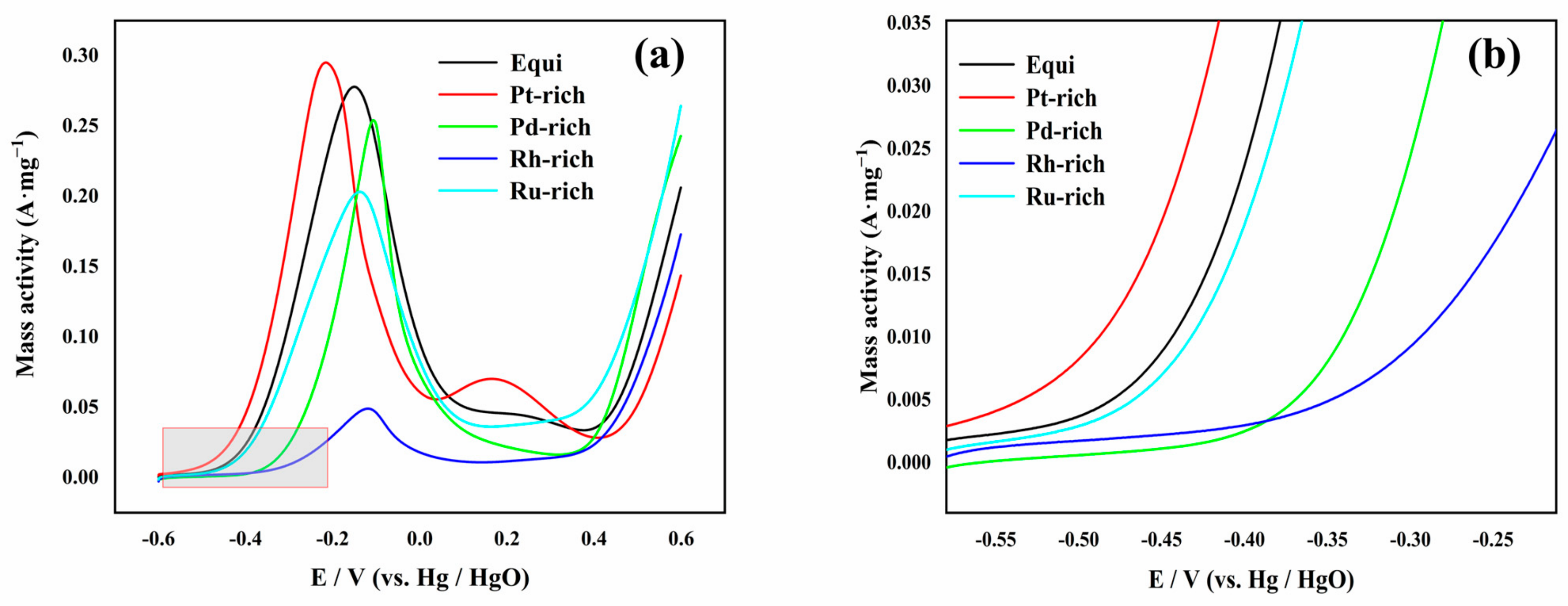
In redox reactions, the lower the initial potential of the catalyst, the stronger its ability to initiate the reaction, that is, it has higher catalytic activity. To determine the onset potential (Eonset) of glycerol oxidation for the PtPdRhRu/C catalysts with different metal ratios, linear sweep voltammetry (LSV) tests were conducted on the modified electrodes prepared in a mixed solution of 1.0 M KOH and 1.0 M glycerol at a scan rate of 10 mV·s−1. Figure 5 shows the partial LSV plots of the electro-oxidation of glycerol by the PtPdRhRu/C catalysts with different metal ratios. Through the analysis of the LSV test results (Figure 5 and Table 3), it was found that the order of the onset potential for the oxidation of glycerol by the catalysts is: PtPdRhRu/C (Pt-rich) < PtPdRhRu/C (Equi) < PtPdRhRu/C (Pd-rich) < PtPdRhRu/C (Ru-rich) < PtPdRhRu/C (Rh-rich). The Eonset analysis reveals that the Pt-rich, Pd-rich and Equi catalysts possess the lowest thermodynamic barriers for glycerol oxidation reaction initiation, which inversely correlates with their superior mass activities. It is consistent with theoretical expectations. The results obtained from the above experiments indicate that the PtPdRhRu/C (Pt-rich), PtPdRhRu/C (Equi), and PtPdRhRu/C (Pd-rich) catalysts have relatively high mass activity and low initial potential, suggesting that the electrochemical performance of the catalyst can be effectively improved by regulating the composition and proportion of the multi-component alloy catalyst.
This enhancement in both thermodynamic (Eonset) and kinetic (mass activity) parameters can be tentatively attributed to the bifunctional mechanism and electronic modulation inherent in the quaternary system. The lower onset potential observed for the PtPdRhRu/C (Pt-rich) suggests a potential bifunctional mechanism. According to previous studies on Pt-Ru/Rh binary systems [59,60], the oxophilic nature of Ru and Rh facilitates the formation of OHads at lower potentials, which helps to oxidatively remove poisonous intermediates (like COads) from the Pt sites [59,60,61,62,63]. Although direct in situ spectroscopic evidence is not included in this study, the electrochemical trends are consistent with this well-established synergistic effect.

2.3. Selectivity and Product Distribution Analysis

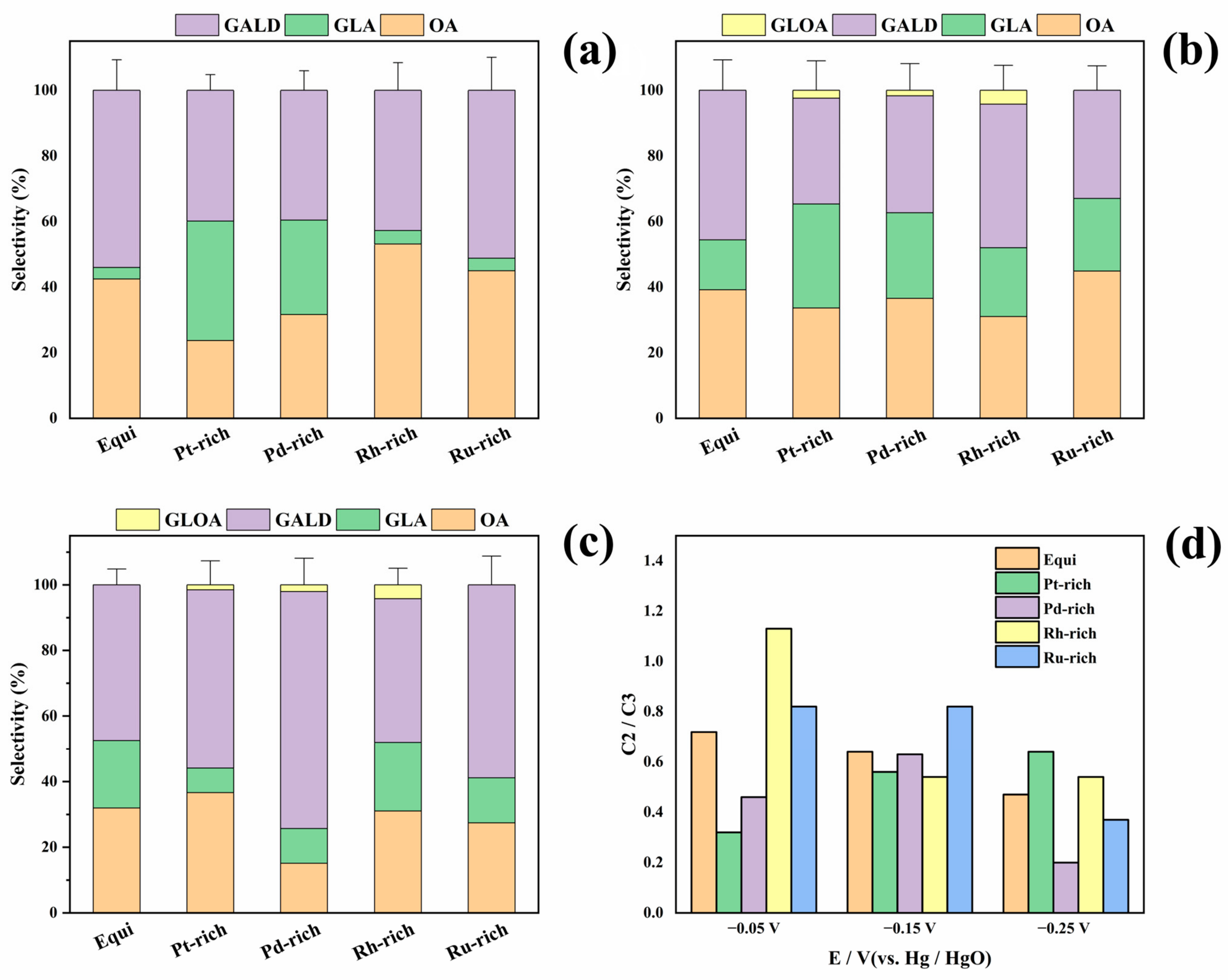
The selectivity of catalyst for conversion of glycerol to high-value-added products is of great significance in addressing the problem of excessive crude glycerol from biodiesel production. Therefore, the product distribution of the glycerol oxidation reaction (GEOR) was systematically investigated across the PtPdRhRu/C series using i-t over a 2 h period in a 1.0 M KOH and 1.0 M glycerol electrolyte. In the experiment, the as-prepared catalysts with different metal ratios, supported by the modified carbon paper electrodes, were used as the working electrode. Aliquots collected after bulk electrolysis at constant potentials of −0.05 V, −0.15 V, and −0.25 V (vs. Hg/HgO) were analyzed via High-Performance Liquid Chromatography (HPLC) to elucidate the influence of metallic composition on reaction pathways. During the entire test, N2 gas was continuously introduced. The analysis results are shown in Figure 6 and Tables S1–S3.
The results in Figure 6 and Tables S1–S3 indicate that the catalysts with different metal ratios exhibited significant differences in their ability to promote the conversion of high-value products from glycerol. As illustrated in Figure 6a, at a fixed potential of −0.05 V, the primary oxidation products identified across all catalysts were glyceraldehyde (GALD), glyceric acid (GLA), and oxalic acid (OA). The PtPdRhRu/C (Equi) and PtPdRhRu/C (Ru-rich) catalysts exhibited a pronounced preference for GALD formation, with selectivity exceeding 50%. Conversely, the PtPdRhRu/C (Pt-rich) and PtPdRhRu/C (Pd-rich) catalysts promoted the sequential oxidation of glycerol toward GLA, while the PtPdRhRu/C (Rh-rich) surface displayed a distinctive propensity for C-C bond cleavage, yielding significant amounts of OA. Upon shifting the potential to −0.15 V (Figure 6b), glyoxylic acid (GLOA) emerged as a fourth product alongside GALD, GLA, and OA. Notably, the selectivity toward GLA for the PtPdRhRu/C (Rh-rich), PtPdRhRu/C (Equi) and PtPdRhRu/C (Ru-rich) catalysts increased by a factor of 3 to 4 times compared to that at −0.05 V, suggesting that the lower potential facilitates the further dehydrogenation of GALD’s aldehyde group into a carboxyl group. At this intermediate potential, GLOA was exclusively detected on the PtPdRhRu/C (Pt-rich), PtPdRhRu/C (Pd-rich) and PtPdRhRu/C (Rh-rich) catalysts surfaces, indicating that the presence of Pt, Pd, and Rh is essential for triggering C-C bond scission and the deep oxidation of -OH groups. At the lowest tested potential of −0.25 V (Figure 6c), the product profiles remained qualitatively similar to those at −0.15 V, including GLOA, GALD, GLA and OA. Notably, the PtPdRhRu/C (Pd-rich) catalyst pointed to a remarkable selectivity of 72% for GALD, the highest among all tested samples, identifying it as a superior candidate for applications targeting partial oxidation to GALD. Similar to the trends observed at higher potentials, deep oxidation to GLOA was only achievable on catalysts containing Pt, Pd, and Rh. The enhanced stability of the quaternary alloy could be related to the high-entropy effect and lattice distortion [49,57]. The complex atomic arrangement in the PtPdRhRu system may create a unique surface environment that prevents the continuous accumulation of carbonaceous species. Furthermore, the strong intermetallic bonding in quaternary alloys is reported to suppress the dissolution of transition metals (metal leaching) compared to binary or ternary counterparts [49,57]. From Figure S4, it can be seen that all the catalysts prepared in this work exhibit acceptable short-term operational stability. After the reaction lasts for more than one hour, the mass activity of all the catalysts remains stable at a certain value without further persistent decline. It should be noted that the 2 h chronoamperometric measurement provides valuable but preliminary insights into the short-term operational stability of the quaternary catalysts. Because post-reaction structural characterization (e.g., post-TEM) and metal-leaching analyses are not available in the current study, these results should not be extrapolated to long-term practical durability or long-term resistance to structural degradation. Further evaluations extending over longer timescales are required to fully assess their industrial viability.
Nevertheless, the observed variation in short-term stability trends suggests that the specific metallic ratios within the quaternary lattice may offer a tunable platform to manipulate the adsorption behaviors of glycerol intermediates. This compositional tuning is expected to play a role in steering the reaction pathways toward desired value-added products, though the definitive coupling between surface geometry and stability warrants future comprehensive investigation.

3. Discussion

It should be noted that while the calculated selectivities and the corresponding error bars represent the instrumental precision of replicate HPLC injections rather than multi-batch electrochemical variance, the composition-dependent product distributions still provide a distinct qualitative trend. A comprehensive analysis of glycerol oxidation products across varying potentials reveals that the selectivity of the PtPdRhRu/C catalysts is synergistically dictated by both the metallic stoichiometry and the applied electrode potential. For the PtPdRhRu/C (Equi) catalyst, GALD and OA constitute the primary products, though GLA yields progressively increase as the potential shifts more negatively. Notably, at −0.25 V, the PtPdRhRu/C (Pd-rich) and PtPdRhRu/C (Ru-rich) catalysts exhibit a marked increase in GALD selectivity, with the Pd-rich catalyst achieving a peak selectivity of 72%, identifying it as a highly efficient platform for partial oxidation. Conversely, at −0.05 V, the PtPdRhRu/C (Pd-rich) catalyst is consistent with a superior propensity for GLA formation (36% selectivity), while the PtPdRhRu/C (Rh-rich) catalyst yields an impressive 53% selectivity for OA, highlighting its potent capacity for deep oxidation even at low potentials. From the above results, it can be seen that the PtPdRhRu/C catalysts with different metal ratios have diverse product selectivities in the catalytic oxidation of glycerol. The selectivity of converting high-value-added products from glycerol oxidation is not only related to the composition and metal ratio of the catalyst, but also closely related to the potential of the glycerol oxidation reaction. This indicates that when constructing a glycerol catalytic oxidation catalyst, various influencing factors should be taken into consideration [59,60,61,62].
Catalyst selectivity for high-value-added products in glycerol oxidation varies significantly across different systems. This paper summarizes several published catalyst systems and their respective product selectivities. As shown in Table S4, there are notable differences in selectivity among various catalyst systems. Notably, the quaternary catalyst system developed in this study achieves a selectivity of up to 72% for GALD and 53% for OA. The catalyst prepared in this work points to excellent selectivity for glycerol catalytic oxidation products.
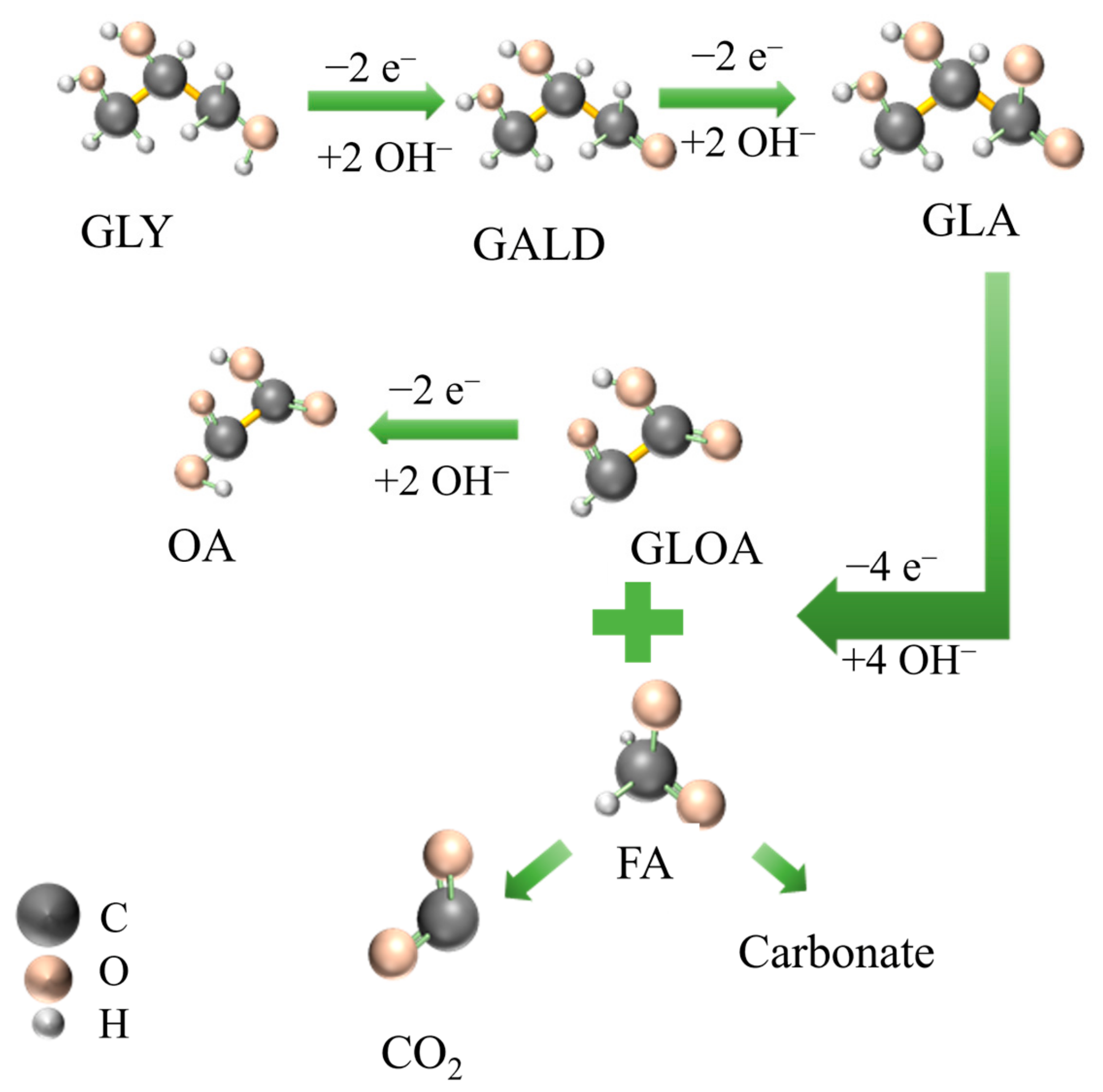
Based on the carbon content of the glycerol electro-oxidation products, these products can be classified into C2 compounds (OA and GLOA) and C3 compounds (GLA and GALD). The competitive pathways between C3 preservation and C2 scission offer critical insights into the site-specific functions of the alloying elements. From Figure 6d and Table S5, the C2/C3 molar ratios vary distinctly across the series. The results show that as the fixed potential decreases, the ratios of C2/C3 products in glycerol conversion under the action of PtPdRhRu/C (Equi) catalyst shows a downward trend, while for PtPdRhRu/C (Pt-rich) catalyst, the ratios of C2/C3 products increases when the reaction potential decreases. The PtPdRhRu/C (Pt-rich) and PtPdRhRu/C (Pd-rich) catalysts predominantly yield C3 products (C2/C3 < 0.7), with the Pd-rich catalyst reaching a minimum ratio of 0.20 at −0.25 V, suggesting that Pd sites effectively stabilize the C3 backbone. In stark contrast, the Rh-rich catalyst achieves a C2/C3 ratio of 1.13 at −0.05 V, and the Ru-rich catalyst consistently maintains a high ratio of 0.82. These observations suggest that Rh and Ru dopants may facilitate pathways associated with C-C bond cleavage, although direct kinetic or in situ spectroscopic evidence is not available. It should be emphasized that the mechanistic discussion presented below is primarily based on the distribution of detected liquid-phase products and previously reported reaction pathways. Direct experimental evidence for some elementary steps (e.g., C-C bond scission or complete mineralization) is not available in this study. The observed enhancement in GEOR performance can be tentatively attributed to the combined effects of electronic modulation and the bifunctional mechanism [63]. The lattice contraction identified by XRD analysis suggests a potential downward shift of the d-band center, which is expected to decrease the binding energy of intermediates. Furthermore, the oxophilic nature of Rh and Ru facilitates the formation of OHads species at lower potentials, promoting the oxidative removal of carbonaceous residues [63]. While in situ spectroscopic evidence is not available in this study, the clear correlation between lattice strain and electrochemical performance is consistent with established catalytic models [59,60]. Based on these findings, a comprehensive reaction mechanism for glycerol electro-oxidation on the PtPdRhRu/C quaternary system is proposed in Figure 7. Overall, the proposed mechanism should be regarded as a qualitative interpretation rather than a fully validated reaction network.
In the glycerol oxidation reaction under alkaline conditions, the glycerol molecule first loses a proton, forming a glycerol anion. The glycerol anion is adsorbed on the surface of the metal catalyst through the oxygen atom. Among the adsorbed glycerol anions, the C-H bonds on the carbon atom connected to the target hydroxyl group are cooperatively activated and break, generating H which is adsorbed on the surface of the metal catalyst to form a metal hydride (M-H). After glycerol loses H, the corresponding hydroxyl group is oxidized to form an unstable aldehyde group (if the primary hydroxyl group is oxidized, GALD) or a ketone group (if the secondary hydroxyl group is oxidized) [61]. In this experiment, under alkaline conditions, glyceraldehyde reacts with hydroxide ions (OH) on the surface of the catalyst. Glyceraldehyde loses electrons and is oxidized, eventually forming glycerate ion (GLA), indicating that the primary hydroxyl group is oxidized. The carbon–carbon bonds (C-C) in glyceric acid molecules break under the action of strong oxidants or specific catalysts. The C2 fragment containing carboxyl group (-COOH) and hydroxyl group (-OH) was oxidized, eventually generating glyoxylic acid (OHC-COOH). The detached C1 fragment (which is usually the terminal hydroxymethyl -CH2OH that breaks off after being gradually oxidized) will be further oxidized to carbon dioxide (CO2) and water. When further deep oxidation occurs, a C-C bond cleavage reaction takes place, generating C2 and C1 fragments [61,62]. Notably, the absence of gaseous product quantification limits the ability to indicate complete oxidation pathways such as CO2 formation.
In this experiment, GLA loses 4e to oxidize to GLOA and formic acid (FA). Due to the instability of GLOA, it easily loses 2e to produce OA. On the other hand, since FA is easily dehydrating or further oxidizing, it was not detected in this experiment. If the deep oxidation reaction is carried out through a decarboxylation reaction, CO2 and smaller hydrocarbon fragments will be generated. CO2 and FA are proposed as the final mineralization products based on the C-C cleavage pathway, although not quantified in this study. By precisely modulating the quaternary atomic ratios and operating potentials, the PtPdRhRu platform enables fine-tuned control over the C2/C3 ratio and the diversity of high-value chemical production, offering a strategic route for optimized glycerol valorization. Importantly, it should be noted that the proposed mechanism serves as a tentative, qualitative interpretation based primarily on the detected liquid-phase product distributions and electrochemical trends. Due to the absence of in situ/operando spectroscopy and theoretical calculations in the present study, a definitive validation of the transient intermediates and precise C-C cleavage pathways remains a challenge. Future investigations utilizing advanced operando techniques will be highly necessary to fully resolve the comprehensive reaction network.

4. Materials and Methods

4.1. Reagents and Materials

Potassium hexachloroplatinate (K2PtCl6, 98%), potassium tetrachloropalladate (K2PdCl4, 99.95%), rhodium (III) chloride hydrate (RhCl3·nH2O, 90%), ruthenium (III) chloride hydrate (RuCl3·nH2O, 90%), glyceraldehyde (C3H6O3, 90%), isopropanol (C3H8O, 95%), and triethylene glycol (C6H14O4, AR) were purchased from Sigma-Aldrich Corporation (St. Louis, MO, USA). Glyceric acid (≥95.0%), tartronic acid (97%), glycolic acid (99.0%), formic acid (≥95%), oxalic acid (98%), dihydroxyacetone (97%), lactic acid (85%), glyoxylic acid (98%), and commercial Pt/C (20 wt%, E-TEK) were obtained from Shanghai Macklin Biochemical Technology Co., Ltd. (Shanghai, China). All other chemicals were of analytical grade and used as received without further purification.

4.2. Preparation of PtPdRhRu/C Quaternary Alloy Nanocatalysts

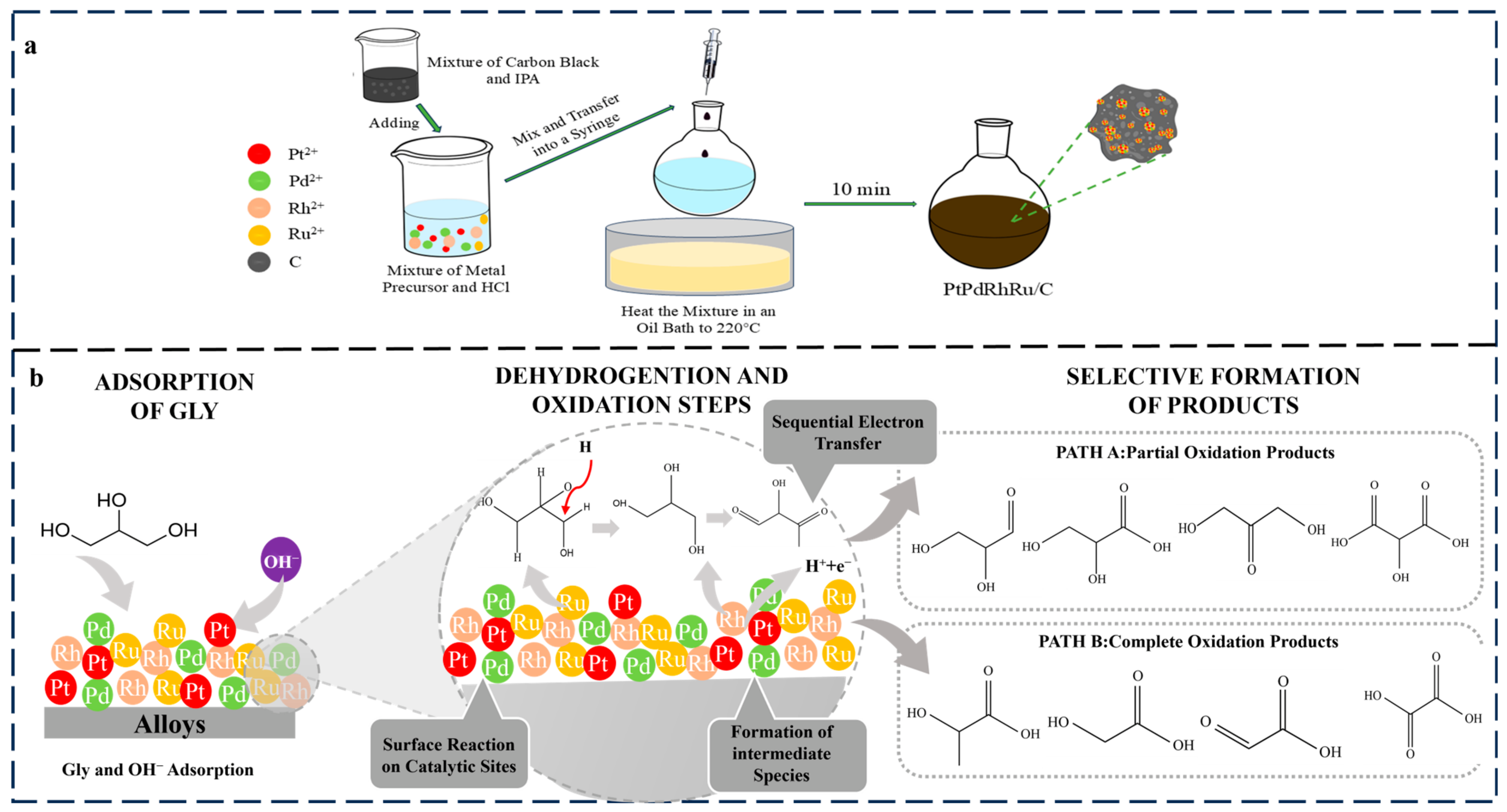
Carbon-supported PtPdRhRu quaternary alloy catalysts with tailored metal ratios were synthesized via a modified one-pot polyol reduction method. The preparation process is shown in Figure 8. In a typical procedure, according to the molar ratios of 1:1:1:1, 5:1:1:1, 1:5:1:1, 1:1:5:1 and 1:1:1:5, respectively, the metal precursors (K2PtCl6, K2PdCl4, RhCl3·nH2O and RuCl3·nH2O) powders were added into 15 mL of 0.1 M hydrochloric acid solution. The mixture was stirred magnetically for 30 min to ensure the formation of a homogeneous precursor complex solution. Simultaneously, 192 mg of carbon black (Vulcan XC-72R) was dispersed in 5 mL of isopropanol, and subsequently added to the metal precursor mixture solution. The resulting mixture was ultrasonicated for 30 min to yield a stable, uniform black suspension. To initiate the reduction, this suspension was introduced dropwise into 150 mL of anhydrous triethylene glycol (TEG) thermal treatment at 220 °C. The reaction was maintained at this temperature for 10 min under an inert atmosphere. Here, TEG served as both a high-boiling-point solvent and a reducing agent, facilitating the rapid nucleation and uniform dispersion of the quaternary alloy nanoparticles onto the carbon support. After the reaction, the solution was naturally cooled to room temperature to obtain a black solution. An ether and acetone mixture was added to the black solution, and the product was separated by high-speed centrifugation (10,000 rpm). The remaining solvents and impurities were removed by multiple washes and centrifugations using a mixture of acetone, ether, water and ethanol. Finally, the catalysts were dried in a vacuum oven at 60 °C overnight and finely pulverized. The resulting quaternary catalysts were designated as Equi, Pt-rich, Pd-rich, Rh-rich, and Ru-rich based on their respective initial molar feeding ratios.

4.3. Characterization

The morphology and microstructure of the synthesized catalysts in this work were characterized using scanning electron microscopy (SEM, Zeiss Merlin, Germany). The crystalline structures and phase compositions were determined by X-ray diffraction (XRD) on a PANalytical X’pert Powder diffractometer (Almelo, Netherlands) with Cu-Kα radiation (λ = 1.5418 Å) in the range of 10–80° with a scan step of 12° min−1. The precise bulk elemental compositions of the quaternary alloy catalysts were quantified via inductively coupled plasma optical emission spectroscopy (ICP-OES, PerkinElmer Optima 8300, Waltham, MA, USA). Electrochemical measurements were conducted using a CHI 660E electrochemical workstation (Shanghai Chenhua Instrument Co., Ltd., Shanghai, China). The analysis of glycerol high-value-added conversion products and the determination of reaction selectivity were performed on a high-performance liquid chromatography (HPLC) system (Agilent 1260 Infinity II, Agilent Technologies, Santa Clara, CA, USA).

4.4. Electrochemical Measurements

The electrochemical performance of the PtPdRhRu/C quaternary alloy catalysts was evaluated using cyclic voltammetry (CV) and linear sweep voltammetry (LSV) in a standard three-electrode cell configuration. A modified glassy carbon electrode (GCE, 3 mm in diameter) served as the working electrode (WE), while a Hg/HgO electrode and a Pt foil (1 × 1 cm2) were employed as the reference (RE) and counter (CE) electrodes, respectively. To prepare the working electrode, 2.5 mg of the catalyst powder was dispersed in a 1 mL mixture of isopropanol, deionized water, and Nafion (25:25:1, v/v/v) and ultrasonicated for 30 min to obtain a homogeneous catalyst ink. Subsequently, 5 μL of this ink was drop-casted onto the pre-polished GCE surface and dried under vacuum at room temperature. The GEOR performance was characterized in an electrolyte containing 1.0 M KOH and 1.0 M glycerol (10 mL). CV and LSV curves were recorded at scan rates of 50 mV·s−1 and 10 mV·s−1, respectively. Throughout the measurements, the electrolyte was continuously purged with high-purity N2 to eliminate dissolved oxygen and minimize interference from oxygen reduction reactions. To ensure data reliability, the electrochemical voltammetric curves were recorded from triplicate independent tests.

4.5. Glycerol Oxidation Products Analysis via HPLC

The identification and quantification of glycerol oxidation products were performed using HPLC method to elucidate selectivity of glycerol conversion under the PtPdRhRu/C quaternary alloy catalysts with varying metal ratios. The analysis of glycerol oxidation products was conducted in a customized H-type double-cell electrolytic cell using chronoamperometry (i-t) method. A graphite rod and an Hg/HgO electrode were utilized as the counter and reference electrodes, respectively. The working electrode was prepared by uniformly coating a 1 × 2 cm2 carbon paper substrate with 10 μL of the catalyst ink (prepared as described in Section 4.4), followed by vacuum drying at room temperature. Throughout the i-t measurements, high-purity N2 was continuously bubbled to deaerate the solution and eliminate interference from dissolved oxygen. After the i-t test for 2 h, 1 mL of sample solution was extracted from the reaction system, and a small amount of sulfuric acid was added to adjust the pH value. The analysis was carried out using an Aminex HPX-87H chromatographic column (Bio-Rad, Hercules, CA, USA), with 5 mM sulfuric acid solution as the mobile phase. The sample was filtered through a 0.22 μm membrane before injection, and the column temperature was controlled at 60 °C. The run time was 20 min at a flow rate of 0.5 mL·min−1. In the experiment, the external standard method was used to calculate the concentration of glycerol oxidation products. To establish analytical precision, each collected solution was evaluated via triplicate HPLC injections, and the corresponding error bars represent the instrumental standard deviation.

5. Conclusions

In this work, a series of carbon-supported PtPdRhRu quaternary alloy nanocatalysts with precisely modulated atomic ratios (Equi, Pt-rich, Pd-rich, Rh-rich and Ru-rich) via a robust and efficient one-pot polyol method. Advanced structural characterization—including STEM-DF, HAADF-STEM mapping, and XRD—XRD results imply that the as-prepared catalysts are single-phase face-centered cubic (fcc) solid solutions. Through STEM DF characterization, it can be seen that the as-prepared PtPdRhRu quaternary alloy nanomaterials are uniform in size, and the nanoparticles are uniformly distributed on the carbon black support without agglomeration. This effectively circumvents the common challenges of phase segregation and metallic agglomeration inherent in multi-component systems.
The electrochemical performance of the PtPdRhRu/C quaternary alloy nanocatalysts with different metal ratios catalysts toward the glycerol electro-oxidation reaction in alkaline media points to a profound synergistic effect. All quaternary compositions significantly surpassed the catalytic benchmarks of commercial Pt/C (20 wt%). Most notably, the mass activities of the prepared PtPdRhRu/C (Pt-rich), PtPdRhRu/C (Equi), PtPdRhRu/C (Pd-rich), PtPdRhRu/C (Ru-rich) and PtPdRhRu/C (Rh-rich) catalysts for glycerol oxidation are 10.5 times, 9.4 times, 8.1 times, 6.4 times and 1.9 times higher than that of commercial Pt/C (20 wt%), respectively. It indicates that the quaternary alloy catalysts have better catalytic activity than the unit metal catalysts. This performance enhancement is attributed to the optimized electronic environment and the bifunctional mechanism facilitated by the quaternary surface.
Analysis of the glycerol oxidation reaction products by HPLC reveal that under the action of the prepared PtPdRhRu/C series catalysts, the main oxidation products of glycerol included GALD, GLA, GLOA and OA, and the selectivity of each catalyst for these products varied depending on the metallic stoichiometry and reaction conditions. The selectivity of the PtPdRhRu/C (Pd-rich) catalyst for GALD reached 72% at −0.25 V. The PtPdRhRu/C (Pt-rich) catalyst had a higher selectivity for GLA at −0.05 V than other catalysts, reaching 36%, and the PtPdRhRu/C (Rh-rich) catalyst had a selectivity of up to 53% for the product OA at −0.05 V. For the PtPdRhRu/C quaternary alloy nanocatalysts, the integration of Rh and Ru effectively lowers the barrier for oxidative C-C bond scission, favoring the production of C2 species such as oxalic acid. Conversely, the synergistic interplay between Pt and Pd is identified as the primary driver for the carbonylation of hydroxyl groups, directing the selectivity toward C3 intermediates like glyceraldehyde and glyceric acid. From the above results, it can be seen that PtPdRhRu/C catalysts with different metal ratios have diverse product selectivities in the glycerol catalytic oxidation reaction. The selectivity of high-value products in glycerol oxidation is not only related to the metallic stoichiometry of the catalyst, but also closely related to the potential of the glycerol oxidation reaction. This indicates that multiple influencing factors should be considered when constructing glycerol catalytic oxidation catalysts. Ultimately, this work establishes the PtPdRhRu quaternary system as a highly versatile and tunable platform for the selective valorization of biomass-derived polyols, providing a strategic blueprint for the design of multi-metallic electrocatalysts for complex organic transformations.

Supplementary Materials

The following supporting information can be downloaded at: https://www.mdpi.com/article/10.3390/inorganics14070175/s1, Figure S1: STEM DF images of catalysts: (a) PtPdRhRu/C (Equi), (b) PtPdRhRu/C (Pt-rich), (c) PtPdRhRu/C (Pd-rich), (d) PtPdRhRu/C (Rh-rich) and (e) PtPdRhRu/C (Ru-rich); Figure S2: HAADF-Line scan of catalysts: (a) PtPdRhRu/C (Equi), (b) PtPdRhRu/C (Pt-rich), (c) PtPdRhRu/C (Pd-rich), (d) PtPdRhRu/C (Rh-rich), (e) PtPdRhRu/C (Ru-rich); Figure S3: CV patterns of the PtPdRhRu/C with different metal ratios in 1.0 M KOH with a scanning rate of 50 mV s−1: (a) PtPdRhRu/C (Equi), (b) PtPdRhRu/C (Pt-rich), (c) PtPdRhRu/C (Pd-rich), (d) PtPdRhRu/C (Rh-rich), (e) PtPdRhRu/C (Ru-rich); Figure S4: i-t curves of the PtPdRhRu/C with varying metal ratios in a solution of 1.0 M KOH + 1.0 M GLY under different potentials. (a) at −0.05 V, (b) at −0.15 V, and (c) at −0.25 V; Table S1: Product concentrations of catalysts with different metal ratios at −0.05 V (mg·L−1); Table S2: Product concentrations of catalysts with different metal ratios at −0.15 V (mg·L−1); Table S3: Product concentrations of catalysts with different metal ratios at −0.25 V (mg·L−1); Table S4: Comparisons of different electrocatalysts for the GLY oxidation toward value-added products [64,65,66,67,68,69,70,71,72,73,74,75,76]; Table S5: The C2/C3 ratio of the catalysts at different fixed potential.

Author Contributions

Conceptualization, J.P.; Methodology, D.C., S.Q. and Y.R.; Investigation, D.C., S.Q. and J.P.; Formal analysis, D.C., J.P., S.Q. and Y.R.; Data curation, D.C., J.P., S.Q. and Y.R.; Visualization, D.C. and Y.R.; Writing—original draft, D.C.; Supervision, J.P.; Project administration, J.P. and Y.R.; Funding acquisition, J.P.; Resources, D.C., J.P. and Y.R.; Writing—review & editing, D.C., J.P., S.Q. and Y.R. All authors have read and agreed to the published version of the manuscript.

Funding

The authors acknowledge financial support from the National Natural Science Foundation of China (Grant Nos. 22278152, 22478131) and the Natural Science Foundation of Heilongjiang Province (No. PL2025B021).

Institutional Review Board Statement

Not applicable.

Informed Consent Statement

Not applicable.

Data Availability Statement

The original contributions presented in this study are included in the article and Supplementary Materials. Further inquiries can be directed to the corresponding authors.

Conflicts of Interest

The authors declare no conflicts of interest.

Abbreviations

The following abbreviations are used in this manuscript:
GALDGlyceraldehyde
GLAGlyceric acid
OAOxalic acid
GLOAGlyoxylic acid
FAFormic acid
TEGTriethylene glycol
CVCyclic voltammetry
LSVLinear sweep voltammetry
HPLCHigh-Performance Liquid Chromatography
XRDX-ray Diffraction
STEM-DFScanning Transmission Electron Microscopy
HAADF-STEMHigh-Angle Annular Dark-Field Scanning Transmission Electron Microscopy

References

  1. Yoo, M.; Chio, D.; Shin, M.; Jung, S.; Lee, J.; Kim, H. Selective electrocatalytic oxidation of glycerol to high-value C1–C3 products: From chemistry to scalability. Chem. Eng. J. 2025, 518, 164743. [Google Scholar]
  2. Badia-Fabregat, M.; Rago, L.; Baeza, J.A.; Guisasola, A. Hydrogen production from crude glycerol in an alkaline microbial electrolysis cell. Int. J. Hydrogen Energy 2019, 44, 17204–17213. [Google Scholar] [CrossRef]
  3. Pradima, J.; Kulkarni, M.R.; Archna. Review on enzymatic synthesis of value added products of glycerol, a by-product derived from biodiesel production. Resour.-Effic. Technol. 2017, 3, 394–405. [Google Scholar] [CrossRef]
  4. Yang, L.; Li, X.; Chen, P.; Hou, Z. Selective oxidation of glycerol in a base-free aqueous solution: A short review. Chin. J. Catal. 2019, 40, 1020–1034. [Google Scholar] [CrossRef]
  5. Qureshi, F.; Yusuf, M.; Pasha, A.A.; Khan, H.W.; Imteyaz, B.; Irshad, K. Sustainable and energy efficient hydrogen production via glycerol reforming techniques: A review. Int. J. Hydrogen Energy 2022, 47, 41397–41420. [Google Scholar] [CrossRef]
  6. Wu, D.Y.; Liu, S.; Nie, Y.X.; Sun, D.L.; Zhou, Y.Y.; Yang, S.; Xu, C.B.; Ma, T.Y.; Zhang, H. Electrocatalytic upgrading of glycerol into high-value products: Catalyst design, process engineering, and economic assessment. Chem. Eng. J. 2025, 518, 164511. [Google Scholar] [CrossRef]
  7. Li, J.; Jiang, K.; Bai, S.; Guan, C.; Wei, H.; Chu, H. High productivity of tartronate from electrocatalytic oxidation of high concentration glycerol through facilitating the intermediate conversion. App. Catal. B Environ. 2022, 317, 121784. [Google Scholar] [CrossRef]
  8. Kwon, Y.; Birdja, Y.; Spanos, I.; Rodriguez, P.; Koper, M.T.M. Highly Selective Electro-Oxidation of Glycerol to Dihydroxyacetone on Platinum in the Presence of Bismuth. ACS Catal. 2012, 2, 759−764. [Google Scholar] [CrossRef]
  9. Tavera Ruiz, C.P.; Dumeignil, F.; Capron, M. Catalytic production of glycolic acid from glycerol oxidation: An optimization using response surface methodology. Catalysts 2021, 11, 257. [Google Scholar] [CrossRef]
  10. Dhabhai, R.; Koranian, P.; Huang, Q.; Scheibelhoffer, D.S.B.; Dalai, A.K. Purification of glycerol and its conversion to value-added chemicals: A review. Sep. Sci. Technol. 2023, 58, 1383–1402. [Google Scholar] [CrossRef]
  11. Musiał, I.; Cibis, E.; Rymowicz, W. Designing a process of kaolin bleaching in an oxalic acid enriched medium by aspergillus niger cultivated on biodiesel-derived waste composed of glycerol and fatty acids. Appl. Clay Sci. 2011, 52, 277–284. [Google Scholar] [CrossRef]
  12. Koranian, P.; Huang, Q.; Dalai, A.K.; Sammynaiken, R. Chemicals production from glycerol through heterogeneous catalysis: A review. Catalysts 2022, 12, 897. [Google Scholar] [CrossRef]
  13. Katryniok, B.; Kimura, H.; Skrzynska, E.; Girardon, J.; Fongarland, P.; Capron, M.; Ducoulombier, R.; Mimura, N.; Paul, S.; Dumeignil, F. Selective catalytic oxidation of glycerol: Perspectives for high value chemicals. Green Chem. 2011, 13, 1960–1979. [Google Scholar] [CrossRef]
  14. Caglar, B.; Hassan, Y.E.; Basak, O.; Hepbasli, A. Electrooxidation of glycerol on monometallic and bimetallic catalysts-containing porous carbon cloth electrodes in an alkaline medium. J. Electrochem. Soc. 2021, 168, 084506. [Google Scholar] [CrossRef]
  15. Hernández, I.V.; Estévez, M.; Vergara-Castañeda, H.; Guerra-Balcázar, M.; Pool, H. Synthesis and application of biogenic gold nanomaterials with {1 0 0} facets for crude glycerol electro-oxidation. Fuel 2020, 279, 118505. [Google Scholar] [CrossRef]
  16. Ma, T.; Yin, M.; Su, C.; Guo, N.; Huang, X.; Han, Z.; Wang, Y.; Chen, G.; Yun, Z. Recent developments in the field of dehydration of bio-renewable glycerol to acrolein over molecular sieve catalysts. J. Ind. Eng. Chem. 2023, 117, 85–102. [Google Scholar]
  17. de Oliveira, A.S.; Vasconcelos, S.J.S.; de Sousa, J.R.; de Sousa, F.F.; Filho, J.M.; Oliveira, A.C. Catalytic conversion of glycerol to acrolein over modified molecular sieves: Activity and deactivation studies. Chem. Eng. J. 2011, 168, 765–774. [Google Scholar] [CrossRef]
  18. Dibenedetto, A.; Angelini, A.; Aresta, M.; Ethiraj, J.; Fragale, C.; Nocito, F. Converting wastes into added value products: From glycerol to glycerol carbonate, glycidol and epichlorohydrin using environmentally friendly synthetic routes. Tetrahedron 2011, 67, 1308–1313. [Google Scholar] [CrossRef]
  19. Zhou, C.H.; Zhao, H.; Tong, D.S.; Wu, L.M.; Yu, W.H. Recent advances in catalytic conversion of glycerol. Catal. Rev. Sci. Eng. 2013, 55, 369–453. [Google Scholar] [CrossRef]
  20. Fan, Y.; Cheng, S.; Wang, H.; Ye, D.; Xie, S.; Pei, Y.; Hu, H.; Hua, W.; Li, Z.H.; Qiao, M.; et al. Nanoparticulate Pt on mesoporous SBA-15 doped with extremely low amount of was a highly selective catalyst for glycerol hydrogenolysis to 1,3-propanediol. Green Chem. 2017, 19, 2174–2183. [Google Scholar]
  21. Checa, M.; Nogales-Delgado, S.; Montes, V.; Encinar, J.M. Recent advances in glycerol catalytic valorization: A review. Catalysts 2020, 10, 1279. [Google Scholar] [CrossRef]
  22. Zhou, Y.; Shen, Y.; Piao, J. Sustainable conversion of glycerol into value-added chemicals by selective electro-oxidation on pt-based catalysts. ChemElectroChem 2018, 5, 1636–1643. [Google Scholar]
  23. Ahmad, M.S.; Rahim, M.H.A.; Alqahtani, T.M.; Witoon, T.; Lim, J.; Cheng, C.K. A review on advances in green treatment of glycerol waste with a focus on electro-oxidation pathway. Chemosphere 2021, 276, 130128. [Google Scholar] [CrossRef] [PubMed]
  24. Coutanceau, C.; Baranton, S.; Kouame, R. Selective electrooxidation of glycerol into value-added chemicals: A short overview. Front. Chem. 2019, 7, 100. [Google Scholar] [CrossRef] [PubMed]
  25. Ning, X.; Yu, H.; Peng, F.; Wang, H. Pt nanoparticles interacting with graphitic nitrogen of N-doped carbon nanotubes: Effect of electronic properties on activity for aerobic oxidation of glycerol and electro-oxidation of CO. J. Catal. 2015, 325, 136–144. [Google Scholar]
  26. Melle, G.; de Souza, M.B.C.; Santiago, P.V.B.; Corradini, P.G.; Mascaro, L.H.; Fernández, P.S.; Sitta, E. Glycerol electro-oxidation at Pt in alkaline media: Influence of mass transport and cations. Electrochim. Acta 2021, 398, 139318. [Google Scholar] [CrossRef]
  27. Ishiyama, K.; Kosaka, F.; Shimada, I.; Oshima, Y.; Otomo, J. Glycerol electro-oxidation on a carbon-supported platinum catalyst at intermediate temperatures. J. Power Sources 2013, 225, 141–149. [Google Scholar] [CrossRef]
  28. Kwon, Y.; Schouten, K.J.P.; Koper, M.T.M. Mechanism of the catalytic oxidation of glycerol on polycrystalline gold and platinum electrodes. ChemCatChem 2011, 3, 1176–1185. [Google Scholar] [CrossRef]
  29. Gomes, J.F.; Garcia, A.C.; Gasparotto, L.H.S.; de Souza, N.E.; Ferreira, E.B.; Pires, C.; Tremiliosi-Filho, G. Influence of silver on the glycerol electro-oxidation over AuAg/C catalysts in alkaline medium: A cyclic voltammetry and in situ FTIR spectroscopy study. Electrochim. Acta 2014, 144, 361–368. [Google Scholar]
  30. Sandrini, R.M.L.M.; Sempionatto, J.R.; Tremiliosi-Filho, G.; Herrero, E.; Feliu, J.M.; Souza-Garcia, J.; Angelucci, C.A. Electrocatalytic oxidation of glycerol on platinum single crystals in alkaline media. ChemElectroChem 2019, 6, 4238–4245. [Google Scholar] [CrossRef]
  31. Simoes, M.; Baranton, S.; Coutanceau, C. Enhancement of catalytic properties for glycerol electrooxidation on Pt and Pd nanoparticles induced by Bi surface modification. Appl. Catal. B Environ. 2011, 110, 40–49. [Google Scholar] [CrossRef]
  32. Yang, F.; Ye, J.; Yuan, Q.; Yang, X.; Xie, Z.; Zhao, F.; Zhou, Z.; Gu, L.; Wang, X. Ultrasmall Pd-Cu-Pt trimetallic twin icosahedrons boost the electrocatalytic performance of glycerol oxidation at the operating temperature of fuel cells. Adv. Funct. Mater. 2020, 30, 1908235. [Google Scholar]
  33. Pembere, A.M.S.; Cui, C.; Wu, H.; Luo, Z. Small gold clusters catalyzing oxidant-free dehydrogenation of glycerol initiated by methene hydrogen atom transfer. Chin. Chem. Lett. 2019, 30, 1000–1004. [Google Scholar] [CrossRef]
  34. An, Z.; Zhang, Z.; Huang, Z.; Han, H.; Song, B.; Zhang, J.; Ping, Q.; Zhu, Y.; Song, H.; Wang, B.; et al. Pt1 enhanced C-H activation synergistic with Ptn catalysis for glycerol cascade oxidation to glyceric acid. Nat. Commun. 2022, 13, 5467. [Google Scholar] [CrossRef] [PubMed]
  35. Alkhawaldeh, A.K. Electrocatalytic activities of a platinum nanostructured electrode modified by gold adatom toward methanol and glycerol electrooxidation in acid and alkaline media. J. Oleo Sci. 2023, 72, 347–356. [Google Scholar] [CrossRef] [PubMed]
  36. Zhou, Y.; Shen, Y.; Luo, X.; Liu, G.; Cao, Y. Boosting activity and selectivity of glycerol oxidation over platinum–palladium–silver electrocatalysts via surface engineering. Nanoscale Adv. 2020, 2, 3423–3430. [Google Scholar] [PubMed]
  37. Kim, H.J.; Lee, J.; Green, S.K.; Huber, G.W.; Kim, W.B. Selective glycerol oxidation by electrocatalytic dehydrogenation. ChemSusChem 2014, 7, 1051–1056. [Google Scholar] [CrossRef] [PubMed]
  38. Hu, X.; Lu, J.; Liu, Y.; Chen, L.; Zhang, X.; Wang, H. Sustainable catalytic oxidation of glycerol: A review. Environ. Chem. Lett. 2023, 21, 2825–2861. [Google Scholar] [CrossRef]
  39. Anil, A.; White, J.; Santos, E.C.D.; Terekhina, I.; Johnsson, M.; Pettersson, L.G.M.; Cornell, A.; Salazar-Alvarez, G. Effect of pore mesostructure on the electrooxidation of glycerol on Pt mesoporous catalysts. J. Mater. Chem. A Mater. 2023, 11, 16570–16577. [Google Scholar] [CrossRef]
  40. Sever, B.; Yildiz, M. Conversion of glycerol to lactic acid over au/bentonite catalysts in alkaline solution. React. Kinet. Mech. Catal. 2020, 130, 863–874. [Google Scholar] [CrossRef]
  41. Arcanjo, M.R.A.; Silva, I.J.; Rodríguez-Castellón, E.; Infantes-Molina, A.; Vieira, R.S. Conversion of glycerol into lactic acid using Pd or Pt supported on carbon as catalyst. Catal. Today 2017, 279, 317–326. [Google Scholar] [CrossRef]
  42. Zhang, Z.; Xin, L.; Qi, J.; Wang, Z.; Li, W. Selective electro-conversion of glycerol to glycolate on carbon nanotube supported gold catalyst. Green Chem. 2012, 14, 2150–2152. [Google Scholar] [CrossRef]
  43. Moreira, T.F.M.; Kokoh, K.B.; Napporn, T.W.; Olivi, P.; Morais, C. Insights on the C2 and C3 electroconversion in alkaline medium on Rh/C catalyst: In situ FTIR spectroscopic and chromatographic studies. Electrochim. Acta 2022, 422, 140507. [Google Scholar] [CrossRef]
  44. Velázquez-Hernández, I.; Zamudio, E.; Rodríguez-Valadez, F.J.; García-Gómez, N.A.; Álvarez-Contreras, L.; Guerra-Balcázar, M.; Arjona, N. Electrochemical valorization of crude glycerol in alkaline medium for energy conversion using Pd, Au and PdAu nanomaterials. Fuel 2020, 262, 116556. [Google Scholar] [CrossRef]
  45. Yongprapat, S.; Therdthianwong, A.; Therdthianwong, S. The enhanced activity of AuAg/c nanonetwork catalysts for glycerol electrooxidation by small amounts of pd. J. Electroanal. Chem. 2019, 847, 113225. [Google Scholar]
  46. Zhong, Z.; Li, M.; Wang, J.; Lin, J.; Pan, J.; Jiang, S.; Xie, A.; Luo, S. Co-doped Ni–Fe spinels for electrocatalytic oxidation over glycerol. Int. J. Hydrogen Energy 2022, 47, 13933–13945. [Google Scholar]
  47. Liu, C.; Hirohara, M.; Maekawa, T.; Chang, R.; Hayashi, T.; Chiang, C. Selective electro-oxidation of glycerol to dihydroxyacetone by a non-precious electrocatalyst—CuO. App. Catal. B Environ. 2020, 265, 118543. [Google Scholar]
  48. Bresciani, G.B.; Franco, J.H.; Kokoh, K.B.; Napporn, T.W.; De Andrade, A.R. Improved glycerol electrooxidation at carbon-supported PdFe bimetallic catalysts. J. Electrochem. Soc. 2023, 170, 124504. [Google Scholar]
  49. Zhang, Y.; Wang, D.; Wang, S. High-entropy alloys for electrocatalysis: Design, characterization, and applications. Small 2022, 18, e2104339. [Google Scholar] [PubMed]
  50. Fu, M.; Ma, X.; Zhao, K.; Li, X.; Su, D. High-entropy materials for energy-related applications. iScience 2021, 24, 102177. [Google Scholar] [PubMed]
  51. Wang, R.; Huang, J.; Zhang, X.; Han, J.; Zhang, Z.; Gao, T.; Xu, L.; Liu, S.; Xu, P.; Song, B. Two-dimensional high-entropy metal phosphorus trichalcogenides for enhanced hydrogen evolution reaction. ACS Nano 2022, 16, 3593–3603. [Google Scholar] [PubMed]
  52. Jin, Z.; Lyu, J.; Zhao, Y.; Li, H.; Lin, X.; Xie, G.; Liu, X.; Kai, J.; Qiu, H. Rugged high-entropy alloy nanowires with in situ formed surface spinel oxide as highly stable electrocatalyst in Zn–air batteries. ACS Mater. Lett. 2020, 2, 1698–1706. [Google Scholar]
  53. Mazzaracchio, V.; Tomei, M.R.; Cacciotti, I.; Chiodoni, A.; Novara, C.; Castellino, M.; Scordo, G.; Amine, A.; Moscone, D.; Arduini, F. Inside the different types of carbon black as nanomodifiers for screen-printed electrodes. Electrochim. Acta 2019, 317, 673–683. [Google Scholar] [CrossRef]
  54. Wang, K.; Sun, Z.Y.; Zhu, Y.; Li, C.H. Effect of different carbon supporter on the Ni/C catalyst for water oxidation. Micro Nano Lett. 2019, 14, 409–411. [Google Scholar] [CrossRef]
  55. Marshall, A.T.; Golovko, V.; Padayachee, D. Influence of gold nanoparticle loading in Au/C on the activity towards electrocatalytic glycerol oxidation. Electrochim. Acta 2015, 153, 370–378. [Google Scholar] [CrossRef]
  56. Liu, L.; Zhang, Y.; Han, J.; Wang, X.Y.; Jiang, W.Q.; Liu, C.T.; Zhang, Z.W.; Liaw, P.K. Nanoprecipitate-strengthened high-entropy alloys. Adv. Sci. 2021, 8, 2100870. [Google Scholar]
  57. Li, Y.W.; Hong, J.; Shen, Y. Application of platinum-based high-entropy-alloy nanoparticles for electro-oxidation of formic acid and glycerol. Int. J. Hydrogen Energy 2024, 82, 448–455. [Google Scholar]
  58. Mostafazadeh, A.K.; Torre, M.S.D.L.; Padilla, Y.; Drogui, P.; Brar, S.K.; Tyagi, R.D.; Bihan, Y.L.; Buelna, G.; Moroyoqui, P.G. An insight into an electro-catalytic reactor concept for high value-added production from crude glycerol: Optimization, electrode passivation, product distribution, and reaction pathway identification. Renew. Energy 2021, 172, 130–144. [Google Scholar]
  59. Abdelwahab, A.; Humaidi, J.R.; Abdulaziz, F.; Alanazi, A.; Alenezi, K.M.; Farghali, A.A. Synergistic enhancement of the hydrogen evolution reaction by bimetallic Pt–Ru nanoparticles supported on a carbon xerogel. Nanoscale Adv. 2026, 8, 1409–1422. [Google Scholar] [CrossRef] [PubMed]
  60. Xie, J.X.; Egan-Morriss, C.; Coker, V.S.; Sullivan Allsop, S.; Cai, R.S.; Haigh, S.J.; Lloyd, J.R. Microbial synthesis of bimetallic Pd–Rh and Pd–Pt nanoparticle catalysts. Nanoscale Adv. 2026, 8, 961–972. [Google Scholar] [CrossRef] [PubMed]
  61. Schnaidt, J.; Heinen, M.; Denot, D.; Jusys, Z.; Behm, J. Electrooxidation of glycerol studied by combined in situ IR spectroscopy and online mass spectrometry under continuous flow conditions. J. Electroanal. Chem. 2011, 661, 250–264. [Google Scholar] [CrossRef]
  62. Valter, M.; Busch, M.; Wickman, B.; Grönbeck, H.; Baltrusaitis, J.; Hellman, A. Electrooxidation of Glycerol on Gold in Acidic Medium: A Combined Experimental and DFT Study. J. Phys. Chem. C 2018, 122, 10489−10494. [Google Scholar] [CrossRef]
  63. Ren, F.F.; Zhang, Z.Q.; Liang, Z.Y.; Shen, Q.; Luan, Y.Q.; Xing, R.; Fei, Z.H.; Du, Y.K. Synthesis of PtRu alloy nanofireworks as effective catalysts toward glycerol electro-oxidation in alkaline media. J. Colloid Interface Sci. 2022, 608, 800–808. [Google Scholar] [PubMed]
  64. Chen, W.; Zhang, L.; Xu, L.T.; He, Y.Q.; Pang, H.; Wang, S.Y.; Zhou, Y.Q. Pulse potential mediated selectivity for the electrocatalytic oxidation of glycerol to glyceric acid. Nat. Commun. 2024, 15, 2420. [Google Scholar] [CrossRef] [PubMed]
  65. White, J.; Peters, L.; Martín-Yerga, D.; Terekhina, I.; Anil, A.; Lundberg, H.; Johnsson, M.; Salazar-Alvarez, G.; Henriksson, G.; Cornell, A. Glycerol Electrooxidation at Industrially Relevant Current Densities Using Electrodeposited PdNi/Nifoam Catalysts in Aerated Alkaline Media. J. Electrochem. Soc. 2023, 170, 086504. [Google Scholar]
  66. Yan, Y.F.; Shi, Q.W.; Wu, X.J.; Zhao, Y.B.; Zhang, S.; Fu, Y.; Gao, D.W.; Lin, H.B.; Li, Z.H.; Shao, M.F. Electrocatalytic oxidation of glycerol to glyceric acid over dealloyed PtCu catalyst. AIChE J. 2026, e70315. [Google Scholar] [CrossRef]
  67. Liu, Z.; Li, W.B.; He, J.R.; Wang, Z.Y.; Liu, Y.Y.; Wang, P.; Cheng, H.F.; Dai, Y.; Huang, B.B.; Zheng, Z.K. Boosting electrocatalytic glycerol oxidation into formate by enhancing glycerol adsorption via Pt-NiCo2O4 catalysts. Appl. Surf. Sci. 2026, 166782. [Google Scholar]
  68. Yang, D.; Wang, M.X.; Zhao, Y.W.; Yuan, Z.T.; Wu, M.J.; Zhou, C.M.; Dai, Y.H.; Wan, X.Y.; Yang, Y.H.; Zhu, Y. Understanding the Doping Effect and Electrolyte Effect in Electrocatalytic Oxidation of Glycerol with Ligand-Protected Silver Nanoclusters: Special Collection: Functional Metal Clusters. Aggregate 2026, 7, e70279. [Google Scholar]
  69. Wang, S.B.; Lin, Y.C.; Li, Y.L.; Tian, Z.Q.; Wang, Y.; Lu, Z.Y.; Ni, B.X.; Jiang, K.; Yu, H.B.; Wang, S.W.; et al. Nanoscale high-entropy surface engineering promotes selective glycerol electro-oxidation to glycerate at high current density. Nat. Nanotechnol. 2025, 20, 646–655. [Google Scholar] [PubMed]
  70. Han, J.S.; Kim, Y.; Jackson, D.H.K.; Jeong, K.E.; Chae, H.J.; Lee, K.Y.; Kim, J.H. Role of Au-TiO2 interfacial sites in enhancing the electrocatalytic glycerol oxidation performance. Electrochem. Commun. 2018, 96, 16–21. [Google Scholar] [CrossRef]
  71. Sun, Y.; Tian, R.F.; Niu, L.; Sun, Y.T.; Zhang, W.G.; Wang, H.X.; Wang, J.; Liu, Y.M. TiO2 nanorod arrays modified by AuAg alloy nanoparticles for photoelectrocatalytic glycerol conversion and synergistic hydrogen production. Int. J. Hydrogen Energy 2025, 119, 34–44. [Google Scholar]
  72. Li, Y.X.; Zhang, Z.H.; Wei, R.R.; Zhang, X.Y.; Geng, R.C.; Zheng, F.B.; Wang, L.; Wang, Y.L.; Yin, S.L. Electron-delocalization across high-entropy alloy nanofibers for efficient electrocatalytic glycerol oxidation. Chem. Eng. J. 2025, 171700. [Google Scholar]
  73. Xu, X.; Wang, P.; Shi, Q.F.; Zhang, J.; Zheng, J.; Long, Y.Z. High-entropy alloyna nofiber electrocatalysts for hydrogen production via coupled glycerol electrooxidation. Electrochim. Acta 2025, 539, 147058. [Google Scholar]
  74. Wang, P.; Wang, G.X.; Chen, K.; Pan, W.F.; Yi, L.C.; Wang, J.; Chen, Q.S.; Chen, J.X.; Wen, Z.H. High-power hybrid alkali-acid fuel cell for synchronous glycerol valorization implemented by high-entropy sulfide electrocatalyst. Nano Energy 2023, 118, 108992. [Google Scholar]
  75. Yang, D.; Cui, X.; Xu, Z.; Yan, Q.; Wu, Y.T.; Zhou, C.M.; Dai, Y.H.; Wan, X.Y.; Jin, Y.G.; Kustov, L.M.; et al. Efficient electrocatalytic oxidation of glycerol toward formic acid over well-defined nickel nanoclusters capped by ligands. Chin. J. Catal. 2025, 76, 185–197. [Google Scholar] [CrossRef]
  76. Thi Phan, N.H.; Ngoc Nguyen, H.L.; Huyen Nguyen, T.T.; Dao, M.U.; Le, T.H.; Van Tran, T.T.; Mai, V.H.; Truong-Le, B.T.; Nguyen Dinh, M.T.; Le, V.Q.; et al. Development of Co–N–C-deposited nickel foam for energy-saving hydrogen production via electrocatalytic conversion of glycerol. Energy Fuels 2025, 39, 3882–3890. [Google Scholar]
Figure 1. XRD patterns of the PtPdRhRu/C catalysts with different metal ratios.
Inorganics 14 00175 g001
Figure 2. HAADF-mapping micrographs of catalysts: (a) PtPdRhRu/C (Equi), (b) PtPdRhRu/C (Pt-rich), (c) PtPdRhRu/C (Pd-rich), (d) PtPdRhRu/C (Rh-rich) and (e) PtPdRhRu/C (Ru-rich).
Inorganics 14 00175 g002aInorganics 14 00175 g002b
Figure 3. ECSA comparison of the PtPdRhRu/C with different metal ratios.
Inorganics 14 00175 g003
Figure 4. Mass activity (a) and Peak mass activity (b) patterns of the PtPdRhRu/C with different metal ratios.
Inorganics 14 00175 g004
Figure 5. (a) LSV curves of the catalysts recorded in 1.0 M KOH + 1.0 M GLY, (b) An enlarged view of the rectangle in (a).
Inorganics 14 00175 g005
Figure 6. Product selectivity diagram of PtPdRhRu/C with different metal ratios in 1.0 M KOH + 1.0 M GLY at fixed potentials, (a) −0.05 V, (b) −0.15 V, (c) −0.25 V and (d) Ratio of C2/C3 products from glycerol conversion at different potentials. Error bars represent the instrumental standard deviation derived from replicate injections.
Inorganics 14 00175 g006
Figure 7. The proposed reaction pathway for electro-oxidation of glycerol.
Inorganics 14 00175 g007
Figure 8. (a) Schematic of the preparation process of the PtPdRhRu/C quaternary alloy nano catalysts, (b) Schematic of the mechanism of glycerol oxidation.
Inorganics 14 00175 g008
Table 1. XRD parameters, calculated lattice constants (a), and lattice contraction percentages of the quaternary PtPdRhRu/C catalysts with different compositions.
PtPdRhRu/C2θ (111)d-Spacing (nm)a (nm)Contraction (%)
Pure Pt39.760.22650.3923-
Equi40.130.22450.38890.87%
Pt-rich39.880.22590.39130.25%
Pd-rich40.300.22360.38731.27%
Rh-rich39.720.22680.3928−0.13%
Ru-rich40.420.22300.38621.55%
Table 2. Atomic ratios of the PtPdRhRu/C catalysts with different metal ratios.
PtPdRhRu/CTheoreticalLine ScanICP-OES
Equi1:1:1:135:30:25:1038:29:26:7
Pt-rich5:1:1:173:11:9:771:8:14:7
Pd-rich1:5:1:118:62:14:617:60:18:5
Rh-rich1:1:5:118:12:59:1116:12:61:11
Ru-rich1:1:1:518:17:17:4819:15:19:47
Table 3. Electrochemical activity of the PtPdRhRu/C with different metal ratios.
PtPdRhRu/CECSA
(m2·gPt−1)
I
(A·mg−1)
Eonset
(V)
Equi48.72 ± 2.150.50 ± 0.03−0.56 ± 0.01
Pt-rich54.38 ± 2.840.56 ± 0.04−0.60 ± 0.02
Pd-rich21.76 ± 1.220.43 ± 0.02−0.55 ± 0.01
Rh-rich19.15 ± 0.980.10 ± 0.01−0.43 ± 0.01
Ru-rich21.02 ± 1.450.34 ± 0.02−0.54 ± 0.02
Disclaimer/Publisher’s Note: The statements, opinions and data contained in all publications are solely those of the individual author(s) and contributor(s) and not of MDPI and/or the editor(s). MDPI and/or the editor(s) disclaim responsibility for any injury to people or property resulting from any ideas, methods, instructions or products referred to in the content.