


Abstract
Organic–inorganic hybrid perovskites (OIHPs) have been widely used in fields such as solar cells, photodetectors, and light-emitting diodes due to their simple preparation by solution methods and excellent optoelectronic properties. In recent years, numerous scholars have delved deeply into the magneto-optical properties of perovskites and explored their potential applications in the magneto-optical field. Herein, we present the Faraday rotation characteristics of formamidinium lead bromide (Fabri3) single crystals within the visible spectrum range. Firstly, FAPbBr3 single crystals with high transparency and a size of 5.5 × 5.6 × 2 mm3 were prepared using the modified inverse temperature crystallization (MITC) method. The experimental results showed that the Verdet constant of FAPbBr3 single crystal at 565 nm was up to 531.6 rad/(T·m). Furthermore, the FAPbBr3 single crystal showed similar or an even higher Verdet constant when compared with the mature magneto-optical material TGG single crystal commonly used in the industry. The thermal simulation results of the FAPbBr3 single crystal show low temperature dependence which achieves about 90% isolation transparency with a magnetic field of 0.35 T for 625 nm. This study demonstrates the outstanding Faraday rotation properties of FAPbBr3 single crystals, thereby offering promising prospects for the development of perovskite materials in non-reciprocal devices such as optical isolators and optical circulators.
1. Introduction
With the rapid development of the laser and communication industries, high-power lasers, detectors, and other devices have become increasingly important in the scientific and industrial fields. Therefore, optical reflection in the optical path has become an important issue that must be addressed. Firstly, these devices are often affected by back reflections, which may cause damage to the equipment. Secondly, additional optical reflections can cause optical signal crosstalk, increase bit error rate, and limit long-distance transmission. Non-reciprocal devices, such as magneto-optic isolators, have become key components in solving this problem [1]. The isolation performance of optical isolators mainly depends on the magneto-optic materials. Currently, the mature magneto-optic materials used in magneto-optic isolators include terbium gallium garnet (TGG) [2,3], terbium aluminum garnet (TAG) [4,5] and yttrium iron garnet (YIG) [6,7,8], etc. However, the crystal structures of these materials are relatively complex and require highly controlled growth conditions, making the growth process relatively difficult and costly [9,10,11].
In recent years, organic–inorganic hybrid perovskites (OIHPs) have come into the foreground. These materials combine organic and inorganic substances, retaining the excellent properties of inorganic perovskites while also having the unique flexibility and processability of organic substances. Noteworthy features include high charge carrier mobility, tunable bandgap [12], and long diffusion length [13,14,15]. In addition, they can be prepared via solution, making them simple, efficient, and low cost. These excellent properties have sparked interest in potential applications in solar cells [16,17], photodetectors [18,19,20], and light-emitting diodes [21,22]. They also exhibit excellent magneto-optical properties such as spin-polarized luminescence [23,24,25], photo-induced magnetization [26], and long spin lifetime [27,28] based on the outstanding photoelectric and magneto-optical properties of perovskite single crystals. Based on this, we will continue to explore their application prospects in the field of optical isolators.
Many scholars have conducted research on the optical rotation properties of OIHPs, but most of these studies have been based on perovskite thin films and nanostructured materials [28,29], which have many intrinsic defects, low charge carrier separation and transport efficiency, and inferior optoelectronic properties compared to perovskite single crystals. The perovskite single crystals that exhibit good optical rotation properties in the visible light region include MAPbX3 (X = Br, Cl) [30,31,32], but they have problems such as poor humidity stability and thermal stability, which limit their practical application in optical isolators. In contrast, FAPbBr3 contains a large organic formamidinium cation (FA+) and has a higher Goldschmidt tolerance factor (t~1), making it more stable in air [33]. FAPbBr3 is stable in the cubic phase at room temperature, and a stable high-temperature operation up to 460 K (187 °C) has been reported in the literature, indicating its good thermal stability. Its higher decomposition temperature means that FAPbBr3 single crystals have better thermal and humidity stability [34]. Moreover, FAPbBr3 single crystals have longer carrier lifetimes [35] and lower dark carrier concentrations, which can further increase the Faraday rotation angle in the visible light region, providing new ideas for the development of optical isolators.
In this work, we successfully prepared large-sized FAPbBr3 single crystals with regular shapes and high transparency using MITC method [36], and characterized their optical and crystal properties. The Faraday rotation performance and temperature dependence of a FAPbBr3 single crystal under different magnetic fields were analyzed from theoretical, experimental and simulation perspectives, and the Verdet constant at each wavelength was calculated. Compared with the performance of the MAPbX3 single crystal and TGG single crystal, the FAPbBr3 single crystal exhibits superior magneto-optical properties.
2. Results and Discussion
The Faraday rotation performance of the FAPbBr3 single crystal was tested using a self-built Faraday rotation testing system. When linearly polarized light passes through a perforated electromagnetic coil and transmits through the sample along (or against) the direction of the magnetic field, the polarization plane undergoes a rotation, with the rotation angle denoted as θ. In this case, the rotation angle θ represents the Faraday rotation angle of the material at that wavelength.
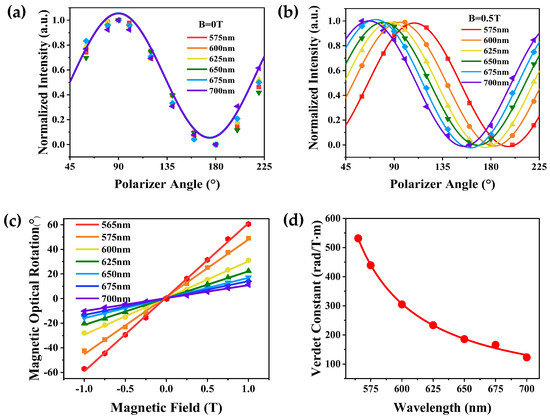
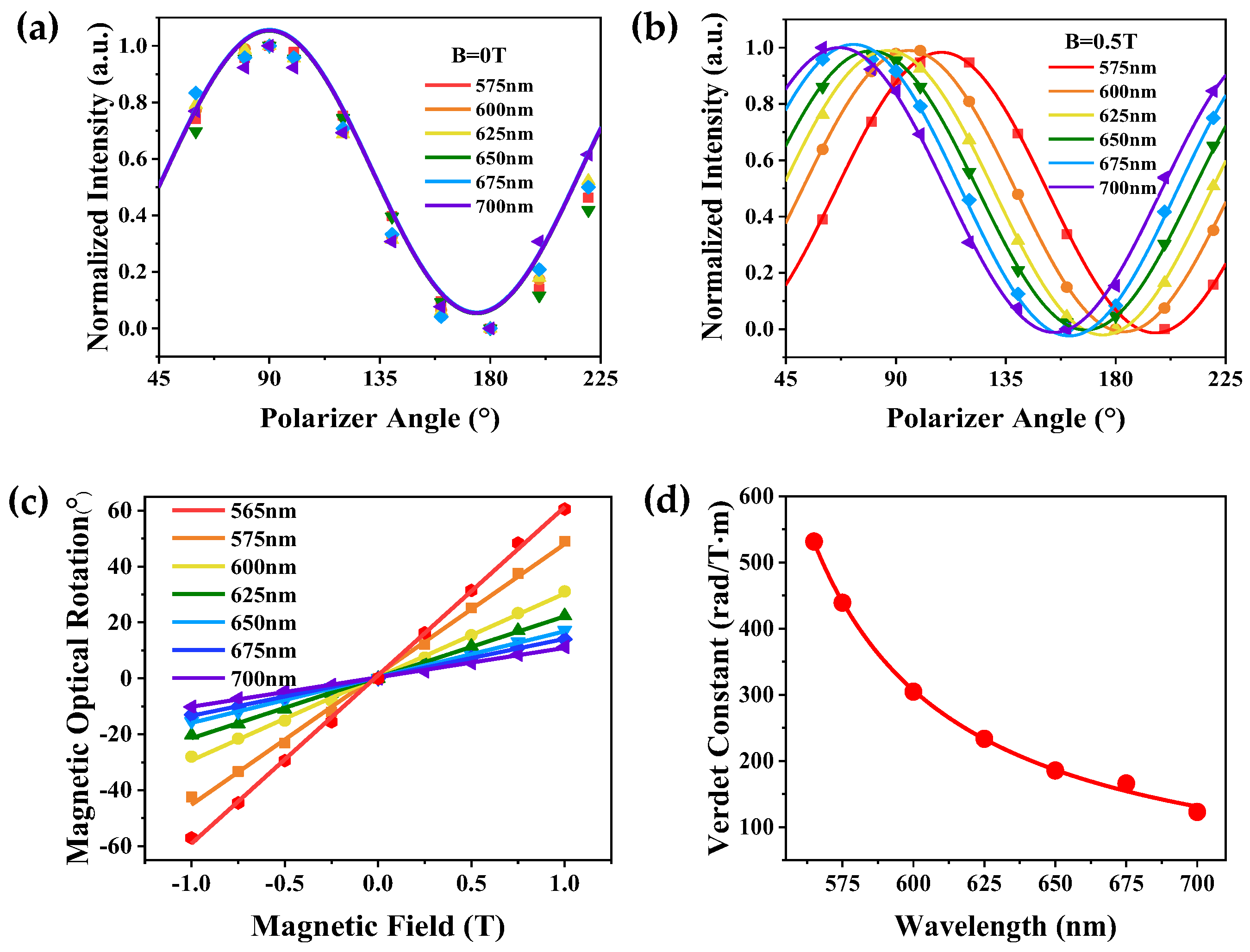
Firstly, the relationship between the transmittance intensity and the polarization angle at different magnetic field strengths was measured, and the results are shown in Figure 1a,b. When the magnetic field is 0 T, the FAPbBr3 crystal has only a small rotation angle (<2°/mm) for polarized light, which can be considered as almost no polarization generated. Therefore, the transmittance spectra of each wavelength have similar shapes. When a magnetic field is applied (B = 0.5 T), the polarization plane of the crystal will undergo different degrees of rotation related to the wavelength, causing the transmittance spectra of different wavelengths to no longer overlap. This result indicates that the FAPbBr3 single crystal has good magneto-optical rotation characteristics.
Figure 1.
Normalized transmittance intensity as a function of polarization angle for FAPbBr3 perovskite single crystal at (a) B = 0 T and (b) at B = 0.5 T; (c) relationship between rotation angle and magnetic field strength for FAPbBr3 perovskite single crystal at different wavelengths; (d) Verdet constant of FAPbBr3 perovskite single crystal at different wavelengths.
To further verify the Faraday effect and determine the rotation rule of the FAPbBr3 single crystal at different wavelengths, the magnetic optical rotation (MOR) angle was measured under different magnetic fields, as shown in Figure 1c. It can be observed that the MOR is linearly related to the magnetic field strength and has a significant wavelength dependence, with larger rotation angles for wavelengths closer to the bandgap. When the magnetic field is reversed, the same rule applies. This result also indicates that the optical rotation direction of the FAPbBr3 single crystal changes according to the direction of the magnetic field.
The magnetic optical rotation (MOR) angle is given by the following equation:
where V is Verdet constant, B is the magnetic field, and L is the distance that the light traverses in the crystal. The Verdet constant is one of the parameters that measures the magneto-optical rotation performance of a material and is determined by the material itself and related to the wavelength of the incident light. The Verdet constant was calculated for each wavelength based on the measured rotation angle and plotted in Figure 1d. The image shows that the Verdet constant has a significant dependence on wavelength, consistent with the single oscillator model [37]:
where λ0 corresponds to the bandgap transition, and A is a constant proportional to the magnetization and transition probability. At the wavelength of 565 nm, the Verdet constant of the FAPbBr3 single crystal is as high as 531.6 rad/(T∙m). Considering the stability of perovskite single crystals in magnetic optical devices, the subsequent experiments will no longer consider the magneto-optical performance at 565 nm wavelength. Here, we only show the limit of the Verdet constant of a FAPbBr3 single crystal near the bandgap.
Next, we will understand the Faraday effect theoretically and analyze the Verdet constant of the FAPbBr3 single crystal. The classical explanation of the Faraday effect is based on the theory of dispersion, in which the Verdet constant of diamagnetic materials is related to the refractive index and can be derived as the Becquerel formula [38]:
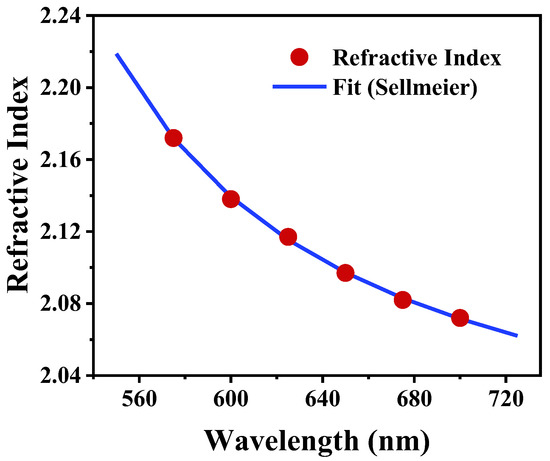
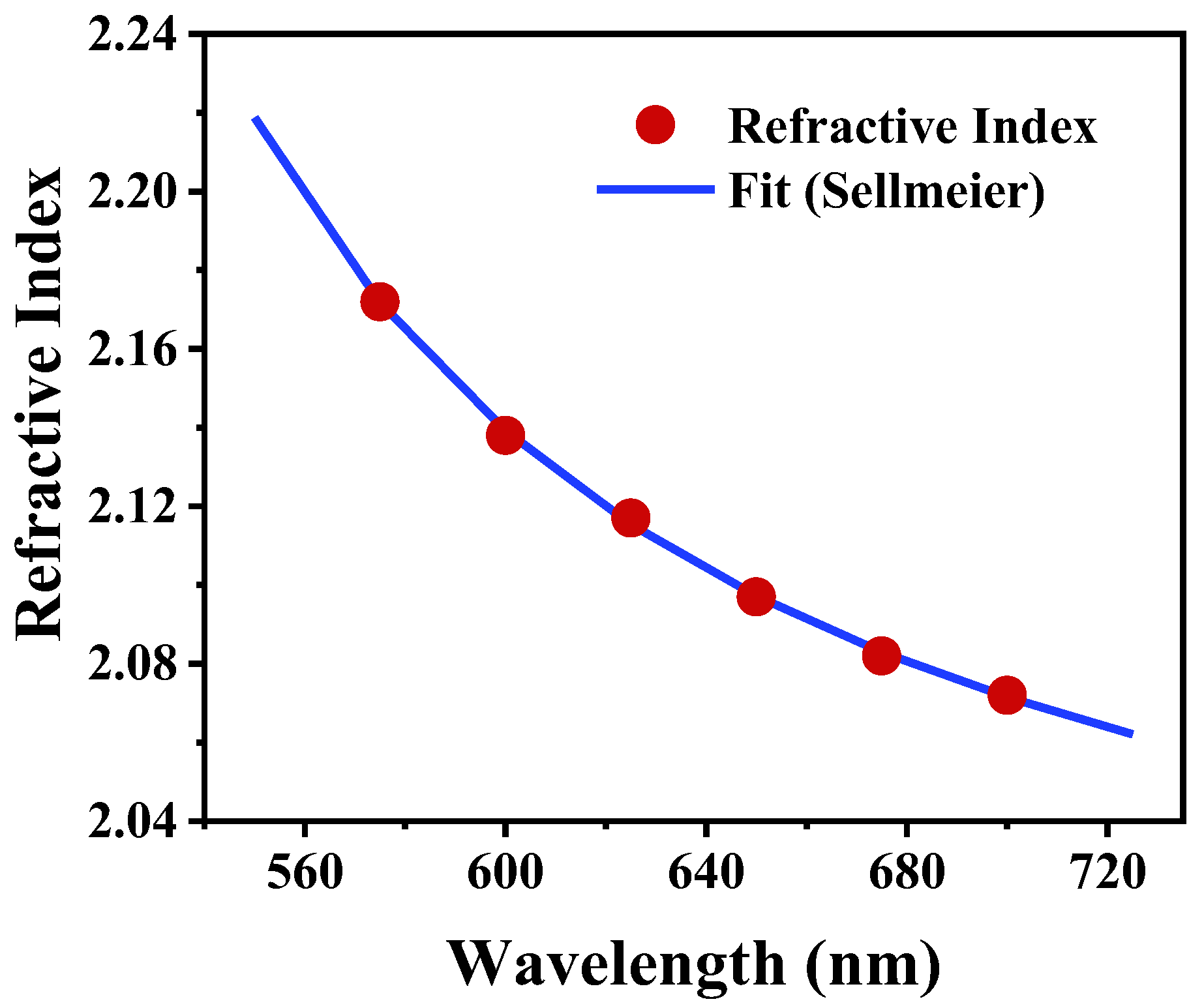
where e is the elementary charge, me is the mass of an electron, c is the speed of light in a vacuum, dn/dλ is the wavelength dispersion of the refractive index, and γ is a multiplication factor indicating the inconsistency between experimental and theoretical values. For pure ionic crystals, γ is taken as 1. The influence of polarization and absorption is included in the variation in refractive index, which can be obtained using the Lorentz–Lorenz equation or the Kramers–Kronig transformation. Figure 2 shows the measured refractive index of a FAPbBr3 single crystal at various wavelengths, where the solid line is the fitted dispersion curve obtained from the data points, which is consistent with the Sellmeier equation [39].
Figure 2.
Refractive index of FAPbBr3 single crystal at different wavelengths.
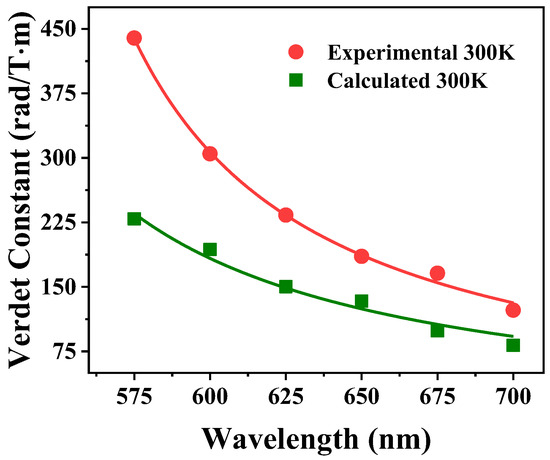
By using the refractive index of FAPbBr3 single crystal at each wavelength, the theoretical value of the Verdet constant of the FAPbBr3 single crystal can be obtained by the Becquerel formula. The results are plotted in Figure 3 and compared with the experimental values. From the figure, it can be seen that due to the presence of the magneto-optic anomalous factor, there is a deviation between the theoretical and experimental values of FAPbBr3 single crystal in the wavelength range of 575 nm to 700 nm, but they have the same trend.
Figure 3.
Comparison between theoretical and experimental values of FAPbBr3 perovskite single crystal Verdet constant.
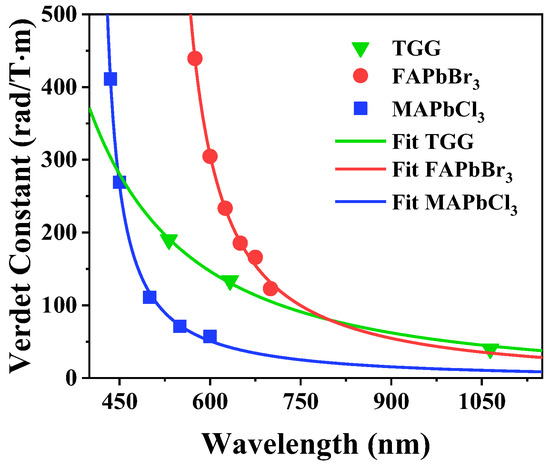
In comparing the Verdet constants of a TGG single crystal with those of a FAPbBr3 single crystal, it is worth noting that the TGG single crystal is a paramagnetic material and exhibits a negative Verdet constant, while the FAPbBr3 single crystal is an antiferromagnetic material and exhibits a positive Verdet constant. The contrasting optical rotation behaviors are illustrated in Figure 4 by plotting their absolute magnitudes. The FAPbBr3 single crystal exhibits good magneto-optical properties in the short-wavelength range, with a maximum Verdet constant of 439.24 rad/(T∙m) at a wavelength of 575 nm, which is about 2.9 times higher than the Verdet constant of TGG single crystal at the same wavelength. In the wavelength range of 565 nm to 700 nm, the Verdet constant of the FAPbBr3 single crystal is much higher or approximately equal to that of TGG single crystal, while in the long-wavelength range, the difference between the two is no more than 50 rad/(T∙m).
Figure 4.
Comparison of Verdet constant for single crystals of TGG, FAPbBr3 and MAPbCl3.
From the graph, it can also be seen that the Verdet constant of the FAPbBr3 single crystal cuts off around the wavelength of 560 nm and is steeper than that of the TGG single crystal. It shows no optical rotation response in the region of shorter wavelengths, which is attributed to the strong absorption of the FAPbBr3 single crystal for wavelengths below 560 nm. We also investigated the magneto-optical properties of the methylammonium lead chloride (MAPbCl3) perovskite single crystal, as shown in the blue part of Figure 4, and found that it exhibits good magneto-optical properties in the wavelength range of 425 nm to 600 nm, which compensates for the deficiency of the FAPbBr3 single crystal at shorter wavelengths. Therefore, we can expand the Verdet constant of the perovskite single crystal to other wavelengths by changing the halogen elements or organic ions, so as to better replace TGG single crystal.
The figure of merit (FOM) is defined as the ratio of the Verdet constant to the absorption coefficient, and it is used to measure the magneto-optical efficiency of materials:
where α is calculated according to the Beer–Lambert law:
where I and I0 are the intensity of transmitted and incident light, respectively. Assuming no reflection, then , and A is the absorbance of the material. Then substituting it into Equation (5), we obtain the relationship between α and A:
The FOM at different wavelengths of FAPbBr3 single crystal can be calculated based on its Verdet constant and absorption spectrum (Table 1). Although there is a high Verdet constant at 575 nm, the large absorption coefficient at this wavelength leads to an almost zero FOM value. On the other hand, a high FOM value of about 50 rad/T is observed at 625 nm wavelength, which is similar to the FOM value of TGG ceramics.
Table 1.
Measurement results of FAPbBr3 single crystal parameters under different wavelengths.
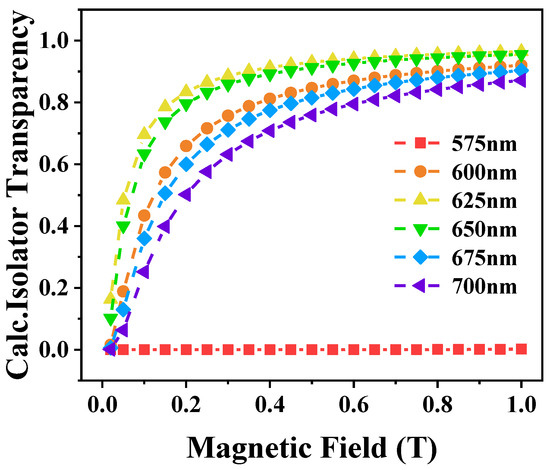
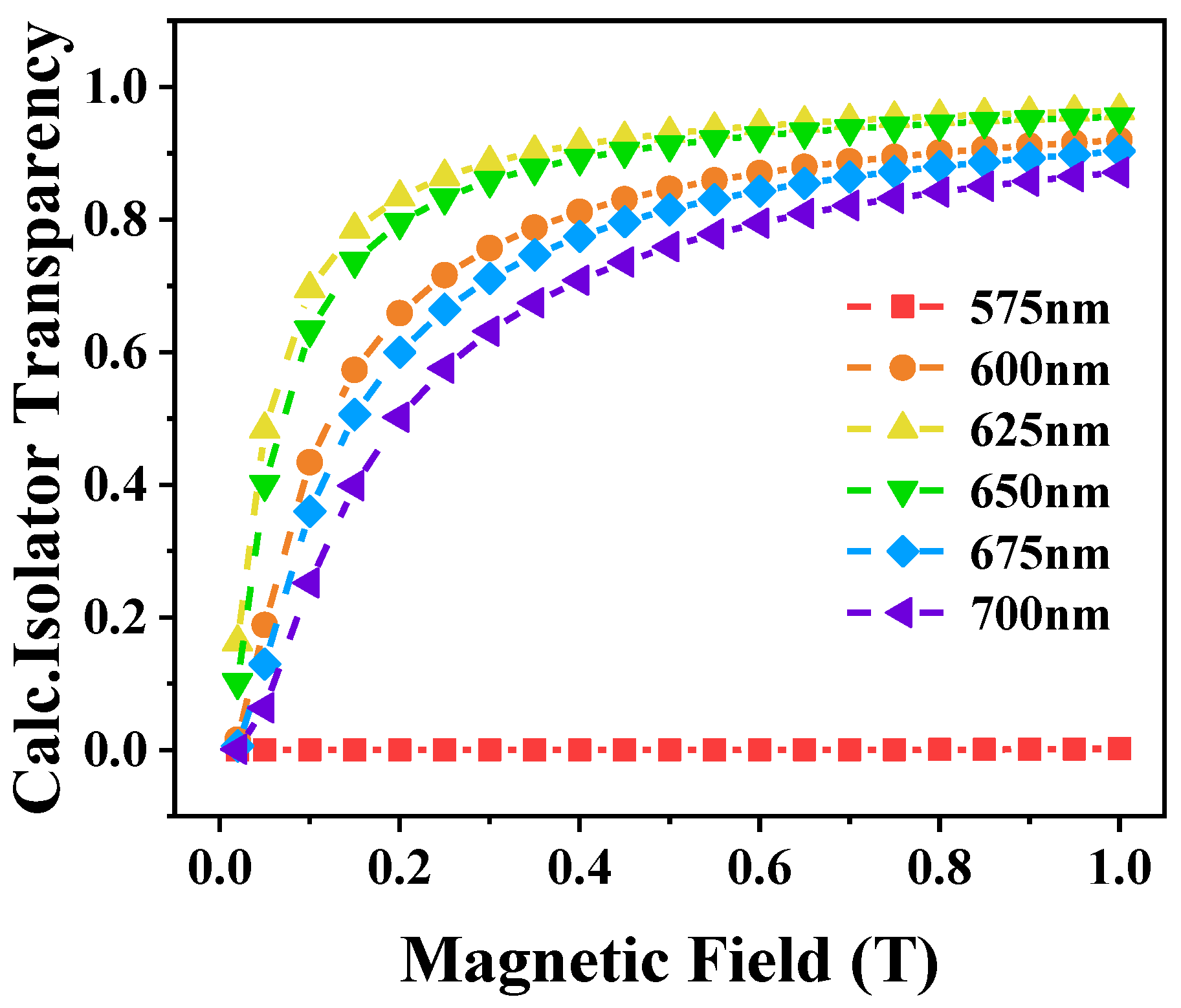
Isolation transparency is another important parameter for evaluating the performance of single crystal optical rotation and is also an important indicator for measuring the performance of optical isolators. According to the above measurements, the transparency of an FAPbBr3-based optical isolator can be calculated:
where L is the crystal thickness required to achieve a 45° rotation at a specific wavelength and magnetic field, which can be calculated using Equation (1). To limit transmission losses and facilitate calculations, we assume that the FAPbBr3 single crystal is coated with an appropriate anti-reflection coating, and the relationship between its isolation transparency and magnetic field strength at various wavelengths is shown in Figure 5.
Figure 5.
Relationship between transparency and magnetic field strength of FAPbBr3 single crystals at different wavelengths.
The FAPbBr3 single crystal can achieve about 90% transparency with a magnetic field of 0.35 T for 625 nm. Although the FAPbBr3 single crystal has a high Verdet constant at 575 nm, the transparency is almost 0 because the wavelength is at the bandgap edge of the crystal and has a high absorption coefficient. In increasing the magnetic field, it can be found that all wavelengths except 575 nm reach 80% transparency at a magnetic field of 1.0 T.
To improve the transparency of single crystals, continuous improvement of the growth method can be carried out to reduce the defect density and increase the Verdet constant and transmission rate, thus allowing it to provide higher transparency at lower magnetic field or wider wavelength ranges. In the manufacturing of optical isolators, to limit transmission losses and improve the performance of the isolator, an anti-reflective coating needs to be applied to the surface of the FAPbBr3 single crystal. The simplest way to achieve this is to deposit a transparent dielectric film with a refractive index equal to the square root of the refractive index of the FAPbBr3 single crystal.
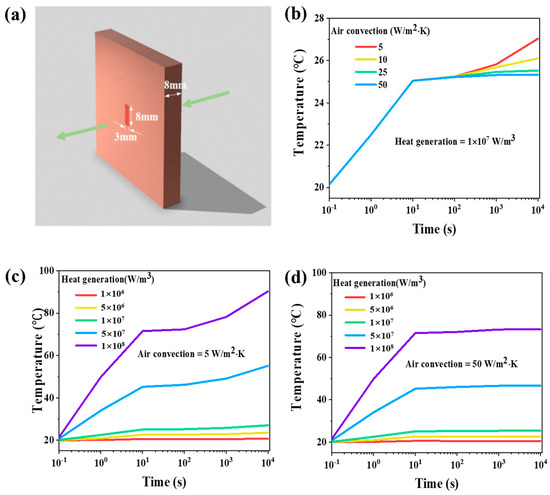
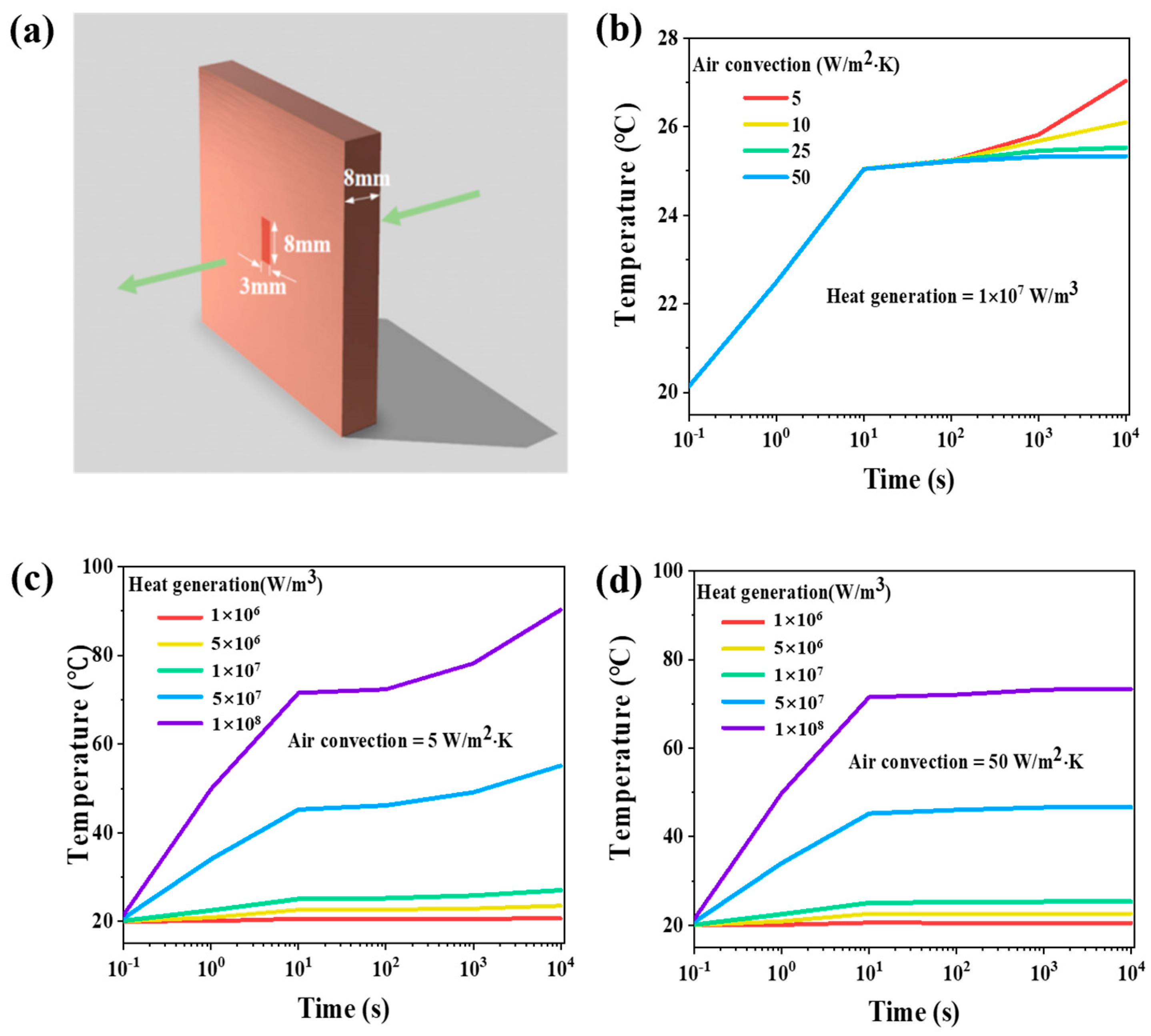
Trap absorption in single crystals can lead to temperature rise in the optical isolator, reducing the crystal’s rotation angle and causing a significant decrease in the Verdet constant, ultimately leading to a decrease in the isolator’s performance and lifespan. When exploring the temperature dependence of a FAPbBr3 single crystal through simulations, the copper heat sink is used to surround the FAPbBr3 single crystal to achieve good thermal conduction and accelerate crystal cooling, as show in Figure 6a. In the simulation process, we only consider the thermal response performance for a 625 nm wavelength. The pathlength required for 45° rotation of the optical isolator at 625 nm can be calculated to be about 9 mm. Then, based on the typical proportion between the lateral size and thickness of perovskite single crystals, the size of the FAPbBr3 single crystal required for simulation can be obtained as 9 mm × 9 mm × 3 mm, and the size of the copper is set to 50 mm × 50 mm × 3 mm.
Figure 6.
(a) Simulation structure model of transient thermal response of FAPbBr3 single crystal; (b) the effect of different air convection on the temperature increase caused by 1 × 10⁷ W m−3 heat; (c,d) influence of different heat generation on temperature rise at 5 W m−2 K−1 and 50 W m−2 K−1 air convection.
Setting the diameter of the excitation light spot to 1 mm, which is a common aperture size for single-frequency lasers used in Raman spectroscopy, for the 625 nm pumping, we assume that the heat is generated solely by sub-band absorption and that all absorbed photons dissipate heat in a non-radiative manner, based on the absorption coefficient at this wavelength and the input power to simulate the temperature rise in the system. To quickly dissipate heat from the system, we introduced air convection and set its range to 5 W m−2 K−1 (stagnant air) to 50 W m−2 K−1 (forced air), with a heat generation range of 1 × 10⁶ W m−3–1 × 10⁸ W m−3. Figure 6b shows the effect of different air convections on temperature rise under heat generation of 1 × 10⁷ W m−3. During the temperature rise process, there are two inflection points. After heating, the initial temperature rises, and the heat is transmitted from the FAPbBr3 single crystal to the copper. The first turn occurs when the temperature becomes consistent, and the second temperature rise is related to the heat dissipation in the convection. Different air convections can effectively control the temperature under the heat generation of 1 × 10⁷ W m−3, and even with the 5 W/m2 convection, the final temperature only increases by less than 8 °C. Figure 6c,d respectively show the temperature changes caused by different heat generations under stagnant and forced air convection. For stagnant air, low heat generation has little contribution to temperature rise, but continuous heating occurs at 1 × 10⁸ W m−3 heat generation, and equilibrium is reached around 90 °C. For forced air, it can be clearly seen that the temperature increases more slowly and stabilizes around 70 °C. The thermal simulation results show that FAPbBr3 single crystals have low temperature dependence and good thermal diffusion performance, which can be used in magnetic-optical devices such as optical isolators.
3. Experimental Section
3.1. Single Crystal Preparation
Regarding the preparation of FAPbBr3 single crystal using a modified inverse temperature crystallization method, compared with the conventional ITC method, the modified ITC method used here involved a seed-assisted secondary growth process. In this process, small crystals were first generated by heating the precursor solution, and well-shaped crystals were then selected as seed crystals and transferred into a fresh precursor solution for further growth. HBr (48 wt%) was added to a round-bottom flask containing equimolar amounts of HC(NH2)2AC (99%) powder and stirred fully for 2 h. After the reaction, the FABr solution was placed in an evaporating dish and evaporated at 80 °C for approximately 8 h to obtain white FABr crystalline powder, and the powder was stored in a vacuum environment after washing and drying. N,N-dimethylformamide (DMF, 99.8%) and γ-butyrolactone (GBL, 99.9%) were mixed in equal volumes, and FABr and PbBr2 (98%) powders with a 1:1 molar ratio were dissolved in the mixed solvent and stirred thoroughly. The precursor solution was obtained by filtering the mixed solution through a polytetrafluoroethylene filter with a pore size of 0.22 μm. The precursor solution was then placed in a beaker and kept on a hotplate at a nucleation temperature for approximately 7 h. During this process, a large number of differently shaped small perovskite crystals were generated at the bottom of the beaker. Regularly shaped small perovskite crystals were selected as seed crystals, which were then placed in a 15 mL new precursor solution for separate growth. After 7–10 days of growth time, a large and regularly shaped FAPbBr3 single crystal was obtained in the container.
3.2. Characterization
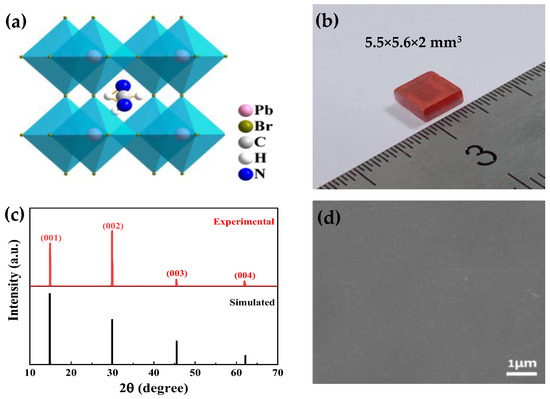
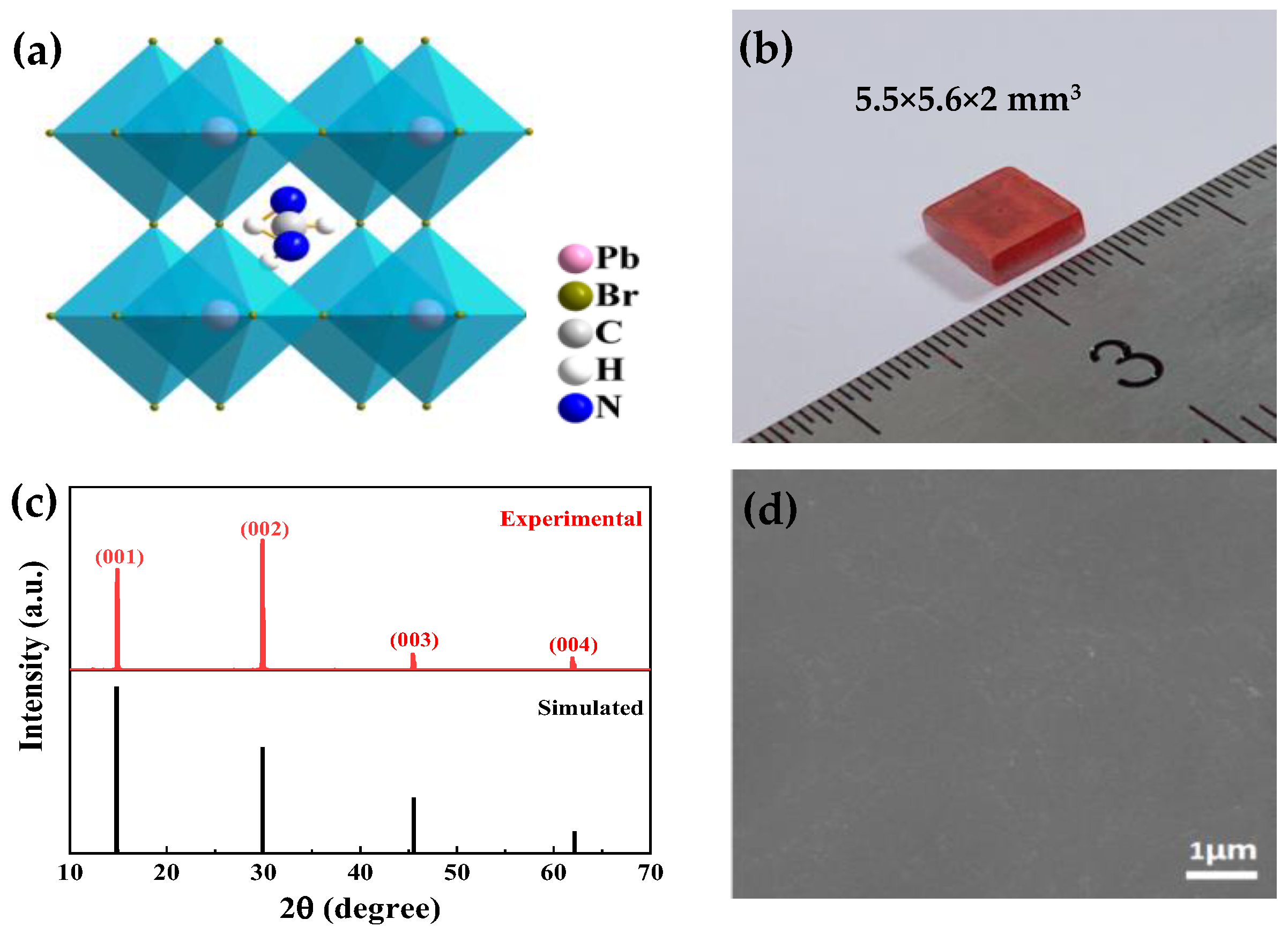
Figure 7 presents the structural, morphological, and crystallographic characterization of the as-grown FAPbBr3 single crystal. Recently, metal halide perovskites have also been explored for artificial synaptic functionality and neuromorphic devices, further demonstrating their broad application potential [40]. Figure 7a shows its structural schematic. The typical image of the prepared FAPbBr3 single crystal is shown in Figure 7b, which shows a regular shape and good transparency. Figure 7c shows the X-ray diffraction (XRD) pattern of the FAPbBr3 single crystal. The red part represents the experimental XRD data, which exhibit narrow and sharp characteristic peaks at 16.2°, 29.9°, 45.5°, and 62.1°, corresponding to the (001), (002), (003), and (004) crystal planes, respectively. This result indicates that the FAPbBr3 single crystal grown by the MITC method has a cubic structure, corresponding to the Pm-3m space group. The black part represents the XRD data of FAPbBr3 single crystal in the COD material library [41]. By comparative analysis, it is found that the characteristic peak positions of the experimental results are in good agreement with those in the database. The clear and sharp characteristic peaks also indicate that the FAPbBr3 single crystal grown in this experiment has a high degree of crystallinity. The scanning electron microscopy (SEM) image (Figure 7d) shows that the prepared FAPbBr3 single crystal has a smooth and flat surface without obvious cracks, holes, or other seed crystals, which meets the testing requirements for subsequent experiments.
Figure 7.
(a) The structural diagram of the FAPbBr3 single crystal; (b) the FAPbBr3 single crystal prepared using the MITC method; (c) the experimental XRD (in red) and simulated XRD (in black) of the FAPbBr3 single crystal; and (d) the SEM image of the FAPbBr3 single crystal.
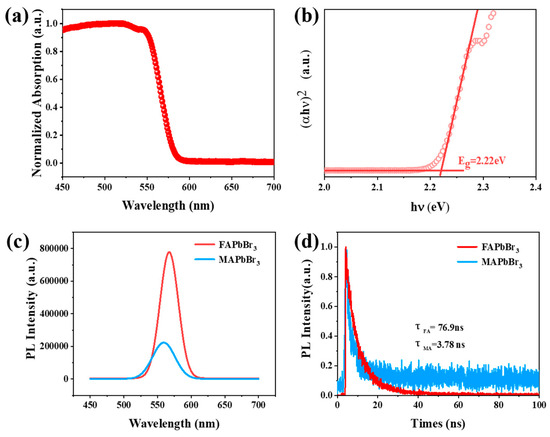
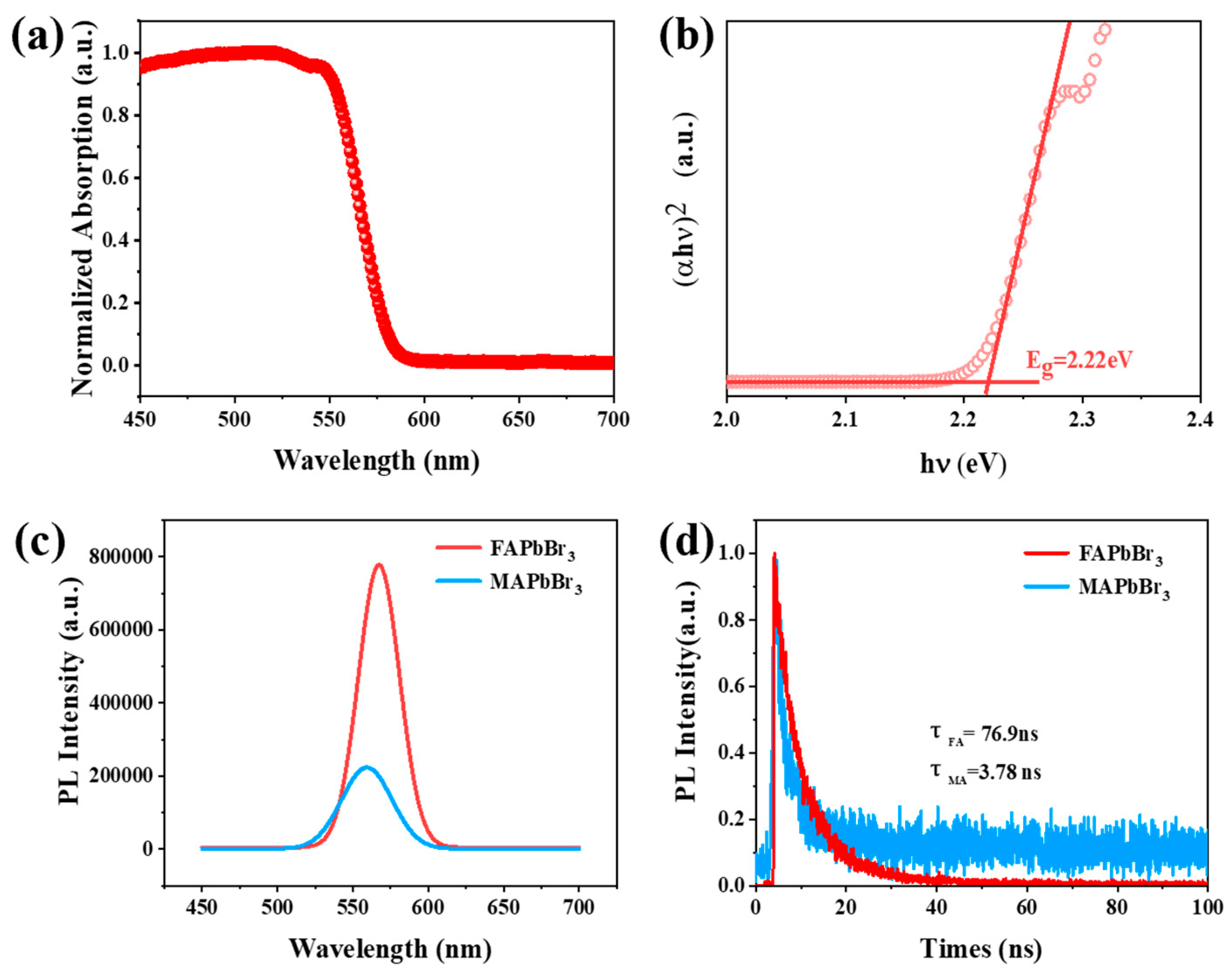
Figure 8a shows the UV-Vis absorption spectrum of the FAPbBr3 single crystal. It can be seen from the figure that the absorption rapidly decreases between 550 nm and 585 nm, and there is a clear absorption edge at around 585 nm. And there is good transmittance in the wavelength range beyond 585 nm. There is no obvious exciton feature in the figure, indicating a small number of defects in the bandgap. Meanwhile, the presence of a single emission peak near the absorption edge confirms the single-phase of perovskite structure. The optical bandgap of the FAPbBr3 single crystal was determined using the Tauc plot method, as shown in Figure 8b, with a value of Eg = 2.22 eV. A 405 nm monochromatic pulsed laser was used to excite the FAPbBr3 sample for photoluminescence (PL) and time-resolved photoluminescence (TRPL) measurements, as shown in Figure 8c,d. Figure 8c shows that FAPbBr3 exhibits a prominent yellow-green emission peak near the 570 nm wavelength, with a full width at half maximum (FWHM) of 32.17 nm. To compare the defects of FAPbBr3 and MAPbBr3 single crystals, PL and TRPL characterizations were also performed on MAPbBr3 samples prepared using the same growth method. The result shows that FAPbBr3 has a higher photoluminescence intensity and a narrower FWHM than MAPbBr3, indicating that FAPbBr3 has a lower defect density, which is related to its greater stability and better crystallinity. High defect density can cause serious non-radiative recombination of carriers, greatly reducing the radiative recombination process, so materials with low defect density are more suitable for optoelectronic devices. At the same time, the carrier lifetimes of the two perovskites were compared, and the results are shown in Figure 8d. The results show that the carrier lifetime of FAPbBr3 (76.9 ns) is longer than that of MAPbBr3 (3.78 ns), indicating that replacing MA+ with FA+ can reduce the defect density of perovskite crystals and suppress non-radiative recombination.
Figure 8.
(a) The absorption spectrum of FAPbBr3 single crystal, showing an absorption cut off at 585 nm; (b) the optical bandgap of FAPbBr3 single crystal was determined to be 2.22 eV using the Tauc plot method; (c) the PL spectra and (d) TRPL spectra of FAPbBr3 and MAPbBr3 under excitation at 405 nm.
4. Conclusions
In summary, the work focuses on the Faraday rotation properties of a hot topic material, the FAPbBr3 single crystal. Firstly, high-quality and transparent FAPbBr3 single crystals were prepared using the modified inverse-temperature crystallization method. Then Faraday rotation tests were performed on the FAPbBr3 single crystal in a magnetic field range of −1 T to 1 T, and the maximum Verdet constant of 531.6 rad/T∙m was obtained at 565 nm. Combining the absorption coefficients of the FAPbBr3 single crystal at various wavelengths, it was calculated that an approximately 90% transparency can be achieved at 625 nm with a 0.35 T magnetic field. Furthermore, the thermal stability of the FAPbBr3 single crystal was simulated, and the results showed that it has low temperature dependence and good thermal diffusion performance. In future work, further improvement of crystal quality and reduction in defect density may provide an effective route to enhancing the optical and magneto-optical performance of FAPbBr3 single crystals. The research findings suggest that the FAPbBr3 single crystal has excellent Faraday rotation properties and has promising prospects in the field of magneto-optical devices.
Author Contributions
Conceptualization, methodology, software, Z.J.; formal analysis, writing—original draft preparation, Z.J. and Y.Y.; validation, data management, Y.Y.; visualization, Y.Y.; supervision, Y.W. All authors have read and agreed to the published version of the manuscript.
Funding
This research received no external funding.
Institutional Review Board Statement
Not applicable.
Informed Consent Statement
Not applicable.
Data Availability Statement
The data presented in this study are available on request from the corresponding author. The data are not publicly available due to the expansion of this study and data analysis, which will possibly lead to commercial applications.
Conflicts of Interest
Authors Ze Jiang, Yangyang Yu, and Yin Wang were employed by the company Tiandi (Changzhou) Automation Co., Ltd. The authors declare that the research was conducted in the absence of any commercial or financial relationships that could be construed as a potential conflict of interest.
References
- Levy, M. The on-chip integration of magnetooptic waveguide isolators. IEEE J. Sel. Top. Quantum Electron. 2002, 8, 1300–1306. [Google Scholar] [CrossRef]
- Starobor, A.V.; Kuznetsov, I.I.; Palashov, O.V.; Pestov, A.E.; Chkhalo, N.I. Faraday Isolator With Composite Magneto-Optical TGG-Sapphire Elements. IEEE J. Quantum Electron. 2021, 57, 7000208. [Google Scholar] [CrossRef] [Scilit]
- Snetkov, I.L.; Yasuhara, R.; Starobor, A.V.; Palashov, O.V. TGG ceramics based Faraday isolator with external compensation of thermally induced depolarization. Opt. Express 2014, 22, 4144–4151. [Google Scholar] [CrossRef] [Scilit] [PubMed]
- Zheleznov, D.; Starobor, A.; Palashov, O.; Lin, H.; Zhou, S.M. Improving characteristics of Faraday isolators based on TAG ceramics by cerium doping. Opt. Lett. 2014, 39, 2183–2186. [Google Scholar] [CrossRef] [Scilit]
- Zheleznov, D.; Starobor, A.; Palashov, O.; Chen, C.; Zhou, S.M. High-power Faraday isolators based on TAG ceramics. Opt. Express 2014, 22, 2578–2583. [Google Scholar] [CrossRef] [Scilit]
- Aung, Y.L.; Ikesue, A.; Watanabe, T.; Makikawa, S.; Iwamoto, Y. Bi substituted YIG ceramics isolator for optical communication. J. Alloys Compd. 2019, 811, 152059. [Google Scholar] [CrossRef] [Scilit]
- Huang, D.N.; Pintus, P.; Peters, J.; Morton, P.A.; Shoji, Y.; Mizumoto, T.; Bowers, J.E.; Ieee. Widely tunable Ce:YIG on Si microring isolators for TE mode operation. In Proceedings of the 15th IEEE International Conference on Group IV Photonics (GFP), Cancun, Mexico, 29–31 August 2018; pp. 85–86. [Google Scholar]
- Ghosh, S.; Keyvaninia, S.; Shoji, Y.; Van Roy, W.; Mizumoto, T.; Roelkens, G.; Baets, R.G. Compact Mach-Zehnder Interferometer Ce:YIG/SOI Optical Isolators. IEEE Photonics Technol. Lett. 2012, 24, 1653–1656. [Google Scholar] [CrossRef] [Scilit]
- Chen, Z.; Hang, Y.; Yang, L.; Wang, J.; Wang, X.; Zhang, P.; Hong, J.; Shi, C.; Wang, Y. Great enhancement of Faraday effect by Pr doping terbium gallium garnet, a highly transparent VI-IR Faraday rotator. Mater. Lett. 2015, 145, 171–173. [Google Scholar] [CrossRef] [Scilit]
- Chen, Z.; Hang, Y.; Yang, L.; Wang, J.; Wang, X.; Hong, J.; Zhang, P.; Shi, C.; Wang, Y. Fabrication and characterization of cerium-doped terbium gallium garnet with high magneto-optical properties. Opt. Lett. 2015, 40, 820–822. [Google Scholar] [PubMed]
- Geho, M.; Sekijima, T.; Fujii, T. Growth mechanism of incongruently melting terbium aluminum garnet (Tb3Al5O12; TAG) single crystals by laser FZ method. J. Cryst. Growth 2005, 275, e663–e667. [Google Scholar] [CrossRef] [Scilit]
- Protesescu, L.; Yakunin, S.; Bodnarchuk, M.I.; Krieg, F.; Caputo, R.; Hendon, C.H.; Yang, R.X.; Walsh, A.; Kovalenko, M.V. Nanocrystals of Cesium Lead Halide Perovskites (CsPbX(3), X = Cl, Br, and I): Novel Optoelectronic Materials Showing Bright Emission with Wide Color Gamut. Nano Lett. 2015, 15, 3692–3696. [Google Scholar] [CrossRef] [Scilit] [PubMed]
- Wang, R.; Mujahid, M.; Duan, Y.; Wang, Z.K.; Xue, J.; Yang, Y. A review of perovskites solar cell stability. Adv. Funct. Mater. 2019, 29, 1808843. [Google Scholar] [CrossRef] [Scilit]
- Li, C.; Wei, J.; Sato, M.; Koike, H.; Xie, Z.-Z.; Li, Y.-Q.; Kanai, K.; Kera, S.; Ueno, N.; Tang, J.-X. Halide-substituted electronic properties of organometal halide perovskite films: Direct and inverse photoemission studies. ACS Appl. Mater. Interfaces 2016, 8, 11526–11531. [Google Scholar] [CrossRef] [Scilit] [PubMed]
- Suarez, B.; Gonzalez-Pedro, V.; Ripolles, T.S.; Sanchez, R.S.; Otero, L.; Mora-Sero, I. Recombination study of combined halides (Cl, Br, I) perovskite solar cells. J. Phys. Chem. Lett. 2014, 5, 1628–1635. [Google Scholar] [CrossRef] [Scilit]
- Gil-Escrig, L.; Roß, M.; Sutter, J.; Al-Ashouri, A.; Becker, C.; Albrecht, S. Fully Vacuum-Processed Perovskite Solar Cells on Pyramidal Microtextures. Sol. RRL 2020, 5, 2000553. [Google Scholar] [CrossRef] [Scilit]
- Wang, D.; Wright, M.; Elumalai, N.K.; Uddin, A. Stability of perovskite solar cells. Sol. Energy Mater. Sol. Cells 2016, 147, 255–275. [Google Scholar] [CrossRef] [Scilit]
- Wang, F.; Zou, X.; Xu, M.; Wang, H.; Wang, H.; Guo, H.; Guo, J.; Wang, P.; Peng, M.; Wang, Z.; et al. Recent Progress on Electrical and Optical Manipulations of Perovskite Photodetectors. Adv. Sci. 2021, 8, e2100569. [Google Scholar] [CrossRef] [Scilit]
- Li, H.; Xu, P.; Liu, D.; He, J.; Zu, H.; Song, J.; Zhang, J.; Tian, F.; Yun, M.; Wang, F. Low-voltage and fast-response SnO(2)nanotubes/perovskite heterostructure photodetector. Nanotechnology 2021, 32, 375202. [Google Scholar] [CrossRef] [Scilit]
- Xie, C.; Liu, C.K.; Loi, H.L.; Yan, F. Perovskite-Based Phototransistors and Hybrid Photodetectors. Adv. Funct. Mater. 2019, 30, 1903907. [Google Scholar] [CrossRef] [Scilit]
- Xing, J.; Yan, F.; Zhao, Y.; Chen, S.; Yu, H.; Zhang, Q.; Zeng, R.; Demir, H.V.; Sun, X.; Huan, A.; et al. High-Efficiency Light-Emitting Diodes of Organometal Halide Perovskite Amorphous Nanoparticles. ACS Nano 2016, 10, 6623–6630. [Google Scholar] [CrossRef] [Scilit]
- Li, G.; Tan, Z.-K.; Di, D.; Lai, M.L.; Jiang, L.; Lim, J.H.-W.; Friend, R.H.; Greenham, N.C. Efficient Light-Emitting Diodes Based on Nanocrystalline Perovskite in a Dielectric Polymer Matrix. Nano Lett. 2015, 15, 2640–2644. [Google Scholar] [CrossRef] [Scilit] [PubMed]
- Wang, J.Y.; Zhang, C.; Liu, H.L.; McLaughlin, R.; Zhai, Y.X.; Vardeny, S.R.; Liu, X.J.; McGill, S.; Semenov, D.; Guo, H.W.; et al. Spin-optoelectronic devices based on hybrid organic-inorganic trihalide perovskites. Nat. Commun. 2019, 10, 129. [Google Scholar] [CrossRef] [Scilit]
- Long, G.K.; Jiang, C.Y.; Sabatini, R.; Yang, Z.Y.; Wei, M.Y.; Quan, L.N.; Liang, Q.M.; Rasmita, A.; Askerka, M.; Walters, G.; et al. Spin control in reduced-dimensional chiral perovskites. Nat. Photonics 2018, 12, 528–533. [Google Scholar] [CrossRef] [Scilit]
- Zhang, C.; Sun, D.; Sheng, C.X.; Zhai, Y.X.; Mielczarek, K.; Zakhidov, A.; Vardeny, Z.V. Magnetic field effects in hybrid perovskite devices. Nat. Phys. 2015, 11, 428–435. [Google Scholar] [CrossRef] [Scilit]
- Giovanni, D.; Ma, H.; Chua, J.; Grätzel, M.; Ramesh, R.; Mhaisalkar, S.; Mathews, N.; Sum, T.C. Highly Spin-Polarized Carrier Dynamics and Ultralarge Photoinduced Magnetization in CH3NH3PbI3 Perovskite Thin Films. Nano Lett. 2015, 15, 1553–1558. [Google Scholar] [CrossRef] [Scilit]
- Belykh, V.V.; Yakovlev, D.R.; Glazov, M.M.; Grigoryev, P.S.; Hussain, M.; Rautert, J.; Dirin, D.N.; Kovalenko, M.V.; Bayer, M. Coherent spin dynamics of electrons and holes in CsPbBr3 perovskite crystals. Nat. Commun. 2019, 10, 673. [Google Scholar] [CrossRef] [Scilit]
- Odenthal, P.; Talmadge, W.; Gundlach, N.; Wang, R.; Zhang, C.; Sun, D.; Yu, Z.-G.; Valy Vardeny, Z.; Li, Y.S. Spin-polarized exciton quantum beating in hybrid organic–inorganic perovskites. Nat. Phys. 2017, 13, 894–899. [Google Scholar] [CrossRef] [Scilit]
- Dionne, G.F.; Bi, L.; Kim, H.S.; Ross, C.A. Spectral origins of high Faraday rotation at 1.5-μm wavelength from Fe and Co in SrTiO3 films. J. Appl. Phys. 2011, 109, 07B761. [Google Scholar] [CrossRef] [Scilit]
- Stamper, C.; Sabatini, R.P.; Bernardi, S.; Liao, C.; Dennis, E.; Sharma, A.; Widmer-Cooper, A.; Saidaminov, M.I.; Ho-Baillie, A.W.; Lakhwani, G. Magnetic optical rotary dispersion and magnetic circular dichroism in methylammonium lead halide perovskites. Chirality 2021, 33, 610–617. [Google Scholar] [CrossRef] [Scilit]
- Chen, T.-P.; Lin, J.-X.; Lin, C.-C.; Lin, C.-Y.; Ke, W.-C.; Wang, D.-Y.; Hsu, H.-S.; Chen, C.-C.; Chen, C.-W. Strong excitonic magneto-optic effects in two-dimensional organic–inorganic hybrid perovskites. ACS Appl. Mater. Interfaces 2021, 13, 10279–10286. [Google Scholar] [CrossRef] [Scilit] [PubMed]
- Sabatini, R.P.; Liao, C.; Bernardi, S.; Mao, W.; Rahme, M.S.; Widmer-Cooper, A.; Bach, U.; Huang, S.; Ho-Baillie, A.W.; Lakhwani, G. Solution-processed Faraday rotators using single crystal lead halide perovskites. Adv. Sci. 2020, 7, 1902950. [Google Scholar] [CrossRef] [Scilit]
- Fan, Z.; Sun, K.; Wang, J. Perovskites for photovoltaics: A combined review of organic–inorganic halide perovskites and ferroelectric oxide perovskites. J. Mater. Chem. A 2015, 3, 18809–18828. [Google Scholar] [CrossRef] [Scilit]
- Fang, Y.; Dong, Q.; Shao, Y.; Yuan, Y.; Huang, J. Highly narrowband perovskite single-crystal photodetectors enabled by surface-charge recombination. Nat. Photonics 2015, 9, 679–686. [Google Scholar] [CrossRef] [Scilit]
- Mannino, G.; Deretzis, I.; Smecca, E.; La Magna, A.; Alberti, A.; Ceratti, D.; Cahen, D. Temperature-Dependent Optical Band Gap in CsPbBr(3), MAPbBr(3), and FAPbBr(3) Single Crystals. J. Phys. Chem. Lett. 2020, 11, 2490–2496. [Google Scholar] [CrossRef] [Scilit]
- Yao, M.; Jiang, J.; Xin, D.; Ma, Y.; Wei, W.; Zheng, X.; Shen, L. High-Temperature Stable FAPbBr(3) Single Crystals for Sensitive X-ray and Visible Light Detection toward Space. Nano Lett. 2021, 21, 3947–3955. [Google Scholar] [CrossRef] [Scilit]
- Yasuhara, R.; Tokita, S.; Kawanaka, J.; Kawashima, T.; Kan, H.; Yagi, H.; Nozawa, H.; Yanagitani, T.; Fujimoto, Y.; Yoshida, H. Cryogenic temperature characteristics of Verdet constant on terbium gallium garnet ceramics. Opt. Express 2007, 15, 11255–11261. [Google Scholar] [CrossRef] [Scilit]
- Borrelli, N.F. Faraday Rotation in Glasses. J. Chem. Phys. 1964, 41, 3289–3293. [Google Scholar] [CrossRef] [Scilit]
- Handa, T.; Tahara, H.; Aharen, T.; Kanemitsu, Y. Large negative thermo-optic coefficients of a lead halide perovskite. Sci. Adv. 2019, 5, eaax0786. [Google Scholar] [CrossRef] [Scilit] [PubMed]
- Shooshtari, M.; Kim, S.Y.; Pahlavan, S.; Serrano-Gotarredona, T.; Bisquert, J.; Linares-Barranco, B. Bio-Inspired Spike-Timing-Dependent Plasticity Learning with Metal Halide Perov-skites: Toward Artificial Synaptic Functionality. ACS Appl. Mater. Interfaces 2026, 18, 7103–7114. [Google Scholar] [CrossRef] [Scilit] [PubMed]
- Elbaz, G.A.; Straus, D.B.; Semonin, O.E.; Hull, T.D.; Paley, D.W.; Kim, P.; Owen, J.S.; Kagan, C.R.; Roy, X. Unbalanced hole and electron diffusion in lead bromide perovskites. Nano Lett. 2017, 17, 1727–1732. [Google Scholar] [CrossRef] [Scilit] [PubMed]

Disclaimer/Publisher’s Note: The statements, opinions and data contained in all publications are solely those of the individual author(s) and contributor(s) and not of MDPI and/or the editor(s). MDPI and/or the editor(s) disclaim responsibility for any injury to people or property resulting from any ideas, methods, instructions or products referred to in the content. |
© 2026 by the authors. Licensee MDPI, Basel, Switzerland. This article is an open access article distributed under the terms and conditions of the Creative Commons Attribution (CC BY) license.