


Abstract
The selective photocatalytic oxidation of biomass-derived 5-hydroxymethylfurfural (HMF) into high-value 2,5-diformylfuran (DFF) under green conditions is a promising route toward carbon neutrality. However, achieving high efficiency and selectivity in pure water remains challenging due to limited oxygen solubility and nonselective radical reactions. In this study, a series of amorphous MoS3-modified Zn3In2S6 nanoflowers (x%MS/ZIS) with varying MoS3 loadings were successfully synthesized via a one-step hydrothermal method and served as the photocatalysts for the highly selective oxidation of HMF to DFF. The incorporation of MoS3 significantly enhances visible-light absorption, promotes efficient separation of photogenerated carriers, and accelerates surface reaction kinetics. Under visible light irradiation, the optimized 2.4%MS/ZIS catalyst achieves 64.7% HMF conversion and 89.5% DFF selectivity in pure water within 6 h, ~39-fold enhancement in DFF yield compared to pristine Zn3In2S6. Radical scavenging experiments and electron paramagnetic resonance analyses suggest that superoxide radicals (·O2−) and photogenerated holes are the main reactive oxygen species governing the selective oxidation, while the absence of ·OH radicals suppresses overoxidation. This study demonstrates a viable and green strategy for the valorization of biomass platform molecules through visible-light-driven photocatalysis in pure water.
1. Introduction
Biomass, as an abundant and renewable green resource, serves as a crucial potential alternative to fossil fuels [1,2,3,4]. Its catalytic conversion is pivotal for the effective development of renewable energy to achieve the carbon neutrality goal [5,6,7,8]. 5-Hydroxymethylfurfural (HMF), a typical biomass-derived platform molecule, has been listed by the U.S. Department of Energy as one of the 12 most promising renewable feedstock chemicals. Featuring multiple active functional groups, including a furan ring, alcoholic hydroxyl group, and aldehyde group, HMF can be further converted into high-value-added products such as 2,5-diformylfuran (DFF), 5-hydroxymethyl-2-furancarboxylic acid (FFCA), and 2,5-furandicarboxylic acid (FDCA) [9,10,11,12]. Among these, DFF contains two active aldehyde groups and one furan ring in its molecular structure, making it a key raw material for the synthesis of furan-based polyesters, pharmaceutical intermediates, functional polymers, etc. With extremely high industrial application potential, the efficient conversion of HMF to DFF represents an important direction for the high-value utilization of biomass [13,14]. The core of HMF oxidation to DFF lies in the highly selective oxidation of hydroxyl groups to aldehyde groups while inhibiting side reactions such as overoxidation. However, this process poses significant challenges due to the coexistence of aldehyde and hydroxyl functional groups in the HMF molecule. Among the various catalytic strategies for HMF oxidation, conventional thermocatalysis typically requires elevated temperatures and pressures, leading to substantial energy consumption and intricate product distributions [15,16]. In contrast, many reported electrocatalytic HMF oxidation systems are operated under alkaline conditions; this environment facilitates the formation of high-value-added carboxylic acid derivatives and tends to suppress aldehyde production [17,18,19].
Photocatalytic oxidation technology exhibits characteristics of mild reaction conditions, simple processes, environmental friendliness, and sustainability [20,21,22,23,24,25]. It has emerged as a promising strategy for the high-value and green conversion of HMF. To date, researchers have conducted extensive explorations in the field, and metal chalcogenides have attracted significant attention as potential photocatalysts due to their narrow band gaps, suitable band edge positions, and efficient utilization of solar energy [26,27]. Among them, ternary metal sulfides exhibit higher hole mobility and stronger charge transfer capacity compared to monometallic sulfides, holding greater promise for biomass photocatalytic conversion. Nevertheless, most of these studies have been carried out in organic solvent systems such as acetonitrile and DMSO [28,29]. The use of organic solvents not only imposes environmental risks and increases reaction costs but also limits practical industrial application. In contrast, the development of efficient photocatalytic systems under pure water is more in line with the requirements of green chemistry. However, achieving high HMF conversion and DFF selectivity in aqueous solution remains a significant challenge. This is primarily attributed to the strong polarity of water and poor solubility of oxygen, which enhance the reactivity of radical species (e.g., ·OH) generated and thereby promote the non-selective mineralization of HMF [30]. Additionally, the adjustable valence band (VB) position and the relatively moderate oxidation capacity of photogenerated holes in HMF oxidation systems also play a significant role in the reaction selectivity [31,32].
Zn3In2S6 (ZIS), a representative ternary metal sulfide typically featuring a nanosheet structure that can effectively shorten the photogenerated charge transfer distance, has become a research focus in this field [33]. However, pristine Zn3In2S6 is plagued by inherent drawbacks, including rapid recombination of photogenerated carriers, weak visible-light absorption, and low surface reaction efficiency [34,35]. To overcome these limitations, various strategies have been proposed, such as cocatalyst loading, heterojunction construction, and defect engineering [36,37,38]. Notably, Co3O4@Zn3In2S6 [39] and Zn3In2S6/Bi2MoO6 [27] heterojunctions have achieved promising performance in HMF photocatalytic conversion. Among potential cocatalysts, transition metal sulfides, such as MoS3, MoS2 and CoS2, have been demonstrated to function as effective cocatalysts that can synergistically interact with photocatalysts to enhance the catalytic efficiency [40,41]. Specifically, amorphous molybdenum trisulfide (MoS3) is an emerging material with abundant surface-active sites and unique electronic properties [42,43] that is expected to optimize the distribution of active sites and regulate the reaction kinetics during HMF oxidation.
The development of efficient photocatalytic systems for the selective oxidation of HMF to DFF in aqueous solution is of great significance but still faces substantial challenges. Given the inherent limitations of pristine Zn3In2S6 and the promising catalytic potential of MoS3, herein, we investigate the effect of amorphous MoS3 modification on the photocatalytic selective oxidation of HMF over Zn3In2S6 in pure water. The incorporation of amorphous MoS3 significantly improves the separation of photogenerated carriers, accelerates surface reaction kinetics, and effectively suppresses HMF mineralization in aqueous solution. This approach demonstrates promising catalytic performance, achieving 64.7% conversion of HMF and 89.5% selectivity of DFF in pure water. Comprehensive experimental analyses and material characterizations have elucidated the reaction mechanism and the involvement of various radical species in the oxidation process.
2. Results and Discussion
2.1. Photocatalyst Synthesis and Characterization
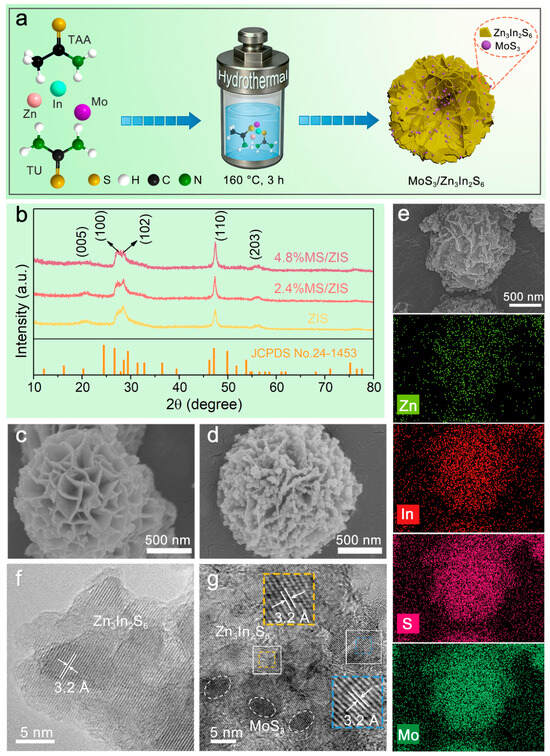
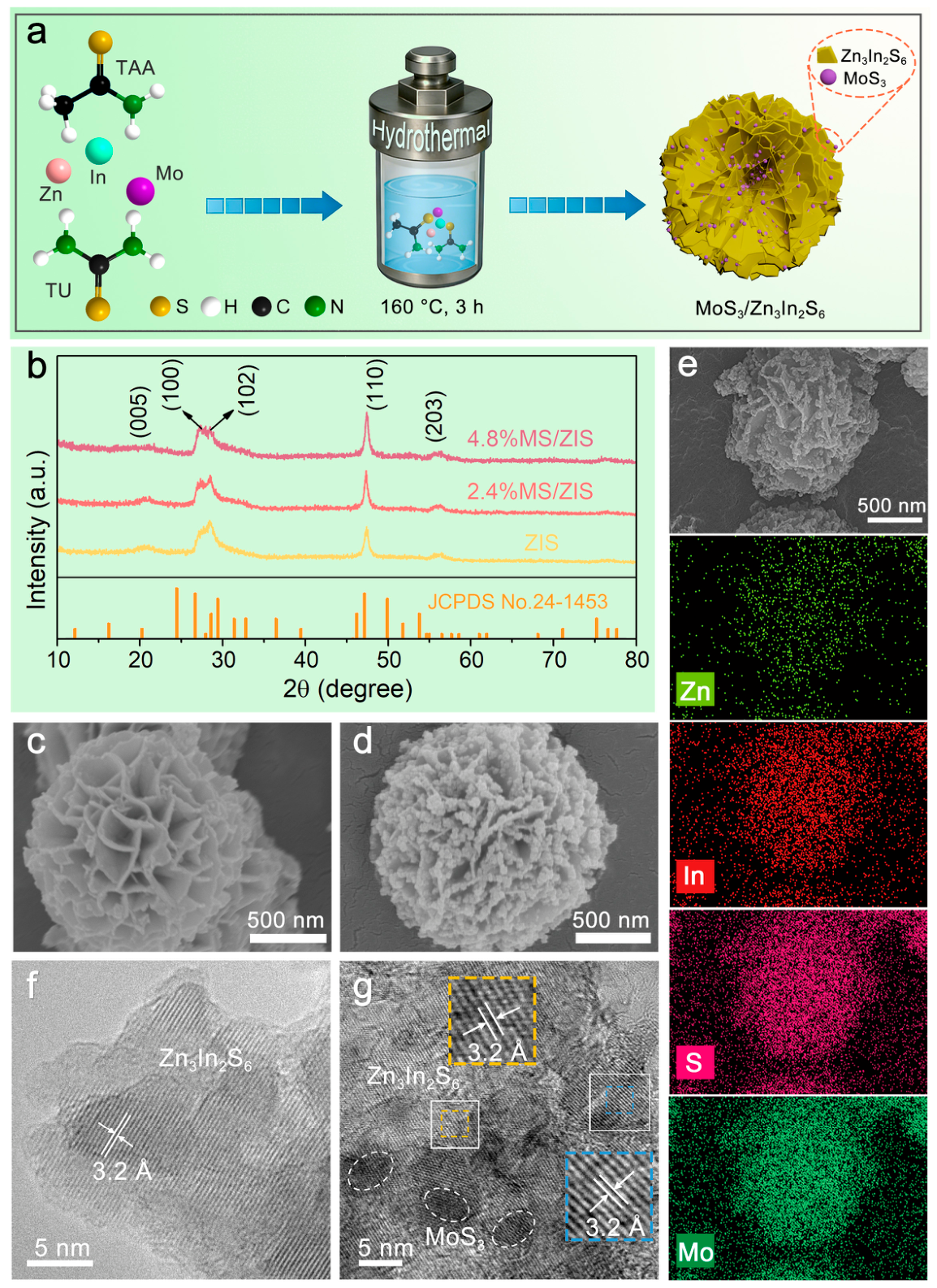
To address the intrinsic limitations of pristine Zn3In2S6 such as rapid photogenerated charge recombination and insufficient surface reaction kinetics, a series of MoS3-loaded Zn3In2S6 composites (denoted as x%MS/ZIS, see details in Materials and Methods) were rationally designed and fabricated via a facile one-step hydrothermal method (Figure 1a). MoS3 was grown directly in situ on the surface of ZIS nanosheets through the thermal decomposition of ammonium tetrathiomolybdate ((NH4)2MoS4) [44] to create intimate interfacial contact between MoS3 and Zn3In2S6. To verify the accuracy of compositional control, inductively coupled plasma–optical emission spectroscopy (ICP-OES) was employed to determine the actual Mo mass fractions in the as-synthesized x%MS/ZIS. As summarized in Table S1, the measured Mo mass fractions were 0.49%, 1.14%, 2.30%, 3.48%, and 4.77% for the samples with theoretical x values of 0.6, 1.2, 2.4, 3.6, and 4.8, respectively. This is very consistent with the theoretical design values, confirming the precise regulation of MoS3 loading content during the synthesis process.
Figure 1.
(a) Schematic illustration of the synthetic procedure for x%MS/ZIS. (b) XRD patterns of the prepared ZIS and x%MS/ZIS. (c,d) SEM images of the prepared ZIS and 2.4%MS/ZIS. (e) EDS mapping images of the prepared 2.4%MS/ZIS, showing the spatial distribution of Zn, In, S, and Mo. (f,g) HR-TEM images of the prepared ZIS and 2.4%MS/ZIS. The dashed boxes in (g) represent the enlarged images of the corresponding area.
The crystalline structures of pristine ZIS and x%MS/ZIS composites were characterized by X-ray diffraction (XRD). As shown in Figure 1b, all diffraction peaks of the pristine ZIS are well matched with the hexagonal phase Zn3In2S6 (JCPDS No. 24-1453), with the characteristic peaks at approximately 20.5°, 27.6°, 28.6°, 47.4°, and 56.2° corresponding to the (005), (100), (102), (110), and (203) crystallographic planes, respectively [45,46]. Notably, the XRD patterns of x%MS/ZIS composites is similar to that of pristine ZIS (Figure 1b and Figure S1), indicating that the introduction of MoS3 does not change the crystalline framework of ZIS. No distinct diffraction peaks corresponding to MoS3 were detected in the x%MS/ZIS composites, which can be attributed to the low loading, high dispersion, and amorphous nature of MoS3 (Figure S2) in the Zn3In2S6 [47].
The morphology of ZIS and x%MS/ZIS were further investigated by scanning electron microscopy (SEM) and transmission electron microscopy (TEM). The pristine Zn3In2S6 exhibits a uniform 3D flower-like microsphere structure with a diameter of approximately 1.4 μm (Figure 1c), composed of interwoven 2D nanosheets with smooth surfaces and a thickness of ~10–20 nm, which is consistent with the result calculated from the Debye–Scherrer formula (Table S2). The 3D nanoflower architecture constructed by interwoven 2D nanosheets can effectively inhibit the stacking of nanosheets, enhance the specific surface area, and thereby improve the probability of their participation in photocatalytic reactions. After loading with MoS3, the 2.4%MS/ZIS composite retains the flower-like microsphere structure (Figure 1d), while numerous discrete small particles are clearly observed on the surface of the Zn3In2S6 nanosheets, which are identified as MoS3. The roughened surface increases the photocatalyst’s BET surface area (Figure S3) and its contact with HMF during the photooxidation reaction. The elemental distribution of the 2.4%MS/ZIS nanocomposite was analyzed by energy-dispersive spectroscopy (EDS) mapping. The uniform distribution of Zn, In, S, and Mo elements in the 2.4%MS/ZIS not only confirms the successful preparation of the MoS3/Zn3In2S6 nanocomposite but also verifies the homogeneous growth of MoS3 on the Zn3In2S6 nanoflowers (Figure 1e). Furthermore, the four elements exhibit a consistent uniform distribution in all the MS/ZIS from 0.6% to 4.8% (Figures S4–S7). On the other hand, it can be observed in the SEM images (Figures S4a, S5a, S6a, and S7a) that only a small amount of MoS3 is present in 0.6%MS/ZIS; as the Mo content increases, the number of nanoparticles on the ZIS surface gradually increases, which fully confirms the gradual increase of the MoS3 loading content.
TEM images further verify the nanoflower structure of both pristine ZIS and 2.4%MS/ZIS (Figure S8a,b). The high-resolution TEM (HR-TEM) images reveal that the edges of both samples exhibit thin-film characteristics, indicating the composition of stacked nanosheets (Figure S8c,d) [48]. On the other hand, the pristine ZIS exhibits a relatively smooth nanosheet structure with a lattice spacing of 3.2 Å (Figure 1f), which corresponds to the (100) plane of hexagonal Zn3In2S6. After the loading of MoS3, parts of the nanosheet surface maintain a smooth sheet structure with the same lattice spacing of 3.2 Å, confirming that these regions are ZIS (Figure 1g). Notably, amorphous nanoparticles with an average size of ~10 nm are also observed on the nanosheet surface. Combined with the SEM characterization results, these nanoparticles are attributed to the amorphous MoS3 cocatalyst. These microscopic observations further verify the intimate interfacial combination between MoS3 and ZIS, which lays a solid foundation for the synergistic enhancement of photocatalytic performance.
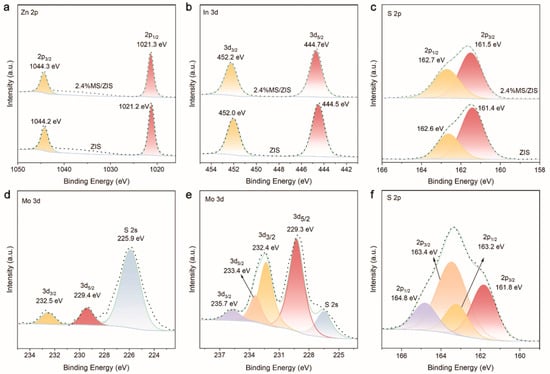
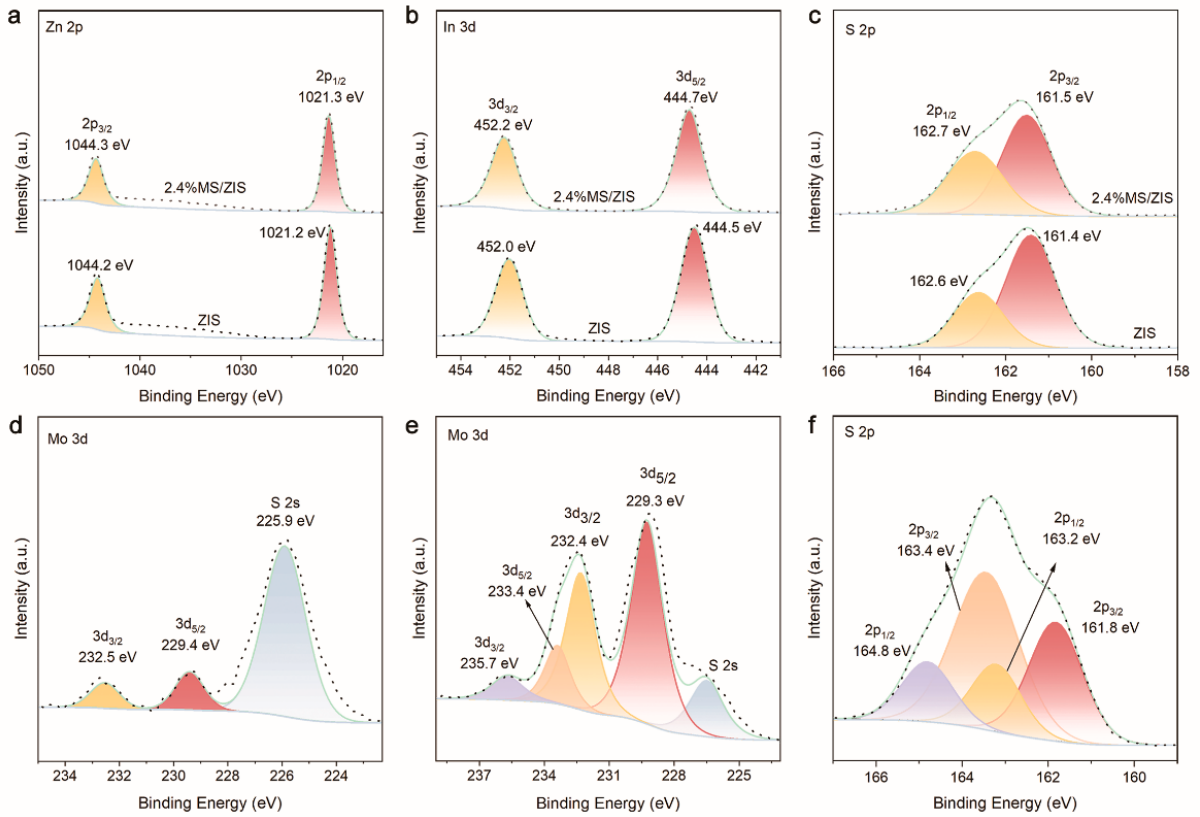
X-ray photoelectron spectroscopy (XPS) was employed to characterize the elemental composition and chemical valence states of various photocatalysts. The Zn 2p spectrum of ZIS exhibits characteristic peaks at about 1044.2 eV and 1021.2 eV for 2p1/2 and 2p3/2 (Figure 2a), the In 3d spectrum at 452.0 eV and 444.5 eV for 3d3/2 and 3d5/2 (Figure 2b), and the deconvoluted S 2p spectrum at 162.6 eV and 161.4 eV for 2p1/2 and 2p3/2 (Figure 2c). However, compared with pristine ZIS, the binding energies of Zn 2p, In 3d, and S 2p in 2.4%MS/ZIS show a 0.1~0.2 eV positive shift, which is attributed to the lower electronegativity of Zn/In than Mo facilitating electron transfer from ZIS to MoS3, and also indicates electronic interactions between ZIS and MoS3. In the Mo 3d spectrum of 2.4%MS/ZIS (Figure 2d), the two prominent peaks at 232.5 eV and 229.4 eV are attributed to Mo 3d3/2 and 3d5/2 of Mo4+, respectively, indicating that Mo mainly exists in the tetravalent state. For the pristine MoS3, the Mo 3d spectrum reveals Mo4+ and Mo6+ coexisting, with proportions of 82.3% and 17.7%, respectively (Figure 2e). The deconvoluted S 2p spectrum shows two doublets: the peaks at 164.8 eV and 163.4 eV are assigned to S 2p1/2 and 2p3/2 for bridging S22–, and those at 163.2 eV and 161.8 eV are assigned to S 2p1/2 and 2p3/2 for terminal S2– ligands, respectively (Figure 2f). The presence of bridging S22–, a signature of MoS3, confirms the amorphous nature of the loaded MoS3 [43]. Overall, the XPS results verify the successful loading of MoS3 on ZIS and the existence of strong electronic interactions between the two components.
Figure 2.
The high-resolution XPS spectra of Zn 2p (a), In 3d (b), S 2p (c) and Mo 3d (d) for ZIS and 2.4%MS/ZIS. The high-resolution XPS spectra of Mo 3d (e) and S 2p (f) for MoS3.
2.2. Photocatalytic HMF Conversion Experiments
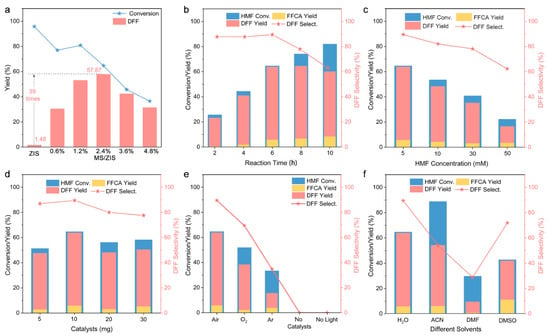
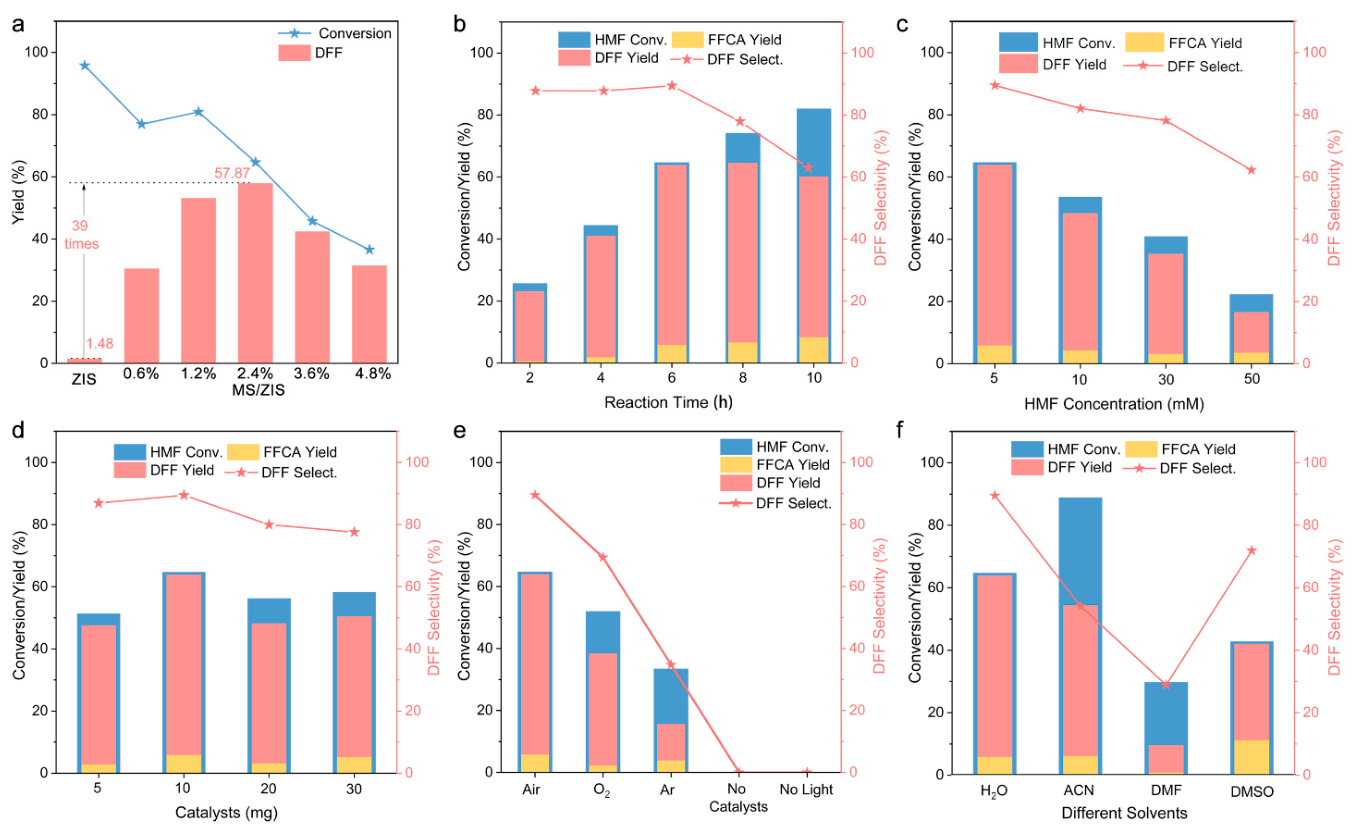
To evaluate the photocatalytic performance of the as-synthesized photocatalysts for HMF oxidation, photocatalytic tests were conducted in pure water under ambient conditions with 460 nm LED irradiation. Figure 3a and Figure S9 showed that pristine ZIS exhibits moderate photocatalytic activity toward HMF oxidation, with nearly complete conversion of HMF, yet the DFF yield is merely 1.48%, reflecting its poor selectivity. Notably, the integration of MoS3 as a cocatalyst significantly enhances the photocatalytic performance of the x%MS/ZIS nanocomposite in HMF-to-DFF conversion. The DFF yield follows a volcano-type dependence on MoS3 loading, initially increasing with MoS3 content and subsequently decreasing, highlighting the critical role of precise modulation of cocatalyst loading. The DFF yield of the 2.4%MS/ZIS is 39-fold higher than that of pristine ZIS, demonstrating the synergistic effect between MoS3 and ZIS. HMF conversion rises steadily with increasing reaction time. The DFF yield first increases, reaching an apparent quantum yield (AQY) of 0.1% at 2 h and a maximum yield of 57.9% at 6 h, after which it decreases upon further extension of the reaction time (Figure 3b). This is mainly attributed to the preferential oxidation of the more reactive aldehyde groups in DFF by accumulated reactive oxygen species (ROS) such as H2O2 and superoxide radical anions (·O2−). Simultaneous polymerization of the formed DFF as well as slight mineralization to carbon dioxide also occurs, which further blocks the active sites of the catalyst, causing a continuous drop in DFF yield and selectivity [31,49]. Further optimization of reaction parameters (Figure 3c,d) revealed that the highest DFF yield and selectivity were obtained under the following optimal conditions: 5 mM of HMF, 6 h of irradiation, and 10 mg of photocatalyst.
Figure 3.
(a) Photocatalytic oxidation of HMF to DFF using the ZIS and x%MS/ZIS photocatalysts. Photocatalytic performance of the 2.4%MS/ZIS photocatalyst in terms of HMF conversion and DFF selectivity under (b) different reaction times, (c) HMF concentrations and (d) photocatalyst masses. (e) Control experiments for the photocatalytic conversion of HMF using the 2.4%MS/ZIS photocatalyst. (f) Solvent effect on the photocatalytic conversion of HMF using the 2.4%MS/ZIS photocatalyst. Standard reaction conditions: 10 mg photocatalyst, 5 mL of 5 mM HMF, air atmosphere, ambient temperature, irradiation with 460 nm LEDs for 6 h.
A series of control experiments (Figure 3e) showed that HMF conversion and DFF yield decrease drastically under the Ar atmosphere, indicating that oxygen plays a crucial role in this reaction. Notably, catalytic activity under pure O2 is lower than under air. Sufficient oxygen in air sustains ROS generation, whereas excess O2 may induce side reactions or hinder HMF adsorption. No HMF conversion was detected in the absence of either catalyst or light, confirming the photocatalytic nature of the reaction and stability of HMF under illumination without the photocatalyst. Solvent effect is another crucial factor regulating the photocatalytic selective oxidation of HMF. The as-prepared 2.4%MS/ZIS photocatalyst achieves a high HMF conversion of 88.8% in acetonitrile, but the DFF selectivity is only 54.1% (Figure 3f), while it shows unsatisfactory conversion and selectivity in DMF and affords good selectivity but low conversion in DMSO. In contrast, the 2.4%MS/ZIS nanocomposite shows a balanced performance in pure water. After 6 h of irradiation, the HMF conversion reaches 64.7%, with a DFF selectivity of 89.5%, along with 5.9% FFCA yield and a selectivity of 9.1%. Compared with other reported aqueous-phase systems (Table S3), the value of the present system lies in its high DFF selectivity in an environmentally benign aqueous solution. However, catalytic cycling experiments indicate that the system has poor stability (Figure S10), which may be attributed to the destruction of the Zn3In2S6 crystal structure caused by photooxidation (Figure S11).
2.3. Photoelectrochemical Behaviors and Charge Dynamics
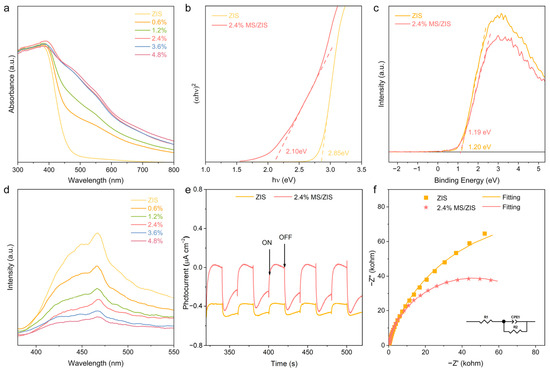
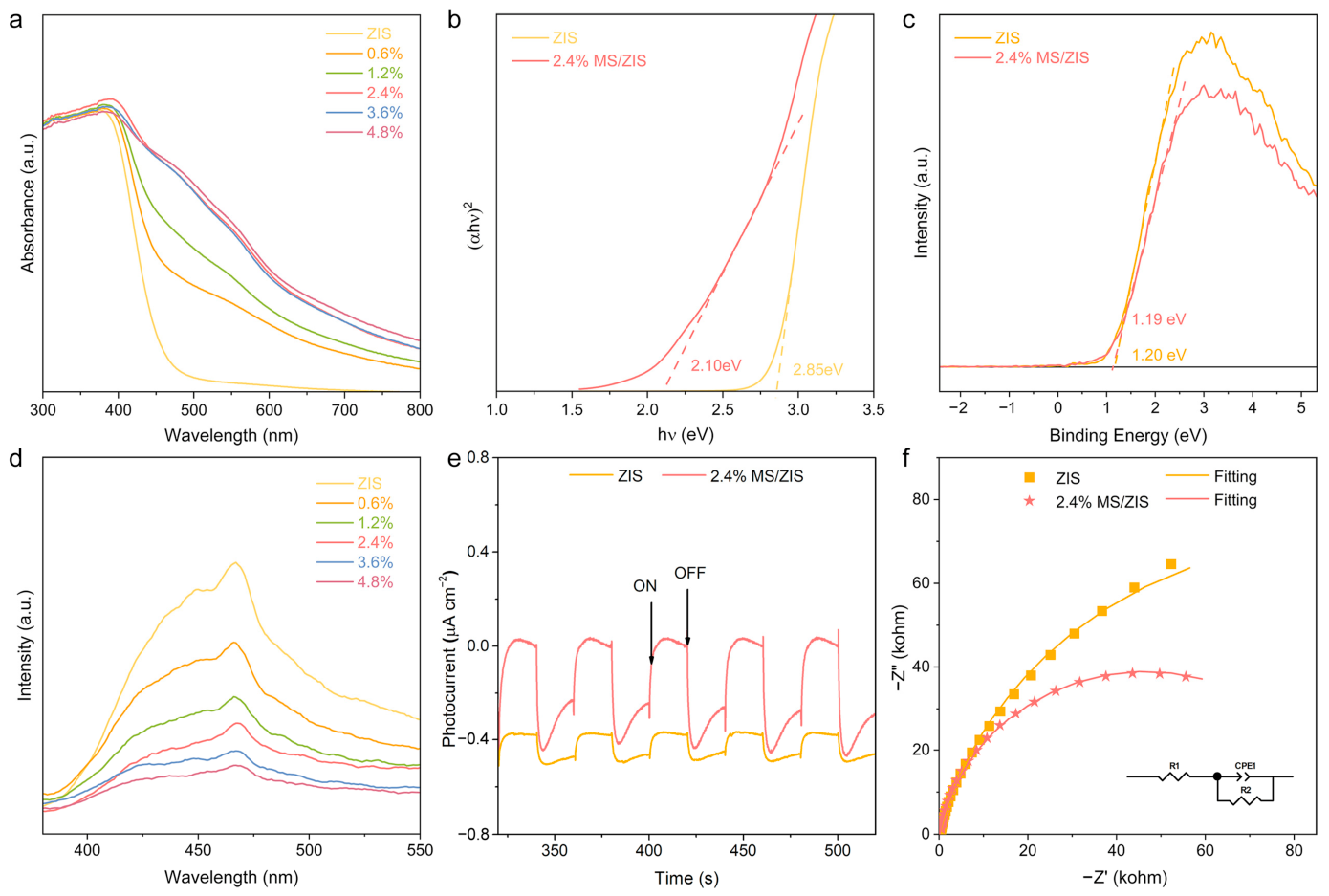
To investigate the charge separation and transfer behavior of the x%MS/ZIS photocatalysts, systematic characterizations were performed. As shown in the UV-Vis diffuse reflectance spectra (Figure 4a), pristine Zn3In2S6 shows an obvious absorption edge at ~500 nm. After loading MoS3, the absorption edge of x%MS/ZIS exhibits an obvious red shift, which becomes more evident with increasing MoS3 content, indicating enhanced visible-light harvesting. Furthermore, with the increasing MoS3 content, the color of the MS/ZIS photocatalyst gradually transitions from light yellow to brownish yellow (Figure S12), also indicating improved visible-light absorption capacity. Pristine MoS3 shows strong and broad absorption across the whole UV-Vis region without a distinct edge (Figure S13), suggesting a narrow band gap or metallic character [50]. The apparent optical band gap estimated from the Tauc plots decreases from 2.85 eV for ZIS to 2.10 eV for 2.4%MS/ZIS (Figure 4b) [51,52]. Valence band XPS spectra show that the VB edges of ZIS and 2.4%MS/ZIS are almost identical (Figure 4c), while their conduction band (CB) edges were calculated to be −1.65 V and −0.91 V, respectively. These results confirm that MoS3 loading effectively modulates the CB potential of ZIS and promotes the migration of photogenerated electrons from ZIS to MoS3, thus boosting charge separation.
Figure 4.
(a) UV-Vis diffuse reflectance spectra of ZIS and x%MS/ZIS nanocomposite. (b) Tauc plots and (c) valence band XPS spectra of ZIS and 2.4%MS/ZIS. (d) Steady-state PL spectra of ZIS and x%MS/ZIS nanocomposite. (e) Transient photocurrent responses and (f) EIS Nyquist plots of ZIS and 2.4%MS/ZIS.
Steady-state photoluminescence (PL) spectra were used to evaluate carrier recombination. As displayed in Figure 4d, the PL peak of the MS/ZIS nanocomposite is nearly identical to that of pristine Zn3In2S6, indicating that the intrinsic CB and VB edges of Zn3In2S6 are preserved. Therefore, the CB edge at −0.91 V should be assigned to that of the loaded MoS3. What is more, pristine ZIS exhibits strong PL emission, which is significantly quenched after introducing MoS3. The quenching effect strengthens gradually with increasing MoS3 content, demonstrating that delocalization of photogenerated electrons to MoS3 enables the separation of electrons and holes in ZIS. Transient photocurrent and electrochemical impedance spectroscopy (EIS) measurements further verify the charge transport properties. Figure 4e shows that 2.4%MS/ZIS presents a much higher photocurrent density than pure ZIS, indicating more efficient charge separation. The EIS Nyquist plots reveal that 2.4%MS/ZIS has a much smaller arc radius (Figure 4f), reflecting lower interfacial charge transfer resistance and faster charge migration [37,53]. In summary, 2.4%MS/ZIS exhibits enhanced visible-light absorption and highly efficient photogenerated charge separation, which contribute to its excellent photocatalytic performance.
2.4. Mechanistic Study on the Photocatalytic Oxidation of HMF
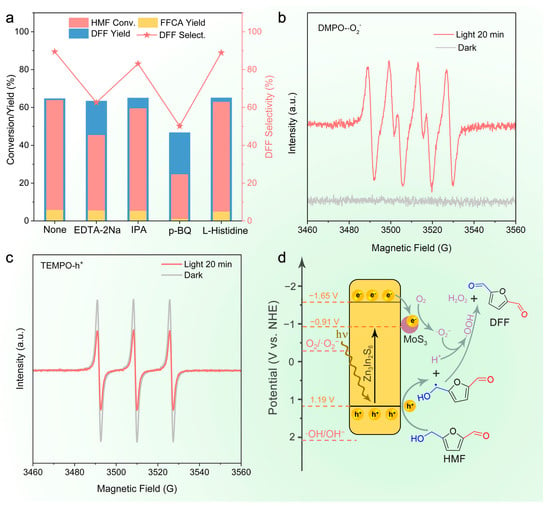
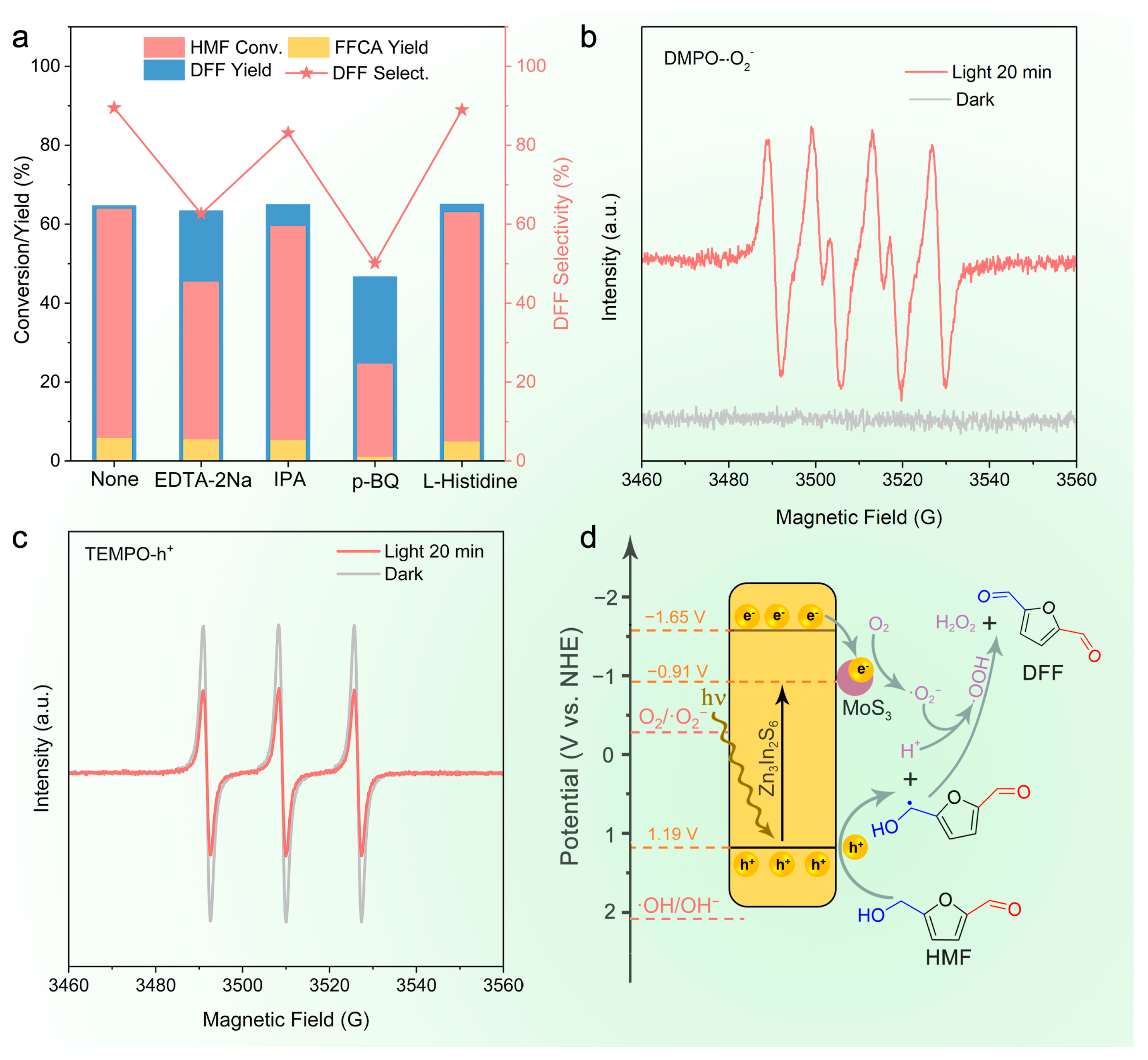
To clarify the roles of photogenerated charge carriers and ROS in the photocatalytic selective oxidation of HMF, radical quenching experiments were conducted. As shown in Figure 5a, EDTA-2Na, IPA, p-BQ, and L-Histidine were employed as specific quenchers for h+, ·OH, ·O2−, and 1O2, respectively. The experimental results show that the addition of IPA and L-Histidine has negligible effects on HMF conversion and DFF yield, indicating that ·OH and 1O2 are not involved in the reaction. In contrast, the introduction of p-BQ leads to a significant decrease in both HMF conversion (to 46.7%) and DFF yield (to 23.42%), suggesting that ·O2− is a key reactive species in the selective oxidation process. When EDTA-2Na is added, HMF conversion remains nearly unchanged, but the DFF yield decreases to 39.7%, suggesting that h+ participates in the selective oxidation pathway. Collectively, these results indicate that ·O2− and h+ are the main reactive species involved in the HMF-to-DFF oxidation process.
Figure 5.
(a) Radical scavenging experiments of photocatalytic HMF conversion over 2.4%MS/ZIS with different quenchers. EPR spectra of ·O2− radical (b) and h+ (c) for 2.4%MS/ZIS. (d) Possible reaction mechanism for the photocatalytic oxidation of HMF to DFF over 2.4%MS/ZIS.
Electron paramagnetic resonance (EPR) spectroscopy was further performed to verify the generation of ·O2− and h+, using 5,5-dimethyl-1-pyrroline N-oxide (DMPO) and 2,2,6,6-tetramethylpiperidine-1-oxyl (TEMPO) as spin traps, respectively. No EPR signal of ·O2− was detected for 2.4%MS/ZIS in the dark, while a distinct four-line signal corresponding to the DMPO-·O2− adduct was observed under light irradiation (Figure 5b), confirming the in situ generation of ·O2−. For h+ detection, TEMPO is inherently paramagnetic and exhibits a baseline EPR signal [54]; however, the interaction between photogenerated h+ and unpaired electrons of TEMPO leads to reduced signal intensity under illumination (Figure 5c), further validating the participation of h+ in the reaction. Therefore, the 2.4%MS/ZIS photocatalyst can efficiently generate ·O2− and h+ upon light irradiation, which collectively enhance the selectivity for HMF oxidation.
Based on the experimental results and comprehensive characterizations, a plausible photocatalytic mechanism for the selective oxidation of HMF to DFF over the 2.4%MS/ZIS photocatalyst is proposed, as illustrated in Figure 5d. Under visible-light irradiation, photogenerated electrons in the ZIS nanoflowers are excited from the VB to the CB and rapidly migrate to the CB of MoS3 cocatalyst due to the favorable band alignment and intimate interfacial contact. Therein, these electrons reduce dissolved molecular oxygen from air to generate ·O2−, which initiates the oxidation of HMF to furfuryl alkoxide anion and hydroperoxyl radical (·OOH). Subsequently, photogenerated holes oxidize the alkoxide anion into a furfuryl alkoxy radical, which reacts with ·OOH to produce DFF and H2O2. Indeed, the generation of H2O2 was experimentally detected in the post-reaction solution (Figure S14), further corroborating the rationality of the proposed mechanistic pathway. Notably, the VB edge potential of Zn3In2S6 is thermodynamically insufficient to oxidize OH−/H2O to ·OH, thereby effectively suppressing non-selective over-oxidation pathways. This intrinsic limitation of the VB potential plays a crucial role in achieving high DFF selectivity. This synergistic interplay between efficient charge separation facilitated by MoS3, controlled hole reactivity, and the aqueous reaction environment underpins the exceptional catalytic performance of the optimized MS/ZIS system.
3. Materials and Methods
3.1. Chemicals
HMF (99.5%) was purchased from Shanghai Haohong Scientific Co., Ltd. (Shanghai, China). Zinc sulfate heptahydrate (ZnSO4·7H2O, 99%) and indium chloride tetrahydrate (InCl3·4H2O, 99.99%) were purchased from Macklin Biochemical Co., Ltd. (Shanghai, China). Thioacetamide (TAA, C2H5NS, 99%), cetrimonium bromide (CTAB, C19H42BrN, 99%), ammonium tetrathiomolybdate ((NH4)2MoS4, 99.95%), thiourea (TU, 99%), disodium ethylenediaminetetraacetate (EDTA-2Na, 99%), p-benzoquinone (p-BQ, 99%), and L-histidine (99%) were purchased from Aladdin Chemical Reagent Co., Ltd. (Shanghai, China). Isopropyl alcohol (IPA, 99.7%), acetonitrile (ACN, ≥99%), N,N-dimethylformamide (DMF, 99.5%), and dimethyl sulfoxide (DMSO, ≥99%) were purchased from Sinopharm Chemical Reagent Co., Ltd. (Shanghai, China). Ultrapure water with a resistivity of 18.2 MΩ·cm was used throughout the experiments. All chemicals were used directly without further purification.
3.2. Preparation of MoS3
A total of 1.2 mmol of (NH4)2MoS4 and 2.4 mmol of TU were added to 30 mL of H2O and stirred vigorously for 30 min until completely dissolved. Then, the reaction solution was transferred to a 50 mL Teflon-lined stainless-steel autoclave and hydrothermally treated in a homogeneous reactor maintained at 160 °C for 3 h. Finally, the obtained precipitated product was thoroughly washed with ultrapure water and absolute ethanol three times, and then dried in a vacuum oven at 60 °C for 12 h.
3.3. Preparation of Zn3In2S6 and MoS3/Zn3In2S6
Zn3In2S6 and MoS3/Zn3In2S6 (MS/ZIS) were synthesized via a one-step hydrothermal approach. Typically, 1.5 mmol of ZnSO4·7H2O, 1 mmol of InCl3·4H2O, 6 mmol of TAA and 0.9 mmol of CTAB were sequentially dissolved in 30 mL of ultrapure water, followed by vigorous stirring to form a homogeneous solution. Subsequently, a predetermined amount of (NH4)2MoS4 and TU was added to the above mixture. After continuous stirring for 30 min, the precursor solution was transferred to a 50 mL Teflon-lined stainless-steel autoclave, which was then placed in a homogeneous reactor and maintained at 160 °C for 3 h of hydrothermal treatment. Upon completion of the reaction, the resulting precipitated product was collected and thoroughly washed with ultrapure water and absolute ethanol three times, and then dried in a vacuum oven at 60 °C for 12 h.
Here, x denotes the nominal Mo mass percentage relative to Zn3In2S6, and the as-synthesized composites were designated as x%MoS3/Zn3In2S6 (x%MS/ZIS), where x corresponds to 0.6, 1.2, 2.4, 3.6, and 4.8. Pristine Zn3In2S6 photocatalyst was prepared under identical synthetic conditions without the addition of (NH4)2MoS4 and TU.
3.4. Photocatalytic Activity Test
In the photocatalytic experiments, the 460 nm light-emitting diodes (LEDs, 100 mW cm−2) were employed as the light source, and the reactions were conducted in 12 mL photoreaction tubes. Typically, 10 mg of the as-synthesized photocatalyst was dispersed in 5 mL of aqueous solution with 5 mM HMF. Prior to light irradiation, the suspension was stirred in the dark for 30 min under an air atmosphere to reach adsorption–desorption equilibrium. Subsequently, the LED light was switched on, and a circulating water system was activated to maintain the reaction temperature at ambient temperature. At predetermined time intervals, aliquots of the reaction mixture were sampled and subjected to analysis using high-performance liquid chromatography (HPLC). Detailed experimental parameters are provided in the Supplementary Information. The HMF conversion, DFF yield, and DFF selectivity were calculated using the following equations:
where in denotes the initial concentration of HMF in the reaction system, while and represent the concentrations of residual HMF and generated DFF at the time of sampling, respectively.
4. Conclusions
In conclusion, we have successfully engineered a series of x%MS/ZIS nanocomposites by in situ loading amorphous MoS3 as a cocatalyst onto Zn3In2S6 nanoflowers via a one-step hydrothermal synthesis. This strategy establishes a highly efficient and selective photocatalytic system for the oxidation of biomass-derived HMF to the high-value chemical DFF under mild, visible-light-driven conditions in pure water. The optimized 2.4%MS/ZIS nanocomposite delivers an HMF conversion of 64.7% and a DFF selectivity of 89.5% and a FFCA selectivity of 9.1% after 6 h of reaction, which corresponds to a 39-fold increase in DFF yield over the pristine Zn3In2S6. This dramatic enhancement is attributed to the synergistic effects of amorphous MoS3, which not only broadens the visible-light absorption and facilitates the spatial separation of photogenerated charge carriers but also optimizes the surface reaction pathway to favor selective oxidation while suppressing the non-selective mineralization of HMF in pure water. Mechanistic investigations, including radical quenching experiments and EPR spectroscopy, suggest that the photocatalytic process is primarily driven by ·O2− and photogenerated h+, with the VB potential of Zn3In2S6 being insufficient to generate ·OH, thereby contributing to high selectivity towards DFF. This work provides a compelling and sustainable approach for the photocatalytic valorization of biomass platform compounds in environmentally benign aqueous systems.
Supplementary Materials
The following supporting information can be downloaded at: https://www.mdpi.com/article/10.3390/inorganics14060163/s1, Table S1: ICP-OES mass fraction of the added Mo in x%MS/ZIS; Figure S1: XRD patterns of the prepared ZIS and x%MS/ZIS; Figure S2: The XRD pattern of the prepared pristine MoS3; Table S2: Crystallite size perpendicular to the (110) plane calculated via the Debye–Scherrer formula; Figure S3: N2 adsorption–desorption isotherms of ZIS and 2.4%MS/ZIS photocatalysts; Figure S4: SEM images and elemental mapping images of 0.6%MS/ZIS; Figure S5: SEM images and elemental mapping images of 1.2%MS/ZIS; Figure S6: SEM images and elemental mapping images of 3.6%MS/ZIS; Figure S7: SEM images and elemental mapping images of 4.8%MS/ZIS; Figure S8: TEM images of (a) ZIS and (b) 2.4%MS/ZIS. HR-TEM images of (c) ZIS and (d) 2.4% MS/ZIS; Figure S9: HPLC results of liquid products from HMF selective photooxidation over Zn3In2S6 and 2.4%MS/ZIS after 6 h irradiation under identical conditions; Figure S10: Photocatalytic cycling tests of HMF to DFF for 2.4% MS/ZIS; Figure S11: The XRD patterns of 2.4%MS/ZIS before and after multiple photocatalytic cycles (a). The SEM image of 2.4%MS/ZIS after multiple photocatalytic cycles; Figure S12: Photographs of ZIS and x%MS/ZIS nanocomposites, in sequence: 0%, 0.6%, 1.2%, 2.4%, 3.6%, 4.8%; Figure S13: UV-Vis diffuse reflectance spectrum of pristine MoS3; Figure S14: Determination of H2O2: 1.5 mL of the solution collected from HMF photooxidation catalyzed by 2.4%MS/ZIS was filtered through a 0.22 μm organic membrane. Then 0.5 mL of 0.1 mol·L−1 potassium hydrogen phthalate (C8H5KO4) aqueous solution and 0.5 mL of 0.4 mol·L−1 KI aqueous solution was added sequentially. After mixing uniformly, the absorbance was measured by UV-Vis spectrophotometer in the wavelength range of 300–400 nm; Table S3: Comparison of representative photocatalytic systems for selective oxidation of HMF to DFF in pure water [31,55,56,57,58,59,60,61,62].
Author Contributions
S.Y.: Data curation, Formal analysis, Investigation, Methodology, Writing—original draft. Q.-X.F.: Investigation, Validation. J.-P.L. and F.-L.W.: Investigation. Y.-J.G.: Conceptualization, Funding acquisition, Supervision, Writing—review and editing. All authors have read and agreed to the published version of the manuscript.
Funding
The authors are grateful for financial support from the National Natural Science Foundation of China (22002065), the Natural Science Foundation of Shandong Province (ZR2020QB060), and the Science, Education and Industry Integration Innovation Pilot Project from Qilu University of Technology (Shandong Academy of Sciences) (2024ZDZX13).
Data Availability Statement
Raw data that support the findings of this study are available from the corresponding author upon reasonable request.
Conflicts of Interest
The authors declare no conflicts of interest.
References
- Dong, M.; Cheng, X.; Liu, H.; Han, B. Recent advances in solvent effects for biomass-derived platform molecule conversion: Experimental and theoretical perspectives. Chem. Soc. Rev. 2026, 55, 2876–2908. [Google Scholar] [CrossRef] [Scilit] [PubMed]
- Chen, C.; Lv, M.; Hu, H.; Huai, L.; Zhu, B.; Fan, S.; Wang, Q.; Zhang, J. 5-Hydroxymethylfurfural and its Downstream Chemicals: A Review of Catalytic Routes. Adv. Mater. 2024, 36, 2311464. [Google Scholar] [CrossRef] [Scilit]
- Sun, D.; Zhang, Y.; Zhou, Y.; Nie, Y.; Ban, L.; Wu, D.; Yang, S.; Zhang, H.; Li, C.; Zhang, K. Photocatalytic and Electrochemical Synthesis of Biofuel via Efficient Valorization of Biomass. Adv. Energy Mater. 2025, 15, 2406098. [Google Scholar] [CrossRef] [Scilit]
- Zhang, Y.; Huber, G.W.; Guo, Z. Hydrogen-bond catalysis in biomass valorization. Chem 2025, 11, 102364. [Google Scholar] [CrossRef] [Scilit]
- Feng, Y.; Long, S.; Tang, X.; Sun, Y.; Luque, R.; Zeng, X.; Lin, L. Earth-abundant 3d-transition-metal catalysts for lignocellulosic biomass conversion. Chem. Soc. Rev. 2021, 50, 6042–6093. [Google Scholar]
- Wu, X.; Luo, N.; Xie, S.; Zhang, H.; Zhang, Q.; Wang, F.; Wang, Y. Photocatalytic transformations of lignocellulosic biomass into chemicals. Chem. Soc. Rev. 2020, 49, 6198–6223. [Google Scholar] [CrossRef] [Scilit] [PubMed]
- Shi, Y.; Tana, T.; Yang, W.; Zhou, Z.; Yong Zhu, H.; Bissember, A.C.; Huang, J.; Han, P.; Sarina, S. High-Efficiency Solar Transformation of Sugars via a Heterogenous Gallium(III) Catalyst. Angew. Chem. Int. Ed. 2024, 63, e202409456. [Google Scholar] [CrossRef] [Scilit]
- Feng, S.; Nguyen, P.T.T.; Ma, X.; Yan, N. Photorefinery of Biomass and Plastics to Renewable Chemicals using Heterogeneous Catalysts. Angew. Chem. Int. Ed. 2024, 63, e202408504. [Google Scholar] [CrossRef] [Scilit]
- Ke, M.-K.; Min, Y.; Mei, S.-C.; Zeng, H.-W.; Wang, Z.-H.; Hua, T.-W.; Chen, J.-J.; Huang, G.-X.; Yu, H.-Q. Highly selective oxidation of 5-HMF to HMFCA via a facile Pt-Ag co-catalytic strategy. Appl. Catal. B Environ. Energy 2024, 358, 124431. [Google Scholar] [CrossRef] [Scilit]
- Li, Y.; Huang, H.; Jiang, M.; Xi, W.; Duan, J.; Ratova, M.; Wu, D. Advancements in transition bimetal catalysts for electrochemical 5-hydroxymethylfurfural (HMF) oxidation. J. Energy Chem. 2024, 98, 24–46. [Google Scholar] [CrossRef] [Scilit]
- Wang, Y.; Cai, C. Photocatalytic Oxidation of 5-Hydroxymethylfurfural to Selective Products by Noble Metal-Free Z-Scheme Heterostructures α-Fe2O3/Zn0.5Cd0.5S. ACS Catal. 2025, 15, 3451–3463. [Google Scholar] [CrossRef] [Scilit]
- Xiong, L.; Qi, H.; Zhang, S.; Zhang, L.; Liu, X.; Wang, A.; Tang, J. Highly Selective Transformation of Biomass Derivatives to Valuable Chemicals by Single-Atom Photocatalyst Ni/TiO2. Adv. Mater. 2023, 35, 2209646. [Google Scholar] [CrossRef] [Scilit]
- Deng, W.; Yan, L.; Wang, B.; Zhang, Q.; Song, H.; Wang, S.; Zhang, Q.; Wang, Y. Efficient Catalysts for the Green Synthesis of Adipic Acid from Biomass. Angew. Chem. Int. Ed. 2021, 60, 4712–4719. [Google Scholar] [CrossRef] [Scilit]
- Zhang, C.; Zhan, P.; Shan, H.; Ren, W.; Liu, Y.; Liu, X.; Zheng, S.; Liao, Z.; Cai, D.; Qin, P. Research on highly efficient photocatalytic selective oxidation of HMF to DFF using CdS@MXene Composites: Construction of Schottky junctions and mechanistic investigation. Chem. Eng. J. 2025, 506, 159946. [Google Scholar] [CrossRef] [Scilit]
- Pang, Y.; Chen, N.; Zhao, Z.; Zhang, L.; Broekman, J.O.P.; Wei, J.; Li, X.; Lin, L.; Huang, H. A unique air-assisted DMSO oxidation pathway for the highly efficient synthesis of 2,5-diformylfuran from 5-hydroxymethylfurfural/fructose. Green Chem. 2023, 25, 9680–9688. [Google Scholar] [CrossRef] [Scilit]
- Lv, G.; Liu, S.; Chen, X.; Chen, M.; Wu, Y.; Gao, Y.; Wang, S.; Tao, F.; Wang, J.; Niu, L. Thermodynamically stable synthesis of high entropy alloys and efficiently catalyzed oxidation of 5-hydroxymethylfurfural into 2,5-furandicarboxylic acid under base-free conditions. Green Chem. 2024, 26, 11316–11327. [Google Scholar] [CrossRef] [Scilit]
- Xu, H.G.; Ning, X.R.; Zhao, J.Y.; Lin, H.Y.; Fu, H.Q.; Wang, S.; Guo, Y.; Wu, H.; Zhu, M.; Yuan, H.Y.; et al. Reactant-induced activation over amorphous metal-metalloid electrocatalysts for HMF electrooxidation. Chem 2024, 10, 2147–2169. [Google Scholar] [CrossRef] [Scilit]
- Zhu, Z.; Ma, S.; He, S.; Song, M.; Xia, B.Y.; You, B. Heterogeneous electrocatalysts from nanostructures to single atoms for biomass-derived feedstocks upgrading. Coord. Chem. Rev. 2025, 527, 216399. [Google Scholar] [CrossRef] [Scilit]
- Liu, F.; Gao, X.; Shi, R.; Guo, Z.; Tse, E.C.M.; Chen, Y. Concerted and Selective Electrooxidation of Polyethylene-Terephthalate-Derived Alcohol to Glycolic Acid at an Industry-Level Current Density over a Pd−Ni(OH)2 Catalyst. Angew. Chem. Int. Ed. 2023, 62, e202300094. [Google Scholar]
- Gao, Z.; Ren, P.; Sun, L.; Luo, N.; Wang, F. Photocatalysts for steering charge transfer and radical reactions in biorefineries. Nat. Synth. 2024, 3, 438–451. [Google Scholar] [CrossRef] [Scilit]
- Savateev, O.; Zhuang, J.; Wan, S.; Song, C.; Cao, S.; Tang, J. Photocatalytic water splitting versus H2 generation coupled with organic synthesis: Alarge critical review. Chin. J. Catal. 2025, 70, 44–114. [Google Scholar] [CrossRef] [Scilit]
- Sun, L.; Luo, N. Catalyst design and structure control for photocatalytic refineries of cellulosic biomass to fuels and chemicals. J. Energy Chem. 2024, 94, 102–127. [Google Scholar] [CrossRef] [Scilit]
- Bhattacharjee, S.; Linley, S.; Reisner, E. Solar reforming as an emerging technology for circular chemical industries. Nat. Rev. Chem. 2024, 8, 87–105. [Google Scholar] [CrossRef] [Scilit]
- Wang, M.; Zhou, H.; Wang, F. Photocatalytic biomass conversion for hydrogen and renewable carbon-based chemicals. Joule 2024, 8, 604–621. [Google Scholar] [CrossRef] [Scilit]
- Xia, T.; Gong, W.; Chen, Y.; Duan, M.; Ma, J.; Cui, X.; Dai, Y.; Gao, C.; Xiong, Y. Sunlight-Driven Highly Selective Catalytic Oxidation of 5-Hydroxymethylfurfural Towards Tunable Products. Angew. Chem. Int. Ed. 2022, 61, e202204225. [Google Scholar] [CrossRef] [Scilit] [PubMed]
- Xiong, R.; Liu, F.; Xiao, X.; Wu, Y.; Xiao, Y.; Cheng, B.; Lei, S. Dual-sulfur-vacancy-enhanced interfacial electric field and photothermal effect for boosting selective photooxidation of 5-hydroxymethylfurfural. J. Colloid Interface Sci. 2025, 692, 137555. [Google Scholar] [CrossRef] [Scilit] [PubMed]
- Xiong, S.; Liu, X.; Shen, Z.; Hu, Z.; Yang, H.; Hao, J.; Cai, J.; Yang, J. Selective Oxidation of 5-Hydroxymethyl Furfural Coupled with H2 Production over Surface Sulfur Vacancy-Rich Zn3In2S6/Bi2MoO6 Heterojunction Photocatalyst. Inorg. Chem. 2023, 62, 20120–20128. [Google Scholar] [CrossRef] [Scilit]
- Cui, J.; Lu, X.; Guo, M.; Zhang, M.; Sun, L.; Xiong, J.; Zhang, R.; Li, X.; Qiao, Y.; Li, D.; et al. Construction of a g-C3N4-driven photocatalytic system for boosted biomass-derived alcohol oxidation: A promising route towards sustainable biomass valorization. Catal. Sci. Technol. 2023, 13, 940–957. [Google Scholar] [CrossRef] [Scilit]
- Tan, C.-L.; Qi, M.-Y.; Tang, Z.-R.; Xu, Y.-J. Cocatalyst decorated ZnIn2S4 composites for cooperative alcohol conversion and H2 evolution. Appl. Catal. B Environ. 2021, 298, 120541. [Google Scholar] [CrossRef] [Scilit]
- Xue, W.; Ye, J.; Zhu, Z.; Kumar, R.; Zhao, J. Harnessing trace water for enhanced photocatalytic oxidation of biomass-derived alcohols to aldehydes. Energy Environ. Sci. 2025, 18, 214–226. [Google Scholar] [CrossRef] [Scilit]
- Liu, Y.; Xue, W.; Ye, J.; Zhang, R.; Rangappa, A.P.; Zhao, J. Cascade Electric Field in ZnIn2S4/CuCo2O4 Photocatalyst for the Selective Oxidation of Biomass-Derived 5-Hydroxymethylfurfural in Aqueous Solutions. Small 2025, 21, 2409005. [Google Scholar] [CrossRef] [Scilit]
- Xiong, L.; Tang, J. Strategies and Challenges on Selectivity of Photocatalytic Oxidation of Organic Substances. Adv. Energy Mater. 2021, 11, 2003216. [Google Scholar] [CrossRef] [Scilit]
- Tan, X.; Si, S.; Xiao, D.; Bao, X.; Song, K.; Wang, Z.; Liu, Y.; Zheng, Z.; Wang, P.; Dai, Y.; et al. Single Cobalt Atoms Induced Molecular O2 Activation for Enhanced Photocatalytic Biomass Upgrading on ZnIn2S4 Nanosheets. ACS Catal. 2023, 13, 14395–14403. [Google Scholar] [CrossRef] [Scilit]
- Luo, J.; Wei, X.; Qiao, Y.; Wu, C.; Li, L.; Chen, L.; Shi, J. Photoredox-Promoted Co-Production of Dihydroisoquinoline and H2O2 over Defective Zn3In2S6. Adv. Mater. 2023, 35, 2210110. [Google Scholar] [CrossRef] [Scilit]
- Liu, T.; Xiong, Y.; Wang, X.; Xue, Y.; Liu, W.; Tian, J. Dual cocatalysts and vacancy strategies for enhancing photocatalytic hydrogen production activity of Zn3In2S6 nanosheets with an apparent quantum efficiency of 66.20%. J. Colloid Interface Sci. 2023, 640, 31–40. [Google Scholar] [CrossRef] [Scilit]
- Meng, S.; Wu, H.; Cui, Y.; Zheng, X.; Wang, H.; Chen, S.; Wang, Y.; Fu, X. One-step synthesis of 2D/2D-3D NiS/Zn3In2S6 hierarchical structure toward solar-to-chemical energy transformation of biomass-relevant alcohols. Appl. Catal. B Environ. 2020, 266, 118617. [Google Scholar] [CrossRef] [Scilit]
- Wang, Y.; Liu, H.; Lv, T.; Jia, W.; Zhang, R.; Peng, L.; Zhang, J. Synergetic Effect of Heterojunction and Sulfur Vacancy on ZnIn2S4/CeO2 to Enhance the Photocatalytic Performance of 5-Hydroxymethylfurfural into 2,5-Diformylfuran. Adv. Funct. Mater. 2025, 35, 2415842. [Google Scholar] [CrossRef] [Scilit]
- Liu, Y.; Xue, W.; Chowdhury, A.; Putta Rangappa, A.; Zhao, J. S-vacancy regulation over ultra-thin ZnIn2S4 for enhanced photocatalytic valorization of biomass-derived 5-hydroxymethylfurfural to 2,5-diformylfuran. Chem. Eng. J. 2024, 497, 154613. [Google Scholar] [CrossRef] [Scilit]
- Dang, R.; Fan, K.; Wang, Y.-N.; Zhu, G.; Liu, L.; Hu, Z.; Guo, T.; Chen, W.; Chen, F. Visible-light-driven valorization of 5-hydroxymethylfurfural over a hollow Co3O4@Zn3In2S6 nanocage in base-free water under an air atmosphere. Chem. Sci. 2026, 17, 8076–8083. [Google Scholar] [CrossRef] [Scilit]
- Wang, L.; Geng, X.; Zhang, L.; Liu, Z.; Wang, H.; Bian, Z. Effects of various alcohol sacrificial agents on hydrogen evolution based on CoS2@SCN nanomaterials and its mechanism. Chemosphere 2022, 286, 131558. [Google Scholar] [CrossRef] [Scilit]
- Liu, S.; Yang, G.; Zhao, L.; Liu, Z.; Wang, K.; Li, X.; Li, N. 1T-MoS2 Nanosheets Coupled with CoS2 Nanoparticles: Electronic Modulation for Efficient Electrochemical Nitrogen Fixation. Inorg. Chem. 2022, 61, 7608–7616. [Google Scholar] [CrossRef] [Scilit]
- Chu, K.; Nan, H.; Li, Q.; Guo, Y.; Tian, Y.; Liu, W. Amorphous MoS3 enriched with sulfur vacancies for efficient electrocatalytic nitrogen reduction. J. Energy Chem. 2021, 53, 132–138. [Google Scholar] [CrossRef] [Scilit]
- Xu, W.-Y.; Li, C.; Li, F.-L.; Xue, J.-Y.; Zhang, W.; Gu, H.; Abrahams, B.F.; Lang, J.-P. A hybrid catalyst for efficient electrochemical N2 fixation formed by decorating amorphous MoS3 nanosheets with MIL-101(Fe) nanodots. Sci. China Chem. 2022, 65, 885–891. [Google Scholar]
- Chai, B.; Liu, C.; Wang, C.; Yan, J.; Ren, Z. Photocatalytic hydrogen evolution activity over MoS2/ZnIn2S4 microspheres. Chin. J. Catal. 2017, 38, 2067–2075. [Google Scholar] [CrossRef] [Scilit]
- Zhang, S.; Zhang, L.; Yue, F.; Meng, Y.; Shi, M.; Li, C.; Li, W.; Qian, X.; Ma, Y.; Wang, L.; et al. Novel cocatalyst MnCo2S4 based on Zn3In2S6 for enhanced photocatalytic hydrogen production and ranitidine degradation. J. Alloys Compd. 2024, 1004, 175941. [Google Scholar] [CrossRef] [Scilit]
- Chen, B.; Wang, Y.; Shen, S.; Zhong, W.; Lu, H.; Pan, Y. Lattice Defects and Electronic Modulation of Flower-Like Zn3In2S6 Promote Photocatalytic Degradation of Multiple Antibiotics. Small Methods 2024, 8, 2301598. [Google Scholar] [CrossRef] [Scilit] [PubMed]
- Meng, S.; Cui, Y.; Wang, H.; Zheng, X.; Fu, X.; Chen, S. Noble metal-free 0D–1D NiSx/CdS nanocomposites toward highly efficient photocatalytic contamination removal and hydrogen evolution under visible light. Dalton Trans. 2018, 47, 12671–12683. [Google Scholar]
- Zhang, Z.; Huang, L.; Zhang, J.; Wang, F.; Xie, Y.; Shang, X.; Gu, Y.; Zhao, H.; Wang, X. In situ constructing interfacial contact MoS2/ZnIn2S4 heterostructure for enhancing solar photocatalytic hydrogen evolution. Appl. Catal. B Environ. 2018, 233, 112–119. [Google Scholar] [CrossRef] [Scilit]
- Zhang, Y.; Jia, G.; Wang, W.; Jiang, L.; Guo, Z. Photocatalytic upgrading of 5-hydroxymethylfurfural—Aerobic or anaerobic? Green Chem. 2024, 26, 2949–2966. [Google Scholar]
- Zhang, H.; Zhou, X.; Su, Y.; Du, C. Sulfur vacancy-induced 1T-MoS2 co-catalyst loaded on Zn3In2S6 for simultaneous promoting photocatalytic hydrogen evolution and pollutant degradation. Fuel 2024, 371, 131939. [Google Scholar]
- Wu, Y.; Wang, H.; Tu, W.; Liu, Y.; Wu, S.; Tan, Y.Z.; Chew, J.W. Construction of hierarchical 2D-2D Zn3In2S6/fluorinated polymeric carbon nitride nanosheets photocatalyst for boosting photocatalytic degradation and hydrogen production performance. Appl. Catal. B Environ. 2018, 233, 58–69. [Google Scholar] [CrossRef] [Scilit]
- Chen, X.; Guo, Y.; Bian, R.; Ji, Y.; Wang, X.; Zhang, X.; Cui, H.; Tian, J. Titanium carbide MXenes coupled with cadmium sulfide nanosheets as two-dimensional/two-dimensional heterostructures for photocatalytic hydrogen production. J. Colloid Interface Sci. 2022, 613, 644–651. [Google Scholar] [CrossRef] [Scilit]
- Hu, C.; Cao, J.; Jia, X.; Sun, H.; Lin, H.; Chen, S. Difunctional Ni2P decorated novel Z-scheme BiVO4/g-C3N4 heterojunction for achieving highly efficient CO2 reduction and tetracycline oxidation. Appl. Catal. B Environ. 2023, 337, 122957. [Google Scholar] [CrossRef] [Scilit]
- Wang, G.; Huang, R.; Zhang, J.; Mao, J.; Wang, D.; Li, Y. Synergistic Modulation of the Separation of Photo-Generated Carriers via Engineering of Dual Atomic Sites for Promoting Photocatalytic Performance. Adv. Mater. 2021, 33, 2105904. [Google Scholar] [CrossRef] [Scilit]
- Yurdakal, S.; Tek, B.S.; Alagöz, O.; Augugliaro, V.; Loddo, V.; Palmisano, G.; Palmisano, L. Photocatalytic Selective Oxidation of 5-(Hydroxymethyl)-2-furaldehyde to 2,5-Furandicarbaldehyde in Water by Using Anatase, Rutile, and Brookite TiO2 Nanoparticles. ACS Sustain. Chem. Eng. 2013, 1, 456–461. [Google Scholar] [CrossRef] [Scilit]
- Battula, V.R.; Jaryal, A.; Kailasam, K. Visible light-driven simultaneous H2 production by water splitting coupled with selective oxidation of HMF to DFF catalyzed by porous carbon nitride. J. Mater. Chem. A 2019, 7, 5643–5649. [Google Scholar] [CrossRef] [Scilit]
- ElMetwally, A.E.; Sayed, M.S.; Zhou, Y.; Domena, J.B.; Shim, J.-J.; Leblanc, R.M.; Knecht, M.R.; Bachas, L.G. Photocatalytic Partial Oxidation of 5-Hydroxymethylfurfural to 2,5-Diformylfuran Using Exfoliated g-C3N4/Pd Nanoarchitectures. J. Phys. Chem. C 2022, 126, 15671–15684. [Google Scholar] [CrossRef] [Scilit]
- Ye, H.-F.; Shi, R.; Yang, X.; Fu, W.-F.; Chen, Y. P-doped ZnxCd1−xS solid solutions as photocatalysts for hydrogen evolution from water splitting coupled with photocatalytic oxidation of 5-hydroxymethylfurfural. Appl. Catal. B Environ. 2018, 233, 70–79. [Google Scholar] [CrossRef] [Scilit]
- Zhang, M.; Zhang, Y.; Ye, L.; Yu, Z.; Liu, R.; Qiao, Y.; Sun, L.; Cui, J.; Lu, X. In situ fabrication Ti3C2Fx MXene/CdIn2S4 Schottky junction for photocatalytic oxidation of HMF to DFF under visible light. Appl. Catal. B Environ. 2023, 330, 122635. [Google Scholar]
- Yu, S.; Song, C.; Zhang, H.; Liao, W.; Zhao, D.; Len, C.; Lü, H.; Su, T. One-step hydrothermal fabrication of visible-light-responsive pompon-like SnxInyS2x+1.5y heterojunctions for highly-efficient photocatalytic oxidation of 5-hydroxymethylfurfural without additional oxidants. J. Alloy. Compd. 2024, 982, 173810. [Google Scholar] [CrossRef] [Scilit]
- Cui, J.; Yu, Z.; Sun, L.; Zhang, M.; Guo, M.; Xiong, J.; Qiao, Y.; Zhang, R.; Lu, X. Photocatalytic selective oxidation of biomass-derived 5-hydroxymethylfurfural to 2,5-diformylfuran under ambient conditions over CdIn2S4/g-C3N4 heterojunctions. Catal. Sci. Technol. 2023, 13, 5892–5901. [Google Scholar] [CrossRef] [Scilit]
- Song, C.; Yu, S.; Bi, R.; Zhao, D.; Zhu, Z.; Yang, K.; Dong, G.; Lü, H.; Su, T. Enhanced photocatalytic oxidation of 5-hydroxymethylfurfural using a green bimetallic sulfide catalyst ZnxCd(1–x)S. J. Alloy. Compd. 2024, 1003, 175606. [Google Scholar] [CrossRef] [Scilit]
Disclaimer/Publisher’s Note: The statements, opinions and data contained in all publications are solely those of the individual author(s) and contributor(s) and not of MDPI and/or the editor(s). MDPI and/or the editor(s) disclaim responsibility for any injury to people or property resulting from any ideas, methods, instructions or products referred to in the content. |
© 2026 by the authors. Licensee MDPI, Basel, Switzerland. This article is an open access article distributed under the terms and conditions of the Creative Commons Attribution (CC BY) license.