


Abstract
Three new heteroleptic copper(I) complexes of the form [Cu(N,N)(XantPhos)]PF6 were synthesized and characterized, where N,N refers to phenyl-substituted imidazo[4,5-f][1,10]phenanthroline. All complexes were obtained as yellow powders in yields ranging 82–95% and were fully characterized by NMR spectroscopy, FT-IR, and mass spectrometry. The complexes were also redox-optically characterized. Their absorption profiles display a lower-energy metal-to-ligand charge-transfer (MLCT) band at approximately 412 nm. In solution, weak dual emission is observed, combining ligand-centered and MLCT contributions, with oxygen-dependent quenching supporting the presence of triplet character in the latter. Temperature- and solvent-dependent studies reveal thermally coupled emissive states, in which a relaxed 3MLCT state dominates at low temperatures. In the solid state, intense orange-to-red emission arises from restricted molecular motion and stabilized 3MLCT states, with C3 showing the highest efficiency. Additionally, aggregation-induced emission (AIE) is observed in solvent mixtures. These results suggest that remote substitution can influence the excited-state dynamics and aggregation-driven emission in Cu(I) complexes.
1. Introduction
Light-emitting materials play a central role in modern optoelectronic technologies, underpinning applications ranging from solid-state lighting and display technologies to sensing and bioimaging [1,2]. In this context, the development of efficient and stable luminescent systems that can be processed by simple, cost-effective fabrication methods remains a major scientific and technological challenge [3,4]. While purely organic emitters have achieved remarkable performance, their operational stability and efficiency are often limited, motivating the exploration of alternative emissive platforms [5,6].
Transition-metal complexes have emerged as particularly versatile luminophores due to their rich excited-state landscapes, which enable phenomena such as phosphorescence and thermally activated delayed fluorescence (TADF) [7,8,9]. These features allow efficient harvesting of both singlet and triplet excitons, offering intrinsic advantages over conventional fluorescent emitters [10]. As a result, metal-based emitters have been extensively investigated for optoelectronic applications, especially in electroluminescent devices [7,11,12,13].
Within this broad family, copper(I) complexes have attracted growing attention as sustainable, earth-abundant alternatives to noble-metal systems such as iridium and ruthenium [7,14,15]. In recent years, [Cu(N,N)(P,P)]+ type complexes (where P,P refers to diphosphine ligands, and the N,N part indicates diimine ligands) have become a benchmark architecture for emissive and photoactive applications [15,16,17,18,19,20,21]. Different studies have shown that electron-rich biphosphines (P,P) stabilize the metal center, reduce flattening distortions in the excited state, and increase emission quantum yields [16,22]. Among the most-studied commercial phosphines, DPEPhos and XantPhos stand out for their ability to form highly emissive systems [23]. The latter, XantPhos, exhibits higher luminance, efficiency, and quantum yields in iTMCs-based LEECs [24,25,26] due to its structural rigidity [27].
On the other hand, phenanthroline-based N,N ligands have played a key role in the development of iTMC-based LEECs, particularly in complexes with noble metals [28,29,30] enabling a broad range of color emissions. When used with copper, these ligands provide structural rigidity and extended aromaticity, thereby modulating visible-range emission [16]. However, solution-phase emission efficiencies of Cu(I) complexes remain limited by structural reorganization and non-radiative decay pathways [21,31,32,33,34]. Therefore, strategies to restrict molecular motion and enhance lattice rigidity are essential for improving solid-state performance [32,34,35,36,37,38,39,40]. Functionalizing the periphery of the diimine ligand has been especially effective, as substituents far from the coordination center can subtly modulate intermolecular interactions, π–π stacking, and local packing environments without drastically altering the Cu-centered electronic structure [16,33,41,42]. Among these, imidazo[4,5-f][1,10]phenanthroline (imphen) ligands have shown promise because of their strong chelating ability, increased planarity, and favorable luminescent properties [19,39,41,43].
In this context, an increasingly recognized phenomenon in Cu(I) photophysics is aggregation-induced emission (AIE), in which spin–orbit coupling predominantly drives singlet emission [44]. Unlike traditional aggregation-caused quenching (ACQ), AIE occurs when the aggregation process restricts intramolecular motions, reduces non-radiative relaxation, and thus increases radiative decay from triplet or mixed MLCT/LLCT states [44]. Several Cu(I) complexes with phenanthroline, imidazo-phenanthroline, or Schiff-base ligands have exhibited this effect, often with red-shifted and stronger emission as aggregation increases or when forming microcrystalline phases [45,46,47]. The phenomenon is closely linked to the rigidification-induced stabilization of 3MLCT or 3LLCT states, providing a mechanistic link between TADF and solid-state phosphorescence. Understanding and controlling AIE is therefore vital for the rational development of highly emissive Cu(I)-based LEEC materials and thin-film devices.
The present study examines this interaction through a series of three new heteroleptic complexes of the type [Cu(N,N)(XantPhos)]PF6, where N,N represents 4-phenyl-substituted imidazo[4,5-f][1,10]phenanthroline ligands with hydrogen (C1), methyl (C2), or fluoro (C3) groups. These modifications were designed to introduce only subtle perturbations at the ligand periphery while maintaining the Cu(I) coordination environment. These complexes were studied electrochemically, spectroscopically, and photophysically to evaluate how weak electronic and intermolecular effects arising from remote functionalization influence excited-state properties in both solution and solid state.
2. Results and Discussion
2.1. Synthesis of Heteroleptic Cu(I) Complexes
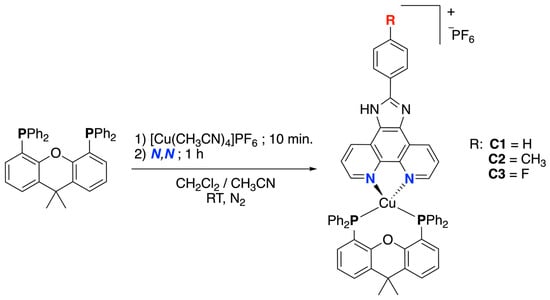
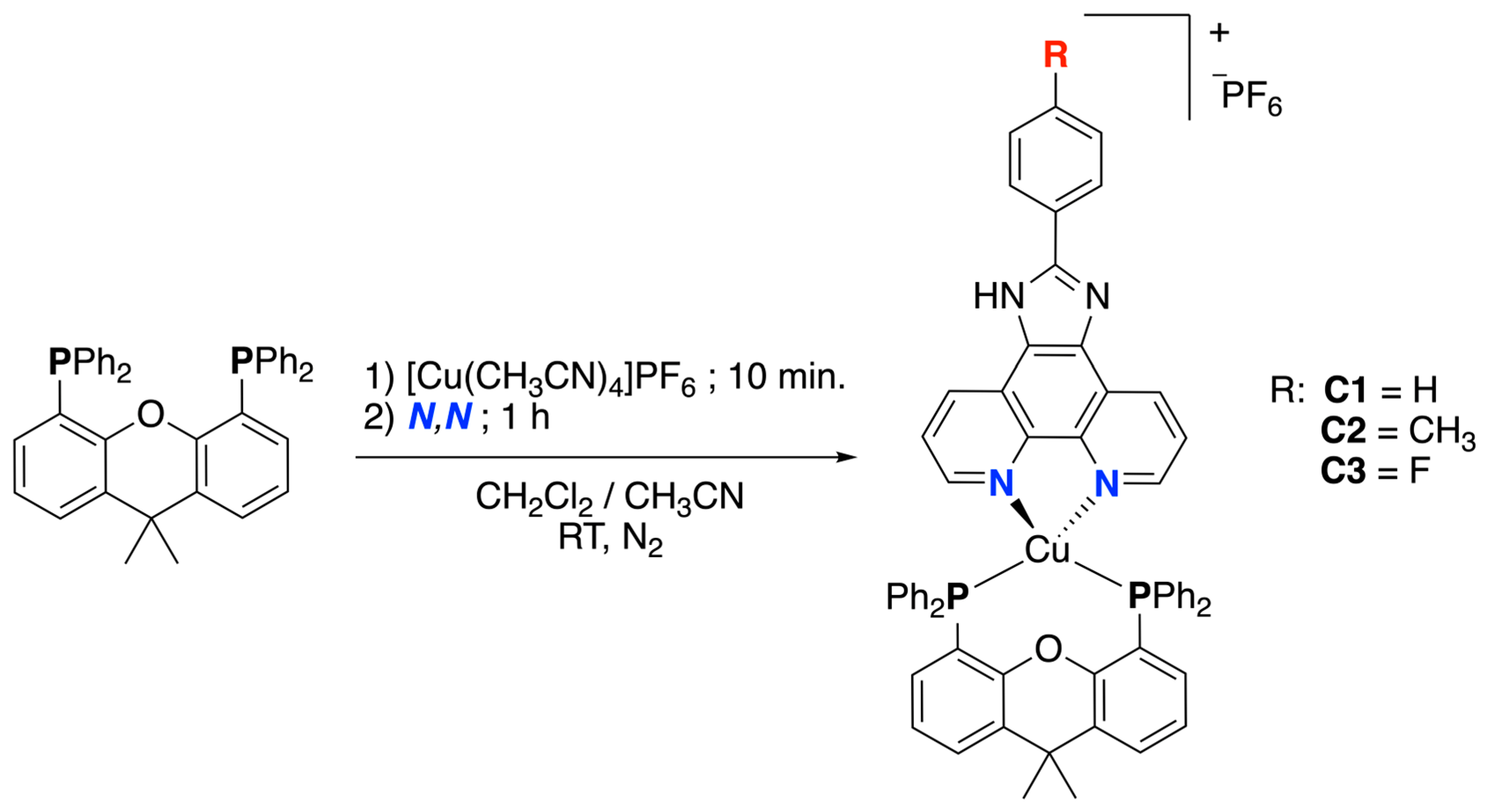
Complexes C1–3, with the general formula [Cu(N,N)(XantPhos)]PF6, were synthesized using a previously reported methodology [40,42,48]. This process involved reacting equimolar amounts of the copper(I) precursor [Cu(CH3CN)4]PF6 with XantPhos under inert conditions to form the intermediate [Cu(XantPhos)(CH3CN)2]PF6, followed by coordination with the corresponding phenanthroline-based N,N ligands L1–3 (Scheme 1). These ligands differ in the substituent at the distant phenyl ring on the imidazo[4,5-f][1,10]phenanthroline core: hydrogen (L1), methyl (L2), or fluoro (L3). All complexes were obtained as yellow powders in yields of 82–95%.
Scheme 1.
Synthetic route to obtain complexes C1–3.
Complexes C1–3 were structurally characterized using spectroscopic and spectrometric methods. The 1H NMR spectra exhibit characteristic aromatic signals for the phenanthroline/imidazo framework in the range of δ ≈ 6.8–9.5 ppm, which aligns with the highly conjugated ligand environment. The presence of the XantPhos moiety is supported by resonances in the aromatic region (ca. 6.6–8.1 ppm) and the distinct singlet at δ ≈ 2.0 ppm for the methyl groups on the xanthene scaffold. In the 31P NMR spectra, a single broad resonance appears around −11 to −12 ppm, typical of heteroleptic Cu(I) complexes with chelating phosphines, while the PF6− anion produces a heptet at approximately −143 to −144 ppm (JP–F ≈ 713 Hz) in the same spectrum. Moreover, the 19F NMR resonance near −72 ppm confirms the presence of PF6−. When L3 (containing a fluorophenyl group) is utilized, an additional signal at −110.30 ppm is observed, attributed to the fluorine substituent on the ligand. High-resolution mass spectrometry (HRMS) analyses validate the composition of the mononuclear Cu(I) complexes, with the general formula [Cu(N,N)(XantPhos)]+, and the [M]+ peaks match well with the calculated isotopic distributions. For more details on the NMR assignments, see the Supplementary Materials.
Furthermore, several single crystals of complex C3 were measured on multiple occasions, but none yielded diffraction data with acceptable statistical parameters R and wR2. Nevertheless, the structural model shown in Figure S16 is consistent with the experimental NMR, IR, and HRMS data, confirming that the studied species corresponds to a mononuclear heteroleptic copper(I) complex.
2.2. Electrochemical Measurements
Electrochemical measurements of complexes (C1–3) were performed using cyclic voltammetry at a scan rate of 0.1 V s−1 in dry dichloromethane at 1 mmol L−1, with 0.1 mol L−1 TBAPF6 as the supporting electrolyte. The selected data from these measurements are summarized in Table 1, and the voltammograms are shown in Figure S17. All three complexes, C1–3, exhibit an irreversible oxidation process occurring between Epa values of 1.48 and 1.52 V versus SCE (see Table 1). The first oxidation is attributed to the Cu+/Cu2+ redox process. It is generally irreversible for heteroleptic copper diphosphine-diimine complexes. The trend in Epa values is C2 > C1 > C3, aligning with the electronic effects of the substituents, where the lower potential corresponds to the electron-donor (-CH3) and the higher potential to the electron-withdrawing substituents (-F). During oxidation, the complex geometry shifts from tetrahedral to square-planar. A higher Epa for the complexes indicates a more stabilized tetrahedral geometry compared to [Cu(dpq)(Xantphos)]PF6. Additionally, the reduction wave, ranging from −0.97 to −1.05 V, is most likely associated with the N,N ligand [31,49,50].
Table 1.
Summary of electrochemical a and photophysical properties of complexes C1–3.
Comparing the redox potentials of complexes C1–3 with the reported [Cu(dpq)(Xantphos)]+ complex (see Table 1) [31], where dpq stands for pyrazino[2,3-f][1,10]phenanthroline, indicates that the Highest Occupied Molecular Orbital (HOMO) is significantly more stabilized in C1–3, while the Lowest Unoccupied Molecular Orbital (LUMO) is at a relatively lower energy level in the imidazo–phenanthroline series. However, C1–3 exhibited a similar electrochemical gap (2.45–2.59 V) compared to that of [Cu(dqp)(XantPhos)]PF6 (≈2.6 V).
2.3. Photophysical Characterization
The photophysical properties of complexes C1–3 were measured both in solution and in the solid state. The first analysis presents the UV–Vis absorption spectra of C1–3, measured in dry dichloromethane at room temperature and shown in Figure S18; the data are summarized in Table 1. The spectra of the obtained complexes show intense high-energy bands (below ~350 nm), typically attributed to intra-ligand (π–π*) transitions of both the phenanthroline-derived ligand and the XantPhos framework [16,26,31,52]. At lower energies, a relatively weaker but distinct absorption band appears at ~410–415 nm for all complexes. This is commonly assigned to metal-to-ligand charge-transfer (MLCT) transitions (d→π*) [16,26,31,52]. The minor differences in absorption maxima among C1–3 (412–413 nm) suggest that the introduction of electron-donating or electron-withdrawing substituents on the distal phenyl ring of the imphen moiety exerts only a modest influence on the MLCT transitions. This is reasonable since the substituents on C2 (CH3) or C3 (F) are spatially distant from the metal center, causing relatively small shifts in the overall ligand π* energy levels compared to the unsubstituted C1.
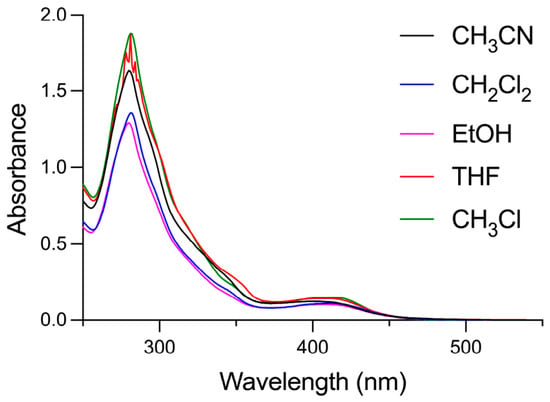
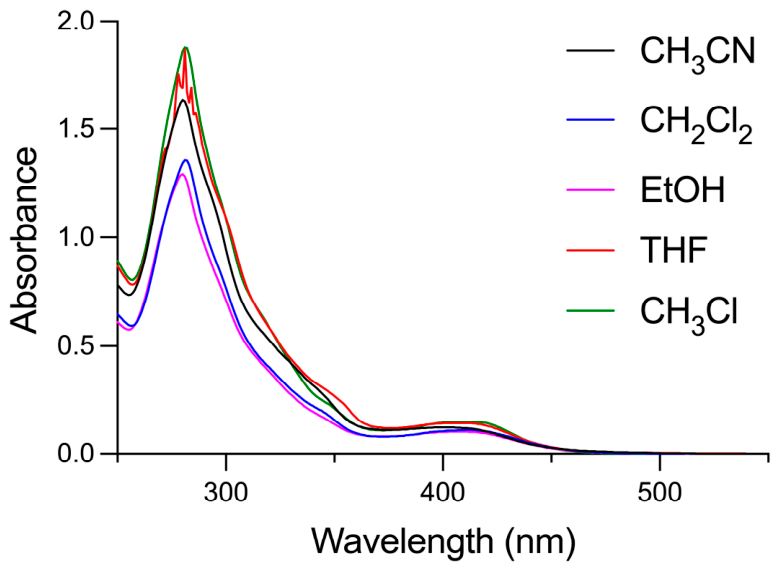
To evaluate the nature of the observed electronic transitions, the UV–Vis spectra of C3 were recorded in different solvents (Figure 1). The spectra show similar profiles across solvents, with an intense absorption band centered at approximately 280 nm that is essentially independent of the solvent. In contrast, a weaker secondary band around 410 nm is observed, showing greater sensitivity to the solvent environment. This behavior can be explained by the different electronic nature of the two transitions. The intense band at 280 nm is essentially solvent-independent because it arises from a ligand-centered (π–π*) transition, which involves minimal change in dipole moment and therefore weak interaction with the surrounding medium. In contrast, the weaker band at 410 nm shows greater solvent sensitivity, suggesting partial charge-transfer character (e.g., MLCT or LLCT), in which excitation involves a larger redistribution of electron density that is more strongly stabilized by the solvent [53,54].
Figure 1.
UV-vis absorption spectra of C3 in different solvents at room temperature.
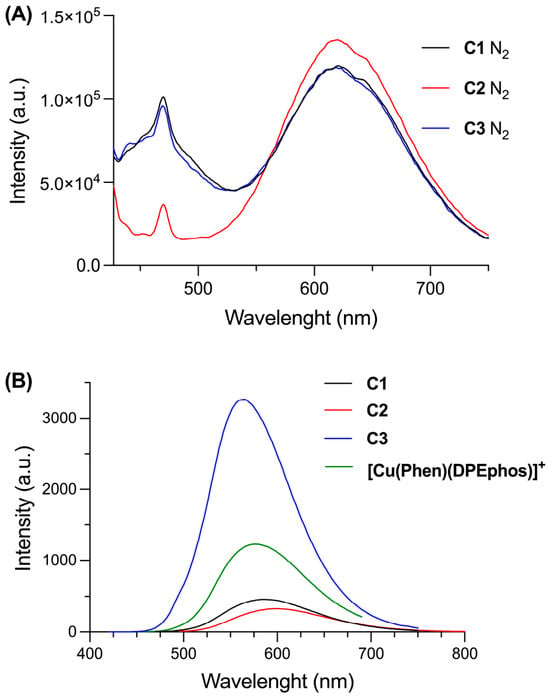
On the other hand, the emission properties of the Cu(I) complexes C1–3 were investigated in N2-saturated dichloromethane and in the solid state (Table 1). In deaerated CH2Cl2 at room temperature, the three complexes show the same general emissive pattern: a weak high-energy band in the blue region (468–475 nm) and a much broader, dominant low-energy band centered in the orange-red region (615–626 nm), as shown in Figure 2A. The excited-state lifetimes were determined to be 16.5 ns for C1, 134.3 ns for C2, and 19.1 ns for C3, indicating that C2 exhibits a notably longer lifetime, although still within the nanosecond regime. All complexes show low photoluminescence quantum yields (F ≈ 0.4%). To elucidate the origin of the emission, the spectra of the free ligands L1–3 were recorded in acetonitrile, showing maxima at 429, 429, and 423 nm, respectively. The similarity between the ligand and complex emission profiles suggests that the higher-energy band arises from a ligand-centered (LC) transition associated with the N,N ligand.
Figure 2.
Emission spectra of C1–3 in (A) anhydrous N2-saturated CH2Cl2 and (B) solid-state.
Conversely, the broad band observed above 600 nm is absent in the spectra of the free ligands, supporting its assignment to a metal-to-ligand charge transfer (MLCT) emission. This interpretation is consistent with previous reports on heteroleptic Cu(I) complexes featuring diimine and bisphosphine ligands [16,21,26,55].
Furthermore, both emission bands show a significant decrease in intensity under air-equilibrated conditions (Figures S19–S21), indicating that both the high-energy (LC/ILCT) and low-energy (MLCT) emissions involve triplet-character states (3LC/3ILCT and 3MLCT). Notably, complex C1 exhibits greater oxygen sensitivity in the high-energy band, suggesting differences in excited-state dynamics across the series. These results support that the observed dual emission arises from a manifold of coupled excited states rather than from purely singlet transitions.
In the solid state, complexes C1–3 display a single, significantly more intense band centered at 564–595 nm (Figure 2B). The close alignment with the benchmark 3MLCT emitter [Cu(Phen)(DPEPhos)]PF6 strongly suggests that the emissive state is a 3MLCT. The increase in intensity is typical of a rigidochromic effect: crystal packing limits the flattening of the Cu(I) coordination sphere and reduces thermally activated non-radiative decay. Extra π–π interactions between neighboring N,N ligands, observed in related Cu(I)–phenanthroline lattices, likely help contribute to this suppression [46].
Among the series, C3 is the brightest solid-state emitter, with a maximum at 564 nm, slightly blue-shifted relative to C1 (586 nm) and C2 (595 nm). This trend is attributed to the para-fluorine substituent on the phenyl ring of the imidazo[4,5-f][1,10]phenanthroline ligand. Weak C–H···F hydrogen bonds and dipolar interactions with adjacent H-N moieties may tighten lattice packing, damp vibrational relaxation, and further amplify emission [56,57,58].
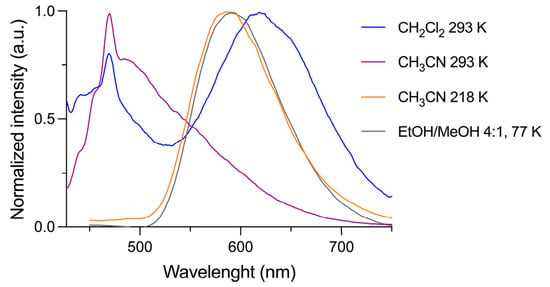
To gain deeper insight into the emissive properties, the emission spectra of C3 were recorded in acetonitrile under both air-equilibrated and N2 atmospheres at 293 K, as well as in acetonitrile at 218 K under N2 and in an EtOH/MeOH (4:1) glassy matrix at 77 K, as shown in Figure 3 and Figure S22. The comparison of spectra recorded in CH2Cl2 and CH3CN (Figure 3) confirms the dual emission of C3, with a higher-energy, relatively structured band and a broader, lower-energy contribution. Here, the solvent modulates the energy balance between these two emissive states, which differ in polarity and degree of structural relaxation. In CH2Cl2, the lower-energy emission band remains clearly observable, whereas in CH3CN, its contribution is significantly reduced, resulting in a spectrum dominated by the higher-energy emission band. This behavior is consistent with the coexistence of a higher-energy state, likely with greater ligand-centered (LC) character, and a lower-energy, more polarized and structurally relaxed state, characteristic of MLCT emission. Additionally, the spectra in acetonitrile under N2 and air show the same spectral shape (Figure S22), with a significant decrease in emission intensity under oxygen. This observation is consistent with the results obtained using CH2Cl2, supporting the conclusion that the lower-energy emission band has a triplet component.
Figure 3.
Normalized emission spectra of C3 recorded under different conditions.
Furthermore, upon cooling either the acetonitrile solution from 293 to 218 K or using EtOH/MeOH (4:1) glassy matrix at 77 K (Figure 3), the emission profile undergoes a pronounced transformation, evolving from a spectrum with a significant high-energy contribution to one dominated by a broad, strongly red-shifted band at 590 nm. This behavior is consistent with a thermally controlled redistribution of the excited-state population, in which emission from a lower-energy, more relaxed MLCT state becomes predominant at low temperature. These temperature-dependent spectral changes may indicate thermally activated processes involving emissive triplet states, potentially consistent with TADF-like behavior in C3. At 218 K and 77 K, the available thermal energy is insufficient to enable T1→S1 up-conversion, resulting instead in a more bathochromically shifted 3MLCT emission.
2.4. Aggregation-Induced Emission Evaluation
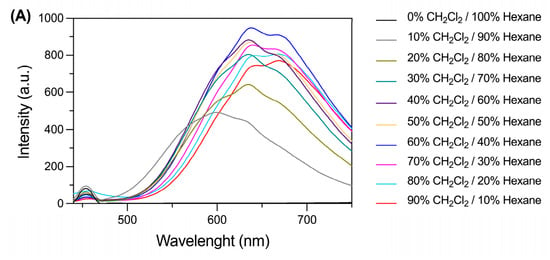
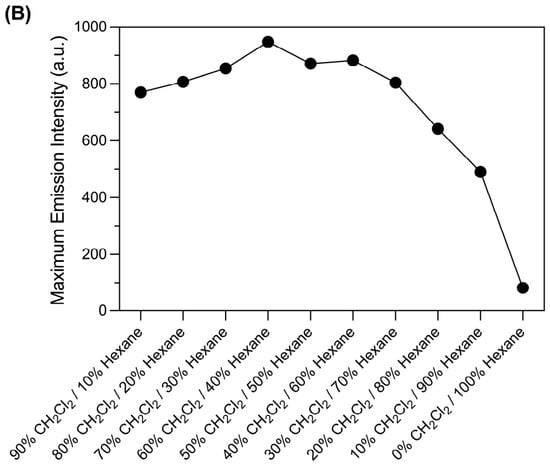
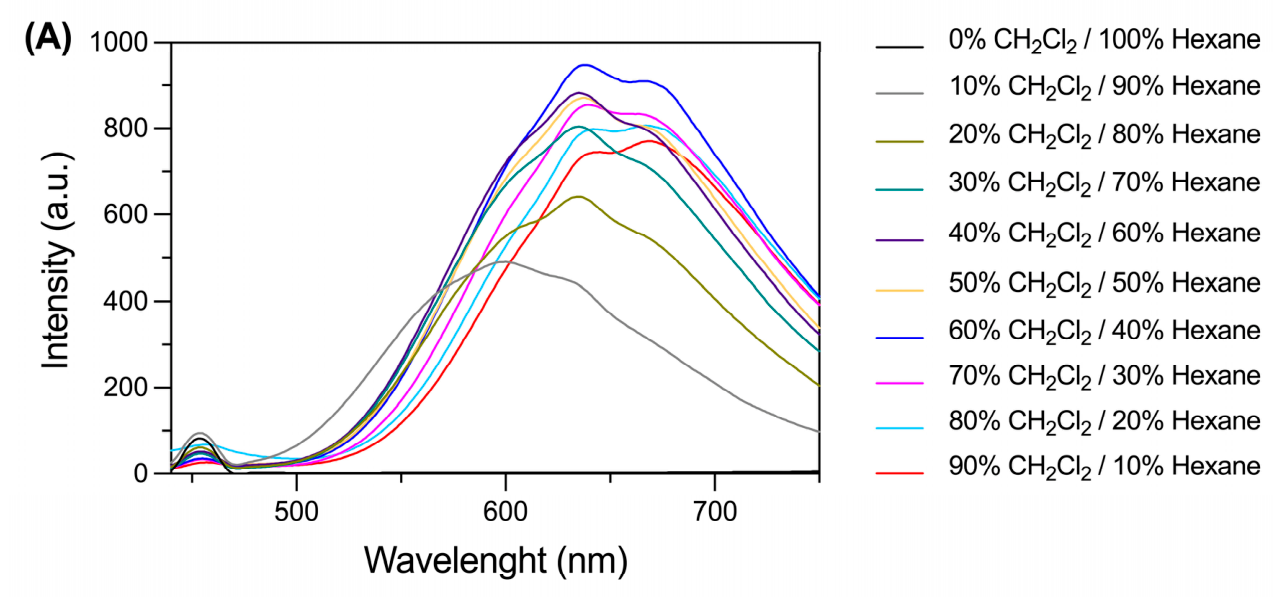
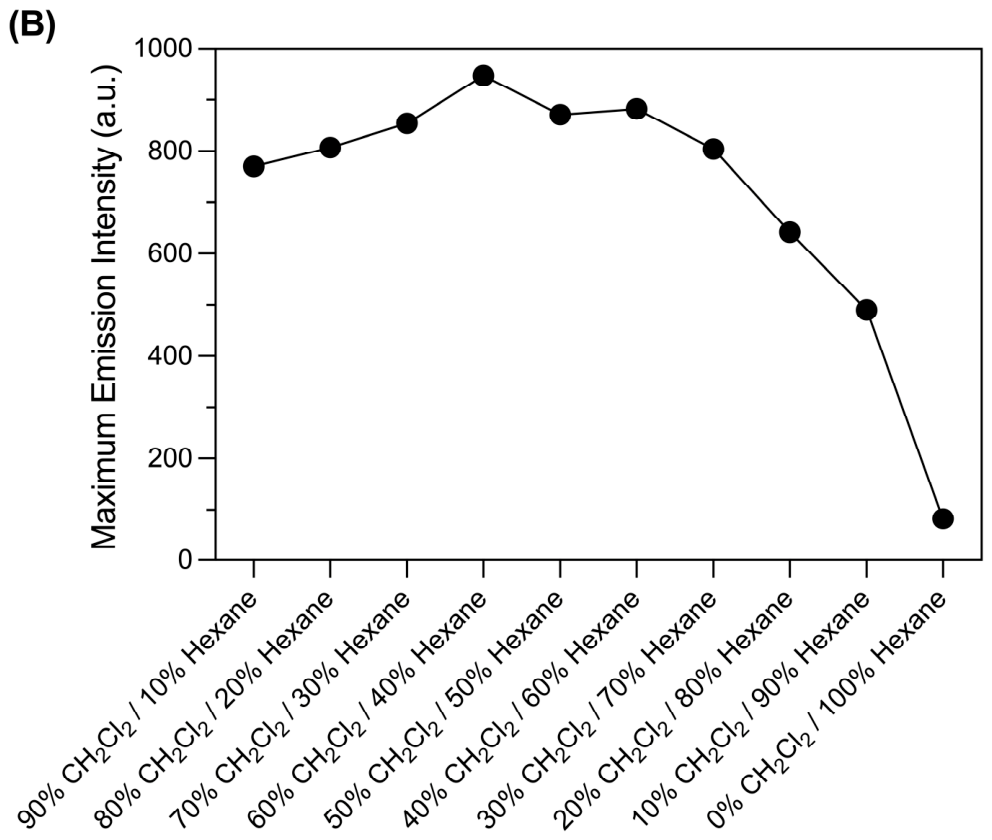
To verify that the enhanced solid-state emission is not solely due to MLCT stabilization, aggregate formation was investigated using solvent-mixture experiments. Emission spectra of several solutions with varying ratios of a good solvent (dichloromethane) and a poor solvent (hexane) were measured for complex C3 at a concentration of 9.1 × 10⁻⁵ M. As shown in Figure 4A, the systematic increase in the hexane proportion leaves the ~450 nm band essentially unchanged, while the low-energy band (~630 nm) grows in intensity. However, at hexane fractions above 60%, emission decreases. This behavior is better illustrated in Figure 4B, which shows the relationship between the maximum emission intensity and the proportions of the solvent mixture. The tendency toward increased maximum emission intensity in C3 supports an aggregation-induced emission (AIE) mechanism. The increase in intensity is not merely a refractive-index effect; it correlates with aggregate formation that restricts intramolecular motion, explaining why emission is much stronger in films or powders than in solution. The latter decrease in emission intensity is attributable to excessive aggregation, which leads to self-quenching and precipitation of the complex. This behavior aligns with previous studies on analogous Cu(I) complexes [39,45,46,47,59].
Figure 4.
(A) Emission spectra of C3 in various CH2Cl2/hexane mixture proportions. (B) Maximum emission intensity for each solvent mixture proportion.
3. Materials and Methods
3.1. General Information
Tetrakis(acetonitrile)copper(I) hexafluorophosphate, 4,5-bis(diphenylphosphino)-9,9-dimethylxanthene (XantPhos), and 1,10-phenanthroline (phen) were purchased from commercial sources and were used without further purification. Solvents (dichloromethane, diethyl ether, acetonitrile, hexanes, and toluene) were obtained from commercial sources and dried with activated molecular sieves. Ligands L1–3 were synthesized according to the reported procedure [60,61,62]. NMR spectra were recorded on a Bruker AVANCE 400 instrument (Bruker, Billerica, MA, USA). Chemical shifts are given in parts per million relative to TMS [1H and 13C, δ(SiMe4) = 0.0] or an external standard [δ(CFCl3) = 0.0 for 19F NMR and δ(H3PO4) = 0.0 for 31P NMR]. Additional 2D experiments supported most NMR assignments. FT-IR spectra were recorded on a Shimadzu IRTracer-100 Spectrophotometer (Shimadzu, Kyoto, Japan), using potassium bromide (KBr) as the solid matrix. High-resolution mass spectra were obtained using a ThermoFisher Scientific Exactive™ Plus Orbitrap Spectrometer (ThermoFisher Scientific, Bremen, Germany). UV-Vis absorption spectra were recorded using a Shimadzu UV-1900i spectrophotometer (Shimadzu, Kyoto, Japan). Electrochemical measurements were performed using a PalmSens 3 Instrument Potentiostat (PalmSens, Utrecht, The Netherlands) in a typical three-electrode electrochemical cell, with a Pt wire as the counter electrode, a saturated Ag/AgCl reference electrode, and a glassy carbon working electrode (0.196 cm2). The supporting electrolyte was 0.1 mol L−1 tetrabutylammonium hexafluorophosphate (TBAPF6) in anhydrous CH2Cl2. The complex concentration was 1 × 10⁻³ mol L−1 [40,48]. Emission spectra were recorded on a Shimadzu RF-6000 Spectrophotometer (Shimadzu, Kyoto, Japan). The 77 K luminescence measurements were performed by freezing alcoholic solutions (methanol/ethanol, 4:1) and recording the spectra on a Jasco FP-8550 spectrofluorometer (Jasco, Tokyo, Japan).
3.2. General Synthesis of Heteroleptic Cu(I) Complexes
In a sealed, nitrogen-purged vial, one equiv. of [Cu(CH3CN)4]PF6 was dissolved in anhydrous acetonitrile. In another nitrogen-purged vial, one equiv. of XantPhos was dissolved in anhydrous dichloromethane. Once both solutions were homogeneous, the XantPhos solution was added dropwise to the [Cu(CH3CN)4]PF6 precursor solution and stirred for 10 min under a nitrogen atmosphere at room temperature to form the [Cu(XantPhos)(CH3CN)2]PF6 intermediate. In a separate, sealed, and nitrogen-purged vial, one equiv. of the respective ligand (L1–3), and 5 mL of anhydrous dichloromethane were added, forming a suspension of the ligand. Afterward, the intermediate [Cu(XantPhos)(CH3CN)2]PF6 in dichloromethane/acetonitrile solution was added to the ligand suspension and kept under a nitrogen atmosphere with constant stirring for 1 h to form the corresponding complex C1–3. Then, the volatiles were removed under reduced pressure, and the crude product was recrystallized using a mixture of dichloromethane and toluene at a low temperature (−20 °C).
Complex C1. Yellow powder, 95% yield (343 mg, 316 mmol). 1H NMR (400 MHz, CDCl3, 298 K): δ/ppm = 9.17 (d, J = 8.2 Hz, 2H), 8.37 (d, J = 7.7 Hz, 2H), 8.27 (br., 2H), 7.69 (d, J = 7.7 Hz, 2H), 7.55 (dd, J = 8.3, 4.7 Hz, 2H), 7.37 (t, J = 7.7 Hz, 2H), 7.28–7.24 (m, 1H), 7.17 (dd, J = 8.2, 5.7 Hz, 8H), 7.03 (t, J = 7.5 Hz, 8H), 6.92 (q, J = 6.1 Hz, 8H), 6.60 (dt, J = 7.8, 3.8 Hz, 2H), 1.80 (s, 6H). H24 not observed.13C{1H} NMR (100 MHz, CDCl3, 298 K): δ/ppm = 155.10 (t, JC–P = 6.4 Hz), 153.01, 146.70, 141.17, 137.98, 134.06 (t, JC–P = 1.9 Hz), 132.78 (t, JC–P = 8.0 Hz), 132.09, 131.55 (t, JC–P = 17.1 Hz), 131.28, 130.13, 130.01, 129.08, 129.01, 128.80 (t, JC–P = 4.8 Hz), 127.32, 127.05, 125.27 (t, JC–P = 2.7 Hz), 125.00, 123.12 (br.), 119.96 (t, JC–P = 13.6 Hz), 36.31, 28.31. 19F NMR (400 MHz, CDCl3, 298 K): δ/ppm = –72.04 (d, JF-P = 713.3 Hz). 31P{1H} NMR (160 MHz, CDCl3, 298 K): δ/ppm = −11.75 (s), −143.66 (hept, JP-F = 713.6 Hz). FT-IR (KBr, selected characteristic bands): ν/cm−1 = 3421.01, 1477.47, 1404.17, 1230.20, 840.98. HRMS(ESI): (C58H44CuN4OP2 [M]+) = Calculated 937.2286, Found 937.2283.
Complex C2. Yellow powder, 82% yield (306 mg, 278 mmol). 1H NMR (400 MHz, CDCl3, 298 K): δ/ppm = 11.74 (br., 1H), 9.18–9.07 (m, 2H), 8.42 (br., 1H), 8.24 (d, J = 7.6 Hz, 2H), 8.15 (br., 1H), 7.69 (dd, J = 7.8, 1.5 Hz, 2H), 7.60 (br., 2H), 7.31 (d, J = 7.4 Hz, 2H), 7.18–7.14 (m, 6H), 7.02 (br., 8H), 6.96 (br., 4H), 6.88 (br., 4H), 6.59 (qd, J = 4.5, 1.3 Hz, 2H), 2.37 (s, 3H), 1.83 (s, 3H), 1.78 (s, 3H). 13C{1H} NMR (100 MHz, CDCl3, 298 K): δ/ppm = 155.11 (t, JC-P = 6.3 H), 153.44, 146.76, 146.40, 141.37, 140.82, 140.53, 136.47, 134.06, 132.78, 132.03, 131.78, 131.56 (t, JC-P = 17.2 Hz), 131.30, 130.02, 129.94, 128.80 (t, JC-P = 4.7 Hz), 127.30, 126.84, 126.44, 125.27, 125.13, 124.73, 121.01, 120.04 (t, JC-P = 13.4 Hz), 36.32, 28.80, 27.82, 21.58. 19F NMR (400 MHz, CDCl3, 298 K): δ/ppm = −71.67 (d, JF-P = 714.0 Hz). 31P{1H} NMR (160 MHz, CDCl3, 298 K): δ/ppm = −11.75 (s), 144.70j (hept, JP-F = 713.7 Hz). FT-IR (KBr, selected characteristic bands): ν/cm−1 = 3421.72, 1509.21, 1403.29, 1226.60, 846.01. HRMS(ESI): (C59H46CuN4OP2 [M]+) = Calculated 951.2443, Found 951.2438.
Complex C3. Yellow powder, 91% yield (421 mg, 382 mmol). 1H NMR (400 MHz, CDCl3, 298 K): δ/ppm = 11.66 (br., 1H), 9.13 (dd, J = 31.4, 8.4 Hz, 2H), 8.64–8.02 (m, 4H), 7.72 (d, J = 7.7 Hz, 2H), 7.63 (dt, J = 7.9, 3.7 Hz, 2H), 7.30–7.13 (m, 8H), 7.10–6.85 (m, 16H), 6.67–6.55 (m, 2H), 1.85 (s, 3H), 1.81 (s, 3H). 13C{1H} NMR (100 MHz, CDCl3, 298 K): δ/ppm = 163.93 (d, JC–F = 250.4 Hz), 155.02 (t, JC–P = 6.3 Hz), 151.94, 147.05, 146.55, 141.31, 140.94, 136.43, 134.03, 132.69 (dd, JC–P = 15.5, 7.9 Hz), 131.61, 131.34 (t, JC–P = 17.2 Hz), 131.17, 129.95, 128.97 (d, JC–F = 8.6 Hz), 128.74, 127.32, 126.47, 125.20, 125.02, 120.78, 119.80 (t, JC–P = 13.7 Hz), 116.10 (d, JC–F = 21.9 Hz), 36.24, 28.61, 27.81. 19F NMR (400 MHz, CDCl3, 298 K): δ/ppm = –71.54 (d, JF-P = 713.6 Hz), –110.30 (s). 31P{1H} NMR (160 MHz, CDCl3, 298 K): δ/ppm = −11.77 (s), −141.43 (hept, JP-F = 713.8 Hz). FT-IR (KBr, selected characteristic bands): ν/cm−1 = 3356.14, 1481.33, 1404.17, 1222.87, 844.82. HRMS(ESI): (C58H43CuFN4OP2 [M]+) = Calculated 955.2192, Found 955.2187.
4. Conclusions
Three new heteroleptic copper(I) complexes of the type [Cu(N,N)(XantPhos)]PF6, containing phenyl-substituted imidazo[4,5-f][1,10]phenanthroline ligands, were successfully synthesized and characterized. Spectroscopic, electrochemical, and photophysical analyses show that subtle electronic changes induced by remote substituents (H, CH3, F) on the phenyl ring have measurable effects on photoluminescence behavior without significantly perturbing the electronic structure at the metal center.
In solution at 293 K, a weak emission is observed, consisting of a higher-energy ligand-centered (LC) band and a lower-energy MLCT contribution, the latter of which is more quenched by oxygen, confirming the predominantly triplet character of the MLCT. Solvent-dependent measurements show that the relative contribution of these bands is modulated by the medium, reflecting differences in polarity and structural relaxation.
Temperature-dependent studies further support a redistribution of the excited-state population, in which a more relaxed, red-shifted 3MLCT state becomes dominant at low temperatures, whereas at room temperature a higher-energy contribution remains significant, consistent with thermally activated processes. In contrast, the solid state exhibits intense emission due to restricted molecular motion and suppressed non-radiative decay, thereby stabilizing the 3MLCT state. Additionally, solvent-mixture experiments confirm aggregation-induced emission (AIE), where controlled aggregation enhances emission by limiting intramolecular dynamics.
These results show that peripheral ligand functionalization is an effective means of tuning the emissive properties of Cu(I) complexes in the solid state, providing useful design guidance for the development of next-generation copper-based light-emitting materials.
Supplementary Materials
The following supporting information can be downloaded at: https://www.mdpi.com/article/10.3390/inorganics14060152/s1, (Figures S1–S25).
Author Contributions
Conceptualization, I.A.G. and A.R.C.; methodology, I.A.G. and A.R.C.; validation, A.V.-M., I.A.G., and A.R.C.; formal analysis, I.A.G., and A.G.; investigation, A.V.-M., M.B., M.H.-M., S.V.-S., C.B., A.G., I.A.G., and A.R.C.; resources, C.B., A.G., I.A.G., and A.R.C.; writing—original draft preparation, A.V.-M., I.A.G., and A.R.C.; writing—review and editing, A.V.-M., I.A.G., and A.R.C.; visualization, I.A.G., and A.R.C.; supervision, I.A.G., and A.R.C.; project administration, A.V.-M., I.A.G., and A.R.C.; funding acquisition, I.A.G., and A.R.C. All authors have read and agreed to the published version of the manuscript.
Funding
This research was funded by ANID Fondecyt grant 1230199. Fondequip program EQM 160042, EQM 120021, EQM 130021, EQM 180024. Anillo ACT250016. Concurso Interno de Financiamiento Asistentes de Investigación 2025 (AI25-03). 39175004-301-81 “Apoyo Investigación Básica Química 2026” DIPOG-UC. 39171019-301-81 Proyecto Puente 2025 VRI-UC. ANID Fondecyt Postdoctoral 3230413 fellowship.
Institutional Review Board Statement
Not applicable.
Informed Consent Statement
Not applicable.
Data Availability Statement
Data are contained within the article and Supplementary Materials.
Conflicts of Interest
The authors declare no conflicts of interest.
References
- Triana, M.A.; Hsiang, E.L.; Zhang, C.C.; Dong, Y.J.; Wu, S.T. Luminescent Nanomaterials for Energy-Efficient Display and Healthcare. ACS Energy Lett. 2022, 7, 1001–1020. [Google Scholar] [CrossRef] [Scilit]
- Lee, L.C.C.; Lo, K.K.W. Shining New Light on Biological Systems: Luminescent Transition Metal Complexes for Bioimaging and Biosensing Applications. Chem. Rev. 2024, 124, 8825–9014. [Google Scholar] [CrossRef] [Scilit]
- Han, T.H.; Choi, M.R.; Jeon, C.W.; Kim, Y.H.; Kwon, S.K.; Lee, T.W. Ultrahigh-efficiency solution-processed simplified small-molecule organic light-emitting diodes using universal host materials. Sci. Adv. 2016, 2, e1601428. [Google Scholar] [CrossRef] [Scilit]
- Kong, L.M.; Zhang, X.Y.; Zhang, C.X.; Wang, L.; Wang, S.; Cao, F.; Zhao, D.W.; Rogach, A.L.; Yang, X.Y. Stability of Perovskite Light-Emitting Diodes: Existing Issues and Mitigation Strategies Related to Both Material and Device Aspects. Adv. Mater. 2022, 34, 2205217. [Google Scholar] [CrossRef] [Scilit]
- Tankeleviciute, E.; Samuel, I.D.W.; Zysman-Colman, E. The Blue Problem: OLED Stability and Degradation Mechanisms. J. Phys. Chem. Lett. 2024, 15, 1034–1047. [Google Scholar] [CrossRef] [Scilit]
- Kwon, J.H.; Jeon, Y.; Lee, T.Y.; Son, Y.H.; Lee, H.; Baek, D.H.; Lee, S.W.; Kim, T.S. Highly efficient, reliable, and ultraflexible bio-organic light-emitting diode patch. Npj Flex. Electron 2025, 9, 55. [Google Scholar] [CrossRef] [Scilit]
- Farokhi, A.; Lipinski, S.; Cavinato, L.M.; Shahroosvand, H.; Pashaei, B.; Karimi, S.; Bellani, S.; Bonaccorso, F.; Costa, R.D. Metal complex-based TADF: Design, characterization, and lighting devices. Chem. Soc. Rev. 2025, 54, 266–340. [Google Scholar] [CrossRef] [Scilit]
- Giobbio, G.; Costa, R.D.; Gaillard, S. Earth-abundant transition metal complexes in light-emitting electrochemical cells: Successes, challenges and perspectives. Dalton Trans. 2025, 54, 3573–3580. [Google Scholar] [CrossRef] [Scilit]
- Lee, L.C.C.; Lo, K.K.W. Brightening New Horizons: Luminescent Transition Metal Complexes in Optical Imaging and Theranostic Applications. ACS Cent. Sci. 2025, 11, 1289–1305. [Google Scholar] [CrossRef] [Scilit]
- Yersin, H.; Rausch, A.F.; Czerwieniec, R.; Hofbeck, T.; Fischer, T. The triplet state of organo-transition metal compounds. Triplet harvesting and singlet harvesting for efficient OLEDs. Coord. Chem. Rev. 2011, 255, 2622–2652. [Google Scholar] [CrossRef] [Scilit]
- Paul, J.J.; Chaitanya, K.S.; Ganesan, R.; Jha, P.; Sekhar, K.V.G.C.; Sindhu, S. Zinc based organic metal complexes for OLED applications. Synth. Met. 2026, 316, 117980. [Google Scholar] [CrossRef] [Scilit]
- Sree, V.G.; Jana, A.; Cho, S.C.; Lee, S.U.; Cho, S.; Sohn, J.I.; Im, H. Green and warm-white light-emitting diodes enabled by zero-dimensional green-emitting Mn(II) bromide complex with record high efficiency. Chem. Eng. J. 2023, 474, 145936. [Google Scholar] [CrossRef] [Scilit]
- Banerjee, S.; Singh, P.; Purkayastha, P.; Ghosh, S.K. Evolution of Organic Light Emitting Diode (OLED) Materials and their Impact on Display Technology. Chem.-Asian J. 2025, 20, e202401291. [Google Scholar] [CrossRef] [Scilit]
- Fresta, E.; Costa, R.D. Beyond traditional light-emitting electrochemical cells—A review of new device designs and emitters. J. Mater. Chem. C 2017, 5, 5643–5675. [Google Scholar] [CrossRef] [Scilit]
- Ferraro, V.; Bizzarri, C.; Bräse, S. Thermally Activated Delayed Fluorescence (TADF) Materials Based on Earth-Abundant Transition Metal Complexes: Synthesis, Design and Applications. Adv. Sci. 2024, 11, 2404866. [Google Scholar] [CrossRef] [Scilit]
- Zhang, Y.; Schulz, M.; Wächtler, M.; Karnahl, M.; Dietzek, B. Heteroleptic diimine–diphosphine Cu(I) complexes as an alternative towards noble-metal based photosensitizers: Design strategies, photophysical properties and perspective applications. Coord. Chem. Rev. 2018, 356, 127–146. [Google Scholar] [CrossRef] [Scilit]
- Mughal, E.U.; Kainat, S.F.; Almohyawi, A.M.; Naeem, N.; Hussein, E.M.; Sadiq, A.; Abd-El-Aziz, A.; Ma, N.; Abd-El-Aziz, A.S.; Timoumi, A.; et al. Thermally activated delayed fluorescence materials: Innovative design and advanced application in biomedicine, catalysis and electronics. RSC Adv. 2025, 15, 7383–7471. [Google Scholar] [CrossRef] [Scilit]
- Keller, S.; Prescimone, A.; Constable, E.C.; Housecroft, C.E. Copper(I) and silver(I) complexes of 9,9-dimethyl-4,5-bis(di-tert-butylphosphino)xanthene: Photophysical properties and structural rigidity under pressure. Photochem. Photobiol. Sci. 2018, 17, 375–385. [Google Scholar] [CrossRef] [Scilit]
- Blasse, G.; Mcmillin, D.R. On the luminescence of bis (triphenylphosphine) phenanthroline copper (I). Chem. Phys. Lett. 1980, 70, 1–3. [Google Scholar] [CrossRef] [Scilit]
- Cuttell, D.G.; Kuang, S.M.; Fanwick, P.E.; McMillin, D.R.; Walton, R.A. Simple Cu(I) complexes with unprecedented excited-state lifetimes. J. Am. Chem. Soc. 2002, 124, 6–7. [Google Scholar] [CrossRef] [Scilit]
- Leoni, E.; Mohanraj, J.; Holler, M.; Mohankumar, M.; Nierengarten, I.; Monti, F.; Sournia-Saquet, A.; Delavaux-Nicot, B.; Nierengarten, J.F.; Armaroli, N. Heteroleptic Copper(I) Complexes Prepared from Phenanthroline and Bis-Phosphine Ligands: Rationalization of the Photophysical and Electrochemical Properties. Inorg. Chem. 2018, 57, 15537–15549. [Google Scholar] [CrossRef] [Scilit]
- Penfold, T.J.; Karlsson, S.; Capano, G.; Lima, F.A.; Rittmann, J.; Reinhard, M.; Rittmann-Frank, M.H.; Braem, O.; Baranoff, E.; Abela, R.; et al. Solvent-Induced Luminescence Quenching: Static and Time-Resolved X-Ray Absorption Spectroscopy of a Copper(I) Phenanthroline Complex. J. Phys. Chem. A 2013, 117, 4591–4601. [Google Scholar] [CrossRef] [Scilit]
- Keller, S.; Bantle, M.; Prescimone, A.; Constable, E.C.; Housecroft, C.E. Hinged and Wide: A New PP Ligand for Emissive [Cu(PP)(NN)][PF6] Complexes. Molecules 2019, 24, 3934. [Google Scholar] [CrossRef] [Scilit]
- Mahoro, G.U.; Fernandez-Cestau, J.; Renaud, J.L.; Coto, P.B.; Costa, R.D.; Gaillard, S. Recent Advances in Solid-State Lighting Devices Using Transition Metal Complexes Exhibiting Thermally Activated Delayed Fluorescent Emission Mechanism. Adv. Opt. Mater. 2020, 8, 2000260. [Google Scholar] [CrossRef] [Scilit]
- Brunner, F.; Martínez-Sarti, L.; Keller, S.; Pertegás, A.; Prescimone, A.; Constable, E.C.; Bolink, H.J.; Housecroft, C.E. Peripheral halo-functionalization in [Cu(NN)(PP)]+ emitters: Influence on the performances of light-emitting electrochemical cells. Dalton Trans. 2016, 45, 15180–15192. [Google Scholar] [CrossRef] [Scilit]
- Nohara, I.; Keller, A.; Tarassenko, N.; Prescimone, A.; Constable, E.C.; Housecroft, C.E. Heteroleptic [Cu(PP)(NN)][PF6] Compounds with Isomeric Dibromo-1,10-Phenanthroline Ligands. Inorganics 2020, 8, 4. [Google Scholar] [CrossRef] [Scilit]
- Costa, R.D. Light-Emitting Electrochemical Cells; Springer Nature: Berlin/Heidelberg, Germany, 2017; Volume 1. [Google Scholar]
- Housecroft, C.E.; Constable, E.C. Over the LEC rainbow: Colour and stability tuning of cyclometallated iridium(III) complexes in light-emitting electrochemical cells. Coord. Chem. Rev. 2017, 350, 155–177. [Google Scholar] [CrossRef] [Scilit]
- Alsaeedi, M.S. Insight into luminescent iridium complexes: Their potential in light-emitting electrochemical cells. J. Saudi. Chem. Soc. 2022, 26, 101442. [Google Scholar] [CrossRef] [Scilit]
- Pal, A.K.; Cordes, D.B.; Slawin, A.M.Z.; Momblona, C.; Ortí, E.; Samuel, I.D.W.; Bolink, H.J.; Zysman-Colman, E. Synthesis, Properties, and Light-Emitting Electrochemical Cell (LEEC) Device Fabrication of Cationic Ir(III) Complexes Bearing Electron-Withdrawing Groups on the Cyclometallating Ligands. Inorg. Chem. 2016, 55, 10361–10376. [Google Scholar] [CrossRef] [Scilit]
- Zhang, Y.; Traber, P.; Zedler, L.; Kupfer, S.; Gräfe, S.; Schulz, M.; Frey, W.; Karnahl, M.; Dietzek, B. Cu(I) vs Ru(II) photosensitizers: Elucidation of electron transfer processes within a series of structurally related complexes containing an extended π-system. Phys. Chem. Chem. Phys. 2018, 20, 24843–24857. [Google Scholar] [CrossRef] [Scilit]
- Bizzarri, C.; Spuling, E.; Knoll, D.M.; Volz, D.; Bräse, S. Sustainable metal complexes for organic light-emitting diodes (OLEDs). Coord. Chem. Rev. 2018, 373, 49–82. [Google Scholar] [CrossRef] [Scilit]
- Bizzarri, C.; Hundemer, F.; Busch, J.; Bräse, S. Triplet emitters versus TADF emitters in OLEDs: A comparative study. Polyhedron 2018, 140, 51–66. [Google Scholar] [CrossRef] [Scilit]
- Du, L.K.; Lan, Z.G. Ultrafast structural flattening motion in photoinduced excited state dynamics of a bis(diimine) copper(I) complex. Phys. Chem. Chem. Phys. 2016, 18, 7641–7650. [Google Scholar] [CrossRef] [Scilit]
- Iwamura, M.; Takeuchi, S.; Tahara, T. Ultrafast Excited-State Dynamics of Copper(I) Complexes. Acc. Chem. Res. 2015, 48, 782–791. [Google Scholar] [CrossRef] [Scilit]
- Castellano, F.N.; Rosko, M.C. Steric and Electronic Influence of Excited-State Decay in Cu(I) MLCT Chromophores. Acc. Chem. Res. 2024, 57, 2872–2886. [Google Scholar] [CrossRef] [Scilit]
- Moonshiram, D.; Garrido-Barros, P.; Gimbert-Suriñach, C.; Picón, A.; Liu, C.M.; Zhang, X.Y.; Karnahl, M.; Llobet, A. Elucidating the Nature of the Excited State of a Heteroleptic Copper Photosensitizer by using Time-Resolved X-ray Absorption Spectroscopy. Chem. Eur. J. 2018, 24, 6464–6472. [Google Scholar] [CrossRef] [Scilit]
- Zhang, Y.; Zedler, L.; Karnahl, M.; Dietzek, B. Excited-state dynamics of heteroleptic copper(i) photosensitizers and their electrochemically reduced forms containing a dipyridophenazine moiety—A spectroelectrochemical transient absorption study. Phys. Chem. Chem. Phys. 2019, 21, 10716–10725. [Google Scholar] [CrossRef] [Scilit]
- Zhang, X.; Wu, Z.; Xu, J.Y.; Li, W.X.; Li, X.L. Synthesis, structures and naked-eye phosphorescence of 2-(6-Methoxynaphthyl)-1H-imidazo[4,5-f][1,10]phenanthroline-Cu(I) complexes. Polyhedron 2021, 202, 115197. [Google Scholar] [CrossRef] [Scilit]
- Henriquez, M.A.; Engl, S.; Jaque, P.; Gonzalez, I.A.; Natali, M.; Reiser, O.; Cabrera, A.R. Phosphine Evaluation on a New Series of Heteroleptic Copper(I) Photocatalysts with dpa Ligand [Cu(dpa)(P,P)]BF4. Eur. J. Inorg. Chem. 2021, 2021, 4020–4029. [Google Scholar] [CrossRef] [Scilit]
- Yang, L.; Feng, J.K.; Ren, A.M.; Zhang, M.; Ma, Y.G.; Liu, X.D. Structures, electronic states and electroluminescent properties of a series of Cu I complexes. Eur. J. Inorg. Chem. 2005, 2005, 1867–1879. [Google Scholar] [CrossRef] [Scilit]
- Villegas-Menares, A.; Hansmann, Y.B.; Bayas, M.; Verdugo, C.; Erazo, I.; Zuñiga, C.; Gonzalez, I.; Galdámez, A.; Villa, L.; Natali, M.; et al. Exploring catalytic activity modulations: Photoredox catalysis with substituted copper(I)-dipyridylamine derivatives. Dalton Trans. 2025, 54, 7306–7314. [Google Scholar] [CrossRef] [Scilit]
- Keller, S.; Alkan-Zambada, M.; Prescimone, A.; Constable, E.C.; Housecroft, C.E. Extended π-Systems in Diimine Ligands in [Cu(P∧P)(N∧N)][PF6] Complexes: From 2,2′-Bipyridine to 2-(Pyridin-2-yl)Quinoline. Crystals 2020, 10, 255. [Google Scholar] [CrossRef] [Scilit]
- Jiang, J.; Zhao, Y.; Li, Z.; Ye, Y.; Wu, Z.; Jiang, F.; Chen, L.; Hong, M. Copper(I) Halide Complex Featuring Blue Thermally Activated Delayed Fluorescence and Aggregate Induced Emission for Efficient X-ray Scintillation and Imaging. Angew. Chem. Int. Ed. Engl. 2025, 64, e202422995. [Google Scholar] [CrossRef] [Scilit]
- Shi, Y.; Liu, X.; Shan, Y.Y.; Zhang, X.; Kong, W.B.; Lu, Y.N.; Tan, Z.D.; Li, X.L. Naked-eye repeatable off-on-off and on-off-on switching luminescence of copper(i)-1-imidazo[4,5-f][1,10]phenanthroline complexes with reversible acid-base responses. Dalton Trans. 2019, 48, 2430–2441. [Google Scholar] [CrossRef] [Scilit]
- Liu, R.; Huang, M.M.; Yao, X.X.; Li, H.H.; Yang, F.L.; Li, X.L. Synthesis, structures and aggregation-induced emissive properties of copper(I) complexes with 1H-imidazo[4,5-f][1,10]phenanthroline derivative and diphosphine as ligands. Inorg. Chim. Acta 2015, 434, 172–180. [Google Scholar] [CrossRef] [Scilit]
- Liu, X.; Shan, Y.Y.; Xu, J.; Zhang, X.; Shang, S.T.; Li, X.L. Alcohol soluble Cu(I) complexes with aggregation-induced phosphorescent emission in ethanol/water solvents. Polyhedron 2019, 164, 152–158. [Google Scholar] [CrossRef] [Scilit]
- Moreno da Costa, D.; Henriquez, M.A.; Gonzalez-Torres, D.; Zuñiga-Loyola, C.; Brito, I.; González, I.; Villegas-Menares, A.; MacLeod-Carey, D.; Morales-Verdejo, C.; Cabrera, A.R. Influence of the thermal stability of ammonium perchlorate in presence of heteroleptic copper (I) complexes bearing ethane-1,2-diimine and biphosphines. Inorg. Chim. Acta 2023, 545, 121249. [Google Scholar] [CrossRef] [Scilit]
- Alkan-Zambada, M.; Keller, S.; Martínez-Sarti, L.; Prescimone, A.; Junquera-Hernández, J.M.; Constable, E.C.; Bolink, H.J.; Sessolo, M.; Ortí, E.; Housecroft, C.E. [Cu(P∧P)(N∧N)][PF6] compounds with bis(phosphane) and 6-alkoxy, 6-alkylthio, 6-phenyloxy and 6-phenylthio- substituted 2,2-bipyridine ligands for light-emitting electrochemical cells. J. Mater. Chem. C 2018, 6, 8460–8471. [Google Scholar] [CrossRef] [Scilit]
- Meyer, M.; Mardegan, L.; Tordera, D.; Prescimone, A.; Sessolo, M.; Bolink, H.J.; Constable, E.C.; Housecroft, C.E. A counterion study of a series of [Cu(P∧P)(N∧N)][A] compounds with bis(phosphane) and 6-methyl and 6,6′-dimethyl-substituted 2,2′-bipyridine ligands for light-emitting electrochemical cells. Dalton Trans. 2021, 50, 17920–17934. [Google Scholar] [CrossRef] [Scilit]
- Levitus, M. Tutorial: Measurement of fluorescence spectra and determination of relative fluorescence quantum yields of transparent samples. Method Appl. Fluoresc. 2020, 8, 033001. [Google Scholar] [CrossRef] [Scilit]
- Beaudelot, J.; Evano, G.; Moucheron, C. Structure-Property Relationships in a New Family of Photoactive Diimine-Diphosphine Copper(I) Complexes. Chem. Eur. J. 2023, 29, e202300758. [Google Scholar] [CrossRef] [Scilit]
- Li, X.N.; Wu, Z.J.; Zhang, H.J.; Si, Z.J.; Zhou, L.; Liu, X.J. The Reasons for Ligand-Dependent Quantum Yields and Absorption Spectrum of Four Polypyridylruthenium(II) Complexes with a Tetrazolate-Based Ligand: TDDFT Study. Eur. J. Inorg. Chem. 2009, 2009, 4052–4061. [Google Scholar] [CrossRef] [Scilit]
- Kinzhalov, M.A.; Grachova, E.V.; Luzyanin, K.V. Tuning the luminescence of transition metal complexes with acyclic diaminocarbene ligands. Inorg. Chem. Front. 2022, 9, 417–439. [Google Scholar] [CrossRef] [Scilit]
- Cruché, C.; Gupta, S.; Kodanko, J.; Collins, S.K. Heteroleptic Copper(I)-Based Complexes Incorporating BINAP and π-Extended Diimines: Synthesis, Catalysis and Biological Applications. Molecules 2022, 27, 3745. [Google Scholar] [CrossRef] [Scilit]
- Rizzo, G.; Blasi, D.; Ragni, R.; Farinola, G.M. New insights in luminescent fluorinated transition metal compounds. Adv. Organomet. Chem. 2022, 78, 189–231. [Google Scholar] [CrossRef] [Scilit]
- Yamada, S.; Mitsuda, A.; Miyano, K.; Tanaka, T.; Morita, M.; Agou, T.; Kubota, T.; Konno, T. Development of Novel Solid-State Light-Emitting Materials Based on Pentafluorinated Tolane Fluorophores. ACS Omega 2018, 3, 9105–9113. [Google Scholar] [CrossRef] [Scilit]
- Zanizdra, S.R.; Korshunov, V.M.; Metlin, M.T.; Metlina, D.A.; Gontcharenko, V.E.; Taydakov, I. Exploring the effect of fluorine radicals as substituents in (3-diketones on the luminescence properties of Eu3+complexes. Opt. Mater. 2025, 160, 116780. [Google Scholar] [CrossRef] [Scilit]
- Xin, X.L.; Chen, M.; Ai, Y.B.; Yang, F.L.; Li, X.L.; Li, F.Y. Aggregation-Induced Emissive Copper(I) Complexes for Living Cell Imaging. Inorg. Chem. 2014, 53, 2922–2931. [Google Scholar] [CrossRef] [Scilit]
- Sun, D.D.; Wang, W.Z.; Mao, J.W.; Mei, W.J.; Liu, J. Imidazo [4,5f][1,10] phenanthroline derivatives as inhibitor of c-myc gene expression in A549 cells via NF-κB pathway. Bioorg. Med. Chem. Lett. 2012, 22, 102–105. [Google Scholar] [CrossRef] [Scilit]
- Wu, J.Z.; Li, L.; Zeng, T.X.; Ji, L.N.; Zhou, J.Y.; Luo, T.; Li, R.H. Synthesis, characterization and luminiscent DNA-binding study of a series of ruthenium complexes containing 2-arylimidazo[f]1,10-phenanthroline. Polyhedron 1997, 16, 103–107. [Google Scholar] [CrossRef] [Scilit]
- Xu, H.; Zheng, K.C.; Deng, H.; Lin, L.J.; Zhang, Q.L.; Ji, L.N. Effects of the ancillary ligands of polypyridyl ruthenium(II) complexes on the DNA-binding behaviors. New J. Chem. 2003, 27, 1255–1263. [Google Scholar] [CrossRef] [Scilit]

Disclaimer/Publisher’s Note: The statements, opinions and data contained in all publications are solely those of the individual author(s) and contributor(s) and not of MDPI and/or the editor(s). MDPI and/or the editor(s) disclaim responsibility for any injury to people or property resulting from any ideas, methods, instructions or products referred to in the content. |
© 2026 by the authors. Licensee MDPI, Basel, Switzerland. This article is an open access article distributed under the terms and conditions of the Creative Commons Attribution (CC BY) license.