


Abstract
Controlling the microstructure of electroless nickel coatings is crucial for optimizing the interfacial properties of carbon fibers. However, a systematic understanding of how dispersants can effectively leverage the refining effect of nanoparticles in composite plating systems remains lacking. This paper proposes the use of a composite dispersant, comprising polyethylene glycol (PEG) and sodium methylene bis-naphthalene sulfonate (NNO) at a 1:1 mass ratio, for nano-Al2O3 to achieve microstructure refinement of nickel coatings on carbon fiber surfaces. The results demonstrate that the composite dispersant modifies the surface state and dispersion stability of Al2O3 particles through synergistic adsorption, thereby regulating the nucleation and growth behavior of the Ni-P alloy. At an optimal composite dispersant concentration of 3 g/L, the coating exhibits the most compact structure, with Ni-P particle size refined to approximately 181 nm. The coating consists of two phases: crystalline Ni3P and amorphous Ni-P. The dual adsorption effect of the dispersant—inhibiting Al2O3 agglomeration while improving the surface wettability of carbon fibers—is key to enhancing the refinement efficiency. Conversely, excessive dispersant addition leads to deteriorated coating quality. This study provides experimental evidence for understanding the multiphase interfacial interaction mechanism involving organic additives, nanoparticles, and metal deposition, and offers a novel strategy for controlling the surface functionalization of carbon fibers.
1. Introduction
With the rapid advancement of new energy technologies and aerospace engineering, the development of carbon fiber-reinforced composites (CFRC) has garnered increasing attention [1,2,3]. Carbon fibers (CF) are regarded as one of the ideal reinforcement materials in advanced composites due to their low density, high specific strength, and excellent dimensional stability. However, their inherent chemical inertness and hydrophobicity pose significant challenges, including difficulties in surface functionalization, poor interfacial bonding with metals, and a tendency for fiber/matrix debonding in composite systems, which restricts their broader application in metal matrix composites (MMCs) [4,5,6].
Surface metallization of CFs has emerged as an effective strategy to enhance interfacial performance. The construction of a continuous metal coating on the fiber surface can significantly improve both interfacial bonding and wettability [7,8,9]. It has been shown that finer and denser surface particles contribute to better coating coverage and enhanced wettability. Yin et al. [10] modified short CFs via electroless copper plating and successfully fabricated short CF-reinforced Ti-based bulk metallic glass composites (BMGCs), achieving a desirable combination of strength and toughness. Subsequently, Yin et al. [11] introduced an electroless copper coating on CF felts to improve wettability, which reduced infiltration defects and led to significant toughening. Nevertheless, coarse and non-uniform coatings often result in limited improvement in wettability, highlighting the importance of developing fine-particle metal coatings on CF surfaces.
To obtain fine-particle or homogeneous Ni coatings via electroless and electroplating processes, numerous studies have confirmed that the addition of refiners or dispersants to the plating bath is an effective strategy. For instance, Kousar et al. [12] successfully deposited Al2O3 nanoparticle-reinforced ternary Ni–W–P composite coatings on (High-Strength Low-Alloy) HSLA steel substrates, demonstrating that the incorporation of Al2O3 nanoparticles significantly reduces particle size. Wang et al. [13] fabricated Al2O3–Ni–P composite coatings on AZ91D magnesium alloy substrates via ultrasonic-assisted electroless plating, demonstrating that the timely desorption of H2 bubbles significantly enhances the deposition rate with refined particle sizes. The incorporation of Al2O3 nanoparticles was shown to alter the surface morphology, refine and homogenize the particle structure, and change the preferred crystallographic orientation from (200) to (111) [14]. Beyond the incorporation of Al2O3 nanoparticles, surfactants and chemical additives have also been widely employed to refine the microstructure of electroless Ni coatings. For instance, Li et al. [15] employed perfluorobutanesulfonyl fluoride (FC-4) as a dispersant to fabricate fine-particle Ni–W–P–PTFE composite coatings with improved wettability.
Chen et al. [16] demonstrated that hexadecylpyridinium bromide (HPB) prevents Al2O3 agglomeration in Ni–Al2O3 composite coatings, promoting uniform particle distribution and particle refinement. However, in the electroless nickel plating process on CF surfaces, additives face a dual challenge: they must both refine the coating structure and ensure the effective dispersion of CFs in the plating bath. Consequently, a single additive often struggles to meet all of the above requirements simultaneously. Zhao et al. [17] employed ethylenediaminetetraacetic acid disodium salt (EDTA-2Na) as the complexing agent. The composite additives generated fine and uniform Ni-P electroless plating particles and enhanced the density, eliminated the surface cracks, and reduced the pinholes on the electroless plating layer surface. Lee et al. [18] studied the effect of SDS surfactant on reducing surface tension and enhance surface wettability during electroless plating, and finally obtained fine particles and improved adhesion. Xiao et al. [19] systematically studied the role of pyridinium propargylamine formate (PPF) in electroless Ni plating. PPF was found to reduce the deposition rate, roughness, and porosity and refine particle crystals, while forming a more uniform and brighter coating. Yuan et al. [20] studied the electrodeposition behavior of Ni on titanium cathode by adding thiourea into Ni plating solution, and found that thiourea can influence the crystallographic orientations of Ni crystals, thus improving the particle refinement and surface smoothness.
In the present work, we investigate the effect of simultaneously introducing a dispersant and nano-Al2O3 particles on the microstructure of the Ni coatings, in order to refine the particle size of electroless Ni–P coatings on CFs, and the underlying mechanism is further discussed.
2. Results
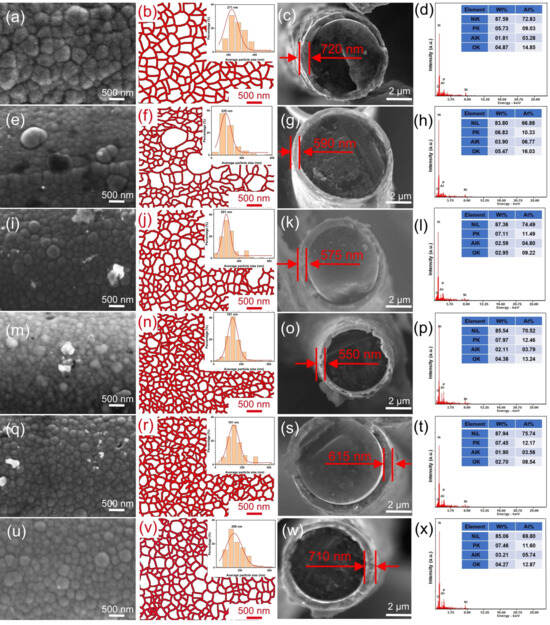
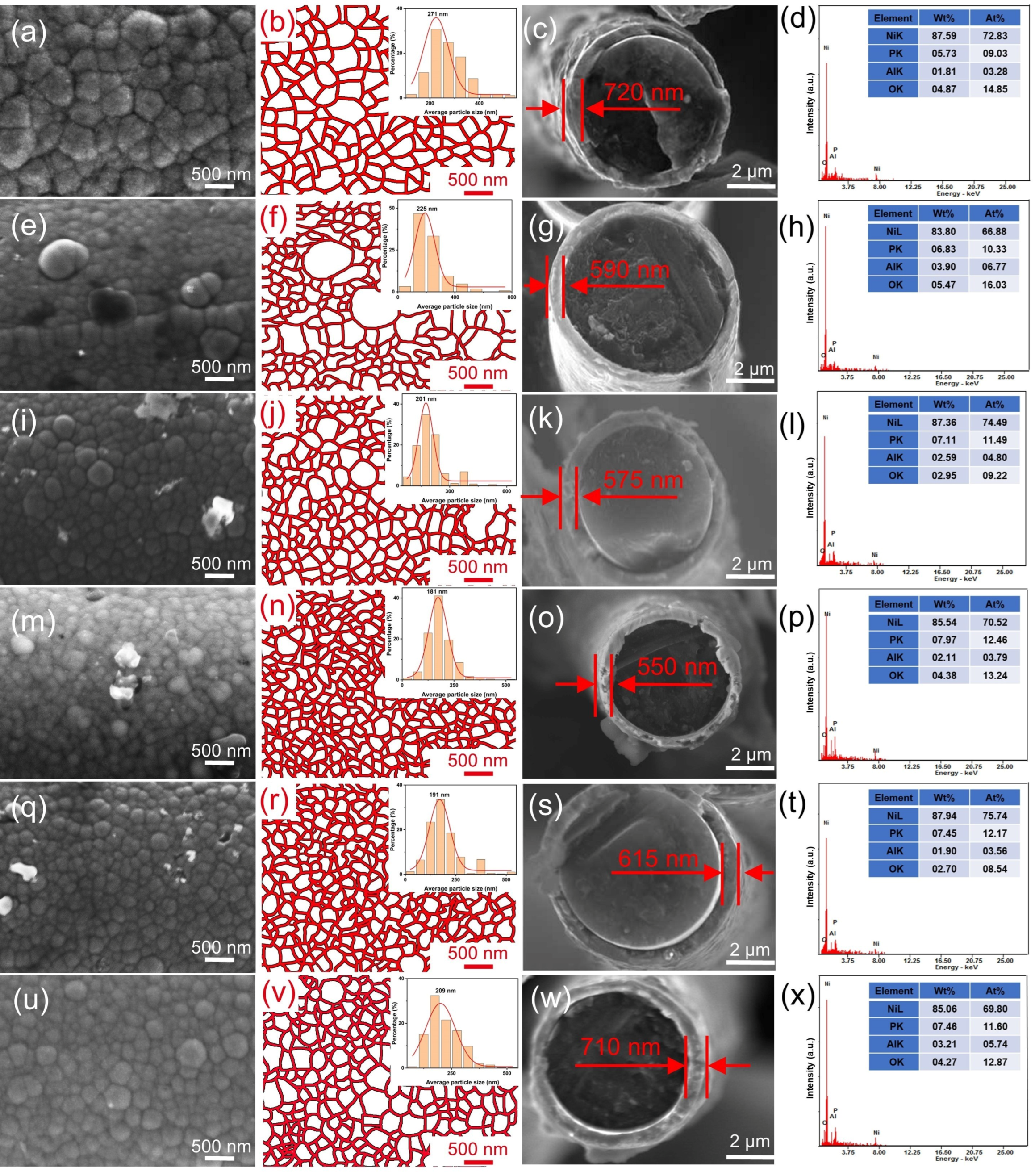
Figure 1 presents the SEM morphologies of electroless Ni coatings deposited on CFs with varying concentrations of dispersant. It can be observed that the Ni coatings consist of granular deposits featuring a typical cauliflower-like morphology, and their fundamental structural characteristics remain largely unchanged with increasing dispersant content.
Figure 1.
Microstructural characterization of electroless Ni-P coatings on carbon fibers with different dispersant contents. (a–d) 0 g/L; (e–h) 1 g/L; (i–l) 2 g/L; (m–p) 3 g/L; (q–t) 4 g/L; (u–x) 5 g/L; each column sequentially presents SEM image, reconstructed particle structure image with the inset showing the particle size distribution (The red line is the Gaussian fit used to calculate the average particle size), cross-sectional morphology of the coating and EDS spectrum.
To provide a clearer illustration of the particle size evolution, the corresponding particle boundary reconstruction results are displayed in Figure 1b,f,j,n,r,v. Statistical analysis from the inset figures indicates that in the absence of dispersant (0 g/L), the average particle size of the coating is approximately 253 nm. As the dispersant concentration increases, the average particle size progressively decreases. When the dispersant concentration reaches 3 g/L, the average particle size is reduced to about 182 nm. Among all samples, the coating obtained under this condition exhibits the finest particle structure, a smooth surface, and a compact morphology. However, an excessively high dispersant concentration is not beneficial for particle refinement. When the concentration is further increased to 4 g/L, the average particle size increases to approximately 192 nm, suggesting that excessive dispersant may hinder further particle refinement. Figure 1d,h,l,p,t,x show the phosphorus mass percentage in different coating measured by EDS, which are 5.73%, 6.83%, 7.11%, 7.97%, 7.45%, and 7.46%, respectively. Phosphorus from the plating bath incorporates into nickel particle, hindering its ordered arrangement and suppressing the formation of a crystalline structure, thereby resulting in an amorphous coating structure.
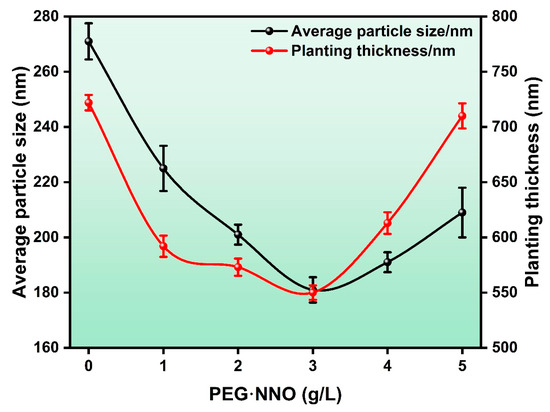
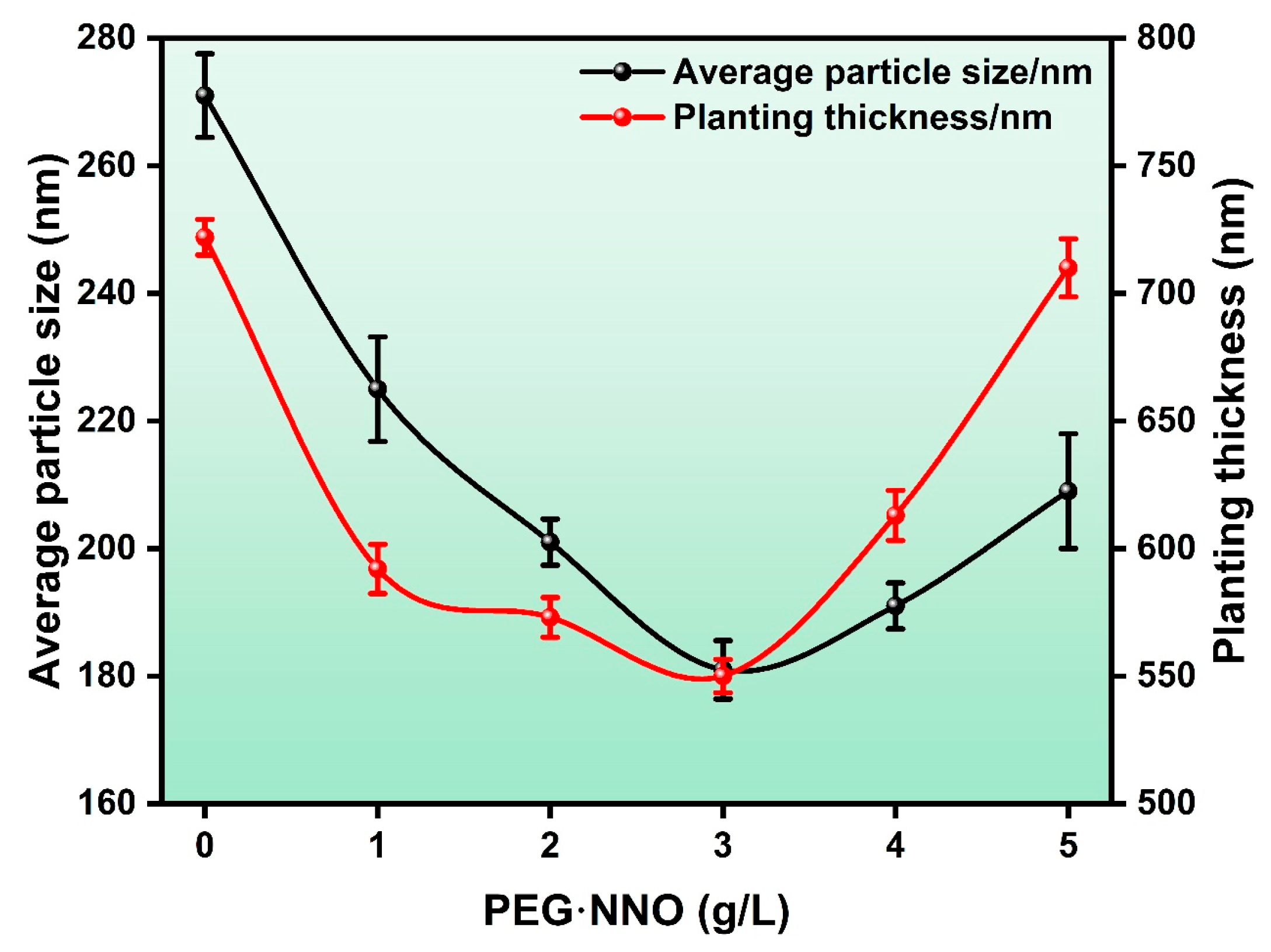
Figure 2 presents a more intuitive illustration of the effect of increasing composite dispersant concentration on the average particle size of the electroless Ni-P coating on CF surfaces. As the dispersant dosage increases from 0 g/L to 5 g/L, the average particle size of the Ni-P coating first decreases and then increases, exhibiting a distinct trend. Specifically, the average particle size reaches a minimum value at a dispersant concentration of 3 g/L, indicating that the particle refinement effect of the dispersant is most pronounced under this condition. This phenomenon can be attributed to the fact that an appropriate amount of dispersant effectively reduces the surface tension of the plating bath, promoting rapid nucleation while inhibiting excessive particle growth. Conversely, an excessively high dispersant concentration may induce side reactions or alter the deposition kinetics, ultimately leading to particle coarsening. Notably, the variation in coating thickness closely correlates with the particle size trend: a finer particle size corresponds to a thinner coating. This synergistic relationship reflects the dual regulatory role of the dispersant in the deposition process—on one hand, refining the particles to influence the compactness of the coating, and on the other hand, affecting the deposition rate to control the coating thickness. This finding holds significant implications for optimizing the surface metallization process of carbon fibers and achieving precise control over the microstructure of the coatings.
Figure 2.
Effect of PEG/NNO composite dispersant concentration on the average particle size and thickness of electroless coatings on carbon fiber surfaces.
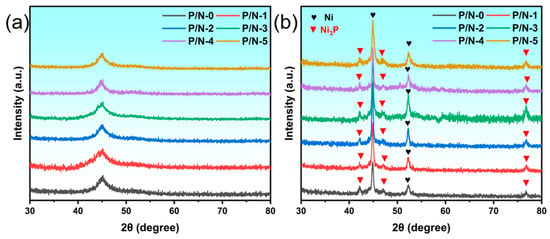
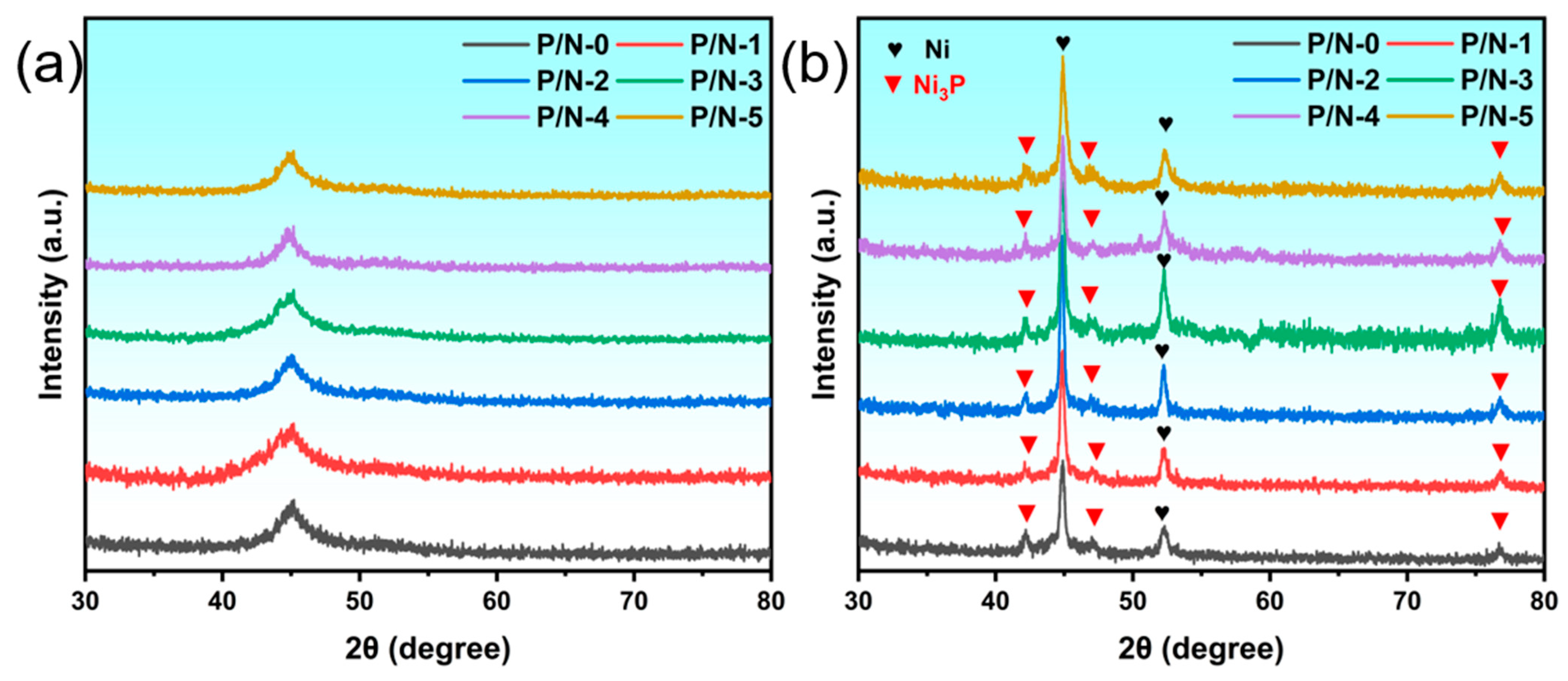
Figure 3 shows the X-ray diffraction (XRD) pattern of the electroless Ni-P coating deposited on the CF surface with different content of PEG/NNO composite dispersant. Figure 3a shows a broad diffuse scattering peak centered at approximately 2θ = 44.5°, which corresponds to the characteristic diffraction of the amorphous Ni-P coating formed during electroless deposition [21,22,23]. This confirms the successful deposition of Ni on the CF substrate. In addition, the XRD pattern after heat treatment (Figure 3b) show the crystalline peak of Ni at 2θ = 44.5° and 52.3°, and the crystalline peak of Ni3P are observed at 2θ = 42.2°, 47.1°and 76.8°, indicating that after heat treatment, Ni and Ni3P are precipitated from the CF surface coating [4,24], indicating the precipitation of a minor crystalline Ni3P phase within the amorphous coating matrix. Based on the above analysis, the XRD results demonstrate that the incorporation of the PEG/NNO composite dispersant facilitates the deposition of an amorphous Ni-P composite coating on the CF surface. Importantly, the particle refinement induced by the dispersant does not alter the fundamental amorphous nature of the coating microstructure.
Figure 3.
XRD pattern of the electroless nickel coating on carbon fiber after incorporation of composite dispersant. (a) before heat treatment. (b) after heat treatment.
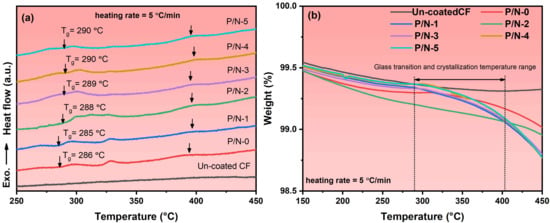
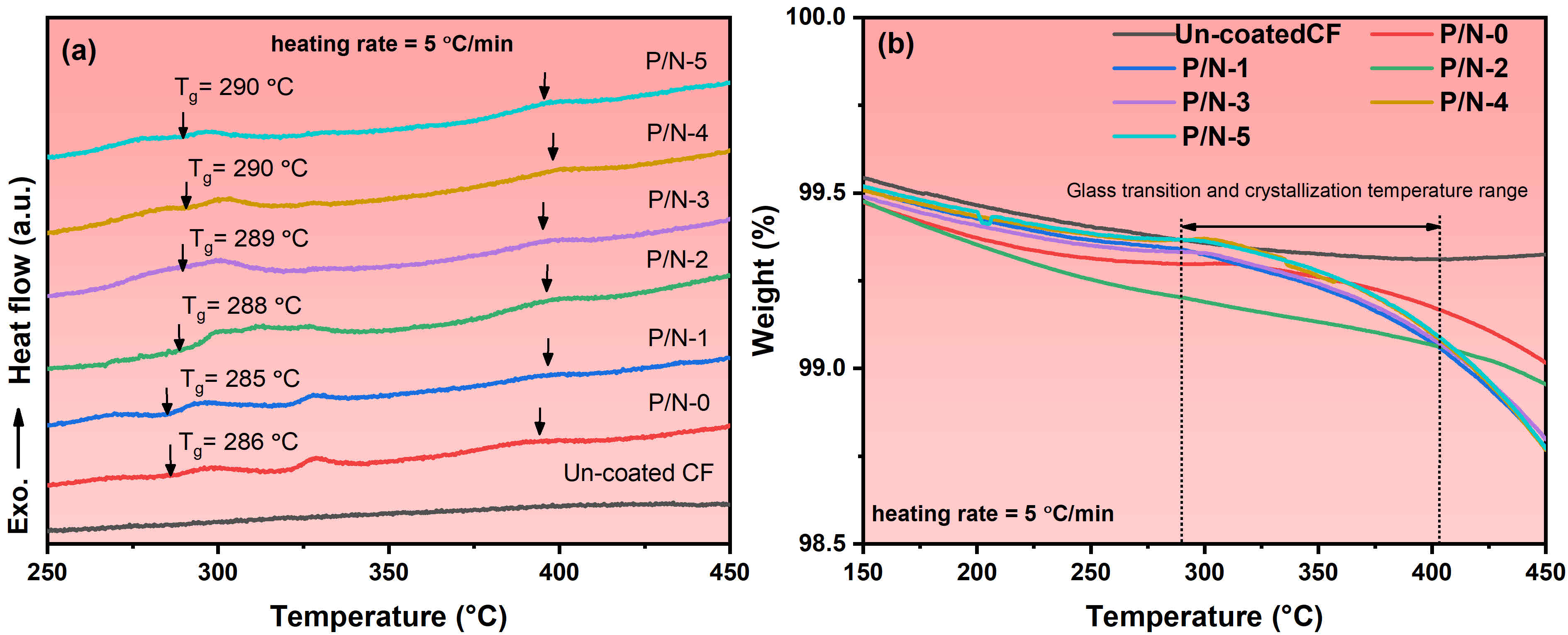
Figure 4 presents synchronous thermal analysis curves of the Ni-P coating deposited on CF surfaces with addition of different amount of PEG/NNO composite dispersant, measured at a heating rate of 5 °C/min. As shown in the thermogram, a distinct exothermic peak appears around 290 °C. This exothermic event is attributed to the crystallization transformation of the amorphous phase within the coating [25]. In addition, there is an exothermic peak at 400 °C, which is due to the precipitation of Ni3P [4,26,27]. In summary, the addition of dispersant did not significantly change the thermal stability of the coating. These thermal characteristics are typical of amorphous materials and corroborate the amorphous nature of the as-deposited Ni-P coating previously identified by XRD analysis as shown in Figure 3a. Figure 4b shows that the weight loss of carbon fiber is only 0.68 wt%, showing good thermal stability. The slight weight loss is likely attributed to the amorphous carbon and volatile carbonaceous impurities. The weight loss of nickel-plated carbon fiber is the most when the dispersant concentration is 5 g/L, which is only 0.55 wt% more than that of the original carbon fiber. It shows that the thermal effect in DSC test is due to mass loss, not decomposition [28,29,30]. In summary, the DSC analysis not only reveals the thermal stability characteristics of the Ni-P coating but also provides essential thermodynamic evidence for understanding its amorphous structure and crystallization mechanism. These findings are of significant importance for elucidating the microstructural evolution of the coating and for guiding the optimization of subsequent heat treatment processes.
Figure 4.
Synchronous thermal analysis curves of the electroless nickel coating on carbon fiber after incorporation of composite dispersant. (a) DSC curves. (b) TG curves.
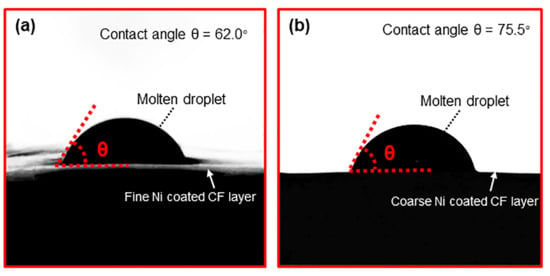
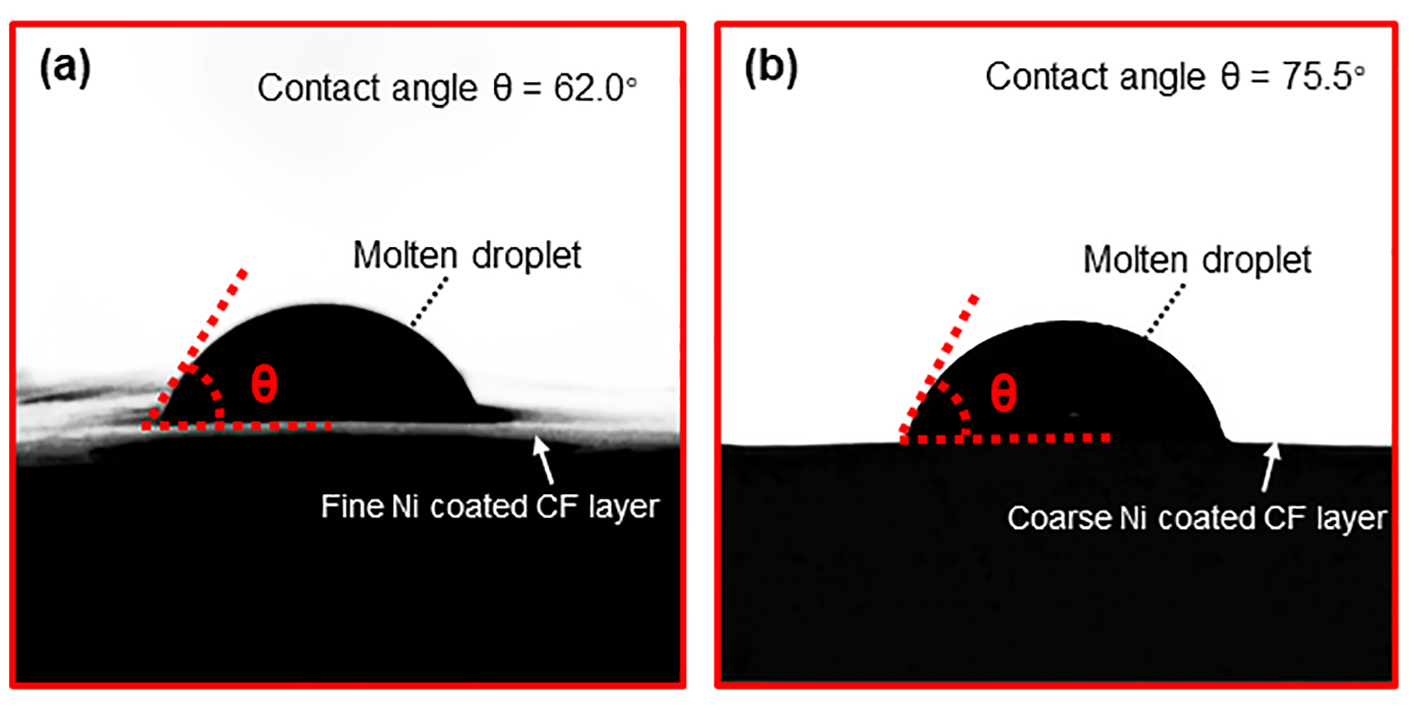
The original intention of Ni plating on CFs in this work is to improve the interfacial wettability in the preparation of carbon fiber-reinforced Ti-based amorphous matrix composites. To this end, wettability tests were carried out, and the results are shown in Figure 5. Figure 5a shows that the contact angle of the Ti41Zr25Be28Fe6 alloy [31] melt on the surface of CFs coated with fine Ni particles is approximately 62.0°, while that on the surface of CFs coated with coarse Ni particles is ~76° (Figure 5b). The former is significantly smaller than the latter. Generally, a smaller contact angle indicates better wettability; therefore, this result demonstrates that the fine Ni particle coating can effectively improve the wettability between the coating and the matrix.
Figure 5.
Contact angle of the Ti41Zr25Be28Fe6 alloy molten droplet on the carbon fiber layer: (a) Fine particle coating. (b) Coarse particle coating.
The reason for the above difference may be related to the increased surface roughness caused by the coarse coating. On the one hand, the fine coating tends to have a denser and more uniform surface morphology, which facilitates the spreading of the molten substrate on the surface, thereby reducing the contact angle. On the other hand, due to the larger particle size, the coarse coating may have more microscopic undulations or local compositional inhomogeneities on the surface, which increase air pockets and pinning effects at the interface between the melt and the solid, leading to reduced wettability. Therefore, by refining the grains and optimizing the surface morphology, it is possible not only to improve the densification of the coating itself but also to significantly enhance its wetting behavior toward the Ti-based amorphous alloy substrate.
3. Discussion
For electroless Ni-P alloy coatings, incorporating nano-Al2O3 particles to form composite coatings is an effective strategy for refining the coating structure and improving wear and corrosion resistance. However, due to their large specific surface area and high surface energy, these nanoparticles tend to agglomerate readily in the plating bath, leading to uneven distribution within the coating and even risking bath instability and decomposition. Therefore, employing a composite dispersant system—such as the combination of PEG and NNO—to disperse the nano-Al2O3 and generate synergistic effects with the particles themselves has become a key approach to controlling the coating’s microstructure and achieving further particle refinement.
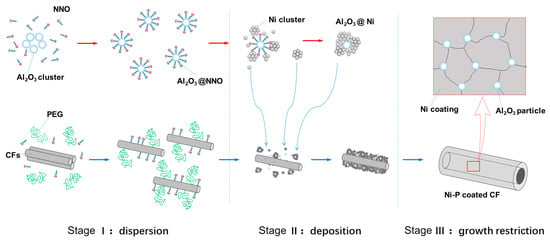
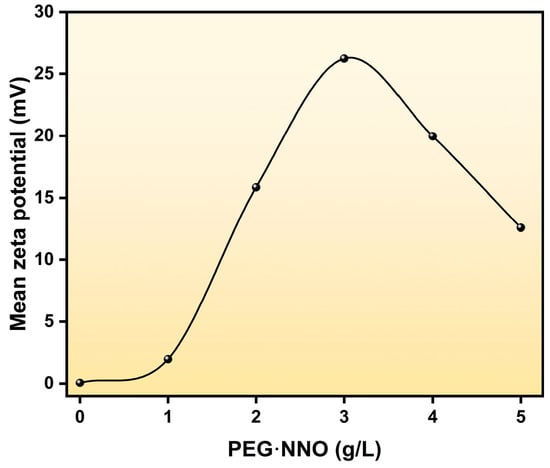
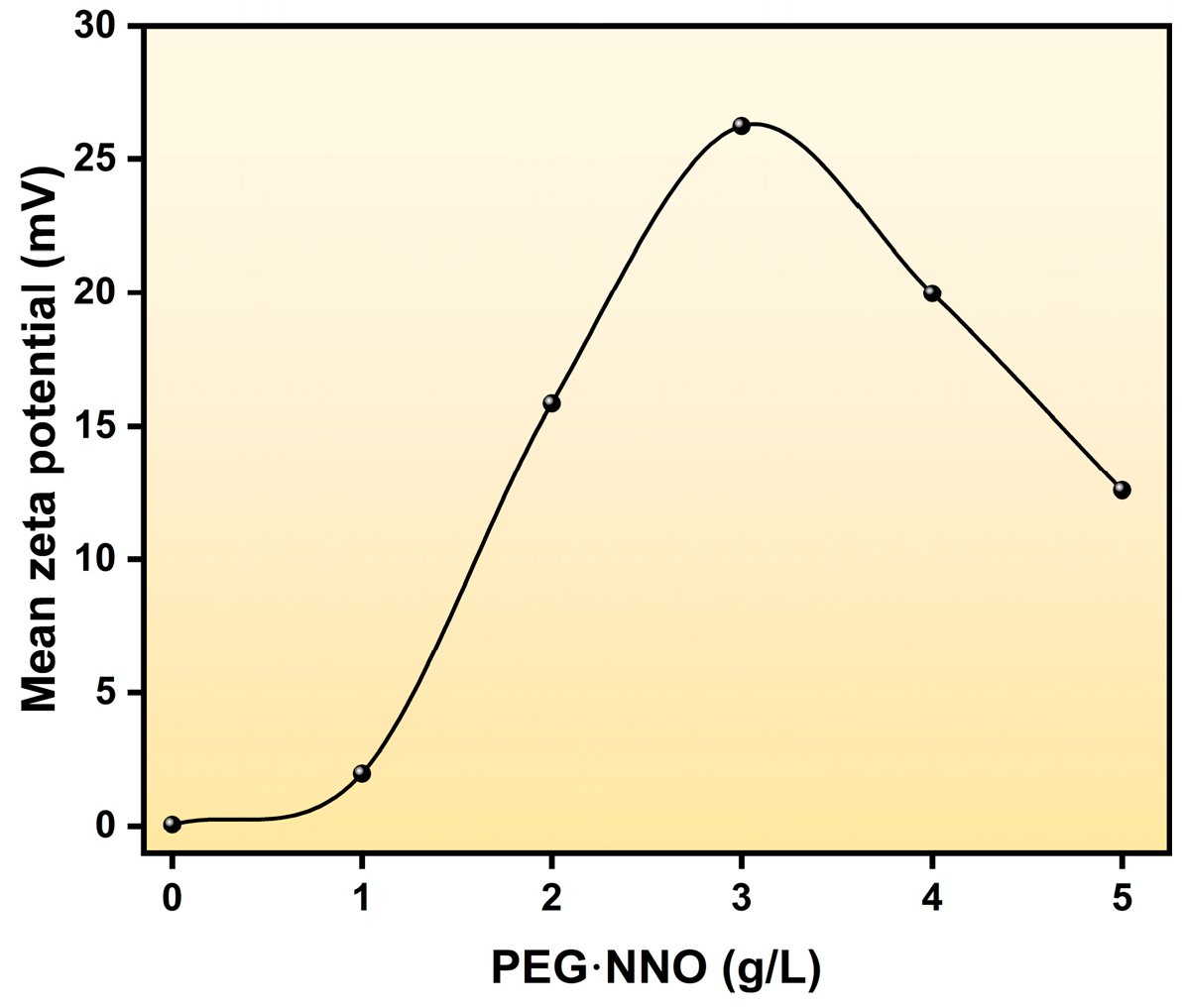
The prerequisite for nano-Al2O3 particles to refine the particle structure is their uniform dispersion in the plating bath. In practice, prolonged ultrasonication is commonly used, but a single dispersion method is often insufficient to counteract the agglomeration driven by the high temperature and ionic strength of the bath. In this work, NNO, a typical anionic surfactant, was introduced. Its sulfonate groups (-SO3−) dissociate in aqueous solution, and upon adsorption onto the Al2O3 surface, impart a high negative charge to the particles, as shown in Figure 6. This establishes an electric double layer around each particle, generating strong electrostatic repulsion that effectively prevents agglomeration due to van der Waals forces, as shown in Figure 7. When PEG/NNO was not added, the absolute value of the Zeta potential in the plating solution was only 0.05 mV. As the concentration of PEG/NNO gradually increased, the absolute Zeta potential also increased steadily. At a concentration of 3 g/L, the absolute Zeta potential reached 26.23 mV, indicating enhanced stability of the plating solution. However, when the concentration was further increased, the absolute Zeta potential decreased, making agglomeration more likely to occur [32,33,34].
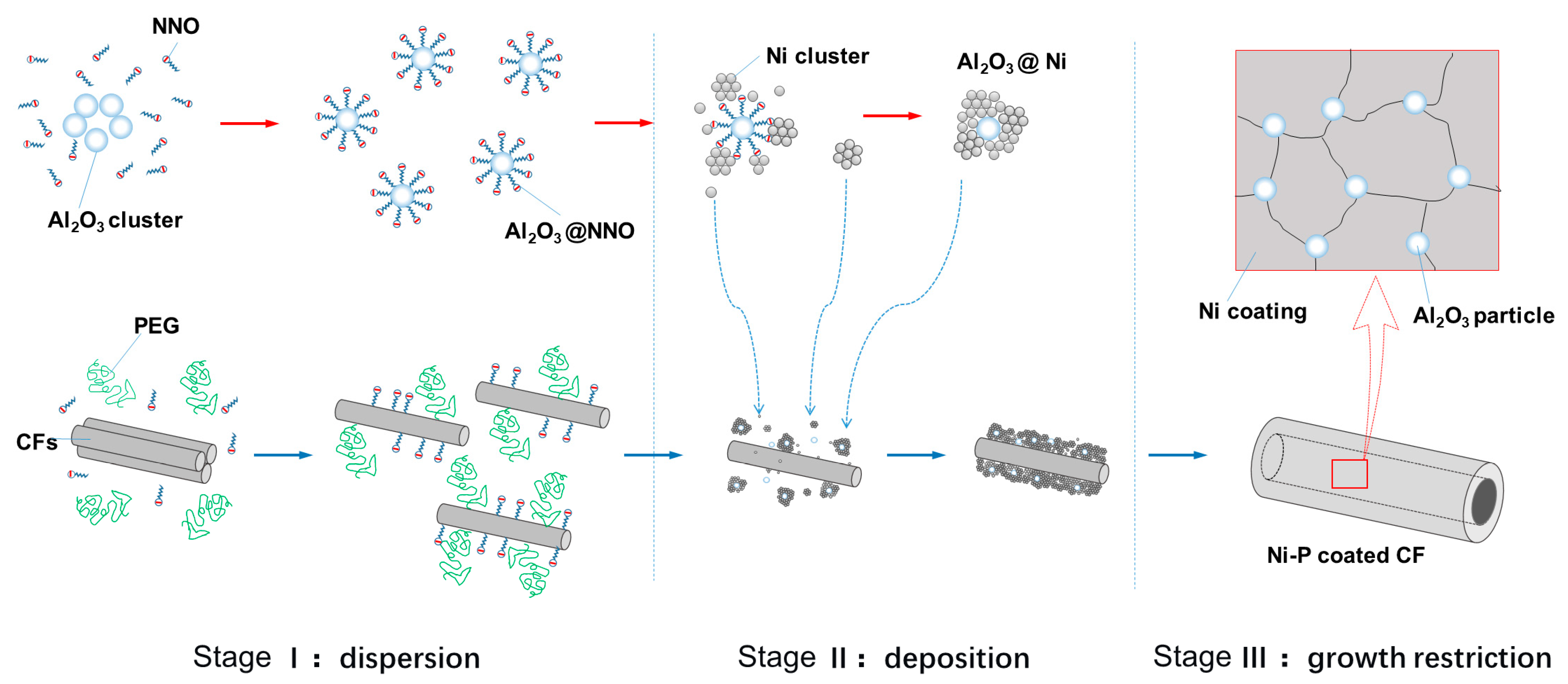
Figure 6.
Schematic diagram of the coating refinement mechanism.
Figure 7.
Zeta potential of the electroless plating bath with different concentrations of PEG/NNO addition.
Meanwhile, PEG, a polymer with long chains containing ether bonds (-O-), adsorbs onto the Al2O3 surface via hydrogen bonding or physical interaction. When particles coated with PEG approach one another, compression and interpenetration of the polymer chains create a steric hindrance effect—an entropic repulsion particularly effective against the compression of the electric double layer by high-concentration electrolytes in the bath. With a 1:1 combination of PEG and NNO, a hybrid adsorption layer forms on the Al2O3 surface, where NNO provides electrostatic charge and PEG supplies a steric barrier. This electrosteric stabilization mechanism enables the nano-Al2O3 to remain well dispersed even in the complex electroless plating environment, laying the groundwork for effective co-deposition and particle refinement.
The refinement strengthening mechanism is primarily governed by an increased nucleation rate. During the deposition process, well-dispersed nano-Al2O3 particles serve as heterogeneous nucleation substrates. According to classical nucleation theory, the free energy barrier for forming a new phase (Ni-P) on an existing solid surface (e.g., Al2O3) is substantially lower than that for homogeneous nucleation. These Al2O3 particles provide numerous high-energy active sites, facilitating the preferential deposition and nucleation of nickel atoms. Simultaneously, the composite dispersants—particularly PEG—adsorb onto the cathode surface, inherently inhibiting nickel deposition and promoting the formation of new nuclei. Once embedded in the coating, Al2O3 particles physically interrupt the epitaxial growth of Ni-P particles, continuously forcing nucleation to reinitiate either on the particle surfaces or within the micro-crevices between particles and the matrix. The PEG/NNO dispersant system not only ensures the uniform dispersion of Al2O3 particles but also enhances cathodic polarization through the adsorption of PEG. This increases the overpotential for nickel ion reduction on the Al2O3 surfaces, with higher overpotential providing a greater driving force for nucleation. Consequently, the synergistic effect of a high density of well-dispersed Al2O3 particles (enabled by the dispersants) and a strong nucleation driving force (enhanced by PEG-induced polarization) establishes a cyclic process of “nucleation—particle pinning—renucleation”. This iterative mechanism effectively refines the particle structure of the Ni-P matrix.
After nucleation, the final microstructure of the coating is primarily determined by the subsequent growth of Ni-P particles. During this stage, the coarsening of Ni-P particles is inhibited by both uniformly dispersed nanoparticles and additives adsorbed at the growing interface. Taking nano-Al2O3 particles as an example—typically much finer than the Ni-P matrix—they are uniformly distributed throughout the coating and become pinned at the interfaces between Ni-P particles. When these interfaces attempt to migrate under a driving force to reduce system energy, the presence of nano-Al2O3 exerts a pinning effect that impedes their movement, thereby effectively restraining particle growth. Concurrently, during coating deposition, additives such as PEG and NNO adsorb onto the growing surface of Ni-P particles or into the adjacent liquid phase. This adsorbed layer lowers the surface energy, which in turn reduces the deposition rate of nickel atoms and inhibits their diffusion toward the growth front. Together, these mechanisms synergistically limit the further growth of Ni-P particles.
The synergistic effect of the composite dispersant and nano-Al2O3 manifests as a temporal relay throughout the deposition process. In the initial stage, PEG and NNO dominate interfacial polarization and promote uniform nucleation. During the middle stage, Al2O3 nanoparticles are incorporated into the coating via co-deposition with Ni-P. In the later stage and after the coating is formed, these nanoparticles exert a pinning effect, while residual organics (or their carbonized derivatives) may generate additional drag at particle boundaries. This combined mechanism—from liquid-phase inhibition to solid-state pinning—enables full-process intervention, resulting in an extremely fine-particle coating microstructure. The integration of chemical additives and physical particles offers a powerful strategy for regulating Ni-P particle structure from nucleation to growth, providing significant potential for the development of fine-particle coatings.
4. Materials and Methods
The electroless nickel plating process follows a sequential pretreatment procedure: degreasing, roughening, sensitization, activation, reduction, and plating. Continuous CFs (SYT 49T, Zhongfu Shenying Carbon Fiber Co., Ltd., Lianyungang, Jiangsu Province, China) were first cut into fixed lengths and heat-treated in a muffle furnace at 420 °C for 1 h to remove the sizing agent. After cooling, the fibers were ultrasonically cleaned in acetone for 1 h, followed by rinsing with ethanol and deionized water. Roughening was carried out by immersing the fibers in concentrated nitric acid (HNO3) under ultrasonic agitation for 1 h, after which they were thoroughly rinsed with deionized water until neutral to remove residual acid. For sensitization, the fibers were soaked in an aqueous solution containing 20 g/L SnCl2 and 40 mL/L HCl at room temperature for 25 min to adsorb a layer of reductive Sn2+ ions onto the surface. Activation was then performed by immersing the fibers in a 0.1 g/L PdCl2 solution for 25 min at room temperature, where Pd2+ ions were reduced by Sn2+ to form metallic Pd catalytic sites. Finally, the fibers were dipped in a 30 g/L NaH2PO2 solution for 1 min to remove excess ions, then dried and stored.
Electroless nickel plating was conducted in a bath placed in a water bath maintained at 80 °C. The bath composition was as follows: 2.0 g/L Al2O3 nanoparticles, 30 g/L NiSO4·6H2O, 20 g/L NaH2PO2, 25 g/L Na3C6H5O7·2H2O, 20 g/L NH4Cl, and a dispersant mixture of PEG and NNO at a 1:1 mass ratio (PEG/NNO composite dispersant, 0–4 g/L). All the chemicals were purchased from Fuchen Chemical Reagent Co. Ltd., Tianjin, China. The bath pH was adjusted to 8.0, with a total volume of 100 mL and a plating duration of 5.0 min. The bath temperature was monitored with a thermometer; once the target temperature was reached, the pretreated carbon fibers were immersed to initiate deposition. After plating, the fibers were collected, rinsed, dried, and characterized. To investigate the effect of dispersant concentration, a series of experiments was conducted by varying the dispersant content while keeping all other parameters constant.
The morphology of Ni-coated CFs was characterized using a scanning electron microscope (SEM, Hitachi S-4800, Tokyo, Japan). Cross-sectional and surface images were obtained at low accelerating voltages to reveal microstructural features. Particle boundaries on the coating surface were reconstructed using an AxioVision SE64 software. The reconstructed images were then imported into Image J Pro plus 6.5 software for quantitative analysis, where particle size was expressed as the equivalent circle diameter. Thermal stability of the coatings was evaluated by simultaneous thermal analyzer (STA, Setaram Thermo ONE, Lyon, France), and phase structure was analyzed by (XRD, Tongda TDM-20, Cu Kα radiation, Dandong, China). Zeta potential was measured by laser particle size analyzer (LPSA, Anton Paar 500, Beijing, China) for 100 times diluted plating solution, and the stability of the plating solution was analyzed. The wettability between the Ti-based alloy melt and the Ni-coated carbon fiber was measured using a contact angle measuring instrument (CAMI, Dataphysics OCA20, Veldhoven, Germany). During the test, the Ni-coated CFs were fixed onto a steel plate to form a fiber lay-up. The molten Ti41Zr25Be28Fe6 alloy was then placed onto the CF layer for 10 s, after which photographic analysis was performed.
5. Conclusions
In this work, we demonstrate that the synergistic use of a polyethylene glycol (PEG) and sodium methylene bis-naphthalene sulfonate (NNO) composite dispersant, in combination with nano-Al2O3 particles, achieves significant microstructural refinement in electroless Ni–P coatings on carbon fibers.
(1) The particle size of the coating was found to be highly dependent on the concentration of the composite dispersant. An optimal dispersant concentration of 3 g/L yielded the finest particles, with an average size of approximately 181 nm. However, excessive dispersant addition leads to coating coarsening and abnormal thickness buildup, which ultimately degraded coating quality.
(2) Phase analysis revealed that the resulting coatings consisted of Ni and P, primarily in an amorphous Ni–P matrix with a minor crystalline Ni3P phase, characteristic of a typical amorphous composite structure. The incorporation of the dispersant did not alter the phase composition or thermal stability of the coatings.
(3) Fine Ni particle coatings on carbon fibers significantly enhance wettability with Ti-based amorphous alloys, achieving a lower contact angle (~62.0°) compared to coarse coatings (~76°). This improvement is attributed to the denser and more uniform surface morphology of fine coatings, which facilitates melt spreading, whereas coarse coatings increase surface roughness and pinning effects that impair wetting.
(4) Mechanistic studies indicate that PEG and NNO modulate the surface charge distribution of Al2O3 particles and carbon fibers at both micro- and macro-scales. This modulation enhances electrostatic repulsion, promoting uniform dispersion of nanoparticles, while also reinforcing the heterogeneous nucleation effect of nano-Al2O3, thereby contributing to microstructural refinement. Further analysis revealed a time-resolved synergistic mechanism between the composite dispersant and nanoparticles: in the early deposition stage, PEG and NNO dominate the inhibition in the liquid phase, facilitating uniform nucleation; in the later stage, the embedded nano-Al2O3 exerts a solid-state pinning effect that effectively suppresses particle growth.
(5) This “liquid-phase inhibition to solid-state pinning” strategy enables continuous regulation of particle refinement from nucleation to growth, offering a new theoretical basis for optimizing metallization processes on carbon fiber surfaces and providing valuable insights for advancing surface functionalization of carbon fibers.
Author Contributions
Investigation, writing—original draft preparation, Y.Z.; Investigation, formal analysis, methodology, W.G.; resources, formal analysis, methodology, T.W.; resources, conceptualization, P.G.; software, validation, L.Z.; methodology, visualization, W.Y.; writing—review and editing, supervision, project administration, funding acquisition, X.W. All authors have read and agreed to the published version of the manuscript.
Funding
This research was funded by the Central Government-Guided Local Projects in Hebei Province (236Z1018G), and the Open Found Project Supported by State Key Laboratory of Materials Processing and Die & Mould Technology, Huazhong University of Science and Technology (P2023–023).
Institutional Review Board Statement
Not applicable.
Informed Consent Statement
Not applicable.
Data Availability Statement
The data presented in this study are available upon request from the corresponding author.
Conflicts of Interest
The authors declare no conflicts of interest.
References
- Deshpande, A.M.; Stepanova, T.; Park, T.; Pradeep, S.A.; Elnaggar, M.; Delavari, K.; Agha, A.; Li, G.; Pourboghrat, F.; Pilla, S. Investigation of the effect of cooling rates on the mechanical behavior of thermoformed continuous fiber reinforced semi-crystalline thermoplastic composites. Compos. Part B Eng. 2026, 309, 113100. [Google Scholar] [CrossRef] [Scilit]
- Eckstein, S.; Youssef, G. Impact efficacy of sandwich structures with additively manufactured skins and elastomeric foam cores. Compos. Part B Eng. 2025, 305, 112728. [Google Scholar] [CrossRef] [Scilit]
- Meyer, O.K.; Haney, R.; Bauder, T.; Gupta, K.; Stephanie, H.; Bordeau, J.; Wood, C.; Mintz, K.; Kumar, S.; Koerner, H. Multichannel hollow carbon fiber reinforcement in an epoxy resin matrix for direct ink writing of high-performance composites. Mater. Des. 2025, 259, 114744. [Google Scholar] [CrossRef] [Scilit]
- Lee, H.; Choi, M.K.; Kang, S.H.; Han, W.; Kim, B.J.; Kim, K.W. Heat-treated Ni-coated fibers for EMI shielding: Balancing electrical performance and interfacial integrity. Polymers 2025, 17, 1610. [Google Scholar] [CrossRef] [Scilit] [PubMed]
- Ren, Q.; Zhang, X.; Zhang, X. Damage visualization and enhanced interlaminar shear strength of carbon fiber reinforced composites with Ni/PUF/PU@ER microcapsules. Compos. Part A 2026, 200, 109338. [Google Scholar] [CrossRef] [Scilit]
- Ling, Y.; Yi, S.; Shen, Y.; Bao, S.; Gao, Z.; Wu, C.; Lu, W. Ultra-broadband electromagnetic shielding properties of Cu/Ni coatings on CFRP. Mater. Sci. Eng. B 2025, 322, 118539. [Google Scholar] [CrossRef] [Scilit]
- Choi, Y.; Meng, X.; Xu, Z. Manufacturing process of short carbon fiber reinforced Al matrix with preformless and their properties. Sci. Rep. 2021, 11, 23385. [Google Scholar] [CrossRef] [Scilit]
- Gao, C.; Wei, M.; Wang, Q. Interface microstructure and mechanical properties of Ni-Co-P alloy coatings modiffed carbon fibres reinforced 7075Al matrix composites. Ceram. Int. 2022, 48, 36748–36757. [Google Scholar] [CrossRef] [Scilit]
- Liu, J.; Yang, X.; Yue, D.; Liu, S.; Zhang, J.; Zhang, Y.; Quan, D.; Zhao, G.; Wang, T.; Li, T. Enhanced interfacial microstructure evolution and mechanical properties of CF/Al–Mg composites with optimal interconnected coating. J. Mater. Res. Technol. 2023, 27, 5994–6007. [Google Scholar] [CrossRef] [Scilit]
- Yin, H.L.; Liu, S.Q.; Zhao, L.C.; Cui, C.X.; Wang, X. Vacuum infiltration molding and mechanical property of short carbon fiber reinforced Ti-based metallic glass matrix composite. J. Mater. Process. Technol. 2021, 295, 117151. [Google Scholar] [CrossRef] [Scilit]
- Yin, H.L.; Yang, W.; Zhao, L.C.; Hu, X.M.; Liu, S.Q.; Cui, C.X.; Wang, X. Fabrication and mechanical property of three-dimensional carbon fiber reinforced Mg-based bulk metallic glass matrix composite. Mater. Sci. Eng. A 2022, 839, 142853. [Google Scholar] [CrossRef] [Scilit]
- Kousar, H.; Umer, M.A.; Shehzad, K.; Ferdous, R.; Mehmood, K.; Basit, A.; Shahbaz, T.; Yasir, M.; Shakoor, A. Exceptional mechanical properties and wear behavior of Al2O3 nanoparticle reinforced Ni-W-P coatings. Tribol. Int. 2024, 194, 109533. [Google Scholar] [CrossRef] [Scilit]
- Wang, X.; Li, C.; Chen, S.; Du, A.; Ma, R.; Zhao, X.; Wang, S.; Fan, Y. Study on properties of Al2O3-Ni-P nano-particle composite coating by ultrasonic electroless plating on AZ91D magnesium alloy. Matéria 2024, 29, 1475–1483. [Google Scholar] [CrossRef] [Scilit]
- Feng, Q.; Li, T.; Yue, H.; Qi, K.; Bai, F.; Jin, J. Preparation and characterization of nickel nano-Al2O3 composite coatings by sediment co-deposition. Appl. Surf. Sci. 2008, 254, 2262–2268. [Google Scholar] [CrossRef] [Scilit]
- Li, T.; Jiang, Y.; Zhang, H.; He, J.; Chan, K.C.; Chan, Y.L.; Jian, W.; Ren, L. A novel electroless Ni-W-P composite plating with polytetrafluoroethylene co-deposition: Assessment of corrosion resistance and microhardness. Colloids Surf. A Physicochem. Eng. Asp. 2025, 710, 136206. [Google Scholar] [CrossRef] [Scilit]
- Chen, L.; Wang, L.; Zeng, Z.; Zhang, J. Effect of surfactant on the electrodeposition and wear resistance of Ni–Al2O3 composite coatings. Mater. Sci. Eng. A 2006, 434, 319–325. [Google Scholar] [CrossRef] [Scilit]
- Zhao, W.; Hui, K.; Zhao, W.; Chen, H.; Cui, Y.; Li, X.; Liu, X.; Song, Y.; Hui, K.; Yan, Y.; et al. Study of the effects of additives on an EDTA-2Na electroless Ni-P plating system. J. Electron. Mater. 2024, 53, 3089–3099. [Google Scholar] [CrossRef] [Scilit]
- Lee, C.Y.; Chen, K.L.; Yen, T.J.; Lee, H.B. The improvement in corrosion resistance of electroless Ni-P coating on micro-arc oxidized AZ31 alloy prepared with sodium dodecyl sulfate additive and post-supercritical CO2 mixed electrolyte. J. Mater. Eng. Perf. 2025, 34, 4190–4202. [Google Scholar] [CrossRef] [Scilit]
- Xiao, J.; Zuo, H.; Li, C.; Yan, H.; Zhang, Y.; Wu, T.; Meng, X.; Lu, J. Effect of pyridinium propargylamine formate on properties and structure of acid electroless nickel plating. J. Electron. Mater. 2025, 54, 11039–11052. [Google Scholar] [CrossRef] [Scilit]
- Yuan, L.; Hu, J.; Ding, Z.; Liu, S. Electrochemical deposition of bright nickel on titanium matrix from ammoniacal solution in the presence of thiourea. Int. J. Electrochem. Sci. 2017, 12, 7312–7325. [Google Scholar] [CrossRef] [Scilit]
- Bai, R.; Zhang, P.; Wang, X.; Zhang, H.; Wang, H.; Shao, Q. Highly Conducting Surface-Silverized Aromatic Polysulfonamide (PSA) Fibers with Excellent Performance Prepared by Nano-Electroplating. Nanomaterials 2024, 14, 115. [Google Scholar] [CrossRef] [Scilit]
- Zhang, J.; Zheng, J.; Chen, X.; Liao, Q.; Li, T. Study on Ni/P-coating deposition and interface behavior in solid-solid/solid-liquid compositing process. J. Mater. Res. Technol. 2024, 30, 7998–8005. [Google Scholar] [CrossRef] [Scilit]
- Liu, H.; Li, J.; Zhang, J.; Gong, P.; Yang, W.; Zhao, L.; Wang, X. Design Optimization and Mechanical Properties of SiC Particle Reinforced Ti-Based Metallic Glass Matrix Composite. Materials 2023, 16, 5323. [Google Scholar] [CrossRef] [Scilit]
- Pan, F.; Cai, L.; Shi, Y. Phase engineering reinforced multiple loss network in apple tree-like liquid metal/Ni-Ni3P/N-doped carbon fiber composites for high-performance microwave absorption. Chem. Eng. J. 2022, 435, 135009. [Google Scholar] [CrossRef] [Scilit]
- Li, D.; Cui, X.; Wen, X.; Jin, G.; Zheng, W.; Li, J.; Shi, L. Study on growth behavior and properties of LDH nanosheet arrays enhanced Ni-based coatings on Mg-Li alloy. Surf. Coat. Technol. 2023, 474, 130088. [Google Scholar] [CrossRef] [Scilit]
- Jiang, Y.; Jian, W.; Du, X.; He, J.; Chan, K.C.; Chan, Y.L.; Huang, H.; Ren, L. High-temperature-induced material softening formed in Ni-W-P-SiC composite coating and its wear reduction mechanism. Chem. Eng. J. 2025, 521, 166760. [Google Scholar] [CrossRef] [Scilit]
- Antonelli, S.B.; Allen, T.L.; Johnson, D.C.; Dubin, V.M. Determining the Role of W in Suppressing Crystallization of Electroless Ni–W–P Films. J. Electrochem. Soc. 2006, 153, J46. [Google Scholar] [CrossRef] [Scilit]
- Ma, Y.; Guo, L.; Qi, L.; Sun, J.; Cao, Y. Growth mechanism and thermal behavior of electroless Cu plating on short carbon fibers. Surf. Coat. Technol. 2021, 419, 127294. [Google Scholar] [CrossRef] [Scilit]
- Zhao, X.W.; Zang, C.G.; Ma, Q.K.; Wen, Y.Q.; Jiao, Q.J. Thermal and electrical properties of composites based on (3-mercaptopropyl) trimethoxysilane- and Cu-coated carbon fiber and silicone rubber. J. Mater. Sci. 2016, 51, 4088–4095. [Google Scholar] [CrossRef] [Scilit]
- Bücheler, D.; Kaiser, A.; Henning, F. Using thermogravimetric analysis to determine carbon fiber weight percentage of fiber-reinforced plastics. Compos. Part B Eng. 2016, 106, 218–223. [Google Scholar] [CrossRef] [Scilit]
- Gong, P.; Wang, X.; Shao, Y.; Chen, N.; Liu, X.; Yao, K.F. A Ti-Zr-Be-Fe-Cu bulk metallic glass with superior glass-forming ability and high specific strength. Intermetallics 2013, 43, 177–181. [Google Scholar] [CrossRef] [Scilit]
- Choi, W.J.; Kim, Y.J.; Lim, D.S.; Bahn, C.B. Electroless palladium or nickel-phosphorus plating for fouling mitigation in high-temperature water systems. Mater. Res. Express 2025, 12, 046503. [Google Scholar] [CrossRef] [Scilit]
- Gupta, A.; Vasudevan, S. Understanding surfactant stabilization of MoS2 nanosheets in aqueous dispersions from Zeta potential measurements and molecular dynamics simulations. J. Phys. Chem. C 2018, 122, 19243–19250. [Google Scholar] [CrossRef] [Scilit]
- Pochapski, D.J.; Carvalho dos Santos, C.; Leite, G.W.; Pulcinelli, S.H.; Santilli, C.V. Zeta potential and colloidal stability predictions for inorganic nanoparticle dispersions: Effects of experimental conditions and electrokinetic models on the interpretation of results. Langmuir 2021, 37, 13379–13389. [Google Scholar] [CrossRef] [Scilit]
Disclaimer/Publisher’s Note: The statements, opinions and data contained in all publications are solely those of the individual author(s) and contributor(s) and not of MDPI and/or the editor(s). MDPI and/or the editor(s) disclaim responsibility for any injury to people or property resulting from any ideas, methods, instructions or products referred to in the content. |
© 2026 by the authors. Licensee MDPI, Basel, Switzerland. This article is an open access article distributed under the terms and conditions of the Creative Commons Attribution (CC BY) license.