


Abstract
Two trinuclear cobalt (Co3)-based metal–organic frameworks, [Co3(CHDC)3(py)4] (2; CHDC = trans-1,4-cyclohexanedicarboxylate, py = pyridine) and [Co3(CHDC)3(mpy)2]· 2DMF (3; mpy = 4-methylpyridine, DMF = N,N-dimethylformamide), were successfully prepared via the solvothermal reactions of Co(NO3)2·6H2O, trans-1,4-cyclohexanedicarboxylic acid, and py/mpy in DMF solution. Single crystal X-ray diffraction analyses revealed that the Co3-secondary building units (SBUs) in 2 and 3 adopt Cooctahedral···Cooctahedral···Cooctahedral and Cotetrahedral···Cooctahedral···Cotetrahedral coordination environments, respectively, and are connected by six CHDC linkers to form two-dimensional sheet structures with a triangular lattice. The structural differences of these Co3-SBUs led to clear differences in the magnetic properties and electronic spin states of 2 and 3; temperature-dependent magnetic susceptibility measurements revealed that 2 and 3 exhibited antiferromagnetic and ferromagnetic interactions, respectively, within the Co3-SBUs. These experimental magnetic results are consistent with the density-functional theory calculations of the model structures of Co3-SBUs, which indicate that the most stable spin states are S = 3/2 for 2 and S = 9/2 for 3.
1. Introduction
Metal–organic frameworks (MOFs) [1,2,3,4,5,6,7], which are molecular-based solid state compounds composed of metal-containing nodes (called secondary building units (SBUs)) and organic linkers, have attracted great interest owing to their fascinating coordination/extended structures and intriguing functional properties, such as adsorption [8,9,10], separation [11,12,13], catalysis [14,15,16], and magnetism [17,18,19]. As is well known, the SBUs of MOFs can adopt a wide variety of geometries depending on the metal species, steric structure of the organic linkers, and reaction conditions, and they play a crucial role in determining the structural stability and functional properties of MOFs [20,21,22]. In particular, owing to the ability of cobalt ions to adopt five distinct coordination geometries with coordination numbers ranging from four to six, namely tetrahedral, square planar, square pyramidal, octahedral, and trigonal prismatic geometries [23,24,25], multinuclear cobalt-based SBUs constructed from combinations of these coordination geometries are of considerable interest from both structural and electronic (d-orbital-derived spin state) perspectives [26,27,28,29,30,31,32]. However, at present, the precise control of the molecular structures of multinuclear cobalt-based SBUs as well as the relationships between their structures and electronic spin states remain insufficiently understood, and further investigations are required for a systematic understanding.
Trans-1,4-cyclohexanedicarboxylate (CHDC) is an aliphatic linker that features both flexibility and moderate rigidity owing to its cyclohexane ring structure and has been extensively employed in MOF chemistry over the past three decades [33,34,35,36]. As illustrated in Scheme S1, the CHDC linker adopts two structural conformations, namely e,e-trans and a,a-trans, of which the former is more thermodynamically stable [37]. From the aforementioned perspectives of structural and electronic interest, cobalt-based MOFs with CHDC linkers have also been investigated [37,38,39,40,41,42]. For example, Kurmoo and Kepert reported that [Co5(OH)8(CHDC)]·4H2O, in which the Co2tetrahedralCo3octahedral(OH)8 layer SBUs were connected by e,e-trans CHDC linkers, exhibits ferrimagnetism (Tc = 60.5 K) [38]. Recently, our group reported a trinuclear cobalt (Co3)-based MOF with an e,e-trans CHDC linker, [Co3(CHDC)3(DMF)2.5(H2O)0.5]·1.5DMF (1; DMF = N,N-dimethylformamide), which adopts a two-dimensional sheet-like structure comprising two similar geometrical arrangements (Cooctahedral···Cooctahedral···Cotetrahedral) of Co3-based SBUs, {Co3(O2C–)6(DMF)3(H2O)0.5} and {Co3(O2C–)6(DMF)2(H2O)} [39]. Magnetic measurements combined with theoretical calculations revealed that the cobalt ion in the Co3-based SBUs of 1 adopts a high-spin state (S = 9/2) and 1 displays the ferromagnetic interaction within the SBUs.
As an extension of the study on 1, we found that adding pyridine or its derivatives under reaction conditions similar to those used to synthesize 1 enabled the modulation of the Co3-based SBU structure in MOFs, particularly the coordination numbers of the two peripheral cobalt ions, with the pyridine ligands serving as auxiliary ligands. Herein, we present experimental and theoretical results of the synthesis, structural characterization, magnetic properties, and electronic spin states of Co3-based MOFs with pyridine (py) and 4-methylpyridine (mpy) as auxiliary ligands, [Co3(CHDC)4(py)4] (2) and [Co3(CHDC)4(mpy)2]·2DMF (3), respectively. We believe that this study makes a significant contribution to the systematic exploration of the correlations between the structures and electronic spin states of MOFs with Co3-based SBUs.
2. Results
2.1. Synthesis of 2 and 3
The Co3-based MOFs 2 and 3 were obtained as purple plate-like and block-like single crystals in 26.7% and 22.8% yields, respectively, by solvothermal reactions of a mixture of Co(NO3)2·6H2O (0.20 mmol), H2CHDC (0.20 mmol), and py or mpy (2.0 mmol) in a 1:1:10 molar ratio in DMF (5.0 mL) at 393 K for 72 h in an autoclave reactor. Three observations were made: (1) when the reaction time was decreased to 24 h, the yields of MOFs decreased; (2) when the molar ratio of py or mpy was reduced by half, the yield decreased, and no single crystals were obtained; and (3) when the molar ratio of py or mpy was increased five-fold (50.0 mmol), the yield of 2 remained almost unchanged, whereas that of 3 decreased. Therefore, the synthetic methods proposed in this study are considered reliable approaches for obtaining pure samples of 2 and 3.
2.2. Crystal Structures
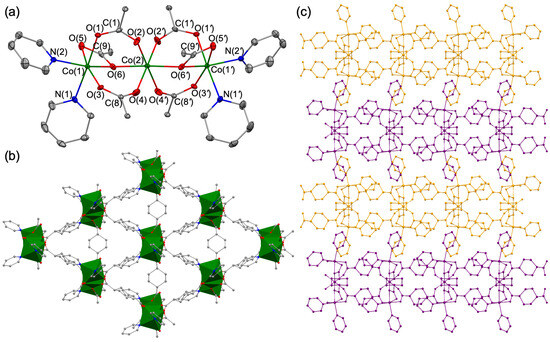
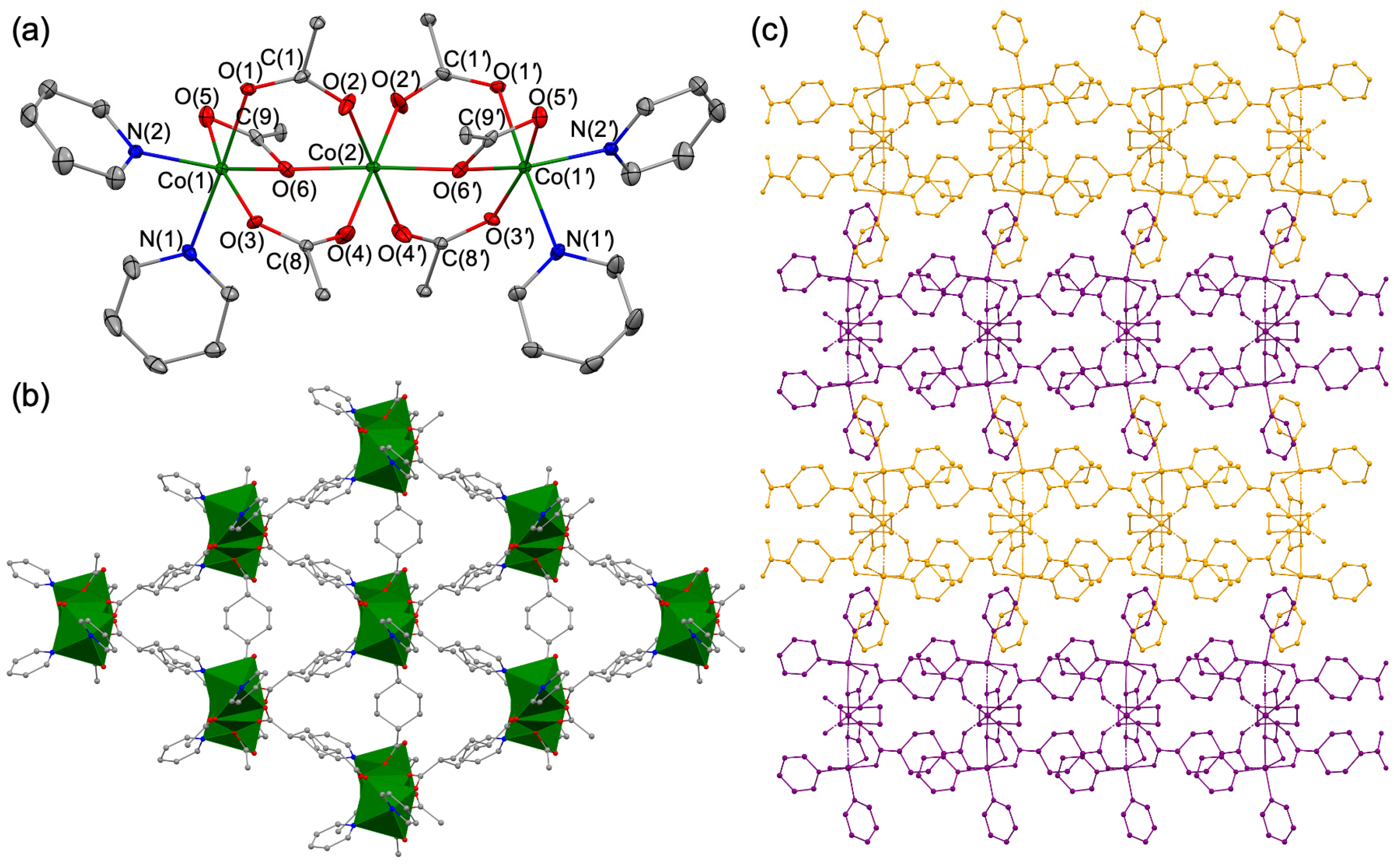
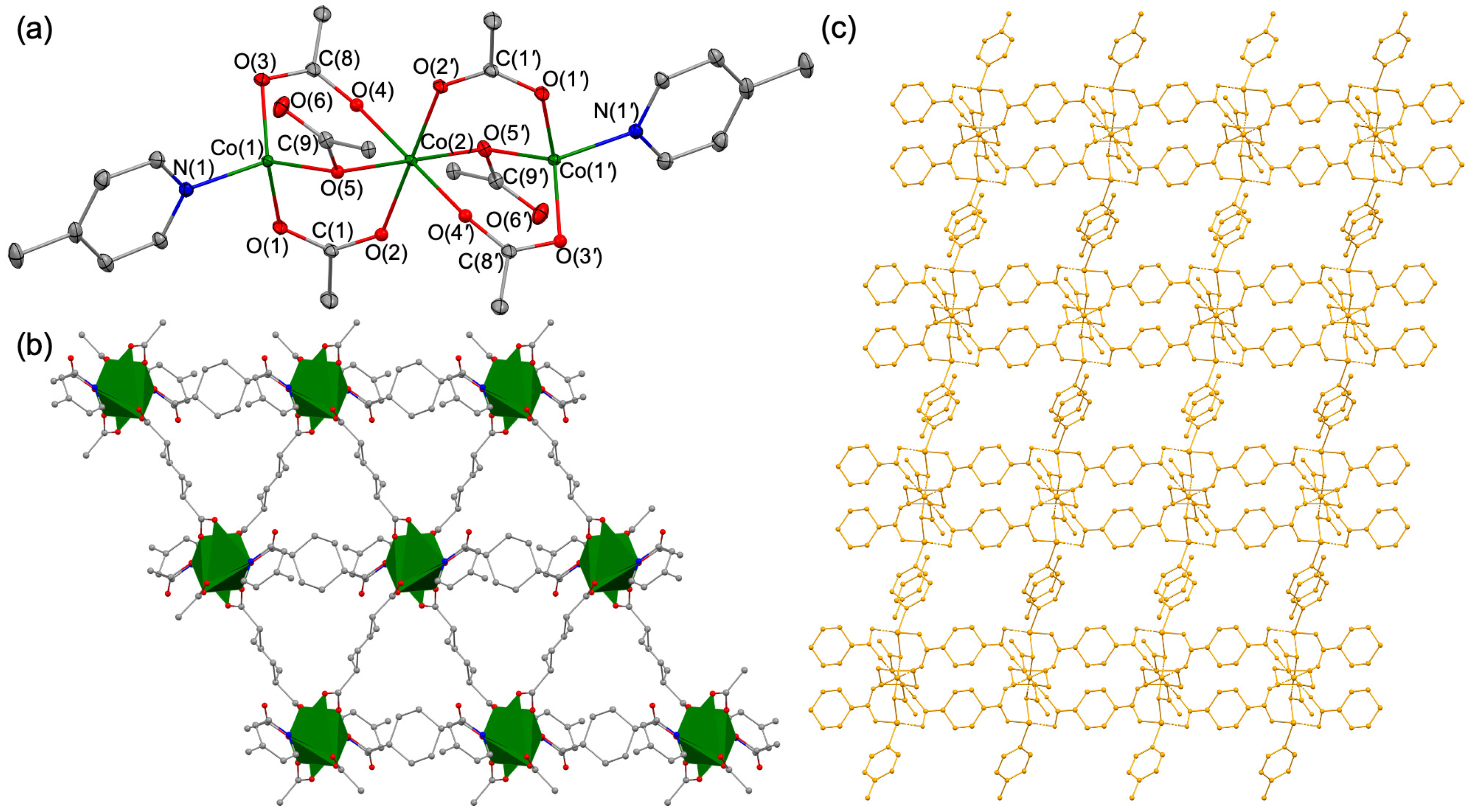
To clarify the coordination and extended structures of 2 and 3 in detail, single crystal X-ray diffraction analyses were performed at 100 K. Diffraction data sufficient for the structural analysis of 2 were obtained using a laboratory diffractometer, whereas those of 3 were collected at the high-energy synchrotron single crystal X-ray diffraction beamline (BL02B1) at SPring-8, Japan. Diffraction analyses revealed that 2 and 3 crystallized in the orthorhombic (Pbcn space group) and monoclinic (P21/c space group) systems, respectively. Figure 1 and Figure 2 show the local Co3-SBU structures, two-dimensional extended structures, and packing structures of 2 and 3, respectively.
Figure 1.
Crystal structure of 2 (all hydrogen atoms are omitted for clarity): (a) the segmented SBU structure (30% thermal ellipsoids. Co: green, C: gray, O: red, N: blue), (b) perspective view of the two-dimensional framework with polyhedral representation of Co3-SBUs along c-axis, and (c) the packing structure along a-axis.
Figure 2.
Crystal structure of 3 (all hydrogen atoms and solvent molecules are omitted for clarity): (a) the segmented SBU structure (30% thermal ellipsoids. Co: green, C: gray, O: red, N: blue), (b) perspective view of the two-dimensional framework with polyhedral representation of Co3-SBUs along a-axis, and (c) the packing structure along b-axis.
Structural refinement revealed that the asymmetric unit of 2 consists of two Co ions, one and a half CHDC anions, and two py molecules. The SBUs in 2 form a {Co3(O2C−)6(py)4} unit, in which (i) a C2 axis passes through the Co(2) ion, (ii) three octahedral Co ions are bridged by four μ2-η1:η1 and two μ2-η2:η1-coordination modes of the carboxylate groups of the CHDC linkers [43], and (iii) each of the two peripheral Co ions is coordinated by two py ligands (see Figure 1a). The three Co ions are arranged in an almost straight line within the SBU, and the angle ∠Co(1)···Co(2)···Co(1′) is 179.46°. By contrast, the asymmetric unit of 3 comprises two Co ions, one and a half CHDC anions, and one mpy molecule, together with one disordered DMF guest molecule. The SBUs in 3 form a {Co3(O2C−)6(mpy)2} unit composed of two peripheral tetrahedral Co ions and one central octahedral Co ion, with the central Co(2) ion lying at an inversion center. Therefore, the three Co ions are perfectly aligned in a straight line (∠Co(1)···Co(2)···Co(1′) = 180°) within the SBU. As shown in Figure 2a, the three Co ions of the SBUs in 3 are bridged by four μ2-η1:η1 and two μ2-η2-coordination modes of the carboxylate groups of the CHDC linkers [43], and each of the two peripheral Co ions is coordinated by one mpy ligand. The Co(1)···Co(2) distances in 2 and 3 are 3.439 and 3.162 Å, respectively, indicating the absence of Co–Co bonds in the Co3-SBUs of 2 and 3 [44]. The shorter Co(1)···Co(2) distance in 3 than in 2 is considered to originate from differences in the coordination numbers of the peripheral Co ions and the coordination modes of the carboxylate groups, as a similar tendency has also been observed in the Co3-SBUs of 1 (Cooctahedral···Cooctahedral: 3.394, 3.434 Å, Cooctahedral···Cotetrahedral: 3.192 Å) [39]. In the Co3-SBUs of 2, the Co–O(μ2-η1:η1) bond lengths range from 2.0410(16) to 2.0616(14) Å and are slightly shorter than the Co–O(6)(μ2-η2) bond lengths (Co(1)–O(6): 2.0852(15) Å, Co(2)–O(6): 2.1037(14) Å). In addition, the Co(1)–O(5) bond (2.3510(16) Å) is markedly elongated relative to the other Co–O bonds and can be regarded as semicoordinative. The Co(1)–N(1) bond (2.2047(18) Å) opposite to O(1) is distinctly longer than the Co(1)–N(2) bond (2.0998(17) Å) opposite to O(6). In the Co3-SBUs of 3, the Co(1)–Ocarboxylate bond lengths in the tetragonal sites are noticeably shorter than the Co(2)–Ocarboxylate bond lengths in the hexagonal sites, which is consistent with previously reported trends in cobalt complexes [39,44]. The Co(1)–N(1) bond length is 2.0445(17) Å, which is shorter than the Co(1)–N bond lengths in the Co3-SBUs of 2.
As depicted in Figure 1b and Figure 2b, the Co3-SBUs in both 2 and 3 are connected to six CHDC linkers, forming two-dimensional sheet structures with a triangular lattice. All CHDC linkers in 2 and 3 adopted the e,e-trans conformation. Owing to the steric bulk of the cyclohexane moieties, the triangular lattice structures of 2 and 3 do not form sufficient pores for guest inclusion. As depicted in Figure 1c, the Co3-SBUs in 2 are aligned along the c-axis direction, and the two-dimensional sheets extending in the a- and b-axes directions are stacked along the c-axis in an ABAB fashion. On the other hand, the Co3-SBUs in 3 are aligned in the a-axis direction, and two-dimensional sheets extending along the b- and c-axis directions are assembled in an AA fashion, with disordered DMF solvent molecules intercalated between the sheets (see Figure 2c).
2.3. Characterizations
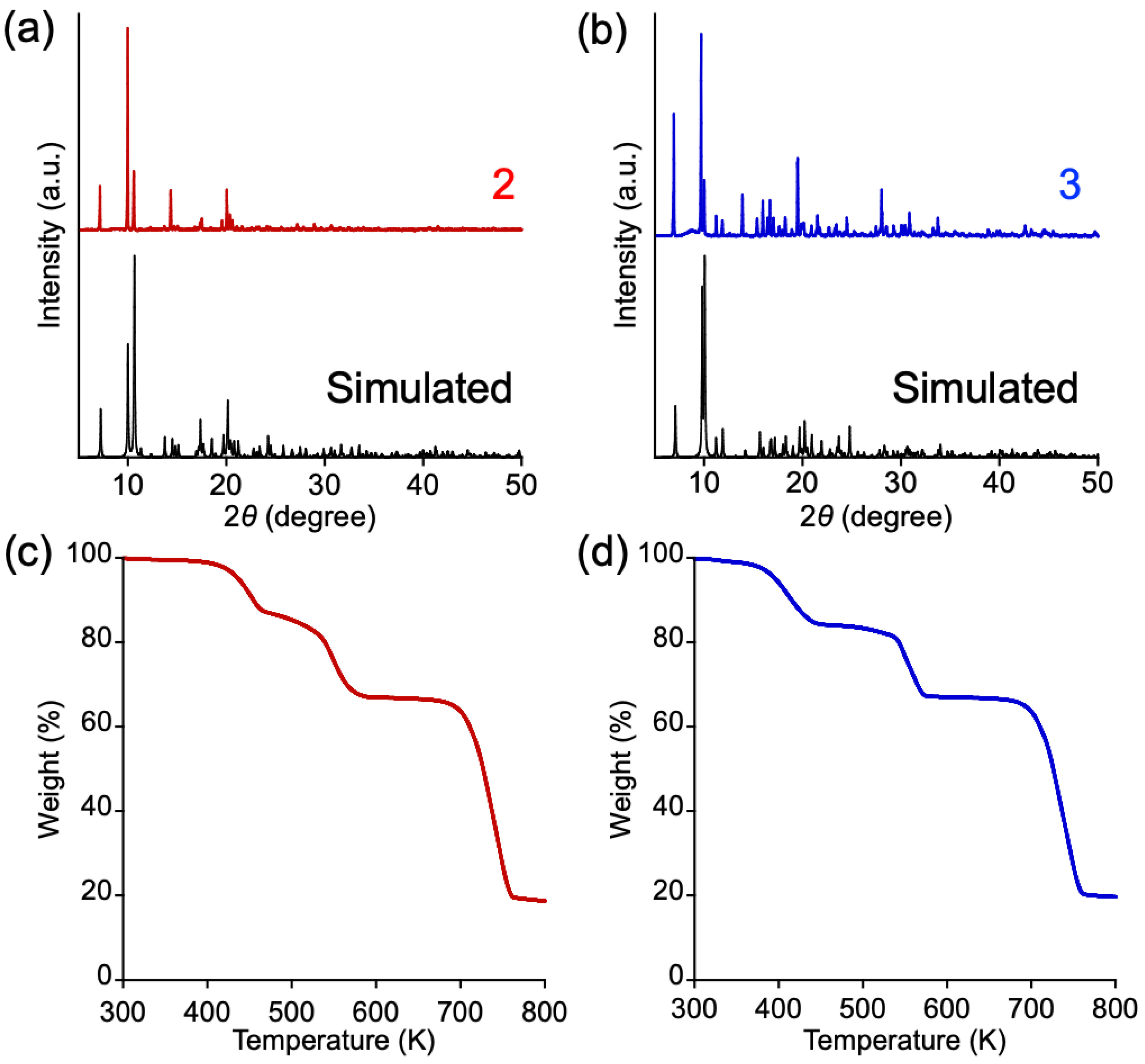
Powder X-ray diffraction (PXRD) measurements were performed at 298 K to examine the phase purities of 2 and 3. As shown in Figure 3a,b, the peak positions in the observed PXRD patterns of 2 and 3 were in good agreement with those of the simulated patterns based on their single crystal structure data, despite the intensity discrepancies that were caused by crystal habit effects [45]. These diffraction results prove that both 2 and 3 form single-phase crystalline compounds without crystalline impurities. The chemical purities of 2 and 3 were also supported by elemental analyses; the observed CHN ratios of 2 and 3 were in good agreement with the calculated values, indicating that 2 contained no guest solvent molecules, whereas 3 incorporated two DMF molecules per Co3-SBU within the crystal lattice.
The thermal stabilities of 2 and 3 were examined by thermogravimetric (TG) analyses under a N2 atmosphere. As shown in Figure 3c,d, three-step weight losses occurred in both TG curves. In 2, the first (15.5% loss at 509 K) and second (33% loss at 594 K) weight losses are in good agreement with the loss of two pyridine molecules (15.8%) at each step, and the third weight loss is attributed to the decomposition of the CHDC linkers. On the other hand, for 3, the first weight loss (15.7% loss at 448 K) was attributed to the loss of two DMF molecules (14.3%), while the second weight loss (32.9% loss at 583 K) was attributed to the dissociation of two mpy molecules (18.3%). The third weight loss of 3, which involved decomposition of the CHDC linkers, begins at approximately 673 K and was similar to that observed for 2.
Figure 3.
Observed and simulated PXRD patterns of (a) 2 and (b) 3 and TG curves of (c) 2 and (d) 3.
2.4. Magnetic Properties
Both of the complexes 2 and 3 have Co3-SBUs linked by CHDC ligands, giving two-dimensional structures in the crystals. As mentioned in the previous section, the Co3-SBUs of 2 and 3 have symmetries with respect to the central Co ions (2 has a C2 axis and 3 has an inversion center). That is, both Co3-SBUs have magnetically two identical peripheral Co sites in addition to the central Co site. In Figure 4 and Figure 5, the variations in the χMT values per Co3 unit are shown in the measured temperature of 1.8–300 K for 2 and 3, respectively. At 300 K, their χMT values are 8.86 cm3 K mol−1 for 2 and 8.44 cm3 K mol−1 for 3, which are larger than the spin-only value for the three noninteracting S = 3/2 system (5.63 cm3 K mol−1) but smaller than the value calculated for S = 3/2 and L = 3 (10.13 cm3 K mol−1). This indicates that all the cobalt(II) ions in the Co3-SBUs of 2 and 3 are in the high-spin state (S = 3/2), although some orbital contribution should be taken into consideration [46]. When lowering the temperature, the temperature-dependent χMT profiles of 2 and 3 are obviously different from each other. In the case of 2, although the χMT value decreases gradually with lowering temperature in the whole measured temperature range, the gradual decease begins around 150 K. The χMT values are 9.28 cm3 K mol−1 at 152 K and 5.18 cm3 K mol−1 at 3.0 K, being followed by a relatively steep decrease to 4.61 cm3 K mol−1 at 1.8 K. In the Co3-SBU of 2, there are three octahedral cobalt(II) ions bridged by carboxylate oxygen atoms to form a nearly linear CoA1octahedral···CoBoctahedral···CoA2octahedral arrangement (∠Co···Co···Co = 179.46°), where the Co ions at both peripheral ends and the central Co ion are distinguished and here designated with A1 and A2 and B. In the Co3-SBU, the peripheral CoA1 and CoA2 are related by the C2 axis passing through the central CoB. For each octahedral cobalt(II) ion, the spin-orbit coupling was considered for the local 4T1 ground state, assuming the axial symmetry [47,48,49]. The local Hamiltonian is written as HA(B),u = ΔA(B)( − 2/3) − (3/2) κA(B) λA(B) LA(B)·SA(B) + β[−(3/2)κA(B)+ ge]·Hu (u = z, x), where ΔA(B), κA(B), λA(B), and ge represent the axial splitting parameter for CoA(B), the orbital reduction factor for CoA(B), the spin-orbit coupling parameter for CoA(B), and the g-factor of free electron, respectively [46]. The magnetic interaction between the cobalt(II) ions in the Co3 unit was assumed to be isotropic for the interaction Hamiltonian Hint = −J (SA1·SB + SA2·SB), in which the interaction between peripheral CoA1 and CoA2 was neglected. Assuming two types of cobalt(II) ions, CoA and CoB, the temperature dependence of magnetic susceptibility (χ) can be expressed as Equations (1)–(5). In Equations (4) and (5), , , and represent the zero-field energies, first-order Zeeman coefficients in the z (or x) direction, and second-order Zeeman coefficients in the z (or x) direction, respectively, for the nth states (n = ±1–±6) generated from the 4T1 ground term of the octahedral CoA(B) ion due to the local spin-orbit coupling [50]. These energies and coefficients can be expressed by local parameters λA(B), κA(B), and ΔA(B).
Using Equations (1)–(5), the temperature dependent χMT profile was satisfactorily simulated, as shown by the red solid line in Figure 4, with J = −0.12 cm−1, λA = −118 cm−1, κA = 0.93, ΔA = 406 cm−1, λB = −145 cm−1, κB = 0.93, and ΔB = 458 cm−1 (discrepancy factor: RχMT = 1.44 × 10⁻⁴). The interaction between the Co3 units was negligible. The gradual decrease in χMT from 150 K to 3.0 K is explained by the orbital contribution. The λ and κ values are normal for the spin-orbit coupling in octahedral high-spin cobalt(II) complexes [46]. The small |Δ| values imply that the structures around cobalt(II) ions are not so distorted from the octahedral geometry. There is a weak antiferromagnetic interaction (J = −0.12 cm−1) within the Co3 unit, which reproduces the relatively steep decrease in χMT from 5.18 cm3 K mol−1 at 3.0 K to 4.61 cm3 K mol−1 at 1.8 K. In a previous study [39], we analyzed 1 by the model incorporating the orbital contribution, under the condition that three linearly arranged Co ions are assumed to have an equivalent octahedral structure with an axial symmetry. The temperature-dependent χMT profile was fitted above 20 K with four independent parameters: J = +3.8 cm−1, λ = −120 cm−1, κ = 0.89, and Δ = −310 cm−1. The λ, κ and |Δ| values are similar to those of 2, while the ferromagnetic interaction is operative within the Co3 unit (J = +3.8 cm−1).
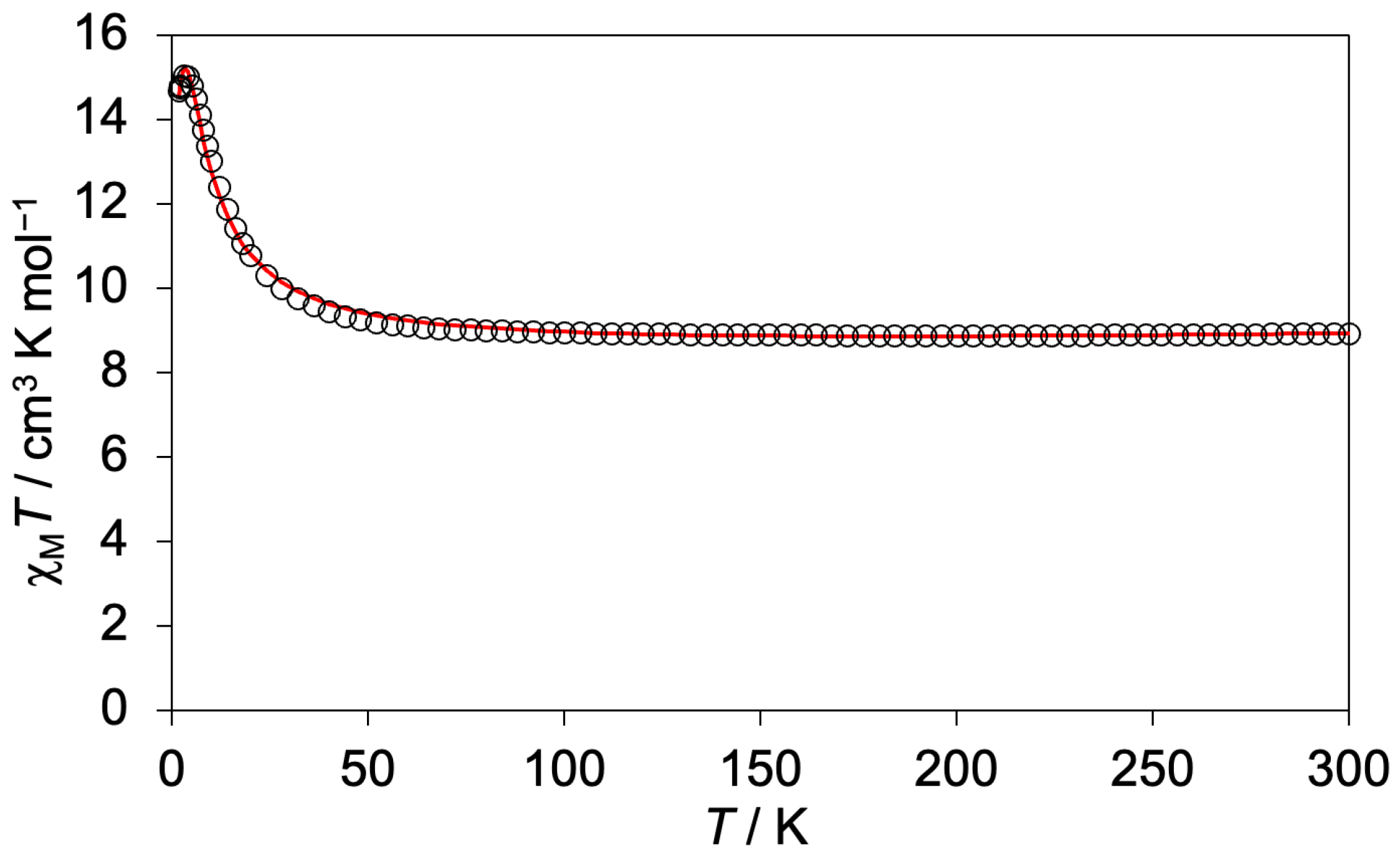
In the case of 3, although the χMT value increases with lowering temperature until 3.0 K, the increase becomes rapid around 50 K. The χMT values are 9.19 cm3 K mol−1 at 52.0 K and 15.03 cm3 K mol−1 at 3.0 K, being followed by a slight decrease to 14.69 cm3 K mol−1 at 1.8 K. The important difference of 3 from 1 and 2 is that χMT increases with lowering temperature until 3.0 K. The temperature-dependent χMT profile could not be explained by the model analyzed for 1 and 2, while 3 has a linear CoA1terahedral···CoBoctahedral···CoA2tetrahedral arrangement with carboxylate bridges in the Co3-SBU, in which peripheral CoA1 and CoA2 with a tetrahedral geometry surrounding the Co ion are related by the inversion center located at the central CoB with an octahedral geometry. The ground state of cobalt(II) ion in a tetrahedral geometry is 4A2 (S = 3/2), and the orbital angular momentum is a second-order effect. Here, we analyzed the temperature-dependent χMT profile by considering the magnetic interaction between cobalt(II) ions in the Co3 unit by use of the isotropic model with the Hamiltonian Hint= −J (SA1SB + SA2SB). The interaction between peripheral CoA1 and CoA2 was neglected. The susceptibility of the trinuclear S = 3/2 unit is given by the following equation [51]:
where g is the average g-factor, β is the Bohr magneton, and TIP is the temperature-independent paramagnetism. We further estimated the interactions between the Co3 units by applying the following molecular field approximation [46]:
where zJ′ is the parameter for the magnetic interaction multiplied by the number of neighboring units. Using Equations (6) and (7), the temperature-dependent χMT profile of 3 was reproduced well, as shown by a solid red line in Figure 5, with g = 2.43, J = +2.56 cm−1, zJ′ = −0.32 cm−1 and TIP = 1500 × 10−6 cm3 mol−1 (RχMT = 7.55 × 10⁻⁵). The increase in χMT from 300 K down to 3.0 K is ascribed to the ferromagnetic interaction (J = +2.56 cm−1) within the Co3 unit, while the subsequent decrease from 3.0 K to 1.8 K may arise from the weak antiferromagnetic interaction (zJ′ = −0.32 cm−1) between the Co3 units.
χM = (Ng2β2/4kT)(A/B) + TIP
A = 165 + 94exp(−9J/2kT) + 35exp(−8J/kT) + 10exp(−21J/2kT) + 84exp(−3J/2kT) +
35exp(−5J/kT) + 10exp(−15J/2kT) + exp(−9J/kT) + 35exp(−3J/kT) +
10exp(−11J/2kT) + exp(−7J/kT)
B = 5 + 6exp(−9J/2kT) + 3exp(−8J/kT) + 2exp(−21J/2kT) + 4exp(−3J/2kT) +
3exp(−5J/kT) + 2exp(−15J/2kT) + exp(−9J/kT) + 3exp(−3J/kT) +
2exp(−11J/2kT) + exp(−7J/kT)
χM’’ = χM/{1 − (zJ′/Ng2β2)χM}
Notably, the antiferromagnetic interaction operates in the Co3-SBU for 2, whereas the ferromagnetic interaction operates in the Co3-SBU for 1 and 3. As shown in the next section, DFT calculations confirm that S = 3/2 is the ground state for 2, whereas S = 9/2 is the ground state for 3. This is in agreement with the fact that the magnetic interactions within the Co3-SBUs are antiferromagnetic in 2 and ferromagnetic in 3. The previous study confirmed via DFT calculations that S = 9/2 is the ground state for 1.
Figure 4.
Temperature dependence of χMT of 2. The red solid line with J = −0.12 cm−1, λA = −118 cm−1, κA = 0.93, ΔA = 406 cm−1, λB = −145 cm−1, κB = 0.93, and ΔB = 458 cm−1.
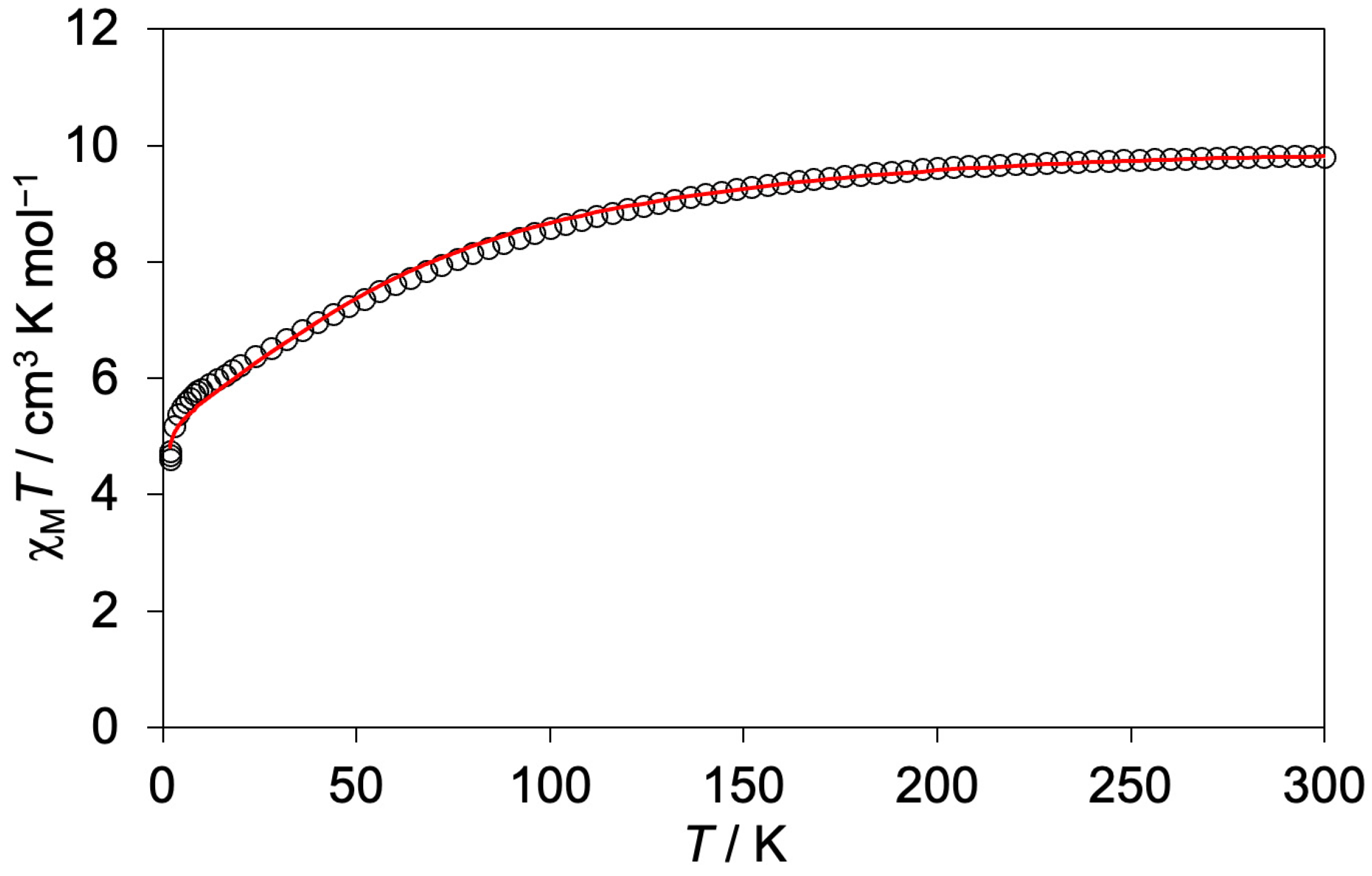
Figure 5.
Temperature dependence of χMT of 3. The red solid line is drawn with g = 2.43, J = +2.56 cm−1, zJ′ = −0.32 cm−1 and TIP = 1500 × 10−6 cm3 mol−1 for Equations (6) and (7) (see text).
2.5. Electronic Spin States
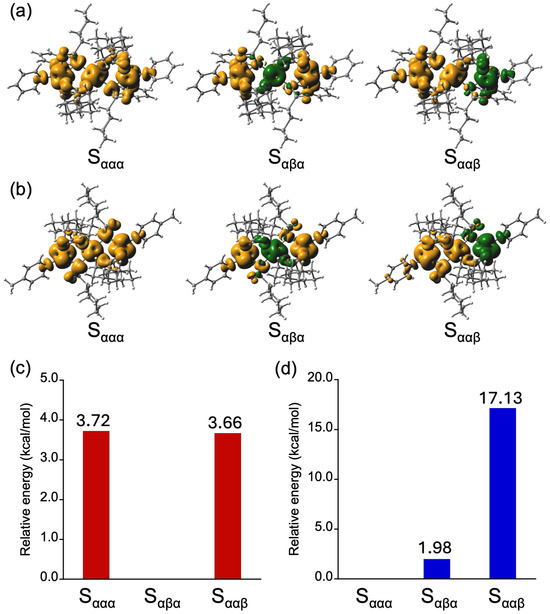
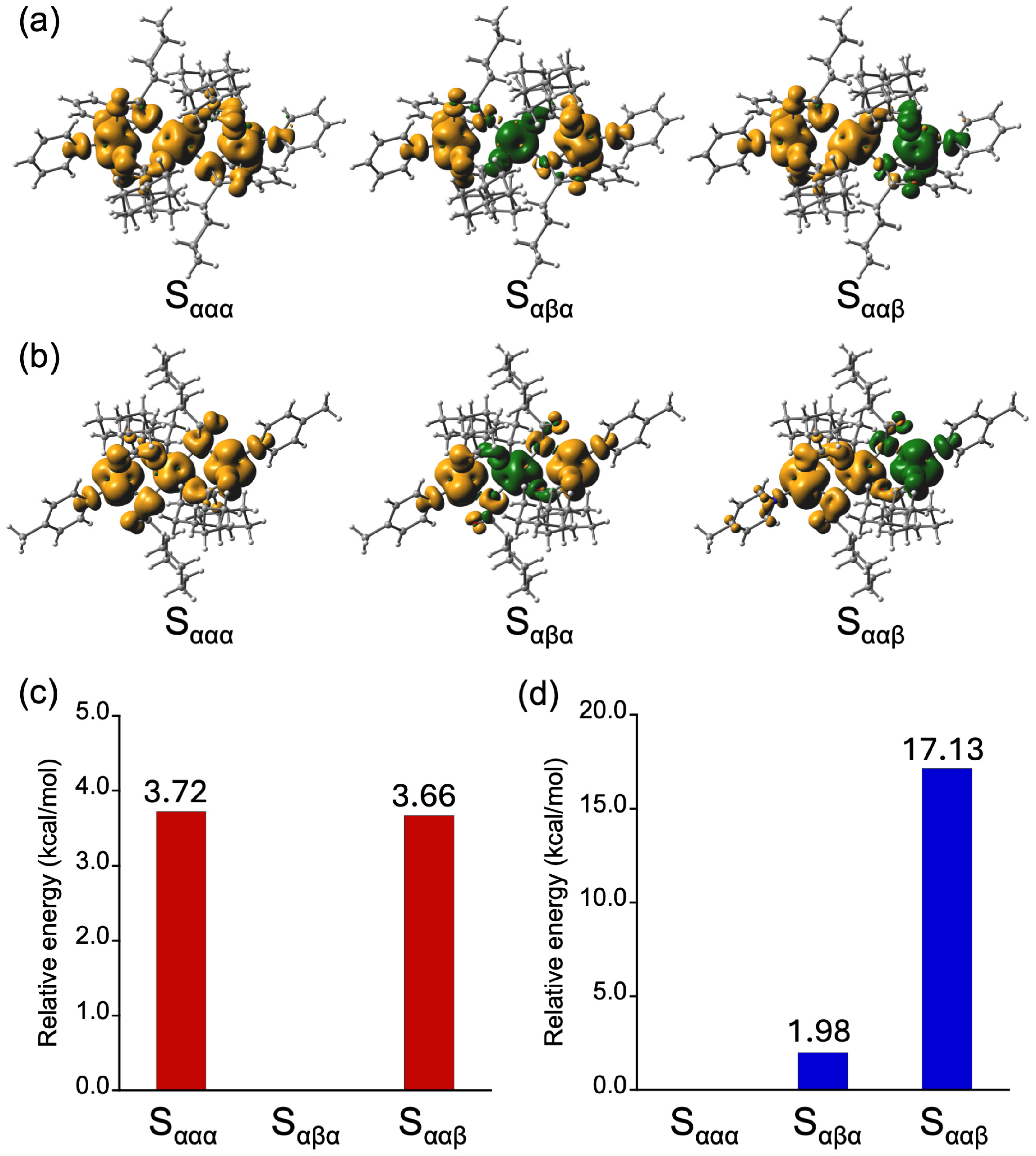
To elucidate the electronic spin states and magnetic properties of 2 and 3 in detail, unrestricted DFT calculations (uB3LYP functional) were conducted using the model structures of their Co3-SBUs. The Co3-SBUs in both 2 and 3 have symmetries (C2 axis for 2 and inversion center for 3) with respect to the central Co ion, and the magnetic measurements suggested that all cobalt(II) ions in 2 (Cooctahedral···Cooctahedral···Cooctahedral) and 3 (Cotetrahedral···Cooctahedral···Cotetrahedral) possess a quartet spin state. Hence, we examined three possible spin states: one decuplet high-spin state (Sααα = [↑↑↑···↑↑↑···↑↑↑]; total spin = 9/2) and two quartet low-spin states (Sαβα =[↑↑↑···↓↓↓ ··↑↑↑], and Sααβ = [↑↑↑···↑↑↑···↓↓↓]; total spin = 3/2).
As depicted in Figure 6a,b, three predicted localized spin states were successfully obtained for each Co3-SBU. In all spin states, the spin density was predominantly localized on the three Co ions (primary) and the atoms in the first coordination sphere (minor), whereas almost no spin density was observed over most of the cyclohexane and pyridyl carbon moieties. These results suggest that the magnetic interactions observed in 2 and 3 arose predominantly within the Co3-SBUs. As shown in Figure 6c,d, the most stable spin states for 2 and 3 were Sαβα and Sααα, respectively. These results are consistent with the experimental magnetic susceptibility data, that is, 2 exhibits antiferromagnetic interactions, whereas 3 shows ferromagnetic interactions.
Figure 6.
Spin density distributions for three possible spin states of the model Co3-SBUs of (a) 2 and (b) 3, together with their relative energies for (c) 2 and (d) 3. Here, the total energies of the Sαβα state for 2 and the Sαaα state for 3 were set at 0 kcal/mol as the reference.
3. Materials and Methods
3.1. Chemicals and Instruments
Trans-1,4-cyclohexanedicarboxylic acid (H2CHDC) was purchased from Tokyo Chemical Industry Co. Ltd. (Tokyo, Japan), and cobalt(II) nitrate hexahydrate, DMF, py, and mpy were obtained from Fujifilm Wako Pure Chemical Industry (Osaka, Japan).
X-ray powder diffraction (XRPD) analyses were performed using a Rigaku (Tokyo, Japan) SmartLab diffractometer with a Cu-Kα radiation source. CHN elemental analyses (EA) were conducted using a Yanaco (Tokyo, Japan) CHN Corder MT-6 instrument. Attenuated total reflection Fourier-transform infrared (ATR-FT-IR) spectroscopy was recorded on a JASCO (Tokyo, Japan) FT/IR-6300 spectrophotometer equipped with a JASCO ATR PRO ONE module. Thermogravimetric (TG) analyses were carried out at a heating rate of 4.0 K/min under a nitrogen atmosphere using a Rigaku TG-DTA8122 analyzer with a sample observation attachment. Variable temperature magnetic susceptibilities were measured using a Quantum Design (San Diego, CA, USA) MPMS3 SQUID magnetometer under a magnetic field of 1000 Oe over the temperature range of 1.8–300 K.
3.2. Synthesis of [Co3(CHDC)3(py)4] (2)
A mixture of Co(NO3)2·6H2O (58.2 mg, 0.20 mmol), H2CHDC (34.4 mg, 0.20 mmol), py (0.16 mL, 2.0 mmol), and DMF (5.0 mL) was heated at 393 K for 72 h using a Teflon-lined stainless-steel autoclave reactor. Purple crystals were obtained, washed with DMF using a membrane filter, and then dried under vacuum at 298 K for 1 h. Yield: 53.5 mg (0.0533 mmol, 26.7%). EA calcd (%) for C44H50N4O12Co3: C 52.65, H 5.02, N 5.58; found C 52.29, H 5.12, N 5.78. ATR-FT-IR (cm−1): 623 (w), 700 (vs), 756 (m), 785 (w), 882 (vw), 899 (vw), 925 (w), 1009 (w), 1038 (m), 1055 (vw), 1109 (vw), 1154 (w), 1214 (m), 1273 (w), 1327 (w), 1356 (w), 1403 (s), 1443 (m), 1485 (m), 1582 (s), 2852 (m), 2936 (m).
3.3. Synthesis of [Co3(CHDC)3(mpy)2]·2DMF (3)
A preparation method similar to that of 2 was applied for the synthesis of 3, but mpy (0.194 mL, 2.0 mmol) was used instead of py. Yield: 46.4 mg (0.0455 mmol, 22.8%). EA calcd (%) for C42H58N4O14Co3: C 49.47, H 5.73, N 5.49; found C 49.55, H 5.43, N 5.60. ATR-FT-IR (cm−1): 660 (m), 679 (m), 722 (w), 790 (s), 822 (m), 885 (w), 902 (w), 926 (m), 973 (w), 1032 (m), 1090 (m), 1200 (m), 1215 (w), 1231 (w), 1260 (m), 1326 (w), 1344 (m), 1383 (vs), 1404 (vs), 1504 (m), 1564 (vs), 1633 (m), 1677 (vs), 2854 (m), 2933 (m).
3.4. Crystallography
SCXRD analysis of 2 was performed at 100 K using a Rigaku (Tokyo, Japan) XtaLAB Synergy-S diffractometer equipped with a HyPix-6000 hybrid photon counting detector and a PhotonJet micro-focus X-ray source (Cu-Kα: λ = 1.54184 Å) at Shimane University, whereas that of 3 was conducted at 100 K using a DECTRIS (Baden-Dättwil, Switzerland) Pilatus3X CdTe 1 M detector and a synchrotron X-ray source (λ = 0.4131 Å) at the BL02B1 beamline of the SPring-8 synchrotron radiation facility. Obtained diffraction data were processed using the CrysAlisPro software (version 1.171.43.108a) [52]. The initial structures were solved by the SHELXT program [53] and then refined by full-matrix least-squares on F2 using the SHELXL program [54] within the Olex2 software (version 1.5) [55]. All non-hydrogen atoms were refined anisotropically, and hydrogen atoms were placed in the calculated positions and refined as riding models. The crystallographic information files (CIFs) for the final refined structures of 2 and 3 can be obtained free of charge from Cambridge Crystallographic Data Centre (CCDC) with the deposition numbers of CCDC-2535643 and 2535644, respectively, and their selected data are summarized in Table 1.
Table 1.
Crystallographic data of 2 and 3.
3.5. Density Functional Theory Calculation Methods
All density functional theory (DFT) calculations were performed using the spin-unrestricted uB3LYP functional [56] with the Def2-TZVP basis set for Co atoms and cc-pVDZ for other atoms implemented in Gaussian 16 (Rev. C.01) software [57]. The molecular geometries of calculation models were constructed using the crystal structures of 2 and 3. Electron density distributions were visualized using GaussView 5.0 software [58].
4. Conclusions
This study presented the synthesis, crystal structures, characterizations, magnetic properties, and DFT-calculated electronic spin states of two new Co3-based MOFs, [Co3(CHDC)3(py)4] (2) and [Co3(CHDC)3(mpy)2]·2DMF (3). The crystal structure analyses reveal that 2 and 3 form different Co3-SBUs owing to the slight structural difference between the auxiliary ligands, py and mpy; specifically, Co3-SBU in 2 exhibits a Cooctahedral···Cooctahedral···Cooctahedral arrangement, in which each peripheral octahedral Co site is coordinated by two py ligands, whereas that in 3 adopts a Cotetrahedral···Cooctahedral···Cotetrahedral arrangement, with each peripheral tetrahedral Co site coordinated by one mpy ligand. Each Co3-SBU is connected to six CHDC linkers to form a two-dimensional sheet structure composed of a triangular lattice, which are stacked in an ABAB pattern in 2 and AA pattern in 3. The chemical compositions of these structures are consistent with the results of the elemental and TG analyses, and their observed PXRD patterns also agree with those simulated from the crystal structures. Furthermore, the temperature-dependent magnetic susceptibility measurements reveal the following: (i) the χMT values (at 300 K) per Co3-SBU for 2 and 3 are 8.86 and 8.44 cm3 K mol−1, respectively, which are higher than the spin-only value for the three noninteracting S = 3/2 systems (5.63 cm3 K mol−1) but lower than the value calculated for S = 3/2 and L =3 (10.13 cm3 K mol−1), indicating the high-spin state (S = 3/2) for all the cobalt(II) ions; and (ii) the antiferromagnetic interaction operates in the Co3-SBU of 2, while the ferromagnetic interaction operates in the Co3-SBU of 3. The differences in the magnetic properties between 2 and 3 are not attributed to their different stacking structures but rather to the different coordination numbers (geometries) of the peripheral cobalt sites within the Co3-SBUs. Indeed, the DFT calculations of the model structures of the Co3-SBUs indicate that the most stable ground spin states are S = 3/2 for 2 and S = 9/2 for 3. To gain further insight into their electronic structures and magnetic properties, we are currently investigating Co3-based MOFs that incorporate other pyridine derivatives.
Supplementary Materials
The following supporting information can be downloaded at: https://www.mdpi.com/article/10.3390/inorganics14040104/s1, Scheme S1: Possible geometrical conformations of CHDC linker; Table S1: Selected bond lengths (Å) and angles (°) of crystal structure of 2; Table S2: Selected bond lengths (Å) and angles (°) of crystal structure of 3.
Author Contributions
Conceptualization, Y.K.; validation, N.Y., H.S., M.H. and Y.K.; formal analysis, K.M., N.Y., H.S., M.H. and Y.K.; investigation, K.M. and Y.K.; resources, Y.K.; data curation, Y.K.; writing—original draft preparation, M.H. and Y.K.; writing—review and editing, K.M., N.Y., H.S., M.H. and Y.K.; visualization, Y.K.; supervision, M.H. and Y.K.; project administration, M.H. and Y.K.; funding acquisition, Y.K. All authors have read and agreed to the published version of the manuscript.
Funding
This research was supported by JSPS KAKENHI, grant numbers JP24K08494, JP24K08363, and JP25K18113. This research was financially supported by SDGs research project of Shimane University.
Institutional Review Board Statement
Not applicable.
Informed Consent Statement
Not applicable.
Data Availability Statement
The original contributions presented in this study are included in the article/Supplementary Materials. Further inquiries can be directed to the corresponding authors.
Acknowledgments
A part of this work was conducted at the Institute for Molecular Science, which was supported by “Advanced Research Infrastructure for Materials and Nanotechnology in Japan (ARIM)” of the Ministry of Education, Culture, Sports, Science and Technology (MEXT) (Proposal Number JPMXP1224MS1072). The synchrotron SCXRD experiment was performed at the BL02B1 of SPring-8 with the approval of the Japan Synchrotron Radiation Research Institute (JASRI) (Proposal No. 2024B1920, 2025A1940). The authors are grateful to Michiko Egawa (Shimane University) for her measurements of the elemental analyses.
Conflicts of Interest
The authors declare no conflicts of interest.
References
- Furukawa, H.; Cordova, K.E.; O’Keeffe, M.; Yaghi, O.M. The Chemistry and Applications of Metal–Organic Frameworks. Science 2013, 341, 1230444. [Google Scholar] [CrossRef] [Scilit] [PubMed]
- Kitagawa, S.; Kitaura, R.; Noro, S.-i. Functional Porous Coordination Polymers. Angew. Chem. Int. Ed. 2004, 43, 2334–2375. [Google Scholar] [CrossRef] [Scilit] [PubMed]
- Stock, N.; Biswas, S. Synthesis of Metal–Organic Frameworks (MOFs): Routes to Various MOF Topologies, Morphologies, and Composites. Chem. Rev. 2012, 112, 933–969. [Google Scholar] [CrossRef] [Scilit] [PubMed]
- Horike, S.; Nagarkar, S.S.; Ogawa, T.; Kitagawa, S. A New Dimension for Coordination Polymers and Metal–Organic Frameworks: Towards Functional Glasses and Liquids. Angew. Chem. Int. Ed. 2020, 59, 6652–6664. [Google Scholar] [CrossRef] [Scilit]
- Howarth, A.J.; Liu, Y.; Li, P.; Li, Z.; Wang, T.C.; Hupp, J.T.; Farha, O.K. Chemical, Thermal and Mechanical Stabilities of Metal–Organic Frameworks. Nat. Rev. Mater. 2016, 1, 15018. [Google Scholar] [CrossRef] [Scilit]
- Zhang, J.; Kosaka, W.; Kitagawa, Y.; Miyasaka, H. A Metal–Organic Framework That Exhibits CO2-Induced Transitions between Paramagnetism and Ferrimagnetism. Nat. Chem. 2021, 13, 191–199. [Google Scholar] [CrossRef] [Scilit]
- Kataoka, Y.; Yano, N.; Mikuriya, M.; Handa, M. Coordination polymers and metal–organic frameworks based on paddlewheel-type dirhodium(II) tetracarboxylates. Coord. Chem. Rev. 2022, 472, 214796. [Google Scholar] [CrossRef] [Scilit]
- Rowsell, J.L.; Yaghi, O.M. Strategies for Hydrogen Storage in Metal–Organic Frameworks. Angew. Chem. Int. Ed. 2005, 44, 4670–4679. [Google Scholar] [CrossRef] [Scilit]
- Kalmutzki, M.J.; Diercks, C.S.; Yaghi, O.M. Metal–Organic Frameworks for Water Harvesting from Air. Adv. Mater. 2018, 30, 1704304. [Google Scholar] [CrossRef] [Scilit]
- Sumida, K.; Rogow, D.L.; Mason, J.A.; McDonald, T.M.; Bloch, E.D.; Herm, Z.R.; Bae, T.-H.; Long, J.R. Carbon Dioxide Capture in Metal–Organic Frameworks. Chem. Rev. 2012, 112, 724–781. [Google Scholar] [CrossRef] [Scilit]
- Wang, Y.; Jin, H.; Ma, Q.; Mo, K.; Mao, H.; Feldhoff, A.; Jiang, Z. A MOF Glass Membrane for Gas Separation. Angew. Chem. Int. Ed. 2020, 59, 4365–4369. [Google Scholar] [CrossRef] [Scilit] [PubMed]
- Li, J.-R.; Kuppler, R.J.; Zhou, H.-C. Selective Gas Adsorption and Separation in Metal–Organic Frameworks. Chem. Soc. Rev. 2009, 38, 1477–1504. [Google Scholar] [CrossRef] [Scilit] [PubMed]
- Takasaki, Y.; Takamizawa, S. Active Porous Transition towards Spatiotemporal Control of Molecular Flow in a Crystal Membrane. Nat. Commun. 2015, 6, 8934. [Google Scholar] [CrossRef] [Scilit] [PubMed]
- Lee, J.; Farha, O.K.; Roberts, J.; Scheidt, K.A.; Nguyen, S.T.; Hupp, J.T. Metal–Organic Framework Materials as Catalysts. Chem. Soc. Rev. 2009, 38, 1450–1459. [Google Scholar] [CrossRef] [Scilit]
- Jiao, L.; Wang, Y.; Jiang, H.-L.; Xu, Q. Metal–Organic Frameworks as Platforms for Catalytic Applications. Adv. Mater. 2018, 30, 1703663. [Google Scholar] [CrossRef] [Scilit]
- Kataoka, Y.; Sato, K.; Miyazaki, Y.; Masuda, K.; Tanaka, H.; Naito, S.; Mori, W. Photocatalytic hydrogen production from water using porous material [Ru2(p-BDC)2]n. Energy Environ. Sci. 2009, 2, 397–400. [Google Scholar] [CrossRef] [Scilit]
- Thorarinsdottir, A.E.; Harris, T.D. Metal–Organic Framework Magnets. Chem. Rev. 2020, 120, 8716–8789. [Google Scholar] [CrossRef] [Scilit]
- Perlepe, P.; Oyarzabal, I.; Mailman, A.; Yquel, M.; Platunov, M.; Dovgaliuk, I.; Rouzières, M.; Négrier, P.; Mondieig, D.; Suturina, E.A.; et al. Metal-Organic Magnets with Large Coercivity and Ordering Temperatures up to 242 °C. Science 2020, 370, 587–592. [Google Scholar] [CrossRef] [Scilit]
- Miller, J.S.; Manson, J.L. Designer Magnets Containing Cyanides and Nitriles. Acc. Chem. Res. 2001, 34, 563–570. [Google Scholar] [CrossRef] [Scilit]
- Tranchemontagne, D.J.; Mendoza-Cortés, J.L.; O’Keeffe, M.; Yaghi, O.M. Secondary Building Units, Nets and Bonding in the Chemistry of Metal–Organic Frameworks. Chem. Soc. Rev. 2009, 38, 1257–1283. [Google Scholar] [CrossRef] [Scilit]
- Kalmutzki, M.J.; Hanikel, N.; Yaghi, O.M. Secondary Building Units as the Turning Point in the Development of the Reticular Chemistry of MOFs. Sci. Adv. 2018, 4, eaat9180. [Google Scholar] [CrossRef] [Scilit] [PubMed]
- Ha, J.; Lee, J.H.; Moon, H.R. Alterations to Secondary Building Units of Metal–Organic Frameworks for the Development of New Functions. Inorg. Chem. Front. 2020, 7, 12–27. [Google Scholar] [CrossRef] [Scilit]
- Guchhait, T.; Giri, M.; Mishra, S.P. Geometry Indices for Four- and Five-Coordinate Metal Complexes: A Concise Review. J. Coord. Chem. 2024, 77, 49–68. [Google Scholar] [CrossRef] [Scilit]
- Sarkar, A.; Dey, S.; Rajaraman, G. Role of Coordination Number and Geometry in Controlling the Magnetic Anisotropy in FeII, CoII, and NiII Single-Ion Magnets. Chem. Eur. J. 2020, 26, 14036–14058. [Google Scholar] [CrossRef] [Scilit]
- Sahu, P.K.; Kharel, R.; Shome, S.; Goswami, S.; Konar, S. Understanding the Unceasing Evolution of Co(II)-Based Single-Ion Magnets. Coord. Chem. Rev. 2023, 475, 214871. [Google Scholar] [CrossRef] [Scilit]
- Castaldelli, E.; Jayawardena, K.D.G.I.; Cox, D.C.; Clarkson, G.J.; Walton, R.I.; Le-Quang, L.; Chauvin, J.; Silva, S.R.P.; Demets, G.J.-F. Electrical Semiconduction Modulated by Light in a Cobalt and Naphthalene Diimide Metal–Organic Framework. Nat. Commun. 2017, 8, 2139. [Google Scholar] [CrossRef] [Scilit]
- Gonzalez-Nelson, A.; Joglekar, C.; van der Veen, M.A. Pillared Cobalt Metal–Organic Frameworks Act as Chromatic Polarizers. Chem. Commun. 2021, 57, 1022–1025. [Google Scholar] [CrossRef] [Scilit]
- Das, M.; Jaswal, V.; Bhambri, H.; Das, P.; Maity, S.; Ghosh, P.; Mandal, S.K.; Sarkar, M. Two Pillared-Layer Metal–Organic Frameworks Based on the Pinwheel Trinuclear Carboxylate Clusters of Zn(II) and Co(II): Synthesis, Crystal Structures, Magnetic Study, and Lewis Acid Catalysis. Dalton Trans. 2023, 52, 1449–1460. [Google Scholar] [CrossRef] [Scilit]
- Akintola, O.; Buchholz, A.; Görls, H.; Plass, W. Modulator-Induced Formation of a Neutral Framework Based on Trinuclear Cobalt(II) Clusters and Nitrilotribenzoic Acid: Synthesis, Magnetism, and Sorption Properties. Eur. J. Inorg. Chem. 2021, 2021, 2266–2273. [Google Scholar] [CrossRef] [Scilit]
- Tian, C.B.; Han, Y.H.; He, Z.Z.; Du, S.W. Magnetic Tuning of an Anionic CoII-MOF through Deionization of the Framework: Spin-Canting, Spin-Flop, and Easy-Plane Magnetic Anisotropy. Chem. Eur. J. 2017, 23, 767–772. [Google Scholar] [CrossRef] [Scilit]
- Zeng, M.-H.; Yin, Z.; Tan, Y.-X.; Zhang, W.-X.; He, Y.-P.; Kurmoo, M. Nanoporous Cobalt(II) MOF Exhibiting Four Magnetic Ground States and Changes in Gas Sorption upon Post-Synthetic Modification. J. Am. Chem. Soc. 2014, 136, 4680–4688. [Google Scholar] [CrossRef] [Scilit]
- Li, H.; Cheng, L.; Tian, L.; Wang, Y.X. A Coordination Polymer of Co(II) Based on 5-(3-Methyl-1H-1,2,4-triazol-1-yl)isophthalic Acid: Synthesis, Structure and Magnetic Properties. J. Mol. Struct. 2025, 1351, 144070. [Google Scholar] [CrossRef] [Scilit]
- Kato, C.N.; Hasegawa, M.; Sato, T.; Yoshizawa, A.; Inoue, T.; Mori, W. Microporous Dinuclear Copper(II) trans-1,4-Cyclohexanedicarboxylate: Heterogeneous Oxidation Catalysis with Hydrogen Peroxide and X-ray Powder Structure of a Peroxo Copper(II) Intermediate. J. Catal. 2005, 230, 226–236. [Google Scholar] [CrossRef] [Scilit]
- Snyder, B.E.R.; Turkiewicz, A.B.; Furukawa, H.; Paley, M.V.; Velasquez, E.O.; Dods, M.N.; Long, J.R. A Ligand Insertion Mechanism for Cooperative NH3 Capture in Metal–Organic Frameworks. Nature 2023, 613, 287–291. [Google Scholar] [CrossRef] [Scilit] [PubMed]
- Ou, Y.C.; Zhong, R.M.; Wu, J.Z. Recent Advances in Structures and Applications of Coordination Polymers Based on Cyclohexanepolycarboxylate Ligands. Dalton Trans. 2022, 51, 2992–3003. [Google Scholar] [CrossRef] [Scilit] [PubMed]
- Bueken, B.; Vermoortele, F.; Cliffe, M.J.; Wharmby, M.T.; Foucher, D.; Wieme, J.; Vanduyfhuys, L.; Martineau, C.; Stock, N.; Taulelle, F.; et al. A Breathing Zirconium Metal–Organic Framework with Reversible Loss of Crystallinity by Correlated Nanodomain Formation. Chem. Eur. J. 2016, 22, 3264–3267. [Google Scholar] [CrossRef] [Scilit]
- Zheng, Y.-Z.; Speldrich, M.; Kögerler, P.; Chen, X.-M. The Role of π–π Stacking in Stabilizing a,a-trans-Cyclohexane-1,4-dicarboxylate in a 2D Co(II) Network. CrystEngComm 2010, 12, 1057–1059. [Google Scholar] [CrossRef] [Scilit]
- Kurmoo, M.; Kumagai, H.; Hughes, S.M.; Kepert, C.J. Reversible Guest Exchange and Ferrimagnetism (TC = 60.5 K) in a Porous Cobalt(II)–Hydroxide Layer Structure Pillared with trans-1,4-Cyclohexanedicarboxylate. Inorg. Chem. 2003, 42, 6709–6722. [Google Scholar] [CrossRef] [Scilit]
- Kataoka, Y.; Matsubara, K.; Yano, N.; Mitsuhashi, R.; Sakiyama, H.; Handa, M. Trinuclear Cobalt(II)-Based Metal–Organic Framework Showing Solvent-Induced Switching to Magnetic Ordering. Cryst. Growth Des. 2025, 25, 3570–3577. [Google Scholar] [CrossRef] [Scilit]
- Qin, L.; Hu, J.; Zhang, M.; Li, Y.; Zheng, H. Construction of Metal–Organic Frameworks Based on Two Neutral Tetradentate Ligands. Cryst. Growth Des. 2012, 12, 4911–4918. [Google Scholar] [CrossRef] [Scilit]
- Demakov, P.A.; Bogomyakov, A.S.; Urlukov, A.S.; Andreeva, A.Y.; Samsonenko, D.G.; Dybtsev, D.N.; Fedin, V.P. Transition Metal Coordination Polymers with trans-1,4-Cyclohexanedicarboxylate: Acidity-Controlled Synthesis, Structures and Properties. Materials 2020, 13, 486. [Google Scholar] [CrossRef] [Scilit] [PubMed]
- Wei, H.X.; Chen, Y.W.; Gao, D.Z.; Sun, Y.Q.; Zhang, G.Y.; Xu, Y.Y. Syntheses, Structures and Magnetic Properties of Three 1-D Chain Metal–Nitroxide Coordination Polymers Bridged by e,e-trans-1,4-Cyclohexanedicarboxylate. Inorg. Chim. Acta 2011, 375, 298–304. [Google Scholar] [CrossRef] [Scilit]
- Hu, M.L.; Morsali, A.; Aboutorabi, L. Lead(II) Carboxylate Supramolecular Compounds: Coordination Modes, Structures and Nano-Structures Aspects. Coord. Chem. Rev. 2011, 255, 2821–2859. [Google Scholar] [CrossRef] [Scilit]
- Kumagai, H.; Oka, Y.; Kawata, S.; Ohba, M.; Inoue, K.; Kurmoo, M.; Okawa, H. Hydrothermal Synthesis, Crystal Structure, and Characterization of a New Hexanuclear Cobalt(II) Complex Comprised of Octahedral and Tetrahedral Cobalt Ions. Polyhedron 2003, 22, 1917−1920. [Google Scholar] [CrossRef] [Scilit]
- Holder, C.F.; Schaak, R.E. Tutorial on Powder X-ray Diffraction for Characterizing Nanoscale Materials. ACS Nano 2019, 13, 7359–7365. [Google Scholar] [CrossRef] [Scilit]
- Kahn, O. Molecular Magnetism; Wiley-VCH: New York, NY, USA, 1993. [Google Scholar]
- Sakiyama, H.; Adams, H.; Fenton, D.E.; Cummings, L.R.; McHugh, P.E.; Okawa, H. Magnetic Analysis of Trinuclear High-spin Cobalt(II) Complexes. Open J. Inorg. Chem. 2011, 1, 33–38. [Google Scholar] [CrossRef]
- Sakiyama, H. Development of MagSaki(Tri) Software for the Magnetic Analysis of Trinuclear High-spin Coblt(II) Complexes. J. Comput. Chem. Jpn. Int. Ed. 2015, 1, 9–13. [Google Scholar]
- Dong, X.; Shi, Z.; Li, D.; Li, Y.; An, N.; Shang, Y.; Sakiyama, H.; Muddassir, M.; Si, C. The regulation research of topology and magnetic exchange models of CPs through Co(II) concrntration adjustment. J. Solid State Chem. 2023, 318, 123713. [Google Scholar] [CrossRef] [Scilit]
- Sakiyama, H. Development of MagSaki(A) Software for the Magnetic Analysis of Dinuclear High-spin Coblt(II) Complexes Considering Anisotropy in Exchange Interaction. J. Comput. Chem. Jpn. 2007, 6, 123–134. [Google Scholar] [CrossRef] [Scilit]
- Tong, Y.-Z.; Wang, Q.-L.; Si, M.; Qi, M.; Yan, S.-P.; Yang, G.-M.; Cheng, P.; Liao, D.-Z. Crystal structure, spectroscopy and magnetism of trinuclear nickel(II), cobalt(II) complexes and their solid solution. Polyhedron 2011, 30, 3151–3157. [Google Scholar] [CrossRef] [Scilit]
- CrysAlisPro Software System; Rigaku Oxford Diffraction: Tokyo, Japan, 2018.
- Sheldrick, G.M. SHELXT—Integrated space-group and crystal-structure determination. Acta Cryst. 2015, A71, 3–8. [Google Scholar] [CrossRef] [Scilit]
- Sheldrick, G.M. Crystal structure refinement with SHELXL. Acta Cryst. 2015, C71, 3–8. [Google Scholar]
- Dolomanov, O.V.; Bourhis, L.J.; Gildea, R.J.; Howard, J.A.K.; Puschmann, H. OLEX2: A complete structure solution, refinement and analysis program. J. Appl. Cryst. 2009, 42, 339–341. [Google Scholar] [CrossRef] [Scilit]
- Becke, A.D. Density-functional thermochemistry. III. The role of exact exchange. J. Chem. Phys. 1993, 98, 5648–5652. [Google Scholar] [CrossRef] [Scilit]
- Frisch, M.J.; Trucks, G.W.; Schlegel, H.B.; Scuseria, G.E.; Robb, M.A.; Cheeseman, J.R.; Scalmani, G.; Barone, V.; Petersson, G.A.; Nakatsuji, H.; et al. Gaussian 16, Revision C.01; Gaussian, Inc.: Wallingford, CT, USA, 2016. [Google Scholar]
- Dennington, R.; Keith, T.; Millam, J. GaussView, Version 5.0; Semichem Inc.: Shawnee Mission, KS, USA, 2009. [Google Scholar]

Disclaimer/Publisher’s Note: The statements, opinions and data contained in all publications are solely those of the individual author(s) and contributor(s) and not of MDPI and/or the editor(s). MDPI and/or the editor(s) disclaim responsibility for any injury to people or property resulting from any ideas, methods, instructions or products referred to in the content. |
© 2026 by the authors. Licensee MDPI, Basel, Switzerland. This article is an open access article distributed under the terms and conditions of the Creative Commons Attribution (CC BY) license.