


Abstract
A simple method employing dextrose as a capping agent was adopted for making MgAl2O4@MgO (AM), 5%NiO-MgAl2O4@MgO (AMNi), 5%CoO-MgAl2O4@MgO (AMCo), and 5%CuO-MgAl2O4@MgO (AMCu) nanocomposites. The average particle sizes, determined via SEM, were in the range of 21.6–51.4 nm, 9.8–13.8 nm, 19.1–32.2 nm, and 9.2–31.2 nm for AM, AMCu, AMNi, and AMCo, respectively. The nanosorbents exhibited type IV isotherm curves and type H3 hysteresis loops, signifying mesoporous properties. The AM, AMCu, AMNi, and AMCo exhibited surface areas of 69.47, 95.87, 86.23, and 75.87 m2/g, respectively. The pseudo second order described the indigo carmine (IDC) sorptions onto AM, AMCu, AMNi, and AMCo. The liquid film diffusion regulated IDC sorption on AMNi and AMCo, whereas the intraparticle diffusion was the dominant model on AM and AMCu. The AMCu’s showed a qt value of 127 mg g−1 from a 50 mg L−1 IDC solution at 20 °C, and 286.2 mg g−1 from a 200 mg L−1 IDC solution at 50 °C, establishing its capability for treating contaminated water. The IDC sorption onto AMCu aligns with the Freundlich model, which may elucidate the elevated qt value of AMCu. Elevating the temperature induced the IDC sorption on AMCu, indicating its endothermic nature, and the negative ΔG° implied that the IDC sorption by AMCu was spontaneous. A 5.0 and 10.0 mg L−1 IDC concentration in natural water samples was treated by the AMCu, which showed 100.0% efficacy for both groundwater samples; however, its efficacy toward the 5 and 10 mg L−1 IDC in seawater was 99.23% and 89.78%, respectively. The MACu’s efficiency throughout four reuse cycles decreased by only 7.21%, demonstrating excellent stability and reusability performance.
1. Introduction
The severity of water pollution stands as one of the primary threats to life arising from the global economic development that humanity has adopted [1,2]. The extensive production and application of dyes on a worldwide scale result in wastewater that poses significant environmental risks. Various industries currently discharge effluents containing organic contaminants into aquatic ecosystems. The industries participating in this dilemma encompass manufacturing, textiles, paper, leather, plastic, ink, and cosmetics. Industries of this nature consume significant quantities of water and generate a wide array of pollutants, including dyes, additives, suspended solids, heavy metals, and solvents. Consequently, these contaminants reach water supplies, posing a significant threat to aquatic ecosystems and the whole environment [3,4]. Every living organism is impacted by the harmful effects of these pollutants, even when present in very low concentrations [5,6,7,8]. Dyes are frequently identified as the primary contaminants in many industrial wastewater [9]. Indigo Carmine (IDC) dye is extensively employed across various industries due to its vibrant color [8]. This substance is classified as a toxic dye due to its harmful effects on human health when it comes into contact with the skin and eyes. The IDC structure consists of four benzene rings along with two negatively charged sulfonate groups, which contribute to its non-biodegradable nature, high toxicity, and carcinogenic effects on both humans and aquatic life. The consumption of this dye in elevated concentrations appeared to be fatal due to its carcinogenic properties and potential to cause reproductive, developmental, neurological, and acute toxic effects. This substance is recognized for its potential to induce a range of hypertension, from mild to severe, as well as various cardiovascular and respiratory impacts. IDC has the potential to inflict irreversible harm on the cornea and conjunctiva, aligning with the World Health Organization’s established limit concentration of 0.005 mg L−1 for IDC [7,8,9,10,11]. Consequently, it is crucial to eliminate IDC from wastewater and industrial discharge sources. A variety of unconventional nano-sorbents, such as carbonaceous materials, metal oxides, and nanocomposites, have been explored for the elimination of IDC [2,12,13]. The technique of photocatalytic degradation for IDC in wastewater has been utilized in various studies, indicating its potential for removing such pollutants through this method [14]. Adsorption is an energy-conserving technique that is simple, straightforward, highly effective, and an easily executed process, which does not release toxic substances [15]. The π/π bonding and Van der Waals force are characteristic of physisorption, whereas chemisorption occurs when bonding between pollutants and sorbents is formed. Metal oxide nanomaterials have been studied for their potential to combat water pollutants, including dyes, pharmaceuticals, and heavy metals. Due to its low specific gravity, MgO exhibits high strength and stiffness, making it suitable for numerous potential applications. These include, but are not limited to, biosensors, computers, electronics, vehicles, aircraft, adsorbents, catalysts, superconducting products, and batteries [16]. Both aluminum and magnesium are targets for various applications due to their widespread mineral abundance on Earth and their relative safety and ease of refinement [17].
There are several methods for preparing oxides of alumina and magnesia, which have been utilized as catalysts, catalyst supports, adsorbents, and wear-resistant coatings, and do not require a specific preparation method. Al2O3-MgO exhibits a higher surface area and adsorption capacity than Al2O3 and/or MgO alone [18]. Spinel magnesium aluminate (MgAl2O4) is a naturally occurring and readily synthesizable nanohybrid that exhibits remarkable properties, including a melting point of 2135 °C, a hardness of 16 GPa, and a low density of 3.58 g/cm3 [19,20]. These substantial characteristics have wide applications in AM, including industries (e.g., ceramics, cement), photocatalysis, methane production from CO2, ethanol synthesis, energy storage, hydrogen production, and adsorption [21,22,23,24]. Metal oxides are often used as additives in refractory materials due to their elevated melting points, reactive chemistry, and propensity to interact with other metal oxides, thereby enhancing the sintering capabilities of spinel materials and imparting novel characteristics [25]. Currently, researchers are focusing on simplifying synthesis processes to produce low-cost, environmentally safe sorbents.
Herein, we aimed to prepare MgAl2O4@MgO (AM) via a simplified one-pot process using dextrose as a capping agent, following an in situ protocol. Thereafter, 5%NiO-MgAl2O4@MgO (AMNi), 5%CoO-MgAl2O4@MgO (AMCo), and 5%CuO-MgAl2O4@MgO (AMCu) nanocomposites will be prepared similarly. The fabricated AM, AMNi, AMCo, and AMCu triple nanohybrids will be characterized and tested for the removal of IDC as a pollutant. The IDC sorption parameters will be optimized, and the sorption kinetics and equilibria will be investigated. Additionally, the sorbent’s reusability and suitability for use in natural water conditions will be evaluated.
2. Results and Discussion
2.1. Characterization of AM, AMCu, AMNi, and AMCo
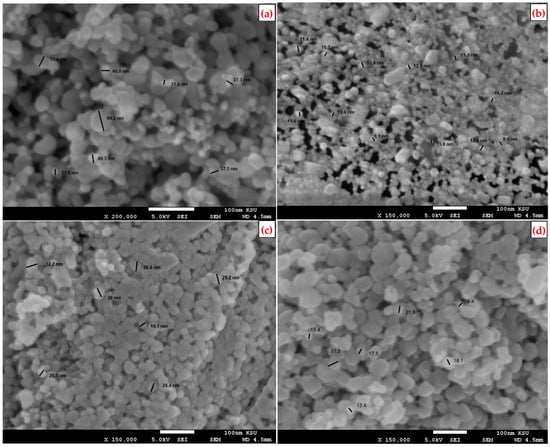
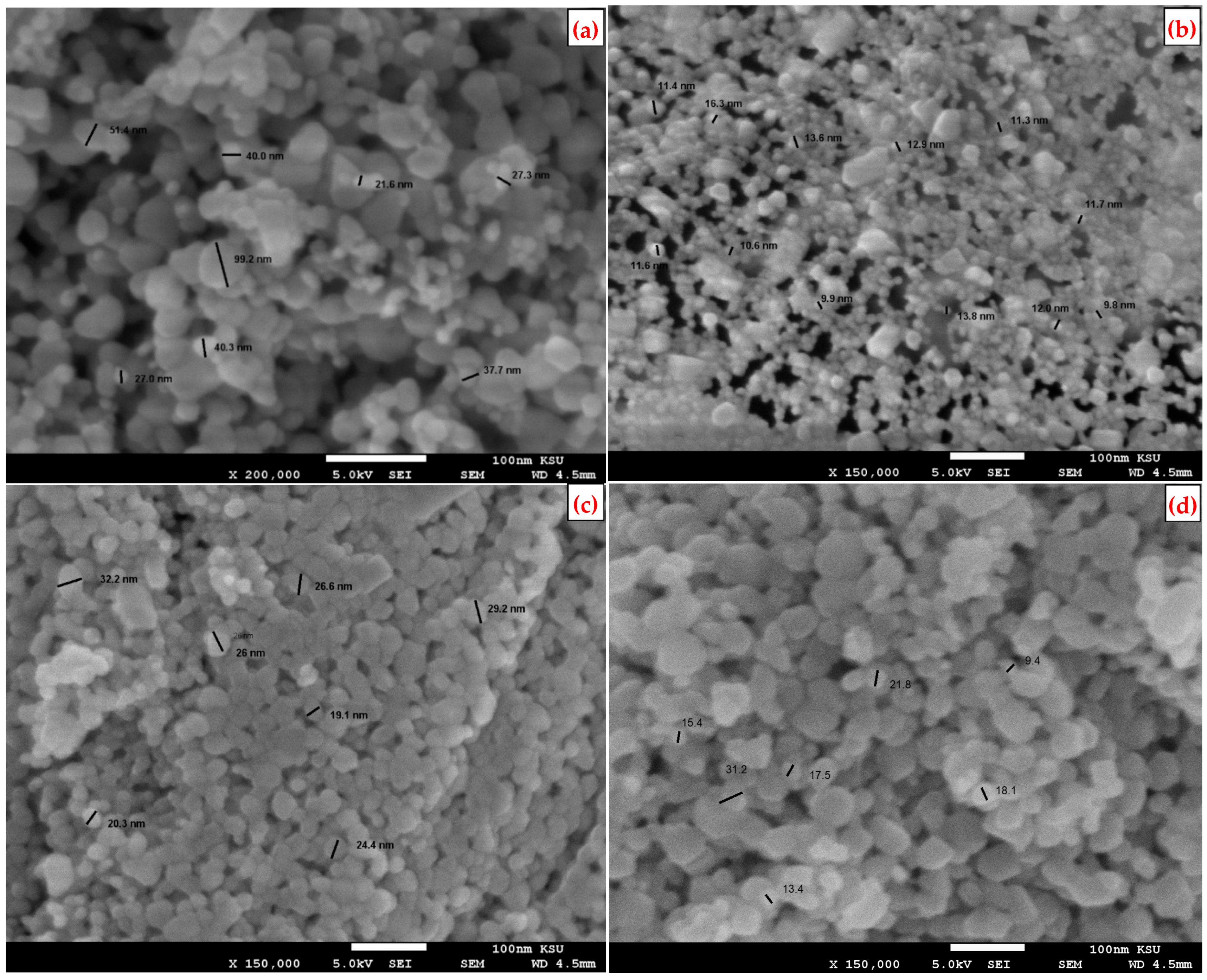
The surface morphology of AM, AMCu, AMNi, and AMCo was examined by SEM. The captured images in Figure 1 show spherical and/or elliptical particles. The particle size was determined using the ImageJ program (Version 1.51 23 April 2018, Windows version). The AM, AMCu, AMNi, and AMCo showed size ranges of 21.6–51.4 nm, 9.8–13.8 nm, 19.1–32.2 nm, and 9.2–31.2 nm, respectively. Notably, AMCu exhibited the shortest size range and the smallest particle sizes. The narrow particle size ranges obtained with dissimilar doping ions in the AM, AMCu, AMNi, and AMCo nanocomposites may serve as a model for the general fabrication of nanoscale heterocomposites.
Figure 1.
SEM images of (a) AM, (b) AMCu, (c) AMNi, and (d) AMCo.
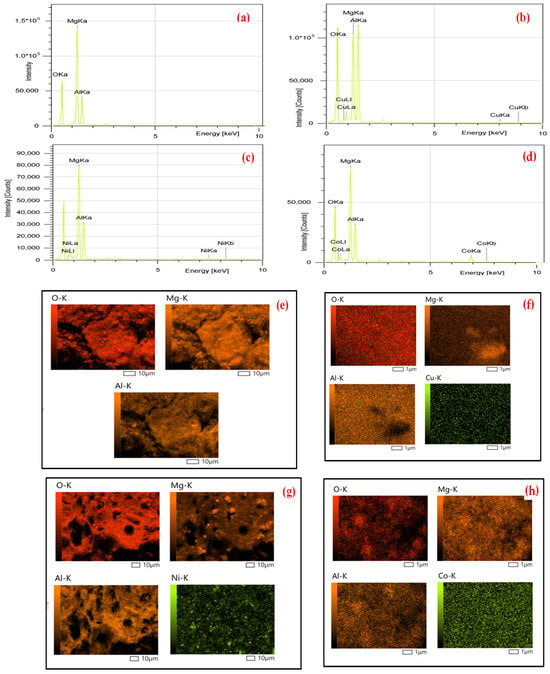
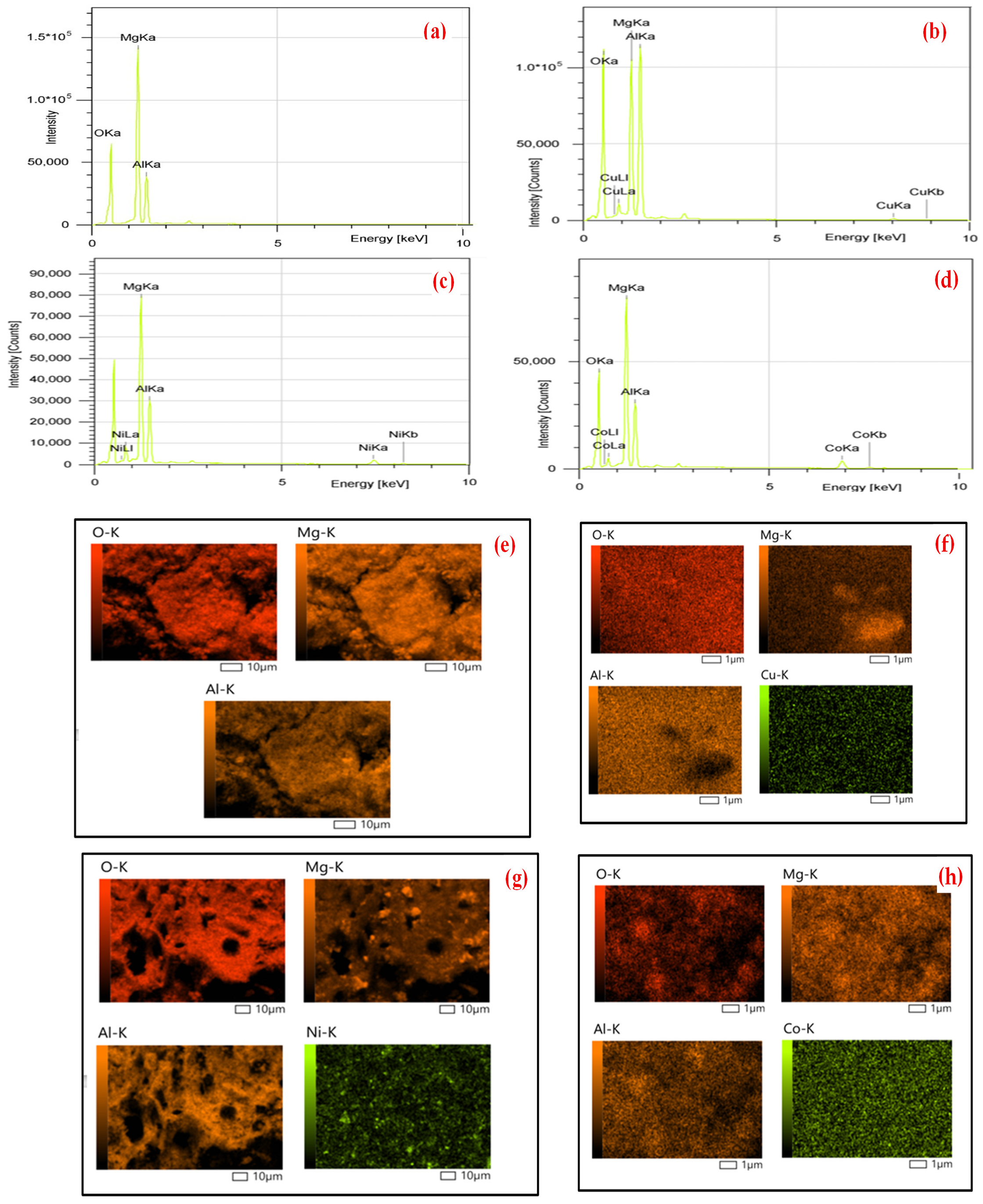
The elements constituting the as-synthesized AM, AMCu, AMNi, and AMCo were identified through EDX. The obtained spectra in Figure 2a–d confirmed the presence of aluminum, oxygen, and magnesium in the synthesized AM, AMCu, AMNi, and AMCo, with intrinsic peaks of Cu, Ni, and Co appearing in the corresponding spectra of the triple composites, respectively. At the same time, Table 1 shows the ratios of the elements that compose these nanohybrids. The presented spectra and the inserted tables confirm the purity of the AM, AMCu, AMNi, and AMCo nanocomposites, at ratios close enough to the intended doping ratios. Additionally, the EDX mapping technique was employed for examining the elemental distribution homogeneity in AM, AMCu, AMNi, and AMCo (Figure 2e–h). The Cu, Ni, and Co maps showed excellent homogeneous distribution across the test areas.
Figure 2.
(a–d) show the EDX spectra of AM, AMCu, AMNi, and AMCo, respectively, while (e–h) are the elemental mapping, respectively.
Table 1.
The elemental composition of AM, AMCu, AMNi, and AMCo, and the ratio of elements constituting them.
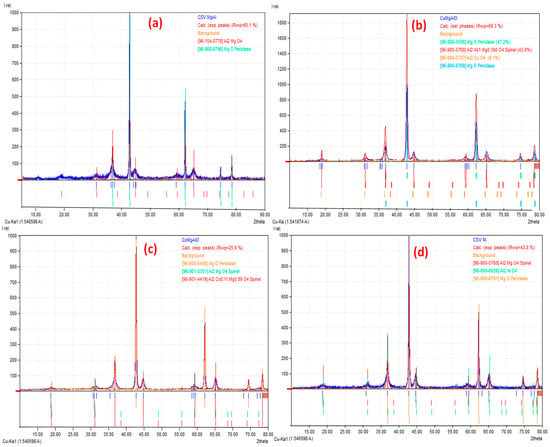
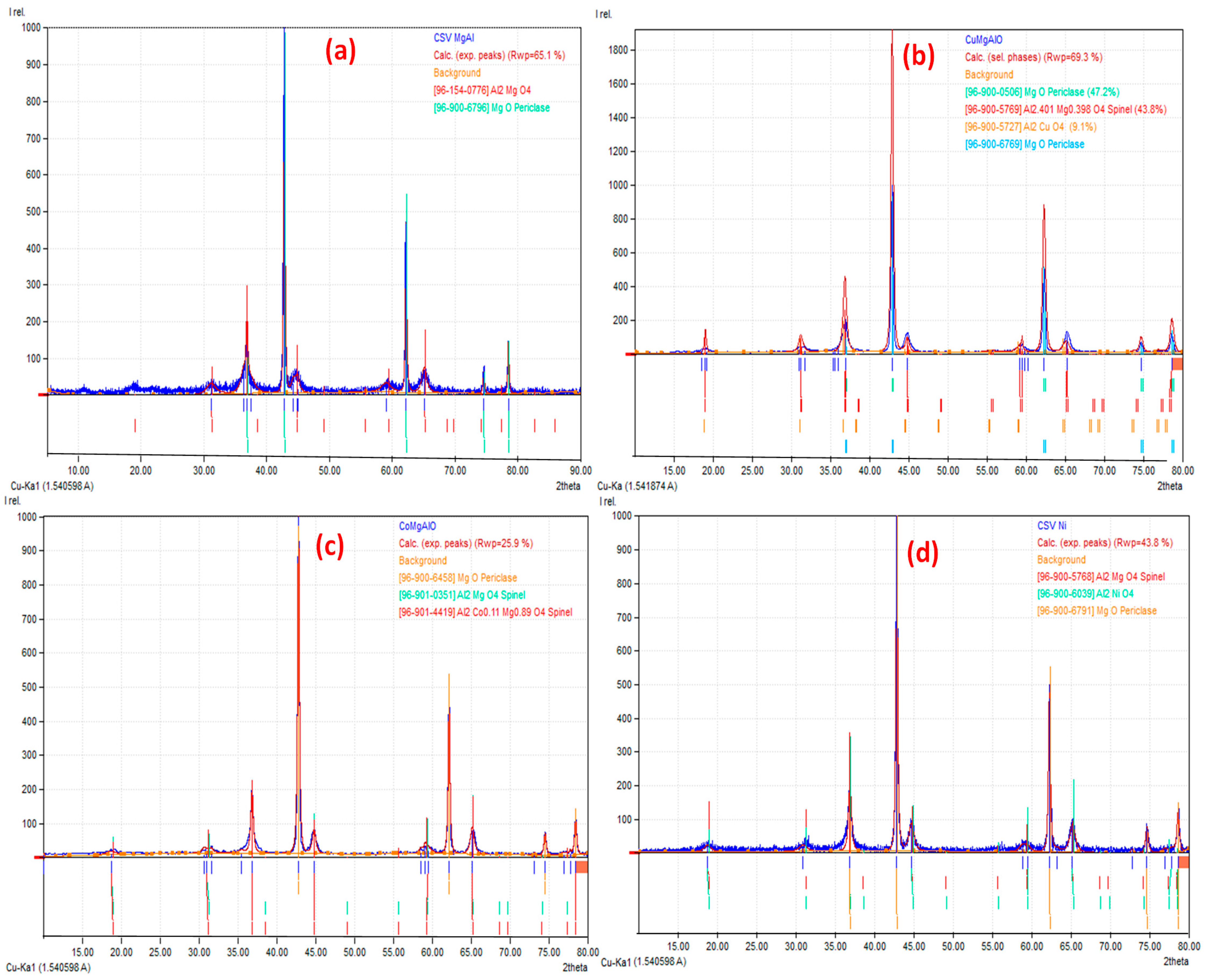
Figure 3 depicts the X-ray spectra of AM, AMCu, AMNi, and AMCo. The diffraction peaks at 2θ° at 19.11, 31.18, 36.86, 44.74, 59.58, 65.16, 74.66, and 78.43 in the XRD patterns of AM, AMCu, AMNi, and AMCo correspond to the cubic crystal planes of MgAl2O4, namely (111), (220), (311), (400), (511), (440), (620), and (533), which showed an excellent agreement to the JCPDS 96-900-2740 as predicted via the MATCH software (Version 4.0). Furthermore, the predominant diffraction maxima at 42.78 and 62.16 2θ° can be attributed to the (200) and (220) planes of the cubic MgO crystal (JCPDS 96-900-6806), as predicted by the MATCH software (Version 4.0). The CuO, NiO, and CoO doping resulted in the phases of CuAl2O4 (JCPDS 96-900-5727), NiAl2O4 (JCPDS 96-900-6039), and Co0.08Mg0.91Al2O4 (JCPDS 96-901-6720) in the corresponding nanohybrids. Considering the principal XRD peaks of MgO and MgAl2O4 (about 2θ° ≈ 42.9 and 2θ° ≈ 37.0) indicated a phase ratio of 4:1, respectively. The crystal size was determined using Bragg’s angles and Debye-Scherer’s formula (Equation (1)). Table 2 displays the lattice dimensions (a) and imperfection (c) as calculated using Equations (2) and (3), respectively [12].
Figure 3.
The XRD patterns of the prepared (a) AM, (b) AMCu, (c) AMCo, and (d) AMNi nanocomposites.
Table 2.
The XRD parameters of the prepared AM, AMCu, AMCo, and AMNi nanocomposites.
λ, D, and β symbolize the wavelength, the crystal size, and the half-height XRD peak-width. Table 2 revealed a significant shift in the D-values, accompanied by a change in the principal MgO peak (2θ = 44.236°) angle position, suggesting a lattice expansion attributed to the doping process. Furthermore, doping the AM with CuO, NiO, and CoO resulted in reducing the crystal’s lattice parameter (a) and increasing the c values, indicating a robust metal oxide–AM interaction.
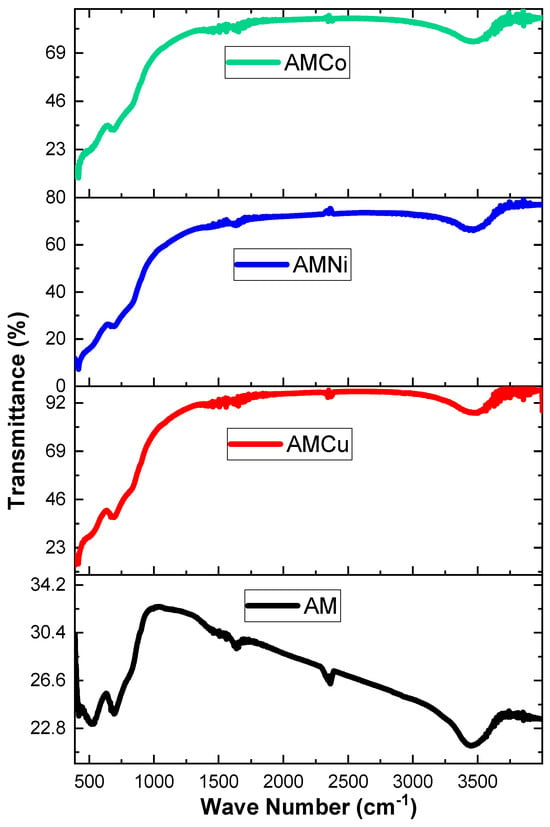
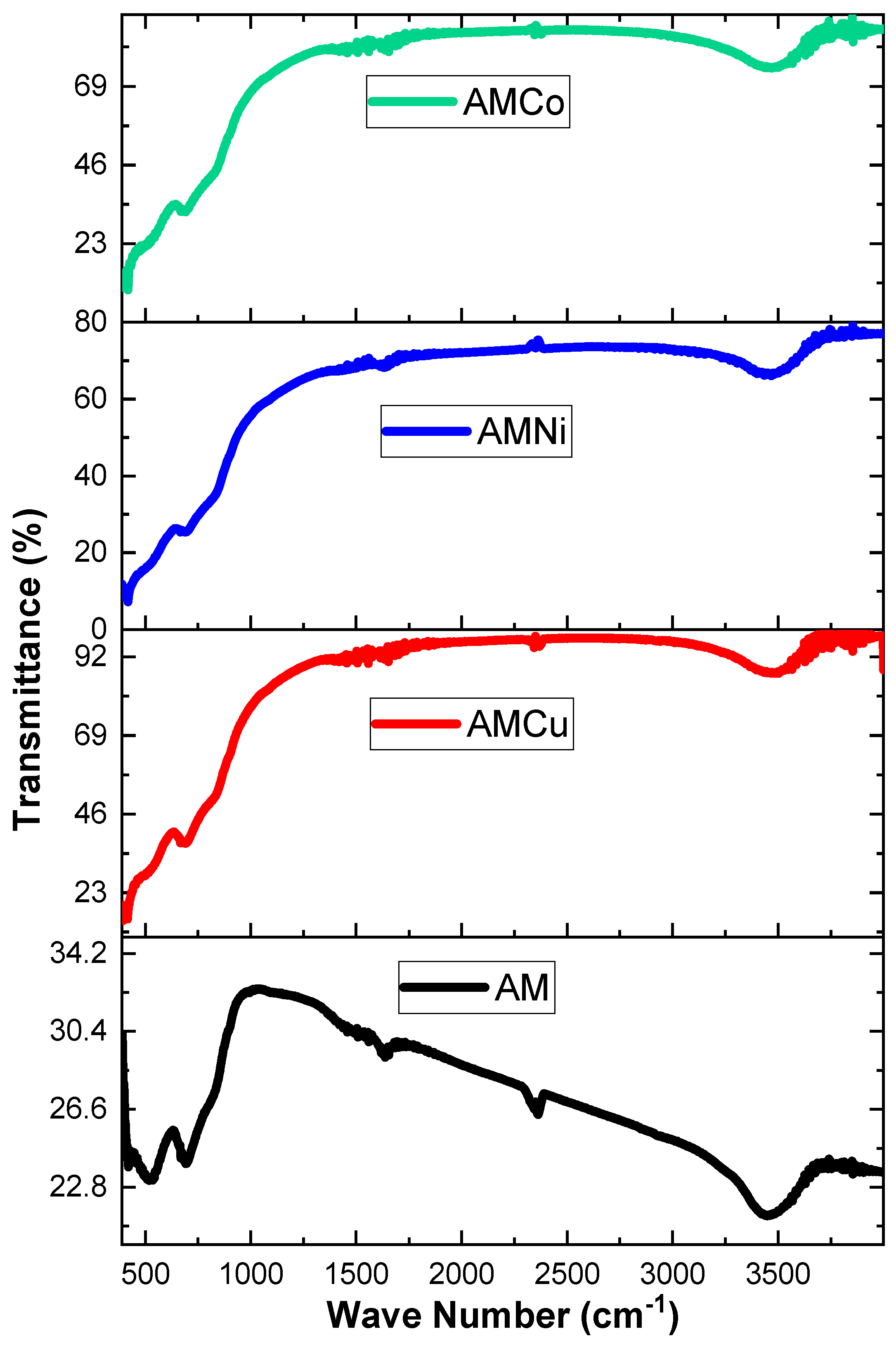
Figure 4 shows the FT-IR spectra of the AM, AMCu, AMNi, and AMCo nanocomposites. The peak about 418 cm−1 could be allocated to Mg-O of the MgO, while the doublet IR peaks at 839 and 698 cm-1 are attributed to asymmetric and symmetric Al-O-Al and the Mg-O-Al of spinel MgAl2O4 construction [26,27]. The 1623 cm−1 bands could be indicative of the O-H bending vibration, while the broad band between 3000–3500 cm−1 is allocatable to the hydrogen-bonded O-H stretching of adsorbed moisture on the AM, AMCu, AMNi, and AMCo surfaces [28]. The vibrating bands about 523 cm−1 in the AMCu, AMNi, and AMCo can be assigned to stretching vibrations of Cu-O, Ni-O, and Co-O bonds.
Figure 4.
The FTIR spectra of AM, AMCu, AMCo, and AMNi nanocomposites.
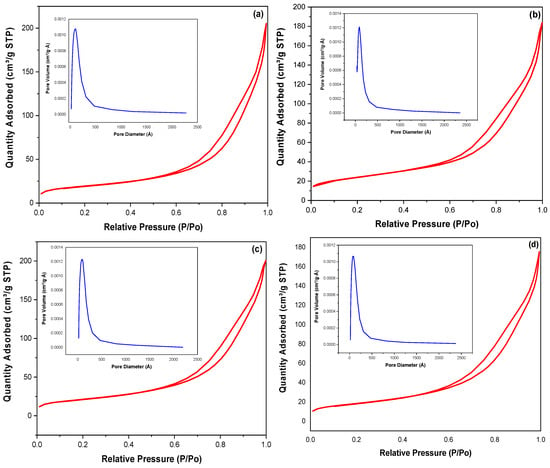
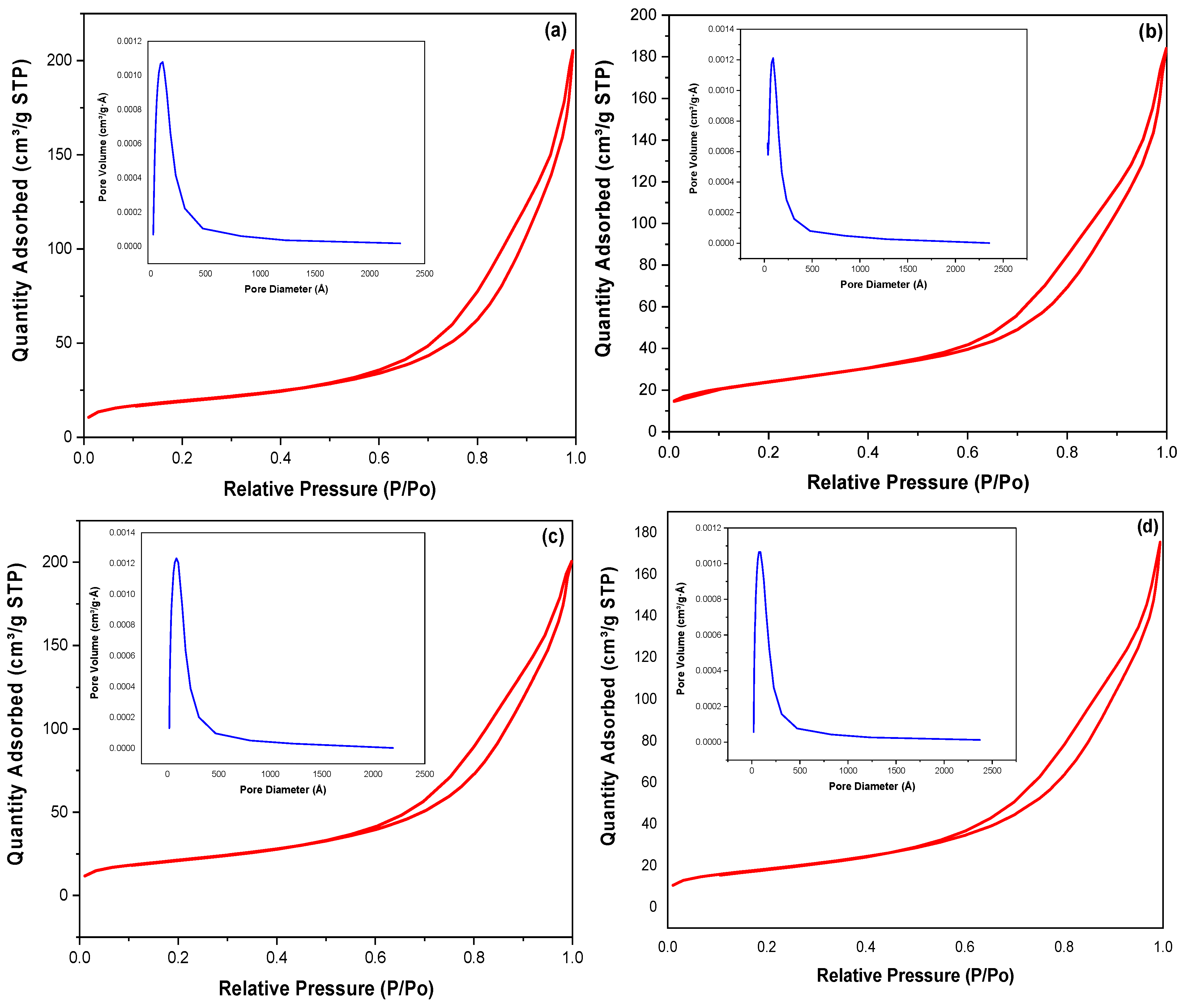
The surface characteristics of AM, AMCu, AMNi, and AMCo nanocomposites were surveyed using N2 adsorption–desorption (Figure 5). The isotherms of AM, AMCu, AMNi, and AMCo exhibited minimal adsorption at low pressures, with adsorption increasing with relative pressure. The AM, AMCu, AMNi, and AMCo exhibited type IV isotherms with an H3 loop-type, indicative of a mesoporous structure with bucket-like and/or cylindrically shaped pores [29,30,31]. The BET surface area of AM, AMCu, AMNi, and AMCo was 69.47, 95.87, 86.23, and 75.87 m2 g−1, respectively, while the average pore diameter was 126.09, 158.40, 130.96, and 131.35 Å, respectively. Compared to AM, the surface characteristics of AMCu, AMNi, and AMCo showed significant improvement. Considering that the process was tested here using three different elements, it can be generalized that doping AM with a transition-metal oxide at the studied dose via the proposed protocol could improve AM surface properties.
Figure 5.
The N2-sorption–desorption loops with the insert pore size distribution of (a) AM, (b) AMCu, (c) AMNi, (d) AMCo.
2.2. Contact Time and Kinetic Investigations
As a function of time, adsorption kinetics show how the adsorption process evolves. Time is a crucial metric that needs to be considered [32]. The adsorption of the IDC dye onto AM, AMCu, AMNi, and AMCo nanocomposites was assessed using a batch method. With 50 mg of each sorbent, a 100 mL solution of IDC (100 mg L−1) was stirred continuously. Afterwards, a UV-vis spectrophotometer was used to quantify the IDC concentrations after filtering a sample from each beaker using a syringe equipped with a 0.22 µm filter. Applying Equation (4), we calculated the adsorption capacity of IDC onto the sorbent at each time (t) and at equilibrium (qt and qe, mg g−1) [33].
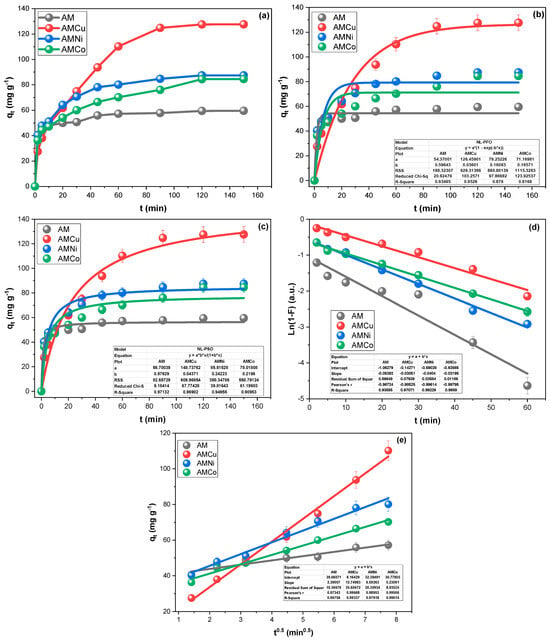
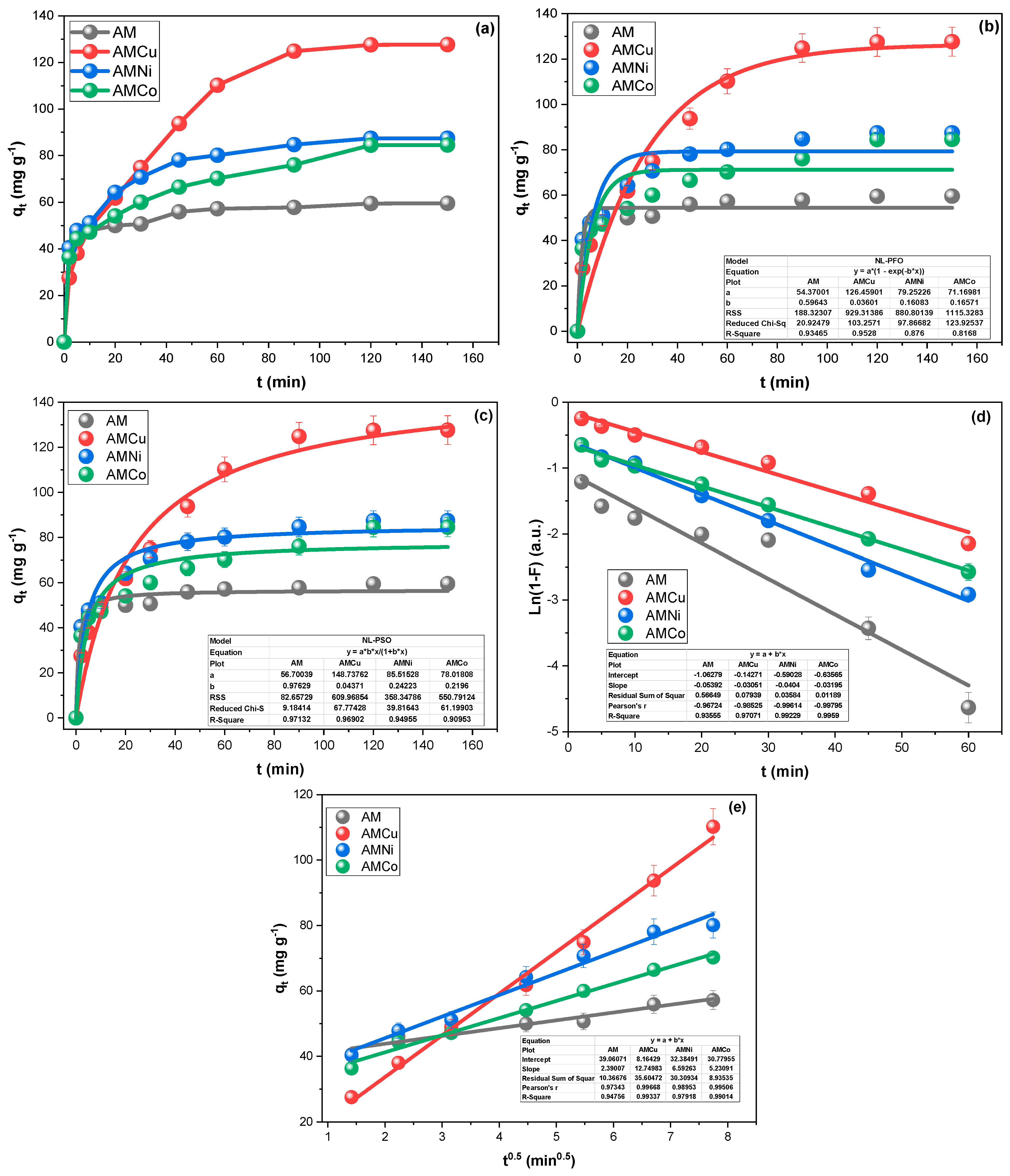
where v (L) represents the volume of the solution, Co and Ct (mg L−1) denote the initial and equilibrium concentrations of IDC in the solution, respectively, and m (g) indicates the mass of the adsorbent [12]. Figure 6 depicts the contact time study of IDC sorption onto AM, ACu, AMNi, and AMCo nanocomposites. The sorption on the four sorbents progressed fast and reached equilibrium within 120 min. The AM, AMCu, AMNi, and AMCo possessed qt values of 59.55, 127.62, 87.45, and 84.55 mg g−1, respectively. These results align with the AMCu having the highest surface area among the prepared nanohybrids and are consistent with the literature (Table 3). Worth noting that approximately 60% of the IDC uptake occurred within the first 40 min, with superior performance for the AMCu nanocomposites, which achieved a 214% removal efficiency compared to the base material (the AM). Figure 6a shows faster IDC removal by AMCu, AMNi, and AMCo in the early stages, which slowed down as they approached equilibrium. This can be attributed to the IDC molecules in the liquid phase being repelled from the sorbent surface, even when sorption sites are available [34].
qt = v(C0 − Ct)/m
Figure 6.
(a) contact time results, (b) NL-PFO, (c) NL-PSO, (d) LFDM, (e) IPDM plots of IDC removal by AM, AMCu, AMNi, and AMCo from 100 mg L−1 solution.
Table 3.
Comparing the AM, AMCu, AMNi, and AMCo performance in removing IDC by some literature findings.
Furthermore, the IDC sorption rate order for its removal by the AM, AMCu, AMNi, and AMCo nanocomposites was studied using the non-linear pseudo-first-order (NL-PFO, Equation (5)) and non-linear pseudo-second-order (NL-PSO, Equation (6)) models. Additionally, the IDC sorption mechanisms were examined using the liquid film diffusion model (LFDM) and the intraparticle diffusion model (IPDM), as explained by Equations (7) and (8), respectively.
where: Ci is a factor connected to layer boundaries. k1 (min−1), k2 (g mg−1 min−1), kIP (mg g−1 min−1/2), and kLF (min−1) stand for NL-PFO, NL-PSO, LFDM, and IPDM constants, respectively. Figure 6b,c illustrate the NL-PFO and NL-PSO graphs from which k1 and k2 were calculated by substituting the slope and intercept into the corresponding parameter mathematical formula (Table 4). The correlation coefficient (R2), along with the residual sum of squares and the reduced Chi-square, was used to assess the best-fitting model [44]. The NL-PSO showed alignment in the IDC sorption onto AM, AMCu, AMNi, and AMCo, with higher R2 values and lower RSS and X2 values, whereas the opposite was observed with the NL-PFO [34,45]. Furthermore, the step controlling IDC sorption onto AM, AMCu, AMNi, and AMCo was investigated. Figure 6d,e display the IPDM and LFDM plots for IDC sorption on the four sorbents, while Table 4 presents the computed results. The plots of IDC sorption onto AM, AMCu, AMNi, and AMCo nanocomposites showed R2 values close to unity for both models; however, the nonzero intercept for the IPDM indicates that the rate-limiting step involves both IPDM and LFDM, which together influenced the IDC sorption. Therefore, the adsorption process initially involves rapid film diffusion at high initial concentrations, followed by intraparticle diffusion as adsorption proceeds [46].
Table 4.
Kinetic results of IDC sorption onto AM, AMCu, AMNi, and AMCo nanocomposites.
2.3. Isotherms and Thermodynamics
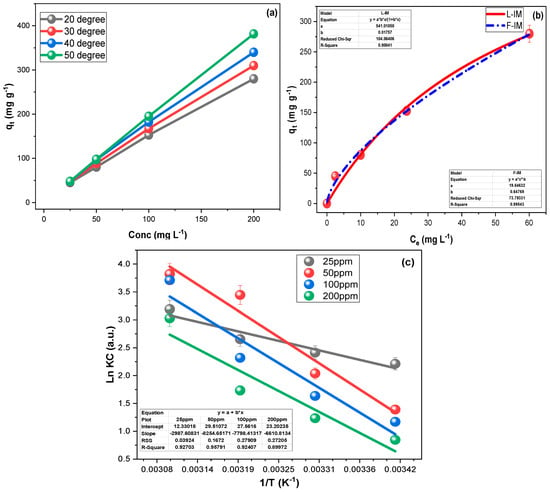
The contact time results demonstrated the AMCu superiority among the tested sorbents; therefore, the impacts of temperature and IDC concentration on its sorption by AMCu were investigated (Figure 7a). The gained qt value increases proportionately with the IDC concentration, exhibiting experimental qt values of 279.8 mg g−1 at a 200 mg L−1 concentration. The temperature dependence of IDC elimination by the AMCu was investigated (293–323 K), revealing a significant qt rise, indicating endothermic sorption. The enhanced IDC removal with elevated temperatures (Figure 7a) can be attributed to the induced IDC mobility via liquid-phase diffusion and/or the swelling of the AMCu particle’s internal structure, which facilitates the infiltration of IDC into the porous framework of the AMCu. This could also be interpreted as a consequence of the AMCu particle’s disintegration, exposing new sorption sites [47]. Given such a high qt value, this quality is essential in the real world, where frequent temperature changes and the need to maintain high removal efficiency are common [48].
Figure 7.
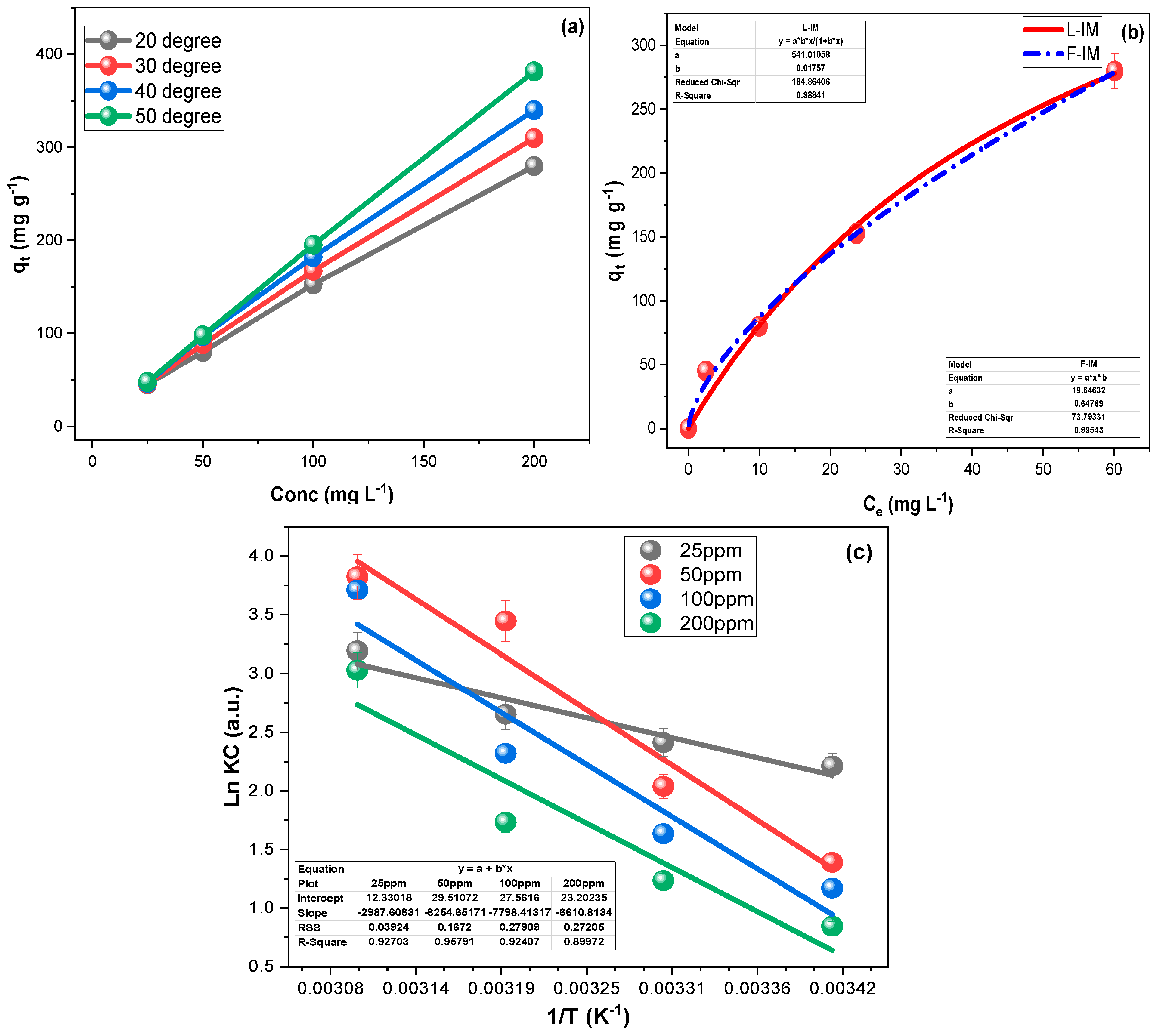
(a) Effect of concentration and temperature on IDC sorption from 25 to 200 mg L−1 concentration range and 293 to 323 K, (b) L-IM and F-IM fittings, and (c) thermodynamic plot from the above-identified concentration and temperature ranges at pH = 6.0.
The most popular models, the Langmuir (L-IM) and the Freundlich (F-IM) isotherms, were applied to explain IDC sorption onto AMCu [49]. L-IM (Equation (9)) was employed to test the one-layer IDC sorption possibility without IDC-AMCu interaction, while the multiple-layer IDC sorption was tested via F-IM (Equation (10)).
where: Ce (mg L−1) denotes the IDC concentration in the solution at equilibrium; qe represents the maximum qt; KL (L mg−1) is the L-IM constant; KF (L g−1) and 1/n signify the F-IM constant and the favorability factor, respectively [12,50]. Figure 7b displays the combined L-IM and F-IM non-linear plots of IDC adsorption on AMCu, with the findings of the two models outlined in Table 5. The fitting results demonstrated that IDC sorption onto AMCu was better described by the F-IM model, with an R2 value of 0.995, indicating heterogeneous multilayered IDC sorption. The sub-unity value of 1/n suggested a favorable IDC sorption onto AMCu [51].
Table 5.
Isotherm results of IDC sorption by MACu using concentrations ranged from 25 to 200 mg L−1 at 293 K, and the thermodynamic results of 25 to 200 mg L−1 IDC concentrations at 293, 303, 313, and 323 K.
The thermodynamics of the IDC sorption onto AMCu can be assessed using characteristic thermodynamic parameters, including the Gibbs free energy (ΔG°), enthalpy (ΔH°), and entropy (ΔS°). Kc was computed via Equation (11), then ln(Kc) was plotted versus the reciprocal of absolute temperature (1/T, 1/K) (Equation (12)), and the application of the resulting ΔH° and ΔS° in Equation (13) [52,53].
where: KC (a.u) is the equilibrium constant, T (K) is the IDC sorption temperature, R = 0.0081345 (kJ mol−1) is the ideal gas constant [54]. The positive ΔH° shown in Table 5 indicates an endothermic IDC sorption onto AMCu, while the negative ΔG° values indicate the spontaneity of IDC sorption onto AMCu at the studied temperature ranges. Furthermore, the positive ΔS° value of IDC sorption onto AMCu indicated a less disordered solid–liquid interface [55].
2.4. The pH Impact on IDC Sorption by AMCu
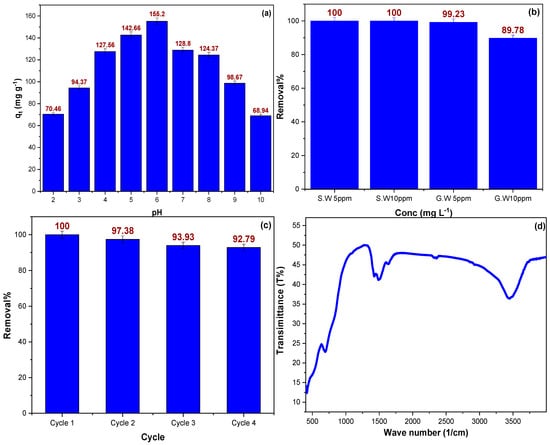
Solution pH is a crucial controlling parameter in sorption processes, as it can affect the sorbent surface charge and the ionization of sorbate groups, if any. The pH effect on IDC sorption onto AMCu was studied, illustrating a greater favourability for acidic media (pH = 2.0 to 6.0) compared to higher pH levels, where the qt values decreased substantially as the pH was raised (Figure 8a). The IDC sorption showed a steady rise from pH 2.0 to 6.0, revealing a qt range of 70.46 and 155.20 mg g−1 [56]. Although the maximum IDC sorption occurred in a neutral medium (pH 7.0), mildly acidic media (pH 5–6) are still suitable for this process. Thanks to the abundance of H+ ions between pH 2.0 and 6.0, the AMCu surface is expected to be positively charged, leading to electrostatic attraction of IDC molecules via their electron-rich functional groups. The decreased IDC sorption as the solution’s pH increased could be attributed to the accumulation of the highly available OH anion on the AMCu surface, leading to repulsion of the IDC molecules through their electronegative sites. In conclusion, to achieve acceptable IDC removal, it is recommended to maintain a pH between 4.0 and 8.0 [57].
Figure 8.
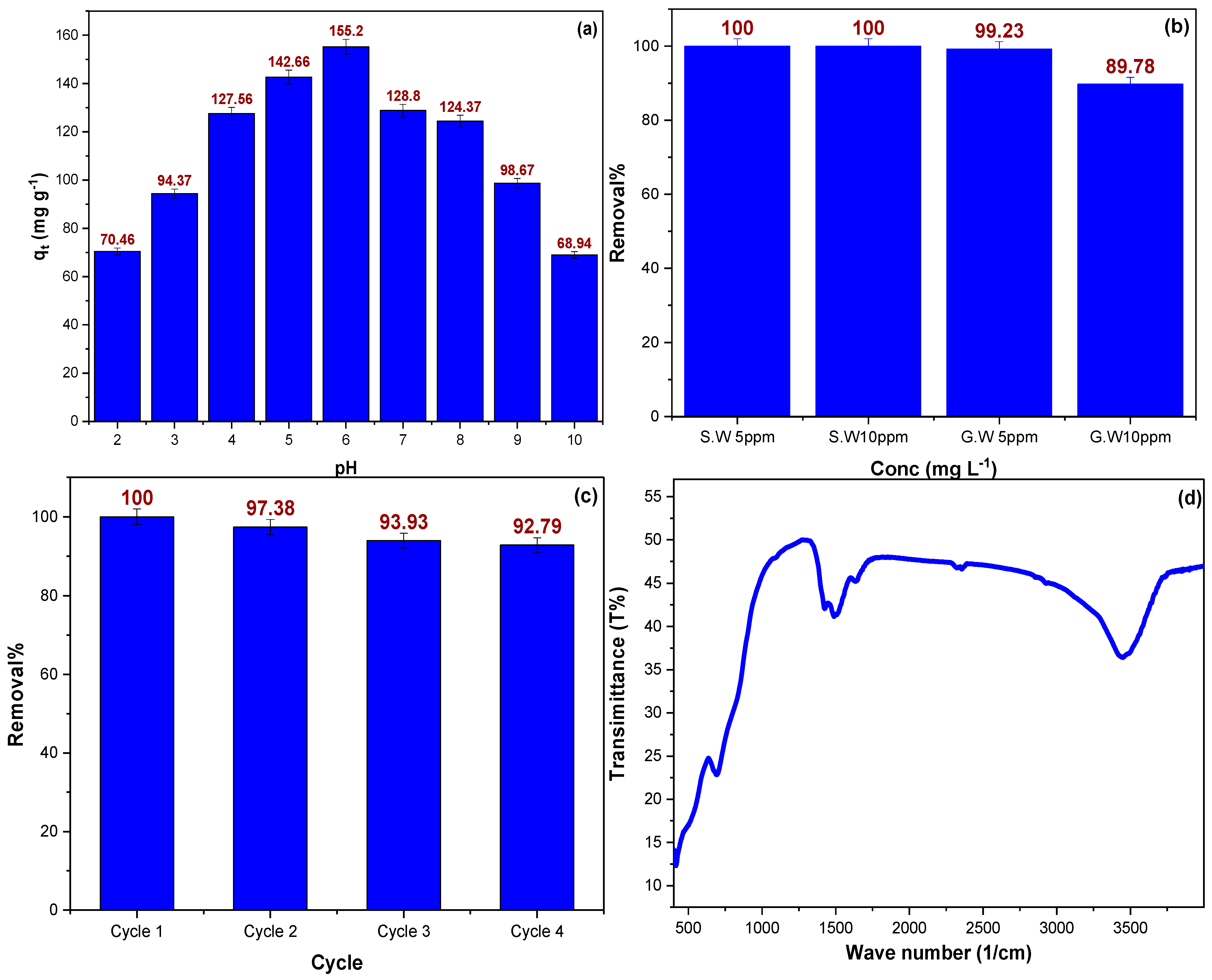
(a) illustrates the effect of pH on the sorption of IDC onto AMCu, (b) demonstrates the application of AMCu in the decontamination of natural water samples spiked with IDC at concentrations of 5 and 10 mg L−1, and (c) the regeneration and reusability outcomes of AMCu, (d) the FTIR analysis of the regenerated AMCu nanohybrid.
2.5. Application to Natural Water and Reusability Studies
A Seawater (SEAW) sample and a groundwater (GRW) sample were employed as solvents for preparing IDC at concentrations of 5 and 10 mg L−1. The 5 and 10 mg L−1 concentrations were used as low values sufficient to test the adsorbent’s capability but high enough to be quantified without being too low to compromise accuracy. The SEAW samples were collected from the Red Sea at Jeda, while the GRW samples were collected from Sudair Industrial City, Riyadh. The SEAW and GEW showed TDS values of 36.14 and 0.37 g L−1, respectively, and temperatures of 25.5 °C and 25.7 °C, respectively. The solutions were then adjusted to pH 6.0. For both samples, 120 mL of each solution was stirred with 50 mg of AMCu sorbent for 2.0 h, after which sorption efficiencies were computed. Figure 8b displays the results of the AMCu effectiveness for eliminating IDC. The slightly lower IDC removal rate from SEAW compared to GRW may be due to the higher salt concentration in SEAW, which could block some of the active sorption sites on AMCu and/or hinder the diffusion of IDC solution to the AMCu surface.
The reusability of the AMCu nanocomposite was investigated over four consecutive cycles (Figure 8c). The nanocomposite’s effectiveness in IDC sorption was confirmed in a four-cycle study, in which the reused AMCu showed minimal changes in adsorption percentage. Its ability to be reused four times without performance loss indicates robust efficiency and performance stability. The stability of the reused AMCu has been tested by conducting FTIR analysis of the adsorbent (Figure 8d). The obtained peaks matched those observed with the virgin AMCu, except for the OH peak enlargement with the reused AMCu, which is attributable to adsorbed moisture and/or the conversion of a portion of AMCu to hydroxides.
3. Materials and Methods
3.1. Materials
Aluminum chloride (AlCl3·6H2O, Sigma Aldrich) was obtained from the St. Louis, MO, USA. Magnesium chloride (MgCl2·6H2O, Riedel-de Haën, Seelze, Duitsland) and Dextrose anhydrous (DXT, Riedel-de Haën) were sourced from Hannover, Germany. Nickel acetate (Fluka, Seelze, Germany) and indigo carmine (IDC, Fluka) were purchased from Buchs, Switzerland. Copper nitrate trihydrate (Cu (NO3)2 ·3H2O, Win-Lab, North Brunswick Township, NJ, USA) and anhydrous cobalt acetate (Co(CH3COO)2, Win-Lab) were obtained from London, England.
3.2. Preparation of Magnesium Aluminate Nanohybrids
Exact amounts of 0.1 mol of MgCl2·6H2O, 0.05 mol of AlCl3·6H2O, 200 mL of distilled water, and 5.0 g of DXT, which serves as a reducing and stabilizing agent, were placed into a 500 mL beaker, which was then heated by a hotplate at 200 °C until dryness. The one-pot constituents were converted into a black, solid product, ground, calcined at 550 °C for 5.0 h, and then the AM was collected. The AMNi, AMCo, and AMCu were prepared by adding nickel acetate, copper nitrate, and cobalt acetate to the one-pot composition prior to heating, and the beakers were then heated under the same AM synthesis conditions.
3.3. Characterization
The AM, AMNi, AMCo, and AMCu triple nanohybrids were tested via scanning electron microscopy (SEM, JSM-IT500, Tokyo, Japan), X-ray diffraction (Bruker AXS, Karlsruhe, Germany), Fourier transform infrared spectroscopy (FTIR, Tracer100, Tokyo, Japan), and a surface analyzer (ASAP 2020, Micromeritics, Miami, FL, USA). The Shimadzu spectrophotometer (2600i, UV-vis, Tokyo, Japan) was employed to measure the sample’s absorption.
3.4. IDC Adsorption
A 100 mg L−1 IDC solution was prepared by dissolving 100 mg of IDC in 1.0 L of DW. To investigate the adsorption of IDC on the synthesized nanohybrids, 100 mL of a 100 mg L−1 IDC solution containing 50 mg of each sorbent was agitated in a shaker at 150 rpm for 120 min. A Shimadzu UV-2600i spectrophotometer was used to measure absorbance at 210 nm after portions of the sample were filtered through a 0.22 μm syringe filter at specified intervals. The influence of pH on sorbents’ effectiveness in removing IDC was evaluated over the pH range 2–10. An extra IDC volume was suited to the intended pH, with the excess left in the solution to account for the pH-dependent color change in the IDC. The impact of the IDC feed concentration on its removal was tested at 25, 50, 100, and 200 mg L−1. Also, the prior experiment was conducted between 20 and 50 °C to see how temperature affected IDC sorption.
To prepare the AMCu nanocomposite for reuse, it was filtered under vacuum using a 0.45 µm nylon filter, washed with ethanol and distilled water, and then dried at 110 °C for 2.0 h. Under the same conditions, second-adsorption tests were conducted on the dried AMCu nanocomposite, and its performance was compared with that of the virgin AMCu. The reusability of the AMCu nanocomposites was evaluated over four cycles. The IDC adsorption percentage of the AMCu nanocomposite was plotted as a function of cycle number.
4. Conclusions
Herin MA, AMCu, AMNi, and AMCo were synthesized using a straightforward method. Nitrogen sorption–desorption, FTIR, XRD, and SEM-EDX characterization were performed on the four nanocomposites. The AM, AMCu, AMNi, and AMCo showed type IV isotherm curves with a type H3 hysteresis loop, indicating mesoporous characteristics. The BET surface areas were 69. 69.47, 95. 87, 86. 86.23, and 75. 87 m2 g−1 for AM, AMCu, AMNi, and AMCo, respectively. FTIR spectra showed distinct peaks of M-O bonds, along with peaks associated with O-H of adsorbed water. The IDC sorptions on AM, AMCu, AMNi, and AMCo were better modeled with the NL-PSO model. The LFDM controlled the IDC sorption on AMNi and AMCo, whereas the IPDM controlled its sorption on AM and AMCu. The AMCu was identified as the best sorbent for seawater and groundwater studies because it exhibited the highest adsorption capacity, reaching 127 mg g−1 within 120 min at a pH of 6.0. The IDC sorption onto AMCu matched that of the F-IM, which may explain the high qt value obtained with AMCu. The sorption increases with the temperature, indicating an endothermic IDC sorption onto the AMCu, and the obtained ΔG° implied that the IDC sorption onto the AMCu was spontaneous, highlighting the most effective sorbent. Both 5.0 and 10.0 mg L−1 IDC concentrations in natural water samples were treated by AMCu, which showed 100.0% efficacy for both groundwater samples; however, its efficacies toward the 5 and 10 mg L−1 IDC in seawater were 99.23% and 89.78%, respectively. The MACu’s efficiency throughout four reuse cycles decreased by approximately 7.21%, demonstrating excellent performance stability.
Author Contributions
Conceptualization, M.R.E. and B.Y.A.; Methodology, S.H.E.; Validation, F.K.A.; Formal analysis, S.H.E. and M.S.; Investigation, S.H.E., M.S.E. and M.S.; Data curation, S.H.E., T.G.I. and M.S.; Writing—original draft, T.G.I. and F.K.A.; Writing—review & editing, M.R.E. and B.Y.A.; Supervision, M.R.E., F.K.A. and M.S.E. All authors have read and agreed to the published version of the manuscript.
Funding
This work was supported and funded by the Deanship of Scientific Research at Imam Mohammad Ibn Saud Islamic University (IMSIU) (grant number IMSIU-DDRSP2602).
Institutional Review Board Statement
Not applicable.
Informed Consent Statement
Not applicable.
Data Availability Statement
The original contributions presented in this study are included in the article. Further inquiries can be directed to the corresponding author.
Conflicts of Interest
The authors declare that they have no conflicts of interest.
References
- Davoudi, S. Adsorption of methylene blue (MB) dye using NiO-SiO2NPs synthesized from aqueous solutions: Optimization, kinetic and equilibrium studies. Iran. J. Chem. Chem. Eng. 2022, 41, 2343–2357. [Google Scholar]
- Kgatle, M.; Sikhwivhilu, K.; Ndlovu, G.; Moloto, N. Degradation kinetics of methyl orange dye in water using trimetallic Fe/Cu/Ag nanoparticles. Catalysts 2021, 11, 428. [Google Scholar] [CrossRef] [Scilit]
- Jenck, J.F.; Agterberg, F.; Droescher, M.J. Transitioning the chemical industry: The case for addressing the climate, toxics, and plastics crises. Environ. Sci. Policy Sustain. Dev. 2021, 63, 4–15. [Google Scholar] [CrossRef] [Scilit]
- Jenck, J.F.; Agterberg, F.; Droescher, M.J. Products and processes for a sustainable chemical industry: A review of achievements and prospects. Green Chem. 2004, 6, 544–556. [Google Scholar] [CrossRef] [Scilit]
- Al-Farraj, E.S.; Abdelrahman, E.A. Efficient photocatalytic degradation of congo red dye using facilely synthesized and characterized MgAl2O4 nanoparticles. ACS Omega 2024, 9, 4870–4880. [Google Scholar] [CrossRef] [Scilit]
- Adam, F.A. Influence of doping-ion-type on the characteristics of Al2O3-based nanocomposites and their capabilities of removing indigo carmine from water. Inorganics 2022, 10, 144. [Google Scholar] [CrossRef] [Scilit]
- Tiotsop Kuete, I.H.; Tchuifon, R.D.T.; Bopda, A.; Ngakou, C.S.; Nche, G.N.-A.; Anagho, S.G. Adsorption of indigo carmine onto chemically activated carbons derived from the Cameroonian agricultural waste garcinia cola nut shells and desorption studies. J. Chem. 2022, 2022, 1236621. [Google Scholar] [CrossRef] [Scilit]
- El-Kammah, M.; Elkhatib, E.; Gouveia, S.; Cameselle, C.; Aboukila, E. Cost-effective ecofriendly nanoparticles for rapid and efficient indigo carmine dye removal from wastewater: Adsorption equilibrium, kinetics and mechanism. Environ. Technol. Innov. 2022, 28, 102595. [Google Scholar] [CrossRef] [Scilit]
- Sánchez-Rodríguez, S.; Trujillo-Reyes, J.; Gutiérrez-Segura, E.; Solache-Ríos, M.; Colín-Cruz, A. Removal of indigo carmine by a Ni nanoscale oxides/Schoenoplectus acutus composite in batch and fixed bed column systems. Sep. Sci. Technol. 2015, 50, 1602–1610. [Google Scholar] [CrossRef] [Scilit]
- Ahmad, M.B.; Soomro, U.; Muqeet, M.; Ahmed, Z. Adsorption of Indigo Carmine dye onto the surface-modified adsorbent prepared from municipal waste and simulation using deep neural network. J. Hazard. Mater. 2021, 408, 124433. [Google Scholar] [CrossRef] [Scilit] [PubMed]
- Gupta, T.; Ansari, K.; Lataye, D.; Kadu, M.; Khan, M.A.; Mubarak, N.M.; Garg, R.; Karri, R.R. Adsorption of Indigo Carmine Dye by Acacia nilotica sawdust activated carbon in fixed bed column. Sci. Rep. 2022, 12, 15522. [Google Scholar] [CrossRef] [Scilit] [PubMed]
- Almufarij, R.S.; Abdulkhair, B.Y.; Salih, M. Fast-simplistic fabrication of MoO3@ Al2O3-MgO triple nanocomposites for efficient elimination of pharmaceutical contaminants. Results Chem. 2024, 7, 101281. [Google Scholar] [CrossRef] [Scilit]
- Wang, F.Y.; Wang, H.; Ma, J.W. Adsorption of cadmium (II) ions from aqueous solution by a new low-cost adsorbent—Bamboo charcoal. J. Hazard. Mater. 2010, 177, 300–306. [Google Scholar] [CrossRef] [Scilit]
- Nitha, T.; Britto, S. MgAl2O4 nanospinel: Green synthesis, characterization and effective heterogeneous catalyst for the photocatalytic degradation of carbol fuchsin dye and synthesis of 2-aryl substituted benzoxazole derivatives. Inorg. Chem. Commun. 2024, 159, 111776. [Google Scholar] [CrossRef] [Scilit]
- Salih, M.; Abdulkhair, B.Y.; Alotaibi, M. Insight into the Adsorption Behavior of Carbon Nanoparticles Derived from Coffee Skin Waste for Remediating Water Contaminated with Pharmaceutical Ingredients. Chemistry 2023, 5, 1870–1881. [Google Scholar] [CrossRef] [Scilit]
- Pachiyappan, J.; Gnanansundaram, N.; Sivamani, S.; Sankari, N.P.B.P.; Senthilnathan, N.; Kerga, G.A. Preparation and characterization of magnesium oxide nanoparticles and its application for photocatalytic removal of rhodamine B and methylene blue dyes. J. Nanomater. 2022, 2022, 6484573. [Google Scholar] [CrossRef] [Scilit]
- Mudd, G.M. Assessing the availability of global metals and minerals for the sustainable century: From aluminium to zirconium. Sustainability 2021, 13, 10855. [Google Scholar] [CrossRef] [Scilit]
- Carnes, C.L.; Kapoor, P.N.; Klabunde, K.J.; Bonevich, J. Synthesis, characterization, and adsorption studies of nanocrystalline aluminum oxide and a bimetallic nanocrystalline aluminum oxide/magnesium oxide. Chem. Mater. 2002, 14, 2922–2929. [Google Scholar] [CrossRef] [Scilit]
- Ganesh, I. A review on magnesium aluminate (MgAl2O4) spinel: Synthesis, processing and applications. Int. Mater. Rev. 2013, 58, 63–112. [Google Scholar] [CrossRef] [Scilit]
- Bromiley, G.D.; Nestola, F.; Redfern, S.A.; Zhang, M. Water incorporation in synthetic and natural MgAl2O4 spinel. Geochim. Cosmochim. Acta 2010, 74, 705–718. [Google Scholar] [CrossRef] [Scilit]
- Almahmoud, S.A.; Alzahrani, S.S.; Abdulkhair, B.Y. Efficacious Removal of Organic Contaminants from Water Using a Novel CoO–NiO@ MgAl2O4 Nanocomposite. ACS Omega 2025, 10, 11188–11201. [Google Scholar] [CrossRef] [Scilit]
- Wu, Q.; Feng, G.; Jiang, F.; Zhang, X.; Xu, Y.; Liu, J.; Liang, J.; Lao, X.; Guo, Z. Insight into enhanced adsorption of Congo red by petal-like MgAl2O4: Effect of dehydroxylation. J. Phys. Chem. Solids 2025, 197, 112398. [Google Scholar] [CrossRef] [Scilit]
- Kumar, K.G.; Bhargav, P.B.; Aravinth, K.; Ahmed, N.; Balaji, C. Photoluminescence and electrochemical performance evaluation of Eu3+ doped MgAl2O4 phosphors for LED and energy storage applications. Ceram. Int. 2022, 48, 36038–36045. [Google Scholar] [CrossRef] [Scilit]
- Abdulkhair, B.Y.E.; Ibrahim, M.N.A.E.-H.; Omran, M.K. Nanocomposite of Graphitic C3N4, MnO2, and MgAl2O4 for Hydrogen Generation. U.S. Patent No. 12,365,586, 22 July 2025. [Google Scholar]
- Zan, W.; Ma, B.; Tang, J.; Liu, K.; Cao, Y.; Tian, J.; Jiang, Z. Preparation and properties of MgAl2O4 spinel ceramics by double-doped CeO2 and La2O3. Ceram. Int. 2023, 49, 15164–15175. [Google Scholar] [CrossRef] [Scilit]
- Milani, S.S.; Kakroudi, M.G.; Vafa, N.P.; Rahro, S.; Behboudi, F. Synthesis and characterization of MgAl2O4 spinel precursor sol prepared by inorganic salts. Ceram. Int. 2021, 47, 4813–4819. [Google Scholar] [CrossRef] [Scilit]
- Mahmoud, S.A.; Elsisi, M.E.; Mansour, A.F. Synthesis and electrochemical performance of α-Al2O3 and M-Al2O4 spinel nanocomposites in hybrid quantum dot-sensitized solar cells. Sci. Rep. 2022, 12, 17009. [Google Scholar] [CrossRef] [Scilit]
- Thommes, M.; Kaneko, K.; Neimark, A.V.; Olivier, J.P.; Rodriguez-Reinoso, F.; Rouquerol, J.; Sing, K.S.W. Physisorption of gases, with special reference to the evaluation of surface area and pore size distribution (IUPAC Technical Report). Pure Appl. Chem. 2015, 87, 1051–1069. [Google Scholar] [CrossRef] [Scilit]
- Bekele, E.A.; Korsa, H.A.; Desalegn, Y.M. Electrolytic synthesis of γ-Al2O3 nanoparticle from aluminum scrap for enhanced methylene blue adsorption: Experimental and RSM modeling. Sci. Rep. 2024, 14, 16957. [Google Scholar] [CrossRef] [Scilit]
- Marcì, G.; Palmisano, L. Heterogeneous Photocatalysis: Relationships with Heterogeneous Catalysis and Perspectives; Elsevier: Amsterdam, The Netherlands, 2019. [Google Scholar]
- Song, S.; Liu, Z.; Zhang, J.; Jiao, C.; Ding, L.; Yang, S. Synthesis and adsorption properties of novel bacterial cellulose/graphene oxide/attapulgite materials for Cu and Pb Ions in aqueous solutions. Materials 2020, 13, 3703. [Google Scholar] [CrossRef] [Scilit] [PubMed]
- Moussout, H.; Ahlafi, H.; Aazza, M.; Maghat, H. Critical of linear and nonlinear equations of pseudo-first order and pseudo-second order kinetic models. Karbala Int. J. Mod. Sci. 2018, 4, 244–254. [Google Scholar] [CrossRef] [Scilit]
- Markeb, A.A.; Moral-Vico, J.; Sánchez, A.; Font, X. Novel nanocomposite synthesis of carboxymethyl cellulose coated to zero-valent iron supported on chitosan for simultaneous removal of heavy metals and pesticides in water: Performance and mechanism. Results Chem. 2025, 13, 102041. [Google Scholar] [CrossRef] [Scilit]
- Benmessaoud, A.; Nibou, D.; Mekatel, E.H.; Amokrane, S. A comparative study of the linear and non-linear methods for determination of the optimum equilibrium isotherm for adsorption of Pb2+ ions onto Algerian treated clay. Iran. J. Chem. Chem. Eng. (IJCCE) 2020, 39, 153–171. [Google Scholar]
- Harrache, Z.; Abbas, M.; Aksil, T.; Trari, M. Thermodynamic and kinetics studies on adsorption of Indigo Carmine from aqueous solution by activated carbon. Microchem. J. 2019, 144, 180–189. [Google Scholar] [CrossRef] [Scilit]
- Ben Nasr, J.; Ghorbal, A. Adsorption of Indigo Carmine dye onto physicochemical-activated leaves of Agave americana L. Iran. J. Chem. Chem. Eng. 2021, 40, 1054–1066. [Google Scholar]
- Chowdhury, M.F.; Khandaker, S.; Sarker, F.; Islam, A.; Rahman, M.T.; Awual, M.R. Current treatment technologies and mechanisms for removal of indigo carmine dyes from wastewater: A review. J. Mol. Liq. 2020, 318, 114061. [Google Scholar] [CrossRef] [Scilit]
- De León-Condés, C.A.; Roa-Morales, G.; Martínez-Barrera, G.; Menchaca-Campos, C.; Bilyeu, B.; Balderas-Hernández, P.; Ureña-Núñez, F.; Toledo-Jaldin, H.P. Sulfonated and gamma-irradiated waste expanded polystyrene with iron oxide nanoparticles, for removal of indigo carmine dye in textile wastewater. Heliyon 2019, 5, e02071. [Google Scholar] [CrossRef] [Scilit] [PubMed]
- Zolgharnein, J.; Rastgordani, M. Optimization of simultaneous removal of binary mixture of indigo carmine and methyl orange dyes by cobalt hydroxide nano-particles through Taguchi method. J. Mol. Liq. 2018, 262, 405–414. [Google Scholar] [CrossRef] [Scilit]
- Hevira, L.; Ighalo, J.O.; Zein, R. Biosorption of indigo carmine from aqueous solution by Terminalia catappa shell. J. Environ. Chem. Eng. 2020, 8, 104290. [Google Scholar] [CrossRef] [Scilit]
- Odogu, A.N.; Daouda, K.; Keilah, L.P.; Tabi, G.A.; Rene, L.N.; Nsami, N.J.; Mbadcam, K.J. Effect of doping activated carbon based Ricinodendron heudelotti shells with AgNPs on the adsorption of indigo carmine and its antibacterial properties. Arab. J. Chem. 2020, 13, 5241–5253. [Google Scholar] [CrossRef] [Scilit]
- Chikate, R.C.; Kadu, B.S. Improved photocatalytic activity of CdSe-nanocomposites: Effect of Montmorillonite support towards efficient removal of Indigo Carmine. Spectrochim. Acta Part A Mol. Biomol. Spectrosc. 2014, 124, 138–147. [Google Scholar] [CrossRef] [Scilit]
- Omran, M.K.A.F.; Abdulkhair, B.Y.E. Water Decontamination via C3N4@ MoO3/MgAl2O4 Nanocomposite. U.S. Patent No. 12,479,741, 25 November 2025. [Google Scholar]
- Elamin, M.R.; Abdulkhair, B.Y.; Algethami, F.K.; Khezami, L. Linear and nonlinear investigations for the adsorption of paracetamol and metformin from water on acid-treated clay. Sci. Rep. 2021, 11, 13606. [Google Scholar] [CrossRef] [Scilit]
- Revellame, E.D.; Fortela, D.L.; Sharp, W.; Hernandez, R.; Zappi, M.E. Adsorption kinetic modeling using pseudo-first order and pseudo-second order rate laws: A review. Clean. Eng. Technol. 2020, 1, 100032. [Google Scholar] [CrossRef] [Scilit]
- Cameu, G.M.; Almeida, L.; Oliveira, A.P.; Igansi, A.; Jaeschke, D.P.; Silveira, N.; Paes, R.; Dias, D.; Pinto, L.A.d.A.; Cadaval, T.R.S. Enhanced Adsorption of Pb(II) and Cd(II) by Activated Carbon Derived from Peach Stones for Efficient Water Decontamination. Processes 2025, 13, 3064. [Google Scholar] [CrossRef] [Scilit]
- Abdus-Salam, N.; Buhari, M. Adsorption of Alizarin and Fluorescein Dyes onto Palm Seeds Activated Carbon: Kinetic and Thermodynamic Studies. J. Chem. Soc. Pak. 2016, 38, 604–614. [Google Scholar]
- Ncibi, M.C.; Sillanpää, M. Optimizing the removal of pharmaceutical drugs Carbamazepine and Dorzolamide from aqueous solutions using mesoporous activated carbons and multi-walled carbon nanotubes. J. Mol. Liq. 2017, 238, 379–388. [Google Scholar] [CrossRef] [Scilit]
- Chibuzo, A.A.; Asadu, C.O.; Ikechukwu, O.M.; Arinze, A.K. Kinetics and isotherm studies on divalent lead ions adsorption by zeolite solution. Int. J. Nov. Res. Eng. Sci. 2016, 3, 49–61. [Google Scholar]
- Elamin, M.R.; Abdulkhair, B.Y.; Elzupir, A.O. Removal of ciprofloxacin and indigo carmine from water by carbon nanotubes fabricated from a low-cost precursor: Solution parameters and recyclability. Ain Shams Eng. J. 2023, 14, 101844. [Google Scholar] [CrossRef] [Scilit]
- Ibrahim, T.G.; Almufarij, R.S.; Abdulkhair, B.Y.; Ramadan, R.S.; Eltoum, M.S.; Elaziz, M.E.A. A Thorough Examination of the Solution Conditions and the Use of Carbon Nanoparticles Made from Commercial Mesquite Charcoal as a Successful Sorbent for Water Remediation. Nanomaterials 2023, 13, 1485. [Google Scholar] [CrossRef] [Scilit]
- Adam, F.A.; Ghoniem, M.G.; Diawara, M.; Rahali, S.; Abdulkhair, B.Y.; Elamin, M.R.; Ben Aissa, M.A.; Seydou, M. Enhanced adsorptive removal of indigo carmine dye by bismuth oxide doped MgO based adsorbents from aqueous solution: Equilibrium, kinetic and computational studies. RSC Adv. 2022, 12, 24786–24803. [Google Scholar] [CrossRef] [Scilit] [PubMed]
- Lima, E.C.; Hosseini-Bandegharaei, A.; Moreno-Piraján, J.C.; Anastopoulos, I. A critical review of the estimation of the thermodynamic parameters on adsorption equilibria. Wrong use of equilibrium constant in the Van’t Hoof equation for calculation of thermodynamic parameters of adsorption. J. Mol. Liq. 2019, 273, 425–434. [Google Scholar] [CrossRef] [Scilit]
- Vimonses, V.; Lei, S.; Jin, B.; Chow, C.W.; Saint, C. Kinetic study and equilibrium isotherm analysis of Congo Red adsorption by clay materials. Chem. Eng. J. 2009, 148, 354–364. [Google Scholar] [CrossRef] [Scilit]
- Markeb, A.A.; Alonso, A.; Sánchez, A.; Font, X. Adsorption process of fluoride from drinking water with magnetic core-shell Ce-Ti@ Fe3O4 and Ce-Ti oxide nanoparticles. Sci. Total Environ. 2017, 598, 949–958. [Google Scholar] [CrossRef] [Scilit]
- Ismail, B.; Hussain, S.T.; Akram, S. Adsorption of methylene blue onto spinel magnesium aluminate nanoparticles: Adsorption isotherms, kinetic and thermodynamic studies. Chem. Eng. J. 2013, 219, 395–402. [Google Scholar] [CrossRef] [Scilit]
- Nguyen, T.H.T.; Dao, T.T.U.; Pham, G.V.; Do, T.S.; Nguyen, T.T.L.; Nguyen, T.H.L.; Chu, M.N.; Quoc, D.Q.N.; Tien, N.A. Effect of pH on the adsorption behaviour of Congo red dye on the Mg-Al layered double hydroxide. IOP Conf. Ser. Mater. Sci. Eng. 2020, 736, 022077. [Google Scholar] [CrossRef] [Scilit]

Disclaimer/Publisher’s Note: The statements, opinions and data contained in all publications are solely those of the individual author(s) and contributor(s) and not of MDPI and/or the editor(s). MDPI and/or the editor(s) disclaim responsibility for any injury to people or property resulting from any ideas, methods, instructions or products referred to in the content. |
© 2026 by the authors. Licensee MDPI, Basel, Switzerland. This article is an open access article distributed under the terms and conditions of the Creative Commons Attribution (CC BY) license.