

You are currently viewing a new version of our website. To view the old version click .

Inorganics, Volume 10, Issue 7

July 2022 - 17 articles

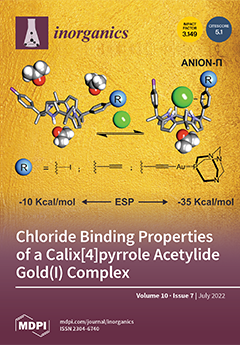
Cover Story: A mono-nuclear “two wall” aryl-extended caxli[4]pyrrole receptor decorated with an acetylide–gold(I)–PTA complex at its upper rim is synthesized. The binding properties of the unprecedented receptor and their synthetic precursors (R= I and ethynyl) towards chloride are studied in dichloromethane and acetone. The calculated ESP values at the centers of the aromatic ring and at the para‐substituent (R) of the differently substituted aromatic walls were not enough to explain the dissimilar free energies of binding of the 1:1 chloride complexes exclusively in terms of repulsive anion–π interactions. The calix[4]pyrrole acetylide gold(I) receptor binds chloride exclusively in the cone conformation, and the presence of free chloride in solution induces the formation of a gold(I)–anionic calix[4]pyrrole dimer. View this paper
  • Issues are regarded as officially published after their release is announced to the table of contents alert mailing list .
  • You may sign up for email alerts to receive table of contents of newly released issues.
  • PDF is the official format for papers published in both, html and pdf forms. To view the papers in pdf format, click on the "PDF Full-text" link, and use the free Adobe Reader to open them.

Articles (17)

  • Article
  • Open Access
3 Citations
3,290 Views
11 Pages

Controlling Chiral Self-Sorting in Truxene-Based Self-Assembled Cages

  • Amina Benchohra,
  • Simon Séjourné,
  • Antoine Labrunie,
  • Liam Miller,
  • Enzo Charbonneau,
  • Vincent Carré,
  • Frédéric Aubriet,
  • Magali Allain,
  • Marc Sallé and
  • Sébastien Goeb

Coordination driven self-assembly of achiral components, i.e., hexa-alkylated truxene ligands (L) with bis-metallic complexes (M2), afforded three chiral face-rotating stereoisomer polyhedra (M6L2). By tuning the length of the alkyl chains as well as...

  • Article
  • Open Access
18 Citations
6,766 Views
12 Pages

Copper (II)-Catalyzed Oxidation of Ascorbic Acid: Ionic Strength Effect and Analytical Use in Aqueous Solution

  • Anastasia E. Murekhina,
  • Daniil N. Yarullin,
  • Maria A. Sovina,
  • Pavel A. Kitaev and
  • George A. Gamov

Copper is an important metal both in living organisms and in the industrial activity of humans, it is also a distributed water pollutant and a toxic agent capable of inducing acute and chronic health disorders. There are several fluorescent chemosens...

  • Article
  • Open Access
4 Citations
3,464 Views
12 Pages

Two-Photon Fluorescence in Red and Violet Conjugated Polymer Microspheres

  • Yanyan Zhi,
  • Ziwei Feng,
  • Tanisha Mehreen,
  • Xiaoyuan Liu,
  • Kirsty Gardner,
  • Xiangping Li,
  • Bai-Ou Guan,
  • Lijuan Zhang,
  • Sergey I. Vagin and
  • Bernhard Rieger
  • + 1 author

We investigate the two-photon fluorescence (TPF) of conjugated polymer (CP) microspheres with diameters up to tens of micrometers. Two polymers, emitting in either the violet or red, were first synthesized and characterized in terms of their one-phot...

  • Concept Paper
  • Open Access
10 Citations
2,464 Views
8 Pages

Gold(III) Complexation in the Presence of the Macropolyhedral Hydridoborate Cluster [B20H18]2−

  • Varvara V. Avdeeva,
  • Anna V. Vologzhanina,
  • Alexey S. Kubasov,
  • Nailya S. Akhmadullina,
  • Oleg N. Shishilov,
  • Elena A. Malinina and
  • Nikolay T. Kuznetsov

Gold(III) complexation with the octadecahydrido-eicosaborate anion [B20H18]2− was studied for the first time. It was found that when gold(III) complexes [Au(L)Cl2]BF4 (L = bipy, phen) reacted with [B20H18]2−, complexes [Au(L)Cl2]2[B20H18]...

  • Article
  • Open Access
6 Citations
3,183 Views
17 Pages

Synthesis and Crystal Structures of Mn(II) and Co(II) Complexes as Catalysts for Oxidation of Cyclohexanone

  • Adedibu C. Tella,
  • Aaron Y. Isaac,
  • Hadley S. Clayton,
  • Adeniyi S. Ogunlaja,
  • Aswathy T. Venugopalan,
  • Marimuthu Prabu and
  • Raja Thirumalaiswamy

The global demand on adipic usage in the production of plasticizers and synthetic polyamide is increasing. In line with the search for an efficient and energy-conserving way to isolate adipic acid (AA) in good yields, this paper introduces the oxidiz...

  • Article
  • Open Access
5 Citations
3,266 Views
13 Pages

Investigations on the Spin States of Two Mononuclear Iron(II) Complexes Based on N-Donor Tridentate Schiff Base Ligands Derived from Pyridine-2,6-Dicarboxaldehyde

  • Yosef Bayeh,
  • Nithin Suryadevara,
  • Sören Schlittenhardt,
  • Róbert Gyepes,
  • Assefa Sergawie,
  • Peter Hrobárik,
  • Wolfgang Linert,
  • Mario Ruben and
  • Madhu Thomas

Iron(II)-Schiff base complexes are a well-studied class of spin-crossover (SCO) active species due to their ability to interconvert between a paramagnetic high spin-state (HS, S = 2, 5T2) and a diamagnetic low spin-state (LS, S = 0, 1A1) by external...

  • Article
  • Open Access
6 Citations
3,153 Views
13 Pages

In this paper, we have used a saturated five-membered N-Heterocyclic carbene (5SIDipp = 1,3-bis-(2,6-diisopropylphenyl)imidazolin-2-ylidine) for the synthesis of SNHC-haloboranes adducts and their further nucleophilic substitutions to put unusual fun...

  • Article
  • Open Access
12 Citations
2,449 Views
12 Pages

Rearrangement of Diferrocenyl 3,4-Thiophene Dicarboxylate

  • Asma Ghazzy,
  • Deeb Taher,
  • Marcus Korb,
  • Khaled Al Khalyfeh,
  • Wissam Helal,
  • Hazem Amarne,
  • Tobias Rüffer,
  • Zakariyya Ishtaiwi and
  • Heinrich Lang

Treatment of 3,4-(ClC(O))2-cC4H2S (1) with [FcCH2OLi] (2-Li) (Fc = Fe(η5-C5H5)(η5-C5H4)) in a 1:2 ratio gave 3,4-(FcCH2OC(O))2-cC4H2S (3). Compound 3 decomposes in solution during crystallization to produce FcCH2OH (2) along with 3,4-thiophen...

  • Article
  • Open Access
4 Citations
3,074 Views
17 Pages

In this work, we report the synthesis and characterization of a mono-nuclear “two wall” aryl-extended calix[4]pyrrole receptor (2Au) decorated with an acetylide-gold(I)-PTA complex at its upper rim. We describe the 1H NMR titration experi...

  • Article
  • Open Access
22 Citations
3,454 Views
13 Pages

The spin-coating technique was used to produce composite films consisting of PMMA polymer doped with anisometric complexes of Eu(III) and Tb(III). It was found that an increase in the content of Tb3+ complexes intensifies emission of both ions due to...

of 2

Get Alerted

Add your email address to receive forthcoming issues of this journal.

XFacebookLinkedIn
Inorganics - ISSN 2304-6740