


Abstract
Beam quality directly determines the output performance and application effectiveness of high-power fiber lasers. Conventional control methods, such as coiling and tapering, degrade mechanical reliability and cause localized heating, while specialty fibers suffer from fabrication complexity and poor compatibility with standard components. To address these issues, this paper proposes and validates a beam quality optimization method using mode-selective loss, based on femtosecond-laser-inscribed periodic index modulation structures in the fiber cladding. Theoretical analysis clarifies the influence of mode weight on the M2 factor in a 20/400 LMA fiber and the optimization mechanism of the structure. In a kilowatt-level laser, the average M2 improvement is 19.5% above 800 W; at 1384 W, M2 drops from 3.31 to 2.67, and the R2 between beam profile and an ideal Gaussian beam increases from 0.5412 to 0.8609. This work provides a fully fiber-integrated, easily fabricated, and tunable beam quality-control solution for high-power fiber lasers.
1. Introduction
The development of large-mode-area fiber (LMA fiber) technology has greatly promoted the power scaling of high-power fiber lasers [1,2,3]. However, larger fiber core diameters support more higher-order modes (HOMs), inevitably degrading beam quality—a key determinant of focusing ability, transmission efficiency, and application effectiveness [4]. Hence, excellent beam quality has always been a continuous pursuit [5,6,7]. To maintain fundamental-mode (FM) operation and optimize beam quality, researchers often employ post-fabrication approaches including coiling, tapering [8,9] and fiber-based beam shapers [10] to suppress HOM, yet these methods generally suffer from drawbacks such as reduced mechanical reliability [11] and localized heating [12]. Alternatively, specialty fibers (e.g., photonic crystal [13], chirally coupled core [14], photonic bandgap [15], multi-trench [16], anti-resonant hollow-core fibers [17], and “bat type” refractive index fibers [18]) can achieve single-mode operation, yet they suffer from complex fabrication and splicing difficulties with standard components. Therefore, developing a simple, low-loss, versatile, stackable FM maintenance method that also ensures mechanical reliability and thermal stability is of great significance for high-power fiber laser beam quality optimization.
To address these challenges, Krämer et al. [19] utilized femtosecond laser direct writing to inscribe cladding structures for mode manipulation and observed modal power redistribution within the modulation region as the inscription length increased. However, their study only demonstrated modal redistribution, failing to achieve directional attenuation and effective suppression of higher-order modes, and lacked experimental validation under high-power operating conditions.
To overcome this limitation, this paper proposes a mode-selective attenuation device based on femtosecond-laser-inscribed periodic index modulation in the fiber cladding to optimize the output beam quality. Theoretical analysis clarifies the influence of mode weight on in a 20/400 LMA fiber and the optimization mechanism of the modulation structure. The device is fabricated by femtosecond direct writing and spliced to the output end of a kilowatt-level fiber laser. Experimental results show that at 1384 W, is reduced from 3.31 to 2.67 with no significant temperature rise, validating the method’s effectiveness under high-power conditions.
2. Theoretical Analysis
To clarify the influence mechanism of mode attenuation on beam quality, we firstly analyze the influence of mode weights and phases on in a step-index LMA fiber. Using theory presented by Yoda et al. [20], the beam quality factors are:
The parameters in Equation (1) are defined as follows:
where is the central coordinate along the transverse spatial axis (), and is the conjugate field of . The above calculation requires knowledge of the complex amplitude distribution at the output end face of the fiber. Under coherent superposition, this electric field is expressed as a linear superposition of the fiber modes with given weights and phases:
where is the total number of modes, is the power weight of the -th mode (), is its normalized mode field distribution (), and is its initial phase. Therefore, using Equations (1)–(5) and the complex amplitude from Equation (6), the theoretical M2 for various mode-weight and phase configurations can be obtained. The fiber parameters in the simulation match the actual device: core/cladding 20/400 μm, NA = 0.066, and V = 3.84 at 1080 nm. Accounting for mode parity, the fiber supports the following five LP modes: LP01, LP11e, LP11o, LP21e, and LP21o.
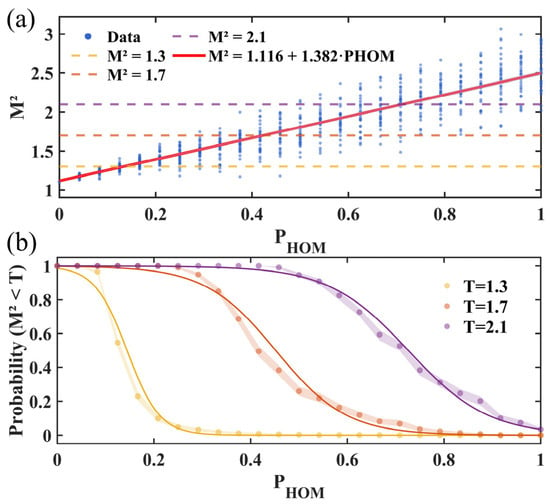
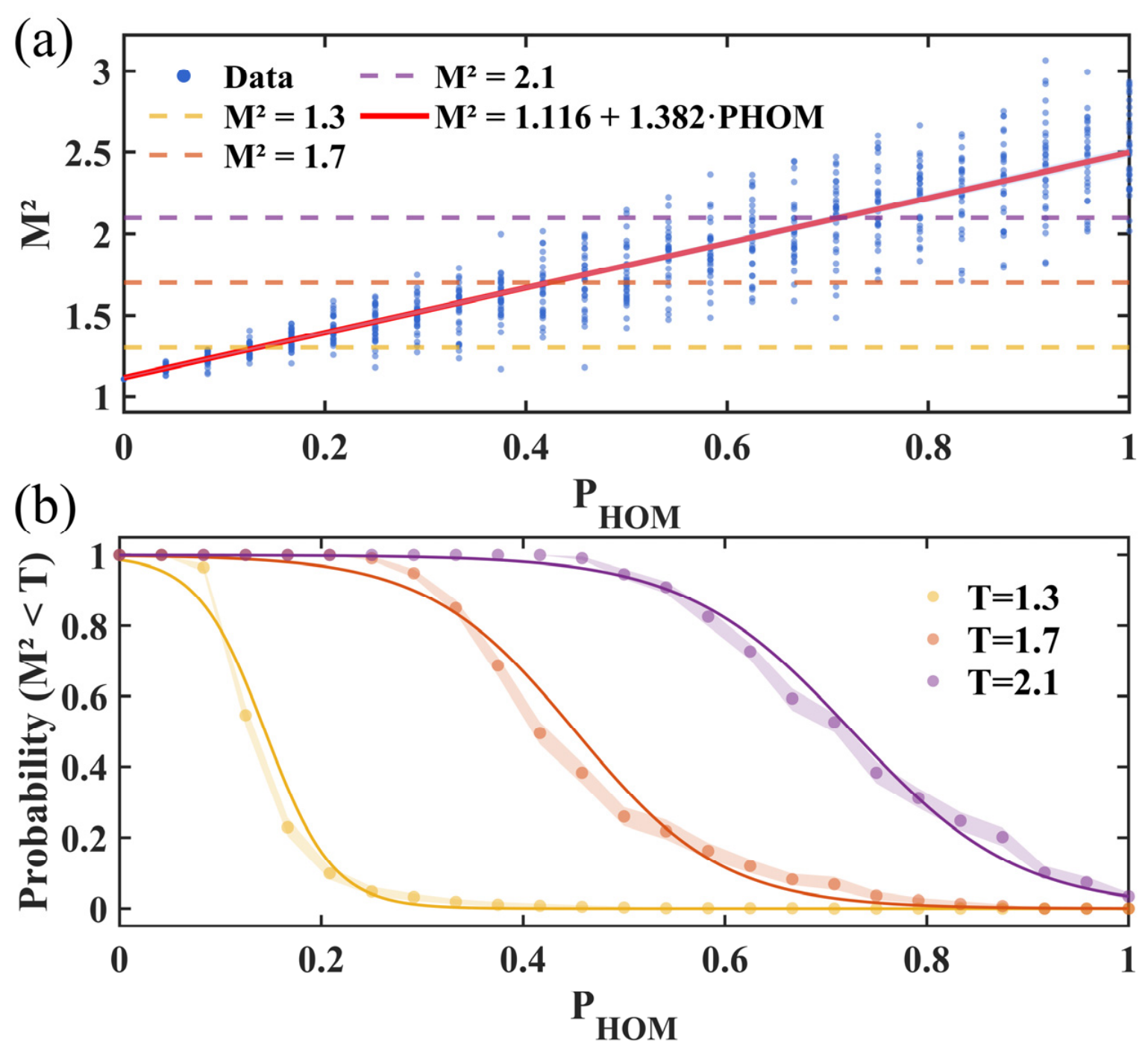
Figure 1a presents the M2 data from theoretical calculations. Here, denotes the total power fraction of higher-order modes, i.e., the fraction of optical power not carried by the fundamental mode. First, the normalized transverse field distributions of all guided LP modes in the 20/400 LMA fiber are numerically solved according to the fiber structural parameters. For each , 30 random mode-power sets following a uniform Dirichlet distribution and random phases are generated, and the output complex amplitude field is constructed by coherent superposition of all guided modes with the generated power weights and initial phases. The corresponding M2 values are then calculated by substituting the complex field into Equations (1)–(5). The semi-transparent scatter points in the figure represent all samples; the solid red line is the regression line fitted by weighted least squares (WLSs). A weighted least squares regression yields the equation M2 with a coefficient of determination , confirming a strong positive linear relationship. This confirms that M2 increases nearly linearly with HOM power fraction. Notably, some data points at high show lower M2 than at low due to phase differences, indicating that intermodal phase also influences beam quality. Figure 1b applies Monte Carlo to the same data to obtain probability curves for M2 < thresholds (1.3, 1.7, and 2.1); shaded areas are 95% bootstrap confidence intervals. Smaller gives higher probability; lower thresholds decay faster with .
Figure 1.
Statistical analysis of M2 based on theoretical calculations. (a) Distribution versus total HOM power fraction under random mode weights and phases, with weighted least-squares regression line (red); (b) Monte Carlo simulated probability of M2 below thresholds (1.3, 1.7, 2.1), and shaded areas represent 95% confidence intervals.
The above statistical results indicate that, for the 20/400 LMA fiber under random phases, M2 increases approximately linearly with the HOM power proportion. Although phase modulation also has an influence, the HOM proportion remains the dominant factor determining beam quality. Based on this, this paper adopts the reduction in HOM proportion as the core concept and designs a mode-selective attenuation device that suppresses HOM transmission to achieve stable beam quality optimization. This mechanism is verified in kilowatt-level experiments.
3. Device Design and Fabrication
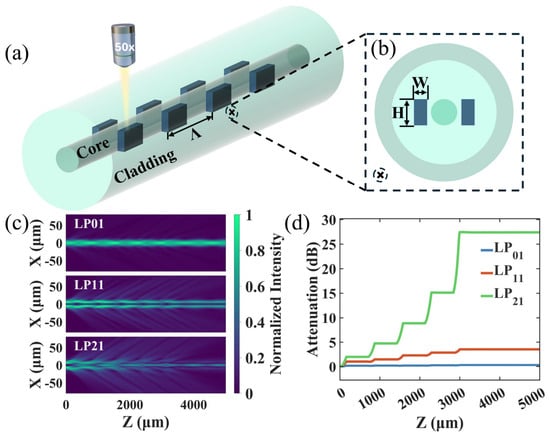
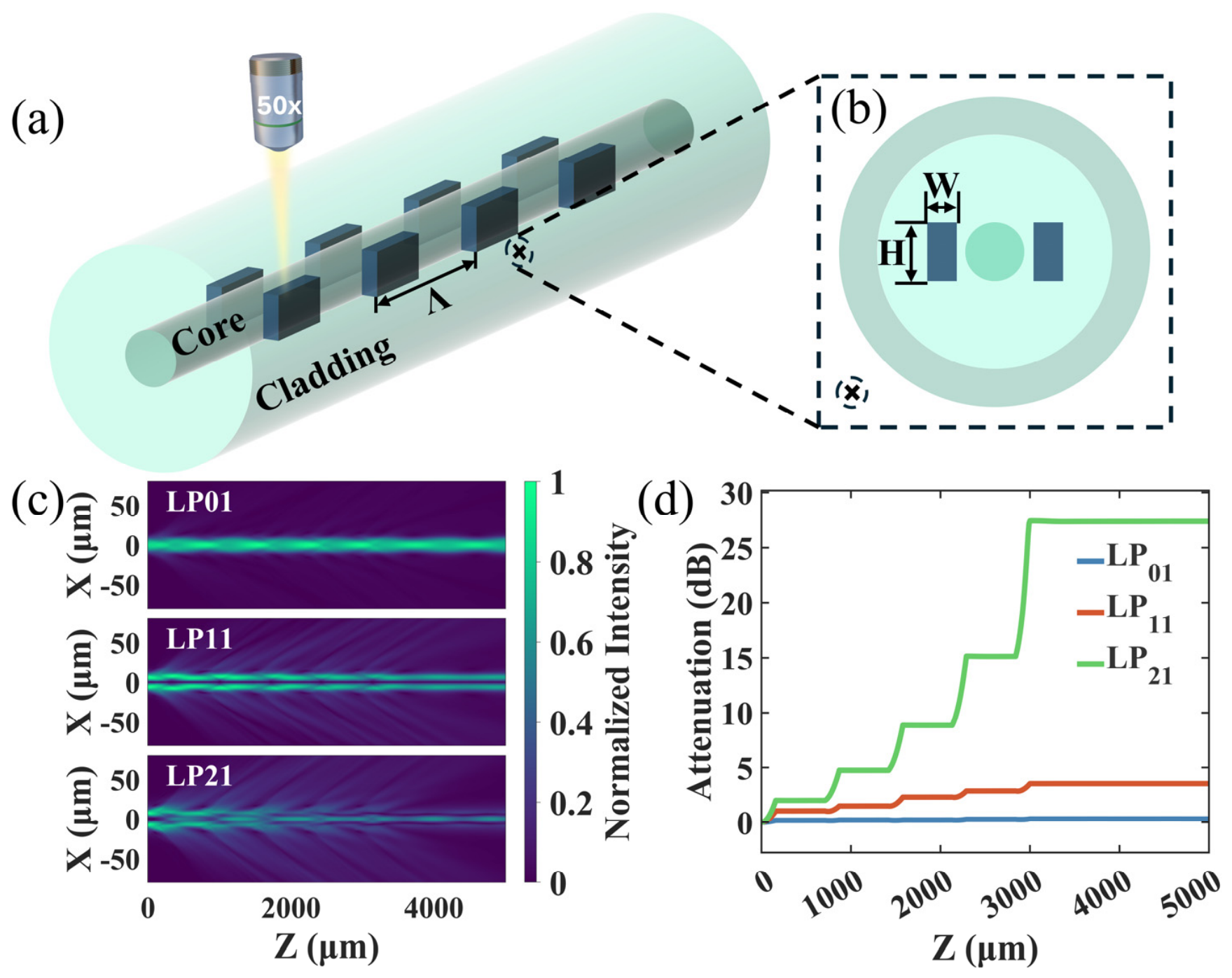
The structure and working principle of the proposed mode attenuation device are illustrated in the axial view of Figure 2a and the cross-sectional view of Figure 2b. A slightly higher-index modulation region in the near-core cladding excites perturbed modes, which undergo multimode interference with periodic core-cladding energy exchange [19] and recouple into the core at the region exit.
Figure 2.
Periodic cladding refractive-index modulation structure and its mode-selective attenuation. (a) Schematic along fiber axis, (b) fiber cross-section, (c) field evolution of fundamental and HOM through the modulation region, (d) corresponding modal power evolution in the core.
The beat length is defined as the characteristic longitudinal distance of periodic core power oscillation, which is determined by the propagation constant difference between the core guided mode and the cladding perturbed mode. Different order modes have distinct beat lengths due to their different propagation constants. By matching the modulation unit length to the beat length of a specific HOM, the core power of this HOM completes a full periodic oscillation within one unit, and most of the power is transferred to the cladding perturbation region at the unit exit and cannot be effectively recoupled back to the core, resulting in strong attenuation. While deliberately mismatching it for the FM, the beat length of the FM is larger than the unit length, so the core-cladding power coupling is weak and only negligible parasitic loss is introduced. Strong HOM attenuation is achieved over a short distance; periodic cascading of multiple units further accumulates HOM suppression with minimal impact on the FM. A rectangular cross-section is adopted to fit the line-by-line femtosecond scanning process, enabling facile fabrication and flexible parameter tuning.
Beam propagation method simulation results are presented in Figure 2c,d. With structural parameters set as , , duty cycle , , and , the calculated total attenuation losses over the full four-unit device (~2.8 mm length) are 0.31 dB for LP01, 3.55 dB for LP11, and 27.38 dB for LP21, verifying effective selective transverse-mode attenuation with low-loss FM transmission.
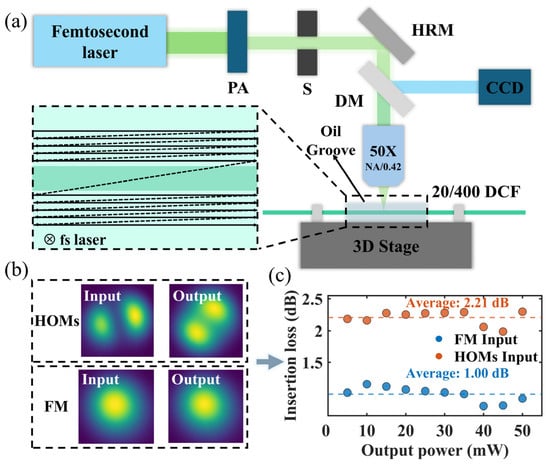
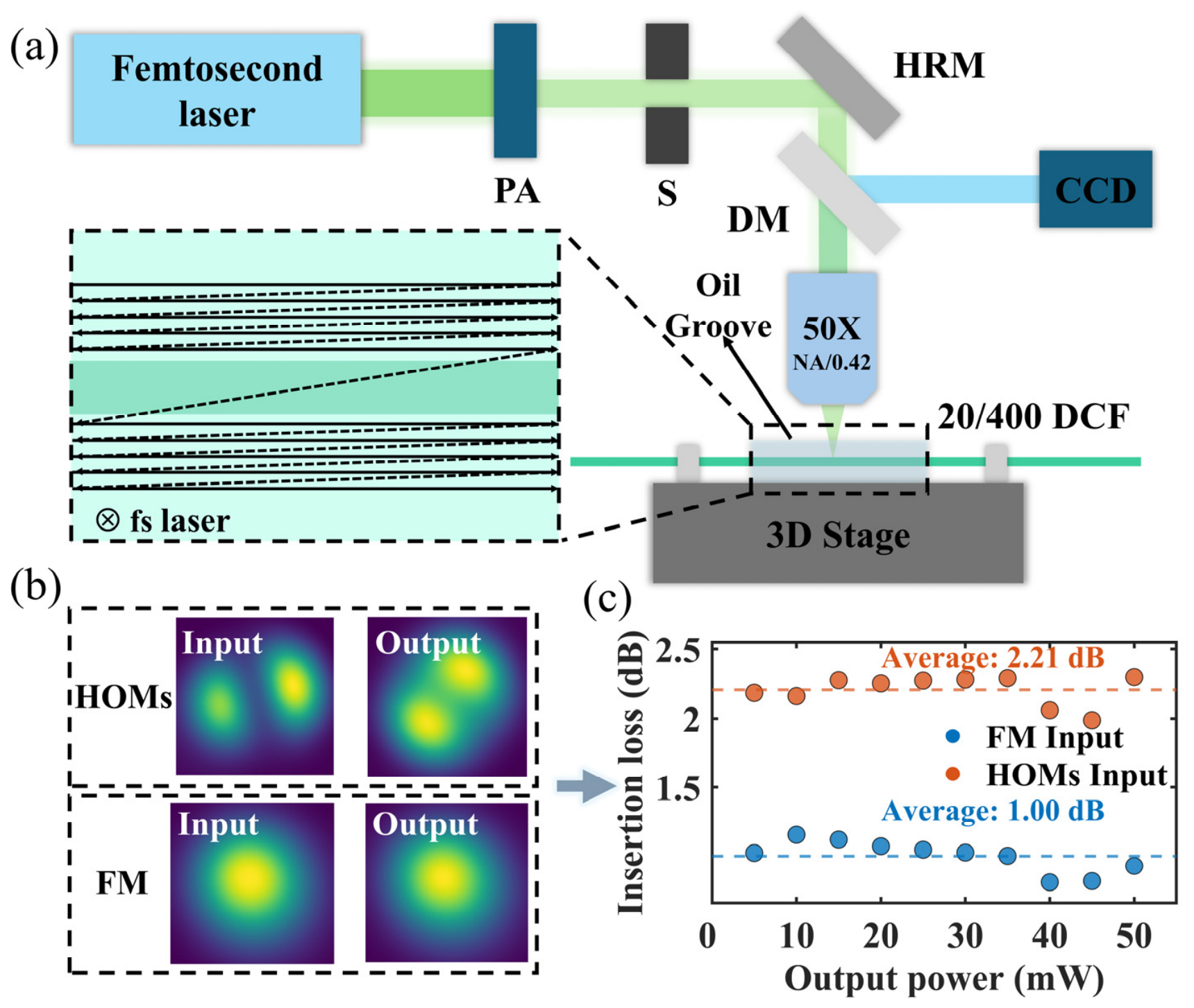
A femtosecond laser (515 nm, 300 fs, 50 kHz, and model: BFL-515-10L) is employed to fabricate the mode-selective attenuator following the simulated parameters, with the processing setup illustrated in Figure 3a. The beam is shaped by an aperture and focused via a 50× objective (NA = 0.42) into the cladding of a commercial LMA fiber (LMA-GDF-20/400-M, Nufern). The rectangular waveguide is inscribed via line-by-line scanning with a speed of 0.2 mm/s, an average power of 3.9 mW after the aperture, and a line spacing of 0.5 μm. The final device contains four periodic modulation units with a total length of ~2.8 mm; as a compact short-length component, it can also be cascaded and embedded in long-distance transmission fibers. The waveguide width is defined by the number of scan lines and line spacing, while the height depends on the beam diffraction depth, both tunable via the aperture and laser power.
Figure 3.
Femtosecond laser direct-writing system and fabrication strategy for the mode attenuator. (a) Optical path schematic with the line-by-line inscription method (PA: power attenuator; S: slit; HRM: high-reflection mirror; DM: dichroic mirror; CCD: charge-coupled device; DCF: double-clad fiber); (b) near-field beam profiles at the input and output ends; (c) insertion loss for FM input and excited HOM input.
The mode-selective attenuation performance is characterized using a 1060 nm broadband source, with results presented in Figure 3b,c. Figure 3b presents the near-field beam profiles at the input and output ends. As shown in Figure 3c, the average insertion loss is ~1.00 dB for FM input and ~2.21 dB for HOM input (excited by offset splicing [21]). The values are obtained via cut-back measurement on the same fiber, with the intrinsic propagation loss of the bare fiber deducted; the intrinsic HOM loss in the fiber without the attenuator is negligible relative to the device-induced attenuation, demonstrating stronger attenuation capability for HOMs. These results validate the selective mode attenuation performance of the device.
The measured FM loss is higher than the simulated value, which mainly arises from the impure FM input in the test and fabrication imperfections. On the one hand, non-uniform refractive index modulation distribution induced by process fluctuations introduces unintended scattering and spurious coupling of the FM, raising the FM insertion loss. On the other hand, structural deviations such as lateral position offset and dimensional fluctuation of the modulation region reduce the matching precision between the unit length and the modal beat length, which slightly degrades the HOM suppression efficiency.
4. Results and Discussion
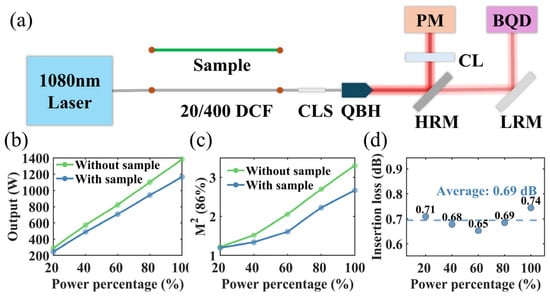
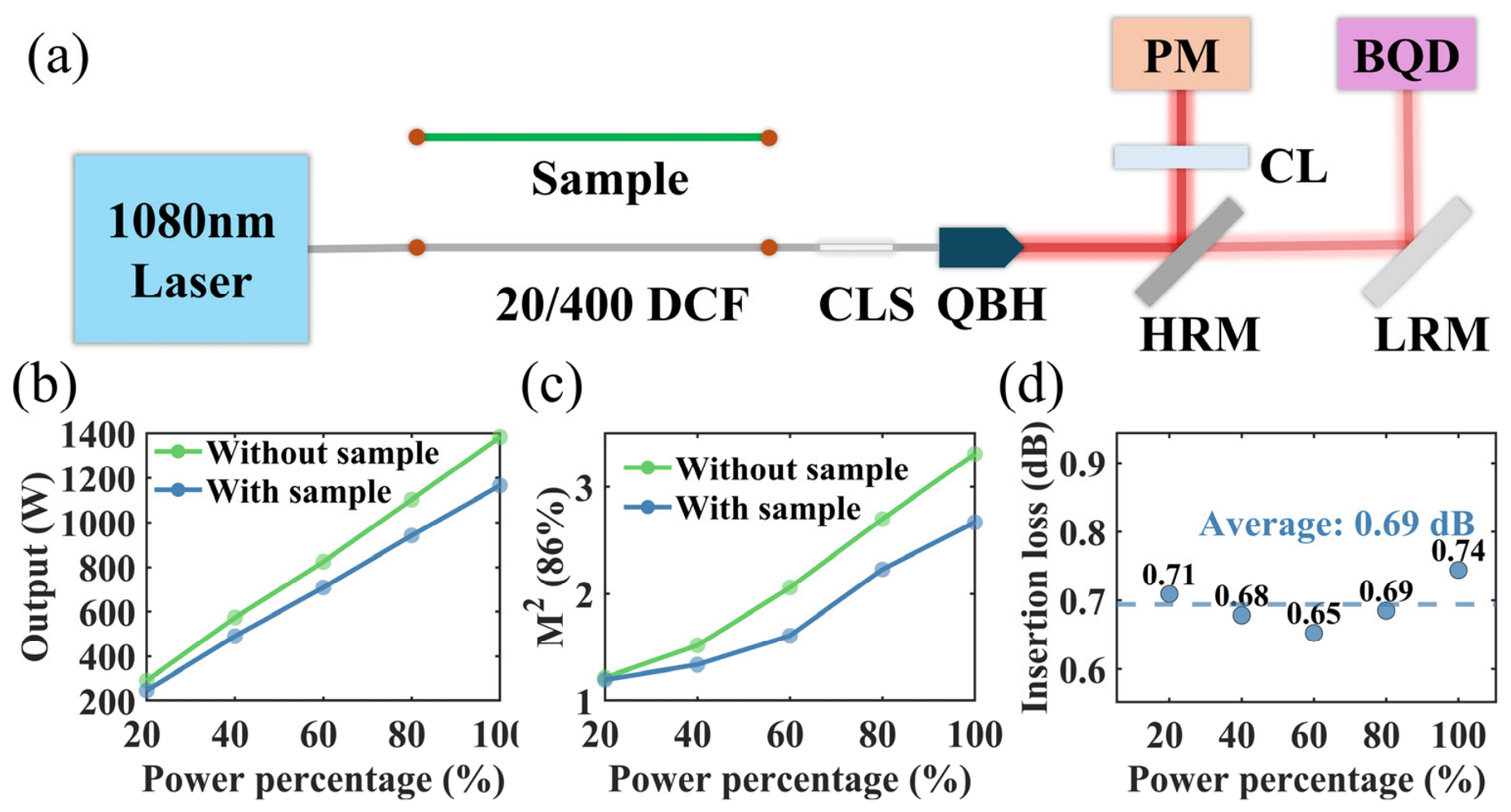
The fabricated sample is spliced to the output end of a kilowatt-level fiber laser system to characterize its high-power performance, with the measurement setup schematically illustrated in Figure 4a. Figure 4b compares the output power with and without the sample. As shown in Figure 4c, the 86% power-in-bucket M2 decreases from 2.06, 2.70 and 3.31 to 1.61, 2.23 and 2.67 at 824 W, 1103 W and 1384 W respectively, corresponding to an average improvement of 19.5%. Figure 4d presents the insertion loss at different output powers, with an average value of ~0.7 dB and minor fluctuations. Quantitative thermal characterization shows that, with no active cooling applied, the surface temperature of the inscribed region is 38.9 °C at an output power of 1384 W (ambient temperature: 27.2 °C), verifying favorable thermal stability under high-power operation. These results confirm that the device achieves consistent beam quality improvement across the full tested power range.
Figure 4.
Experimental setup and performance characterization in the kilowatt-level fiber laser system. (a) Schematic of the measurement setup (CLS: cladding laser stripper; QBH: quartz block head; HRM: high-reflection mirror; CL: concave lens; PM: power meter; LRM: low-reflection mirror; BQD: beam quality detector); (b) output power vs. set power with/without the sample; (c) M2 measured via the 86% power-in-bucket method vs. output power; (d) sample insertion loss at different output powers.
Based on the above data, the beam waist field at 100% output power is compared with an ideal Gaussian beam. Figure 5 shows the results without and with the sample, respectively. The coefficient of determination is introduced to quantify the agreement, with the formula:
where the numerator is the residual sum of squares and the denominator is the total sum of squares. A value of close to 1 indicates good agreement with an ideal Gaussian beam.
Figure 5.
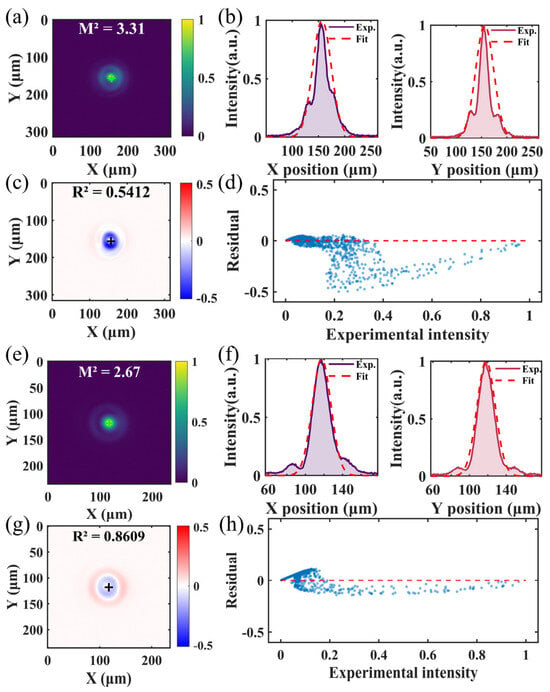
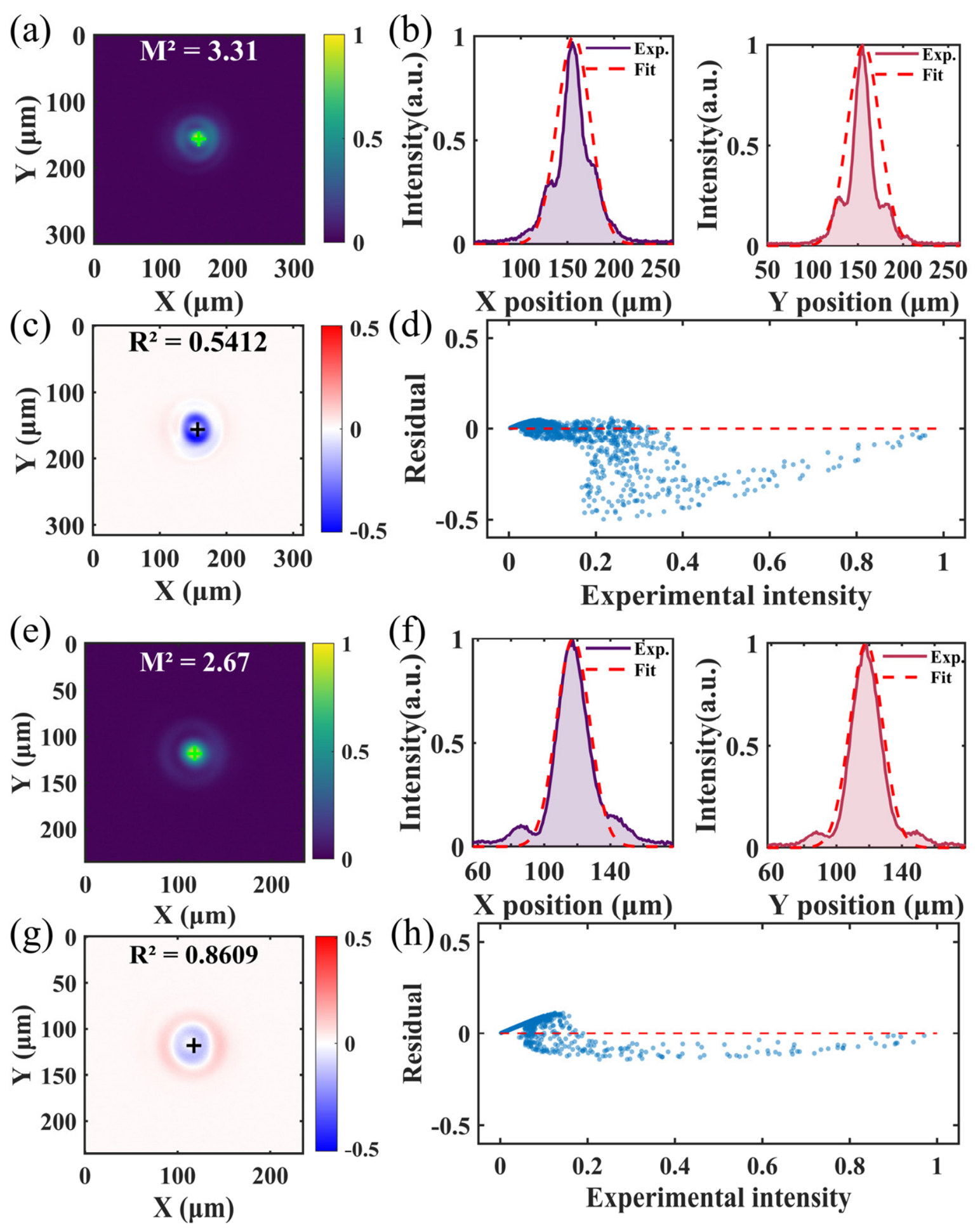
Output beams at 100% power setting without the sample (a–d) and with the sample (e–h). (a,e) Beam waist intensity distributions (M2 = 3.31 and 2.67, respectively); (b,f) horizontal and vertical cross-sectional profiles with Gaussian fits; (c,g) spatial residual maps (R2 = 0.5412 and 0.8609, respectively); (d,h) residual versus measured intensity.
Figure 5 compares the output beam characteristics at 100% power setting, where Figure 5a–d correspond to the case without the sample and Figure 5e–h correspond to the case with the sample.
As shown in Figure 5a, the beam waist exhibits obvious distortion without the sample, with M2 = 3.31. Figure 5b presents the x- and y-direction cross-sectional profiles, which deviate significantly from the Gaussian fits, featuring a steeper peak and slower decaying wings. The spatial residual map in Figure 5c gives , indicating a large deviation from the ideal Gaussian distribution. As displayed in Figure 5d, the residual-intensity scatter plot shows the absolute residual exceeds 0.4 within the normalized intensity range of 0.2–0.4, confirming the notable mismatch. After inserting the sample, the beam quality is significantly improved. As shown in Figure 5e, M2 decreases to 2.67. The cross-sectional profiles in both directions shown in Figure 5f almost coincide with the Gaussian fits. As illustrated in Figure 5g, the residual magnitude is greatly reduced, and rises to 0.8609. Figure 5h shows that the absolute residual of all points is below 0.15, with the point cloud tightly distributed around zero without obvious bias. Combined with the theoretical analysis in Section 2, the M2 factor exhibits an approximately positive linear relationship with the HOM power fraction in the 20/400 LMA fiber. The selective attenuation of HOMs by the device directly reduces the proportion of HOM power in the output beam, which is the essential reason for the measured M2 improvement.
These results verify that the device effectively optimizes beam quality by attenuating higher-order modes, making the output approach a fundamental Gaussian profile.
Despite the clear beam quality improvement demonstrated above, the device performance remains mainly constrained by the following two factors: the uniformity of the femtosecond-laser-inscribed refractive index modulation depth, and the intrinsic FM loss of a single modulation unit. On this basis, beam quality can be further enhanced without significantly sacrificing FM transmission power through complementary optimization approaches. Improving the stability of the inscription process (including scanning speed, pulse energy consistency and focusing condition) can enhance the uniformity of refractive index modulation, reduce parasitic FM loss caused by unintended scattering and spurious coupling, and effectively raise the ratio of HOM suppression to FM loss. Moderately increasing the number of cascaded modulation units can further elevate the HOM suppression ratio, as HOM attenuation accumulates nearly linearly with unit count while FM loss increases only marginally due to the deliberate beat-length mismatch design for the FM.
5. Conclusions
In summary, this paper proposes and validates a fully fiber-integrated beam quality optimization scheme based on a femtosecond-laser-inscribed mode-selective attenuator. Theoretical analysis clarifies the influence of mode weight and phase on beam quality, and kilowatt-level experiments verify its effectiveness. At powers above 800 W, the average M2 improvement ratio reaches 19.5%; specifically, at 1384 W, M2 drops from 3.31 to 2.67 and increases from 0.5412 to 0.8609, indicating significantly improved agreement with a Gaussian beam. This scheme features low insertion loss, flexible stackable deployment and easy integration with existing fiber systems, providing a novel beam quality optimization tool for high-power fiber lasers. The current device performance is mainly limited by the uniformity of refractive index modulation depth and the fundamental mode loss of a single unit; further enhancement of the HOM suppression ratio requires optimizing the inscription process to reduce intrinsic loss and increasing the number of cascaded units. With further process optimization to lower insertion loss, the device performance is expected to be continuously improved for more practical high-power fiber laser applications.
Author Contributions
Conceptualization, Z.W., M.W. (Meng Wang) and R.Z.; methodology, M.W. (Minnan Wu); software, M.W. (Meng Wang) and M.W. (Minnan Wu); validation, M.W. (Minnan Wu), Q.Q. and H.L.; formal analysis, M.W. (Meng Wang) and M.W. (Minnan Wu); investigation, M.W. (Minnan Wu); resources, Z.W., M.W. (Meng Wang) and R.Z.; data curation, M.W. (Minnan Wu), Q.Q. and R.Z.; writing—original draft preparation, M.W. (Minnan Wu); writing—review and editing, Z.W., M.W. (Meng Wang) and R.Z.; visualization, M.W. (Minnan Wu) and H.L.; supervision, Z.W., M.W. (Meng Wang) and R.Z.; project administration, Z.W., M.W. (Meng Wang) and R.Z.; funding acquisition, Z.W., M.W. (Meng Wang) and R.Z. All authors have read and agreed to the published version of the manuscript.
Funding
This work was supported by Science and Technology Innovation Program of Hunan Province (2021RC4027), National Natural Science Foundation of China (NSFC) (62405373), and National Natural Science Foundation of China (NSFC) (12504500).
Institutional Review Board Statement
Not applicable.
Informed Consent Statement
Not applicable.
Data Availability Statement
The data presented in this study are available upon request from the corresponding authors. The data are not publicly available due to privacy restrictions.
Conflicts of Interest
The authors declare no conflicts of interest.
References
- Jauregui, C.; Limpert, J.; Tünnermann, A. High-power fibre lasers. Nat. Photon. 2013, 7, 861–867. [Google Scholar] [CrossRef] [Scilit]
- Mermelstein, M.D.; Andrejco, M.J.; Fini, J.; Yablon, A.; Headley, C., III; DiGiovanni, D.J.; McCurdy, A.H. 11.2 dB SBS gain suppression in a large mode area Yb-doped optical fiber. In Proc. SPIE 6873, Fiber Lasers V: Technology, Systems, and Applications, San Jose, CA, USA, 19–24 January 2008; SPIE: Bellingham, WA, USA, 2008; p. 68730N. [Google Scholar]
- Shiner, B. The Impact of Fiber Laser Technology on the World Wide Material Processing Market. In CLEO: 2013, OSA Technical Digest (Online), Applications and Technology 2013, San Jose, CA, USA, 9–14 June 2013; Optica Publishing Group: San Jose, CA, USA, 2013; p. AF2J.1. [Google Scholar]
- Richardson, D.J.; Nilsson, J.; Clarkson, W.A. High power fiber lasers: Current status and future perspectives [Invited]. J. Opt. Soc. Am. B 2010, 27, B63–B92. [Google Scholar] [CrossRef] [Scilit]
- Zuo, J.; Lin, X. High-Power Laser Systems. Laser Photonics Rev. 2022, 16, 2100741. [Google Scholar] [CrossRef] [Scilit]
- Chen, X.; Yao, T.; Huang, L.; An, Y.; Wu, H.; Pan, Z.; Zhou, P. Functional Fibers and Functional Fiber-Based Components for High-Power Lasers. Adv. Fiber Mater. 2023, 5, 59–106. [Google Scholar] [CrossRef] [Scilit]
- Wang, Y.; Chen, G.; Li, J. Development and prospect of high-power Yb3+ doped fibers. High Power Laser Sci. Eng. 2018, 6, e40. [Google Scholar] [CrossRef] [Scilit]
- Leandro, L.; Grüner-Nielsen, L.; Rottwitt, K. Mode resolved bend-loss analysis in few-mode fibers using spatially and spectrally resolved imaging. Opt. Lett. 2015, 40, 4583–4586. [Google Scholar] [CrossRef] [Scilit]
- Donlagic, D. In-line higher order mode filters based on long highly uniform fiber tapers. J. Light. Technol. 2006, 24, 3532–3539. [Google Scholar] [CrossRef] [Scilit]
- Chen, K.; Fang, W.; Ma, X.; Zhou, Y.; Zhang, W.; Chen, X.; Huang, S.; Liao, M.; Ohishi, Y.; Gao, W. Spatial mode and wavelength switchable erbium-doped fiber laser based on a fiber beam shaper. Opt. Express 2022, 30, 47452–47462. [Google Scholar] [CrossRef] [Scilit]
- Walorny, M.; Abramczyk, J.; Jacobson, N.; Tankala, K. Mechanical reliability of double clad fibers in typical fiber laser deployment conditions. In Proc. SPIE 9728, Fiber Lasers XIII: Technology, Systems, and Applications, San Francisco, CA, USA, 13–18 February 2016; SPIE: Bellingham, WA, USA, 2016; p. 97283A. [Google Scholar]
- Zhang, H.; Zhou, P.; Wang, X.; Xiao, H.; Xu, X. Fiber fuse effect in high-power double-clad fiber laser. In Conference on Lasers and Electro-Optics Pacific Rim (CLEOPR), Kyoto, Japan, 30 June–4 July 2013; IEEE: New York, NY, USA, 2013. [Google Scholar]
- Matniyaz, T.; Bingham, S.P.; Kalichevsky-Dong, M.T.; Hawkins, T.W.; Pulford, B.; Dong, L. High-power single-frequency single-mode all-solid photonic bandgap fiber laser with kHz linewidth. Opt. Lett. 2022, 47, 377–380. [Google Scholar] [CrossRef] [Scilit]
- Hochheim, S.; Brockmüller, E.; Wessels, P.; Koponen, J.; Lowder, T.; Novotny, S.; Willke, B.; Neumann, J.; Kracht, D. Single-Frequency 336 W Spliceless All-Fiber Amplifier Based on a Chirally-Coupled-Core Fiber for the Next Generation of Gravitational Wave Detectors. J. Light. Technol. 2022, 40, 2136–2143. [Google Scholar] [CrossRef] [Scilit]
- Kuhlmey, B.T.; Eggleton, B.J.; Wu, D.K.C. Fluid-Filled Solid-Core Photonic Bandgap Fibers. J. Light. Technol. 2009, 27, 1617–1630. [Google Scholar] [CrossRef] [Scilit]
- Jain, D.; Baskiotis, C.; Sahu, J. Mode area scaling with multi-trench rod-type fibers. Opt. Express 2013, 21, 1448–1455. [Google Scholar] [CrossRef] [Scilit]
- Li, H.; Goel, C.; Zang, J.; Raghuraman, S.; Chen, S.; Hassan, M.R.A.; Chang, W.; Yoo, S. Integration of an anti-resonant hollow-core fiber with a multimode Yb-doped fiber for high power near-diffraction-limited laser operation. Opt. Express 2022, 30, 7928–7937. [Google Scholar] [CrossRef] [Scilit]
- Li, W.; Liu, W.; Deng, Y.; Chen, Y.; Yang, H.; Chen, Q.; Zheng, J.; Xiao, H.; Chen, Z.; Pan, Z.; et al. Functional Yb-doped fiber with a bat-type refractive index distribution for beyond kilowatt all-fiber single-frequency laser amplification. Light Sci. Appl. 2025, 14, 271. [Google Scholar] [CrossRef] [Scilit]
- Krämer, R.G.; Gelszinnis, P.; Voigtländer, C.; Schulze, C.; Thomas, J.U.; Richter, D.; Duparré, M.; Nolte, S. Femtosecond inscribed mode modulators in large mode area fibers: Experimental and theoretical analysis. In Proc. SPIE 9344, Fiber Lasers XII: Technology, Systems, and Applications, San Francisco, CA, USA, 7–12 February 2015; SPIE: Bellingham, WA, USA, 2015; p. 93440E. [Google Scholar]
- Yoda, H.; Polynkin, P.; Mansuripur, M. Beam quality factor of higher order modes in a step-index fiber. J. Light. Technol. 2006, 24, 1350–1355. [Google Scholar] [CrossRef]
- Rao, B.; Zhao, X.; Li, H.; Tian, X.; Wang, M.; Wang, Z. Mode coupling in large-mode-area double-cladding chirped and tilted fiber Bragg gratings. Opt. Express 2021, 29, 11277–11292. [Google Scholar] [CrossRef] [Scilit]
Disclaimer/Publisher’s Note: The statements, opinions and data contained in all publications are solely those of the individual author(s) and contributor(s) and not of MDPI and/or the editor(s). MDPI and/or the editor(s) disclaim responsibility for any injury to people or property resulting from any ideas, methods, instructions or products referred to in the content. |
© 2026 by the authors. Licensee MDPI, Basel, Switzerland. This article is an open access article distributed under the terms and conditions of the Creative Commons Attribution (CC BY) license.