


Abstract
Highly saturated structural colors are crucial for the micro-nanophotonic displays. However, achieving Schrödinger’s red pixels remains a challenge due to the difficulty in suppressing higher-order resonances in the blue-green wavelength band. In this paper, we utilize the TuRBO algorithm for global physical parameter optimization of periodic nanopillar metasurface structures to realize the high-saturation red. Based on the intrinsic dispersion characteristics of characterized by high extinction coefficients in the blue-green wavelength band, the high-saturation Schrödinger’s red that surpasses the Adobe RGB boundary has been produced successfully. The calculated results show that after 45 iterations, the structure achieves gradient refractive index matching, aligning the intrinsic dispersion of with the ideal reflection spectrum of Schrödinger’s red pixels, thereby effectively suppressing higher-order resonances in the blue-green wavelength band. Ultimately, an ultra-high saturation red is achieved with CIE coordinates of (0.6507, 0.3043) in the CIE chromaticity space.
1. Introduction
Structural colors exhibit tremendous potential for applications in the fields of next-generation miniaturized displays [1], coatings or inks [2] and reconfigurable optical devices [3] because of its ultra-high spatial resolution [4], fade resistance [5] and dynamic tunability [6]. In the early stages, research on structural colors mainly focused on metallic nanostructures, utilizing the localized surface plasmon resonance (LSPR) effect for color manipulation [7,8,9]. However, metallic nanostructures are limited by high intrinsic ohmic losses. It is difficult to achieve high saturation colors. By contrast, dielectric nanostructures based on Mie resonance exhibit very low intrinsic loss in the visible light wavelengths range, which can realize high saturation structural colors [10,11].
With in-depth research on the geometric shapes [12], material properties [13], and spatial arrangements [14,15] of all-dielectric metasurfaces, the performance ceiling of structural colors is constantly being pushed. The color gamut coverage of metasurface structural colors has exceeded the Adobe RGB range. Nevertheless, achieving high-saturation red colors continues to present a challenge [16]. According to Erwin Schrödinger’s color theory, high-saturation red pixels are defined as Schrödinger’s red pixels [17,18]. It requires an ideal reflection spectrum which shows near 1 in the red wavelength band and 0 in the blue-green wavelength band. Because the resonant structures that support the fundamental red mode typically also support higher-order modes in the blue-green wavelength band, the realization of highly saturated red colors encounters substantial difficulties [19].
In 2019, Bo Yang et al. proposed a new design strategy based on interlayer refractive index matching to suppress high-order resonances. It can effectively suppress the reflection in the blue-green wavelength band while ensuring a reflectivity close to 100% at the resonance peak of 625 nm [20]. In 2020, Wenhong Yang et al. utilized the material properties of and , combined with the refractive index matching strategy, to suppress background reflection to nearly zero [21]. In 2025, Hongyan Yang et al. constructed a bilayer nanopillar metasurface based on the refractive index matching strategy. In the red wavelength band, the peak reflectivity remains close to 1. Meanwhile, in the blue-green wavelength band, background reflection is suppressed to an extremely low level [22]. The above schemes demonstrated the potential of the refractive index matching strategy in achieving high-saturation red colors.
However, their CIE chromaticity coordinates still fail to significantly surpass the red boundary of Adobe RGB. To break through the red saturation bottleneck, in 2022, Dong et al. designed a nanoantenna based on quasi-bound-states-in-the-continuum (q-BIC) modes. This structure achieved a high-saturation red which significantly breaks through the red boundary of Adobe RGB [23]. However, the realization of q-BIC modes strongly depends on the structural parameters of the micro-nano structural units, as well as the incident angle and polarization of the light source [24,25]. This not only increases the complexity of structural design but also poses challenges for industrial preparation. Therefore, achieving high saturation red remains a significant challenge.
As research into the limits of red saturation deepens, the complexity of structures and mechanisms poses computational challenges. Traditional design methods struggle to efficiently solve multidimensional optimization problems [26]. Therefore, machine learning, which is widely applied in various parameter optimization scenarios, has become a powerful tool for solving red saturation optimization problems. In 2022, Hu et al. proposed a polarization-controlled hybrid metal-dielectric layer, which utilizes a bidirectional neural network for the inverse design of geometric parameters of desired colors. This approach achieves dynamic structural colors beyond the sRGB gamut while reducing dependence on design experience and lowering computational costs [27]. In 2024, Lee et al. introduced a hybrid metasurface structure combining metal and dielectric components, utilizing the Particle Swarm Optimization (PSO) algorithm for inverse design. This approach achieves full coverage of the sRGB gamut and enhances transmission efficiency to over 70% [28].
In this paper, we propose an all-dielectric multilayer nanorod metasurface with as the core. Due to the high degree of matching between the dispersion characteristics of and the ideal reflection spectrum of Schrödinger’s red pixels, it can achieve high-saturation red colors beyond the Adobe RGB color gamut with a simple structure. Meanwhile, the TuRBO algorithm is utilized to optimize the metasurface to achieve high saturation red. After 45 iterations, an ultra-high saturation red point located at (0.6507, 0.3043) in the CIE chromaticity space is achieved.
2. Structural Design
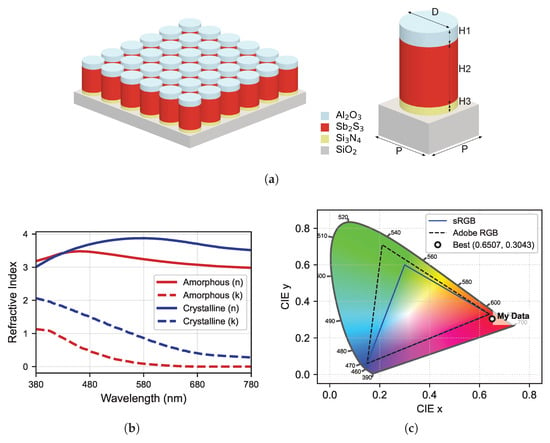
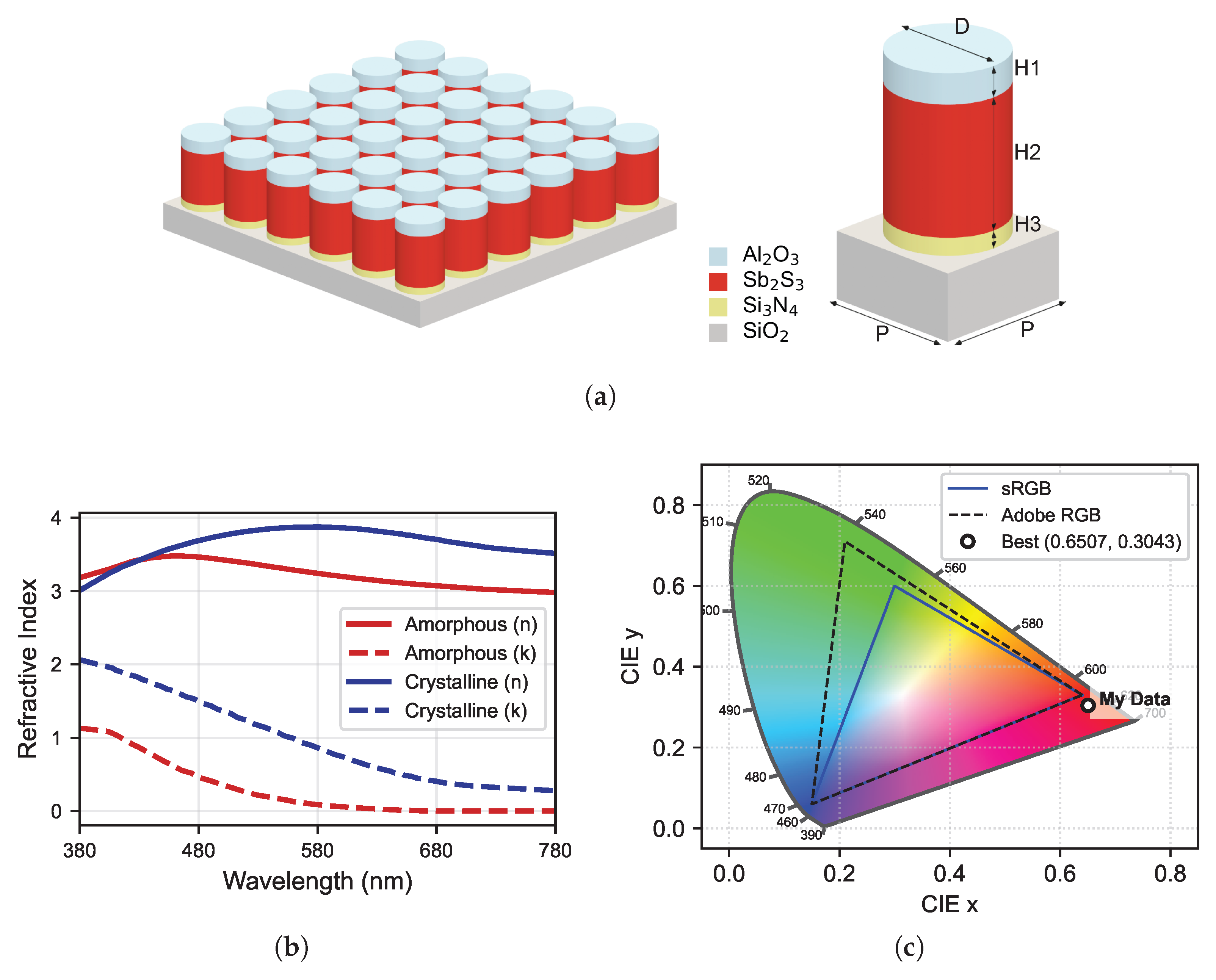
Figure 1a illustrates a schematic diagram of an equi-period nanorod array structure centered around . The substrate is chosen to be , which exhibits high transparency in the visible light wavelength range, ensuring the purity of the metasurface background signal. Each individual nanorod adopts a three-layer vertical stacking configuration, consisting of , , and from top to bottom. and serve as refractive index matching media between the core layer and the external environment (air and substrate) [20]. The diameter of the nanorod is . The periodicity of the array is .
Figure 1.
Structure and results: (a) Schematic of vertical three-layer stacked nanopillar array structure, (b) Complex refractive index of in amorphous and crystalline states versus wavelength, (c) CIE 1931 chromaticity coordinates of optimal structural color (0.6507, 0.3043).
The complex refractive index of is shown in Figure 1b within the visible light wavelength range. It can be seen that the extinction coefficient of amorphous exhibits strong dispersion characteristics within the visible light wavelength range [29]. Strong absorption effect is exhibited in the blue-green wavelength band. As the wavelength red shifts, the extinction coefficient gradually decreases, eventually approaching 0 at about 600 nm. Then it maintains nearly lossless state in the red wavelength band. This characteristic is highly consistent with the ideal reflection spectrum required by Schrödinger’s red pixels. In the blue-green wavelength band, the strong absorption effect of the material can effectively suppress the reflection of non-target wavelengths. In the red wavelength band, its extremely low loss characteristic ensures efficient reflection at the main resonance peak.
Three-dimensional finite-difference time-domain (FDTD) simulations were performed to evaluate the optical response of the proposed metasurface. Periodic boundary conditions were applied along the and directions, while PML boundary conditions were applied along the direction. A local mesh refinement was applied in the nanostructure region with a spatial resolution of nm. A normally incident linearly polarized plane wave covering the wavelength range of 380–780 nm was used as the excitation source. The reflection spectra were obtained using a power monitor placed above the metasurface. Wavelength-dependent complex refractive indices were used for all materials. The optical constants of amorphous and crystalline were obtained from ellipsometric measurements reported by Lu et al. The optical constants of and were obtained from the Palik optical constants database, while the wavelength-dependent optical constants of were adopted from the experimental data reported by Philipp et al.
After iterative optimization using the machine learning algorithm TuRBO, we have identified a set of optimal structural parameter values that enable high-saturation red color, as shown in Table 1. The lattice period is 381.02 nm, and the nanocolumn diameter is 349.83 nm. In terms of vertical thickness distribution, the thicknesses of , , and are precisely optimized to 44.12 nm, 239.45 nm, and 66.34 nm, respectively. As shown in Figure 1c, the color point of the optimal structure falls at (0.6507, 0.3043) in the CIE chromaticity space. It has significantly surpassed the red gamut boundary of Adobe RGB.
Table 1.
Optimal structural parameters of the proposed metasurface.
3. Design Method
To efficiently explore the complex parameter space of the metasurface, a trust-region Bayesian optimization (TuRBO) algorithm [30] was employed in this study. TuRBO is suitable for black-box optimization problems with high computational costs and limited objective evaluations, making it applicable to FDTD-based metasurface optimization tasks. Furthermore, previous studies on nanophotonic structure optimization have demonstrated that Bayesian optimization can achieve high-quality solutions with fewer evaluations compared with conventional optimization algorithms [31]. Therefore, TuRBO is employed to optimize metasurface parameters for achieving highly saturated red structural colors beyond the Adobe RGB color gamut.
At the beginning, based on the CIE 1931 chromaticity space, the fitness function (Fitness) is designed to quantify the degree of approximation between the structural color coordinates and the target points. A larger Fitness value indicates that the structural color coordinates are closer to the target point.
where represents the CIE chromaticity coordinates calculated by the Finite-difference time-domain method (FDTD), and denotes the preset target point coordinates. In this paper, the target point is set to the CIE chromaticity coordinates (0.704, 0.296) corresponding to the Schrödinger’s red pixel.
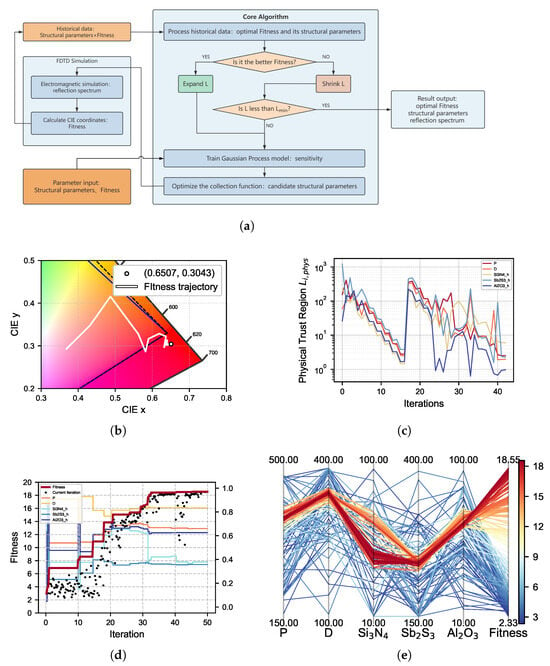
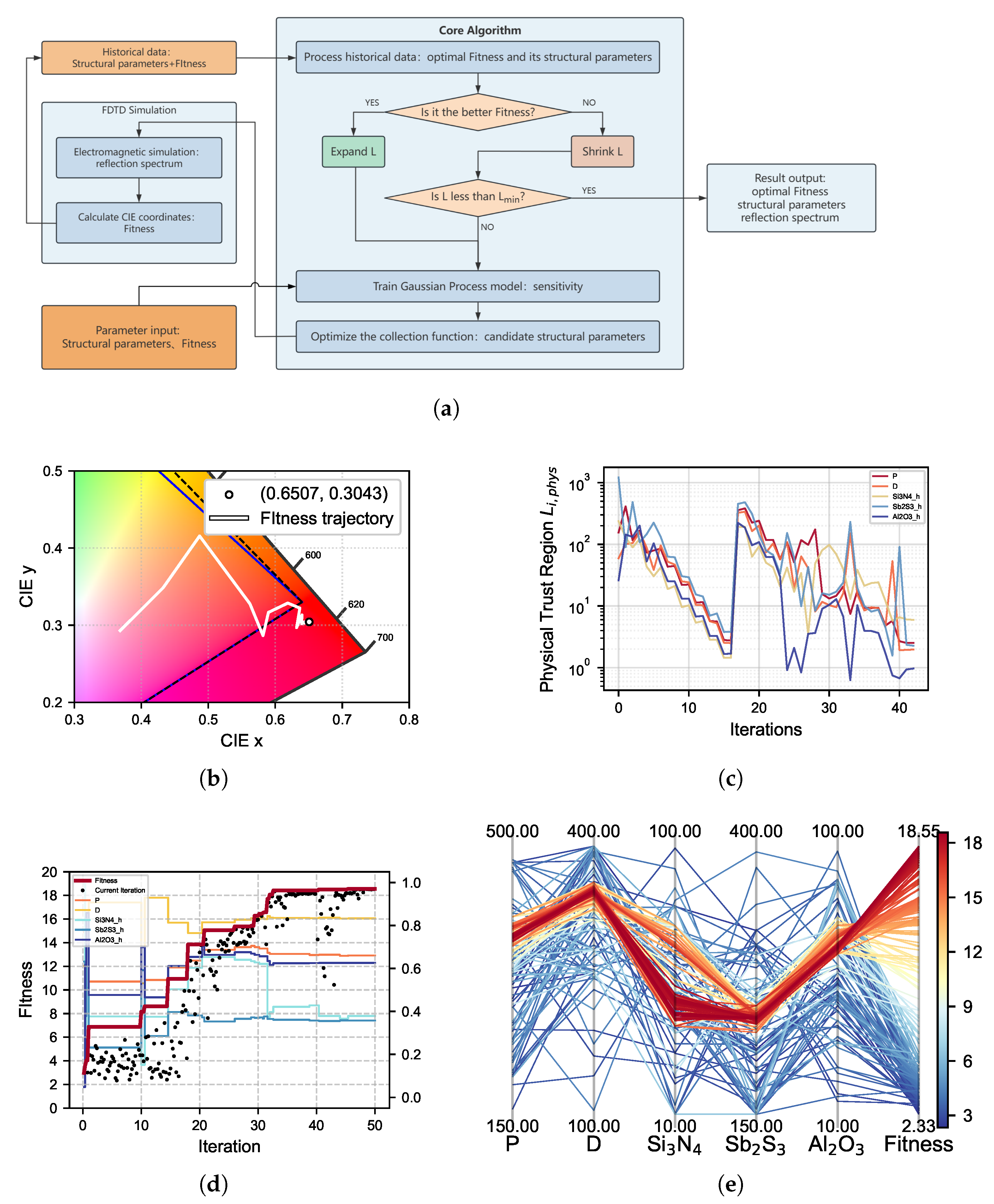
The workflow of the automated iterative system driven by the TuRBO algorithm is shown in Figure 2a. The system consists of a parameter input layer, a core algorithm layer, an FDTD simulation layer, and a historical data layer.
Figure 2.
Automated iteration system based on TuRBO algorithm and multidimensional convergence analysis: (a) Automated iteration system flowchart, (b) Anisotropic trust region evolution curve, (c) Optimization trajectory in CIE 1931 chromaticity space, (d) Objective function and parameter convergence history, (e) Six-dimensional parallel coordinate mapping.
At the parameter input layer, we select the lattice period , nanocolumn diameter , and the thickness parameters of each layer of , , and as design variables. Simultaneously, the range of values for each variable and the are input into the system as initial data.
At the core algorithm layer, due to the lack of historical data in the early stages of optimization, the acquisition function generates five sets of initial structural parameters through random sampling and passes them to the FDTD simulation layer. The FDTD simulation layer calculates the reflection spectrum and its CIE chromaticity coordinates. Then it computes the corresponding . The five sets of initial data, including structural parameters and values, are saved to the historical data layer.
Based on the historical data, the TuRBO algorithm enters the iterative optimization phase.
Firstly, the core algorithm layer compares the latest result with historical records to determine the current optimal and its corresponding structural parameters. Simultaneously, the algorithm adjusts the overall search step size based on the improvement of . When continuously increases, it indicates that the current direction holds greater promise. is doubled to accelerate optimization. If the increase stops, it is considered that the current search space is too large to optimize. is halved to shift to a fine search.
Secondly, the algorithm calculates the sensitivity of to each structural parameter by training a local Gaussian process (GP) model based on all historical data. It allows the overall search step size to be converted into the actual search step size for each structural parameter. Then the search space for each structural parameter has been determined. The center is the structural parameters corresponding to the current optimal . The edge length is the corresponding actual search step size .
Within this space, the acquisition function selects five sets of candidate structural parameters based on the trained local Gaussian process model and passes them to the FDTD simulation layer for calculation. The FDTD simulation layer completes the calculation of reflection spectra and their corresponding CIE chromaticity coordinates, and then calculates the corresponding .
Thirdly, the new five sets of data are updated to the historical data layer and fed back to the new round of iteration. This process is repeated until is reduced to a preset minimum value , indicating that the current region has been fully searched. In this paper, is set to .
Figure 2b illustrates the optimization trajectory of structural color in the CIE chromaticity diagram. With the red vertex as the convergence target, the algorithm simultaneously optimizes the resonance enhancement of the red band and the out-of-band suppression of the blue-green band by minimizing the chromaticity space distance. The reflection spectrum is guided to approach the ideal spectrum of Schrödinger’s red.
Figure 2c illustrates the dynamic evolution of search step sizes for various structural parameters. It can be seen that the step sizes for and converge rapidly, whereas those for and undergo frequent dynamic adjustments. It indicates that the algorithm is capable of recognizing the sensitivity differences of red saturation to different structural parameters and allocating appropriate search step sizes accordingly.
Figure 2d illustrates the convergence curves of the objective function and structural parameters. Based on the adaptive trust region mechanism, the algorithm secured a near-optimal solution within a five-dimensional space after just 45 iterations. it is worth noting that, as increases stepwise, the structural parameters adjust synchronously, demonstrating the algorithm’s efficacy in identifying the nonlinear coupling relationships among these parameters.
Figure 2e illustrates the distribution of the samples. The bright-colored lines representing high fitness are clearly clustered within specific parameter intervals, visually demonstrating the algorithm’s efficient targeting of highly promising spaces. Furthermore, the bright-colored distribution of exhibits a dual-center clustering, visually illustrating the algorithm’s ability to effectively balance global exploration and local fine exploration.
4. Analysis and Discussion
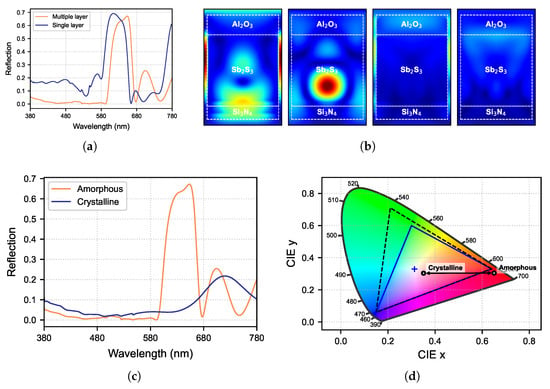
Figure 3a illustrates the reflection spectra of the single-layer and three-layer nanorod metasurface structure. It can be observed that the strong self-absorption effect of in the blue-green wavelength band ensures that the reflection spectra are already at a low level of approximately 0.15, while the low-loss characteristic in the red wavelength band ensures that the reflection peak can reach up to 0.7. The introduction of the three-layer nanorod configuration further reduces the reflectivity in the blue-green wavelength range and achieves high reflectivity across the entire red wavelength range. By precisely controlling the multilayer interference effect, high-order resonant modes in the blue-green wavelength band are suppressed, thereby enhancing the saturation and brightness of the red wavelengths.
Figure 3.
Optical response analysis of the optimized metasurface. (a) Comparison of reflection spectra between single-layer and multilayer nanopillar structures. (b) Electric and magnetic field distributions at the resonance wavelength (658 nm) and cutoff wavelength (450 nm). From left to right: electric and magnetic fields at 658 nm and 450 nm, respectively. (c) Reflection spectra of the amorphous and crystalline states of . (d) Corresponding CIE chromaticity coordinate shifts induced by the phase transition of .
Figure 3b illustrates the distribution diagrams of electric and magnetic fields. At the cutoff wavelength band (450 nm), due to the high extinction coefficient of , the incident energy rapidly attenuates after entering the interior of the nanorod layer, leading to significant suppression of the electromagnetic field [32]. In contrast, at the resonant center wavelength (658 nm), exhibits high refractive index and low loss characteristics. At this wavelength, the magnetic field energy is highly concentrated within the core layer, inducing significant magnetic pole response [33]. Furthermore, due to the nanorod spacing being much smaller than the resonant wavelength, a strong near-field coupling effect occurs between adjacent units, causing the electric field energy to violently spill out from the core layer and be compressed into a subwavelength air gap, further enhancing the system’s radiative feedback to the far field [34].
Furthermore, as a phase change material, exhibits significant changes in complex refractive index when its crystalline state changes [29]. Figure 3c and d illustrate the reflection spectra and CIE chromaticity coordinates of the crystalline and amorphous states under optimal parameters, respectively. When transitions from amorphous to crystalline state, the color point of the structure in the CIE chromaticity space will shift from (0.6507, 0.3043) to (0.3512, 0.3033). Although previous studies have shown that low-saturation color variations are sufficient for information encryption [35,36,37], the main advantage of the proposed platform lies in its reversible phase-change capability. This feature may enable the writing, modification, and hiding of optical information without redesigning the structure. On this basis, the high-saturation red state in the amorphous phase and the dark state in the crystalline phase form a pronounced color contrast and may be assigned as distinguishable optical logic states, thereby facilitating optical readout and providing potential for reconfigurable optical storage and information steganography [38]. It should be noted that the above discussion is based only on the potential applications derived from the distinct optical responses of amorphous and crystalline . The practical realization of active color switching still requires further investigation of the specific optical or thermal excitation conditions, heat dissipation process, and cycling stability of the phase transition.
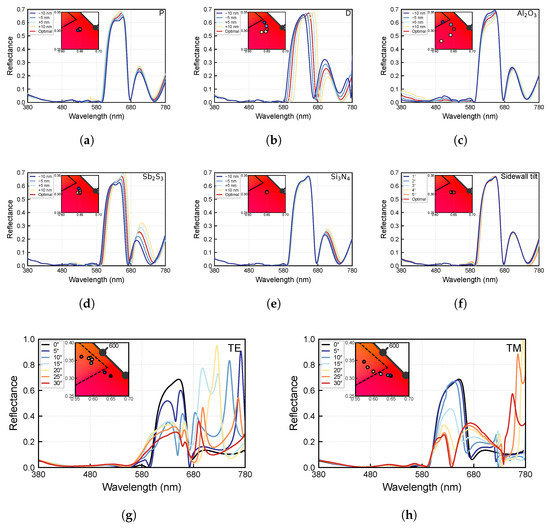
To further evaluate the practical feasibility of the optimized metasurface, fabrication tolerance analysis was performed by introducing independent nm and nm deviations in the lattice period , nanopillar diameter , and the thicknesses of , , and . In addition, sidewall inclination angles of – were considered to evaluate the influence of non-ideal fabrication profiles. Figure 4 illustrates the reflection spectra and corresponding CIE chromaticity coordinate distributions recalculated for each perturbed structure under different fabrication deviations.
Figure 4.
Robustness analysis of the optimized metasurface. Fabrication tolerance analysis for variations in (a) lattice period , (b) nanorod diameter , (c) thickness, (d) thickness, (e) thickness, (f) sidewall tilt angle. Angle-dependent optical responses under (g) TE and (h) TM polarization.
The results reveal that the fabrication sensitivity of the structure strongly depends on different geometric parameters. As shown in Figure 4a,d–f, variations in the thickness, thickness, lattice period , and sidewall inclination induce only limited spectral changes. In particular, the reflectance in the blue-green wavelength region remains at an extremely low level without obvious excitation of higher-order modes or additional reflection peaks, while the primary reflection characteristics in the red wavelength region are well preserved. The CIE coordinates remain close to the optimized red coordinate point, with the corresponding ranges for variations in the thickness, thickness, lattice period , and sidewall inclination being ––, ––, ––, and ––, respectively. These results demonstrate that these parameters exhibit good fabrication tolerance and do not significantly affect the suppression of blue-green reflection or the formation of high-saturation red structural color.
In contrast, as shown in Figure 4b,c, the nanopillar diameter and thickness exhibit higher fabrication sensitivity. When the nanopillar diameter varies within nm, the main reflection band in the red wavelength region undergoes a noticeable shift, indicating that deviations in this parameter significantly affect the spectral response. For variations in the thickness, the suppression of reflection in the blue-green wavelength region gradually weakens, accompanied by the emergence of additional reflection peaks, resulting in pronounced changes in the overall spectral characteristics. The corresponding CIE coordinate ranges are –– and ––, respectively. Although these deviations introduce noticeable chromaticity shifts, most CIE coordinates remain beyond the Adobe RGB red boundary, indicating that the structure can still maintain high color saturation. Therefore, the nanopillar diameter and thickness are identified as the dominant fabrication-sensitive parameters affecting structural color stability, and precise control of these parameters is required during practical device fabrication.
Furthermore, the angular and polarization dependence of the optimized metasurface was investigated under oblique illumination conditions. The incident angle was varied from to with a step of , and the reflection spectra and corresponding CIE chromaticity coordinates were calculated for both TE and TM polarizations, as shown in Figure 4g and Figure 4h, respectively. At normal incidence, the TE and TM polarized responses are identical due to the rotational symmetry of the circular nanopillar structure. As the incident angle increases, the optical response gradually exhibits angle- and polarization-dependent characteristics.
For TE polarization, the red reflection band exhibits noticeable spectral variations with increasing incident angle. The reflectance in the red wavelength region gradually changes, accompanied by the appearance of angle-dependent resonant features at longer wavelengths, resulting in a deviation of the CIE coordinates from the optimized red point. In comparison, TM polarization exhibits relatively weaker angular dispersion within a small-angle range (–), where the main red reflection band and CIE coordinates remain relatively stable. With further increasing incident angle, the red reflection band also undergoes spectral shifts and reflectance variations, leading to a gradual displacement of the CIE coordinates. These results indicate that the optimized metasurface maintains stable high-saturation red structural color under near-normal illumination, while larger incident angles introduce certain angular and polarization dependencies. The TM polarization exhibits relatively improved angular stability compared with TE polarization. Therefore, further optimization by incorporating multiple incident angles and polarization states into the design objectives may provide an effective strategy for achieving wide-angle and polarization-insensitive structural color performance.
5. Conclusions
In this paper, we have proposed and studied an all-dielectric metasurface structure centered around . Based on the unique dispersion characteristics of , the structural color micro-nano parameters are optimized by using the TuRBO algorithm. Through gradient refractive index matching, the intrinsic dispersion characteristics of are highly aligned with the ideal reflection spectrum of Schrödinger’s red pixels, effectively suppressing high-order resonances in the blue-green wavelength range. After 45 iterations, an ultra-high saturation point located at (0.6507, 0.3043) in the CIE chromaticity space is achieved.
Author Contributions
Author Contributions: Conceptualization, Y.W., B.N. and L.W.; methodology, Y.W. and B.N.; software, Y.W.; validation, Y.W. and B.N.; formal analysis, Y.W.; investigation, Y.W.; data curation, Y.W.; writing—original draft preparation, Y.W.; writing—review and editing, B.N. and L.W.; visualization, Y.W.; supervision, B.N. and L.W.; project administration, B.N. and L.W.; funding acquisition, B.N. and L.W. All authors have read and agreed to the published version of the manuscript.
Funding
This research was funded by the Natural Science Foundation of Jiangsu Province, grant number BK20241464, and the National Natural Science Foundation of China, grant number 52402147.
Data Availability Statement
The data supporting the findings of this study are available from the corresponding author upon reasonable request.
Conflicts of Interest
The authors declare no conflicts of interest.
References
- Fu, Q.; Yu, W.; Bao, G.; Ge, J. Electrically responsive photonic crystals with bistable states for low-power electrophoretic color displays. Nat. Commun. 2022, 13, 7007. [Google Scholar] [CrossRef] [Scilit] [PubMed]
- Kim, J.B.; Chae, C.; Han, S.H.; Lee, S.Y.; Kim, S.H. Direct writing of customized structural-color graphics with colloidal photonic inks. Sci. Adv. 2021, 7, eabj8780. [Google Scholar] [CrossRef] [Scilit] [PubMed]
- Zhao, N.; Li, Z.; Zhu, G.; Li, J.; Deng, L.; Dai, Q.; Zhang, W.; He, Z.; Zheng, G. Tri-channel metasurface for watermarked structural-color nanoprinting and holographic imaging. Opt. Express 2022, 30, 37554–37565. [Google Scholar] [CrossRef] [Scilit] [PubMed]
- Geng, J.; Xu, L.; Yan, W.; Shi, L.; Qiu, M. High-speed laser writing of structural colors for full-color inkless printing. Nat. Commun. 2023, 14, 565. [Google Scholar] [CrossRef] [Scilit] [PubMed]
- Chen, J.; Wu, J.; Huang, D.; Tang, C.; Zhu, M.; Wang, L. Eco-Friendly Color Printing Using Transparent Wood Paper. Adv. Opt. Mater. 2023, 11, 2203093. [Google Scholar] [CrossRef] [Scilit]
- Li, X.; Zhao, J.; Yang, J.; Huo, Y.; Yu, Y. Structural colors go active. Adv. Sci. 2025, 12, 2413027. [Google Scholar] [CrossRef] [Scilit] [PubMed]
- Seo, M.; Lee, H.; Kim, H.; Lee, M. Structural color printing with a dielectric layer coated on a nanotextured metal substrate: Simulation and experiment. Nanoscale Adv. 2019, 1, 4090–4098. [Google Scholar] [CrossRef] [Scilit] [PubMed]
- Keil, M.; Wetzel, A.E.; Wu, K.; Khomtchenko, E.; Urbankova, J.; Boisen, A.; Rindzevicius, T.; Bunea, A.I.; Taboryski, R.J. Large plasmonic color metasurfaces fabricated by super resolution deep UV lithography. Nanoscale Adv. 2021, 3, 2236–2244. [Google Scholar] [CrossRef] [Scilit] [PubMed]
- Toadere, F.; Farcău, C. Plasmonic structurally colored surfaces with metal film over microsphere lattices. Opt. Mater. 2024, 156, 115936. [Google Scholar] [CrossRef] [Scilit]
- Liu, X.; Huang, Z.; Zang, J. All-dielectric silicon nanoring metasurface for full-color printing. Nano Lett. 2020, 20, 8739–8744. [Google Scholar] [CrossRef] [Scilit] [PubMed]
- Huang, L.; Xu, L.; Powell, D.A.; Padilla, W.J.; Miroshnichenko, A.E. Resonant leaky modes in all-dielectric metasystems: Fundamentals and applications. Phys. Rep. 2023, 1008, 1–66. [Google Scholar] [CrossRef] [Scilit]
- Wu, S.; Connolly, P.W.; Pusino, V.; Buller, G.S.; Cumming, D.R. Polarization-Controlled Transmissive Plasmonic Color Filter Using a Dimer-Aperture Array. Adv. Sci. 2025, 12, 2501941. [Google Scholar] [CrossRef] [Scilit] [PubMed]
- Gu, X.; Li, J.; Liang, Z.; Wang, B.; Zhu, Z.; Chen, Y. Multilayer all-dielectric metasurfaces expanding color gamut. Nanophotonics 2024, 13, 3749–3763. [Google Scholar] [CrossRef] [Scilit] [PubMed]
- Lee, J.S.; Park, J.Y.; Kim, Y.H.; Jeon, S.; Ouellette, O.; Sargent, E.H.; Kim, D.H.; Hyun, J.K. Ultrahigh resolution and color gamut with scattering-reducing transmissive pixels. Nat. Commun. 2019, 10, 4782. [Google Scholar] [CrossRef] [Scilit] [PubMed]
- Zheng, H.; Hu, H.; Weber, T.; Wang, J.; Nan, L.; Zou, B.; Maier, S.A.; Tittl, A. All-dielectric structural coloration empowered by bound states in the continuum. Nanophotonics 2024, 13, 4327–4335. [Google Scholar] [CrossRef] [Scilit] [PubMed]
- Li, Y.; Hu, J.; Zeng, Y.; Song, Q.; Qiu, C.W.; Xiao, S. Recent progress on structural coloration. Photonics Insights 2024, 3, R03. [Google Scholar] [CrossRef] [Scilit]
- Schrödinger, E. Theorie der Pigmente von größter Leuchtkraft. Ann. Phys. 1920, 367, 603–622. [Google Scholar] [CrossRef] [Scilit]
- Daqiqeh Rezaei, S.; Dong, Z.; You En Chan, J.; Trisno, J.; Ng, R.J.H.; Ruan, Q.; Qiu, C.W.; Mortensen, N.A.; Yang, J.K. Nanophotonic structural colors. ACS Photonics 2021, 8, 18–33. [Google Scholar] [CrossRef] [Scilit]
- Jacucci, G.; Vignolini, S.; Schertel, L. The limitations of extending nature’s color palette in correlated, disordered systems. Proc. Natl. Acad. Sci. USA 2020, 117, 23345–23349. [Google Scholar] [CrossRef] [Scilit] [PubMed]
- Yang, B.; Liu, W.; Li, Z.; Cheng, H.; Choi, D.Y.; Chen, S.; Tian, J. Ultrahighly saturated structural colors enhanced by multipolar-modulated metasurfaces. Nano Lett. 2019, 19, 4221–4228. [Google Scholar] [CrossRef] [Scilit] [PubMed]
- Yang, W.; Xiao, S.; Song, Q.; Liu, Y.; Wu, Y.; Wang, S.; Yu, J.; Han, J.; Tsai, D.P. All-dielectric metasurface for high-performance structural color. Nat. Commun. 2020, 11, 1864. [Google Scholar] [CrossRef] [Scilit] [PubMed]
- Yang, H.; Yang, Y.; Sun, H.; Li, Q.; He, Q.; Xiao, G.; Wang, B.; Li, J. High saturation and extending color gamut of reflective structural color using sio2-tio2 double-layer all-dielectric metasurface. Opt. Laser Technol. 2025, 186, 112638. [Google Scholar] [CrossRef] [Scilit]
- Dong, Z.; Jin, L.; Rezaei, S.D.; Wang, H.; Chen, Y.; Tjiptoharsono, F.; Ho, J.; Gorelik, S.; Ng, R.J.H.; Ruan, Q.; et al. Schrödinger’s red pixel by quasi-bound-states-in-the-continuum. Sci. Adv. 2022, 8, eabm4512. [Google Scholar] [CrossRef] [Scilit] [PubMed]
- Zhou, C.; Huang, L.; Jin, R.; Xu, L.; Li, G.; Rahmani, M.; Chen, X.; Lu, W.; Miroshnichenko, A.E. Bound States in the Continuum in Asymmetric Dielectric Metasurfaces. Laser Photonics Rev. 2023, 17, 2200564. [Google Scholar] [CrossRef] [Scilit]
- Huang, L.; Li, S.; Zhou, C.; Zhong, H.; You, S.; Li, L.; Cheng, Y.; Miroshnichenko, A.E. Realizing Ultrahigh-Q Resonances Through Harnessing Symmetry-Protected Bound States in the Continuum. Adv. Funct. Mater. 2024, 34, 2309982. [Google Scholar] [CrossRef] [Scilit]
- Ji, W.; Chang, J.; Xu, H.X.; Gao, J.R.; Gröblacher, S.; Urbach, H.P.; Adam, A.J. Recent advances in metasurface design and quantum optics applications with machine learning, physics-informed neural networks, and topology optimization methods. Light Sci. Appl. 2023, 12, 169. [Google Scholar] [CrossRef] [Scilit] [PubMed]
- Hu, L.; Ma, L.; Wang, C.; Liu, L. Machine learning-assisted design of polarization-controlled dynamically switchable full-color metasurfaces. Opt. Express 2022, 30, 26519–26533. [Google Scholar] [CrossRef] [Scilit] [PubMed]
- Lee, C.; Lee, S.; Seong, J.; Park, D.Y.; Rho, J. Inverse-designed metasurfaces for highly saturated transmissive colors. J. Opt. Soc. Am. B 2024, 41, 151–158. [Google Scholar] [CrossRef] [Scilit]
- Lu, L.; Dong, Z.; Tijiptoharsono, F.; Ng, R.J.H.; Wang, H.; Rezaei, S.D.; Wang, Y.; Leong, H.S.; Lim, P.C.; Yang, J.K.; et al. Reversible tuning of Mie resonances in the visible spectrum. ACS Nano 2021, 15, 19722–19732. [Google Scholar] [CrossRef] [Scilit] [PubMed]
- Eriksson, D.; Pearce, M.; Gardner, J.; Turner, R.D.; Poloczek, M. Scalable Global Optimization via Local Bayesian Optimization. In Proceedings of the Advances in Neural Information Processing Systems; Curran Associates, Inc.: New York, NY, USA, 2019; Volume 32. [Google Scholar]
- Schneider, P.I.; Garcia Santiago, X.; Soltwisch, V.; Hammerschmidt, M.; Burger, S.; Rockstuhl, C. Benchmarking Five Global Optimization Approaches for Nano-optical Shape Optimization and Parameter Reconstruction. ACS Photonics 2019, 6, 2726–2733. [Google Scholar] [CrossRef] [Scilit]
- Delaney, M.; Zeimpekis, I.; Du, H.; Yan, X.; Banakar, M.; Thomson, D.J.; Hewak, D.W.; Muskens, O.L. Nonvolatile programmable silicon photonics using an ultralow-loss Sb2Se3 phase change material. Sci. Adv. 2021, 7, eabg3500. [Google Scholar] [CrossRef] [Scilit] [PubMed]
- Liu, H.; Dong, W.; Wang, H.; Lu, L.; Ruan, Q.; Tan, Y.S.; Simpson, R.E.; Yang, J.K. Rewritable color nanoprints in antimony trisulfide films. Sci. Adv. 2020, 6, eabb7171. [Google Scholar] [CrossRef] [Scilit] [PubMed]
- Kuznetsov, A.I.; Miroshnichenko, A.E.; Brongersma, M.L.; Kivshar, Y.S.; Luk’yanchuk, B. Optically resonant dielectric nanostructures. Science 2016, 354, aag2472. [Google Scholar] [CrossRef] [Scilit] [PubMed]
- Gu, J.; Liu, Y.; Meng, N.; Sahmuganathan, V.; Tan, S.C.; Sudijono, J.; Tang, J.; Venkatasubramanian, E.; Mallick, A.; Tjiptoharson, F.; et al. Structural Colors Based on Diamond Metasurface for Information Encryption. Adv. Opt. Mater. 2023, 11, 2202826. [Google Scholar] [CrossRef] [Scilit]
- Ren, Y.; Jin, R.; Song, M.; Lin, P.; Xu, T.; Lu, Y. High-Performance Color Printing and Information Encryption Enabled by Silicon Carbide Metasurface. Adv. Funct. Mater. 2026, 36, e26191. [Google Scholar] [CrossRef] [Scilit]
- Xing, W.; Choi, D.Y.; Li, Z.; Yue, W.; Sun, D.; Chen, S.; Gao, S. A Reconfigurable Steganography Strategy Based on Multi-Dimensional Optical Encryption Metasurface. Adv. Funct. Mater. 2026, 36, e76536. [Google Scholar] [CrossRef] [Scilit]
- Ke, Y.; Ruan, Q.; Li, Y.; Wang, H.; Wang, H.; Zhang, W.; Pan, C.; Suseela Nair, P.N.; Yin, J.; Yang, J.K. Engineering dynamic structural color pixels at microscales by inhomogeneous strain-induced localized topographic change. Nano Lett. 2023, 23, 5520–5527. [Google Scholar] [CrossRef] [Scilit] [PubMed]

Disclaimer/Publisher’s Note: The statements, opinions and data contained in all publications are solely those of the individual author(s) and contributor(s) and not of MDPI and/or the editor(s). MDPI and/or the editor(s) disclaim responsibility for any injury to people or property resulting from any ideas, methods, instructions or products referred to in the content. |
© 2026 by the authors. Licensee MDPI, Basel, Switzerland. This article is an open access article distributed under the terms and conditions of the Creative Commons Attribution (CC BY) license.