


Abstract
High-energy, ultrafast pulse generation from mid-infrared (MIR) fiber lasers is often limited by pulse splitting caused by excessive nonlinear phase accumulation, especially in anomalous-dispersion cavities. Dissipative soliton resonance (DSR) offers a route to energy scaling by accommodating additional gain through temporal pulse broadening under peak-power clamping. Here, we numerically demonstrate DSR operation in a net-normal-dispersion Er3+: ZBLAN mode-locked fiber laser at 2.8 µm, using an As2S3 fiber for dispersion and nonlinear management. Systematic parameter sweeps show that the gain saturation energy primarily governs pulse-energy scaling, whereas the output-coupling ratio controls peak-power extraction and the operation regime. The spectral filter bandwidth and saturable absorber parameters define the stability window and mediate transitions among dissipative solitons, DSR pulses, noise-like pulses, multi-pulse states, and unstable operation. After coordinated cavity optimization, a stable rectangular DSR pulse with a maximum energy of 408.52 nJ is obtained under a 55 nm filter bandwidth, relaxing the narrow-filtering requirement reported in previous MIR DSR designs. A high-peak-power DSR state with 3112.1 W peak power and 316.58 nJ energy is also achieved at a 95% output-coupling ratio. By tuning the As2S3 fiber length, DSR dynamics are also accessed near the zero-dispersion boundary and in the anomalous-dispersion regime, where spike-on-pedestal temporal profiles and dual-peak spectra emerge. This work advances the understanding of MIR DSR dynamics and offers design guidance for compact, high-energy ultrafast sources at 2.8 µm.
1. Introduction
Mid-infrared (MIR) ultrafast fiber lasers operating near 2.8 µm have attracted considerable attention because of their broad applications in laser microsurgery, molecular spectroscopy, remote sensing, and nonlinear frequency conversion [1,2,3]. Rare-earth-doped fluoride fibers, whose transmission window extends to approximately 5 µm, have enabled rapid progress in compact MIR ultrafast sources [4,5,6,7,8,9,10]. However, scaling the pulse energy directly from the MIR fiber oscillators remains an important challenge. In the anomalous-dispersion operation regime, excessive nonlinear phase accumulation readily triggers pulse splitting, preventing further increase in single-pulse energy [7,11].
Since the first demonstration of stable soliton mode-locking in an Er3+-doped fluoride-glass fiber laser near 2.8 µm by Duval et al. [4], several approaches have been explored to increase the single-pulse energy of MIR mode-locked oscillators, including Ho3+-doped fluoride gain fibers [5], large-mode-area gain fibers [6,7], diverse mode-locking techniques [7,9,10,12], dispersion management [13], and a dissipative soliton (DS) pulse-shaping scheme [14]. For example, Antipov et al. obtained a 7.6-nJ 180-fs conventional soliton from a Ho3+-doped fluoride fiber laser mode-locked by nonlinear polarization rotation (NPR) [5]. Normani et al. reported a GaSb-based SESAM mode-locked Er3+:ZBLAN fiber laser that delivered pulses with an energy of ~6 nJ [12]. By using a hybrid mode-locked large-mode-area Er3+:ZBLAN fiber laser, Yu et al. reduced intracavity nonlinear phase accumulation and further increased the pulse energy to 9.4 nJ [7]. Chen et al. achieved a 16.1-nJ pulse from a spatiotemporally mode-locked soliton laser at 2.8 µm [10]. Using the large normal dispersion of Ge for dispersion management, Qin et al. demonstrated breathing-pulse operation in an Er3+:ZBLAN fiber laser, directly delivering 215-fs pulses with an energy of 9.3 nJ [13]. More recently, Dong et al. numerically obtained DSs with a maximum energy of 528 nJ by introducing an As2S3 fiber to shift the cavity toward the net-normal-dispersion regime [14]. Despite these advances, many reported MIR fiber oscillators still operate in conventional soliton or breathing soliton regimes, for which the tolerable nonlinear phase shift is limited and further energy scaling is often interrupted by pulse breakup [15].
Dissipative soliton resonance (DSR) provides a robust route to overcome the energy limitations imposed by the soliton area theorem [16,17]. In this regime, the pulse duration and energy increase almost linearly with the pump power, while the peak power remains constant without wave breaking [16]. This behavior is governed by the peak-power-clamping (PPC) effect of the saturable absorber (SA), and has been widely investigated in near-infrared mode-locked fiber lasers across different dispersion regimes [18,19]. Extending this mechanism to MIR fiber oscillators is attractive, as it may enable high-energy pulse generation directly from 2.8 µm laser cavities.
Recent numerical work has demonstrated DSR operation in an all-anomalous-dispersion Er3+:ZBLAN mode-locked fiber laser at 2.8 µm, producing pulses with energies up to 120.54 nJ [20]. However, that high-energy state requires a 0.5 nm spectral filter, and broader filtering destabilizes the single-pulse DSR solution, particularly at high pump levels. This indicates that DSR generation at 2.8 µm is feasible, but the reliance on narrow spectral filtering imposes practical constraints on experimental implementation. These constraints raise two key questions: whether stable high-energy DSR pulses can be generated in a net-normal-dispersion MIR fiber laser, and whether the stringent requirement on narrow filter bandwidth can be relaxed for practical implementation. Furthermore, identifying the detailed parameter space that supports stable DSR operation is essential for experimental realization, yet this has not been systematically explored in the MIR region.
The As2S3 fiber provides a practical approach to achieving a net-normal-dispersion MIR cavity due to its relatively large normal second-order group-velocity dispersion (GVD) at 2.8 µm [21]. Its large nonlinear coefficient enhances the nonlinear phase shift involved in NPR, helping the cavity reach the PPC condition at a reduced intracavity power. Moreover, free-space- and butt-coupling between Er3+:ZBLAN and As2S3 fibers has already been widely adopted in cascaded MIR supercontinuum systems, suggesting that hybrid fluoride–chalcogenide cavity designs are experimentally feasible and support more compact laser architectures [21,22,23].
In this work, we numerically demonstrate DSR pulse formation in a net-normal-dispersion 2.8 µm Er3+: ZBLAN fiber laser incorporating an As2S3 fiber. The effects of key cavity parameters, including gain saturation energy, filter bandwidth, output-coupling ratio, NPR-based SA parameters, and As2S3 fiber length, are systematically explored to clarify their roles in DSR pulse shaping, energy scaling, and stability. The pulse operation states are mapped to distinguish stable DSR operation from DSs, noise-like pulses (NLPs), multiple pulses, and unstable states. Crucially, by optimizing cavity parameters, a stable DSR pulse with a maximum pulse energy of 408.52 nJ is obtained for the first time in the proposed net-normal-dispersion MIR cavity. Moreover, spectral-doublet rectangular DSR pulses are also observed when the laser operates in the near-zero- and anomalous-dispersion region by adjusting the As2S3 fiber length. These results provide physical insight into high-energy DSR pulse formation and evolution in MIR fiber lasers and suggest a feasible route toward compact, high-energy ultrafast MIR sources.
2. Theoretical Model
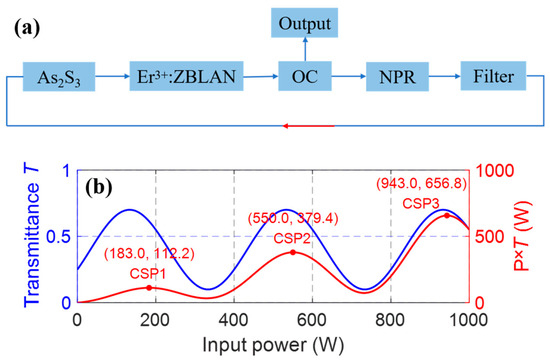
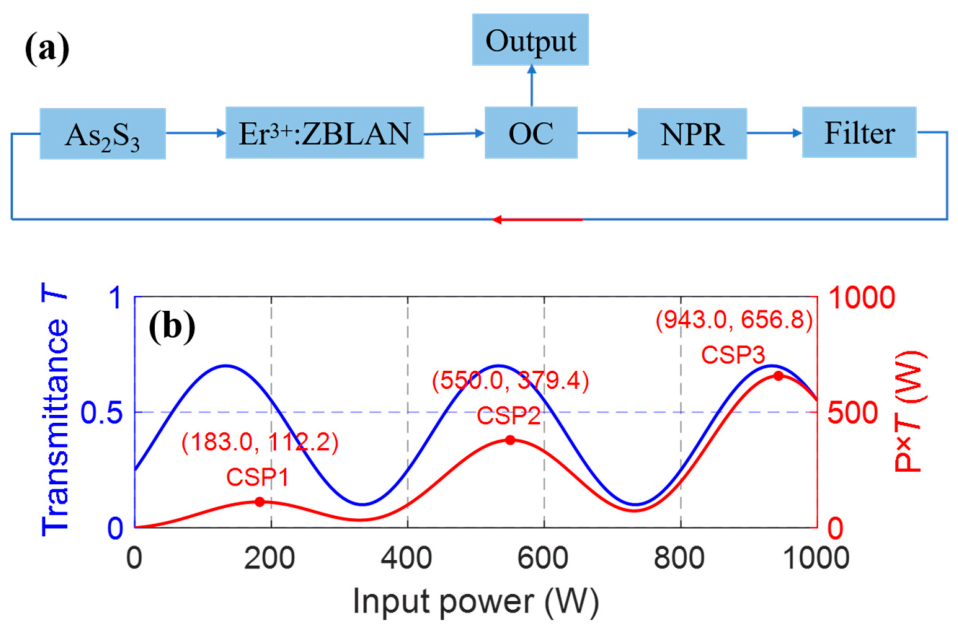
Figure 1a shows the schematic of the proposed Er3+: ZBLAN mode-locked fiber laser. The cavity consists of an Er3+: ZBLAN gain fiber (Le Verre Fluoré, Bruz, France), an As2S3 fiber, an output coupler (OC), an NPR-based SA, and a spectral filter. Pulse propagation in each fiber segment is modeled by the modified generalized nonlinear Schrödinger equation (GNLSE) [24,25],
where A(z, T) is the slowly varying pulse envelope in the temporal domain, z is the propagation distance, and T is the co-moving time in the pulse frame. ω0 is the central angular frequency, corresponding to 2792 nm. The terms β2 and β3 represent the second- and third-order GVD coefficients, while γ, g, and α0 denote nonlinearity, gain, and attenuation coefficients, respectively. For the As2S3 fiber, the gain g is zero, whereas for the Er3+: ZBLAN fiber, it is given by [24,26]:
where g0 is the small-signal gain coefficient determined by the doping concentration, and Esat is the gain saturation energy, which depends on the pump power in practical lasers [26]. To simplify the analysis, Esat is varied to emulate the pump-power scaling, while g0 is fixed at 3.45 m−1 in our simulations. Epulse is the pulse energy; ωg0 is the central angular frequency of the gain spectrum, and Δωg is the full-width at half-maximum (FWHM) gain bandwidth, corresponding to a bandwidth of 120 nm [14].
Figure 1.
(a) Schematic diagram of MIR DSR mode-locked Er3+: ZBLAN fiber laser. OC: output coupler; NPR: nonlinear polarization rotation. (b) The transmission curve of the NPR and its transmitted power.
The nonlinear response function R(t) includes both the Kerr and Raman contributions and is given by [11],
where fR represents the fractional contribution of the delayed Raman response, with values of 0.06 for Er3+: ZBLAN fiber [14] and 0.148 for As2S3 fiber [27]. The Raman response functions hR(t) for these two fibers are given by:
where ωp is the angular frequency of the pump pulse, n2 is the nonlinear refractive index, c is the speed of light in vacuum, gR(Ω) is the Raman gain spectrum, and Θ(t) is the Heaviside step function ensuring causality of the Raman response. Relevant parameters can be found in Ref. [14]. For Equation (5), τ1 = 23 fs and τ2 = 164.5 fs [27].
The sinusoidal transmission curve of the NPR-based SA is modeled as [28]
where R0 is the lowest transmissivity, dR is the modulation depth, P is the instantaneous pulse power, Psat is the saturation power of the SA, and ϕ is the phase delay. As shown in Figure 1b, the positive saturable absorption of the transmission curve means that transmission increases with the instantaneous power of the input pulse, whereas the reverse saturable absorption (RSA) means the opposite.
Moreover, the band-pass spectral filter is expressed as [29]:
where ωf0 and ∆ωf (corresponding to the wavelength bandwidth ∆λf) are the central angular frequency and FWHM bandwidth of the filter, respectively.
The initial simulation parameters are summarized in Table 1, where the dispersion, loss, and nonlinear coefficients of the Er3+: ZBLAN and As2S3 fibers were taken from Refs. [20,21], respectively. The net-cavity dispersion is about 0.716 ps2.
Table 1.
Cavity parameters in the simulations.
3. Numerical Results and Discussions
The GNLSE is solved using the split-step Fourier method. The simulation is initialized with a combination of Gaussian white noise and a weak 2 ps pulse (1 × 10⁻¹⁰ nJ) to accelerate convergence [30]. A stable mode-locked state is reached when the relative change in pulse energy remains below 10−9 for two successive roundtrips [31].
3.1. Generation of Stable DSR Pulses
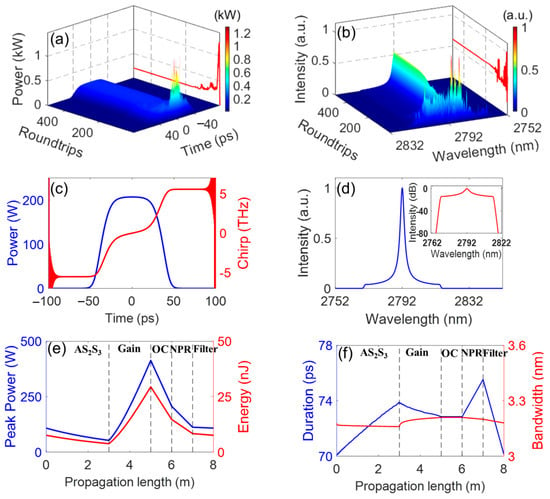
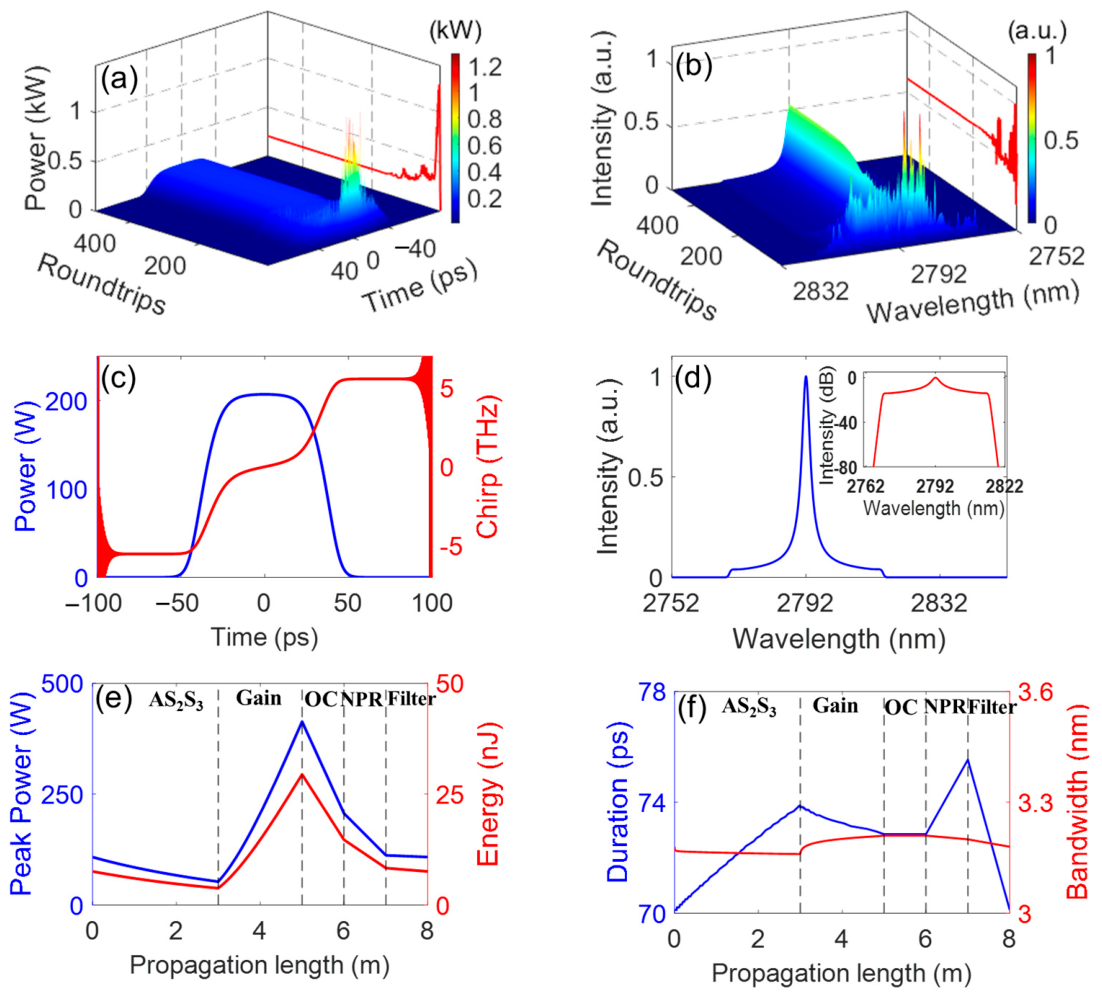
Figure 2 shows the build-up dynamics and steady-state characteristics of the DSR pulse obtained using the parameters listed in Table 1. Starting from the weak initial field, the intracavity optical field gradually evolves into a stable single-pulse state after approximately 200 roundtrips, as shown in the temporal and spectral evolution maps in Figure 2a,b. During this process, the initial noise field is first amplified in the gain fiber, resulting in a rapid increase in peak power. When the pulse peak power reaches the RSA region of the NPR-based SA, the high-intensity pulse center undergoes stronger nonlinear loss than the low-intensity wings. The PPC effect suppresses further peak-power growth and causes the additional intracavity energy to be accommodated mainly through temporal broadening. Consequently, the pulse evolves into a stable rectangular temporal waveform, as shown in Figure 2c.
Figure 2.
The generation of the DSR pulse in the net-normal-dispersion regime. (a) Temporal and (b) spectral evolutions over roundtrips, where the red lines represent the peak power in each roundtrip. (c) Temporal profile and corresponding frequency chirp. (d) Output spectrum on a linear scale; the inset shows the same spectrum on a logarithmic scale. (e) Intracavity evolution of peak power and pulse energy. (f) Intracavity evolution of pulse duration and 3 dB spectral bandwidth.
The steady-state pulse exhibits typical DSR characteristics in the normal-dispersion fiber lasers [26,28,32]. The temporal profile has a rectangular flat-top shape with steep edges, and the frequency chirp remains close to zero over most of the central plateau. The corresponding spectrum, shown in Figure 2d, is centered at 2792 nm and displays a smooth bell-shaped profile on a linear scale. On the logarithmic scale, it appears as a narrow triangular peak sitting on a broad temporal pedestal (inset in Figure 2d). In this case, the pulse has a peak power of 206.85 W, a duration of 72.15 ps, an energy of 14.73 nJ, and a 3 dB spectral bandwidth of 3.21 nm.
The intracavity evolution further clarifies the pulse-shaping mechanism, as summarized in Figure 2e,f. In the 3 m As2S3 fiber, the pulse undergoes slight temporal broadening from 70.12 to 73.88 ps because of the large normal GVD. Meanwhile, the peak power decreases from 107.5 to 52.9 W, mainly due to the 1 dB/m propagation loss, which gives an overall attenuation of approximately 3 dB. The pulse is then amplified in the Er3+: ZBLAN gain fiber, where the peak power increases from 53.0 to 413.7 W. At the same time, the anomalous dispersion of the gain fiber partly compensates for the chirp accumulated in the normal-dispersion segment, leading to a slight decrease in duration from 73.88 to 72.15 ps. After output coupling, the pulse entering the NPR-based SA has a peak power of 206.85 W, which lies within the first RSA region of the NPR transmission curve (Figure 1b). In this region, the pulse center experiences stronger nonlinear attenuation than the wings, leading to PPC. As a result, the peak power is reduced to 112.24 W after the SA, while the pulse duration slightly increases from 72.15 to 75.54 ps. This behavior confirms that the NPR-based SA provides the nonlinear loss mechanism required for DSR formation. The subsequent spectral filter only weakly reshapes the pulse because its 45 nm bandwidth is much broader than the 3 dB spectral bandwidth of ~3.2 nm of the DSR pulse. In addition, the intra-cavity energy evolution in Figure 2e closely tracks the peak power because the duration exhibits a relatively restricted variation range across the entire laser cavity, consistent with DSR dynamics observed in the near-infrared fiber lasers [33,34].
3.2. Influence of Key Cavity Parameters
3.2.1. Influence of Gain Saturation Energy
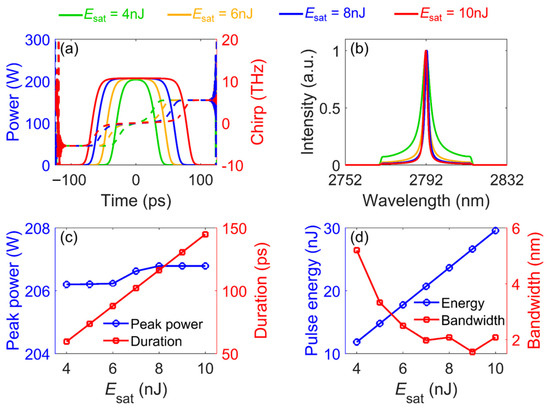
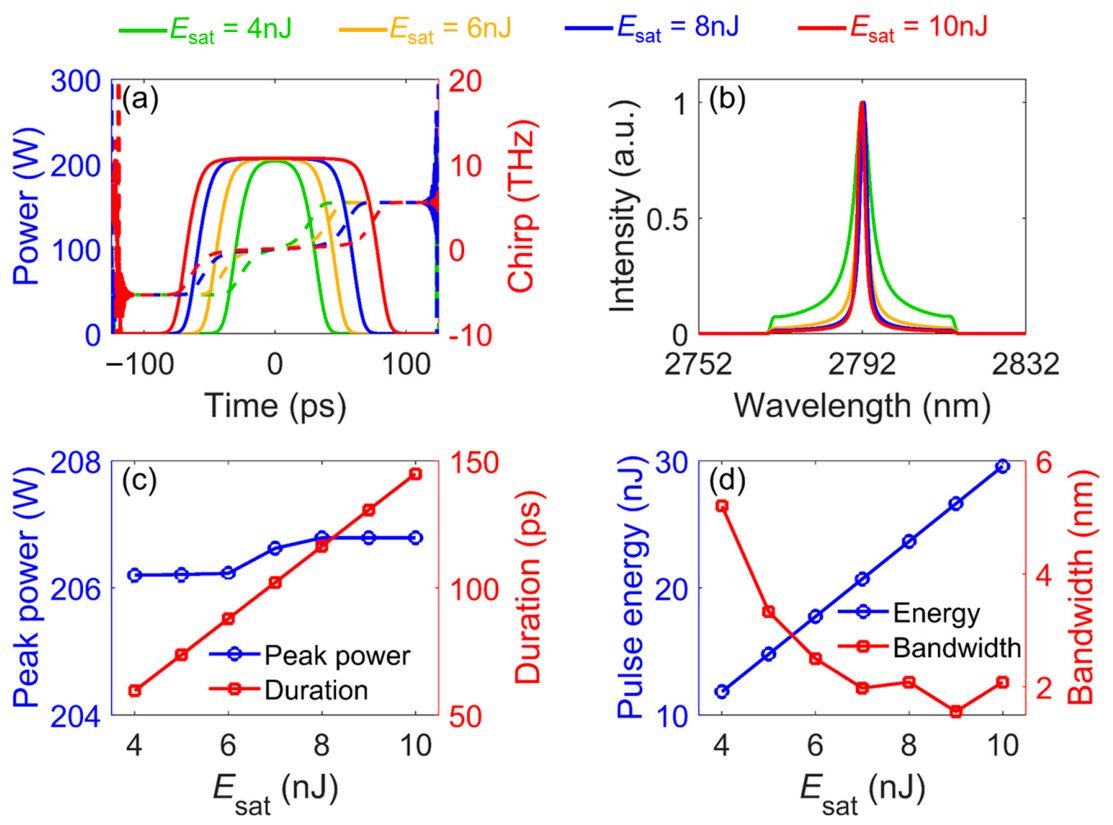
To evaluate pump-dependent energy scaling within the DSR regime, Esat was increased from 4 to 10 nJ while all other cavity parameters were fixed. As shown in Figure 3a, stable rectangular pulses are obtained over the investigated range, where the flat-top region of the pulse expands progressively, while the peak power remains almost constant. Quantitatively, the pulse duration broadens from 59.5 to 144.9 ps, and the peak power is clamped between 206.2 and 206.8 W (Figure 3a,c). As a result, the pulse energy increases almost linearly from 11.8 nJ to 29.6 nJ (Figure 3d). Moreover, the frequency chirp remains near-zero across the entire flat-top region. Together, these features further confirm the DSR operation in our proposed cavity, where additional gain is accommodated through temporal broadening rather than amplitude growth [16,26,33,35].
Figure 3.
Influence of gain saturation energy Esat on DSR pulse characteristics. (a) Temporal pulse profiles (solid lines) with corresponding frequency chirps (dash lines). (b) Normalized output spectra on a linear scale. (c) Pulse peak power and duration, and (d) pulse energy and 3 dB spectral bandwidth as functions of Esat.
In the spectral domain, the output spectra retain smooth bell-shaped profiles on a linear scale, and the 3 dB bandwidth decreases from 5.2 to 2.08 nm, as shown in Figure 3b,d. This spectral narrowing can be attributed to the continuous expansion of the near-zero-chirp flat-top temporal plateau. As the pulse becomes longer while its peak power remains clamped, a larger fraction of the pulse energy is concentrated near the central optical frequency, leading to a narrower 3 dB bandwidth [28].
These results confirm that Esat is the critical parameter governing DSR energy scaling in the proposed cavity. Owing to the PPC effect, increasing Esat mainly broadens the pulse duration rather than raising the peak power, indicating that higher-energy narrowband DSR pulses with tunable duration can be obtained simply by adjusting the pump power in practical operation.
3.2.2. Influence of Spectral Filter Bandwidth
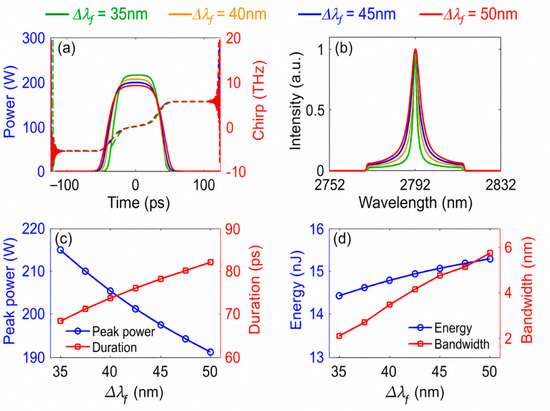
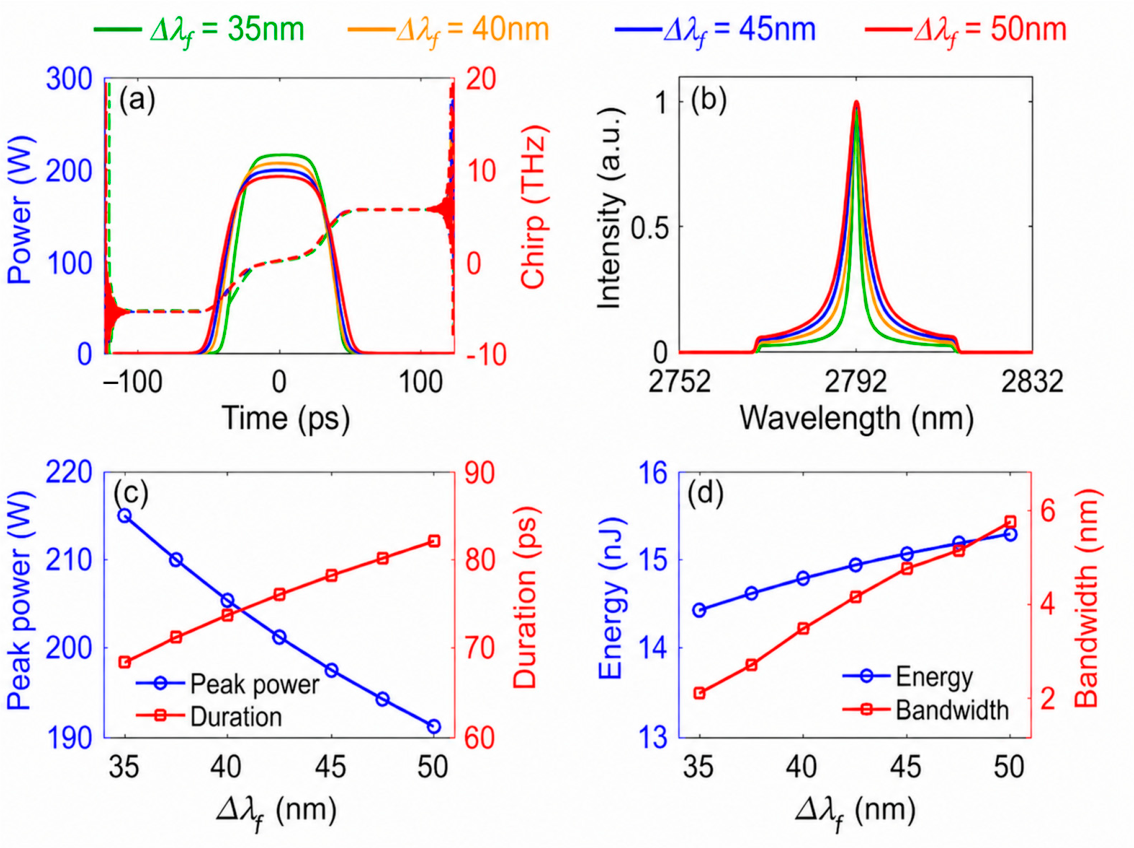
Spectral filtering provides an important linear loss mechanism for shaping and stabilizing pulses in dissipative laser cavities. To clarify its influence, the filter bandwidth Δλf was varied from 35 to 50 nm at Esat = 5 nJ, while all other cavity parameters were kept unchanged. As shown in Figure 4a, stable rectangular DSR pulses are maintained over this bandwidth range. With increasing Δλf, the pulse duration increases from 68.5 to 81.3 ps, whereas the peak power decreases from 215.0 to 191.3 W, as summarized in Figure 4c. This evolution indicates that broader filtering relaxes the spectral constraint imposed on the circulating pulse, allowing more spectral components to remain in the cavity. Correspondingly, the 3 dB spectral bandwidth increases from 1.9 to 5.8 nm, accompanied by a slight increase in pulse energy from 14.42 to 15.27 nJ, as shown in Figure 4b,d. In the net-normal-dispersion cavity, this broadened spectrum further increases the group-delay spread among different frequency components and shifts the steady-state dissipative balance toward a longer temporal waveform under the PPC effect.
Figure 4.
Influence of spectral filtering bandwidth Δλf on DSR pulse characteristics. (a) Temporal pulse profiles (solid lines) with corresponding frequency chirps (dash lines). (b) Normalized output spectra on a linear scale. (c) Pulse peak power and duration, and (d) pulse energy and 3 dB spectral bandwidth as functions of Δλf.
However, when Δλf is further increased to 54 nm, stable DSR operation can no longer be sustained. In this case, the filter provides insufficient spectral confinement for suppressing the SPM-induced spectral pedestal generated by the steep pulse edges. The nonlinear phase accumulation disturbs the dissipative balance among gain, loss, dispersion, nonlinearity, and NPR-induced peak-power clamping, eventually leading to pulse instability.
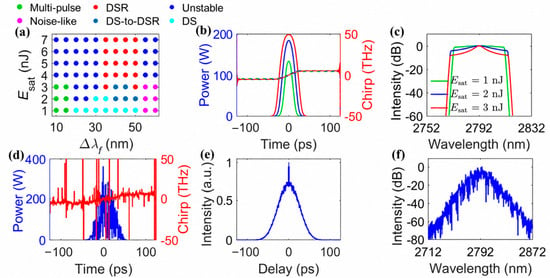
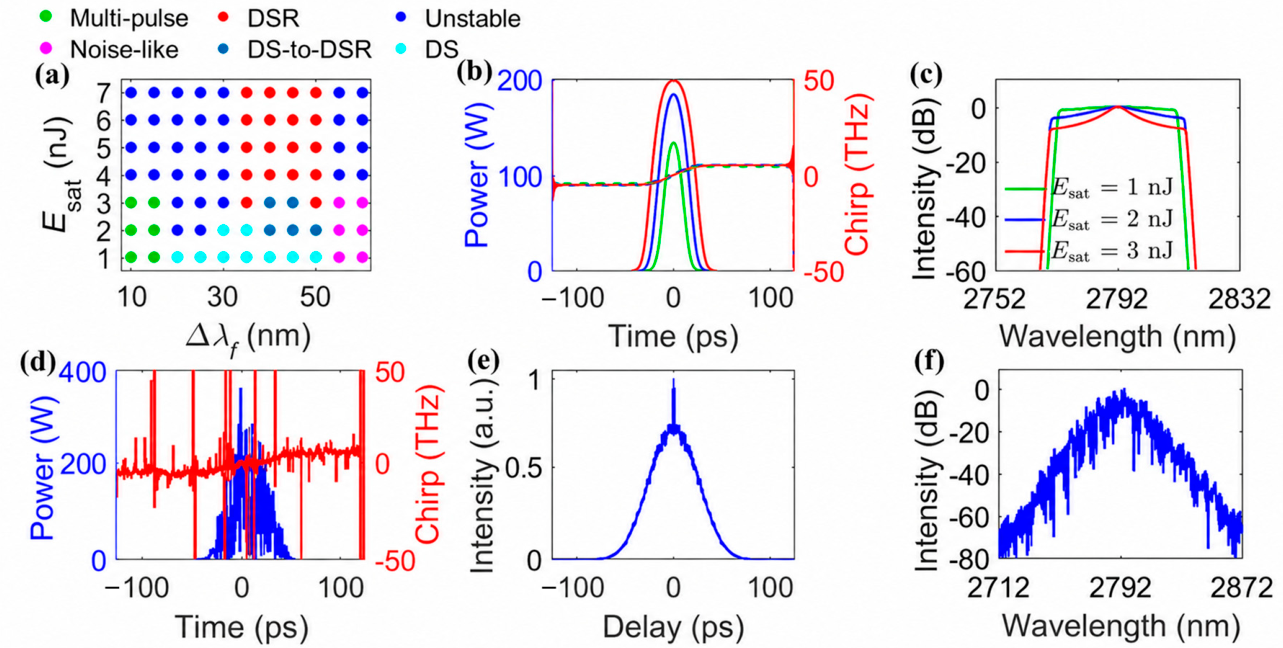
To further delineate the operating window for DSRs, the pulse states were mapped in the (Δλf, Esat) parameter space, as shown in Figure 5a. Within the filter bandwidth range of Δλf = 35–50 nm, increasing Esat drives a clear transition from a DS state to DSR operation due to the PPC effect of the SA. As shown in Figure 5b,c, the temporal profile evolves from a Gaussian-like pulse with a linear chirp into a rectangular flat-top waveform with a nearly chirp-free central plateau, while the spectrum changes from a cat-ear-like profile to a triangular DSR spectrum. This transition occurs because the increased gain raises the intracavity pulse energy until the NPR-based saturable absorber enters the effective PPC region. These behaviors are consistent with the DSR dynamics observed in near-infrared normal-dispersion fiber lasers [28]. At Esat = 2 nJ, the peak power at the OC output in the cavity is ~184.7 W, slightly higher than the first critical saturation power (CSP) of the SA (Figure 1b), indicating the onset of the DS-to-DSR transition.
Figure 5.
(a) Pulse-state distribution in the (Δλf, Esat) parameter space. Different colors denote distinct operation regimes. (b) Temporal profiles (solid lines) and corresponding frequency chirps (dash lines) illustrating the pump-induced transition from DS to DSR operation at Δλf = 40 nm. (c) Corresponding normalized output spectra. (d) Temporal profile with the chirp, (e) autocorrelation trace, and (f) output spectrum of the NLP obtained at Esat = 2 nJ, Δλf = 55 nm.
However, at low Esat, increasing Δλf beyond 50 nm leads to the generation of NLPs. The broadened filter weakens spectral confinement and allows nonlinear spectral components and stochastic sub-pulse structures to persist in the cavity. The temporal trace in Figure 5d shows fine structures with fluctuating intensities in the pulse envelope, while the autocorrelation trace in Figure 5e exhibits the double-scale structure characteristic of NLPs [36,37]. The corresponding spectrum in Figure 5f is broadened and modulated, further distinguishing this state from a coherent rectangular DSR pulse.
Therefore, stable MIR DSR operation requires both sufficient gain and appropriate spectral filtering: insufficient gain prevents PPC-supported flat-top pulse formation, whereas overly broad filtering permits excessive nonlinear phase accumulation and drives the cavity toward NLP or unstable operation. Meanwhile, increasing Δλf has an important influence on pulse-state transitions rather than on pulse-energy enhancement.
3.2.3. Influence of Output-Coupling Ratio
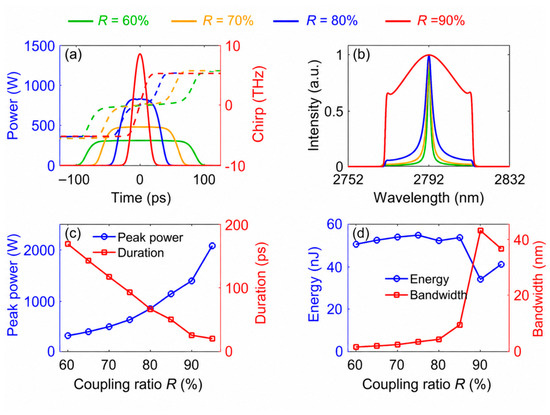
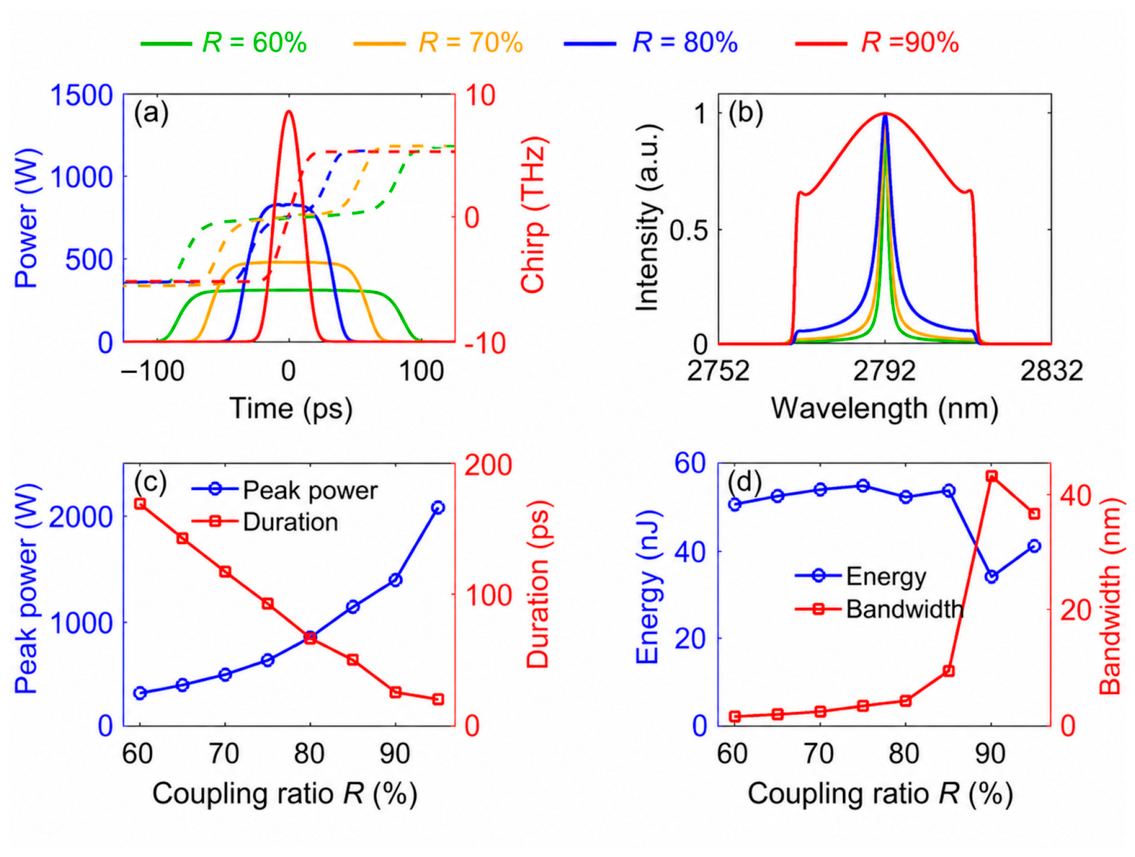
With Esat = 5 nJ and Δλf = 45 nm, the output-coupling ratio R was varied from 60% to 95%, while the other cavity parameters were kept constant. As shown in Figure 6a, increasing R gradually drives the pulse from a DSR state toward a DS state. The flat-topped temporal envelope progressively contracts, while a pronounced linear chirp develops across the central part of the pulse. Correspondingly, the pulse duration decreases from 167.5 to 19.1 ps, whereas the peak power increases from 303.9 to 2060.8 W, as shown in Figure 6c. This transition originates from the reduced residual intracavity field after stronger output extraction. As R increases, more energy is extracted at the OC, leaving a weaker circulating pulse for the next roundtrip. Consequently, the peak power incident on the NPR-based SA decreases from 202.6 to 108.5 W. When this value falls below the first CSP of the SA, PCSP = 183.0 W (Figure 1b), the pulse moves out of the effective PPC region and the PPC effect becomes insufficient to sustain DSR operation. Consequently, the cavity evolves from a broad flat-top DSR waveform toward a shorter, strongly chirped DS state, consistent with the DS–DSR transition discussed in Figure 5b,c. Within the DSR regime, the pulse energy slightly increases from 50.2 to 53.4 nJ, as shown in Figure 6d.
Figure 6.
Influence of output-coupling ratio R on DSR pulse characteristics. (a) Temporal pulse profiles (solid lines) with corresponding frequency chirps (dash lines). (b) Normalized output spectra on a linear scale. (c) Pulse peak power and duration, and (d) pulse energy and 3 dB spectral bandwidth as functions of R.
The spectral evolution further supports this regime transition. As shown in Figure 6b, the spectrum broadens and changes from a bell-shaped DSR profile to a cat-ear-like DS spectrum near the transition point at R = 90%. Meanwhile, the pulse energy rapidly drops from 53.4 to 33.6 nJ, as shown in Figure 6d. In the DS regime, further increasing R improves the output energy again because of the larger extraction fraction, while the reduced residual intracavity field weakens the SPM-induced spectral broadening.
These results show that R controls not only the extraction efficiency but also the pulse operation regime. A moderate R is favorable for high-energy DSR operation, whereas an excessively large R weakens peak-power clamping and drives the cavity toward DS-like operation under the same Esat value.
3.2.4. Influence of Parameters of the SA
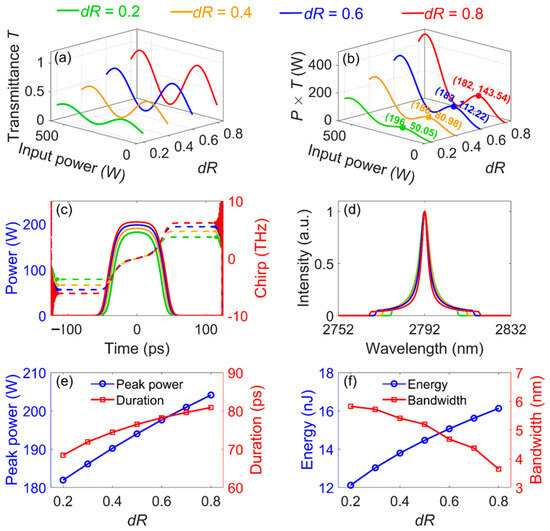
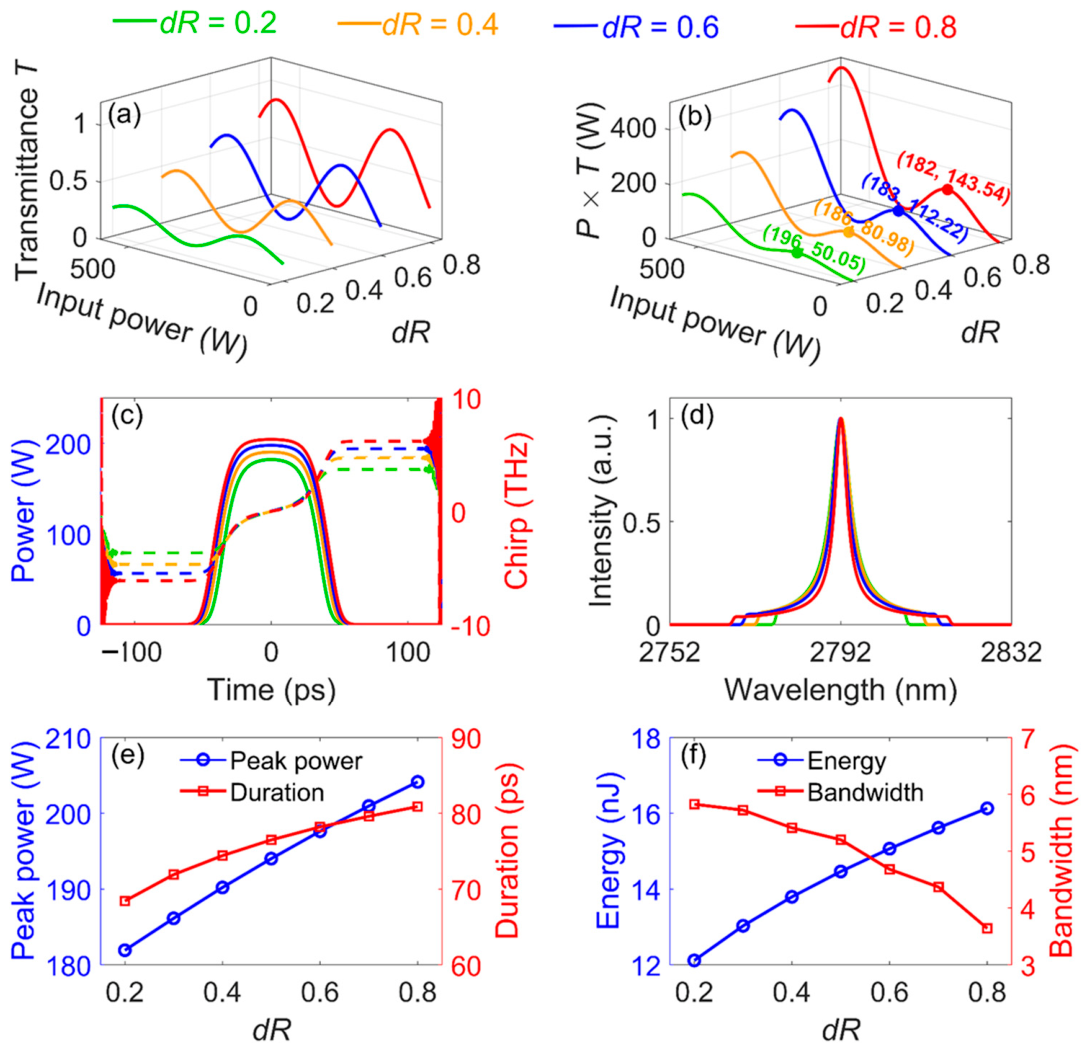
The parameters of the NPR-based SA determine the nonlinear transmission T and the transmitted power (P × T), therefore affecting the PPC condition required for DSR operation. Figure 7 shows the influence of the modulation depth dR, with Esat = 5 nJ, Δλf = 45 nm, and R = 50%, while the other cavity parameters are kept unchanged. As shown in Figure 7a,b, increasing dR from 0.2 to 0.8 enhances the modulation contrast of the NPR transmission curve, leading to a higher peak value of the transmitted-power curve. Meanwhile, the first CSP point shifts slightly to a lower input power level. Under these conditions, the laser maintains stable rectangular DSR operation. The peak power increases from 181.9 to 204.1 W, consistent with the higher transmitted powers, while the pulse duration broadens from 68.4 to 80.8 ps driven by the strengthened PPC effect (Figure 7c,e). This simultaneous increase in peak power and temporal width raises the pulse energy from 12.11 to 16.13 nJ (Figure 7f). Meanwhile, the 3 dB spectral bandwidth decreases from 5.82 to 3.64 nm, because the broadened, weakly chirped flat-top plateau confines more pulse energy near the central wavelength. In contrast, the low-intensity spectral pedestal broadens as the steeper temporal edges generate stronger SPM-induced frequency shifts (Figure 7d).
Figure 7.
Influence of modulation depth dR on DSR pulse characteristics. (a) NPR transmission curves for different dR. (b) Corresponding transmitted-power curves P × T. (c) Temporal pulse profiles (solid lines) with corresponding frequency chirps (dash lines). (d) Normalized output spectra on a linear scale. (e) Pulse peak power and duration, and (f) pulse energy and 3 dB spectral bandwidth as functions of dR.
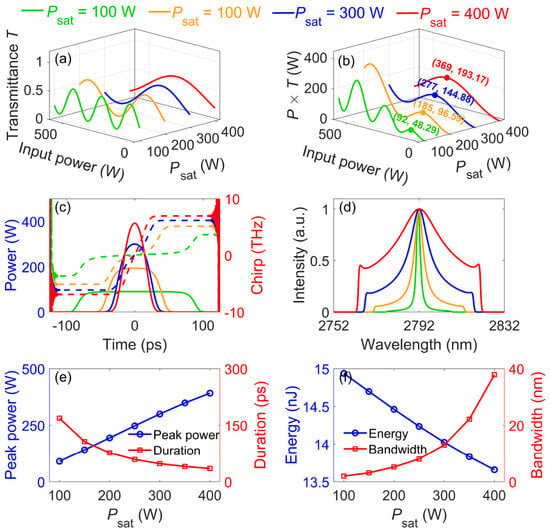
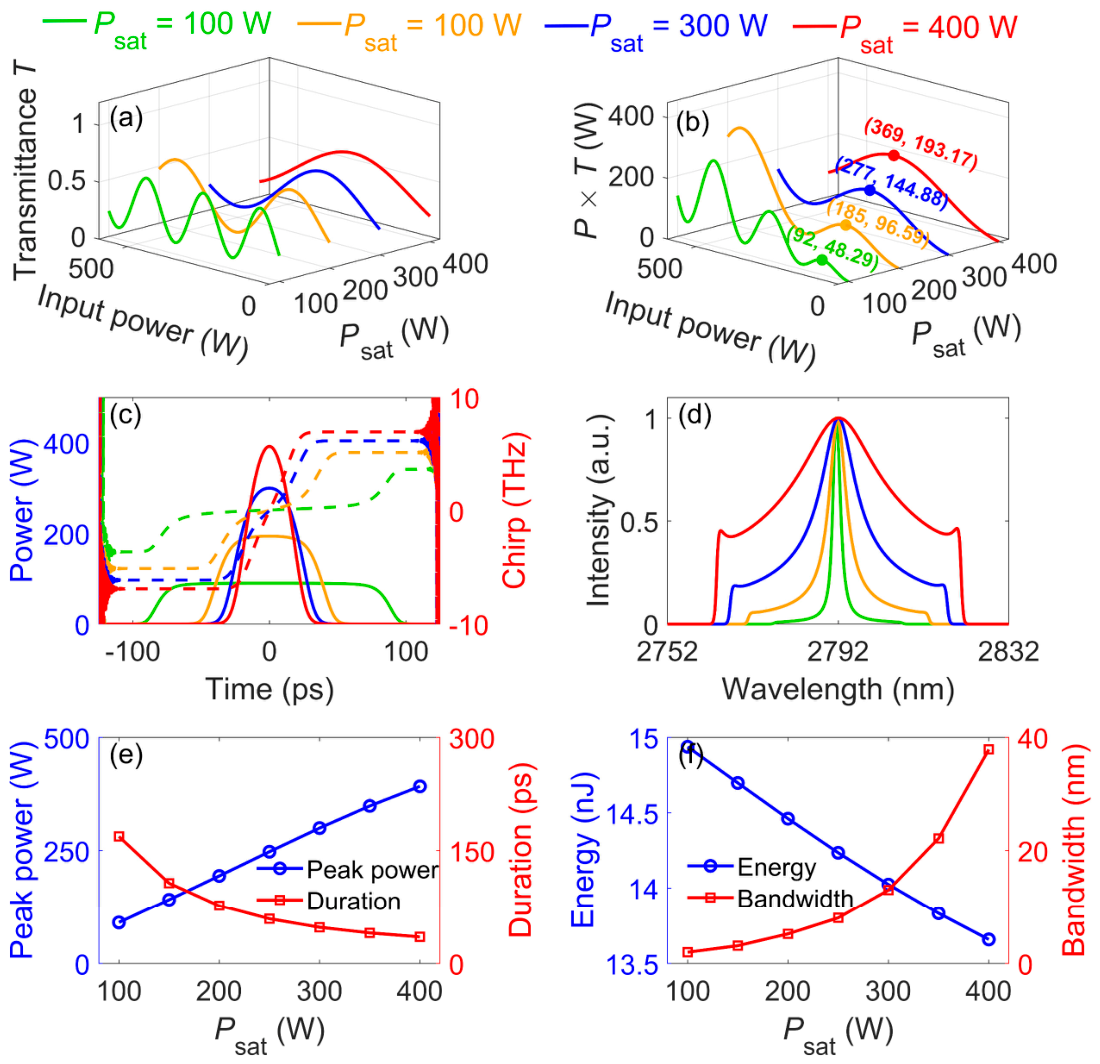
The effect of the saturation power Psat is shown in Figure 8, where dR = 0.5 and the other parameters remain fixed. As Psat increases from 100 to 400 W, the first CSP increases from 92 to 369 W, and the corresponding transmitted power increases from 48.29 to 193.17 W, as shown in Figure 8b. Therefore, the effective PPC region moves to a higher input-power level. To reach this region, the pulse evolves toward a higher peak power and a shorter duration. As shown in Figure 8c,e, the output peak power increases from 92.5 to 392 W, whereas the pulse duration decreases from 168.7 to 35.03 ps. This behavior indicates that increasing Psat weakens the PPC effect, and the pulse no longer stores energy mainly through temporal broadening, but shifts toward a shorter, higher-peak-power state. Correspondingly, the spectrum broadens rapidly, with the 3 dB bandwidth increasing from 1.97 to 34.8 nm, mainly because of stronger SPM induced by the higher peak power. The pulse energy changes only slightly, decreasing from 14.9 to 13.7 nJ, which indicates that Psat primarily controls the clamped peak-power level and pulse shape rather than directly enhancing the pulse energy.
Figure 8.
Influence of saturation power Psat on DSR pulse characteristics. (a) NPR transmission curves for different Psat. (b) Corresponding transmitted-power curves P × T. (c) Temporal pulse profiles (solid lines) with corresponding frequency chirps (dash lines). (d) Normalized output spectra on a linear scale. (e) Pulse peak power and duration, and (f) pulse energy and 3 dB spectral bandwidth as functions of Psat.
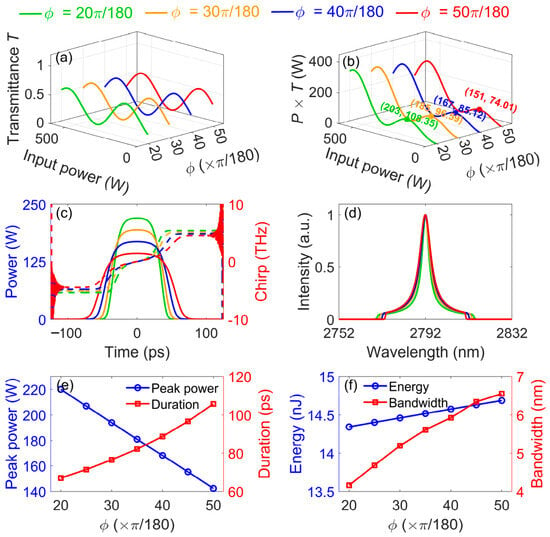
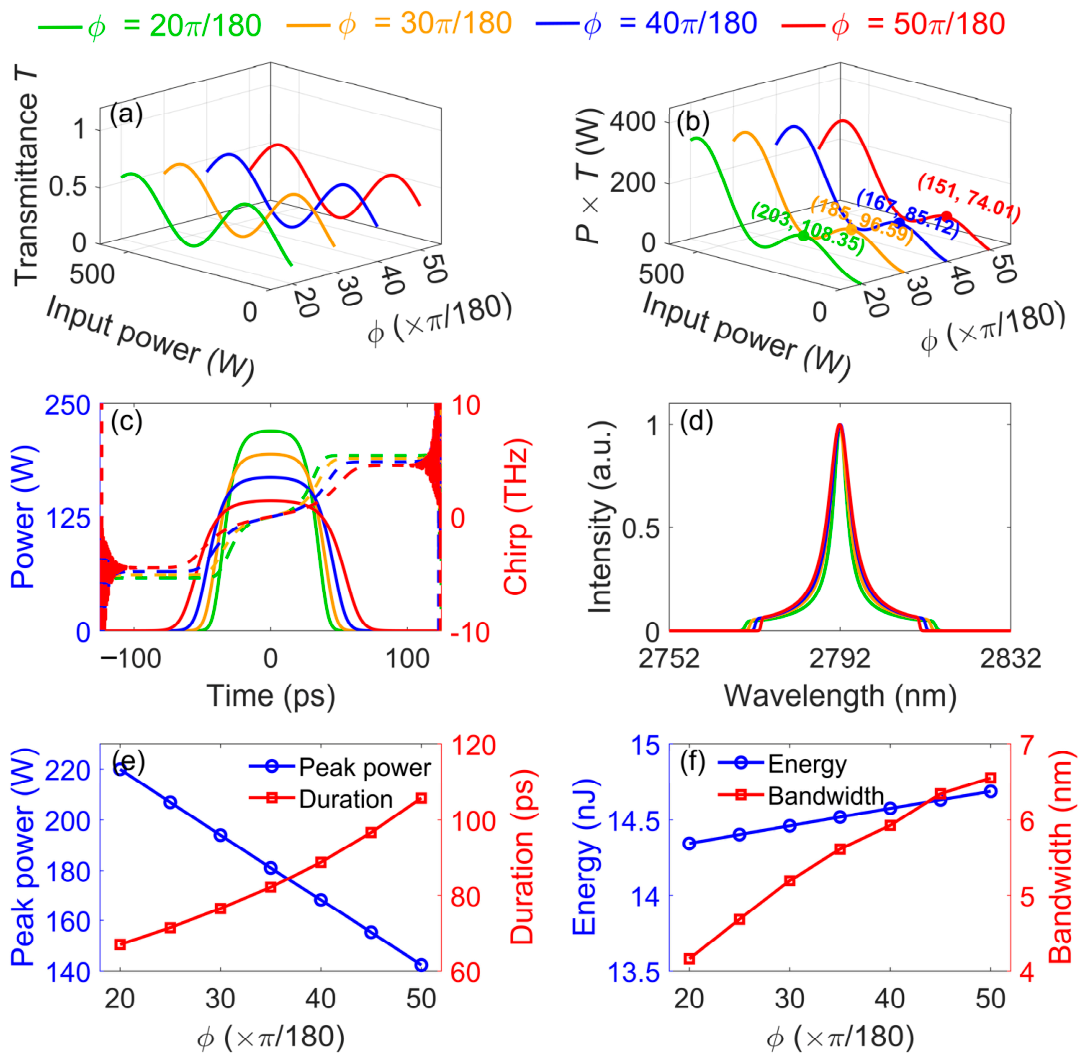
Figure 9 shows the influence of the phase delay ϕ at dR = 0.5 and Psat = 200 W. As ϕ increases from 20π/180 to 50π/180, the first CSP shifts from 203 to 151 W, while the maximum transmitted power decreases from 108.35 to 74.01 W, as shown in Figure 9b. As a result, the peak power is clamped at a lower level. The output peak power decreases from 220 to 142.4 W, whereas the pulse duration increases from 67.0 to 105.8 ps, as shown in Figure 9c,e. The pulse energy increases only slightly from 14.4 to 14.72 nJ, indicating that the reduced clamped peak power is mainly compensated by temporal broadening. Meanwhile, the 3 dB spectral bandwidth increases from 4.16 to 6.55 nm, accompanied by a gradual departure of the temporal top from an ideal flat plateau.
Figure 9.
Influence of phase delay ϕ on DSR pulse characteristics. (a) NPR transmission curves for different ϕ. (b) Corresponding transmitted-power curves P × T. (c) Temporal pulse profiles (solid lines) with corresponding frequency chirps (dash lines). (d) Normalized output spectra on a linear scale. (e) Pulse peak power and duration, and (f) pulse energy and 3 dB spectral bandwidth as functions of ϕ.
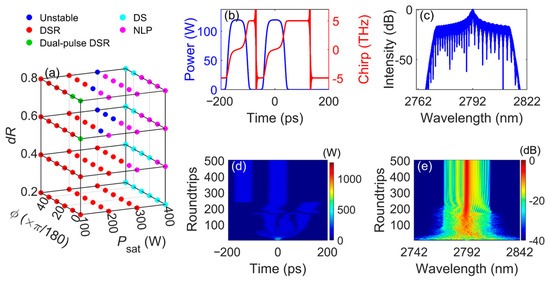
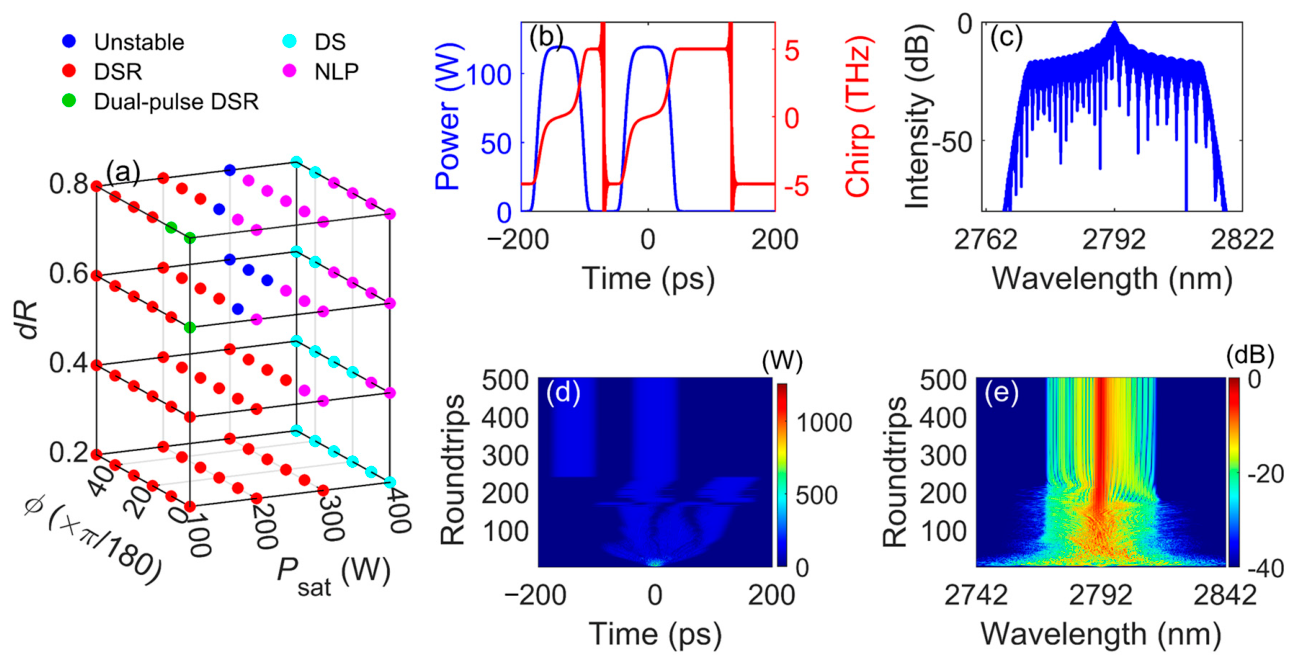
To further clarify the combined influence of the NPR-based SA parameters, the pulse-state distribution in the (dR, Psat, ϕ) parameter space is summarized in Figure 10a. When Psat exceeds 200 W, the stable DSR region shrinks rapidly within the selected parameter space, especially at larger dR. At low dR, increasing Psat shifts the CSP to a higher input-power level, and the cavity tends to operate in the DS regime under the same pump condition. However, at high dR, the stronger modulation contrast and the elevated transmitted power at large Psat allow higher local peak powers and short pulse components to circulate before effective clamping is established, leading to stronger nonlinear phase accumulation [11]. Once the peak powers enter the PPC region, additional intracavity gain is no longer converted into coherent flat-top broadening; instead, it is redistributed into fluctuating sub-pulses and background components, driving the cavity toward the NLP regime [28,36]. This PPC-assisted NLP formation is consistent with that observed in near-infrared normal-dispersion fiber lasers [28,36].
Figure 10.
Pulse-state distribution is governed by NPR-based SA parameters. (a) Pulse state distribution in the (dR, Psat, ϕ) parameter space. Blue, red, green, cyan, and magenta dots denote unstable, single-pulse DSR, dual-pulse DSR, DS, and NLP states, respectively. (b) Temporal profile and frequency chirp, (c) optical spectrum, (d) temporal evolution, and (e) spectral evolution of a representative dual-pulse DSR state obtained at dR = 0.8, Psat = 100 W, and ϕ = 10π/180.
Moreover, as ϕ decreases, dual-pulse DSR states are obtained for Psat =100 W, dR ≥ 0.6, and ϕ ≤ 10π/180. This specific parameter setting shifts the SA into an effective PPC regime at a relatively low intracavity peak power and provides strong nonlinear pulse discrimination. A representative case is shown in Figure 10b–e. Unlike previously reported multi-pulse DSR formation seeded by a pre-existing multi-pulse DS state [38], the dual-pulse DSR in this simulation emerges directly from a weak noise initial field. As shown in Figure 10d, the weak noise field first evolves into a broad rectangular wave packet with internal intensity modulations; subsequently, dynamic gain competition and PPC-induced nonlinear loss suppress the central temporal component, allowing the two outer components to gradually stabilize into two rectangular DSR pulses after approximately 240 roundtrips. The weak chirp across the central region of each pulse further supports its DSR nature, as shown in Figure 10b. The corresponding optical spectra in Figure 10c,e display pronounced, persistent interference fringes within an overall DSR-like spectral envelope over successive roundtrips. This feature suggests a bound-state-like dual-pulse DSR state with a fixed pulse separation, rather than simple energy-induced pulse splitting [38]. For other NPR settings, the PPC window is either too weak or mismatched with the intracavity peak-power level, so the cavity tends to evolve toward single-pulse DSR, DS, NLP, or unstable states rather than a dual-pulse DSR state.
Overall, high-energy single-pulse DSR operation requires an effective PPC window matched to the intracavity peak-power level. A mismatch of dR, Psat, and ϕ drives the laser toward DS, NLP, dual-pulse DSR, or unstable states. These results provide a practical parameter map for selecting NPR-based SA settings in future experimental implementations.
3.2.5. Influence of the As2S3 Fiber Length
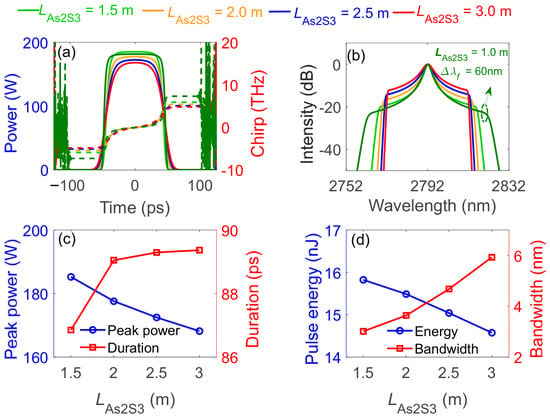
The As2S3 fiber length LAs2S3 is an important parameter because this segment simultaneously introduces large normal dispersion, strong nonlinearity, and propagation loss. To clarify its role in DSR formation, LAs2S3 was varied from 1.5 to 3 m while the other cavity parameters were fixed at Esat = 5 nJ, R = 0.5, Δλf = 45 nm, dR = 0.5, Psat = 200 W, and ϕ = 40π/180. As LAs2S3 is reduced from 3 to 1.5 m, the net cavity dispersion decreases from 0.716 to 0.275 ps2. Meanwhile, both the propagation loss and nonlinear phase accumulation introduced by the As2S3 fiber segment are reduced.
As shown in Figure 11a, the DSR pulse evolves toward a shorter and higher-power state with decreasing LAs2S3. The pulse duration decreases from 89.4 to 86.8 ps, while the peak power increases from 168.2 to 185.3 W, as summarized in Figure 11c. The pulse energy correspondingly increases from 14.6 to 15.9 nJ, mainly because the shorter As2S3 segment introduces lower propagation loss. At the same time, the temporal profile develops a flatter top and steeper edges, indicating weaker dispersive stretching and a stronger relative contribution of edge-induced nonlinear reshaping. Consistently, the 3 dB bandwidth narrows from 5.93 to 3.02 nm, while the low-intensity spectral pedestal becomes more pronounced, as shown in Figure 11b,d. For this reason, when LAs2S3 is reduced to 1.0 m, the original dissipative balance is no longer maintained under the same filtering condition due to pulse instability occurrence. Instead, a broader Δλf of 60 nm is required to achieve stable DSR operation, as plotted by dark-green traces in Figure 11a,b, where the DSR pulse exhibits a longer duration and broader spectral pedestal.
Figure 11.
Influence of As2S3 fiber length LAs2S3 on DSR pulse characteristics. (a) Temporal pulse profiles (solid lines) with corresponding frequency chirps (dash lines). The dark-green curve denotes the stable DSR case obtained at LAs2S3 = 1 m and Δλf = 60 nm. (b) Normalized output spectra on a logarithmic scale. (c) Pulse peak power and duration, and (d) pulse energy and 3 dB spectral bandwidth as functions of LAs2S3.
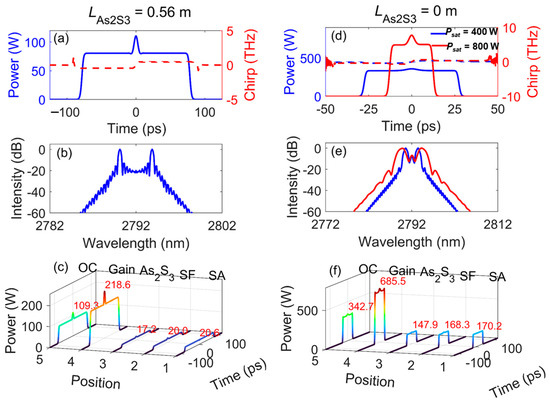
When LAs2S3 is further reduced to 0.56 m, the net cavity dispersion approaches zero, with a value of −0.0014 ps2. Under the parameter set Esat = 5 nJ, R = 0.5, Δλf = 5 nm, dR = 0.2, Psat = 100 W, and ϕ = 40π/180, a stable DSR pulse can still be obtained. However, its temporal and spectral characteristics differ markedly from those of the flat-top DSR pulse in the net-normal-dispersion regime. As shown in Figure 12a, the pulse exhibits a narrow central spike sitting on a broad rectangular pedestal. This spike-on-pedestal structure arises from localized temporal compression in the Er3+:ZBLAN gain fiber, where anomalous dispersion compensates the positive chirp accumulated in the As2S3 fiber together with the SPM-induced nonlinear chirp [39]. The intracavity evolution in Figure 12c supports this interpretation. After the pulse passes through the NPR-based SA, the high-intensity central spike experiences stronger nonlinear loss than the pedestal due to the PPC effect; but when it sequentially transmits through the anomalous-dispersion Er3+: ZBLAN fiber, the central peak is compressed and presents a higher peak power. Meanwhile, the spectrum evolves into a double-peak structure due to the strong SPM effect [39], as shown in Figure 12b. These characteristics are consistent with those of DSRs in anomalous dispersion cavities [39,40,41]. It should be noted that DSR operation near the zero-dispersion boundary is highly sensitive to the cavity parameters, in agreement with previous numerical studies showing that DSR solutions exist only within a narrow stability domain [18].
Figure 12.
DSR pulse characteristics near the near-zero-dispersion and in the anomalous-dispersion cavity. (a) Temporal pulse profile (solid lines) with corresponding frequency chirps (dash lines), (b) output spectrum, and (c) intracavity temporal evolution at Esat = 5 nJ, R = 0.5, Δλf = 5 nm, dR = 0.2, Psat = 100 W, ϕ = 40π/180, and LAs2S3 = 0.56 m, corresponding to a near-zero net-cavity dispersion. (d) Temporal pulse profile (solid lines) with corresponding frequency chirps (dash lines), (e) output spectrum, and (f) intracavity temporal evolution at Esat = 5 nJ, R = 0.5, Δλf = 10 nm, dR = 0.5, ϕ = 40π/180, LAs2S3 = 0 m, and Psat = 400 and 800 W, respectively.
When the As2S3 fiber is completely removed, the cavity operates in an all-anomalous-dispersion regime dominated by the Er3+: ZBLAN fiber. In this case, the constraints on DSR formation become less stringent than near the zero-dispersion boundary [18]. For example, stable DSR pulses are obtained over a broad Psat range from 400 to 800 W under Esat = 5 nJ, R = 0.5, Δλf = 10 nm, dR = 0.5, and ϕ = 40π/180, as shown in Figure 12d–f. Increasing Psat shifts the effective PPC region to a higher power level, allowing the pulse to sustain a higher central spike and a shorter temporal duration. As a result, the dual-peak spectrum broadens due to the enhanced SPM effect, as shown in Figure 12e. The intracavity evolution in Figure 12f follows the same qualitative trend as the near-zero-dispersion case in Figure 12c, where anomalous dispersion and SPM tend to generate a localized high-intensity spike, while the NPR-based SA limits its growth through RSA.
Therefore, tailoring LAs2S3 enables controlled access to DSR pulses with different temporal structures and single- or dual-peak spectral profiles across net-normal, near-zero, and anomalous-dispersion regimes. These results further extend MIR DSR dynamics beyond the previously studied anomalous-dispersion cavity [20].
3.3. Realization of High-Energy DSR Pulse
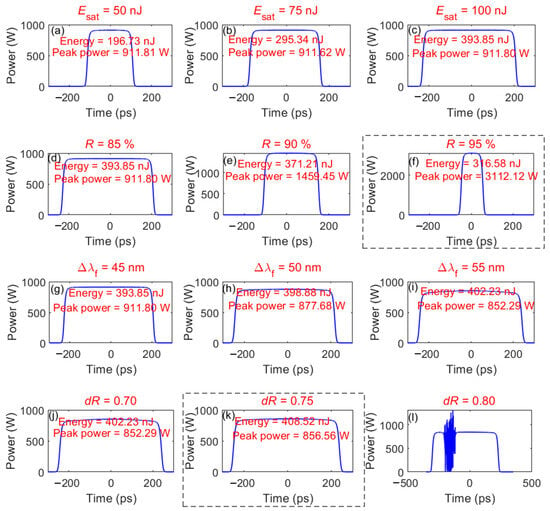
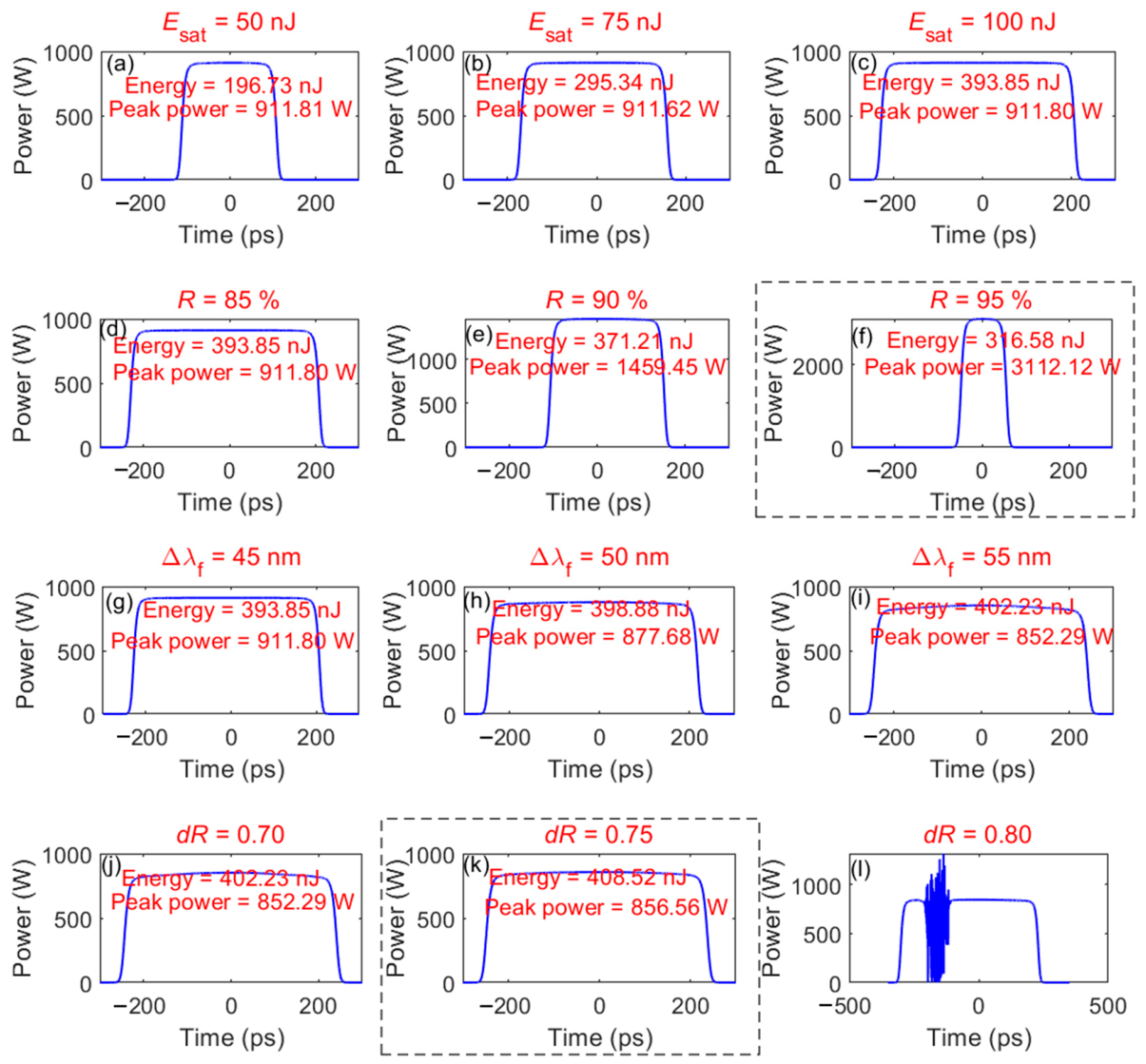
Based on the parameter analysis in Section 3.2, Esat was identified as the dominant parameter for increasing the single-pulse energy. Since the preceding simulations were mainly performed at a relatively low Esat of 5 nJ, Esat was further increased to 50–100 nJ to examine whether the DSR energy-scaling mechanism could be maintained at higher gain levels. The other parameters were initially set to R = 0.85, Δλf = 45 nm, dR = 0.7, Psat = 200 W, ϕ = 50π/180, and LAs2S3 = 2 m to favor pulse-energy improvement within the stable DSR region.
As shown in Figure 13a–c, the pulse maintains a stable rectangular temporal profile as Esat increases, while the peak power remains nearly clamped at ~911 W. Accordingly, the pulse energy increases from 196.73 to 393.85 nJ. These results clearly demonstrate that the DSR pulse energy can be continuously scaled with increasing Esat, while preserving stable single-pulse operation.
Figure 13.
Optimization process for high-energy DSR pulse generation. (a–c) Output temporal profiles of DSR pulses for different Esat. (d–f) Output temporal profiles for different R. (g–i) Output temporal profiles for different Δλf. (j–l) Output temporal profiles for different dR.
With Esat fixed at 100 nJ, R, Δλf, and dR were then optimized to improve the output performance. As shown in Figure 13d–f, increasing R from 85% to 95% raises the peak power from 911.8 to 3112.1 W, whereas the pulse energy decreases from 393.85 to 316.58 nJ due to the faster narrowing of the pulse duration. Therefore, R = 85% is more favorable for achieving high-energy DSR pulses, whereas R = 95% enables higher peak-power extraction. This result indicates that the output-coupling ratio provides an effective degree of freedom for balancing pulse-energy scaling and peak-power enhancement.
Subsequently, Δλf and dR were further adjusted to achieve the high-energy DSR state. By optimizing these two parameters, the maximum output energy of 408.52 nJ is obtained at Δλf = 55 nm and dR = 0.75, as shown in Figure 13k. Further increasing dR to 0.8 leads to pulse instability, as shown in Figure 13l. These results indicate that, with an appropriate dR, stable high-energy DSR pulses can be maintained over a finite parameter range of Esat, Δλf, and R, rather than only at a single isolated point, confirming the robustness of the optimized solution against parameter perturbations. Compared with the previously reported 2.8 µm DSR pulse in an all-anomalous-dispersion Er3+:ZBLAN cavity, which required a 0.5 nm spectral filter and produced 120.54-nJ pulses [20], the proposed net-normal-dispersion cavity supports higher pulse energy under a much broader 55 nm filter bandwidth. This cavity design relaxes the stringent narrow-band filtering requirement for experimental realization of MIR DSR sources.
In addition, regarding practical implementation, the mode-field mismatch and large refractive index contrast between Er3+: ZBLAN and As2S3 fibers will inevitably introduce localized insertion losses at the butt-coupled interface [21,22,23]. While the exact loss depends on the specific coupling geometry, typical values for butt-coupled fluoride–chalcogenide fiber interfaces are estimated to be several dB. For example, an insertion loss of 1.87 dB has been reported for an optimized Er3+: ZBLAN-to-As2S3-PC hybrid micro-taper butt-coupled interface [22]. Consequently, this elevated cavity loss raises the mode-locking threshold, requiring a higher pump power (i.e., a larger Esat) to reach the PPC condition necessary for stable DSR operation. Nevertheless, as demonstrated in recent cascaded mid-infrared supercontinuum systems, the reliability of such heterogeneous interfaces can be significantly improved through careful end-face preparation (e.g., angle-cleaving or index-matching fluid), optimized coupling distance, and proper environmental sealing [22,23].
4. Conclusions
In this work, we numerically demonstrated, for the first time, high-energy DSRs in a net-normal-dispersion Er3+: ZBLAN mode-locked fiber laser operating at 2.8 µm. By introducing an As2S3 fiber segment, the cavity dispersion and nonlinear phase accumulation were effectively managed, enabling stable rectangular DSR pulse formation through the NPR-induced PPC effect. The generated DSR pulses exhibit typical flat-top temporal profiles, nearly chirp-free central plateaus, and smooth bell-shaped spectra.
Systematic parameter investigations show that the gain saturation energy is the dominant factor for pulse-energy scaling, as additional gain is mainly converted into temporal broadening rather than peak-power growth. The output-coupling ratio controls the balance between energy extraction and peak-power enhancement, while the spectral filter bandwidth and NPR-based saturable absorber parameters determine the stability window of DSR pulses and mediate transitions among DS, DSR, NLP, multi-pulse, and unstable states. In addition, tuning theAs2S3 fiber length enables access to DSR dynamics across net-normal-, near-zero-, and anomalous-dispersion regimes, where distinct temporal and spectral structures are observed.
Through coordinated cavity optimization, a stable rectangular DSR pulse with a maximum energy of 408.52 nJ was achieved under a broad filter bandwidth of 55 nm, significantly relaxing the stringent sub-nanometer filtering requirement reported in previous anomalous-dispersion MIR DSR designs. In addition, a high-peak-power DSR pulse with a peak power of 3112.12 W was also achieved at R = 95%, revealing a trade-off between maximum pulse energy and peak-power extraction.
These results provide deeper insight into DSR dynamics and offer practical numerical guidance for designing compact, high-energy ultrafast MIR fiber sources around 2.8 µm.
Author Contributions
Conceptualization, J.L.; methodology, J.L.; software, S.T.; validation, S.T.; formal analysis, S.C.; investigation, J.L.; resources, F.X.; data curation, J.L.; writing—original draft preparation, J.L.; writing—review and editing, J.L.; visualization, S.T.; supervision, X.T.; project administration, L.D.; funding acquisition, L.D. All authors have read and agreed to the published version of the manuscript.
Funding
This research was funded by the Strategic Priority Research Program of the Chinese Academy of Sciences (No. XDB0650000).
Institutional Review Board Statement
Not applicable.
Informed Consent Statement
Not applicable.
Data Availability Statement
The data in this study are available upon request.
Conflicts of Interest
The authors declare no conflict of interest.
References
- Zhang, Y.; Wu, K.; Guang, Z.; Guo, B.; Qiao, D.; Wei, Z.; Yang, H.; Wang, Q.; Li, K.; Copner, N.; et al. Advances and Challenges of Ultrafast Fiber Lasers in 2–4 μm Mid-Infrared Spectral Regions. Laser Photonics Rev. 2024, 18, 2300786. [Google Scholar] [CrossRef] [Scilit]
- Amini-Nik, S.; Kraemer, D.; Cowan, M.L.; Gunaratne, K.; Nadesan, P.; Alman, B.A.; Miller, R.J.D. Ultrafast Mid-IR Laser Scalpel: Protein Signals of the Fundamental Limits to Minimally Invasive Surgery. PLoS ONE 2010, 5, e13053. [Google Scholar] [CrossRef] [Scilit] [PubMed]
- Mandon, J.; Guelachvili, G.; Picqué, N. Fourier Transform Spectroscopy with a Laser Frequency Comb. Nat. Photonics 2009, 3, 99–102. [Google Scholar] [CrossRef] [Scilit]
- Duval, S.; Bernier, M.; Fortin, V.; Genest, J.; Piché, M.; Vallée, R. Femtosecond Fiber Lasers Reach the Mid-Infrared. Optica 2015, 2, 623–626. [Google Scholar] [CrossRef] [Scilit]
- Antipov, S.; Hudson, D.D.; Fuerbach, A.; Jackson, S.D. High-Power Mid-Infrared Femtosecond Fiber Laser in the Water Vapor Transmission Window. Optica 2016, 3, 1373–1376. [Google Scholar] [CrossRef] [Scilit]
- Yu, L.; Tang, Z.; Zeng, Q.; Li, Z.; Wang, J.; Wang, J.; Luo, X.; Yan, P.; Dong, F.; Liu, X.; et al. Spatiotemporal Mode-Locking in a Linear-Cavity Er:ZBLAN Fiber Laser. J. Light. Technol. 2024, 42, 4966–4971. [Google Scholar] [CrossRef] [Scilit]
- Yu, L.; Tang, Z.; Liang, J.; Zeng, Q.; Wang, J.; Luo, X.; Wang, J.; Yan, P.; Dong, F.; Liu, X.; et al. High-Energy Femtosecond Pulse Generation from a Hybrid Mode-Locked Large-Mode-Area Er:ZBLAN Fiber Laser. Opt. Lett. 2023, 48, 1830–1833. [Google Scholar] [CrossRef] [Scilit] [PubMed]
- Gu, H.; Qin, Z.; Xie, G.; Hai, T.; Yuan, P.; Ma, J.; Qian, L. Generation of 131 fs Mode-Locked Pulses from 2.8 μm Er:ZBLAN Fiber Laser. Chin. Opt. Lett. 2020, 18, 031402. [Google Scholar] [CrossRef] [Scilit]
- Qin, Z.; Xie, G.; Ma, J.; Yuan, P.; Qian, L. 2.8 μm All-Fiber Q-Switched and Mode-Locked Lasers with Black Phosphorus. Photonics Res. 2018, 6, 1074–1078. [Google Scholar] [CrossRef] [Scilit]
- Chen, Y.; Zhou, Y.; Qin, Z.; Xie, G.; Yuan, P.; Ma, J.; Qian, L. Spatiotemporally Mode-Locked Soliton Fiber Laser at 2.8 μm. High Power Laser Sci. Eng. 2023, 11, e59. [Google Scholar] [CrossRef] [Scilit]
- Agrawal, G.P. Nonlinear Fiber Optics. In Nonlinear Science at the Dawn of the 21st Century; Lecture Notes in Physics; Springer: Berlin/Heidelberg, Germany, 2000; Volume 542, pp. 195–211. [Google Scholar] [CrossRef] [Scilit]
- Normani, S.; Idlahcen, S.; Loiko, P.; Hatim, S.; Hanzard, P.-H.; De Paula, A.R.; Guillemot, L.; Godin, T.; Berthelot, T.; Cozic, S.; et al. 2.8-μm Polarization-Maintaining Er Fiber Laser Mode-Locked by a GaSb-Based SESAM. Opt. Express 2024, 32, 15106–15118. [Google Scholar] [CrossRef] [Scilit] [PubMed]
- Qin, Z.; Xie, G.; Gu, H.; Hai, T.; Yuan, P.; Ma, J.; Qian, L. Mode-Locked 2.8-μm Fluoride Fiber Laser: From Soliton to Breathing Pulse. Adv. Photonics 2019, 1, 065001. [Google Scholar] [CrossRef] [Scilit]
- Dong, Y.; Liang, W.; Xiao, X.; Xiao, Y.; He, W.; Chen, S.; Yan, L.; Wang, C.; Guo, H. Numerical Study of High-Energy Dissipative Soliton Generation in a 2.8 μm Mid-Infrared Ultrafast Fiber Laser. Chaos Solitons Fractals 2026, 206, 117988. [Google Scholar] [CrossRef] [Scilit]
- Wise, F.W.; Chong, A.; Renninger, W.H. High-energy Femtosecond Fiber Lasers Based on Pulse Propagation at Normal Dispersion. Laser Photonics Rev. 2008, 2, 58–73. [Google Scholar] [CrossRef] [Scilit]
- Chang, W.; Ankiewicz, A.; Soto-Crespo, J.M.; Akhmediev, N. Dissipative Soliton Resonances. Phys. Rev. A 2008, 78, 023830. [Google Scholar] [CrossRef] [Scilit]
- Krzempek, K.; Abramski, K. Dissipative Soliton Resonance Mode-Locked Double Clad Er:Yb Laser at Different Values of Anomalous Dispersion. Opt. Express 2016, 24, 22379–22386. [Google Scholar] [CrossRef] [Scilit] [PubMed]
- Grelu, P.; Chang, W.; Ankiewicz, A.; Soto-Crespo, J.M.; Akhmediev, N. Dissipative Soliton Resonance as a Guideline for High-Energy Pulse Laser Oscillators. J. Opt. Soc. Am. B 2010, 27, 2336–2341. [Google Scholar] [CrossRef] [Scilit]
- Zhou, J.; Qi, W.; Pan, W.; Feng, Y. Dissipative Soliton Generation from a Large Anomalous Dispersion Ytterbium-Doped Fiber Laser. Opt. Lett. 2020, 45, 5768–5771. [Google Scholar] [CrossRef] [Scilit] [PubMed]
- Dong, Y.; Liang, W.; Xiao, X.; Xiao, Y.; He, W.; Chen, S.; Yan, L.; Guo, H. High-Energy Dissipative Soliton Resonance at 2.8 μm: Theoretical Demonstration and Optimization in an Er3+:ZBLAN Mode-Locked Fiber Laser. Opt. Laser Technol. 2026, 199, 114995. [Google Scholar] [CrossRef] [Scilit]
- Woodward, R.I.; Hudson, D.D.; Fuerbach, A.; Jackson, S.D. Generation of 70-fs Pulses at 2.86 μm from a Mid-Infrared Fiber Laser. Opt. Lett. 2017, 42, 4893–4896. [Google Scholar] [CrossRef] [Scilit] [PubMed]
- Shamim, M.H.M.; Alamgir, I.; Rochette, M. Broadband All-Fiber Mid-Infrared Supercontinuum Generation in an As2S3-Polycarbonate Hybrid Microtaper. J. Phys. Photonics 2025, 7, 025013. [Google Scholar] [CrossRef] [Scilit]
- Yan, B.; Huang, T.; Zhang, W.; Wang, J.; Yang, L.; Yang, P.; Xia, K.; Bai, S.; Zhao, R.; Wu, D.; et al. Generation of Watt-Level Supercontinuum Covering 2-6.5 μm in an All-Fiber Structured Infrared Nonlinear Transmission System. Opt. Express 2021, 29, 4048–4057. [Google Scholar] [CrossRef] [Scilit] [PubMed]
- Oktem, B.; Ülgüdür, C.; Ilday, F.Ö. Soliton–Similariton Fibre Laser. Nat. Photonics 2010, 4, 307–311. [Google Scholar] [CrossRef] [Scilit]
- Chong, A.; Renninger, W.H.; Wise, F.W. Properties of Normal-Dispersion Femtosecond Fiber Lasers. J. Opt. Soc. Am. B 2008, 25, 140–148. [Google Scholar] [CrossRef] [Scilit]
- Li, X.; Huang, X.; Chen, E.; Zhou, Y.; Han, Y. Dissipative-Soliton-Resonance and Evolution in an All-Normal Dispersion Er-Doped Fiber Laser. Opt. Laser Technol. 2022, 156, 108592. [Google Scholar] [CrossRef] [Scilit]
- Liu, L.; Cheng, T.; Nagasaka, K.; Tong, H.; Qin, G.; Suzuki, T.; Ohishi, Y. Coherent Mid-Infrared Supercontinuum Generation in All-Solid Chalcogenide Microstructured Fibers with All-Normal Dispersion. Opt. Lett. 2016, 41, 392–395. [Google Scholar] [CrossRef] [Scilit] [PubMed]
- Cheng, Z.; Li, H.; Wang, P. Simulation of Generation of Dissipative Soliton, Dissipative Soliton Resonance and Noise-like Pulse in Yb-Doped Mode-Locked Fiber Lasers. Opt. Express 2015, 23, 5972–5981. [Google Scholar] [CrossRef] [Scilit] [PubMed]
- Wen, Z.; Lu, B.; Qi, X.; Zhang, C.; Wang, K.; Chen, H.; Bai, J. Effects of Spectral Filtering on Pulse Dynamics in a Mode-Locked Fiber Laser with a Bandwidth Tunable Filter. J. Opt. Soc. Am. B 2019, 36, 952–961. [Google Scholar] [CrossRef] [Scilit]
- Cai, J.-H.; Chen, H.; Chen, S.-P.; Hou, J. State Distributions in Two-Dimensional Parameter Spaces of a Nonlinear Optical Loop Mirror-Based, Mode-Locked, All-Normal-Dispersion Fiber Laser. Opt. Express 2017, 25, 4414–4423. [Google Scholar] [CrossRef] [Scilit] [PubMed]
- Wang, J.; Kong, J.; Liu, Z.; Lin, N.; Liu, S.; Ma, X. Impact of SESAM Modulation Depth and Spectral Filtering on Picosecond Fiber Laser Stability. Opt. Laser Technol. 2025, 183, 112258. [Google Scholar] [CrossRef] [Scilit]
- Li, J.; Wang, C.; Wang, P. Harmonic Dissipative Soliton Resonance in an Er/Yb Co-Doped Fiber Laser Based On SESAM. J. Light. Technol. 2022, 40, 5958–5966. [Google Scholar] [CrossRef] [Scilit]
- Du, W.; Li, H.; Li, J.; Wang, P.; Zhang, S.; Liu, Y. Mechanism of Dissipative-Soliton-Resonance Generation in Fiber Laser Mode-Locked by Real Saturable Absorber. Opt. Express 2018, 26, 21314–21323. [Google Scholar] [CrossRef] [Scilit] [PubMed]
- Wu, Y.; Dong, Z.; Hua, L.; Zhang, Z.; Tian, J.; Song, Y. Improvement of Peak Power of Dissipative Soliton Resonance Pulse in a Thulium-Doped Fiber Laser. Opt. Laser Technol. 2023, 157, 108656. [Google Scholar] [CrossRef] [Scilit]
- Liu, C.; Wu, Q.; Yao, Y.; Wu, C.; Gan, Y.; Fu, Y.; Yang, Y.; Tian, J.; Xu, K. Numerical Research on the Dissipative-Soliton-Resonance Peak Power in Normal-Dispersion Fiber Lasers. Opt. Commun. 2020, 474, 126163. [Google Scholar] [CrossRef] [Scilit]
- Zhou, Y.; Chu, X.; Qian, Y.; Liang, C.; Komarov, A.; Tang, X.; Tang, M.; Zhu, H.; Zhao, L. Investigation of Noise-like Pulse Evolution in Normal Dispersion Fiber Lasers Mode-Locked by Nonlinear Polarization Rotation. Opt. Express 2022, 30, 35041–35049. [Google Scholar] [CrossRef] [Scilit] [PubMed]
- Li, J.; Wang, C.; Wang, P. Tunable Noise-like Pulse and Q-Switched Erbium-Doped Fiber Laser. Opt. Express 2022, 30, 4768–4781. [Google Scholar] [CrossRef] [Scilit] [PubMed]
- Chowdhury, S.D.; Pal, A.; Chatterjee, S.; Sen, R.; Pal, M. Multipulse Dynamics of Dissipative Soliton Resonance in an All-Normal Dispersion Mode-Locked Fiber Laser. J. Light. Technol. 2018, 36, 5773–5779. [Google Scholar] [CrossRef] [Scilit]
- Komarov, A.; Dmitriev, A.; Komarov, K.; Meshcheriakov, D.; Sanchez, F. Spectral-Doublet Rectangular Pulses in Passive Mode-Locked Fiber Lasers with Anomalous Dispersion. Phys. Rev. A 2016, 94, 043827. [Google Scholar] [CrossRef] [Scilit]
- Li, J.; Wang, C.; Wang, P. Narrow-Bandwidth Picosecond Dissipative Soliton Resonance in an All-anomalous-dispersion Er/Yb Co-Doped Fiber Laser. Opt. Fiber Technol. 2024, 82, 103637. [Google Scholar] [CrossRef] [Scilit]
- Chang, W.; Soto-Crespo, J.M.; Ankiewicz, A.; Akhmediev, N. Dissipative Soliton Resonances in the Anomalous Dispersion Regime. Phys. Rev. A 2009, 79, 033840. [Google Scholar] [CrossRef] [Scilit]

Disclaimer/Publisher’s Note: The statements, opinions and data contained in all publications are solely those of the individual author(s) and contributor(s) and not of MDPI and/or the editor(s). MDPI and/or the editor(s) disclaim responsibility for any injury to people or property resulting from any ideas, methods, instructions or products referred to in the content. |
© 2026 by the authors. Licensee MDPI, Basel, Switzerland. This article is an open access article distributed under the terms and conditions of the Creative Commons Attribution (CC BY) license.