


Abstract
Quantum fidelity can serve as an effective diagnostic tool for detecting topological phase transitions. We investigate quantum critical behavior and topological phase transitions in a one-dimensional non-Hermitian Su–Schrieffer–Heeger lattice with periodic driving. The interplay between periodic driving and non-Hermiticity opens gaps at both zero and quasienergies and gives rise to stable topological zero and modes under open boundary conditions. To characterize the critical properties of the transition, we construct the fidelity susceptibility based on Floquet eigenstates and systematically compare two definitions: the self-normal fidelity and biorthogonal fidelity. In contrast to the self-normal fidelity susceptibility, the biorthogonal fidelity susceptibility exhibits a clear power-law scaling with system size and converges more reliably to the analytically expected critical points in the thermodynamic limit. Our results demonstrate that the biorthogonal fidelity susceptibility provides a robust and accurate approach to identifying Floquet non-Hermitian topological phase transitions and their quantum critical properties.
1. Introduction
Non-Hermitian systems can be realized by introducing gain-loss processes or nonreciprocal hopping, and they can more accurately describe realistic physical systems [1,2,3,4,5,6,7,8,9]. Non-Hermitian systems exhibit a diverse range of distinctive phenomena without any counterparts in Hermitian systems [10,11,12,13,14,15]. Such as the breakdown of the Bloch bulk–boundary correspondence (BBC), the non-Hermitian skin effect (NHSE) in which bulk states accumulate at the boundaries under open boundary conditions [16,17,18,19,20,21,22], and exceptional points (EPs) [23,24,25,26,27,28]. In non-Hermitian systems, their energy spectra under periodic boundary conditions (PBC) and open boundary conditions (OBC) often differ markedly [29,30,31,32,33,34,35,36,37,38,39]. Therefore, it is crucial to accurately characterize topological phase transitions in non-Hermitian systems.
Quantum fidelity susceptibility is a fundamental measure of the similarity between quantum states [40,41,42,43,44,45,46,47,48,49]. Recently, fidelity susceptibility has been generalized to non-Hermitian systems to diagnose non-Hermitian topological phase transitions [50,51,52,53,54,55,56]. Because non-Hermitian systems possess distinct sets of left and right eigenstates, two types of fidelity can be defined depending on how these eigenstates are employed.
In this work, we are the first to extend the fidelity susceptibility to a one-dimensional periodically driven non-Hermitian Su-Schrieffer-Heeger (SSH) model. In contrast to static systems, periodic driving can induce diverse phases and transitions [57], including Floquet topological zero modes and modes [58,59,60,61,62,63,64,65]. While previous studies have successfully applied fidelity to characterize phase transitions in static non-Hermitian systems, its application to periodically driven open quantum systems remains unexplored. To fill this gap, we explicitly distinguish our work from previous static studies by verifying the effectiveness of fidelity susceptibility in characterizing both Floquet topological zero and mode phase transitions. To characterize the critical properties of the non-Hermitian Floquet system, we construct the fidelity susceptibility from Floquet eigenstates within the biorthogonal framework. For completeness, we also present the self-normal definition as a reference comparison, in order to illustrate how the choice of fidelity affects the extracted critical behavior. The self-normal fidelity based on normalized right eigenstates and the biorthogonal fidelity based on left and right eigenstates. Our results show that the biorthogonal fidelity susceptibility provides a more reliable characterization of the phase transition, especially in the scaling of peak values and the convergence of transition points in the thermodynamic limit. In summary, we establish the biorthogonal fidelity susceptibility as an effective tool for diagnosing non-Hermitian Floquet topological phase transitions and their universal critical scaling, and we provide a methodological framework that can be generalized to more general periodically driven open quantum systems.
2. Model Hamiltonian
We construct a one-dimensional Floquet non-Hermitian SSH chain with only nearest-neighbor hopping. In real space, the tight-binding Hamiltonian with N unit cells under open boundary conditions (OBC) can be written as
where () are the creation (annihilation) operators on sublattice in the n-th unit cell and . The intra-cell hopping amplitudes are time-dependent and non-reciprocal, given by and .
Under periodic boundary conditions (PBC), spatial translational invariance is restored. By applying the Fourier transform (where ), the system can be transformed into momentum space. The corresponding Bloch Hamiltonian is then given by [19,66]
where , , and are the Pauli matrices. The parameters and denote the intracell and intercell nearest-neighbor hopping amplitudes, respectively. The periodic driving strength is set by , while the non-Hermitian contribution is controlled by . The Hamiltonian is time-periodic, satisfying , where and is the frequency of the periodic driving. In the frequency domain, the Schrödinger equation can be written as [60,61]:
here, the Floquet Hamiltonian , and . The Floquet Hamiltonian can be written as:
here and . In the weak driving case, the Floquet spectrum replicates the static one shifted by integer multiples of . We truncate the Floquet Hamiltonian in the extended Floquet space and retain five Floquet bands in the calculations. The truncated matrix is then diagonalized under OBC to obtain the Floquet eigenstates used in the fidelity susceptibility. To avoid overcounting, we restrict the quasienergy range of the eigenstates to .
3. Fidelity Susceptibility
In a quantum system, states within the same phase remain highly similar even when the control parameters differ significantly. However, as the system approaches the phase transition point, its wave functions become highly sensitive to even minor perturbations. Quantum fidelity provides a simple and broadly applicable diagnostic of quantum phase transitions, which quantifies the similarity between eigenstates of the same system evaluated at different values of the control parameters.
The concept of quantum fidelity can be extended to non-Hermitian systems. In the framework of biorthogonal quantum mechanics, the Hamiltonian has two types of eigenvectors, the left and the right eigenstates [53,67,68].
where and refer to the left and right eigenvectors, respectively, and they satisfy the biorthogonal condition . For a non-Hermitian system, quantum fidelity can be characterized by two definitions: the self-normal fidelity and the biorthogonal fidelity, depending on the usage of the eigenstates.
The self-normal fidelity characterizes quantum state similarity through the inner product of normalized right eigenstates at distinct parameters. It is defined as [54]
where denotes the n-th normalized right eigenstate corresponding to parameter . The biorthogonal fidelity is defined as the inner product between the normalized left and right eigenstates corresponding to distinct parameters [52,53,54],
where denotes the n-th normalized left eigenstate corresponding to parameter . The values of the fidelity and dependent on the controlled parameters and . When , the fidelity susceptibility can be defined as
Moreover, the fidelity susceptibility exhibits a scaling law [43,48],
where denote the peak position of the fidelity susceptibility.
To clarify why the biorthogonal fidelity susceptibility provides a more pronounced signal of the quantum phase transition, it is useful to recall the intrinsic structure of non-Hermitian quantum mechanics. In non-Hermitian systems, the eigenstates of the Hamiltonian form a biorthogonal set composed of right and left eigenvectors satisfying . As a consequence, the conventional fidelity defined solely with right eigenstates does not fully capture the geometric structure of the state space.
By contrast, the biorthogonal fidelity naturally incorporates both left and right eigenstates and therefore reflects the parameter dependence of the eigenstates more faithfully. In particular, near non-Hermitian critical points, notably exceptional points, the eigenstates coalesce. This coalescence leads to a strongly enhanced non-orthogonality among the right or left eigenstates themselves, alongside a singular behavior in the state normalization. This enhanced sensitivity is intrinsically related to the spectral geometry of non-Hermitian systems. Therefore, the biorthogonal fidelity susceptibility generally provides a clearer indicator of the quantum phase transition, as also supported by the numerical results presented above.
4. Fidelity Susceptibility and Topological Phase Transition
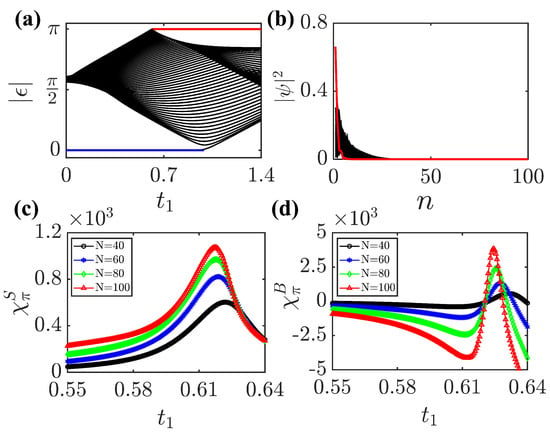
The quasienergy spectrum of the Floquet Hamiltonian under OBC is depicted in Figure 1a. It is noticed that a gap opens around the quasienergy , leading to the emergence of robust topological zero modes. In contrast to the static case, periodic driving also induces the opening of a gap around the quasienergy , thereby giving rise to a distinct class of robust topological modes. Under weak driving conditions, the phase boundaries can be approximated as , .
Figure 1.
(a) The quasienergy spectrum as a function of under open boundary condition for , and the red and blue lines represent the topological mode and zero mode, respectively. (b) The bulk eigenstates (black), and the topological mode (red) of the Floquet Hamiltonian under open boundary condition for . (c,d) The self-normal fidelity susceptibility and biorthogonal fidelity susceptibility as functions of , shown near the phase transition points of the topological mode. Other parameters are set as follows: , , and .
As shown in Figure 1b, we plot the distributions of the eigenstates under OBC shows at . It is noticed that, due to the NHSE, the bulk states (black) exhibit a skin accumulation and become localized at the left boundary of the system. In this parameter regime, the system hosts only the topological mode, whose wave function is localized at the left end of the system.
We further investigate the phase transition associated with the mode by using the self-normal and biorthogonal fidelity susceptibilities, as shown in Figure 1c and Figure 1d, respectively. As the parameter is varied, the quantum fidelity susceptibility exhibits pronounced changes near the transition point, developing a clear peak. The value of at which the peak occurs shows a slight deviation from the analytical result, which can be attributed to finite-size effects. Calculations for different system sizes demonstrate that, as the system size increases, the peak height of the fidelity susceptibility grows, and the corresponding peak position in approaches more closely the analytical value of the mode transition point.
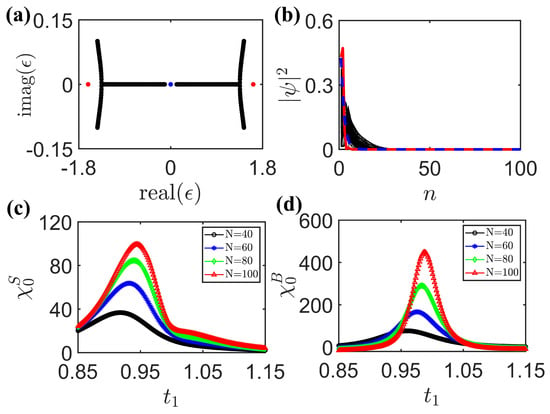
Under appropriate parameter conditions, the system can simultaneously host stable topological zero modes and modes. In non-Hermitian systems, the quasienergies generally acquire non-zero imaginary parts. Figure 2a shows the quasienergy spectrum on the complex-energy plane under OBC at . It is noticed that the topological zero modes (blue) and modes (red) are well separated from the bulk spectrum (black). The average of the eigenstates under OBC is presented in Figure 2b at . The wave functions of the topological zero modes (blue) and modes (red) are both localized at the left boundary of the system. In contrast, the bulk-state wave functions (black) accumulate near the boundary, reflecting the NHSE.
Figure 2.
(a) The quasienergy spectra under the open boundary condition for . The topological mode and zero mode are highlighted in red and blue, respectively. (b) The bulk eigenstates (black), the zero mode (blue), and the mode (red) of the Floquet Hamiltonian under open boundary condition for . (c,d) The self-normal fidelity susceptibility and biorthogonal fidelity susceptibility as functions of , shown near the transition points of the topological zero mode. Other parameters are set as follows: , , and .
We further investigate the transition associated with the zero mode by means of the self-normal and biorthogonal fidelity susceptibilities, as shown in Figure 2c and Figure 2d, respectively. As the parameter is varied, a pronounced change of the fidelity susceptibility is observed in the vicinity of the transition point. With increasing system size, the peak of the fidelity susceptibility becomes higher, and the corresponding peak position in approaches more closely the analytical value of the zero-mode transition point.
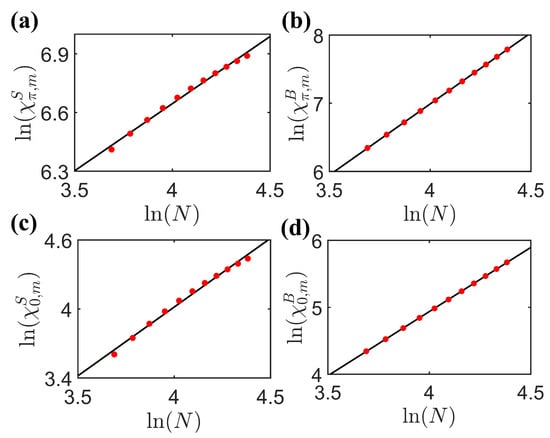
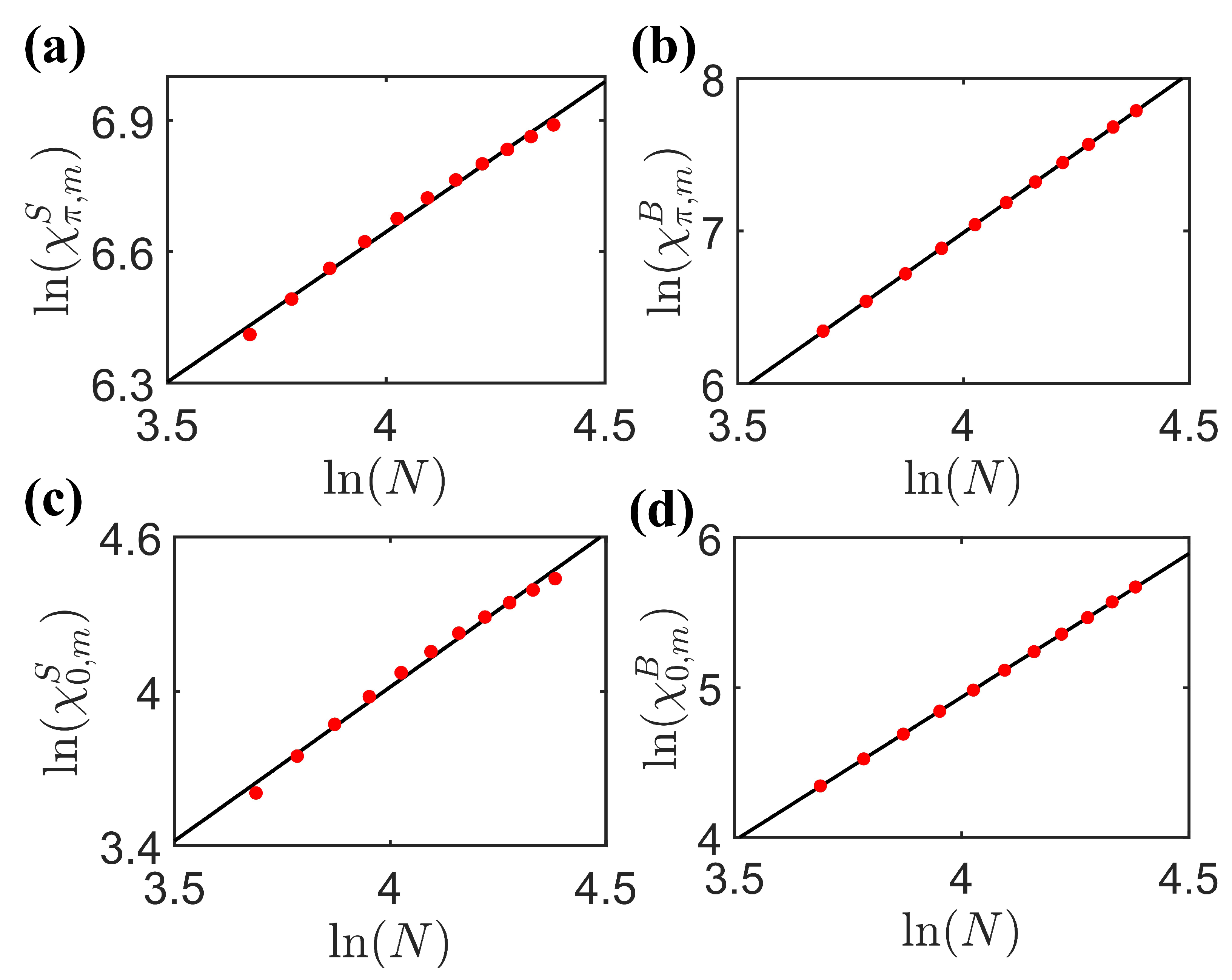
To characterize the critical behavior, we analyze the scaling of the peak value of the fidelity susceptibility with the lattice length. At the mode transition point, the scaling behaviors of the maxima of the self-normal and biorthogonal fidelity susceptibilities with the lattice length are shown in Figure 3a and Figure 3b, respectively. As the lattice length increases, the peak of the self-normal fidelity susceptibility grows slowly. In contrast, the maximum of the biorthogonal fidelity susceptibility follows a power-law scaling with the lattice length, consistent with the power-law form given in Equation (9), and the fit yields .
Figure 3.
(a,b) The logarithmic scaling of maxima and with the lattice size N at the transition points of the topological mode, respectively. (c,d) The logarithmic scaling of maxima and with the lattice size N at the transition points of the topological zero mode, respectively. The parameters used in the calculations are set as follows: , , and .
At the zero-mode transition point, the scaling behaviors of the peak values of the self-normal and biorthogonal fidelity susceptibilities with the lattice length are presented in Figure 3c and Figure 3d, respectively. Consistent with the behavior at the mode transition, the peak of the self-normal fidelity susceptibility increases slowly with the lattice length, whereas the maximum of the biorthogonal fidelity susceptibility again obeys the power-law scaling form in Equation (9), with the fit giving . These results indicate that the biorthogonal fidelity susceptibility provides a more reliable probe of the topological phase transitions and critical properties in non-Hermitian Floquet systems.
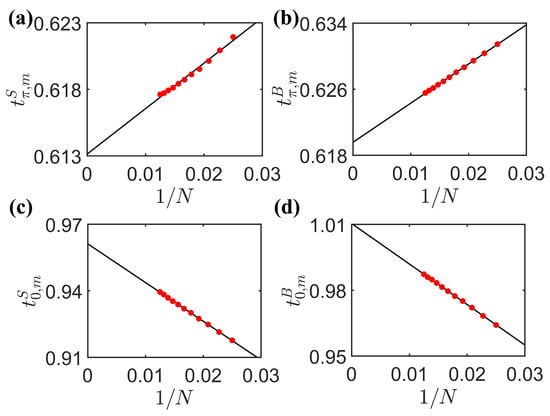
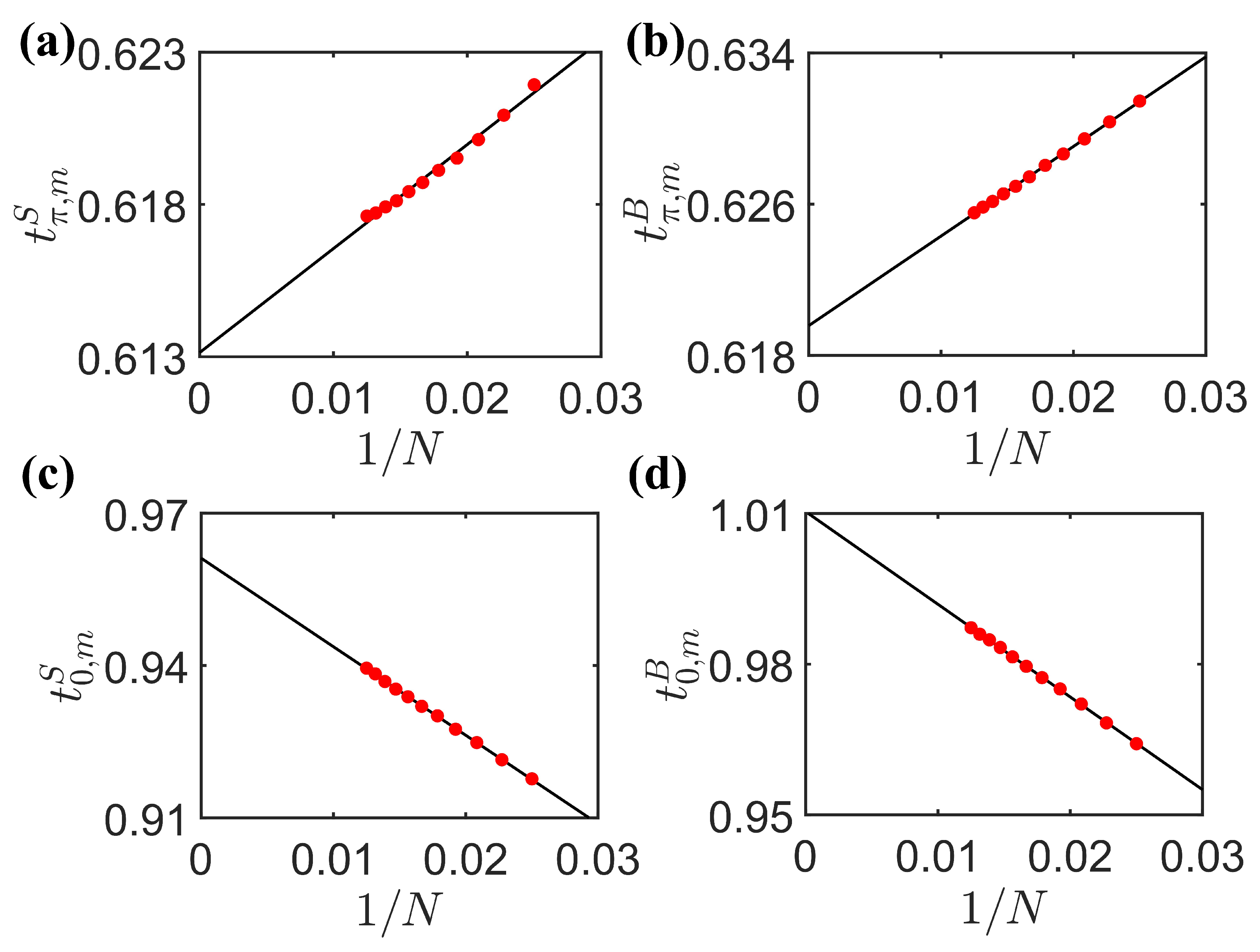
The fidelity susceptibility exhibits pronounced finite-size effects near the phase transition points, manifested by a drift of the peak position with the system size N. To characterize the critical properties and scaling law, we first focus on the transition associated with the mode. For the two definitions of the fidelity susceptibility—self-normal and biorthogonal—the peak positions, denoted by and , respectively, obey the finite-size scaling behavior shown in Figure 4a,b. As the lattice length N increases, the transition point extracted from the fits in both the self-normal and biorthogonal cases approaches the analytical value of the mode transition. It is worth emphasizing that, compared with the self-normal case, the biorthogonal fitting exhibits better convergence and a smaller deviation within the accessible finite-size window.
Figure 4.
(a,b) The finite-size scaling of and defined at the maxima of the self-normal fidelity susceptibility and biorthogonal fidelity susceptibility , respectively. (c,d) The finite-size scaling of and defined at the maxima of the self-normal fidelity susceptibility and biorthogonal fidelity susceptibility , respectively. The parameters used in the calculations are set as follows: , , and .
In the following, we further examine the finite-size behavior at the zero-mode transition. In an analogous manner, we extract the peak positions of the self-normal and biorthogonal fidelity susceptibilities in the vicinity of the zero-mode critical point, and denote them by and , respectively. The corresponding finite-size scaling results are presented in Figure 4c,d. Upon approaching the thermodynamic limit, the zero-mode transition point obtained from the fits under both definitions converges to the analytical value, while the biorthogonal definition again yields a superior fit compared with the self-normal one. These results indicate that the biorthogonal fidelity susceptibility has a clear advantage in determining the critical points and scaling properties of non-Hermitian Floquet topological phase transitions.
To provide further insight into the quantum critical behavior, we interpret the correlation length critical exponent . In the standard Hermitian SSH model, the topological phase transition is typically accompanied by a gap closing and belongs to the universality class characterized by the correlation length critical exponent . The finite-size scaling results based on the biorthogonal fidelity susceptibility show that, in the present periodically driven non-Hermitian SSH model, both the zero and mode transitions are consistent with the same critical scaling behavior. This indicates that the Floquet nature of the system is reflected not in a change of the universal exponent, but in the richer topological phase structure, which supports both zero and mode transitions, with the latter having no static counterpart. Therefore, the biorthogonal fidelity susceptibility provides a unified and reliable way to characterize the critical properties of the Floquet non-Hermitian system.
5. Conclusions
In this work, we investigate quantum critical behavior and Floquet topological phase transitions in a one-dimensional non-Hermitian periodically driven SSH model. Distinct from existing research that predominantly focuses on static non-Hermitian systems, our work represents the first attempt to extend the fidelity susceptibility to periodically driven non-Hermitian frameworks. Crucially, we highlight the innovative contribution of our study by explicitly verifying the effectiveness of fidelity susceptibility in characterizing both Floquet topological zero and modes phase transitions. To characterize the critical properties of Floquet topological transitions in non-Hermitian systems, we formulate the fidelity susceptibility within the biorthogonal framework and use the self-normal definition only as a reference comparison. Our results show that the fidelity susceptibility exhibits pronounced peaks near the transition points for both the zero modes and modes phases. The finite-size scaling further reveals that fidelity sensitivity maximum increases with system size, while the peak position drifts toward the critical point in the thermodynamic limit. Moreover, as the system approaches the thermodynamic limit, the extracted transition parameters converge toward their analytical values. In non-Hermitian Floquet systems, the biorthogonal fidelity susceptibility offers enhanced stability and accuracy for extracting universal critical properties. Owing to its high sensitivity to perturbations, it has become a powerful tool in high-precision optical sensing and is applied to areas ranging from quantum sensing technologies [69,70,71,72,73,74,75,76] to classical detection platforms.
In summary, our study establishes the biorthogonal fidelity susceptibility as an effective probe of Floquet-driven non-Hermitian topological phase transitions and their universal scaling behavior. The developed framework can be extended to more general non-Hermitian settings, including models with long-range hopping and higher-dimensional driven open systems, offering a viable route and methodological basis for further understanding criticality and topological phase transitions in non-Hermitian systems.
Author Contributions
X.Z.: Data curation; Formal analysis; Investigation; Methodology; Software; Writing—original draft. J.C.: Validation; Writing—review and editing. Z.W.: Project administration; Writing—review. S.C.: Conceptualization; Data curation; Formal analysis; Funding acquisition; Project administration; Supervision; Writing—review and editing. All authors have read and agreed to the published version of the manuscript.
Funding
This work was supported by the National Natural Science Foundation of China (Grant No. 12204130).
Data Availability Statement
The original contributions presented in this study are included in the article. Further inquiries can be directed to the corresponding authors.
Acknowledgments
The data for this work was obtained using equipment provided by the School of Physics and Electronic Engineering, Jiangsu University.
Conflicts of Interest
The authors declare no conflicts of interest.
References
- Bergholtz, E.J.; Budich, J.C.; Kunst, F.K. Exceptional topology of non-Hermitian systems. Rev. Mod. Phys. 2021, 93, 015005. [Google Scholar] [CrossRef] [Scilit]
- Ashida, Y.; Gong, Z.; Ueda, M. Non-Hermitian physics. Adv. Phys. 2021, 69, 249. [Google Scholar] [CrossRef] [Scilit]
- Kunst, F.K.; Edvardsson, E.; Budich, J.C.; Bergholtz, E.J. Biorthogonal Bulk-Boundary Correspondence in Non-Hermitian Systems. Phys. Rev. Lett. 2018, 121, 026808. [Google Scholar] [CrossRef] [Scilit]
- Gong, Z.; Ashida, Y.; Kawabata, K.; Takasan, K.; Higashikawa, S.; Ueda, M. Topological Phases of Non-Hermitian Systems. Phys. Rev. X 2018, 8, 031079. [Google Scholar] [CrossRef] [Scilit]
- Jiang, L.; Miao, W.; Sun, W.-Y.; Ma, W. Entanglement negativity and exceptional-point signatures in a pt-symmetric non-hermitian xy dimer: Parameter regimes and directional-coupler mapping. Photonics 2025, 12, 1239. [Google Scholar] [CrossRef] [Scilit]
- Liu, X.; Artoni, M.; La Rocca, G.; Wu, J. Optical unidirectional transport and directional blockade in cold atoms via non-hermitian four-wave mixing. Photonics 2025, 12, 521. [Google Scholar] [CrossRef] [Scilit]
- Shi, Z.; Qin, L.; Zhao, X.; Huang, H. Optical pattern formation in a rydberg-dressed atomic gas with non-hermitian potentials. Photonics 2022, 9, 856. [Google Scholar] [CrossRef] [Scilit]
- Tang, H.; Zhuang, R.; Wei, J.; Chen, Q.; Liu, S.; Liu, G.; Feng, Z.; Zhang, Y. Non-hermitian control of tri-photon and quad-photon using parallel multi-dressing quantization. Photonics 2025, 12, 653. [Google Scholar] [CrossRef] [Scilit]
- Xu, J.; Mao, Y.; Liu, K.; Zhu, Z. Robust sensing based on exceptional points in detuned non-hermitian scattering system. Photonics 2024, 11, 882. [Google Scholar] [CrossRef] [Scilit]
- Yao, S.; Wang, Z. Edge States and Topological Invariants of Non-Hermitian Systems. Phys. Rev. Lett. 2018, 121, 086803. [Google Scholar] [CrossRef] [Scilit]
- Longhi, S. Probing non-Hermitian skin effect and non-Bloch phase transitions. Phys. Rev. Res. 2019, 1, 023013. [Google Scholar] [CrossRef] [Scilit]
- Song, F.; Yao, S.; Wang, Z. Non-Hermitian Skin Effect and Chiral Damping in Open Quantum Systems. Phys. Rev. Lett. 2019, 123, 170401. [Google Scholar] [CrossRef] [Scilit] [PubMed]
- Jiang, H.; Lang, L.-J.; Yang, C.; Zhu, S.-L.; Chen, S. Interplay of non-Hermitian skin effects and Anderson localization in nonreciprocal quasiperiodic lattices. Phys. Rev. B 2019, 100, 054301. [Google Scholar] [CrossRef] [Scilit]
- Lee, C.H.; Thomale, R. Anatomy of skin modes and topology in non-Hermitian systems. Phys. Rev. B 2019, 99, 201103. [Google Scholar] [CrossRef] [Scilit]
- Li, Y.; Ji, X.; Chen, Y.; Yan, X.; Yang, X. Topological energy braiding of non-Bloch bands. Phys. Rev. B 2022, 106, 195425. [Google Scholar] [CrossRef] [Scilit]
- Yao, S.; Song, F.; Wang, Z. Non-Hermitian Chern Bands. Phys. Rev. Lett. 2018, 121, 136802. [Google Scholar] [CrossRef] [Scilit]
- Wan, L.-L.; Lü, X.-Y. Quantum-Squeezing-Induced Point-Gap Topology and Skin Effect. Phys. Rev. Lett. 2023, 130, 203605. [Google Scholar] [CrossRef] [Scilit]
- Ji, X.; Geng, H.; Akhtar, N.; Yang, X. Floquet engineering of point-gapped topological superconductors. Phys. Rev. B 2025, 111, 195419. [Google Scholar] [CrossRef] [Scilit]
- Cao, Y.; Li, Y.; Yang, X. Non-Hermitian bulk-boundary correspondence in a periodically driven system. Phys. Rev. B 2021, 103, 075126. [Google Scholar] [CrossRef] [Scilit]
- Fu, Y.; Wan, S. Degeneracy and defectiveness in non-Hermitian systems with open boundary. Phys. Rev. B 2022, 105, 075420. [Google Scholar] [CrossRef] [Scilit]
- Yang, X.; Feng, Y.; Wahab, A.; Geng, H. Non-hermitian second-order topological phases and bipolar skin effect in photonic kagome crystals. Phys. Rev. A 2026, 113, 023506. [Google Scholar] [CrossRef] [Scilit]
- Lu, C.-Z.; Deng, X.; Kou, S.-P.; Sun, G. Many-body phase transitions in a non-Hermitian Ising chain. Phys. Rev. B 2024, 110, 014441. [Google Scholar] [CrossRef] [Scilit]
- Guo, C.-X.; Liu, C.-H.; Zhao, X.-M.; Liu, Y.; Chen, S. Exact Solution of Non-Hermitian Systems with Generalized Boundary Conditions: Size-Dependent Boundary Effect and Fragility of the Skin Effect. Phys. Rev. Lett. 2021, 127, 116801. [Google Scholar] [CrossRef] [Scilit] [PubMed]
- Tong, X.; Zhang, Y.; Li, B.; Yang, X. Impact of nonreciprocal hopping on localization in non-hermitian quasiperiodic systems. Phys. Rev. B 2025, 111, 214202. [Google Scholar] [CrossRef] [Scilit]
- Yang, X.; Cao, Y.; Zhai, Y. Non-hermitian weyl semimetals: Non-hermitian skin effect and non-bloch bulk boundary correspondence. Chin. Phys. B 2022, 31, 010308. [Google Scholar] [CrossRef] [Scilit]
- Hodaei, H.; Hassan, A.U.; Wittek, S.; Garcia-Gracia, H.; El-Ganainy, R.; Christodoulides, D.N.; Khajavikhan, M. Enhanced sensitivity at higher-order exceptional points. Nature 2017, 548, 187. [Google Scholar] [CrossRef] [Scilit]
- Xiao, L.; Deng, T.; Wang, K.; Wang, Z.; Yi, W.; Xue, P. Observation of non-bloch parity-time symmetry and exceptional points. Phys. Rev. Lett. 2021, 126, 230402. [Google Scholar] [CrossRef] [Scilit]
- Jin, L.; Wu, H.C.; Wei, B.-B.; Song, Z. Hybrid exceptional point created from type-iii dirac point. Phys. Rev. B 2020, 101, 045130. [Google Scholar] [CrossRef] [Scilit]
- Li, L.; Lee, C.H.; Mu, S.; Gong, J. Critical non-Hermitian skin effect. Nat. Commun. 2020, 11, 5491. [Google Scholar] [CrossRef] [Scilit]
- Ji, X.; Ding, W.; Chen, Y.; Yang, X. Non-Hermitian second-order topological superconductors. Phys. Rev. B 2024, 109, 125420. [Google Scholar] [CrossRef] [Scilit]
- Yokomizo, K.; Murakami, S. Non-Bloch Band Theory of Non-Hermitian Systems. Phys. Rev. Lett. 2019, 123, 066404. [Google Scholar] [CrossRef] [Scilit] [PubMed]
- Yang, Z.; Zhang, K.; Fang, C.; Hu, J. Non-Hermitian Bulk-Boundary Correspondence and Auxiliary Generalized Brillouin Zone Theory. Phys. Rev. Lett. 2020, 125, 226402. [Google Scholar] [CrossRef] [Scilit]
- Xiao, L.; Deng, T.; Wang, K.; Zhu, G.; Wang, Z.; Yi, W.; Xue, P. Non-Hermitian bulk–boundary correspondence in quantum dynamics. Nat. Phys. 2020, 16, 761. [Google Scholar] [CrossRef] [Scilit]
- Kawabata, K.; Okuma, N.; Sato, M. Non-Bloch band theory of non-Hermitian Hamiltonians in the symplectic class. Phys. Rev. B 2020, 101, 195147. [Google Scholar] [CrossRef] [Scilit]
- Zhang, Z.; Yang, Z.; Hu, J. Bulk-boundary correspondence in non-Hermitian Hopf-link exceptional line semimetals. Phys. Rev. B 2020, 102, 045412. [Google Scholar] [CrossRef] [Scilit]
- Liu, T.; Cheng, S.; Guo, H.; Xianlong, G. Fate of Majorana zero modes, exact location of critical states, and unconventional real-complex transition in non-Hermitian quasiperiodic lattices. Phys. Rev. B 2021, 103, 104203. [Google Scholar] [CrossRef] [Scilit]
- Li, L.; Wei, Y.; Wu, G.; Ruan, Y.; Chen, S.; Lee, C.H.; Ni, Z. Exact solutions disentangle higher-order topology in two-dimensional non-Hermitian lattices. Phys. Rev. B 2025, 111, 075132. [Google Scholar] [CrossRef] [Scilit]
- Wang, H.-Y.; Song, F.; Wang, Z. Amoeba Formulation of Non-Bloch Band Theory in Arbitrary Dimensions. Phys. Rev. X 2024, 14, 021011. [Google Scholar] [CrossRef] [Scilit]
- Wang, S.-X.; Yan, Z. Theory for the spectral splitting exponent of exceptional points. Phys. Rev. B 2025, 112, 195125. [Google Scholar] [CrossRef] [Scilit]
- Zanardi, P.; Paunković, N. Ground state overlap and quantum phase transitions. Phys. Rev. E 2006, 74, 031123. [Google Scholar] [CrossRef] [Scilit]
- You, W.-L.; Li, Y.-W.; Gu, S.-J. Fidelity, dynamic structure factor, and susceptibility in critical phenomena. Phys. Rev. E 2007, 76, 022101. [Google Scholar] [CrossRef] [Scilit]
- Gu, S.-J. Fidelity Approach to Quantum Phase Transitions. Int. J. Mod. Phys. B 2010, 24, 4371. [Google Scholar] [CrossRef] [Scilit]
- Sun, G. Fidelity susceptibility study of quantum long-range antiferromagnetic Ising chain. Phys. Rev. A 2017, 96, 043621. [Google Scholar] [CrossRef] [Scilit]
- Gu, S.-J.; Kwok, H.-M.; Ning, W.-Q.; Lin, H.-Q. Fidelity susceptibility, scaling, and universality in quantum critical phenomena. Phys. Rev. B 2008, 77, 245109. [Google Scholar] [CrossRef] [Scilit]
- Zhu, Z.; Sun, G.; You, W.-L.; Shi, D.-N. Fidelity and criticality of a quantum Ising chain with long-range interactions. Phys. Rev. A 2018, 98, 023607. [Google Scholar] [CrossRef] [Scilit]
- Chen, S.; Wang, L.; Hao, Y.; Wang, Y. Intrinsic relation between ground-state fidelity and the characterization of a quantum phase transition. Phys. Rev. A 2008, 77, 032111. [Google Scholar] [CrossRef] [Scilit]
- Yang, S.; Gu, S.-J.; Sun, C.-P.; Lin, H.-Q. Fidelity susceptibility and long-range correlation in the kitaev honeycomb model. Phys. Rev. A 2008, 78, 012304. [Google Scholar] [CrossRef] [Scilit]
- Albuquerque, A.F.; Alet, F.; Sire, C.; Capponi, S. Quantum critical scaling of fidelity susceptibility. Phys. Rev. B 2010, 81, 064418. [Google Scholar] [CrossRef] [Scilit]
- Luo, Q.; Zhao, J.; Wang, X. Fidelity susceptibility of the anisotropic xy model: The exact solution. Phys. Rev. E 2018, 98, 022106. [Google Scholar] [CrossRef] [Scilit]
- Jiang, H.; Yang, C.; Chen, S. Topological invariants and phase diagrams for one-dimensional two-band non-Hermitian systems without chiral symmetry. Phys. Rev. A 2018, 98, 052116. [Google Scholar] [CrossRef] [Scilit]
- Zhang, D.-J.; Wang, Q.H.; Gong, J. Quantum geometric tensor in PT -symmetric quantum mechanics. Phys. Rev. A 2019, 99, 042104. [Google Scholar] [CrossRef] [Scilit]
- Tzeng, Y.-C.; Ju, C.-Y.; Chen, G.-Y.; Huang, W.-M. Hunting for the non-hermitian exceptional points with fidelity susceptibility. Phys. Rev. Res. 2021, 3, 013015. [Google Scholar] [CrossRef] [Scilit]
- Sun, G.; Tang, J.-C.; Kou, S.-P. Biorthogonal quantum criticality in non-hermitian many-body systems. Front. Phys. 2022, 17, 33502. [Google Scholar] [CrossRef] [Scilit]
- Zeng, C.-C.; Cai, Z.; Wang, G.-H.; Sun, G. Fidelity and criticality in the nonreciprocal aubry-andré-harper model. EPL 2025, 149, 38001. [Google Scholar] [CrossRef] [Scilit]
- Tu, Y.-T.; Jang, I.; Chang, P.-Y.; Tzeng, Y.-C. General properties of fidelity in non-Hermitian quantum systems with PT symmetry. Quantum 2023, 7, 960. [Google Scholar] [CrossRef] [Scilit]
- Wei, B.-B. Fidelity susceptibility in one-dimensional disordered lattice models. Phys. Rev. A 2019, 99, 042117. [Google Scholar] [CrossRef] [Scilit]
- Lu, G.; Wang, N. A generalized floquet hamiltonian method for dispersive photonic time crystals. Photonics 2025, 12, 264. [Google Scholar] [CrossRef] [Scilit]
- Rechtsman, M.C.; Zeuner, J.M.; Plotnik, Y.; Lumer, Y.; Podolsky, D.; Dreisow, F.; Nolte, S.; Segev, M.; Szameit, A. Photonic Floquet topological insulators. Nature 2013, 496, 196. [Google Scholar] [CrossRef] [Scilit]
- Eckardt, A. Colloquium: Atomic quantum gases in periodically driven optical lattices. Rev. Mod. Phys. 2017, 89, 011004. [Google Scholar] [CrossRef] [Scilit]
- Rudner, M.S.; Lindner, N.H.; Berg, E.; Levin, M. Anomalous Edge States and the Bulk-Edge Correspondence for Periodically Driven Two-Dimensional Systems. Phys. Rev. X 2013, 3, 031005. [Google Scholar] [CrossRef] [Scilit]
- Lindner, N.H.; Refael, G.; Galitski, V. Floquet topological insulator in semiconductor quantum wells. Nat. Phys. 2011, 7, 490. [Google Scholar] [CrossRef] [Scilit]
- Ji, X.; Yang, X. Generalized bulk-boundary correspondence in periodically driven non-Hermitian systems. J. Phys. Condens. Matter 2024, 36, 243001. [Google Scholar] [CrossRef] [Scilit]
- Kitagawa, T.; Berg, E.; Rudner, M.; Demler, E. Topological characterization of periodically driven quantum systems. Phys. Rev. B 2010, 82, 235114. [Google Scholar] [CrossRef] [Scilit]
- Fruchart, M. Complex classes of periodically driven topological lattice systems. Phys. Rev. B 2016, 93, 115429. [Google Scholar] [CrossRef] [Scilit]
- He, L.; Addison, Z.; Jin, J.; Mele, E.J.; Johnson, S.G.; Zhen, B. Floquet Chern insulators of light. Nat. Commun. 2019, 10, 4194. [Google Scholar] [CrossRef] [Scilit] [PubMed]
- Su, W.P.; Schrieffer, J.R.; Heeger, A.J. Solitons in Polyacetylene. Phys. Rev. Lett. 1979, 42, 1698. [Google Scholar] [CrossRef] [Scilit]
- Brody, D.C. Biorthogonal quantum mechanics. J. Phys. A Math. Theor. 2014, 47, 035305. [Google Scholar] [CrossRef] [Scilit]
- Chen, W.; Peng, L.; Lu, H.; Lu, X. Characterizing bulk-boundary correspondence of one-dimensional non-Hermitian interacting systems by edge entanglement entropy. Phys. Rev. B 2022, 105, 075126. [Google Scholar] [CrossRef] [Scilit]
- DeMille, D.; Hutzler, N.R.; Rey, A.M.; Zelevinsky, T. Quantum sensing and metrology for fundamental physics with molecules. Nat. Phys. 2024, 20, 741. [Google Scholar] [CrossRef] [Scilit]
- Kantsepolsky, B.; Aviv, I.; Weitzfeld, R.; Bordo, E. Exploring quantum sensing potential for systems applications. IEEE Access 2023, 11, 31569. [Google Scholar] [CrossRef] [Scilit]
- Li, P.; Zhou, J.-Y.; Li, S.; Udvarhelyi, P.; Xu, J.-S.; Li, C.-F.; Huang, B.; Guo, G.-C.; Gali, A. Non-invasive bioinert room-temperature quantum sensor from silicon carbide qubits. Nat. Mater. 2025, 24, 1913. [Google Scholar] [CrossRef] [Scilit]
- Malia, B.K.; Wu, Y.; Martínez-Rincón, J.; Kasevich, M.A. Distributed quantum sensing with mode-entangled spin-squeezed atomic states. Nature 2022, 612, 661. [Google Scholar] [CrossRef] [Scilit]
- Rizzato, R.; Schalk, M.; Mohr, S.; Hermann, J.C.; Leibold, J.P.; Bruckmaier, F.; Salvitti, G.; Qian, C.; Ji, P.; Astakhov, G.V.; et al. Extending the coherence of spin defects in hbn enables advanced qubit control and quantum sensing. Nat. Commun. 2023, 14, 5089. [Google Scholar] [CrossRef] [Scilit]
- Stray, B.; Lamb, A.; Kaushik, A.; Vovrosh, J.; Rodgers, A.; Winch, J.; Hayati, F.; Boddice, D.; Stabrawa, A.; Niggebaum, A.; et al. Quantum sensing for gravity cartography. Nature 2022, 602, 590. [Google Scholar] [CrossRef] [Scilit] [PubMed]
- Tobar, G.; Manikandan, S.K.; Beitel, T.; Pikovski, I. Detecting single gravitons with quantum sensing. Nat. Commun. 2024, 15, 7229. [Google Scholar] [CrossRef] [Scilit] [PubMed]
- Ye, J.; Zoller, P. Essay: Quantum sensing with atomic, molecular, and optical platforms for fundamental physics. Phys. Rev. Lett. 2024, 132, 190001. [Google Scholar] [CrossRef] [Scilit] [PubMed]
Disclaimer/Publisher’s Note: The statements, opinions and data contained in all publications are solely those of the individual author(s) and contributor(s) and not of MDPI and/or the editor(s). MDPI and/or the editor(s) disclaim responsibility for any injury to people or property resulting from any ideas, methods, instructions or products referred to in the content. |
© 2026 by the authors. Licensee MDPI, Basel, Switzerland. This article is an open access article distributed under the terms and conditions of the Creative Commons Attribution (CC BY) license.