


Abstract
In intelligent education, reusable immersive scenes can provide consistent visual contexts for foreign-language interpreting practice and structured assessment activities. This work focuses on the optical and geometric stage of such scene preparation: passive multi-view 3D reconstruction from non-ideal consumer-camera imagery. The PatchMatchNet pipeline incorporates PANet-style bidirectional cross-scale feature exchange and CBAM weighting of aggregated matching evidence to balance reciprocal geometric information with spatially variable observation reliability. The reported allocation comprises 99 DTU scenes and 44 assigned self-collected scenes, with 5 additional self-collected scenes listed outside the allocation. In the joint-module comparison, the reported reconstruction-to-reference, reference-to-reconstruction, and symmetric-mean point-set distances change from 0.483, 0.321, and 0.402 to 0.350, 0.222, and 0.286, respectively (nominal mm). These values characterize the custom mixed evaluation and its within-table architectural comparison. The reconstruction, point-cloud export, and Unity3D (version 2022.3 LTS) visualization workflow is illustrated on the PICO 4 Pro, supporting the preparation of visual assets for immersive language-learning environments.
1. Introduction
Passive multi-view three-dimensional (3D) reconstruction recovers scene geometry from images taken at different viewpoints. A calibrated projection model links camera observations to 3D locations, while correspondence and depth fusion determine which surface estimates remain geometrically consistent. Classical multi-view geometry and comparative MVS evaluations provide the foundations for this process [1,2]. More generally, multi-view imaging has also supported spatial localization tasks, including multi-view ground-penetrating radar interpretation [3]. Here, the emphasis is on explicit point-cloud reconstruction from non-ideal consumer-camera photographs.
For intelligent-education applications, reusable reconstructed scenes can provide stable visual contexts for immersive interpreting practice. Reliable object geometry and coherent changes of viewpoint help maintain the consistency of visual prompts across sessions. Interactive visual interfaces in augmented-reality teleoperation offer a related example of how spatial representations can support user interaction [4]; the present work concentrates on creating the underlying 3D scene assets rather than on a teleoperation controller.
Handheld acquisition makes the evidence across views uneven even when the projective constraints are shared. Occlusion, motion blur, low texture, lighting variation, and nonuniform baselines change local matching reliability. Structure-from-motion recovers image poses from repeatable correspondences, whereas dense stereo must additionally select supporting views and check geometric consistency [5,6]. Low-resolution visual recognition research also illustrates how feature representations can lose fine detail [7]. Information-fusion work in other sensing domains similarly distinguishes the contributions of non-equivalent sources [8]. These observations motivate reciprocal cross-scale feature flow together with location-dependent matching weights.
PatchMatch uses randomized initialization and spatial propagation to search for plausible correspondences efficiently [9]. PatchMatchNet incorporates related hypothesis refinement into a learned coarse-to-fine multi-view stereo pipeline with calibrated feature warping, source-view weighting, cost aggregation, and depth regression [10]. Its staged structure reduces the need for an exhaustive fine-resolution depth search. Two representation questions are particularly relevant here: how fine boundaries influence coarse depth initialization, and how unreliable view-aggregated costs are downweighted before depth prediction.
Feature hierarchies address the first question. Feature pyramid networks send contextual information from coarser to finer resolutions [11], while path aggregation adds a complementary bottom-up route [12]. Related multi-scale fusion research on satellite, UAV, and surveillance images demonstrates the wider value of combining spatial detail and context when observations differ in resolution [13]. In the present MVS architecture, reciprocal H/8–H/4–H/2 information exchange serves depth hypothesis evaluation rather than object detection.
The second question concerns asymmetric reliability within the cost representation. Repeated texture, boundary mixing, and partial visibility can generate inconsistent responses across spatial locations and feature channels. CBAM offers sequential channel and spatial weighting [14]; attention has also been adapted to imaging-based rail surface inspection [15]. In this study, channel–spatial weighting is applied to aggregated matching evidence rather than to the raw input image so that its role is tied to depth estimation.
Other image-based 3D approaches include neural scene representations and sparse-view radiance-field regularization [16]. Their primary representations and rendering objectives differ from the explicit calibrated depth maps and fused point clouds adopted here. Preserving the PatchMatchNet geometry and fusion interfaces allows the feature-path and cost-weighting changes to be compared while maintaining the same form of reconstructed output.
View-dependent reflectance and occlusion complicate correspondence because intensity similarity alone is not a geometric guarantee. Patch-warping constraints have been investigated for neural surface reconstruction [17], while occlusion-aware visual representation methods have separately emphasized selective attention to visible evidence [18]. For multi-view depth fusion, an attention-weighted candidate must still satisfy the camera-based consistency checks required for inclusion in the final point cloud.
In this study, reflectance changes and occlusion are sources of ambiguous or absent observations, not physical effects directly solved by PANet or CBAM. The two modules adjust cross-scale image representations and the relative weight of matching evidence; they do not estimate surface reflectance, reveal fully occluded geometry, or correct camera pose. Depth-map consistency checks and multi-view fusion remain necessary to reject geometrically incompatible estimates.
Recent learned MVS systems improve inference through global feature context and unified depth representations. TransMVSNet introduces transformer-based cross-view context [19], and UniMVSNet analyzes depth representations across cascade stages [20]. They form a relevant architectural background for a more narrowly scoped modification of the PatchMatchNet feature and matching stages.
Camera geometry remains integral to any interpretation of reconstruction quality. An incorrectly calibrated camera or an unfavorable viewing baseline changes the image-to-depth relationship independently of the network’s learned features. The present comparison keeps the calibrated camera model, the stage-wise depth search, and the point-cloud fusion interface conceptually fixed, isolating the intended role of cross-scale information exchange and matching reliability weights.
Geometry-aware MVS approaches provide closer context for the depth-estimation task. GeoMVSNet uses explicit geometry perception across scales [21], whereas GoMVS emphasizes geometrically consistent cost aggregation [22]. Separate visual recognition research has examined self-distillation to improve learned representations [23], although its recognition objective differs from metric stereo. These distinctions clarify why the present comparison focuses on directed point-set distances and the symmetric summary rather than on an unrelated recognition measure.
Adaptive region aggregation has also been investigated directly for multi-view stereo, including the deformable feature-pyramid approach of Hu et al. [24]. The research question here is how reciprocal feature exchange across H/8, H/4, and H/2 interacts with channel–spatial weighting after source-view matching aggregation. The camera model, depth-hypothesis schedule, and point-cloud fusion remain the geometric interfaces for interpreting the resulting variant comparisons.
Across adjacent machine learning tasks, interpretable embedding and boundary analysis [25], structural pose modeling [26], physiological-signal representation [27], and student-centered model distillation [28] offer different accounts of how a model organizes incomplete or heterogeneous evidence. Comparative modeling studies also show why conclusions should be tied to the measurements and tasks actually evaluated [29]. These studies motivate a careful distinction between representation, decision criteria, and measured performance; their output targets differ from multi-view depth estimation.
Computational deployment further spans distributed training over variable communication links [30], network-security modeling [31], provenance-aware model routing [32], and diagnostic approaches to sparse optimization rewards [33]. These examples illustrate the need to specify data interfaces and evaluation targets when discussing a computational pipeline; the present paper’s quantitative evidence remains the reconstructed point-set distances obtained under its stated evaluation protocol.
Three linked issues motivate the modification. First, a predominantly top-down pyramid creates directional asymmetry in cross-scale information flow. Second, even after source-view combination, the matching tensor retains asymmetric reliability across channels and spatial locations because occlusion, blur, repetitive texture, and illumination differences are local. Third, evaluation should distinguish the two directed point-set errors while also providing a symmetric summary. The proposed design therefore balances reciprocal feature exchange with deliberately nonuniform reliability weighting and evaluates both directions explicitly.
The calibrated imaging model, depth bounds, source-view pairing, stage-wise hypothesis search, geometric verification, and point-cloud fusion remain fixed. PANet changes only communication among feature scales, while CBAM changes only the weighting of already constructed matching evidence. This separation makes the single-module and joint ablations interpretable and prevents architectural gains from being conflated with a different camera model or output geometry.
The main contributions are summarized as follows:
- (1)
- Bidirectional cross-scale feature exchange. A PANet-style bottom-up path is integrated into the three PatchMatchNet feature resolutions without changing the depth-estimation interfaces. The additional route reduces the directional imbalance of a top-down pyramid and allows fine edges and local shape cues to influence coarse depth initialization.
- (2)
- Reliability-asymmetric cost reweighting. CBAM is placed after correlation and source-view combination but before depth regression, so channel and spatial weights respond to nonuniform matching reliability rather than to visual saliency in the RGB input. Camera geometry, depth hypotheses, and the output representation remain unchanged.
- (3)
- Bidirectional point-set evaluation. PANet and CBAM are considered separately and jointly using reconstruction-to-reference and reference-to-reconstruction distances together with their symmetric mean. Each reported ablation is interpreted relative to its own baseline, linking geometric reconstruction outcomes to the construction of coherent immersive scenes.
2. Imaging Geometry, Data Acquisition, and Reconstruction Pipeline
2.1. Multi-View Optical Imaging Geometry and Camera Model
Let Xw denote a scene point in world coordinates and Xc its camera-frame coordinates. Instead of a homogeneous block transform, Equation (1) expresses the world-to-camera mapping relative to the camera center C, with rotation R and the equivalent world-to-camera translation t:
Here, C is the camera center in world coordinates, R is orthonormal, and t is the translation in the conventional world-to-camera extrinsic matrix. The center-based and translation-based camera descriptions are equivalent, and the same calibrated rigid transformation is used for feature warping, back-projection, and cross-view consistency.
For a rectified image, perspective normalization of the camera-frame point yields the two-component normalized coordinate (ξ, η):
For the undistorted or rectified pinhole-equivalent representation, the focal lengths and principal-point offsets map normalized coordinates to pixels (u, v), as in Equation (3). The effective intrinsic matrix K contains fx, fy, cx, and cy:
The same projective model is applied to every calibrated view, but the reliability of the observations is not symmetric across views. Baseline, visibility, blur, exposure, and residual calibration error can change the evidence associated with the same surface point. Attention can therefore reweight photometric matching evidence, but it cannot repair an incorrect pose without changing the epipolar geometry.
A valid surface point should satisfy the corresponding projection relation in every camera that observes it. In practice, occluded, blurred, or weakly textured views contribute less reliable evidence than clear views. Pixel-wise view weighting and later channel–spatial attention accommodate this observation asymmetry while leaving the geometric constraint unchanged.
For a reference pixel and candidate depth, calibrated cameras define depth-conditioned mappings from the reference feature map to each source feature map. Correct depths align the same surface element in visible views; incorrect depths generally sample inconsistent structures. Bilinear warping remains differentiable but can mix foreground and background responses near boundaries, and finite image support or occlusion can generate spurious matches. PatchMatchNet therefore evaluates multiple source views and later fuses geometrically consistent depth estimates.
Optical degradation enters before any learned operation. Defocus and motion blur broaden local gradients, sensor noise perturbs feature activation, exposure variation changes contrast, and uncorrected distortion shifts projected samples. The network does not explicitly estimate a point-spread function or noise distribution; it only represents and weights the observed evidence. Calibration quality and view geometry consequently remain independent determinants of achievable three-dimensional precision. Signal-centric studies of weak electrical faults likewise investigate representation of imperfect measurements [34], while optical display fabrication addresses different aspects of image formation and hardware [35]; neither provides a substitute for calibrated camera geometry.
2.2. PatchMatch Depth Hypotheses and Cost-Volume Formulation
PatchMatchNet uses discrete depth hypotheses without requiring a separately estimated surface-normal state. At stage s and reference pixel p, Equation (4) organizes the Ns depth candidates into a column vector:
The coarsest stage samples the valid depth interval; later stages propagate and locally resample hypotheses near inherited estimates. Let ωs(p) denote the corresponding nonnegative normalized probability vector, with one entry per depth candidate. Depth regression is its inner product with the hypothesis vector:
Equation (5) is the stage-wise expectation over candidate depths, expressed as a probability-weighted vector product. Its normalization condition is equivalent to summing the candidate probabilities to one. Differentiable warping, source-view weighting, and cost evaluation determine these probabilities before the next refinement stage.
The coarse-to-fine schedule balances search range and spatial precision. Coarse grids support broad exploration at moderate memory cost, whereas finer stages refine around inherited estimates rather than rebuilding a dense full-resolution volume. Because early errors can constrain later sampling, the coarse stages benefit from access to fine boundary and local-shape cues; the added bottom-up feature path supplies this information without changing the depth-search rule.
Adaptive propagation and local resampling are complementary. Propagation imports plausible candidates from learned neighboring locations, while resampling explores depths around the current estimate. The evaluator compares candidates using scale-specific reference/source features and pixel-wise source-view weights. CBAM is applied only after multi-view responses have been combined, so it changes confidence in the matching representation rather than the candidate depths themselves. Attention-guided temporal prediction has also been developed for respiratory motion [36] and thermal forecasting [37]; in this reconstruction network, attention weights a spatial matching representation rather than a time series.
2.3. Image Acquisition, Dataset Composition, and Camera Calibration
The dataset description covers calibrated DTU scenes alongside consumer-camera sequences acquired around static objects and compact indoor or outdoor structures. Handheld acquisition typically supplies approximately 15–20 images per scene with nominal 30–50% overlap. COLMAP estimates image poses and camera parameters from overlapping views.
The acquisition description records 50 self-collected scenes. The numerical comparisons use the reported allocation, and selected consumer-camera images illustrate the reconstruction and visualization workflow.
Consumer-camera sequences combine weak texture, shading, occlusion, nonuniform viewpoints, and variable image quality. These properties make them useful for examining cross-scale feature support and locally adaptive matching weights. Quantitative comparisons are reported as aggregate point-set distances for the custom mixed evaluation, while self-collected examples illustrate the imaging and visualization workflow. Cooperative UAV deployment research considers heterogeneous sensing and coordination [38], whereas semantic multi-modal sensing frameworks investigate the integration of different observation channels [39]. The present workflow restricts fusion to calibrated camera views.
DTU supplies calibrated imagery and reference geometry. The study reports custom mixed-protocol aggregate distances rather than official DTU leaderboard scores; Section 5 interprets them as comparative indicators for the architectures.
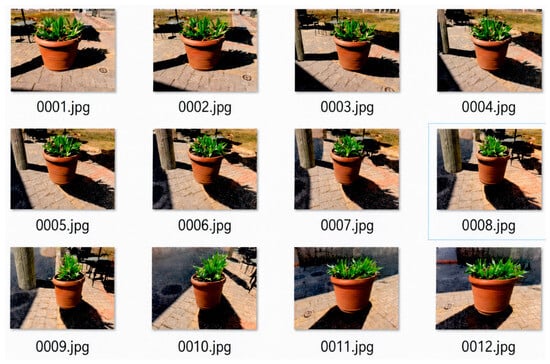
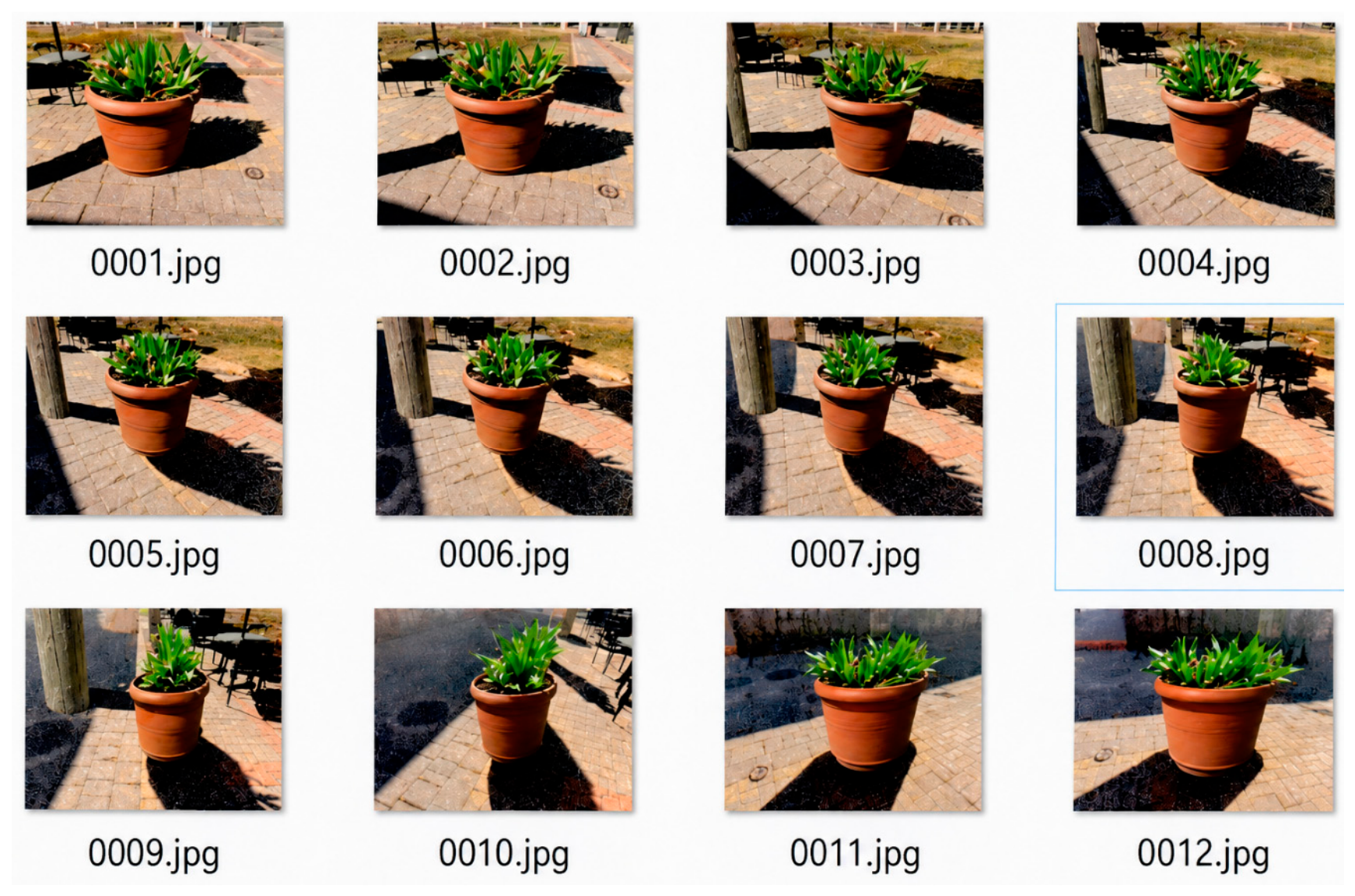
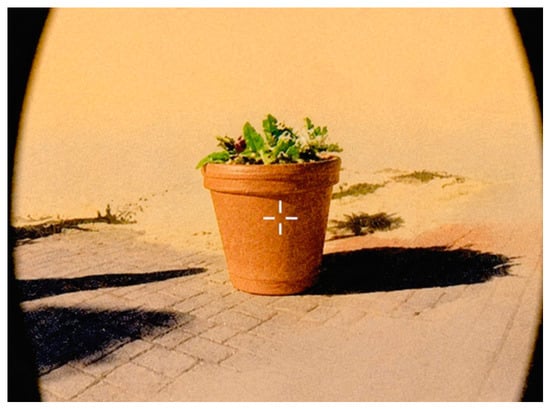
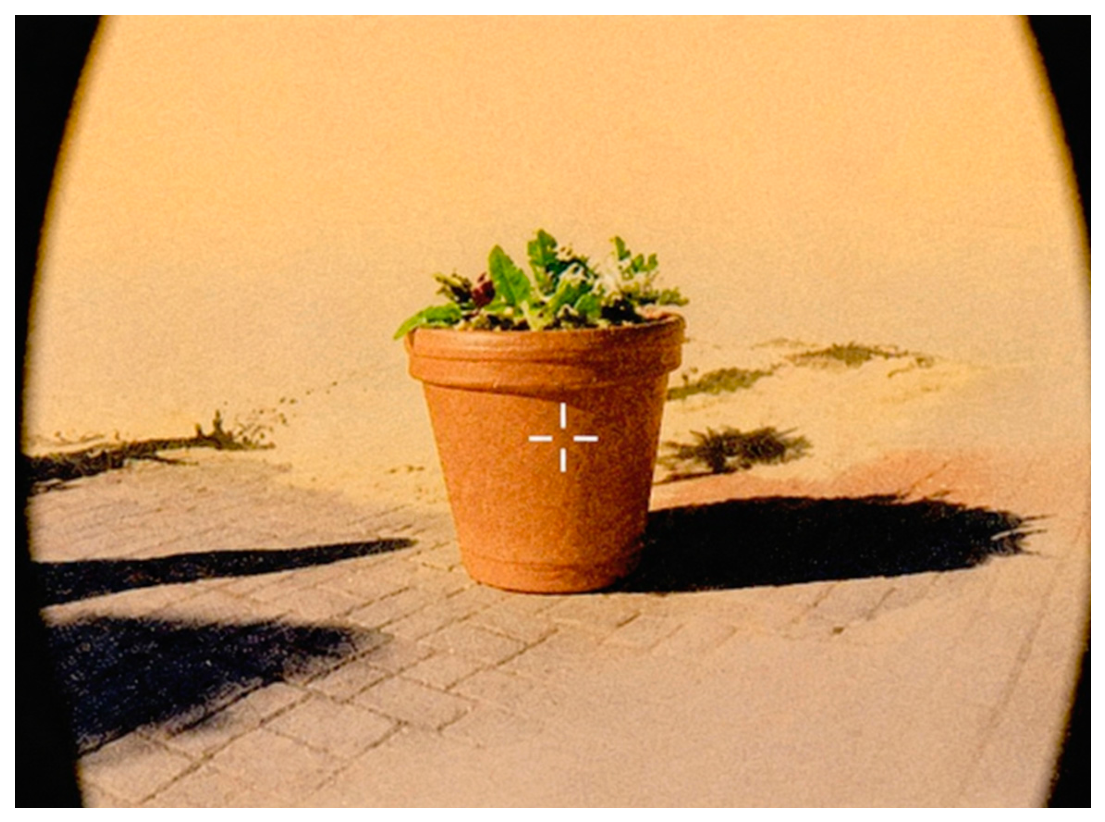
Figure 1 shows an image sequence of a potted plant acquired from different consumer-camera viewpoints. Repeated background patterns, smooth pot surfaces, plant boundaries, and changing shadows yield different levels of correspondence support across the images, motivating scale-aware feature exchange and spatially adaptive matching.
Figure 1.
Multi-view images of the potted-plant scene acquired using a consumer mobile camera.
Camera parameters were estimated with COLMAP. Scale-invariant features were matched, inconsistent correspondences were rejected with PnP-RANSAC, incremental structure from motion recovered camera poses and sparse geometry, and bundle adjustment refined the solution. The estimated camera arrangement reflects nonuniform handheld viewpoints around the objects.
The recovered poses provide multiple viewing directions and baselines for triangulation, while peripheral and self-occluded regions receive fewer valid rays. The same verified camera files are supplied to every network variant, so differences among ablations arise from feature and cost processing rather than from changes in camera estimation.
Table 1 provides a sample calibration record using the OpenCV fisheye model, with separate horizontal and vertical focal lengths, principal-point coordinates, and four fisheye distortion coefficients (k1–k4). These parameters define the camera geometry used for image rectification and calibrated projection.
Table 1.
Example of camera intrinsic parameters.
Focal lengths and principal-point coordinates are expressed in pixels. The principal point is located near the nominal image center. The four fisheye distortion terms characterize the calibrated lens mapping and are handled consistently in projection and multi-view feature warping.
Table 2 gives an example extrinsic record. Orientation is stored as a normalized unit quaternion followed by translation, camera identifier, and image name. The quaternion is converted to a rotation matrix for geometric warping and back-projection.
Table 2.
Example of camera extrinsic parameters.
Intrinsic and extrinsic records, depth bounds, reference/source identifiers, and RGB images form the scene input. The same calibrated data are used for every ablation variant, preventing pose quality or view selection from being mistaken for an architectural effect.
Image preparation preserves the calibrated pixel geometry. Intrinsics, distortion coefficients, image dimensions, and poses must refer to the same image version because untracked cropping or resizing would invalidate the projection matrices. Reference-source lists are formed after pose estimation to balance overlap and triangulation leverage: very small baselines amplify depth uncertainty, whereas very large baselines increase occlusion and appearance change.
The scene-specific COLMAP calibration and reference–source associations provide the geometric inputs for reconstruction. Approximately 15–20 images per self-collected scene and 30–50% nominal overlap describe the image acquisition. For every model variant, input poses and camera calibration serve the same geometric role; comparisons emphasize changes introduced by feature fusion and matching-evidence weighting.
2.4. End-to-End Reconstruction Task and Output Representation
For each reference view, the network receives calibrated reference/source images, camera parameters, and a valid depth interval. After coarse-to-fine inference, a pixel with depth di is converted to a world-frame point using the corresponding camera center and rectified back-projection ray:
In Equation (6), Ci is the camera center, Ri the world-to-camera rotation, Ki the effective rectified-image intrinsic matrix, and the homogeneous pixel coordinate after appropriate fisheye undistortion or rectification. The camera-frame z-depth di scales that back-projected ray; the expression is algebraically equivalent to inverse extrinsic transformation. Following photometric and geometric consistency filtering, points are exported to PLY, MeshLab, and Unity3D formats. Three-dimensional diffusion models for molecular configurations address a distinct structural representation problem [40]; here, the recovered quantity is an explicit surface point set in the world frame.
During fusion, each depth sample is reprojected into neighboring views and checked for agreement in image position and recovered depth. Samples inconsistent with supporting views are rejected before point-cloud export. This step is important because attention can strengthen a locally plausible hypothesis, whereas only camera-consistent estimates should survive into the geometric model.
The end-to-end interface is unchanged by the proposed modules: calibrated RGB views and depth bounds remain the inputs, and per-view depth maps followed by back-projection, consistency filtering, and point-cloud fusion remain the outputs. PANet and CBAM modify evidence used to rank depth hypotheses, not the definition of three-dimensional geometry.
3. Bidirectional Cross-Scale Feature Aggregation in PatchMatchNet
3.1. Baseline PatchMatchNet and Cross-Scale Feature Pathways
The baseline comprises multi-view encoding, a feature pyramid, stage-wise PatchMatch propagation, cost aggregation, depth regression, and depth fusion. Coarse features provide context for broad depth search, while fine features preserve boundaries. A conventional top-down pyramid repeatedly sends deep context to high-resolution maps but offers no equally short reverse path for shallow geometric cues. This directional imbalance can aggravate boundary erosion and weak-texture fragmentation when the input is blurred or effectively low resolution.
Coarse and fine features therefore have different but coupled roles. Coarse stages need local edge evidence to protect narrow structures, while fine stages need broader context to disambiguate repetitive or weak texture. Bidirectional communication improves reciprocal access to these cues without assuming scale invariance or identical feature responses.
3.2. Bidirectional Path Aggregation and Cross-Scale Information Symmetry
The feature extractor is augmented with a PANet-style path aggregation network. The existing top-down route propagates context through lateral fusion and upsampling, while a complementary bottom-up route returns shallow geometric information through aligned downsampling and lateral fusion. The added route reduces the one-way bias of the original hierarchy and allows edge and local-shape cues to influence the features used for coarse matching. Multi-task visual motion modeling offers a separate example of learning from spatial and temporal structure [41]; unlike that prediction task, the stage-wise network here predicts metric depth hypotheses.
Lateral projections first align channel dimensions. A coarse map is upsampled and fused with the adjacent higher-resolution feature; the resulting map is then downsampled through the bottom-up path and combined with the next coarser level. Repeating this operation over the three scales creates short communication paths in both directions without duplicating depth-estimation stages. The geometric meaning and range of the depth hypotheses are unchanged.
At the architectural level, the three feature maps follow H/8 to H/4 to H/2 along the top-down route and H/2 to H/4 to H/8 along the added bottom-up route. Each cross-scale combination aligns spatial resolution and channel dimensions before the output is passed to the corresponding PatchMatch stage. The resulting description specifies the network connectivity and tensor interfaces at the level needed for the cross-scale analysis.
The two paths are applied sequentially rather than by concatenating all resolutions. Spatial alignment precedes fusion, and channel projection controls tensor size. This design limits memory growth, preserves a scale-specific receptive field, and changes only the evidence supplied to matching, not the number of depth stages or the geometric search interval.
Three maps are used: F1/2 at H/2 × W/2, F1/4 at H/4 × W/4, and F1/8 at H/8 × W/8. The inherited PatchMatchNet channel dimensions and stage interfaces are preserved. The term cross-scale symmetry therefore refers to reciprocal information access rather than equality of resolutions, parameters, or feature values.
3.3. Coarse-to-Fine Depth Estimation with Path-Aggregated Features
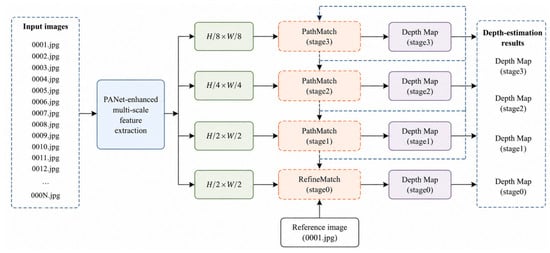
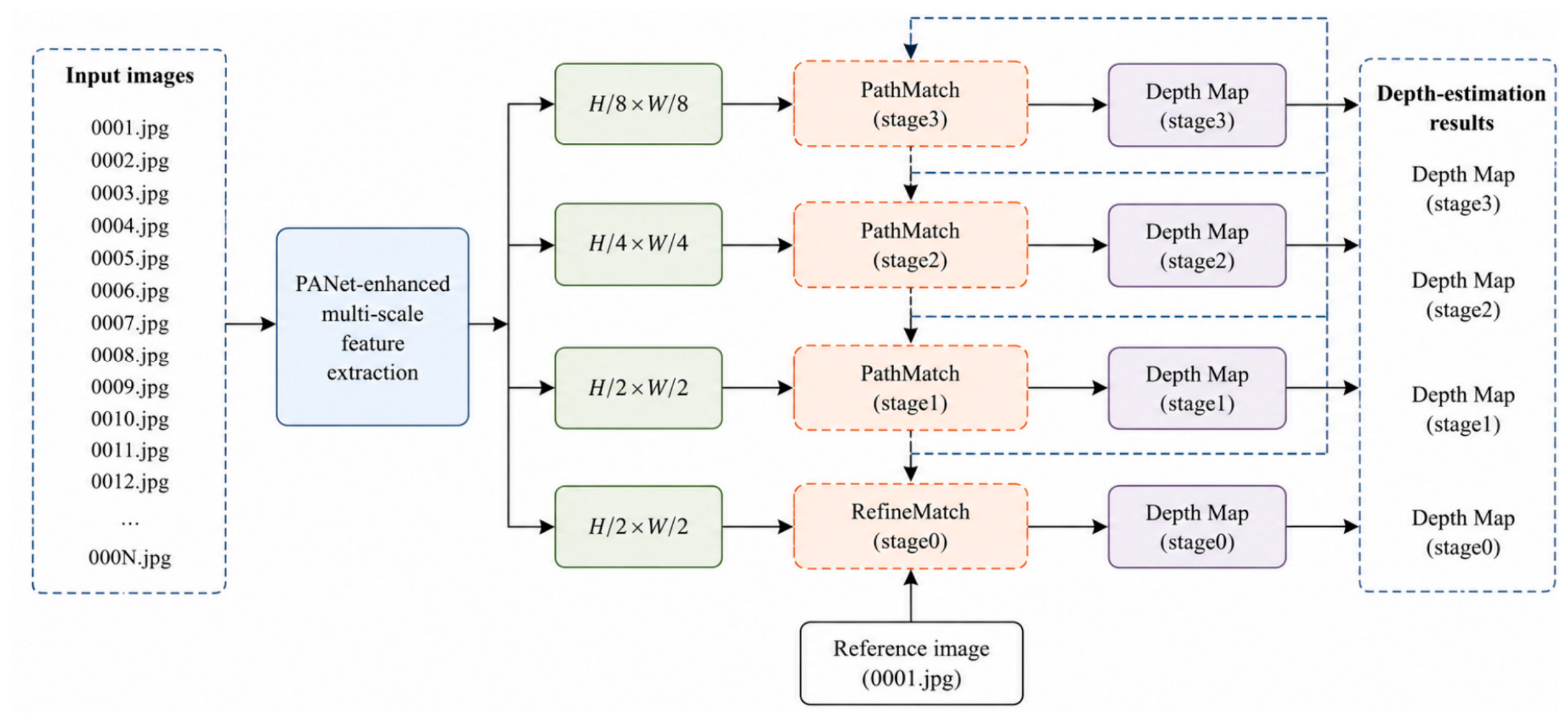
Figure 2 summarizes the stage connections. Stage 3 uses the H/8 × W/8 representation to establish global depth structure; its estimate initializes Stage 2 at H/4 × W/4, Stage 1 refines the result at H/2 × W/2, and Stage 0 performs final refinement using the reference image and the preceding depth estimate.
Figure 2.
Schematic of PANet-enhanced PatchMatchNet, distinguishing the Stage 3 → Stage 2 → Stage 1 → Stage 0 coarse-to-fine depth route from the H/2 → H/4 → H/8 bottom-up feature-exchange route.
In Figure 2, scale-specific features and depth estimates follow the main paths, while the propagated depth initializes the next finer stage. Coarse initialization avoids an unnecessarily broad high-resolution search. The bottom-up feature route simultaneously gives coarse matching access to boundary information that would otherwise become available only after the hypothesis range has narrowed.
Figure 2 is read as a schematic of the depth-estimation path, not as a complete layer-level specification. The original coarse-to-fine depth transfer is Stage 3 → Stage 2 → Stage 1 → Stage 0; the distinct PANet contribution is the bottom-up feature exchange H/2 → H/4 → H/8 that occurs before these features enter the corresponding matching stages. These are two different pathways: one transports feature information toward coarser scales, whereas the other propagates estimated depth toward finer scales.
Because each stage refines around an inherited estimate, an early depth error can persist through the cascade. PANet reduces this risk by enriching coarse features with local structural cues before the search interval contracts. Later stages then focus on boundary displacement and small gaps while remaining coupled to the coarse geometric solution.
Large depth-order errors are addressed first at low resolution, where the receptive field covers a wider area; finer stages correct local displacement and surface detail. The forward propagation of depth estimates preserves geometric coupling between stages rather than producing independent predictions at each scale.
PANet also avoids naive multi-scale stacking. Features are fused only after spatial alignment and returned to the appropriate PatchMatch stage, preserving the division of labor among coarse ordering, intermediate layout refinement, and fine boundary recovery. The bottom-up path enriches these roles rather than replacing them.
3.4. Cross-Scale Balance and Expected Error Reduction
The modification primarily targets weak-texture ambiguity and boundary erosion. Coarse context narrows plausible correspondences, whereas bottom-up access to shallow gradients protects thin structures and depth discontinuities. The expected effect is therefore a larger reduction in reconstruction-to-reference distance than in reference-to-reconstruction distance; feature fusion can improve localization but cannot create surfaces that are invisible in every view.
Section 5 tests this mechanism by comparing the two directed distances separately. A stronger change in localization than in coverage would be consistent with the role assigned to the bidirectional feature path, while the symmetric mean summarizes their combined geometric effect.
4. Reliability-Asymmetric Cost Aggregation and VR Deployment
4.1. Cost-Volume Aggregation Under Observation Asymmetry Heterogeneity-Aware Federated Optimization Has Also Been Examined for IoV Network Planning [42], Which Differs from the Shared Calibrated-View Geometry Used in This Evaluation
For each depth hypothesis, source features are warped to the reference frame and compared with the reference feature. Groupwise correlation forms a multi-channel response, and pixel-wise view weights combine source evidence. Because occlusion, reflection, repetitive texture, and accidental similarity are local, the resulting tensor is not uniformly reliable. The adaptive aggregator therefore estimates data-dependent channel and spatial weights in cost space rather than applying attention directly to RGB values.
A surface may be well observed in one location or feature group and ambiguous in another. Enforcing uniform treatment would amount to a false symmetry assumption. Instead, the network deliberately preserves reliability asymmetry: strong, coherent matching evidence can receive larger weights, while diffuse or inconsistent responses are attenuated before depth regression.
The cost tensor contains channel, spatial, and view-dependent uncertainty. Pixel-wise view weighting first controls how much each source view contributes. CBAM then acts on the combined representation, assigning nonuniform channel and spatial weights. The two operations are complementary: view weighting handles source contribution, whereas channel–spatial attention interprets the reliability pattern that remains after view aggregation.
For each candidate depth, reference and warped source features are correlated within channel groups. The grouped response retains multiple matching components rather than collapsing immediately to one scalar. After source-view combination, a high response can still arise from repeated texture, a mixed boundary, or an occluded surface. CBAM is applied at this point so that its weights are conditioned on depth-dependent matching evidence rather than image saliency alone.
The view-aggregated matching representation at stage s can be described using spatial dimensions Hs × Ws, a depth-hypothesis index k, and a feature-channel count C. CBAM applies channel weighting followed by spatial weighting to the aggregated evidence while preserving the external depth-stage interface. The analysis emphasizes module placement between source-view aggregation and depth regression and the corresponding reliability-aware role of attention.
4.2. Channel Attention for Cost-Volume Reweighting
Channel attention uses global average and maximum pooling to produce two channel descriptors. Equation (7) writes the shared multilayer perceptron as the operator g; sigmoid normalization yields the channel-weight vector:
ac(F) = σ(g(GAP(F)) + g(GMP(F)))
In Equation (7), ac(F) contains one weighting coefficient per channel. GAP aggregates overall channel response, whereas GMP retains strongly activated evidence. The same mapping (g) processes both pooled descriptors, and the resulting sigmoid weights reweight the cost representation channel by channel.
In the standard CBAM construction, channel-average and channel-maximum descriptors are processed by a shared bottleneck multilayer perceptron followed by a sigmoid gate. Spatial attention concatenates channel-average and channel-maximum maps and passes them through a 7 × 7 convolution and a sigmoid gate. Equations (7)–(10) express these channel–spatial weighting operations at the level used for the present cost-aggregation analysis.
4.3. Spatial Attention for Region-Sensitive Aggregation
For channel-wise feature vector fx at spatial position x, define its average and maximum response as two spatial descriptor maps:
In Equations (8) and (9), 1C is the C-dimensional all-ones vector, and fx contains the C channel responses at location x. Equation (10) stacks the descriptor maps and applies the spatial 7 × 7 convolution operator K7 × 7 followed by sigmoid normalization. Channel attention precedes this spatial gate in the adopted CBAM sequence.
The resulting spatial map determines where channel-refined evidence should influence depth regression. Channel attention selects response components; spatial attention selects locations. This deliberately asymmetric weighting is compatible with the symmetric projective geometry because it changes the confidence assigned to observations, not the geometry itself.
4.4. Joint Reconstruction Network with Symmetric Exchange and Asymmetric Reweighting
PANet and CBAM are inserted at distinct computational stages. PANet acts before correspondence computation and improves reciprocal information exchange among feature scales; CBAM acts after correlation and source-view combination and models nonuniform reliability in the matching representation. Their interfaces do not overlap, which allows the single-module and joint ablations to be interpreted mechanistically.
Cost-space attention is more directly tied to the reconstruction objective than independent RGB saliency because it operates on depth-conditioned evidence. A visually prominent texture is useful only if it is geometrically consistent across views. Since CBAM preserves tensor dimensions, the decoder, camera model, depth representation, and point-cloud output remain unchanged.
The architectural comparisons hold the calibrated imaging model, depth-search representation, and point-cloud fusion workflow fixed at the level described in this paper. PANet modifies cross-scale evidence exchange, and CBAM adjusts the view-aggregated matching tensor; their effects are evaluated through the reported directed and symmetric point-set distances.
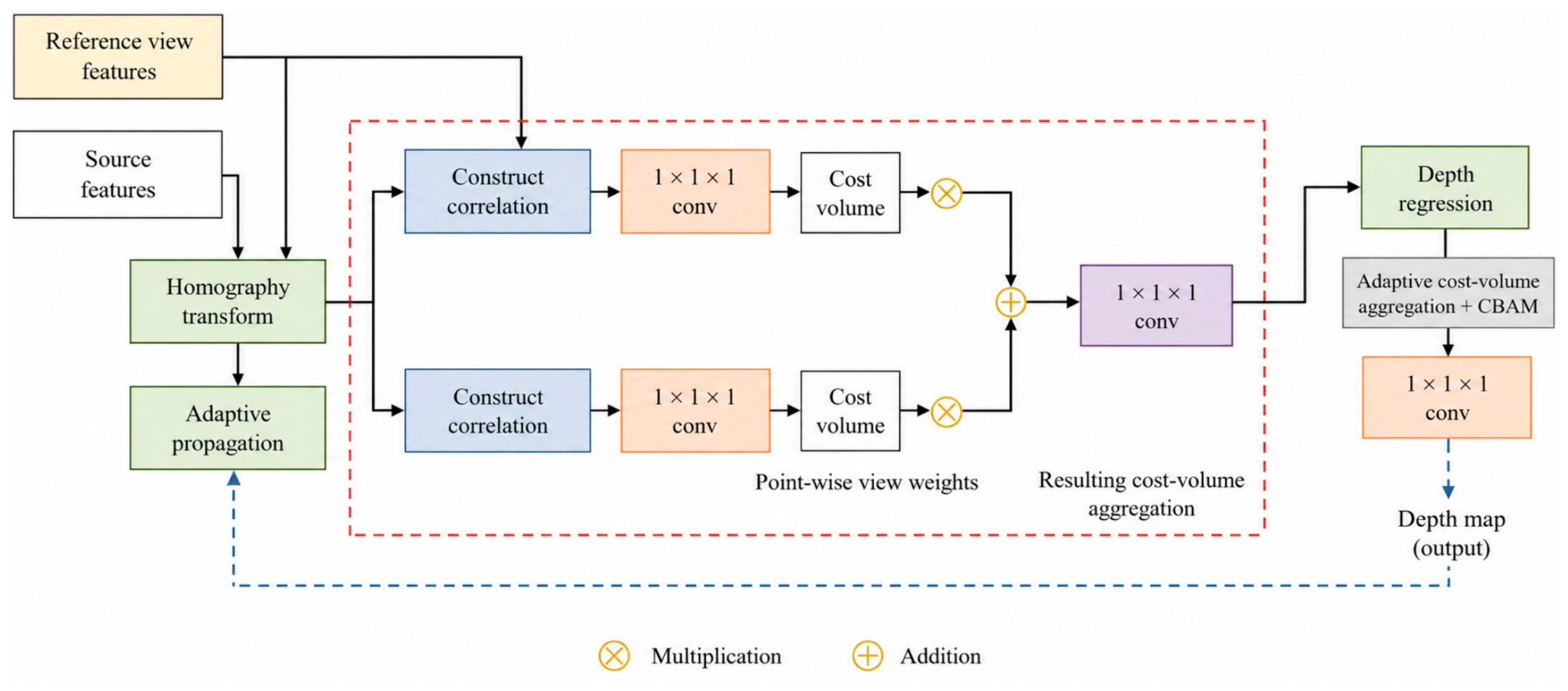
Figure 3 separates the two mechanisms. PANet changes the multi-scale evidence supplied to matching, whereas CBAM changes the channel–spatial reliability of the aggregated cost before depth regression. The modules are complementary because they act on different failure modes, although their gains need not be additive when weak-texture boundaries are affected by both representation and aggregation errors.
Figure 3.
Schematic of the jointly modified reconstruction pipeline. Original PatchMatchNet operations comprise calibrated warping, correlation, view weighting, aggregation, and depth regression; the additions are PANet feature exchange and post-aggregation CBAM weighting. The diagram does not encode undocumented tensor dimensions or kernel settings.
For Figure 3, the inherited operations are calibrated warping, groupwise correlation, pixel-wise source-view weighting, cost aggregation, and stage-wise depth regression. The introduced attention operation is located conceptually between the aggregated matching representation and depth regression. The figure is illustrative rather than a complete executable graph; in particular, its presentation does not establish channel count, depth-axis treatment, or a numerical attention bottleneck.
The joint model preserves the baseline camera model, depth-search interface, fusion procedure, and evaluation metrics. PANet is expected to improve localization of valid matches, while CBAM is expected to reduce the influence of ambiguous regions and improve surface support. Section 5 evaluates these effects through directed and symmetric point-set distances.
Depth fusion provides a geometric safeguard after attention. A locally high confidence can strengthen a candidate within one reference view, but the estimate must still reproject consistently into supporting views before entering the fused point cloud. The architecture-level comparison is informed by the directed aggregate metrics, while the retained images illustrate acquisition, depth estimation, and visual deployment.
4.5. Depth-Map Fusion, Point-Cloud Generation, and VR Scene Deployment
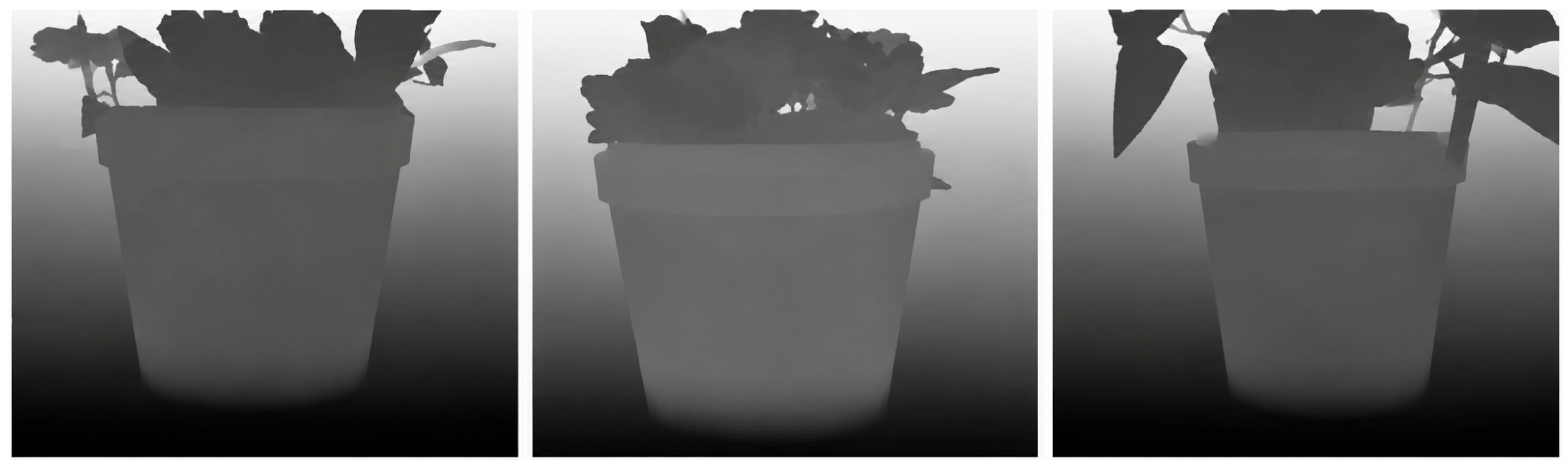
The final network produces a depth map for each selected reference view. Figure 4 shows depth maps of the potted-plant scene with display contrast normalized for visualization; the underlying depth values and image geometry are unchanged.
Figure 4.
Multi-view depth maps of the potted-plant scene. Display contrast is normalized for visualization; the underlying depth estimates are unchanged. Digital urban simulation provides a broader illustration of interactive spatial context [43], while functional electronic materials for sensing and heating concern the hardware rather than the geometry of such experiences [44].
Cross-view agreement among the main surfaces allows the fusion stage to reject inconsistent samples after attention. Fine vegetation remains less complete because subpixel or fully occluded structure provides insufficient multi-view evidence, regardless of feature exchange or cost reweighting.
After back-projection and consistency checking, accepted samples form a fused point cloud. Consistency filtering is intended to suppress unsupported samples while preserving geometry observed across calibrated views.
The PLY point cloud is an explicit geometric output that can be inspected, filtered, and converted to standard modeling formats. Absolute geometric accuracy is meaningful only when the reconstruction is compared with a reference of known scale and registration; this condition is satisfied by standard DTU evaluation but is not independently documented for the self-collected subset used in the mixed internal protocol.
For visualization, the fused point cloud is converted to a mesh-compatible asset in MeshLab and exported to Unity3D. Coordinate orientation, scale, normals, and material references are preserved during OBJ or FBX conversion. XR interaction then changes only the displayed pose through translation, rotation, and scaling; it does not alter the reconstructed geometry. The exported scenes could also be reused as visual prompts in immersive language practice.
The model was deployed in Unity3D on a PICO 4 Pro headset. Figure 5 records successful scene loading and viewpoint display, with translation, rotation, scaling, and predefined views available after asset import.
Figure 5.
Reconstructed three-dimensional scene loaded on the Pico VR device.
5. Experiments, Results, and Discussion
5.1. Datasets, Splits, and Experimental Configuration
Table 3 lists a custom allocation of 143 assigned scenes: training includes 83 DTU and 11 self-collected scenes (94 total, 65.7%); validation includes 11 DTU and 14 self-collected scenes (25 total, 17.5%); and testing includes 5 DTU and 19 self-collected scenes (24 total, 16.8%). In all, 99 DTU and 44 self-collected scenes are assigned. This is the study’s custom mixed allocation rather than the official DTU evaluation split. Related time-frequency-based fault detection designs illustrate task-specific preprocessing of weak observations [45]; here, the independent unit is a calibrated image sequence.
Table 3.
Custom mixed dataset allocation used for the experiments.
DTU contributes calibrated reference scenes, and the self-collected images introduce naturally non-ideal acquisition conditions. Comparisons are evaluated within each ablation table, using its explicitly recorded baseline, rather than as cross-table benchmark rankings.
Table 3 separately lists 5 self-collected scenes outside the 143-scene allocation. The assigned test subset comprises 5 DTU scenes and 19 self-collected scenes. The 50-scene acquisition description includes one scene not categorized in Table 3; all experimental subset totals refer to the 143 explicitly assigned scenes.
Table 4 summarizes the platform and reconstruction configuration accompanying the reported module comparisons.
Table 4.
Platform and reconstruction configuration for the reported experiments.
The recorded configuration identifies the NVIDIA GeForce RTX 4080 SUPER GPU, Ubuntu 22.04 LTS, COLMAP camera calibration, and three feature scales (H/2, H/4, H/8). The geometric processing chain comprises calibrated feature warping, depth-hypothesis search, matching-evidence aggregation, depth regression, and point-cloud fusion. Training details beyond those shown in Table 4 are not inferred from public default configurations.
The experiments are analyzed through the recorded point-set distances and the corresponding model architectures. The VR demonstration is treated as an illustration of scene export and visualization, separate from the geometric-distance comparisons.
The comparison distinguishes feature-path changes from cost-aggregation changes. These variations affect the information available to the depth decoder, whereas camera geometry and the point-cloud output interface remain conceptually fixed.
Percentage changes are calculated directly from the values reported in each comparison. The PatchMatchNet baselines in Table 5, Table 6 and Table 7 have different numerical values; accordingly, each table provides its own reference for relative comparisons, and the three baselines are not combined into a single control result. Method selection in maintenance optimization [46] and the combination of physical testing with numerical damage simulation [47] are examples of domain-specific evaluation designs; neither constitutes an additional stereo-reconstruction experiment.
Table 5.
Quantitative comparison of multi-scale fusion methods under the mixed evaluation protocol.
Table 6.
Quantitative comparison of attention mechanisms under the mixed evaluation protocol.
Table 7.
Quantitative comparison of PatchMatchNet module combinations under the mixed evaluation protocol.
5.2. Evaluation Metrics for Point-Cloud Accuracy and Completeness
Let R be the reconstructed point set and G the reference set. Define δ(x;S) = min{||x − y||2: y ∈ S} as the nearest-neighbor Euclidean distance from x to set S. Equation (11) writes reconstruction-to-reference distance as an expectation under the uniform distribution over R:
Interchanging the sampling and reference sets gives the reverse reference-to-reconstruction distance:
The symmetric indicator is an equally weighted linear combination of the two directional expectations:
Here, Unif(S) means uniform sampling over the finite point set S, and ||·||2 denotes Euclidean distance. Thus, Equations (11)–(13) retain the original nearest-neighbor distance definitions and arithmetic averaging; the vector form in Equation (13) is unchanged by exchanging R and G. For standard DTU evaluation, the reference geometry and coordinate system support millimeter interpretation. The custom mixed protocol values are interpreted as within-study distance indicators using the documented evaluation allocation.
Equations (11)–(13) define the directed nearest-neighbor distances and their symmetric mean for the custom evaluation. The metrics are interpreted in the context of the reported mixed allocation. Standard DTU scores and the custom point-set summaries are distinct evaluation quantities and are therefore not combined in a benchmark ranking.
Reconstruction-to-reference distance captures one direction of geometric deviation, while reference-to-reconstruction distance captures the reverse direction. Both reflect the interaction of geometry, point density, sampling, and registration. Their symmetric mean provides a compact aggregate comparison; the separate directions help explain how module choices alter the recorded point-set agreement.
The interpretation pairs point-set distances with the visual examples of consumer-camera reconstruction. Table 5, Table 6 and Table 7 each describe a specific ablation group; their trends are read relative to the baseline contained in that same table. Task-specific multi-objective modeling, such as physics-constrained viscoelastic property prediction [48], reinforces the need to interpret the objective variables of each comparison in their own units.
For the results in Table 5, Table 6 and Table 7, the term overall refers to the arithmetic mean of the two directed point-set distances shown in the same row. Reported numbers correspond to the custom mixed evaluation rather than official standard-DTU leaderboard entries.
The tables summarize architectural comparisons for the custom mixed scene allocation, and the accompanying figures document example input views, depth estimates, and VR asset display. The numerical unit is reported as nominal mm for consistency with the tabulated records and is interpreted within this evaluation setting.
5.3. Ablation of Multi-Scale Feature Fusion
Table 5 examines cross-scale representation by comparing the baseline feature pyramid with HRNet, adaptive spatial feature fusion (ASFF), and PANet variants. The reported directed distances and their symmetric mean show how alternative feature-aggregation strategies behave within this particular comparison.
Regarding Table 5, note that distances summarize the custom mixed evaluation (nominal mm). Improvements are calculated relative to the PatchMatchNet row in Table 5.
Within Table 5, the PANet variant changes the reconstruction-to-reference distance from 0.486 to 0.377 (22.4% lower), the reference-to-reconstruction distance from 0.324 to 0.262 (19.1% lower), and the symmetric mean from 0.405 to 0.320 (21.0% lower), using the displayed three-decimal values. Relative to the HRNet and ASFF variants in this comparison, PANet also has the lowest reported overall distance.
The cross-scale results are consistent with the purpose of a bottom-up feature path: early depth hypotheses receive geometric cues from the higher-resolution representation, while coarse features provide broader matching context. The larger relative decrease in the first directed distance than in the second is compatible with improved localization of visible structures, without requiring a claim about specific individual pixels. Research on online mitigation in communication networks [49] similarly separates an implemented processing mechanism from its target performance metrics; the geometric quantities used here are point-set distances.
The reported comparison links feature aggregation to point-set agreement under varied handheld image conditions. The observed ranking applies to the architectures and custom evaluation represented in Table 5 and illustrates the role of reciprocal scale communication in maintaining geometric scene structure.
5.4. Ablation of Attention Mechanisms and Joint Improvements
Table 6 compares ECA-Net, squeeze-and-excitation (SE), and CBAM inserted into the baseline matching pipeline. ECA-Net and SE operate primarily through channel reweighting; CBAM additionally includes a spatial attention stage that can respond to local ambiguity in aggregated matching evidence.
With regard to Table 6, note that distances summarize the custom mixed evaluation (nominal mm). Improvements are calculated relative to the PatchMatchNet row in Table 6.
Within Table 6, CBAM changes the reconstruction-to-reference distance from 0.482 to 0.434 (10.0% lower), the reverse distance from 0.324 to 0.268 (17.3% lower), and the symmetric mean from 0.403 to 0.351 (12.9% lower), using the tabulated values. In this comparison, the spatial-and-channel CBAM variant has the lowest reported overall distance among the evaluated attention choices.
ECA-Net and SE emphasize channel information, whereas CBAM combines channel weighting with a spatial mask. The larger relative change in the reverse directed distance in Table 6 is consistent with improved support across geometrically represented regions, while the metrics remain aggregate descriptors of reconstructed point sets.
Table 7 compares four module configurations—baseline, PANet only, CBAM only, and their combination—to assess the reported outcome of using reciprocal feature exchange and spatially adaptive cost reweighting together. Each configuration is compared against the baseline recorded in Table 7.
With regard to Table 7, note that distances summarize the custom mixed evaluation (nominal mm). Improvements are calculated relative to the PatchMatchNet baseline in Table 7.
In Table 7, the reported symmetric mean decreases from 0.402 for PatchMatchNet to 0.373 with PANet, 0.304 with CBAM, and 0.286 with both modules. The joint variant also changes the directed distances from 0.483/0.321 to 0.350/0.222. Relative to the baseline in this table, these are decreases of 27.5% and 30.8% in the two directed measures, and 28.9% in the symmetric mean (a difference of 0.116). These results describe the four module settings within the Table 7 comparison.
The joint model combines two complementary processing roles: bidirectional feature exchange supplies cross-scale evidence before matching, and channel–spatial attention adapts the cost representation before depth regression. Table 7 shows a lower overall distance for the joint setting than either individual module in that comparison, consistent with these functions operating at distinct points in the pipeline.
5.5. Discussion: Cross-Scale Symmetry, Matching Reliability, and Immersive Visualization
The results can be interpreted through the placement of the two modules in the reconstruction pipeline. PANet alters the direction in which information travels among feature scales; CBAM assigns nonuniform importance to the resulting matching representation. The directed point-set distances summarize different aspects of geometric agreement. Their relative trends are informative at the architecture level and are interpreted alongside the corresponding visual examples. Frequency-enhanced state-space models for incipient feeder faults [50] concern a different form of evidence weighting, while Koopman surrogates for rail dynamics [51] represent time-varying states rather than the static scene geometry addressed here.
This distinction is important because symmetry is not imposed indiscriminately. The calibrated projection model and the symmetric mean metric treat corresponding geometric relations consistently, but the observations themselves are not equally reliable. Cross-scale information exchange benefits from greater reciprocity, whereas view-, channel-, and region-dependent matching evidence requires asymmetric weighting. The architecture therefore uses symmetry where exchange should be balanced and asymmetry where the data are intrinsically nonuniform.
Under non-ideal imaging, the two mechanisms address different propagation paths for error. Bidirectional scale communication can preserve edges weakened by reduced effective resolution or weak texture, while cost-domain attention can attenuate localized ambiguity caused by occlusion, repetitive structure, or illumination change. Neither mechanism corrects inaccurate camera calibration, creates evidence for fully occluded surfaces, or guarantees invariance to a specified degradation severity.
The illustrative acquisition sequence in Figure 1 and depth maps in Figure 4 contain low-texture regions, geometric boundaries, cast shadows, and changing viewpoints. These naturally co-occurring conditions are relevant to the problem of producing consistent geometry from consumer-camera input and to the visual coherence of immersive scene assets.
Consumer-camera imagery combines local texture variations, viewpoint changes, and unequal visibility across the scene. The feature and cost pathways are designed around these spatially varying inputs: fine-scale detail can contribute to coarse matching, while locally adaptive weighting acts on aggregated evidence after warping. Domain-specific transport simulations, including heavy-component flow in storage tanks [52] and ion transport in polymer electrolytes [53], operate on physical fields rather than camera-projected surfaces. These distinctions keep the interpretation of the present results tied to stereo geometry.
The reported geometric comparisons and representative images jointly address reconstruction quality in naturally varied handheld settings. Controlled single-factor perturbations and alternative acquisition configurations provide possible extensions of the same symmetry/asymmetry analysis.
Relative to recent MVS work, the architectural contribution is deliberately specific. TransMVSNet strengthens global matching, UniMVSNet changes depth representation, GeoMVSNet adds geometry perception, and GoMVS enforces geometric consistency in cost aggregation. The present method retains PatchMatchNet’s search and fusion interfaces while altering reciprocal cross-scale feature communication and post-correlation reliability weighting. A numerical state-of-the-art comparison would require a common DTU protocol, resolution, source-view count, training data, reference geometry, and computational budget.
The retained figures document image capture, depth estimation, and VR display, while Table 5, Table 6 and Table 7 summarize the respective architectural comparisons. After calibrated reconstruction, the point-cloud representation is carried through MeshLab conversion into Unity3D, connecting geometric processing with reusable immersive visual scenes.
The retained acquisition and depth-map illustrations provide visual context for the reconstruction workflow. Apparent image softness can depend on the capture conditions as well as rendering, screenshot extraction, resizing, and manuscript export. The reproduced panels are interpreted in terms of visible scene structure and depth-map presentation rather than as measurements of native camera resolution.
For intelligent-education applications, the reconstructed VR environments offer reusable visual task contexts for foreign-language interpreting practice and structured assessment design. Scene consistency and geometric detail provide a technical basis for presenting comparable immersive prompts across training activities.
The PICO 4 Pro visualization demonstrates the transfer of a point-cloud-derived asset into an immersive display environment. In the reported pipeline, this asset provides a visual resource that can support the design of standardized interpreting prompts and interactive training scenarios.
The contribution centers on the relationship between reciprocal cross-scale feature exchange, observation-dependent matching weights, and the resulting directed point-set distances. The experiments use a custom mixed collection of DTU and consumer-camera scenes, with each module comparison interpreted according to its own tabulated baseline.
The evaluation treats geometric distance, visual scene rendering, and language-training application as distinct layers: the first is represented by the reported point-set tables, the second by the exported VR scenes, and the third by the potential reuse of those scenes in instructional activities. This separation maintains a direct connection between the measured variables and the claims made from them.
Within the reported mixed evaluation, the PANet-style path and post-aggregation CBAM weighting correspond to lower directed and symmetric point-set distances in the respective comparisons. The architecture preserves the original geometric depth-search and point-cloud export interfaces.
Further work can extend this framework through scene-specific evaluation, controlled optical degradations, and standardized visual tasks in immersive language training. These directions connect the geometric reconstruction methodology with structured educational content without changing the interpretation of the current numerical results.
Together, these results show that the most defensible role of symmetry in this task is structural rather than semantic: reciprocal pathways and bidirectional metrics improve balance where information should be exchanged in both directions, while adaptive attention retains the asymmetry required by nonuniform observations.
6. Conclusions
This work examines passive multi-view 3D reconstruction for preparing coherent visual environments from non-ideal consumer-camera images. The PatchMatchNet-based architecture combines bidirectional PANet-style feature exchange with CBAM reweighting of view-aggregated matching evidence. The design treats cross-scale communication as reciprocal while allowing observation reliability to vary across feature channels and spatial locations.
- (1)
- In the Table 7 joint-module comparison, reconstruction-to-reference, reference-to-reconstruction, and symmetric-mean distances are 0.350, 0.222, and 0.286 (nominal mm), versus 0.483, 0.321, and 0.402 for its PatchMatchNet baseline. The corresponding reductions are 27.5%, 30.8%, and 28.9%, respectively. These quantities are reported for the custom mixed evaluation and describe the architectural variants within that comparison.
- (2)
- Table 5 and Table 6 separately describe feature-fusion and attention-module choices. Their PANet and CBAM variants have symmetric-mean distances of 0.320 and 0.351, respectively, using the baselines in their own tables. The directional comparisons support a focused analysis of reciprocal geometric evidence and spatially variable matching reliability under consumer-camera image conditions.
- (3)
- The reconstruction workflow produces calibrated depth estimates, fused point-cloud assets, and an immersive Unity3D display demonstrated with the PICO 4 Pro. The exported environments provide reusable visual contexts for planning foreign-language interpreting exercises and structured assessment prompts in intelligent education. In this way, the geometric modeling study contributes an enabling visual-scene component to immersive teaching applications.
Author Contributions
Conceptualization, J.L. and S.Z.; methodology, J.L.; software, J.L.; validation, J.L. and S.Z.; formal analysis, J.L.; investigation, J.L.; resources, S.Z.; data curation, J.L.; writing—original draft preparation, J.L.; writing—review and editing, J.L. and S.Z.; visualization, J.L.; supervision, S.Z.; project administration, S.Z. All authors have read and agreed to the published version of the manuscript.
Funding
This work was supported by 2021 Ministry of Education Industry-University Cooperation Collaborative Education Project “Research on the Application of Blended Teaching Mode in Interpreting Courses for Foreign Language Majors” Project Number: 202102029007.
Data Availability Statement
The original contributions presented in this study are included in the article. Further inquiries can be directed to the corresponding author.
Conflicts of Interest
The authors declare no conflict of interest.
References
- Hartley, R.; Zisserman, A. Multiple View Geometry in Computer Vision, 2nd ed.; Cambridge University Press: Cambridge, UK, 2004. [Google Scholar] [CrossRef] [Scilit]
- Seitz, S.M.; Curless, B.; Diebel, J.; Scharstein, D.; Szeliski, R. A comparison and evaluation of multi-view stereo reconstruction algorithms. In Proceedings of the IEEE Computer Society Conference on Computer Vision and Pattern Recognition, New York, NY, USA, 17–22 June 2006; pp. 519–528. [Google Scholar] [CrossRef] [Scilit]
- Lv, H.; Li, C.; Dai, J.; Zhang, Y.; Fan, Z.; Tan, Y.; Wang, D.; Xie, B. Lightweight framework for underground pipeline recognition and spatial localization based on multi-view 2D GPR images. IEEE Trans. Geosci. Remote Sens. 2025, 63, 5110115. [Google Scholar] [CrossRef] [Scilit]
- Wang, X.; Guo, S.; Xu, Z.; Zhang, Z.; Sun, Z.; Xu, Y. A robotic teleoperation system enhanced by augmented reality for natural human–robot interaction. Cyborg Bionic Syst. 2024, 5, 0098. [Google Scholar] [CrossRef] [Scilit] [PubMed]
- Schönberger, J.L.; Frahm, J.-M. Structure-from-motion revisited. In Proceedings of the IEEE Conference on Computer Vision and Pattern Recognition, Las Vegas, NV, USA, 27–30 June 2016; pp. 4104–4113. [Google Scholar] [CrossRef] [Scilit]
- Schönberger, J.L.; Zheng, E.; Frahm, J.-M.; Pollefeys, M. Pixelwise view selection for unstructured multi-view stereo. In Computer Vision-ECCV 2016; Springer: Cham, Switzerland, 2016; pp. 501–518. [Google Scholar] [CrossRef] [Scilit]
- Huang, Z.; Yang, S.; Zhou, M.; Li, Y.; Gong, Z.; Chen, Y. Feature map distillation of thin nets for low-resolution object recognition. IEEE Trans. Image Process. 2022, 31, 1364–1379. [Google Scholar] [CrossRef] [Scilit] [PubMed]
- Liu, M.; Dong, Z.; Shi, H. Multi-sensor information fusion and multi-model fusion-based remaining useful life prediction of fan slewing bearings with the nonlinear Wiener process. Sustainability 2023, 15, 12010. [Google Scholar] [CrossRef] [Scilit]
- Barnes, C.; Shechtman, E.; Finkelstein, A.; Goldman, D.B. PatchMatch: A randomized correspondence algorithm for structural image editing. ACM Trans. Graph. 2009, 28, 24. [Google Scholar] [CrossRef] [Scilit]
- Wang, F.; Galliani, S.; Vogel, C.; Speciale, P.; Pollefeys, M. PatchMatchNet: Learned multi-view PatchMatch stereo. In Proceedings of the IEEE/CVF Conference on Computer Vision and Pattern Recognition, Nashville, TN, USA, 20–25 June 2021; pp. 14194–14203. [Google Scholar]
- Lin, T.-Y.; Dollár, P.; Girshick, R.; He, K.; Hariharan, B.; Belongie, S. Feature pyramid networks for object detection. In Proceedings of the IEEE Conference on Computer Vision and Pattern Recognition, Honolulu, HI, USA, 21–26 July 2017; pp. 2117–2125. [Google Scholar] [CrossRef] [Scilit]
- Liu, S.; Qi, L.; Qin, H.; Shi, J.; Jia, J. Path aggregation network for instance segmentation. In Proceedings of the IEEE/CVF Conference on Computer Vision and Pattern Recognition, Salt Lake City, UT, USA, 18–22 June 2018; pp. 8759–8768. [Google Scholar] [CrossRef] [Scilit]
- Liu, Z.; Kwan, M.-P.; Jiang, W.; Liu, Y.; Cui, B. A lightweight multiscale fusion framework for traffic vehicle detection from satellite remote sensing, UAV, and CCTV imagery. IEEE Trans. Geosci. Remote Sens. 2026, 64, 5632717. [Google Scholar] [CrossRef] [Scilit]
- Woo, S.; Park, J.; Lee, J.-Y.; Kweon, I.S. CBAM: Convolutional block attention module. In Computer Vision-ECCV 2018; Springer: Cham, Switzerland, 2018; pp. 3–19. [Google Scholar] [CrossRef] [Scilit]
- Wang, Y.; Xiao, H.; Ma, C.; Zhang, Z.; Cui, X.; Xu, A. On-board detection of rail corrugation using improved convolutional block attention mechanism. Eng. Appl. Artif. Intell. 2025, 146, 110349. [Google Scholar] [CrossRef] [Scilit]
- Niemeyer, M.; Barron, J.T.; Mildenhall, B.; Sajjadi, M.S.M.; Geiger, A.; Radwan, N. RegNeRF: Regularizing neural radiance fields for view synthesis from sparse inputs. In Proceedings of the IEEE/CVF Conference on Computer Vision and Pattern Recognition, New Orleans, LA, USA, 18–24 June 2022; pp. 5480–5490. [Google Scholar]
- Darmon, F.; Bascle, B.; Devaux, J.-C.; Monasse, P.; Aubry, M. Improving neural implicit surfaces geometry with patch warping. In Proceedings of the IEEE/CVF Conference on Computer Vision and Pattern Recognition, New Orleans, LA, USA, 18–24 June 2022; pp. 6260–6269. [Google Scholar]
- Lin, G.; Yang, S.; Zheng, W.-S.; Li, Z.; Huang, Z. A semantically guided and focused network for occluded person re-identification. IEEE Trans. Inf. Forensics Secur. 2025, 20, 9716–9731. [Google Scholar] [CrossRef] [Scilit]
- Ding, Y.; Yuan, W.; Zhu, Q.; Zhang, H.; Liu, X.; Wang, Y.; Liu, X. TransMVSNet: Global context-aware multi-view stereo network with transformers. In Proceedings of the IEEE/CVF Conference on Computer Vision and Pattern Recognition, New Orleans, LA, USA, 18–24 June 2022; pp. 8585–8594. [Google Scholar]
- Peng, R.; Wang, R.; Wang, Z.; Lai, Y.; Wang, R. Rethinking depth estimation for multi-view stereo: A unified representation. In Proceedings of the IEEE/CVF Conference on Computer Vision and Pattern Recognition, New Orleans, LA, USA, 18–24 June 2022; pp. 8645–8654. [Google Scholar]
- Zhang, Z.; Peng, R.; Hu, Y.; Wang, R. GeoMVSNet: Learning multi-view stereo with geometry perception. In Proceedings of the IEEE/CVF Conference on Computer Vision and Pattern Recognition, Vancouver, BC, Canada, 17–24 June 2023; pp. 21508–21518. [Google Scholar]
- Wu, J.; Li, R.; Xu, H.; Zhao, W.; Zhu, Y.; Sun, J.; Zhang, Y. GoMVS: Geometrically consistent cost aggregation for multi-view stereo. In Proceedings of the IEEE/CVF Conference on Computer Vision and Pattern Recognition, Seattle, WA, USA, 17–21 June 2024; pp. 20207–20216. [Google Scholar]
- Wang, X.; Yang, X.; Huang, Z.; Chen, Y. CLIP-SD: CLIP-enhanced self-distillation for visual recognition. IEEE Trans. Multimed. 2026, 28, 2201–2213. [Google Scholar] [CrossRef] [Scilit]
- Hu, H.; Su, L.; Mao, S.; Chen, M.; Pan, G.; Xu, B.; Zhu, Q. Adaptive region aggregation for multi-view stereo matching using deformable convolutional networks. Photogramm. Rec. 2023, 38, 430–449. [Google Scholar] [CrossRef] [Scilit]
- Pei, J.; Feng, M. Explainable federated clustering via visual embedding and boundary interpretation. Neurocomputing 2026, 697, 134236. [Google Scholar] [CrossRef] [Scilit]
- Cui, Q.; Ding, Z.; Chen, F. Hybrid directed hypergraph learning and forecasting of skeleton-based human poses. Cyborg Bionic Syst. 2024, 5, 0093. [Google Scholar] [CrossRef] [Scilit] [PubMed]
- Li, J.; Li, J.; Wang, X.; Zhan, X.; Zeng, Z. A domain generalization and residual network-based emotion recognition from physiological signals. Cyborg Bionic Syst. 2024, 5, 0074. [Google Scholar] [CrossRef] [Scilit] [PubMed]
- Yang, S.; Yang, J.; Zhou, M.; Huang, Z.; Zheng, W.-S.; Yang, X.; Ren, J. Learning from human educational wisdom: A student-centered knowledge distillation method. IEEE Trans. Pattern Anal. Mach. Intell. 2024, 46, 4188–4205. [Google Scholar] [CrossRef] [Scilit] [PubMed]
- Feng, L.; Guo, M.; Wang, W.; Chen, Y.; Shi, Q.; Guo, W.; Lou, Y.; Kang, H.; Chen, Z.; Zhu, Y. Comparative Analysis of Machine Learning Methods and a Physical Model for Shallow Landslide Risk Modeling. Sustainability 2023, 15, 6. [Google Scholar] [CrossRef] [Scilit]
- Pei, J.; Frascolla, V.; Al-Dulaimi, A.; Liu, W.; Aldhyani, T.H.H.; Bashir, A.K.; Mumtaz, S. Distributed large models training optimization with real-time wireless channel feedback. IEEE J. Sel. Areas Commun. 2026, 44, 2231–2243. [Google Scholar] [CrossRef] [Scilit]
- Tang, D.; Tan, P.; Yan, Y.; Li, K.; Liang, W.; Qin, Z.; Zhang, J. Low-rate flow table overflow attacks in SDN: Model, analysis and a machine learning based mitigation approach. IEEE Trans. Comput. 2026, 75, 2253–2266. [Google Scholar] [CrossRef] [Scilit]
- Xu, Y.; He, J.; Talati, I.C.; Qian, Y.; Wang, Y.; Xu, Z.; Shang, D. Policy-bounded, provenance-aware deployment assurance for LLM request routing. SSRN 2026, SSRN:7554440. [Google Scholar]
- Wang, Y.; Tang, Y.; Liu, B.; Liu, X.; Shang, D. When LLM Reward Design Fails: Diagnostic-Driven Refinement for Sparse Structured RL. Transactions on Machine Learning Research. 2026. Available online: https://openreview.net/forum?id=5TmwBBn8Oh (accessed on 22 October 2026).
- Luo, H.; Li, Q.; Zhou, H.; Sun, W.; Li, W.; Liu, Z.; Ji, Y.; Ding, L. Weak single phase-to-ground fault time detection with learnable-parameter-driven DSP-enhanced transformer. IEEE Trans. Smart Grid. 2026, 17, 1693–1708. [Google Scholar] [CrossRef] [Scilit]
- Chen, Z.; Man, Z.; Rao, S.; Zhao, J.; Wang, S.; Zhang, R.; Teng, F.; Tang, A. Rigid crosslinker-assisted nondestructive direct photolithograph for patterned QLED displays. Light Sci. Appl. 2025, 14, 251. [Google Scholar] [CrossRef] [Scilit] [PubMed]
- Han, Z.; Tian, H.; Han, X.; Wu, J.; Zhang, W.; Li, C.; Qiu, L.; Duan, X.; Tian, W. A respiratory motion prediction method based on LSTM-AE with attention mechanism for spine surgery. Cyborg Bionic Syst. 2024, 5, 0063. [Google Scholar] [CrossRef] [Scilit] [PubMed]
- Wang, J.; Deng, J.; Rashwan, T.L.; Liu, D.; Ren, S.; Qu, G.; Wang, C. Coal spontaneous combustion temperature prediction under variable oxygen atmospheres using Chameleon Swarm Algorithm-optimized Long Short-Term Memory. Energy 2026, 363, 142304. [Google Scholar] [CrossRef] [Scilit]
- Fan, E.; Chen, Y.; Shan, Z.; Nahrstedt, K.; Caesar, M.; Kim, J. Communication-aware multi-agent reinforcement learning for decentralized cooperative UAV deployment. arXiv 2026, arXiv:2603.16141. [Google Scholar] [CrossRef] [Scilit]
- Peng, Y.; Xiang, L.; Yang, K.; Jiang, F.; Wang, K.; Wu, D.O. SIMAC: A semantic-driven integrated multimodal sensing and communication framework. IEEE J. Sel. Areas Commun. 2025, 44, 673–688. [Google Scholar] [CrossRef] [Scilit]
- Das, A.; Jiang, P.; Zhu, D.; Poczos, B.; Lugo-Martinez, J. State-space architectures for scalable diffusion-based 3D molecule generation. In Proceedings of the NeurIPS 2025 Workshop on Structured Probabilistic Inference and Generative Modeling, San Diego, CA, USA, 6 December 2025. [Google Scholar]
- Fuhrmann, S.; Langguth, F.; Waechter, M.; Goesele, M. MVE—An Image-Based Reconstruction Environment. Comput. Graph. 2015, 53, 44–53. [Google Scholar] [CrossRef] [Scilit]
- Pei, J.; Xu, X.; Wang, L.; Al-Rubaye, S.; Zhang, S.; Al-Dulaimi, A. Adaptive federated learning for future IoV-oriented IoT end-to-end network planning. IEEE Internet Things J. 2026, 13, 22488–22500. [Google Scholar] [CrossRef] [Scilit]
- Pan, L.; Yang, F.; Lu, F.; Qin, S.; Yan, H.; Peng, R. Multi-Agent Simulation of Safe Livability and Sustainable Development in Cities. Sustainability 2020, 12, 2070. [Google Scholar] [CrossRef] [Scilit]
- Guo, J.; Chen, C.; Dong, X.; Li, X.; Zhao, Q.; Zhang, M.; Yang, C. Multi-Functional Liquid Metal/Carbon Nanotubes/Bacterial Cellulose Flexible Composite Film, Suitable for Electromagnetic shielding, Intelligent Wearable Sensors and Joule Heater Materials. Colloids Surf. A Physicochem. Eng. Asp. 2026, 752, 141829. [Google Scholar] [CrossRef] [Scilit]
- Li, Q.; Luo, H.; Cheng, H.; Deng, Y.; Sun, W.; Li, W.; Liu, Z. Incipient fault detection in power distribution system: A time–frequency embedded deep-learning-based approach. IEEE Trans. Instrum. Meas. 2023, 72, 2507914. [Google Scholar] [CrossRef] [Scilit]
- Cui, B.; Wang, H. Optimization of risk-based and cost-minimized maintenance strategy for corroded pipeline using reinforcement learning. Reliab. Eng. Syst. Saf. 2026, 276, 112929. [Google Scholar] [CrossRef] [Scilit]
- Liu, Z.; Gu, X.; Kwan, M.-P.; Cui, B. Integrated ultrasonic testing and numerical simulation for damage detection in steel bridge deck pavements. Eng. Struct. 2026, 355, 122421. [Google Scholar] [CrossRef] [Scilit]
- Cui, B.; Wang, H. Coupled prediction of viscoelastic properties of asphalt mixtures using a multi-task physics-constrained neural network. Adv. Eng. Inform. 2026, 72, 104437. [Google Scholar] [CrossRef] [Scilit]
- Tang, D.; Tao, R.; Gao, C.; Li, K.; Qin, Z.; Zhang, J.; Dai, R. Gemini: An online mitigation system against sneaky DoS attacks in SDN. IEEE Trans. Comput. 2026. Epub ahead of printing. [Google Scholar] [CrossRef] [Scilit]
- Luo, H.; Feng, Q.; Sun, W.; Li, W.; Li, Q.; Zhao, W.; Liu, Z. FD-Mamba with neural observer and frequency-enhanced update for incipient feeder fault detection. IEEE Internet Things J. 2026, 13, 20761–20772. [Google Scholar] [CrossRef] [Scilit]
- Wang, X.; Song, Y.; Yang, H.; Yao, J.; Wang, H.; Liu, Z. Koopman Neural Operator-based surrogate modelling for high-frequency dynamics of high-speed rail pantographs. Mech. Syst. Signal Process. 2026, 258, 114780. [Google Scholar] [CrossRef] [Scilit]
- Wang, Y.; Xu, Z.; Tian, Z.; Liu, W.; Yang, J.; Huang, Q. Progress in the flocculation and sedimentation mechanisms and jet mixing transportation of heavy components in crude oil storage tanks. J. Pipeline Sci. Eng. 2026, 100511. [Google Scholar] [CrossRef] [Scilit]
- Li, C.; Liu, P.; Zhao, M.; Zhang, Y.; Bao, H.; Yang, M.; Chen, Y.; Zhong, G. Regulation mechanism of dielectric constant on ion transport behavior in vinylidene fluoride-based solid composite electrolytes. Electrochim. Acta 2026, 573, 149499. [Google Scholar] [CrossRef] [Scilit]

Disclaimer/Publisher’s Note: The statements, opinions and data contained in all publications are solely those of the individual author(s) and contributor(s) and not of MDPI and/or the editor(s). MDPI and/or the editor(s) disclaim responsibility for any injury to people or property resulting from any ideas, methods, instructions or products referred to in the content. |
© 2026 by the authors. Licensee MDPI, Basel, Switzerland. This article is an open access article distributed under the terms and conditions of the Creative Commons Attribution (CC BY) license.