


Abstract
A dynamic extended Beer–Lambert law with photodissociation and recombination is proposed, which is built to describe the interactions between light and molecular gases. The model comprises two spatiotemporally coupled first-order nonlinear partial differential equations. Numerical solutions of these equations systematically reveal the nonlinear transmission properties and steady-state dissociation behavior of the medium from the weak- to intense-light regime. In the weak-light limit, the model naturally reduces to the classic Beer–Lambert law, with the system reaching a steady state characterized by high molecular density and exponential light attenuation. Conversely, in the intense-light regime, low molecular concentration and pronounced photoinduced transparency occurs, and light attenuates linearly instead of exponentially. A method for measuring the recombination rate constant under steady-state conditions is presented, which imposes significantly lower demands on both the light intensity and the temporal resolution of the measurement equipment compared to conventional approaches.
1. Introduction
The propagation of light in an absorbing medium is typically described by the Beer–Lambert law (BL law) [1,2], which states that the light intensity decays exponentially with the penetration depth, while the medium remains unchanged. BL law is valid under conditions of weak light and dense media, because the molecules consumed by light absorption are negligible, or the molecules have sufficient time to recover to their original state after absorbing photons. However, in the case of intense light and dilute media, the absorbed photon number is comparable with the total number of molecules. Parnis et al. [3,4] proposed an extended Beer–Lambert law to deal with this case, with the form given below:
Here, I and c denote the dimensionless light intensity and the spatial number density (concentration) of the medium molecules, respectively. This model can be successfully applied to describe photochemical reaction processes that lack a spontaneous reverse reaction, such as photocyclization and photocycloreversion reactions in photochromism [5]. However, a limitation of this model is that it has no non-trivial steady-state solution, which means it can not revert to the conventional BL law naturally. It can be seen from Equation (2) that the molecular concentration c decreases monotonically. That is, after a sufficiently long time, all of the medium will inevitably be consumed, light absorption will no longer occur, and the medium will become completely transparent. This outcome is inconsistent with many actual light absorption processes, and the reason is that it fails to account for the reversibility of the light absorption process. For example, in reactions such as the photodissociation of iodine molecules, the dissociated iodine atoms spontaneously recombine to form iodine molecules, thereby increasing the molecular number density. In addition to photodissociation, molecules may also absorb photons through energy-level transitions. In this case, the reversibility manifests in the fact that the excited particles spontaneously return to the ground state via radiative decay or collisional relaxation, thereby regaining the ability to absorb photons. The mechanisms of “spontaneous reversibility” include, but are not limited to, the two cases described above. However, we will limit our discussion to photodissociation in this paper. The influence of such reversibility effects is not captured in the model proposed in [3]. After a limited literature survey [6,7,8,9,10,11,12,13], we have not found the anticipated model.
In this paper, taking the photodissociation of iodine molecules as an example, we develop a kinetic model capable of handling reversible photochemical reactions by introducing a recombination term. By numerically solving this set of spatiotemporally coupled equations, we then systematically investigate the nonlinear transmission characteristics and molecular dissociation behavior of the medium over a range spanning from weak to intense light fields. As an application of this model, we present a method for measuring the rate constant of recombination under steady-state.
The present work is motivated by the practical needs arising from the research on dynamic zooming technology. Dynamic zooming is a highly desirable and challenging technology in direct-drive laser fusion experiments, which refers to the reduction of the laser focal spot diameter on a nanosecond timescale to match the continuously shrinking target pellet [14,15]. This technique can effectively suppress cross-beam energy transfer and improve irradiation uniformity [15]. In the course of this research, we have innovatively proposed a novel scheme based on the photodissociation of iodine molecules. The change in chemical bonds before and after the dissociation of iodine molecules brings about a slight variation in their refractive index, which, through appropriate optical path design, can be utilized to shift the position of the focal spot. Therefore, we need to know precisely how the iodine molecule concentration varies with time and convert this into the corresponding change in refractive index. The related work will be published separately later. In this paper, we present, merely as an application example, the dimensionless recombination rate constant calculated under typical parameter conditions.
2. Model Formulation and Solution
The photodissociation of iodine molecules and its reverse reaction can be expressed as
Based on the original model of Equations (1) and (2), we only need to incorporate the contribution of recombination to the molecular number density into Equation (2). The recombination of iodine atoms is essentially a three-body reaction that depends on the concentration and efficiency of the third body. However, when the concentration of the third body is fixed, it can also be treated as a two-body reaction, with the influence of the third body fully absorbed into the reaction rate constant. This is the approach adopted in Ref. [16]. The atomic recombination term can be written as where is the rate constant and denotes the concentration of iodine atoms. The incident light intensity and the initial concentration of iodine molecules are denoted by and , respectively. According to mass conservation and the fact that iodine atoms are produced by the dissociation of iodine molecules, we get
Substituting into the recombination term, the complete set of equations can be written as
where is the absorption cross-section of iodine molecules. The quantum yield of this reaction is unity (i.e., one molecule dissociates upon absorbing one photon) [17], so we have directly set it to 1 in the above equations. Both and the quantum yield are wavelength-dependent. We treated them as constants in this paper because we are only concerned with the absorption of iodine molecules near 527 nm. If a broader spectral range were to be studied, neither of these two quantities could be treated as constants. We adopt the same nondimensionalization scheme as that used by Parnis [3]; namely,
Then the corresponding dimensionless rate constant is given by
For simplicity, the hat notation will be omitted in the subsequent equations. The simplified equations together with the boundary and initial conditions are as follows:
At this point, we have completed the formulation of the model. We treat A as a constant in this paper. Strictly speaking, the reaction rate should be described by the Arrhenius equation, where A is a function of temperature. If the medium temperature undergoes significant changes, the model would need to incorporate the time dependence of A, or even include the system temperature as an additional dependent variable to be solved in a coupled manner.
This set of equations can be conveniently solved numerically using the forward Euler method. Specifically, time and space are discretized into equally spaced slices, and the calculation starts from the time slice at . First, using Equation (10) and the initial condition Equation (13) (which in fact corresponds to the BL law), the light intensity distribution at is obtained as . Then, advancing by a time step , the values I(x, 0) obtained in the previous step are substituted into Equation (11) together with c(x, 0) to yield the concentration distribution at time , denoted . This result is then substituted back into Equation (10), which is integrated to obtain the new light intensity distribution . By repeating this iterative procedure, I and c at all time slices can be obtained. The above solution process can be readily implemented in code, and the computational cost is modest. These equations are not complicated in form and exhibit good convergence. We also varied the time and spatial grid step sizes to ensure that our conclusions are grid-independent.
Compared with the original model, the immediate change is that molecules are no longer simply consumed. instead, a steady-state solution now exists:
In the weak-light limit, where , an approximation can be made:
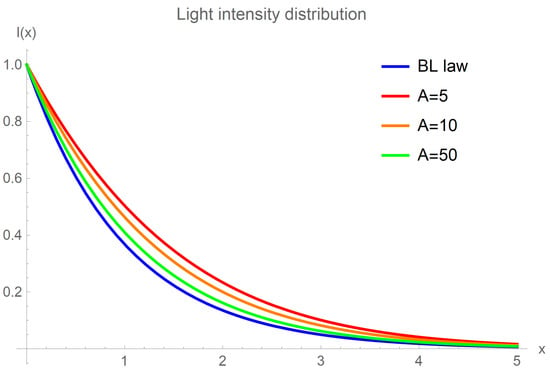
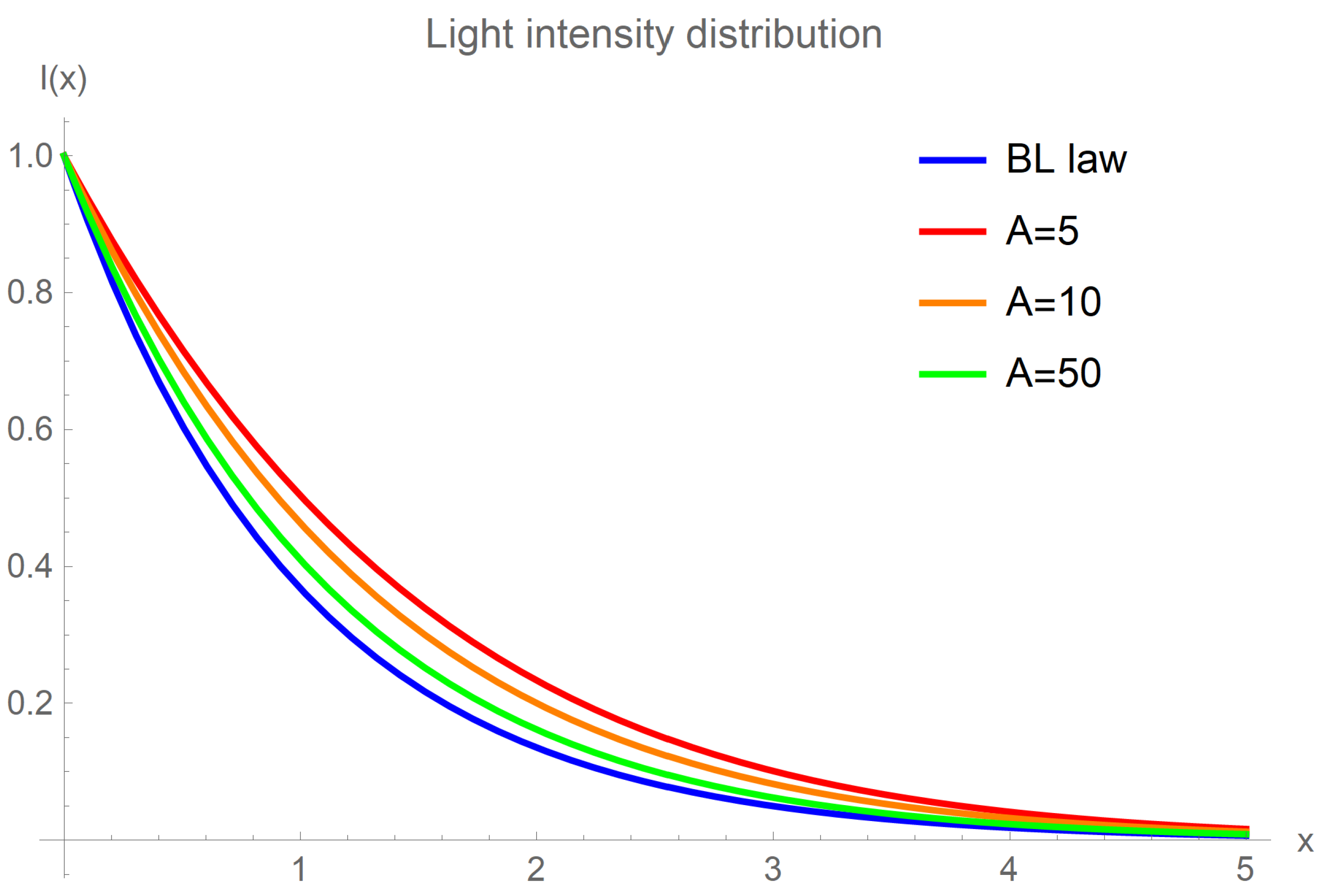
At the entrance of the light beam, and is only slightly less than 1; thus, the light intensity still exhibits a nearly exponential decay, albeit slightly slower. As the light penetrates deeper, I decreases and approaches 1, and the attenuation behavior of I reverts to the BL law. To examine this quantitatively using numerical methods, we set , and 50, respectively, calculated the steady-state light intensity distributions , and plotted them together with the exponential decay result given by BL law, as shown in Figure 1. It can be seen that the larger the value of A, the closer is to the exponential decay. Our model can naturally revert to the BL law, as expected.
Figure 1.
Steady-state light intensity distribution comparison of and BL law.
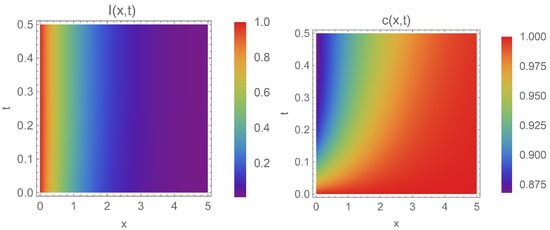
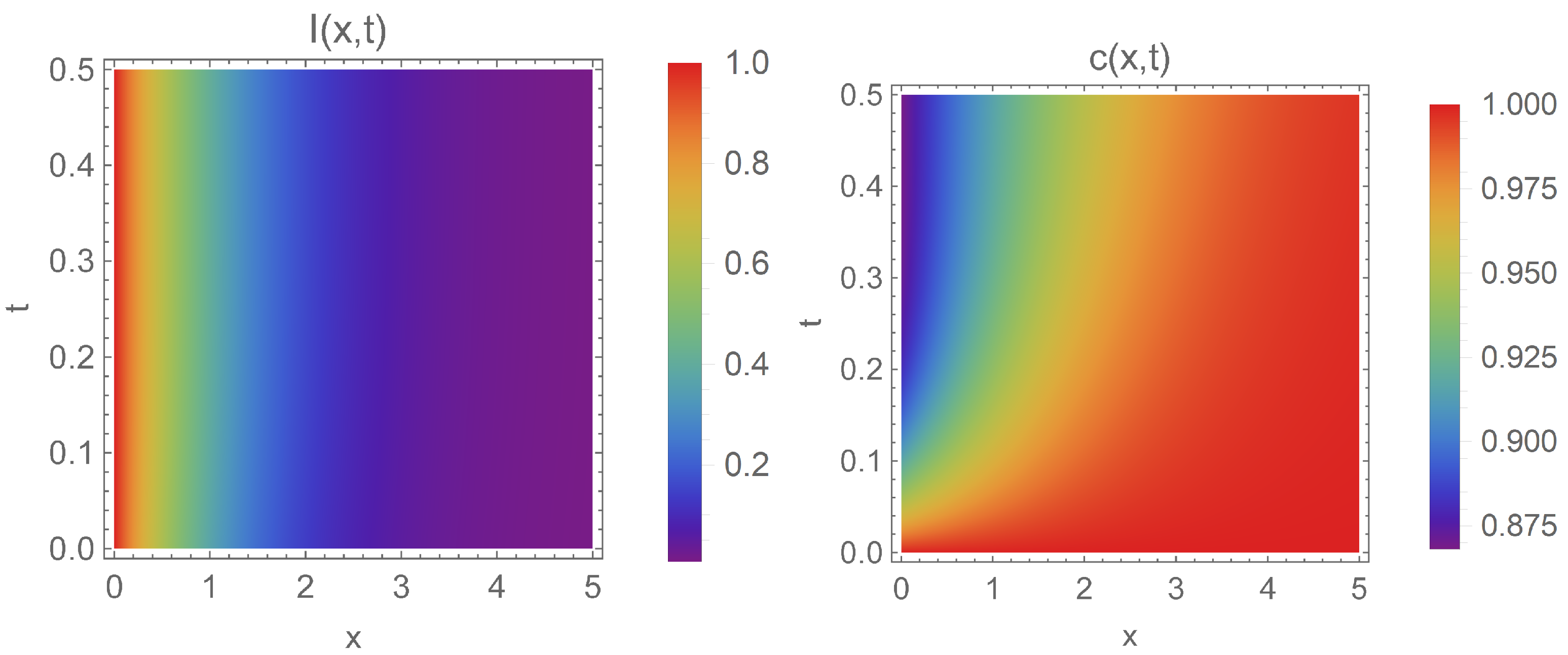
The spatiotemporal profiles of I and c under a typical weak-light limit, i.e., , are presented in Figure 2. It can be seen that the light penetrates only a thin layer of the medium, and the molecular concentration decreases slightly near the incident end.
Figure 2.
Spatiotemporal profiles of I (left) and c (right) under .
In the intense-light limit, taking , an approximation yields . Substituting into Equation (10), we get
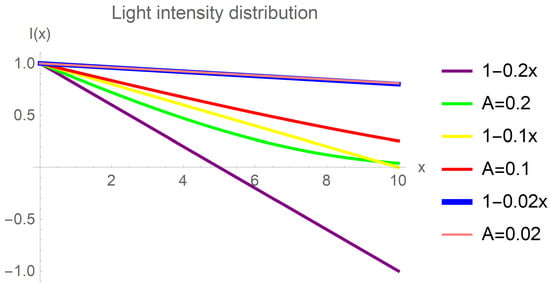
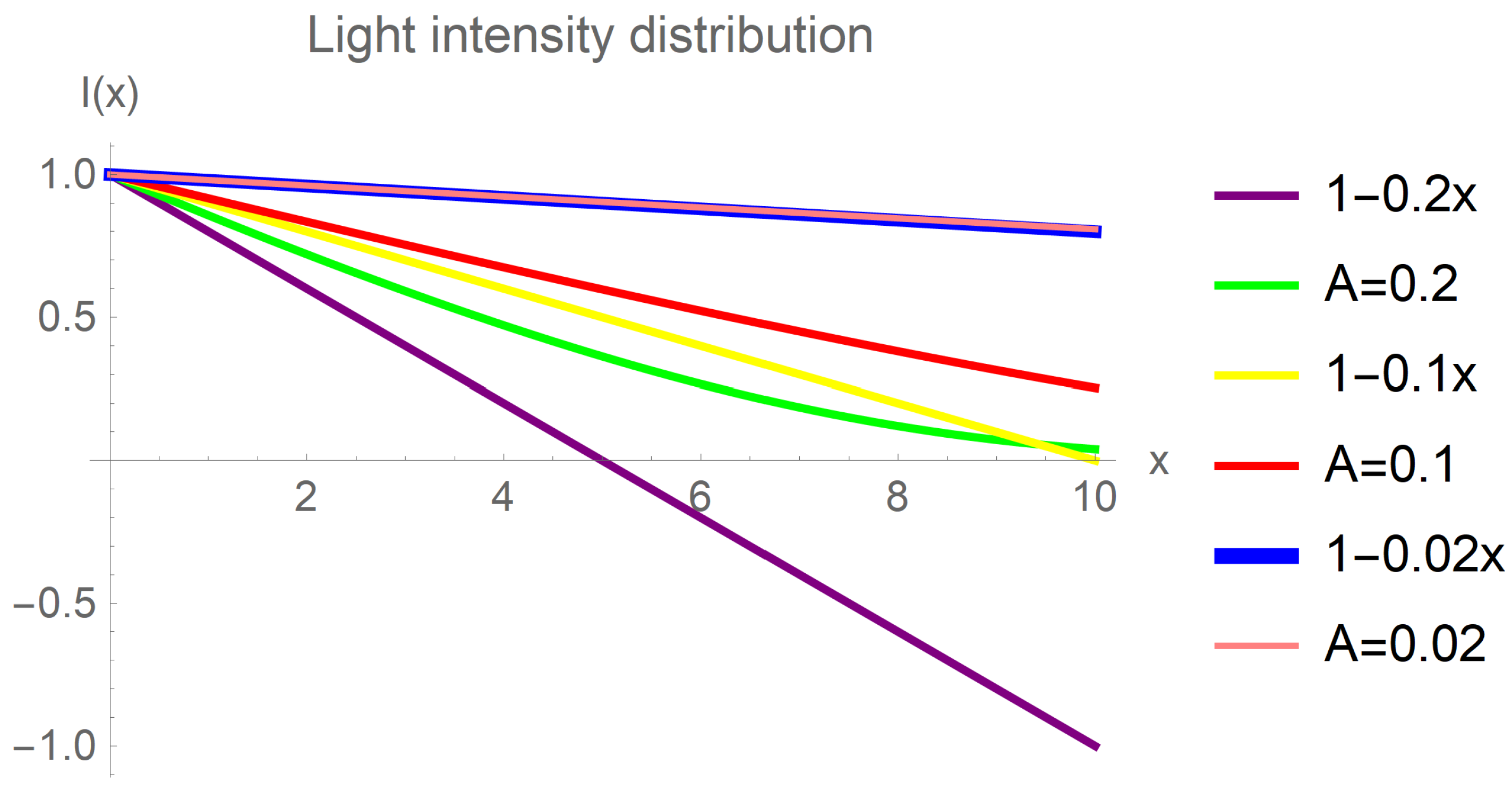
The steady-state light intensity changes from an exponential decay to a linear decay with a slope of , which differs markedly from the BL law. To investigate this quantitatively, we set , and . The s are plotted together with the corresponding linear decays with slope , as shown in Figure 3. It can be seen that the smaller the value of A, the closer is to a linear decay.
Figure 3.
Steady-state light intensity distribution comparison of and their corresponding linear decays.
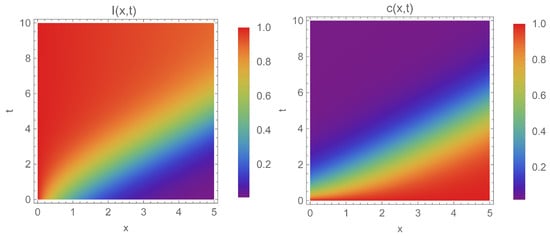
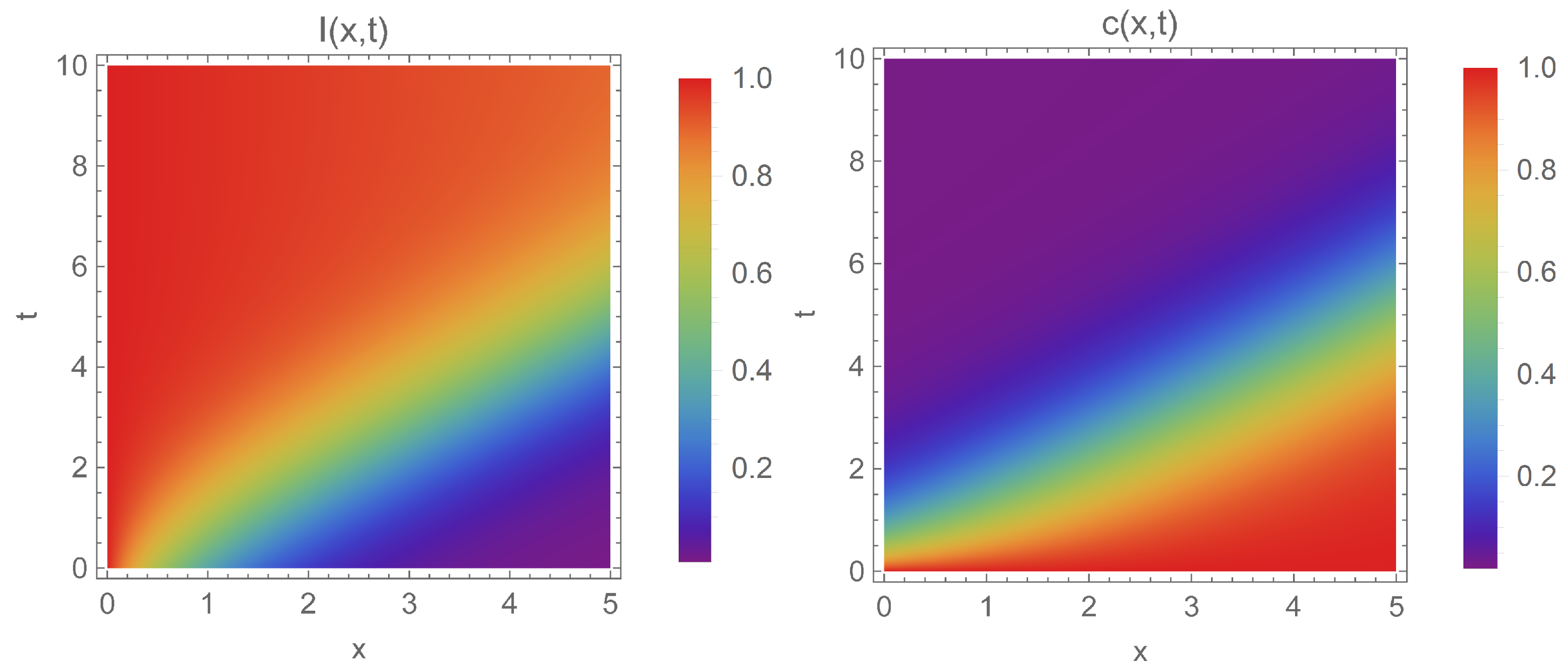
Similarly, the spatiotemporal profiles of I and c for are shown in Figure 4. The light is able to penetrate a thick layer of the medium, and the molecular concentration is suppressed to a low level. A pronounced “photoinduced transparency” phenomenon appears due to the linear attenuation.
Figure 4.
Spatiotemporal profiles of I (left) and c (right) under .
In our practical application of dynamic zooming, the typical light intensity of current large-scale lasers is approximately (for 1 J/cm2, 5 ns pulse, 527 nm laser beam), and the absorption cross-section of iodine molecules for 527 nm laser light is approximately [18]. Both the recombination rate constant and initial concentration are pressure-dependent, which is also the largest source of uncertainty in our experimental design. Assuming the iodine gas operates at one atm pressure, we find the recombination rate constant to be [16], and using the typical molecular concentration under this condition, i.e., , for calculation, substituting into Equation (9) yields the corresponding dimensionless recombination rate constant . This demonstrates that the recombination effect is negligible under these conditions. However, if the operating pressure is increased to 10 atm, both [16] and will increase by an order of magnitude simultaneously, and we obtain , making the recombination effect highly significant. The above calculations are all quite rough and do not even take temperature effects into account. Nevertheless, they are sufficient to show that under certain possible experimental conditions, the recombination effect is already an issue that we must take into consideration.
3. Nonlinear Transmission and Rate Constant Measurement
In experiments, it is far easier to vary the light intensity than to change the thickness of the medium. Define the transmittance of a specific thickness as
Then T in the BL law is a constant when is fixed. In the model of [3], T increases monotonically with time and eventually approaches unity for any . In the present model, the steady-state transmittance is no longer trivial. Instead, it is a function of the light intensity. Since the nondimensionalization procedure makes A dependent on , with
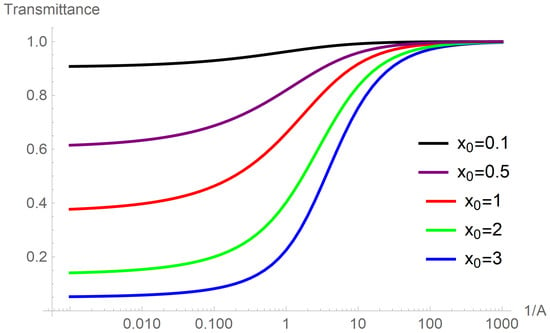
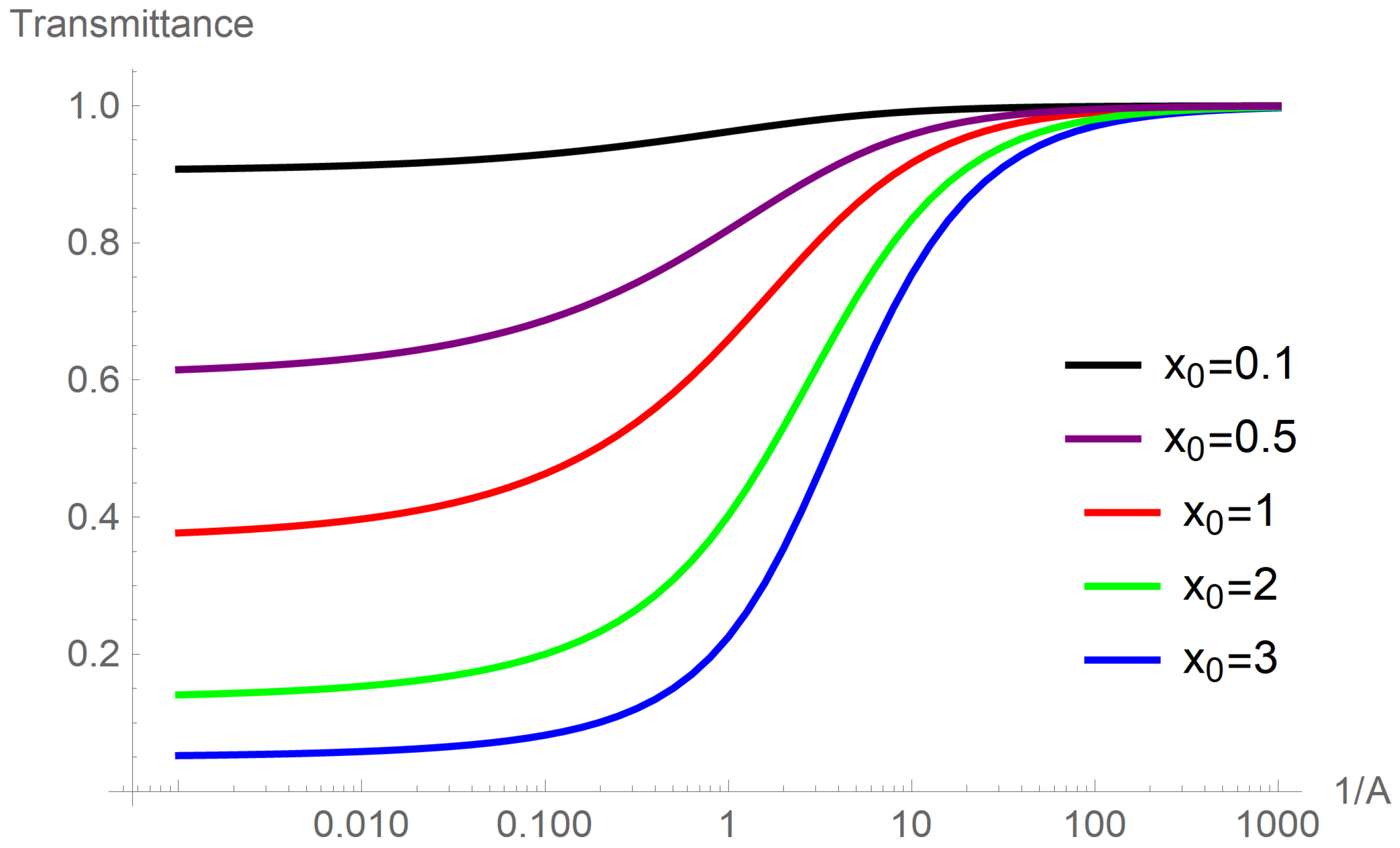
we plot the steady-state transmittance versus for points at various s on a logarithmic horizontal axis, as shown in Figure 5.
Figure 5.
Transmittance as a function of at different points.
Under weak light, T follows the BL law and remains nearly constant. As increases beyond a certain threshold, T rises rapidly and eventually stabilizes just below unity. The curves in the figure resemble a hyperbolic tangent function in shapes, but a satisfactory fit is not obtained.
This nonlinear transmission behavior provides us with a method for measuring the recombination rate constant . The conventional approach to measuring involves using a pulsed light source to instantaneously dissociate the molecules, followed by continuous recording of the temporal evolution of the atomic concentration, with subsequently extracted by curve fitting [16]. Such a measurement technique imposes stringent requirements on both the intensity of the light source and the temporal resolution of the detection equipment. Using the model developed in this paper, can be measured under steady-state conditions at relatively low light intensities. Parameters such as the medium thickness , concentration , and light intensity , are relatively easy to measure, and only the absorption cross-section carries a relatively large uncertainty. We first measure a transmittance under extremely weak light and substitute it into Equation (8) to obtain the absorption cross-section and the corresponding dimensionless thickness as
Then a curve for , similar to Figure 5, can be generated. is then increased until an observable change in transmittance occurs, at which point the new transmittance is recorded. By referring to the curve for , the corresponding dimensionless rate constant, denoted as , can be determined. Substituting into Equation (9) yields the rate constant as
This single-point measurement method is subject to relatively large errors especially when is not sufficiently high. To improve the measurement accuracy, the transmittance can be measured at multiple light intensities, and a more precise result can be obtained by curve fitting using the curve for .
4. Discussion
In this paper, building upon the earlier work of [3,4], we developed a more complete kinetic model, which can be used to calculate the dynamic evolution of the light intensity and molecular number density as functions of penetration depth under the combined effects of photo-dissociation and recombination. We discussed the different behaviors of the model in the steady state under the weak-light and intense-light limits and validated them using numerical solutions. The model in this paper is applicable over the entire light intensity range from the weak-light limit to the strong-light limit. In the strong-light limit, our model yields the same results as Parnis because the recombination term is negligible. Under weak-light conditions, however, Parnis’s model still describes a process in which the medium molecules are continuously consumed, whereas our model can reduce to the conventional BL theorem and yield a nontrivial steady-state result.
As an example of application, we show that under centain conditions of dynamic zooming experiments, the recombination term is indeed important. We also presented a method for measuring the recombination rate constant under steady-state conditions. This method imposes significantly lower demands on both the light intensity and the temporal resolution of the measurement equipment compared to conventional approaches.
In this paper, we have treated the molecular concentration as a local quantity and neglected the fluid transport processes such as diffusion and convection. This is justified because most of the photochemical processes are sufficiently fast. For weak light, even if the gas undergoes transport, I and c can rapidly reach a new steady state, as if transport had never occurred. For strong light, the laser pulse is typically of very short duration, and the molecules do not have time to migrate appreciably. Only under extreme conditions, such as strong light of very long duration and/or extremely dilute media, might the contribution of transport terms need to be considered.
Author Contributions
Resources and funding acquisition, J.W.; supervision, J.Z.; others, X.L. All authors have read and agreed to the published version of the manuscript.
Funding
This work was financially supported by the National Natural Science Foundation of China, NSFC Grant No. 62405297.
Data Availability Statement
All data is avaliable under resonable request.
Acknowledgments
During the preparation of this manuscript, the authors used [Deepseek, V2.4] for the purposes of translation, data collection and especially searching for similar dynamic models of the BL law. The authors have reviewed and edited the output and take full responsibility for the content of this publication.
Conflicts of Interest
The authors declare no conflicts of interest.
Abbreviations
The following abbreviations are used in this manuscript:
| BL | Beer–Lambert |
References
- Beer, A. Bestimmung der Absorption des rothen Lichts in farbien Flussigkeiten. Ann. Phys. 1852, 86, 74–88. [Google Scholar]
- Lambert, J.H. Photometria Sive de Mensure et Gradibus Luminis, Colorum et Umbrae; Klett: Augsberg, Germany, 1760. [Google Scholar]
- Parnis, J.M.; Oldham, K.B. Beyond the Beer–Lambert law: The dependence of absorbance on time in photochemistry. J. Photochem. Photobiol. A Chem. 2013, 267, 6–10. [Google Scholar] [CrossRef] [Scilit]
- Oldham, K.B.; Parnis, J.M. Shining light on Beer’s law. ChemTexts 2017, 3, 5. [Google Scholar] [CrossRef] [Scilit]
- Kitagawa, D.; Nakahama, T.; Nakai, Y.; Kobatake, S. 1,2-Diarylbenzene as fast T-type photochromic switch. J. Mater. Chem. C 2019, 7, 2865–2870. [Google Scholar] [CrossRef] [Scilit]
- Casasant, G.; Falcini, F.; Garra, R. Beer–Lambert law in photochemistry: A new approach. J. Photochem. Photobiol. A Chem. 2022, 432, 114086. [Google Scholar] [CrossRef] [Scilit]
- Mayerhofer, T.G.; Mutschke, H.; Popp, J. Employing Theories Far beyond Their Limits—The Case of the (Boguer-) Beer–Lambert Law. ChemPhysChem 2016, 17, 1948. [Google Scholar] [CrossRef] [Scilit] [PubMed]
- Casasanta, G.; Garra, R. Towards a Generalized Beer–Lambert Law. Fractal Fract. 2018, 2, 8. [Google Scholar] [CrossRef] [Scilit]
- Shaw, R.A.; Kostinski, A.B.; Lanterman, D.D. Super-exponential extinction of radiation in a negatively correlated random medium. J. Quant. Spectrosc. Radiat. Transf. 2002, 75, 13–20. [Google Scholar] [CrossRef] [Scilit]
- Westberg, J.; Avetisov, V.; Chen, Y.; Bjoroy, O.; Gerser, P. Sensing of molecular hydrogen using direct tunable diode laser absorption spectroscopy. Opt. Express 2025, 33, 11409. [Google Scholar] [CrossRef] [Scilit] [PubMed]
- Qiu, X.; Xiong, X.; Li, L.; Guo, G.; Gong, T.; Guo, S.; Shang, Z.; Sun, X.; Tian, Y.; Xie, G.; et al. Development of an FDM-TDLAS sensor for long-term online monitoring of H2S and CO to predict water wall corrosion trends. Anal. Chem. 2025, 97, 14058–14066. [Google Scholar] [CrossRef] [Scilit] [PubMed]
- Huang, Y.; He, Y.; Qiao, S.; Sun, H.; Ma, Y. Intelligent algorithm-assisted indirect absorption spectroscopy for trace gas sensing. Sensors 2026, 26, 4054. [Google Scholar] [CrossRef] [Scilit] [PubMed]
- Qiao, S.; Lv, Z.; Liu, B.; Ma, H.; He, Y.; Sun, H.; Ma, Y. Asymmetric tongs induced frequency splitting achieving simultaneous two-component gas sensing with a single quartz tuning fork in two independent resonant modes. ACS Sens. 2026, 11, 7104–7114. [Google Scholar] [CrossRef] [Scilit] [PubMed]
- Huang, X.; Hu, D.; Zhou, W.; Dai, W.; Deng, X.; Yuan, Q.; Zhu, Q.; Jing, F. Optical zooming based on focusing grating in direct drive ICF. Opt. Express 2016, 24, 22053. [Google Scholar] [CrossRef] [Scilit] [PubMed]
- Temporal, M.; Piriz, A.R.; Canaud, B.; Ramis, R.; Craxton, R.S. Partition of Omega-like facility into two configurations of 24 and 36 laser beams to improve implosion performance. Sci. Rep. 2023, 13, 10010. [Google Scholar] [CrossRef] [Scilit] [PubMed]
- Hippler, H.; Luther, K.; Troe, J. Recombination of iodine atoms in gases at high pressures. Chem. Phys. Lett. 1972, 16, 174–176. [Google Scholar] [CrossRef] [Scilit]
- Laurence, G.S. Thermal and Photochemical Exchange of Iodine with Trifluoro-methyl Iodide. Trans. Faraday Soc. 1967, 63, 1155–1165. [Google Scholar] [CrossRef] [Scilit]
- Saiz-Lopez, A.; Saunders, R.W.; Joseph, D.M.; Ashworth, S.H.; Plane, J.M.C. Absolute absorption cross-section and photolysis rate of I2. Atmos. Chem. Phys. 2004, 4, 1443–1450. [Google Scholar] [CrossRef] [Scilit]
Disclaimer/Publisher’s Note: The statements, opinions and data contained in all publications are solely those of the individual author(s) and contributor(s) and not of MDPI and/or the editor(s). MDPI and/or the editor(s) disclaim responsibility for any injury to people or property resulting from any ideas, methods, instructions or products referred to in the content. |
© 2026 by the authors. Licensee MDPI, Basel, Switzerland. This article is an open access article distributed under the terms and conditions of the Creative Commons Attribution (CC BY) license.